The Complete Guide to AI Search Visibility Tools for B2B Brands and Agencies
Learn about AI search visibility tools to enhance your brand's presence in AI-generated answers.
By WREMF Team · 2026-09-19
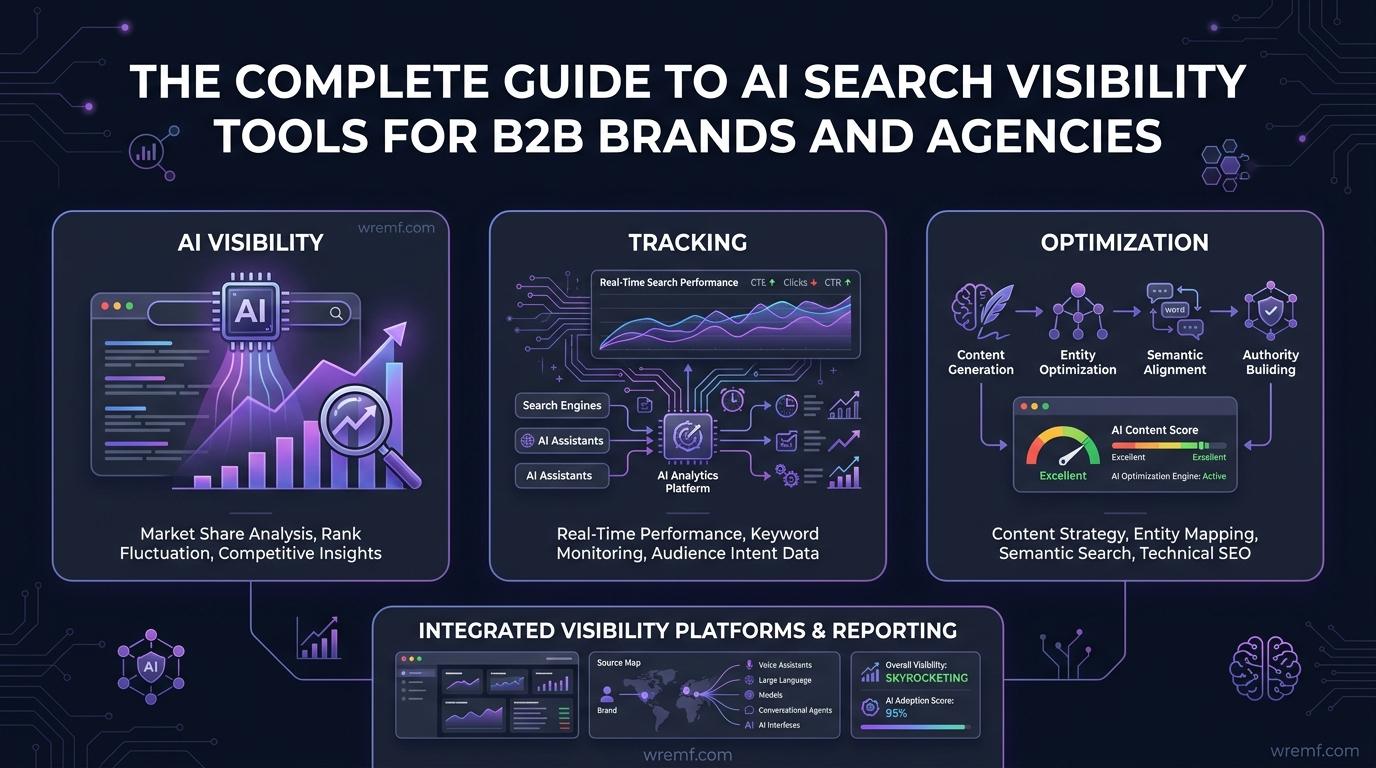
AI search visibility tools track how often, where, and how favorably a brand appears in AI-generated answers across platforms like ChatGPT, Gemini, and Google AI Overviews. They analyze citation frequency, brand mentions, AI share of voice, and source links, which traditional SEO tools cannot measure. Tracking these metrics helps identify visibility gaps and content improvements, ensuring brands are cited positively in AI platforms that potential buyers use before making purchasing decisions. This data serves to connect AI presence to traffic and business outcomes.
Key takeaways
- AI search visibility tools measure presence across multiple AI engines, beyond traditional SEO rankings.
- Core capabilities include prompt tracking, citation frequency monitoring, and AI share of voice analysis.
- Even a top organic position doesn't ensure AI visibility; brands may be absent from AI answers.
- Tools vary in LLM coverage, prompt discovery methods, and analytics platform integration.
- Choosing between software, managed service, and hybrid models depends on team resources and goals.
The Complete Guide to AI Search Visibility Tools for B2B Brands and Agencies
AI search visibility tools are platforms that track how brands appear across AI-generated answers, citations, and recommendations in ChatGPT, Gemini, Perplexity, Claude, Google AI Overviews, Copilot, and other AI engines. As AI-powered discovery reshapes how buyers research and shortlist vendors, measuring brand presence in AI answers has become as important as tracking keyword rankings. This guide is for B2B SaaS teams, in-house SEO teams, marketing agencies, and consultants who need to understand, compare, and select the right tools for AI search visibility. It covers how these tools work, what separates strong platforms from weak ones, how to evaluate the major options including WREMF, Profound, OtterlyAI, SE Ranking, Semrush, and Ahrefs, and how to choose the right model for your team's resources and goals.
QUICK ANSWER:
AI search visibility tools track how brands are mentioned, cited, compared, and recommended across AI-generated answers in platforms such as ChatGPT, Gemini, Perplexity, Claude, Google AI Overviews, and Copilot. They measure prompt-level citation data, AI share of voice, competitor visibility, and source consistency. Teams use these tools to identify visibility gaps, improve content for generative search, and connect AI discovery to traffic and business outcomes.
KEY TAKEAWAYS:
- AI search visibility tools measure brand presence in AI-generated answers across multiple AI engines, not just Google Search rankings.
- Core capabilities include prompt tracking, citation frequency monitoring, competitor visibility comparison, AI share of voice, and source consistency analysis.
- Rankings alone do not confirm AI visibility. A brand can hold a top organic position and still be absent from AI answers.
- Tools differ significantly in LLM coverage, prompt discovery methods, reporting depth, accuracy detection, and integration with analytics platforms such as Google Analytics 4.
- WREMF tracks AI visibility across 10 engines with unlimited prompts, BYOK support, GEO audits, AEO content briefs, and managed execution options starting at €59 per month.
- Choosing between software, a managed service, and a hybrid model depends on team size, internal execution capacity, and program maturity.
What AI Search Visibility Tools Actually Measure
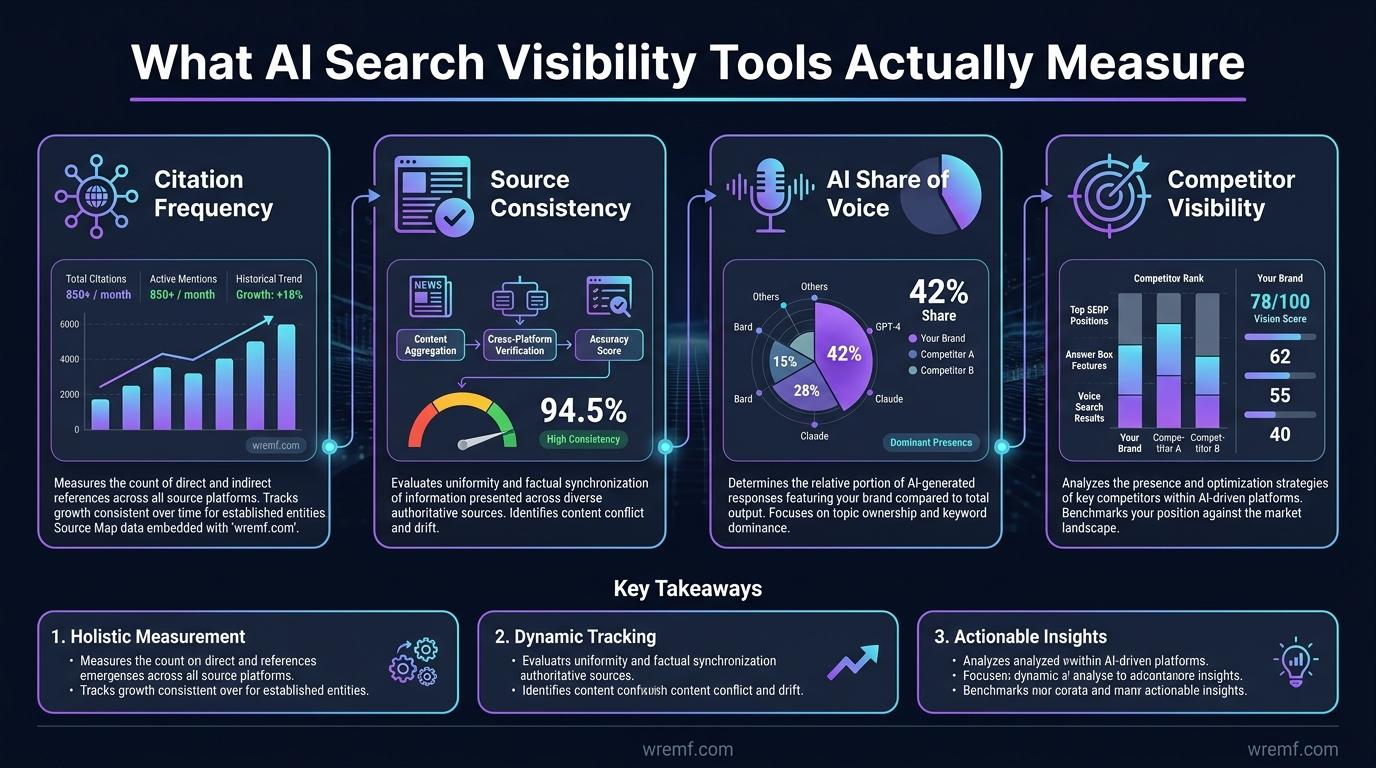
AI search visibility tools measure how often, where, and how favourably a brand appears in AI-generated answers across major LLM platforms and answer engines. The core measurement differs meaningfully from traditional SEO tracking.
Traditional SEO tools such as Semrush and Ahrefs measure keyword rankings, backlink profiles, organic traffic, and SERP positions. These signals remain valuable for understanding Google Search performance, but they do not reveal whether a brand is present in the AI answers that increasingly shape buyer journeys before a click ever reaches a website.
AI search visibility tools are built for a different measurement model. They submit prompts to AI engines, collect the responses, and analyse which brands are mentioned, cited, compared, or recommended. The output is a map of brand presence across prompt categories, AI platforms, and competitor domains.
The specific signals these tools track include citation frequency, which measures how often a brand is named as a source or recommendation. They also track brand mentions, which captures how often a brand appears in AI responses even without a direct citation link. Source links indicate which pages AI engines pull from when generating answers. AI share of voice compares brand presence against competitor domains across the same prompt set. Visibility gaps identify prompts and topics where a brand is absent but competitors appear.
Beyond raw tracking, stronger platforms connect these signals to content strategy. They identify which source pages are driving citations, which competitor domains AI engines prefer, and where content gaps exist that are suppressing brand visibility in AI-generated answers.
AI visibility data is inherently dynamic. AI answers vary by engine, prompt phrasing, location, and retrieval window. A single prompt run once is not a reliable measurement baseline. Effective tools run prompts at scheduled intervals, track changes over time, and report on visibility trends rather than point-in-time snapshots.
For B2B teams using generative search as a discovery channel, the practical question is not just whether the brand ranks in Google. The question is whether AI engines mention, cite, compare, and recommend the brand when buyers ask the questions that precede a purchase decision. AI search visibility tools are the measurement layer that answers that question, as explained in depth in the AI search engine optimization guide
KEY TAKEAWAY: AI search visibility tools measure brand presence in AI-generated answers through prompt tracking, citation frequency, source analysis, and AI share of voice, filling a measurement gap that traditional SEO tools were not designed to address.
Why AI Search Visibility Has Become a Measurable Marketing Channel
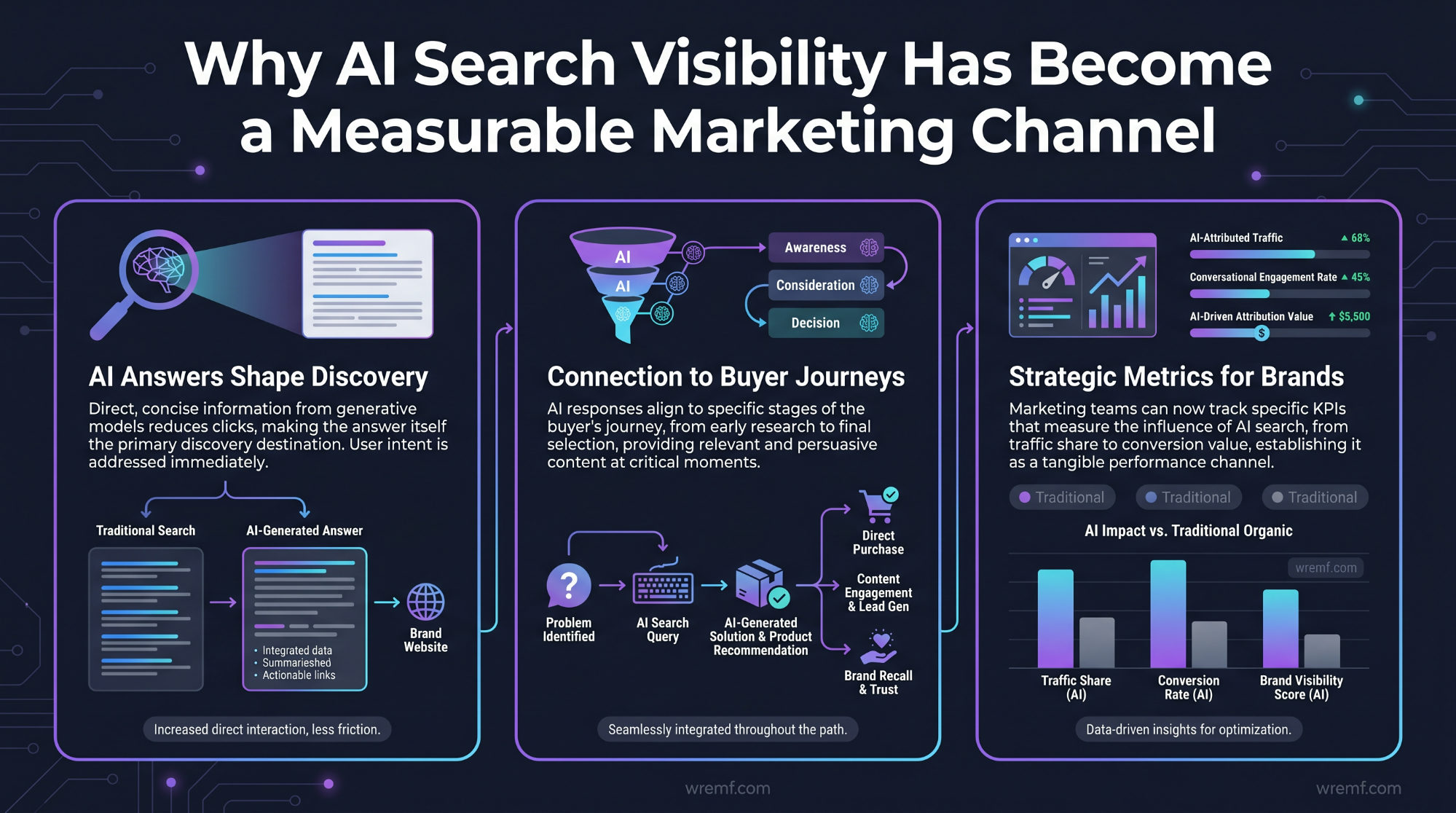
AI answers now shape discovery before a click ever reaches a website. Buyers use ChatGPT, Perplexity, Gemini, and Google AI Overviews to research categories, compare vendors, and shortlist solutions. If a brand is absent from those answers, it is absent from a growing share of the buying journey.
This shift has created a new category of measurement need. Search engines have traditionally served as the primary discovery layer, with organic rankings determining visibility. AI engines operate differently. They synthesise information from multiple sources, generate natural language answers, and present recommendations without requiring the user to evaluate individual search results. Brand presence in that synthesis depends on source authority, citation consistency, entity recognition, and content structure, not just domain authority and keyword targeting.
According to McKinsey's AI insights AI adoption in business contexts has accelerated rapidly, and organisations are increasingly relying on AI-generated summaries and recommendations as part of research and procurement workflows. For B2B brands, this means that AI-generated answers are part of the buyer's information environment long before a sales conversation begins.
The measurement challenge is real. Unlike keyword rankings, which are indexed and relatively stable, AI responses are generated dynamically. They change based on prompt phrasing, retrieval context, engine version, and available sources. A brand can rank on page one of Google and still be completely absent from the AI answers buyers read on the same topic.
This is why AI search visibility tools exist as a distinct category. They provide the structured, repeatable measurement framework that teams need to understand whether their brand is present in generative search, which AI platforms are citing them, which competitors are winning AI share of voice, and what content and authority signals need to improve.
For agencies and enterprise teams, this data also supports client reporting, pitch environments, and board-level visibility discussions. AI visibility data gives marketing leaders a quantified view of brand presence in the channels buyers are using, connected to business outcomes through GA4 attribution and AI referral traffic analysis.
DID YOU KNOW:
Gartner AI research highlights that enterprises are actively developing AI search and answer strategies as part of broader digital discovery programs, signalling that AI visibility measurement is moving from early adopter territory into standard marketing practice.
KEY TAKEAWAY: AI search visibility has become a measurable marketing channel because buyers increasingly use AI engines to research and shortlist vendors, making brand presence in AI-generated answers a strategic metric rather than an experimental one.
The Core Capabilities to Evaluate in Any AI Search Visibility Tool
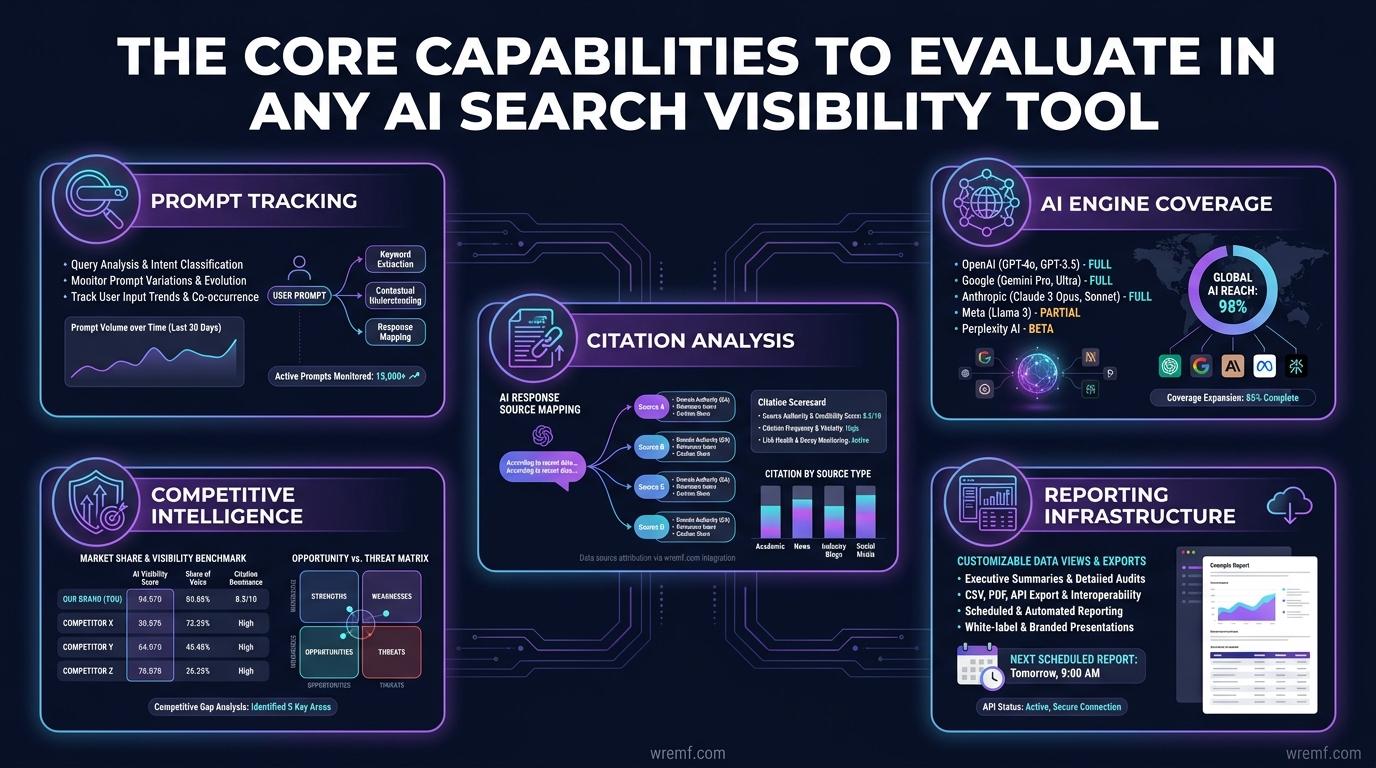
The strongest AI search visibility tools share a consistent set of capabilities, but the depth and quality of each capability varies significantly across platforms. Understanding what to evaluate before selecting a tool prevents investment in platforms that only partially address the measurement problem.
Prompt Tracking and Prompt Intelligence
Prompt tracking is the foundation of AI search visibility measurement. A tool should allow teams to define the prompts that reflect real buyer journeys, not just branded queries, and run those prompts across multiple AI engines at scheduled intervals.
Prompt intelligence goes further. It identifies which prompts are driving citations, which prompt categories show the largest visibility gaps, and how prompt performance changes over time. Platforms that only support manual prompt entry without scheduling, categorisation, or discovery capabilities limit the scalability of visibility tracking as the prompt set grows.
WREMF includes unlimited prompt tracking on every plan with BYOK support, which means teams are not charged per prompt run and can maintain comprehensive prompt coverage without escalating costs.
LLM and AI Engine Coverage
Coverage matters because AI engines do not produce consistent answers. A brand may be well-cited in Perplexity and absent in Gemini. Copilot may pull different sources than Claude. Google AI Overviews applies a different retrieval logic than ChatGPT. Tools that only cover two or three engines give an incomplete picture of AI visibility.
WREMF tracks visibility across 10 AI engines including ChatGPT, Claude, Gemini, Perplexity, Copilot, Google AI Overviews, Google AI Mode, DeepSeek, Grok, Meta AI, and Mistral. Broader coverage produces more actionable AI visibility data because it identifies engine-specific gaps and source preferences.
Citation Frequency and Source Link Analysis
Citation tracking measures how often a brand is named in AI answers and which pages are driving those citations. Source link analysis identifies the specific URLs that AI engines retrieve and cite. Together, these signals tell teams which content is performing as a citation source and which pages need optimisation or consolidation.
This is meaningfully different from backlink analysis. A page with strong external link equity may still fail to attract AI citations if its content structure, entity clarity, or topical authority signals are insufficient for AI retrieval systems.
Competitor Visibility and AI Share of Voice
Competitive intelligence in AI search requires tracking which competitor domains appear in the same prompts as your brand, how often they are cited versus your brand, and which prompt categories they dominate. AI share of voice expresses this as a proportional metric, showing relative brand presence across a defined prompt set.
Profound and Peec AI both offer competitive benchmarking features, and Peec in particular has built its reputation on side-by-side competitor visibility comparison for agencies. SE Ranking integrates competitive AI visibility data alongside organic search data within a unified dashboard.
GEO and AEO Capabilities
Generative Engine Optimization and Answer Engine Optimization go beyond tracking. They require content strategy, entity optimisation, structured data improvement, and source authority building. The best AI search visibility platforms do not stop at reporting. They surface content gaps, generate AI-ready content briefs, support technical optimisation, and connect visibility data to execution workflows.
Reporting, Attribution, and Integration
For teams reporting to leadership or managing client workspaces, reporting infrastructure matters. White-label reports, Looker Studio connectors, Google Analytics 4 attribution, and API access determine how visibility data flows into existing workflows and decision systems.
The complete picture of what to evaluate is covered in the AI search engine optimization tools guide
KEY TAKEAWAY: Evaluate AI search visibility tools across six dimensions: prompt tracking depth, AI engine coverage, citation and source analysis, competitive intelligence, GEO and AEO execution support, and reporting and attribution capabilities.
Comparing the Leading AI Search Visibility Tools
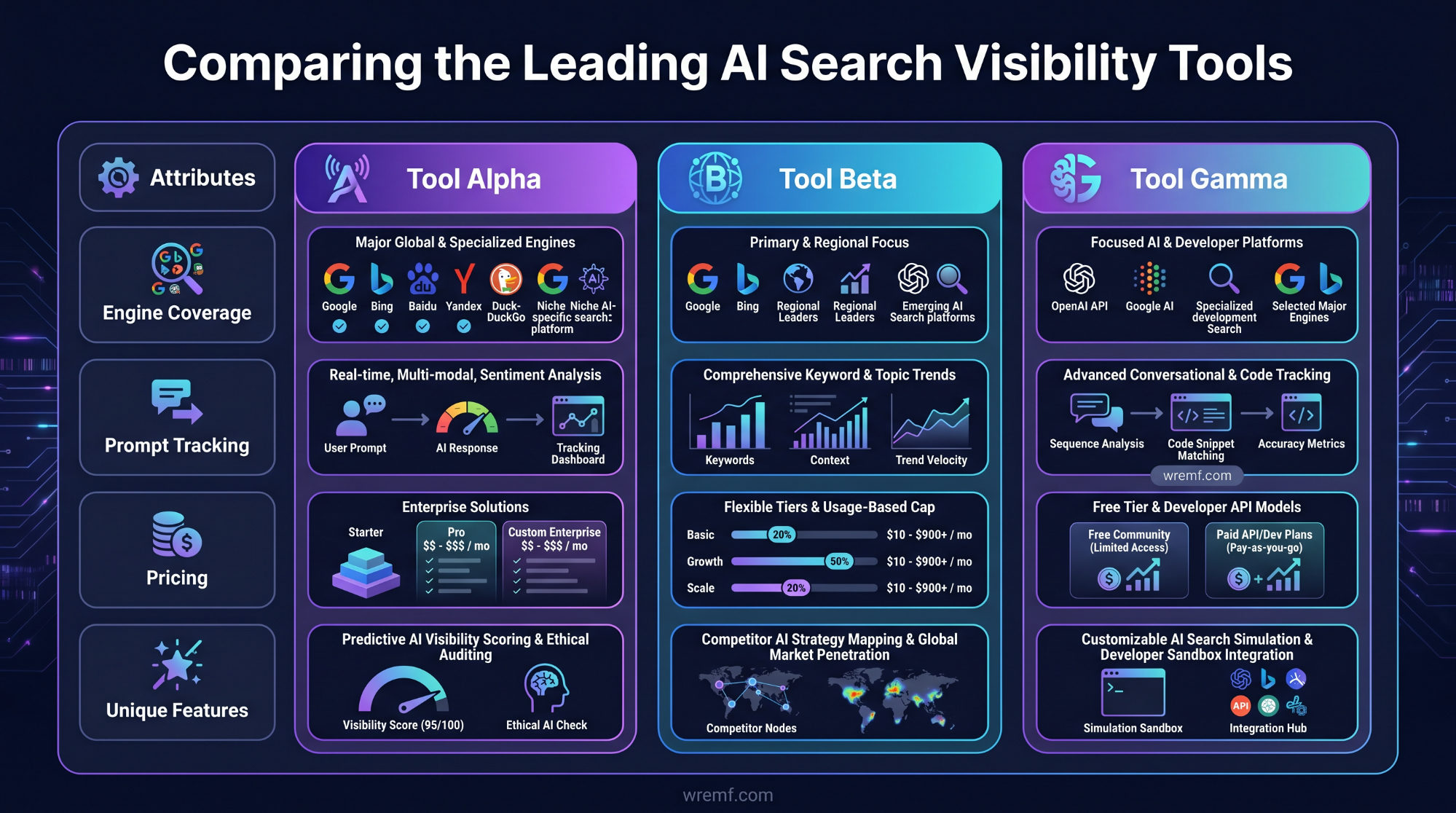
The AI search visibility tools market includes a range of platforms serving different team types, budgets, and use cases. The following comparison covers the most prominent options available, their core strengths, limitations, and best-fit scenarios.
WREMF
WREMF is an AI visibility platform and managed service built specifically for tracking how brands appear across 10 AI engines. It covers ChatGPT, Claude, Gemini, Perplexity, Copilot, Google AI Overviews, Google AI Mode, DeepSeek, Grok, Meta AI, and Mistral.
Core strength is broad engine coverage combined with unlimited prompt tracking, BYOK on every plan, GEO audits, AEO content optimisation, AI share of voice, source citation tracking, and white-label reporting. WREMF also offers managed execution, which means teams can choose to have WREMF run the entire AI visibility program including audit, content, citation cleanup, and reporting rather than using only the software.
Pricing starts at €59 per month for the Starter plan, which covers one website, up to three competitors, and includes core prompt intelligence, source citation tracking, the AI Visibility Index, and monthly reporting. The Growth plan at €149 per month adds five websites, ten to fifteen competitors, advanced citation tracking, AI share of voice, GEO audits, a content brief generator, SEO testing, GA4 attribution, white-label reports, and a Looker Studio connector. Managed execution starts from €1,500 per month for teams that need strategy, senior-led implementation, and ongoing optimisation.
Teams can compare WREMF pricing plans to understand which plan fits their current stage.
Profound
Profound is positioned as an enterprise-grade AI monitoring tool designed for large teams and Fortune 500 brands. It offers deep analysis and reporting, handles complex brand monitoring needs, and integrates with enterprise workflows. Profound is typically used by large organisations with dedicated AI visibility programs and custom requirements. Pricing is not publicly listed, which means it is better suited to teams with budget for enterprise contracts rather than those needing pricing transparency upfront.
OtterlyAI
OtterlyAI focuses on brand mention monitoring and citation tracking across AI search engines. It is often the first tracking software smaller teams try because of its affordability and straightforward setup. It is best suited to small teams, solo consultants, and founders who need basic AI visibility tracking. LLM coverage includes ChatGPT, Perplexity, and Google Gemini on its entry tier. Pricing ranges from $29 per month for a limited starter option to $489 per month for full coverage.
The limitations of OtterlyAI relative to more comprehensive platforms include limited engine coverage on lower plans, no accuracy or hallucination detection, and simpler competitive intelligence compared to dedicated competitive benchmarking tools.
SE Ranking
SE Ranking integrates AI search visibility tracking into a broader SEO platform that includes organic search, keyword tracking, and Google Analytics 4 integration. Its core strength is combining traditional SEO data with AI visibility data in a single dashboard, making it practical for SEO teams that need both signals in one environment.
LLM coverage includes Google AI Overviews, Google AI Mode, Gemini, ChatGPT, and Perplexity. Pricing runs from approximately $129 to $279 per month. SE Ranking is positioned as the best fit for mid-market SEO teams and medium-sized agencies that want side-by-side SEO and GEO tracking without moving to a dedicated AI visibility platform.
Semrush AI Search Toolkit
Semrush has added AI visibility capabilities through its AI Search Toolkit for users already operating within the Semrush ecosystem. It covers citation data and visibility tracking across major AI engines. The practical advantage is that teams already paying for Semrush can extend into AI search visibility without adopting a separate platform. The limitation is that it is designed as an extension of an SEO platform rather than a purpose-built AI visibility solution, which means the depth of prompt tracking, citation analysis, and GEO execution support is less developed than dedicated tools.
Ahrefs
Ahrefs has introduced prompt-based tracking features for benchmarking brand performance in AI search. It is best suited to teams already deep in the Ahrefs ecosystem who want to layer AI visibility data into existing workflows. Like Semrush, its AI visibility capabilities are additions to a fundamentally keyword and backlink-oriented platform.
Peec AI
Peec AI is built for competitive benchmarking in AI search, making it popular with agencies managing AI visibility for multiple clients. It offers side-by-side competitor visibility comparison, professional client-facing reports, and multi-client dashboard support. Pricing ranges from €89 to €499 per month with a card-required 14-day trial. Its setup is more complex than simpler tools and it works best for established brands rather than new companies with limited existing AI visibility.
ZipTie
ZipTie is noted for its ability to capture exact AI Overview text, screenshots, and competitor share-of-voice data, with query generation from Google Search Console. It is strongest for teams focused specifically on Google AI Overviews monitoring and AI Mode tracking. Coverage beyond Google AI is more limited.
The following comparison summarises key dimensions across these platforms.
Primary focus
- WREMF: Full AI visibility platform with managed execution option
- Profound: Enterprise AI monitoring and reporting
- OtterlyAI: Basic brand mention and citation tracking
- SE Ranking: SEO plus AI visibility in one dashboard
- Semrush: AI search visibility as an add-on to existing SEO suite
- Ahrefs: AI visibility benchmarking within SEO platform
- Peec AI: Competitive benchmarking for agencies
- ZipTie: Google AI Overviews capture and competitor share of voice
AI engine coverage
- WREMF: 10 engines including ChatGPT, Claude, Gemini, Perplexity, Copilot, Google AI Overviews, Google AI Mode, DeepSeek, Grok, Meta AI, Mistral
- Profound: Enterprise custom coverage
- OtterlyAI: ChatGPT, Perplexity, Gemini
- SE Ranking: Google AI Overviews, Google AI Mode, Gemini, ChatGPT, Perplexity
- Semrush: Major AI engines via toolkit
- Ahrefs: Prompt-based tracking, coverage expanding
- Peec AI: ChatGPT, Perplexity, Claude, Gemini, Copilot
- ZipTie: Google AI Overviews, AI Mode focused
Managed execution option
- WREMF: Yes, from €1,500 per month
- Profound: Enterprise services available
- OtterlyAI: No
- SE Ranking: No
- Semrush: No
- Ahrefs: No
- Peec AI: No
- ZipTie: No
Pricing transparency
- WREMF: Public pricing from €59 per month
- Profound: Contact sales
- OtterlyAI: Public pricing from $29 per month
- SE Ranking: Public pricing from $129 per month
- Semrush: Public pricing as add-on to existing plans
- Ahrefs: Public pricing as add-on to existing plans
- Peec AI: Public pricing from €89 per month
- ZipTie: Varies
For a detailed review of tools in this category, the best AI search optimization tools guide offers further comparison context.
KEY TAKEAWAY: The AI search visibility tools market spans from affordable basic trackers to enterprise platforms, with meaningful differences in engine coverage, prompt tracking depth, competitive intelligence, and managed execution support.
How to Use AI Search Visibility Tools: A Practical Workflow
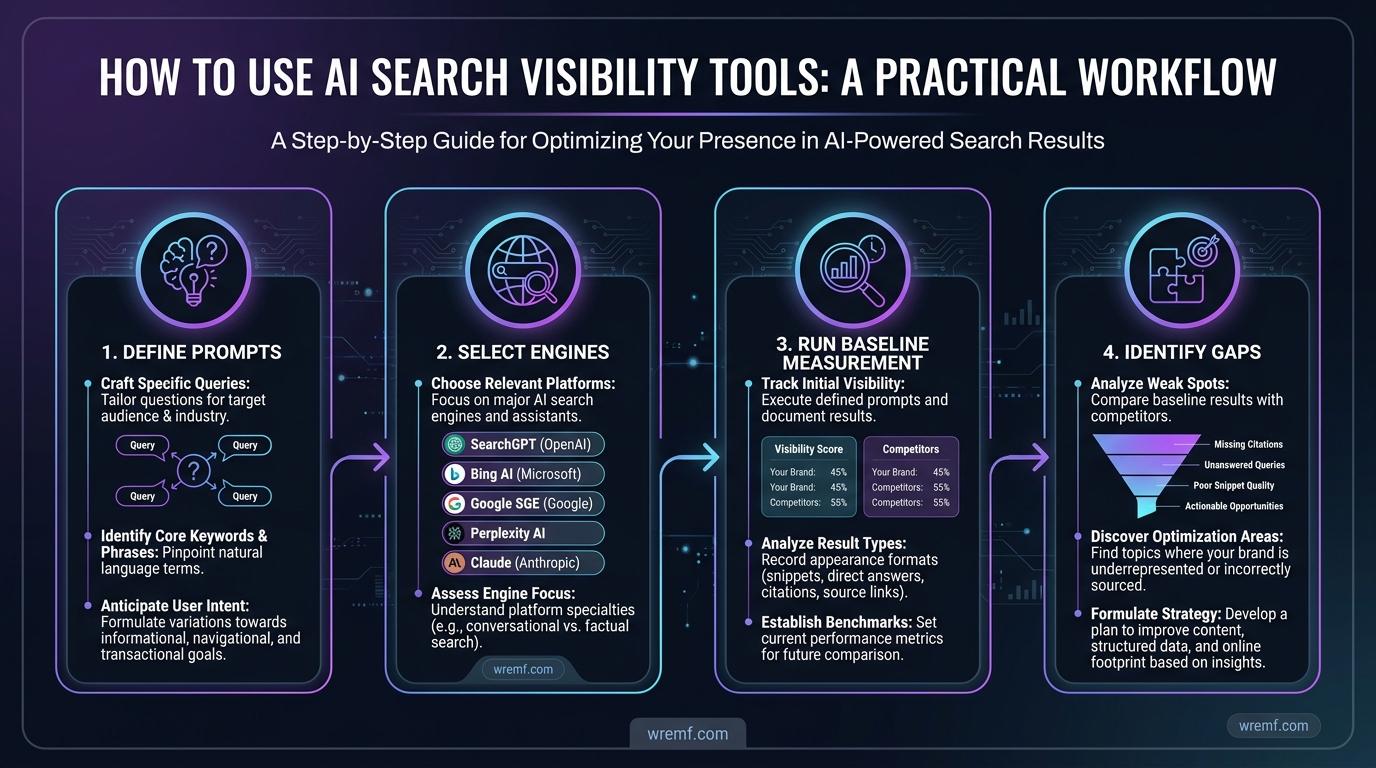
A structured approach to AI search visibility tracking produces more useful data than running occasional ad hoc prompts. The following workflow applies to teams at any stage, from solo founders using a Starter plan to enterprise teams running managed programs.
Step 1: Define your prompt set
Begin by mapping the prompts that reflect your buyers' actual research behaviour. Include prompts across five categories: brand awareness queries that name your company, competitive comparison queries that ask AI engines to compare vendors in your category, buyer intent queries that describe a problem your product solves, solution-seeking queries that ask which tools or services are recommended, and feature-specific queries that name capabilities or use cases. Aim for 20 to 50 prompts as a starting point, weighted toward competitive and buyer intent categories where AI visibility has the highest commercial impact.
Step 2: Select your AI engines for tracking
Choose the AI engines most relevant to your buyers. For most B2B teams, the priority engines are ChatGPT, Perplexity, Gemini, Claude, and Google AI Overviews. Teams selling into enterprise or technical markets should also track Copilot and DeepSeek. Track all available engines where possible to identify engine-specific visibility gaps and source preferences. WREMF covers 10 engines by default, which removes the need to choose a limited subset.
Step 3: Run your baseline measurement
Submit your prompt set across your selected AI engines and collect baseline data on brand mentions, citations, source links, and AI share of voice. Record which competitors appear in the same answers and how frequently. This baseline establishes the starting point for all future comparisons and trend analysis.
Step 4: Identify visibility gaps and competitor domains
Analyse the results to identify the specific prompts and topic areas where your brand is absent. Note which competitor domains are being cited in your place. Map the source pages those competitors are using to generate citations. This produces a prioritised list of content and authority gaps.
Step 5: Audit your content and source signals
Review the pages on your website that should be generating citations for each gap area. Evaluate their content structure, entity clarity, topical depth, internal linking, and structured data. For teams using WREMF Growth or Managed, the GEO audit and content brief generator systematically identify which pages need optimisation and what changes to make.
Step 6: Execute content and citation improvements
Implement the required content improvements, entity optimisation, and source authority changes. For technical SEO teams, this includes structured data, content structure, and link equity work. For content teams, this means producing AI-ready content briefs that address the specific prompts where visibility gaps exist. For managed service clients, WREMF handles this end to end.
Step 7: Schedule ongoing monitoring and track changes
Set your prompt tracking to run at scheduled intervals, at minimum weekly. Monitor how brand mentions, citations, and AI share of voice change over time as improvements take effect. Connect AI referral traffic data from Google Analytics 4 to track whether improved AI visibility translates into measurable website traffic from AI engines.
Step 8: Report and iterate
Generate regular visibility reports for internal stakeholders, agency clients, or leadership teams. WREMF Growth and Managed plans include white-label reports, Looker Studio connectors, and monthly reporting. Use each reporting cycle to refine the prompt set, update competitor tracking, and prioritise the next round of content and citation work.
The complete methodology behind this process is explained in the generative AI optimization services guide
KEY TAKEAWAY: Effective use of AI search visibility tools follows a repeatable eight-step workflow: define prompts, select engines, establish a baseline, identify gaps, audit content, execute improvements, monitor changes, and report and iterate.
Real-World Use Cases for AI Search Visibility Tools
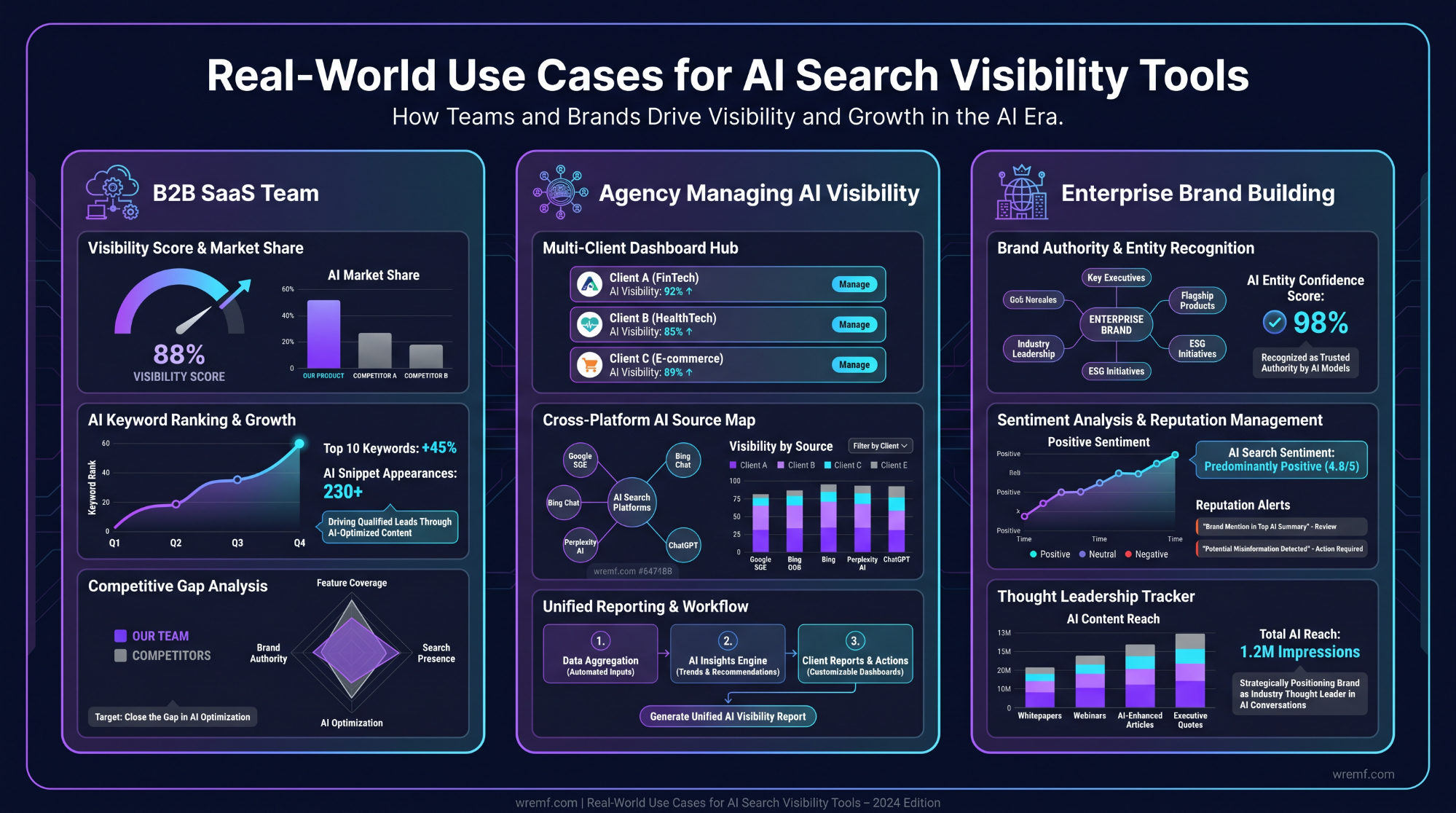
Understanding how different teams use AI search visibility tools in practice helps clarify which platform model and plan level fits a given situation. The following scenarios reflect realistic applications without overstating outcomes.
B2B SaaS Team Investigating Competitor AI Presence
A B2B SaaS company notices that its primary competitor appears consistently in ChatGPT and Perplexity answers when buyers ask questions about the product category. The internal marketing team does not know which sources are driving those citations or why their brand is absent.
Using WREMF, the team builds a prompt set across buyer intent and competitive comparison categories, runs it across five AI engines, and collects baseline citation data. The analysis reveals that the competitor is being cited from three content types: detailed comparison guides, third-party review pages, and a well-structured product documentation hub. The team's own content is present in Perplexity but absent in ChatGPT and Claude. Citation frequency is low even where mentions exist because source pages lack the entity depth and content structure that AI retrieval systems favour.
With this data, the content team prioritises three content gaps and the SEO team schedules a GEO audit through WREMF to identify the specific technical and structural changes needed.
Agency Managing AI Visibility for Multiple Clients
A digital marketing agency has started receiving client requests for AI visibility reporting alongside traditional SEO reporting. The agency needs to track AI citations and share of voice across multiple client domains simultaneously, produce white-label reports for client presentations, and demonstrate AI visibility progress over time.
Using WREMF Growth at €149 per month, the agency sets up five client workspaces, tracks up to fifteen competitors per client, and generates white-label reports through the Looker Studio connector. The AI share of voice metric gives account managers a clear comparison point for client briefings. As the agency's AI visibility program matures, it explores adding WREMF agency services for clients that need managed GEO execution rather than reporting alone.
Enterprise Brand Building a Managed AI Visibility Program
A larger enterprise brand with a multi-market presence and a dedicated content team wants to build a structured AI visibility program but lacks the internal expertise to run GEO strategy and AEO content optimisation independently. The marketing team has experience with traditional SEO tools including Semrush and Ahrefs but has not built AI citation tracking into its workflow.
The brand engages WREMF on the Managed plan at a custom price starting from €1,500 per month. WREMF runs a full AI visibility audit, develops a custom GEO strategy across priority markets, produces AEO content briefs for the content team, handles citation and entity cleanup, and delivers monthly reporting with a dedicated strategy review. The internal team retains control of execution decisions while WREMF provides the strategic roadmap and implementation support. Teams considering this model can book a quick call with WREMF to discuss whether managed execution fits their current program stage.
KEY TAKEAWAY: AI search visibility tools serve different teams differently. A SaaS team needs gap identification and content direction, an agency needs multi-client reporting infrastructure, and an enterprise team may need managed execution alongside software tracking.
How WREMF Differs From Traditional SEO Tools
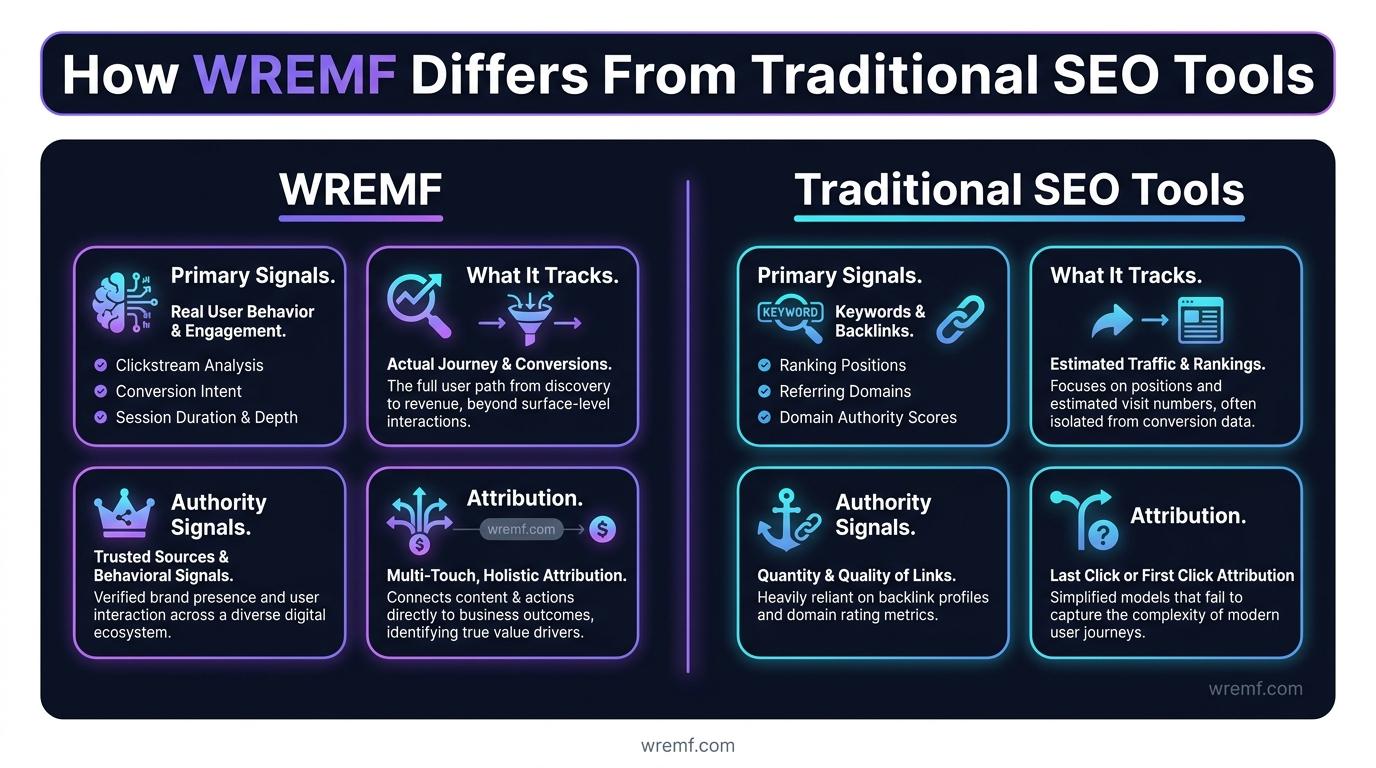
Traditional SEO tools were built to measure performance in Google Search. WREMF was built to measure brand presence in AI-generated answers. These are different problems requiring different signals and measurement logic.
Traditional SEO tools such as Semrush and Ahrefs remain essential for keyword research, organic rankings, backlink analysis, technical SEO audits, and SERP monitoring. They are optimised for a search model where users see a list of results and choose which pages to visit. These tools are not going away, and teams running active SEO programs should continue using them for their primary purpose.
The limitation is that traditional SEO tools do not measure what happens when a buyer asks ChatGPT which project management software is best for enterprise teams, or asks Perplexity to compare CRM platforms. Those AI-generated answers have their own citation logic, source preferences, and entity signals that keyword rankings and backlink profiles do not reflect.
The following comparison illustrates the distinction.
Primary signal
- Traditional SEO tools: Keyword rankings
- WREMF: AI prompt answers
What it tracks
- Traditional SEO tools: SERP position
- WREMF: AI citations and brand mentions
Authority signal
- Traditional SEO tools: Backlinks
- WREMF: Source citations in AI answers
Query model
- Traditional SEO tools: Keywords
- WREMF: Prompts
Competitive view
- Traditional SEO tools: SERP overlap
- WREMF: AI share of voice
Attribution
- Traditional SEO tools: Organic sessions
- WREMF: AI referral traffic and prompt-level attribution
Engine coverage
- Traditional SEO tools: Google and Bing primarily
- WREMF: 10 AI engines
Audit type
- Traditional SEO tools: Technical SEO
- WREMF: GEO and AEO audits
Source consistency
- Traditional SEO tools: Not measured
- WREMF: Tracked across engines
The practical recommendation is to use traditional SEO tools for what they do well and add WREMF as the AI visibility layer. Teams that already use Semrush or Ahrefs as SEO platforms do not need to replace them. They need to add a measurement and execution layer for AI engines. WREMF is designed to sit alongside existing SEO tooling and answer the question that Semrush and Ahrefs were not built to answer: is our brand present in the AI-generated answers that influence buyers before they click?
More context on how this distinction affects SEO and AI visibility strategy is available in the AI SEO tools guide
KEY TAKEAWAY: WREMF adds the AI visibility layer to existing SEO workflows rather than replacing traditional SEO tools. The two measurement systems track different signals and serve complementary purposes.
Understanding the Relationship Between SEO, AEO, and GEO
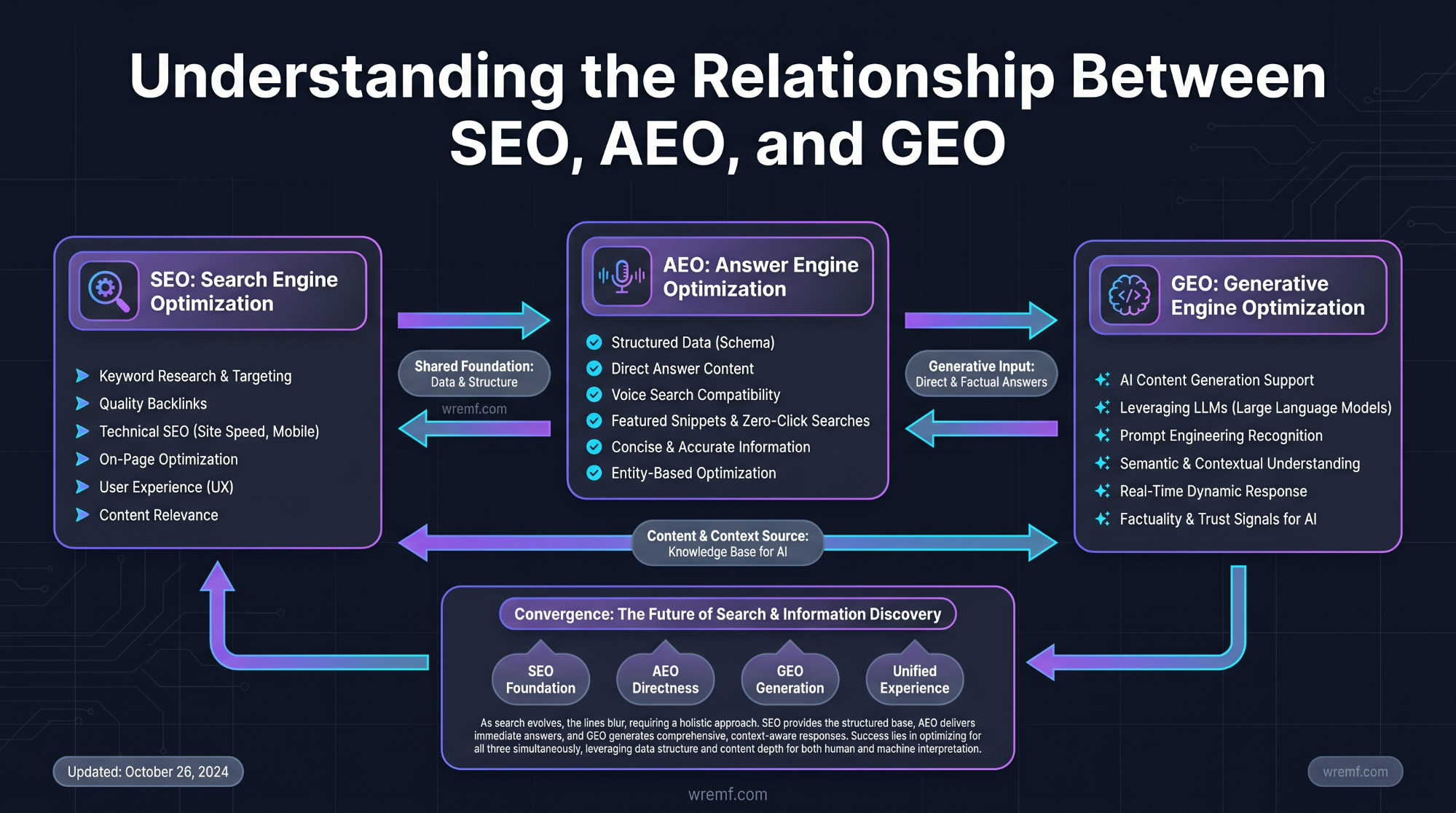
SEO, Answer Engine Optimization, and Generative Engine Optimization are related but distinct disciplines. Understanding how they connect helps teams build a coherent AI search visibility strategy rather than treating each as a separate program.
SEO, or search engine optimisation, focuses on improving a website's visibility in organic search results. It encompasses technical SEO, on-page optimisation, content strategy, and link building. SEO remains the foundation of digital discoverability because it builds the authority, indexability, and topical credibility that AI engines also rely on when selecting sources.
Answer Engine Optimization is the practice of structuring content so that it is retrieved and cited by AI-powered answer engines. AEO focuses on the specific content signals that influence whether an AI engine includes a brand or page in its generated answer: clear entity definitions, structured content, authoritative sourcing, and direct answers to specific questions. The answer engine optimization guide provides a full breakdown of AEO principles and implementation.
Generative Engine Optimization is a broader practice that encompasses all the optimisation work required to improve brand visibility across generative AI platforms. GEO includes content strategy, entity optimisation, source authority building, technical structure, and AI-specific measurement. It applies to multiple AI engines simultaneously, not just a single answer engine.
The three disciplines share a common foundation: strong SEO creates the credibility and authority that both AEO and GEO build on. AEO applies that foundation to the specific retrieval logic of answer engines. GEO scales the practice across the full landscape of generative AI platforms.
For B2B brands, the practical implication is that teams should not abandon SEO in favour of GEO or AEO. Instead, they should run SEO as the base layer, apply AEO principles to high-value content that needs to generate citations, and use GEO strategy to improve presence across all AI engines simultaneously.
AI search visibility tools connect all three by measuring outcomes across the AI engine landscape, identifying which content and authority improvements are producing citation results, and surfacing the gaps that SEO, AEO, or GEO work needs to address. The LLM SEO services guide provides additional guidance on how these disciplines interact in practice.
KEY TAKEAWAY: SEO, AEO, and GEO are complementary disciplines that build on each other. AI search visibility tools measure the outputs of all three by tracking citation performance, source authority, and brand presence across AI engines.
Limitations and Risks of AI Search Visibility Tools
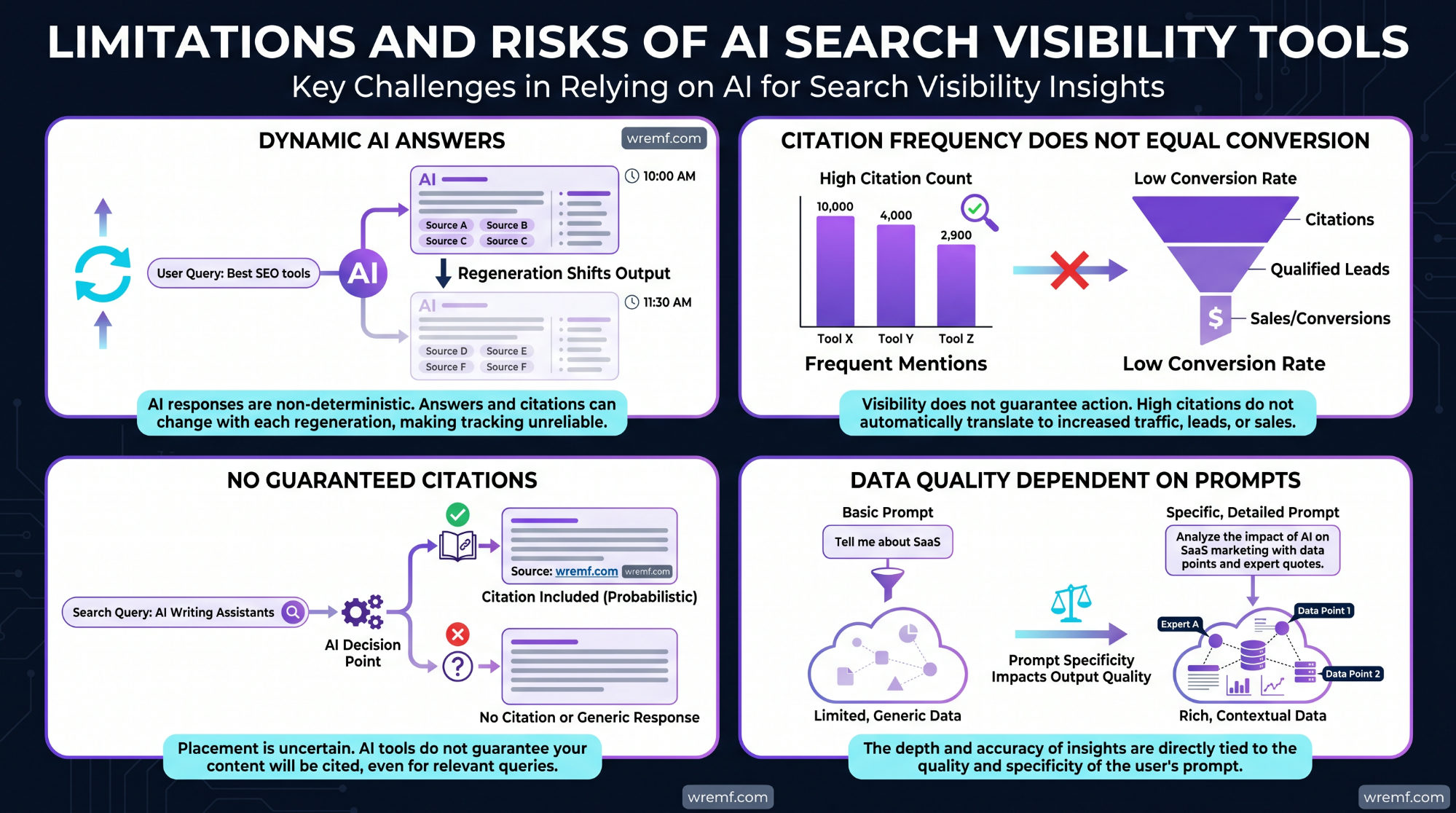
AI search visibility tools provide genuinely useful data, but they carry important limitations that teams should understand before making strategic decisions based on the output.
AI answers are not fixed or reproducible
AI engines generate answers dynamically. The same prompt submitted at different times, from different locations, or with slightly different phrasing can produce materially different results. A single prompt run is not a reliable measurement. Visibility assessments require consistent prompt sets, regular scheduling, and trend analysis over time rather than point-in-time snapshots. No AI search visibility tool can claim that its measurements are permanent or that a brand's visibility score reflects a stable state.
Citation frequency does not equal conversion
Being cited in an AI answer does not guarantee that the user acts on the recommendation, visits the website, or converts. AI share of voice and citation frequency are useful brand presence metrics, but they need to be connected to AI referral traffic data through Google Analytics 4 and downstream conversion tracking to understand whether AI citations are contributing to business outcomes. Teams that report only on citation counts without attribution context risk overvaluing visibility metrics that do not connect to revenue.
Google's AI Overviews documentation notes that AI Overviews sessions are classified separately from standard organic sessions, which means attribution requires specific tracking configurations rather than standard organic session analysis.
Rankings do not confirm AI visibility
A brand holding a top three organic position for a target keyword is not necessarily cited in the AI answer for the equivalent prompt. AI retrieval logic considers content structure, entity authority, citation history, and source depth alongside organic authority signals. Teams that assume high rankings guarantee AI visibility will underinvest in the specific improvements that AI citations require.
No platform guarantees AI citation or recommendation
AI engines make their own source selection decisions. No tool, platform, or managed service can guarantee that a specific AI engine will cite or recommend a brand. WREMF tracks AI visibility and helps teams improve the signals that influence AI citation decisions, but it does not promise citation outcomes. Teams should treat AI visibility work as probability improvement, not guaranteed inclusion.
Software-only plans require internal execution capacity
WREMF Starter and Growth plans provide excellent tracking, reporting, and attribution data. Acting on that data requires content production, SEO implementation, technical changes, and ongoing optimisation. Teams without internal resources to execute on GEO and AEO recommendations will see limited improvement from tracking alone. For teams without execution capacity, the Managed plan provides the strategic and implementation support needed to convert visibility data into actual improvements.
AI visibility data quality depends on prompt set quality
The output of any AI search visibility tool is only as useful as the prompt set it runs. Generic or branded prompts produce limited competitive intelligence. A well-designed prompt set covering buyer intent, competitive comparison, solution seeking, and feature-specific categories produces significantly more actionable AI visibility data. Investing in prompt strategy before scaling tracking is essential.
KEY TAKEAWAY: AI search visibility tools provide valuable but inherently dynamic data. Teams must understand that AI answers change, citations do not equal conversions, rankings do not confirm AI visibility, and software alone does not produce improvement without execution.
How to Choose Between Software, Managed, and Hybrid AI Visibility Models
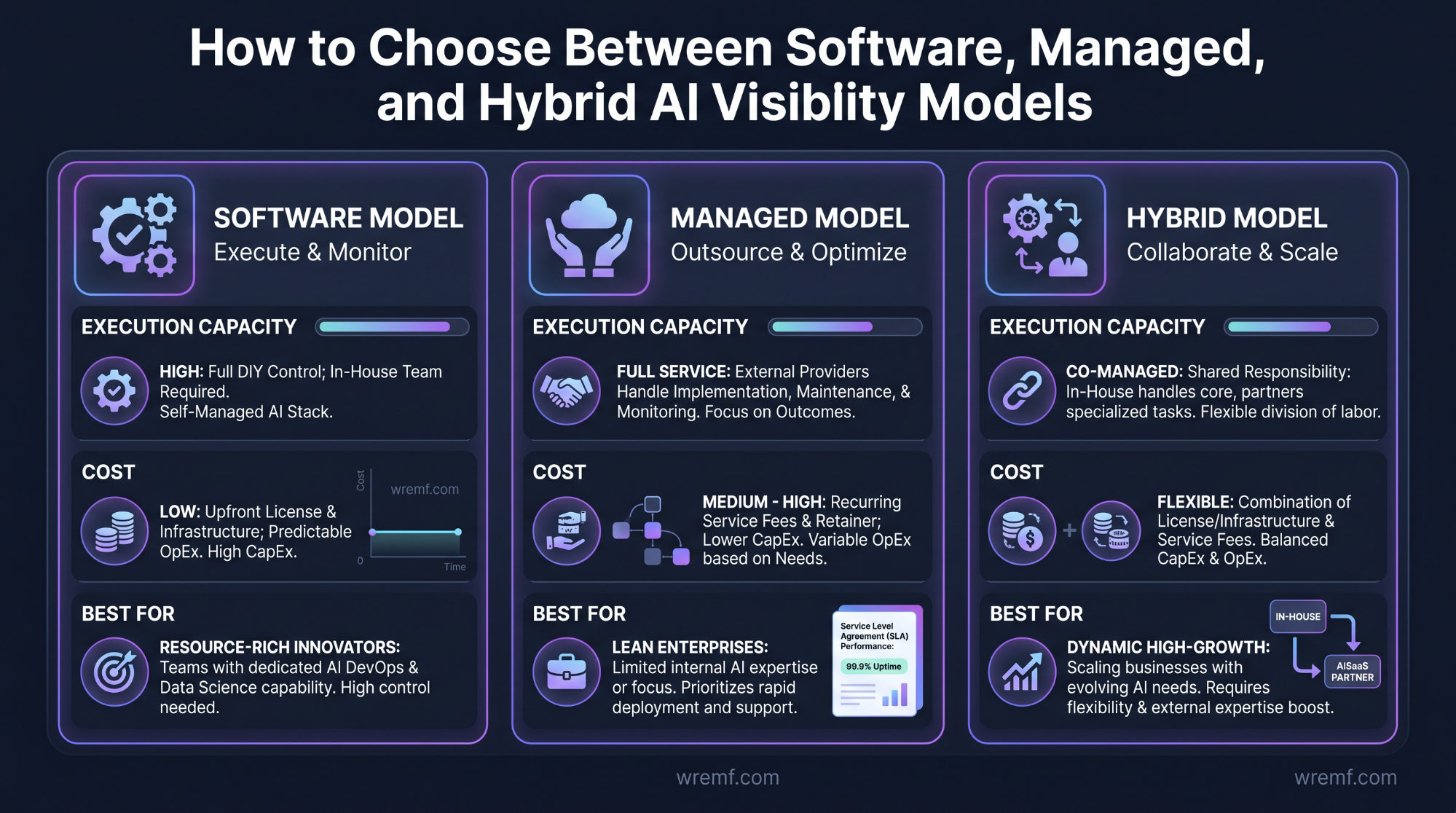
The right engagement model for AI search visibility depends on team size, internal execution capacity, program maturity, and budget. WREMF supports all three models and teams can move between them as their programs develop.
Software model
The software model is best for teams with strong internal SEO, content, and technical execution resources. These teams can interpret AI visibility data, develop content briefs, implement GEO and AEO improvements, and report on progress independently. WREMF Starter suits solo founders, solo consultants, and small SaaS teams beginning to track AI visibility. WREMF Growth suits in-house SEO teams, B2B marketing teams, and agencies that need reporting, attribution, and white-label workflows alongside tracking.
The key requirement for software-only success is execution capacity. Teams that can act on visibility data quickly, produce AI-ready content, and implement technical improvements will see the most value from self-serve tracking.
Managed model
The managed model is best for teams that need strategy, implementation, and ongoing optimisation support without building an internal AI visibility function from scratch. WREMF Managed includes a full AI visibility audit, custom GEO strategy, AEO content optimisation, citation and entity cleanup, senior-led execution, strategy calls, a custom roadmap, and monthly reporting.
This model suits enterprise brands with complex AI visibility requirements, large agencies managing multiple client programs that need expert backup, and multi-market teams that need consistent AI visibility work across different geographies and brand contexts. Pricing starts from €1,500 per month with custom onboarding available.
Hybrid model
The hybrid model combines WREMF software for day-to-day tracking and reporting with periodic engagement of the WREMF senior team for audits, strategy reviews, and execution sprints. This model suits teams that have built internal tracking capability but need expert guidance on GEO strategy, content briefs, or citation authority work at key program milestones.
The hybrid model is particularly effective for agencies that use WREMF to track and report on client AI visibility but bring in WREMF's managed execution team for quarterly strategy updates or content optimisation sprints.
The following comparison helps clarify which model fits different team profiles.
Team profile and recommended model
- Solo founder or solo consultant: Starter software plan
- Small SaaS marketing team with execution capacity: Growth software plan
- Agency managing multiple clients with in-house delivery: Growth software plan plus agency services for execution support
- B2B marketing team needing attribution and GEO audit: Growth software plan
- Enterprise brand or team without internal AI visibility execution capacity: Managed plan
- Team that wants software tracking plus periodic expert strategy: Hybrid model using Growth plan with Managed sprints
IMPORTANT:
Moving between WREMF plans and models is designed to be flexible. Teams can start with Starter, expand to Growth as their prompt sets and competitor tracking needs grow, and add managed execution when they reach the point where tracking data outpaces internal delivery capacity.
KEY TAKEAWAY: Software is best for teams with execution capacity, managed is best for teams that need strategy and implementation support, and hybrid suits teams that want continuous tracking with periodic expert involvement.
Common Misconceptions About AI Search Visibility Tools
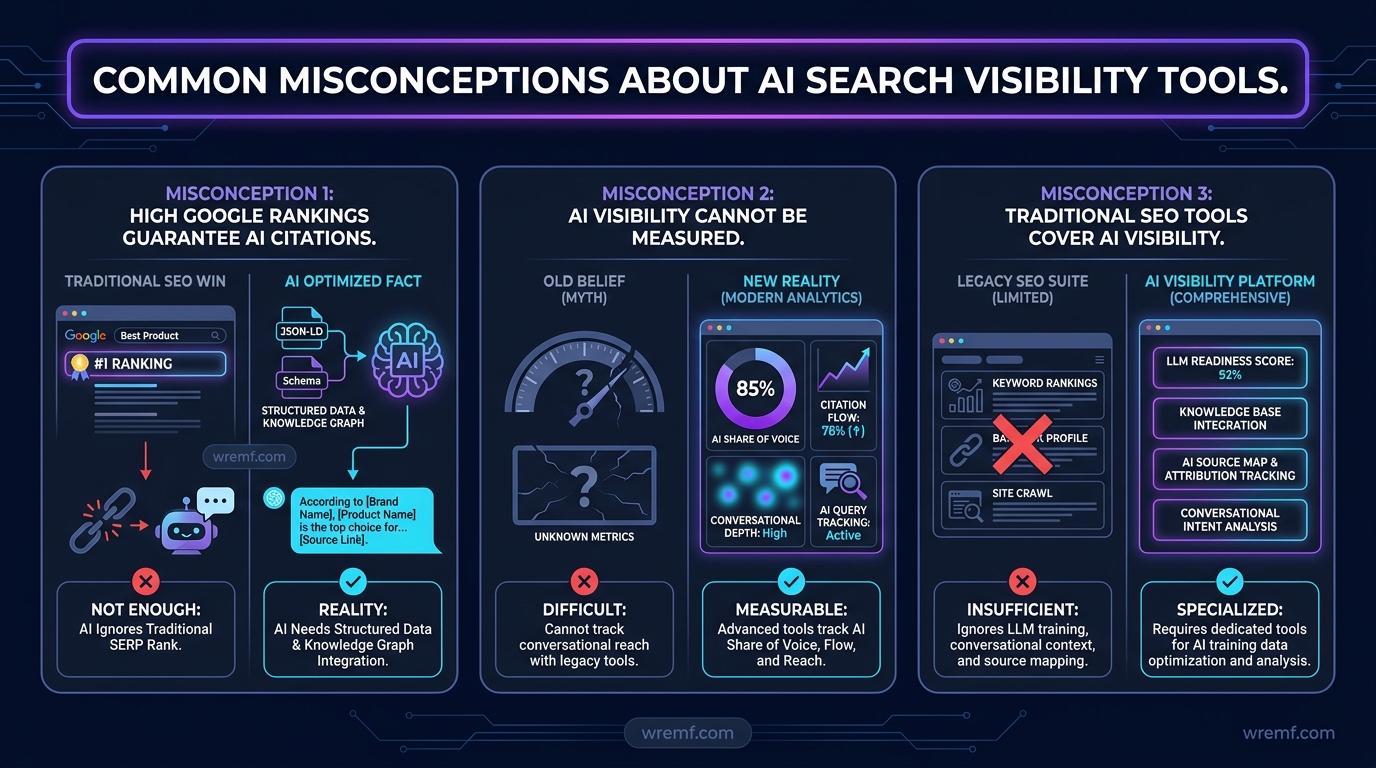
MYTH: If your brand ranks on page one of Google, it will automatically appear in AI answers.
FACT: Rankings and AI citations use different signals. AI engines consider content structure, entity authority, source depth, citation history, and topical clarity alongside domain authority. A brand can hold a top organic position and still be absent from AI-generated answers for the same topic. AI search visibility tools exist precisely because rankings do not predict AI citation presence.
MYTH: AI visibility cannot be measured because AI answers are too unpredictable.
FACT: AI answers are dynamic, but they are measurable through structured prompt tracking, consistent scheduling, and trend analysis. AI search visibility tools run defined prompt sets at regular intervals, track citation frequency, monitor AI share of voice, and identify source patterns over time. The measurement is probabilistic rather than deterministic, but it produces actionable data that teams can use to improve their content and authority signals.
MYTH: Using a traditional SEO tool like Semrush or Ahrefs already covers AI search visibility.
FACT: Semrush and Ahrefs were built for keyword rankings, backlink analysis, and SERP monitoring. Their AI visibility features are extensions added to keyword-centric platforms. They do not provide the same depth of prompt intelligence, multi-engine citation tracking, GEO audit capability, or AI share of voice measurement as platforms built specifically for AI visibility. Teams that rely only on traditional SEO tools will have gaps in their AI visibility data that affect their ability to compete in generative search.
MYTH: If you pay for an AI visibility tool or managed service, the platform can guarantee your brand will be cited by ChatGPT or Google AI Overviews.
FACT: No tool or service can guarantee AI citation. AI engines make independent source selection decisions based on their own retrieval logic. AI visibility platforms improve the signals that influence citation decisions, including content quality, entity clarity, structured data, and source authority, but they cannot override AI engine behaviour. WREMF is transparent about this and positions its service as improving AI visibility probability, not guaranteeing citation outcomes.
MYTH: AI search visibility only matters for large enterprise brands with established content programs.
FACT: AI visibility is relevant for any brand whose buyers use AI engines to research and compare solutions. Small SaaS companies, solo consultants, and growing B2B brands are often the most vulnerable to AI visibility gaps because they have not yet established the source authority and citation presence that AI engines favour. Starting AI visibility tracking early, even at the Starter plan level, produces a clearer picture of where gaps exist and what improvements will have the most impact as the brand grows.
KEY TAKEAWAY: The most harmful misconceptions about AI search visibility tools are that rankings guarantee AI citations, that AI answers cannot be measured, and that traditional SEO tools already cover the problem. Each of these assumptions leads to underinvestment in a measurable and improvable channel.
What to Look for When Evaluating Pricing and Market Durability
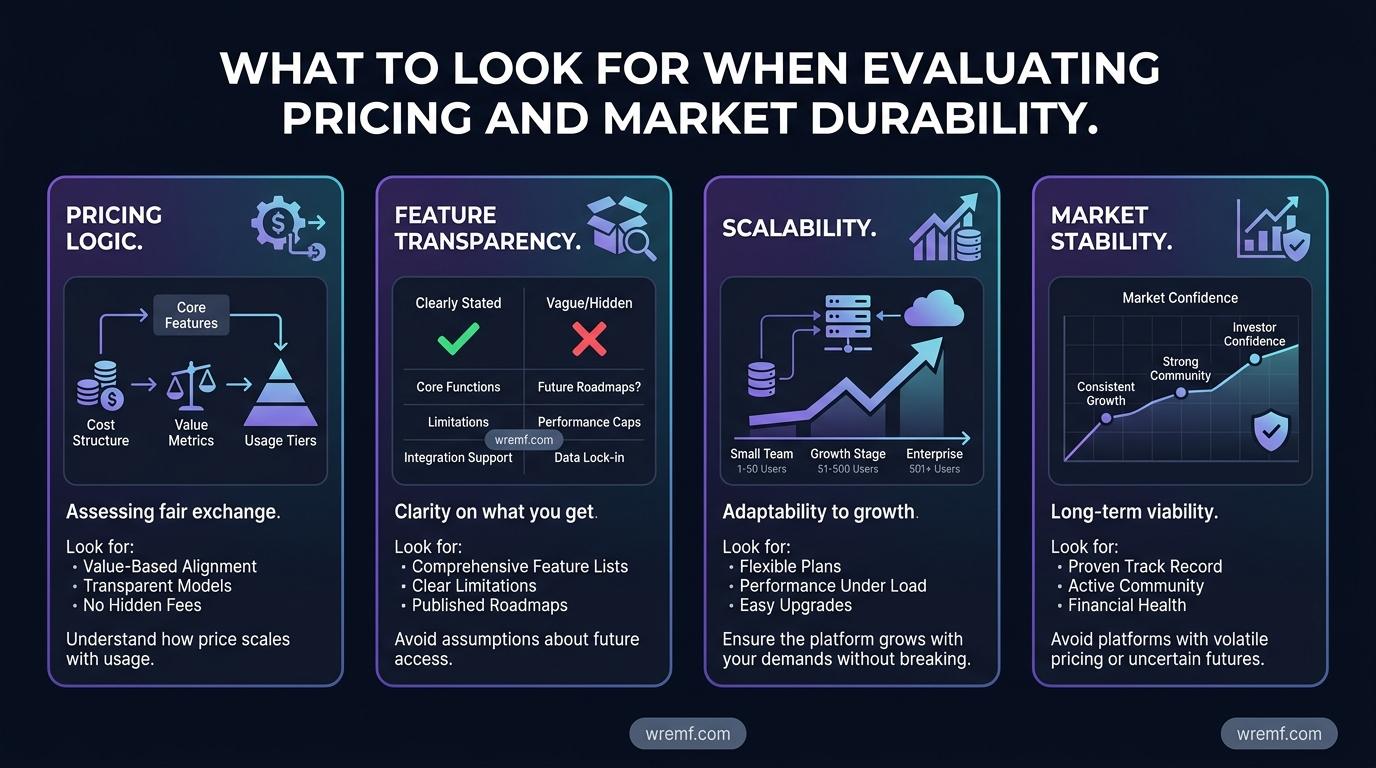
AI search visibility tools pricing varies from entry-level self-serve plans under $30 per month to enterprise contracts requiring direct negotiation. Understanding pricing logic and market durability before committing helps teams avoid both underinvestment in essential capabilities and overspending on features that do not fit their current program stage.
Pricing considerations
Per-prompt pricing models create unpredictable costs as prompt sets scale. Teams that start with 20 prompts and grow to 200 will see costs increase significantly on platforms that charge per prompt run. WREMF includes unlimited prompt tracking on every plan with BYOK support, which means cost predictability is built in regardless of how large the prompt set becomes.
Platforms that offer a free trial without requiring a credit card are lower risk for initial evaluation. WREMF charges after a three-day onboarding window following checkout, which gives teams time to configure their workspace before the first billing cycle begins.
White-label reports, API access, and client management tools are typically locked behind higher plans or treated as enterprise add-ons. Teams that manage client workspaces or need to integrate AI visibility data into broader reporting systems should confirm these features are included before selecting a plan.
Market durability
The AI search visibility tools market is maturing rapidly, but it remains early stage. Some platforms currently operating may not reach commercial sustainability. When evaluating tools, consider whether the platform has transparent pricing, clear product development direction, an established customer base, and operational infrastructure rather than only relying on feature comparisons.
Platforms without public pricing often require significant contracting time before a team can begin tracking, which creates adoption friction. Platforms with very low entry pricing may limit coverage, prompt volume, or reporting depth in ways that require immediate upgrade.
WREMF's pricing structure is designed to provide value at each level without per-prompt markups or artificial data limits that create unexpected costs as programs scale. Teams can review the complete plan structure on the WREMF pricing page before committing.
Digital channels for AI visibility are evolving, and platforms that invest in expanding engine coverage, improving attribution accuracy, and developing GEO and AEO execution capabilities will be more durable than those that only track mentions without connecting data to action.
KEY TAKEAWAY: Evaluate AI search visibility tool pricing based on prompt volume limits, engine coverage at each tier, white-label and reporting features, and market durability, not just the headline monthly price.
Connecting AI Visibility Data to Traffic, Attribution, and Business Outcomes
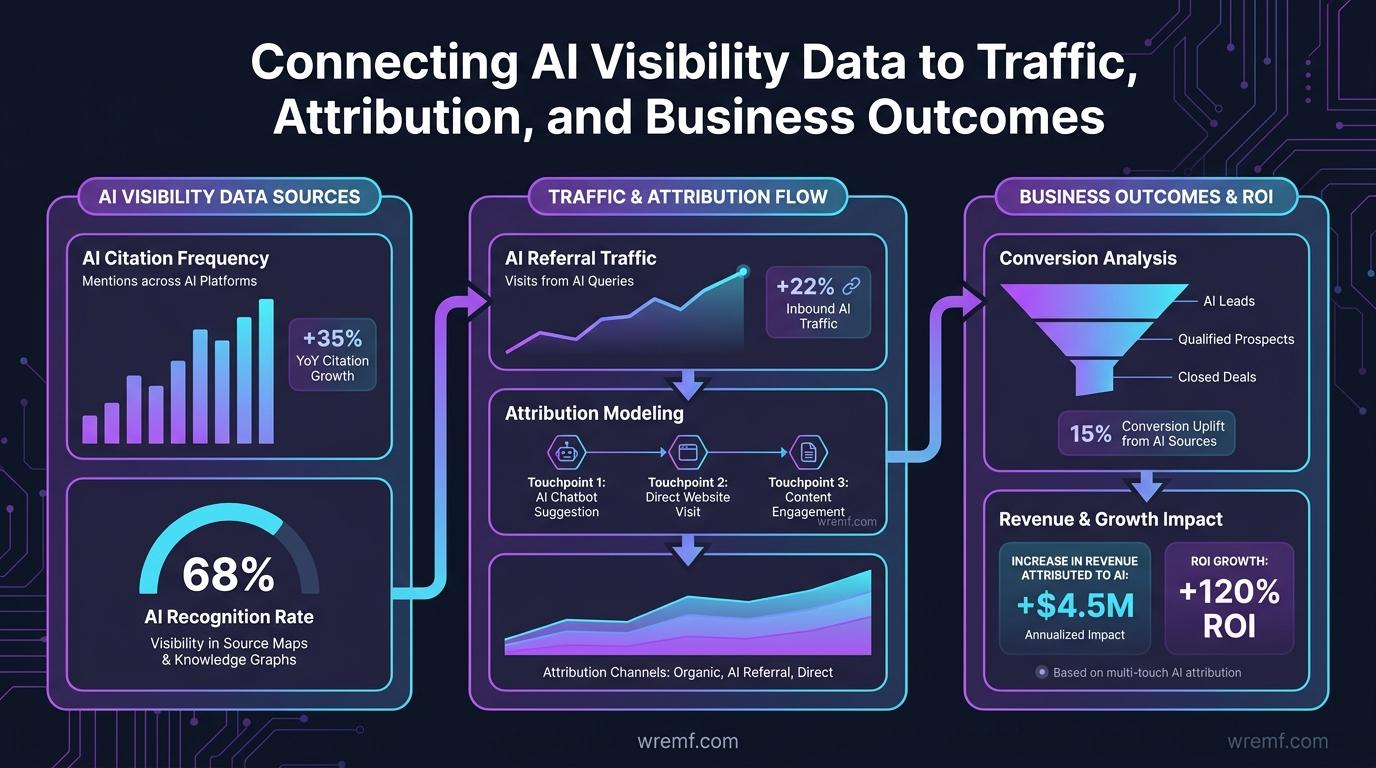
AI visibility data is most valuable when it connects to actual business outcomes rather than existing as a standalone vanity metric. The bridge between citation tracking and business impact is AI referral traffic attribution and conversion analysis.
AI referral traffic is the direct traffic that arrives at a website from users who followed a link or source reference in an AI-generated answer. Google's AI Overviews, Perplexity, and some ChatGPT interfaces include source citations that users can follow. Tracking these sessions in Google Analytics 4 requires specific UTM parameter configurations and direct traffic segment analysis because GA4 does not always classify AI referral sessions as a distinct source by default.
WREMF Growth plan includes GA4 attribution integration and the Looker Studio connector, which allows teams to combine AI visibility data with website traffic and conversion data in a single reporting environment. This makes it possible to answer the practical question: is improved AI citation frequency translating into measurable website sessions and pipeline activity?
Source consistency analysis adds another dimension. AI engines do not always cite the same pages across different queries or different sessions. Source consistency measures how reliably a brand's preferred pages appear as citations across repeated prompt runs. Low source consistency indicates that AI engines are drawing from multiple pages without a clear authority signal, which typically means the brand's content structure and internal authority distribution need improvement.
AI brand monitoring provides the ongoing layer. It tracks whether brand mentions are increasing or decreasing over time, whether sentiment is accurate, and whether AI engines are describing the brand correctly. Inaccurate AI-generated descriptions can represent a brand risk that monitoring surfaces before it affects buyer perception. The AI brand monitoring guide covers this monitoring dimension in detail.
For agencies, connecting AI visibility data to client revenue conversations requires clear reporting on which prompt categories are generating citations, which citations are producing referral traffic, and how that traffic compares to organic and paid channels. White-label reports and the Looker Studio connector make this presentation workflow practical at scale.
KEY TAKEAWAY: AI visibility data becomes strategically valuable when connected to GA4 attribution, AI referral traffic, and source consistency analysis, creating a direct line from citation tracking to business outcomes.
Conclusion
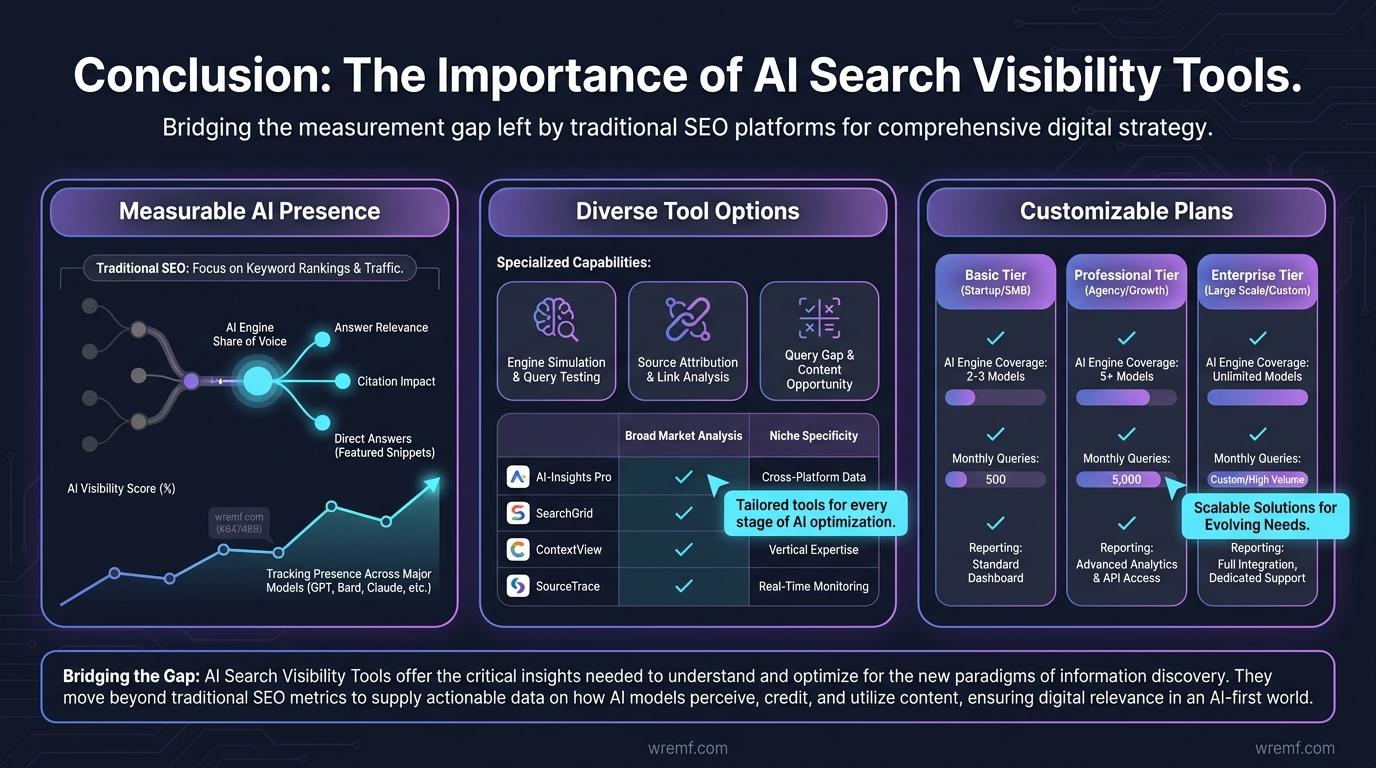
AI search visibility tools address a measurement gap that traditional SEO platforms were not designed to fill. As buyers increasingly use ChatGPT, Perplexity, Gemini, Claude, and Google AI Overviews to research and shortlist vendors, brand presence in AI-generated answers has become a measurable and improvable channel. The tools available range from basic mention trackers to full AI visibility platforms with managed execution options. Choosing the right tool depends on engine coverage, prompt tracking depth, competitive intelligence, reporting infrastructure, and whether the team needs software, a managed service, or a hybrid model. WREMF is built specifically for this challenge, offering unlimited prompt tracking across 10 AI engines, GEO and AEO execution support, and flexible plans from €59 per month. Teams ready to measure and improve their AI search visibility can explore WREMF agency services and software options or compare plans directly at the WREMF pricing page
Frequently Asked Questions About AI Search Visibility Tools
What is an AI search visibility tool?
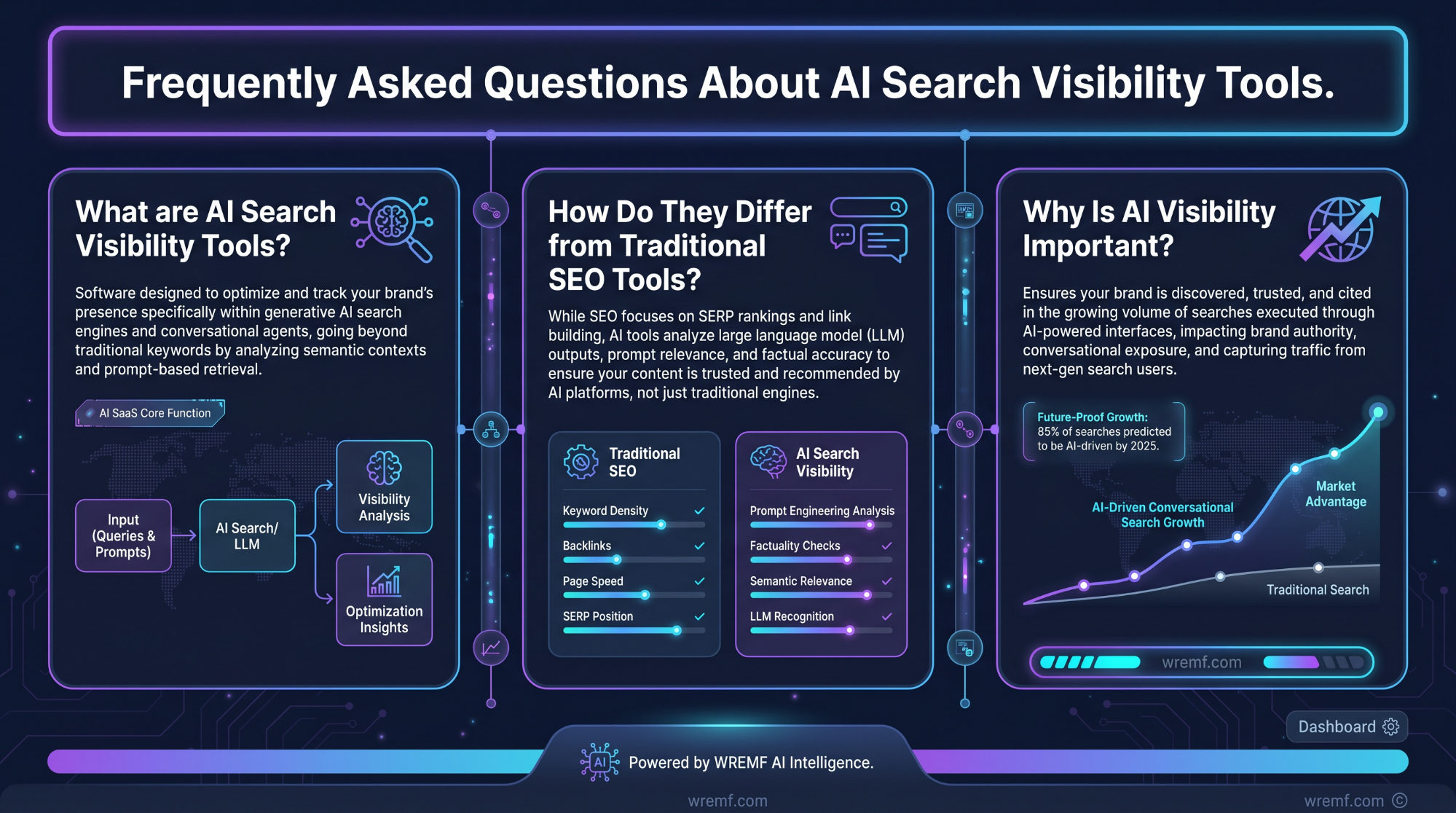
An AI search visibility tool is a platform that tracks how a brand appears in AI-generated answers across large language models and AI search engines such as ChatGPT, Claude, Gemini, Perplexity, Google AI Overviews, and Copilot. Unlike traditional SEO tools that measure keyword rankings in search engine results pages, AI search visibility tools monitor whether a brand is mentioned, cited, or recommended when users ask AI systems questions relevant to that brand's category. They help marketing teams understand what AI engines say about them, how often they appear, and how they compare to competitors in AI-generated answers.
How do AI search visibility tools differ from traditional SEO tools?
Traditional SEO tools such as Semrush, Ahrefs, and SE Ranking measure keyword rankings, backlink profiles, and on-page signals within standard search engine results pages. AI search visibility tools measure something different: whether and how a brand appears inside AI-generated answers produced by large language models. AI systems such as ChatGPT, Perplexity, and Gemini do not return a ranked list of ten blue links. They synthesise an answer and may or may not cite a brand. Traditional ranking data does not correlate directly with AI citation frequency, which means teams need dedicated AI visibility tracking alongside conventional SEO measurement. Tools such as WREMF's AI visibility suite are purpose-built for this distinct measurement need.
Why do I need to optimise my website for AI search engines?
When a potential customer asks ChatGPT or Perplexity "What is the best project management tool for remote teams?", they typically receive one synthesised answer mentioning three to five products. If a brand is absent from that answer, it does not exist to that buyer at that moment. As Google's AI Overviews documentation confirms, AI-generated summaries now appear prominently in search results, meaning visibility in AI answers is becoming as commercially important as traditional organic rankings. Optimising for AI search engines means structuring content, strengthening entity authority, and building source credibility so AI systems are more likely to retrieve, cite, and recommend a brand.
Do I need AI visibility tracking if I already rank well on Google?
Yes. Strong Google rankings do not guarantee strong AI citation visibility. AI systems do not simply surface the top-ranking page for a query. They synthesise answers from multiple sources based on factors including entity clarity, content structure, source authority, and citation patterns. Marketing teams frequently discover that well-ranking pages are absent from AI-generated answers, while less prominent pages from competitors are being cited regularly. Tracking AI visibility separately from search rankings is necessary because the two signals measure different things and are not reliably correlated.
Can Google Analytics track AI search visibility?
Google Analytics 4 can capture some referral traffic from AI platforms when those platforms pass referrer data, but it cannot tell you whether your brand was mentioned, cited, or recommended in an AI-generated answer. GA4 attribution for AI traffic is partial and inconsistent because most AI engines do not pass clear referral signals for every interaction. A dedicated AI search visibility tool is required to track prompt-level brand mentions, citation frequency, share of voice, and source consistency across AI platforms in a way that GA4 alone cannot provide.
How does an AI visibility tracker work?
An AI visibility tracker runs structured queries, called prompts, across multiple AI engines and records whether a brand is mentioned, how prominently it appears, which sources are cited, and how competitors perform in the same answers. The platform processes these results at scale and surfaces metrics such as AI share of voice, citation frequency, mention sentiment, and source consistency. Most platforms allow users to define the prompts relevant to their category, buying stage, and competitive context. WREMF's prompt intelligence feature automates this process across ten AI engines simultaneously, providing a consistent and repeatable measurement system.
What is a good AI visibility score?
There is no universal benchmark for AI visibility scores because scoring methodologies differ between platforms and vary by industry, competitive intensity, and prompt volume. A useful starting point is to measure your brand's mention rate and share of voice relative to your direct competitors across the prompts most relevant to your buying journey. If your brand appears in fewer AI answers than your main competitors for high-intent queries, that is a meaningful gap regardless of the absolute score. WREMF's AI Visibility Index provides a structured scoring framework that accounts for citation frequency, source quality, competitor comparison, and mention consistency rather than relying on a single number.
Can I track the visibility of specific prompts?
Yes. Most dedicated AI search visibility tools allow users to define custom prompts and track how AI engines respond to those specific queries over time. This is more useful than general mention tracking because it connects visibility data to the exact questions your target buyers are asking AI systems. For example, a B2B SaaS company might track prompts such as "best CRM for mid-market sales teams" across ChatGPT, Claude, and Perplexity simultaneously. Prompt-level tracking reveals which queries generate citations, which generate competitor mentions, and where content or authority gaps exist. According to VentureBeat's AI coverage, the ability to map AI responses to specific buyer intent signals is one of the most commercially valuable capabilities in AI search monitoring.
Which AI search systems should an AI visibility tool analyse?
A comprehensive AI search visibility tool should cover the major AI engines that influence B2B buying decisions, including ChatGPT, Claude, Gemini, Perplexity, Google AI Overviews, Microsoft Copilot, DeepSeek, Grok, Meta AI, and Mistral. The relative importance of each platform varies by audience and use case, but tracking across multiple engines matters because brand visibility is rarely consistent across all of them. A brand may appear frequently in ChatGPT answers and rarely in Perplexity answers for the same query. WREMF tracks across ten AI engines from a single platform, which simplifies cross-engine comparison without requiring separate tools or manual testing.
What is AI competitor research, and how does it help?
AI competitor research is the practice of tracking how competing brands appear in AI-generated answers across the same prompts and categories as your own brand. It reveals which competitors are being recommended more frequently, which sources AI engines use to support those recommendations, and where gaps in your own AI visibility exist relative to your market. This goes beyond knowing whether you are mentioned. It answers whether your competitors are being recommended instead of you, and why. WREMF's competitive landscape tracking maps competitor citations, share of voice, and source patterns so teams can identify specific optimisation priorities rather than working from guesswork.
Is AI recommending my brand or my competitors?
This is one of the most important questions a B2B marketing team can ask. AI systems frequently recommend a small set of brands for any given category query, and those recommendations have a direct influence on buyer awareness and pipeline. The only way to answer this question reliably is to run systematic prompt testing across AI engines and compare your brand's citation rate against competitors for the queries your buyers are actually using. Manual testing in ChatGPT or Perplexity provides limited and inconsistent data. Automated tracking across multiple engines and prompts over time is necessary to understand the competitive picture accurately.
What sources do AI engines trust, and how do I know if I am among them?
AI engines tend to cite sources that are authoritative, consistent, well-structured, and frequently referenced across the web. These include established publications, high-authority industry blogs, product review platforms, technical documentation, and sources with strong entity signals. Whether your brand appears in these trusted source pools depends on factors including content quality, structured data, entity clarity, third-party mentions, and citation patterns. WREMF's source citation tracking identifies which sources AI engines are using when your brand or competitors are mentioned, helping teams understand whether they are appearing in trusted source contexts or being overlooked in favour of third-party content.
How do I get mentioned and cited more often in AI answers?
Improving AI citation frequency typically requires a combination of content structure improvements, entity authority building, and source consistency work. Answer-first content formats, clear definitions, structured headings, FAQ sections, and schema markup all improve how AI systems retrieve and process content. Third-party mentions on authoritative sites reinforce entity signals. Ensuring that your brand, category, and key claims are described consistently across all digital channels reduces ambiguity for AI retrieval systems. The WREMF agency team works through a structured process covering audit, strategy, content optimisation, authority development, and ongoing measurement to improve citation visibility systematically rather than through isolated tactics.
How do I measure the ROI of AI search visibility?
Measuring ROI from AI search visibility requires connecting citation and mention data to downstream traffic and pipeline signals. The measurement chain typically runs from prompt-level visibility, to AI referral traffic in GA4, to lead and pipeline attribution. This is imperfect because AI engines do not consistently pass referral data, but directional attribution is possible by combining AI citation tracking with GA4 data, UTM parameters, CRM pipeline data, and share of voice trends over time. As McKinsey's AI insights research consistently notes, demonstrating business impact from AI investments requires measurement frameworks that connect activity to commercial outcomes, not just visibility metrics.
How is an AI visibility score calculated?
AI visibility scores are calculated differently across platforms, but most combine several signals: the percentage of tracked prompts in which the brand appears, citation frequency relative to competitors, source quality and authority, mention sentiment, and consistency across AI engines. A useful score weights high-intent prompts more heavily than general awareness queries because those prompts are closer to purchase decisions. WREMF's scoring methodology accounts for prompt relevance, engine coverage, citation source quality, and competitive share of voice to produce a score that reflects commercially meaningful visibility rather than raw mention counts. Teams can review the WREMF methodology for a detailed explanation of how scoring works.
Does AI actually crawl and cite my content?
AI systems use a combination of pre-training data, retrieval-augmented generation, and real-time web access depending on the platform. ChatGPT's browsing mode, Perplexity, and Google AI Overviews actively retrieve content from the web when generating answers. Others rely primarily on training data supplemented by selected sources. This means that even well-structured content is not guaranteed to be cited simply because it exists online. Factors such as domain authority, content freshness, structured formatting, entity clarity, and third-party citation patterns all influence whether an AI system retrieves and cites a specific source. According to Google's AI Overviews documentation, content that is helpful, well-structured, and authoritative is more likely to be used in AI-generated summaries.
What is the difference between LLM monitoring and AI search monitoring?
LLM monitoring typically refers to tracking brand mentions and accuracy within responses from large language models such as ChatGPT, Claude, and Gemini when users interact with those models directly. AI search monitoring is broader and includes AI-powered search engines such as Perplexity, Google AI Overviews, and Microsoft Copilot, which combine retrieval with language model generation. In practice, a comprehensive AI search visibility strategy requires both. LLM monitoring catches how brand knowledge is represented in model responses, while AI search monitoring tracks how brands appear in retrieval-augmented, search-style queries with real-time web access. The distinction matters because a brand may perform differently in each context.
How do I track brand mentions in AI search?
Tracking brand mentions in AI search requires defining a set of prompts relevant to your category, submitting those prompts systematically across AI engines, and recording whether your brand is mentioned, in what context, and alongside which competitors and sources. Manual tracking by visiting ChatGPT or Gemini directly is inconsistent and unscalable because AI responses vary between sessions, users, and contexts. Automated platforms run standardised prompts at scheduled intervals across multiple engines, capturing structured data on mention rates, citation sources, and share of voice over time. This makes it possible to detect trends, identify declines, and act on specific gaps rather than relying on anecdotal observations.
What should marketing agencies look for in an AI visibility tool?
Marketing agencies managing multiple client accounts need AI visibility tools that support multi-client workspaces, white-label reporting, and scalable prompt tracking without per-prompt pricing that makes client work financially unpredictable. Key capabilities include multi-engine coverage, competitor tracking, citation source analysis, share of voice reporting, GA4 integration for traffic attribution, and the ability to export data or connect to reporting tools such as Looker Studio. WREMF is designed to support agency workflows with white-label reports, client portals, Looker Studio connectors, and unlimited prompt tracking on higher plans. Teams can explore WREMF for agencies to understand how the platform supports client management and reporting at scale.
How much do AI visibility tracking tools cost?
AI visibility tool pricing varies significantly depending on the number of engines tracked, the number of websites and competitors monitored, reporting depth, and whether managed execution is included. Entry-level tools typically start between $29 and $99 per month for basic mention tracking. Mid-tier platforms with multi-engine coverage, white-label reporting, and attribution features typically range from $149 to $500 per month. Managed AI visibility services, where an agency handles strategy and execution alongside software, generally start from $1,500 per month. WREMF's software plans start at €59 per month for founders and solo consultants, with growth plans at €149 per month and managed execution from €1,500 per month. Full details are available on the WREMF pricing page.
Is there a free AI visibility tool?
Some AI visibility platforms offer free trials or limited free tiers that allow basic mention checking across one or two AI engines. These are useful for confirming whether a brand is mentioned at all before committing to a paid tool. However, free tools typically lack multi-engine coverage, competitor comparison, prompt-level tracking, share of voice reporting, and attribution capabilities. For teams that need systematic AI visibility measurement rather than occasional spot checks, a paid platform is generally necessary. WREMF offers a three-day onboarding window before the first charge begins, which allows teams to explore the platform before committing to a billing cycle.
How do I run an AI visibility audit?
An AI visibility audit evaluates how a brand currently appears across major AI engines, which prompts generate citations or mentions, how competitors are performing for the same queries, which sources AI engines trust in the category, and where content, entity, or technical gaps exist. The process typically involves prompt landscape mapping, citation analysis, competitive visibility comparison, source consistency review, and content structure assessment. WREMF's GEO audit feature supports structured AI visibility audits, and the WREMF agency team delivers full audits as part of managed engagements, including actionable recommendations rather than just data outputs. Teams can also request an AI Visibility Audit directly through the agency service.
What are the key features to look for in an AI search visibility tool?
The most important features in an AI search visibility tool include multi-engine prompt tracking, citation source analysis, competitor share of voice comparison, brand mention accuracy detection, AI visibility scoring, content brief generation informed by prompt gaps, GA4 attribution integration, and white-label reporting for agencies. Accuracy detection matters because AI systems sometimes generate incorrect or outdated information about brands, which can damage credibility with prospects. Engine coverage matters because visibility patterns differ significantly between ChatGPT, Perplexity, Claude, and Google AI Overviews. WREMF combines all of these capabilities in one platform, with the option to add managed execution for teams that need strategy and implementation support alongside the software.
Can small or mid-sized companies improve visibility in AI search?
Yes. AI search visibility is not determined solely by brand size or domain authority. Smaller B2B companies can improve their citation frequency by producing well-structured, answer-first content that clearly addresses the questions buyers ask AI systems, building consistent entity signals across their website and third-party sources, and earning mentions from authoritative publications in their category. As Gartner's AI research consistently highlights, AI adoption is accelerating across all company sizes, which means smaller brands that invest in AI visibility early may gain a competitive advantage before larger competitors fully adapt. The entry-level tier of WREMF is specifically designed for founders, solo consultants, and small SaaS teams starting to build AI visibility systematically.
What is the difference between Answer Engine Optimization and Generative Engine Optimization?
Answer Engine Optimization (AEO) focuses on structuring content so that AI-powered answer engines such as ChatGPT, Perplexity, and Bing Copilot retrieve and present it as a direct answer to user questions. Generative Engine Optimization (GEO) is broader and covers strategies for improving how a brand appears across all generative AI discovery surfaces, including AI Overviews, AI Mode, and LLM-native interfaces. In practice, both disciplines overlap significantly. Both involve answer-first content formats, entity clarity, structured data, source authority, and citation building. WREMF supports both AEO and GEO through prompt intelligence, citation tracking, GEO audits, content briefs, and managed execution services.
Why does accuracy matter more than just brand mentions in AI search?
A brand being mentioned frequently in AI answers is only valuable if those mentions are accurate. AI systems sometimes hallucinate incorrect pricing, feature descriptions, company positioning, or product names. When prospects encounter inaccurate information about a brand in an AI answer and that information conflicts with what they hear on a demo call, it undermines trust and creates friction in the sales process. Monitoring not just mention frequency but also the accuracy and consistency of AI-generated brand descriptions is essential for protecting brand credibility. This is why leading AI visibility platforms now include accuracy and sentiment analysis alongside mention rate tracking.
What is the future of AI in SEO, and why does it matter now?
AI is reshaping search behaviour by shifting users from keyword queries in search engines toward conversational questions asked directly of AI systems. According to the Perplexity blog, AI-native search behaviour is growing rapidly as users discover that conversational AI provides faster, synthesised answers than traditional search. This means that organic search traffic patterns are changing as AI answers absorb queries that previously drove clicks to websites. SEO professionals need to expand their measurement and optimisation practice to cover AI citation visibility alongside traditional ranking signals. Waiting until AI traffic displacement is clearly visible in analytics data means missing the window to build AI visibility proactively.
When should a company use software, an agency, or a hybrid AI visibility model?
Software-only AI visibility platforms are appropriate for teams with strong internal execution resources who need tracking, measurement, and reporting but can develop and implement their own strategy. Agency-only AI visibility services suit companies that prefer to outsource strategy, content optimisation, and citation building entirely. A hybrid model combines platform-level tracking and reporting with managed strategy and execution, which is typically the most efficient option for companies that want measurable progress without building a full in-house AI visibility capability. WREMF offers all three models: self-serve software starting at €59 per month, fully managed execution from €1,500 per month, and hybrid arrangements that combine software access with senior-led agency support.
How often is AI visibility data updated in tracking platforms?
Update frequency varies by platform and plan. Some tools run prompt checks daily, others weekly or on demand. For most B2B use cases, weekly or bi-weekly tracking is sufficient to identify meaningful trends, though daily tracking is valuable for brands in fast-moving competitive categories or during active campaigns. The important consideration is consistency: AI responses vary between sessions, so tracking must use standardised prompt formats at regular intervals to produce reliable trend data. Infrequent or inconsistent manual checks produce noisy data that is difficult to act on. Scheduled automated tracking across all major AI engines is a core requirement for any serious AI visibility programme.
How do brand performance reports work in AI visibility platforms?
Brand performance reports in AI visibility platforms aggregate prompt-level data into summary views showing mention rate, share of voice, citation source breakdown, sentiment patterns, and competitive comparison over a defined time period. These reports help marketing leaders and agency clients understand whether AI visibility is improving, which specific prompts or topics are generating the most citations, and how the brand compares to competitors across different AI engines. White-label versions of these reports allow agencies to deliver client-ready outputs without manual formatting. Teams can review a WREMF sample report to understand what AI visibility reporting looks like in practice before committing to a platform.
What are people asking AI systems about my industry, and how do I find out?
Understanding the prompt landscape in your category requires mapping the questions buyers actually ask AI systems at different stages of the buying journey: awareness questions, comparison questions, use-case questions, and vendor selection questions. This prompt landscape analysis reveals which topics generate AI citations, which competitors appear most frequently, and where content gaps exist. It is one of the most commercially valuable inputs into an AI search content strategy because it connects content investment directly to the queries that influence buyer decisions. WREMF's prompt intelligence feature helps teams identify and track high-value prompts across AI engines systematically rather than relying on manual guesswork.
Can I integrate AI visibility data with other reporting tools?
Yes. Leading AI visibility platforms offer integrations with analytics and reporting tools including Google Analytics 4, Looker Studio, and API access for custom workflows. Integration with GA4 allows teams to connect AI citation trends with actual traffic and conversion data, providing a more complete picture of commercial impact. Looker Studio connectors enable teams to combine AI visibility metrics with other marketing data in unified dashboards. WREMF's Growth plan includes a Looker Studio connector and GA4 attribution, and the WREMF API supports custom integrations for teams with more complex data workflows or agency-level reporting requirements.
What is the relationship between structured data and AI citation visibility?
Structured data, including schema markup implemented according to Schema.org documentation standards, helps AI systems understand what a page is about, what entity it represents, and how it relates to other entities. While structured data alone does not guarantee AI citations, it reduces ambiguity and improves the likelihood that AI retrieval systems correctly associate content with the right brand, product, or category. Entity markup, FAQ schema, how-to schema, and organisation schema are particularly relevant for AI visibility because they make content relationships explicit. Technical AI visibility work, including structured data implementation, is part of WREMF's agency service offering for clients that need both measurement and implementation support.
Related reading
- AI Search Engine Optimization Tools: The Complete 2026 Guide for AI Search, SEO, AEO, and GEO
- Generative AI Optimization Services: The Complete Guide to GEO, AEO, LLM Optimization, and AI Visibility
- AI Brand Visibility: The Complete B2B Guide to Tracking, Measuring, and Improving How AI Engines Mention Your Brand
- The Complete Guide to AI Visibility Tools for B2B Brands, SEO Teams, and Agencies