The Complete Guide to AI Visibility Tools for B2B Brands, SEO Teams, and Agencies
Discover AI visibility tools for tracking brand mentions in AI engines, aiding SEO teams in optimizing their AI search presence.
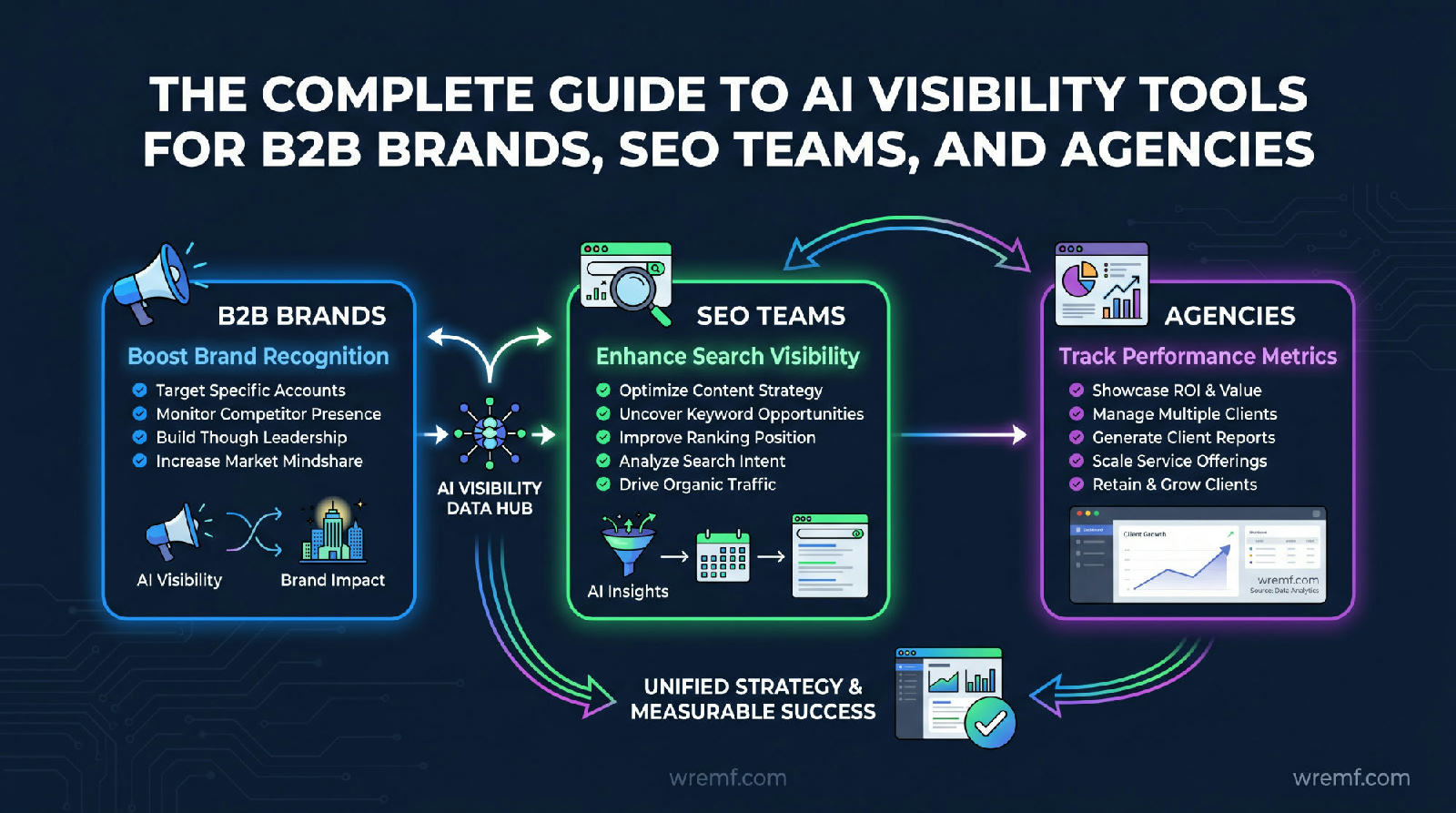
By WREMF Team · 2026-09-19
An AI visibility tool is software that tracks how brands appear across AI engines like ChatGPT and Gemini by monitoring responses, citations, and mentions. Unlike traditional SEO tools, AI visibility tools measure brand presence in AI-generated answers instead of keyword rankings. They help teams identify competitive gaps, improve citations, and connect AI activity to traffic and revenue. These tools include capabilities like prompt tracking, source citation analysis, and calculating AI share of voice, essential for thorough brand measurement.
Key takeaways
- AI visibility tools track brand mentions, citations, and share of voice across multiple AI engines.
- These tools provide insights that traditional SEO platforms like keyword rankers cannot.
- Core capabilities include prompt tracking, source citation tracking, and AI share of voice.
- GEO audits are essential for structuring content for AI citation and visibility.
- WREMF offers comprehensive AI visibility tracking over 10 AI engines with GE audits and endless prompts.
The Complete Guide to AI Visibility Tools for B2B Brands, SEO Teams, and Agencies

An AI visibility tool is software that tracks how AI engines mention, cite, compare, and recommend a brand across prompt-based discovery journeys in platforms like ChatGPT, Gemini, Perplexity, Claude, and Google AI Overviews. As buyers increasingly shortlist vendors through AI-generated answers before visiting a website, AI visibility has become a measurable and manageable search channel. This guide is written for B2B SaaS teams, SEO professionals, marketing agencies, and growth leaders who need to understand, evaluate, and act on AI visibility data. It covers what AI visibility tools track, how they differ from traditional SEO tools, what separates strong platforms from weak ones, and how WREMF fits as software, managed service, or hybrid execution partner. If your brand is not appearing in AI answers where buyers are looking, this guide explains what to do about it.
QUICK ANSWER:
An AI visibility tool tracks how a brand appears across AI engines such as ChatGPT, Gemini, Perplexity, Claude, and Google AI Overviews by monitoring prompt responses, citations, mentions, and share of voice. These tools differ from traditional SEO platforms because they measure presence in AI-generated answers rather than keyword rankings. Teams use AI visibility tools to identify gaps, benchmark competitors, improve citations, and connect AI search activity to traffic and revenue outcomes.
KEY TAKEAWAYS:
- AI visibility tools track brand mentions, citations, and share of voice across AI engines including ChatGPT, Gemini, Perplexity, Claude, Copilot, Grok, and Google AI Overviews
- Traditional SEO tools measure keyword rankings and backlinks but do not track how AI engines cite or recommend brands in prompt responses
- Prompt tracking, source citation tracking, and AI share of voice are the three foundational measurement capabilities every serious AI visibility tool should include
- Source consistency across AI engines matters because the same brand may be cited accurately by one engine and misrepresented or absent in another
- WREMF provides AI visibility tracking across 10 AI engines with unlimited prompts, BYOK support, GEO audits, and managed execution options starting from 59 euros per month
- No AI visibility tool can guarantee that an AI engine will recommend a brand; these tools measure current presence and guide improvement efforts
What Is an AI Visibility Tool and What Does It Actually Track
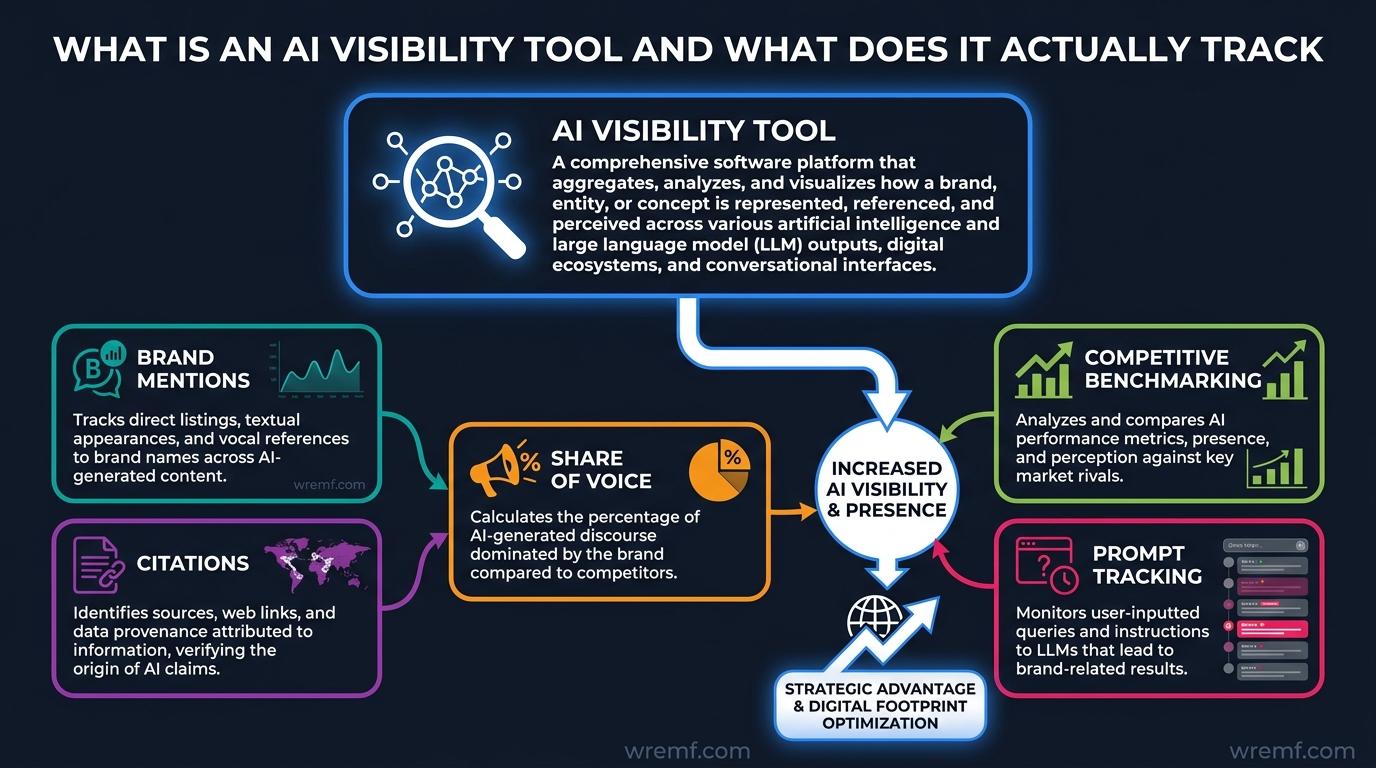
An AI visibility tool is a platform that measures how AI engines discover, reference, and recommend a brand across buyer-relevant prompts. Unlike tools that track search engine rankings, AI visibility tools query large language models directly and analyse the responses to determine whether a brand appears, how prominently it appears, what sources are cited, and how competitors compare.
The distinction matters because AI search visibility is structurally different from organic search visibility. In Google Search, a brand either ranks for a keyword or it does not. In AI-generated answers, a brand may be mentioned, cited as a source, recommended by name, compared against competitors, or entirely absent, depending on the prompt, the engine, the context, and the training or retrieval data available. A single prompt about project management software might return different brand mentions in ChatGPT, Perplexity, Claude, and Google AI Mode, even when asked in the same language on the same day.
What AI visibility tools specifically track includes: brand mentions within AI responses, source citations and the URLs or domains referenced, visibility score or AI Visibility Index across engines, competitive share of voice in prompt responses, sentiment associated with brand mentions, citation consistency across AI platforms, prompt-level breakdowns showing which queries generate visibility, and traffic attributed to AI referral sources through integrations such as Google Analytics 4.
AI visibility data is distinct from traditional SEO data because it reflects how AI systems synthesise, retrieve, and present information rather than how a crawl bot scores a page for relevance and authority. According to Google's AI Overviews documentation AI Overviews use a separate classification from standard organic sessions, which means existing analytics tools alone cannot account for this channel.
Teams that understand what AI visibility tools track, and what those tools cannot do, are better positioned to build measurement programs that connect brand performance in AI search to business outcomes. WREMF's AI visibility tracking covers 10 AI engines including ChatGPT, Gemini, Perplexity, Claude, Copilot, DeepSeek, Grok, Meta AI, and Mistral, giving teams a comprehensive picture of where their brand stands across the AI search landscape.
KEY TAKEAWAY: AI visibility tools track brand mentions, source citations, share of voice, and prompt-level visibility across AI engines, giving teams data that traditional SEO tools are not built to provide.
Why Traditional SEO Tools Cannot Measure AI Search Visibility
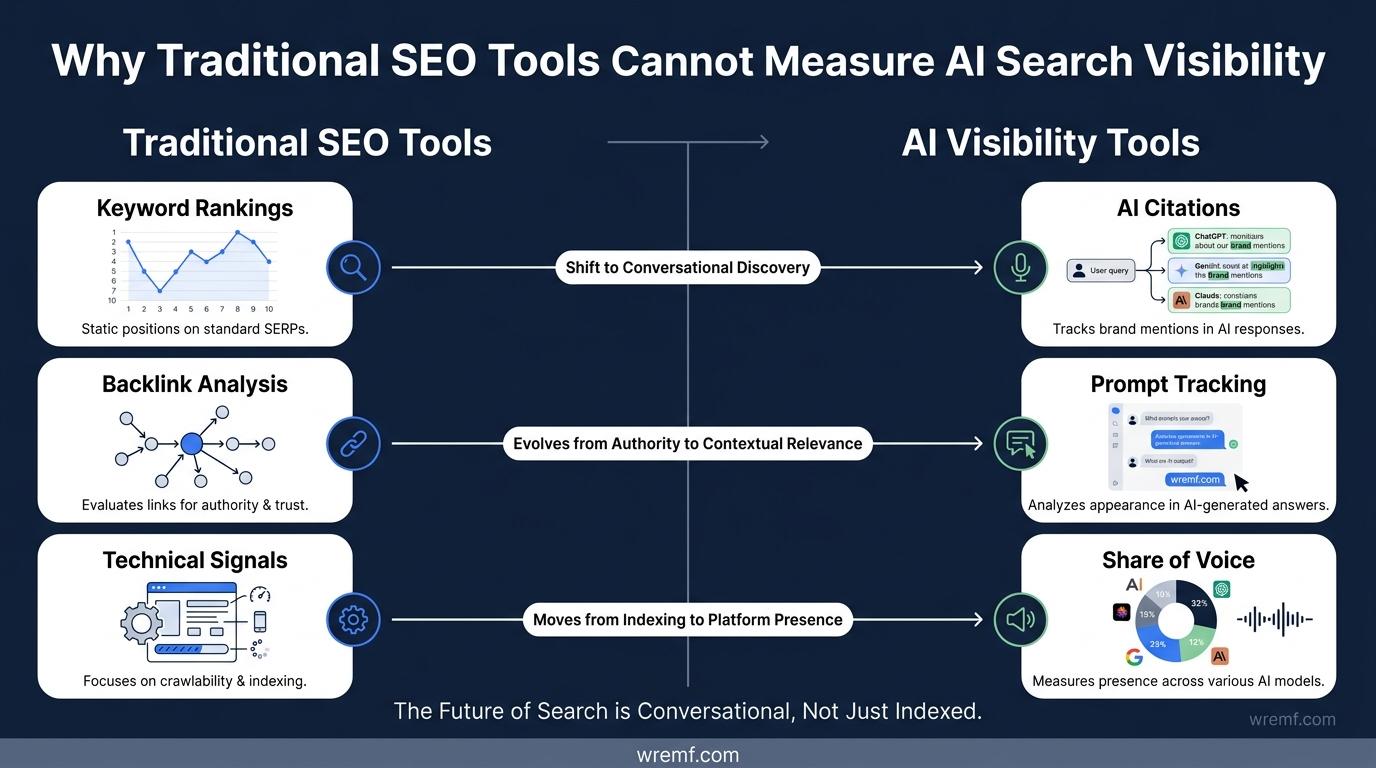
Traditional SEO tools were built to measure performance on Google's SERP using keyword rankings, backlinks, crawl data, and technical signals. They remain highly useful for those purposes. WREMF does not replace them. What traditional SEO tools cannot do is tell a team whether their brand is being cited in a ChatGPT answer, how often they appear in Perplexity compared to a competitor, or which prompts are driving AI referral traffic to their website.
The gap between traditional SEO tools and AI visibility tools is structural. A keyword rank tracker queries a search engine index and reports a position. An AI visibility tool queries a large language model or a retrieval-augmented generation system and analyses the full text of the response for brand mentions, citations, sentiment, and source attribution. These are fundamentally different measurement systems serving different discovery surfaces.
The comparison below illustrates the practical difference:
Primary signal
- Traditional SEO tools: Keyword rankings
- WREMF: AI prompt answers
What it tracks
- Traditional SEO tools: SERP position
- WREMF: AI citations and brand mentions
Authority signal
- Traditional SEO tools: Backlinks
- WREMF: Source citations in AI answers
Query model
- Traditional SEO tools: Keywords
- WREMF: Prompts
Competitive view
- Traditional SEO tools: SERP overlap
- WREMF: AI share of voice
Attribution
- Traditional SEO tools: Organic sessions
- WREMF: AI referral traffic and prompts
Engine coverage
- Traditional SEO tools: Google and Bing
- WREMF: 10 AI engines
Audit type
- Traditional SEO tools: Technical SEO
- WREMF: GEO and AEO audits
Source consistency
- Traditional SEO tools: Not measured
- WREMF: Tracked across engines
The practical recommendation is to run both systems in parallel. Tools such as SE Ranking and Ahrefs remain relevant for keyword research, backlink analysis, technical SEO, and site audit workflows. WREMF adds the AI visibility layer by tracking how AI engines mention, cite, compare, and recommend brands across prompt-based discovery journeys. Teams that rely only on keyword rankings to assess visibility in the AI era are working with an incomplete picture. For a broader perspective on how these systems relate, the AI search engine optimization guide covers the full strategic context for B2B brands navigating both traditional and AI search.
KEY TAKEAWAY: Traditional SEO tools measure SERP rankings and technical signals but cannot track AI citations, prompt-level visibility, or share of voice across AI engines; both systems are needed for complete search visibility measurement.
The Core Capabilities Every AI Visibility Tool Should Include
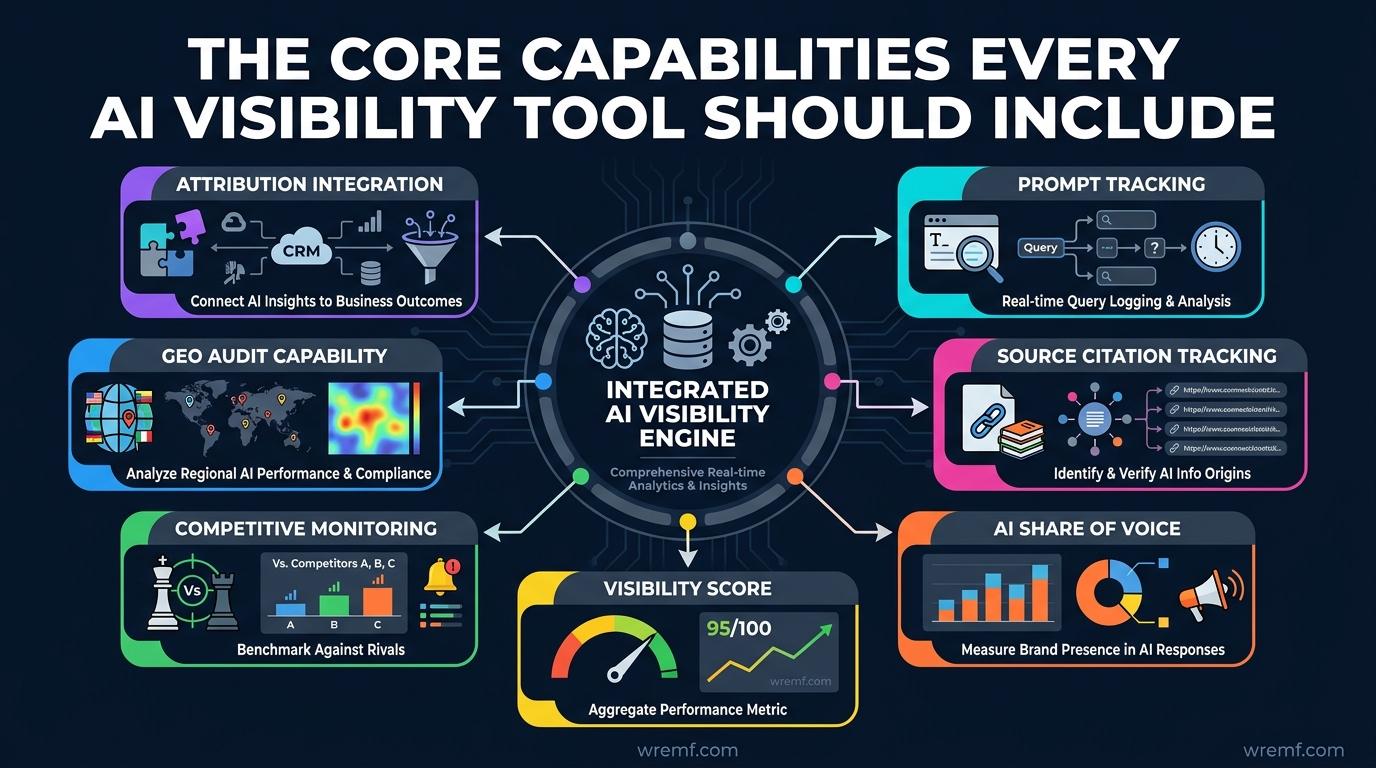
Not every AI visibility tool provides the same depth of measurement. Some platforms offer a surface-level visibility score based on a handful of prompts. Others provide prompt-level breakdowns, competitive benchmarking, source citation analysis, and attribution integration. Understanding which capabilities matter most for a given team prevents wasted budget on tools that cannot answer the questions the team actually needs to answer.
The following capabilities represent the minimum standard for a serious AI visibility program.
Prompt tracking is the foundational capability. A tool must be able to run a defined set of prompts across multiple AI engines and record the responses. Without prompt tracking, everything else is guesswork. The quality of prompt tracking depends on prompt volume, the ability to customise prompts to reflect real buyer questions, update frequency, and whether the tool tracks prompts automatically or requires manual input. Prompt Volumes matter because a tool that tests 15 prompts per month will miss significant visibility patterns that only emerge at higher scale.
Source citation tracking identifies which domains and URLs are referenced in AI-generated answers. This is the AI equivalent of backlink analysis. When an AI engine cites a source, it is effectively endorsing that source's authority on the topic. Teams that do not track citations cannot identify which content assets are driving AI visibility, which competitor sources are being cited instead of theirs, or where citation gaps exist that content and authority work can address.
AI share of voice measures how often a brand appears in AI answers compared to competitors across the same prompt set. Share of voice is the primary competitive metric in AI search because, unlike SERP rankings where multiple results appear simultaneously, AI answers often mention a limited number of brands. A brand that appears in 60 percent of relevant prompts has meaningful share of voice. A brand that appears in 8 percent has a visibility gap that requires investigation.
AI Visibility Index or visibility score aggregates prompt-level data into a single score that can be tracked over time. This metric is useful for internal reporting, leadership updates, and client dashboards. The score should be based on real AI responses across multiple engines rather than estimated from proxies like content quality scores or domain authority.
Competitive monitoring tracks how competitors appear in the same prompts where a brand is also tracked. Competitive benchmarking answers questions such as: Which AI engines favour a competitor? Which prompts does a competitor dominate? Which sources does the AI cite when recommending a competitor? This data drives content strategy, citation improvement, and authority building decisions.
GEO audit capability assesses how well a website and its content are structured for discovery by AI engines. Generative Engine Optimization, or GEO, involves ensuring that content is structured, authoritative, and clearly attributed so that AI retrieval systems can find, parse, and cite it. A GEO audit identifies specific content, structural, and authority issues that reduce AI visibility.
Attribution integration, specifically with Google Analytics 4, connects AI visibility measurements to actual traffic and conversion data. Without attribution, teams cannot demonstrate whether improvements in AI citations translate into measurable business outcomes.
The generative AI optimization services guide explains how GEO and answer engine optimisation fit together as a strategic framework for improving AI visibility over time.
WREMF includes all of these capabilities across its plans. The Growth plan adds advanced citation tracking, AI share of voice, GEO audits, a content brief generator, SEO testing, GA4 attribution, white-label reports, and a Looker Studio connector, making it suitable for agencies and in-house teams that need both measurement depth and reporting infrastructure.
KEY TAKEAWAY: A capable AI visibility tool must include prompt tracking, source citation tracking, AI share of voice, a visibility score, competitive monitoring, GEO audit capability, and attribution integration to support a complete measurement and improvement program.
How AI Visibility Tools Handle Prompt Intelligence and Competitive Benchmarking
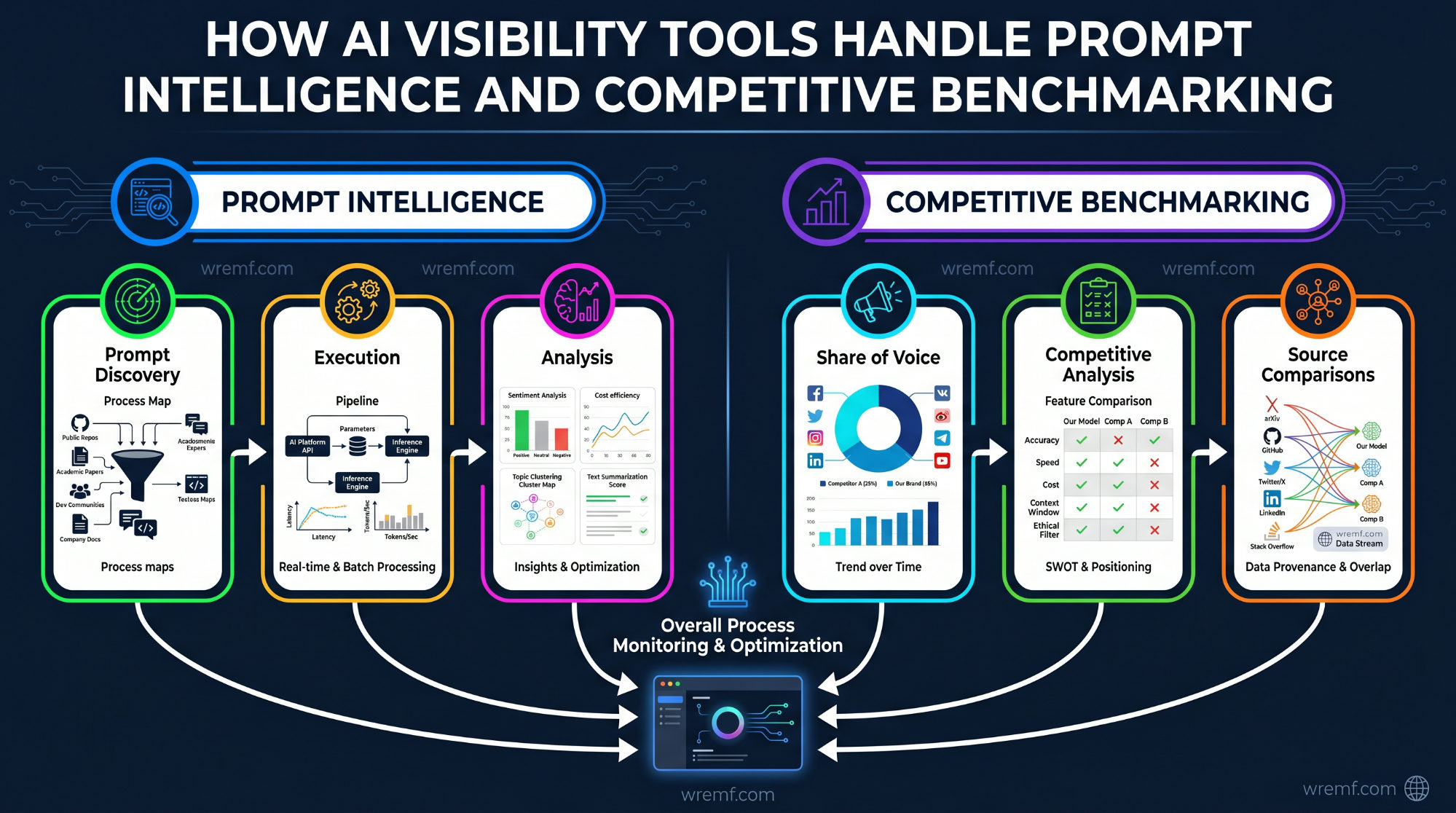
Prompt intelligence is the practice of building, managing, and analysing a structured set of prompts that reflect the actual questions buyers ask AI engines when researching products, services, and solutions in a given market. It is one of the most important and least understood aspects of AI visibility measurement.
A prompt is not simply a keyword. When a buyer types "what is the best project management software for remote teams" into Perplexity or "compare B2B marketing analytics platforms" into ChatGPT, the AI engine generates a synthesised response drawing on its training data and, in retrieval-augmented systems, its current index of web content. The brands that appear in those answers have achieved AI search visibility for that prompt. The brands that do not appear have a gap.
Prompt intelligence involves three layers of work. The first is prompt discovery: identifying which prompts are relevant to a brand's market, product category, buyer journey stage, and competitive context. Good AI visibility tools provide automated prompt suggestions based on industry, competitors, and target keywords, but teams should also contribute prompts drawn from real sales conversations, support tickets, and content research. Keyword Research informs prompt discovery because high-volume search queries often correspond to high-frequency AI prompts.
The second layer is prompt execution: running prompts at regular intervals across multiple AI engines and recording full responses. The frequency and consistency of prompt execution matters because AI responses can change as models update, retrieval indexes refresh, and competitor content changes. A tool that runs prompts monthly will miss the signal that a competitor's citation rate doubled after they published a well-structured comparison page.
The third layer is prompt analysis: understanding what the response data means for the brand's competitive position. Which prompts generate mentions? Which prompts generate citations with links? Which prompts recommend a competitor exclusively? Which engines show the brand consistently versus inconsistently? Answer engine insights from prompt analysis direct content strategy, authority building, and technical optimisation priorities.
Competitive benchmarking in AI visibility tools works by running the same prompt set against tracked competitors and comparing the results. A strong competitive benchmarking view shows share of voice per engine, share of voice per prompt category, which sources are cited for competitors, and how sentiment compares. Teams can use this data to identify visibility gaps, reverse-engineer why competitors appear more frequently, and prioritise the content and citation improvements most likely to shift the results.
According to McKinsey's AI insights AI adoption in business settings is accelerating rapidly, which means the competitive gap between brands that measure AI visibility and those that do not is widening each quarter. Waiting until competitors have already established strong AI citations before starting measurement puts a brand at a structural disadvantage.
WREMF's prompt intelligence capability supports unlimited prompts across 10 AI engines on every plan, with BYOK support so teams are not paying per-prompt markups. This makes it practical to run large prompt sets that reflect the full scope of a brand's competitive landscape rather than limiting tracking to a handful of brand name queries.
KEY TAKEAWAY: Prompt intelligence involves discovering, executing, and analysing structured prompts across AI engines; it is the core measurement mechanism that reveals where a brand has AI visibility and where competitive gaps exist.
Understanding AI Share of Voice and Source Citation Tracking
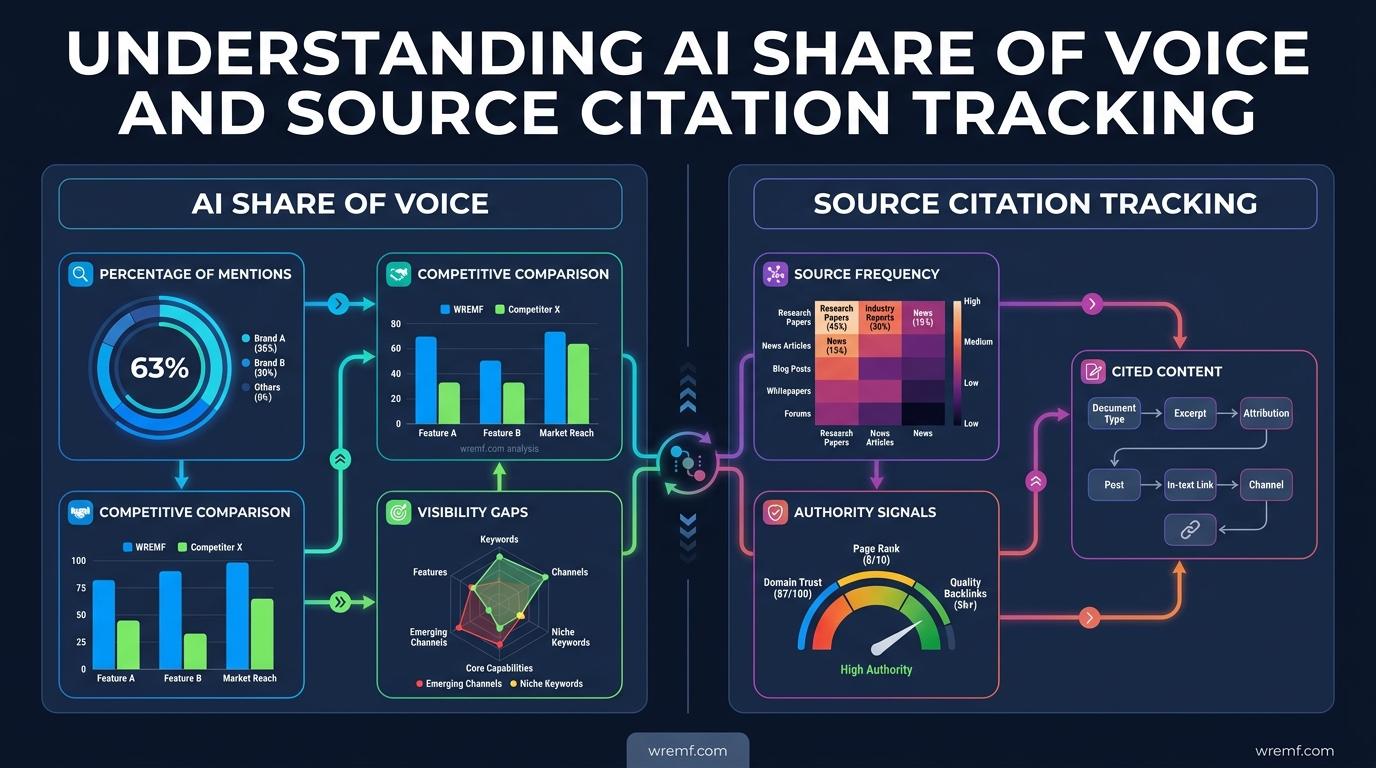
AI share of voice and source citation tracking are the two metrics that separate serious AI visibility measurement from basic brand monitoring. Both concepts borrow from existing marketing frameworks but work differently in the context of AI search.
AI share of voice is the percentage of relevant AI-generated answers in which a brand appears, measured against a defined competitor set and prompt set. If a team tracks 100 prompts relevant to their market and their brand appears in 45 of the resulting AI responses, their AI share of voice is 45 percent for that prompt set. If the top competitor appears in 72 of the same 100 responses, the competitive gap is clear and measurable.
Share of voice as a concept has been used in advertising and PR for decades. In AI search, it takes on additional nuance because appearance alone does not equal citation. A brand can be mentioned in passing within an AI answer without being cited as a trusted source. A brand can be cited as a source without being recommended. A brand can be recommended without the AI response including a link to the brand's website. These distinctions matter for understanding what kind of visibility a brand actually has and what improvement looks like.
Source citation tracking addresses this distinction directly. When an AI engine generates an answer that references external content, it may include source citations showing which pages or domains were used to construct the response. Citation tracking records which sources appear, how frequently they appear, and whether a brand's own content is among the cited sources. In retrieval-augmented systems like Perplexity and Google AI Overviews, source citations are often explicit. In generative-only systems like standard ChatGPT responses, citations may be implicit or absent depending on the version and settings.
The practical value of source citation tracking is that it identifies which content assets are contributing to AI visibility and which are not. A brand may have strong domain authority according to traditional SEO tools but low citation rates in AI answers because the content is structured in ways that AI retrieval systems find difficult to parse, because the content does not address the specific questions being asked, or because competitor content is better structured for AI citation. GEO audits identify and address these specific issues.
AI citation patterns also reveal authority signals that differ from traditional backlinks. When multiple AI engines independently cite the same source for a given topic, that source has demonstrated authoritative coverage of that topic in a way that AI retrieval systems recognise and replicate. Building a citation presence in AI answers is therefore partly a content strategy exercise and partly an authority and entity consistency exercise.
Teams can track citation gaps using WREMF's source citation tracking alongside GA4 attribution data to understand which AI citations are generating actual referral traffic and which are contributing to awareness without direct conversion paths.
KEY TAKEAWAY: AI share of voice measures how often a brand appears in relevant AI answers compared to competitors, while source citation tracking identifies which content assets are being cited; together they drive content and authority improvement decisions.
How to Track AI Visibility Across ChatGPT, Gemini, Perplexity, Claude, and Google AI Overviews
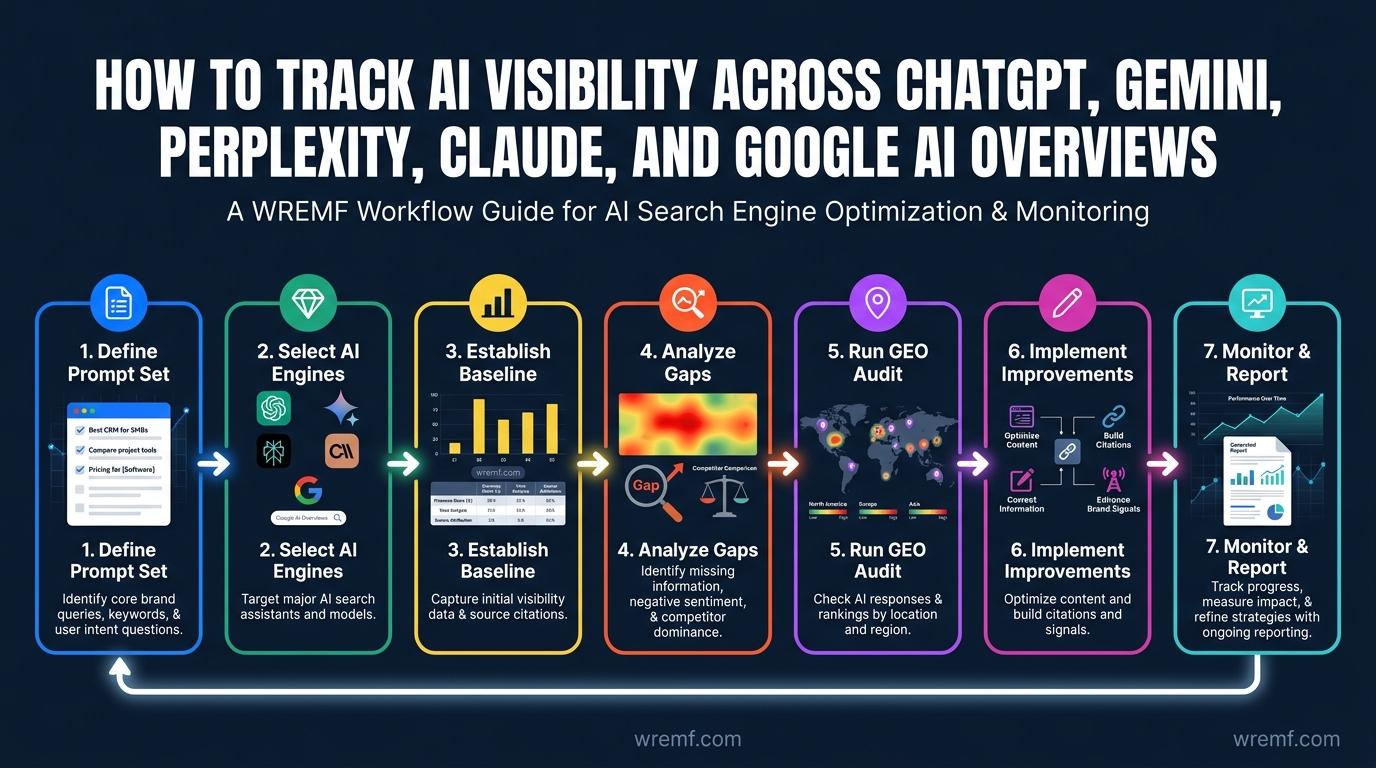
Tracking AI visibility systematically requires a structured process that covers prompt design, engine selection, response collection, analysis, and ongoing monitoring. The following workflow applies whether a team is starting from scratch or improving an existing AI visibility program.
Step 1: Define your prompt set
Build a list of prompts that reflect how your buyers research your category, compare options, and make decisions using AI engines. Include brand-specific prompts, competitive comparison prompts, buyer-intent prompts such as "best software for X", and solution-seeking prompts that do not mention any brand. A strong starting prompt set includes at least 30 prompts across these categories. Use Keyword Research data, sales conversations, and competitor analysis to inform the prompt list.
Step 2: Select the AI engines to track
Prioritise the engines most relevant to your buyers. ChatGPT, Perplexity, Gemini, Claude, and Google AI Overviews cover the majority of AI-assisted discovery journeys for B2B buyers. Depending on the market and audience, Copilot, Grok, DeepSeek, Meta AI, and Mistral may also be relevant. Different engines weight sources differently, so covering multiple engines reveals source consistency issues that single-engine tracking misses.
Step 3: Establish a baseline visibility measurement
Run the full prompt set across all selected engines and record the results. Capture brand mentions, source citations, competitive mentions, and sentiment. This baseline becomes the reference point for measuring improvement over time. The WREMF AI Visibility Index provides a structured baseline score that can be compared across engines and tracked weekly.
Step 4: Analyse citation gaps and competitive patterns
Compare where your brand appears against where competitors appear. Identify which prompts consistently return competitor citations without your brand. Identify which sources the AI engines are citing when they mention your competitors. These citation patterns reveal which content and authority areas to prioritise.
Step 5: Run a GEO audit
Assess your website and content against the structural, semantic, and authority factors that influence AI citation rates. A GEO audit examines content structure, entity clarity, E-E-A-T signals, schema markup, Structured data, internal linking, source credibility of references, and how well content directly answers the types of questions AI engines are processing. Visibility gaps identified in Steps 3 and 4 should map to specific GEO audit findings.
Step 6: Implement content and authority improvements
Based on the GEO audit and citation gap analysis, update existing content, create new content targeting underserved prompts, improve Structured data and schema markup, build citations through credible external references, and strengthen entity consistency across the website. Content teams and SEO teams should work from AI-ready content briefs that specify the prompts, entities, and citation requirements for each piece.
Step 7: Set up monitoring and reporting
Configure scheduled prompt tracking to run at regular intervals. Set up reporting dashboards for internal teams, leadership, or clients. Connect AI visibility data to GA4 attribution to track whether improving AI citations translates into measurable referral traffic. White-label reports are available in WREMF Growth and above, which is useful for agencies managing AI visibility for multiple clients.
Step 8: Iterate based on data
AI responses change as models update, competitor content evolves, and retrieval indexes refresh. Monthly or weekly reviews of visibility score trends, citation patterns, and competitive share of voice should feed directly into the content and authority improvement cycle.
The answer engine optimization guide covers the content strategy and structural optimisation decisions that support this workflow in detail.
KEY TAKEAWAY: A structured AI visibility tracking process requires defined prompts, multi-engine coverage, baseline measurement, citation gap analysis, a GEO audit, content improvements, and ongoing monitoring to produce actionable and measurable results.
Real-World Scenarios: How Teams Use AI Visibility Tools
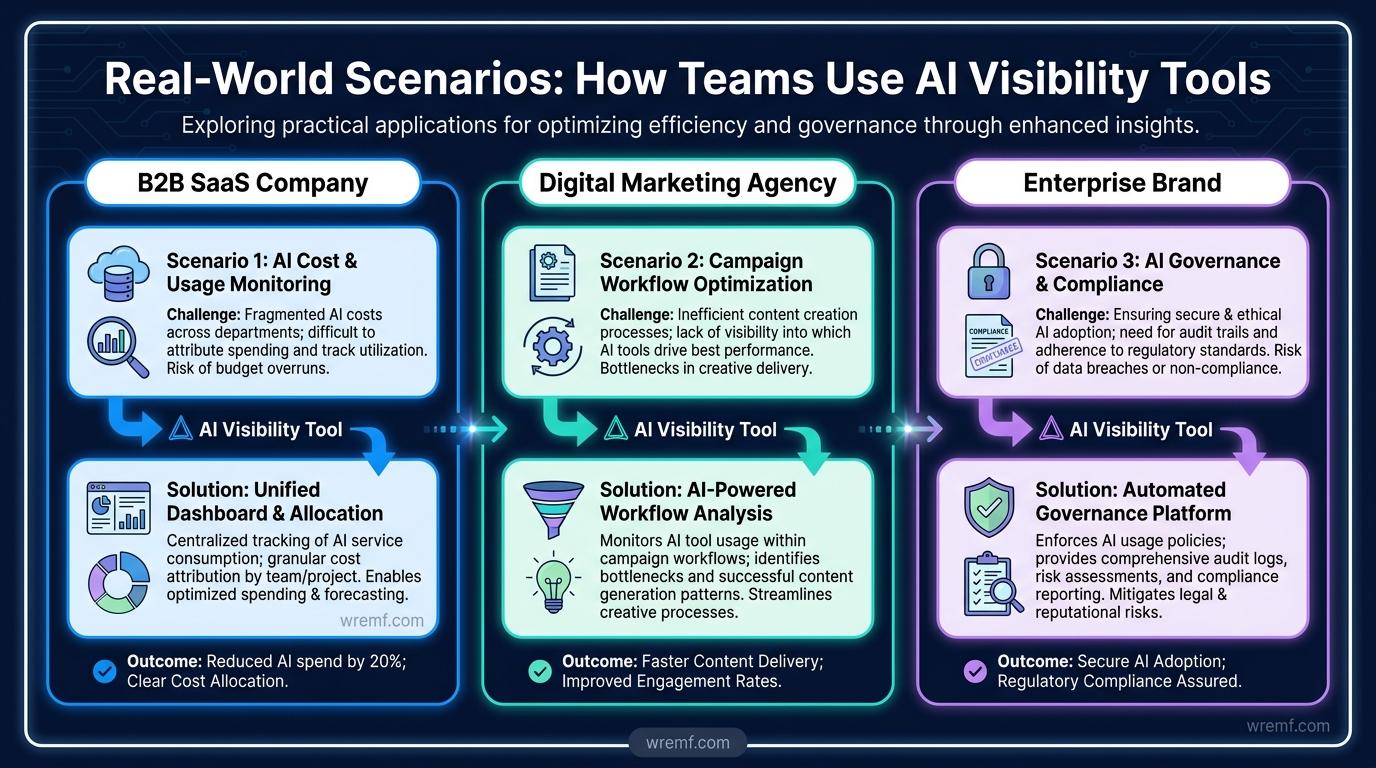
The practical value of an AI visibility tool becomes clearest when applied to specific team contexts. The following scenarios illustrate how different types of organisations use these tools and what they expect from them.
Scenario one: A B2B SaaS company investigating competitor AI presence
A B2B SaaS company with a mature SEO program notices that their organic traffic is stable but pipeline from inbound discovery channels has softened. The head of marketing suspects that buyers are discovering competitors through AI answers before running a traditional Google search. Using WREMF, the team sets up 50 prompts across buyer-intent and competitive comparison categories and tracks responses across ChatGPT, Perplexity, Gemini, and Google AI Overviews. The data shows that two competitors appear in over 60 percent of buyer-intent prompts while the brand itself appears in fewer than 20 percent. Citation analysis reveals that the competitors' long-form comparison pages and third-party review mentions on sites like Reddit and Gartner are being cited frequently. The team uses these insights to build a GEO-optimised content strategy targeting the specific prompts and topics where they are underperforming. A founder or small SaaS team exploring this approach can start with WREMF's Starter plan at 59 euros per month, which covers 10 AI engines, unlimited prompts, BYOK, core prompt intelligence, and basic competitor tracking for up to three competitors.
Scenario two: An agency managing AI visibility for multiple clients
A digital marketing agency is managing SEO and content strategy for eight B2B clients. Several clients are asking about AI visibility and want to know how their brands appear in ChatGPT and Perplexity compared to competitors. The agency needs a platform that supports multiple websites, client workspaces, white-label reporting, competitive benchmarking, and professional-grade exports. Using WREMF Growth at 149 euros per month, the agency tracks five websites and up to 15 competitors, generates white-label reports for client presentations, uses the Looker Studio connector to integrate AI visibility data with existing client dashboards, and accesses GEO audits and a content brief generator to turn insights into deliverables. The client management tools within the Growth plan support the agency's pitch environments and ongoing reporting cadence without requiring a separate platform for each client.
Scenario three: An enterprise brand running a managed AI visibility program
A Fortune 500 technology company wants to build a systematic AI visibility program across multiple product lines and markets. The internal team has strong execution capacity but needs strategic direction on GEO, AEO, citation cleanup, and entity consistency. They engage WREMF's Managed plan, which starts at 1,500 euros per month and includes an AI visibility audit, custom GEO strategy, AEO content optimisation, citation entity and authority cleanup, senior-led execution, strategy calls, a custom roadmap, and monthly reporting. The Managed plan is designed for large agencies, enterprise brands, and multi-market teams that need end-to-end delivery rather than software access alone. Region-specific filtering and language customisation are included to support multi-market prompt tracking.
These scenarios show that AI visibility tools are not one-size-fits-all. The right engagement model depends on team size, internal execution capacity, client complexity, and whether the priority is measurement, strategy, or full execution.
KEY TAKEAWAY: AI visibility tools serve different team types in different ways; a founder needs baseline tracking and prompt intelligence, an agency needs multi-client reporting and white-label workflows, and an enterprise brand needs strategic execution alongside platform access.
Evaluating AI Visibility Tools: What to Look for Before Choosing a Platform
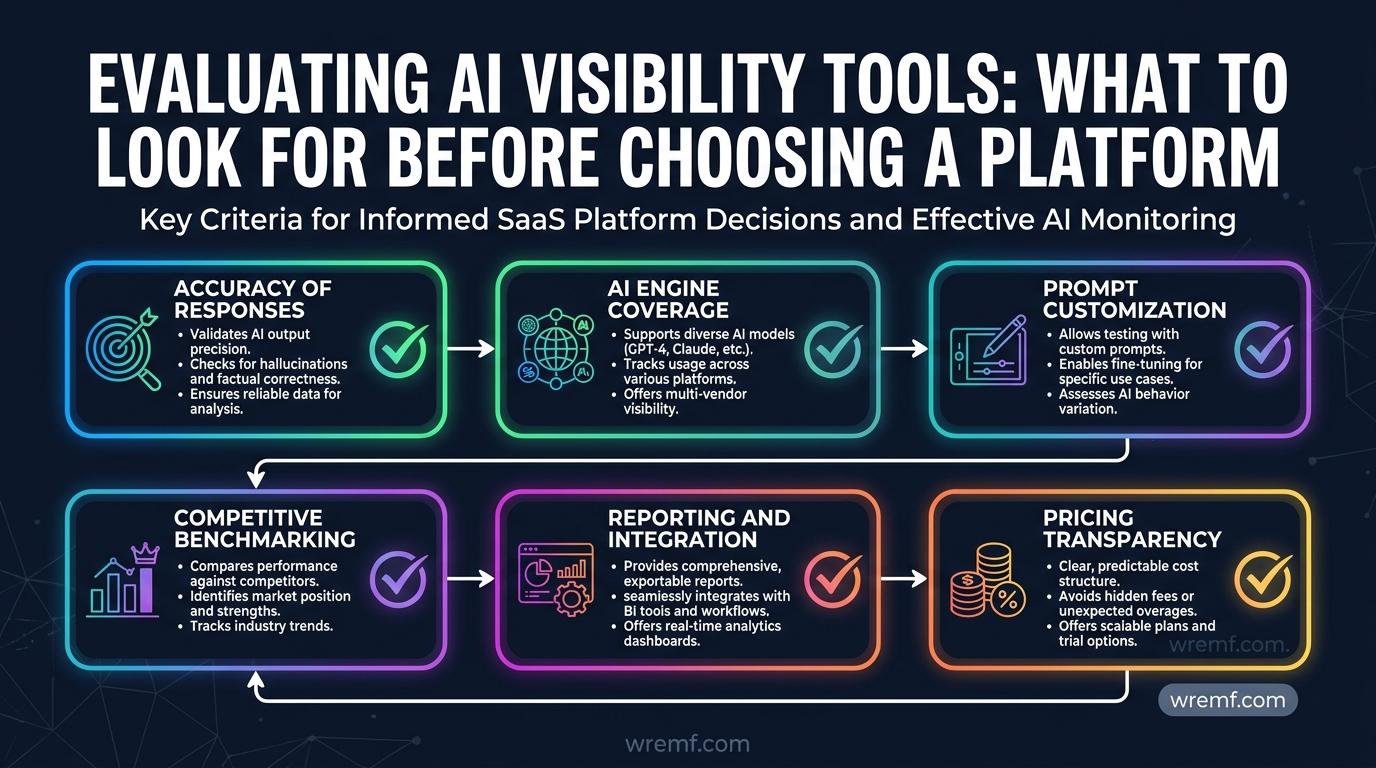
Choosing an AI visibility tool requires evaluating several dimensions that go beyond price and feature lists. The market includes tools that range from basic brand mention monitors to enterprise-grade platforms with deep citation analysis, competitive intelligence, and managed execution options. Evaluating them requires a clear framework.
Accuracy and response fidelity is the first consideration. Some tools query AI engines directly and record real responses. Others use simulated or cached responses that may not reflect what buyers actually see when they use ChatGPT or Perplexity today. Tools that track real AI-generated answers rather than estimating visibility from proxies provide more accurate and actionable data. Accuracy detection, including the ability to identify when an AI engine returns incorrect information about a brand, is a differentiating capability.
AI engine coverage determines which platforms a tool tracks. The minimum useful coverage for a B2B brand in most markets includes ChatGPT, Gemini, Perplexity, Claude, and Google AI Overviews. Broader coverage that includes Copilot, Grok, DeepSeek, Meta AI, and Mistral provides a more complete picture of AI search visibility across the full landscape of AI platforms and AI models that buyers use. Tools that cover only two or three engines will miss visibility patterns that appear on platforms their coverage does not include.
Prompt customisation and volume matter because the quality of AI visibility data depends on the quality and relevance of the prompts being tracked. Tools that limit teams to a small number of prompts or restrict prompt customisation produce incomplete data. Unlimited prompt tracking with BYOK support removes the artificial cost ceiling that per-prompt pricing models create. WREMF includes unlimited prompts and BYOK on every plan, which means teams can build large, well-structured prompt sets without financial constraints changing what they measure.
Competitive benchmarking depth determines how useful the tool is for understanding competitive position rather than just measuring absolute visibility. A tool that shows only a brand's own visibility score without comparing it to competitors provides limited strategic value. Strong competitive benchmarking should show share of voice per engine, per prompt category, and over time, alongside citation source analysis that reveals why competitors appear.
Reporting and integration capabilities affect how the tool fits into existing workflows. White-label reporting is essential for agencies. GA4 integration is essential for teams connecting AI visibility to traffic and revenue. Looker Studio connectors, CSV exports, client workspaces, and API access determine whether the tool can integrate into existing reporting infrastructure or requires separate manual processes.
Pricing transparency is a practical consideration. Some AI visibility platforms require a demo or a sales conversation before revealing pricing, which makes it difficult to evaluate fit before committing time to a conversation. WREMF publishes pricing openly: Starter at 59 euros per month, Growth at 149 euros per month, and Managed from 1,500 euros per month, with a 3-day onboarding window before the first Stripe charge. Teams can compare WREMF pricing plans to assess plan fit before committing.
Free trial availability varies by platform. Several tools in the market offer free trials ranging from 7 to 14 days. WREMF's 3-day onboarding window serves a similar orientation function, with full platform access beginning once onboarding details are submitted.
DID YOU KNOW:
Research tracked by Gartner AI research consistently identifies AI-assisted discovery as an accelerating influence on B2B buying journeys, with buyers using AI answers to shortlist vendors before conducting further research.
KEY TAKEAWAY: Evaluating AI visibility tools requires assessing response accuracy, AI engine coverage, prompt volume flexibility, competitive benchmarking depth, reporting integration, and pricing transparency before selecting a platform.
The Relationship Between SEO, AEO, GEO, and AI Visibility Tools
SEO, AEO, and GEO are three related but distinct disciplines, and understanding how they connect helps teams use AI visibility tools more effectively.
SEO, or search engine optimisation, is the practice of improving a website's visibility in traditional search engine results. It focuses on keyword rankings, technical website health, backlinks, crawlability, and content relevance for Google's SERP. SEO indicators such as domain authority, organic traffic, and keyword positions remain important but do not directly measure AI visibility.
AEO, or answer engine optimisation, is the practice of structuring content so that answer engines and AI systems can extract, synthesise, and present it accurately in response to user questions. AEO focuses on clear content structure, direct answers, entity consistency, E-E-A-T signals, and content that matches the types of questions AI engines are asked. The answer engine optimization services guide covers AEO strategy in depth for teams looking to build these capabilities.
GEO, or Generative Engine Optimization, is the practice of optimising content and website structure so that generative AI systems can find, parse, and cite the content accurately in AI-generated answers. GEO builds on AEO and SEO foundations but adds specific attention to how generative AI workflows retrieve and synthesise content. This includes Structured data, schema markup, internal link structure, source credibility, content depth, and entity authority. The LLM SEO services guide explains how these layers work together for AI search visibility.
AI visibility tools sit at the measurement layer across all three disciplines. They tell teams whether SEO, AEO, and GEO efforts are producing results in actual AI-generated answers. A brand can have strong SEO indicators, well-structured AEO content, and solid GEO optimisation but still have low AI citation rates if key content gaps remain, if entity authority is weak, or if competitors have built stronger citation presence in specific topic areas. AI visibility measurement reveals where the gaps are so that SEO, AEO, and GEO work can be prioritised correctly.
The Knowledge Graph is relevant here because AI engines use entity relationships and authority signals that overlap with Google's structured entity data. Brands with clear, consistent entity definitions, well-attributed content, and strong citation patterns in authoritative sources are more likely to appear in AI-generated answers. Building entity authority is a shared objective across SEO, AEO, GEO, and AI visibility improvement programs.
AI content strategy, content creation workflows, and content optimization decisions should all be informed by AI visibility data. When prompt tracking shows that a brand is absent from AI answers about a specific topic, that gap represents both a GEO content opportunity and an AEO content structure opportunity. When citation tracking shows that a competitor's third-party coverage on sites like Reddit or industry publications is being cited heavily, that reveals an authority gap that content strategy and digital PR can address.
KEY TAKEAWAY: SEO, AEO, and GEO work together to build the foundations that AI visibility tools measure; without all three disciplines aligned, improvements in one area may not translate into better AI citations or higher AI share of voice.
AI Visibility Tool Limitations, Risks, and Honest Caveats
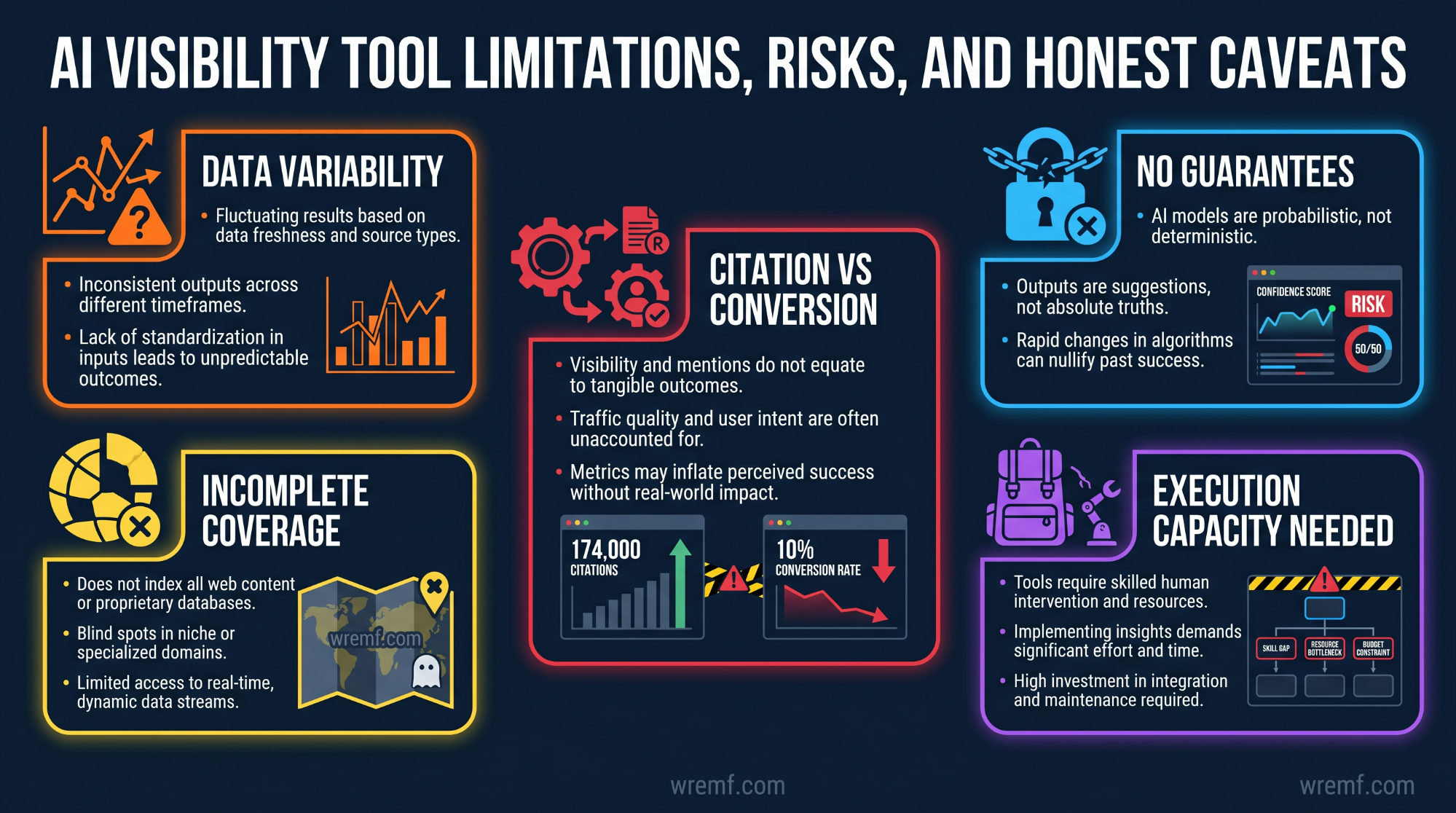
AI visibility tools provide valuable data, but teams that treat AI visibility metrics as fixed, comprehensive, or predictive will make poor strategic decisions. Understanding the genuine limitations of these tools is essential for building a measurement program that is useful rather than misleading.
AI responses are not stable. The same prompt asked to the same AI engine on different days can return different answers. Model updates, retrieval index refreshes, and changes in the source set available to a retrieval-augmented system can all shift which brands appear in a given response. This means that a single snapshot of AI visibility data is never fully representative of persistent visibility. Effective measurement requires consistent tracking over time across multiple prompt executions to identify genuine trends rather than one-off response variations.
Coverage is never complete. No AI visibility tool can query every possible prompt that buyers might use or cover every regional variant, language version, and personalisation context that affects AI responses. A tool that tracks 100 prompts is measuring a sample of the potential prompt space, not the full landscape. Region-specific filtering and language-specific tracking help narrow the gap for multi-market teams, but all AI visibility data should be interpreted as directional rather than exhaustive.
Citation does not equal conversion. Appearing as a cited source in an AI answer is a positive signal, but it does not guarantee that buyers will click through, engage with the content, or convert into customers. AI referral traffic attribution can be incomplete because some AI engines do not pass clear referral signals, and Google Analytics 4 may classify AI-referred sessions under direct traffic depending on the engine and the user's path. Teams should treat AI visibility metrics as leading indicators and cross-reference them with attribution data rather than treating citation counts as standalone performance metrics.
No platform can guarantee AI recommendations. AI visibility tools measure and guide improvement but cannot instruct ChatGPT, Perplexity, Claude, Gemini, or any other AI engine to recommend a specific brand. Improvements in AI citations result from better content, stronger authority, improved entity consistency, and more comprehensive coverage of relevant topics. These improvements increase the probability of being cited but do not control the output of any AI system.
Software-only plans require internal execution capacity. WREMF Starter and Growth plans provide measurement, reporting, and analysis capabilities that are powerful in the hands of teams with the skills and time to act on the data. Teams that have AI visibility data but lack the capacity to run GEO audits, produce optimised content, clean up citations, or improve entity authority will see limited results from measurement alone. For these teams, WREMF's Managed plan or the hybrid model, combining software access with periodic expert execution, is a better fit. The AI SEO agency guide covers what to look for when choosing an execution partner.
Accuracy detection is a differentiating and undervalued capability. Some AI engines occasionally return inaccurate information about brands, including outdated descriptions, incorrect product details, or misattributed features. Tools that do not detect these inaccuracies leave teams unaware of brand perception risks in AI search. Monitoring for AI content accuracy is part of a complete AI brand monitoring program.
IMPORTANT:
AI visibility scores and citation rates reflect current performance based on the prompts and engines tracked. They are useful for identifying gaps and measuring improvement over time but should not be presented to stakeholders as absolute measures of AI search presence without explaining the methodology and sample scope.
KEY TAKEAWAY: AI visibility tools provide directional measurement and strategic guidance but cannot guarantee AI recommendations, cover all possible prompts, or replace internal execution capacity; teams should use them as informed decision-support tools rather than deterministic performance systems.
How WREMF Fits as Software, Managed Service, and Hybrid Execution Partner
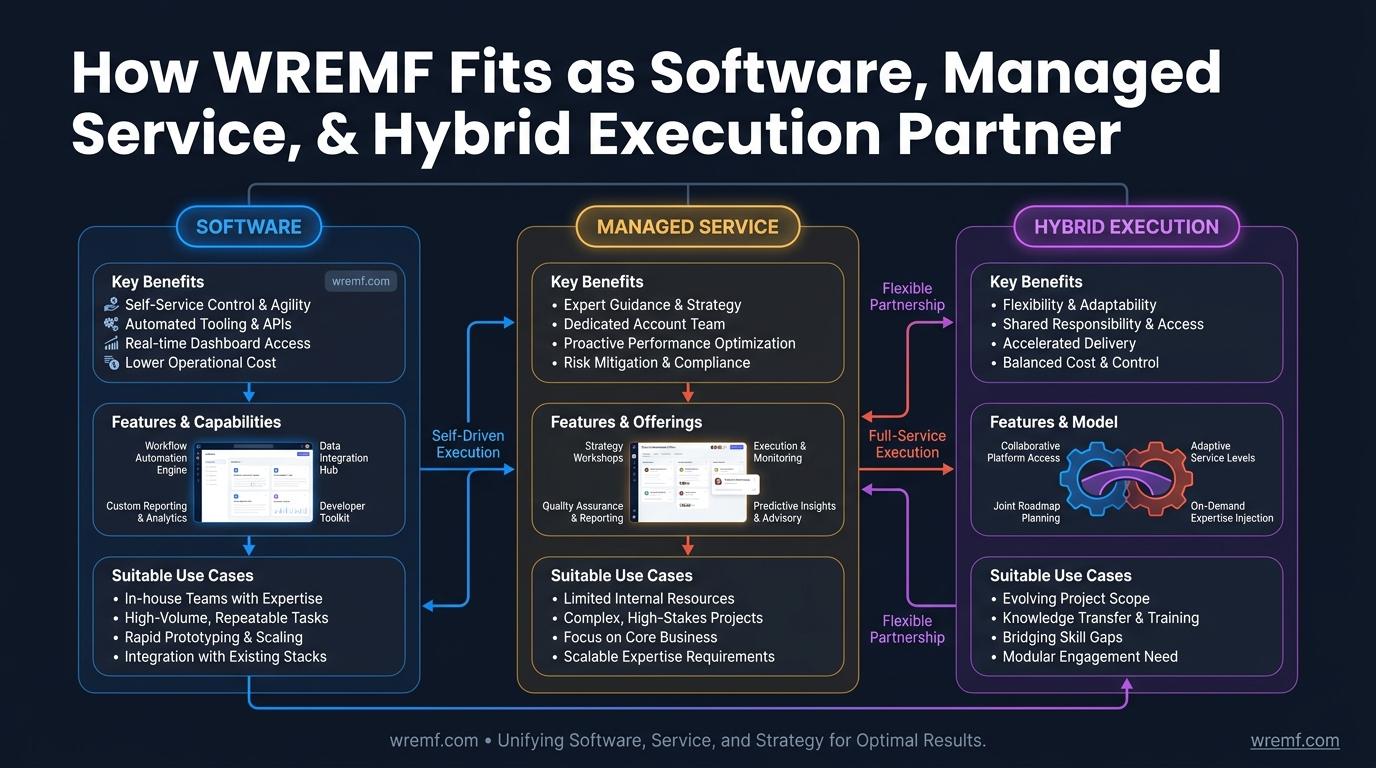
WREMF is designed to support teams at different stages of AI visibility maturity and with different internal execution capabilities. The engagement model a team chooses should reflect their resources, their ambitions, and how quickly they need to move from measurement to improvement.
The software model is best for teams with strong internal SEO, content, or growth capabilities who want to own their AI visibility measurement and improvement program. WREMF software provides 10-engine prompt tracking, unlimited prompts, BYOK, source citation tracking, AI Visibility Index, competitive benchmarking, GEO audits, content brief generation, GA4 attribution, and reporting infrastructure. The Growth plan at 149 euros per month is suitable for B2B marketing teams, SEO teams, in-house growth teams, and agencies managing multiple clients. The Starter plan at 59 euros per month is the right entry point for founders, solo consultants, AI SEO specialists, and small SaaS teams building their first AI visibility baseline.
The managed model is best for teams that need strategy, implementation, and ongoing optimisation support alongside measurement. WREMF Managed starts at 1,500 euros per month and covers everything in the Growth plan plus an AI visibility audit, custom GEO strategy, AEO content optimisation, citation entity and authority cleanup, senior-led execution, strategy calls, a custom roadmap, and monthly reporting. This model is designed for enterprise brands, large agencies, and multi-market teams where the internal team cannot run a full AI visibility program alongside existing workloads. Teams that prefer to speak with the WREMF team before committing to a plan can book a quick call with WREMF
The hybrid model combines software access with selective use of senior WREMF expertise. A team might run WREMF software in-house for daily and weekly monitoring, then engage the WREMF agency team for a GEO audit sprint, a citation cleanup project, or a structured AEO content strategy review. This model is particularly effective for agencies that have strong client relationships and delivery capacity but want strategic AI visibility expertise available for complex briefs. The WREMF agency services page covers the scope of managed and hybrid execution options.
The decision between software, managed, and hybrid comes down to three questions. First, does the team have the internal capacity to act on AI visibility data? If the answer is yes, the software model delivers strong value. Second, does the team need strategic direction alongside measurement? If the answer is yes, the managed or hybrid model is more appropriate. Third, is the team managing multiple clients or brands? If the answer is yes, the Growth plan's white-label reporting, client workspaces, and competitive benchmarking are the relevant capabilities to evaluate.
Every WREMF plan includes 10-engine AI visibility tracking and BYOK. Higher plans add deeper reporting, attribution, white-label workflows, API access, MCP integration, and managed execution. There are no per-prompt markups on any plan.
KEY TAKEAWAY: WREMF's three engagement models, software, managed, and hybrid, are designed to match different team resources and AI visibility maturity levels; the right choice depends on internal execution capacity, the number of brands or clients being tracked, and whether strategic execution support is needed.
Common Misconceptions About AI Visibility Tools and AI Search Measurement
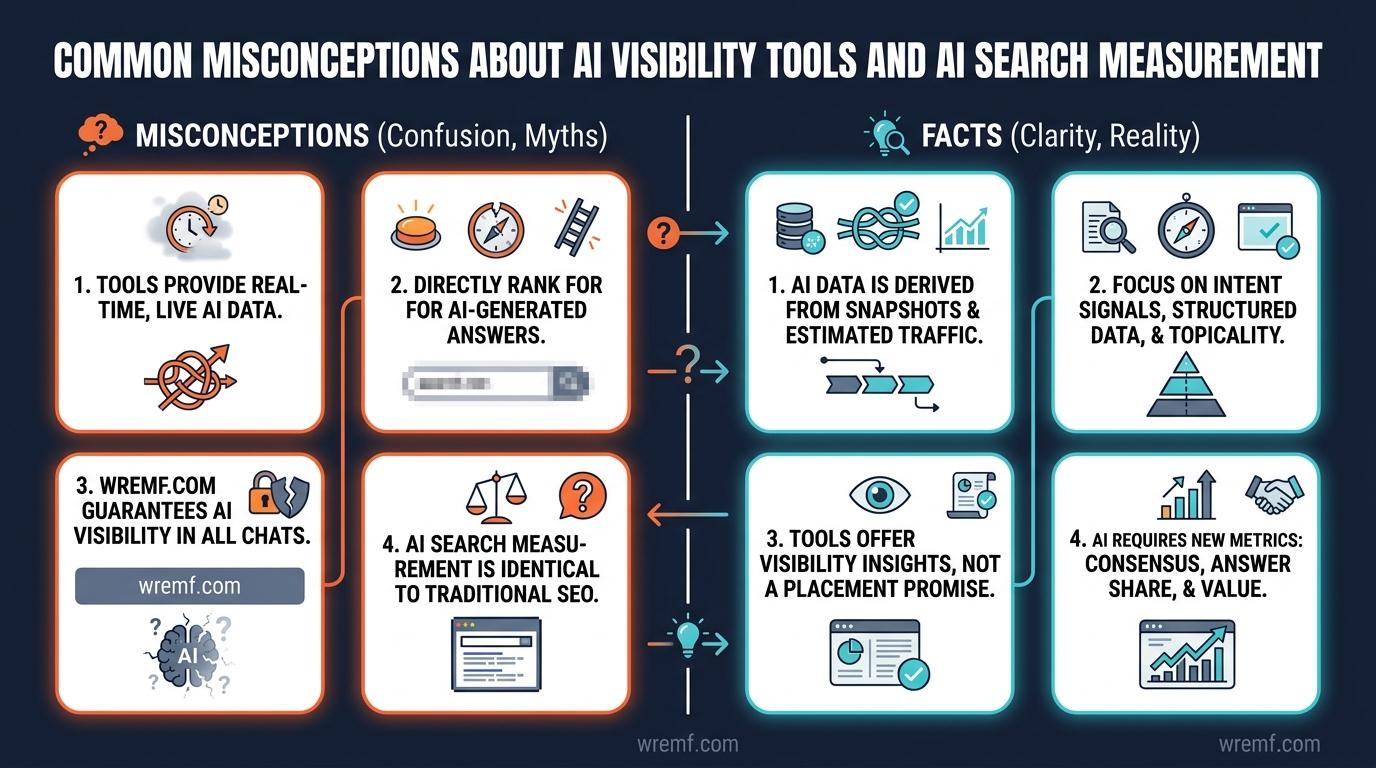
MYTH: If a brand ranks well on Google, it will automatically appear in AI-generated answers.
FACT: Google rankings and AI citation presence are related but not equivalent. AI engines select sources based on factors including content structure, entity authority, topic coverage depth, and retrieval relevance, not simply organic search position. A brand can rank in the top three on Google for a keyword and still be absent from ChatGPT, Perplexity, or Google AI Overviews responses about the same topic. AI visibility requires its own measurement and optimisation program.
MYTH: AI visibility cannot be measured reliably because AI answers are always changing.
FACT: AI responses do vary across time and context, but structured prompt tracking across multiple engines and regular intervals produces directional data that is reliable enough for strategic decision-making. AI visibility tools measure trends, share of voice, citation patterns, and competitive gaps rather than claiming that any single response is permanent. The variability of AI answers is a reason to track systematically, not a reason to avoid measurement.
MYTH: Investing in AI visibility optimisation guarantees that an AI engine will recommend the brand.
FACT: No tool, agency, or strategy can guarantee that ChatGPT, Gemini, Perplexity, Claude, or any other AI engine will recommend a specific brand. GEO and AEO improvements increase the probability of being cited by improving content structure, entity authority, source credibility, and topic coverage. Measurement tracks whether those improvements are working. The outcome is better visibility over time, not a guaranteed placement.
MYTH: AI visibility tools and traditional SEO tools serve the same purpose, so there is no need to invest in both.
FACT: Traditional SEO tools measure SERP rankings, backlinks, technical health, and crawlability on Google and Bing. AI visibility tools measure prompt-level brand presence, source citations, AI share of voice, and visibility scoring across AI engines. These are structurally different measurement systems tracking different discovery surfaces. Teams that only use traditional SEO tools are blind to how their brand performs in the AI-generated answers that an increasing proportion of buyers consult before visiting a website.
MYTH: A high visibility score from one AI engine means the brand is visible across all AI platforms.
FACT: AI engines weight sources differently, update their retrieval indexes on different schedules, and draw on different training data. A brand with strong visibility on Perplexity may have low visibility on Google AI Overviews or Claude. Source consistency, the measure of whether a brand is cited accurately and consistently across multiple AI engines, is a separate and important metric that only emerges from multi-engine tracking.
KEY TAKEAWAY: The most costly misconceptions about AI visibility tools involve assuming that Google rankings translate automatically to AI citations, that AI answers cannot be tracked, and that optimisation guarantees placement; none of these assumptions hold up against how AI retrieval systems actually work.
Conclusion
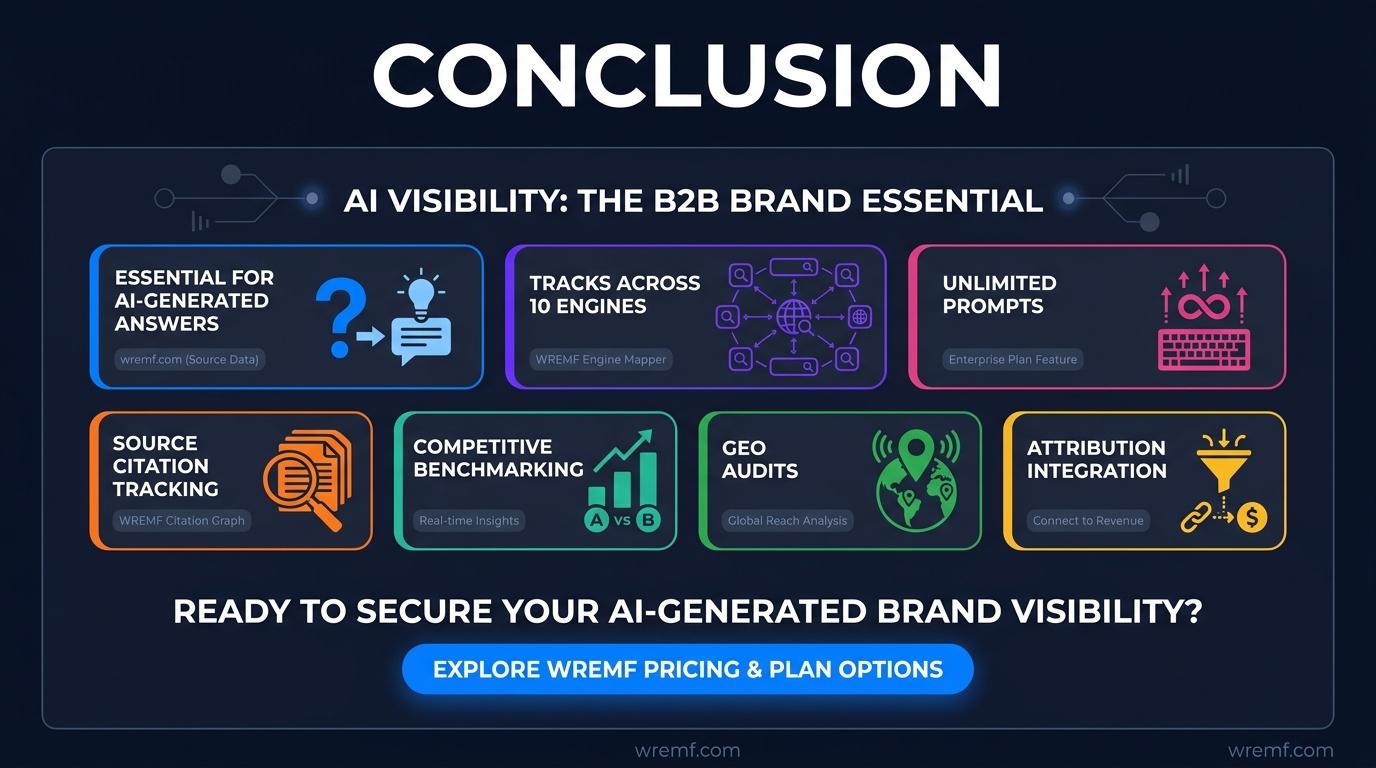
AI visibility tools have moved from a niche interest to a practical requirement for B2B brands and agencies that want to understand and improve how they appear in AI-generated answers. The brands appearing in ChatGPT, Perplexity, Gemini, Claude, and Google AI Overviews answers are being shortlisted before a buyer ever reaches a website. Measuring and improving that presence requires tools built specifically for prompt-based discovery, not adaptations of traditional SEO platforms. WREMF tracks AI visibility across 10 engines with unlimited prompts, source citation tracking, competitive benchmarking, GEO audits, and attribution integration. Whether a team needs self-serve software, full managed execution, or a hybrid approach, WREMF is built to match the resource and maturity level of the team using it. Explore WREMF pricing and plan options to find the right starting point.
Frequently Asked Questions About AI Visibility Tools
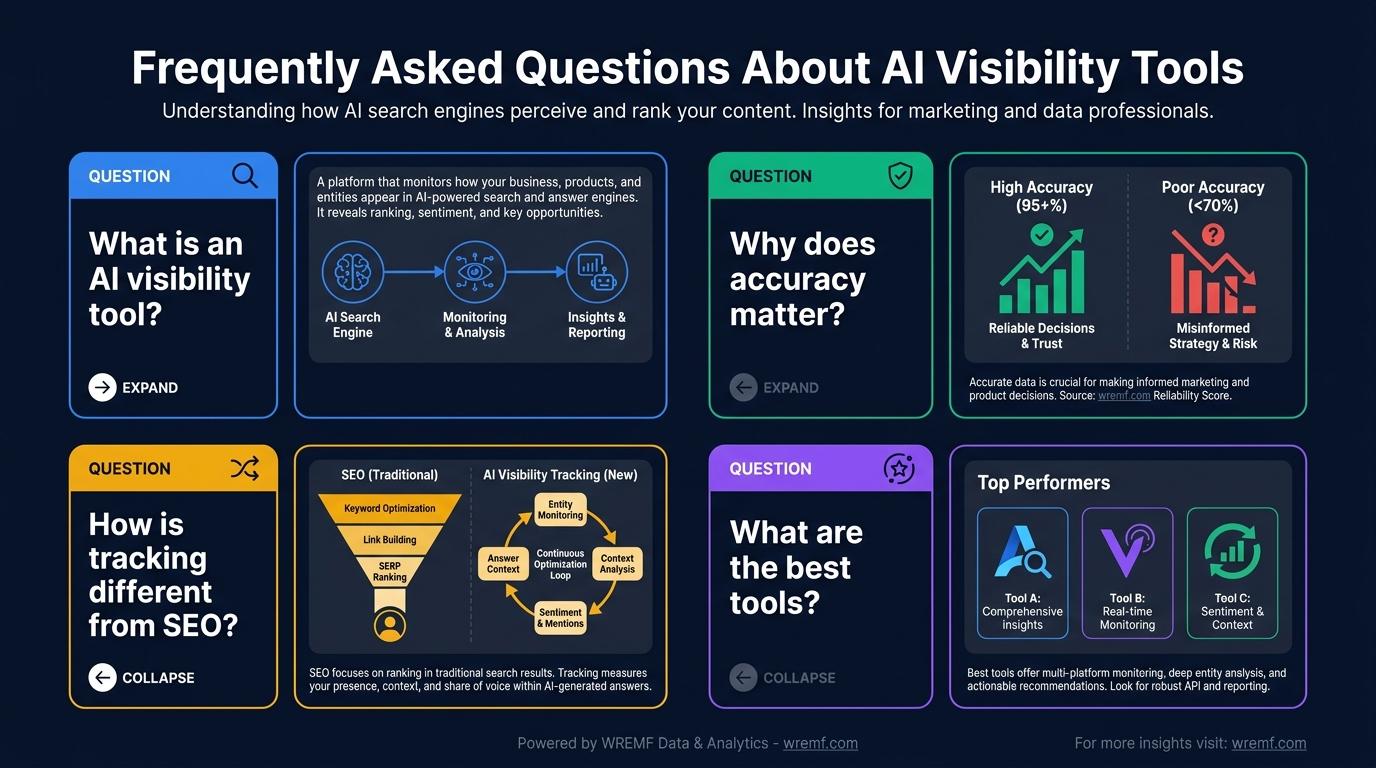
What is an AI visibility tool?
An AI visibility tool tracks how your brand appears across AI-powered discovery surfaces such as ChatGPT, Gemini, Claude, Perplexity, Google AI Overviews, and Copilot. It monitors whether your brand is mentioned in AI-generated answers, which prompts trigger those mentions, how competitors are positioned, and whether the information AI engines surface about you is accurate. Unlike traditional rank tracking, which measures position in search results, AI visibility tools measure citation presence, source attribution, share of voice, and brand perception inside AI responses. Teams use these platforms to understand and improve how AI engines represent their brand.
Why does accuracy matter more than just tracking whether you are mentioned?
Being mentioned in AI answers is not enough if the information is wrong. AI engines frequently hallucinate details such as pricing, features, product names, and company positioning. A brand could appear in dozens of AI responses and still lose buyer trust if those responses contain incorrect claims. In real-world audits, teams routinely discover that AI platforms are quoting outdated pricing, misattributing product capabilities, or describing a brand in ways that conflict with its current positioning. The core question is not whether AI mentions your brand, but what AI is saying about you and whether it is accurate. Accuracy detection is therefore one of the most important capabilities to evaluate in any AI visibility tool.
How is AI visibility tracking different from traditional SEO?
Traditional SEO measures keyword rankings, organic click-through rates, and backlink profiles in search engine results pages. AI visibility tracking measures something different: whether your brand is cited, recommended, or described inside AI-generated answers across platforms like ChatGPT, Perplexity, Gemini, and Google AI Overviews. When a buyer asks an AI assistant for a recommendation, no ranked list appears. One answer is generated. If your brand is absent from that answer, you do not exist to that buyer at that moment. AI visibility tools are purpose-built to track this layer of discoverability, which traditional SEO platforms were not designed to measure.
Do I need AI visibility tracking if my brand already ranks well on Google?
Yes. Strong organic rankings do not guarantee visibility in AI-generated answers. Google AI Overviews, ChatGPT, Claude, Perplexity, and other AI engines draw from their own knowledge bases, retrieval systems, and cited sources, which do not always align with organic search rankings. A brand ranking on page one of Google can be entirely absent from AI-generated recommendations for the same query. Conversely, some brands with modest organic rankings appear frequently in AI answers because their content structure, entity clarity, and citation profile align well with how AI engines retrieve and synthesise information. Tracking both traditional search performance and AI visibility is increasingly necessary for complete search coverage.
What is AI share of voice and why does it matter?
AI share of voice measures how often your brand appears in AI-generated answers compared to competitors for a defined set of prompts. It is the AI equivalent of share of voice in paid or organic search. If ten prompts relevant to your category are tracked and your brand appears in four of them while a competitor appears in eight, your AI share of voice is 40% against their 80%. This competitive gap is often invisible to teams relying on traditional SEO data alone. According to Gartner's AI research, AI-driven information discovery is reshaping buyer behaviour, making competitive visibility inside AI answers a strategically relevant metric for B2B marketing teams.
How does an AI visibility tracker work?
An AI visibility tool submits a structured set of prompts to AI platforms such as ChatGPT, Gemini, Perplexity, and Claude, then analyses the responses for brand mentions, citations, competitor references, sentiment, and source attribution. The tool stores these results over time to identify trends, measure share of voice, and detect accuracy issues such as hallucinated pricing or incorrect feature descriptions. More advanced platforms also map which source content influenced the AI response, identify citation gaps, and generate recommendations for improving visibility. WREMF's prompt intelligence feature automates this process across ten AI engines simultaneously, removing the need for manual prompt testing.
When someone asks ChatGPT a question about your industry, does your brand get mentioned?
Most brands do not know. When a buyer asks ChatGPT, Gemini, or Claude a question such as "What is the best project management tool for remote agencies?", the AI generates one consolidated answer that typically names three to five products. If your brand is absent from that answer, it does not appear to that buyer at all, regardless of how well your website ranks in traditional search. This is the core problem AI visibility tracking solves. The first step is identifying which prompts are relevant to your category, then systematically measuring whether your brand appears and how it is described across those prompts and across different AI platforms.
What is the difference between AI mentions and AI citations?
An AI mention is any reference to your brand name inside an AI-generated answer, whether positive, neutral, or inaccurate. An AI citation is a specific reference to a source document, URL, or piece of content that the AI engine used to construct its answer. Citations are more commercially valuable than mentions alone because they indicate that AI engines are treating your content as a credible source. A brand can be mentioned without being cited, which often indicates the AI is drawing on generalised training data rather than specific, retrievable content. Tracking both mentions and citations helps teams understand not just whether AI talks about their brand, but whether their content is being used as a trusted reference. Teams can explore this distinction further using WREMF's source citation tracking.
What are search-backed prompts and why do they matter for AI visibility?
Search-backed prompts are queries submitted to AI engines that trigger retrieval-augmented generation, meaning the AI searches the live web or a specific index before generating its answer. Platforms like Perplexity, Google AI Overviews, and certain ChatGPT configurations use this approach. For brands, search-backed prompts matter because they create an opportunity for real-time content to influence AI-generated answers. If your content is crawlable, well-structured, and aligned with the query intent, it can be retrieved and cited even in responses generated from live search. Understanding which prompts in your category trigger search-backed generation versus pure model recall helps teams prioritise content and citation efforts more effectively.
Does AI actually crawl and cite your content?
AI engines vary significantly in how they retrieve and cite content. Retrieval-augmented systems like Perplexity and Google AI Overviews actively crawl and retrieve live content, meaning well-structured, crawlable pages have a direct opportunity to be cited. Model-based systems like standard ChatGPT responses draw from training data rather than live retrieval, which means citation influence operates through the sources that were included in training. In both cases, content structure, entity clarity, E-E-A-T signals, and schema markup influence how reliably a page is retrieved and cited. According to Google's AI Overviews documentation, content eligible for AI Overviews must meet quality and relevance thresholds that align with established quality guidelines.
What sources do AI engines trust, and how do you get your brand cited more often?
AI engines tend to trust sources with strong entity authority, consistent brand signals across the web, structured and well-formatted content, credible third-party references, and established topical relevance in a given category. Getting cited more often involves building content that directly answers the types of questions AI engines receive, improving entity consistency across your website and external sources, developing third-party mentions from credible publications, implementing schema markup to clarify content structure, and ensuring your brand positioning is clear and consistent across all surfaces. This combination of on-site content quality and off-site authority development forms the foundation of effective generative engine optimization.
Why do brands lose visibility in AI answers?
Brands lose AI visibility for several common reasons. Thin or vague content fails to satisfy the specific question types AI engines receive. Inconsistent entity signals across a website, social profiles, and third-party sources confuse AI models about what a brand does and who it serves. Outdated content causes AI engines to rely on stale training data rather than current positioning. Lack of structured markup reduces the retrievability of key pages. Poor citation profiles mean the brand has few credible third-party references to draw authority from. In AI visibility audits, teams frequently discover that content written for traditional keyword ranking performs poorly in AI retrieval because it lacks the direct, answer-first structure that generative engines prefer.
How consistent is brand perception across ChatGPT, Gemini, and Perplexity?
Brand perception varies significantly across AI platforms because each system uses different training data, retrieval mechanisms, and response generation logic. A brand described as a market leader in ChatGPT responses may be described as a niche tool in Perplexity, or may not appear at all in Gemini. This inconsistency reflects differences in which content each platform retrieves and how each model interprets brand signals. Tracking perception across multiple engines is important because buyers use different AI platforms at different points in their research process. Multi-engine monitoring identifies where perception gaps exist and helps teams prioritise which platform to address first based on audience overlap and business impact.
Can AI visibility improve traditional SEO performance?
There is a meaningful overlap between the factors that improve AI visibility and those that improve traditional SEO. Content that is well-structured, authoritative, entity-consistent, and directly answers user questions tends to perform better in both AI-generated answers and organic search rankings. Improvements to schema markup, internal linking, E-E-A-T signals, and content clarity benefit both channels. However, optimising purely for AI visibility sometimes requires different content formats, such as direct answer-first structures and FAQ-style content, that traditional SEO content does not always prioritise. Teams that invest in AI-ready content optimisation typically see complementary improvements across both AI visibility and traditional search performance over time.
What should marketing agencies look for in an AI visibility tool?
Agencies managing multiple clients need AI visibility tools with white-label reporting, multi-client workspace management, and flexible data export options. Key capabilities to evaluate include: prompt-level tracking that shows which questions trigger brand mentions, source citation attribution, competitor benchmarking across AI platforms, sentiment analysis that reveals how a brand is being described rather than just whether it appears, and integration with reporting workflows such as Looker Studio or GA4. Native API access is important for agencies building custom dashboards. Tools limited to CSV exports create unnecessary manual overhead at scale. For agencies that also need execution support, WREMF's agency offering combines white-label software with optional managed AI visibility services.
What are the best AI visibility tools for marketing agencies?
The best AI visibility tools for agencies combine multi-client management, white-label reporting, deep competitor analysis, and prompt-level citation tracking. Platforms worth evaluating include WREMF, Profound, and Otterly.ai. WREMF is purpose-built for agencies and B2B teams, tracking ten AI engines with white-label reporting, BYOK support, Looker Studio integration, and optional managed execution. Profound offers enterprise-level prompt monitoring with strong data volume. Otterly.ai provides accessible entry-level monitoring. The right choice depends on the number of clients, required depth of analysis, reporting workflow requirements, and whether the agency needs software only or a combined software and managed AI visibility service. Teams can compare options at WREMF's AI visibility tools comparison.
How much do AI visibility tools cost?
AI visibility tool pricing varies widely depending on platform depth, the number of AI engines tracked, prompt volume, and whether managed services are included. Entry-level tools with basic mention tracking typically start around $29 to $79 per month. Mid-tier platforms with competitive analysis, citation tracking, and reporting integrations typically range from $100 to $300 per month. Enterprise and managed solutions range from several hundred to several thousand dollars per month depending on scope. WREMF's Starter plan begins at €59 per month and includes unlimited prompt tracking across ten AI engines. The Growth plan at €149 per month adds GEO audits, share of voice, white-label reports, and GA4 attribution. Managed execution starts from €1,500 per month. Full pricing details are available at WREMF pricing.
Is there a free trial available for AI visibility tools?
Many AI visibility platforms offer free trials or limited free tiers. WREMF includes a 3-day onboarding window before the first charge begins, allowing teams to set up their workspace and run initial tracking before committing. Some entry-level tools offer 7-day free trials with restricted features. When evaluating a free trial, test whether the platform tracks the specific AI engines relevant to your audience, whether it detects accuracy issues and hallucinations rather than just mentions, and whether the reporting format suits your team or clients. A trial that only answers "are we mentioned?" may not reveal the depth of data needed for strategic decision-making.
What is the difference between LLM monitoring and AI search monitoring?
LLM monitoring tracks how large language models such as GPT-4, Claude, and Gemini describe a brand in their generated responses, based primarily on model training data and inference behaviour. AI search monitoring tracks visibility in AI-powered search environments such as Perplexity, Google AI Overviews, and Microsoft Copilot, which combine language model generation with real-time web retrieval. The distinction matters because optimisation strategies differ. LLM monitoring informs entity authority and brand signal consistency work. AI search monitoring informs content structure, crawlability, and citation source optimisation. Comprehensive AI visibility tools cover both layers. As OpenAI's research continues to evolve retrieval-augmented capabilities, the boundary between the two categories is narrowing.
How is AI visibility score calculated?
AI visibility scores vary by platform but generally measure a combination of mention frequency, citation rate, share of voice against competitors, sentiment consistency, and accuracy across a defined set of tracked prompts and AI engines. A higher score reflects broader and more accurate representation across AI-generated answers. Some platforms weight citation quality differently from raw mention counts, and some apply regional or language-specific filters. The most useful visibility scores are decomposable, meaning teams can see which prompts, competitors, engines, or content types are driving score changes. WREMF's AI Visibility Index aggregates signal across ten AI engines and connects score movements to specific prompt and citation data.
Can Google Analytics 4 track traffic from AI search?
Google Analytics 4 can capture some traffic from AI sources, but its default attribution is limited. Traffic from Perplexity and some other AI platforms arrives as referral traffic and can be identified by source. Traffic generated by users who click through from Google AI Overviews is typically classified differently from standard organic sessions, as noted in Google's AI Overviews documentation. Traffic from conversational AI platforms like ChatGPT is largely invisible in GA4 because most AI interactions do not generate direct click referrals. Dedicated AI visibility tools bridge this gap by tracking brand presence at the prompt level rather than relying solely on click-through attribution, giving teams a fuller picture of how AI discovery influences the buyer journey.
What is entity clarity and why does it matter for AI visibility?
Entity clarity refers to how consistently and precisely AI engines understand what your brand does, who it serves, and how it fits within its product category. When entity clarity is weak, AI engines may describe a brand in vague, inaccurate, or conflicting terms across different platforms and prompts. This happens when a brand's content uses inconsistent terminology, lacks clear category signals, or has sparse third-party corroboration. Improving entity clarity involves aligning on-site language, structured data, schema markup, and external brand mentions around consistent, specific positioning. Strong entity clarity increases the reliability with which AI engines retrieve and accurately describe a brand, directly improving both AI visibility scores and citation accuracy.
What is Generative Engine Optimization and how does it relate to AI visibility tools?
Generative Engine Optimization (GEO) is the practice of structuring content, building authority, and optimising technical foundations so that AI-powered answer engines are more likely to retrieve, cite, and recommend a brand. It extends traditional SEO principles into the AI discovery layer by focusing on answer-first content formats, entity consistency, source citation signals, and structured markup that AI engines can parse reliably. AI visibility tools support GEO by identifying which prompts a brand does and does not appear in, which competitors are being cited instead, and which source content is driving AI responses. Without measurement, GEO optimisation is directionally blind. Tracking tools make it possible to test changes and observe their effect on citation rates and share of voice over time.
When should a team use software only versus hiring an AI visibility agency?
Software-only AI visibility tools are best suited for teams with strong internal SEO, content, and technical execution resources that need measurement and insight but can act on findings independently. An AI visibility agency is more appropriate when a team lacks the internal capacity to interpret findings, develop strategy, and implement optimisation changes across content, technical structure, and authority signals. A hybrid model, combining a software platform with managed execution, suits companies that want reliable measurement alongside expert strategy and implementation without building a specialist in-house team. WREMF's managed service covers the full workflow from audit through to ongoing optimisation, with senior-led execution and monthly reporting included from €1,500 per month.
What additional features should teams consider when evaluating AI visibility tools?
Beyond basic mention tracking, teams should evaluate: prompt-level granularity that shows exactly which questions trigger brand mentions, source attribution that identifies which content is driving AI citations, sentiment and perception analysis that reveals how a brand is described rather than just whether it appears, competitor benchmarking across multiple AI platforms, schema and structured data audit capabilities, integration with GA4 and third-party reporting tools, white-label reporting for agency use cases, and API access for custom workflow integration. Teams building long-term AI visibility programmes should also assess whether the platform offers content brief generation and actionable optimisation recommendations rather than reporting alone. Platforms that combine measurement with direction are more operationally useful than dashboards that only display current state.
What is the future of AI visibility tracking through 2026 and 2027?
AI visibility tracking is expected to become significantly more complex and commercially important over the next two years. AI Mode in Google Search, expanded Perplexity capabilities, and deeper AI integration in Microsoft Copilot are increasing the share of information discovery that happens inside AI-generated answers rather than traditional search results. As McKinsey's AI insights continue to document the acceleration of enterprise AI adoption, marketing teams face growing pressure to demonstrate AI-channel visibility as a distinct performance metric. Tracking capabilities are expected to evolve toward real-time citation monitoring, prompt-intent mapping, AI agent visibility, and pipeline-level attribution that connects AI mentions to revenue outcomes rather than just traffic.
How do I check my brand's visibility in ChatGPT?
The most systematic way to check brand visibility in ChatGPT is to submit a structured set of prompts relevant to your product category, buyer persona, and purchase decision stage, then analyse the responses for brand mentions, competitor mentions, accuracy, and source citations. Doing this manually at scale is impractical because results vary across sessions, model versions, and user contexts. AI visibility tools automate this process by running controlled prompt sets at regular intervals and aggregating results into trackable trends. For a quick initial check, running ten to twenty manually crafted prompts in ChatGPT across different query types such as comparison, recommendation, and problem-solution formats gives a useful first signal of current AI presence and accuracy.
Does schema markup actually impact AI search visibility?
Schema markup improves the ability of AI crawlers and search engines to parse structured information about a brand, product, or piece of content. For AI search platforms that use real-time retrieval, such as Google AI Overviews and Perplexity, properly implemented schema can increase the likelihood that structured data such as FAQs, product details, pricing, and reviews are retrieved and included in generated answers. According to Schema.org documentation, structured data provides explicit semantic signals that help systems understand content meaning beyond surface-level text analysis. While schema markup alone does not guarantee AI citations, it is a consistent technical foundation for AI-ready content. Teams often discover during GEO audits that schema coverage is incomplete or inconsistent across their highest-value pages.
What is AI visibility and why does it matter for B2B brands?
AI visibility refers to how prominently and accurately a brand appears in AI-generated answers, recommendations, and citations across platforms including ChatGPT, Gemini, Claude, Perplexity, Google AI Overviews, and Copilot. For B2B brands, AI visibility matters because an increasing share of early-stage buyer research now happens inside AI assistants rather than traditional search engines. When a B2B buyer asks an AI platform for a software recommendation, a vendor comparison, or an industry explanation, the brands that appear in those answers gain disproportionate awareness and consideration. Brands that are absent lose visibility at the exact moment buyer intent is forming. VentureBeat's AI coverage consistently documents how generative AI is reshaping enterprise software discovery and purchase behaviour.
How do brand performance reports work in AI visibility platforms?
Brand performance reports in AI visibility platforms aggregate data from tracked prompts across multiple AI engines to show how a brand is mentioned, cited, described, and compared over time. A typical report covers mention rate by engine, share of voice against named competitors, accuracy flags where AI descriptions conflict with known brand facts, citation source breakdown showing which content is driving visibility, and sentiment summary across positive, neutral, and negative characterisations. The most useful reports are segmented by prompt type, buyer stage, and geographic or language filter. WREMF's sample report demonstrates how these metrics are presented for client review, including white-label formatting for agencies presenting AI visibility data to their clients.
Why should brands compare AI visibility across different AI models?
Different AI models train on different data, apply different retrieval logic, and weight brand signals differently. A brand that appears prominently in Perplexity responses may be absent from Gemini, or described in conflicting terms across ChatGPT and Claude. Buyers use different AI platforms depending on their workflow, industry, and device context, so limiting monitoring to one platform creates blind spots in competitive visibility analysis. Comparing performance across models also helps teams identify which optimisation actions have the broadest cross-platform impact versus those that only influence a single engine. Multi-engine tracking is a core feature of purpose-built AI visibility tools and a significant advantage over manual prompt testing, which cannot reliably scale across multiple platforms simultaneously.
Related reading
- AI Search Tracker: The Complete Guide to Monitoring Brand Visibility Across AI Engines
- AI Citation Optimization Services: The Complete B2B Guide to Getting Cited in AI Search
- Enterprise LLM Visibility Tracking: The Complete Guide for B2B Teams
- LLM SEO Services: The Complete 2026 Guide to AI Search Visibility, AEO, GEO, and LLM Optimization
- The Complete Guide to AI Search Visibility Tools for B2B Brands and Agencies
- AI Brand Visibility: The Complete B2B Guide to Tracking, Measuring, and Improving How AI Engines Mention Your Brand