The Complete Guide to AI Visibility Optimization for B2B Brands
Learn AI visibility optimization to boost B2B brand presence in AI-generated content through structured programs and measurement frameworks.
By WREMF Team · 2026-09-20
AI visibility optimization enhances how AI engines mention, cite, and recommend a brand across prompts. It involves structuring content, ensuring entity authority, maintaining source consistency, and using technical signals to increase brand visibility in AI-generated answers. This practice differs from traditional SEO, addressing how engines like ChatGPT, Gemini, and Google AI Overviews select sources. Key components include prompt monitoring, citation analysis, and AI share of voice. Brands must foster authority, ensure entity consistency, and lead with clear content to succeed.
Key takeaways
- AI visibility optimization targets AI engines' answers, distinct from SEO rankings.
- Core signals include content structure, authority, and entity consistency.
- AI visibility is measured via prompt tracking, citation analysis, and visibility metrics.
- Platforms like WREMF offer software, managed, and hybrid models for visibility.
- A separate strategy for prompt-based discovery is essential alongside traditional SEO.
The Complete Guide to AI Visibility Optimization for B2B Brands

AI visibility optimization is the practice of structuring content, authority signals, and technical foundations so that AI engines mention, cite, compare, and recommend your brand across prompt-based discovery journeys. As buyers increasingly turn to ChatGPT, Gemini, Perplexity, Google AI Overviews, Claude, and other answer engines to research products and shortlist vendors, appearing in those answers has become a measurable business priority. This guide is written for B2B SaaS marketers, SEO teams, agency professionals, and growth leaders who need to understand what AI visibility optimization involves, how to measure it, and how to build a sustainable program around it. The page covers the full scope of AI visibility optimization, from foundational definitions and measurement frameworks to GEO audits, prompt tracking, citation analysis, source consistency, AI share of voice, and the decision between software, managed, and hybrid execution models. WREMF is referenced throughout as a practical tool and managed service option for teams building AI visibility programs from the ground up or scaling existing ones.
QUICK ANSWER:
AI visibility optimization is the process of improving how AI search engines, large language models, and answer engines mention, cite, and recommend a brand across relevant prompts. It combines content structure, entity authority, source consistency, and technical signals to increase the likelihood that AI engines surface a brand in generated answers. Teams track AI visibility using prompt monitoring, citation analysis, AI share of voice, and AI referral traffic attribution across platforms including ChatGPT, Gemini, Perplexity, Google AI Overviews, and Claude.
KEY TAKEAWAYS:
- AI visibility optimization differs from traditional SEO because it targets how AI engines generate answers, not just how search engines rank pages.
- ChatGPT alone processes more than 2.5 billion prompts every day, and Google AI Overviews now reach 2 billion users each month, making AI-generated answers a significant discovery surface for B2B buyers.
- The core signals that influence AI citations include content structure, entity consistency, source authority, and the quality of structured data and internal linking across a website.
- AI visibility can be measured using prompt tracking, citation coverage, AI share of voice, sentiment analysis, and AI referral traffic attribution through tools like GA4.
- WREMF tracks AI visibility across 10 AI engines and offers software, managed, and hybrid execution options for teams at different stages of AI search readiness.
- Rankings on Google alone do not guarantee visibility in AI-generated answers, meaning brands need a separate strategy to appear in prompt-based discovery.
What AI Visibility Optimization Means and Why It Matters Now
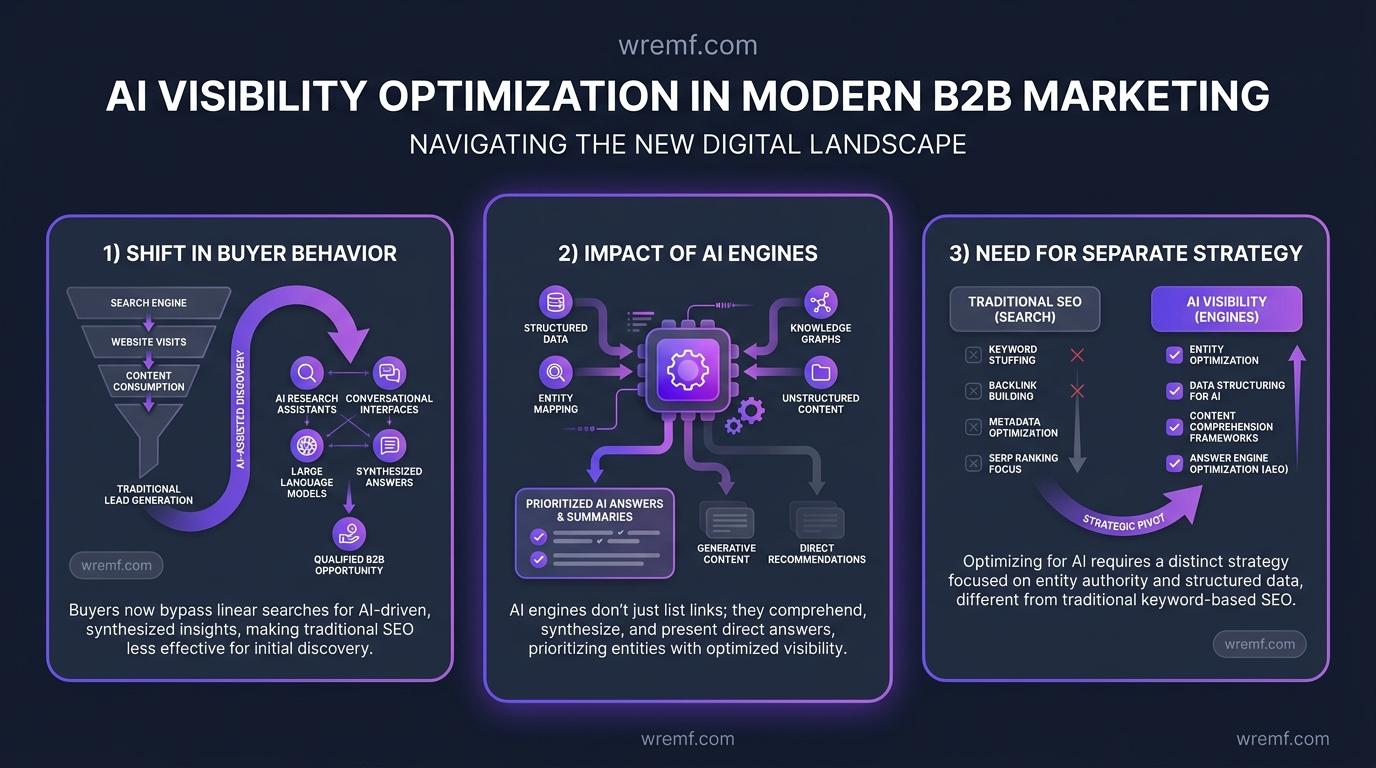
AI visibility optimization is the systematic practice of improving how AI engines represent, cite, and recommend a brand when users submit relevant prompts. It matters because the discovery journey for B2B buyers has fundamentally shifted from clicking through lists of links to consuming AI-generated summaries that name specific vendors, cite specific sources, and shape purchasing decisions before a buyer ever visits a website.
The shift is not theoretical. ChatGPT alone processes more than 2.5 billion prompts every day. Google AI Overviews now reach 2 billion users each month. According to data reported by VentureBeat's AI coverage AI referrals to top websites spiked 357% year-over-year in June 2025, reaching 1.13 billion visits. For B2B marketers and SEO professionals, this represents a fundamental change in how brands get discovered, evaluated, and chosen.
Traditional search visibility was defined by ranking position. A brand optimized pages for keywords, earned backlinks, and climbed the SERP. That approach still matters for organic search, but it does not translate directly into AI-generated answers. AI engines do not simply repeat the top-ranked result. They synthesize information from multiple sources, evaluate the credibility and clarity of those sources, and generate answers that often name specific brands, products, or services based on citation patterns, entity authority, and content structure, not just ranking position.
AI visibility optimization addresses this gap. It encompasses several interconnected disciplines. Answer Engine Optimization, commonly called AEO, focuses on structuring content so that answer engines can extract precise, attributable answers from it. Generative Engine Optimization, known as GEO, focuses on improving how generative AI systems represent a brand across synthesized outputs. Large Language Model Optimization, referred to as LLMO or LLM SEO, focuses on the signals that influence how large language models such as GPT-4, Claude, and Gemini select and cite sources. Together, these disciplines form the foundation of a modern AI visibility strategy, and teams can find a full breakdown of these relationships in the AI search engine optimization guide
Understanding AI visibility optimization also requires understanding which AI engines matter. The main platforms where brand visibility can be measured and influenced include ChatGPT and OpenAI's broader model ecosystem, Google AI Overviews and Google AI Mode, Gemini, Perplexity, Claude from Anthropic, Microsoft Copilot powered by Bing's search index, DeepSeek, Grok, Meta AI, and Mistral. Each engine uses different retrieval mechanisms, source weighting logic, and citation behaviors. A brand that appears consistently in ChatGPT answers may be largely absent from Perplexity or Google AI Mode without deliberate effort to address the signals each engine prioritizes.
KEY TAKEAWAY: AI visibility optimization is not a single tactic but a structured program covering content, entity authority, source consistency, and prompt monitoring across multiple AI engines simultaneously.
How AI Engines Decide Which Sources to Cite
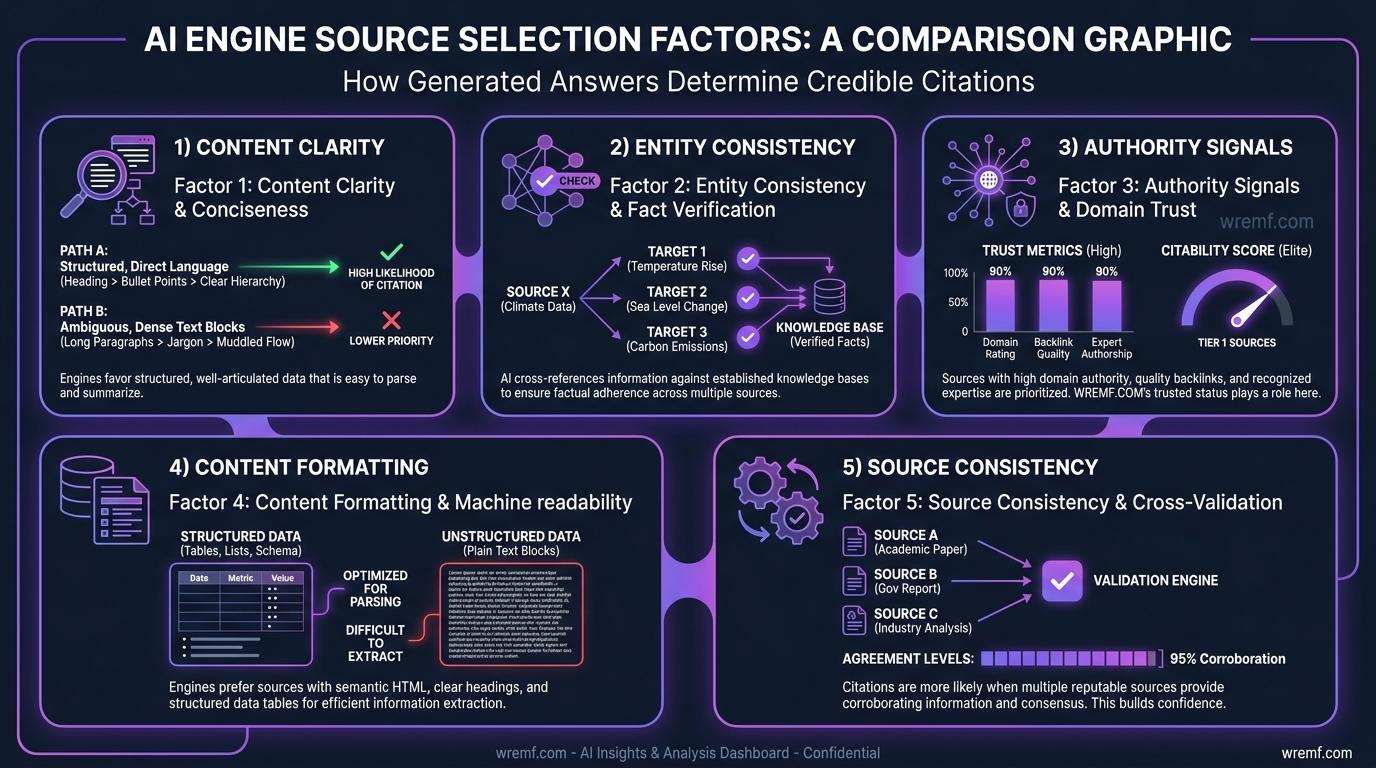
AI engines select sources based on a combination of content clarity, entity consistency, structural signals, and perceived authority, not simply on which pages rank highest in traditional search results. Understanding this selection logic is the starting point for any practical AI visibility optimization program.
Large language models are trained on broad corpora of web content and learn to associate specific brands, topics, and claims with specific sources. When a user submits a prompt, the model generates an answer by drawing on the patterns and associations established during training and, in the case of retrieval-augmented systems, by querying live web content through integrated search. The sources that appear in AI-generated answers tend to share several observable characteristics.
First, they answer the prompt directly and early in the content. AI systems favor passages that lead with a clear, complete answer rather than burying the key information after lengthy preamble. This is the foundation of answer-first content structure, and it underpins both AEO and GEO approaches.
Second, they demonstrate entity consistency. When a brand's name, products, authors, and key topics are described consistently across the brand's own site, third-party publications, knowledge graph entries, knowledge panels, and structured data, AI engines have a stronger signal to work with. Inconsistent entity signals, conflicting descriptions, or missing structured data create ambiguity that reduces citation likelihood.
Third, they carry authority signals. These are not identical to traditional backlink authority, though backlinks remain relevant. For AI citation purposes, authority is also reflected in how often a source is mentioned in other credible documents, whether the source appears in editorial coverage, third-party reviews, and community discussions, and whether the brand's content is attributed to credible expert authors. According to Anthropic's research the models it develops are designed to produce accurate, well-attributed outputs, which reinforces why source credibility and clear attribution matter throughout the content structure.
Fourth, content formatting affects extractability. Pages with clear heading hierarchies, concise definition blocks, structured data including schema markup, semantic URLs, and well-organized internal linking patterns are more likely to be parsed and cited accurately. Analysis from Profound's dataset of 2.6 billion citations found that semantic URLs with four to seven descriptive words receive 11.4% more citations than generic URL structures. Listicle and comparative content formats account for more than 25% of AI citations across major platforms, which reflects the preference AI engines have for structured, comparative, and clearly organized content.
Fifth, source consistency across AI engines matters independently. A brand can appear in ChatGPT answers but be entirely absent from Perplexity or Google AI Overviews because each engine draws from different source pools and applies different weighting logic. Tracking source consistency across engines is a distinct measurement task, separate from tracking individual citation frequency.
TIP:
Map your brand's content against the specific prompt types buyers use in each AI engine. A page written to answer a broad SEO keyword may not answer an AI prompt with enough precision to be cited. Restructure key pages to lead with direct answers, use clear entity attribution, and deploy FAQ-level specificity throughout.
KEY TAKEAWAY: AI engines favor sources that answer prompts directly, maintain consistent entity signals, carry credible authority, use extractable content formatting, and appear reliably across the source sets each engine draws from.
The Difference Between SEO, AEO, GEO, and LLM Optimization
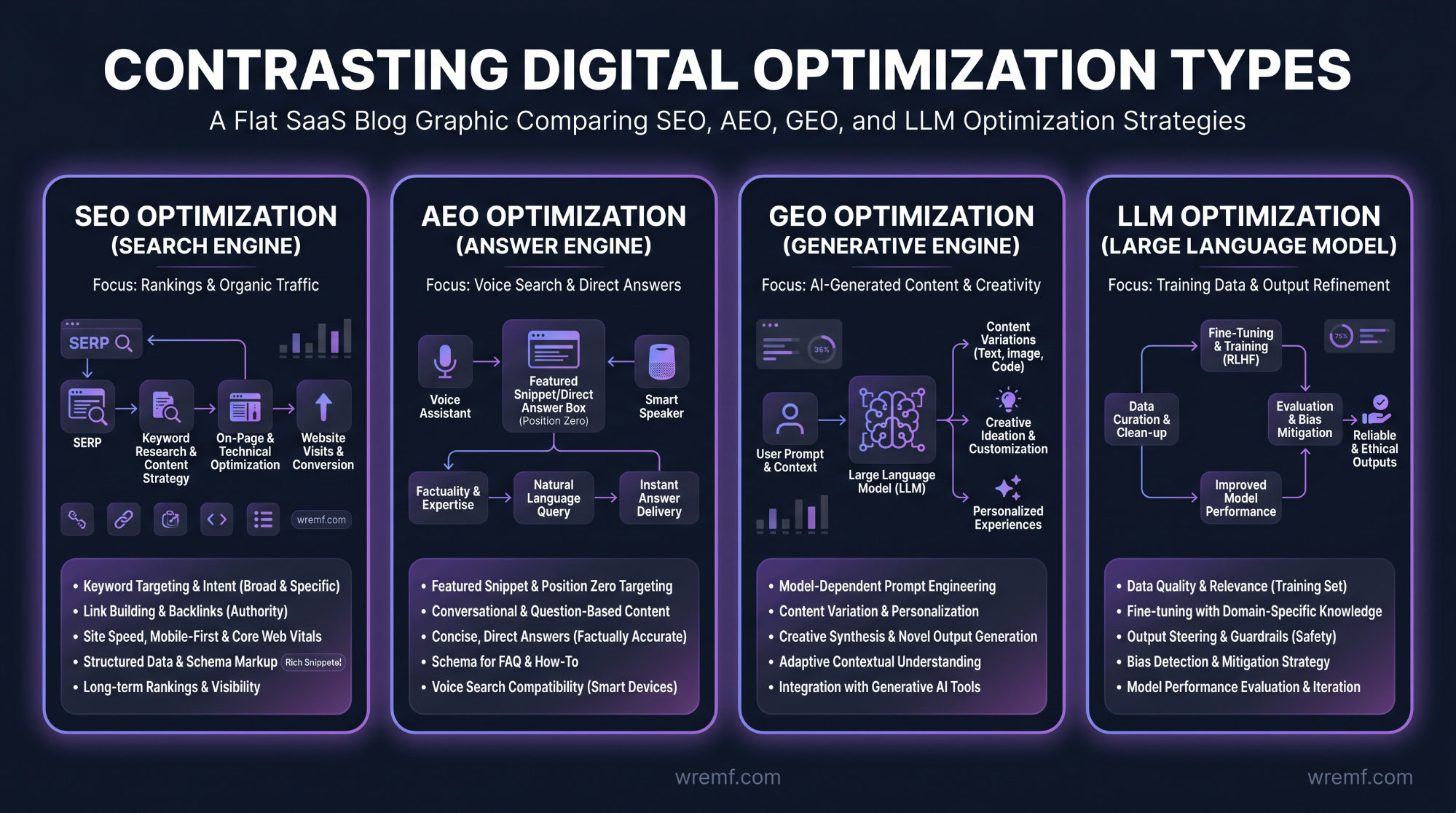
SEO, AEO, GEO, and LLM optimization are related but distinct disciplines that address different layers of search and AI discovery. Using them interchangeably leads to measurement gaps and missed optimization opportunities.
Search Engine Optimization focuses on improving organic rankings in traditional search engines, primarily Google and Bing. It encompasses technical SEO, keyword research, on-page optimization, backlink building, site audits, crawlability, and page performance. Tools like Ahrefs and Semrush were built specifically for this discipline and remain the standard for tracking keyword rankings, site audit results, and backlink profiles.
Answer Engine Optimization is the practice of structuring content so that answer engines and AI-powered assistants can extract and present accurate, attributed answers. AEO is primarily about content format, question-and-answer structure, schema markup, entity clarity, and source authority. The goal is not just to rank for a keyword but to become the source an answer engine cites when it generates a response to a related prompt. Teams can explore a detailed breakdown of the practical application of this discipline through the answer engine optimization guide | https://wremf.com/blog/answer-engine-optimization-the-complete-guide-to-aeo-ai-search-visibility-and-answer-first-content.
Generative Engine Optimization extends AEO into the context of large language model outputs and generative AI systems. GEO addresses how brands appear in synthesized, multi-source answers generated by systems like ChatGPT, Claude, Gemini, and Perplexity. GEO involves content strategy, entity management, citation building, and source consistency analysis across the full ecosystem of generative engines. A full explanation of the service model around GEO is available in the generative AI optimization services guide
LLM Optimization, sometimes called LLMO or LLM SEO, focuses specifically on the signals that influence how large language models index, associate, and reproduce brand-related information. This includes training data quality, entity association patterns, citation frequency in credible documents, and the consistency of brand descriptions across the web.
The practical difference for a B2B marketing team is as follows. A team that ranks on page one of Google for a competitive keyword but has not addressed AEO, GEO, or LLM visibility may find that competitors with weaker Google rankings appear repeatedly in ChatGPT, Perplexity, and Google AI Overviews answers. Rankings and AI citations measure different things, and a brand needs to address both.
Here is how the dimensions compare when evaluating traditional SEO tools against an AI visibility platform like WREMF.
Primary signal
- Traditional SEO tools: Keyword rankings
- WREMF: AI prompt answers
What it tracks
- Traditional SEO tools: SERP position
- WREMF: AI citations and brand mentions across engines
Authority signal
- Traditional SEO tools: Backlinks
- WREMF: Source citations in AI answers
Query model
- Traditional SEO tools: Keywords
- WREMF: Prompts
Competitive view
- Traditional SEO tools: SERP overlap
- WREMF: AI share of voice
Attribution
- Traditional SEO tools: Organic sessions
- WREMF: AI referral traffic and prompt-level attribution
Engine coverage
- Traditional SEO tools: Google and Bing
- WREMF: 10 AI engines
Audit type
- Traditional SEO tools: Technical SEO and site audit
- WREMF: GEO and AEO audits with source consistency analysis
Traditional SEO tools remain essential for organic search performance, keyword tracking, crawlability, and backlink analysis. WREMF adds the AI visibility layer by tracking how AI engines mention, cite, compare, and recommend brands across the prompt-based discovery journey that now precedes many B2B purchase decisions. Teams that want to understand how these layers connect can review the AI search engine optimization tools guide for a practical comparison of tool types and their respective roles.
KEY TAKEAWAY: SEO, AEO, GEO, and LLM optimization address different discovery layers, and a complete AI visibility program requires all four working together, each measured with the right tools for that layer.
How to Measure AI Visibility Optimization Performance
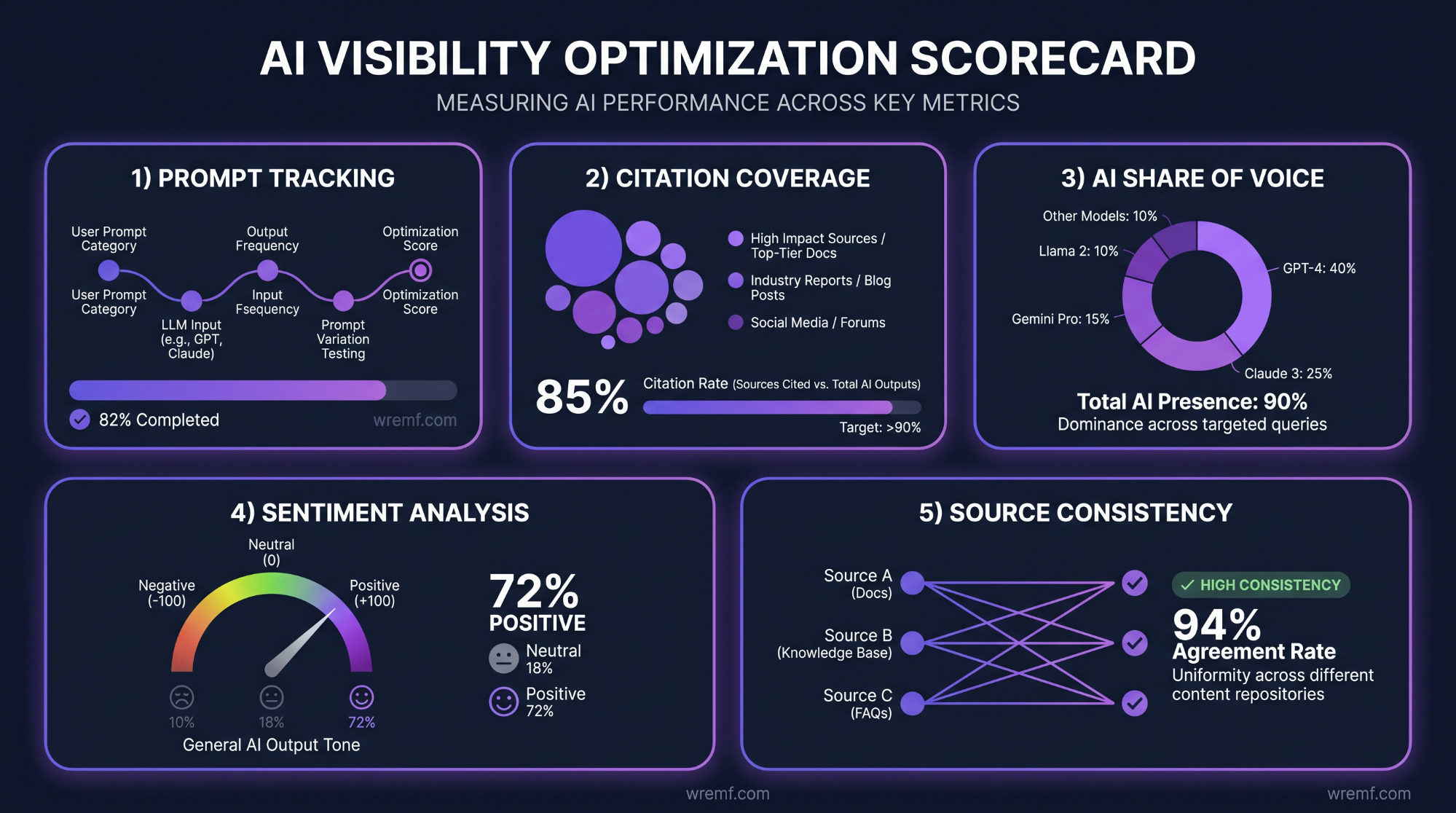
AI visibility performance is measured through a combination of prompt tracking, citation coverage, AI share of voice, sentiment analysis, source consistency, and AI referral traffic attribution. No single metric tells the complete story.
Prompt tracking is the foundation of AI visibility measurement. A team selects a set of prompts that reflect how target buyers describe their problems, categories, and vendor requirements in AI engines. These prompts are run systematically across AI engines at regular intervals. The outputs are analyzed to determine which brands, sources, and claims appear in the answers. This produces a structured dataset of citation frequency, source presence, competitor mentions, and sentiment patterns across each engine.
Citation coverage measures how often a brand's content or name appears when relevant prompts are submitted. Citation coverage can be broken down by engine, by prompt category, by content type, and by competitor comparison. A fintech client case referenced in multiple AI visibility analyses achieved a 7x increase in AI citations within 90 days following a systematic citation and entity optimization program, which illustrates how measurable and improvable citation coverage is when treated as a trackable metric.
AI share of voice extends citation coverage into a competitive context. Rather than measuring a brand's citations in isolation, AI share of voice calculates what percentage of all relevant AI-generated answers include a brand's citation relative to named competitors. This makes AI share of voice the AI-era equivalent of traditional SEO share of voice, with prompt responses replacing SERP positions as the measurement unit.
Sentiment analysis adds a qualitative layer to citation data. A brand may appear frequently in AI answers but be described neutrally, negatively, or with qualifications that undermine buyer confidence. Measuring the sentiment of AI responses over time helps teams understand whether their AI visibility optimization program is improving both citation frequency and brand representation quality.
Source consistency analysis tracks whether a brand's name, product descriptions, key claims, and authority signals are represented consistently across all the major AI engines. Inconsistencies in how Claude describes a product versus how Perplexity describes the same product often point to underlying content or entity issues that can be resolved.
AI referral traffic attribution connects AI visibility to website traffic and business outcomes. Using GA4, teams can segment traffic from AI referral sources and match it to conversion events. This is the bridge between AI visibility as a branding metric and AI visibility as a revenue-contributing channel. According to Google Analytics Help properly configured GA4 properties can segment traffic sources at a channel-group level, which makes AI referral attribution possible with the right configuration.
WREMF's Growth plan includes GA4 attribution and a Looker Studio connector, which gives marketing and SEO teams a direct path from prompt-level data to commercial reporting without needing to build custom attribution models from scratch.
KEY TAKEAWAY: AI visibility performance requires a multi-metric measurement framework covering prompt tracking, citation coverage, AI share of voice, sentiment, source consistency, and AI referral traffic attribution, with none of these metrics sufficient on its own.
A Practical Process for Running an AI Visibility Optimization Program
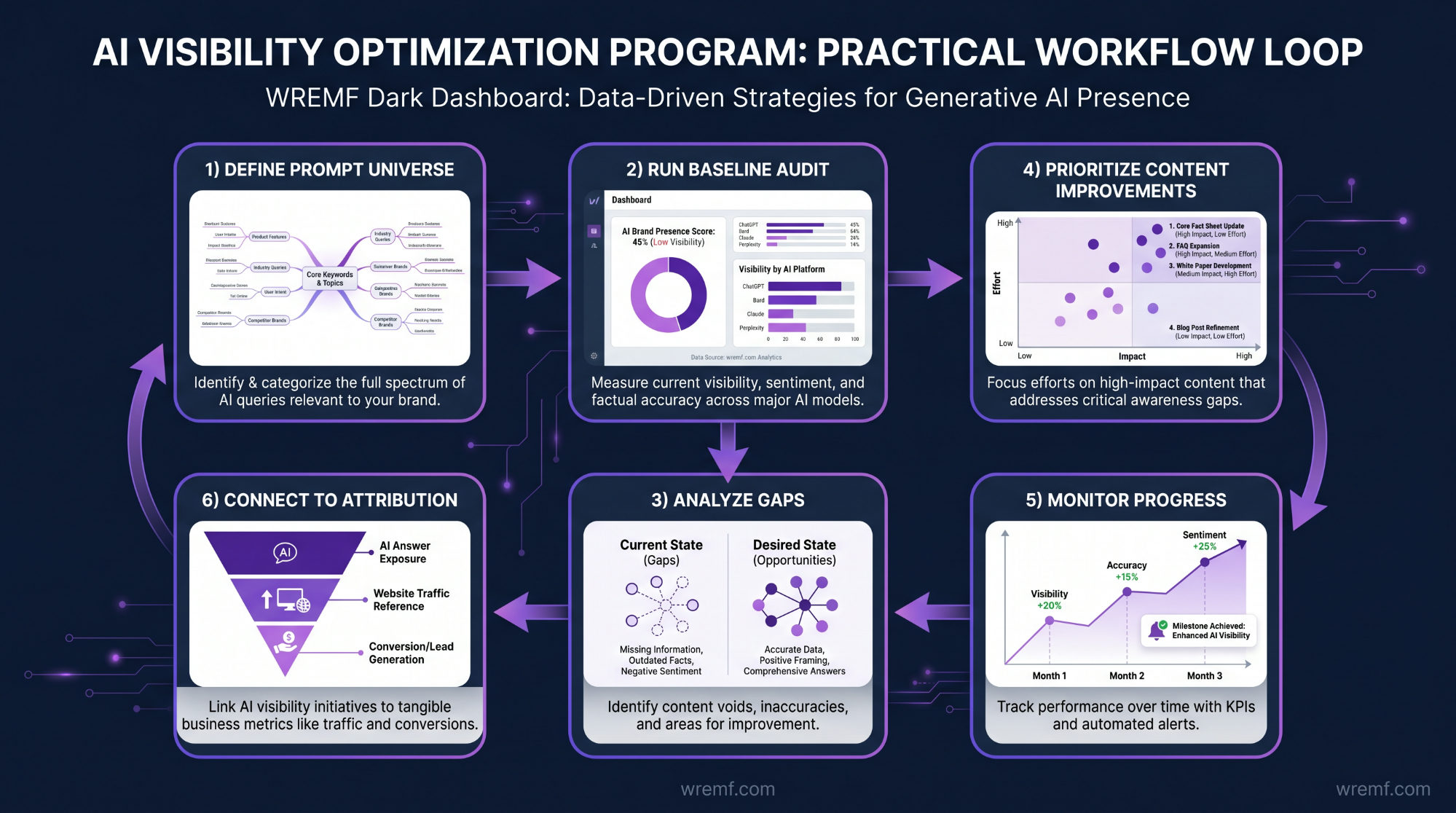
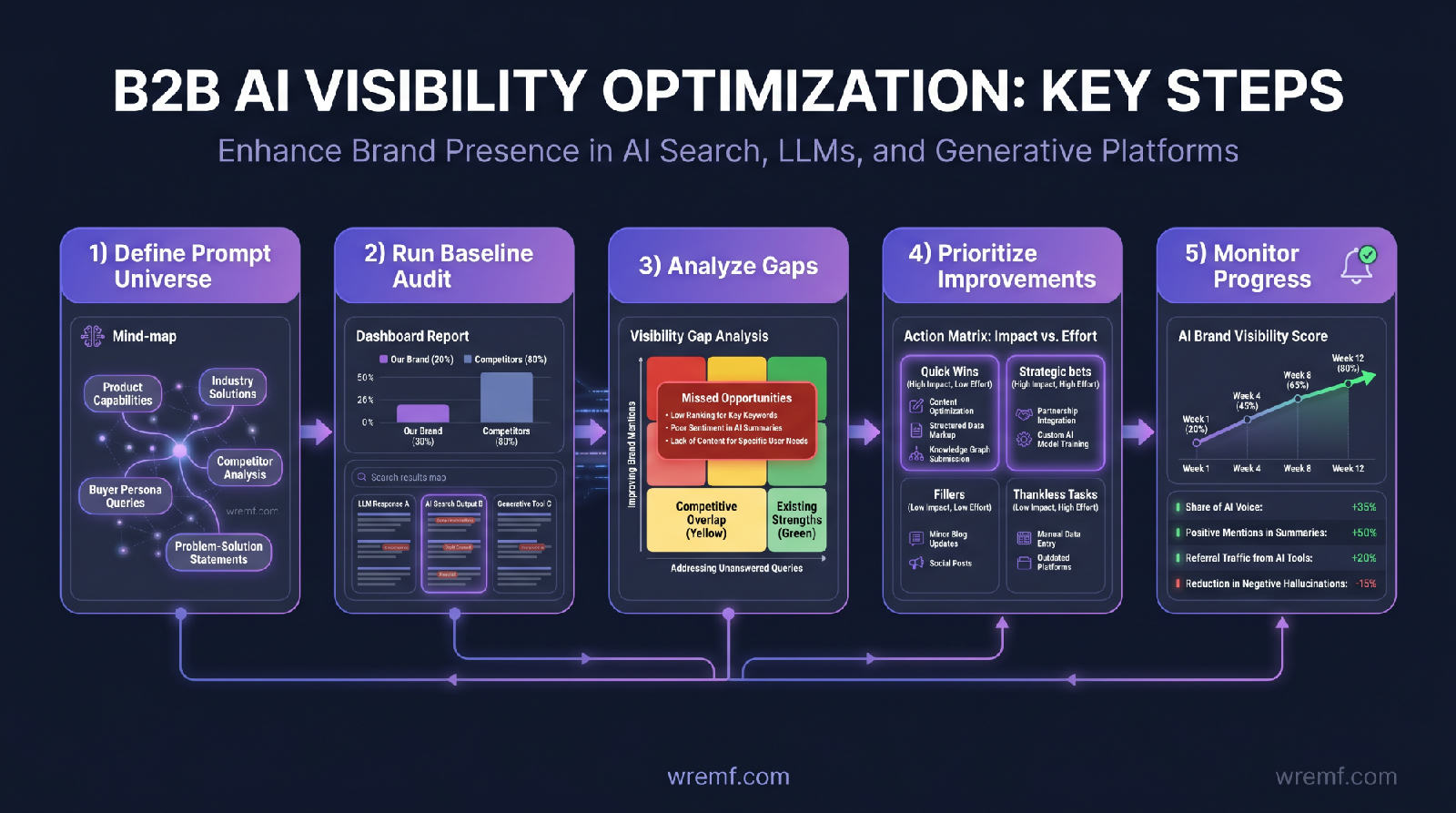
Running an AI visibility optimization program involves a structured sequence of audit, measurement, content improvement, entity management, and ongoing monitoring. The following workflow applies to B2B teams regardless of whether they use software, a managed service, or a hybrid model.
Step 1: Define the prompt universe
Identify the prompts that reflect how target buyers describe their category, problem, and vendor requirements in AI engines. These are not the same as keyword lists. Prompts are conversational, often multi-sentence, and reflect the research behavior of someone who wants a synthesized answer rather than a list of links. A typical prompt universe for a B2B SaaS brand might include 50 to 200 prompts spanning awareness, comparison, and decision-stage questions.
Step 2: Run a baseline AI visibility audit
Submit the prompt universe across the relevant AI engines and record every citation, brand mention, competitor mention, source reference, and sentiment pattern in the outputs. This baseline establishes the starting position for all subsequent measurement. A GEO audit of this type also identifies which competitor brands are currently dominating AI-generated answers in the category and which sources AI engines are drawing from most frequently.
Step 3: Analyze citation and entity gaps
Compare baseline citation data against the prompt universe to identify gaps. Which prompts return no mention of the brand? Which prompts consistently surface competitors? Which engines show the weakest brand presence? Entity gap analysis identifies where the brand's name, products, and claims are described inconsistently or absent from sources that AI engines favor, including knowledge graph entries, knowledge panels, and third-party editorial content.
Step 4: Prioritize content and technical fixes
Use citation gap data to prioritize content improvements. Pages that are frequently cited but represent the brand poorly should be revised for clarity, entity consistency, and answer-first structure. Pages that address high-value prompts but are not being cited should be audited for content format, schema markup, structured data, internal linking quality, and semantic URL structure. Content creation priorities should follow the prompt universe rather than keyword volume alone.
Step 5: Improve entity signals and source authority
Entity management involves ensuring that the brand's name, product names, executive names, and key topic associations are accurate and consistent across the brand's website, structured data, knowledge graph entries, knowledge panels, and third-party sources including editorial coverage, third-party reviews, and community discussions. This is a distinct task from backlink building, though the two overlap when earning editorial mentions.
Step 6: Rerun prompts and measure citation improvement
After content and entity improvements are made, rerun the original prompt universe across AI engines and compare citation frequency, source presence, competitor share, and sentiment against the baseline. Citation improvements in high-priority prompts indicate that the optimization actions are working. Comprehensive citation coverage and competitive share of voice typically require 90 to 180 days of sustained effort across content, entity, and authority signals.
Step 7: Set up scheduled AI monitoring and alerts
Ongoing AI visibility monitoring requires running prompt tracking on a scheduled basis, typically weekly, to catch shifts in citation patterns caused by model updates, new competitor content, or changes in the source sets AI engines draw from. Alerts can be configured to flag significant drops in citation frequency or changes in brand sentiment. WREMF includes scheduled AI monitoring and alert functionality across its plans, with prompt-level reporting available through the platform dashboard.
Step 8: Connect to attribution and reporting
Map AI visibility metrics to business outcomes by integrating prompt tracking data with GA4 attribution, white-label reporting workflows, and leadership dashboards. This step closes the loop between AI visibility as a brand metric and AI visibility as a demonstrable contributor to pipeline and revenue.
DID YOU KNOW:
According to analysis cited in the AI visibility industry, quick wins from schema updates and entity optimization can show measurable citation improvements in 30 to 45 days, while comprehensive competitive share of voice gains typically require 90 to 180 days of sustained execution.
KEY TAKEAWAY: A structured AI visibility optimization program follows a repeatable audit, gap analysis, content improvement, entity management, and monitoring cycle that produces measurable citation and share of voice improvements over time.
Content Strategy and Content Optimization for AI Visibility
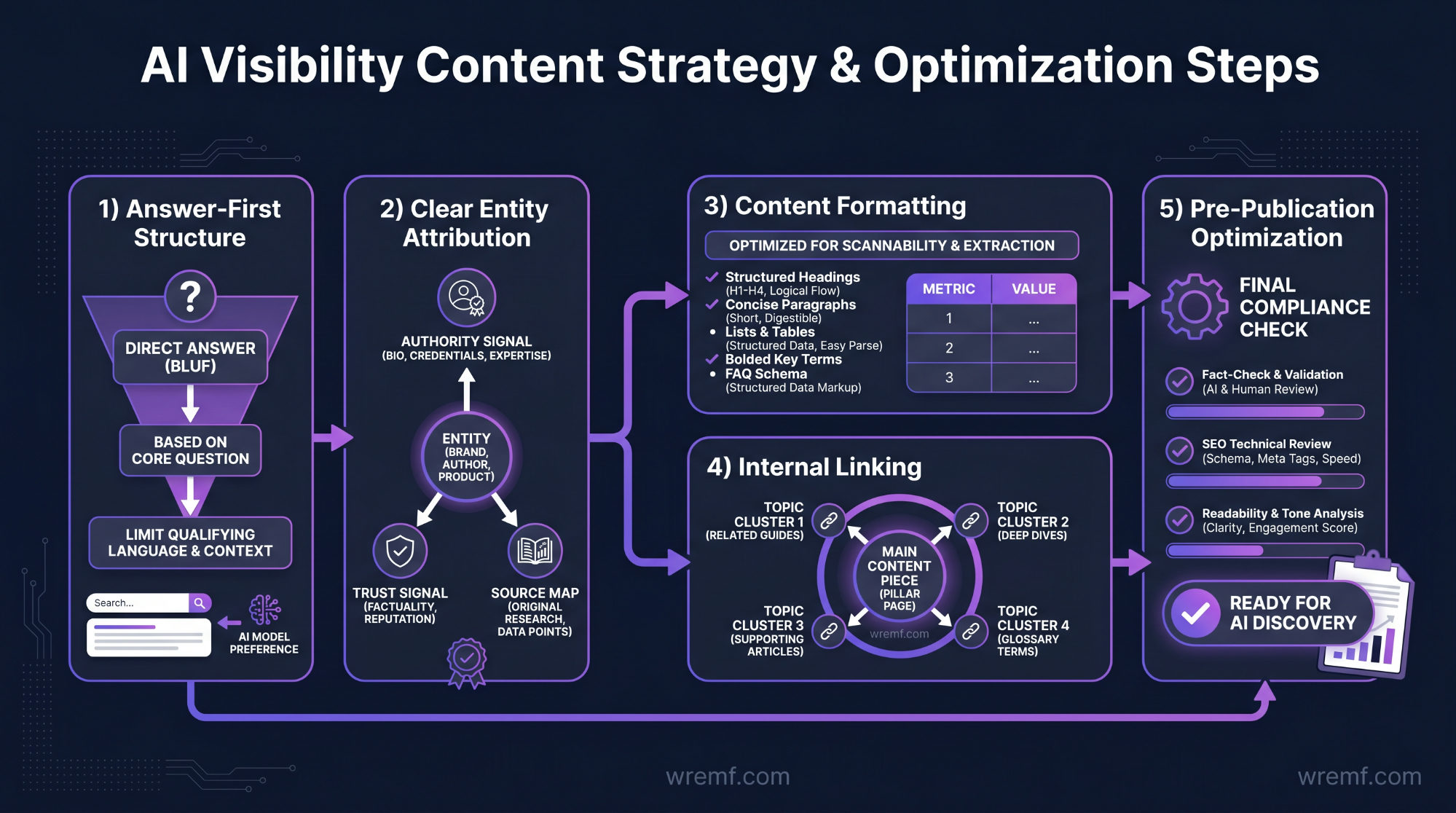
Content strategy for AI visibility optimization requires a different approach than traditional SEO content creation. The goal shifts from ranking for keywords to being cited by AI engines in response to relevant prompts, which changes how content is planned, structured, and maintained.
AI engines favor content that answers questions directly, uses clear attributable language, organizes information into extractable passages, and demonstrates topical authority through consistency and depth. Content that buries key answers under lengthy introductions, uses vague language, or lacks clear entity attribution is less likely to be cited even if it ranks well in organic search.
Content creation for AI visibility starts with the prompt universe rather than the keyword list. Each prompt represents a specific question or research task a buyer might submit to ChatGPT, Perplexity, or Google AI Mode. Content briefs should map directly to these prompts and specify the answer structure, entity mentions, and source references required for the page to be extractable by AI engines. WREMF's Growth plan includes an AI-ready content brief generator that maps content planning directly to prompt intelligence data.
Content Libraries play a specific role in AI visibility programs. Rather than maintaining a loosely connected archive of blog posts, effective AI visibility content programs build structured content inventories where each page serves a defined role in the prompt universe. Some pages answer category-level prompts. Others answer comparison prompts. Others address objection-handling or proof-based prompts. A well-organized Content Inventory makes it easier to identify gaps, avoid duplication, and prioritize updates when citation data reveals underperforming pages.
Content formatting affects citation rates significantly. Analysis of 2.6 billion citations across AI platforms found that comparative and listicle content formats account for more than 25% of all AI citations, making them the most effective formats for AI visibility after the broad "other" category. Blog and opinion content accounts for approximately 12% of citations, while video content accounts for less than 2% of citations across most AI engines. This means that long-form explanatory guides, structured comparison pages, and clearly organized definition articles have a substantially higher citation potential than unstructured narrative content or video-first assets.
Internal linking also influences AI visibility. A well-structured internal linking architecture helps AI crawlers understand the topical relationships between pages, reinforces entity associations, and improves the overall authority signal of the content cluster. Each page should link naturally to related supporting content using descriptive anchor text that reflects the topic relationship accurately.
AI-generated content presents a specific consideration. Content created using AI drafting tools, sometimes called AI Draft outputs, needs to be reviewed and revised to ensure it includes genuine entity clarity, expert-level attribution, accurate claims, and the kind of source-backed specificity that AI engines favor when selecting citations. AI content that is generic, repetitive, or lacks clear authorship signals may underperform in AI visibility terms even if it satisfies basic content length requirements.
Content Campaigns designed specifically for AI visibility should include a combination of foundational pages that address core category prompts, comparison content that addresses vendor evaluation prompts, and thought leadership content that builds topical authority over time. Enterprise content strategy for AI visibility also benefits from structured Content Campaigns that coordinate publishing cadence with entity cleanup and structured data deployment.
KEY TAKEAWAY: AI visibility content strategy requires planning around prompts rather than keywords, prioritizing structured and comparative formats, building organized Content Libraries, and ensuring every key page leads with a direct, extractable answer.
Entity Signals, Structured Data, and Technical Foundations
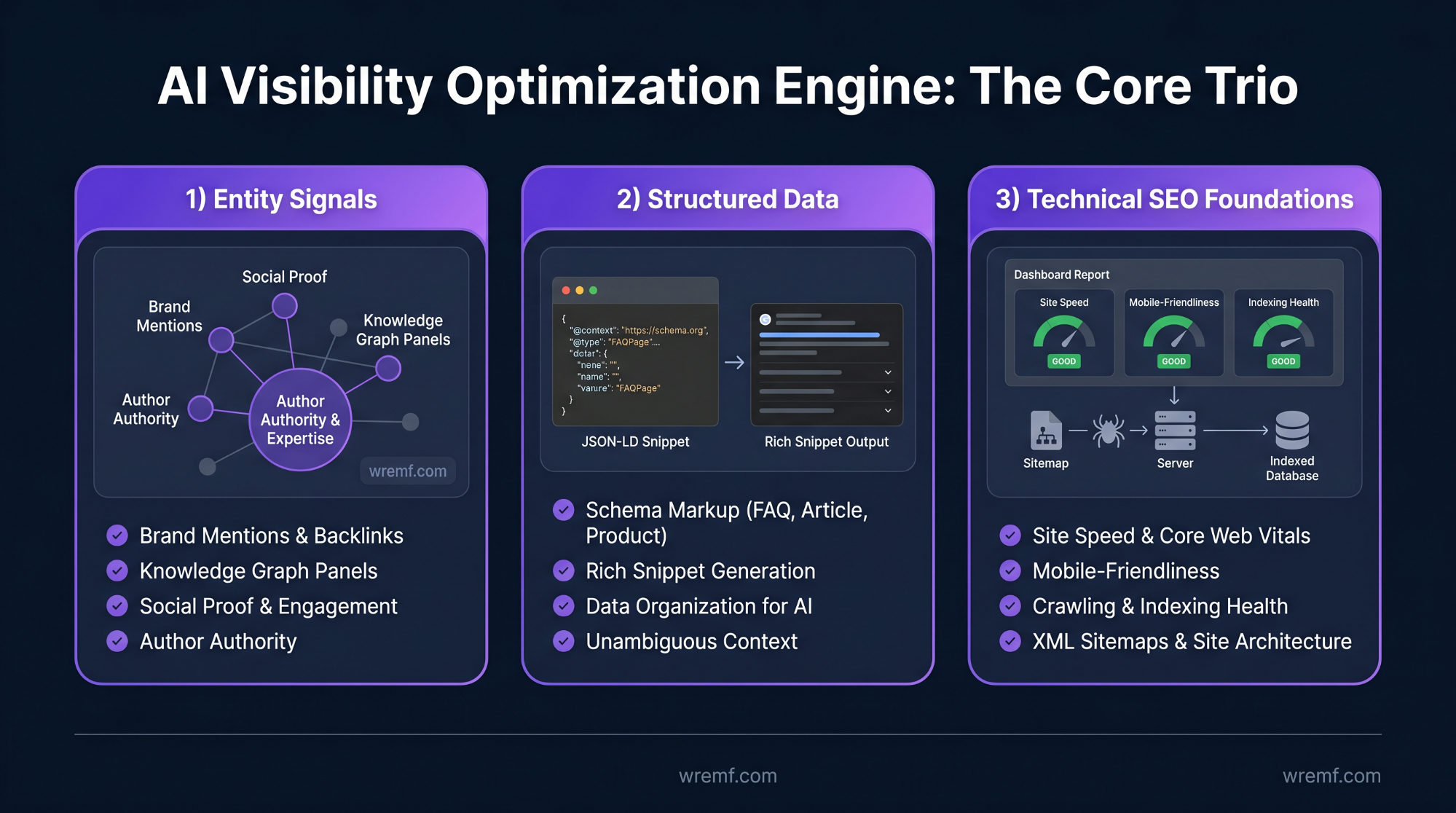
Entity signals, structured data, and technical SEO form the infrastructure layer of AI visibility optimization. Without these foundations, even well-written content can fail to be consistently cited by AI engines.
Entity signals are the associations AI engines make between a brand name, its products, its topics, and the claims made about them across the web. Strong entity signals mean that when a user asks a generative AI system about a category, the system can confidently associate the brand with that category and cite the brand's content as a relevant source. Entity Management is the practice of ensuring that these associations are accurate, consistent, and reinforced across the brand's website, knowledge graph entries, knowledge panels, schema markup, and third-party sources.
Knowledge Graph entries and knowledge panels are particularly important for brand entity clarity. When a brand has a well-populated knowledge graph profile with accurate descriptions, founding information, product details, and credible references, AI engines have a reliable source of entity information to draw from. Brands that lack or have inaccurate knowledge graph data may find that AI engines describe them inconsistently across different engines, which weakens both citation quality and buyer confidence.
Structured data, specifically schema markup, helps AI engines parse the purpose, structure, and content of individual pages more accurately. Relevant schema types for AI visibility optimization include Organization schema, Product schema, Article schema, FAQ schema, HowTo schema, and BreadcrumbList schema. According to Schema.org documentation structured data vocabularies are designed to help search engines and other automated systems understand the meaning and context of web content, which directly supports AI citation accuracy. The combination of FAQ schema and entity claim optimization is particularly effective for early citation gains, with some teams reporting measurable improvements within 30 to 45 days of deployment.
Technical SEO foundations remain relevant for AI visibility because many AI engines with retrieval-augmented generation capabilities index web content using AI crawler systems. Pages that are blocked from crawling, slow to load, or dependent on JavaScript rendering that AI crawlers cannot parse will not be indexed and therefore cannot be cited. A site audit should include a review of robots.txt, crawl access permissions, Core Web Vitals, page speed, and rendering behavior specifically for AI crawlers such as GPTBot and Google's AI Mode crawler, in addition to standard search engine bots.
Semantic URL structure also affects citation rates. As noted earlier, analysis of citation patterns across AI platforms found that pages with natural-language URL slugs of four to seven descriptive words received 11.4% more citations than pages with generic or numeric URL structures. Migrating high-priority pages to semantic URLs is a technical fix with a directly measurable impact on AI citation performance.
Internal linking architecture reinforces entity relationships and topical authority at the site level. A clear internal linking structure, using descriptive anchor text that names the topic accurately, helps AI engines map the relationship between pages and understand which pages should be cited for which types of prompts.
KEY TAKEAWAY: Entity signals, schema markup, knowledge graph accuracy, semantic URL structure, and technical crawlability form the infrastructure layer that determines whether AI engines can reliably parse, attribute, and cite a brand's content.
Tracking Prompts, Citations, and AI Share of Voice Across Engines
Prompt tracking is the core measurement activity in AI visibility optimization. It involves systematically submitting a defined set of prompts to AI engines and analyzing the outputs to measure citation frequency, brand mentions, competitor presence, sentiment, and source patterns over time.
LLM prompts used for AI visibility tracking are different from SEO keywords in both form and function. A keyword is a brief search term. A prompt is a conversational question or task that reflects a real buyer's research behavior in a generative AI interface. Effective prompt tracking requires building a prompt library that covers awareness, comparison, and decision-stage buyer questions, then running those prompts across each relevant AI engine on a scheduled basis. LLM visibility analysis produces structured data about which brands, which sources, and which content types appear consistently in AI-generated answers for the brand's target category.
Prompt intelligence adds a second layer of insight. Beyond tracking which brands appear in AI answers, prompt intelligence identifies the patterns in how AI engines describe those brands, what attributes are emphasized, which concerns are raised, and how the brand is positioned relative to competitors. This produces actionable insights for both content optimization and brand messaging alignment.
Citation Coverage is a specific metric that measures the percentage of relevant prompts in which a brand's content or name is cited. A brand with 20% citation coverage is mentioned in one in five relevant AI-generated answers. Tracking citation coverage over time, segmented by prompt category, AI engine, and competitor, provides the clearest picture of how an AI visibility program is progressing.
Competitor visibility tracking complements brand citation data. Understanding which competitors appear most frequently in AI answers for the brand's target prompts, and which sources AI engines cite when recommending competitors, reveals both the content gap and the authority gap that the AI visibility program needs to close. This is where AI share of voice becomes actionable: a brand with 15% AI share of voice in a category where the leading competitor holds 45% has a clear benchmark to target.
Monitoring tools such as WREMF provide scheduled prompt tracking across 10 AI engines, including ChatGPT, Gemini, Perplexity, Claude, Google AI Overviews, Google AI Mode, Copilot, DeepSeek, Grok, and Meta AI. The platform tracks citations, brand mentions, competitor mentions, sentiment, and source consistency through a centralized dashboard with alerts for significant changes. Teams that want to understand how AI mention tracking works in practice can review the AI mention tracking guide for a detailed methodology breakdown.
WREMF also supports BYOK, which stands for Bring Your Own Key, on every pricing plan. This means teams can connect their own API keys for the AI engines they want to query directly, which removes per-prompt markup costs and gives teams full control over prompt volume and scheduling without hitting artificial usage limits. This is particularly relevant for growth teams and agencies that need to run high-volume prompt tracking across multiple clients or markets.
Compare WREMF pricing plans to see how prompt tracking, citation analysis, competitor tracking, and AI share of voice reporting are distributed across the Starter, Growth, and Managed tiers.
KEY TAKEAWAY: Prompt tracking, citation coverage, and AI share of voice are the three primary measurement pillars of AI visibility optimization, and tracking them systematically across multiple AI engines produces the competitive intelligence needed to prioritize content and authority improvements.
AI Visibility Optimization for Agencies and Multi-Client Teams
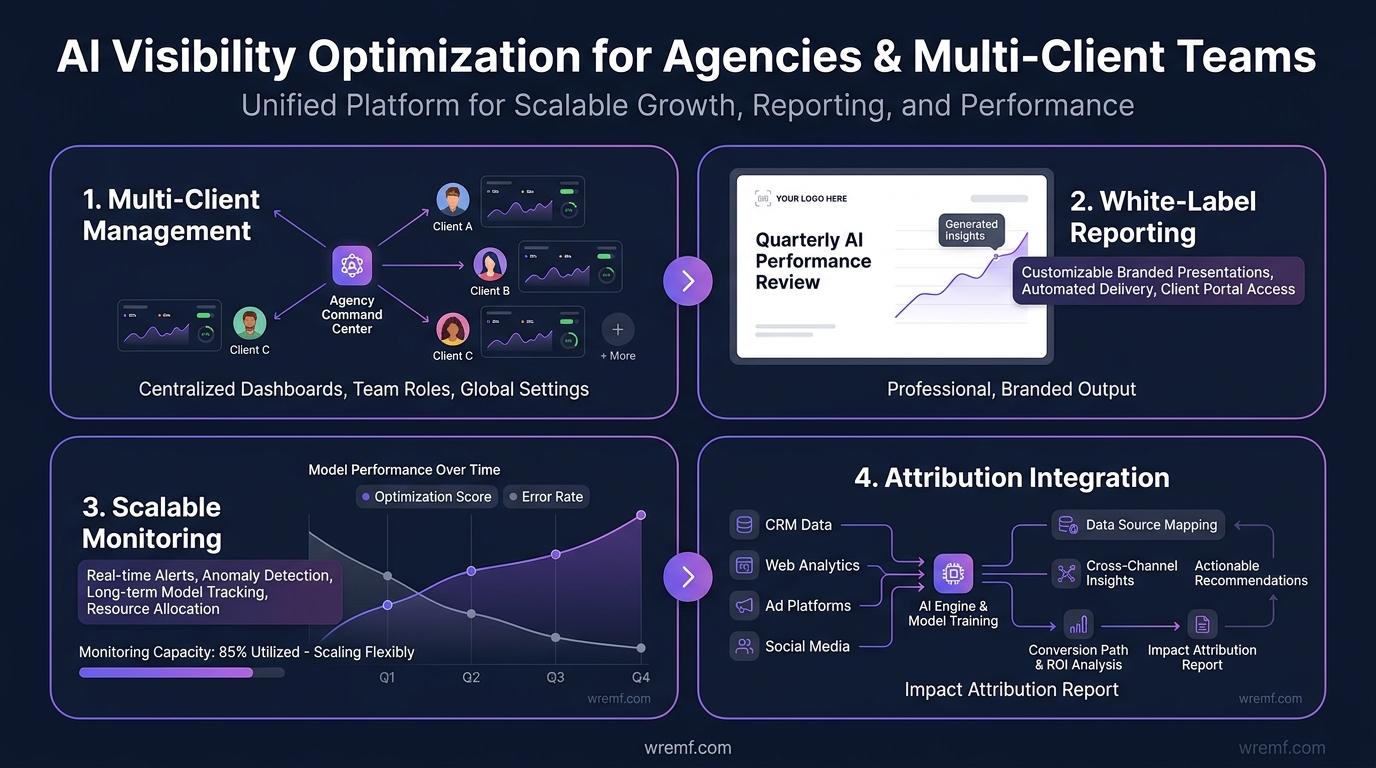
Agencies managing AI visibility optimization for multiple clients face a distinct set of operational challenges that differ from those of in-house marketing teams. Scale, reporting consistency, client communication, and attribution all require agency-specific workflows and tooling.
The core agency challenge is running prompt tracking, citation analysis, competitor visibility monitoring, and performance reporting across multiple client accounts simultaneously without creating manual bottlenecks. An agency managing AI visibility for ten B2B SaaS clients needs to run hundreds of prompts across 10 AI engines for each client, aggregate the results into client-specific dashboards, and produce branded reports that connect citation data to business outcomes. This is not practical with manual processes or general-purpose analytics tools.
White-label reporting is a foundational requirement for agencies. Clients expect branded reports that show AI visibility performance in terms they understand: citation frequency, AI share of voice, competitor positioning, and traffic attribution. WREMF's Growth plan includes white-label reports and a Looker Studio connector, which gives agencies a direct path from prompt tracking data to client-facing dashboards without needing custom development. The Looker Studio connector allows agencies to embed WREMF citation data alongside GA4 attribution data and other reporting layers in a unified client report.
Multi-brand management is supported through WREMF's website and competitor tracking limits at each plan tier. The Growth plan covers up to five websites and 10 to 15 competitors, while the Managed plan offers custom configurations for large agencies managing enterprise accounts or multi-market programs. Agencies that want to understand the full managed execution offering, including GEO strategy, AEO content optimization, citation and entity cleanup, and senior-led execution, can explore WREMF agency services
Client portals and Account Management workflows matter for agencies that need to give clients direct visibility into their AI visibility data without exposing the agency's full platform or other client data. Structured account separation, role-based access, and branded dashboards all contribute to a professional client experience that reinforces the agency's value as a strategic AI visibility partner.
For agencies considering how to position AI visibility as a service line, the most effective approach is to lead with measurement. Showing a prospective client their current citation coverage, AI share of voice, and competitor positioning in AI-generated answers is a more compelling entry point than explaining the technical details of GEO or AEO in the abstract. Data-led storytelling converts prospect interest into client engagement faster than methodology-led pitches.
Real-world use case: A B2B content agency managing five SaaS clients notices that several clients are ranking on page one of Google but receiving minimal citations in Perplexity and ChatGPT answers for their core category prompts. The agency runs a baseline AI visibility audit using WREMF, identifies the specific content and entity gaps causing low citation rates for each client, prioritizes structured data deployment and content reformatting for the most commercially valuable prompts, and sets up weekly monitoring with white-label reports delivered to each client. Within 90 days, three of the five clients see measurable improvements in citation coverage and AI share of voice for their primary prompt categories.
KEY TAKEAWAY: Agencies need AI visibility platforms with white-label reporting, multi-account management, scheduled monitoring, and attribution integration to deliver scalable AI visibility programs that demonstrate clear client value.
Real-World Scenarios for AI Visibility Optimization
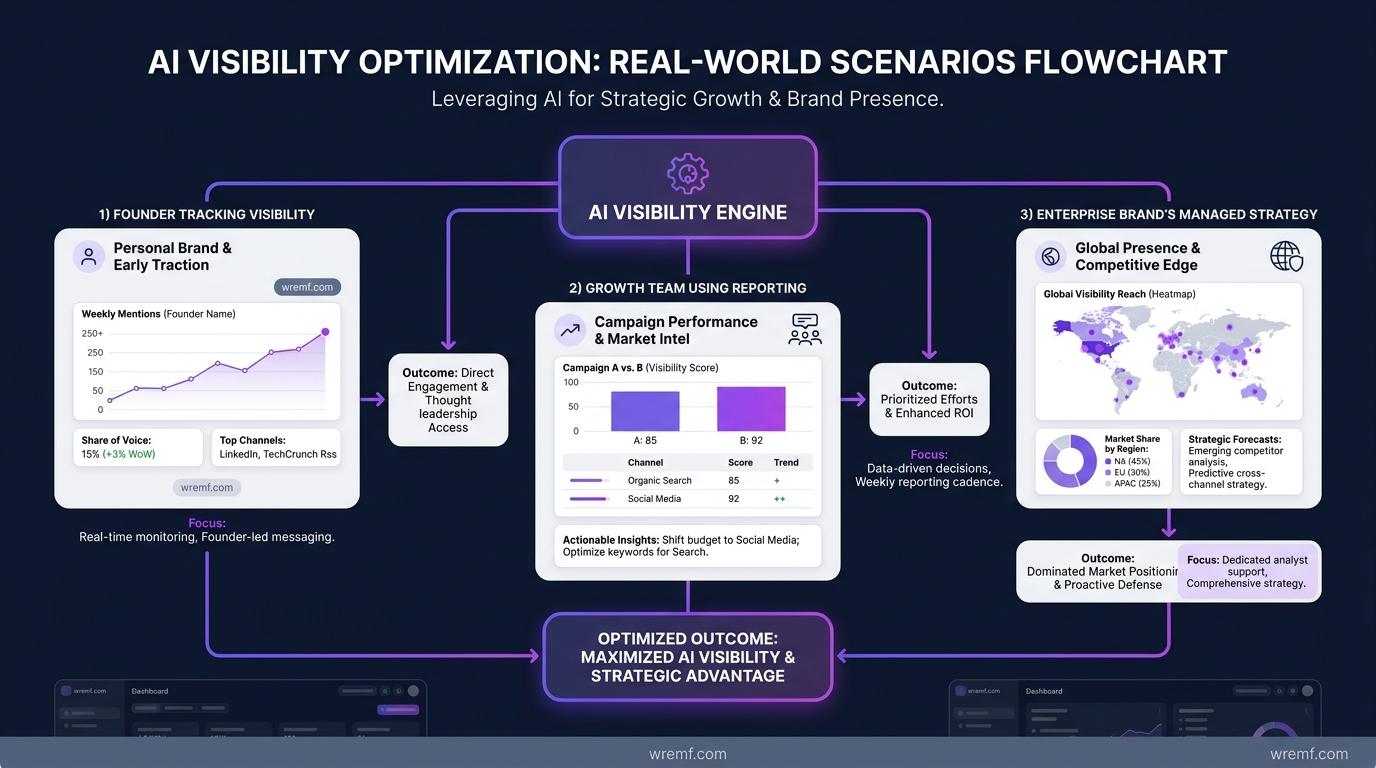
The practical application of AI visibility optimization differs depending on team size, technical resources, competitive context, and the maturity of the brand's existing SEO and content program. The following scenarios illustrate how different teams approach the challenge.
Scenario one: A B2B SaaS founder tracking early AI visibility
A founder running a CRM tool for small businesses notices that when they ask ChatGPT to recommend CRM software for small teams, three competitors appear by name in the answer but their own brand does not. They sign up for WREMF's Starter plan at 59 euros per month, configure the prompt universe around their target category and competitor set, and run their first baseline citation analysis across 10 AI engines. The results confirm that the brand has low citation coverage across all engines and that the three named competitors all have significantly more editorial coverage and better-structured product pages. The founder uses the citation and entity gap data to prioritize three content improvements: adding FAQ-structured content to the product pages, deploying Organization and Product schema across the site, and securing two editorial placements in publications that AI engines frequently cite for CRM-related prompts. Monthly monitoring shows gradual citation improvement over the following quarter.
Scenario two: A growth team using WREMF Growth for reporting and attribution
A B2B marketing team at a mid-size SaaS company has a strong Google rankings profile but no clear picture of how AI search is affecting their awareness funnel. They move to WREMF's Growth plan at 149 euros per month, connect GA4 attribution, and configure white-label reports for weekly stakeholder updates. The AI Visibility Index gives the team a single score to track progress, and the GEO audit identifies four content clusters where competitors are dominating AI answers despite the team having stronger Google rankings. The team uses the content brief generator to rebuild those four content clusters around prompt-matched answer structures and deploys the updated pages over six weeks. AI referral traffic attribution in GA4 confirms a measurable increase in visits from AI sources within the reporting period.
Scenario three: An enterprise brand using WREMF Managed for strategy and execution
A global B2B technology brand operating in multiple markets needs a comprehensive AI visibility program but does not have sufficient internal capacity to run GEO strategy, AEO content optimization, citation cleanup, entity management, and ongoing monitoring simultaneously. They engage WREMF's Managed plan, starting from 1,500 euros per month, which includes a full AI visibility audit, custom GEO strategy, AEO content optimization, citation and entity cleanup, senior-led execution, strategy calls, a custom roadmap, and monthly reporting. The Managed team handles the end-to-end execution while the client's in-house team reviews strategy recommendations, approves content, and monitors progress through the custom dashboard. This hybrid of strategic oversight and managed execution allows the brand to build AI visibility at scale without expanding internal headcount.
KEY TAKEAWAY: AI visibility optimization looks different at each stage of team maturity, from a founder running solo prompt tracking to an enterprise brand delegating full program execution, and the right WREMF plan scales to match the team's resources and objectives.
Limitations, Risks, and Caveats in AI Visibility Optimization
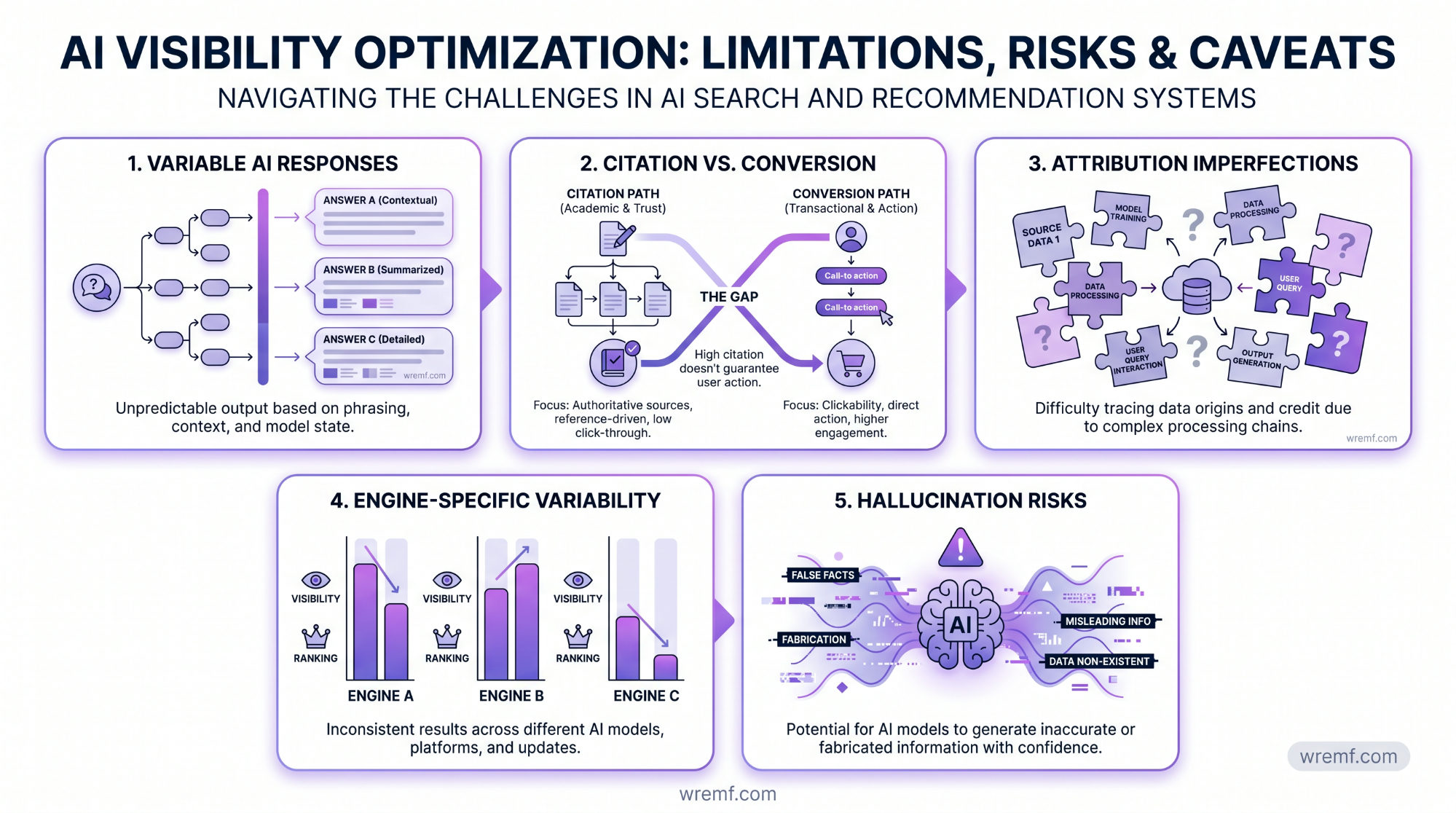
AI visibility optimization involves genuine uncertainties that any responsible practitioner should understand before building a program or setting client expectations. No platform, including WREMF, can guarantee that an AI engine will recommend or cite a specific brand.
The first major limitation is that AI-generated answers are not fixed. The same prompt submitted to ChatGPT today may produce a different answer tomorrow. AI engines update their models, retrain on new data, adjust their retrieval logic, and change their source weighting in ways that are not publicly disclosed and cannot be predicted. This means citation patterns can shift without any corresponding change in the brand's content or authority profile. Ongoing monitoring is the only way to detect and respond to these shifts quickly.
The second limitation is that citation frequency does not equal conversion. A brand can appear in hundreds of AI-generated answers and still fail to generate meaningful traffic or pipeline if the citations are generic, the brand is mentioned briefly alongside several competitors, or the user never clicks through to the brand's website. Citation coverage is a leading indicator of AI visibility, not a guarantee of commercial outcomes. Teams should track AI referral traffic and attribution data alongside citation frequency to understand the actual business impact.
The third limitation is that AI referral traffic attribution is imperfect. Google Analytics Help documentation confirms that AI traffic sources can arrive through referral, direct, or organic channels depending on how the user followed a link or typed in a URL after reading an AI answer. This means that the true volume of AI-influenced visits is likely underreported in most GA4 configurations. Teams should configure UTM tracking, monitor dark traffic anomalies, and use multiple attribution signals to build a more complete picture.
The fourth limitation is engine-specific variation. A brand's citation performance on Perplexity is not predictive of performance on Google AI Overviews or ChatGPT. Each engine uses different source pools, different retrieval mechanisms, and different content quality signals. Perplexity's blog has published guidance on how its answer engine approaches source selection, which illustrates the degree to which each platform has its own citation logic. A comprehensive AI visibility program must measure and optimize for each engine separately.
The fifth limitation is that hallucinations remain a real risk. LLMs can generate inaccurate descriptions of a brand's products, pricing, or capabilities even when citing what appears to be the brand's own content. Citation and entity cleanup, accurate structured data, and consistent knowledge panel information all reduce hallucination risk, but they cannot eliminate it entirely. Teams should run regular brand audit checks to identify inaccurate AI-generated descriptions and respond with content corrections and entity updates.
The sixth limitation is execution capacity. Software-only plans like WREMF's Starter and Growth tiers require the customer's team to interpret data and execute improvements. Teams without strong internal SEO, content, and entity management resources may collect valuable data but struggle to act on it effectively. Managed and hybrid models address this gap by providing expert execution alongside the software.
IMPORTANT:
No AI visibility platform can guarantee that any specific AI engine will recommend or cite a brand. The goal of AI visibility optimization is to improve the quality and consistency of the signals that AI engines use to evaluate sources, not to control AI engine outputs directly.
KEY TAKEAWAY: AI visibility optimization programs must account for answer variability, imperfect attribution, engine-specific differences, hallucination risk, and execution capacity constraints before setting performance expectations.
How to Choose Between WREMF Software, Managed Service, and Hybrid Models
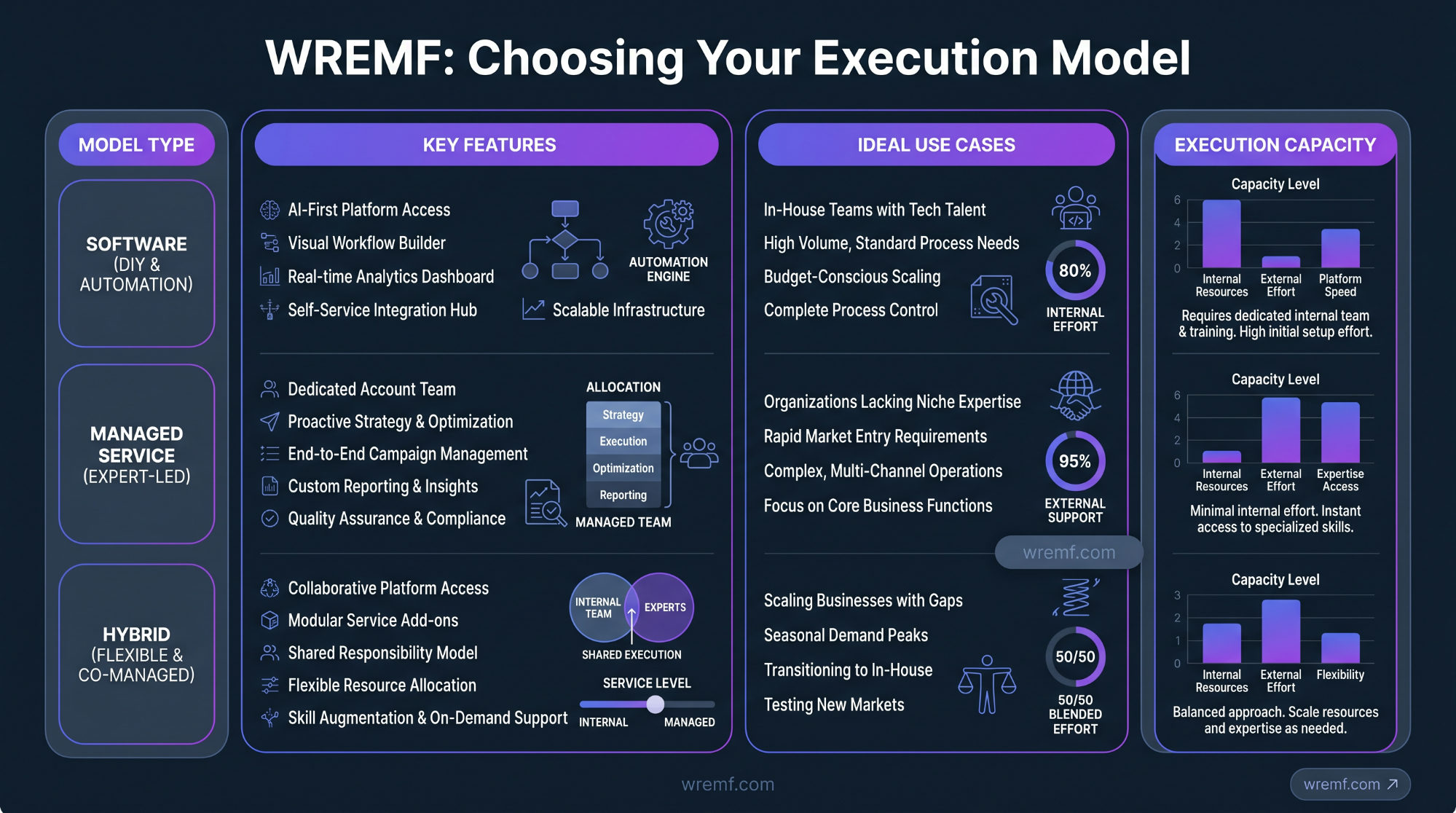
The decision between WREMF as software, as a managed service, or as a hybrid depends on the team's internal execution capacity, the complexity of the AI visibility challenge, and the pace of improvement required. There is no single right answer, and teams can move between models as their program matures.
Software-only is the right starting point for teams with strong internal SEO and content capabilities who need visibility data but have the resources to act on it themselves. WREMF's Starter plan at 59 euros per month is designed for founders, solo consultants, AI SEO specialists, and small SaaS teams beginning to track AI visibility. It includes 10 AI engines, unlimited prompts, BYOK, core prompt intelligence, source citation tracking, an AI Visibility Index, basic competitor tracking for up to three competitors, and monthly reporting. The Growth plan at 149 euros per month extends this to five websites, up to 15 competitors, GA4 attribution, white-label reports, a Looker Studio connector, GEO audits, a content brief generator, SEO testing, and priority support. These two tiers serve in-house teams and agencies that have the execution resources to act on the data the platform surfaces.
Managed service is the right model for teams that need strategy, implementation, and ongoing optimization support alongside the tracking data. WREMF's Managed plan, starting from 1,500 euros per month, provides a full AI visibility audit, a custom GEO strategy, AEO content optimization, citation and entity cleanup, senior-led execution, strategy calls, a custom roadmap, and monthly reporting. This model is best suited to large agencies managing enterprise accounts, enterprise B2B brands without sufficient internal AI visibility resources, and multi-market teams that need coordinated execution across several geographies or product lines.
Hybrid is the most flexible model. A team uses WREMF software for ongoing prompt tracking, citation monitoring, AI share of voice reporting, and attribution, and engages the senior WREMF team for audit sprints, strategy sessions, and execution bursts when the internal team needs specialist support. The hybrid model is particularly effective for growth-stage SaaS companies that have a capable in-house SEO or content team but need expert GEO and AEO guidance for the strategic build-out phases.
Choosing based on team profile
- Founder or solo consultant: Start with Starter. Track baseline citations, identify the biggest gaps, and address them with targeted content and entity updates before adding more complexity.
- In-house SEO or marketing team: Growth plan provides the reporting, attribution, and content tooling needed to run a structured AI visibility program internally.
- Agency with multiple clients: Growth or Managed depending on client scale. White-label reports and multi-account support make Growth the default for most agencies, with Managed available for enterprise client programs.
- Enterprise brand with complex markets: Managed plan or hybrid model with custom onboarding, dedicated account management, and senior-led strategy execution.
Teams that want to speak with someone before committing to a plan can book a quick call with WREMF to discuss plan fit, onboarding, and how the platform maps to their specific AI visibility objectives.
KEY TAKEAWAY: The choice between WREMF software, managed, and hybrid models should be based on the team's internal execution capacity, the scope of the AI visibility challenge, and whether the team needs data only or data plus expert-led implementation.
Common Misconceptions About AI Visibility Optimization
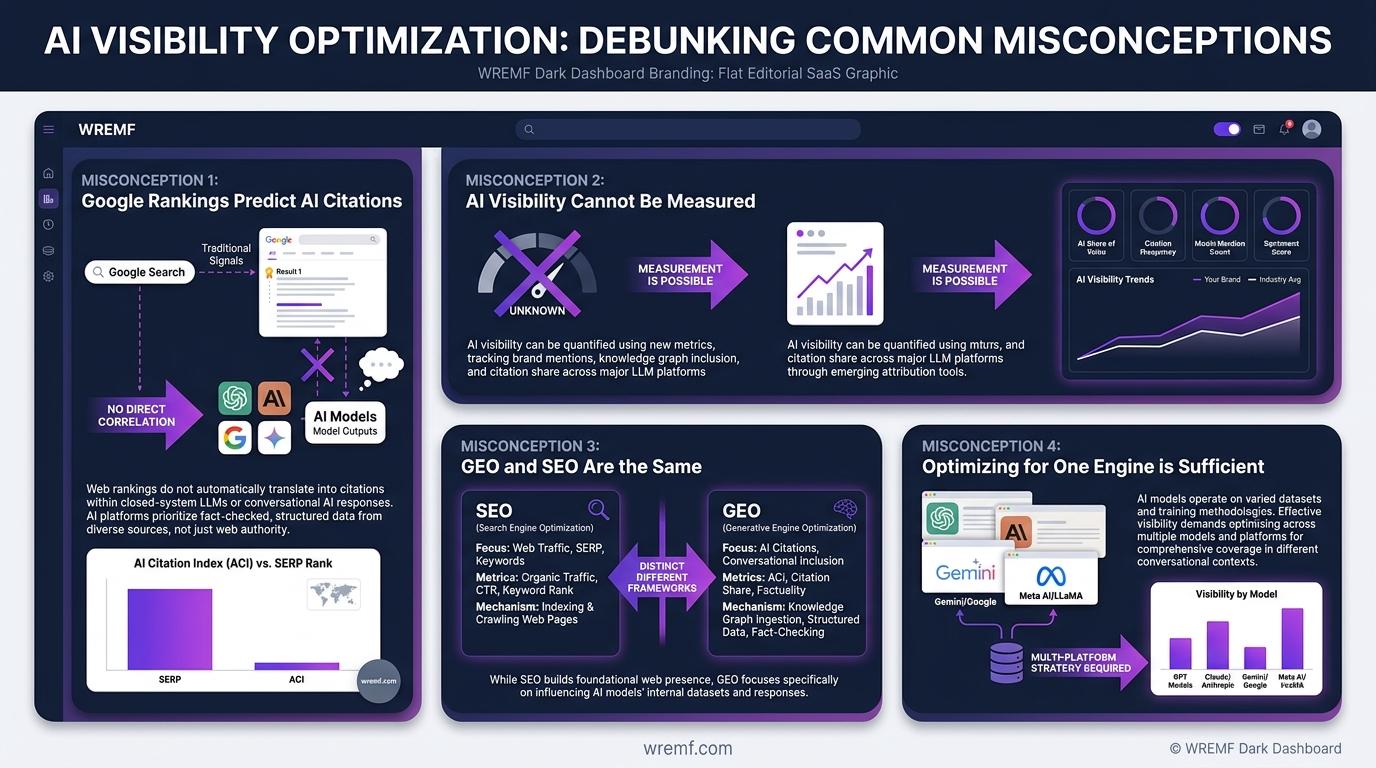
MYTH: If a brand ranks on page one of Google, it will automatically appear in AI-generated answers.
FACT: Google rankings and AI citation presence are measured by different signals and require separate optimization approaches. A brand can rank on page one for a competitive keyword and receive zero citations in Google AI Overviews, ChatGPT, or Perplexity answers for the same topic if its content lacks the structural clarity, entity consistency, and answer-first format that AI engines favor. Rankings and AI citations are not interchangeable metrics.
MYTH: AI visibility cannot be measured in a reliable or repeatable way.
FACT: AI visibility is measurable through systematic prompt tracking, citation coverage analysis, AI share of voice calculation, sentiment monitoring, and AI referral traffic attribution. Platforms like WREMF run structured prompt sets across 10 AI engines on a scheduled basis and produce consistent, comparable datasets over time. While individual AI answers can vary between sessions, aggregate citation patterns across large prompt sets are stable enough to produce actionable performance data.
MYTH: GEO and SEO are the same thing with different branding.
FACT: GEO and SEO address fundamentally different discovery layers and require different optimization actions. SEO focuses on keyword rankings, crawlability, backlinks, and SERP position in traditional search engines. GEO focuses on how generative AI systems represent a brand in synthesized, multi-source answers. A brand needs both disciplines working together, but conflating them leads to measurement gaps and misallocated effort. The complete guide to generative AI optimization services explains the practical distinction in detail.
MYTH: Optimizing for one AI engine is sufficient because they all use the same sources.
FACT: Each major AI engine uses different source pools, retrieval mechanisms, and content quality signals. A brand that appears consistently in Perplexity answers may have minimal presence in Google AI Overviews or ChatGPT because each engine applies different weighting to content type, source authority, and entity signals. Citation coverage must be tracked and optimized separately across each engine in the target set.
MYTH: An AI visibility optimization program can guarantee that a brand will be recommended by ChatGPT, Gemini, or other AI engines.
FACT: No AI visibility program, software platform, or managed service can guarantee AI engine recommendations. The goal of AI visibility optimization is to improve the quality, consistency, and extractability of the signals that AI engines use to evaluate and select sources. Citation likelihood improves through better content structure, stronger entity signals, higher source authority, and greater consistency across the web, but the final decision about what an AI engine cites rests with the model's generation logic, not with the brand's optimization actions.
KEY TAKEAWAY: The most costly misconceptions in AI visibility optimization are assuming Google rankings predict AI citations, believing AI citations cannot be measured, and expecting that optimization can guarantee specific AI engine recommendations.
Conclusion
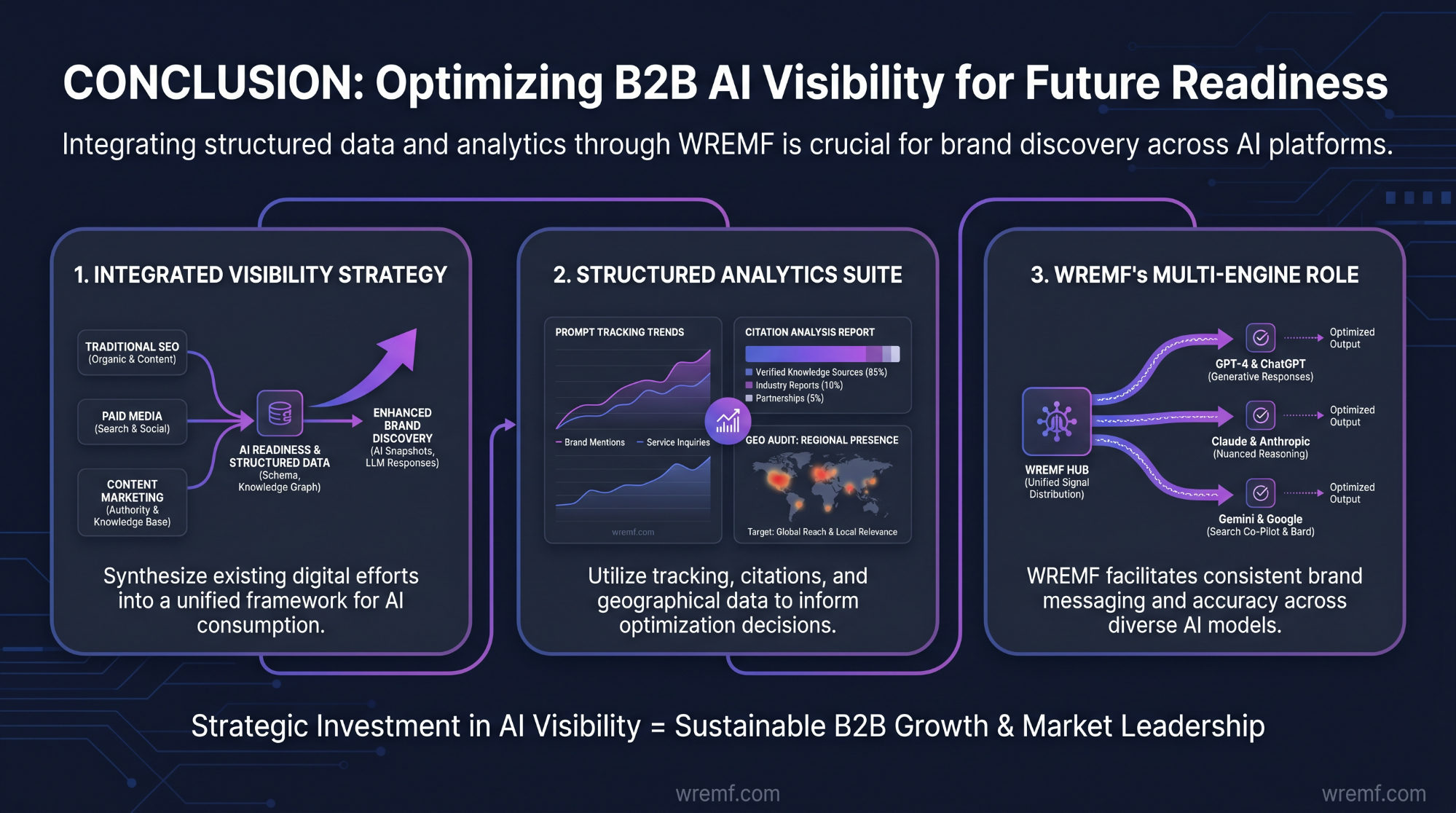
AI visibility optimization is the practice of improving how AI engines mention, cite, and recommend a brand across the prompt-based discovery journeys that now shape B2B buying decisions. It requires a structured program covering prompt tracking, citation analysis, GEO audits, AEO content strategy, entity management, structured data, source consistency, and AI referral traffic attribution, all measured systematically across the AI engines where target buyers are actively researching. Teams that treat AI visibility as a standalone add-on to their existing SEO program will underperform relative to teams that integrate it as a separate, rigorously measured discipline. WREMF helps B2B brands and agencies track, improve, and prove AI visibility across 10 engines, with software plans starting at 59 euros per month and managed execution available for teams that need expert-led strategy and implementation. Explore WREMF agency services or review the full pricing options to find the plan that fits your team's current stage and objectives.
Frequently Asked Questions About AI Visibility Optimization
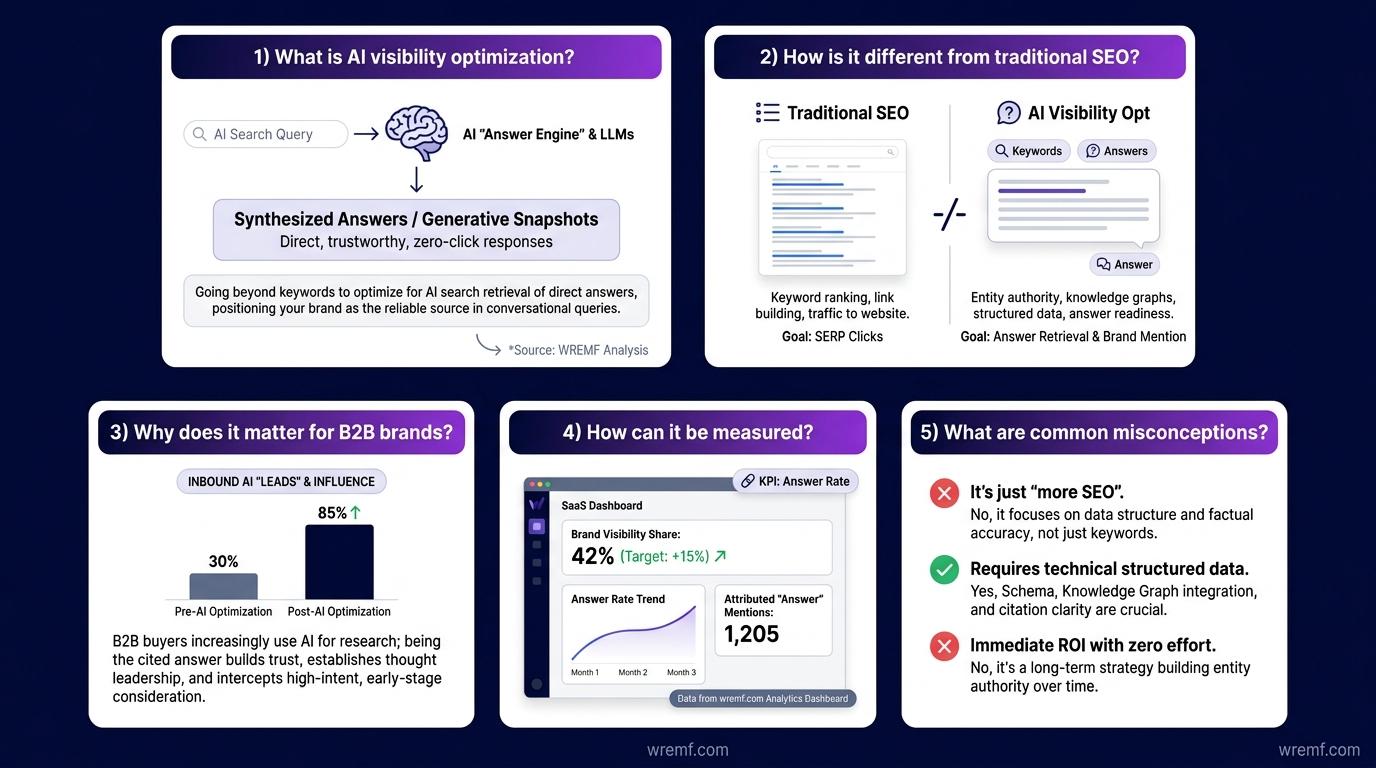
What is AI visibility optimization?
AI visibility optimization is the practice of improving how a brand appears, is cited, and is recommended across AI-powered discovery systems such as ChatGPT, Claude, Gemini, Perplexity, Google AI Overviews, Copilot, DeepSeek, Grok, and Meta AI. Unlike traditional SEO, which focuses on ranking in search engine results pages, AI visibility optimization focuses on whether AI models include your brand in generated answers, how favorably you are described, and how consistently you are cited as a trusted source. For B2B brands, this is increasingly relevant as buyers use AI assistants to research categories, compare vendors, and make purchase decisions before ever visiting a website.
How is AI visibility optimization different from traditional SEO?
Traditional SEO focuses on ranking pages in search engine results for keyword queries. AI visibility optimization focuses on whether AI engines cite your brand, include it in generated recommendations, and describe it accurately when users ask questions about your category. According to Google's AI Overviews documentation, AI Overviews are a distinct layer of search that applies different classification signals from standard organic rankings. This means a brand can rank well in traditional search but remain invisible in AI-generated answers, and vice versa. Both disciplines matter, but they require different strategies, content structures, and measurement approaches.
Why does AI visibility matter for B2B brands?
AI visibility matters because B2B buyers increasingly use tools like ChatGPT, Perplexity, and Google AI Overviews to research software categories, shortlist vendors, and evaluate options before contacting a sales team. If your brand is not cited in AI-generated answers for the prompts your buyers use, you are invisible at a critical stage of the buying journey. Gartner research consistently highlights that buyers complete a significant portion of their research independently before engaging vendors, and AI search is accelerating that trend. Being absent from AI answers at the research stage can mean losing pipeline before your sales team ever enters the conversation.
Is your brand being cited when buyers ask AI about your category?
Most brands do not know whether they are being cited in AI answers, how they are described, or how they compare to competitors in AI-generated responses. The only reliable way to find out is to systematically track the prompts your buyers use across multiple AI engines and measure citation frequency, sentiment, and competitor share of voice. Manual spot-checking across ChatGPT, Gemini, Claude, and Perplexity is not scalable or consistent. WREMF's AI Visibility Index provides structured tracking of how your brand appears across ten AI engines, giving you a measurable baseline instead of guesswork.
Can you just manually monitor AI engines to see if your brand appears?
Manual monitoring is not a practical or reliable approach to AI visibility optimization. To check your brand's visibility accurately, you would need to run hundreds of relevant prompts across ChatGPT, Claude, Gemini, Perplexity, Google AI Overviews, Copilot, and other engines, record the outputs, compare responses across sessions, track changes over time, and benchmark against competitors. AI models produce variable outputs depending on phrasing, session context, and model version. Running this manually even once is time-consuming. Running it consistently at scale is not feasible without tooling designed for systematic prompt tracking and response analysis.
How many prompts can you realistically track manually across AI engines?
Manually tracking prompts across multiple AI engines does not scale. A single product category may have dozens of relevant buying-stage, comparison, and recommendation prompts. Across ten AI engines, even twenty prompts generates two hundred data points per run, all requiring manual recording, comparison, and analysis. This is before accounting for response variation, competitor tracking, and scheduled re-runs. In practice, teams that attempt manual monitoring quickly find it unsustainable. Purpose-built AI visibility tools automate prompt execution, response capture, citation detection, and trend analysis so teams can track thousands of prompts at scale without manual effort.
What makes content stand out in AI search?
Content that performs well in AI search tends to be structured around specific questions, uses clear and direct language, provides factual and verifiable information, and is published on sources that AI engines recognise as authoritative. Answer-first formatting, where the direct answer appears in the first sentence of a response, makes it easier for AI models to extract and cite your content. Schema.org structured data helps AI systems understand your content's context, entities, and relationships. Content that defines terms clearly, uses consistent entity naming, and covers a topic comprehensively tends to be cited more often than content that is vague, promotional, or poorly structured.
How should you structure content for AI search visibility?
Content structured for AI search visibility should use clear H2 and H3 headings that reflect natural-language questions, answer each question directly in the opening sentence, avoid burying the key point in introductory text, and use short paragraphs that are easy for AI models to parse and extract. Specific, factual details such as dimensions, specifications, comparisons, and use cases improve citation likelihood because AI engines prefer content that directly resolves user queries. Vague headings, marketing language, and thin content with no distinct information value are consistently deprioritised. WREMF's content brief generator helps teams produce AI-ready content structures based on prompt-level visibility data.
How does schema markup help AI understand your content?
Schema markup, based on Schema.org vocabulary, provides structured signals that help AI systems and search engines understand the entities, relationships, and factual claims within a page. For AI visibility optimization, relevant schema types include FAQ, HowTo, Product, Organization, and Article. When AI engines process content for generative answers, structured data helps them identify what a page is about, who created it, what it claims, and how it relates to other known entities. While schema markup alone does not guarantee citation, it reduces ambiguity and improves retrieval reliability, particularly for factual and product-related queries where precision matters.
How does semantic clarity improve AI search visibility?
Semantic clarity means using consistent, specific, and unambiguous language throughout your content so that AI models can accurately identify entities, understand relationships, and extract relevant information. Inconsistent naming, overloaded terminology, and vague category descriptions make it harder for AI systems to associate your content with the right queries. For example, if your brand describes its product category differently across pages, AI models may struggle to consistently include you in relevant answers. Defining your category clearly, using recognised terminology, and maintaining entity consistency across your site improves the reliability of AI citations across engines like ChatGPT, Claude, Gemini, and Perplexity.
What writing mistakes reduce AI search visibility?
Common writing mistakes that reduce AI search visibility include burying the direct answer after lengthy introductions, using vague headings that do not reflect the question being answered, making unsupported claims without factual grounding, using inconsistent terminology for the same entity across pages, writing in a way that prioritises keyword density over clarity, and producing content that describes features without connecting them to specific use cases or outcomes. AI models prefer content that resolves a question efficiently. Content that requires extensive reading before reaching a useful answer is less likely to be extracted and cited than content that is structured for direct retrieval.
What is LLM SEO?
LLM SEO refers to the practice of optimising content, entity signals, and authority so that large language models such as GPT-4, Claude, Gemini, and Mistral are more likely to retrieve, cite, and recommend a brand when responding to relevant user queries. It overlaps with AEO and GEO but focuses specifically on how LLMs select and prioritise sources during response generation. LLM SEO typically involves improving content structure, strengthening entity authority, building consistent third-party mentions, and ensuring that the information AI models have indexed about a brand is accurate and current. As OpenAI's research shows, LLMs draw on training data and retrieval systems, making authoritative, well-structured content a key factor in citation likelihood.
What is generative engine optimization (GEO)?
Generative engine optimization, commonly referred to as GEO, is the practice of improving how a brand's content is retrieved, cited, and represented in AI-generated answers across generative AI systems such as ChatGPT, Perplexity, Claude, Google AI Overviews, and Copilot. GEO involves a combination of content structure improvements, entity authority development, technical AI readiness, source citation building, and prompt-level visibility tracking. It differs from traditional SEO in that the goal is not to rank a URL but to become the source an AI engine cites or recommends when answering queries in your category. You can learn more about GEO audit processes and methodology at WREMF.
What is answer engine optimization (AEO)?
Answer engine optimization, or AEO, is the process of structuring and optimising content so that answer engines, including AI-powered systems like Google AI Overviews, Perplexity, and ChatGPT, retrieve and present your brand's information in direct response to user questions. AEO focuses on question-and-answer content formats, factual accuracy, structured data, entity clarity, and source authority. It is closely related to GEO but emphasises the answer extraction layer rather than the broader generative response. For B2B brands, AEO is particularly important for category definition, product comparison, and buying-stage queries where AI engines often synthesise answers from multiple sources rather than returning a list of links.
How do AI visibility metrics differ from traditional SEO metrics?
Traditional SEO metrics focus on keyword rankings, organic traffic, click-through rates, and backlink authority. AI visibility metrics focus on citation frequency, brand mention rate across AI engines, share of voice in AI-generated responses, sentiment of AI descriptions, source consistency across engines, and prompt-level visibility for buying-stage queries. There is no direct equivalent of a keyword ranking in AI visibility because AI responses are generated dynamically rather than pulled from a ranked list. Teams measuring AI visibility need to track whether their brand is cited, how it is described, which competitors appear alongside it, and whether AI traffic is contributing to pipeline and conversion. WREMF's methodology maps these metrics into a measurable scoring framework.
Is AI visibility correlated with stronger performance in traditional search channels?
There is a meaningful overlap between the factors that drive AI visibility and those that support traditional search performance. High-quality content, strong entity authority, consistent structured data, and trusted third-party mentions contribute positively to both. However, they are not equivalent. A brand can have strong organic rankings and weak AI citation coverage if its content is not structured for answer extraction. Conversely, brands with strong authority signals, clear entity definitions, and well-structured factual content often benefit across both channels. The most effective AI visibility optimization strategies tend to reinforce traditional SEO foundations while adding AI-specific content structure and citation-building work.
What levers actually influence AI citations?
The primary factors that influence AI citations include the authority and trustworthiness of your domain and third-party mentions, the clarity and structure of your content, the accuracy and specificity of your factual claims, the consistency of your entity signals across your site and external sources, the relevance of your content to the specific prompts users submit, and the freshness of your content relative to AI model training and retrieval cycles. Off-site factors such as being mentioned in recognised publications, industry directories, and authoritative third-party sources also strengthen citation likelihood. WREMF's source citation tracking helps teams identify which sources are being cited alongside their brand and where citation gaps exist.
Which AI surfaces should B2B brands prioritise for visibility?
The most commercially relevant AI surfaces for B2B brands are typically ChatGPT, Perplexity, Google AI Overviews, Claude, and Google AI Mode, as these attract the highest volume of research and buying-stage queries. However, priority should be based on where your specific buyers are active, which engines surface your category most prominently, and where competitors are already visible. Copilot is relevant for brands targeting Microsoft-ecosystem buyers. Gemini matters for brands in Google Workspace-adjacent categories. Grok and Meta AI are growing surfaces worth monitoring. WREMF tracks visibility across ten AI engines simultaneously so teams can identify where they are cited, where they are absent, and where competitors are outperforming them.
How do you measure ROI when AI users do not click through to your website?
AI-generated answers often resolve queries without requiring a click, which means traditional click-based attribution underestimates the business impact of AI visibility. Measuring ROI requires a combination of direct AI traffic attribution using GA4 and UTM tracking, share of voice analysis to quantify brand presence in AI-generated answers, and pipeline correlation to identify whether AI-visible brands convert at higher rates. Some brands also track branded search uplift as a proxy for AI-driven awareness. While direct attribution remains challenging, teams that connect AI citation data with pipeline metrics can build a credible business case. WREMF supports GA4 attribution and share of voice reporting as part of the Growth plan.
How long does it take to see results from AI visibility optimization?
The timeline for AI visibility improvements depends on the current state of your content, entity authority, and citation footprint. Technical and content structure improvements can begin influencing AI responses within weeks if the AI engine uses real-time retrieval, as Perplexity does. For LLMs that rely primarily on training data, changes may take longer to reflect in responses. Authority-building work, which involves earning third-party mentions and strengthening entity signals across external sources, typically takes three to six months to show measurable impact. Teams should set expectations around gradual improvement rather than immediate results. Consistent monitoring is essential to identify what is working and where further optimisation is needed.
What happens when AI models update their training data or change their algorithms?
AI model updates can shift citation patterns, change which sources are prioritised, and alter how categories are described in generated answers. This is one of the most significant risks in AI visibility optimization and a primary reason why ongoing monitoring matters more than one-time optimisation. When a model update occurs, brands that have built strong entity authority, consistent third-party mentions, and accurate structured data tend to recover faster than those relying on thin content or single-channel signals. Scheduled AI monitoring allows teams to detect changes quickly and respond with targeted content or citation improvements rather than discovering a visibility drop through declining pipeline weeks later.
How do you prevent or correct AI hallucinations about your brand?
AI hallucinations about a brand, where AI engines generate inaccurate descriptions, incorrect product claims, or misleading comparisons, are addressed through a combination of entity authority reinforcement, content accuracy improvements, and external source consistency. Publishing clear, factually accurate content about your brand, products, category, and positioning across your own site and trusted third-party sources reduces the information gap that causes hallucinations. Structured data using Schema.org markup helps AI systems identify verified facts about your organization. Monitoring AI outputs regularly using WREMF's prompt intelligence tools allows teams to detect inaccurate descriptions early and take corrective action before misinformation spreads across multiple AI engines.
How is AI brand sentiment measured?
AI brand sentiment refers to how AI engines describe your brand in generated answers, including whether the description is positive, neutral, negative, or vague. Unlike social listening, which tracks human-authored content, AI sentiment analysis captures how the AI model itself frames your brand when responding to category, comparison, or recommendation queries. Measuring this requires systematic prompt testing across multiple engines and analysis of the language used in responses. Key signals include whether the AI describes your brand favourably relative to competitors, whether it uses your preferred positioning language, and whether it flags any concerns or limitations. Brand sentiment in AI answers is a black box without structured monitoring.
Can regulated industries manage AI misinformation effectively?
Regulated industries such as financial services, healthcare, and legal services face specific challenges with AI misinformation because AI engines may generate outputs that misrepresent products, services, or compliance positions. The most effective approach combines proactive content accuracy work, ensuring that authoritative and compliant information is prominently published and well-structured, with ongoing monitoring to detect inaccurate AI outputs. Schema markup and clear entity definitions help AI systems distinguish between verified claims and speculative content. Regulated brands should also work to build citation presence on recognised authoritative third-party sources in their sector, which helps AI engines prefer accurate institutional content over less reliable sources when generating responses.
How often should AI visibility benchmarks be updated?
AI visibility benchmarks should be reviewed at least monthly, with higher-frequency monitoring for brands in competitive categories or during periods of active content or product changes. AI engines update their models, retrieval systems, and response policies on irregular schedules, meaning citation patterns can shift without warning. Monthly benchmarking provides a baseline for trend analysis, while weekly or daily scheduled monitoring helps teams detect sudden changes in brand visibility, competitor citation patterns, or prompt-level response shifts. WREMF supports scheduled AI monitoring with configurable re-run frequencies so teams can set the cadence that matches their visibility goals and competitive environment.
What features should you look for in an AI visibility platform?
The most important features in an AI visibility platform include multi-engine coverage across at least the major AI systems such as ChatGPT, Claude, Gemini, Perplexity, and Google AI Overviews, structured prompt tracking with scheduled re-runs, citation detection and source analysis, competitor visibility tracking, share of voice reporting, sentiment analysis for brand descriptions, GA4 or analytics integration for attribution, and GEO audit capabilities. Additional features worth evaluating include white-label reporting for agencies, BYOK support to control API costs, content brief generation, and real-time alerting for visibility changes. The WREMF platform covers all of these capabilities and tracks visibility across ten AI engines.
How many competitors can you track simultaneously in an AI visibility tool?
Competitor tracking capacity varies significantly between platforms. Some tools limit competitor tracking to three or five brands, which is insufficient for competitive categories where multiple vendors are regularly cited in AI answers. Tracking five to fifteen competitors simultaneously allows teams to understand their relative share of voice, identify which competitors are gaining ground in AI citations, and benchmark their own visibility against the field. WREMF's Starter plan supports up to three competitors, the Growth plan supports ten to fifteen competitors, and the Managed plan supports custom competitor sets. You can review the full breakdown on the WREMF pricing page.
Can you track visibility for specific prompts in an AI visibility tool?
Yes. Tracking specific prompts is a core capability in purpose-built AI visibility tools and one of the most direct ways to understand how your brand appears in the exact queries your buyers use. Rather than tracking generic category terms, prompt-level tracking allows you to monitor buying-stage queries such as "best project management software for remote teams" or "which CRM integrates with HubSpot" and see whether your brand is cited, how it is described, and which competitors appear in the same response. WREMF's prompt intelligence feature allows teams to build custom prompt sets, run them across multiple AI engines, and monitor response patterns over time.
Do AI visibility tools support content optimisation before publishing?
Some AI visibility platforms offer pre-publication content optimisation features that help teams structure new content to improve citation likelihood before it goes live. This typically includes content brief generation based on prompt-level gap analysis, AI-ready formatting recommendations, entity and schema guidance, and comparison of draft content against the structure of currently cited sources. Pre-publication optimisation is more efficient than retrofitting published content because it avoids the need to rewrite pages after they have already underperformed. WREMF's content briefs feature generates AI-ready content structures based on real prompt data and citation patterns identified across major AI engines.
What is AI share of voice and how is it measured?
AI share of voice measures the proportion of AI-generated responses in a defined prompt set in which your brand is cited or recommended, compared to the total responses and the responses mentioning competitors. For example, if your brand appears in thirty out of one hundred relevant AI responses while your closest competitor appears in fifty, your AI share of voice is thirty percent in that prompt set. Share of voice is a more useful strategic metric than raw citation counts because it contextualises your visibility relative to the competitive landscape. Tracking share of voice over time reveals whether your AI visibility optimization efforts are increasing your relative presence or simply keeping pace with competitors who are also actively optimising.
Can agencies deliver AI visibility optimization as a white-label service?
Yes. AI visibility optimization is well-suited to white-label agency delivery because the underlying work, including prompt tracking, citation analysis, GEO audits, content optimisation, and share of voice reporting, can be packaged under a client-facing brand. Agencies managing multiple clients need tools that support custom prompt sets per client, white-label reporting, and scalable monitoring without per-prompt markups that erode margins. WREMF supports white-label reporting and client portals and is designed for agencies managing AI visibility across multiple brands. The platform also offers BYOK on every plan, allowing agencies to control API costs across their client portfolio.
What level of strategic guidance and managed execution is available?
Beyond software, WREMF operates as a senior-led AI visibility agency for teams that want strategy and execution managed for them rather than just a dashboard. The Managed plan includes a full AI visibility audit, custom GEO strategy, AEO content optimisation, citation and entity cleanup, authority development, senior-led execution, strategy calls, a custom roadmap, and monthly reporting. This is designed for enterprise brands, large agencies, and multi-market teams that need measurable AI visibility improvements without building an internal AI search function from scratch. Teams that want to explore managed execution can talk to the WREMF agency team to discuss scope, timelines, and deliverables.
How do you run an AI visibility audit?
An AI visibility audit involves mapping the prompts your buyers use across the buying journey, running those prompts across major AI engines, recording which sources are cited, analysing whether and how your brand appears, comparing your citation presence against competitors, reviewing your content structure and entity signals for AI readiness, and identifying the highest-priority gaps to address. The audit produces a baseline visibility score, a prompt-level citation analysis, a competitor share of voice comparison, and a prioritised list of content, technical, and authority improvements. WREMF's GEO audit feature supports structured AI visibility audits for both software users and teams working with the WREMF agency.
What is a good AI visibility score?
AI visibility scores vary by platform and methodology, but in general a useful score captures citation frequency, share of voice relative to competitors, sentiment quality, and source consistency across multiple AI engines. There is no universal benchmark because AI visibility depends heavily on category competitiveness, content maturity, and entity authority. A brand that appears in sixty to seventy percent of relevant AI responses with neutral to positive sentiment and consistent source representation is performing well in most B2B software categories. The most useful approach is to establish a baseline score, monitor it over time, and measure improvement relative to your own starting point and competitive set rather than against an abstract target.
Which AI agents and engines influence B2B purchase decisions most?
The AI engines that most influence B2B purchase decisions are currently ChatGPT, Perplexity, Google AI Overviews, and Claude, based on their adoption among professional and business users conducting research. Gartner's AI research consistently identifies enterprise adoption of AI assistants in research and vendor evaluation workflows as a growing trend. Google AI Mode and Copilot are significant for brands in categories with strong Google search intent or Microsoft ecosystem relevance. The relative importance of each engine varies by industry, audience seniority, and query type. Tracking visibility across multiple engines rather than optimising for a single platform gives B2B brands a more complete picture of where their buyers are actually discovering vendors.
Does AI visibility tooling support ChatGPT Shopping and product-level tracking?
Product-level and shopping-focused AI visibility tracking is an emerging capability as ChatGPT and other AI engines expand into commerce and product recommendations. For B2B SaaS brands, the most relevant form of product visibility tracking is monitoring how specific products, features, pricing tiers, and use cases are described in AI-generated comparison and recommendation responses. Tracking whether AI engines accurately represent your product's capabilities, position it correctly in category comparisons, and recommend it for the right use cases is directly relevant to pipeline. WREMF's prompt tracking and citation analysis capabilities support product-level visibility monitoring across the AI engines that matter most for B2B buying decisions.
How does WREMF integrate with GA4, CRM, and BI tools?
WREMF supports GA4 attribution through its Growth and Managed plans, allowing teams to connect AI visibility data with website traffic and conversion metrics. A Looker Studio connector is included in the Growth plan for teams that want to incorporate AI visibility data into broader BI dashboards. API access is available for teams that need to connect WREMF data with CRM systems, custom reporting pipelines, or internal analytics platforms. BYOK support is included on every plan, allowing teams to use their own API keys. Full API documentation and integration options are available on the WREMF API page for technical teams evaluating integration depth before purchase.
Is being mentioned by AI engines enough, or does positioning matter?
Being mentioned by AI engines is not sufficient if the description is vague, unfavourable, or positions your brand as a secondary option. AI-generated answers can mention a brand while recommending a competitor, describing limitations, or presenting the brand as suitable only for a narrow use case. Optimising for AI visibility means not just increasing mention frequency but improving how your brand is described, which use cases it is recommended for, and how it compares to competitors in AI-generated responses. Brand sentiment analysis and competitor share of voice tracking are essential for understanding whether AI mentions are commercially useful or simply neutral noise that does not drive buyer consideration.
What is the difference between WREMF software and WREMF managed services?
WREMF software gives teams the tools to track, analyse, and improve their own AI visibility through structured prompt tracking, citation analysis, competitor monitoring, GEO audits, content briefs, and attribution reporting. WREMF managed services provide senior-led strategy and execution for teams that want the work done for them, including AI visibility audits, GEO strategy, content optimisation, authority development, and ongoing reporting. A hybrid approach combines both, where teams use the software for continuous monitoring and reporting while WREMF executes the strategic and content work. The right model depends on internal resource availability, the complexity of the category, and how quickly the team needs to build AI visibility. View current plans and pricing to compare options.
How do multilingual and multi-regional AI visibility differences affect strategy?
AI visibility varies across languages and regional AI engine deployments because models trained on different datasets produce different citation patterns for the same brand. A brand that is well-cited in English-language AI responses may be nearly invisible in French, German, Spanish, or Japanese AI queries. Regional AI engines and localised versions of global platforms may also prioritise different sources based on local authority signals and training data composition. For brands operating across multiple markets, building AI visibility requires market-specific content, localised entity signals, and regional source citation building alongside the core English-language strategy. Multi-regional coverage requirements should be a key evaluation criterion when selecting an AI visibility platform.
Should you choose a software-only AI visibility tool or a managed agency service?
The choice between software and managed services depends on your team's internal capacity to execute. Software-only solutions are appropriate for teams that have strong content, SEO, and technical resources and need visibility data to direct their own work. Managed agency services are better suited to teams that need strategy, content creation, authority building, and ongoing optimisation delivered by specialists rather than handled in-house. A hybrid model, where software provides continuous monitoring and reporting while an agency handles execution, is often the most effective approach for B2B brands in competitive categories. WREMF offers all three options: standalone software, a full-service AI visibility agency, and a combined software plus managed execution model. According to McKinsey's AI insights, organisations that combine AI tooling with specialist execution consistently outperform those relying on either alone.
Related reading
- AI Brand Visibility: The Complete B2B Guide to Tracking, Measuring, and Improving How AI Engines Mention Your Brand
- Generative AI Optimization Services: The Complete Guide to GEO, AEO, LLM Optimization, and AI Visibility
- Large Language Model Optimization Services: The Complete Guide to LLMO, AI Search Visibility, AEO, GEO, RAG, and LLM Performance
- The Complete Guide to AI Search Visibility for B2B Brands and SEO Teams