AI Brand Visibility: The Complete B2B Guide to Tracking, Measuring, and Improving How AI Engines Mention Your Brand
Understand AI brand visibility in B2B; learn to track, measure, and boost mentions by AI.
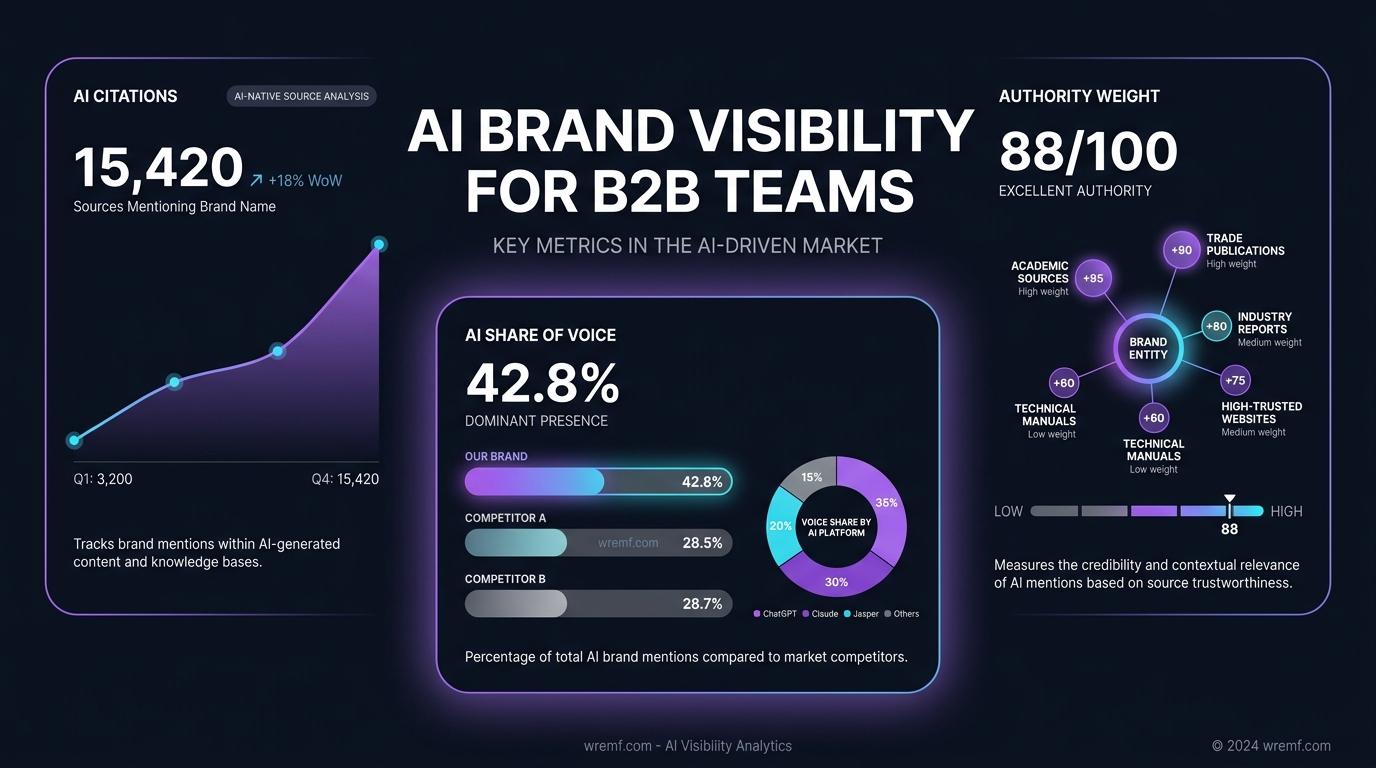
By WREMF Team · 2026-09-19
AI brand visibility refers to how often and accurately AI engines mention, cite, or recommend a brand in response to relevant prompts. It involves tracking AI citations, share of voice, authority weight, and source consistency across various platforms like ChatGPT, Gemini, and Claude. Unlike traditional SEO, this concept measures brand presence in AI-generated answers. Key components include citation analysis and prompt monitoring. The outcomes impact how brands are considered in early buyer research stages. AI brand visibility requires an integrated approach using SEO, AEO, and GEO strategies.
Key takeaways
- AI brand visibility measures mentions, citations, and recommendations across AI platforms.
- Traditional SEO does not ensure visibility in AI-generated answers.
- Key metrics include AI citations, AI share of voice, and source consistency.
- AI brand visibility can be enhanced using GEO audits, AEO strategies, and prompt intelligence.
- WREMF provides tools for AI visibility tracking across multiple AI engines.
AI Brand Visibility: The Complete B2B Guide to Tracking, Measuring, and Improving How AI Engines Mention Your Brand
AI brand visibility is the measure of how often, how accurately, and how favourably AI engines mention, cite, compare, and recommend your brand across relevant prompts and buyer queries. As ChatGPT, Gemini, Perplexity, Claude, Google AI Overviews, Copilot, and other large language models become primary discovery surfaces for B2B buyers, brand visibility in AI search has become a distinct and measurable dimension of marketing performance. This guide is written for B2B SaaS founders, in-house SEO teams, growth leaders, content teams, and agencies that need to understand what AI brand visibility means, how it is measured, and how to act on the data. The article covers prompt tracking, AI citations, AI share of voice, source consistency, GEO, AEO, and how teams can use WREMF as software, a managed service, or a hybrid execution partner. If your brand is not appearing in AI-generated responses, this guide explains why and what to do about it.
QUICK ANSWER:
AI brand visibility measures how often and how accurately AI engines such as ChatGPT, Gemini, Perplexity, Google AI Overviews, Claude, and Copilot mention, cite, or recommend a brand in response to relevant prompts. It is tracked using prompt monitoring, citation analysis, AI share of voice scoring, and source consistency checks across multiple AI platforms. Unlike traditional search rankings, AI brand visibility reflects whether a brand is present in the answers buyers receive before they visit any website.
KEY TAKEAWAYS:
- AI brand visibility measures how AI engines mention, cite, compare, and recommend a brand across prompts relevant to that brand's category, audience, and buyer journey.
- Traditional SEO rankings do not guarantee AI brand visibility. A brand can rank on page one of Google and still be absent from ChatGPT, Gemini, Perplexity, and Google AI Overviews answers.
- The core metrics for AI brand visibility include AI citations, AI share of voice, authority weight, source consistency, and AI Visibility Score across relevant prompt sets.
- AI brand visibility can be tracked and improved through prompt intelligence, citation monitoring, GEO audits, AEO content strategy, entity authority cleanup, and structured data optimisation.
- WREMF tracks AI brand visibility across 10 AI engines with unlimited prompt monitoring, citation tracking, competitor benchmarking, and AI share of voice reporting on every plan.
- Teams can run AI brand visibility programmes as self-serve software, as a fully managed service, or as a hybrid combining WREMF software with senior-led strategy and execution support.
What Is AI Brand Visibility and Why It Differs From Traditional Search Visibility
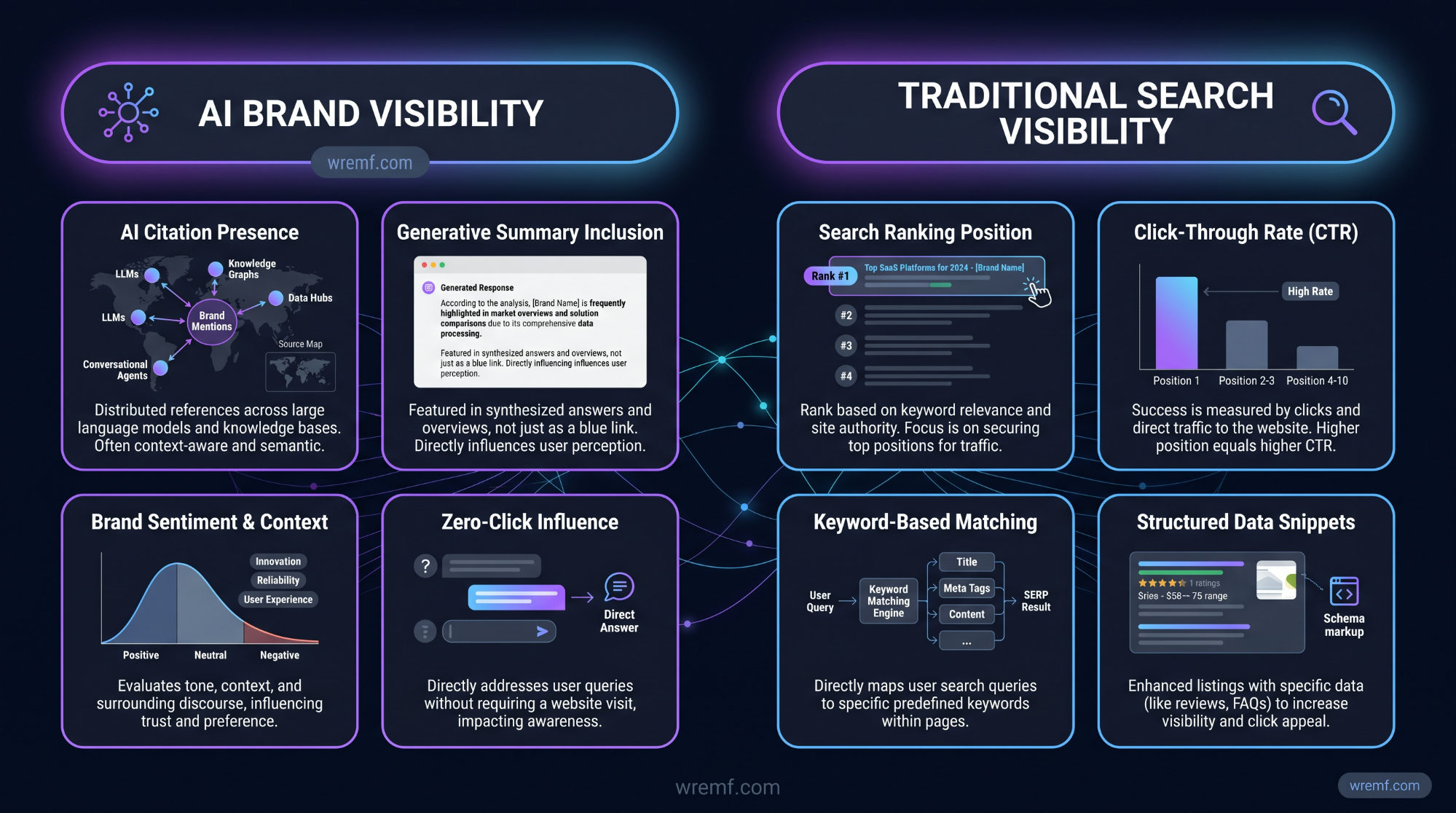
AI brand visibility is the degree to which a brand appears, is cited, and is recommended across AI-generated responses in AI search engines and large language models. It differs from traditional search visibility because it measures presence in answers rather than rankings in results pages.
In traditional search, visibility means appearing in a list of organic results ranked by relevance and authority signals such as backlinks, domain authority, and keyword targeting. A brand's position on a search results page is the primary measure of visibility. In AI search, the dynamic is fundamentally different. AI engines such as ChatGPT, Gemini, Perplexity, and Claude do not return a ranked list of links in the same way a search engine does. They synthesise answers from multiple sources and either mention, cite, recommend, or omit brands entirely. A brand that does not appear in those synthesised answers has zero AI brand visibility for that prompt, regardless of where it ranks on Google.
AI brand visibility is shaped by several overlapping factors. These include which sources the AI engine has indexed or retrieved, how consistently a brand is described across those sources, whether the brand's content and entity data match the query context, and how authoritative the brand's sourced information appears relative to competitors. The concept of source consistency is particularly important. If a brand's description, positioning, category, and expertise are stated differently across different web pages, third-party publications, directories, and partner sites, AI engines may produce inconsistent or diluted brand mentions rather than clear, definitive attributions.
AI brand visibility is not binary. A brand can be mentioned in passing, listed alongside multiple competitors without differentiation, or cited definitively as the leading authority on a topic. These distinctions matter for commercial outcomes. A brand mentioned as one of ten options in an AI-generated response carries different weight than a brand cited as the primary recommended solution for a specific problem. WREMF's authority weight framework captures this distinction by scoring definitive citations more heavily than supporting mentions, helping teams understand whether their AI brand visibility is strengthening or diluting over time.
For B2B brands, AI brand visibility matters because buyers increasingly use AI engines to shortlist vendors, compare solutions, and form initial preferences before visiting any brand's website. According to research tracked by analysts at Gartner's AI research enterprise buyers are integrating AI-assisted research into procurement workflows at an accelerating rate. If a brand is absent from AI-generated answers during those research moments, it is absent from the buyer's consideration set before any sales conversation begins.
KEY TAKEAWAY: AI brand visibility measures whether and how a brand appears in AI-generated answers, not just where it ranks in search results, making it a distinct and measurable performance dimension that requires its own tracking methodology.
Why AI Brand Visibility Matters More Than Ever for B2B Teams
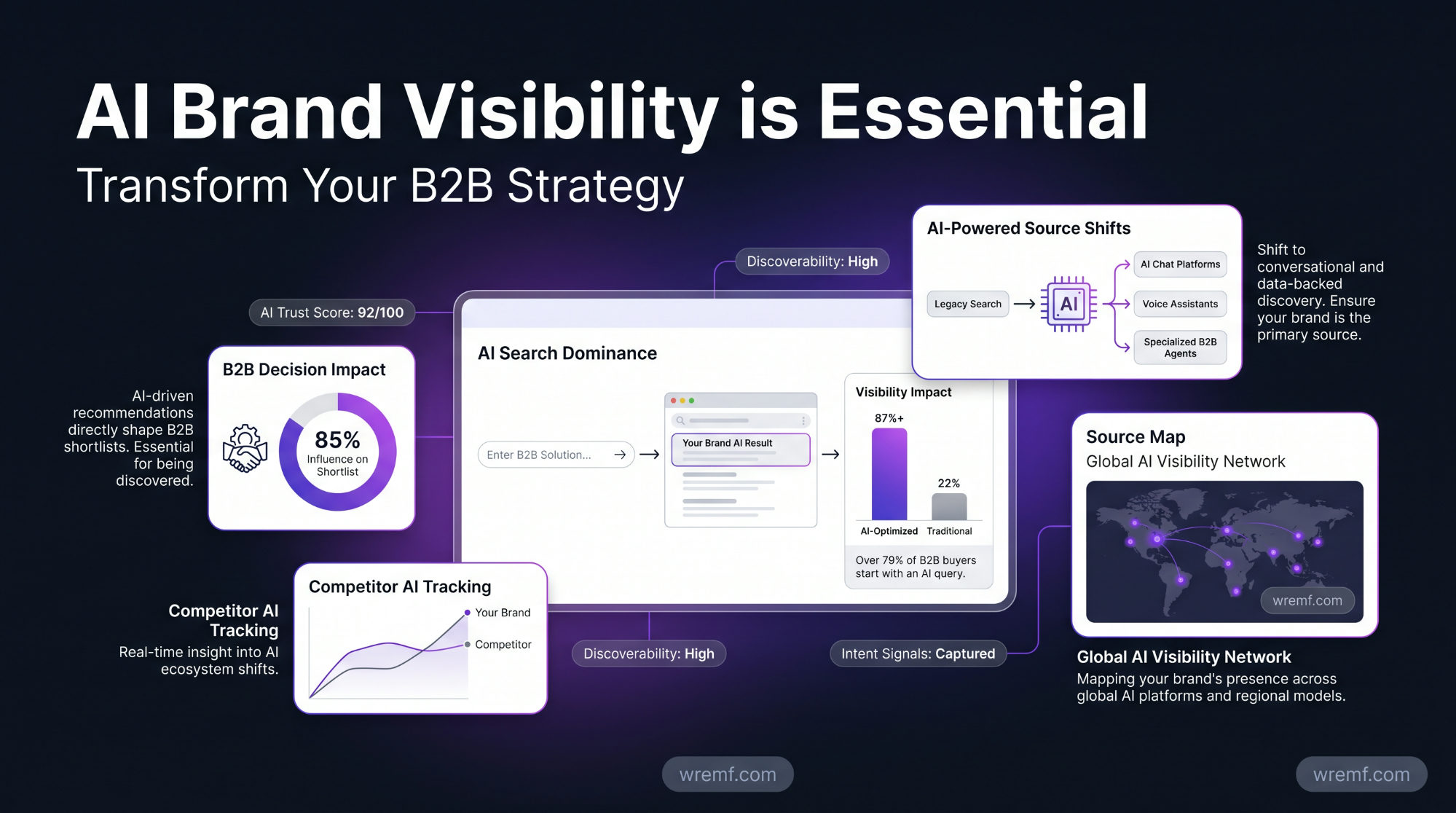
AI brand visibility has moved from an experimental concept to a commercially significant channel because AI search is now where a substantial portion of buyer research happens. The scale of usage across major AI platforms makes this a strategic priority, not an optional one.
ChatGPT alone receives over 4.5 billion monthly visits, and Perplexity processes more than 500 million searches per month. In 2024, 314 million people used ChatGPT daily, not just for conversation but to look up products, reviews, and brands. These are not fringe usage patterns. They represent a shift in how buyers discover, evaluate, and shortlist B2B solutions. For B2B SaaS companies, agencies, and professional service firms, this means the buyer journey now includes a discovery phase that happens entirely inside AI engines, often before the buyer visits a search results page or a brand's website.
Three structural shifts explain why AI brand visibility now requires dedicated measurement and strategy.
Zero-click search is the new normal. AI engines produce synthesised answers that satisfy the query without requiring the user to click through to a source. When a buyer asks ChatGPT to recommend the best project management tool for a remote engineering team, they typically receive a curated answer that names specific tools, describes their strengths, and may include a recommendation. If a brand is not in that answer, it does not benefit from that query, even if it has strong organic search rankings for the same topic.
AI-referred traffic is growing. Brands that appear in AI citations do receive referral traffic from AI engines, but this traffic is not tracked by standard UTM conventions or default analytics configurations. AI referral traffic shows up inconsistently across analytics platforms and requires specific attribution setup to measure accurately. Teams that do not track this channel miss a growing portion of their traffic and discovery data.
Traditional SEO does not guarantee AI visibility. A brand can rank on page one of Google for a target keyword and still be absent from ChatGPT, Gemini, Perplexity, and Google AI Overviews answers. Rankings signal that a page is relevant and authoritative for keyword-based retrieval. They do not guarantee that AI engines will cite that page, trust that source, or mention that brand in a synthesised answer. As covered in WREMF's AI search engine optimization guide AI visibility requires a separate layer of strategy beyond traditional SEO, covering content structure, entity consistency, source authority, and prompt-level relevance.
The competitive landscape in AI search is also structurally different from traditional search. In AI-generated responses, brands compete not only with direct category competitors but also with answer aggregators such as Reddit, Wikipedia, Stack Overflow, and Quora, which often dominate AI citations. A B2B SaaS company tracking its AI brand visibility may find that generic information pages from Wikipedia or forum threads from Reddit are displacing the brand's own content in AI answers about its core category. This makes source monitoring and entity authority work essential components of an AI brand visibility programme.
KEY TAKEAWAY: AI brand visibility matters because buyers now research products inside AI engines before visiting websites, making presence in AI-generated answers a commercially significant factor that traditional SEO measurement does not capture.
How AI Brand Visibility Is Measured: Core Metrics and What They Tell You
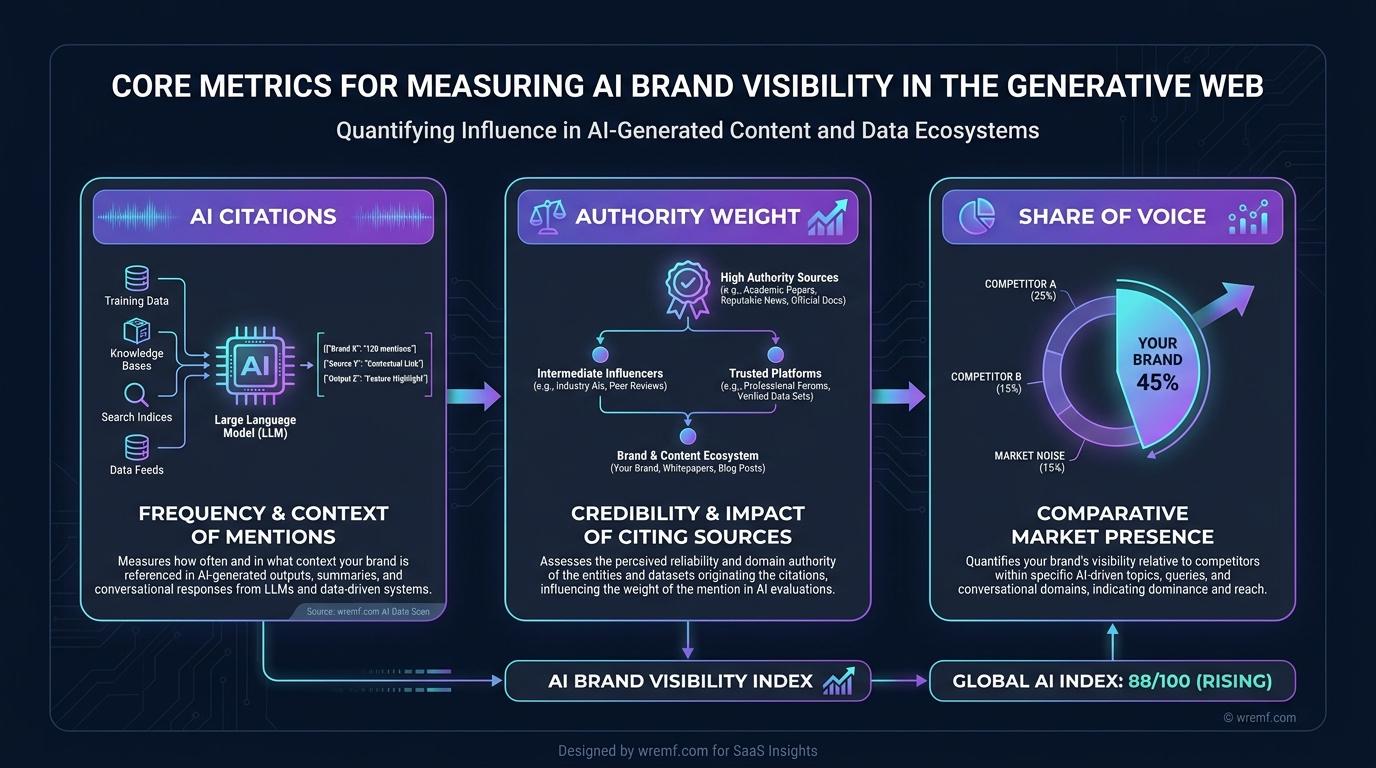
AI brand visibility is measured through a combination of prompt-level monitoring, citation analysis, AI share of voice calculation, authority weight scoring, and source consistency checks across AI engines. No single metric tells the complete story.
The most important metrics for AI brand visibility programmes are as follows.
AI Citations
AI citations are the specific instances where an AI engine references a brand as a source in a synthesised answer. A citation may take the form of a named mention, a linked source, a direct attribution such as "According to [brand]", or an implied reference where the brand's content informs the answer without being explicitly named. Tracking AI citations requires running structured prompts across AI engines and recording which brands are mentioned, how they are positioned, and whether the mention is definitive or supporting.
AI citation share is the proportion of total citations a brand receives relative to its competitors across a defined prompt set. The calculation is straightforward: Brand Citations divided by Total Citations multiplied by 100. If one brand appears in 733 AI-generated answers and its closest competitor appears in 695 across the same tracked prompt set, the first brand holds approximately 51.3 percent of citation share within that competitive set. Tracking citation share over time reveals whether a brand is gaining or losing ground in AI-generated responses.
AI Share of Voice
AI share of voice is a broader measure than citation share. It captures the total proportional presence a brand holds across all AI engine responses for a defined topic, category, or keyword set. This includes direct citations, brand mentions in comparison contexts, and attributions in recommendation answers. AI share of voice differs from organic share of voice or SEO SOV because it reflects presence in synthesised answers rather than rankings in search results pages. Teams that track AI share of voice alongside organic SOV gain a more complete picture of brand presence across both traditional and AI-powered discovery channels.
AI Visibility Score
An AI Visibility Score aggregates citation frequency, mention quality, platform coverage, and prompt relevance into a single composite score. WREMF's AI Visibility Index calculates this score across all 10 tracked AI engines and segments it by prompt category, competitor comparison, and topic cluster. The score helps teams prioritise which content areas, citation gaps, or authority weaknesses to address first.
Authority Weight
Authority weight scores the quality of AI citations, not just their volume. A definitive citation, where the AI engine phrases an answer as "According to [brand]" or attributes a specific finding directly to the brand, carries more commercial weight than a supporting mention where the brand is listed as one of several options. WREMF's authority weight framework scores definitive citations at three points and supporting mentions at one point, then tracks the total score over time. A brand with 24 authority weight points, for example four definitive citations and six supporting mentions, is building stronger AI brand visibility than a brand with the same total mention count but fewer definitive attributions.
Source Consistency
Source consistency measures whether a brand is described consistently across the sources that AI engines retrieve and cite. If a brand's positioning, category description, and core claims vary across its own website pages, third-party directories, partner sites, media coverage, and social profiles, AI engines may produce inconsistent brand representations or diluted citations. Source consistency analysis identifies where the brand's information diverges across the web and guides correction work.
LLM Snapshot Tracking
LLM snapshot tracking records what AI engines say about a brand at a specific point in time and tracks how those answers change as AI model updates, content changes, and source sets evolve. Because AI engines update their training data and retrieval sets on varying schedules, a brand's AI visibility can shift without any corresponding change in its organic search rankings. Snapshot tracking creates a historical record that supports trend analysis and helps teams identify the impact of content and citation improvements.
DID YOU KNOW:
A 2024 study analysing 75,000 brands found that YouTube mentions show the strongest correlation with AI brand visibility in ChatGPT and AI Mode, and that brand mentions matter more than link volume or content volume for AI citation presence.
KEY TAKEAWAY: AI brand visibility requires tracking multiple interconnected metrics including AI citations, citation share, AI share of voice, authority weight, and source consistency, because no single signal captures the full picture of how a brand appears across AI engines.
The Difference Between SEO, AEO, and GEO in the Context of AI Brand Visibility
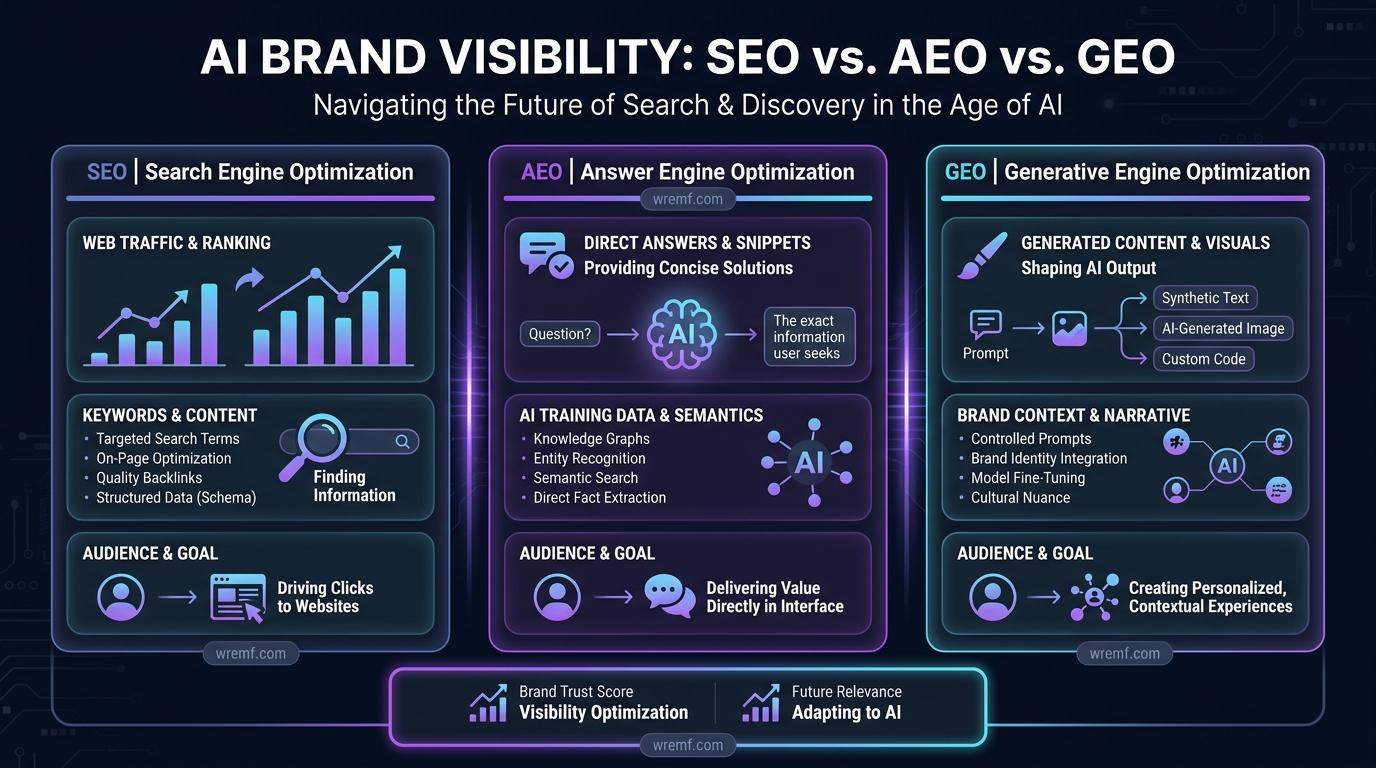
SEO, Answer Engine Optimization, and Generative Engine Optimization are complementary disciplines that each contribute to AI brand visibility from different angles. Understanding how they relate and where they differ is essential for building a coherent AI visibility programme.
Search Engine Optimization focuses on improving a brand's visibility in traditional search engine results pages. SEO practices such as keyword research, content optimisation, backlink building, technical crawlability, and structured data (schema) remain valuable for driving organic traffic and establishing domain authority. These signals also contribute indirectly to AI brand visibility because AI engines draw on indexed web content, domain rating signals, and authority cues when selecting sources for synthesised answers.
Answer Engine Optimization is the practice of structuring content so that AI engines and answer aggregators extract and present it accurately in direct responses to queries. AEO work includes writing answer-first content, using structured information formats, optimising for featured snippets, and ensuring that a brand's content provides clear, direct, verifiable answers to the questions buyers ask. When AI engines such as Perplexity, Google AI Overviews, and ChatGPT compose an answer, they favour sources that state answers clearly, attribute claims accurately, and match the conversational structure of the prompt. AEO directly supports AI citation presence. WREMF's answer engine optimization guide explains this approach in practical detail for B2B content teams.
Generative Engine Optimization is the broader strategic discipline of improving how a brand appears in generative AI-produced content. GEO encompasses content architecture, entity authority, source consistency, citation gap analysis, and the technical and editorial work required to make a brand a trusted source for AI-generated answers. While AEO focuses on the structure of individual content pieces, GEO addresses the holistic brand footprint that AI engines assess when deciding which sources to cite.
The relationship between these three disciplines and AI brand visibility can be stated plainly. SEO builds the organic foundation. AEO structures content for AI extraction. GEO optimises the brand's full source footprint for generative retrieval. AI brand visibility is the measurable outcome of all three working together. A brand that excels at SEO but ignores AEO and GEO may rank well on Google while remaining invisible in ChatGPT, Gemini, Perplexity, and other AI engines. As covered in WREMF's generative AI optimization services guide the most effective AI visibility programmes treat GEO, AEO, and SEO as integrated rather than separate activities.
E-E-A-T, which stands for Experience, Expertise, Authoritativeness, and Trustworthiness, is also directly relevant to AI brand visibility. AI engines use authority signals similar to E-E-A-T when evaluating source quality. Content that demonstrates clear author expertise, cites credible evidence, and is consistent with the brand's broader content and entity profile is more likely to be selected as a citation source. E-E-A-T metrics such as author bios, author schema, structured markup, and entity authority signals should be treated as inputs to AI brand visibility, not just as Google-specific optimisation factors.
KEY TAKEAWAY: SEO, AEO, and GEO each contribute to AI brand visibility from different angles, and teams that integrate all three disciplines produce stronger and more consistent AI citation presence than those that rely on SEO alone.
How AI Engines Decide Which Brands to Mention and Cite
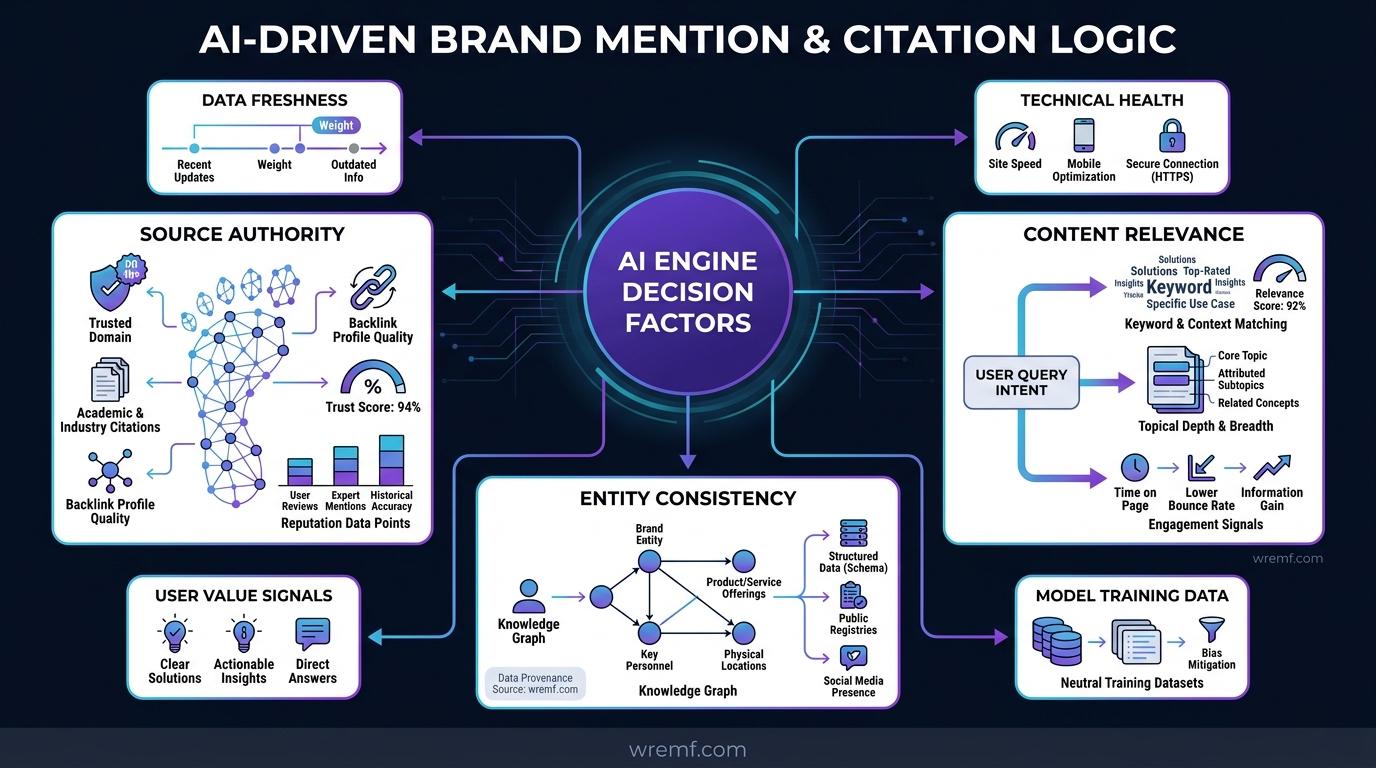
AI engines do not rank brands the way search engines rank pages. Their selection of sources for synthesised answers is governed by retrieval logic, training data, real-time web search, and authority signals that differ by platform and query type.
Large language models such as GPT-4, Claude, Gemini, and their underlying AI-driven models retrieve and synthesise information based on patterns learned during training and, where applicable, real-time retrieval from the web. When a user submits a prompt, the model identifies relevant concepts, finds matching content from its indexed or retrieved source set, and composes an answer that draws on the most relevant, consistent, and authoritative available information. The brand that appears most consistently across high-authority sources, with the clearest and most relevant content matching the prompt's context, is more likely to be cited.
Several factors influence which brands appear in AI-generated responses.
Source authority and trust. AI engines favour sources that are widely cited, editorially consistent, and associated with credible domains. High domain authority alone is not sufficient, but it contributes to the probability of citation. Sources like Wikipedia, major publications, and well-established industry sites carry strong weight as answer aggregators in AI responses. According to Google's AI Overviews documentation AI Overviews are designed to surface the most helpful and trustworthy information for a given query, which means source quality and content clarity are primary factors in citation selection.
Content relevance and prompt alignment. AI engines match content to the conversational structure and semantic intent of the prompt. Content that directly addresses the query topic, uses the vocabulary the prompt uses, and provides a clear answer is more likely to be retrieved and cited. This is why answer-first content architecture and target keyword set alignment matter for AI brand visibility, not just for organic search rankings.
Entity consistency across sources. The more consistently a brand is described across its website, backlinks, third-party directories, media mentions, and social profiles, the more confidently an AI engine can represent that brand in a synthesised answer. Citation cliffs occur when a brand's authority signals are strong in one area but weak or absent in others, creating gaps that prevent consistent AI citation.
Mention frequency and recency. Brands that are mentioned frequently across current, authoritative web sources are more likely to appear in AI-generated responses. This is where branded web mentions, brand's citations across media, and YouTube mentions all contribute to AI brand visibility. The 2024 study of 75,000 brands found that YouTube mentions show the strongest correlation with AI brand visibility in ChatGPT and AI Mode, suggesting that video content and multi-format brand presence amplify citation probability.
AI model updates. Different AI engines update their training data and retrieval sets on different schedules. AI model updates can cause a brand's visibility to change significantly without any corresponding change in organic rankings. LLM snapshot tracking captures these shifts over time.
KEY TAKEAWAY: AI engines select brands for citation based on source authority, content relevance to the prompt, entity consistency across the web, and mention frequency across authoritative sources, not keyword rankings alone.
Tracking AI Brand Visibility Across ChatGPT, Gemini, Perplexity, Google AI Overviews, and Other AI Engines
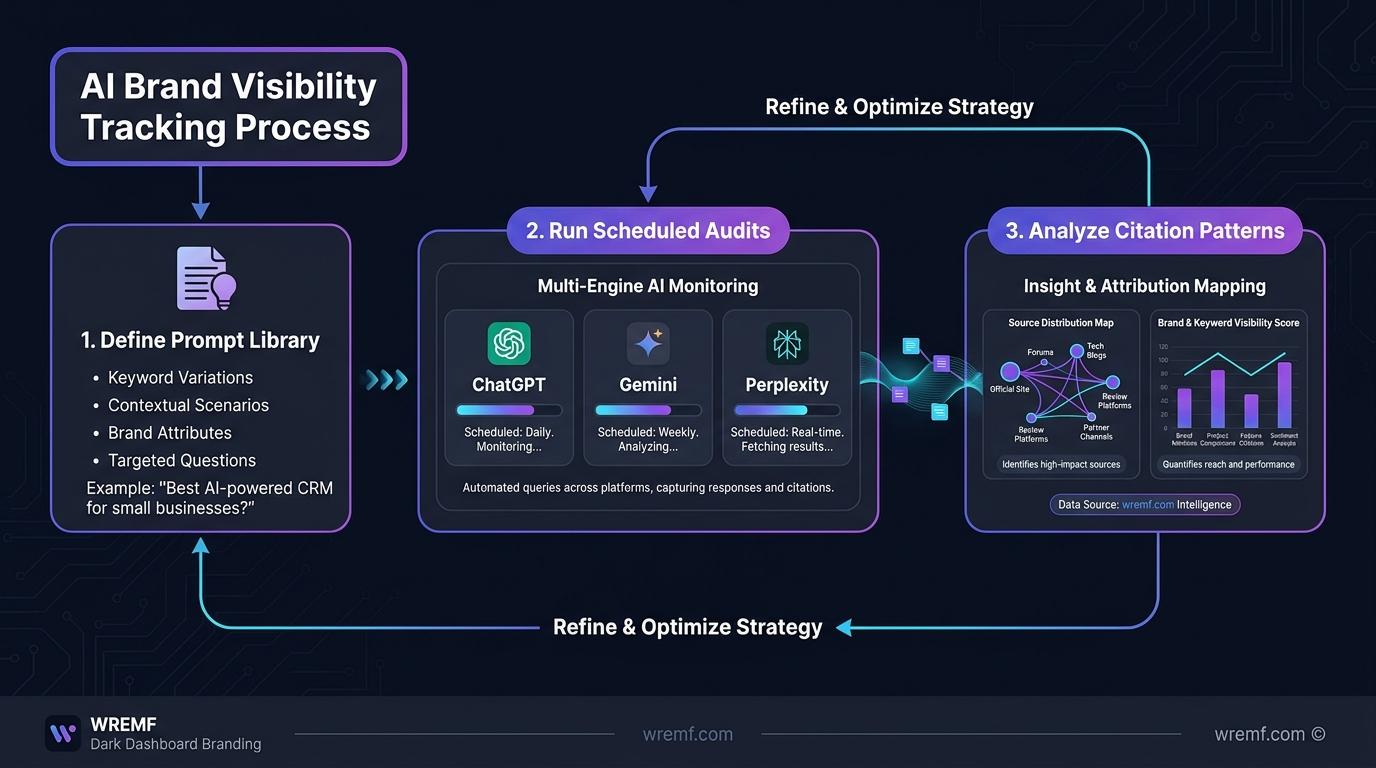
Tracking AI brand visibility requires a structured approach to prompt design, engine coverage, citation recording, and comparative benchmarking. A single prompt run on a single AI engine does not produce a reliable picture of a brand's AI visibility.
Effective AI brand visibility tracking covers multiple AI engines because each platform has different retrieval logic, source preferences, and response patterns. ChatGPT and SearchGPT use OpenAI's models and retrieval infrastructure. Gemini draws on Google's index and knowledge graph. Perplexity performs real-time web search and cites sources explicitly. Google AI Overviews applies a separate classification within Google Search. Claude uses Anthropic's models and retrieval architecture. Microsoft Copilot, also known as Bing Co-Pilot, integrates Bing's index with OpenAI's models. DeepSeek, Grok, Meta AI, and Mistral each represent distinct retrieval and response behaviours. As explored in the VentureBeat AI coverage the divergence in how these platforms retrieve and synthesise information means that a brand's visibility varies significantly by engine, making multi-platform tracking essential.
A comprehensive AI brand visibility tracking programme should cover the following elements.
Prompt library design. The foundation of AI brand visibility tracking is a structured set of prompts that reflect the actual questions buyers ask when researching in a brand's category. These prompts should include category discovery queries such as "what are the best tools for X", comparison queries such as "X vs Y for B2B teams", problem-solution queries, and branded queries that test how specific brand names are represented in AI answers.
Engine coverage. Tracking should span at least the primary AI engines relevant to a brand's audience. For most B2B SaaS brands, this means covering ChatGPT, Gemini, Perplexity, Google AI Overviews, Claude, and Microsoft Copilot as a minimum. WREMF tracks AI brand visibility across 10 AI engines from a single dashboard, with unlimited prompts on every plan, removing the cost unpredictability of per-prompt pricing models.
Citation recording. Each prompt run should record which brands are mentioned, whether the mention is definitive or supporting, which sources are cited, and how the brand is described. Citation recording should happen on a scheduled basis rather than ad hoc, because AI brand visibility shifts over time with model updates, content changes, and competitive activity.
Competitor benchmarking. AI brand visibility only makes sense in competitive context. Tracking which competitors appear in AI answers alongside or instead of a brand reveals citation gaps, authority gaps, and content gaps. Competitive AI share of voice data guides prioritisation decisions about where to invest in content, citation building, and entity authority work.
Source analysis. Understanding which sources AI engines use when mentioning a brand reveals which content is driving citations and which sources need strengthening. If a competitor's page, a Wikipedia entry, or a Reddit thread is being cited instead of a brand's own content, that is an actionable insight for GEO and AEO strategy.
Teams that want to begin AI brand visibility tracking can start by reviewing WREMF's AI mention tracking guide for practical guidance on prompt design, engine coverage, and citation recording workflows.
KEY TAKEAWAY: Reliable AI brand visibility tracking requires structured prompt libraries, multi-engine coverage, consistent citation recording, and competitive benchmarking, because single-engine or single-prompt measurements produce incomplete and unreliable visibility data.
A Practical Workflow for Running an AI Brand Visibility Programme
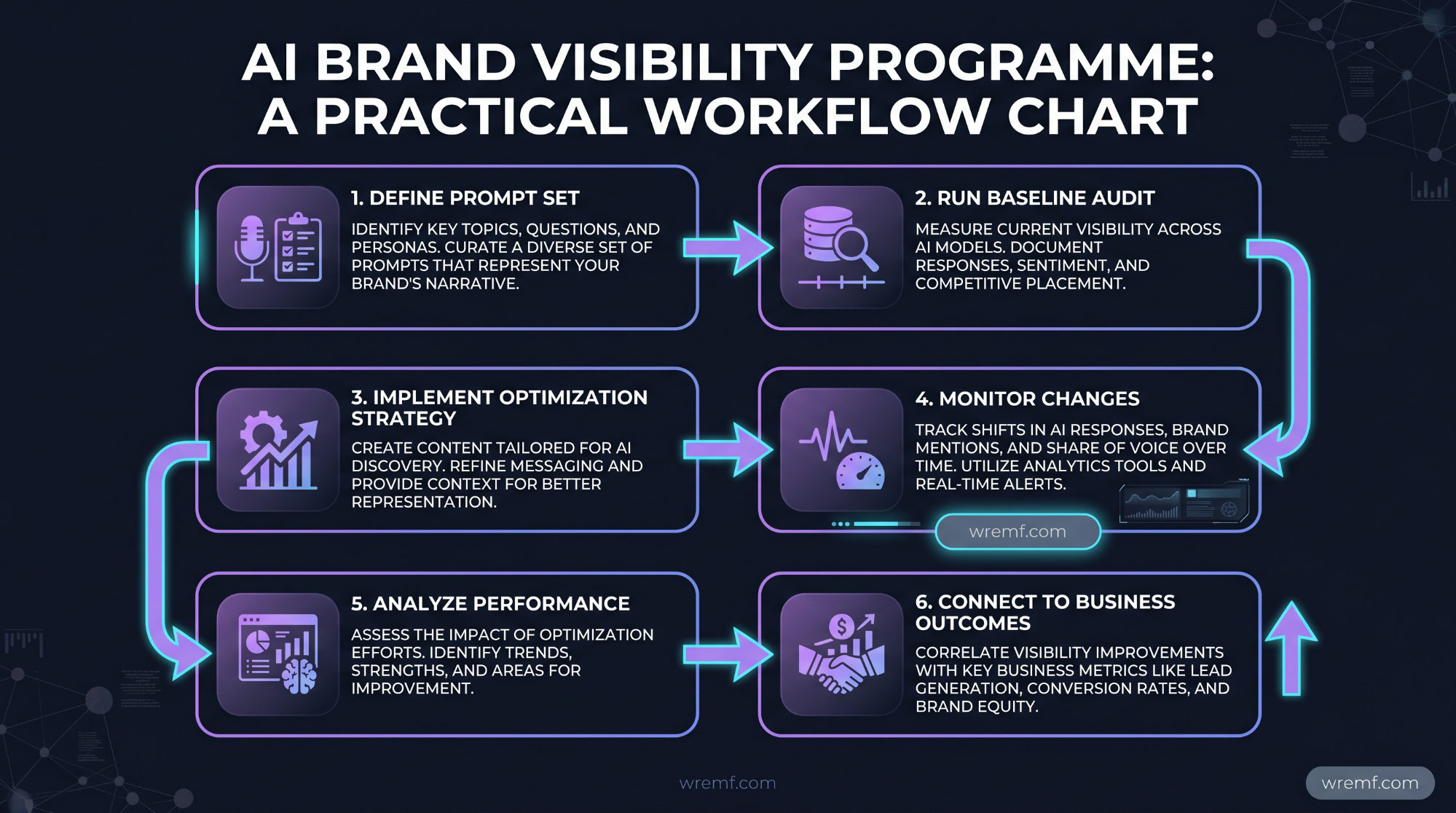
Running an AI brand visibility programme follows a structured sequence from baseline measurement through to ongoing optimisation. The following workflow applies whether a team is using WREMF as self-serve software, a managed service, or a hybrid model.
Step 1: Define the prompt set
Build a library of prompts that reflect how buyers in the target category actually search and ask questions in AI engines. Include discovery prompts, comparison prompts, problem-solution prompts, and branded prompts. Segment prompts by buyer journey stage and topic cluster. A B2B SaaS team might build 30 to 80 prompts covering its core use cases, competitor comparisons, and category-level queries.
Step 2: Run a baseline visibility audit
Execute the full prompt set across all relevant AI engines and record which brands appear, how they are described, which sources are cited, and whether the brand holds any AI citations at baseline. This creates the starting point for all subsequent measurement. WREMF's GEO audit workflow automates this process and delivers structured baseline data across 10 AI engines.
Step 3: Measure AI share of voice and authority weight
Calculate the brand's AI citation share and AI share of voice relative to its top competitors. Score each citation using the authority weight framework, distinguishing definitive citations from supporting mentions. Identify which topics and prompt categories show the strongest and weakest brand presence.
Step 4: Identify citation gaps and source gaps
Compare which sources AI engines cite when answering prompts in the brand's category. Identify where competitor content, Wikipedia entries, answer aggregators such as Quora, or third-party publications are displacing the brand's own content. Map these gaps to specific content and citation opportunities.
Step 5: Audit source consistency
Review how the brand is described across its website, structured data, backlinks, directories, media coverage, and partner sites. Identify inconsistencies in category description, positioning language, and entity data. Source consistency work reduces AI brand misrepresentation and strengthens citation reliability.
Step 6: Execute content and citation improvements
Based on gap analysis, produce or update content to match the answer-first structure that AI engines favour. Improve author bios, author schema, and E-E-A-T signals. Build citations in credible third-party sources. Update structured data (schema) across key pages. Ensure internal links connect authoritative content to the brand's core entity cluster.
Step 7: Monitor and track changes over time
Schedule recurring prompt runs to track how AI brand visibility changes following content updates, citation building, entity authority work, and AI model updates. LLM snapshot tracking records what AI engines said at each point in time, enabling trend analysis and impact measurement.
Step 8: Connect AI visibility to business outcomes
Use AI referral traffic data in GA4 to connect AI citations to actual website sessions, leads, and pipeline. WREMF's GA4 attribution integration and Looker Studio connector enable teams on the Growth plan to build dashboards that show AI brand visibility alongside traffic and conversion data.
DID YOU KNOW:
A study analysing 75,000 brands found that AI Mode rewards established brands more than emerging ones, and that AI Overviews place higher value on domain rating than most other AI platforms, suggesting that existing SEO authority still contributes meaningfully to AI brand visibility in Google's AI products.
KEY TAKEAWAY: A structured AI brand visibility programme follows eight steps from prompt library design through to GA4 attribution, with each step building on the previous one to create a measurable, improvable, and reportable AI visibility programme.
Improving AI Brand Visibility: Core Strategies for Content, Citations, and Entity Authority
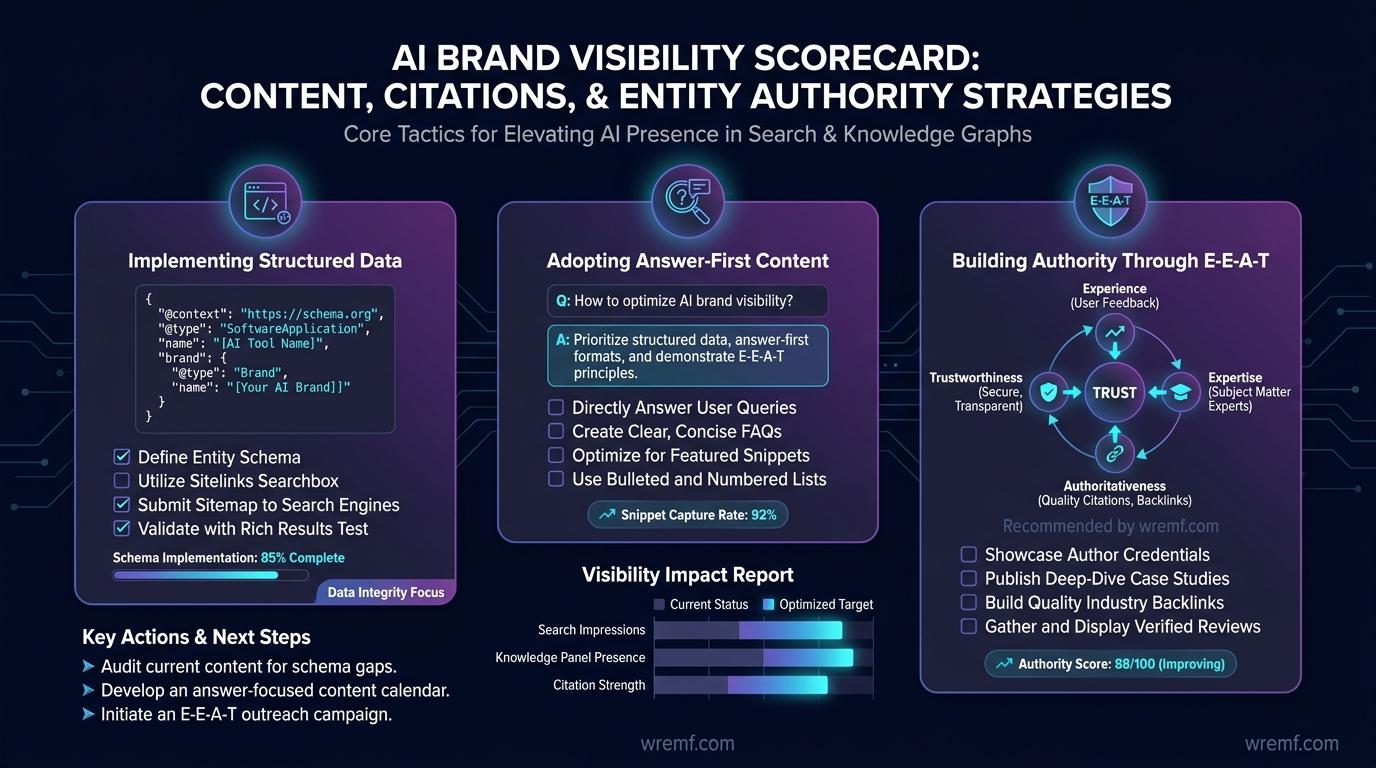
Improving AI brand visibility requires work across content structure, citation building, entity authority, and technical foundations. There is no single lever that produces consistent AI citation presence across all engines.
Implement Structured Data and Schema Markup
Structured data (schema) and structured markup help AI engines understand what a brand does, who it serves, and what its content covers. Schema markup applied to organisation pages, product pages, article pages, and author profiles creates machine-readable entity signals that support consistent AI brand representation. Author schema on content pages associates individual articles with named, credible authors, strengthening E-E-A-T metrics and improving the probability that content will be retrieved as a trustworthy source.
Adopt Answer-First Content Architecture
AI engines favour content that states its answer clearly in the first sentence, uses direct and specific language, and structures supporting information in scannable formats. Rewriting key pages to follow answer-first principles improves both AEO performance and AI citation probability. Content optimisation for AI visibility differs from keyword-focused content optimisation. The goal is not just to include target keyword set phrases, but to provide the clearest, most direct, most verifiable answer to the exact question a buyer would ask in a prompt.
Build and Signal Authority Through E-E-A-T
E-E-A-T signals communicate to both search engines and AI engines that a brand's content is produced by credible, experienced sources. Practical E-E-A-T work includes adding detailed author bios with professional credentials, applying author schema markup, ensuring content cites credible primary sources, maintaining consistent brand voice and positioning across all content, and building authoritative AI mentions through media coverage, third-party publications, and expert contributions. Brands that demonstrate strong E-E-A-T metrics see higher rates of definitive AI citations because AI engines treat author credibility and source consistency as quality signals.
Address Citation Gaps and Strengthen External Source Presence
If AI engines are citing competitors or answer aggregators instead of a brand's own content, the brand needs to build citation presence in the sources AI engines actually retrieve. This means earning coverage in publications that AI engines trust, contributing to industry resources, building branded anchors in editorial content, and ensuring that brand descriptions in third-party directories and partner sites are consistent and accurate. Citation cliffs, where a brand's AI citation presence drops sharply in certain topic areas, usually indicate a source gap in those areas rather than a content quality problem.
Optimise for Prompt-Specific Relevance
Content and pages should be mapped to specific prompts, not just keywords. A page optimised for the search query "best project management software for remote teams" may not be optimised for the conversational prompt "what project management tool would you recommend for a distributed engineering team of 20?" Understanding the difference between search volume-driven keyword targeting and prompt-driven content alignment is central to Generative Engine Optimization. WREMF's AI-ready content brief generator helps teams build content that is aligned to both keyword targets and prompt-level relevance simultaneously.
Expand Multi-Format Brand Presence
The 2024 study of 75,000 brands showed that YouTube mentions correlate strongly with AI brand visibility. This suggests that multi-format brand presence, including video content, podcast appearances, and media mentions alongside written content, contributes to the overall brand footprint that AI engines assess. B2B brands that invest only in written content may be leaving AI citation opportunities on the table.
KEY TAKEAWAY: Improving AI brand visibility requires coordinated work across structured data, answer-first content architecture, E-E-A-T signals, citation gap remediation, and multi-format brand presence, with each element reinforcing the others across AI engines.
Real-World Scenarios: How B2B Teams Use AI Brand Visibility Data
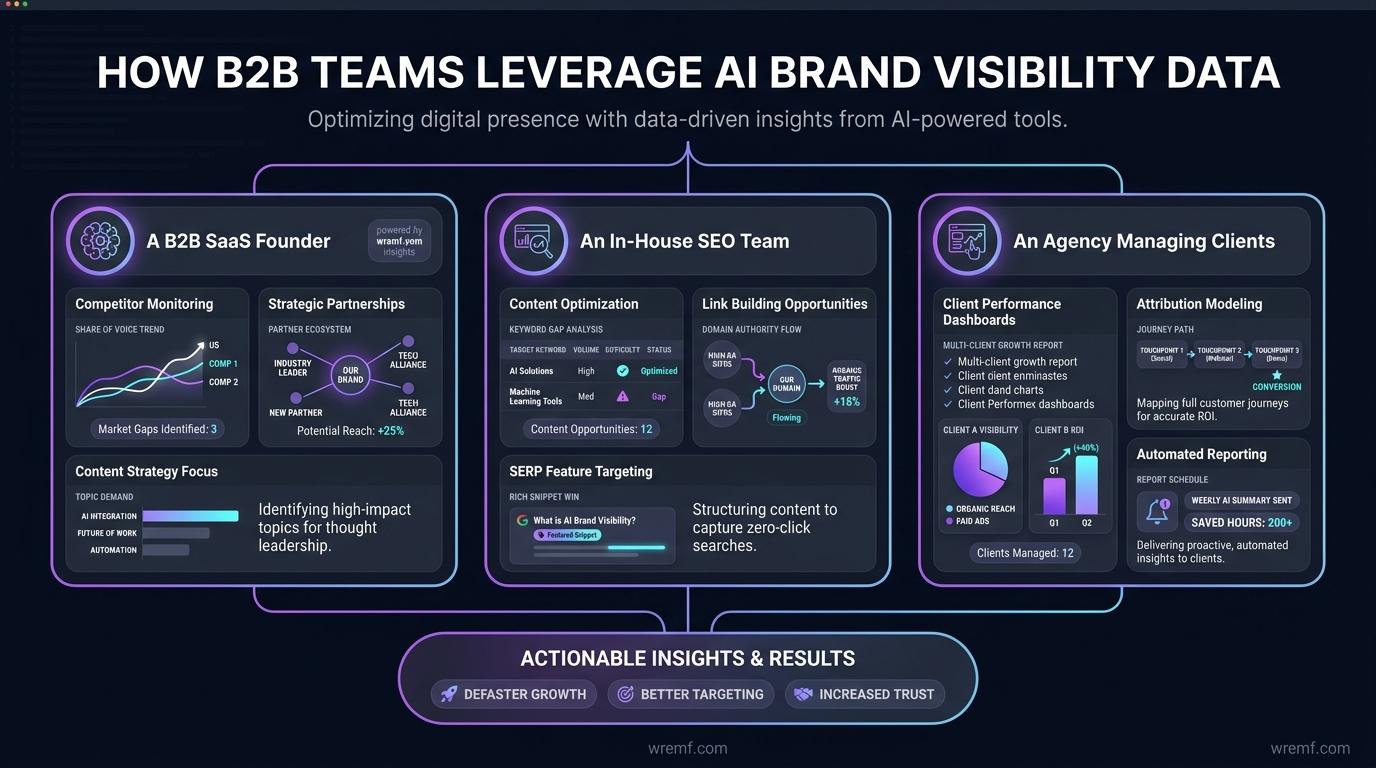
AI brand visibility data becomes actionable when applied to specific team contexts and business challenges. The following scenarios illustrate how different B2B teams use AI brand visibility measurement and improvement in practice.
Scenario One: A B2B SaaS Founder Tracking Early AI Visibility
A founder running a small SaaS company in the productivity tools category notices that competitors are being recommended by ChatGPT and Perplexity when buyers ask about tools for their use case. The founder has invested in SEO and holds decent organic rankings for several target keywords, but AI brand visibility has not been part of the measurement programme.
Using WREMF's Starter plan at €59 per month, the founder runs a baseline audit across 10 AI engines using a prompt library covering category discovery, competitor comparison, and problem-solution queries. The baseline reveals that two direct competitors appear in 80 percent of relevant AI answers, while the founder's brand appears in fewer than 10 percent. The citation source data shows that competitor mentions are driven by two high-authority third-party publications and a strong Wikipedia entity presence. The founder uses this data to prioritise media outreach, Wikipedia entity work, and answer-first content updates on core product pages.
Scenario Two: An In-House SEO Team Comparing Google Rankings With AI Citation Presence
A B2B SaaS company's SEO team holds page-one Google rankings for several high-value keywords but notices that AI-generated responses for the same queries rarely mention the brand. The team uses WREMF's Growth plan to run structured prompt tracking across ChatGPT, Gemini, Perplexity, and Google AI Overviews alongside their existing SEO reporting.
The data reveals that while the brand's pages rank well organically, the content structure does not match the answer-first format that AI engines favour. The brand's product pages are optimised for keyword density and backlink equity rather than direct query answering. The SEO team uses WREMF's content brief generator to rebuild key landing pages with answer-first architecture and structured markup, then tracks whether AI citation frequency improves over the following 90 days. The GA4 attribution integration allows the team to connect improved AI citations to measurable changes in direct AI referral traffic sessions.
Scenario Three: An Agency Managing AI Brand Visibility for Multiple Clients
A digital marketing agency managing SEO and content programmes for eight B2B SaaS clients wants to add AI brand visibility tracking and reporting to its service offering. The agency uses WREMF's Growth plan to track up to five client websites simultaneously, with white-label reporting and Looker Studio connector for client-facing dashboards.
For each client, the agency builds a separate prompt library, runs scheduled AI brand visibility monitoring, and produces monthly white-label reports showing AI citation share, AI share of voice, competitor benchmarking, and content recommendations. For clients with larger budgets and more complex AI visibility challenges, the agency recommends WREMF's Managed plan or uses WREMF's hybrid model to bring in senior WREMF execution support for GEO audits, citation cleanup, and AEO content strategy work. Teams interested in how agencies can structure this service offering can explore WREMF agency services for practical details on client workflows and white-label capabilities.
KEY TAKEAWAY: AI brand visibility data serves different team contexts differently, from founders identifying their first citation gaps to agencies building white-label AI visibility reporting programmes for multiple clients.
AI Brand Visibility Versus Traditional SEO Tools: What Each Measures and Why Both Matter
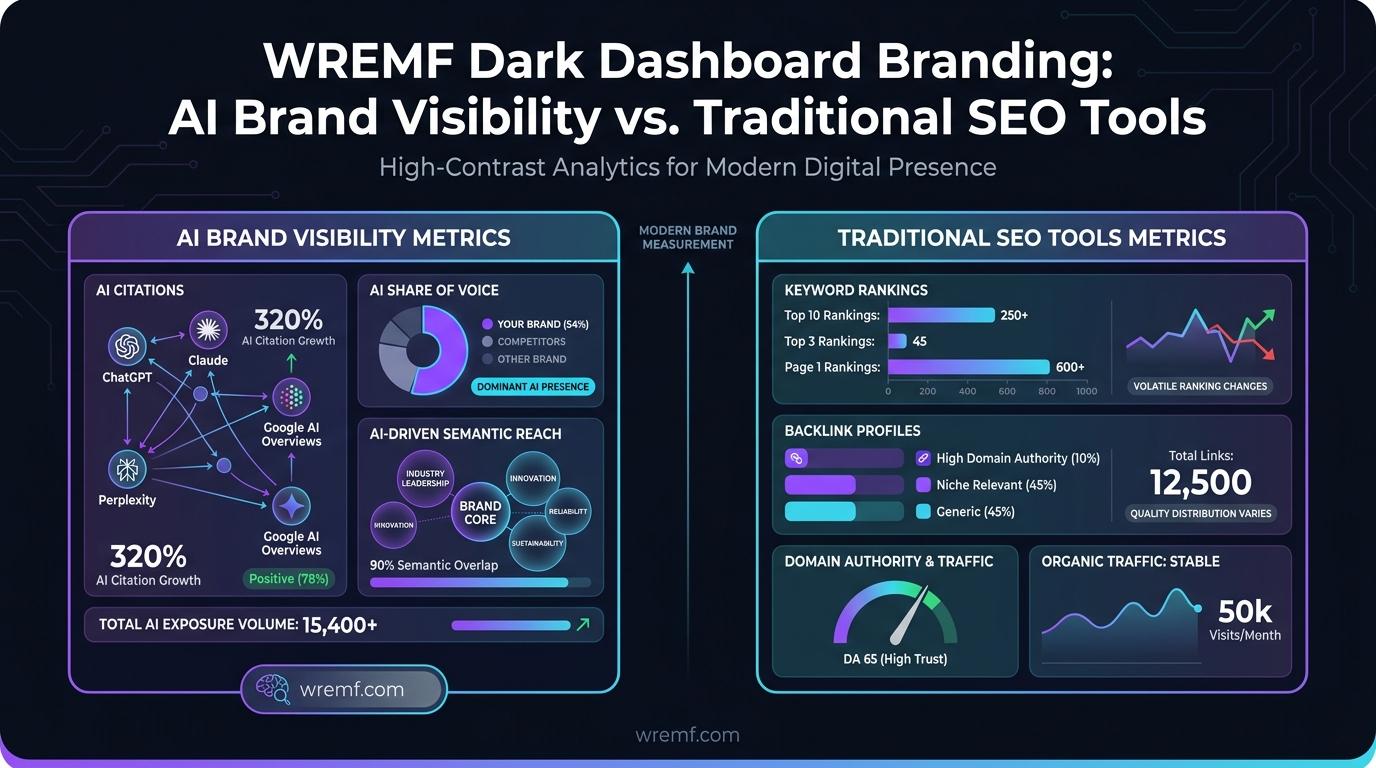
Traditional SEO tools and AI brand visibility platforms measure different things. Understanding this distinction helps teams allocate resources and avoid the assumption that strong SEO reporting coverage means AI brand visibility is also covered.
The comparison below covers the core dimensions where these two measurement approaches diverge.
Primary signal
- Traditional SEO tools: Keyword rankings in organic search results
- WREMF: AI prompt answers and brand citations across AI engines
What it tracks
- Traditional SEO tools: SERP position, search volume, and traffic potential
- WREMF: AI citations, mention frequency, AI share of voice, and source consistency
Authority signal
- Traditional SEO tools: Backlinks, domain authority, and domain rating
- WREMF: Source citations in AI answers and authority weight scoring
Query model
- Traditional SEO tools: Keywords matched to search intent
- WREMF: Prompts matched to conversational query patterns across AI engines
Competitive view
- Traditional SEO tools: SERP overlap and competitor keyword rankings
- WREMF: AI share of voice and competitor citation presence across AI engines
Attribution model
- Traditional SEO tools: Organic sessions from Google Search Console and GA4
- WREMF: AI referral traffic attribution and prompt-level session tracking
Engine coverage
- Traditional SEO tools: Google and Bing primarily
- WREMF: 10 AI engines including ChatGPT, Gemini, Perplexity, Claude, Copilot, Google AI Overviews, DeepSeek, Grok, Meta AI, and Mistral
Audit type
- Traditional SEO tools: Technical SEO, crawl health, and backlink profile
- WREMF: GEO audits, AEO content analysis, and citation gap assessment
Source consistency measurement
- Traditional SEO tools: Not directly measured
- WREMF: Tracked across AI engines as a core visibility factor
The practical conclusion is straightforward. Traditional SEO tools remain essential for keyword research, organic rankings, backlink analysis, crawlability, and content gap identification. Tools referenced in the SEO community such as SE Ranking and the Semrush AI Visibility Toolkit offer their own approaches to tracking AI presence, and the market for AI visibility measurement is growing. WREMF adds the dedicated AI visibility layer by tracking how AI engines mention, cite, compare, and recommend brands across prompt-based discovery. As detailed in WREMF's AI SEO tools guide teams that use both traditional SEO tools and a dedicated AI visibility platform like WREMF get the most complete picture of their brand's discovery presence across both ranking-based and answer-based search channels.
KEY TAKEAWAY: Traditional SEO tools measure search rankings and organic visibility; WREMF measures AI brand visibility across AI engines. Teams that use both get a complete picture of how their brand is discovered across all major search and AI discovery surfaces.
Choosing the Right AI Brand Visibility Approach: Software, Managed Service, or Hybrid
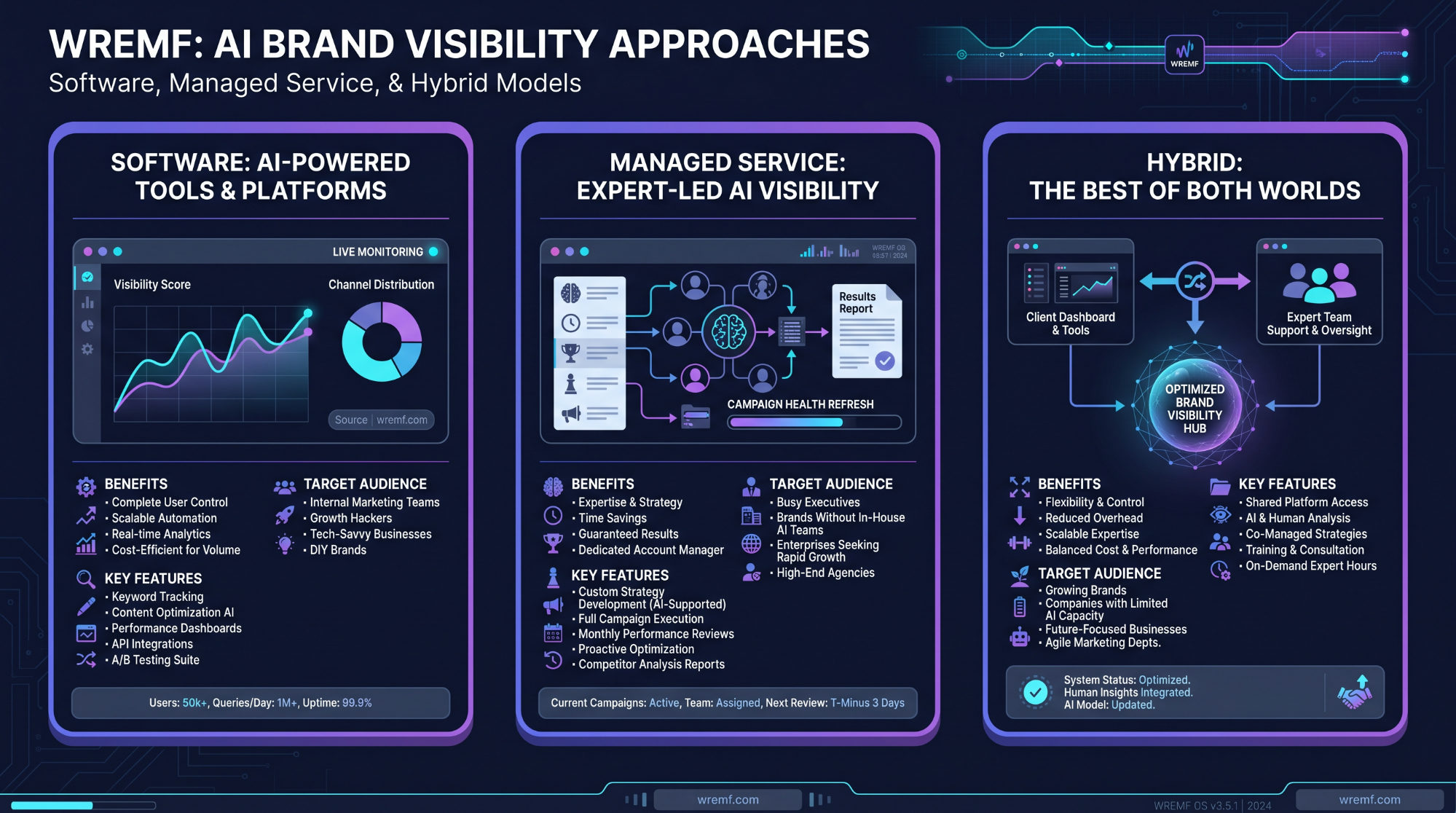
The right AI brand visibility approach depends on a team's internal execution capacity, strategic maturity, and reporting requirements. WREMF offers three engagement models that match different team contexts.
Software-only is best suited for teams with strong internal execution resources. Founders, solo consultants, in-house SEO specialists, and growth teams that want to own their AI brand visibility measurement, analysis, and optimisation can use WREMF as a self-serve platform. The Starter plan at €59 per month covers one website, up to three competitors, 10 AI engines, unlimited prompts, core prompt intelligence, source citation tracking, and the AI Visibility Index. It is designed for founders, small SaaS teams, solo consultants, AI SEO specialists, and solo marketers beginning to track AI visibility. The Growth plan at €149 per month adds five websites, 10 to 15 competitor tracking slots, advanced citation tracking, AI share of voice reporting, GEO audits, content brief generation, SEO testing, GA4 attribution, white-label reports, and Looker Studio connector. WREMF pricing provides a full breakdown of plan features and limits.
Managed service is best suited for teams that need strategy, implementation, and ongoing optimisation support rather than just measurement data. The WREMF Managed plan, from €1,500 per month, delivers end-to-end AI brand visibility programme management including AI visibility audit, custom GEO strategy, AEO content optimisation, citation and entity authority cleanup, senior-led execution, strategy calls, and monthly reporting. It is designed for enterprise brands, large agencies, and multi-market teams that want WREMF to run the AI visibility programme rather than just provide the software.
Hybrid engagement combines WREMF software with senior-led strategy and execution support on a project or sprint basis. A B2B SaaS company might use WREMF Growth for ongoing tracking and reporting while bringing in the WREMF managed team for a GEO audit, citation cleanup sprint, or AEO content strategy project. This model is particularly useful for growth-stage companies that have internal SEO capacity but lack the specialised GEO and AEO expertise to move from tracking data to structured execution.
Every WREMF plan includes BYOK support, meaning teams can bring their own API keys for AI engine access, removing per-prompt cost markups and making AI brand visibility tracking cost-predictable at any scale. Teams that want to discuss which model fits their situation can book a quick call with WREMF before committing to a plan.
KEY TAKEAWAY: Software-only plans suit teams with strong internal execution capacity, managed plans suit teams that need strategy and implementation support, and hybrid models suit teams that want ongoing tracking software combined with expert execution on a project basis.
Limitations, Risks, and Honest Caveats About AI Brand Visibility
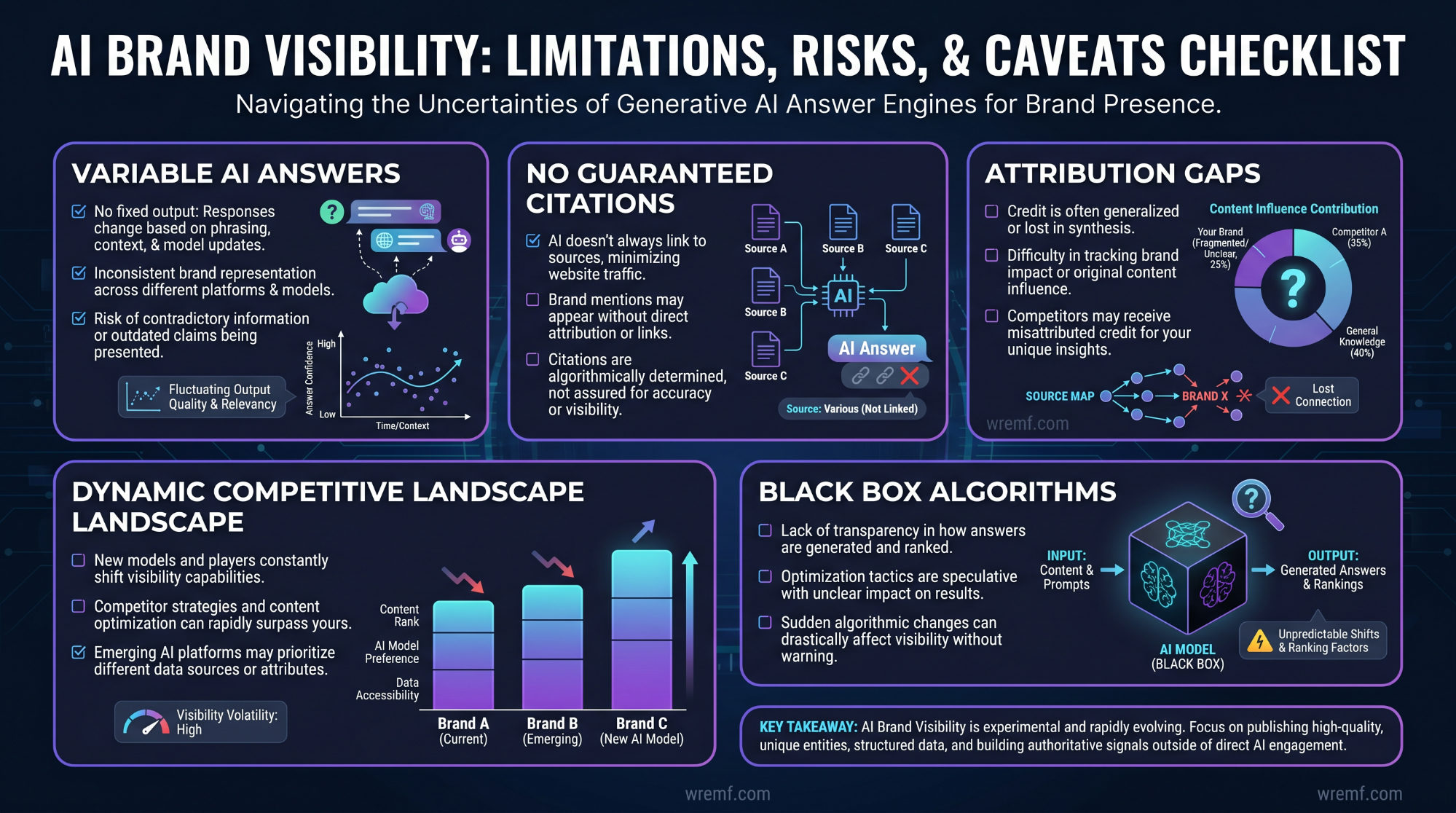
AI brand visibility is a legitimate and measurable performance dimension, but it comes with structural limitations that every team should understand before building programmes or making investment decisions based on AI visibility data.
AI answers are not fixed or reproducible. AI engines can return different answers to the same prompt depending on the user's account settings, location, device, conversation history, and the engine's current retrieval state. This means that a single prompt run does not produce a definitive picture of a brand's AI brand visibility. Reliable measurement requires structured prompt libraries run consistently across multiple sessions and engines. WREMF addresses this by running scheduled, structured prompt monitoring across all 10 tracked AI engines rather than relying on single-session queries.
No platform can guarantee that an AI engine will recommend a brand. AI citation presence can be improved through content, entity authority, structured data, and source consistency work, but AI engines make their own retrieval and synthesis decisions. The goal of an AI brand visibility programme is to make a brand a consistently strong candidate for citation, not to guarantee inclusion. Any service that promises guaranteed AI recommendations or citations should be treated with scepticism.
AI referral traffic attribution is incomplete in most analytics configurations. Traffic that arrives from AI engines does not always carry clear attribution markers. AI referral traffic may appear as direct traffic, as referral traffic from generic AI domains, or be absent from standard UTM-based attribution entirely. Teams that do not set up AI-specific attribution tracking will undercount the commercial impact of AI brand visibility improvements. GA4 attribution setup and Looker Studio dashboards are required to get reliable AI traffic data, not optional additions.
Rankings alone do not indicate AI brand visibility. A brand can hold strong organic search rankings for its target keyword set and still be absent from ChatGPT, Gemini, Perplexity, and other AI engines. Treating Google rankings as a proxy for AI brand visibility leads to missed gaps and missed opportunities. As covered in WREMF's AI Overview SEO guide Google AI Overviews follow different selection logic than organic rankings, and brands need to optimise for both separately.
GEO and AEO results take time. Improving AI brand visibility through content optimisation, structured data, citation building, and entity authority work is not an overnight process. AI engines update their training data and retrieval logic on their own schedules, and the effects of content improvements may take weeks or months to reflect in AI citation data. Teams should plan for a 60 to 90 day minimum evaluation window when assessing the impact of GEO and AEO interventions.
Software-only plans require internal execution capacity. WREMF's Starter and Growth plans deliver comprehensive tracking, reporting, and strategic insight, but they require the user's team to act on that data. A team that receives citation gap data and AI share of voice reports but lacks the internal capacity to produce answer-first content, improve structured markup, or build external citations will see limited improvement from software alone. In those cases, WREMF's Managed or hybrid model is more appropriate.
KEY TAKEAWAY: AI brand visibility measurement and improvement has real limitations including answer variability, attribution gaps, and execution dependencies, and teams should build programmes with realistic timelines and honest expectations about what platforms and strategies can and cannot guarantee.
Common Misconceptions About AI Brand Visibility
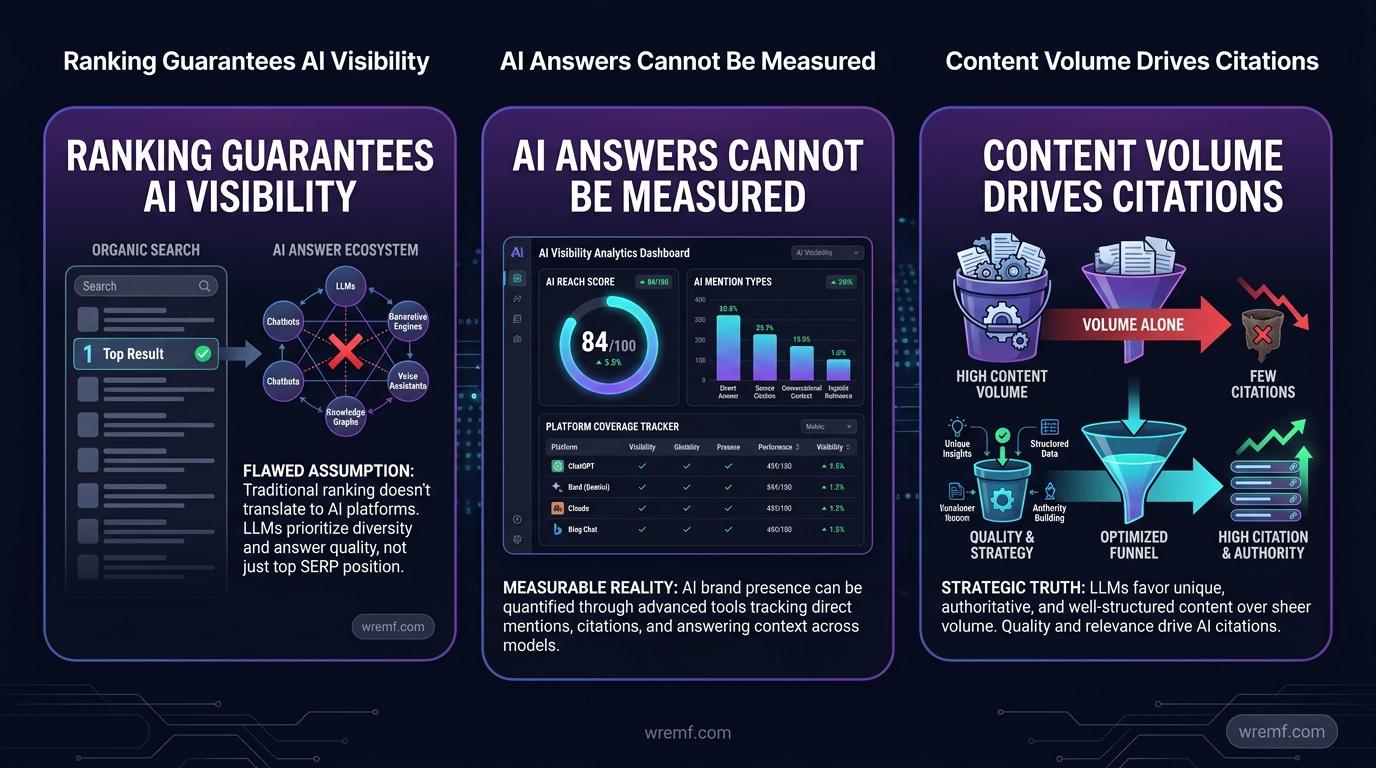
MYTH: If a brand ranks on page one of Google, it will appear in ChatGPT and AI Overviews answers automatically.
FACT: Google rankings and AI citation presence are governed by different signals and selection logic. A brand can hold strong organic search rankings and still be absent from AI-generated responses. AI engines assess source consistency, content structure, entity authority, and prompt-level relevance, not just ranking position. AI brand visibility requires its own measurement and optimisation programme separate from traditional SEO.
MYTH: AI brand visibility cannot be measured because AI answers change constantly.
FACT: AI brand visibility can be measured systematically using structured prompt libraries, scheduled monitoring across multiple AI engines, citation recording, and AI share of voice tracking. While AI answers do vary by session, engine, and time, consistent measurement methodology produces reliable trend data. WREMF's AI Visibility Index and LLM snapshot tracking are specifically designed to capture AI brand visibility trends despite answer variability.
MYTH: Building more content and more backlinks is enough to improve AI brand visibility.
FACT: Content volume and link volume have little correlation with AI citation presence based on the 2024 study of 75,000 brands. AI engines prioritise source consistency, entity authority, answer-first content structure, and multi-format brand presence over raw content volume or backlink count. A smaller amount of well-structured, authoritative, consistently cited content produces better AI brand visibility than a high volume of thin or inconsistently positioned content.
MYTH: AI brand visibility only matters for consumer brands with high search volume.
FACT: AI brand visibility is commercially significant for B2B SaaS companies, professional services firms, agencies, and any brand whose buyers use AI engines for research and vendor shortlisting. ChatGPT alone processes billions of monthly queries that include B2B software research, vendor comparison, and solution discovery prompts. B2B buyers increasingly use AI engines as part of their Customer Journey before contacting vendors, making AI brand visibility a priority for B2B go-to-market programmes regardless of branded search volume.
MYTH: AI citations can be fully controlled or guaranteed through optimisation work.
FACT: AI brand visibility can be meaningfully improved through content, entity authority, citation building, and source consistency work, but AI engines make independent retrieval and synthesis decisions. No platform or agency can guarantee that an AI engine will cite a specific brand in a specific answer. The goal of an AI brand visibility programme is to improve citation probability and authority weight consistently over time, not to control AI engine output.
KEY TAKEAWAY: The most common misconceptions about AI brand visibility relate to the assumption that SEO rankings equal AI visibility, that AI answers cannot be measured, and that content volume alone drives citations. All three are demonstrably false and lead teams to under-invest in the distinct work required for AI brand visibility improvement.
Conclusion
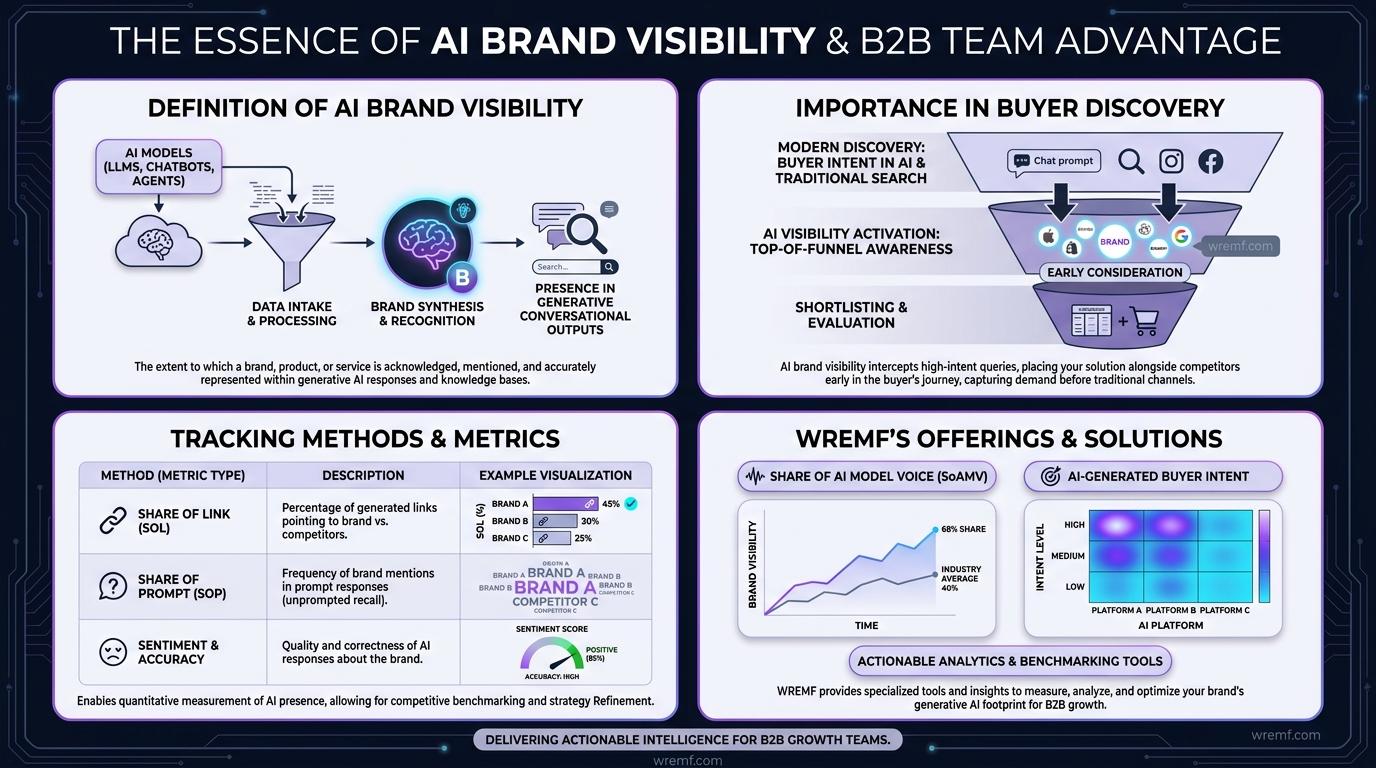
AI brand visibility is the measure of whether buyers encounter your brand in the AI-generated answers they receive across ChatGPT, Gemini, Perplexity, Google AI Overviews, Claude, Copilot, and other AI engines. It requires dedicated tracking, structured prompt monitoring, citation analysis, AI share of voice measurement, and coordinated work across GEO, AEO, content, and entity authority. Traditional SEO remains important, but it does not cover the AI visibility layer that now shapes B2B buyer discovery. WREMF provides the software, managed service, and hybrid execution support that B2B teams and agencies need to track, understand, and improve their AI brand visibility across all major AI platforms. Teams that want to start measuring can explore WREMF pricing plans and begin with a 3-day onboarding window on any plan.
Frequently Asked Questions About AI Brand Visibility
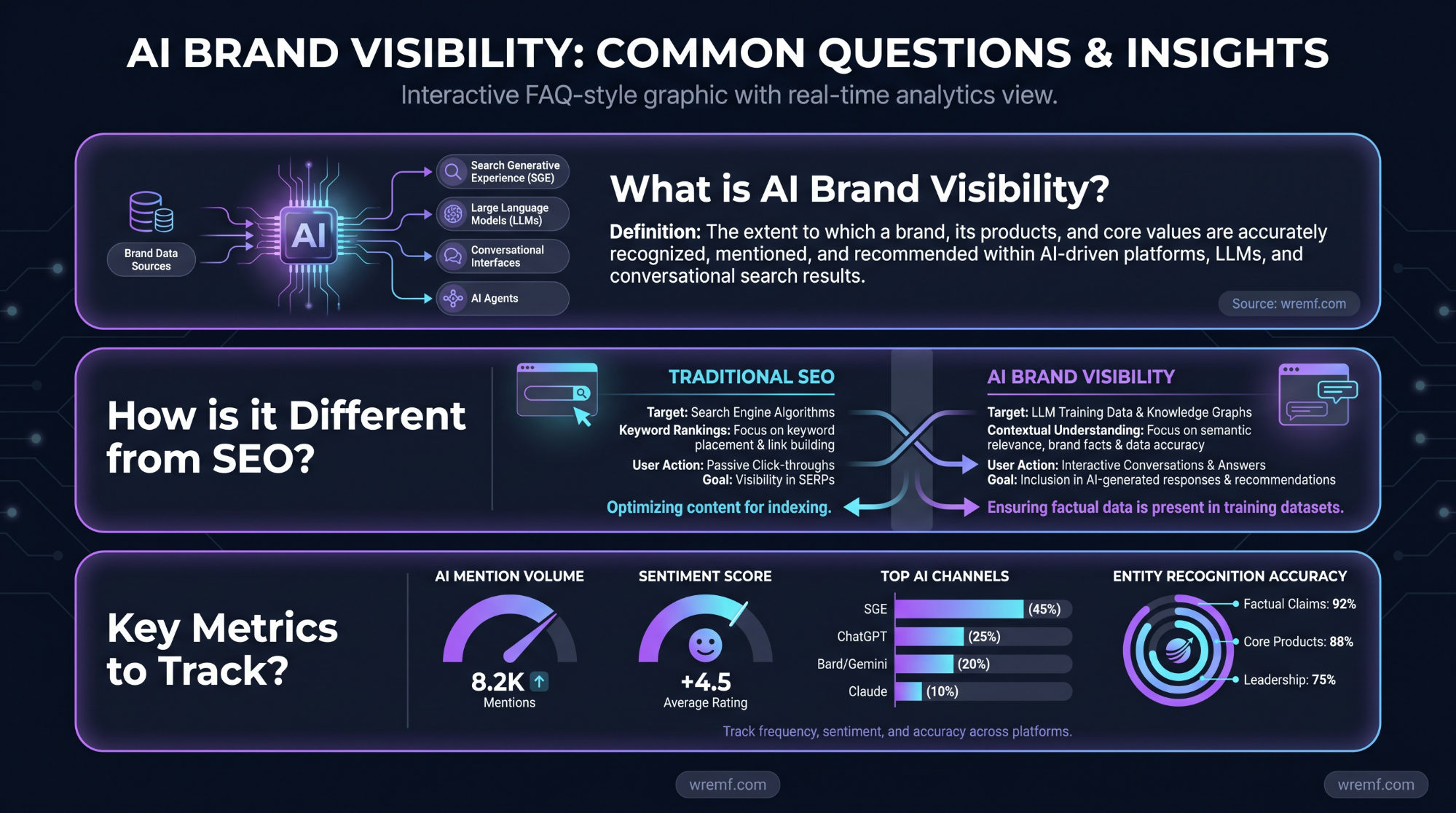
What is AI brand visibility, and why does it matter for B2B brands?
AI brand visibility refers to how frequently, accurately, and favourably your brand appears in responses generated by AI-powered search and discovery systems such as ChatGPT, Claude, Gemini, Perplexity, Google AI Overviews, Microsoft Copilot, and other large language models. When someone asks an AI engine a question relevant to your category, AI brand visibility determines whether your brand is cited, recommended, or completely absent. As AI-driven search continues to grow, brands that are not visible in AI-generated responses risk losing discovery opportunities to competitors that are. For B2B brands especially, AI visibility increasingly influences how buyers find, evaluate, and shortlist vendors before they ever visit a website.
How is AI brand visibility different from traditional SEO tracking?
Traditional SEO tracking measures keyword rankings, organic clicks, backlinks, and domain authority in standard search engine results pages. AI brand visibility tracking measures something different: whether AI engines mention your brand, cite your content, and recommend you in generated answers. A brand can rank well in Google Search and still be invisible in Google AI Overviews, ChatGPT, or Perplexity. The mechanisms are also different. AI systems select sources based on entity authority, content structure, citation signals, and training data patterns rather than purely link-based ranking signals. Teams that rely only on traditional SEO tracking are missing a growing portion of how their audience discovers information, making dedicated AI search visibility measurement an essential addition to any modern measurement stack.
What key metrics should I track to measure AI brand visibility?
The most important AI brand visibility metrics include:
- AI share of voice: the percentage of relevant AI-generated answers that mention your brand compared to competitors
- URL citation rate: how often AI engines link to your domain when providing responses, which indicates both visibility and trust
- Entity correctness: how accurately AI engines represent your brand, products, services, and expertise
- Sentiment and positioning: whether AI answers describe your brand as a leader, an alternative, or a secondary mention, and whether the tone is positive, neutral, or negative
- Time to citation: how quickly new content is incorporated into AI-generated responses, which reflects domain authority and crawl signals
- Brand citation share: your proportion of total AI citations across a defined prompt set compared to competitors
Tracking these metrics consistently across multiple AI engines gives a reliable picture of how your brand is performing in AI-driven discovery. WREMF's AI Visibility Index tracks these signals across ten AI engines in one unified dashboard.
What is AI share of voice, and how is it calculated?
AI share of voice measures what percentage of relevant AI-generated answers include a mention of your brand compared to the total mentions across your competitive set. For example, if ten AI responses about your category mention your brand three times and competitors seven times, your AI share of voice is thirty percent. It is calculated by running a defined set of prompts across AI engines, recording which brands appear in each response, and dividing your brand mentions by the total brand mentions across the prompt set. AI share of voice is a more useful competitive metric than standard organic share of voice because it captures visibility specifically within AI-generated answers, which are increasingly the first touchpoint in a buyer's research journey. WREMF tracks AI share of voice across competitor sets so teams can see how they compare across multiple AI platforms simultaneously.
How do AI engines decide which brands and sources to cite?
AI engines select sources and brands to cite based on a combination of signals including content quality and structure, entity authority, the presence of structured data, citation patterns from authoritative third-party sources, internal linking signals, and consistency of information across the web. Systems like Google AI Overviews, as explained in Google's AI Overviews documentation, use grounding mechanisms to attribute claims to specific sources. LLMs such as ChatGPT and Claude draw on training data and retrieval-augmented generation pipelines that weight sources with strong E-E-A-T signals, clear factual claims, and well-structured content. Brands that consistently appear in authoritative third-party publications, maintain clean entity data, and produce retrievable answer-first content are more likely to be cited across AI engines.
How do I track AI citations and brand mentions across multiple AI search engines?
Tracking AI citations across multiple engines requires a systematic process of running defined prompts, recording which brands and sources appear in responses, and logging citation patterns over time. Manual tracking is time-consuming and inconsistent because AI responses vary by query phrasing, session context, and model version. Dedicated AI visibility platforms automate this process by running scheduled prompt sets across engines such as ChatGPT, Claude, Gemini, Perplexity, Google AI Overviews, and Copilot, then aggregating the results into structured citation and mention reports. WREMF's source citation tracking monitors how frequently your domain is cited across AI engines, which pages are being referenced, and how citation patterns shift over time.
Can I track both branded and unbranded queries for AI visibility?
Yes. Tracking both branded and unbranded queries is essential for a complete picture of AI brand visibility. Branded queries, such as searches that include your company name or product names, reveal how AI engines describe and position your brand when someone already knows you exist. Unbranded queries, such as category questions or problem-based prompts, reveal whether AI engines recommend your brand to people who are discovering solutions for the first time. Unbranded prompt visibility is particularly valuable for B2B brands because it reflects top-of-funnel AI discovery, where buyers are forming shortlists without yet knowing specific vendors. A strong AI visibility strategy tracks both query types across relevant AI engines and monitors how citation rates and share of voice differ between branded and unbranded prompt categories.
Can I upload my own prompts and keywords to track specific industry questions?
Yes. Effective AI brand visibility tracking requires tracking the specific prompts your target audience is likely to use, not just generic category terms. This means uploading your own keyword sets, question-based prompts, comparison queries, and use-case prompts that reflect real buyer intent in your market. Prompt intelligence tools allow teams to define a custom prompt library, run those prompts across AI engines on a scheduled basis, and analyse which brands appear, which sources are cited, and where citation gaps exist. WREMF's prompt intelligence module supports custom prompt tracking so teams can monitor the exact queries most relevant to their category, buying stage, and competitive landscape.
How do you track AI sentiment and brand positioning in AI-generated content?
AI sentiment tracking goes beyond simple mention counts to analyse the tone, framing, and competitive positioning of your brand within AI-generated responses. The relevant questions are not only whether your brand appears, but whether AI answers describe you as a category leader, a viable alternative, or an incidental mention alongside competitors. Sentiment analysis in AI visibility tools examines the language used around your brand, the context in which you appear, and whether the framing is positive, neutral, or negative. This is important because an AI answer that mentions your brand in a dismissive or comparison-unfavourable context can shape buyer perception even when you are technically present. Regular sentiment audits help teams identify positioning problems before they influence buying decisions at scale.
Can I compare my brand's AI visibility to competitors?
Yes, and competitor comparison is one of the most actionable applications of AI brand visibility data. By running the same prompt set across AI engines for your brand and your competitors simultaneously, you can identify which competitors are being recommended more frequently, which sources AI engines cite for competitor content, and where your brand is absent from responses where competitors appear. This comparison reveals citation gaps, prompt coverage gaps, and authority gaps that direct your content and optimisation strategy. Understanding where competitors have stronger AI visibility, and why, is often more useful than tracking your own metrics in isolation. WREMF's competitive landscape module tracks competitor AI share of voice, citation rates, and positioning across multiple AI engines so teams can benchmark accurately.
How does tracking AI brand visibility help SEO and PR teams?
For SEO teams, AI brand visibility data identifies which content is being retrieved and cited by AI engines, which pages lack the structural signals needed for AI retrieval, and where competitor content is outperforming your pages in AI-generated answers. This insight informs content strategy, structured data improvements, and internal linking priorities in ways that traditional rank tracking cannot. For PR teams, AI brand visibility data identifies whether third-party mentions in publications, podcasts, or industry resources are contributing to AI citation signals, and whether earned media coverage is translating into AI recommendation visibility. Both teams benefit from understanding how AI engines perceive and represent the brand, and from being able to show leadership a measurable metric that connects content and PR investment to AI discovery outcomes. Gartner's research confirms that AI is reshaping how buyers discover and evaluate vendors, making this measurement increasingly strategic.
What is an AI visibility score, and what counts as a good score?
An AI visibility score is a composite metric that aggregates how often your brand appears, is cited, and is positively positioned across a defined set of AI engines and prompts. It typically combines mention frequency, citation rate, share of voice, sentiment, and entity accuracy into a single benchmark figure. There is no universal standard for what constitutes a good AI visibility score because it depends on your market, prompt set size, competitive density, and the AI engines being tracked. In practice, teams should focus on directional improvement over time and relative performance against competitors rather than chasing an absolute number. A useful benchmark is whether your AI visibility score is improving month-over-month and whether your share of voice is growing relative to your closest competitors across the prompts that matter most to your buying audience.
Why do AI visibility scores fluctuate, and how do AI model updates affect citation patterns?
AI visibility scores fluctuate because AI models are updated regularly, retrieval logic changes, and the sources these systems weight can shift based on new training data, algorithm adjustments, or changes in how well-structured your content is relative to competitors. When AI models are updated, citation patterns can change significantly. Content that was previously cited reliably may drop out of responses, while competitor content that improves its structure or third-party citation footprint may gain visibility. Comparing AI visibility data across time periods is essential for detecting these shifts early. Teams should monitor for citation cliffs, which are sudden drops in citation frequency, and investigate whether they correlate with content changes, competitor improvements, or AI model updates. Regular LLM snapshot tracking helps identify these changes before they compound into sustained visibility losses.
How do I run an AI visibility audit?
An AI visibility audit begins with defining the prompt set that reflects how your target audience searches for solutions in your category. This includes category questions, problem-based queries, comparison prompts, and buying-intent questions. The next step is running those prompts across major AI engines and recording which brands appear, which sources are cited, and how your brand is framed when it does appear. The audit should then assess entity correctness across AI platforms, identify citation gaps by comparing your content to content that AI engines are already citing, and evaluate the structural readiness of your key pages for AI retrieval. Technical signals including structured data, schema markup, internal linking, and content formatting should also be reviewed. WREMF offers a structured GEO and AI visibility audit for teams that need a systematic assessment of their current AI visibility baseline and prioritised recommendations for improvement.
How does an AI visibility audit differ from a traditional SEO audit?
A traditional SEO audit focuses on technical site health, keyword rankings, backlink profiles, on-page optimisation, and crawlability for search engine bots. An AI visibility audit focuses on different signals: whether AI engines cite your brand, how accurately they represent your entity, which content structures are retrievable by AI systems, how your citation patterns compare to competitors, and whether your brand appears in the AI-generated answers your audience is most likely to encounter. While some elements overlap, such as structured data and content quality, the diagnostic focus and the metrics produced are fundamentally different. Teams that run only traditional SEO audits are missing the signals that determine AI recommendation visibility, which is increasingly separate from standard organic search rankings.
How do I measure the ROI of AI search visibility investment?
Measuring the ROI of AI search visibility investment requires connecting visibility metrics to business outcomes. The clearest path is AI traffic attribution: tracking whether sessions that originate from AI-generated responses, including referrals from Perplexity, ChatGPT, Google AI Mode, or other AI engines, convert at meaningful rates. Beyond direct traffic, teams can track changes in branded search volume as a proxy for AI-driven brand awareness, monitor pipeline-stage correlations when AI visibility improves in buying-intent prompts, and compare lead quality from AI-referred sessions against other channels. The Harvard Business Review's coverage of AI in marketing consistently notes that measurement frameworks for AI-driven channels are still maturing, which means teams that build measurement infrastructure now will have a significant advantage. WREMF supports GA4 attribution integration so teams can connect AI visibility changes to actual traffic and conversion data.
Which AI engines should I prioritise for brand visibility tracking?
The AI engines most important to track depend on where your audience is actively discovering information. For most B2B brands, the highest priority engines are Google AI Overviews and Google AI Mode, because they reach the largest search audience; ChatGPT and Perplexity, because they are the leading conversational AI platforms for research queries; and Microsoft Copilot, because of its integration into enterprise productivity workflows. Claude, Gemini, DeepSeek, Grok, Meta AI, and Mistral are increasingly relevant depending on your audience profile and market geography. Tracking across multiple engines matters because citation patterns and brand positioning frequently differ between platforms. A brand that appears prominently in Perplexity answers may be absent from ChatGPT responses for the same query, making multi-engine tracking essential for an accurate visibility picture.
What is the difference between AI brand visibility and traditional brand awareness?
Traditional brand awareness measures how familiar a target audience is with your brand through surveys, aided and unaided recall studies, branded search volume, and social mention tracking. AI brand visibility measures something more specific and more actionable: whether AI-powered search and discovery systems actively surface, cite, and recommend your brand when your target audience asks relevant questions. A brand can have high traditional awareness but low AI brand visibility if its content is not structured in ways that AI systems can retrieve and cite. Conversely, a newer brand with strong entity authority, well-structured content, and consistent third-party citations can achieve strong AI visibility even with limited traditional brand recognition. Both metrics matter, but AI brand visibility is increasingly the metric that determines whether buyers encounter your brand during AI-assisted research.
Do I need structured data and schema markup to improve AI brand visibility?
Structured data and schema markup are not the only factors in AI brand visibility, but they are meaningful contributors. Schema markup helps AI engines correctly interpret your brand identity, product information, author expertise, and content type, which supports accurate entity representation and citation. Schema.org documentation provides standardised vocabulary for marking up organisations, products, articles, FAQs, and reviews in ways that both search engines and AI retrieval systems can interpret more reliably. Entity correctness, which is how accurately AI engines describe your brand and offerings, is partly determined by how clearly your structured data defines your identity. Teams that combine strong schema implementation with well-structured, answer-first content and consistent third-party citations tend to see better AI citation rates over time.
When should I use AI visibility software versus hiring an AI visibility agency?
Software-only AI visibility platforms are best suited to teams that have strong internal execution resources, including content strategists, SEO specialists, or growth marketers who can translate visibility data into optimisation actions. If your team can analyse prompt coverage gaps, produce AI-ready content, improve entity signals, and manage citation building independently, a software subscription provides the measurement infrastructure without the overhead of managed services. An AI visibility agency is the better choice when you need strategy, execution, and ongoing optimisation support that your internal team does not have the capacity or specialisation to deliver. A hybrid model, which combines the WREMF platform for tracking and reporting with WREMF's managed agency execution for strategy and content operations, is ideal for companies that want visibility measurement alongside practical implementation without building an internal AI search team from scratch. You can explore WREMF's agency services to understand which model fits your current needs.
What does WREMF track, and how is it different from general SEO tools?
WREMF is purpose-built for AI brand visibility and tracks how your brand appears across ten AI engines including ChatGPT, Claude, Gemini, Perplexity, Google AI Overviews, Copilot, DeepSeek, Grok, Meta AI, and Mistral. Unlike general SEO tools that focus on keyword rankings, backlink profiles, and organic search performance, WREMF tracks prompt-level brand mentions, source citations, AI share of voice, entity accuracy, sentiment positioning, and competitor visibility specifically within AI-generated responses. The platform combines prompt intelligence, citation tracking, competitive landscape analysis, AI traffic attribution, GEO audits, and content briefs in one system. For agencies, WREMF also supports white-label reporting, client portals, and BYOK integration. The core distinction is that WREMF measures and improves AI recommendation visibility, which is a separate and growing channel from standard organic search. You can view a sample WREMF report to see what the data looks like in practice.
How long does it take to see AI visibility data after setting up tracking?
Most AI visibility platforms begin returning data within hours of setup, as they run live prompt queries against AI engines and do not rely solely on historical crawl data. However, meaningful trend data, which shows how your AI share of voice, citation rate, and sentiment are moving over time, typically requires two to four weeks of consistent tracking to establish a reliable baseline. Citation patterns can shift relatively quickly in response to content changes, structured data improvements, or new third-party mentions, so teams should expect to see early directional signals within the first month and more stable trend analysis within the first quarter. Scheduled monitoring is essential because AI engine responses are not static; a single snapshot provides a point-in-time reading rather than an accurate picture of ongoing performance.
How does AI brand visibility connect to the broader customer journey?
AI brand visibility is increasingly influential at the earliest stages of the B2B customer journey, specifically during problem awareness and vendor discovery. When a buyer asks an AI engine a category question, a comparison question, or a problem-solving question, the brands cited and recommended in that response form an initial shortlist before the buyer ever conducts a traditional web search or visits a vendor website. Brands that are absent from AI-generated answers at this stage effectively miss the first filtering step of the modern buying process. As McKinsey's research on AI adoption highlights, AI tools are now embedded in professional research workflows across industries, making top-of-funnel AI visibility a strategic priority rather than an experimental metric. Teams that track AI visibility alongside pipeline stage data can begin connecting citation coverage in buying-intent prompts to downstream conversion patterns.
What should I look for when choosing an AI visibility platform?
When evaluating AI visibility platforms, the most important capabilities to assess include the number of AI engines tracked, the depth of prompt customisation available, citation and mention tracking accuracy, competitor comparison features, sentiment and positioning analysis, attribution integration with analytics platforms such as GA4, reporting quality for internal and client use, and whether the platform offers actionable recommendations or only raw data. Additional considerations for agencies include white-label reporting, client portal access, multi-brand management, and API or MCP integration options. Platforms that track only one or two AI engines provide an incomplete picture. Platforms that show data without connecting it to recommended actions leave teams uncertain about what to do next. WREMF's full platform suite is designed to address both measurement and actionability across all major AI discovery surfaces.
Is there a free trial available for AI brand visibility tools?
Many AI visibility platforms offer trial periods, limited free tiers, or demo options to allow teams to evaluate the data quality and platform fit before committing to a paid plan. WREMF's Starter plan begins at €59 per month and includes a three-day onboarding window before the first charge, which gives teams time to set up their workspace, run initial prompt sets, and review early visibility data. For teams that want to evaluate the platform before starting checkout, booking a quick call with the WREMF team is also an option. If you need to review what the reporting output looks like before committing, the WREMF sample report provides a concrete example of the data and insights the platform produces. You can also view full pricing and plan details to compare options across Starter, Growth, and Managed tiers.
Do AI visibility tools require long-term contracts?
Commitment structures vary by provider. Some enterprise AI visibility platforms require annual contracts, while others offer monthly billing with no long-term lock-in. WREMF's software plans operate on a monthly basis with no long-term commitment required, giving teams the flexibility to adjust their plan as their AI visibility programme evolves. The Managed tier, which includes senior-led strategy, GEO execution, citation building, and ongoing optimisation, is structured with clear deliverables and no unnecessary lock-in. For teams that are uncertain about the right level of investment, starting with a software plan and upgrading to managed execution once the audit has identified priority opportunities is a common and practical path.
How do AI visibility agencies differ from traditional SEO agencies?
Traditional SEO agencies focus on keyword strategy, technical SEO, link building, and organic search rankings within standard search engine results pages. AI visibility agencies focus on a different set of objectives: improving how brands appear in AI-generated responses, building entity authority recognisable to large language models, optimising content structure for AI retrieval, improving citation consistency across AI engines, and tracking share of voice within AI answer systems. The skills, tools, and optimisation tactics are meaningfully different. An AI visibility agency needs expertise in generative engine optimisation (GEO), answer engine optimisation (AEO), prompt intelligence, entity authority development, and AI citation analysis. WREMF operates as both an AI visibility software platform and a senior-led AI visibility agency that helps B2B brands improve their discoverability across ChatGPT, Claude, Gemini, Perplexity, Google AI Overviews, and other AI discovery surfaces.
Related reading
- AI Search Engine Optimization Tools: The Complete 2026 Guide for AI Search, SEO, AEO, and GEO
- Best Answer Engine Optimization for Enhancing AI Visibility
- The Complete Guide to AI Search Visibility Tools for B2B Brands and Agencies
- Large Language Model Optimization Services: The Complete Guide to LLMO, AI Search Visibility, AEO, GEO, RAG, and LLM Performance
- The Complete Guide to AI Search Visibility for B2B Brands and SEO Teams
- The Complete Guide to AI Visibility Tools for B2B Brands, SEO Teams, and Agencies