The Complete Guide to AI Brand Visibility Tools for B2B Teams
Learn about AI brand visibility tools and how B2B teams can improve presence in AI answers.
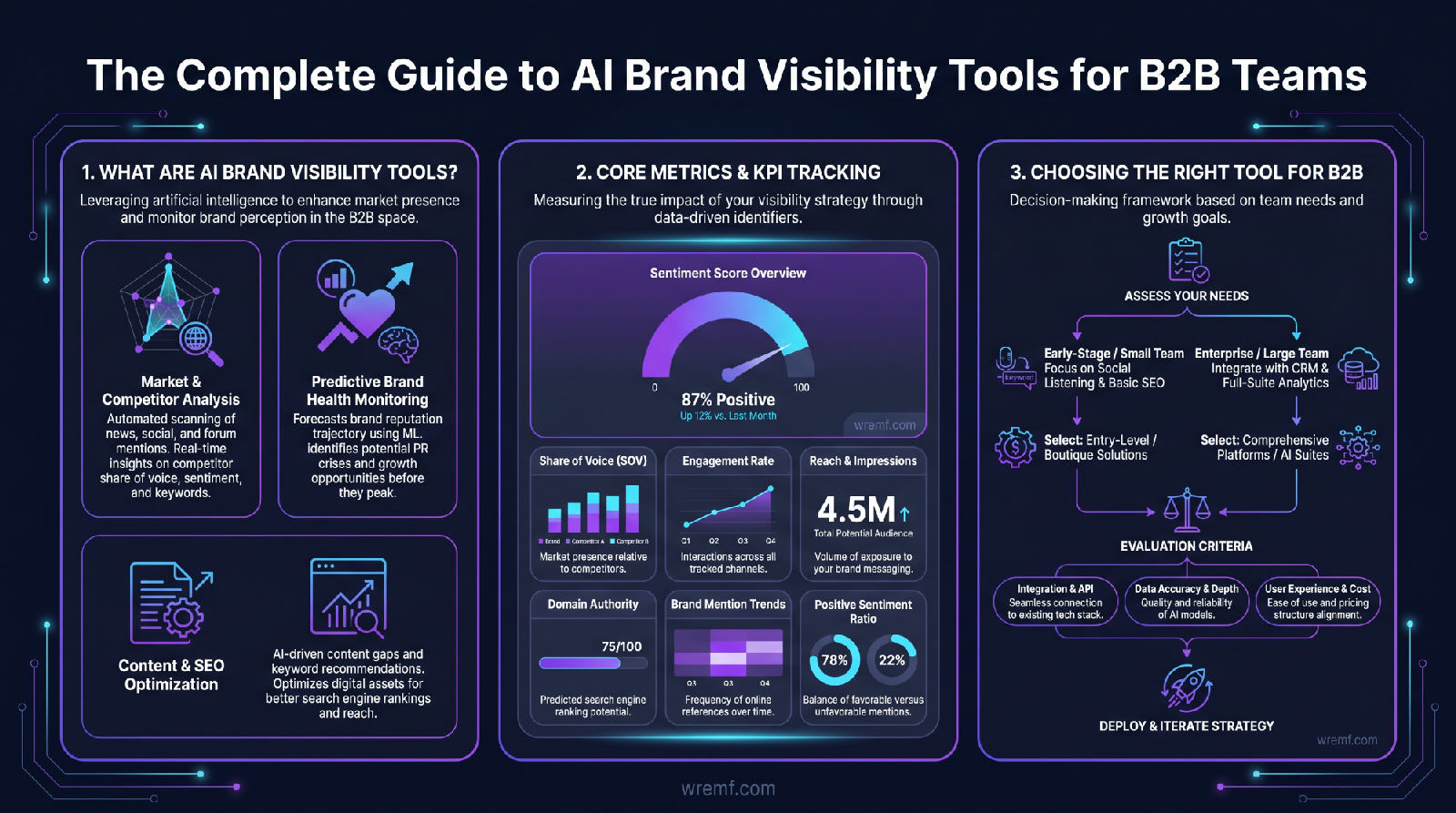
By WREMF Team · 2026-09-20
An AI brand visibility tool tracks how a brand is represented across AI engines like ChatGPT, Gemini, and Perplexity. These tools provide metrics on brand mentions, source citations, AI share of voice, and prompt coverage. AI presence influences buyer decisions by appearing in AI-generated responses at the discovery stage. Measuring these metrics helps identify gaps and optimize content strategies. Unlike traditional SEO, AI visibility focuses on prompts and AI citations rather than keyword rankings.
Key takeaways
- AI brand visibility tools track metrics like brand mentions, source citations, and AI share of voice.
- Brand presence in AI-generated answers impacts buyer decisions at the discovery stage.
- AI visibility contrasts with traditional SEO by focusing on prompts rather than keywords.
- Tools like WREMF enable tracking across multiple AI engines with diverse features like GEO audits.
- Prompt libraries support structured measurement and reveal actionable content and citation gaps.
The Complete Guide to AI Brand Visibility Tools for B2B Teams

An AI brand visibility tool is software that tracks how AI engines mention, cite, compare, and recommend your brand across prompt-based discovery surfaces such as ChatGPT, Gemini, Perplexity, Claude, Google AI Overviews, and Copilot. As AI answers now shape buyer discovery before a single click reaches your website, brand presence in AI-generated responses has become a measurable and strategically important channel. This guide is written for B2B SaaS teams, SEO and content teams, marketing agencies, and consultants who need to understand, measure, and improve AI search visibility. It covers how AI brand visibility tools work, what to measure, how tools compare, and how WREMF supports tracking and execution across software, managed, and hybrid models. If your brand is invisible in AI answers, this guide explains what to do about it.
QUICK ANSWER:
An AI brand visibility tool tracks how often and how accurately a brand appears in AI-generated answers across engines such as ChatGPT, Gemini, Perplexity, Claude, and Google AI Overviews. These tools measure brand mentions, source citations, AI share of voice, competitor presence, and prompt-level visibility data. Teams use them to identify visibility gaps, improve content and citation strategies, and prove AI search performance to stakeholders.
KEY TAKEAWAYS:
- AI brand visibility tools measure brand presence in AI-generated answers, not just search engine rankings
- Core metrics include brand mentions, source citations, AI share of voice, prompt coverage, and source consistency across engines
- Prompt tracking and citation analysis reveal why competitors appear in AI answers while your brand does not
- Rankings on Google do not automatically translate into citations in ChatGPT, Gemini, Perplexity, or Google AI Overviews
- WREMF tracks AI visibility across 10 AI engines with unlimited prompts, BYOK support, and options for self-serve software, managed execution, or hybrid engagement
What Is an AI Brand Visibility Tool and Why Does It Matter
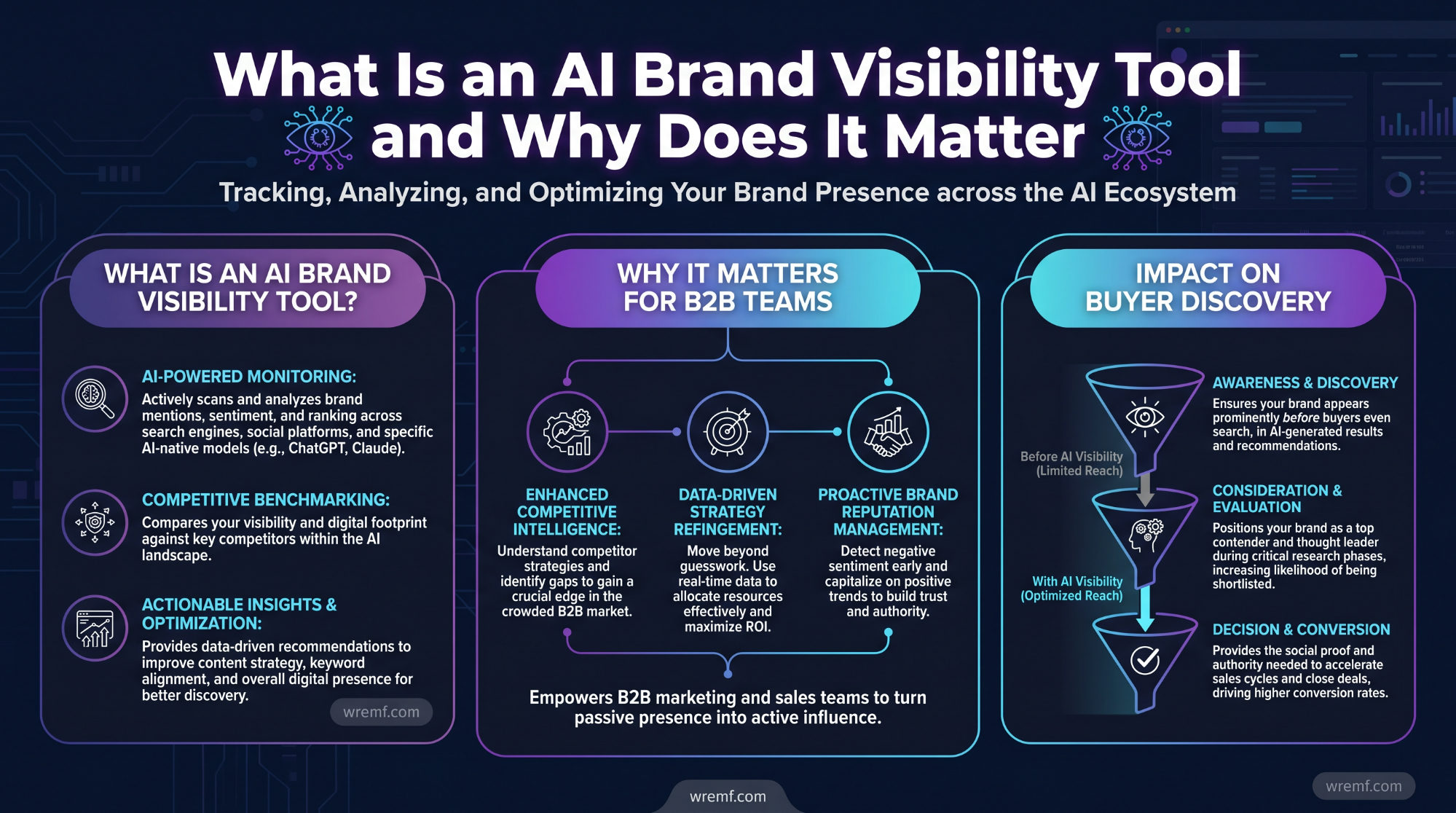
An AI brand visibility tool is a platform that measures how a brand is represented in AI-generated responses across large language models and answer engines. It matters because AI search now influences buyer decisions at the discovery and consideration stage, often before a user visits any website.
Traditional search analytics platforms were built for a world where search meant ranking on Google's SERP. That model assumed a user types a keyword, sees a list of blue links, and clicks through to a website. AI search works differently. A user enters a prompt into ChatGPT, Perplexity, Gemini, or Google AI Mode and receives a synthesised answer that may or may not mention your brand, cite your content, or link to your domain.
The gap between traditional search visibility and AI search visibility is now significant. A brand can rank on page one of Google's SERP and still be absent from AI-generated answers for the same query. Conversely, a brand that is frequently cited across AI engines may drive AI referral traffic that never shows up cleanly in standard Google Analytics sessions without specific attribution configuration.
According to Gartner's AI research AI assistants and generative search interfaces are reshaping how buyers evaluate and shortlist vendors. With over 100 million people using AI assistants monthly, a brand's representation in AI responses directly influences customer discovery, consideration, and decision-making. That makes AI brand visibility a commercial metric, not just a technical SEO curiosity.
An AI brand visibility tool gives teams the data layer to answer questions that traditional SEO platforms cannot. Which prompts trigger mentions of your brand? Which AI engines cite your content as a source? How does your AI share of voice compare to competitors? Where are the visibility gaps that content or citation strategy could address? What is your brand's Presence Quality score across different prompt clusters?
Understanding these questions requires a different category of tooling. The AI visibility tracking guide for B2B brands explains how AI search engine optimisation differs from traditional SEO and why tracking must start with prompts rather than keywords.
KEY TAKEAWAY: AI brand visibility tools measure brand presence in AI-generated answers, not search rankings, making them essential for any team that wants to understand how buyers discover and evaluate them through prompt-based search.
How AI Brand Visibility Is Different From Traditional Search Visibility
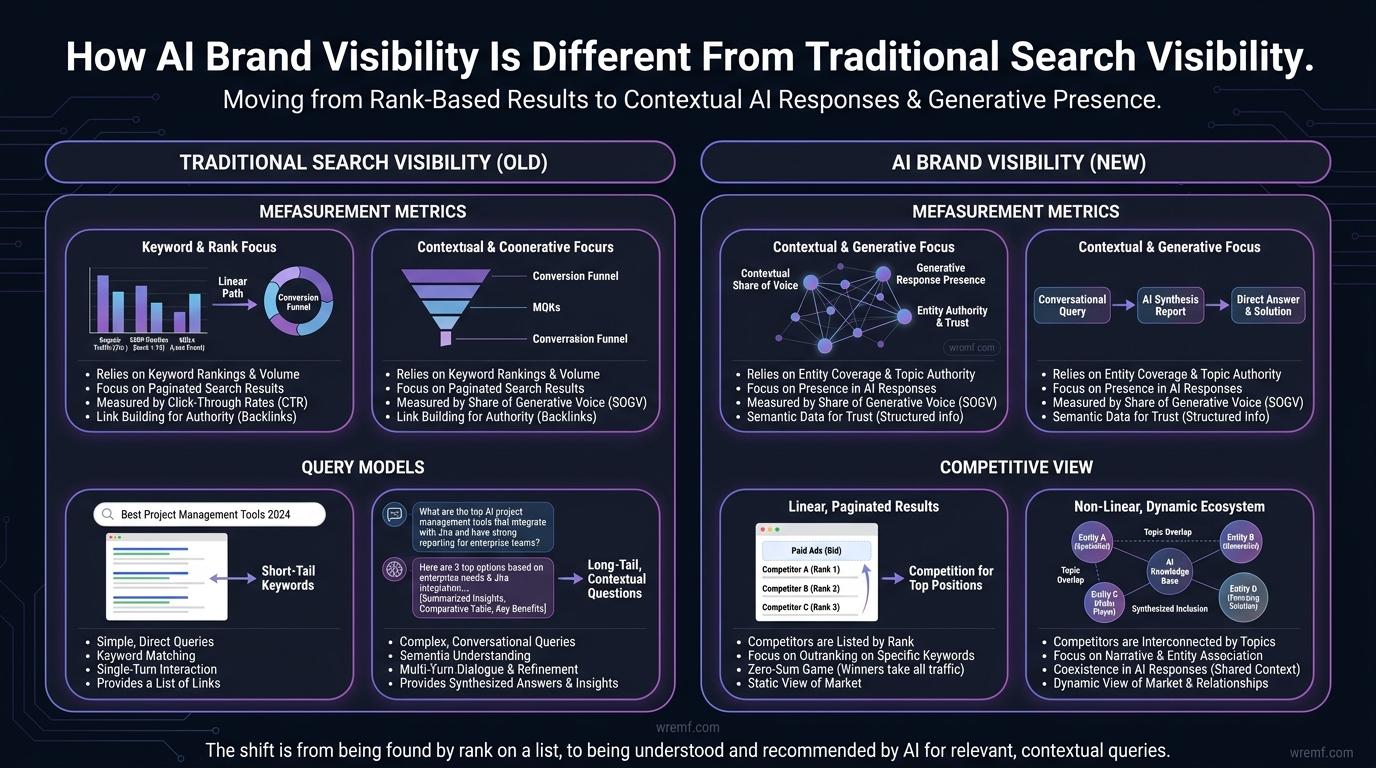
AI brand visibility and traditional search visibility measure fundamentally different things. Traditional search visibility measures where a page ranks in Google's organic results. AI brand visibility measures whether and how a brand appears in AI-synthesised answers across multiple engines.
This distinction matters practically. A brand's position in Google's SERP does not predict its presence in ChatGPT answers, Perplexity citations, Gemini recommendations, or Google AI Overviews. The signals that influence AI citations include source authority, content structure, entity consistency, training data inclusion, and how consistently a brand is referenced across credible external sources. These signals overlap with SEO indicators like E-E-A-T, but they are not identical.
The relationship between SEO, Answer Engine Optimisation, and Generative Engine Optimisation is worth clarifying here. SEO focuses on ranking pages in search engines for target keywords. Answer Engine Optimisation, commonly known as AEO, focuses on structuring content so that answer engines extract it as a response to user queries. Generative Engine Optimisation, known as GEO, focuses on making content and brand signals compatible with how large language models generate answers and select sources. All three disciplines are related, but each requires distinct measurement and execution.
The following comparison illustrates the core differences between traditional search tracking and AI brand visibility tracking:
Primary signal
- Traditional SEO tools: Keyword rankings in Google's SERP
- AI brand visibility tools: Brand citations and mentions in AI-generated answers
What gets measured
- Traditional SEO tools: Page position, impressions, click-through rate
- AI brand visibility tools: Prompt coverage, brand mentions, source citations, AI share of voice
Authority signal
- Traditional SEO tools: Backlinks and domain authority
- AI brand visibility tools: Source citations in AI answers and credibility of sources
Query model
- Traditional SEO tools: Keywords
- AI brand visibility tools: Prompts and conversational queries
Competitive view
- Traditional SEO tools: SERP overlap and ranking gaps
- AI brand visibility tools: Competitor AI share of voice across prompt clusters
Engine coverage
- Traditional SEO tools: Google and Bing primarily
- AI brand visibility tools: ChatGPT, Gemini, Perplexity, Claude, Copilot, Google AI Overviews, DeepSeek, Grok, Meta AI, Mistral
Traffic attribution
- Traditional SEO tools: Organic sessions in Google Analytics
- AI brand visibility tools: AI referral traffic analysis and prompt-to-click attribution
Traditional SEO tools remain essential for rankings, crawlability, backlinks, Keyword Research, and technical site health. AI brand visibility tools add the measurement layer that SEO platforms were not designed to provide. The answer engine optimization services guide explains how AEO sits alongside SEO rather than replacing it.
KEY TAKEAWAY: AI brand visibility tracking requires different tools and metrics than traditional SEO because AI engines select sources using different signals than Google's ranking algorithm.
Core Metrics That AI Brand Visibility Tools Should Measure
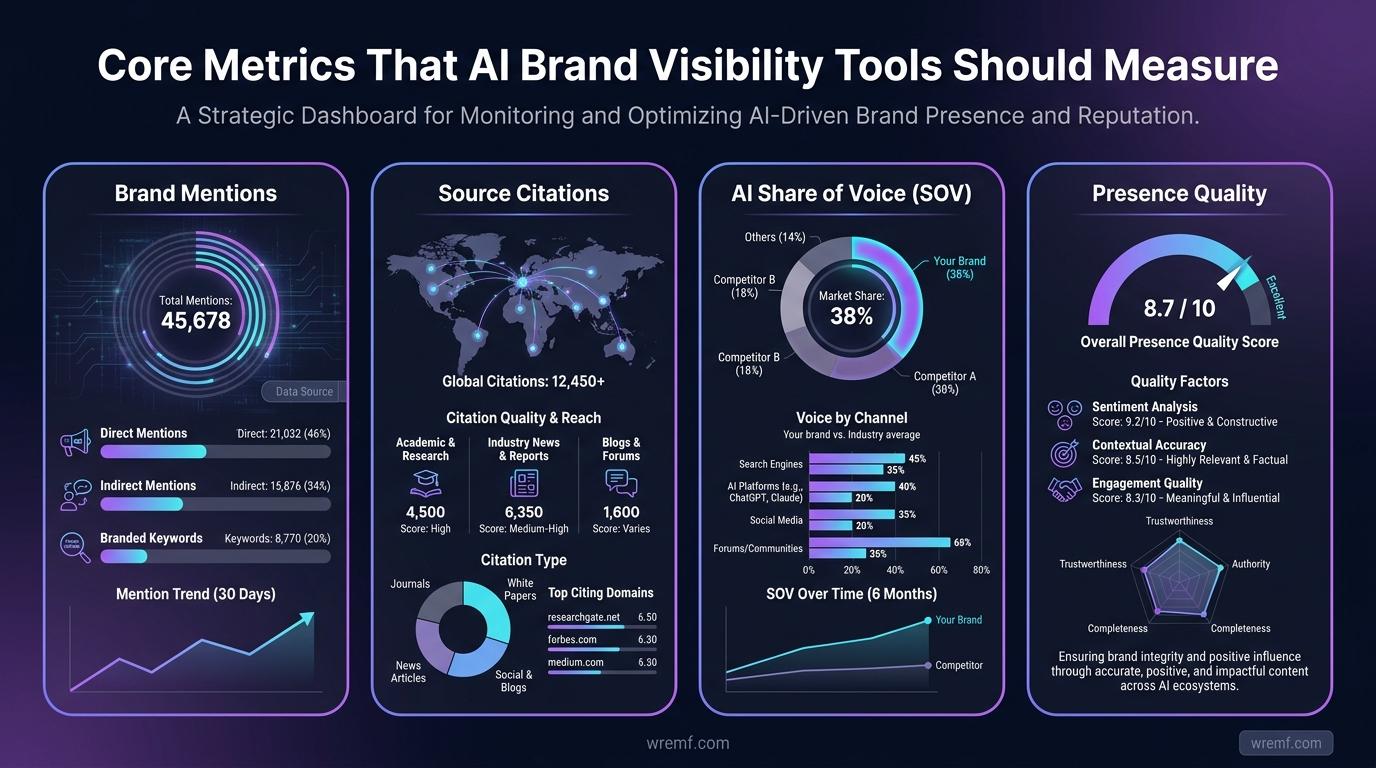
Effective AI brand visibility tools measure a structured set of metrics that reveal how, where, and how often a brand appears across AI-generated answers. Not all tools measure the same things, and teams should evaluate tools based on which metrics align with their visibility and reporting priorities.
Brand mentions refer to the frequency with which an AI engine includes a brand name in its generated response. A mention does not necessarily mean a recommendation. Some tools distinguish between neutral mentions, positive framing, and negative sentiment, which is where sentiment analysis becomes relevant.
Source citations refer to instances where an AI engine explicitly references a brand's domain, content, or source material as the basis for an answer. Source citations carry more authority than passive mentions because they indicate that the AI engine is drawing from the brand's content as a reference. Tracking source citations across engines helps teams understand which content is being used as input and where citation gaps exist.
AI share of voice is the percentage of tracked prompts in which a brand appears relative to the total number of prompts monitored and relative to competitors. AI share of voice is to AI search what SERP visibility is to traditional SEO. It is the headline metric that tells a marketing team or agency whether their brand is gaining or losing ground in AI-generated discovery.
Presence Quality is a composite measure that weights not just whether a brand appears in an answer, but how it appears. A brand that is mentioned in passing in a neutral list scores lower than a brand that is cited as a recommended solution with a source link. Tools that measure Presence Quality give teams a more accurate view of brand performance than raw mention counts alone.
Prompt coverage measures how many of the tracked prompts in a given cluster return a result that includes the brand. If a team tracks 50 prompts across a buyer journey cluster and the brand appears in 12 of them, prompt coverage is 24 percent. Low prompt coverage in high-intent prompt clusters is one of the most actionable visibility gaps a team can identify.
Visibility gaps are the prompts and topic areas where competitors appear in AI answers and the tracked brand does not. Identifying visibility gaps is the starting point for a content strategy aligned with AI search, including new Content Briefs, structured data improvements, schema markup updates, and citation outreach.
Source Links are the specific URLs that AI engines cite when generating answers. Tracking which URLs appear as Source Links across ChatGPT, Perplexity, Gemini, and Google AI Overviews helps teams understand which pages carry citation authority and which domains are being used as references. This informs Site Audit priorities and content optimisation decisions.
Competitor visibility data shows which competing brands appear in the same prompt clusters as the tracked brand. A structured competitor set typically includes three to five core competitors, three to five adjacent competitors, and one to three aspirational brands that frequently receive AI recommendations. Tracking competitor AI share of voice over time reveals Market Competition dynamics that keyword rankings alone cannot show.
For agencies managing AI visibility reporting across multiple clients, the AI mention tracking guide provides a practical framework for monitoring brand mentions across AI answers at scale.
KEY TAKEAWAY: Effective AI brand visibility measurement goes beyond counting mentions and requires tracking source citations, AI share of voice, Presence Quality, prompt coverage, visibility gaps, and competitor performance across multiple AI engines.
How AI Brand Visibility Tools Work: The Core Technical Process
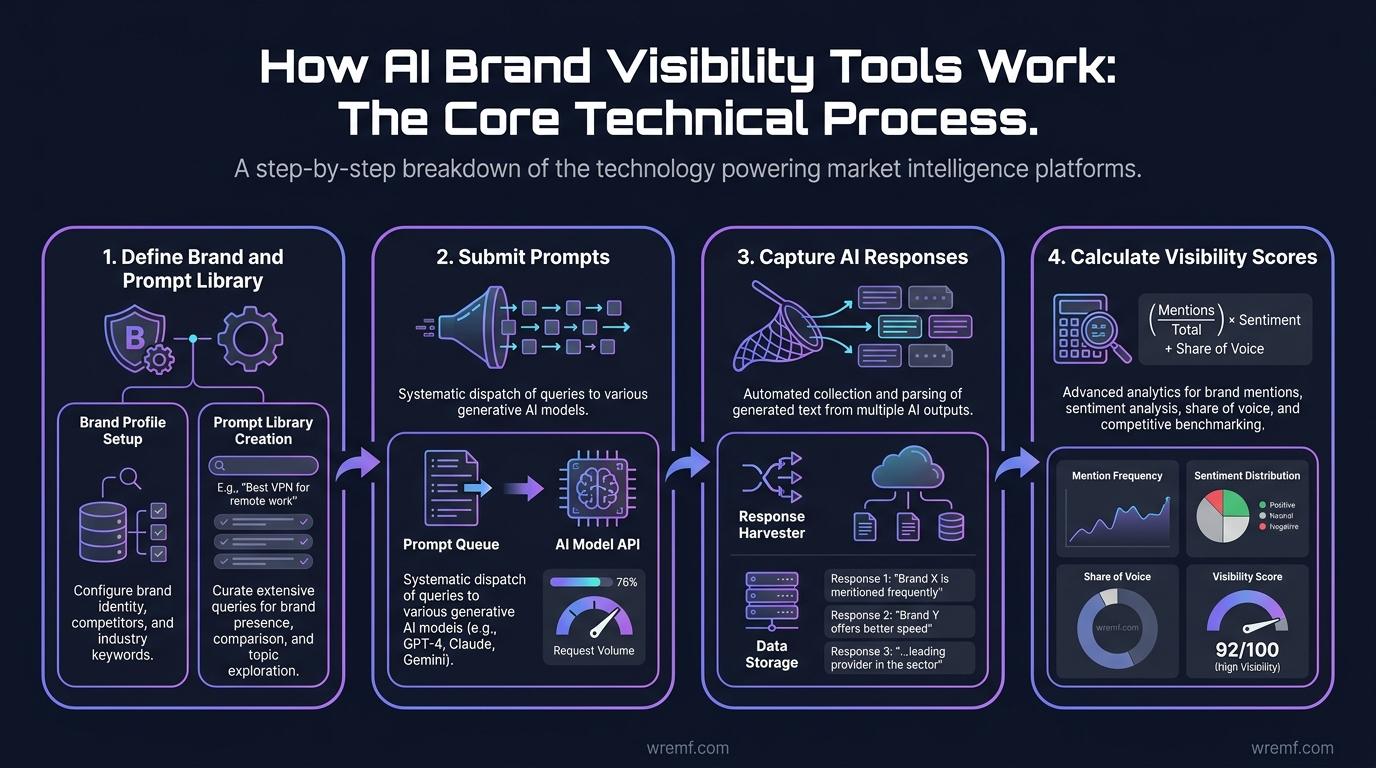
AI brand visibility tools work by submitting prompts to AI engines, capturing the generated responses, parsing those responses for brand mentions and citations, and aggregating the results into dashboards and reports. The process involves several distinct layers that vary across platforms.
Step 1: Define your brand and prompt library
The first step is entering the brand name, domain, product names, and any brand entity anchors that help the tool distinguish accurate mentions from false positives. Teams also define the prompt library, which is the set of buyer-intent queries, comparison prompts, and category prompts that represent how real users discover brands through AI search.
Step 2: Submit prompts across AI engines
The tool submits each prompt to the configured AI engines. Engines typically include ChatGPT, Gemini, Perplexity, Claude, Google AI Overviews, Copilot, and others depending on the platform's coverage. More capable platforms use an AI Crawler or API integration to access real AI-generated responses rather than simulated outputs.
Step 3: Capture and parse AI-generated responses
Each AI-generated answer is captured and parsed for brand mentions, competitor mentions, source citations, and Source Links. Sophisticated tools also record the full response context so teams can validate whether a mention is a recommendation, a neutral reference, or a negative framing.
Step 4: Calculate visibility scores and composite scores
The tool aggregates the parsed data into metrics such as mention frequency, source citation rate, AI share of voice, and a composite score that reflects overall brand performance across the prompt library and engine set. Some tools provide a visibility score that can be tracked week over week to identify trends.
Step 5: Identify competitors in the same answer space
The platform maps which competitor brands appeared in the same prompts as the tracked brand. Displacement prompts, which are prompts where a competitor appears and the tracked brand does not, are particularly useful for prioritising content gaps and citation strategy.
Step 6: Connect visibility data to content and citation action
The most practical AI brand visibility tools connect measurement to action by surfacing visibility gaps, generating Content Briefs, flagging citation opportunities, and identifying which pages need content optimisation to improve their chances of being cited. Some platforms include a Content Audit or AEO Grader to evaluate existing content against AI citation readiness.
Step 7: Report and attribute AI-driven traffic
The final step is connecting AI visibility data to business outcomes. This means attributing AI referral traffic through GA4, generating Dashboard reports for stakeholders, and producing white-label reports for agency clients. Looker Studio connectors and CSV exports extend reporting flexibility for larger teams.
WREMF automates steps one through seven across 10 AI engines with unlimited prompts on every plan. Teams using the Growth plan gain access to GA4 attribution, GEO audits, a content brief generator, white-label reports, and a Looker Studio connector, making it suitable for in-house SEO teams and marketing agencies managing multiple clients. Compare WREMF pricing plans to understand which plan fits your team's reporting and execution needs.
KEY TAKEAWAY: AI brand visibility tools work by submitting structured prompts to AI engines, parsing the responses for brand and competitor signals, and translating that data into actionable visibility metrics, content priorities, and attribution reporting.
How to Build a Prompt Library for AI Brand Visibility Tracking
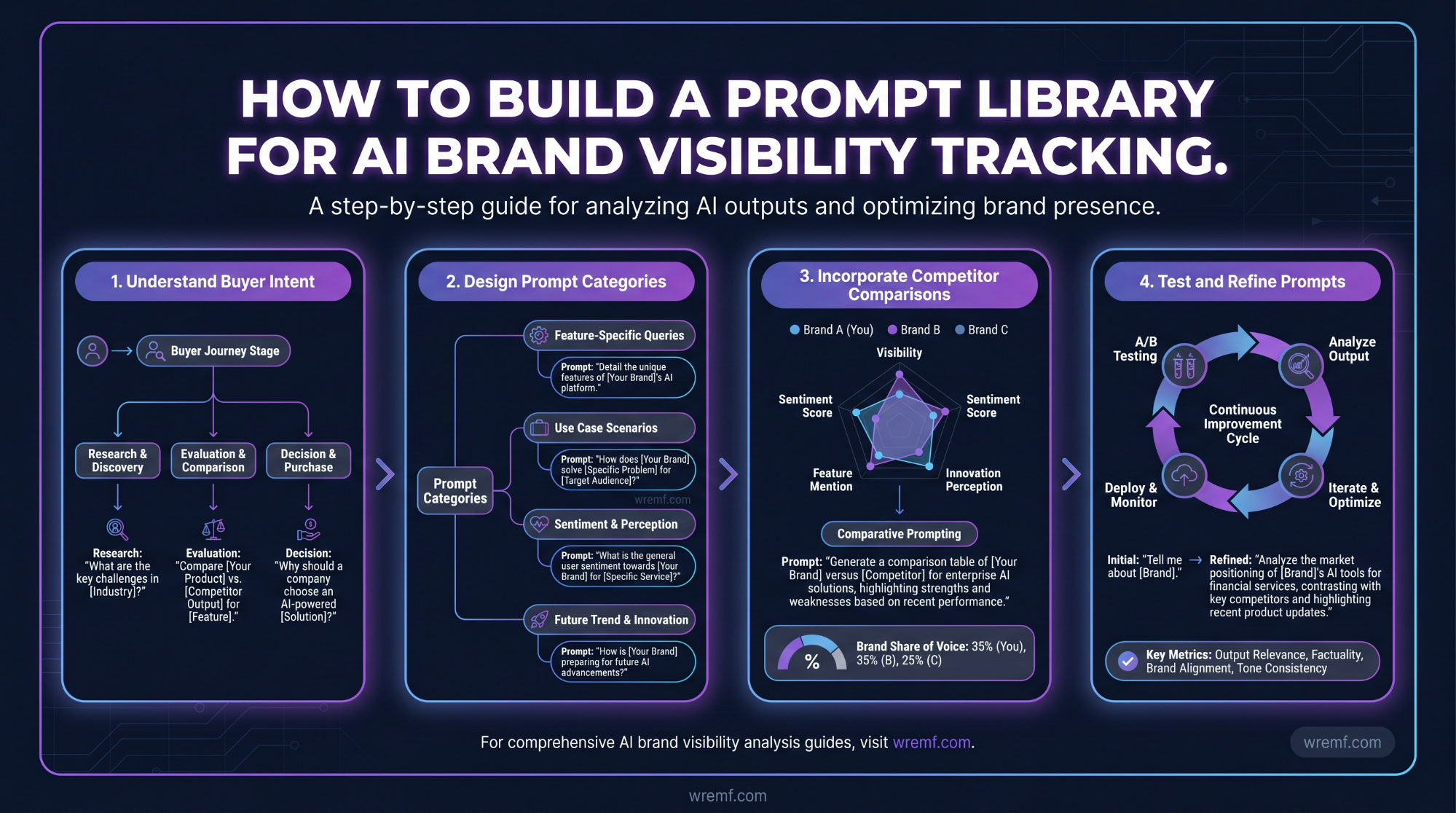
A prompt library is the set of queries submitted to AI engines to measure brand visibility. The quality of a prompt library determines the accuracy and usefulness of the data an AI brand visibility tool returns. A poorly constructed prompt library produces misleading results and wastes tracking budget.
Effective prompt libraries are built around the Customer Journey, not just high-volume keywords. Buyers use AI engines to ask questions at different stages of their journey, including awareness questions about category problems, consideration questions comparing solutions, and decision questions about specific products or vendors.
A well-structured prompt library for a B2B SaaS brand typically includes:
Category awareness prompts such as "what are the best tools for tracking AI search visibility" or "how do brands appear in AI answers"
Comparison prompts such as "chatgpt versus perplexity for B2B research" or "which AI visibility platform is better for agencies"
Vendor evaluation prompts such as "what is [brand name] used for" or "is [brand name] a reliable AI visibility tool"
Problem-solution prompts such as "why does my competitor appear in ChatGPT answers and I don't" or "how do I improve my brand's visibility in Google AI Overviews"
Region-specific filtering prompts where brand visibility differs by market or language, which is especially relevant for multi-market enterprise teams
Prompt design should avoid injecting the brand name directly into the prompt unless the intent is specifically to test named-brand retrieval. Prompts that force a mention of a competitor in the wording can inflate that competitor's mention count and produce false positives. The reliable approach is to design prompts around buyer intent and let AI engines surface brands organically.
For teams new to prompt intelligence, the AI search engine optimisation tools guide provides practical guidance on connecting prompt design to content strategy and visibility measurement.
KEY TAKEAWAY: A prompt library built around the Customer Journey rather than keywords produces more accurate AI brand visibility data and surfaces more actionable content and citation gaps.
AI Brand Visibility Tools Compared: What to Look for Before Choosing
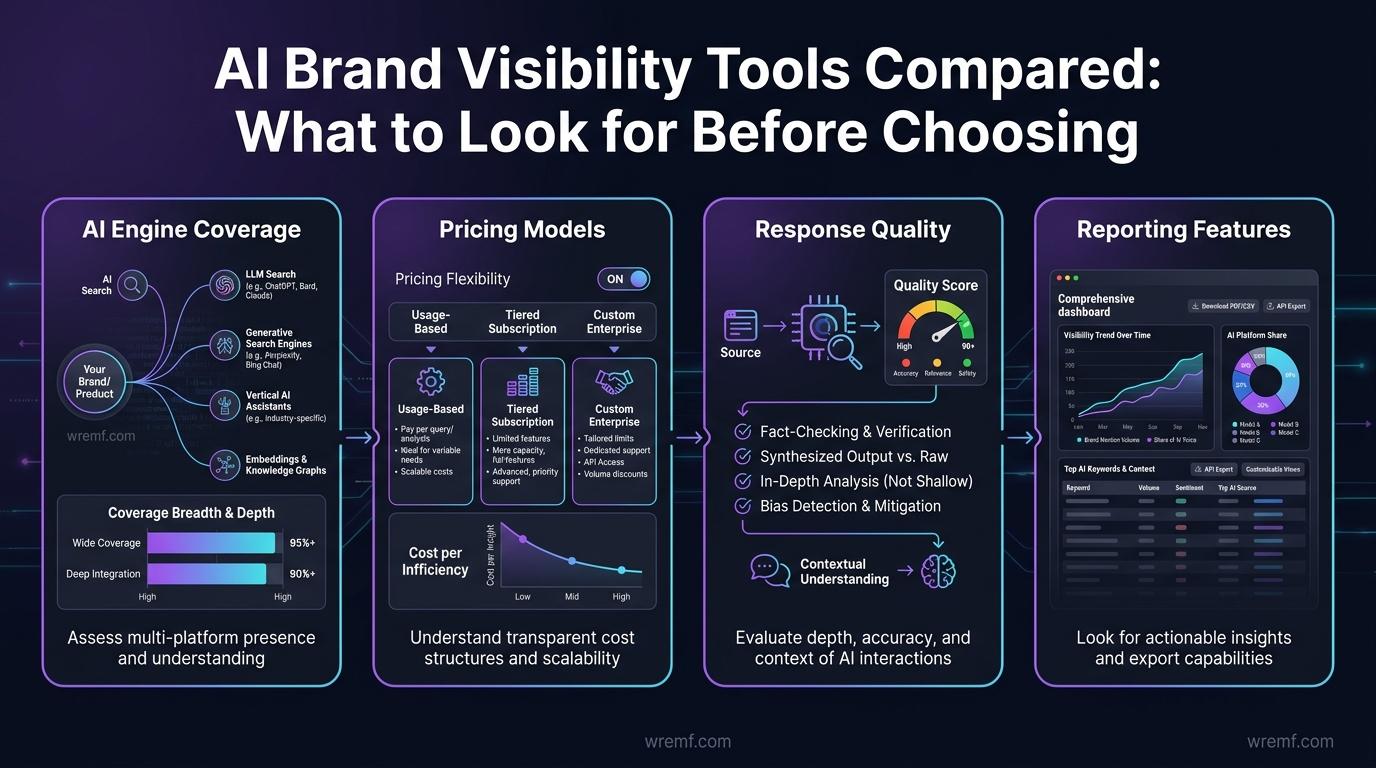
Choosing the right AI brand visibility tool requires evaluating several dimensions beyond headline features. The market includes tools built for different use cases, team sizes, and execution models, and the cheapest option is not always the most cost-efficient once manual verification time is factored in.
The following comparison covers the key evaluation dimensions teams should assess:
AI engine coverage
- Minimum viable coverage: ChatGPT, Gemini, Perplexity, Google AI Overviews
- Stronger coverage: Claude, Copilot, DeepSeek, Grok, Meta AI, Mistral, Google AI Mode
- Why it matters: Buyer prompts are distributed across multiple AI platforms and a tool that covers only two engines will miss a significant share of visibility data
Prompt model and scaling
- Per-prompt pricing tools: Costs increase with prompt volume, which can limit tracking depth
- Unlimited prompt platforms: Allow broader prompt libraries without per-prompt markups, which is better for teams tracking large prompt sets
- Why it matters: Per-prompt markups incentivise teams to track fewer prompts, reducing data quality
Real responses versus simulated results
- Simulation-based tools: Estimate visibility without querying real AI engines
- Real-response tools: Submit actual prompts to live AI engines and capture genuine outputs
- Why it matters: Simulated results do not reflect actual AI-generated answers, which reduces reliability for competitive tracking and source analysis
Context visibility
- Tools that show only mention counts: Require manual verification to determine whether a mention is a recommendation, neutral reference, or negative framing
- Tools that show full answer context: Allow teams to validate mentions quickly and avoid false positives, especially when tracking competitor names that overlap with other entities
- Why it matters: Without context, a number on a dashboard is not actionable
Source Link and citation tracking
- Basic mention tracking: Flags that a brand was mentioned but not which URL was cited
- Source-level citation tracking: Shows which specific pages are being cited across which engines, which directly informs content and site audit priorities
- Why it matters: Source citation data is the most actionable output for content and SEO teams
Export and reporting
- CSV export only: Sufficient for small teams or solo consultants
- Dashboard plus white-label report plus Looker Studio connector: Required for agencies managing client workspaces and reporting across multiple brands
- Why it matters: Agency and enterprise teams need reporting formats that match client expectations
Several tools appear frequently in market research on this category. The Semrush AI Visibility Toolkit offers brand performance reports and competitor data within the Semrush platform. SE Visible from SE Ranking provides high-level AI brand visibility tracking with sentiment analysis, weekly updates, and cached AI answers. OtterlyAI focuses on detailed GEO audits across 25 or more ranking factors. Profound AI is positioned for enterprise AI visibility tracking at scale. The 12 best AI search optimisation tools guide provides a broader comparison of platforms available for AI search visibility, AEO, and GEO use cases.
WREMF is positioned differently from single-feature tools. It covers 10 AI engines with unlimited prompts on every plan, includes BYOK support to avoid per-prompt markups, and offers three engagement models: self-serve software, managed AI visibility execution, and a hybrid model that combines software access with senior-led strategy and execution support. That flexibility makes WREMF relevant for solo consultants on the Starter plan at 59 euros per month through to enterprise brands and large agencies on the Managed plan from 1,500 euros per month.
DID YOU KNOW:
According to BCG's AI insights AI-native buyer journeys are accelerating across B2B categories, with AI assistants increasingly used to shortlist vendors before direct website visits occur.
KEY TAKEAWAY: The right AI brand visibility tool depends on engine coverage, prompt model, response quality, context visibility, citation tracking depth, and reporting format, not just headline pricing or feature count.
Real-World Use Cases for AI Brand Visibility Tools
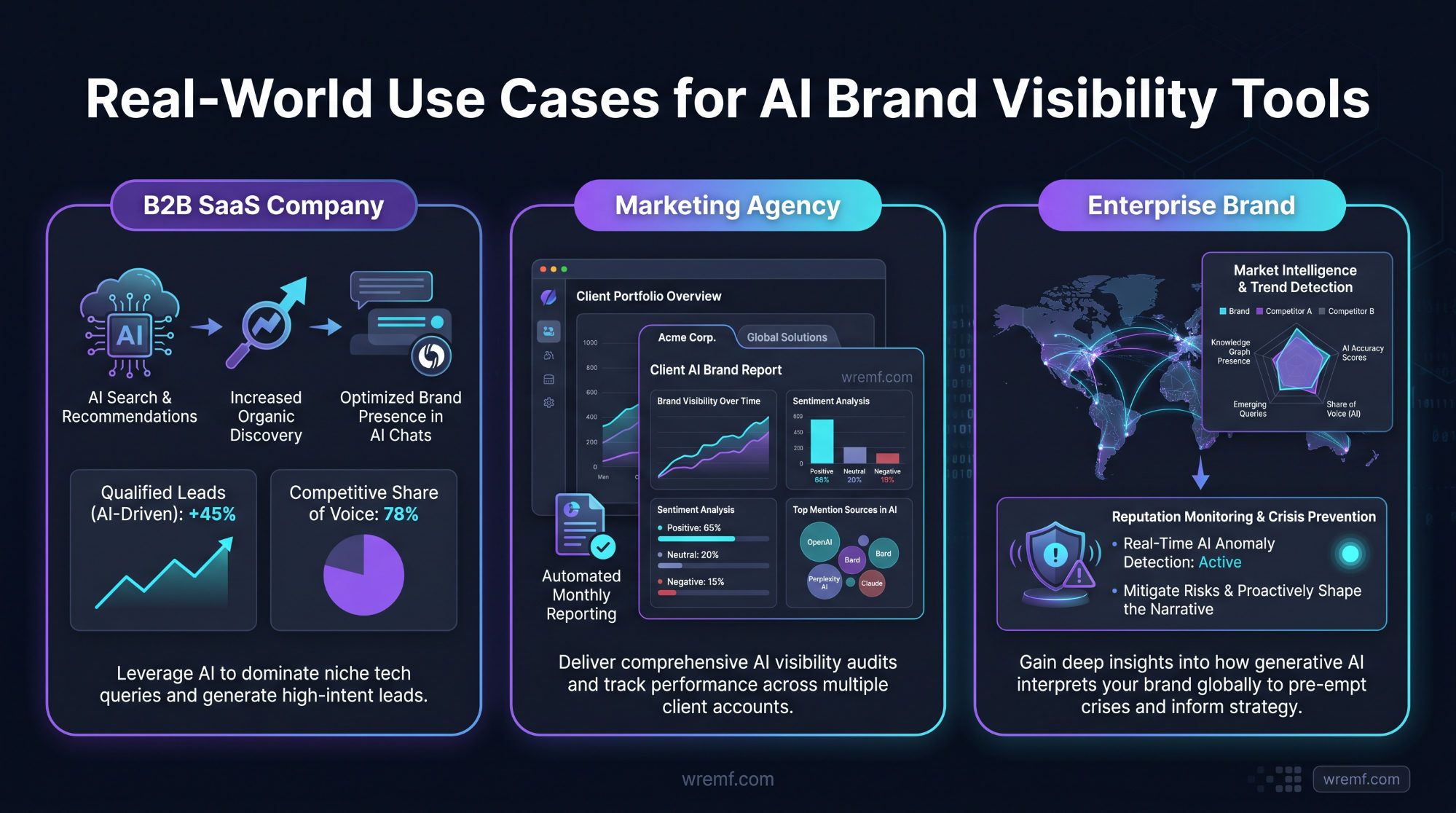
Understanding how different teams apply AI brand visibility tools in practice helps clarify which features and engagement models matter most for different contexts.
Use case one: A B2B SaaS company investigating competitor AI presence
A mid-market B2B SaaS company notices its pipeline has slowed while a direct competitor seems to be gaining momentum. The marketing team suspects the competitor is appearing more frequently in ChatGPT and Perplexity answers for category-level buyer prompts. Using an AI brand visibility tool, the team builds a prompt library around buyer-intent queries in their category and tracks which brands appear in AI-generated answers across five AI engines over a rolling 30-day period. The data reveals that the competitor is cited in 60 percent of tracked prompts while their own brand appears in fewer than 20 percent. The visibility gap analysis shows the competitor's long-form comparison content and third-party review citations are the primary source inputs being referenced. The team uses this insight to prioritise new content briefs, schema markup improvements, and a citation outreach strategy. WREMF's Growth plan provides exactly this workflow: prompt tracking, competitor visibility, source citation analysis, GEO audits, and a content brief generator within one platform.
Use case two: A marketing agency reporting AI visibility to clients
A digital marketing agency manages SEO and content for eight B2B clients. Several clients have started asking questions about their brand's presence in AI-generated answers after seeing competitors mentioned in ChatGPT responses. The agency needs a platform that supports client workspaces, produces white-label Dashboard reports, connects to Looker Studio, and tracks competitor AI share of voice across multiple brands simultaneously. Using WREMF Growth, the agency tracks up to five websites and 10 to 15 competitors per account, generates white-label reports for client presentations and pitch environments, and uses the Looker Studio connector to embed AI visibility data into existing client reporting dashboards. The agency also uses the AI SEO agency guide to help clients understand the difference between traditional SEO performance and AI search visibility performance.
Use case three: An enterprise brand running a full AI visibility audit
A large enterprise brand in the B2B technology sector wants a comprehensive view of how its brand is positioned across AI engines in four markets. The brand's internal marketing team does not have the capacity to design prompt strategies, run GEO audits, manage citation and entity cleanup, or produce monthly reporting at the required scale. The brand engages WREMF Managed, which begins with an AI visibility audit covering brand mentions, source citations, competitor positioning, E-E-A-T signals, content gaps, schema structure, and source consistency across AI engines. The senior-led execution team delivers a custom GEO strategy, AEO content optimisation, citation and entity authority cleanup, and a monthly reporting cadence. The enterprise team receives strategic guidance, a custom roadmap, and regular strategy calls without needing to build internal AI visibility execution capacity.
KEY TAKEAWAY: AI brand visibility tools serve different use cases depending on team size, execution capacity, and reporting requirements, ranging from solo prompt tracking to full managed AI visibility programs for enterprise brands and agencies.
AI Brand Visibility Across Different AI Engines: Why Coverage Matters
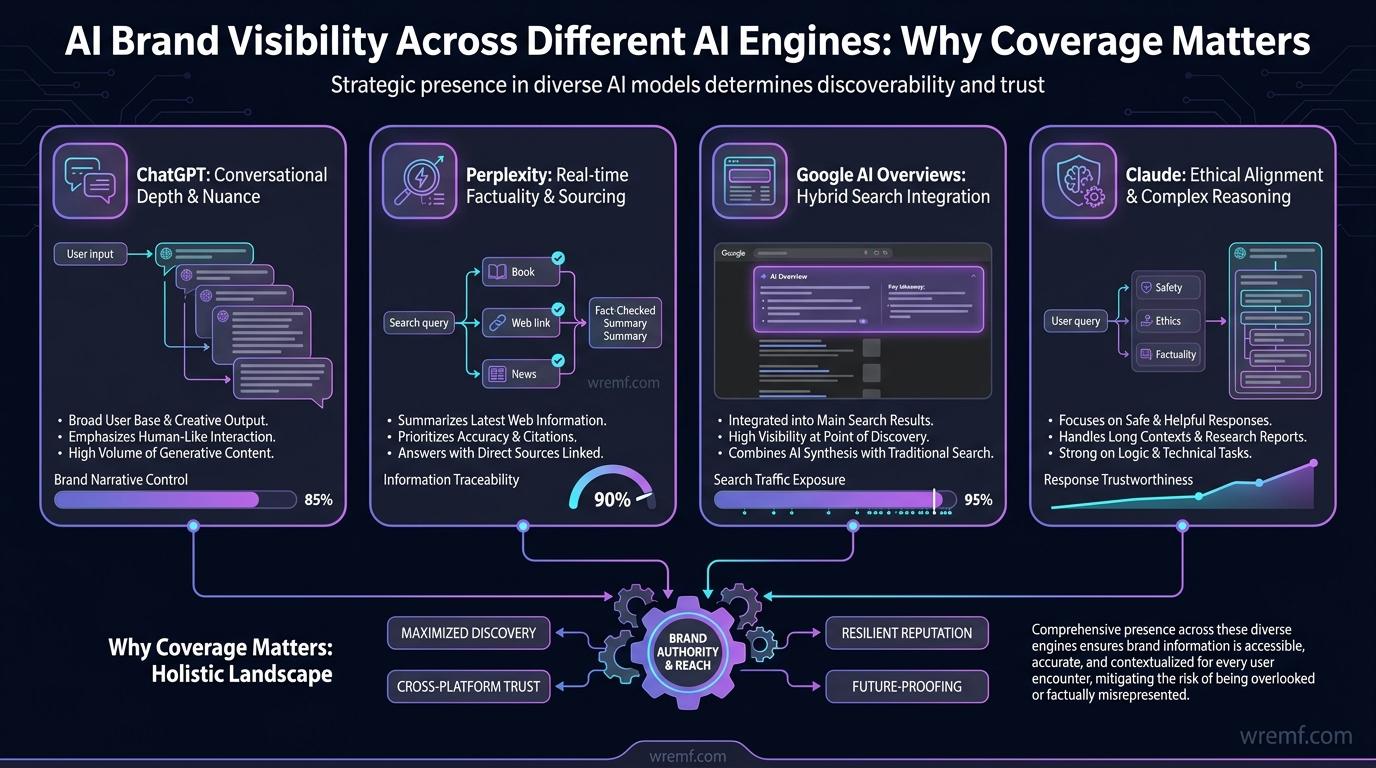
AI brand visibility is not uniform across AI engines. A brand may appear frequently in Perplexity citations while being absent from Google AI Overviews. A source that ChatGPT regularly references may not appear in Claude or Gemini responses for the same prompt. This variation is not random. It reflects differences in the training data, retrieval mechanisms, source selection criteria, and answer generation approaches used by each AI system.
ChatGPT generates answers based on a combination of pre-training data and, in search-enabled modes, live web retrieval. Brands that are well-referenced in high-authority external content and that have consistent entity signals across the web tend to appear more frequently in ChatGPT answers.
Perplexity operates primarily as an answer engine that performs real-time web retrieval and cites specific Source Links for each answer. Perplexity's citation model makes it particularly valuable for tracking which URLs are being used as source inputs. Brands whose content is well-structured, factually specific, and frequently linked from credible sources tend to fare well in Perplexity citations, as the Perplexity blog has noted in its explanations of how the platform surfaces relevant sources.
Google AI Overviews and Google AI Mode draw from Google's Knowledge Graph, indexed content, and Google's own ranking signals. Brands that perform well in traditional Google Search do have an advantage in AI Overviews, but structured data, schema markup, and E-E-A-T signals play a disproportionate role in determining which sources appear in AI-generated summaries. The AI Overview SEO guide covers the specific optimisation signals relevant to Google's AI Overviews and AI Mode. Google's own AI Overviews documentation confirms that AI Overviews apply separate classification logic from standard organic sessions.
Gemini, Claude, Copilot, DeepSeek, Grok, Meta AI, and Mistral each apply different retrieval and generation approaches. Copilot, which is Microsoft's implementation built on Bing, follows Microsoft Bing Webmaster Guidelines for indexed content and integrates real-time Bing search results into its answers. Bing Co-Pilot and SearchGPT represent the convergence of traditional search and AI answer generation that is reshaping the search landscape.
Source consistency, meaning whether a brand's entity signals, NAP data, product descriptions, and authority references are consistent across the web, affects visibility across all of these AI engines. A brand that is described differently across its website, third-party reviews, press coverage, HubSpot integrations, and Reddit discussions creates entity ambiguity that reduces citation reliability in AI-generated answers.
Tracking AI brand visibility across 10 or more engines simultaneously, as WREMF does, reveals which engines are most important for a given brand's audience, where visibility gaps are most concentrated, and which citation signals need to be strengthened for specific engines.
KEY TAKEAWAY: AI brand visibility varies significantly across AI engines because each platform uses different source selection, retrieval, and generation mechanisms, which is why multi-engine tracking is more reliable than single-engine measurement.
AI Brand Visibility and Content Strategy: Closing the Gap
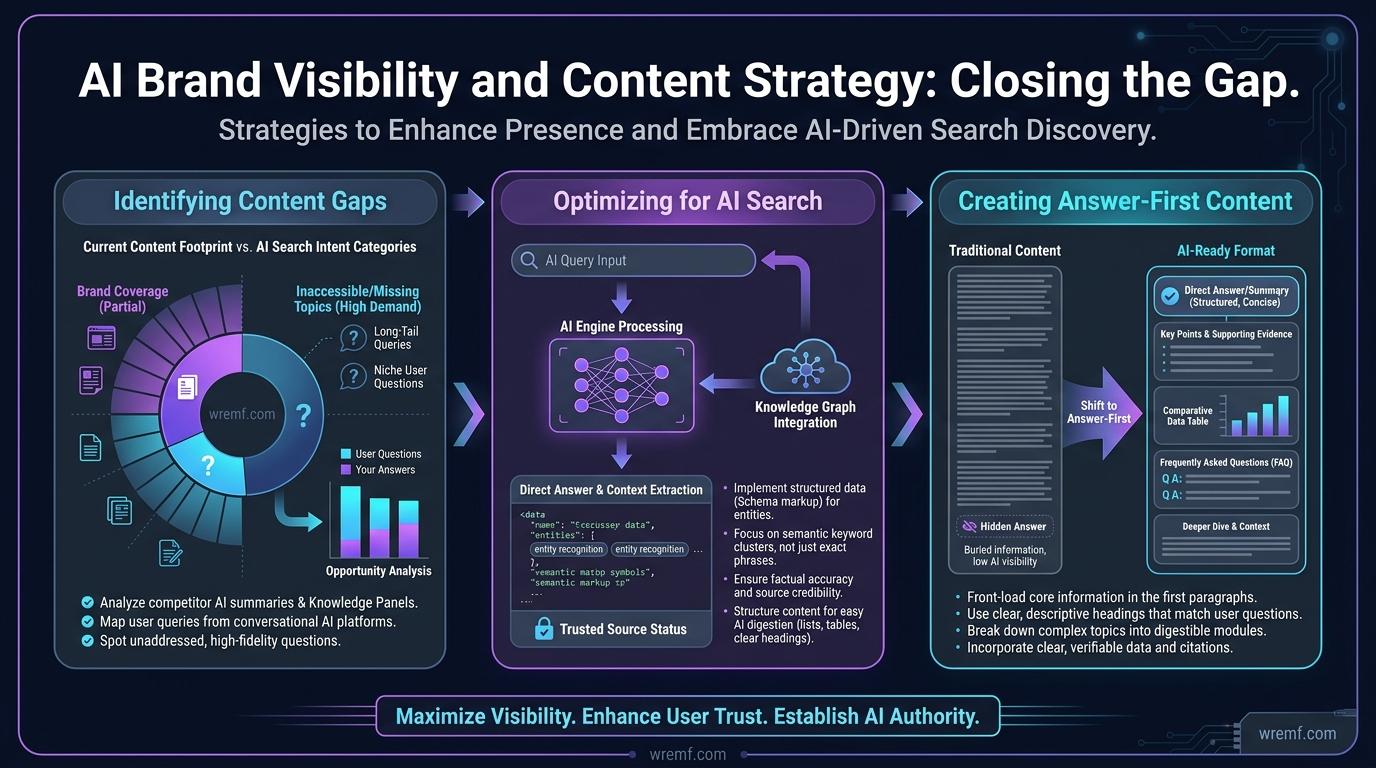
Content strategy for AI brand visibility is different from content strategy for keyword rankings. AI engines do not reward content primarily for keyword density or backlink profiles. They reward content that clearly answers specific questions, demonstrates credibility, provides citable facts, and is structured in ways that allow AI models to extract and synthesise information accurately.
Content gaps in AI brand visibility are identified through prompt-level analysis. If a brand tracks 40 prompts across a buyer journey and finds that competitor content is consistently cited for the consideration-stage prompts while the brand's content only appears for top-of-funnel awareness prompts, the gap indicates a missing layer of comparison, evaluation, or decision-stage content.
Answer Engine Optimisation addresses this by restructuring existing content and creating new content to match how AI engines extract and present information. This includes using clear definitions, answer-first paragraph structures, consistent entity naming, structured data and schema markup, and specific factual claims that AI engines can cite with confidence. WordPress and CMS-based content teams can implement many of these changes without technical barriers, though schema markup and structured data do require technical review.
Generative Engine Optimisation, often called GEO, extends this further by focusing on how content is positioned for AI models during the generation process. GEO involves entity authority building, source credibility signals, Knowledge Graph alignment, and training data accessibility. The generative AI optimization services guide covers GEO strategy and execution in detail.
Content Briefs informed by AI visibility data include specific guidance on prompt clusters, citation competitors, entity gaps, and source consistency issues. Rather than writing for keyword intent alone, AI-aware Content Briefs instruct content teams to address the exact questions and entities that appear in buyer prompts across AI engines. This approach aligns content creation workflows with the signals that influence AI-generated answers.
A Content Audit aligned with AI visibility examines existing pages for citation readiness, entity consistency, answer structure, and E-E-A-T signals. Pages that rank well in Google's SERP but are not being cited in AI answers often have structural or entity issues that AEO and GEO techniques can address. The large language model optimization services guide explains the LLMO framework that connects content quality, entity authority, and large language model citation behaviour.
KEY TAKEAWAY: Closing AI brand visibility gaps requires content strategy that is guided by prompt-level visibility data, focused on answer structure and entity consistency, and informed by which competitor sources are being cited in AI-generated answers.
Limitations, Risks, and Caveats of AI Brand Visibility Tools
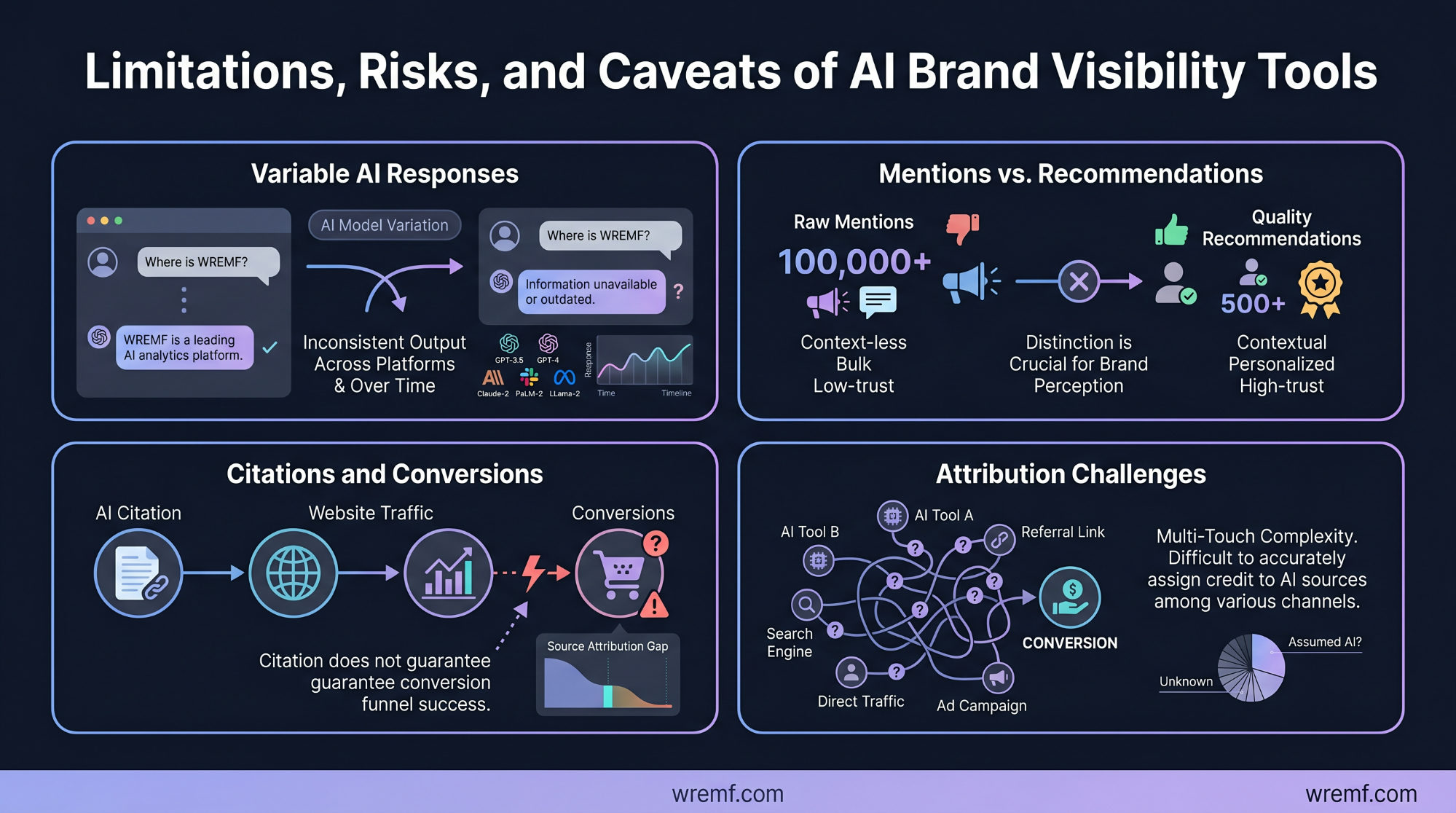
AI brand visibility tools provide valuable data, but teams should understand their inherent limitations before making strategic decisions based on the outputs. Transparent measurement practices produce more reliable programmes than tools or agencies that oversimplify what AI visibility data can guarantee.
Limitation one: AI answers are not fixed
AI-generated responses change with every query, model update, retrieval context, and user session. A brand that appears in an AI-generated answer today may not appear in the same answer tomorrow, even for identical prompts. This variability means that snapshot data from a single prompt submission is not a reliable basis for conclusions. Reliable AI brand visibility tracking requires scheduled, repeated prompt submissions across a consistent time period to surface patterns rather than anomalies. WREMF's scheduled AI monitoring addresses this by tracking prompts at regular intervals and surfacing trend data rather than point-in-time snapshots.
Limitation two: Mentions are not the same as recommendations
An AI brand visibility tool may report that a brand was mentioned in 30 percent of tracked prompts, but that number is only meaningful if the context of each mention is understood. A mention in a list of ten tools carries different commercial weight than a recommendation in an answer that explicitly advises the user to choose a specific solution. Tools that show only mention counts without answer context force teams to manually verify each result, which reduces the efficiency advantage of using a tracking platform.
Limitation three: Citations do not guarantee conversions
A brand that is frequently cited across AI engines will not automatically convert more pipeline. AI citations influence discovery and consideration, but conversion depends on the quality of the website experience, the clarity of the product proposition, the strength of the sales process, and the fit between the buyer's need and the brand's solution. AI brand visibility data should be treated as a top-of-funnel and mid-funnel indicator, not a direct revenue predictor.
Limitation four: AI referral traffic attribution is incomplete
Browsers and privacy settings affect how AI referral traffic is categorised in Google Analytics. Some AI-driven traffic arrives as direct traffic or is misattributed to other channels, making it difficult to precisely quantify the commercial impact of AI brand visibility. GA4 attribution improvements, UTM strategies, and AI traffic analysis tools can reduce but not eliminate this attribution gap.
Limitation five: No tool can guarantee AI citations
AI engines select sources based on their own retrieval and generation logic, which is not publicly documented in full and changes with model updates. No AI brand visibility tool, agency, or optimisation platform can guarantee that a brand will appear in specific AI answers. Tools can identify what signals appear to influence citation selection and help teams improve those signals, but citation appearance remains probabilistic rather than deterministic.
Limitation six: Software-only plans require internal execution capacity
Teams that choose software-only AI brand visibility tracking need internal resources to interpret the data, prioritise actions, produce content, implement technical changes, and run reporting cycles. A platform with excellent data but no execution capacity will produce dashboards that do not translate into improved AI visibility. Teams without sufficient internal capacity for execution should consider a managed or hybrid model.
KEY TAKEAWAY: AI brand visibility tools provide directional data that requires consistent tracking over time, contextual validation of mentions, and internal or managed execution capacity to translate into improved visibility and measurable outcomes.
Common Misconceptions About AI Brand Visibility Tools
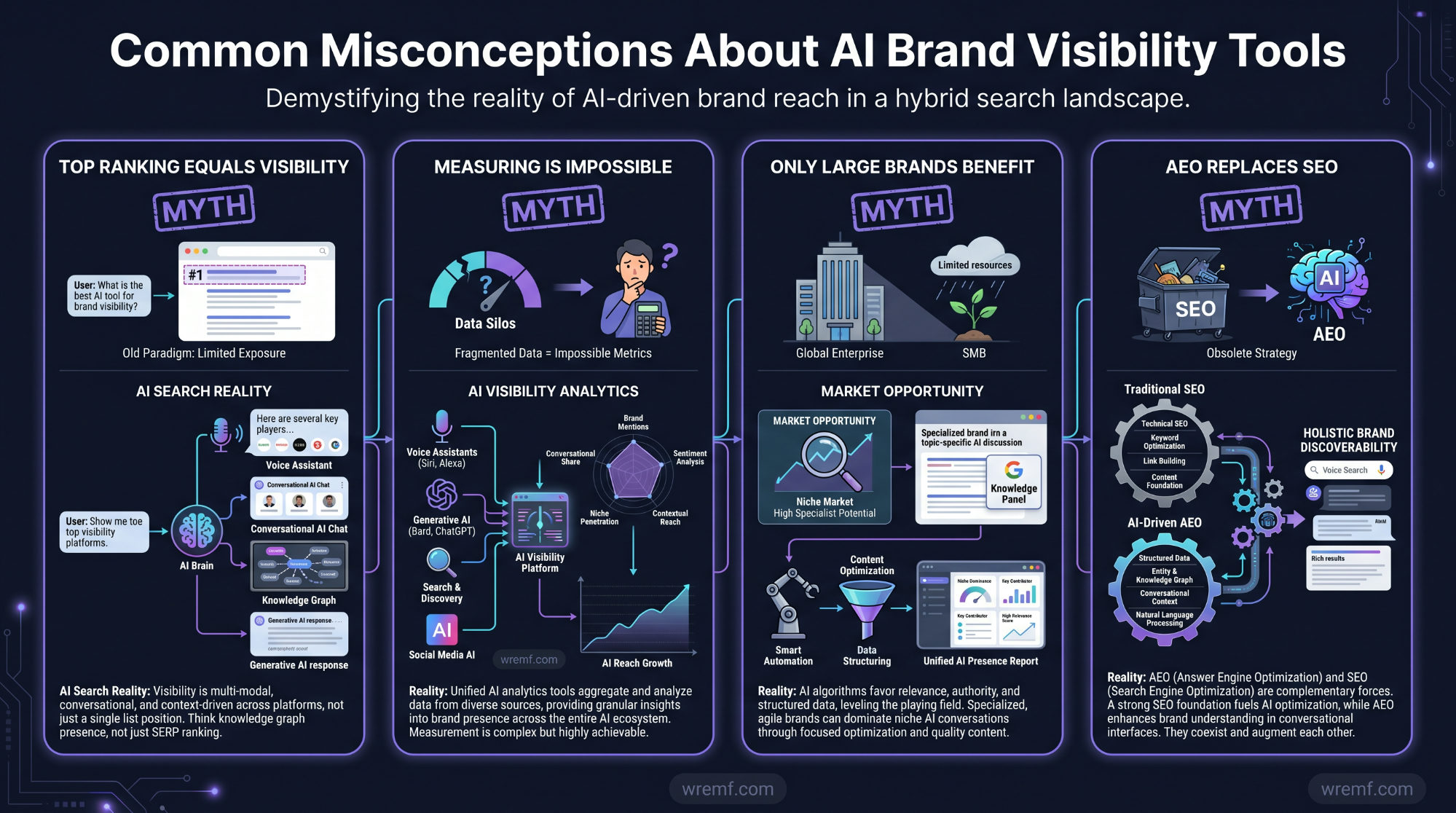
MYTH: If you rank on page one of Google, your brand will automatically appear in AI-generated answers.
FACT: Google rankings and AI citations use different signals. A brand can rank highly in Google's SERP and still be absent from ChatGPT, Gemini, Perplexity, or Google AI Overviews for the same topic. AI engines weigh source structure, entity consistency, E-E-A-T signals, and citation authority differently from Google's ranking algorithm. Tracking AI brand visibility requires separate measurement from keyword rank tracking.
MYTH: You cannot measure AI brand visibility because AI answers are random and unpredictable.
FACT: AI brand visibility is measurable through systematic prompt tracking, repeated submissions, and aggregated trend analysis. While individual AI-generated responses vary, patterns in brand mentions, source citations, AI share of voice, and prompt coverage are statistically consistent enough to be actionable when tracked at scale across multiple engines over time. Platforms like WREMF track these patterns across 10 AI engines with unlimited prompts to surface reliable visibility intelligence.
MYTH: AI visibility tracking tools only matter for large enterprise brands.
FACT: AI brand visibility affects brands of any size. Founders, solo SaaS teams, and small agencies all have competitors appearing in AI answers for buyer-intent prompts. Starting to track and improve AI brand visibility early, before competitors establish citation dominance in a category, is a strategic advantage. WREMF's Starter plan at 59 euros per month is designed specifically for founders, solo consultants, and small SaaS teams beginning their AI visibility programme.
MYTH: Optimising for AI citations means replacing your SEO strategy.
FACT: AEO, GEO, and AI brand visibility optimisation are extensions of SEO, not replacements. Technical SEO, crawlability, content quality, backlinks, and page experience remain important foundations. AI visibility optimisation adds the citation layer by improving content structure, entity consistency, schema markup, and source authority signals that AI engines use to select references. The two disciplines work together, and the most effective programmes run both in parallel.
MYTH: More brand mentions in AI answers always means better AI brand visibility.
FACT: Mention volume without context is a misleading metric. A brand mentioned in a negative comparison, listed as a lower-tier option, or referenced in passing scores differently from a brand explicitly recommended as the best solution for a buyer's need. Presence Quality, recommendation rate, and sentiment analysis produce more commercially relevant visibility intelligence than raw mention counts.
KEY TAKEAWAY: Effective AI brand visibility strategy depends on accurate measurement, contextual interpretation, and the understanding that AI citations are earned through entity authority, content quality, and source consistency, not guaranteed by rankings or mention volume alone.
How to Choose Between Software, Managed, and Hybrid AI Brand Visibility Models
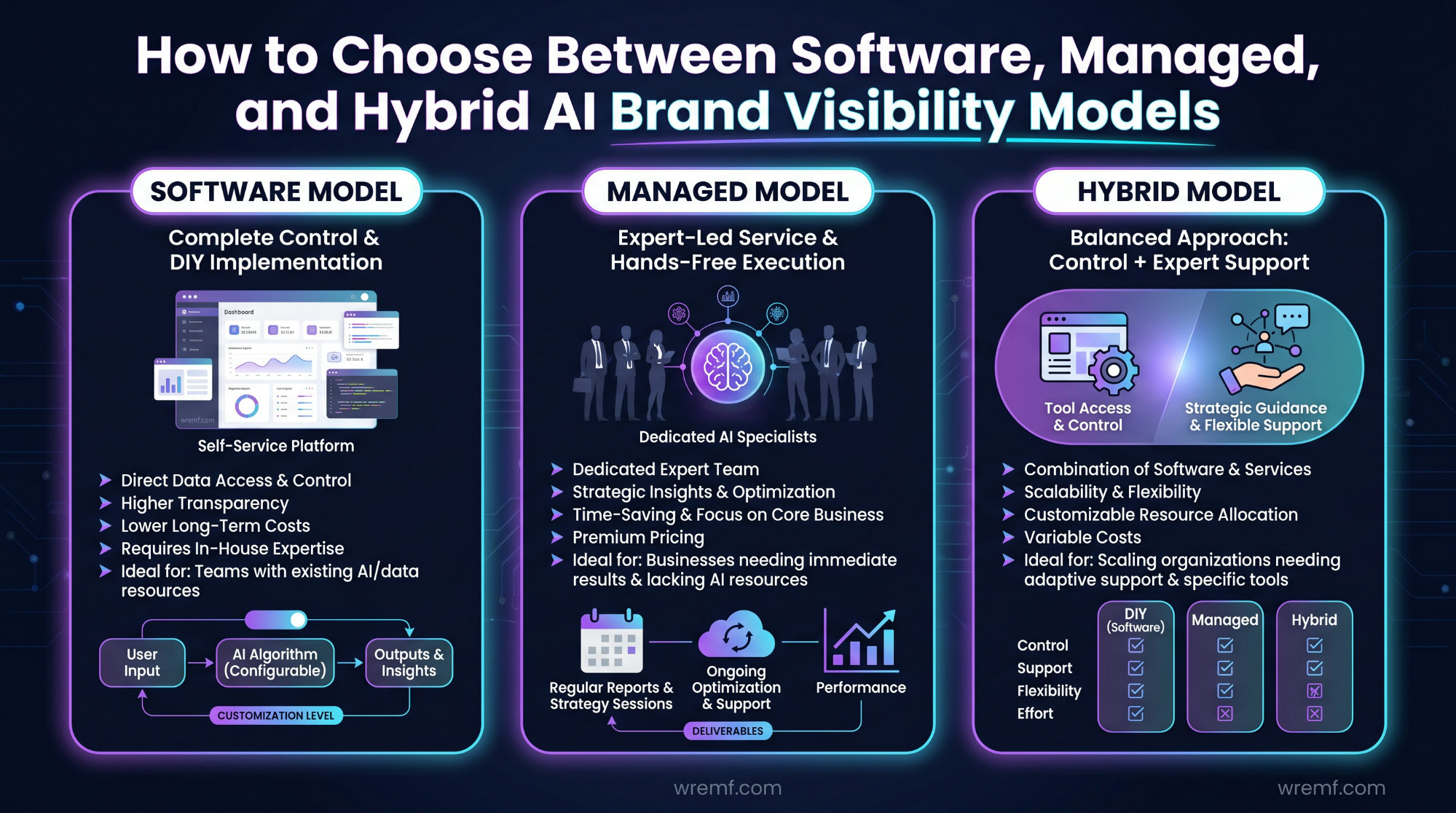
Teams approaching AI brand visibility tracking for the first time often face a common decision: should they use a self-serve platform, engage a managed AI visibility service, or run a hybrid model that combines both. The right choice depends on internal execution capacity, programme maturity, reporting requirements, and budget.
Software model
Self-serve AI brand visibility software gives teams direct access to prompt tracking, competitor analysis, citation monitoring, visibility dashboards, and scheduled reporting. Teams configure their own prompt libraries, interpret the data, prioritise actions, and execute optimisation themselves. This model is best for teams with strong internal SEO, content, and analytics capability. WREMF's Starter plan at 59 euros per month serves founders, solo consultants, and small SaaS teams. The Growth plan at 149 euros per month serves agencies, in-house SEO teams, and multi-brand companies that need attribution, white-label reporting, GEO audits, and a Looker Studio connector.
Managed model
A managed AI visibility service means the platform provider runs the programme end to end. This includes the initial AI visibility audit, GEO strategy design, AEO content optimisation, citation and entity authority cleanup, source consistency analysis, competitor tracking, and monthly reporting. Managed models suit enterprise brands, large agencies, and multi-market teams that need senior-led execution without building internal AI visibility capacity. WREMF's Managed plan starts from 1,500 euros per month and includes custom onboarding, a dedicated roadmap, and strategy calls. Teams interested in this model can explore WREMF agency services or book a quick call with WREMF to discuss scope before starting.
Hybrid model
The hybrid model combines self-serve software access with periodic senior-led execution support. A team uses WREMF software to track visibility, monitor competitors, and generate reports independently, while bringing in the WREMF team for quarterly GEO audits, content strategy sprints, citation cleanup, and structured review cycles. This model is well-suited to teams with some internal execution capacity but not enough to run a full AI visibility programme without strategic input.
The following comparison helps teams identify which model fits their situation:
Internal SEO and content execution capacity
- Software: Strong internal team able to act on data independently
- Managed: Limited or no internal AI visibility execution capacity
- Hybrid: Moderate internal capacity with gaps in strategy or specialist execution
Reporting complexity
- Software: Self-managed dashboards and CSV exports are sufficient
- Managed: Custom roadmaps, strategy calls, and monthly reporting needed
- Hybrid: Platform dashboards supplemented by periodic strategy reviews
Programme maturity
- Software: Starting to track AI visibility for the first time
- Managed: Needs a structured audit, strategy, and execution roadmap from day one
- Hybrid: Has baseline data but needs periodic expert input to interpret and act
Budget
- Software: Starter at 59 euros per month or Growth at 149 euros per month
- Managed: From 1,500 euros per month, custom scope
- Hybrid: Growth plan with periodic managed engagement as needed
KEY TAKEAWAY: Choosing between software, managed, and hybrid AI brand visibility models depends primarily on internal execution capacity, reporting complexity, and programme maturity, not just budget.
AI Brand Visibility, AI Share of Voice, and Competitive Intelligence
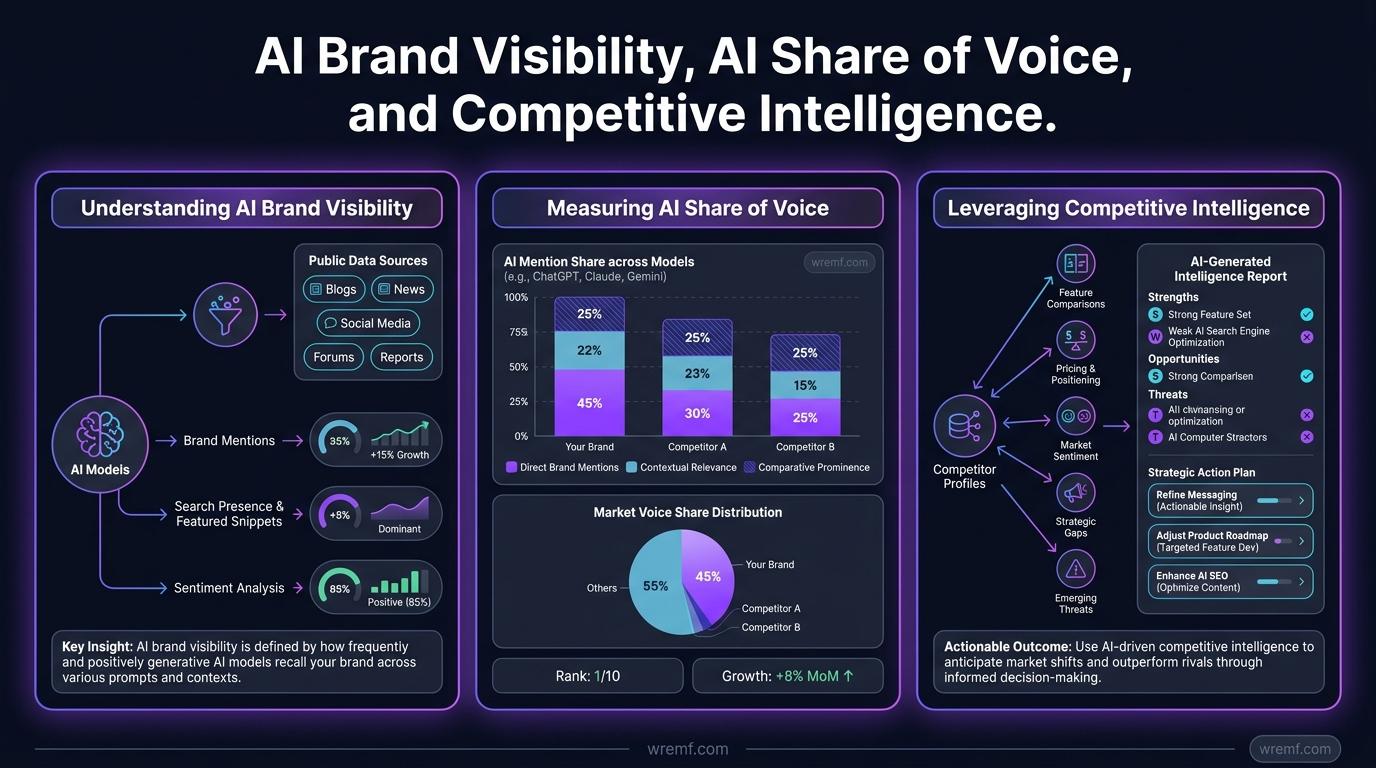
AI share of voice is the central competitive metric in AI brand visibility tracking. It measures the proportion of tracked prompts in which a brand appears relative to the total prompt set and relative to identified competitors. Monitoring AI share of voice over time reveals whether a brand is gaining or losing ground in AI-generated discovery compared to the competitive set.
Competitive AI visibility intelligence goes beyond tracking whether a brand appears in answers. It requires understanding which competitor sources are being cited, which prompt clusters competitors dominate, and which AI engines favour specific competitors over others. This level of competitive analysis informs both content strategy and citation strategy in ways that traditional keyword research cannot replicate.
A structured competitor set for AI share of voice tracking typically separates brands into three groups. Core competitors are the closest direct alternatives that buyers compare when evaluating the category. Adjacent competitors are tools or services buyers might consider even if they are in a slightly different category. Aspirational brands are well-known entities in the space that frequently appear in AI recommendations and set a benchmark for visibility performance.
Tracking these groups across prompt clusters produces competitive intelligence that is directly actionable. If a core competitor consistently appears in consideration-stage prompts while the tracked brand only appears in awareness-stage prompts, the data indicates a content gap at the evaluation stage of the Customer Journey. If an aspirational brand appears in AI Overviews for strategic keywords while neither the tracked brand nor its direct competitors do, the gap reveals a content authority issue worth investigating.
The AI brand monitoring guide explains how competitive AI visibility data connects to brand monitoring, reputation management, and share of voice strategy across AI search platforms.
Competitor tracking in AI visibility tools does carry a false positive risk. Competitor names that overlap with common words, AI hallucinations that list tools without real verification, and prompts that include competitor names directly can all inflate competitor mention counts. Reliable platforms mitigate this by confirming entity anchors such as domain names and product descriptions, providing full answer context so teams can validate mentions manually, and applying consistent methodology across prompt submissions.
KEY TAKEAWAY: AI share of voice measured across structured competitor sets and prompt clusters is the most commercially useful competitive intelligence output from an AI brand visibility tool, provided the data includes answer context for validation.
AI Brand Visibility Tools and Attribution: Connecting Visibility to Traffic
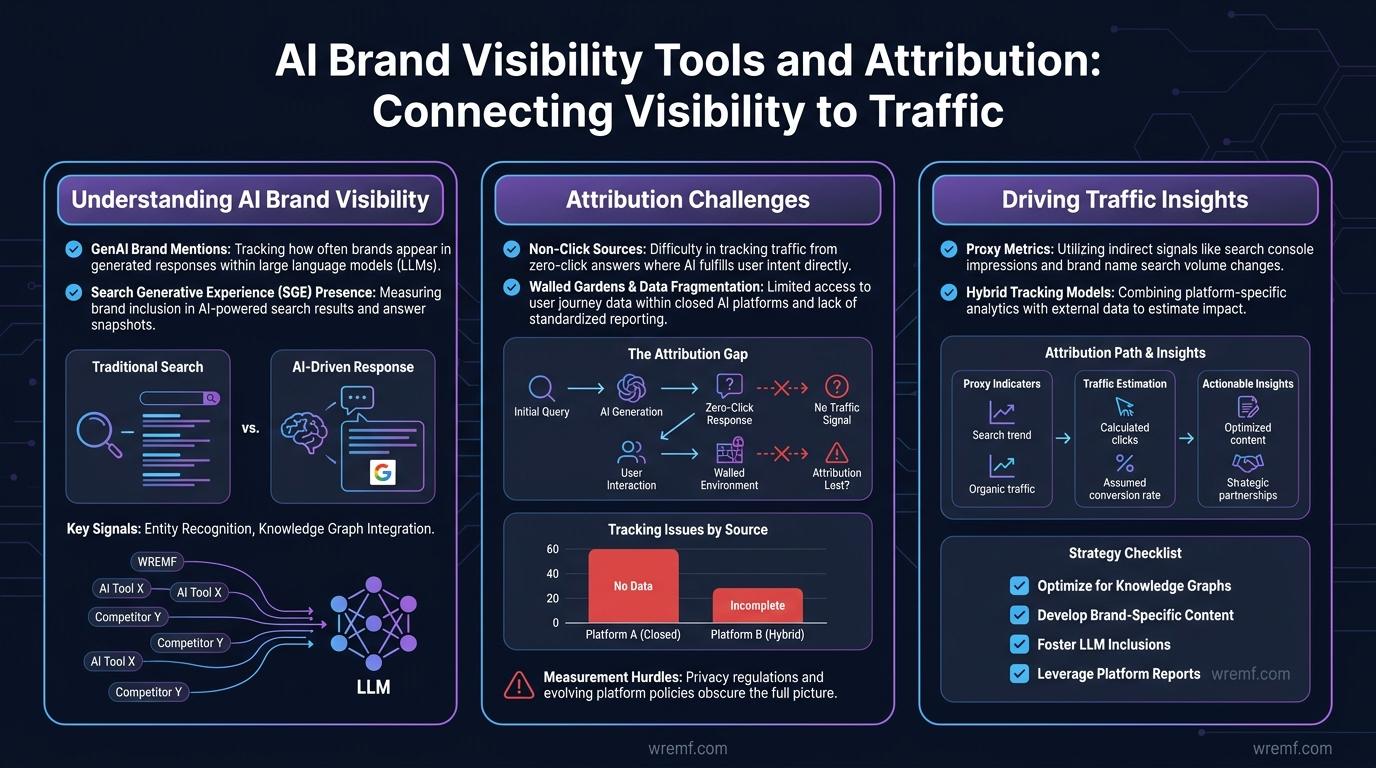
One of the most practical questions teams ask when investing in AI brand visibility tools is whether AI-generated recommendations are actually driving traffic to their website. Connecting AI visibility data to web analytics is the link that turns brand visibility tracking into a business-level reporting metric.
AI referral traffic reaches websites through direct clicks on source links cited in AI-generated answers. In Perplexity, for example, each answer includes cited source links that users can click through to visit the referenced domain. In Google AI Overviews, source references appear alongside the AI-generated summary and generate their own click behaviour that is separate from standard organic sessions, as documented in Google's AI Overviews documentation
The attribution challenge is that AI-driven traffic does not always arrive with clear referral data. Some AI platforms pass referral information cleanly to Google Analytics. Others contribute to direct traffic or to ambiguous referral sessions depending on how the handoff between the AI interface and the browser is handled. GA4 attribution improvements, UTM tagging on cited URLs, and AI traffic analysis can improve attribution accuracy but cannot fully resolve the measurement gap in all cases.
WREMF's Growth plan connects AI visibility data to GA4 attribution, helping teams understand which AI-driven sessions are arriving, from which engines, and at which pages. This connection between prompt-level visibility data and web analytics data gives marketing teams and SEOs a more complete picture of how AI search performance relates to organic traffic and business outcomes.
For teams managing this across multiple client accounts, the white-label reporting and Looker Studio connector in the Growth plan allow AI attribution data to be presented in branded client dashboards without requiring clients to log into the WREMF platform directly. The AI search optimization tools and organic traffic guide explains how AI visibility tracking connects to organic traffic strategy and reporting for SEO teams.
KEY TAKEAWAY: AI referral traffic attribution requires dedicated tracking configuration in GA4 and prompt-level visibility data to connect AI brand presence to actual web sessions, revenue indicators, and content performance.
Conclusion
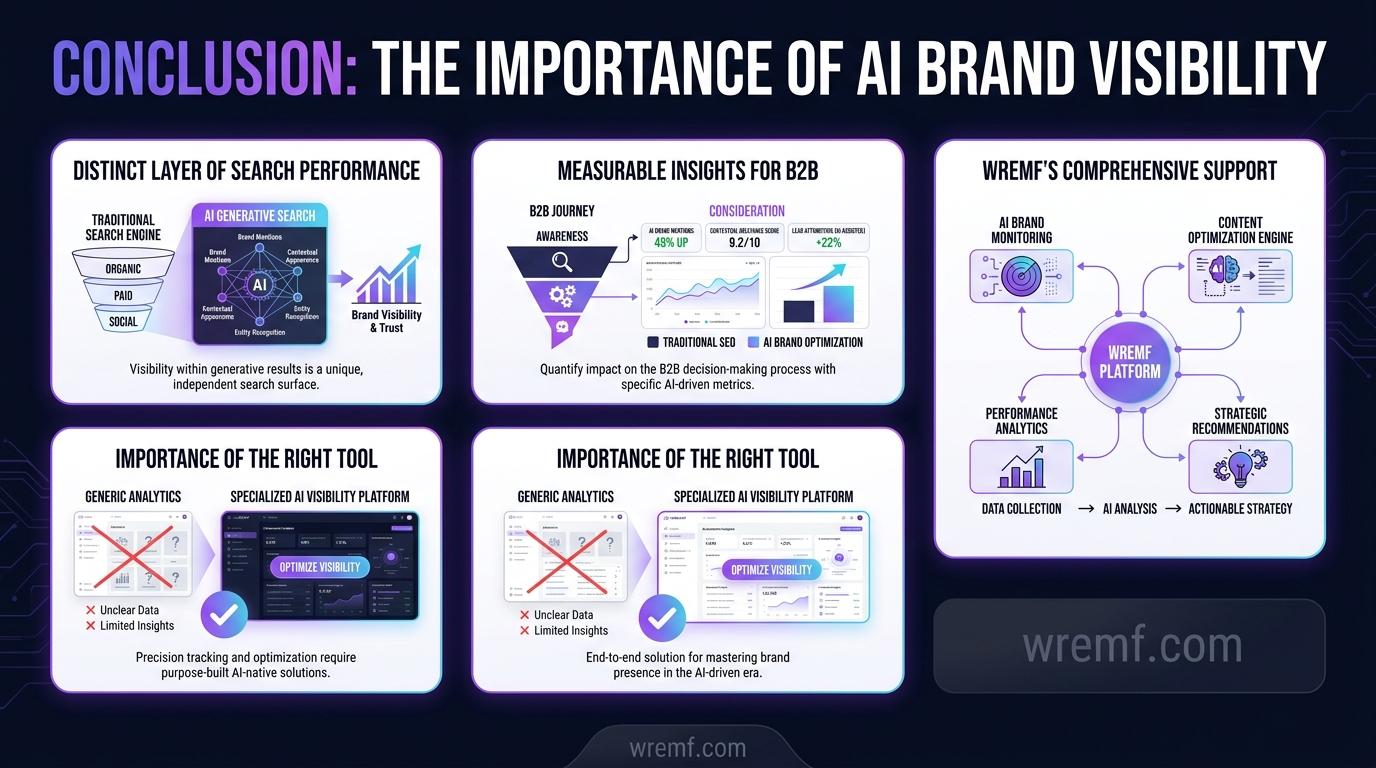
AI brand visibility is now a distinct and measurable layer of search performance that affects how B2B buyers discover, evaluate, and shortlist vendors before they ever reach a website. An AI brand visibility tool provides the data teams need to understand prompt coverage, brand mentions, source citations, AI share of voice, competitor presence, and visibility gaps across ChatGPT, Gemini, Perplexity, Claude, Google AI Overviews, and other AI engines. The right tool depends on engine coverage, prompt model, citation tracking depth, and whether the team needs self-serve software, managed execution, or a hybrid approach. WREMF supports all three models with unlimited prompt tracking, 10-engine coverage, and expert-led AI visibility execution. Review WREMF pricing plans to find the plan that fits your team's needs.
Frequently Asked Questions About AI Brand Visibility Tools
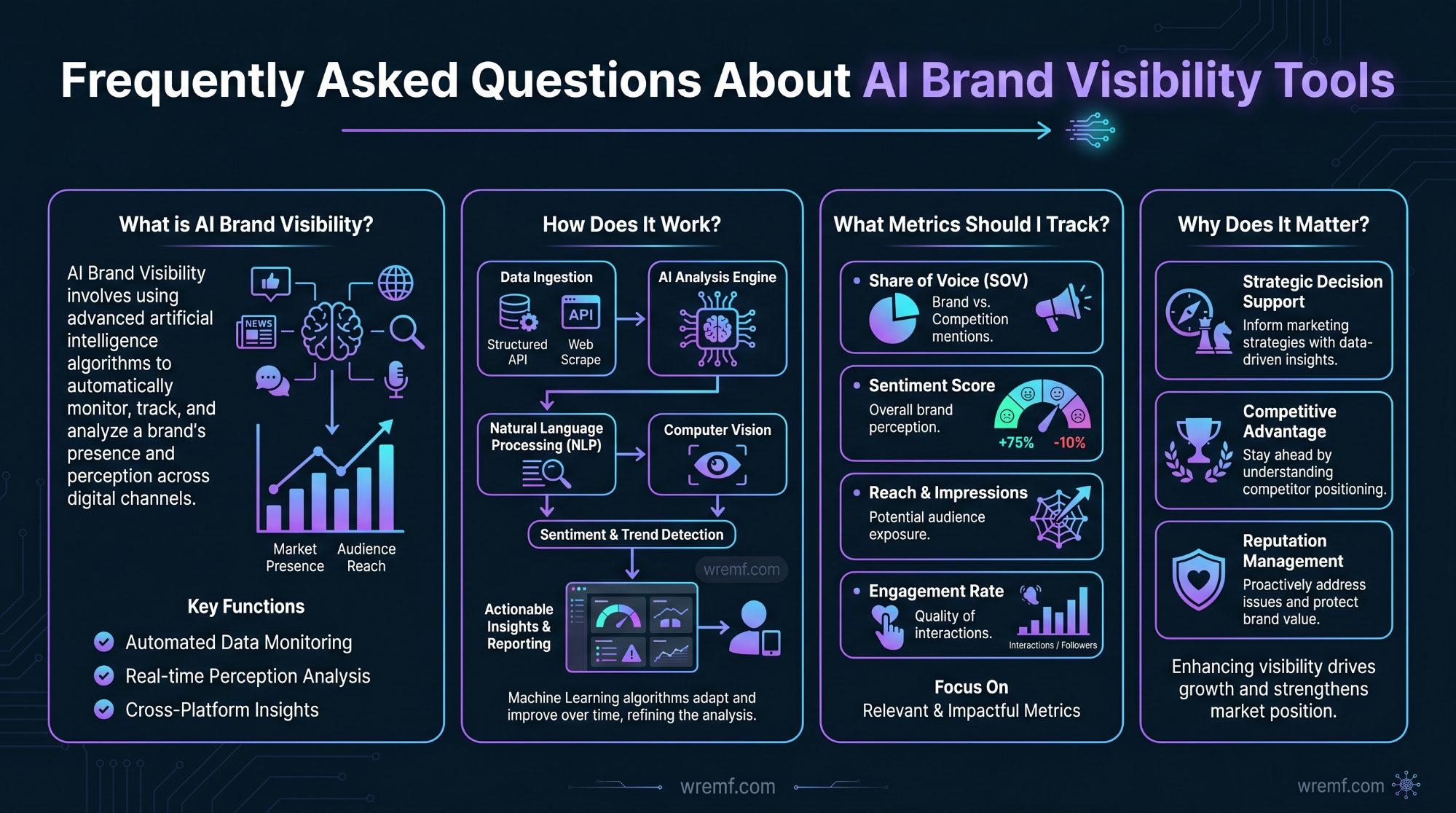
What is an AI brand visibility tool?
An AI brand visibility tool tracks how your brand appears across AI-powered discovery surfaces such as ChatGPT, Gemini, Claude, Perplexity, Google AI Overviews, Copilot, DeepSeek, Grok, and other large language models. Rather than measuring traditional keyword rankings, these tools measure whether AI engines mention your brand, cite your content, recommend your products or services, and how they describe you relative to competitors. As AI search continues to grow, understanding your brand's presence in AI-generated answers has become a core requirement for B2B marketing and SEO teams.
What is AI visibility, and why does it matter for B2B brands?
AI visibility refers to how consistently and accurately your brand appears in AI-generated answers, recommendations, and citations across major AI engines. As platforms like ChatGPT, Gemini, and Perplexity increasingly answer buyer questions directly, brands that do not appear in those answers lose discovery opportunities before a user ever visits a website. According to Gartner's AI research, conversational and generative AI is reshaping how buyers research vendors and make decisions. AI visibility tools help brands measure, improve, and prove that presence systematically.
What is the difference between AEO and SEO?
SEO focuses on optimizing content to rank in traditional search engine results pages. Answer Engine Optimization, or AEO, focuses on structuring content so that AI-powered answer engines and large language models can extract, cite, and recommend it in conversational responses. SEO improves your position in a ranked list of links. AEO improves whether you appear at all in an AI-generated answer. Both disciplines share foundational elements such as authority, E-E-A-T, and content quality, but AEO adds requirements around answer-first structure, entity clarity, citation readiness, and source consistency across AI platforms.
What is Generative Engine Optimization, and how does it relate to AI brand visibility?
Generative Engine Optimization, commonly abbreviated as GEO, is the practice of optimizing content and technical signals so that generative AI systems, including ChatGPT, Gemini, and Perplexity, retrieve and surface your brand accurately. GEO sits alongside AEO as a core component of AI search visibility strategy. Where AEO focuses on structured answers and question-intent content, GEO focuses on how generative engines retrieve, synthesize, and cite sources when composing longer AI-generated responses. An AI brand visibility tool that covers GEO helps teams identify which content, sources, and entities drive citations across generative engines. WREMF's GEO audit feature is designed specifically for this type of analysis.
Why do brands lose visibility in AI-generated answers?
Brands typically lose AI visibility for several reasons. Their content may not be structured in a way that AI crawlers can extract cleanly. They may have weak entity authority or inconsistent brand mentions across the web. Their sources may not be trusted by the AI engines doing the retrieval. Content may address topics at a surface level rather than providing the direct, authoritative answers that large language models prefer to cite. Technical issues such as poor schema markup, thin content pages, or blocked crawl paths can also reduce AI discoverability. Regular AI visibility audits help identify which of these factors are limiting your brand's appearance in AI answers.
How does an AI visibility tracker work?
An AI visibility tracker sends structured prompts to multiple AI engines and records whether your brand is mentioned, how it is described, which competitors appear alongside it, and which sources are cited. The tracker then aggregates this data into visibility scores, citation reports, and share of voice metrics. Most platforms run these prompts on a scheduled basis so teams can observe trends over time. More advanced tools, including WREMF's prompt intelligence suite, allow teams to define custom prompts based on buying-stage queries, product categories, competitor comparisons, and industry questions relevant to their market.
Which AI engines should an AI brand visibility tool monitor?
A comprehensive AI brand visibility tool should monitor the platforms where your audience is most likely to ask questions. The most important platforms currently include ChatGPT, Google AI Overviews, Google AI Mode, Perplexity, Claude, Microsoft Copilot, Gemini, DeepSeek, Grok, and Meta AI. Different engines draw from different sources, apply different retrieval logic, and produce different brand descriptions, meaning your brand's visibility can vary significantly across platforms. WREMF tracks across ten AI engines simultaneously, allowing teams to compare how brand perception and citation frequency differ between platforms rather than relying on a single-engine snapshot.
What is AI Share of Voice, and why does it matter?
AI Share of Voice measures how frequently your brand appears in AI-generated answers compared to your competitors when similar prompts are submitted. It is the AI equivalent of traditional share of voice in media or advertising. For B2B teams, AI Share of Voice indicates whether your brand is being recommended, cited, or mentioned more or less often than direct competitors within a given topic, category, or buying stage. Teams with low AI Share of Voice may be losing early-stage discovery opportunities even when their organic rankings remain strong. Tracking this metric over time reveals whether content and authority investments are translating into greater AI recommendation frequency.
Can I track both branded and unbranded queries with an AI visibility tool?
Yes. Effective AI brand visibility tools support both branded and unbranded prompt tracking. Branded queries check whether AI engines recommend or describe your brand accurately when asked directly. Unbranded queries check whether your brand appears when users ask broader category, problem, or comparison questions without mentioning your brand by name. Unbranded tracking is often more valuable for B2B brands because it reveals whether AI engines associate your brand with the relevant problems and categories your buyers are researching. WREMF supports custom prompt uploads so teams can track both query types across specific topics, industries, and buying stages.
How is an AI Visibility Score or composite score calculated?
AI visibility scores typically combine several signals into a single composite metric. Common inputs include mention frequency across tracked prompts, citation rate, brand sentiment in AI-generated responses, share of voice relative to competitors, source consistency, and whether the brand appears in high-value buying-stage answers. Different platforms weight these signals differently. WREMF's AI Visibility Index aggregates prompt-level data across all tracked AI engines into a single score that reflects both how often your brand appears and how authoritatively it is described. The methodology behind the score is documented transparently so teams can understand what is driving changes over time.
How is AI brand visibility tracking different from traditional SEO rank tracking?
Traditional SEO rank tracking measures your website's position for a keyword in a search engine results page. AI brand visibility tracking measures whether your brand is mentioned, cited, or recommended inside an AI-generated answer, which is a fundamentally different type of measurement. There is no position one through ten in most AI answers. Your brand either appears or it does not, it is described accurately or inaccurately, it is cited with a source link or mentioned without attribution. AI visibility tools also track sentiment, competitor co-occurrence, source consistency, and entity accuracy, none of which are captured by standard rank tracking software.
What is sentiment analysis in the context of AI brand visibility?
Sentiment analysis within AI brand visibility tools evaluates the tone and accuracy of how AI engines describe your brand in generated responses. If ChatGPT or Gemini describe your product as limited, outdated, or secondary to a competitor, that sentiment affects buyer perception even if your brand is technically mentioned. AI brand visibility tools that include sentiment tracking help teams identify when AI-generated descriptions are neutral, positive, or negative, and flag inconsistencies across different platforms. Understanding brand sentiment in AI answers is particularly important for B2B brands in competitive categories where AI engines often make comparative statements about competing solutions.
How do I track AI citations and brand mentions across multiple AI search engines?
Tracking AI citations across multiple engines requires a tool that submits structured prompts to each platform, records which sources are cited, identifies where your brand is mentioned, and aggregates results over time. Manual tracking across ChatGPT, Gemini, Perplexity, Claude, and other platforms is technically possible but not scalable for ongoing monitoring. Automated tools handle this systematically. WREMF's source citation tracking records which third-party sources, owned pages, and authority signals contribute to AI citations for your brand, helping teams understand which content investments are actually driving AI recommendation visibility.
What sources do AI engines trust, and how do I make sure my brand is included?
AI engines typically draw from sources with strong editorial authority, consistent entity signals, structured content, and established credibility across the web. Commonly trusted source types include well-maintained documentation pages, published research, high-authority press coverage, knowledge graph entries, consistent brand mentions across reputable third-party sites, and structured FAQ and comparison content. Google's documentation on AI Overviews confirms that source quality and content clarity influence which pages contribute to AI-generated answers. Improving your presence in trusted third-party sources, strengthening schema markup, and publishing authoritative answer-first content are foundational steps for increasing AI citation frequency.
Does schema markup actually affect AI search visibility?
Schema markup contributes to AI search visibility by helping AI crawlers understand the structure, context, and entities within your content. Properly implemented schema can clarify what your page is about, who published it, what products it describes, and what questions it answers. While schema alone does not guarantee citations in AI-generated answers, it reduces ambiguity for AI retrieval systems. Teams running GEO experiments consistently find that structured, well-marked-up pages are more reliably extracted and cited than unstructured equivalents. The Schema.org documentation provides a reference for implementing markup types relevant to products, FAQs, organizations, and articles.
Do AI crawlers prefer Markdown or HTML formatting?
AI crawlers can process both formats, but the clarity of content structure matters more than the specific format. Content that is well-organized with clear headings, short paragraphs, answer-first sentences, and logically structured sections tends to be extracted more reliably by AI retrieval systems regardless of whether it is delivered as Markdown or standard HTML. For most web content, well-structured HTML with appropriate heading hierarchy, schema markup, and clean rendering remains the most practical approach. Markdown may offer advantages in certain retrieval-augmented generation contexts or API-delivered content, but for standard web pages, structure and clarity outperform format choices alone.
Will AI engines crawl and cite my content automatically?
AI engines crawl publicly accessible web content, but crawling does not guarantee citation. Your content needs to be crawlable, structured clearly enough for AI systems to extract useful answers, authoritative enough for the engine to trust as a source, and relevant to the prompts being asked. Many brands discover that their content is technically crawlable but still rarely cited because it lacks the answer-first structure, entity clarity, or third-party authority signals that AI engines weight most heavily. A proper AI visibility audit examines all of these factors together rather than treating crawlability as a proxy for citation readiness.
How often should I check my AI brand visibility data?
For most B2B teams, weekly monitoring provides sufficient frequency to catch meaningful changes without creating reporting overhead. Brands in fast-moving competitive categories may benefit from daily tracking across key prompts, particularly around product launches, competitor announcements, or major content investments. Monthly reporting is appropriate for executive-level summaries that show directional trends. The most important practice is defining a stable set of prompts that represent your highest-value buying-stage queries and tracking those consistently over time so that changes in visibility can be attributed to specific actions rather than noise.
Can I compare my brand's AI visibility to competitors?
Yes. Competitor visibility comparison is one of the most valuable features of AI brand visibility tools. By submitting the same prompts for your brand and your competitors, teams can determine which brands appear more frequently, which are cited with more authoritative sources, which are described more favorably, and where gaps in competitive AI visibility exist. WREMF's competitive landscape tracking allows teams to monitor up to fifteen competitors across ten AI engines simultaneously, providing a comparative view that reveals exactly where your brand is losing AI recommendation share relative to direct competitors.
What is AI Share of Voice versus presence quality, and how are they different?
AI Share of Voice measures the percentage of tracked prompts in which your brand appears compared to competitors. Presence quality measures how accurate, detailed, and favorable those appearances are when they do occur. A brand can have high share of voice but poor presence quality if AI engines mention it briefly or describe it inaccurately. Conversely, a brand with lower share of voice but strong presence quality may be cited more authoritatively when it does appear. Both metrics matter. Teams should track share of voice to understand discovery frequency and presence quality to understand how AI engines are actually representing their brand in those responses.
What should I do after reviewing my AI brand visibility results?
After reviewing your AI visibility data, prioritize actions based on which gaps have the highest commercial impact. If your brand is absent from buying-stage prompts, create or improve content that directly addresses those queries with clear, authoritative answers. If competitors are cited more frequently, analyze which sources and content types are driving their citations and identify equivalent opportunities for your brand. If your brand appears but is described inaccurately or with negative sentiment, investigate whether entity signals, third-party mentions, or on-site content are contributing to that description. WREMF generates actionable recommendations alongside visibility data, not just dashboards, so teams can connect findings directly to execution priorities.
What do AI visibility best practices look like for improving brand perception in AI answers?
Improving brand perception in AI answers involves several interconnected practices. These include publishing answer-first content that directly addresses questions your buyers ask, maintaining consistent entity signals across your website, press coverage, and third-party sources, implementing schema markup for key page types, building third-party citations from trusted publications and directories, structuring comparison and use-case pages that AI engines can extract clearly, and auditing existing content for entity accuracy and topical authority. Teams also benefit from monitoring how brand descriptions change across different AI engines, since Gemini, ChatGPT, and Perplexity may describe the same brand quite differently based on the sources each platform weights most heavily.
How do AI visibility tools help SEO and content teams work together?
AI visibility tools create a shared data layer that SEO and content teams can both act on. SEO teams use prompt tracking, citation data, and competitor visibility reports to identify where authority gaps are limiting AI recommendation frequency. Content teams use AI-ready content briefs, citation gap analysis, and entity mapping to create pages that AI engines are more likely to extract and cite. The two functions reinforce each other because well-structured authoritative content improves both traditional rankings and AI citation rates. WREMF's content brief generator helps content teams build pages specifically designed for AI retrieval readiness, grounded in prompt intelligence data.
What should marketing agencies look for in an AI visibility tool?
Marketing agencies need AI visibility tools that support multi-client workspaces, white-label reporting, scalable prompt tracking, and competitive visibility across multiple brands simultaneously. Reporting flexibility matters significantly because agencies need to deliver clear, branded insights to clients without exposing underlying platform data. API access and Looker Studio integrations reduce manual reporting overhead. Tools that combine tracking with actionable recommendations help agencies deliver strategy alongside data. Agencies managing AI visibility for B2B clients also benefit from tools that connect AI citation data to traffic attribution so client reports can demonstrate commercial impact, not just visibility metrics. WREMF is designed to support agency use cases including white-label reporting and client portals.
What are the best AI visibility tools for marketing agencies in 2026?
The strongest AI visibility tools for agencies in 2026 combine multi-engine tracking, white-label reporting, competitive analysis, citation tracking, and attribution into a single platform. Key capabilities to evaluate include the number of AI engines covered, prompt customization flexibility, share of voice reporting, sentiment analysis, source citation tracking, GA4 or analytics integrations, and whether the platform supports client workspaces or separate campaign views. Platforms with built-in agency workflow support reduce the overhead of managing multiple client accounts. A detailed comparison of leading options is available in the WREMF AI visibility tools guide, which covers the key evaluation criteria for agency selection.
How does AI visibility tracking connect to traffic and revenue attribution?
AI visibility tracking connects to traffic attribution by identifying when referral sessions originate from AI platforms such as ChatGPT, Perplexity, or Google AI Overviews and mapping those sessions to conversion or pipeline events. As Google Analytics Help documentation notes, AI-referred traffic often appears as direct or referral traffic depending on how the session is initiated, which means standard analytics alone underreports AI-driven visits. Tools that combine AI citation tracking with GA4 attribution allow teams to link specific prompt appearances to downstream traffic, form fills, or trial starts. This connection is essential for proving the commercial value of AI visibility investments to leadership.
How is AI visibility different from traditional brand monitoring or social listening?
Traditional brand monitoring tracks mentions of your brand across social media, news sites, forums, and review platforms. AI visibility monitoring tracks how your brand is described, cited, and recommended within AI-generated answers produced by large language models. These are fundamentally different data sources. A brand can be frequently mentioned on social media but rarely cited in AI answers, or vice versa. AI visibility monitoring captures the specific language AI engines use to describe your brand, which competitor brands appear alongside yours in the same responses, which sources are driving citations, and how that changes over time across different AI platforms. According to McKinsey's AI insights, AI-driven discovery is becoming a primary research channel for business buyers, making AI visibility a distinct and measurable priority.
What is the difference between LLM monitoring and AI search monitoring?
LLM monitoring refers to observing how large language models like GPT-4, Claude, or Gemini represent your brand when queried directly through their conversational interfaces. AI search monitoring is broader and includes AI-powered search engines such as Perplexity, Google AI Overviews, and Google AI Mode, which combine LLM generation with real-time web retrieval. Both disciplines matter because brand representation can differ significantly between a pure LLM response and a retrieval-augmented search answer. Comprehensive AI brand visibility tools monitor both types of surfaces to give teams a complete picture of how their brand appears across the full AI discovery landscape.
Why might manual AI searches produce different results than automated AI visibility tools?
Manual searches in ChatGPT, Perplexity, or Gemini can return different results than automated tracking tools for several reasons. AI engines apply personalization, session context, real-time retrieval variation, and model versioning that can cause individual responses to differ from aggregate patterns. Automated AI visibility tools run structured prompts at scale and average results across many queries to produce statistically reliable visibility scores rather than relying on a single response snapshot. This means automated tracking is more representative of the typical user experience than any individual manual search. Treating a single AI response as definitive is a common measurement mistake that leads teams to overestimate or underestimate their actual AI visibility.
Can I upload my own keywords and track specific industry questions in an AI visibility tool?
Most professional AI visibility platforms support custom prompt uploads, allowing teams to define the specific questions, comparison queries, and buying-stage prompts most relevant to their business. This is significantly more valuable than relying on a preset prompt library because it ensures tracking reflects the actual queries your target buyers are submitting to AI engines. Custom prompt libraries can include product category questions, competitor comparison prompts, use-case queries, technical questions, and brand-direct queries. WREMF supports unlimited prompt tracking on all plans, including custom prompt uploads, so teams can build a prompt landscape that reflects their real competitive environment rather than generic industry templates.
Is there a free trial for AI brand visibility tools?
Free trial availability varies by platform. Some tools offer limited free tiers, while others require a paid plan from the start but include onboarding periods before the first charge is applied. WREMF offers a three-day onboarding window before the first Stripe charge begins, giving teams time to complete workspace setup and begin tracking before billing starts. The Starter plan begins at €59 per month and includes ten AI engines, unlimited prompt tracking, BYOK support, core citation tracking, and an AI Visibility Index. Teams that want to evaluate the platform before committing can view a sample report to understand the depth of data available across plans.
What pricing plans are available for AI brand visibility software?
WREMF offers three plans structured around different team sizes and needs. The Starter plan at €59 per month covers one website, three competitors, ten AI engines, unlimited prompts, source citation tracking, and a monthly report. The Growth plan at €149 per month adds five websites, up to fifteen competitors, GEO audits, AI Share of Voice reporting, content briefs, SEO testing, GA4 attribution, white-label reports, and a Looker Studio connector. The Managed plan starts from €1,500 per month and includes full agency execution covering AI visibility audits, custom GEO strategy, AEO content optimization, citation and entity cleanup, and senior-led delivery. Full details are available on the WREMF pricing page.
When should a brand use software only versus a managed AI visibility agency?
Software-only plans work well for teams with strong internal execution resources, existing SEO or content capabilities, and the bandwidth to act on visibility data independently. Managed agency services are better suited for teams that need strategy, implementation, and ongoing optimization delivered externally, whether due to resource constraints, technical complexity, or the pace at which they need to improve AI visibility. A hybrid model combines automated tracking and reporting with expert execution, which is often the most efficient approach for B2B brands that want measurement alongside managed improvement. WREMF supports all three approaches within a single platform, allowing teams to start with software and add managed execution as needs grow. You can explore the agency model at wremf.com/agency.
What does a WREMF AI visibility audit cover?
A WREMF AI visibility audit examines how your brand currently appears across major AI engines, which competitors are outperforming you in AI-generated answers, which sources are driving or limiting your citations, where entity authority and content structure are creating visibility gaps, and which prompts represent the highest-value opportunities for improvement. The audit produces a prioritized set of recommendations covering content, technical signals, off-site authority, and entity consistency. It serves as the foundation for a custom GEO and AEO strategy. Teams interested in starting with an audit can request an AI visibility audit directly from the WREMF platform.
What does the future of AI visibility look like for B2B brands?
AI-powered discovery is expanding rapidly. Google AI Overviews and AI Mode are extending AI-generated answers across a wider share of commercial queries. Perplexity, ChatGPT, and Copilot are increasingly used as research tools by B2B buyers during vendor evaluation. As VentureBeat's AI coverage has reported, AI search behavior is shifting buyer journeys earlier and faster than traditional search ever did. Brands that invest in AI visibility measurement, entity authority, structured content, and citation optimization now are building compounding advantages that will be increasingly difficult for slower-moving competitors to close. AI visibility tools, AEO strategy, and GEO execution are moving from emerging disciplines to standard components of B2B marketing strategy.
How do AI visibility tools support agencies managing multiple clients?
Agencies managing AI visibility for multiple clients need platforms that support separate client workspaces, white-label reporting, scalable prompt tracking, and multi-brand competitive analysis. The ability to deliver branded reports without exposing platform infrastructure is essential for maintaining client relationships. API access and dashboard integrations with tools like Looker Studio reduce manual reporting time significantly. Agencies also benefit from tools that generate actionable recommendations automatically, since this reduces the analytical overhead of turning raw visibility data into client-facing strategy. WREMF is purpose-built to support agency workflows including white-label reporting, client portals, and multi-brand prompt tracking across ten AI engines simultaneously.
Do I need to commit to a long-term contract to use an AI visibility tool?
Contract requirements vary by platform. WREMF operates on a monthly subscription basis with no long-term lock-in required. Starter and Growth plans are available as month-to-month subscriptions. The Managed plan includes custom onboarding and a clear deliverable structure but is designed around practical engagement terms rather than rigid multi-year commitments. Teams that want to discuss the right plan or onboarding approach before committing can book a quick call with the WREMF team to clarify scope, pricing, and what to expect from the platform before starting checkout.
How many prompts can an AI visibility tool realistically track across multiple LLMs?
The practical scale of prompt tracking depends on the platform architecture and whether you are using BYOK, which stands for Bring Your Own Key. Platforms with per-prompt markup pricing quickly become cost-prohibitive at scale. WREMF includes unlimited prompt tracking on all plans with BYOK support, meaning teams connect their own API keys to the underlying models and avoid per-prompt fees. This makes it practical to track hundreds of prompts across ten AI engines on a daily or weekly schedule without the cost scaling that would make large prompt libraries uneconomical on other platforms. The combination of unlimited prompts and BYOK is a core differentiator for teams that need comprehensive coverage rather than a narrow prompt sample.
Related reading
- AI Brand Visibility: The Complete B2B Guide to Tracking, Measuring, and Improving How AI Engines Mention Your Brand
- The Complete Guide to AI Visibility Reporting for B2B Brands
- The Complete Guide to AI Search Visibility for B2B Brands and SEO Teams
- The Complete Guide to AI Visibility Tools for B2B Brands, SEO Teams, and Agencies