Grok SEO: The Complete Guide to Grok AI SEO, AI Search Visibility, and LLM Optimization
Explore how Grok SEO enhances brand visibility in AI searches. Discover methods and insights to optimize AI-generated content and improve citations.
By WREMF Team · 2026-08-23
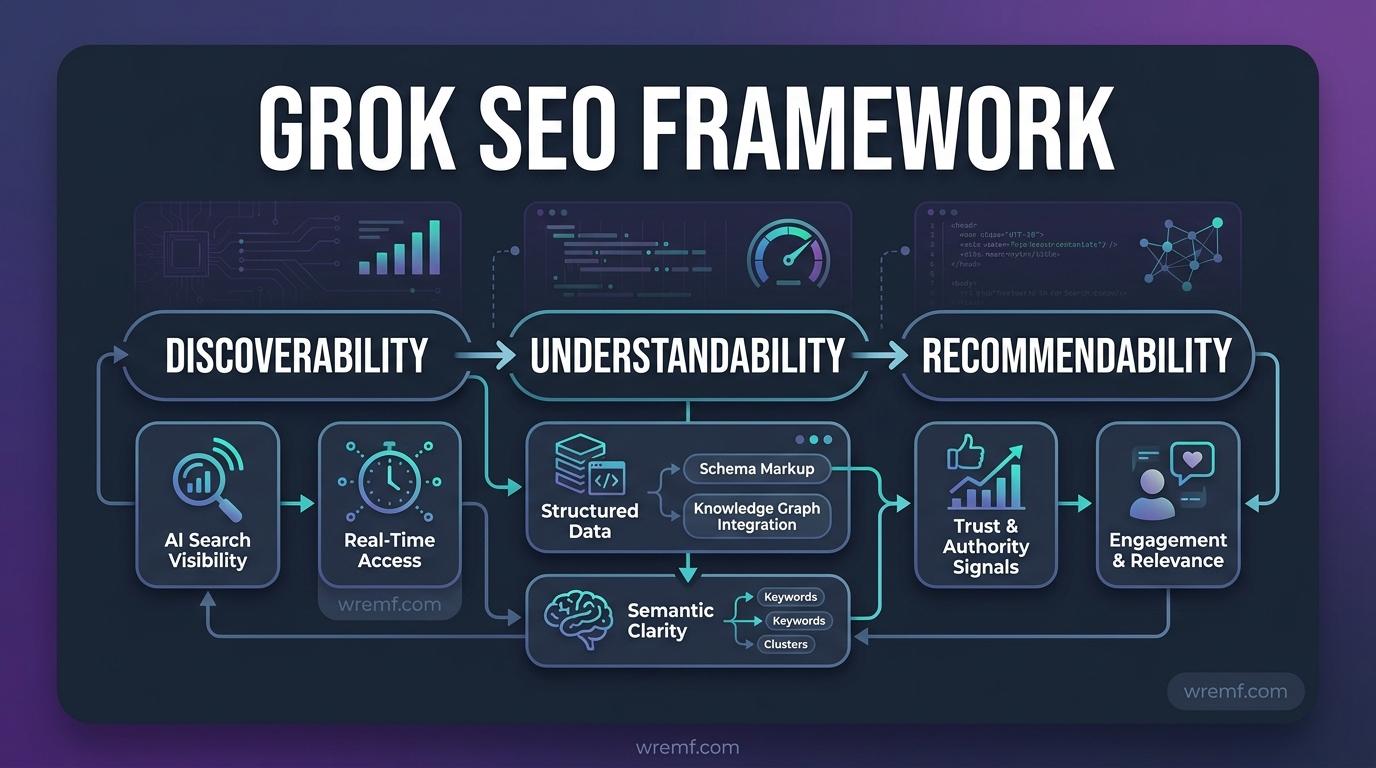
Grok SEO is the optimization process aimed at improving brand visibility within Grok, an AI assistant created by xAI. It involves making a brand discoverable, understandable, and recommendable in AI-generated answers, citations, and real-time searches. Grok SEO integrates classic SEO techniques, structured data, prompt and citation tracking, LLM Optimization, and brand authority. This approach ensures a measurable AI presence, helping B2B teams enhance visibility across AI models like ChatGPT, Gemini, and Perplexity. Understanding Grok's unique capabilities is essential for successful optimization.
Key takeaways
- Grok SEO optimizes brand discoverability within AI-powered systems like Grok.
- Structured data and schema markup enhance AI understanding of entities.
- Real-time access in AI influences Grok SEO strategies.
- AI visibility requires citation tracking and source consistency.
- Conversational search impacts content creation for AI SEO.
Grok SEO: The Complete Guide to Grok AI SEO, AI Search Visibility, and LLM Optimization
Grok SEO is the process of making your brand discoverable, understandable, and recommendable inside Grok and AI-powered search systems. xAI describes Grok as a real-time AI assistant, and X Help explains that Grok can use public X posts and web search when responding to user queries. This guide explains Grok AI SEO, AI crawlers, structured data, real-time access, prompt tracking, source citations, Digital PR, AI traffic, Share of Model, privacy risks, and measurement. It also shows how WREMF helps B2B teams track, improve, and prove AI visibility across Grok, ChatGPT, Claude, Gemini, Perplexity, Google AI Overviews, Copilot, DeepSeek, Meta AI, and Mistral. Use this guide to build a practical Grok SEO workflow for AI search.
What Is Grok SEO?
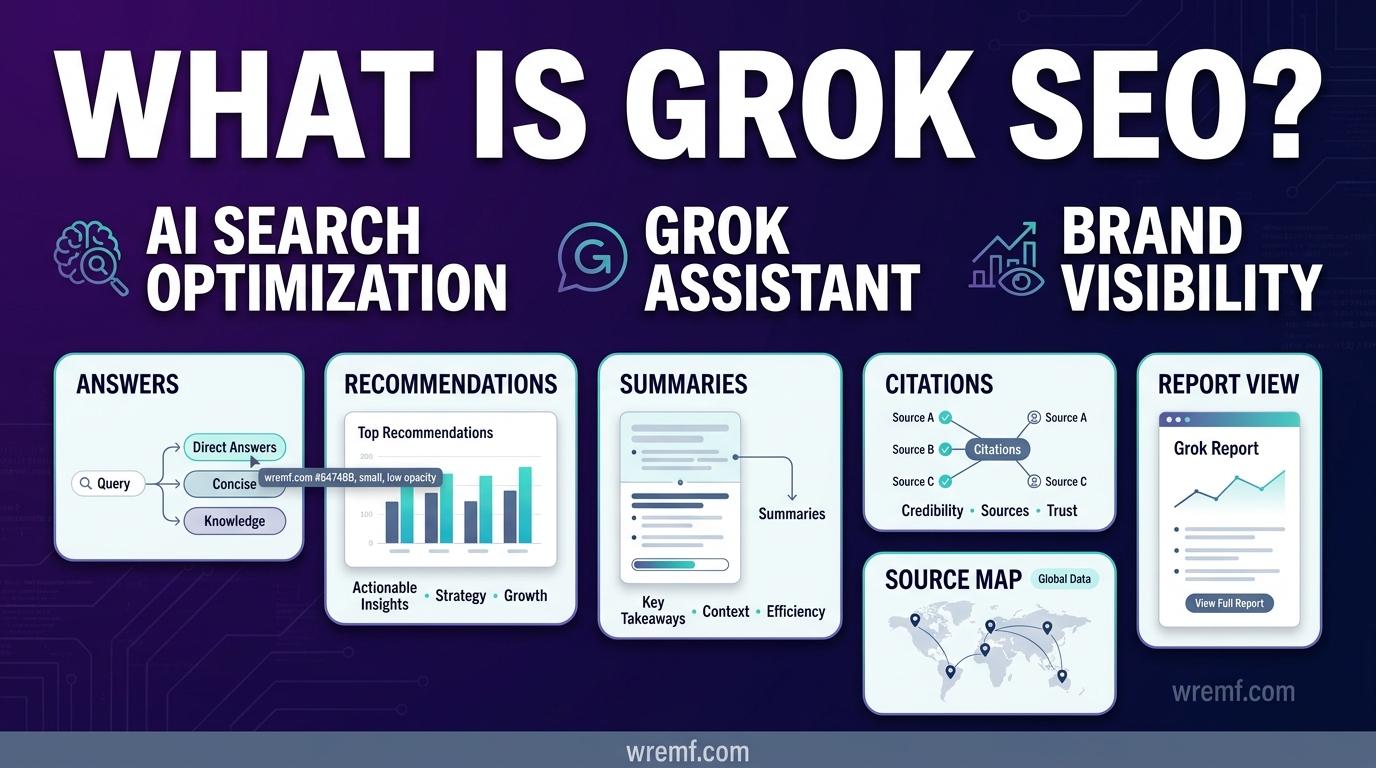
Grok SEO is AI search optimization for Grok, the AI assistant built by xAI. Grok SEO helps your brand appear accurately in Grok answers, recommendations, summaries, citations, and conversational search results.
Grok AI is an AI assistant from xAI that can answer questions, reason through tasks, search current information, and operate across Grok products. The official xAI Grok page describes Grok as an AI chatbot with real-time search, reasoning, coding, and voice capabilities, which matters because Grok visibility depends on how your brand appears in sources Grok can access. (xAI)
Grok AI SEO is not a separate replacement for SEO. Grok AI SEO combines classic SEO optimization, answer engine optimisation, generative engine optimisation, LLM Optimization, structured data, prompt tracking, citation tracking, source consistency, and brand authority.
AI visibility is the measurable presence of a brand inside AI-generated answers, recommendations, citations, summaries, and comparisons. AI visibility matters because B2B buyers can now ask AI models for vendor shortlists before they search Google, click ads, visit review sites, or speak to sales.
WREMF helps teams track, improve, and prove AI visibility across 10 AI engines through the WREMF platform suite, including Grok, ChatGPT, Claude, Gemini, Perplexity, Google AI Overviews, Copilot, DeepSeek, Meta AI, and Mistral.
| Concept | Definition | Why It Matters |
|---|---|---|
| Grok SEO | Optimization for Grok answers, citations, and brand visibility | Helps your brand become easier for Grok to understand and reference |
| Grok AI SEO | Broader optimization across Grok, web sources, and X platform context | Connects content, source authority, and real-time signals |
| AI visibility | Measurement of mentions, citations, recommendations, and source presence | Shows whether AI systems include your brand in relevant answers |
| LLM Optimization | Making content easier for large language models to retrieve and summarize | Improves answer-readiness across AI models |
| Share of Model | Your relative visibility inside AI answers compared with competitors | Helps marketing teams report AI search performance |
KEY TAKEAWAY: Grok SEO is the practical discipline of making your brand findable, credible, and measurable inside Grok and AI-powered search systems.
To improve Grok SEO, you need to understand how Grok changes the relationship between traditional search engines, AI models, and real-time discovery.
Why Grok SEO Matters as Search Engines Become AI-Powered
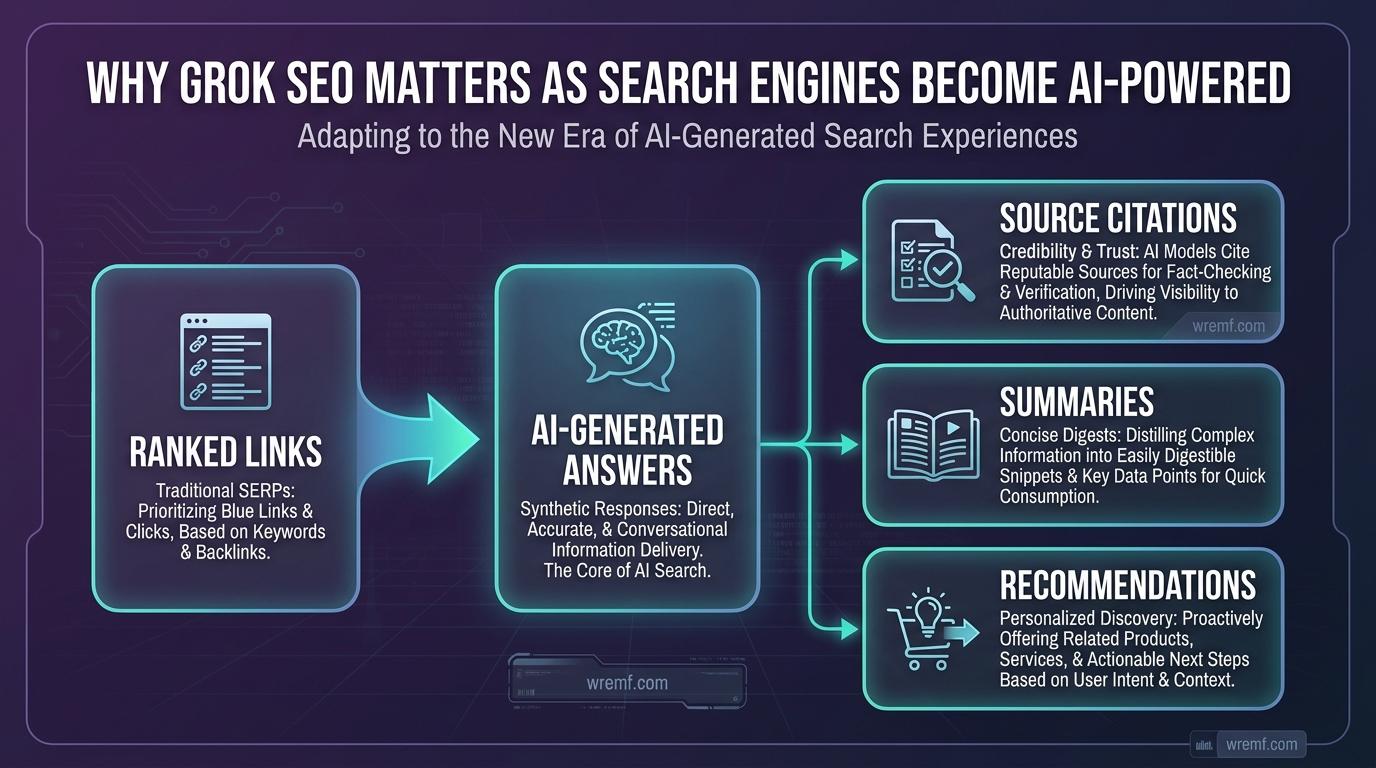
Grok SEO matters because search is shifting from ranked links to AI-generated answers, source citations, summaries, and recommendations. Brands that only track search engines can miss how AI models describe, compare, or ignore them.
Traditional search engines still matter because AI-powered search systems often depend on crawlable, indexed, and well-structured web content. Google Search Central explains that site owners can manage how content appears in AI features such as AI Overviews and AI Mode, which shows that classic search visibility and AI answer visibility are now connected. (Google for Developers)
AI Overviews are AI-generated snapshots in Google Search that summarize key information and include links for deeper exploration. AI Overviews matter because they compress research into answer units that can influence which sources users trust before they visit a site.
Grok adds another layer because Grok can operate with real-time access. xAI’s Web Search documentation states that the Web Search tool enables Grok to search the web in real time and browse pages to answer queries with up-to-date content. (xAI Docs)
Real-time access is the ability of an AI-powered search system to retrieve current information instead of relying only on training data. Real-time access matters for Grok SEO because product launches, trending topics, public brand mentions, news, founder commentary, and source updates can affect how Grok answers current queries.
In real B2B buying journeys, a prospect may ask Grok for “best AI visibility tools,” ask ChatGPT for a comparison, use Perplexity for citations, check Gemini or Google AI Overviews for market context, and then visit pricing pages. Grok SEO therefore needs to cover prompts, results, structured data, source citations, Digital PR, AI traffic, and competitor visibility.
DID YOU KNOW: Microsoft’s Copilot Search messaging says Copilot Search provides summarized answers with cited sources, while OpenAI’s web search documentation says web search can provide answers with sourced citations. This shows why citation tracking is becoming a core AI visibility metric. (Microsoft)
KEY TAKEAWAY: Grok SEO matters because AI search visibility now depends on answers, prompts, citations, source ecosystems, and real-time discovery, not only classic search rankings.
The next step is understanding how Grok differs from other AI models and why that difference changes your optimization workflow.
How Grok Works Differently From ChatGPT, Gemini, Perplexity, Claude, and AI Overviews
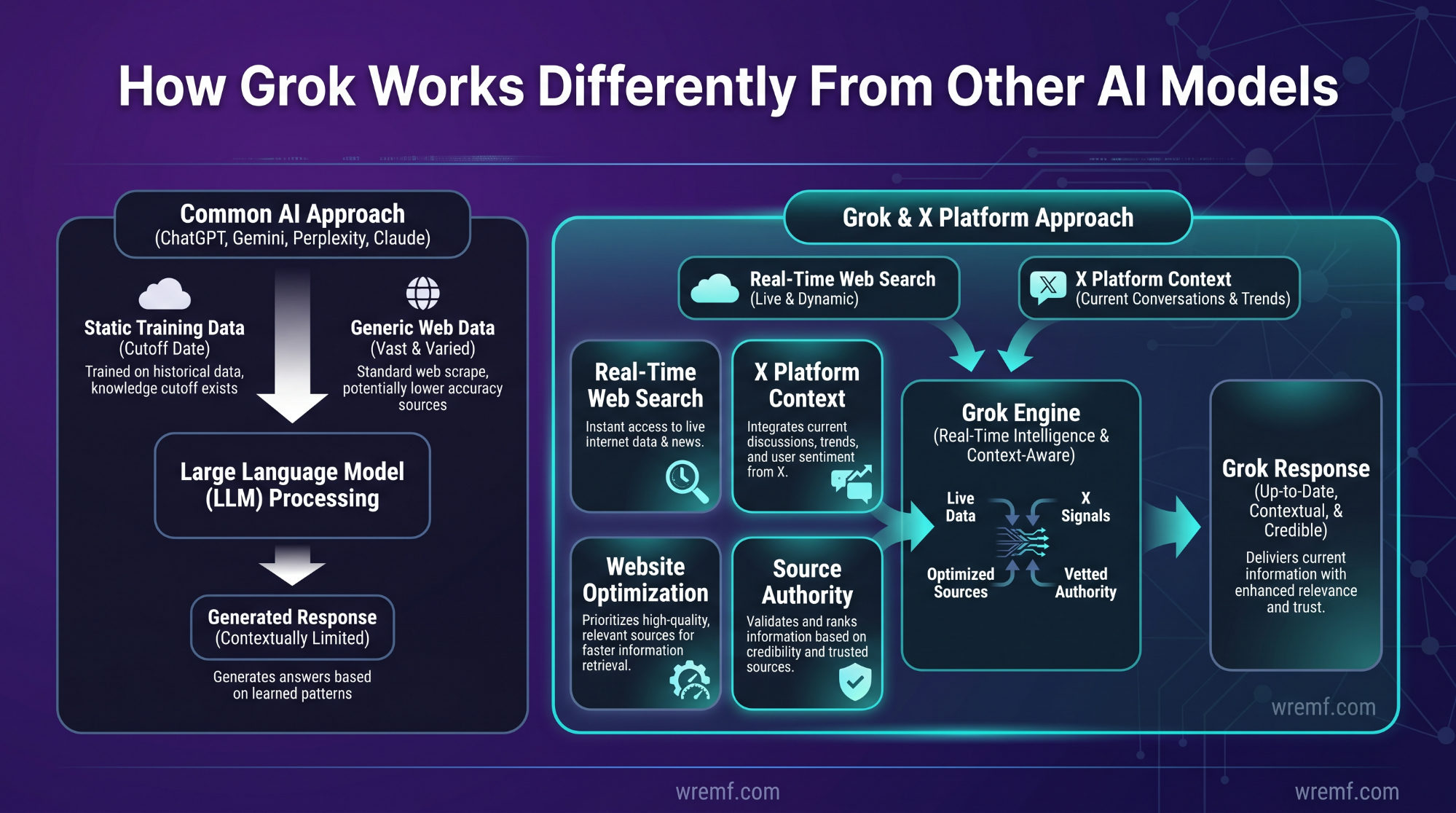
Grok differs from many AI models because it combines frontier AI capabilities with real-time web search and X platform context. Grok SEO therefore needs website optimization, source authority, and public conversation monitoring.
According to X Help about Grok, Grok can decide whether to search public X posts and conduct a real-time web search when answering users. This matters because Grok visibility can be influenced by both web content and public conversation around your brand. (Help Center)
The X platform factor is the role of public X posts, brand discussions, expert commentary, and social velocity in Grok’s possible answer context. The X platform factor matters because Grok has a stronger connection to X than ChatGPT, Claude, Gemini, Perplexity, and Google AI Overviews.
ChatGPT, Claude, Gemini, Perplexity, Copilot, DeepSeek, Grok, Meta AI, and Mistral do not retrieve and cite sources in identical ways. Some AI models rely heavily on web search. Some prioritize citations. Some blend model memory, search results, retrieved documents, and product-specific indexes.
| AI discovery surface | Typical visibility factor | What to monitor |
|---|---|---|
| Grok | Real-time web access and X platform context | Grok prompts, X mentions, source citations, brand sentiment |
| ChatGPT | Web search, model context, citations where enabled | Brand mentions, cited pages, recommendation prompts |
| Claude | Web search and citations where enabled | Source accuracy, document clarity, cited claims |
| Gemini | Google ecosystem and web results | AI Overviews, search results, structured data, brand entity clarity |
| Perplexity | Cited answer engine behavior | Citation frequency, source quality, topical authority |
| Copilot | Microsoft search and AI answer experiences | Citations, Bing visibility, publisher source presence |
The key difference between SEO and GEO is that SEO focuses on search result visibility, while GEO focuses on AI-generated answers. Grok SEO sits inside GEO because the goal is to make your brand visible in generated responses, not just ranked pages.
IMPORTANT: A high Google ranking can help discovery, but it does not guarantee that Grok will mention, cite, or recommend your brand. Grok may use different sources, current context, X platform conversation, and real-time web results depending on the query.
KEY TAKEAWAY: Grok SEO requires SEO foundations, GEO measurement, AEO formatting, X platform awareness, and source citation tracking.
Once Grok’s retrieval behavior is clear, the next question is whether your website is technically readable by search systems and AI crawlers.
Technical Prerequisites for Grok AI SEO
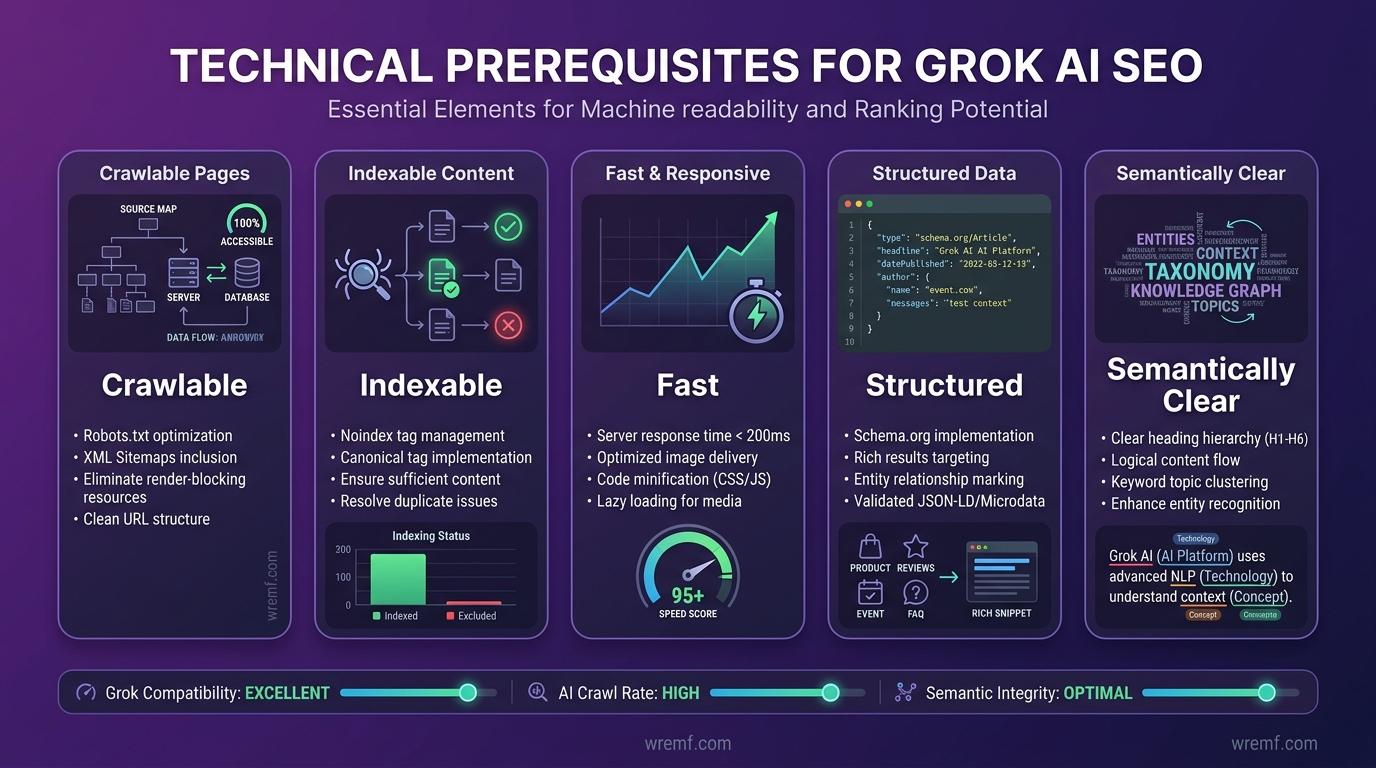
Technical Grok AI SEO starts with crawlable, indexable, fast, structured, and semantically clear pages. If AI crawlers and search engines cannot access or understand your content, Grok visibility becomes harder to improve.
AI crawlers are automated systems that fetch pages for search, retrieval, training, answer generation, or AI product experiences. AI crawlers matter because blocked, thin, slow, or JavaScript-dependent content can reduce the chance that AI-powered systems understand your website.
Indexable URLs are pages that search engines can discover, crawl, render, and include in search indexes. Indexable URLs matter for Grok SEO because AI-powered search systems often depend on public web pages that are accessible, stable, and machine-readable.
Technical prerequisites for Grok SEO include:
Crawlable public HTML content
Indexable URLs with descriptive slugs
Clean canonical tags
Complete XML sitemap coverage
Accurate title tags and metadata optimization
Fast Page Speed and mobile usability
Clear internal linking between related pages
Structured data using valid schema markup
Robots.txt rules that do not accidentally block useful discovery
Public pages that do not rely only on client-side rendering
Consistent organization, product, author, and service information
Google Search Central explains that structured data helps Google understand page content and gather information about entities such as people, organizations, products, and other items. This is important because structured data supports machine interpretation, even though it does not guarantee Grok citations. (Google for Developers)
Structured data is machine-readable markup that explains the entities and relationships on a page. Structured data matters because AI models and search engines need clear signals about companies, products, services, authors, locations, reviews, and content types.
Schema engineering is the deliberate design of schema markup, entity definitions, page relationships, and metadata to improve machine understanding. Schema engineering matters because Grok AI SEO depends on clarity and consistency, not just keyword placement.
Metadata optimization is the process of improving title tags, meta descriptions, social metadata, canonical signals, and page-level summaries. Metadata optimization matters because AI search systems and search engines often use metadata to interpret page purpose and relevance.
TIP: Use a GEO audit workflow to compare raw HTML, rendered HTML, structured data, metadata, internal linking, and AI-readable page content before rewriting copy.
KEY TAKEAWAY: Technical Grok AI SEO requires indexable URLs, crawlable content, structured data, metadata optimization, fast pages, and internal linking that helps AI crawlers understand your site.
After the technical layer, the next priority is creating content that matches how people ask AI systems questions.
How to Create Grok SEO Content for Conversational Search
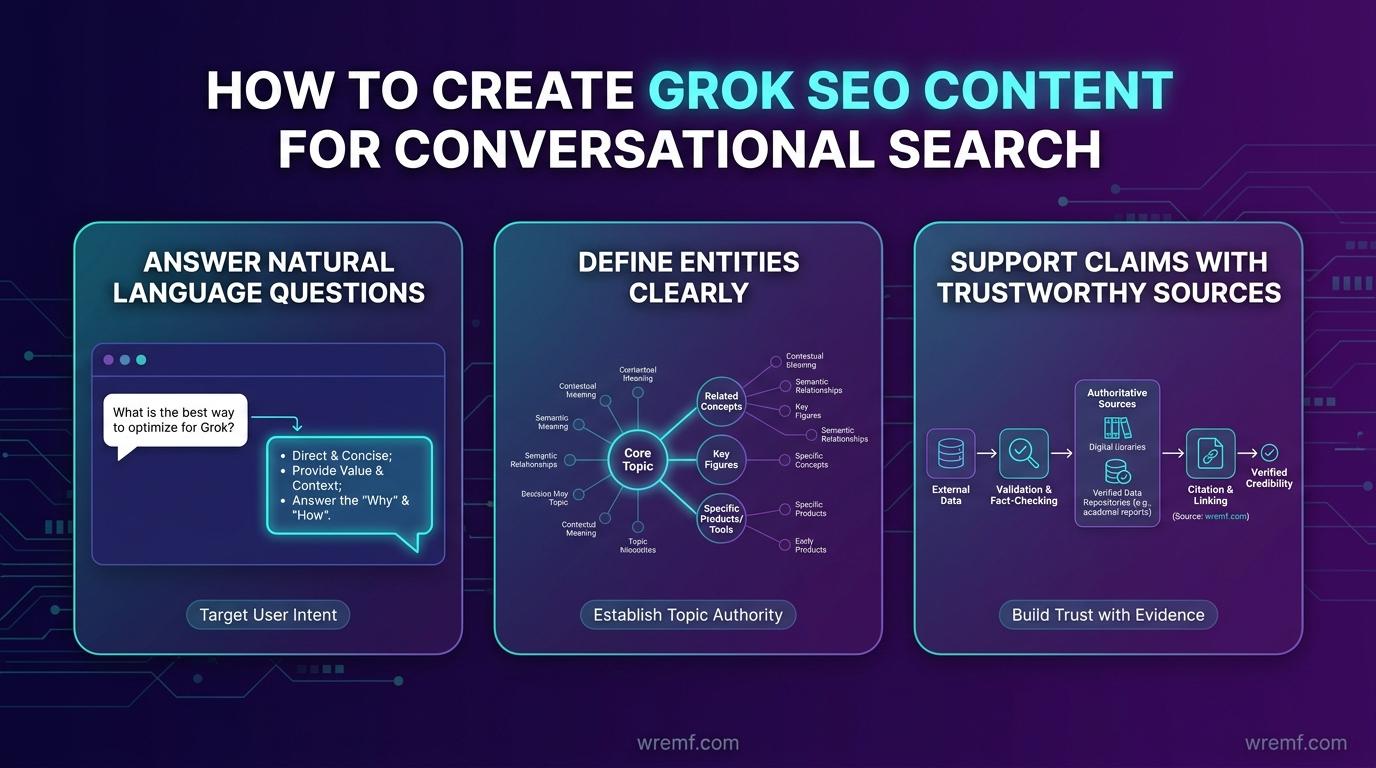
Grok SEO content should answer natural language questions directly, define entities clearly, and support claims with trustworthy sources. Content that is useful to people and easy for AI models to quote has a stronger AI search foundation.
Conversational search is the use of full natural language questions inside search engines, Grok, ChatGPT, Gemini, Claude, Perplexity, Copilot, and voice assistants. Conversational search matters because users ask AI models complete questions instead of typing short keyword fragments.
AI Keyword Mapping is the process of mapping buyer prompts, search terms, questions, pain points, and AI answer patterns to content sections. AI Keyword Mapping matters because prompt coverage is broader than classic keyword coverage.
A strong Grok SEO content workflow includes:
Start each page with a direct answer
Define major entities in plain language
Use H2 sections that match real prompts
Include comparison tables for decision queries
Cite authoritative sources near important claims
Add practical examples without inventing case studies
Connect related content with internal linking
Refresh content when models, features, or search behavior changes
Use AI prompt templates for ideation, not as a substitute for expertise
Build content clusters around connected search intents
Content marketing for Grok SEO is not only blog writing. Content marketing includes product pages, comparison pages, guides, FAQs, glossary entries, documentation, reports, API pages, case-based explainers, and audience pages that make your brand easier for AI models to understand.
Google Search Central’s helpful content guidance explains that Google’s systems aim to reward helpful, reliable, people-first content. This matters for Grok SEO because answer-first pages still need real usefulness, not just AI-facing formatting. (Google for Developers)
Topical authority is the depth and consistency of expertise a website demonstrates across a subject area. Topical authority matters because AI models need repeated, consistent, source-backed information to associate a brand with a category.
Content clusters are groups of related pages that cover a topic from multiple angles. Content clusters matter because Grok SEO requires coverage across definitions, comparisons, use cases, implementation, tools, services, measurement, and risks.
For example, a brand targeting AI visibility should not publish one generic article. The brand should create content clusters covering Grok SEO, AI search visibility, LLM visibility, AI Overviews, prompt tracking, source citations, SEO vs AEO vs GEO, AI traffic attribution, and AI visibility tools.
KEY TAKEAWAY: Grok SEO content should be answer-first, entity-rich, source-backed, and mapped to conversational search rather than keyword lists alone.
Strong content still needs stronger entity signals, especially when Grok evaluates a brand across multiple sources.
Entity Authority, Brand Search Volume, and Source Consistency
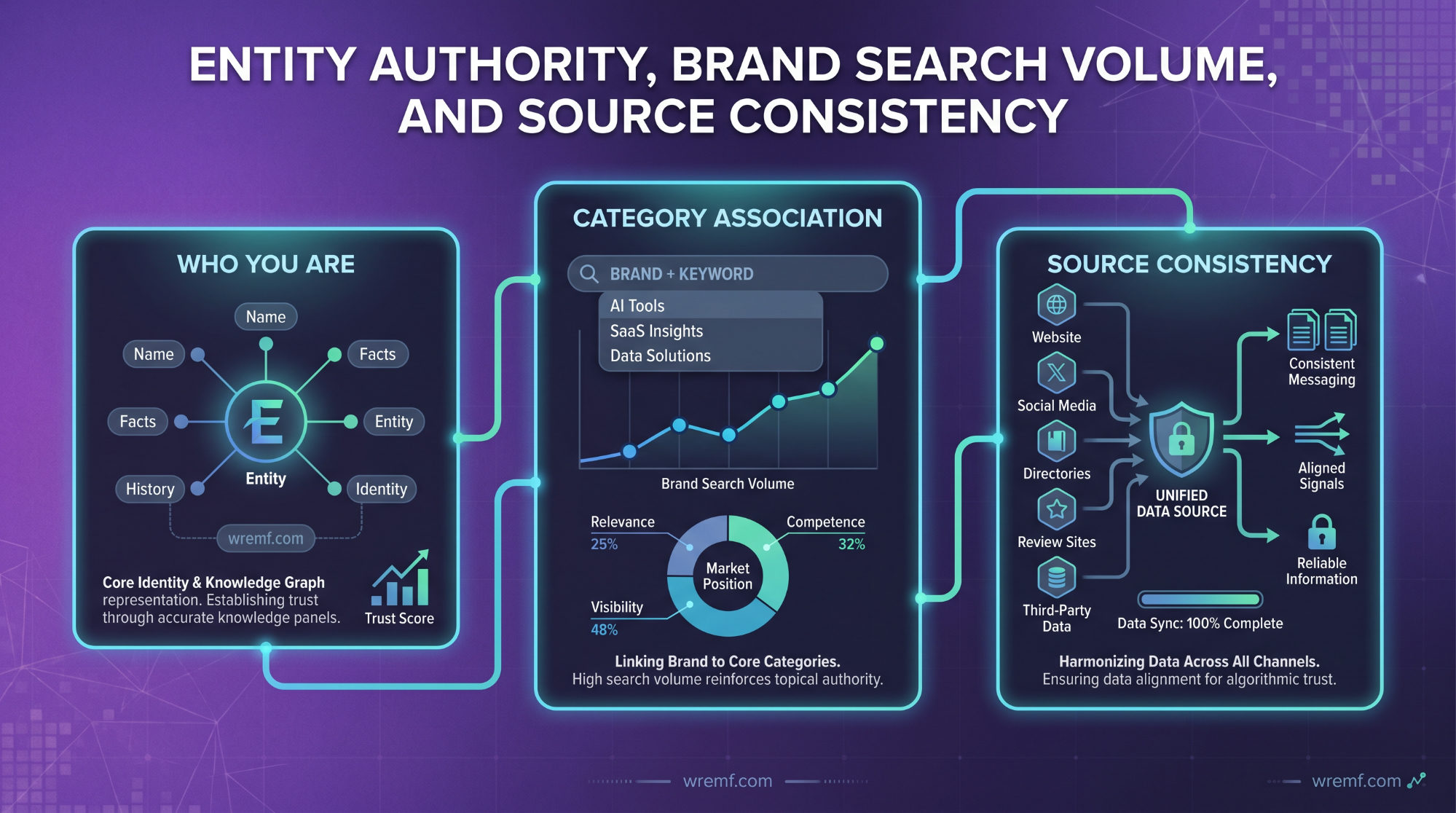
Entity authority helps Grok understand who you are, what category you belong to, and why your brand should be associated with a topic. Source consistency reduces confusion across your website, profiles, third-party sources, and public mentions.
Entity authority is the strength and clarity of a brand’s identity across the web. Entity authority matters because AI models need to connect your company name, product category, executives, location, services, content, and third-party references into one coherent understanding.
Brand search volume is the level of direct demand for your company, product, founder, or branded terms in search engines. Brand search volume matters because it can indicate inbound interest, market awareness, and whether people actively seek your brand.
Inbound interest is the demand created when users search for your brand, visit your site, click from AI tools, mention your company, or compare you with competitors. Inbound interest matters because Grok SEO is more credible when people and sources already connect your brand to the topic.
Source consistency is the alignment of brand facts across your website, social profiles, directories, press mentions, reviews, documentation, and AI-generated answers. Source consistency helps AI systems reduce ambiguity when identifying a company, product, or claim.
In practical AI visibility audits, SEO teams frequently discover that AI models describe a brand using outdated positioning. This often happens when old profiles, unclear About pages, inconsistent category labels, and weak internal linking send conflicting signals.
A source consistency cleanup should verify:
Company name and legal name
Product name and category
Founder and leadership references
Main service areas
Pricing claims
Target market
Locations served
Social profiles
Documentation and help pages
Comparison language
Third-party mentions
Review profiles
Public datasets and directories
WREMF helps teams identify source consistency gaps through AI visibility monitoring, prompt intelligence, and source citation analysis. This is useful when a model mentions competitors, misclassifies your category, or uses outdated brand descriptions.
KEY TAKEAWAY: Grok SEO improves when your brand entity, source citations, third-party references, and public descriptions tell the same story.
The next Grok-specific layer is the X platform, where public conversation can influence real-time visibility.
The X Platform Factor: Brand Sentiment, Community Notes, and Real-Time Visibility
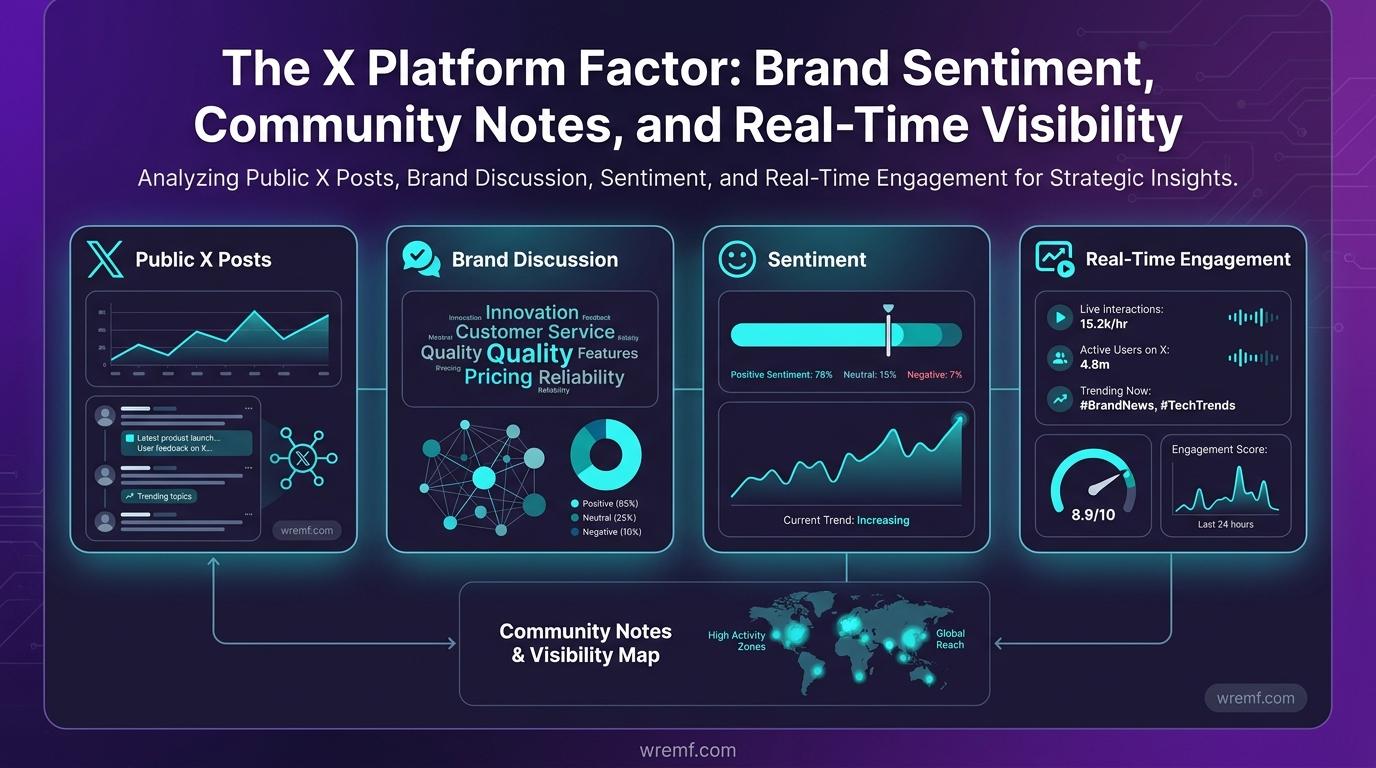
The X platform matters for Grok SEO because Grok can use public X posts when answering some queries. Public brand discussion, sentiment, expert commentary, and real-time engagement can influence the information environment around your brand.
The X Concept is the idea that real-time public discussion can affect AI visibility when an AI assistant has access to live social signals. The X Concept matters because Grok has a stronger relationship with X platform content than most competing AI models.
Brand mentions are references to your company, product, founders, reports, or services across public sources. Brand mentions matter because AI models can use repeated mentions to understand what your brand is associated with.
Community Notes are crowd-sourced contextual notes on X that can add correction, context, or trust signals to public posts. Community Notes matter for Grok SEO because disputed or corrected public claims can affect how trustworthy a brand narrative appears.
Digital PR is the process of earning credible third-party mentions, expert quotes, coverage, links, and references across trusted publications and communities. Digital PR matters because AI search visibility depends on source ecosystems, not only website copy.
A practical X platform and Digital PR workflow includes:
Monitor branded prompts in Grok
Track brand mentions on the X platform
Review sentiment around product claims
Publish clear product updates from official accounts
Correct inaccurate public claims through credible channels
Earn coverage from relevant publications
Turn expert commentary into source-backed content
Track whether source citations change after announcements
Measure inbound interest after launches, PR, and public discussion
Digital outreach supports Grok SEO when it earns relevant, credible references rather than low-quality links. For B2B companies, valuable outreach may include analyst mentions, SaaS comparison guides, founder interviews, industry podcasts, data studies, partner pages, and customer education resources.
IMPORTANT: Do not use fake engagement, spam posting, or manipulative social tactics to influence Grok. Grok SEO should focus on clear claims, credible sources, real expertise, and consistent public information.
KEY TAKEAWAY: Grok SEO includes website optimization, but Grok’s X platform connection makes brand sentiment, Digital PR, real-time engagement, and public source consistency more important.
The next section explains how structured data and semantic meaning make your content easier for AI systems to parse.
Structured Data, Schema Markup, and Semantic Meaning for LLM Consumption
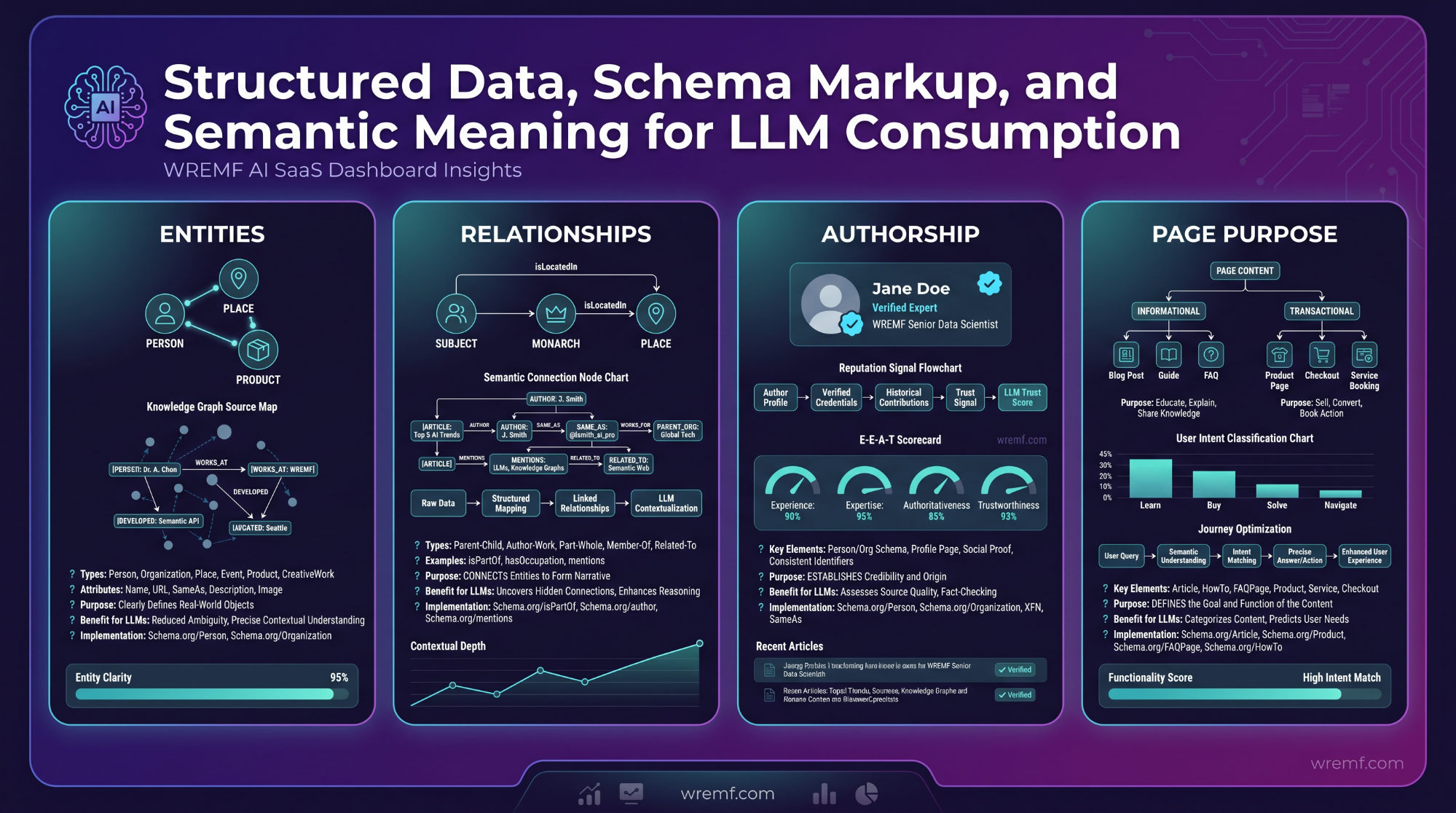
Structured data supports Grok SEO by making entities, relationships, authorship, products, services, and page purpose easier to understand. Schema markup does not guarantee citations, but schema-enhanced clarity reduces ambiguity.
Semantic meaning is the clear relationship between words, entities, intent, and context on a page. Semantic meaning matters because AI models retrieve and summarize concepts, not isolated keyword strings.
Semantic structure is the organization of content around entities, questions, answers, categories, and relationships. Semantic structure matters because AI models need to understand what a page is about, who it is for, and how it relates to other content.
For Grok AI SEO, schema markup should support:
Organization identity
Software product details
Service descriptions
Author expertise
FAQ content
Article metadata
Breadcrumbs
Review information where valid
Local AEO where geography matters
SameAs links to official profiles
Relationships between products, services, and topics
E-E-A-T signals are indicators of experience, expertise, authoritativeness, and trustworthiness. E-E-A-T signals matter because AI models and search engines both need reliable sources for factual answers.
Author expertise is the visible proof that content was created or reviewed by someone with relevant knowledge. Author expertise matters because AI-generated answers are more useful when they can rely on accurate, accountable, and source-backed information.
Schema-enhanced clarity works best when markup reinforces visible content. A common implementation mistake is adding schema markup while leaving the page vague, thin, or inconsistent. AI crawlers and search systems need the visible page and structured data to agree.
Specialized niches may require extra clarity. Local AEO should clarify service areas, locations, reviews, and business categories. Christian Grok SEO, Kingdom Grok Optimization, Church Grok AI SEO, faith-based content, Biblical authenticity, and Christian websites require careful entity definitions, audience context, and source consistency so AI models do not confuse mission, doctrine, services, and commercial intent.
KEY TAKEAWAY: Structured data improves Grok SEO when it supports visible content, semantic meaning, source consistency, and clear entity relationships.
Once technical and semantic foundations are in place, you need to measure whether Grok visibility is actually improving.
How to Measure Grok SEO Beyond Rankings
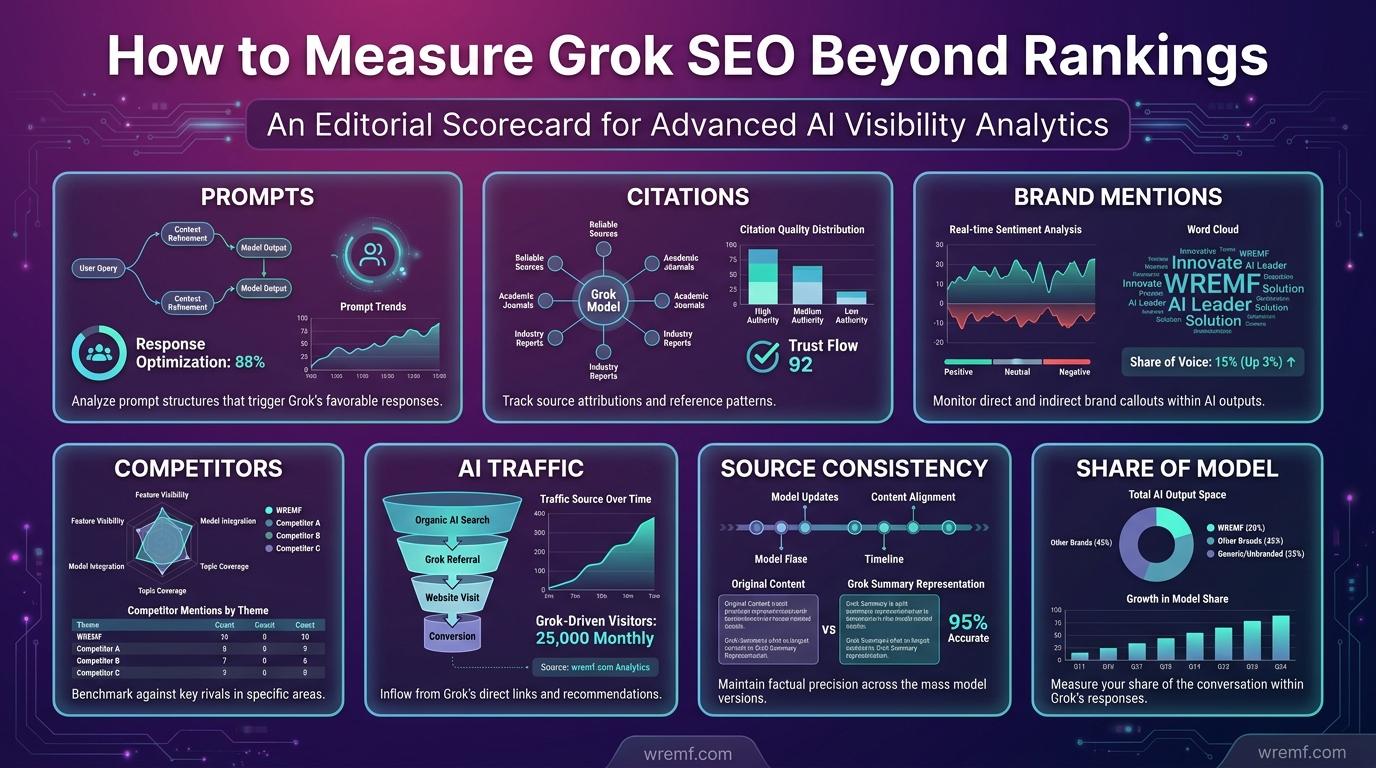
Grok SEO measurement should track prompts, citations, brand mentions, competitors, AI traffic, source consistency, and Share of Model. Rankings alone are not enough because AI answers can influence buyers without producing a traditional click.
Prompt tracking shows how your brand appears when users ask specific questions inside AI models. Prompt tracking matters because AI discovery often starts with prompts such as “best Grok SEO tools,” “which AI visibility platform tracks Grok,” or “how do I optimize for Grok AI?”
Citation tracking measures whether AI systems cite your website or third-party sources when answering relevant prompts. Citation tracking matters because citations can influence trust, referral traffic, and executive confidence in AI visibility reporting.
AI traffic is website traffic referred from AI assistants, AI search tools, and AI-powered search experiences. AI traffic matters because it connects AI visibility to measurable sessions, engagement, leads, and pipeline, even though some AI influence remains zero-click.
AI search traffic is the subset of website traffic that comes from AI-powered discovery surfaces. AI search traffic matters because it helps teams understand whether AI visibility is producing measurable visits.
Share of Model is the percentage of AI answer visibility your brand captures compared with competitors across a prompt set. Share of Model matters because B2B teams need to know whether Grok, ChatGPT, Gemini, Claude, and Perplexity recommend competitors more often.
AI Visibility Score is a composite metric that can combine mentions, citations, recommendations, source quality, prompt coverage, competitor presence, and sentiment. AI Visibility Score matters because leadership needs one directional metric that can be tracked over time.
| Metric | What It Measures | What It Misses | Recommended Use |
|---|---|---|---|
| Google ranking | Position in classic search engines | AI answers without clicks | SEO baseline |
| Prompt tracking | Brand presence across AI prompts | Business impact by itself | AI visibility monitoring |
| Source citations | URLs cited by AI systems | Uncited brand mentions | Citation improvement |
| Brand mentions | Whether the brand appears in answers | Whether the answer is accurate or positive | Awareness and accuracy checks |
| Share of Model | Visibility versus competitors | Full revenue attribution | Competitive reporting |
| AI traffic attribution | Sessions and conversions from AI sources | Zero-click influence | Business impact reporting |
| Conversational conversion rates | Conversion quality from AI-origin sessions | Invisible pre-click research | Pipeline analysis |
Microsoft introduced an AI Performance dashboard in Bing Webmaster Tools public preview that reports when a site is cited in AI-generated answers, including total citations and average cited pages. This is important because major platforms are beginning to expose AI citation data, not only classic clicks and rankings. (Bing Blogs)
WREMF connects prompts, citations, competitors, source consistency, and attribution through the WREMF methodology. This helps teams turn Grok SEO from manual testing into repeatable reporting.
If you want to see how AI engines currently describe your brand, review a sample AI visibility report before building your own measurement workflow.
KEY TAKEAWAY: Grok SEO should be measured through prompts, citations, brand mentions, competitors, source consistency, AI traffic, and Share of Model, not rankings alone.
After measurement, the next question is how Grok SEO relates to SEO, AEO, GEO, and legacy SEO tools.
SEO vs AEO vs GEO for Grok SEO
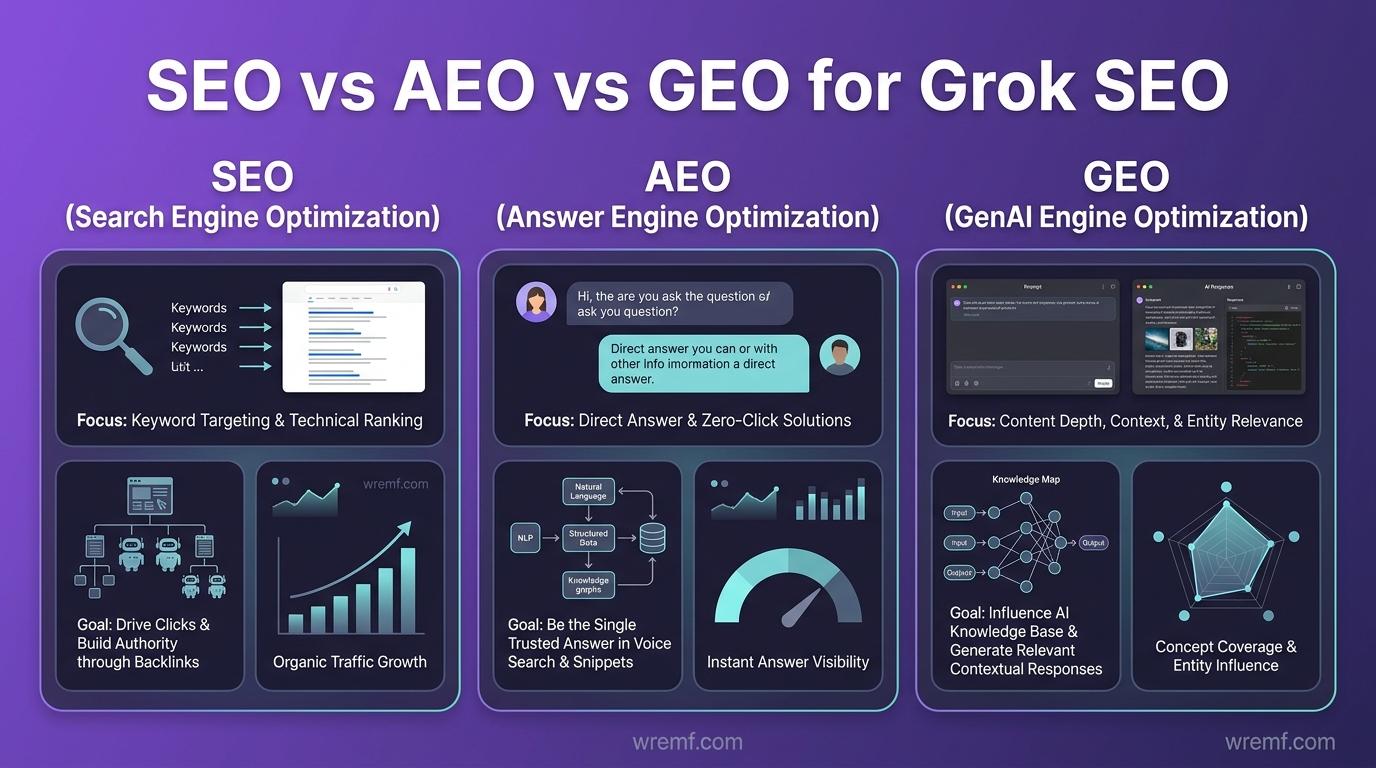
SEO, AEO, and GEO work together, but they optimize different parts of the discovery journey. Grok SEO needs all three because Grok can use search results, direct answers, citations, and conversational recommendations.
SEO is the practice of improving website visibility in search engines. SEO matters because crawlability, indexability, content quality, internal linking, structured data, and authority still influence what AI-powered systems can discover.
Answer engine optimisation is the process of formatting content so it can answer user questions directly in snippets, AI answers, voice assistants, and answer engines. Answer engine optimisation matters because Grok users ask direct questions and expect direct answers.
Generative engine optimisation is the process of improving how brands appear in AI-generated answers, summaries, comparisons, and recommendations. Generative engine optimisation matters because Grok, ChatGPT, Claude, Gemini, Perplexity, Copilot, DeepSeek, Meta AI, and Mistral generate responses rather than only listing URLs.
| Discipline | Primary Goal | Example Metric | What It Misses Alone | Recommended When |
|---|---|---|---|---|
| SEO | Improve search engine visibility | Clicks, impressions, rankings | AI recommendations and citations | You need technical and organic foundations |
| AEO | Answer direct questions clearly | Featured snippets and answer coverage | Competitive AI share of voice | You need answer-first content |
| GEO | Improve AI-generated answer visibility | Mentions, citations, Share of Model | Classic search visibility if isolated | You need AI visibility reporting |
| Grok SEO | Improve visibility inside Grok | Grok prompts, citations, X signals | Other AI models if tracked alone | You need Grok-specific monitoring |
| LLM Optimization | Make content easier for AI models to retrieve | Retrieval quality and summarization accuracy | Platform-specific measurement | You need machine-readable content |
The best option for most B2B teams is not choosing between SEO, AEO, and GEO. The best option is to use SEO for technical and organic foundations, AEO for answer-readiness, GEO for AI visibility, and Grok SEO for Grok-specific monitoring.
AI platform optimization is the process of adapting content, source strategy, and measurement to each AI discovery surface. AI platform optimization matters because Grok, ChatGPT, Gemini, Perplexity, Copilot, and Google AI Overviews use different retrieval and citation patterns.
KEY TAKEAWAY: SEO builds discoverability, AEO builds answer-readiness, GEO builds AI answer visibility, and Grok SEO applies these disciplines to Grok’s real-time web and X-powered environment.
The next step is deciding whether to manage Grok SEO manually, with software, through an agency, or with a hybrid model.
Grok SEO Tools, Software, Services, and Professional Support
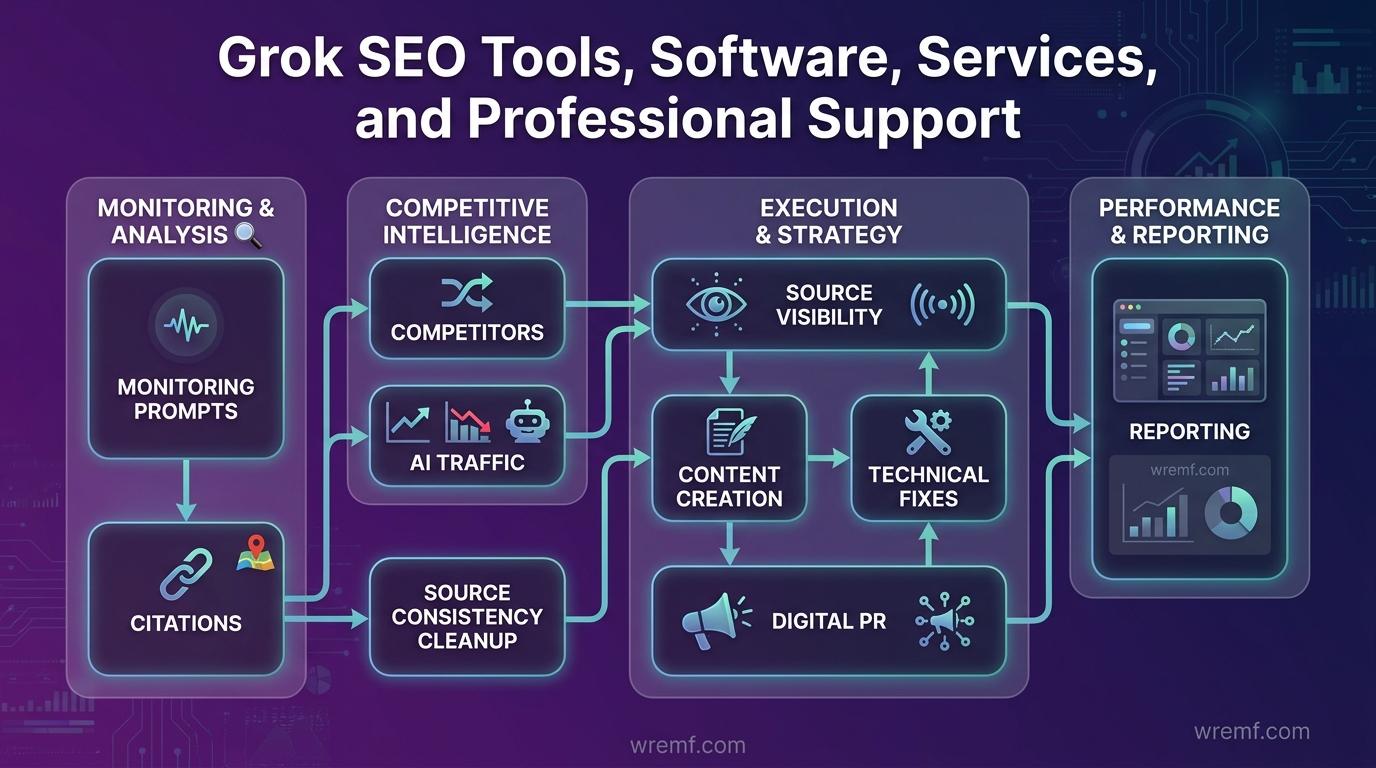
Grok SEO tools help you monitor prompts, citations, competitors, AI traffic, and source visibility. Professional Grok SEO services help you turn those insights into content, technical fixes, source consistency cleanup, Digital PR, and reporting.
Grok SEO tools are software platforms that help teams measure AI search visibility across prompts, answers, sources, and competitors. Grok SEO tools matter because manual testing is inconsistent, difficult to repeat, and hard to present to leadership.
Grok SEO services are consulting or managed execution services for improving visibility across Grok and other AI discovery surfaces. Grok SEO services matter when your team needs strategy, audits, content optimization, schema guidance, authority building, and reporting support.
| Option | Best For | What It Measures | What It Misses | Main Limitation |
|---|---|---|---|---|
| Manual Grok testing | Early exploration | A few prompts and answer examples | Repeatability and scale | Not reliable for reporting |
| Traditional SEO tools | Classic search performance | Keywords, rankings, backlinks, technical issues | AI answers and citations | Limited AI visibility context |
| AI visibility software | Prompt, citation, and competitor tracking | Mentions, citations, Share of Model | Execution if team lacks capacity | Requires action from team |
| Grok SEO agency | Strategy and execution | Depends on reporting setup | Full internal ownership | Requires budget |
| Hybrid model | Software plus managed support | Measurement and action | Requires clear roles | Best with defined ownership |
Agencies managing multiple clients often need white-label reporting, client portals, prompt groups, scheduled monitoring, and source citation exports. In-house brands often need competitor visibility, AI traffic attribution, content briefs, and executive reporting.
WREMF supports software, agency, and hybrid models. Brands can use WREMF to monitor Grok SEO, agencies can use white-label AI visibility reporting, and teams needing execution can work with the WREMF agency team.
For buying-stage teams, WREMF pricing starts with Starter at €39 per month for 1 website, Growth at €89 per month for 5 websites, and Enterprise for unlimited websites, unlimited seats, custom branded portals, and dedicated support. Use WREMF pricing when comparing software cost, agency support, and hybrid execution.
KEY TAKEAWAY: Grok SEO software is best for repeatable measurement, Grok SEO services are best for execution, and a hybrid model is best when teams need both reporting and action.
Once you choose the operating model, you need a practical roadmap for Grok AI Readiness.
A Practical 5-Step Roadmap for Grok AI Readiness
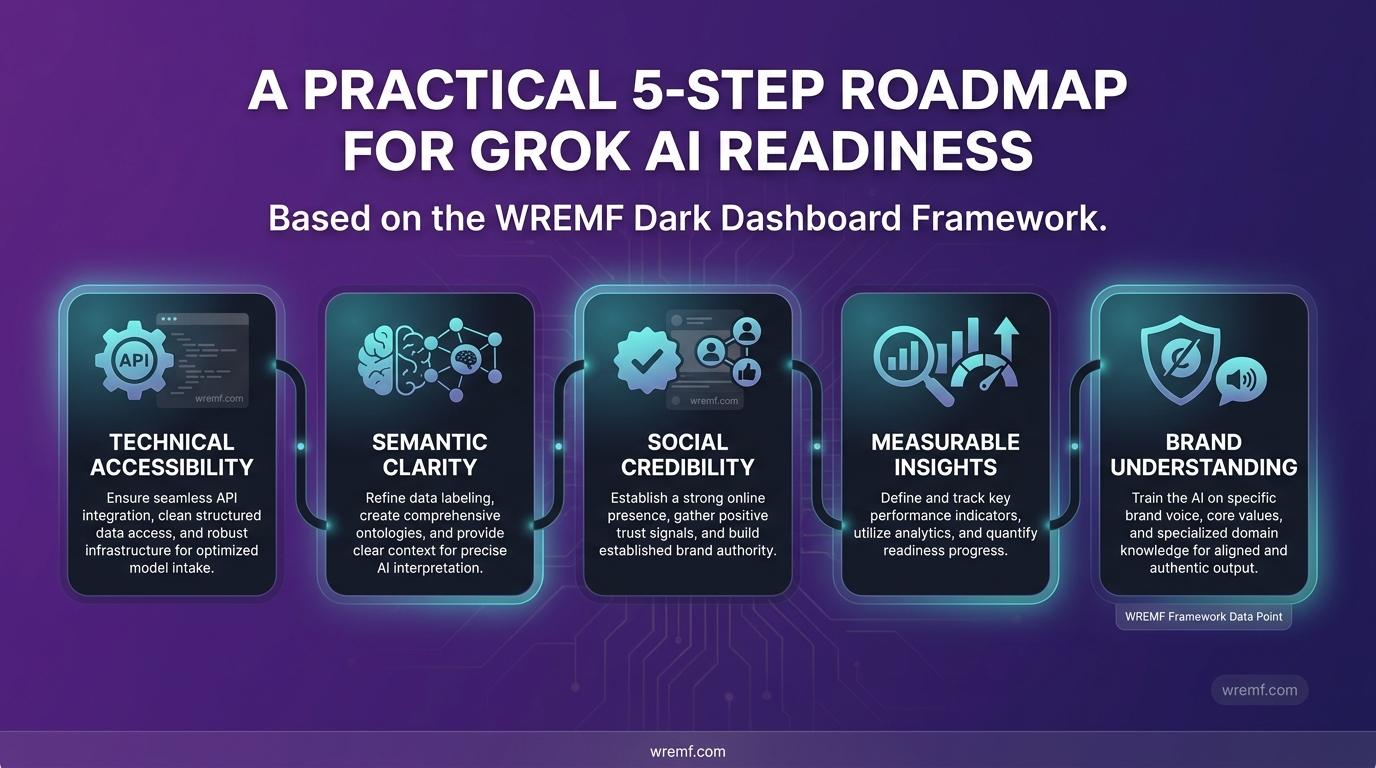
Grok AI Readiness is a repeatable workflow for making your brand technically accessible, semantically clear, socially credible, and measurable inside Grok. The goal is not to manipulate Grok, but to make accurate brand understanding easier.
AI Readiness is the state of having content, technical infrastructure, source signals, and reporting that support AI discovery. AI Readiness matters because Grok SEO requires more than publishing content and waiting for rankings.
Run a technical audit of LLM-readable architecture
Check crawlability, indexable URLs, robots.txt, Page Speed, JavaScript rendering, metadata optimization, canonical tags, structured data, and internal linking. A content audit should also test whether important pages are understandable without hidden scripts or vague copy.
Strengthen brand authority on the X platform
Review public X platform mentions, founder commentary, product announcements, customer discussion, and Community Notes risk. Grok SEO should include public conversation monitoring because Grok can use X context for some answers.
Optimize content for natural language processing
Natural language processing is the AI field that helps systems interpret human language. Natural language processing matters for Grok SEO because Grok needs clear entities, direct answers, definitions, comparisons, and source-backed claims.
Establish semantic structure and internal linking
Use topic clusters, clear headings, descriptive anchors, structured data, and page relationships to help search engines and AI models understand your expertise. Internal linking should connect pillar pages, feature pages, comparison pages, and supporting guides.
Continuously monitor prompts, citations, competitors, and AI traffic
Track Grok prompts, citation tracking, brand mentions, competitor visibility, AI search traffic, Share of Model, and conversational conversion rates. Continuous monitoring matters because AI answers can change as sources, trends, and public conversations change.
WREMF’s prompt intelligence feature, source citation tracking, and competitive landscape analysis support this roadmap across Grok and other AI models.
KEY TAKEAWAY: Grok AI Readiness works best as a repeatable operating system covering technical access, prompt mapping, content clarity, source authority, and measurement.
A complete roadmap should also include advanced optimization tactics for content refresh, prompts, custom charts, and specialized niches.
Advanced Grok SEO Tactics for Content Refresh, Prompts, and Specialized Niches
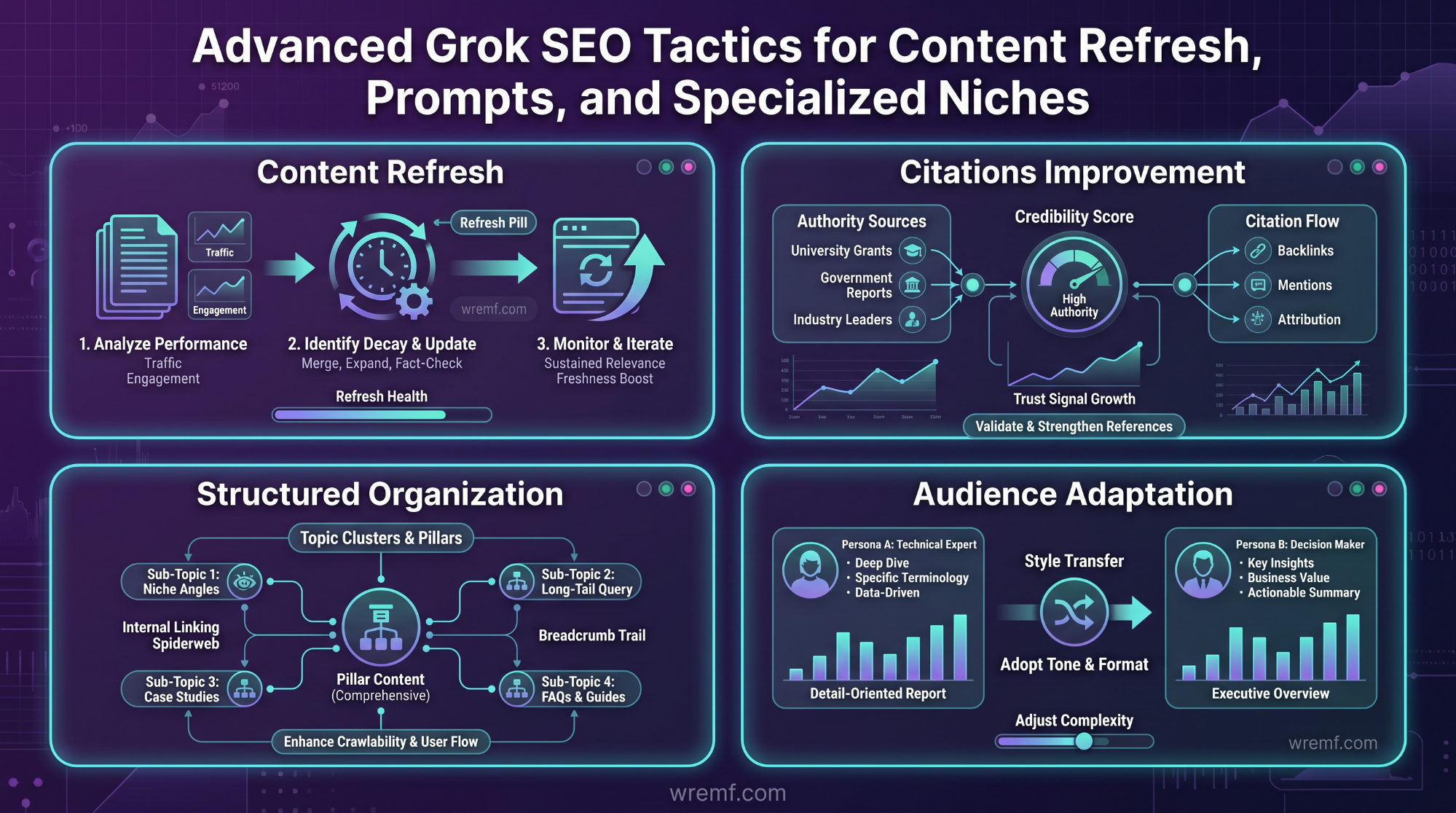
Advanced Grok SEO improves how content is refreshed, cited, structured, and adapted for specific audiences. The goal is to make content more accurate, more extractable, and more useful across AI-powered search systems.
Grok SEO Prompts are prompt templates used to test how Grok answers buyer questions, compares competitors, summarizes categories, and cites sources. Grok SEO Prompts matter because they reveal what Grok says before your prospects see it.
SEO prompts are reusable instructions that help content teams research, update, evaluate, or rewrite SEO content. SEO prompts matter because they speed up content refresh cycles, but they should be validated with search data, analytics, and source checks.
AI prompt templates are structured prompts for recurring workflows such as content audits, FAQ expansion, competitor comparison, or technical SEO review. AI prompt templates matter because repeatable testing is better than random one-off queries.
Free seo prompts and premium seo prompts can help teams ideate, but expert review is still required. Expert-crafted templates should be treated as workflow accelerators, not proof that a page will appear in Grok.
Advanced Grok SEO tactics include:
Build prompt libraries by funnel stage
Test Grok answers against ChatGPT, Gemini, Claude, Perplexity, and Copilot
Refresh content when Grok cites outdated sources
Add answer-first summaries to important pages
Use schema markup for niche services and local AEO
Create custom charts that explain proprietary data clearly
Publish original data when available
Add comparison tables for decision-stage prompts
Use content refresh cycles every 30 to 90 days for important pages
Track citation changes after updates
Custom charts can support Grok SEO when they present original data in text-supported formats and explain the insight clearly in nearby copy. The important point is that AI crawlers need text context, not unexplained assets.
For specialized niches, clarity matters more than jargon. Christian Grok SEO, Kingdom Grok Optimization, Church Grok AI SEO, faith-based content, Biblical authenticity, and Christian websites should define mission, audience, service scope, theological position where relevant, and practical value clearly. The same logic applies to healthcare, legal, fintech, B2B SaaS, local services, and enterprise software.
KEY TAKEAWAY: Advanced Grok SEO uses prompts, content refresh cycles, source monitoring, structured data, and niche-specific clarity to improve AI answer-readiness over time.
The next section covers risks, privacy, shared chats, and search integrity.
Privacy, Shared Chats, and Search Integrity in the Grok Era
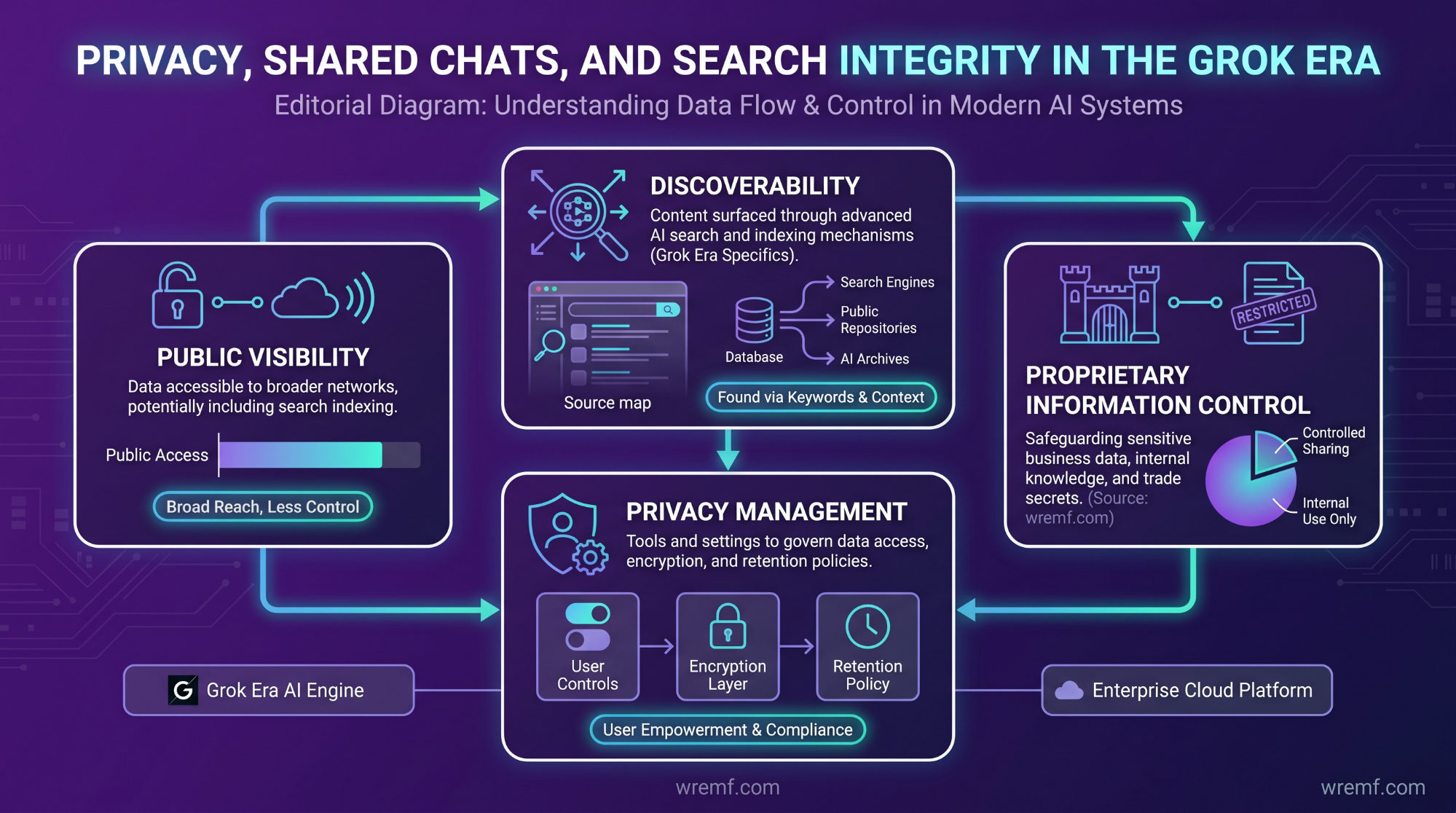
Grok SEO should improve public visibility without exposing proprietary, private, or sensitive information. AI readiness is valuable only when teams control what should be discoverable and what should remain private.
Shared chats are AI conversations that users make accessible through sharing features or public links. Shared chats matter because public sharing can create unexpected discovery, compliance, and reputation risks depending on platform behavior and indexing practices.
Indexing practices are the rules and behaviors that determine whether pages, public posts, shared chats, and URLs can appear in search engines or AI retrieval systems. Indexing practices matter because Grok SEO depends on public information, not confidential data.
Indexing loopholes are situations where content becomes discoverable in ways the publisher did not expect. Indexing loopholes matter because AI search readiness should not create privacy, compliance, or intellectual property risk.
Search integrity is the practice of keeping search and AI answer systems accurate, transparent, and resistant to manipulation. Search integrity matters because brands should improve visibility through useful content and credible sources, not spam, fake engagement, or deceptive pages.
Cloudflare’s AI Crawl Control documentation explains that its tooling can manage AI crawlers, analyze AI traffic, track robots.txt health, and identify crawler behavior. This reflects a wider market shift where publishers want more control over how AI systems access content. (Cloudflare Docs)
Practical safeguards include:
Keep proprietary strategy out of public pages
Review shared chats before distributing links
Use noindex for pages that should not appear publicly
Separate public knowledge bases from internal documentation
Check content management system permissions
Review robots.txt rules for AI crawlers
Keep customer data out of AI-readable public pages
Monitor public AI answers for inaccurate or sensitive claims
Document who approves public claims and schema changes
llms.txt is a proposed file format for helping large language models use a website at inference time. The llms.txt proposal describes it as a proposed standard, which means teams should treat it as experimental support, not a replacement for robots.txt, sitemap hygiene, or structured data. (llms-txt)
IMPORTANT: AI search visibility should never require leaking private data. The goal is to publish accurate, useful, public information that AI systems can safely retrieve.
KEY TAKEAWAY: Grok SEO requires public clarity, but privacy controls, shared chats governance, robots.txt review, and search integrity must protect sensitive information.
The final strategy layer is future-proofing your brand as Grok and AI search continue to evolve.
The Future of Grok SEO, DeepSearch, AIME 2025, LiveCodeBench, and AI Search Capability
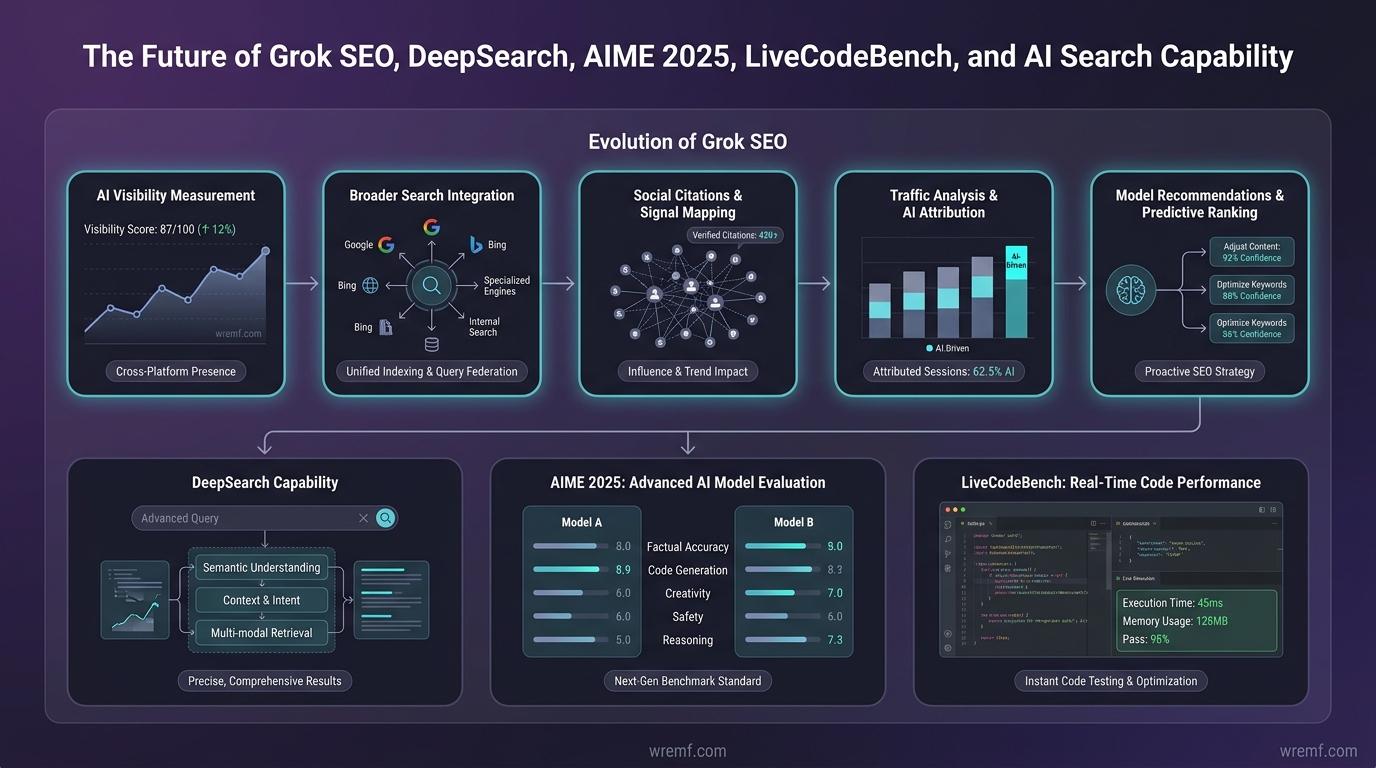
The future of Grok SEO is broader AI visibility measurement across search, social, citations, traffic, and model recommendations. As AI models gain stronger reasoning and tool use, brands need clearer sources, better measurement, and more resilient content systems.
DeepSearch is a research-oriented AI search mode associated with deeper query handling and multi-source synthesis in AI systems. DeepSearch matters because buyer research is becoming more conversational, multi-step, and source-dependent.
AIME 2025 and LiveCodeBench are benchmark contexts often discussed in AI model capability comparisons. AIME 2025 relates to math reasoning, while LiveCodeBench relates to coding performance. These benchmarks matter for AI search strategy only as indicators that AI models are becoming more capable at reasoning through complex tasks.
Benchmark claims should be used carefully. xAI’s Grok 4 announcement states that Grok 4 includes native tool use and real-time search integration, but marketing teams should not convert benchmark results into unsupported SEO claims. (xAI)
ERP 2.0 is sometimes used to describe a future where AI systems connect search, enterprise data, workflows, and decision support. For Grok SEO, the practical implication is simple: public content, private data, APIs, and AI agents will increasingly interact.
API and MCP integrations matter because AI visibility reporting will need to connect with analytics, CRM, content workflows, dashboards, and client portals. WREMF supports technical workflows through API and MCP integrations, which helps teams connect AI visibility data with internal systems.
AI-readable encyclopedia content is content that explains a category, brand, product, or topic in a structured, source-backed, and extractable way. AI-readable encyclopedia content matters because AI models need concise definitions, stable facts, and clear relationships to answer accurately.
KEY TAKEAWAY: Grok SEO will keep evolving as AI models gain stronger search, reasoning, and tool capabilities, so teams need durable measurement systems rather than one-off optimization tricks.
Before the FAQ, it is important to address the misconceptions that often block teams from acting.
Common Myths About AI Visibility Debunked
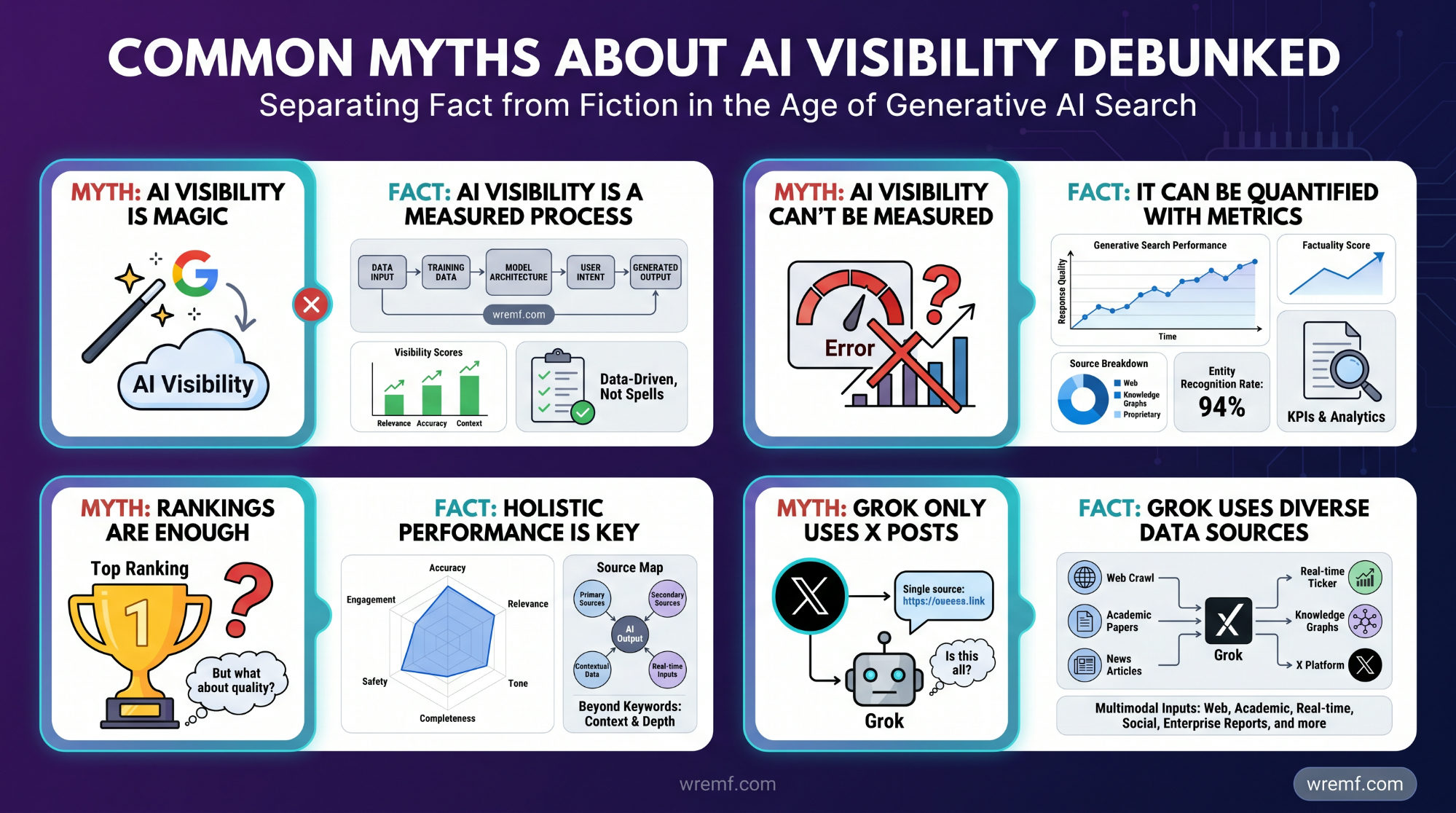
AI visibility is measurable, improvable, and connected to SEO, AEO, GEO, citations, and brand authority. The main risk is treating AI visibility as either magic or a simple ranking report.
MYTH: Grok SEO replaces traditional SEO.
FACT: Grok SEO builds on traditional SEO. Crawlability, indexable URLs, Page Speed, structured data, metadata optimization, internal linking, and helpful content still matter. The difference is that Grok SEO also tracks prompts, brand mentions, X platform signals, source citations, and AI-generated recommendations.
MYTH: AI visibility is impossible to measure.
FACT: AI visibility cannot be measured with one ranking number, but it can be measured through prompt tracking, citation tracking, Share of Model, AI Visibility Score, AI traffic, and competitor presence. WREMF turns these signals into repeatable reporting across Grok, ChatGPT, Claude, Gemini, Perplexity, Google AI Overviews, Copilot, DeepSeek, Meta AI, and Mistral.
MYTH: Rankings are enough if your website already performs well in Google.
FACT: Rankings are useful, but rankings alone do not show whether Grok recommends your brand, cites your sources, describes your product correctly, or mentions competitors instead. AI search visibility requires tracking answers, citations, brand sentiment, source consistency, and competitor visibility.
MYTH: Grok only uses X posts, so website SEO does not matter.
FACT: X Help explains that Grok can use public X posts and real-time web search. That means website content, search visibility, structured data, source authority, and public X platform context can all matter depending on the query.
MYTH: AI prompt templates are enough to win Grok visibility.
FACT: Grok SEO Prompts, seo prompts, AI prompt templates, free seo prompts, and premium seo prompts can help content teams test ideas, but prompts do not create authority by themselves. Real visibility comes from accurate content, crawlable pages, source citations, Digital PR, brand authority, and continuous monitoring.
KEY TAKEAWAY: AI visibility is not magic, and it is not just SEO with a new name. It is a measurable workflow across prompts, citations, competitors, source consistency, and attribution.
The most common questions below clarify implementation, tools, timing, risks, and buying decisions.
Frequently Asked Questions
Can Grok do SEO?
Grok can help with SEO tasks such as content ideas, title drafts, keyword brainstorming, technical explanations, competitor research summaries, and Grok SEO Prompts. Grok should not be treated as a complete SEO tool by itself because it does not replace crawl data, Google Search Console, analytics, rank tracking, citation tracking, or AI visibility reporting. For Grok SEO, use Grok as a research and drafting assistant, then validate outputs with real data. WREMF helps teams monitor how Grok and other AI models describe, mention, cite, and compare a brand.
What is Grok SEO and how does it work?
Grok SEO is the process of optimizing your website, brand sources, X platform presence, structured data, and answer-first content so Grok can understand and reference your brand accurately. Grok SEO works by improving crawlability, entity clarity, source consistency, topical authority, prompt coverage, and citation quality. Because Grok can use web search and public X context, Grok AI SEO should include both technical website optimization and public brand signal monitoring. The goal is measurable AI visibility, not guaranteed rankings or guaranteed citations.
Is SEO dead or evolving in 2026?
SEO is evolving, not dead. Search engines still crawl, index, rank, and display websites, but AI Overviews, Grok, ChatGPT, Gemini, Perplexity, Claude, and Copilot are changing how users discover answers. SEO now overlaps with answer engine optimisation, generative engine optimisation, LLM Optimization, structured data, content marketing, Digital PR, and AI traffic attribution. Teams that only track classic rankings may miss brand mentions, source citations, and AI recommendations. Teams that combine SEO, AEO, and GEO are better prepared for AI-powered discovery.
Which AI is best for SEO?
No single AI model is best for SEO in every workflow. Grok is useful for real-time topics and X platform context, ChatGPT is useful for structured ideation and content workflows, Claude is strong for long-form analysis, Gemini connects closely to Google’s ecosystem, and Perplexity is useful for cited answer research. The best SEO workflow usually combines AI models with verified search data, analytics, and AI visibility tracking. WREMF tracks visibility across multiple AI models so teams do not rely on one platform’s answer pattern.
Can I use Grok as my search engine?
You can use Grok as an AI-powered search and answer assistant, especially for current topics, public X discussion, and web-informed answers. However, Grok should complement, not fully replace, search engines, analytics tools, source verification, and professional research workflows. For marketing teams, the better question is whether buyers use Grok to evaluate your category. If buyers ask Grok for product comparisons, vendor recommendations, or topical explanations, Grok SEO becomes part of your AI search visibility strategy.
How does Grok compare with ChatGPT, Gemini, and Perplexity for SEO?
Grok is especially relevant for real-time topics and X platform context, while ChatGPT is strong for structured workflows, Gemini is closely connected to Google’s AI search ecosystem, and Perplexity is known for citation-led answer research. For SEO teams, the best approach is not choosing one AI model. The best approach is testing the same prompts across multiple AI models, then comparing mentions, citations, source patterns, sentiment, and competitor visibility. WREMF helps teams track this across 10 AI engines.
How do you optimize technical elements for Grok?
Technical optimization for Grok starts with crawlable HTML, indexable URLs, fast pages, clean metadata, structured data, schema markup, semantic headings, internal linking, and consistent entity descriptions. You should also review robots.txt, sitemap coverage, canonical tags, JavaScript rendering, and mobile usability. For AI crawlers, the key is making public content easy to access and understand without exposing private data. A GEO audit can identify whether pages are AI-readable and whether schema-enhanced clarity matches the visible content.
How quickly will I see results from Grok AI SEO?
Grok AI SEO timelines vary by crawlability, brand authority, competition, content quality, source coverage, and how quickly AI systems refresh answers. Some changes, such as clearer metadata or better structured data, can be implemented quickly. Measurable changes in citations, recommendations, AI traffic, and Share of Model may take longer because AI answers depend on many sources. Avoid agencies that guarantee instant Grok rankings or fixed revenue increases. A practical workflow measures baseline prompts first, then tracks changes over 30, 60, and 90 days.
How do I know if competitors are already using AI SEO services?
You can test competitor visibility by running the same commercial and comparison prompts across Grok, ChatGPT, Gemini, Perplexity, Claude, Copilot, and Google AI Overviews. Look for competitor mentions, recommendations, citations, source patterns, sentiment, and whether their pages are referenced more often than yours. You can also review their structured data, content clusters, Digital PR coverage, X platform activity, and AI search traffic signals where available. WREMF’s competitive landscape tracking helps compare these signals in a repeatable way.
Should I hire a Grok SEO agency or use software?
Use software if your team can act on data and mainly needs prompt tracking, citation tracking, competitor visibility, AI Visibility Score, and reporting. Hire an agency if you need strategy, technical fixes, content optimization, schema guidance, Digital PR, source consistency cleanup, and monthly execution. Use a hybrid model if you need both measurement and done-for-you improvement. WREMF supports all three paths through software, agency services, and combined software plus managed execution for brands and agencies.
Are Grokipedia links or AI links useful for authority?
Links from AI-related platforms may be useful when they are indexable, relevant, trusted, and visible to users or search engines. They should not be treated as guaranteed authority signals. For Grok SEO, the stronger goal is source consistency across credible pages, publications, profiles, documentation, reviews, and public brand mentions. Do not chase low-quality AI links or indexing loopholes. Focus on accurate public references, helpful content, trustworthy citations, and Digital PR that supports real brand authority.
Can Grok SEO help local, niche, or faith-based websites?
Grok SEO can help local, niche, and faith-based websites when the content clearly explains the audience, service area, expertise, values, and source-backed claims. For example, local AEO should clarify location, services, reviews, and business details. Christian Grok SEO, Kingdom Grok Optimization, Church Grok AI SEO, faith-based content, Biblical authenticity, and Christian websites require extra clarity so AI systems understand purpose, audience, doctrine where relevant, and practical services. The same principle applies to specialized B2B, healthcare, legal, and software categories.
How does WREMF help with Grok SEO?
WREMF helps teams track, improve, and prove Grok SEO by monitoring prompts, source citations, competitor visibility, AI share of voice, AI traffic attribution, GEO audit findings, and source consistency. WREMF is useful for brands that want software, agencies that need white-label reporting, and teams that want managed execution. The platform supports Grok along with ChatGPT, Claude, Gemini, Perplexity, Google AI Overviews, Copilot, DeepSeek, Meta AI, and Mistral. For teams that need execution, WREMF also offers managed AEO, GEO, and AI visibility services.
Conclusion
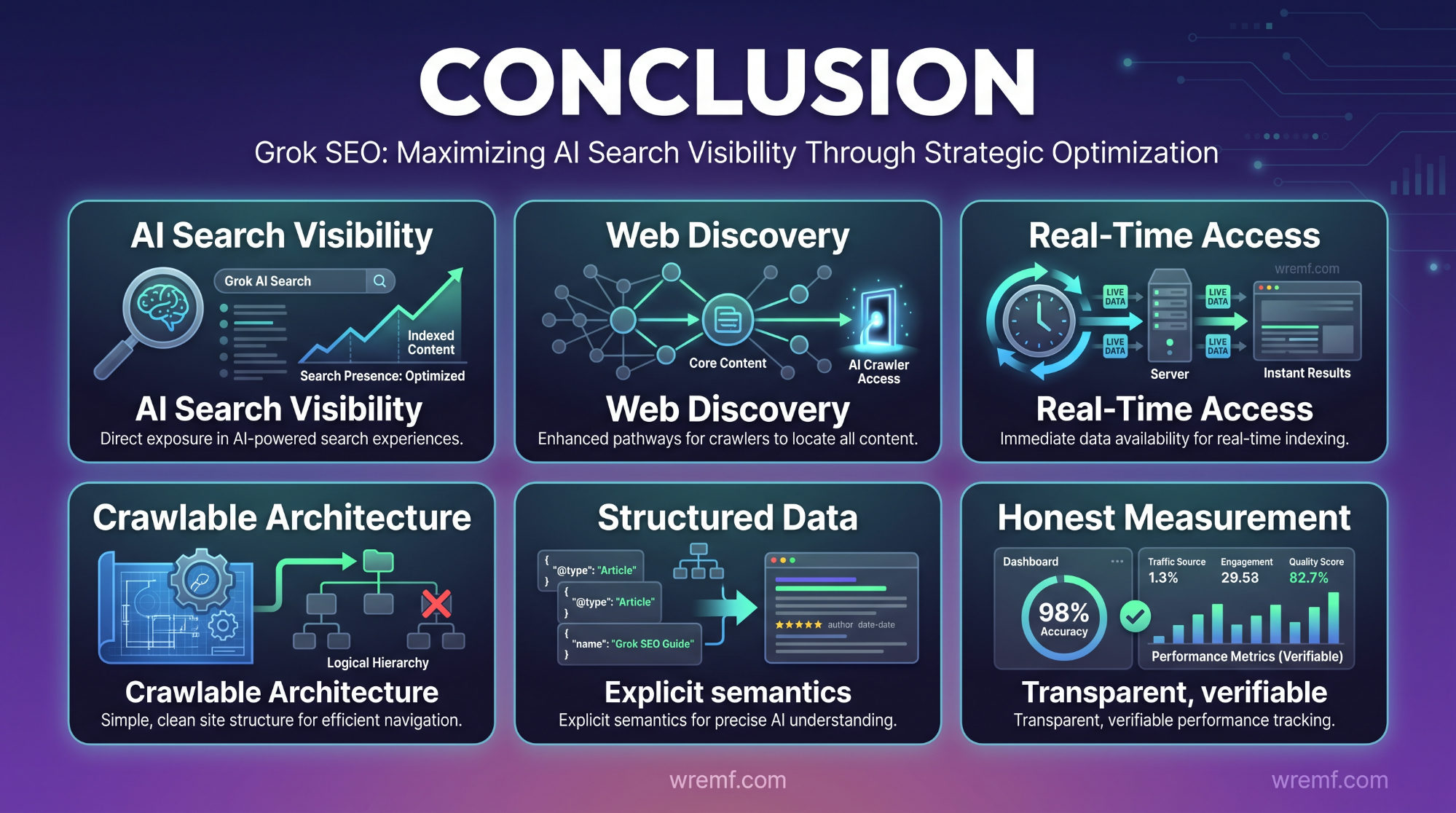
Grok SEO is the next step in AI search visibility because Grok combines web discovery, real-time access, public X platform context, and conversational answers. The winning approach is not keyword stuffing, indexing loopholes, or random prompts. The winning approach is crawlable architecture, structured data, answer-first content, source consistency, Digital PR, prompt tracking, citation tracking, AI traffic attribution, and honest measurement. WREMF helps teams turn Grok AI SEO from manual testing into a repeatable workflow across major AI discovery surfaces. To start tracking, improving, and proving AI visibility, explore the WREMF platform suite or talk to the WREMF agency team.