How to Optimize for AI Search Engines
Learn AI search optimization strategies including technical SEO and structured data for enhanced AI visibility.
By WREMF Team · 2026-08-24
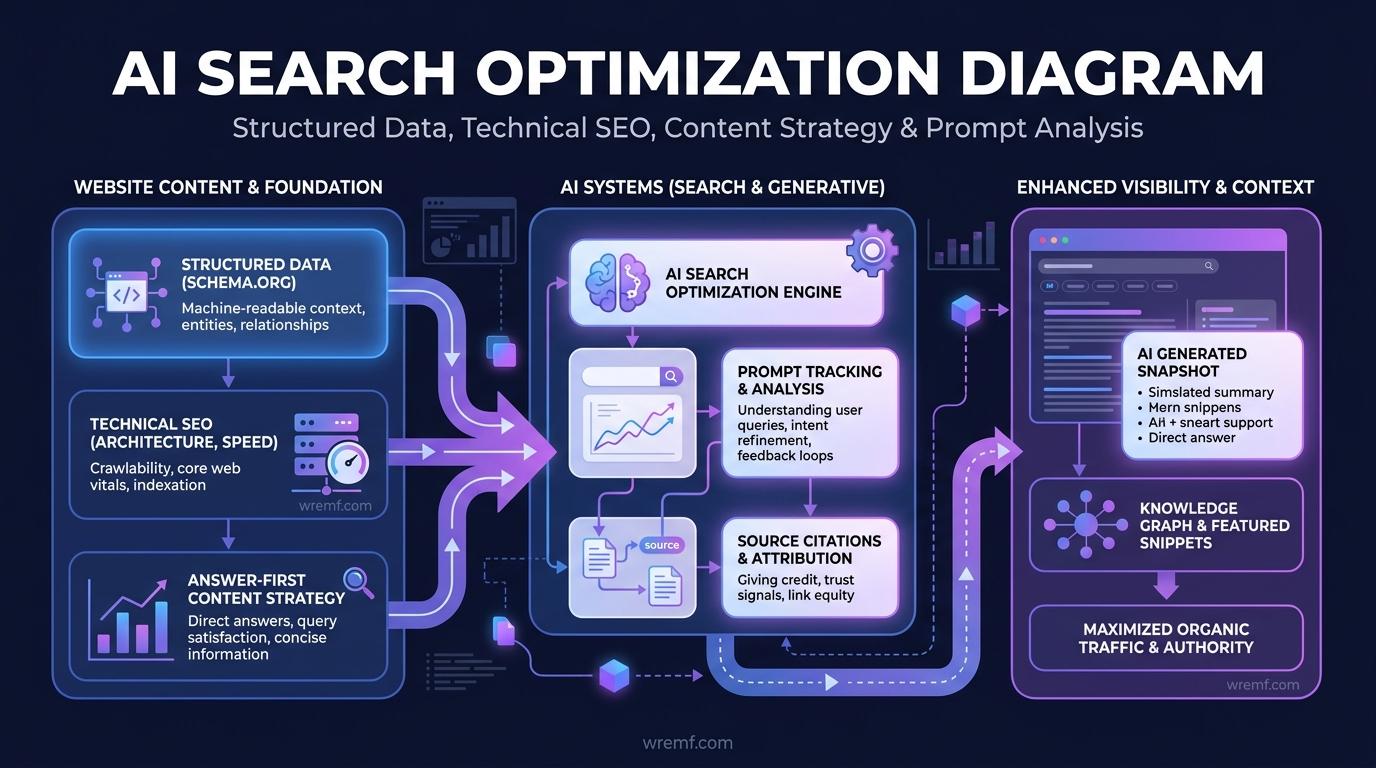
AI search optimization involves enhancing how a brand appears in AI-generated answers and recommendations. It differs from traditional SEO by prioritizing answer inclusion, source citation, and recommendation visibility. Key elements include technical SEO, structured data, schema markup, and content strategies that provide clear, concise, and retrievable information. AI systems like ChatGPT, Google AI Overviews, and Microsoft Copilot require content to be trustworthy and summarizable, directly impacting brand visibility and recommendation presence.
Key takeaways
- AI search optimization differs from classic SEO by focusing on answer inclusion and citation visibility.
- Technical SEO is crucial as AI engines require indexable, crawlable, and structured content.
- An answer-first content strategy enhances AI search visibility with direct, clear responses.
- Conversational query targeting aligns content with natural language prompts and long-tail keywords.
- Citation-worthiness is enhanced with clear, original, and source-consistent content for AI engines.
How to Optimize for AI Search Engines
How to optimize for AI search engines means making your website, brand, sources, and content easy for AI systems to understand, retrieve, cite, and recommend. Gartner predicted that traditional search engine volume would drop 25% by 2026 as AI chatbots and virtual agents take more search behavior from classic search engines. This guide explains how AI Search works across Google AI Overviews, ChatGPT, Perplexity, Claude, Gemini, Microsoft Copilot, Bing Copilot, and other AI assistants. It covers Technical SEO, structured data, schema markup, answer-first content strategy, source citations, prompt tracking, content clusters, AI tools, Google Search, Search Console, and measurement in a zero-click environment. WREMF helps B2B teams track, improve, and prove AI visibility across major AI discovery surfaces. Continue reading to build a practical AI SEO and GEO workflow.
What Is AI Search Optimization?
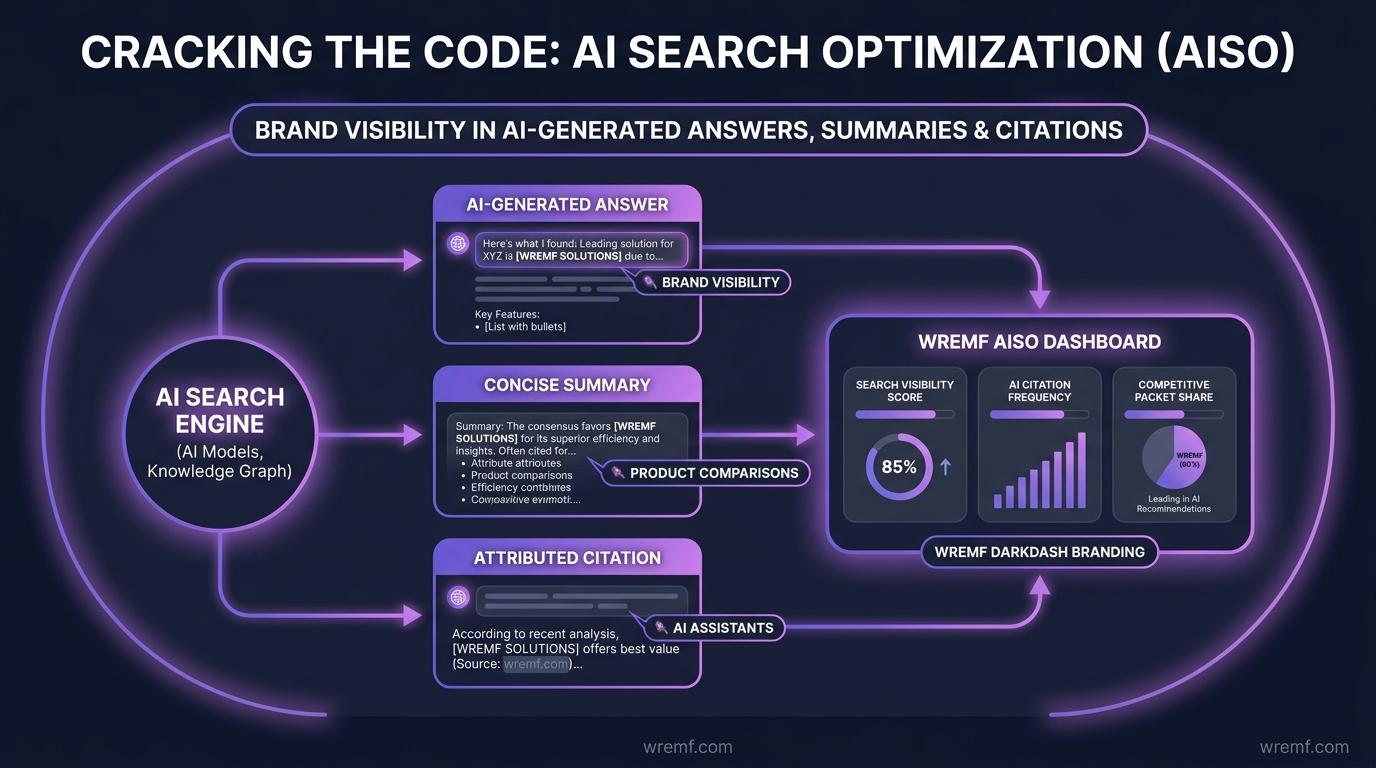
AI search optimization is the process of improving how your brand appears in AI-generated answers, summaries, citations, recommendations, and search results. AI Search matters because buyers now use AI assistants to compare vendors, solve problems, and shortlist products before visiting websites.
AI search optimization is different from classic search engine optimization because it focuses on answer inclusion, source selection, citation visibility, brand mentions, and recommendation presence. Traditional SEO still matters, but AI search engines add a new layer: your content must be retrievable, trustworthy, concise, and easy for a Large Language Model to summarize.
AI visibility is the measurable presence of a brand inside AI-generated answers, citations, recommendations, and summaries. AI visibility matters because a prospect may learn about your brand through ChatGPT, Perplexity, Google AI Overviews, Claude, Gemini, or Microsoft Copilot before clicking a website.
Generative Engine Optimization is the practice of improving how generative AI systems select, synthesize, cite, and recommend content. Generative Engine Optimization matters because AI engines often answer the user directly instead of only listing search results pages.
Answer Engine Optimization is the practice of structuring content so Answer engines can extract concise, accurate, useful answers. Answer Engine Optimization matters because users often ask AI tools full questions, not short keyword fragments.
AI SEO is the combined practice of using SEO strategies, AEO, and GEO to improve visibility across search engines and AI engines. AI SEO matters because the future search journey includes Google Search, Google AI Overviews, AI Mode, ChatGPT search, Perplexity, Claude web search, Gemini, Bing Copilot, and Microsoft Copilot.
Google Search Central explains that Google’s ranking systems are designed to prioritize helpful, reliable, people-first content created to benefit people, not content created mainly to manipulate rankings. That guidance is important because AI search optimization should strengthen usefulness and clarity rather than produce shallow generative AI content. (Google for Developers)
WREMF helps teams turn AI visibility from guesswork into a measurable workflow. The WREMF platform suite connects prompt tracking, AI citations, competitor visibility, source consistency, content briefs, GEO audits, and reporting across major AI discovery surfaces.
| Optimization Area | Main Question It Answers | What It Improves | Example Metric |
|---|---|---|---|
| SEO | Can search engines find and rank the page? | Rankings, clicks, impressions | Average position |
| AEO | Can Answer engines extract a direct answer? | Answer inclusion and snippet clarity | Answer presence |
| GEO | Can generative AI systems cite or recommend the brand? | AI citations, summaries, recommendations | Citation frequency |
| AI visibility | Does the brand appear across AI discovery surfaces? | Mentions, share of voice, attribution | Prompt-level visibility score |
The key difference between SEO and GEO is the output. SEO aims to earn visibility in search results, while GEO aims to earn visibility inside generated answers, cited sources, and AI recommendations.
KEY TAKEAWAY: AI search optimization combines SEO, AEO, and GEO so your brand can be found, understood, cited, and recommended by AI search engines.
The next step is understanding how AI search engines process queries and retrieve information.
How Do AI Search Engines Work?
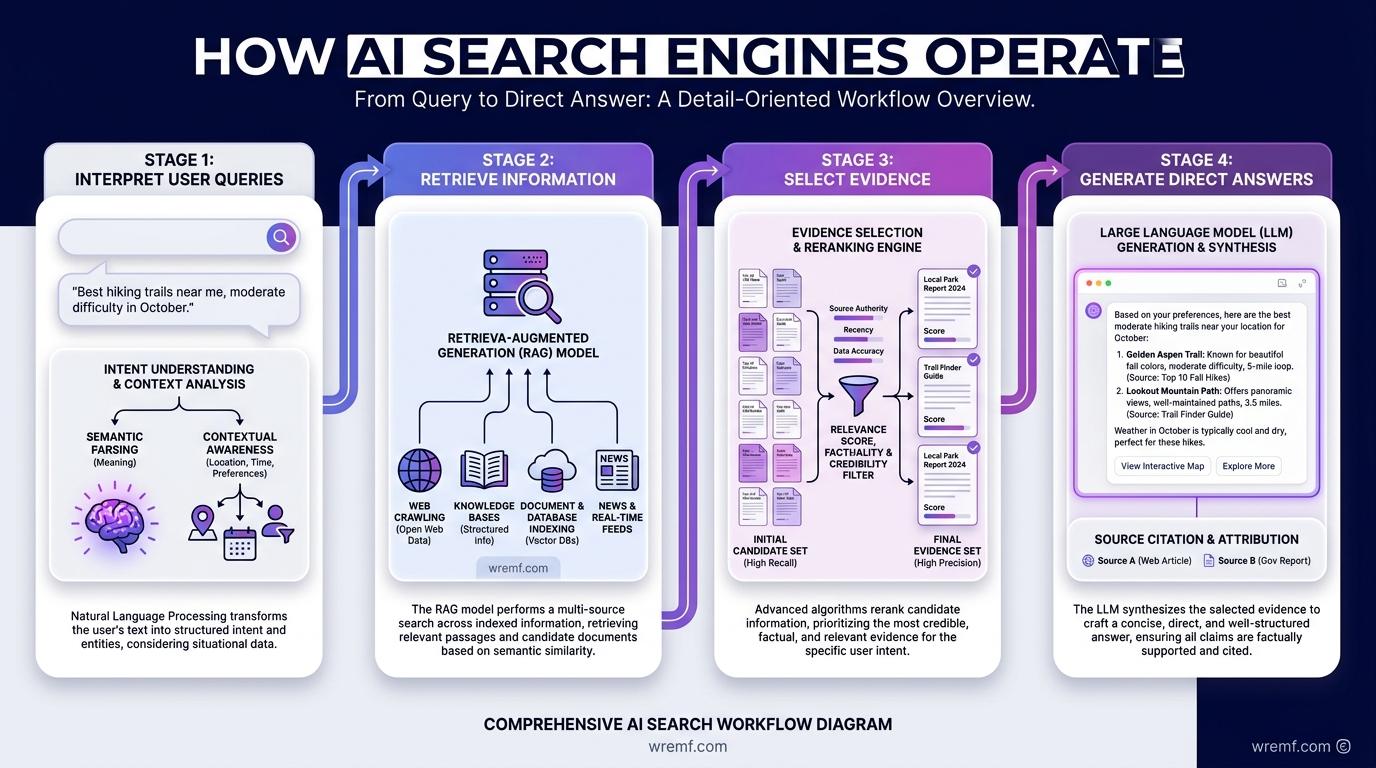
AI search engines work by interpreting a user query, retrieving relevant information, selecting evidence, and generating a direct answer. The most visible AI search systems combine search indexes, Large Language Model reasoning, retrieval systems, citations, and source ranking.
A Large Language Model is an AI system that processes and generates language based on learned patterns and available context. A Large Language Model matters for AI Search because it can turn retrieved documents into summaries, recommendations, comparisons, and direct responses.
Retrieval-Augmented Generation is a method where an AI system retrieves external information before generating an answer. Retrieval-Augmented Generation matters because many AI search engines need current sources, cited pages, or structured knowledge to answer timely questions.
An Answer engine is a system that returns a direct response instead of only showing a list of links. Answer engines matter because users increasingly expect search engines and AI assistants to summarize information, compare options, and cite supporting sources.
OpenAI says ChatGPT search provides fast, timely answers with links to relevant web sources and blends a natural language interface with current information. Anthropic says Claude’s web search tool gives Claude access to real-time web content and includes citations from search results. (OpenAI)
Perplexity describes itself as an AI-powered answer engine that provides accurate, trusted, real-time answers. Microsoft says Copilot Search in Bing combines traditional search and generative AI, provides summaries, and cites sources prominently so users can validate the answer. (Perplexity AI)
AI engines generally follow a workflow like this:
Understand the query, entity, intent, and context
Retrieve candidate sources from a search index, website, database, or web search tool
Evaluate source relevance, authority, freshness, and clarity
Generate a natural language answer from selected evidence
Add citations, links, recommendations, or follow-up prompts where the platform supports them
AI discovery surfaces are the places where people discover brands through AI-generated answers. AI discovery surfaces include Google AI Overviews, AI Mode, ChatGPT, Claude, Gemini, Perplexity, Microsoft Copilot, Bing Copilot, DeepSeek, Grok, Meta AI, Mistral, Microsoft Start, and other AI assistants.
Search index visibility still matters because many AI tools depend on indexed, crawlable, public content. If your page is blocked, thin, slow, technically broken, or unclear, AI engines may ignore it or rely on a competitor, directory, review site, Help Center, Reddit discussion, news article, or outdated profile instead.
DID YOU KNOW: Gartner predicted that traditional search engine volume would drop 25% by 2026 as generative AI chatbots and virtual agents become substitute answer engines. (Gartner)
AI visibility is the measurable presence of a brand inside AI-generated answers, citations, recommendations, summaries, and source lists. AI visibility matters because a buyer may use an AI assistant to compare vendors before visiting your website, reviewing your pricing, or speaking to sales.
KEY TAKEAWAY: AI search engines use retrieval, ranking, source selection, and generative AI synthesis, so optimization must improve access, clarity, credibility, citations, and measurement.
Once you understand the retrieval process, you can build the technical foundation AI engines need to read your website.
Build Technical SEO Foundations for AI Search Engines
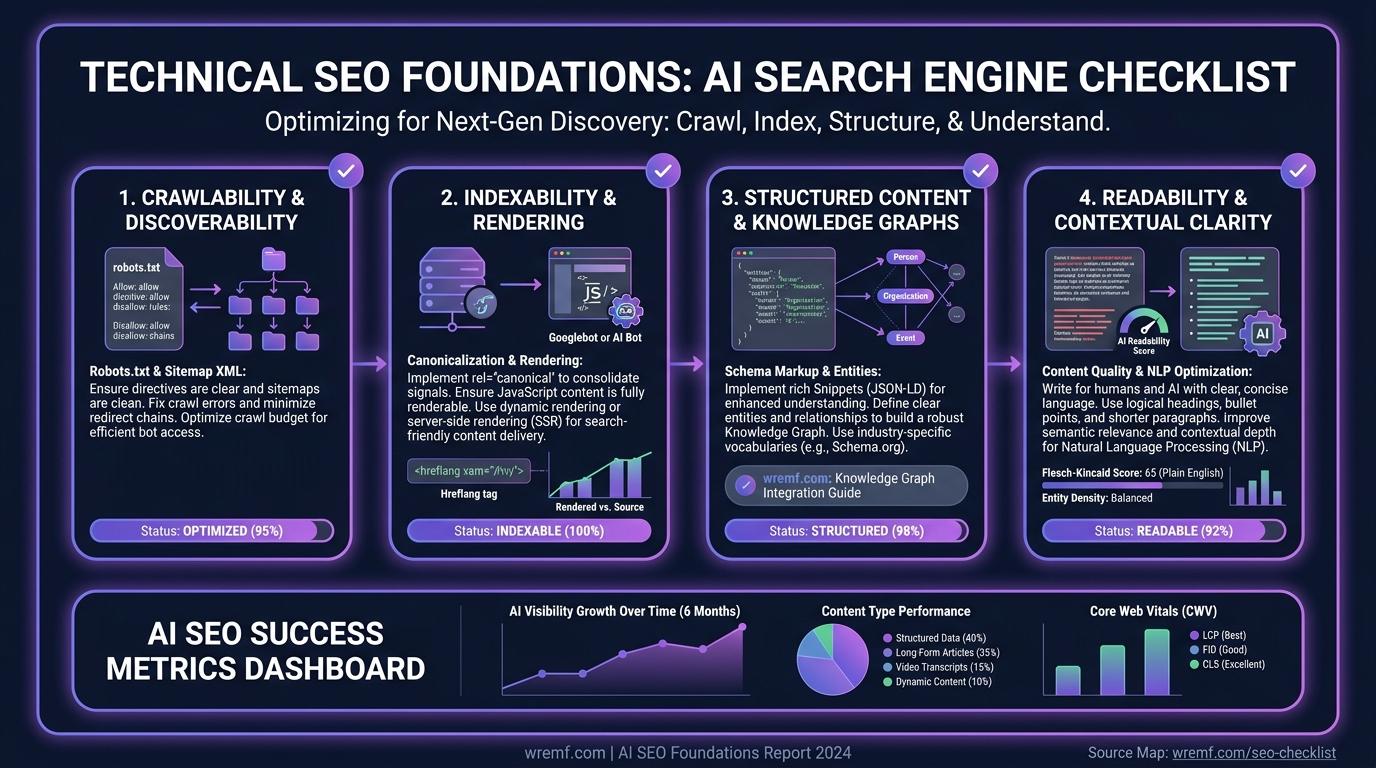
Technical SEO makes your website crawlable, indexable, structured, and readable for search engines and AI engines. AI Search visibility often fails when important content is blocked, hidden, duplicated, slow, or hard for machines to parse.
Technical SEO is the process of improving a website’s crawlability, indexability, rendering, structure, performance, and search accessibility. Technical SEO matters for AI Search because many AI search engines depend on web indexes and retrievable pages.
Indexable content is content that search engines can discover, crawl, render, and store in a search index. Indexable content matters because Google AI Overviews, Google Search, AI Mode, Bing, Copilot Search, and other retrieval systems cannot reliably use pages that are blocked or unavailable.
Semantic HTML is the use of meaningful HTML elements that describe page structure. Semantic HTML matters because search engines, accessibility tools, and AI systems can better understand headings, tables, lists, navigation, product information, author bio sections, FAQ sections, and article structure.
Semantic HTML should support a clear heading hierarchy. Semantic HTML helps machines understand whether a passage is a definition, comparison, checklist, FAQ answer, product explanation, service description, or company profile. Semantic HTML also reduces ambiguity when a page includes several topics, products, or audience segments.
Google Search Central explains that structured data is a standardized format for providing information about a page and classifying the page content. Google also says it uses structured data to understand page content and gather information about people, books, companies, and other entities. (Google for Developers)
Structured data helps search engines understand entities, facts, and relationships. Structured data matters for AI search optimization because machines need clear clues about organizations, products, services, articles, FAQs, breadcrumbs, events, reviews, and local business details.
Schema markup is a vocabulary used to describe structured data on a page. Schema markup matters because it can clarify entity types, page types, product details, service details, FAQPage schema, FAQ schema, Article markup, Organization markup, Product markup, Rich Results eligibility, and Rich snippet context.
Google says it generally recommends JSON-LD for structured data when a site setup allows it because it is easier to implement and maintain at scale. Google also warns not to add structured data about information that is not visible to users, even if the information is accurate. (Google for Developers)
For AI search engines, your technical checklist should include:
HTTP 200 status codes for strategic pages
Clean canonical tags
Crawlable internal linking
XML sitemap coverage for important pages
Fast loading templates
Stable rendering for important body copy
Semantic HTML for headings, sections, tables, and FAQs
Structured data that matches visible page content
Author bio and reviewer information where relevant
Clear organization and product details
No accidental noindex, robots.txt blocking, or broken redirects
WordPress Caching checks if your CMS uses WordPress Caching plugins
WordPress Caching validation after template, plugin, or structured data changes
WordPress Caching rules that do not serve outdated schema markup or stale metadata
Internal linking is the practice of connecting related pages with descriptive links. Internal linking matters for AI Search because it shows relationships between topics, categories, entities, product pages, comparison pages, methodology pages, Help Center content, and content clusters.
A Knowledge Graph is a structured representation of entities and relationships. A Knowledge Graph matters because AI engines need to understand how your company, products, people, topics, industry terms, and sources connect.
A Google Business Profile is a business listing that helps Google understand local business details such as name, category, location, hours, reviews, and services. A Google Business Profile matters for local AI assistant queries because users may ask for nearby providers, service availability, or trusted local options.
Technical SEO is especially important for product pages, service pages, documentation, Help Center articles, Business Profile pages, comparison pages, and content clusters. If an AI engine cannot parse your page cleanly, it may rely on a third-party summary instead of your official source.
| Technical Element | Why It Matters for AI Search | Common Mistake | Better Practice |
|---|---|---|---|
| Crawlability | Lets search engines and AI engines access the page | Blocking important URLs | Keep revenue and authority pages crawlable |
| Indexability | Allows pages to enter the search index | Accidental noindex | Audit templates and canonical rules |
| Semantic HTML | Helps machines parse page structure | Generic page blocks | Use clear headings, sections, lists, and tables |
| Structured data | Clarifies entities and content types | Markup that does not match visible content | Keep schema markup aligned with the page |
| Internal linking | Shows topic and entity relationships | Orphaned content | Link clusters with descriptive anchor text |
| Metadata | Explains page purpose | Duplicate titles | Use specific, intent-led metadata |
| WordPress Caching | Protects performance and freshness | Serving stale markup | Clear cache after SEO and schema updates |
WREMF supports practical GEO audits that review crawlability, rendering, entity clarity, answer-first structure, internal linking, and source gaps. Teams can use the WREMF GEO audit workflow to find technical and content issues before rewriting pages at scale.
KEY TAKEAWAY: Technical SEO supports AI search visibility by making pages accessible, indexable, structured, and easier for AI engines to interpret.
After machines can read your pages, your content strategy needs to help them answer real questions.
Move to an Answer-First Content Strategy for AI Search
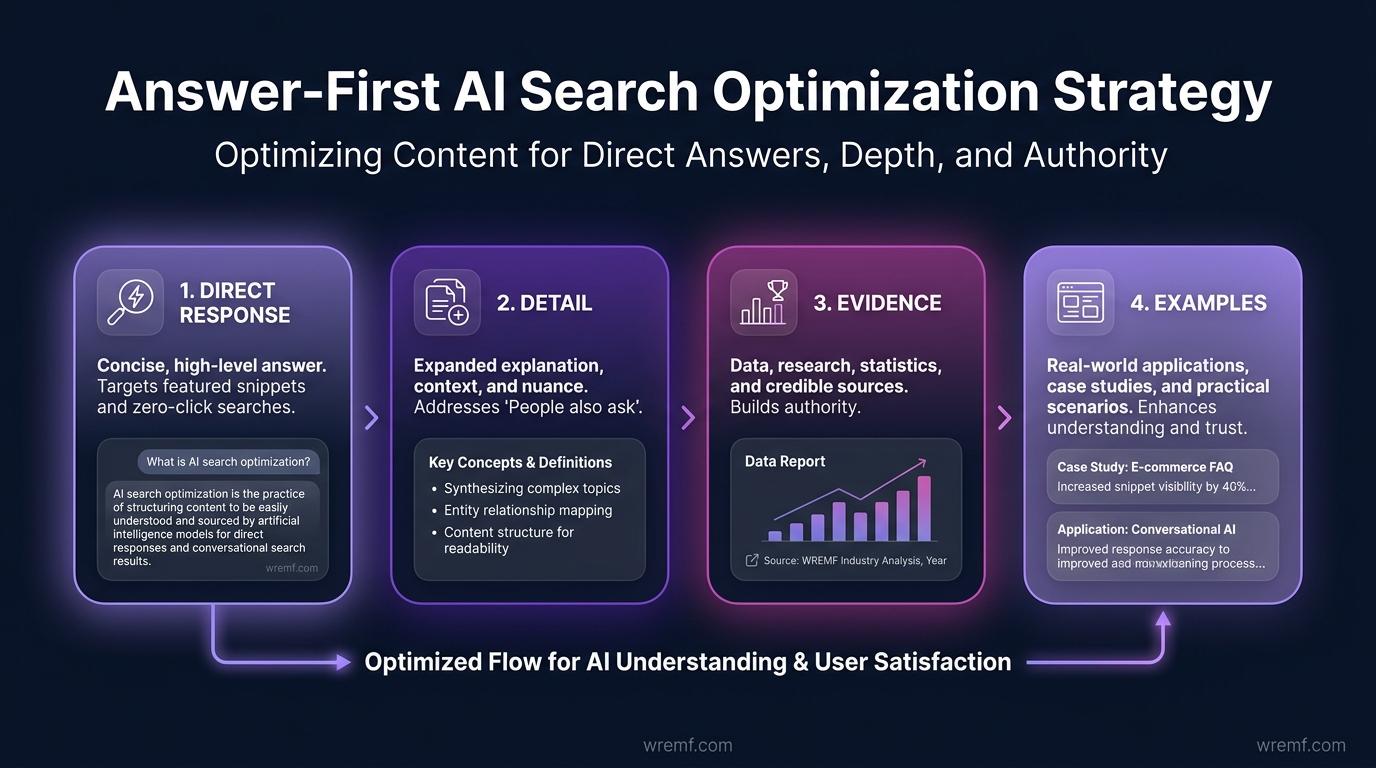
An answer-first content strategy gives users and AI engines a direct response before adding detail, evidence, and examples. AI Search rewards content that is clear enough to extract and complete enough to trust.
Content strategy is the plan for creating, structuring, updating, and measuring content around audience needs and business goals. Content strategy matters for AI search optimization because AI engines need pages that answer questions directly and support those answers with credible evidence.
Answer-first content is content that begins important sections with a direct answer. Answer-first content matters because AI Overviews, ChatGPT, Perplexity, Claude, Gemini, Copilot, and voice assistants often need concise passages that make sense without surrounding text.
Generative AI content is content created with the help of AI tools. Generative AI content can support scale, but it needs human review, fact-checking, original insight, and brand-specific expertise to avoid becoming generic or inaccurate.
Google Search Central’s people-first content guidance asks whether content provides original information, substantial description, insightful analysis, and additional value beyond rewriting other sources. That is a useful standard for AI SEO because weak generative AI content gives AI engines little reason to cite your page. (Google for Developers)
A strong answer-first page should include:
A direct definition in the introduction
H2 sections that begin with an extractable answer
Concise paragraphs with one main idea
Clear tables for comparisons
FAQs based on real user prompts
Named sources near factual claims
Author bio and reviewer signals where appropriate
Updated examples and current terminology
Strong internal linking to related content clusters
Clear product, service, and audience positioning
The 3-sentence rule is a content structure where a passage includes one direct answer, one supporting explanation, and one implication. The 3-sentence rule matters because AI engines can extract the passage without losing the main meaning.
People Also Ask data is a useful source of natural language questions that users already ask in Google Search. People Also Ask matters because those questions often match how users prompt ChatGPT, Gemini, Perplexity, and Claude.
Keyword research is still useful, but AI Search requires prompt research too. Keyword research tells you what people search. Prompt research tells you how people ask an AI assistant for help, comparison, diagnosis, or recommendation.
AI tools can help gather question patterns, summarize competitor pages, cluster prompts, and draft content briefs. AI tools should not replace expert judgment because AI tools can miss nuance, repeat errors, or invent unsupported claims.
The WREMF prompt intelligence workflow helps teams track real prompts across AI engines, identify missing answers, compare AI-generated responses, and convert content gaps into action.
TIP: Rewrite important H2 sections so the first 1 to 2 sentences answer a complete query without needing the rest of the article.
AI search optimization works best when content is written in modular blocks. A modular page gives AI engines clear definitions, answer-first passages, source-backed claims, comparison tables, and practical workflows. A modular page also helps human readers scan, validate, and act faster.
KEY TAKEAWAY: Answer-first content strategy improves AI search visibility because it gives both users and AI systems clear, extractable, source-backed answers.
The next step is matching your content to the prompts buyers actually use.
Target Conversational Queries, Long-Tail Keywords, and Prompt Intent
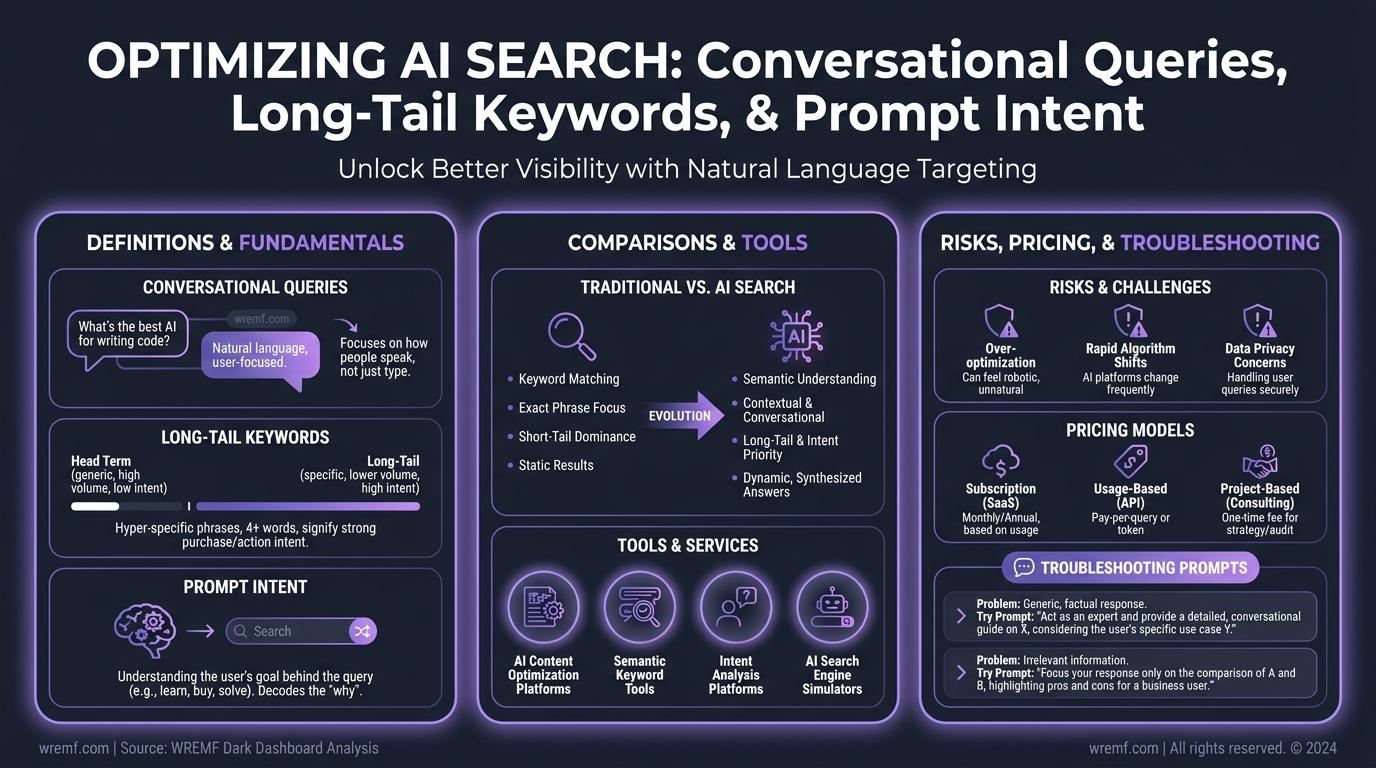
Conversational query targeting helps AI search engines match your content to how people ask questions. AI search optimization should cover definitions, comparisons, tools, services, risks, pricing, implementation, product pages, and troubleshooting prompts.
Long-tail keywords are specific search phrases that reveal clearer intent than broad keywords. Long-tail keywords matter because AI assistants often receive detailed prompts such as “how do I optimize my SaaS website for ChatGPT and Google AI Overviews?”
Prompt intent is the goal behind a natural language question asked in an AI tool. Prompt intent matters because users ask AI assistants to explain, compare, recommend, summarize, diagnose, plan, and choose.
Search results pages used to be the main place where users compared links. AI search results now often combine summaries, citations, follow-up prompts, cited sources, related topics, product suggestions, news results, video results, and business listings inside one experience.
Your prompt map should include questions from every buying and learning stage:
What is AI Search optimization?
What are Generative Search Results?
What is Generative Engine Optimization?
How do I optimize my website for AI search engines?
How do I rank in ChatGPT, Perplexity, Gemini, and Google AI Overviews?
What makes content stand out in AI Search?
How should I structure content for AI search visibility?
How does schema markup help AI understand content?
How can semantic clarity boost AI Search visibility?
What writing mistakes reduce AI search visibility?
Is SEO still worth it with Google AI Overviews and AI Mode?
What AI tools monitor AI visibility?
How do I measure AI traffic attribution?
How do I optimize product pages for AI search engines?
How can agencies report AI visibility to clients?
How do I keep SEO strategies effective as generative AI changes search?
Prompt tracking is the process of monitoring how AI engines answer selected questions over time. Prompt tracking matters because AI answers can change by engine, date, location, query wording, and source availability.
Content gaps are missing questions, topics, examples, comparisons, or proof points that prevent a page from satisfying user intent. Content gaps matter because AI engines may cite competitors, directories, forums, Help Center pages, or news articles when your own site does not answer the query.
Content clusters are groups of related pages that cover a topic from multiple angles. Content clusters matter because AI engines and search engines can better understand topic authority when definitions, comparisons, use cases, methodology, product pages, and support content are connected.
| Prompt Intent | Example Query | Best Content Format | Measurement |
|---|---|---|---|
| Definition | What is AI search optimization? | Pillar section or glossary | Answer inclusion |
| Comparison | SEO vs AEO vs GEO | Comparison table | Mention and citation share |
| Implementation | How do I optimize my website for AI Search? | Checklist or workflow | Task completion |
| Commercial | Best AI visibility tools for agencies | Buying guide or product page | Demo intent |
| Risk | Will AI Overviews reduce clicks? | Measurement guide | Branded search and AI referrals |
| Platform | How do I optimize for Perplexity? | Platform-specific guide | Citation frequency |
| Local | How do I appear in AI assistant local results? | Business Profile and local page | Local mention visibility |
| Support | How should Help Center content support AI Search? | Support article hub | Answer accuracy |
Semantic clarity is the practice of using precise language, consistent terminology, and explicit entity relationships. Semantic clarity matters because AI engines need to distinguish your brand, product, category, audience, competitors, features, and use cases.
In practical AI visibility audits, marketing teams often find that pages answer broad SEO keywords but miss buyer prompts. For example, a page may define AI SEO but fail to answer “which AI visibility metrics should a CMO report monthly?” That missing prompt can cause absence in high-intent AI recommendations.
KEY TAKEAWAY: AI search engines reward content that matches natural language prompts, not just exact-match keywords.
Once prompts are mapped, your pages need to become reliable sources that AI systems can cite.
Become a Citation-Worthy Source for AI Engines
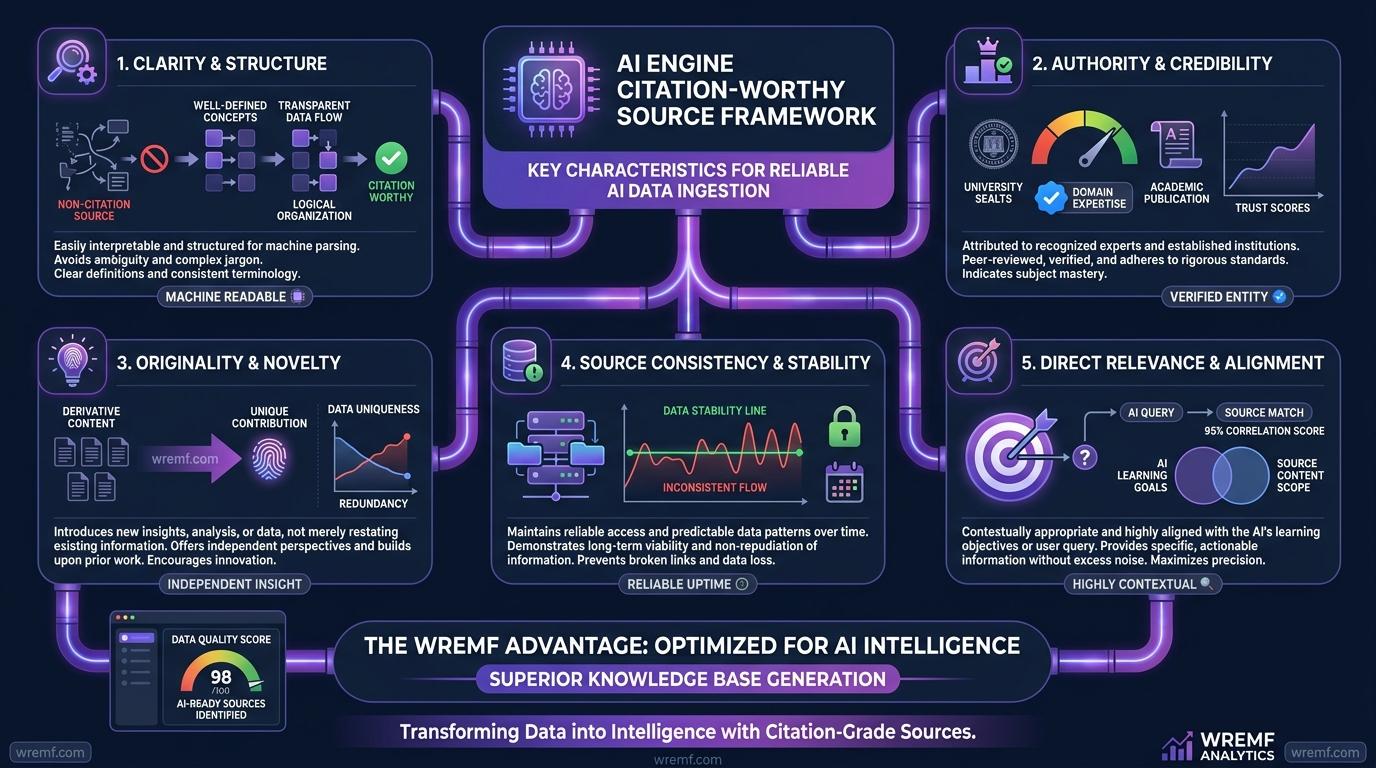
A citation-worthy source gives AI engines clear, verifiable, useful evidence for a specific answer. Citation worthiness depends on clarity, authority, originality, source consistency, and direct relevance to the user’s prompt.
AI citations are links, references, or source mentions used to support AI-generated answers. AI citations matter because a brand can gain visibility even when the user does not click a traditional organic result.
Source citations are the specific pages, domains, documents, or publications an AI engine uses to ground an answer. Source citations matter because they show which sources influence AI-generated summaries, comparisons, and recommendations.
Microsoft says Copilot responses will have more prominent citations to show the publisher content they are sourced from. Microsoft also says Copilot Search cites sources prominently so users can validate where information came from. (Microsoft)
A citation-worthy page usually includes:
A direct answer to a real question
Specific claims supported by named sources
Original analysis or proprietary data where possible
Clear definitions
Practical examples
Comparison tables
Updated product and service details
Consistent brand facts
Author bio or reviewer information for expert topics
Strong internal links to related pages
External links only where they strengthen authority
Proprietary data is original information produced through research, product usage, surveys, customer analysis, or market tracking. Proprietary data matters because AI engines, journalists, analysts, and search engines have more reason to cite content that adds new evidence.
Entity authority is the strength and clarity of a brand, product, person, or organization across trusted sources. Entity authority matters because AI systems need to know who you are, what category you belong to, what you sell, and which third-party sources confirm those facts.
Source consistency is the alignment of brand facts across your website, third-party profiles, review platforms, directories, documentation, social profiles, news articles, and Business Profile information. Source consistency matters because conflicting sources can cause inaccurate AI summaries.
Digital PR can support AI visibility when it earns credible mentions from trusted publications, analyst pages, industry reports, expert interviews, podcasts, events, and directories. Digital PR should not be measured by backlink volume alone. For AI Search, relevance, authority, and consistency matter more than raw link counts.
Brand mentions are references to your company across your website, third-party sources, forums, news, directories, social platforms, and partner pages. Brand mentions matter because AI systems can use repeated, consistent references to understand relevance and category association.
WREMF helps teams monitor which sources AI engines cite for important prompts. The WREMF source citation tracking workflow helps identify whether AI answers rely on your site, competitors, directories, review sites, media articles, forums, or outdated third-party pages.
If you want to see how AI engines currently describe your brand, review a sample AI visibility report before building your own measurement workflow.
KEY TAKEAWAY: AI citations matter because they reveal which sources influence AI-generated answers, not just which pages rank in Google Search.
After building citation-worthy sources, you need platform-specific tactics because each AI engine retrieves and presents answers differently.
Optimize for Google AI Overviews, AI Mode, ChatGPT, Perplexity, Claude, Gemini, and Copilot
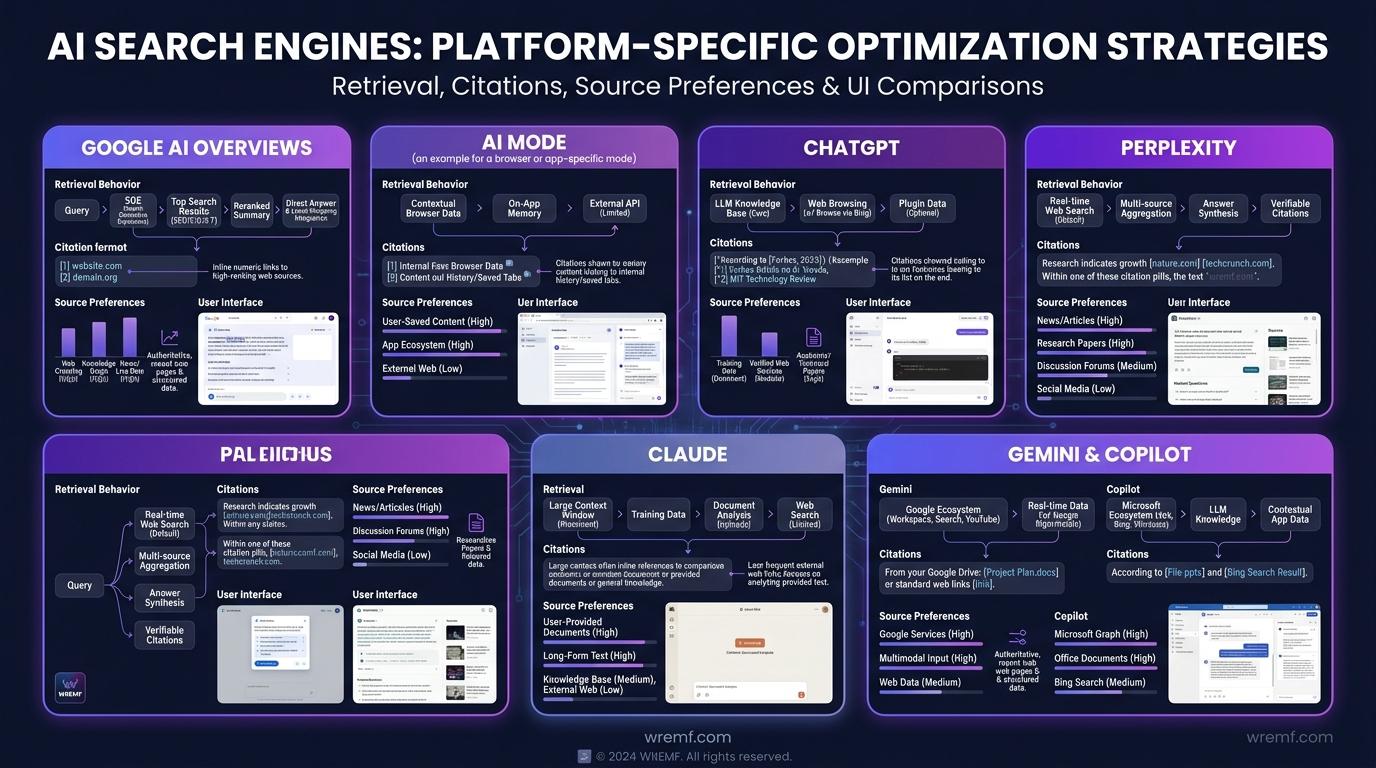
Platform-specific optimization matters because each AI search engine has different retrieval behavior, citation formats, source preferences, and user interfaces. The shared foundation is helpful, crawlable, structured, answer-first content, but measurement must be engine-specific.
Google AI Overviews are AI-generated summaries that appear in Google Search for some queries. Google AI Overviews matter because they can appear above traditional search results and influence whether users click, refine, or continue researching.
Google AI Overviews should be treated as part of Google Search, not as a separate channel. Google’s AI features guidance points website owners back to Search fundamentals, which means helpful content, technical accessibility, indexability, and snippet eligibility remain important. (Google for Developers)
Google’s AI Overviews are not the same as the earlier Google SGE experiment. Google SGE was the Search Generative Experience test environment, while Google AI Overviews and AI Mode are current AI Search experiences that affect how users discover information in Google.
AI Mode is Google’s conversational AI Search experience for deeper, follow-up-driven exploration. AI Mode matters because users can ask longer prompts, compare topics, and continue a query chain instead of restarting with a short keyword.
ChatGPT search is OpenAI’s search experience that can answer current questions with links to relevant web sources. ChatGPT search matters because users can ask conversational questions and refine the answer through follow-up prompts.
Perplexity is an answer engine that emphasizes real-time answers and source visibility. Perplexity matters because source citations are central to the user experience, making citation frequency a practical AI visibility KPI.
Claude web search gives Claude access to real-time web content and citations from search results. Claude matters for B2B research because users often ask it to summarize, compare, evaluate, and analyze complex topics.
Microsoft Copilot and Bing Copilot matter because Microsoft integrates generative AI into Bing, Copilot Search, Microsoft Start, productivity workflows, and work-related discovery surfaces. Microsoft says Copilot Search blends traditional and generative search and includes citations, web results, relevant data, and video results. (Bing Blogs)
Gemini matters because it connects closely to the Google ecosystem and AI Mode. DeepSeek, Grok, Meta AI, and Mistral matter because users are spreading discovery behavior across multiple Generative AI platforms and AI assistants.
| Platform | What to Optimize | What to Monitor | Practical Priority |
|---|---|---|---|
| Google AI Overviews | Helpful content, Technical SEO, structured data, entity clarity | Inclusion, citations, linked sources | Maintain Google Search fundamentals |
| AI Mode | Deep answer coverage and follow-up intent | Answer accuracy and source presence | Build complete content clusters |
| ChatGPT search | Current, clear, source-backed content | Mentions, citations, recommendations | Publish direct comparison and product facts |
| Perplexity | Trusted sources and concise evidence | Citation frequency and source order | Build citation-ready answer blocks |
| Claude | Verifiable claims and balanced language | Citations and answer quality | Support claims with credible sources |
| Microsoft Copilot | Bing-visible content and cited sources | Mentions and citation presence | Maintain Bing and Microsoft ecosystem visibility |
| Gemini | Google ecosystem clarity and topic authority | AI answer inclusion and brand framing | Strengthen entity and content structure |
Semrush reported that queries triggering AI Overviews became less purely informational during 2025, with informational intent dropping from 91.3% in January 2025 to 57.1% in October 2025 among queries that triggered AI Overviews. That shift matters because AI Overviews increasingly touch commercial, navigational, and transactional search behavior. (Semrush)
In real B2B buying journeys, users ask prompts like “best AI visibility tools for agencies,” “compare GEO software and SEO tools,” or “which platform tracks ChatGPT and Perplexity citations?” These prompts combine education and buying intent, so your content needs both substance and decision support.
WREMF tracks visibility across 10 AI engines, including ChatGPT, Claude, Gemini, Perplexity, Google AI Overviews, Copilot, DeepSeek, Grok, Meta AI, and Mistral. The goal is not to assume one AI engine represents the entire AI Search landscape. The goal is to compare how each AI engine describes, cites, and recommends your brand.
KEY TAKEAWAY: AI search optimization needs a shared foundation plus platform-specific monitoring because every AI engine retrieves and presents answers differently.
Once platform tactics are clear, you need a measurement system that captures more than clicks.
Measure AI Visibility in a Zero-Click Search Environment
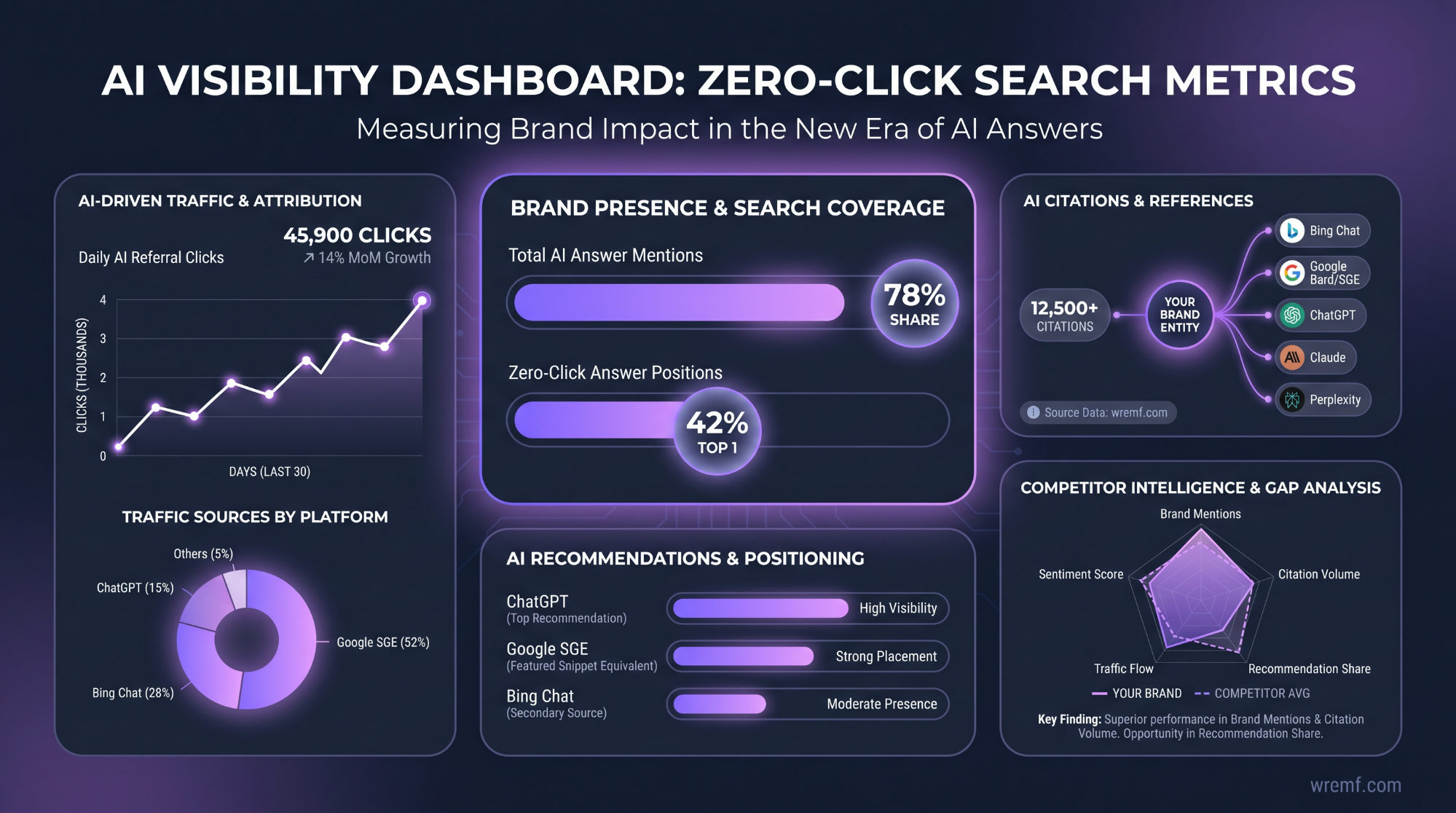
AI visibility measurement tracks brand presence, citations, recommendations, competitors, and AI-driven traffic when users may not click a website. Traditional SEO metrics remain useful, but they cannot fully explain AI Search performance.
AI share of voice is the percentage of relevant AI-generated answers where your brand appears compared with competitors. AI share of voice matters because AI assistants often recommend only a small set of brands, vendors, tools, sources, or products.
AI traffic attribution connects AI discovery surfaces to sessions, conversions, branded search, pipeline, or assisted journeys. AI traffic attribution matters because AI influence can appear as referral traffic, direct traffic, branded search, sales conversations, or partner mentions.
Search Console is Google’s performance reporting tool for clicks, impressions, CTR, and average position in Google Search. Search Console matters for AI search optimization because it shows whether pages have a strong organic foundation, but Search Console does not fully isolate every AI-generated answer or zero-click influence.
Similarweb estimated that AI platforms generated more than 1.13 billion referral visits in June 2025, while Google Search generated 191 billion referrals in the same month. Similarweb also reported that AI referrals were up 357% from June 2024, which shows fast growth from a smaller base. (Similarweb)
The Reuters Institute’s 2026 report was based on a strategic sample of 280 digital leaders from 51 countries and territories. The report reflects why publishers and marketers are watching AI summaries, chatbot discovery, and referral shifts closely. (reutersinstitute.politics.ox.ac.uk)
AI visibility works by measuring prompts, citations, mentions, competitors, source consistency, and downstream traffic signals together. AI visibility cannot be reduced to rankings alone because AI-generated answers can mention a brand, cite a third-party source, or recommend a competitor without producing a click.
A practical AI visibility dashboard should include:
| KPI | What It Measures | Why It Matters |
|---|---|---|
| Prompt visibility | Whether your brand appears for tracked prompts | Shows answer presence |
| Citation frequency | How often AI engines cite your pages or sources | Shows source influence |
| Recommendation share | How often your brand is recommended | Shows buying-stage visibility |
| Competitor visibility | Which competitors appear instead of you | Shows displacement risk |
| Source consistency | Whether sources describe your brand accurately | Reduces confusion |
| AI referral traffic | Sessions from AI platforms | Connects AI discovery to visits |
| Branded search lift | Changes in branded demand | Captures indirect influence |
| Sentiment | Positive, neutral, or negative framing | Shows reputation risk |
| Search Console trend | Clicks, impressions, CTR, and position | Connects SEO and AI visibility |
| Content gap count | Missing answer opportunities | Guides content strategy |
Competitor visibility is the presence of competing brands inside AI-generated answers for the same prompts. Competitor visibility matters because the real question is not only “Do we appear?” but “Who appears when we do not?”
The WREMF methodology connects prompts, citations, competitors, source consistency, and attribution into one repeatable measurement system. This makes AI Search easier to report because teams can show what changed, why it changed, and what action comes next.
IMPORTANT: AI visibility measurement is directional, not absolute. Answers can vary by engine, model, location, prompt wording, freshness, personalization, and source availability.
KEY TAKEAWAY: AI visibility measurement requires prompt tracking, citation analysis, competitor comparison, source consistency, Search Console context, and attribution because clicks alone miss much of AI search influence.
Measurement shows where you stand, but improvement requires a repeatable implementation workflow.
How to Optimize Your Website for AI Search Engines Step by Step
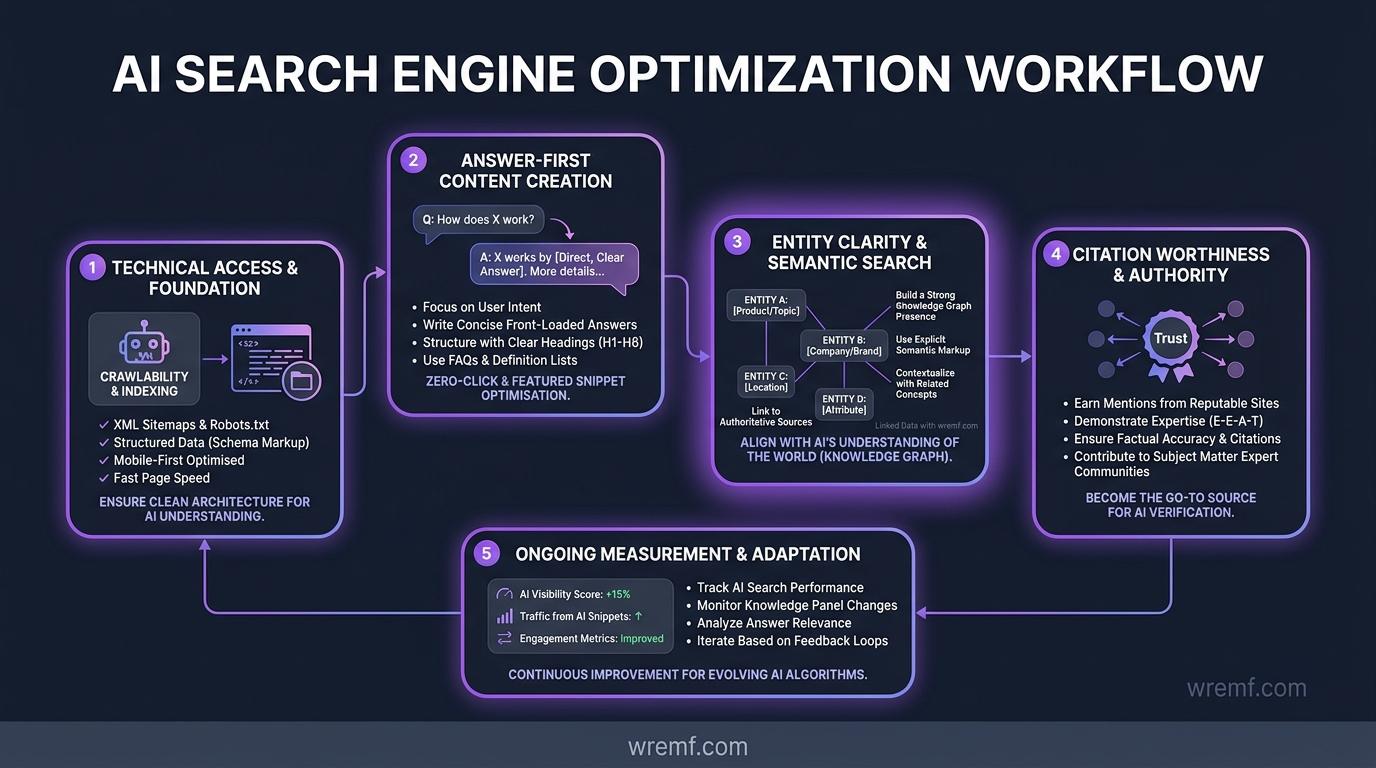
The most effective way to optimize your website for AI search engines is to combine technical access, answer-first content, entity clarity, citation worthiness, and ongoing measurement. A one-time rewrite is not enough.
This workflow applies to B2B SaaS companies, agencies, consultants, product-led companies, publishers, ecommerce teams, local businesses, and service businesses.
Audit crawlability and indexability
Start with the pages that matter most for revenue, category authority, and brand trust. Check whether each page returns HTTP 200, is indexable, loads important content reliably, uses a canonical URL, and has clear metadata.
Use this when:
Important pages are missing from search results
AI engines cite competitors but not your pages
Product pages depend on heavy JavaScript
Help Center content is not indexed
Business Profile details conflict with website details
Map prompts to pages
Create a prompt map that connects real user questions to the best page on your site. Include definition prompts, comparison prompts, tool prompts, service prompts, commercial prompts, risk prompts, local prompts, and implementation prompts.
Use this when:
You have many pages but unclear intent coverage
AI tools mention your competitors more often
Your blog posts attract traffic but not buyer intent
You need to prioritize content briefs
Rewrite key sections with answer-first structure
Each important page should answer the main query in the first paragraph. Each H2 should begin with a direct answer. Each major term should have a concise definition.
A strong section includes:
One direct answer
One supporting explanation
One example or data point
One implication
One clear next step
Add structured comparisons and decision support
AI engines often answer comparison prompts. Tables help users and machines understand differences between tools, workflows, metrics, platforms, content types, and implementation options.
Use tables for:
SEO vs AEO vs GEO
AI visibility tools vs SEO tools vs manual testing
Prompt tracking vs citation tracking vs AI traffic attribution
Software vs agency vs hybrid model
Brand mentions vs citations vs recommendations
Product page optimization priorities
Search engine vs Answer engine vs generative AI platform
Strengthen entity and Knowledge Graph signals
Make your organization, product, category, audience, founders, authors, services, pricing, and methodology consistent across your site and third-party sources. Add strong About pages, author bio sections, product pages, comparison pages, service pages, and methodology pages.
Build citation-worthy content clusters
Create content clusters that answer the full topic, not just one keyword. A cluster may include a pillar page, glossary, product page, methodology page, comparison page, pricing page, Help Center articles, case-style examples, and FAQs.
Optimize product pages and service pages
Product pages and service pages should include direct answers, use cases, audience fit, pricing context, differentiators, limitations, FAQs, structured data, internal links, and source-backed claims. AI engines need enough detail to compare your offer with alternatives.
Use FAQPage schema carefully
FAQPage schema and FAQ schema can help clarify question and answer content when they match visible page content. FAQPage schema should support real user questions, not repeat keyword-stuffed variations.
Monitor AI answers weekly
Track priority prompts across AI engines. Record brand mentions, citations, competitors, answer sentiment, recommendation wording, source changes, and inaccurate descriptions.
Turn findings into content briefs and tests
AI visibility findings should become action items. A missing citation may require a stronger methodology page. An inaccurate brand description may require source consistency cleanup. A competitor recommendation may reveal a content gap.
WREMF supports this workflow through AI visibility tracking, prompt intelligence, source citation analysis, competitor visibility, content recommendations, SEO testing, and reporting. Teams can use WREMF AI-ready content briefs to turn prompt and citation gaps into practical content updates.
KEY TAKEAWAY: AI search optimization is a repeatable workflow that moves from audit to prompt mapping, content restructuring, citation building, monitoring, and testing.
Once the workflow is defined, teams need to decide whether software, services, or a hybrid approach fits best.
Should You Use AI Visibility Software, an Agency, or a Hybrid Model?
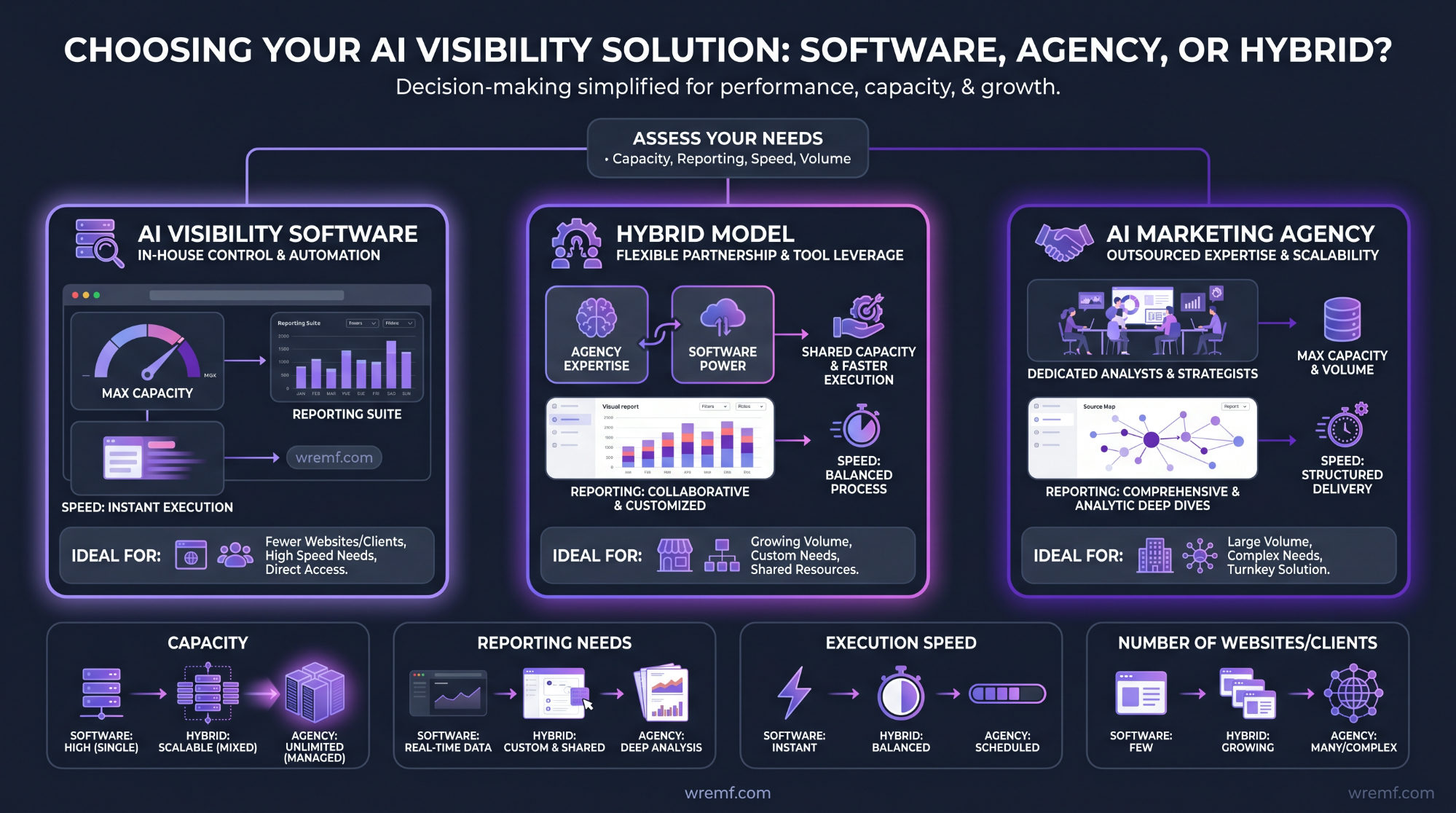
You should choose AI visibility software, an agency, or a hybrid model based on your capacity, reporting needs, execution speed, and number of websites or clients. Most growing teams need software for measurement and internal or external support for execution.
AI visibility software is a platform that tracks prompts, AI citations, mentions, competitors, source consistency, visibility scoring, and reporting across AI engines. AI visibility software matters because manual testing is too inconsistent for repeatable decision-making.
An AI visibility agency is a service partner that helps execute AEO, GEO, content optimization, entity cleanup, citation improvement, technical recommendations, and monthly reporting. An AI visibility agency matters when teams need strategy and implementation without hiring a full internal function.
A hybrid model combines software measurement with managed execution. A hybrid model matters because AI visibility is both a measurement problem and a source ecosystem problem.
| Option | Best For | What It Measures | What It Misses | Recommended When |
|---|---|---|---|---|
| Manual testing | Early exploration | A few prompts | Scale, history, consistency, competitors | You are validating the channel |
| SEO tools only | Traditional Google Search performance | Rankings, links, traffic, keywords | AI mentions, citations, recommendation visibility | SEO is still the main priority |
| AI visibility software | Teams that need repeatable monitoring | Prompts, citations, competitors, share of voice | Execution unless included | You need reporting and dashboards |
| Agency service | Teams lacking execution capacity | Depends on reporting setup | Productized monitoring if not included | You need implementation support |
| Hybrid model | B2B brands and agencies scaling AI visibility | Measurement plus action | Requires coordination | You need software and managed execution |
Agencies managing multiple clients often need white-label reporting, client portals, API access, prompt libraries, scheduled monitoring, and consistent reporting logic. In-house brands often need dashboards, recommendations, stakeholder reports, source cleanup, and board-ready visibility summaries.
WREMF is useful for brands that want software, agencies that need white-label reporting, and teams that want managed execution. For teams that need strategy and implementation, the WREMF agency team provides managed AEO, GEO, authority building, source consistency cleanup, technical AI visibility foundations, and AI-ready content execution.
Pricing can matter when AI visibility moves from experiment to operating system. WREMF pricing includes Starter at €39 per month for 1 website, Growth at €89 per month for 5 websites, and Enterprise for unlimited websites, unlimited seats, and custom branded portals. Teams comparing software, agency, and hybrid models can review WREMF pricing when cost and packaging become part of the decision.
KEY TAKEAWAY: Software measures AI visibility, agencies execute improvements, and hybrid models work best when teams need both reliable data and practical implementation.
Choosing the right model also helps avoid common mistakes that reduce AI Search visibility.
Common AI Search Optimization Mistakes to Avoid
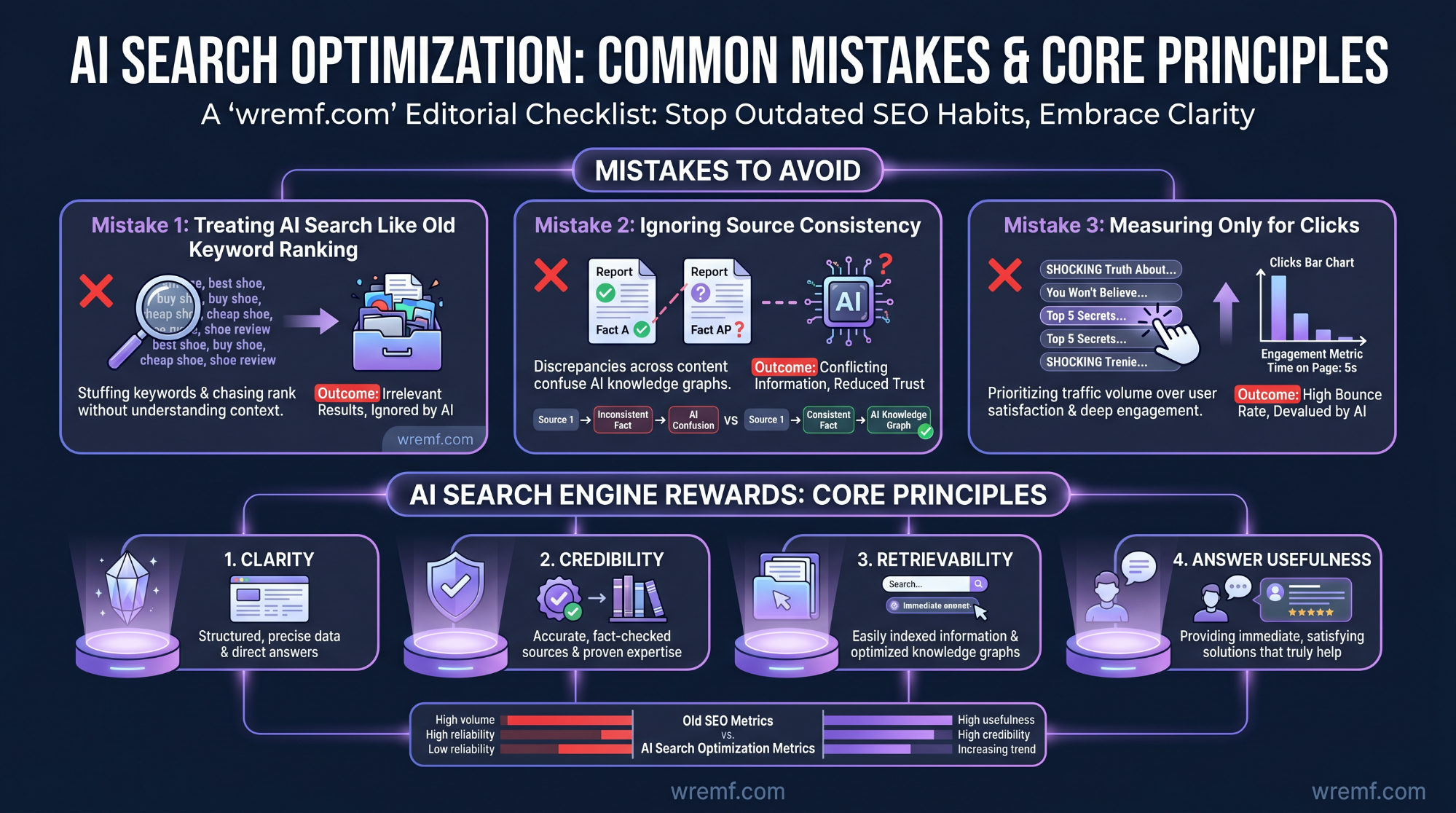
The biggest AI Search optimization mistakes are treating AI search like old keyword ranking, ignoring source consistency, and measuring only clicks. AI search engines reward clarity, credibility, retrievability, and answer usefulness.
A common mistake is assuming that ranking in Google Search is the same as being recommended by AI engines. Rankings can support AI visibility, but AI-generated answers also depend on query interpretation, source selection, summary quality, cited evidence, and platform behavior.
Another mistake is publishing generic generative AI content at scale. Generic generative AI content often repeats definitions that already exist on stronger domains. AI engines have little reason to cite a weaker version of the same answer unless the page adds clarity, data, authority, or unique structure.
A third mistake is ignoring third-party sources. If your website says one thing, a review platform says another, Microsoft Start or a news article says something outdated, and your Business Profile uses a different category, an AI engine may synthesize a confused brand description.
Teams also over-focus on schema markup while neglecting visible content. Schema markup can clarify entities, but it cannot compensate for vague pages, missing proof, weak author bio signals, thin answers, or unhelpful content.
Customer Support content is another overlooked source. Help Center pages, documentation, support articles, onboarding guides, and troubleshooting pages often answer specific prompts better than marketing pages. AI assistants may retrieve support content when users ask practical questions.
| Mistake | Why It Hurts AI Visibility | Better Approach |
|---|---|---|
| Keyword stuffing | Makes content less useful and less extractable | Use answer-first structure and semantic clarity |
| Ignoring Technical SEO | Prevents retrieval systems from using pages | Fix crawlability, rendering, and indexability |
| Weak definitions | Creates ambiguity for AI summaries | Define entities clearly |
| No comparison content | Misses buying-stage prompts | Add tables and decision guidance |
| No source tracking | Hides citation gaps | Monitor AI citations by prompt and engine |
| Inconsistent brand facts | Creates inaccurate AI answers | Clean up source consistency |
| No Help Center optimization | Misses practical support prompts | Improve documentation and support content |
| Measuring only clicks | Misses zero-click influence | Track mentions, citations, share of voice, and branded demand |
In real-world reporting, leadership often asks why traffic did not immediately rise after AI visibility improved. The answer may be that AI visibility first changes awareness, branded search, sales conversations, vendor shortlists, and assisted journeys before it creates direct referral traffic.
KEY TAKEAWAY: AI search optimization fails when teams chase rankings alone instead of improving clarity, citations, source consistency, helpful content, and measurable prompt visibility.
These mistakes also explain why common myths about AI visibility are misleading.
Common Myths About AI Visibility Debunked
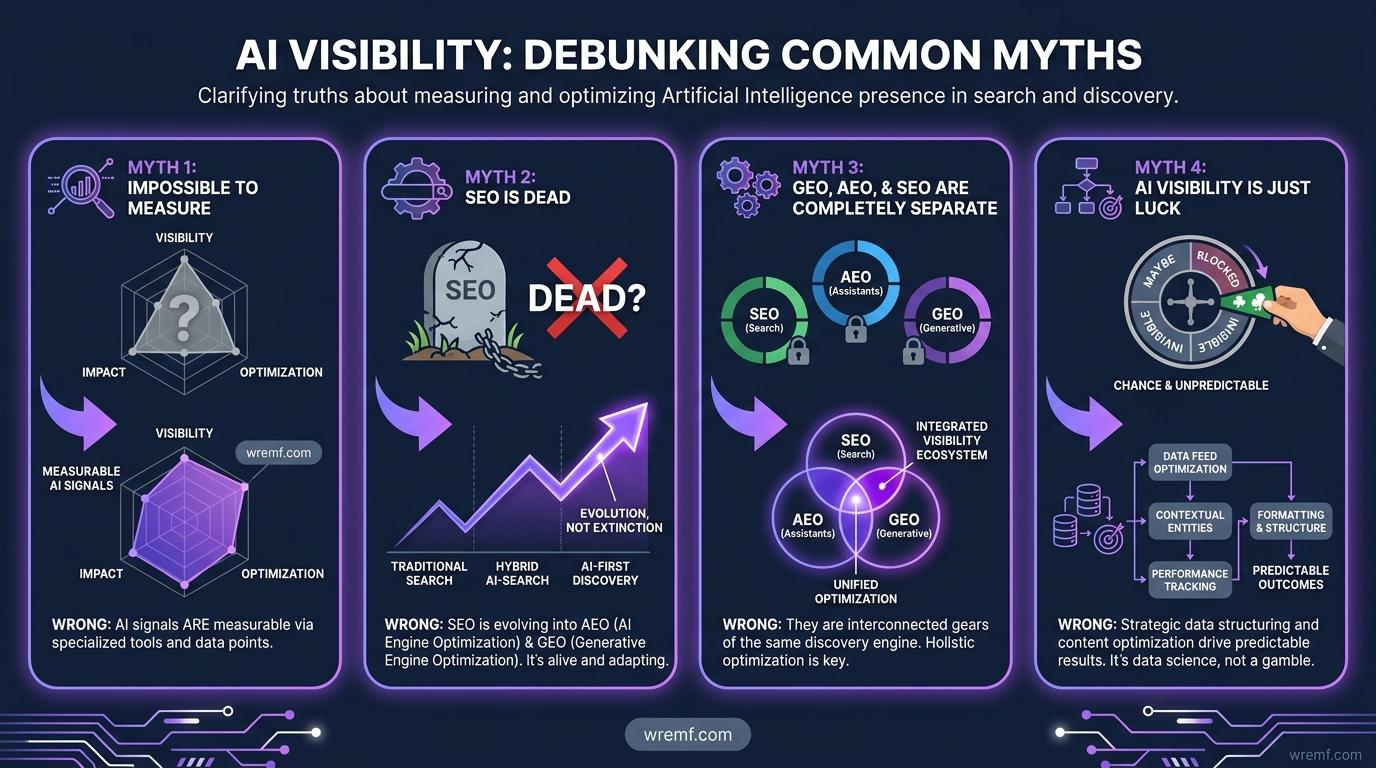
AI visibility is measurable, improvable, and connected to SEO, but it is not the same as traditional ranking. The most common myths come from treating AI Search as either magic or ordinary SEO with a new label.
MYTH: AI visibility is impossible to measure.
FACT: AI visibility is not perfectly deterministic, but it can be measured directionally through prompt tracking, citation frequency, recommendation share, competitor visibility, source consistency, sentiment, and AI referral traffic. The goal is not a single universal rank. The goal is a repeatable monitoring system across important prompts and AI engines.
MYTH: SEO is dead because AI search gives direct answers.
FACT: SEO is still important because many AI search experiences rely on crawlable web content, search indexes, structured data, helpful content, and trusted sources. Google’s Search guidance still emphasizes helpful, reliable, people-first content, which means SEO strategies remain part of AI search optimization. (Google for Developers)
MYTH: GEO, AEO, and SEO are completely separate strategies.
FACT: SEO, AEO, and GEO overlap, but they optimize for different outcomes. SEO improves traditional search visibility, AEO improves answer extraction, and GEO improves inclusion in generative AI summaries, citations, and recommendations. Strong teams coordinate all three instead of choosing one.
MYTH: Rankings alone are enough.
FACT: Rankings do not show whether ChatGPT, Claude, Perplexity, Gemini, Microsoft Copilot, or Google AI Overviews mention your brand. Rankings also do not show which sources AI engines cite, how competitors are framed, or whether your brand is recommended. AI visibility requires additional metrics beyond search results pages.
MYTH: Schema markup alone will make AI engines cite your content.
FACT: Schema markup helps machines interpret content, but it does not guarantee AI citations. AI engines still need clear visible content, credible claims, source support, technical access, query relevance, and consistent brand facts.
KEY TAKEAWAY: AI visibility is neither magic nor a replacement for SEO. It is a measurable layer that connects search, answers, citations, competitors, and source ecosystems.
With the myths removed, the final operating question is how to maintain AI visibility every week and month.
Create a Weekly and Monthly AI Search Optimization Workflow
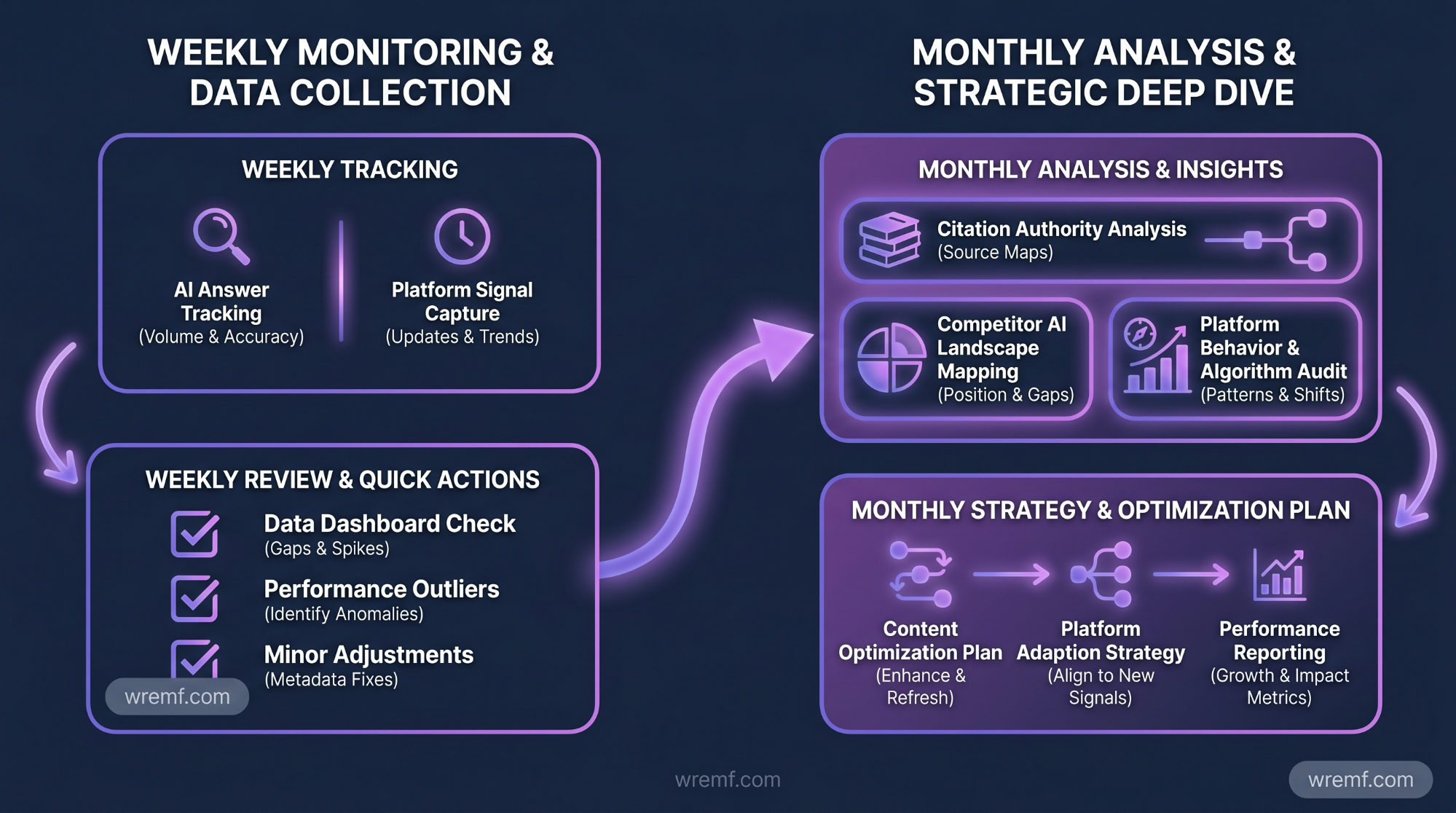
AI search optimization should be managed as a recurring workflow because AI answers, citations, competitors, and platform behavior change over time. Weekly monitoring catches answer drift, while monthly analysis turns changes into strategy.
Answer drift is the change in how AI engines describe, cite, or recommend a brand over time. Answer drift matters because your brand can gain, lose, or change visibility without a clear change in Google rankings.
A weekly AI Search workflow should include:
Review priority prompts across major AI engines
Record whether your brand appears
Record which competitors appear
Save cited sources
Flag inaccurate brand descriptions
Identify new third-party sources influencing answers
Check for changes in sentiment or recommendation wording
Review Help Center prompts and support-oriented answers
Prioritize urgent corrections
A monthly AI Search workflow should include:
Compare AI share of voice month over month
Review citation gains and losses
Identify content gaps by prompt cluster
Connect AI referral traffic with analytics where available
Compare branded search changes in Search Console
Update content briefs
Review structured data and FAQPage schema
Review Business Profile and local source consistency
Report visibility changes to leadership or clients
Decide which pages need SEO testing or rewriting
AI traffic attribution connects AI discovery to business outcomes, but it should be interpreted carefully. Some AI tools pass referral traffic. Some influence branded search. Some lead to direct visits, sales calls, demo requests, or account research that analytics tools cannot fully attribute.
For agencies, reporting needs to be standardized. The same prompt categories, engines, KPIs, and client-facing explanations should be used every month. For in-house teams, the same workflow should connect SEO, content strategy, product marketing, sales, and Customer Support insights.
WREMF supports scheduled AI monitoring, white-label reports, client portals, BYOK support, API access, MCP integrations, and AI share-of-voice reporting. Technical teams can explore the WREMF API and MCP integrations when they need AI visibility data inside internal dashboards, client portals, or automated workflows.
KEY TAKEAWAY: AI search optimization becomes reliable when teams monitor prompts, citations, competitors, source consistency, Search Console trends, and attribution on a recurring rhythm.
A consistent workflow turns AI visibility from a one-time audit into a measurable growth system.
How WREMF Helps Teams Optimize for AI Search Engines
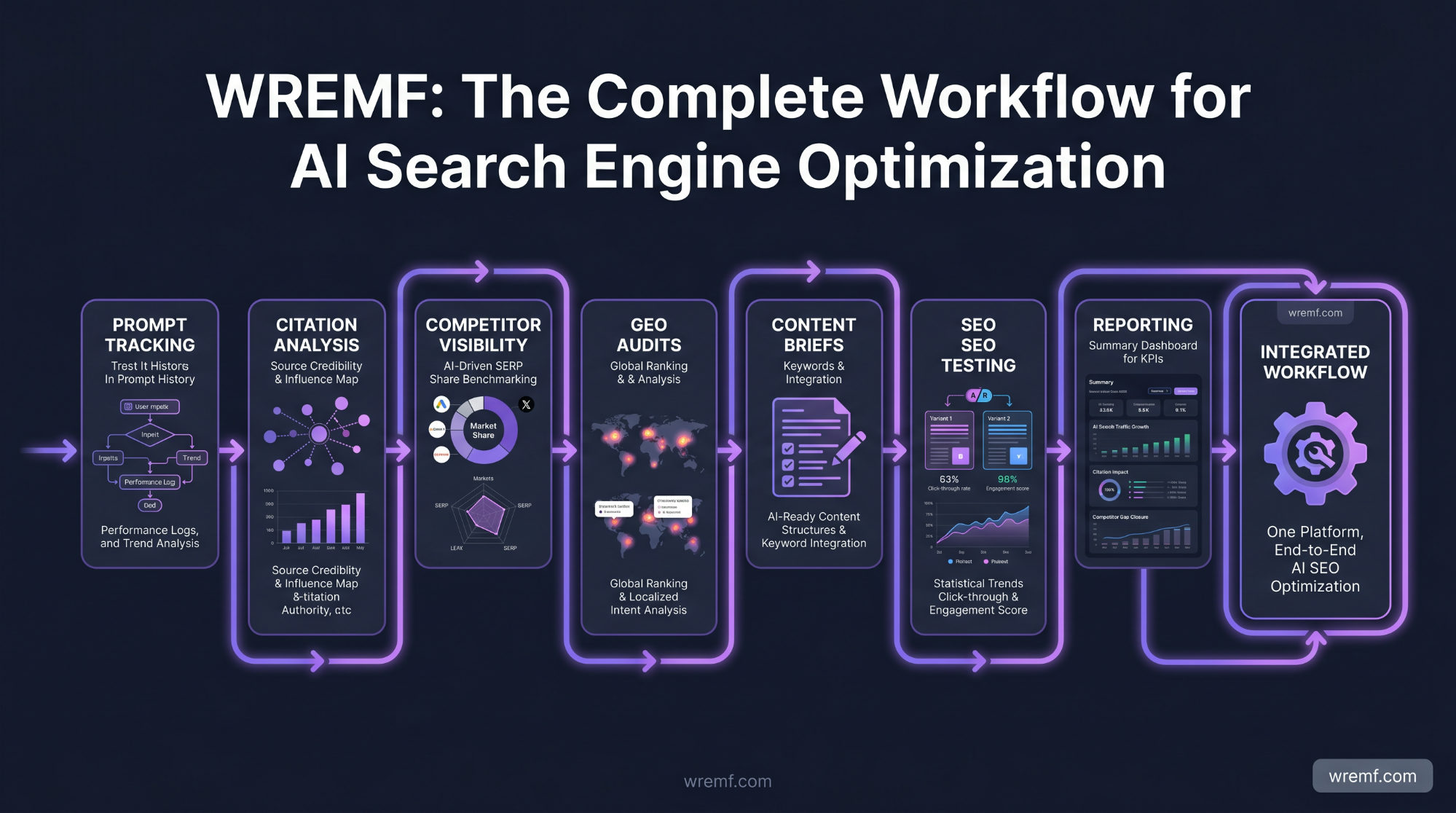
WREMF helps teams optimize for AI search engines by combining prompt tracking, citation analysis, competitor visibility, GEO audits, content briefs, SEO testing, and reporting in one workflow. WREMF is designed for brands, agencies, and hybrid teams that need both measurement and action.
WREMF tracks how brands appear across ChatGPT, Claude, Gemini, Perplexity, Google AI Overviews, Copilot, DeepSeek, Grok, Meta AI, Mistral, and other AI discovery surfaces. This matters because one AI engine cannot represent the full AI Search landscape.
WREMF combines four practical layers:
Visibility tracking to see where your brand appears
Prompt intelligence to understand which questions matter
Source citation tracking to see which pages and domains influence answers
Competitive landscape analysis to compare your brand against alternatives
The WREMF competitive landscape workflow helps teams identify competitors that appear in AI answers, prompts where competitors are recommended, and source gaps that influence those recommendations.
WREMF also supports execution. Teams can use software only, work with the agency team, or combine both. The hybrid model is useful when you need measurement, strategy, content updates, entity cleanup, technical guidance, and recurring reporting.
For B2B brands, WREMF helps connect AI visibility to marketing priorities such as category ownership, vendor shortlists, product positioning, pipeline attribution, and leadership reporting. For agencies, WREMF supports white-label reporting, client visibility dashboards, and repeatable AEO and GEO workflows through WREMF for agencies.
For in-house teams, WREMF helps marketing, SEO, content, product marketing, and growth teams understand which prompts matter, which AI engines mention the brand, which sources are cited, and which actions should be prioritized. In-house teams can explore WREMF for brands when AI visibility needs to become part of the broader growth workflow.
KEY TAKEAWAY: WREMF turns AI visibility into a repeatable system for tracking, improving, and proving how a brand appears across AI discovery surfaces.
The most useful AI Search programs end by answering the practical questions buyers, marketers, and executives ask most often.
Frequently Asked Questions
What is AI search optimization?
AI search optimization is the process of improving how your website, brand, products, services, and sources appear in AI-generated answers. It includes Technical SEO, answer-first content, structured data, schema markup, AI citations, prompt tracking, source consistency, and AI visibility measurement. AI search optimization applies to Google AI Overviews, AI Mode, ChatGPT search, Perplexity, Claude, Gemini, Microsoft Copilot, Bing Copilot, and other AI assistants. The goal is not only to rank in traditional search results. The goal is to be understood, cited, mentioned, and recommended when users ask relevant questions.
How is AI search optimization different from traditional SEO?
Traditional SEO focuses on crawlability, rankings, clicks, impressions, backlinks, and organic search performance. AI search optimization adds prompt tracking, source citations, brand mentions, recommendation visibility, AI share of voice, source consistency, and competitor presence inside AI-generated answers. SEO still matters because many AI search engines use web content and search indexes. The difference is that AI Search may answer the user directly, cite a third-party source, or recommend a brand without producing a traditional click. Teams need SEO metrics and AI visibility metrics together.
How do I optimize content for Google AI Overviews?
To optimize content for Google AI Overviews, start with Google Search fundamentals. Make pages crawlable, indexable, helpful, accurate, and aligned with real user intent. Use answer-first introductions, concise definitions, clear headings, structured data that matches visible content, and source-backed claims. Google AI Overviews are part of Google’s AI Search experience, so Technical SEO and helpful content remain important. You should also monitor whether your pages are cited or linked in Google AI Overviews for priority queries because rankings alone do not show full AI visibility.
How do I rank in ChatGPT, Perplexity, Claude, and Gemini?
You do not rank in ChatGPT, Perplexity, Claude, and Gemini the same way you rank in traditional search results. You improve visibility by making your brand clear, your pages crawlable, your claims verifiable, your sources consistent, and your content useful for real prompts. Publish direct definitions, comparison pages, product details, Help Center answers, methodology pages, and source-backed content clusters. WREMF helps teams monitor prompts, citations, brand mentions, competitor visibility, and answer changes across major AI engines so improvements are based on evidence rather than manual spot checks.
Does schema markup help with AI search visibility?
Schema markup can help AI search visibility by clarifying entities, page types, products, services, FAQs, breadcrumbs, authors, organizations, and local business details. Structured data gives search engines explicit clues about page meaning, and Google recommends JSON-LD when a site setup allows it. However, schema markup does not guarantee AI citations, Rich Results, rankings, or recommendations. The visible content still needs to be helpful, accurate, crawlable, and relevant to the user’s prompt. Treat schema markup as a support layer, not as a substitute for strong content.
What metrics should I track for AI search visibility?
The most useful AI search visibility metrics are prompt visibility, citation frequency, AI share of voice, competitor visibility, recommendation presence, source consistency, sentiment, AI referral traffic, branded search changes, and Search Console trends. Search Console metrics such as clicks, impressions, CTR, and average position still matter, but they do not capture all AI influence. WREMF connects prompts, citations, competitors, source consistency, and attribution into a repeatable reporting workflow so teams can track how visibility changes across AI engines over time.
Is SEO still worth it with AI search engines?
SEO is still worth it because AI search engines often depend on crawlable web pages, search indexes, helpful content, structured data, trusted sources, and clear entity signals. AI Search changes the measurement model, but it does not remove the need for Technical SEO, content strategy, internal linking, Search Console analysis, and authority building. The better question is how SEO strategies should evolve. Teams should keep SEO fundamentals while adding AEO and GEO practices that improve answer extraction, citation visibility, and AI-generated recommendations.
What are the best AI tools for monitoring AI search visibility?
The best AI tools for monitoring AI search visibility should track prompts, citations, competitors, AI share of voice, recommendation presence, source consistency, and reporting across multiple AI engines. A basic SEO tool can show keyword rankings and traffic, but it usually will not show how ChatGPT, Perplexity, Claude, Gemini, or Microsoft Copilot describe your brand. WREMF combines prompt intelligence, source citation tracking, competitive landscape analysis, AI visibility scoring, scheduled monitoring, and white-label reporting for teams that need a repeatable AI Search workflow.
Should I use AI visibility software or an agency?
Use AI visibility software if you need repeatable tracking, prompt monitoring, citation analysis, competitor visibility, and reporting. Use an agency if you need strategy, content execution, entity cleanup, technical guidance, source consistency cleanup, and monthly implementation support. Use a hybrid model if you need both measurement and execution. WREMF supports all three paths: software for teams that want dashboards, agency services for teams that want managed execution, and a hybrid model for teams that need both.
How often should I monitor AI search results?
You should monitor priority AI Search prompts weekly and review performance monthly. Weekly checks help catch answer drift, new competitors, citation changes, and inaccurate brand descriptions. Monthly reviews help connect AI visibility to content updates, source gaps, Search Console trends, AI referral traffic, branded search, and reporting. High-value commercial prompts should be checked more often than low-priority informational prompts because they influence vendor shortlists, product comparisons, and buying decisions.
How do I optimize product pages for AI search engines?
To optimize product pages for AI search engines, include clear product definitions, use cases, pricing context, audience fit, feature comparisons, limitations, FAQs, schema markup, internal links, and source-backed claims. Product pages should answer buyer prompts such as who the product is for, what problem it solves, how it compares with alternatives, and when it is not the right fit. Make sure product details are consistent across your website, directories, review platforms, Business Profile listings, Help Center pages, and third-party sources.
What is the difference between AI citations, brand mentions, and recommendations?
AI citations are sources linked or referenced by an AI engine to support an answer. Brand mentions are references to your brand inside an AI-generated response, whether or not the answer links to your site. Recommendations are stronger buying-stage mentions where the AI engine suggests your brand as a suitable option. All three matter. A brand can be cited but not recommended, mentioned but not cited, or recommended through a third-party source. AI visibility measurement should track each separately.
Conclusion
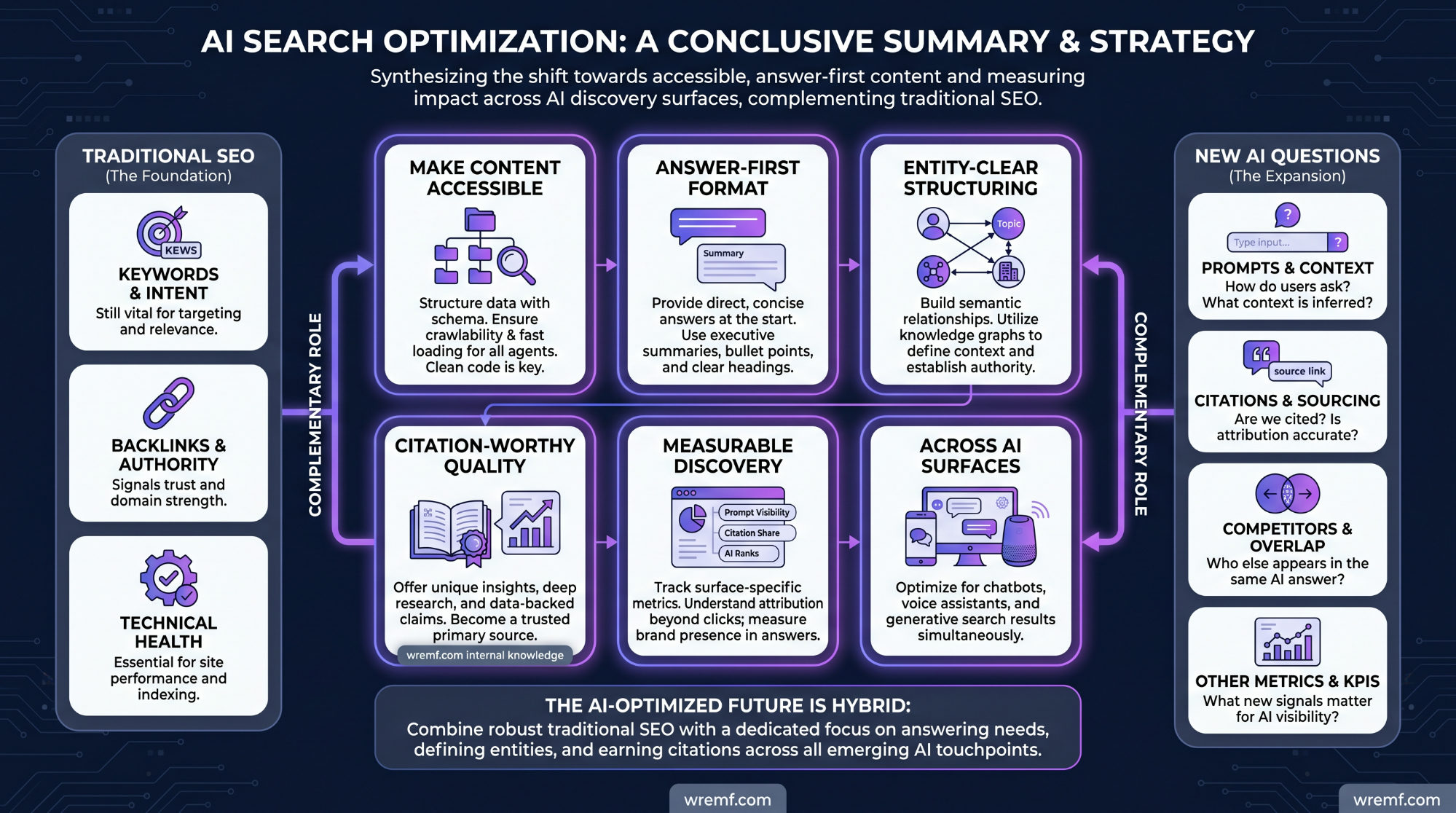
How to optimize for AI search engines comes down to one repeatable system: make your content accessible, answer-first, entity-clear, citation-worthy, and measurable across AI discovery surfaces. Traditional SEO still matters, but AI visibility adds new questions about prompts, citations, competitors, recommendations, source consistency, Search Console trends, and attribution. WREMF helps B2B teams track, improve, and prove that visibility across major AI engines without treating AI Search as guesswork. To build a practical workflow for your brand or clients, explore the WREMF platform suite or request support from the WREMF agency team.
Related reading
- Best Answer Engine Optimization for Enhancing AI Visibility
- AI Search Engine Optimization: The Complete Guide for B2B Brands
- Answer Engine Optimization: The Complete Guide to AEO, AI Search Visibility, and Answer-First Content
- Perplexity AI Optimization: The Complete Guide to AI Search Visibility in 2026