Perplexity SEO: How to Optimize for Perplexity AI, Citations, and AI Search Visibility
Learn the essentials of Perplexity SEO for AI and citation visibility. Understand key strategies and technical underpinnings.
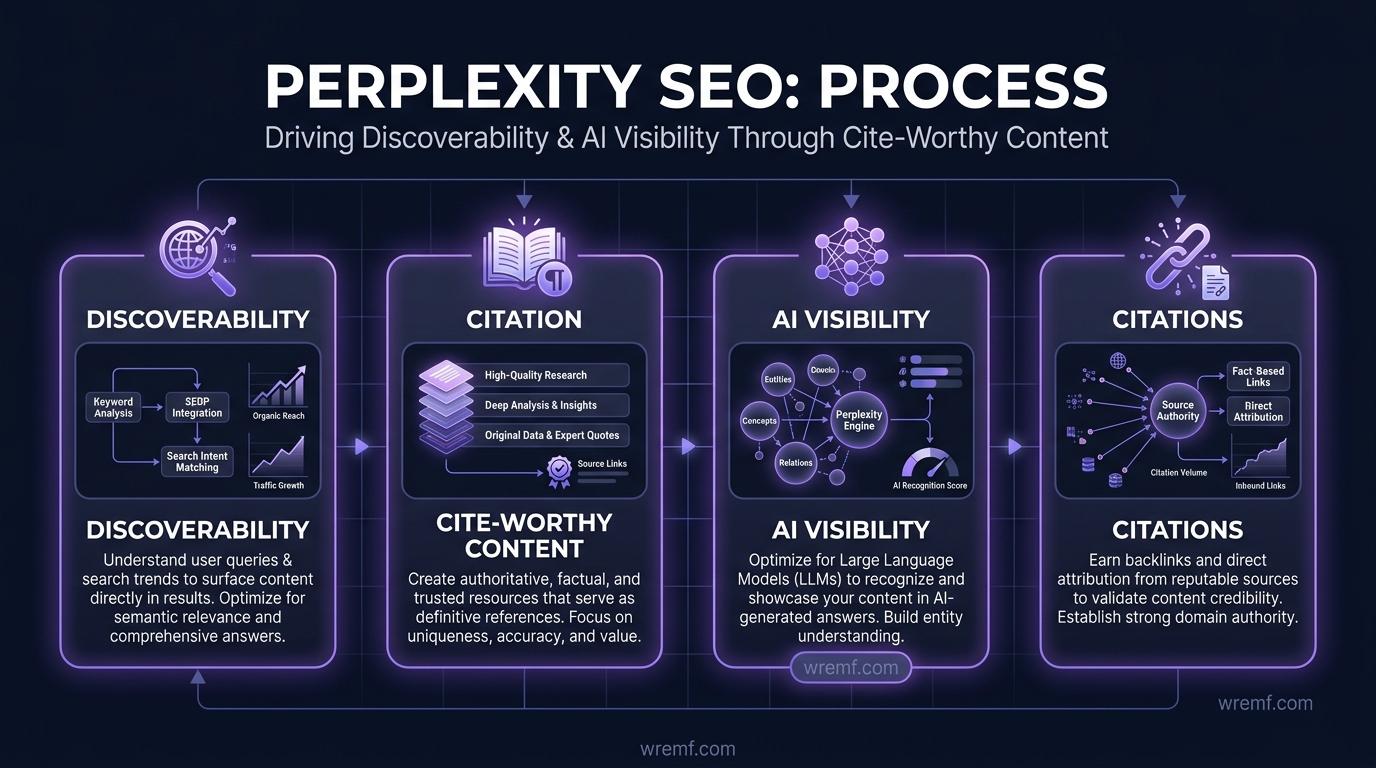
By WREMF Team · 2026-08-26
Perplexity SEO is about optimizing your website for visibility and citations in Perplexity AI answers. It emphasizes becoming a trusted source that the AI engine can cite and recommend. Unlike traditional SEO focusing on rankings, Perplexity SEO targets answer cards, citations, and AI search visibility. The approach includes technical SEO foundations, structured content, understanding AI language models, and aligning your brand authority with topics and categories.
Key takeaways
- Perplexity SEO focuses on making content cite-worthy for AI-generated answers.
- Answer visibility, citations, and AI referral traffic matter more than traditional SEO metrics.
- Technical SEO foundations like schema markup and crawlability are crucial.
- Clear, structured, and updated content increases chances of being cited.
- Entity authority and source consistency are essential for trust in AI systems.
Perplexity SEO: How to Optimize for Perplexity AI, Citations, and AI Search Visibility
Perplexity SEO is the practice of making your website discoverable, cite-worthy, and visible inside Perplexity AI answers. Perplexity describes itself as a free AI-powered answer engine that provides accurate, trusted, and real-time answers, while Google Search Central says search systems reward helpful, reliable, people-first content. This page explains how Perplexity AI finds sources, how PerplexityBot works, why citations matter, and how Perplexity SEO differs from traditional search engine optimization. You will also learn how Answer Engine Optimization, Generative Engine Optimisation, AI SEO, content freshness, technical SEO, source consistency, and measurement fit together. WREMF helps teams track, improve, and prove this visibility across Perplexity, ChatGPT, Claude, Gemini, Google AI Overviews, Copilot, DeepSeek, Grok, Meta AI, Mistral, and other AI discovery surfaces.
What Is Perplexity SEO?
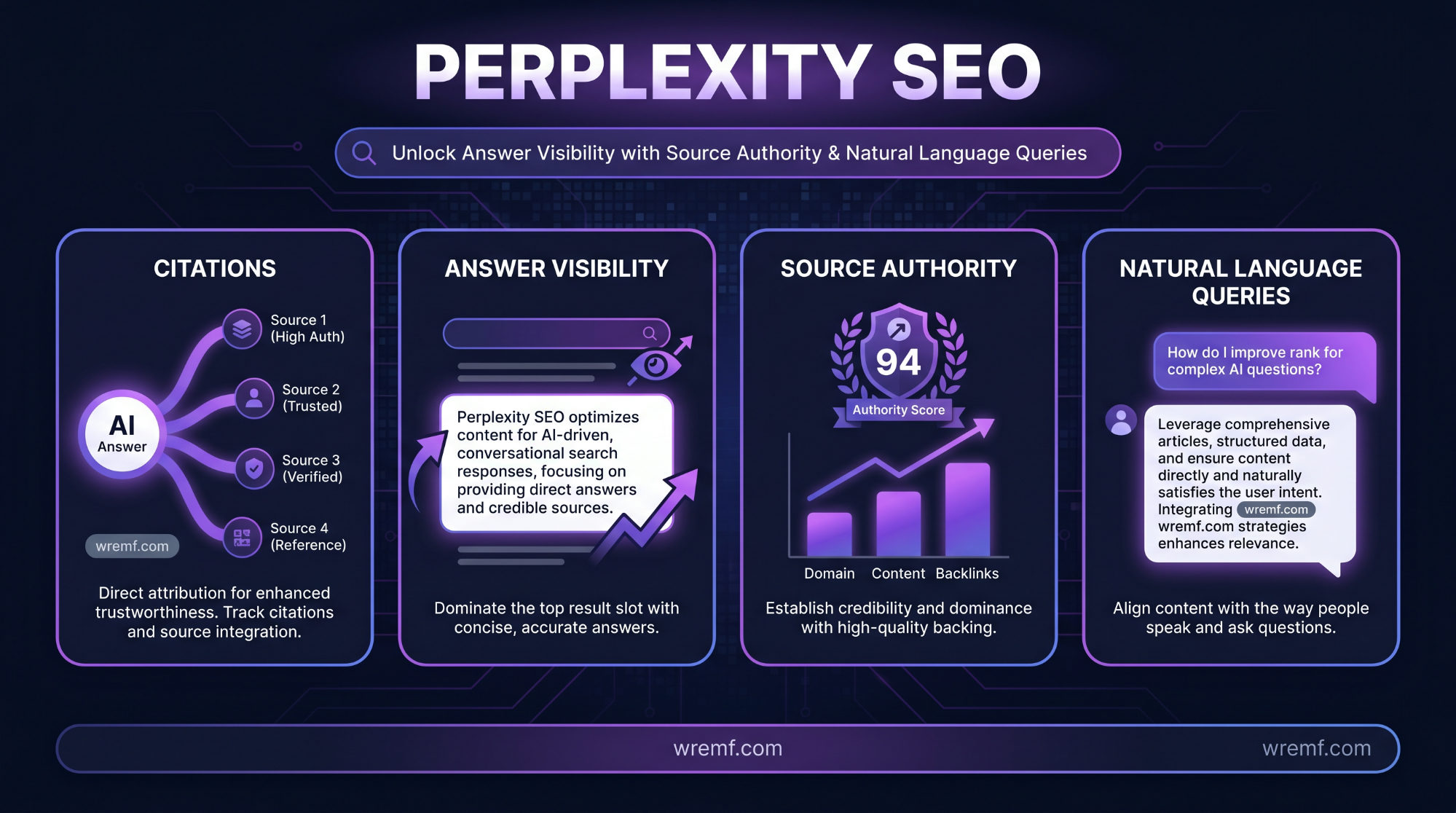
Perplexity SEO is search engine optimization for Perplexity AI, focused on citations, answer visibility, source authority, and natural language queries. The goal is to become a trusted source that Perplexity can retrieve, summarise, recommend, and cite.
Perplexity AI is an AI-powered answer engine that combines search, language models, retrieval, and citations to answer user questions. A traditional search engine usually returns a list of ranked links. Perplexity often returns an answer card supported by cited sources, which changes the objective from only ranking to being included in the answer itself.
AI search visibility is the measurable presence of a brand inside AI-generated answers, citations, recommendations, summaries, and source references. AI search visibility matters because buyers increasingly ask AI assistants to compare vendors, explain topics, and recommend tools before visiting company websites.
Perplexity SEO connects SEO, Answer Engine Optimization, and Generative Engine Optimisation. SEO helps pages get crawled, indexed, ranked, and understood. Answer Engine Optimization helps content become extractable as direct answers. Generative Engine Optimisation helps brands appear inside AI-generated responses across Perplexity AI, OpenAI ChatGPT, Google Gemini, Claude, Copilot, and Google AI Overviews.
WREMF helps teams make this work measurable instead of speculative. The WREMF platform suite connects prompt tracking, source citation tracking, competitor visibility, AI share of voice, and AI traffic attribution so teams can see where they appear and what to improve next.
Perplexity SEO is the measurable practice of improving how a brand appears in Perplexity AI answers, citations, answer cards, and source references. Perplexity SEO matters because AI search discovery now depends on whether AI systems can find, trust, extract, and cite your content.
KEY TAKEAWAY: Perplexity SEO is not a replacement for SEO, but a broader AI visibility workflow built around answers, citations, sources, prompts, and brand authority.
To apply Perplexity SEO well, you first need to understand how Perplexity differs from Google Search and traditional ranking systems.
How Is Perplexity AI Different From Google Search?
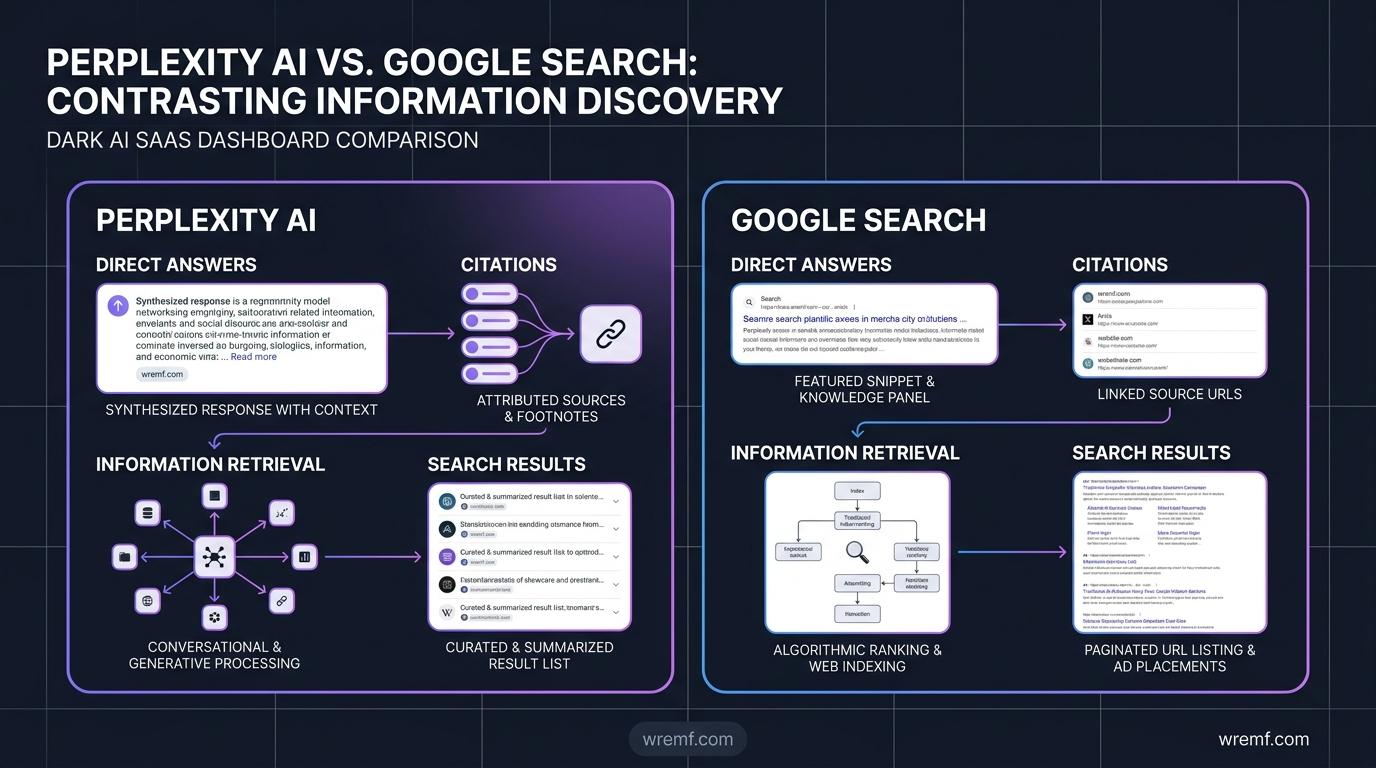
Perplexity AI is different from Google Search because it behaves like an answer engine, not only a search engine. It retrieves information, generates a direct answer, and cites selected sources inside the response.
Google Search is still built around crawling, indexing, ranking, and presenting results, even as Google AI Overviews add generative answers to search results. Google Search Central explains that its ranking systems are designed to present helpful, reliable information created to benefit people, not content made only to manipulate rankings. Google Search Central’s helpful content guidance remains a strong baseline for Perplexity SEO because AI systems also need clear, useful, reliable content. (Google for Developers)
Perplexity AI adds a visible citation layer. Instead of asking users to inspect ten blue links, Perplexity may produce a direct answer with a smaller set of cited pages. That creates a zero-click reality for many informational and commercial queries because the user may get enough information without clicking through to a website.
The key difference between SEO and Perplexity SEO is the unit of visibility. Traditional SEO often measures keyword rankings, impressions, clicks, CTR, and backlinks. Perplexity SEO measures answer inclusion, source citations, brand mentions, recommendation visibility, Share of Answers, source influence, sentiment, and AI referral traffic.
| Visibility model | Best for | What it measures | What it misses | Example metric |
|---|---|---|---|---|
| Traditional SEO | Google Search and Bing organic visibility | Rankings, impressions, clicks, CTR, backlinks | AI answer mentions and citations | Average position for a keyword |
| Answer Engine Optimization | Direct answers and featured snippet style content | Extractable answers, structured Q&A, answer-first content | Competitor recommendation context | Featured snippet ownership |
| Generative Engine Optimisation | AI-generated responses across Perplexity, ChatGPT, Gemini, Claude, and Copilot | Mentions, citations, summaries, answer sentiment | Some hidden model reasoning | Share of Answers |
| Perplexity SEO | Perplexity AI answer cards, citations, and referral traffic | Perplexity citations, prompt visibility, content freshness, source authority | Full internal answer-selection logic | Number of cited URLs by prompt cluster |
Answer Engine Optimization is the process of formatting content so answer engines can extract clear responses to user questions. Answer Engine Optimization matters because Perplexity, Google AI Overviews, featured snippet systems, and voice assistants reward direct, structured answers.
Generative Engine Optimisation is the process of improving how a brand appears in AI-generated responses. Generative Engine Optimisation matters because users increasingly ask AI tools for recommendations, comparisons, definitions, and buying advice instead of only searching keywords.
A common implementation mistake is treating Perplexity AI like a keyword rank tracker. Perplexity may cite a page because it has a clean definition, fresh data, a credible comparison table, a direct answer, or a primary-source explanation. SEO optimization still matters, but AI SEO rewards machine-readable structure and source usefulness in addition to rankings.
DID YOU KNOW: Microsoft launched AI Performance in Bing Webmaster Tools in public preview in February 2026 to show when a site is cited in AI-generated answers across supported AI experiences, which signals that citation-level AI visibility measurement is becoming a formal search metric. (bing.com)
KEY TAKEAWAY: Perplexity SEO requires SEO fundamentals, but the main visibility signal is whether your content becomes useful enough to be cited inside an AI-generated answer.
The next section explains how Perplexity finds, retrieves, and cites web content.
How Does Perplexity Find and Cite Content?
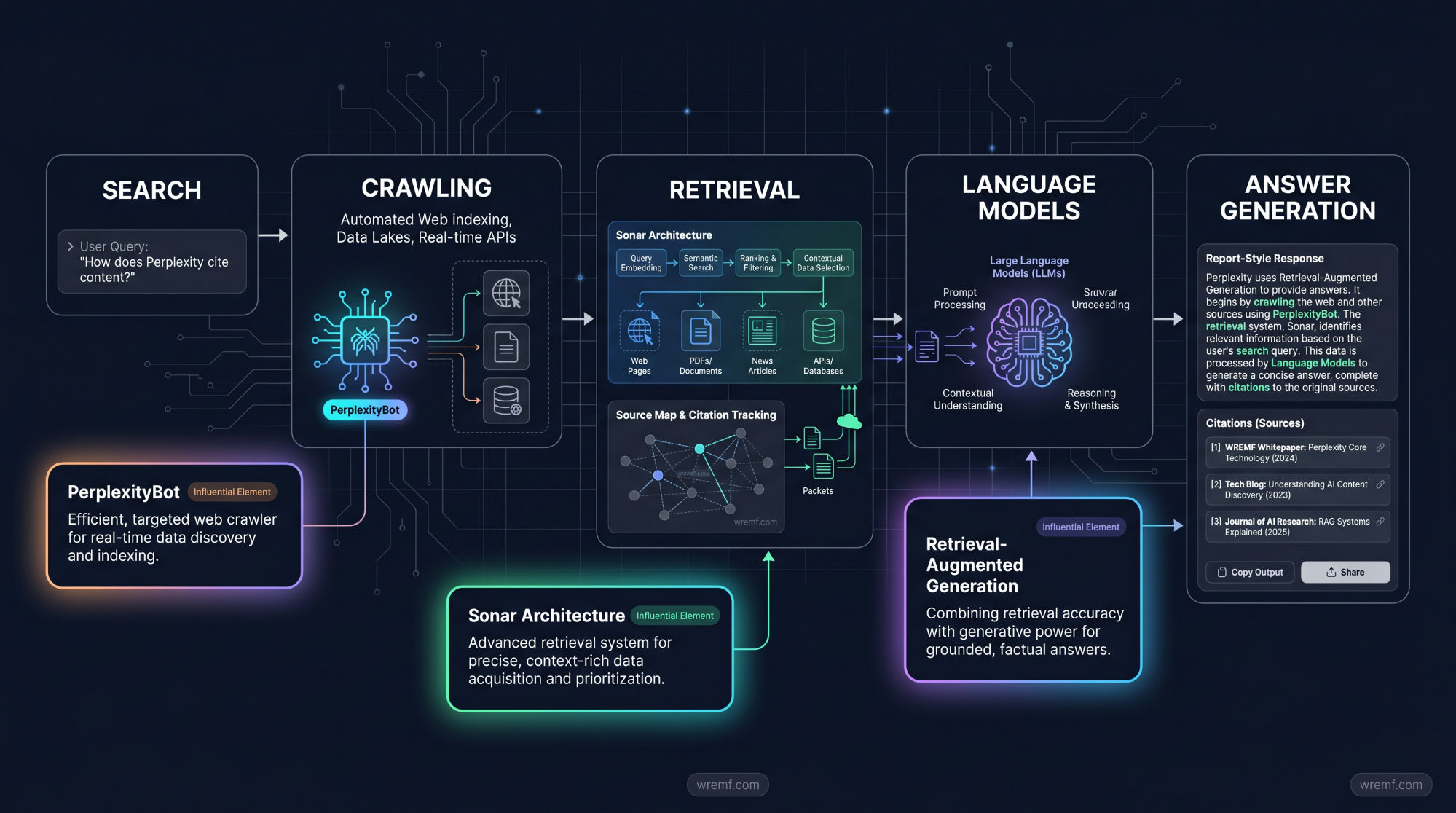
Perplexity finds and cites content through search, crawling, retrieval, language models, and answer generation. PerplexityBot, Sonar architecture, and Retrieval-Augmented Generation influence which sources are available for AI-generated responses.
Retrieval-Augmented Generation is a method where an AI system retrieves relevant external information before generating an answer. Retrieval-Augmented Generation matters because it connects Large Language Models with current web content instead of relying only on static training data.
Large Language Models are AI systems trained to understand and generate language at scale. Large Language Models matter because Perplexity, ChatGPT, Claude, Gemini, Copilot, DeepSeek, Grok, Meta AI, and Mistral use language models to summarise, compare, and explain retrieved information.
Perplexity’s official Sonar API documentation says Sonar provides web-grounded AI responses with streaming, tools, search options, and Sonar models. Perplexity’s API platform also describes Sonar as providing real-time web search, conversational answers with citations, and structured retrieval from billions of webpages. This matters for SEO teams because Perplexity’s answer system depends on retrieval and citation, not only language generation. Perplexity’s Sonar documentation explains the web-grounded response model. (Perplexity)
The Sonar model is a Perplexity model family built for web-grounded answers, search, and synthesis. The Sonar model matters for Perplexity SEO because source selection, search context, retrieval quality, and answer generation shape which pages appear as citations.
PerplexityBot is Perplexity’s crawler for surfacing and linking websites in Perplexity search results. Perplexity’s crawler documentation says PerplexityBot is not used to crawl content for AI foundation model training and recommends allowing PerplexityBot in robots.txt if a site wants to appear in Perplexity results. Perplexity’s crawler documentation describes the crawler and robots.txt guidance. (Perplexity)
User-agent: PerplexityBot is the robots.txt user-agent directive used to control PerplexityBot access. This matters because blocking the crawler can reduce the ability of public pages to appear as cited sources in Perplexity answers.
A practical Perplexity SEO workflow has four layers:
Crawl access: PerplexityBot can reach public pages you want discoverable.
Retrieval quality: pages answer natural language queries clearly.
Citation quality: pages provide specific, source-backed, current information.
Brand association: Perplexity connects your brand with the right topics, categories, products, and use cases.
Perplexity SEO works by making your content accessible to PerplexityBot, understandable to retrieval systems, useful to answer generation, and credible enough to cite. Perplexity SEO fails when content is blocked, vague, outdated, thin, inconsistent, or disconnected from the questions buyers actually ask.
IMPORTANT: Perplexity has faced public controversy over crawler behaviour, with Cloudflare and media reports alleging that some Perplexity-related crawling bypassed publisher restrictions. Perplexity disputed parts of those claims, so the practical SEO recommendation is to define crawler access intentionally, monitor logs, and avoid assuming every AI crawler behaves the same way. (The Verge)
KEY TAKEAWAY: Perplexity visibility depends on crawl access, retrievable answers, citation quality, source consistency, and clear entity relationships.
Once the retrieval layer is understood, technical SEO becomes the foundation that lets answer engines reach and interpret your content.
What Technical SEO Foundations Matter for Perplexity SEO?
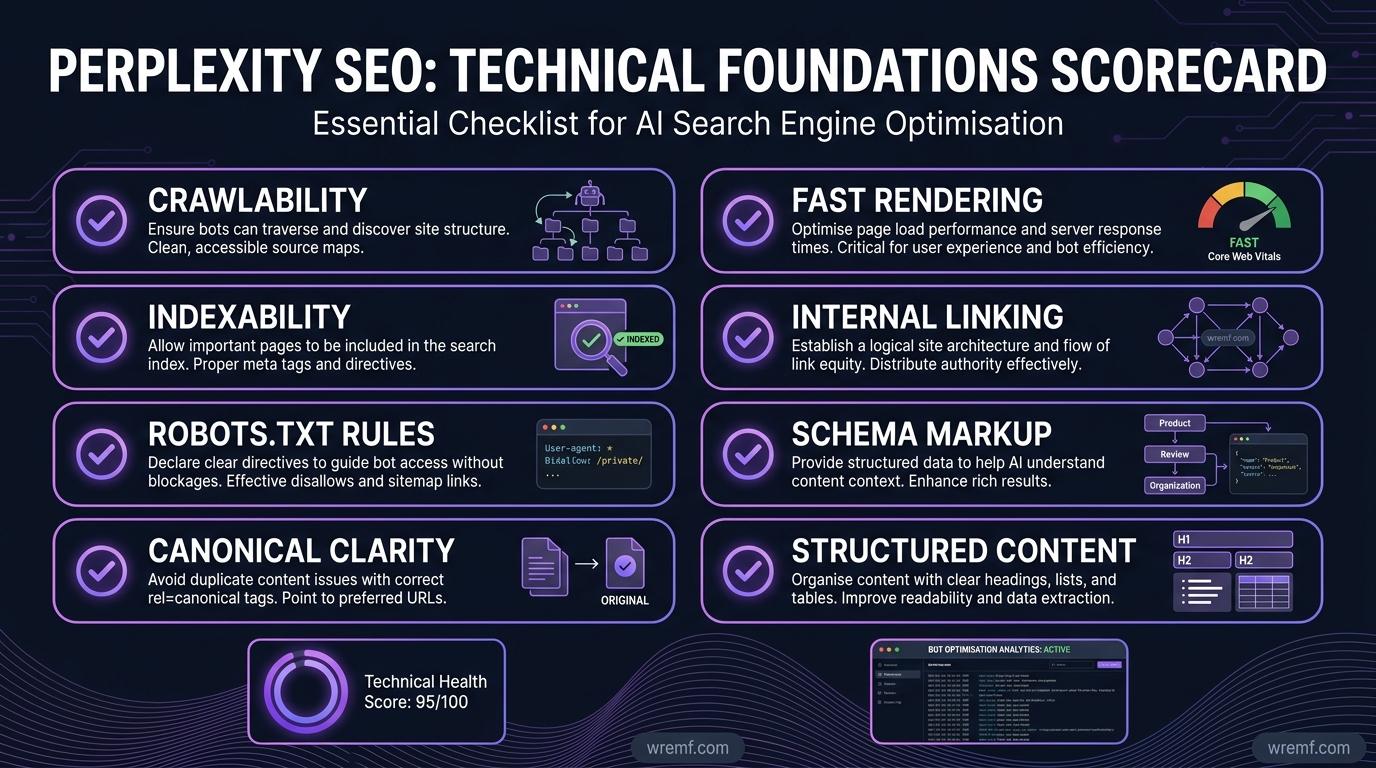
Technical Perplexity SEO starts with crawlability, indexability, robots.txt rules, canonical clarity, fast rendering, internal linking, schema markup, and structured content. If Perplexity cannot access or understand a page, strong writing alone will not make the page cite-worthy.
The robots.txt file tells crawlers which areas of a site they may access. For Perplexity SEO, the most important decision is whether you want PerplexityBot to crawl public informational pages, product pages, comparison pages, pricing pages, blog posts, resource pages, documentation, and research pages.
A simple allow rule can look like this:
User-agent: PerplexityBot
Allow: /
A blocking rule can look like this:
User-agent: PerplexityBot
Disallow: /
The right approach depends on your business model. A B2B SaaS company usually benefits from allowing public marketing pages, product docs, guides, comparison pages, and research pages. A publisher with licensing concerns may choose stricter controls. A private app, customer portal, staging site, checkout flow, or internal knowledge base should usually remain blocked from public crawlers.
Schema markup is structured metadata that helps search engines understand entities, content types, authorship, products, FAQs, reviews, and organisations. Schema markup matters for Perplexity SEO because structured data can reinforce entity clarity, even though Perplexity does not publicly disclose every signal used in answer selection.
Structured Data is machine-readable information added to a webpage to clarify what the page is about. Structured Data supports AI search because answer engines benefit from unambiguous entities, relationships, and page context.
Technical Perplexity SEO also depends on HTML structure. Clear headings, answer-first paragraphs, HTML tags, comparison tables, canonical tag usage, internal linking, and clean page templates help both search engines and AI tools parse content. Natural Language Processing systems are better at extracting meaning when content has predictable structure and clear language.
Natural Language Processing is the field of machine learning that helps computers interpret and generate human language. Natural Language Processing matters for Perplexity SEO because AI systems need clear language, stable entities, and predictable structure to extract meaning accurately.
A practical technical checklist includes:
Allow PerplexityBot for public pages you want discoverable.
Keep important content server-rendered or easily rendered.
Use descriptive title tags and meta descriptions.
Use one canonical tag for duplicate or near-duplicate pages.
Add organisation, article, product, FAQ schemas, or relevant schema markup where appropriate.
Use internal linking to connect pillar pages, sub-niches, and topical SEO links.
Keep page speed and mobile usability strong.
Avoid hiding core answers inside scripts, tabs, or assets that crawlers cannot parse.
Keep important definitions and answer blocks in clean HTML.
Audit robots.txt and server logs after major site changes.
TIP: Run a GEO audit before rewriting content. The WREMF GEO audit feature helps teams inspect whether pages are crawlable, structured, entity-clear, and aligned with AI search prompts.
KEY TAKEAWAY: Technical Perplexity SEO makes your content accessible and interpretable before citation quality is even considered.
After the technical foundation is in place, content structure determines whether Perplexity can extract useful answers.
How Do You Make Content Cite-Worthy to Perplexity?
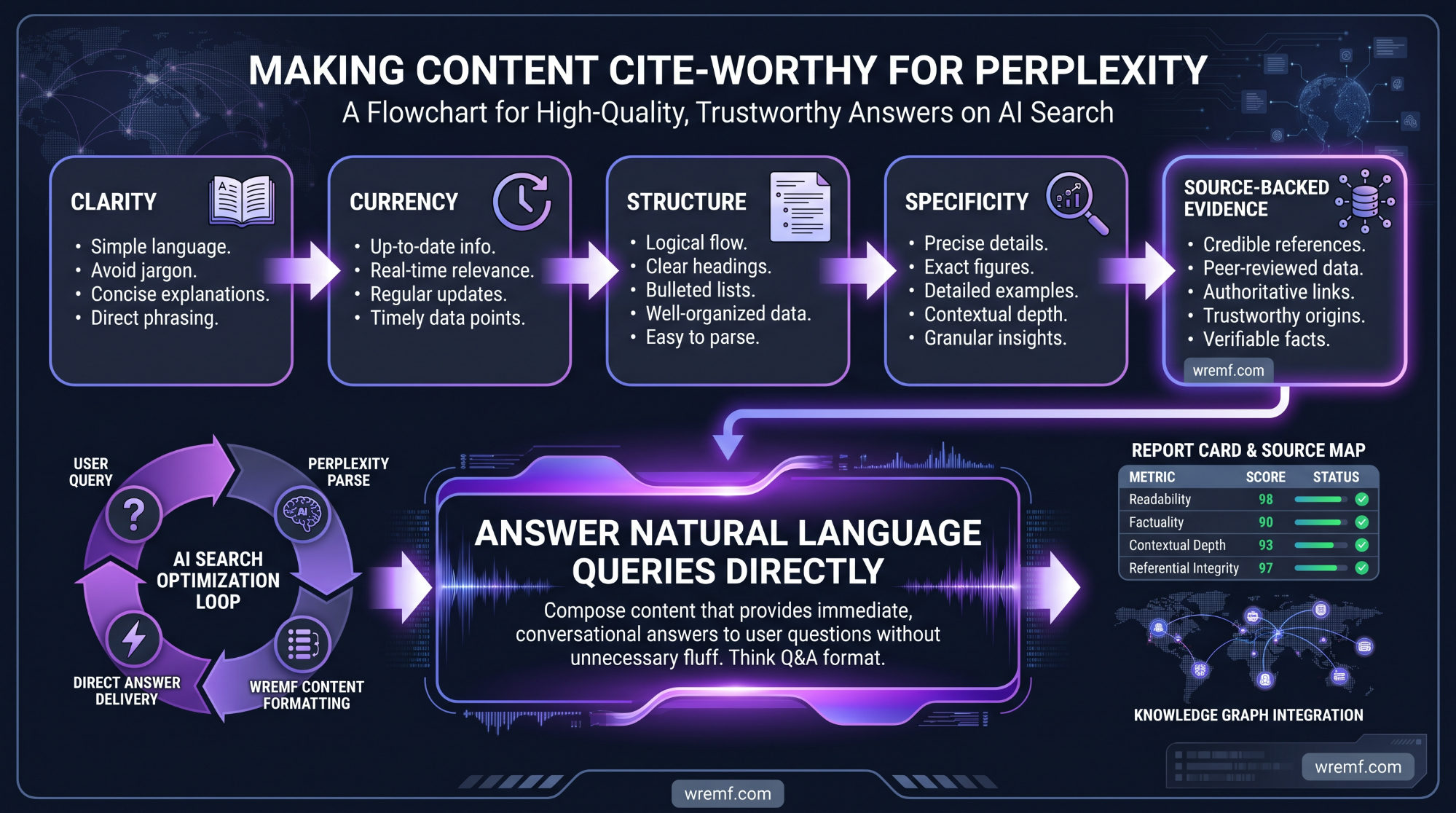
Cite-worthy content for Perplexity is clear, current, structured, specific, and source-backed. Perplexity is more likely to cite pages that answer natural language queries directly and provide evidence that supports the generated answer.
AI citations are source references shown inside AI-generated responses. AI citations matter because they turn brand visibility into a traceable source relationship, not just an impression, keyword position, or unverified mention.
The most effective Perplexity SEO content uses answer-first formatting. Answer-first formatting means starting a section with the direct answer before adding context, examples, and nuance. This mirrors how users ask natural language queries and how answer engines build response snippets.
A strong Content Format for Perplexity includes:
A direct answer in the first 1 to 2 sentences.
A concise definition under 60 words for major terms.
Q&A sections for conversational queries.
Comparison Tables when users compare options.
HTML tags for steps, criteria, or lists.
Clear statistics with named sources.
Updated dates where content freshness matters.
Practical examples that show experience.
Internal links that connect related pages.
External links to authoritative primary sources.
Content freshness is the practice of keeping information current, accurate, and aligned with recent changes. Content freshness matters for Perplexity SEO because users often ask Perplexity about current tools, pricing, models, regulations, market changes, and software features.
Cite-worthy content is not just long content. A 400-word answer with original data, a clear table, and current sourcing can be more useful than a 4,000-word article that repeats generic SEO advice. In practical AI visibility audits, teams often find that pages fail because they lack concise definitions, current evidence, or direct answers to high-intent questions.
For Perplexity SEO, create content around questions such as:
What is Perplexity SEO?
How does Perplexity choose citations?
Is Perplexity good for SEO?
How do I get my website cited by Perplexity?
What is PerplexityBot?
What is the Sonar model?
What is Sonar architecture?
How is Perplexity different from Google Search?
What are Perplexity Pages?
What are Perplexity Focus Modes?
What is Deep Research in Perplexity?
Does Perplexity use the same signals as Google?
How do I measure Perplexity referral traffic?
What content does Perplexity cite for B2B topics?
The WREMF content brief generator helps teams turn AI visibility gaps into answer-first briefs, structured Q&A, comparison tables, and citation-ready content sections.
KEY TAKEAWAY: Perplexity cites content that gives direct, structured, current, and evidence-backed answers to real user questions.
The next layer is entity authority, because answer engines need to understand who you are and why your brand belongs in the answer.
Why Do Entity Authority, E-E-A-T, and Source Consistency Matter?
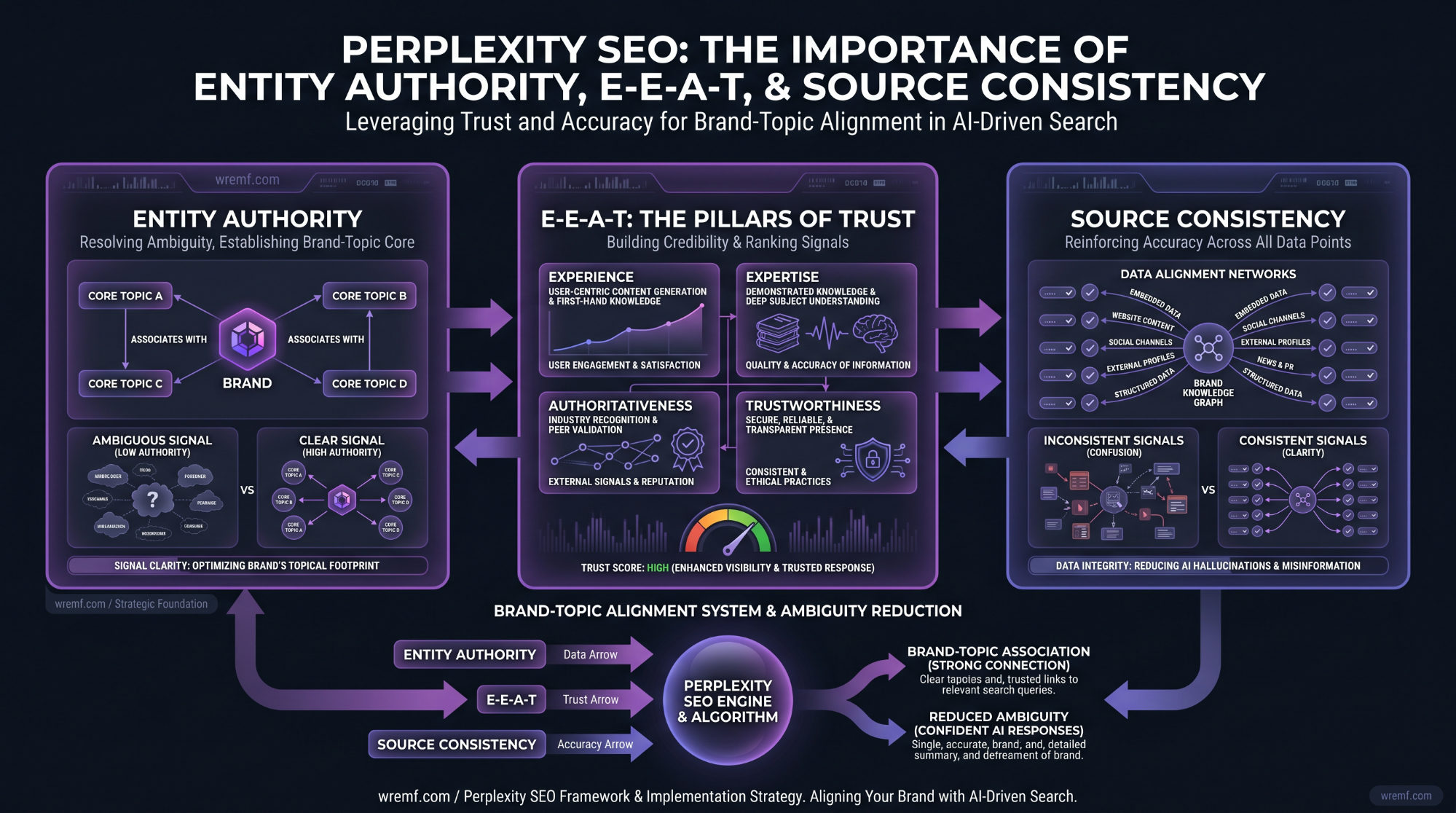
Entity authority matters in Perplexity SEO because AI systems need to connect a brand with a topic, category, product, market, and trust context. Source consistency helps AI systems reduce ambiguity across the web.
Entity authority is the strength of association between a named entity and a set of topics, facts, and trusted references. Entity authority matters because AI search tools need to know whether a brand is relevant to a category before recommending or citing it.
E-E-A-T stands for Experience, Expertise, Authoritativeness, and Trustworthiness. E-E-A-T matters for Perplexity SEO because answer engines benefit from sources that show first-hand knowledge, clear authorship, verifiable claims, and trustworthy references.
Source consistency is the alignment of brand facts across your website, profiles, review platforms, databases, third-party articles, knowledge panels, and business listings. Source consistency matters because conflicting descriptions can confuse AI-generated responses.
Marketing teams often find inconsistent facts across LinkedIn, Crunchbase-style profiles, directories, review sites, old press pages, and sales decks. One source says the company is an SEO agency. Another says it is an AI visibility platform. A third says it is a content automation tool. Perplexity and other AI tools may then produce mixed or outdated answers.
This is why Perplexity SEO is not only a content problem. It is also a source ecosystem problem. Your owned content, earned mentions, third-party sources, and structured profiles all help AI systems decide whether your brand belongs in a citation set or recommendation list.
Off-page SEO still matters, but the goal changes. A backlink profile should support semantic relevancy, not only domain authority. Digital PR should create credible brand mentions across relevant industry sources. A LinkedIn post, YouTube video, Google Business Profile, podcast page, conference profile, or analyst mention can reinforce entity clarity when the information is consistent.
Domain authority is an industry metric used by SEO tools to estimate a site’s relative ranking strength. Domain authority matters less than source relevance for Perplexity SEO because an answer engine may prefer a specific, well-structured, current source over a broad but generic high-authority page.
The practical workflow is:
Define your canonical brand description.
Align product categories across public profiles.
Keep founder, pricing, location, and product facts consistent.
Publish pillar pages and sub-niches that reinforce topical authority keywords.
Build credible mentions from relevant industry sources.
Monitor how Perplexity AI and other answer engines describe your brand.
The WREMF source citation tracking feature helps teams see which sources AI engines cite, which facts AI engines repeat, and where inconsistent source signals may affect AI search visibility.
KEY TAKEAWAY: Entity authority and source consistency help Perplexity understand what your brand is, when your brand should appear, and why your brand can be trusted.
Once your entity signals are clear, you can build a content strategy for Perplexity, ChatGPT, Gemini, Claude, and Google AI Overviews together.
How Do You Build a Perplexity SEO Content Strategy?
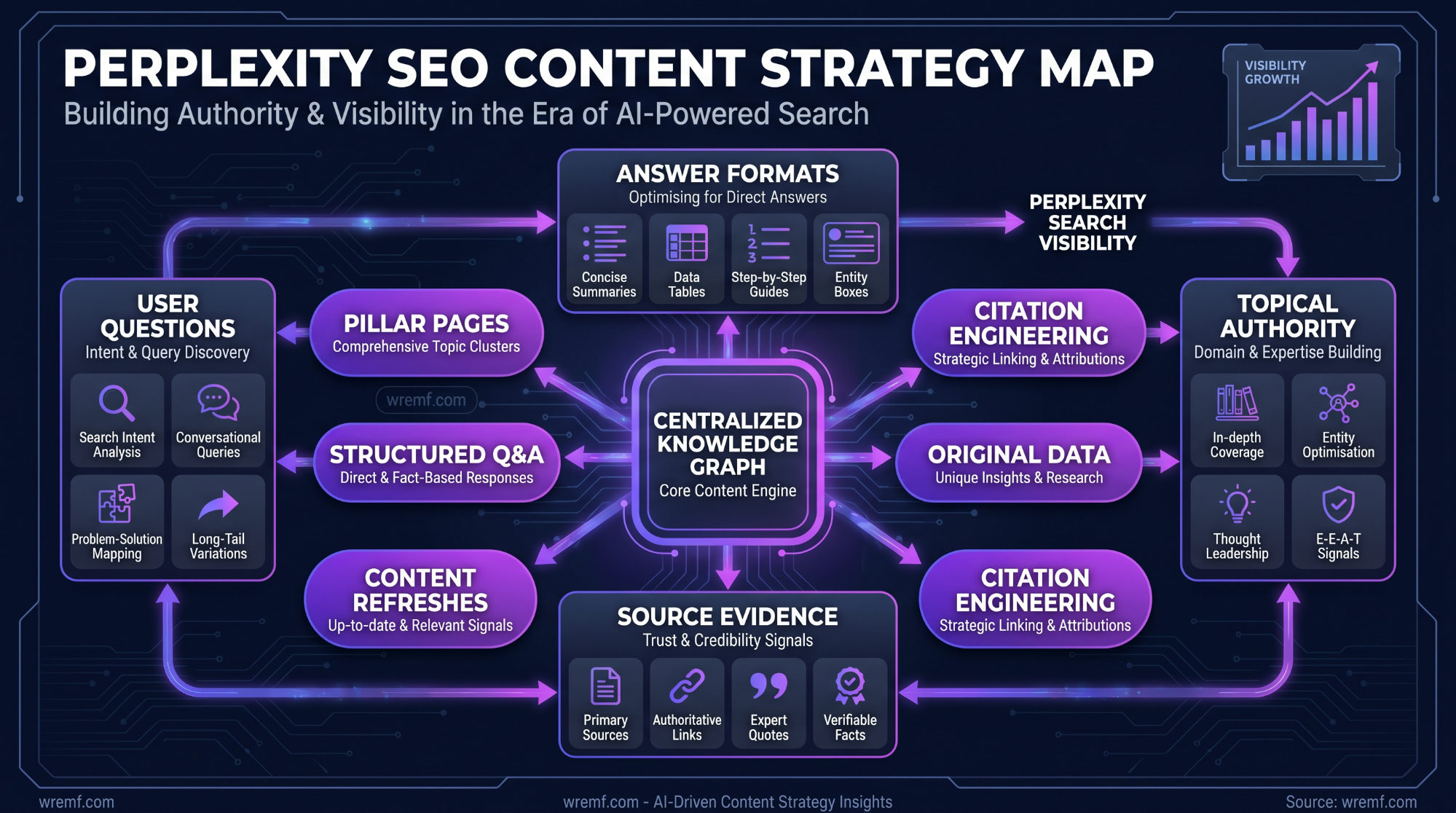
A Perplexity SEO content strategy should map user questions, answer formats, source evidence, and topical authority into one publishing system. The strongest strategy combines pillar pages, content refreshes, structured Q&A, original data, and citation engineering.
Content Gaps are unanswered or under-answered questions in your content ecosystem. Content Gaps matter because Perplexity can only cite your website for topics your pages explain clearly.
Pillar pages are comprehensive resources that cover a broad topic and link to supporting subtopics. Pillar pages matter for Perplexity SEO because they create a central source that answer engines can cite for definitions, comparisons, workflows, and related questions.
Start with prompt research rather than keyword research alone. Keywords tell you how people search in Google. Prompts tell you how people ask AI tools for recommendations, comparisons, explanations, and next steps. A query like “best AI SEO tools for agencies” may have a keyword pattern, but the Perplexity answer may depend on features, pricing, source mentions, content freshness, and comparison context.
Use this content strategy model:
| Content asset | Best for | What to include | Perplexity SEO value |
|---|---|---|---|
| Pillar page | Broad topic ownership | Definitions, comparisons, workflows, FAQs | Builds topical authority |
| Product page | Commercial intent | Features, use cases, pricing context, proof | Supports recommendation visibility |
| Comparison page | Buying-stage queries | Tradeoffs, use cases, alternatives | Helps AI answer vendor comparisons |
| Original research | Citation-worthy data | Stats, methodology, sample size, findings | Creates primary-source value |
| FAQ hub | Conversational Queries | Structured Q&A and direct answers | Matches natural language queries |
| Refresh page | Current topics | Updated facts, timelines, product changes | Supports content freshness |
| Programmatic SEO page | Scalable long-tail intent | Location, industry, tool, or use-case variations | Covers sub-niches when quality is controlled |
Perplexity SEO content should include both evergreen and fresh content. Evergreen pages define the core category. Fresh pages cover model changes, AI search landscape updates, Perplexity Pages, Focus Modes, Deep Research, shopping surfaces, and changes in answer engine campaigns.
Perplexity Pages are Perplexity-generated or Perplexity-hosted pages that organise information into research-style content pages. Perplexity Pages matter because they show how AI tools are becoming content discovery surfaces, not only answer boxes. Perplexity’s Help Center explains how Pages work inside Perplexity, including creating and using pages. (Perplexity)
Focus Modes are Perplexity search modes that help users narrow the context of a search, such as academic, writing, or other task-specific modes depending on the product experience. Focus Modes matter for Perplexity SEO because specialised queries may retrieve different source types than broad web searches.
Deep Research is a deeper AI research workflow that uses multi-step information gathering and synthesis. Deep Research matters for Perplexity SEO because complex B2B queries may depend on stronger source depth, comparison logic, and evidence quality than simple fact queries.
Mid-page CTA: If you want to see how AI engines currently describe your brand, review a sample AI visibility report before building your own Perplexity SEO measurement workflow.
KEY TAKEAWAY: A Perplexity SEO content strategy should start with real prompts, then build source-backed content that answers, compares, proves, and refreshes key topics.
Content creation is only one side of the work, because measurement determines whether Perplexity visibility is actually improving.
How Do You Measure Perplexity SEO Performance?
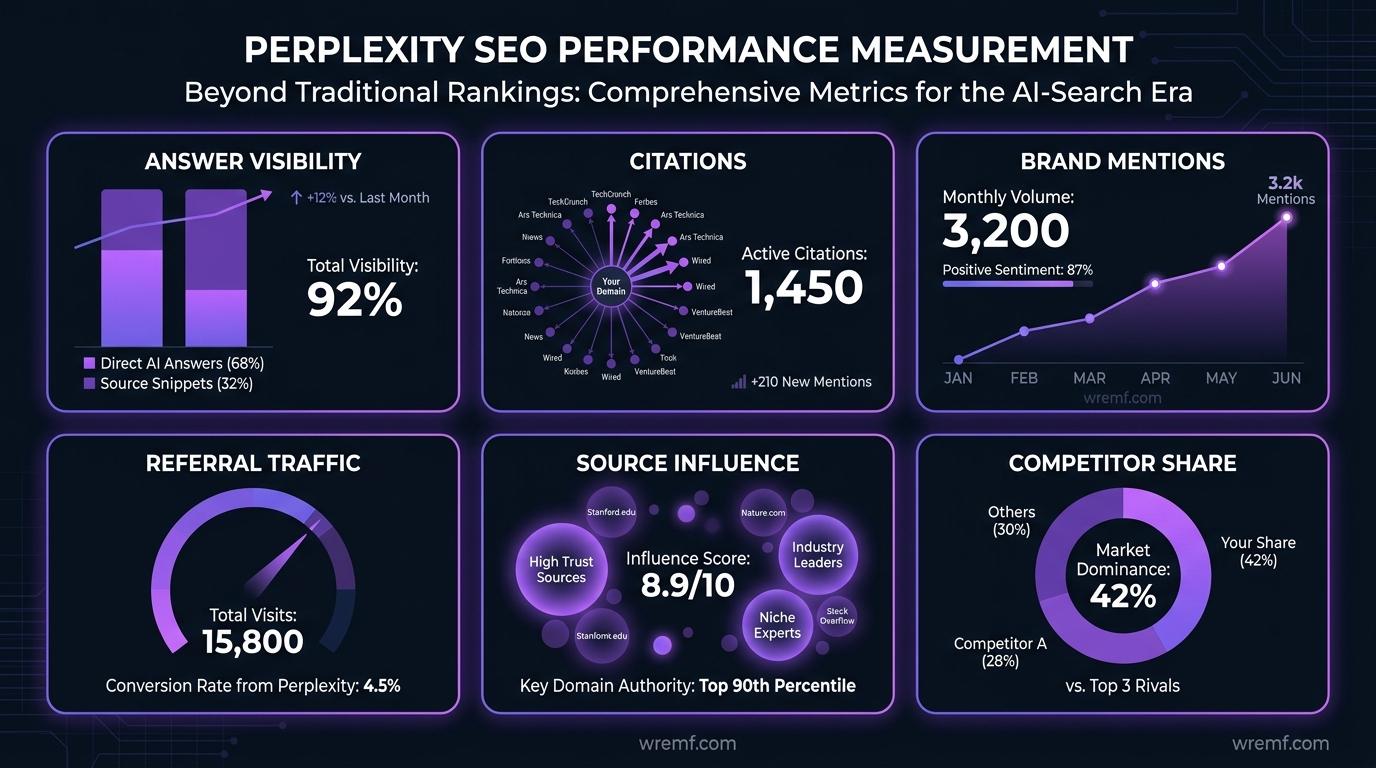
Perplexity SEO performance should be measured through answer visibility, citations, brand mentions, referral traffic, source influence, and competitor share. Rankings alone are not enough because Perplexity often answers without a traditional results page.
Prompt tracking is the process of monitoring how AI engines respond to repeated user prompts over time. Prompt tracking matters because it shows whether your brand appears, how your brand is described, which competitors are recommended, and which sources are cited.
AI share of voice is the percentage of relevant AI-generated answers where your brand appears compared with competitors. AI share of voice matters because B2B buyers often ask AI tools to shortlist vendors before visiting websites.
AI traffic attribution connects AI visibility to website sessions, conversions, pipeline, or assisted journeys. AI traffic attribution matters because leadership needs to know whether AI discovery surfaces create measurable business impact.
Share of Answers is the percentage of tracked AI answers where a brand appears, is cited, or is recommended. Share of Answers matters because AI visibility is prompt-based and answer-based, not only keyword-based.
In real-world reporting, Perplexity SEO measurement usually includes seven KPI groups:
| KPI | What it shows | Example measurement | Limitation |
|---|---|---|---|
| Prompt visibility | Whether your brand appears for target prompts | Brand appears in 18 of 50 prompts | Prompt sets must be representative |
| Citation count | Whether your URLs are cited | 12 cited URLs across 80 tests | Some answers may mention without citing |
| Share of Answers | Visibility versus competitors | 22 percent answer presence in a category | Requires competitor tracking |
| Source influence | Which domains shape answers | Industry directory cited 9 times | Source causality is hard to prove |
| Referral traffic | Visits from Perplexity | Sessions from perplexity.ai in analytics | Dark traffic may be untracked |
| Sentiment and accuracy | How the brand is described | Accurate, outdated, neutral, negative | Requires qualitative review |
| Content gap rate | Missing answers by prompt cluster | 14 prompts with no owned source | Requires content mapping |
Google Analytics can show referral traffic from Perplexity when referrals are passed correctly. Google Search Console can show Google Search performance, but it does not directly show Perplexity citations. Microsoft’s AI Performance release shows that major platforms are moving toward citation-level AI visibility reporting, but cross-engine measurement still requires dedicated AI visibility tracking. (bing.com)
WREMF turns AI visibility from a guessing game into a measurable workflow. The WREMF methodology connects prompts, citations, competitors, source consistency, and attribution so teams can report what changed, why it changed, and what to improve next.
KEY TAKEAWAY: Perplexity SEO should be measured by answer presence, citations, competitors, source influence, and attribution rather than keyword rankings alone.
Once measurement is clear, teams can decide whether to use software, an agency, or a hybrid model.
Should You Use Perplexity SEO Software, an Agency, or a Hybrid Model?
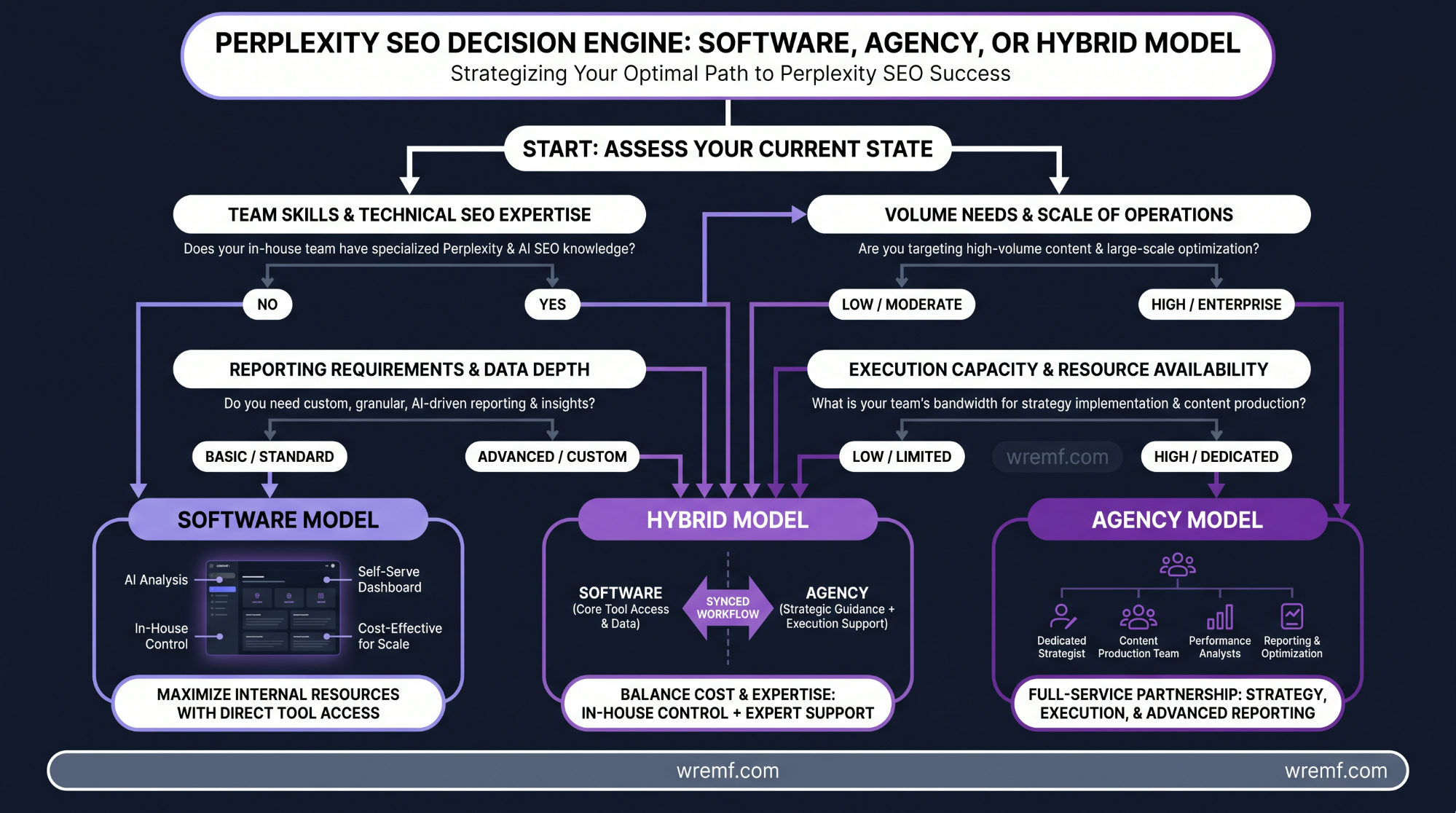
The right Perplexity SEO operating model depends on your team’s skills, volume, reporting needs, and execution capacity. Software is best for measurement, agency support is best for execution, and a hybrid model works best when teams need both.
AI SEO software helps teams monitor prompts, citations, rankings, competitors, and reporting across AI search surfaces. AI SEO software matters because manual testing becomes unreliable when prompts, engines, regions, devices, and competitors multiply.
A Perplexity SEO agency helps with strategy, content optimisation, entity authority, citation improvement, technical foundations, and ongoing reporting. Agency support matters when teams know what needs to change but lack time, senior SEO expertise, technical resources, or editorial capacity.
A hybrid model combines software with managed execution. A hybrid model matters because many teams need both visibility data and help turning that data into content, source cleanup, technical fixes, and authority-building actions.
| Operating model | Best for | What it includes | Main limitation | Recommended when |
|---|---|---|---|---|
| Software | In-house SEO, content, and growth teams | Prompt tracking, citations, dashboards, reports, competitor monitoring | Requires internal execution | You have a team that can act on recommendations |
| Agency service | Teams needing expert execution | Strategy, audits, briefs, content optimisation, reporting | Less internal control if unmanaged | You need senior-led execution and clear deliverables |
| Hybrid model | Scaling brands and agencies | Software plus managed AEO, GEO, content, and reporting | Requires prioritisation discipline | You need measurement and execution together |
WREMF is useful for brands that want software, agencies that need white-label reporting, and teams that want managed execution. The WREMF agency team supports AI visibility strategy, GEO consulting, AEO execution, source consistency cleanup, citation improvement, monthly reporting, and technical AI visibility foundations.
WREMF pricing is designed around usage by website count rather than prompt limits. Starter is €39 per month for 1 website, Growth is €89 per month for 5 websites, and Enterprise supports unlimited websites, unlimited seats, custom branded portals, and dedicated support. Pricing details are most relevant when teams are deciding whether to manage Perplexity SEO internally, through an agency, or through a combined workflow.
Agencies managing multiple clients often need white-label reports, repeatable prompt sets, source citation tracking, and client portals. In-house brands often need competitor visibility, AI traffic attribution, and recommendations that connect AI search visibility to business outcomes.
KEY TAKEAWAY: Use software when you can execute internally, use an agency when you need senior support, and use a hybrid model when you need measurement plus implementation.
The next section compares Perplexity SEO with AI SEO, AEO, GEO, and traditional SEO so the differences are easy to apply.
How Do SEO, AI SEO, AEO, and GEO Work Together?
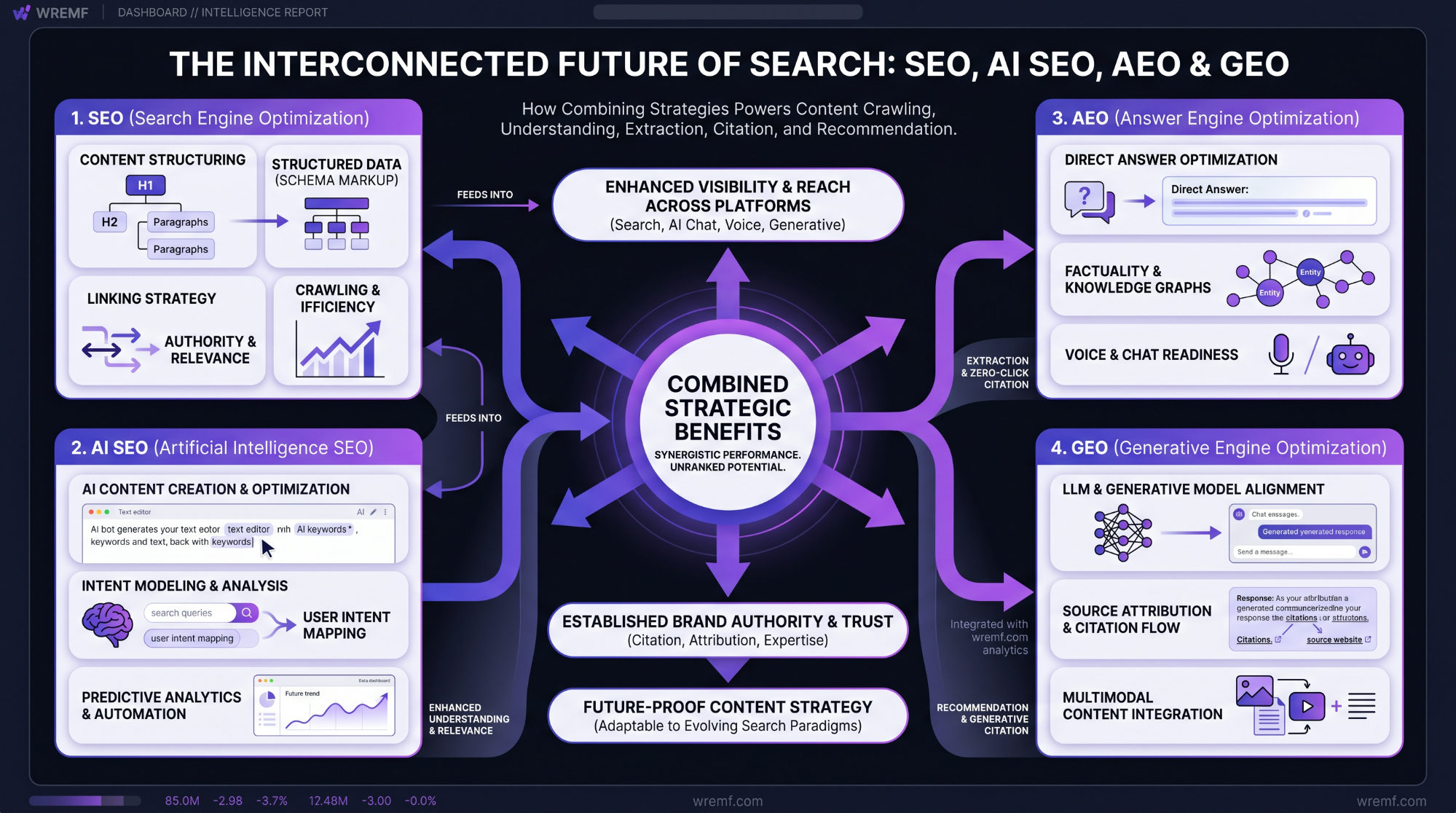
SEO, AI SEO, AEO, and GEO work together by improving how content is crawled, understood, extracted, cited, and recommended. The strongest Perplexity SEO strategy uses all four rather than treating them as separate channels.
Search engine optimization is the practice of improving a website’s visibility in search engines such as Google Search and Bing. Search engine optimization matters because crawlable, useful, authoritative pages are still the foundation for many AI search citations.
AI SEO is the practice of improving visibility across AI-powered search experiences, including Perplexity AI, Google AI Overviews, ChatGPT Search-style experiences, Gemini, Claude, and Copilot. AI SEO matters because search journeys now include both search engine result pages and AI-generated responses.
Answer Engine Optimisation is the British spelling of Answer Engine Optimization, and both refer to improving content for direct-answer systems. Answer Engine Optimisation matters because Perplexity, voice assistants, featured snippets, and answer cards often reward concise answer blocks.
Generative Engine Optimisation focuses on improving brand mentions, citations, and recommendations inside generative AI answers. Generative Engine Optimisation matters because AI-generated responses can influence vendor discovery even when users do not click a traditional result.
| Discipline | Primary goal | Main asset | Best metric | What actually matters |
|---|---|---|---|---|
| SEO | Rank and earn organic traffic | Website pages | Rankings, clicks, CTR | Helpful content, crawlability, authority |
| AI SEO | Appear across AI search surfaces | Prompt-aligned content | AI visibility score | Mentions, citations, answer inclusion |
| AEO | Win direct answers | Answer-first content | Featured snippet and answer inclusion | Clear definitions and Q&A format |
| GEO | Influence generative answers | Source-backed brand ecosystem | Share of Answers | Citations, entity clarity, source consistency |
| Perplexity SEO | Earn Perplexity answer visibility | Cite-worthy source pages | Perplexity citations and referral traffic | Retrieval quality and current evidence |
The key difference between SEO and GEO is that SEO optimizes for search visibility, while GEO optimizes for inclusion inside AI-generated answers. The key difference between AEO and GEO is that AEO focuses on answer extraction, while GEO focuses on generated response influence, citations, and recommendations.
This is widely misunderstood. You cannot replace SEO with GEO because AI systems still rely on accessible web content, topical authority, and source quality. You also cannot rely only on SEO because ranking on Google does not guarantee citation inside Perplexity AI, ChatGPT, Gemini, or Google AI Overviews.
KEY TAKEAWAY: SEO, AI SEO, AEO, and GEO are overlapping layers of the same visibility system, not competing strategies.
The next step is converting that system into a practical workflow your team can follow.
What Is a Step-by-Step Perplexity SEO Workflow?
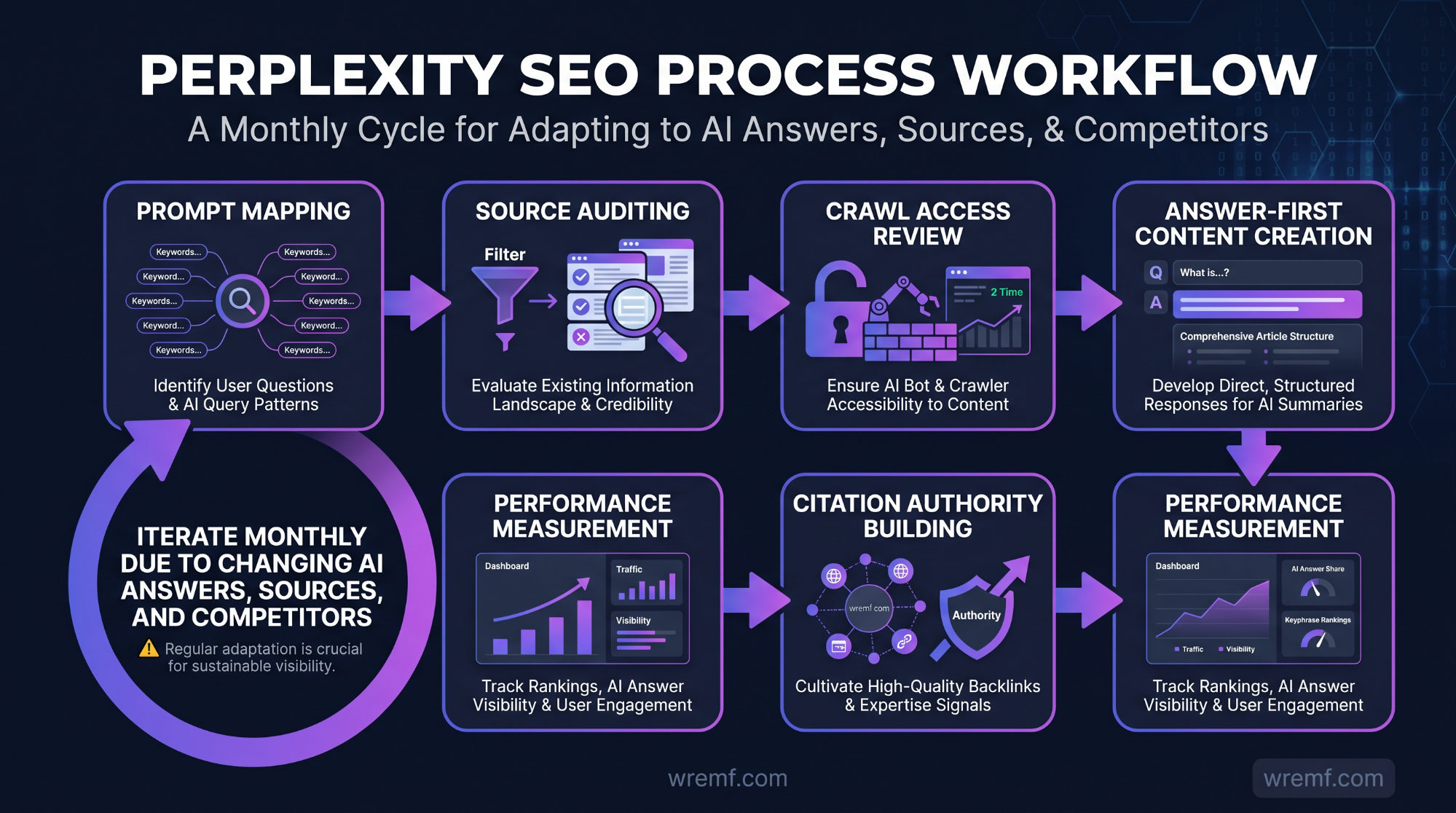
A practical Perplexity SEO workflow starts with prompts, audits sources, fixes crawl access, creates answer-first content, builds citation authority, and measures performance. The workflow should be repeated monthly because AI answers, sources, and competitors change.
Step 1 is prompt mapping. Build a prompt set that reflects how real users ask Perplexity AI questions. Include definition prompts, comparison prompts, buying prompts, service prompts, problem prompts, and implementation prompts. For example, “How do I optimize for Perplexity AI?” and “What are the best AI visibility tools for agencies?” represent different stages of user intent.
Step 2 is answer visibility testing. Run your prompt set across Perplexity, ChatGPT, Claude, Gemini, Copilot, and Google AI Overviews where possible. Record whether your brand appears, whether competitors appear, whether your website is cited, and whether the answer is accurate.
Step 3 is source citation analysis. Identify which sources Perplexity cites for your target topics. These may include your website, competitor pages, Wikipedia, Reddit communities, Quora answers, industry reports, review platforms, news sites, documentation, YouTube video pages, LinkedIn post pages, or software directories.
Step 4 is technical access review. Check robots.txt, PerplexityBot access, canonical tags, indexability, page speed, rendering, and structured data. If public content is blocked or hard to parse, answer engines may not retrieve it reliably.
Step 5 is content gap mapping. Identify prompts where your brand is absent, inaccurate, uncited, or weaker than competitors. Then create or update pages with answer-first definitions, Q&A sections, comparison tables, evidence, content freshness updates, and internal links.
Step 6 is authority and consistency cleanup. Align brand facts across your website, profiles, directories, articles, partner pages, and documentation. This improves entity clarity and reduces the risk of outdated or inconsistent AI-generated responses.
Step 7 is reporting and iteration. Track prompt visibility, citations, Share of Answers, competitor changes, referral traffic, content gap closure, and sentiment. Use monthly reporting to decide which prompts, pages, and sources to prioritise next.
WREMF’s prompt intelligence feature helps teams track prompts across major AI engines, monitor answer changes, and identify gaps in AI discovery. This matters because manual prompt testing is difficult to scale once teams track dozens of prompts, competitors, markets, and content clusters.
KEY TAKEAWAY: Perplexity SEO works best as a repeatable workflow that connects prompts, sources, content, technical access, and reporting.
That workflow also needs to account for Perplexity’s product surfaces, including Pages, Focus Modes, Discover-style feeds, and shopping experiences.
How Do Perplexity Pages, Focus Modes, Discover, and Shopping Affect SEO?
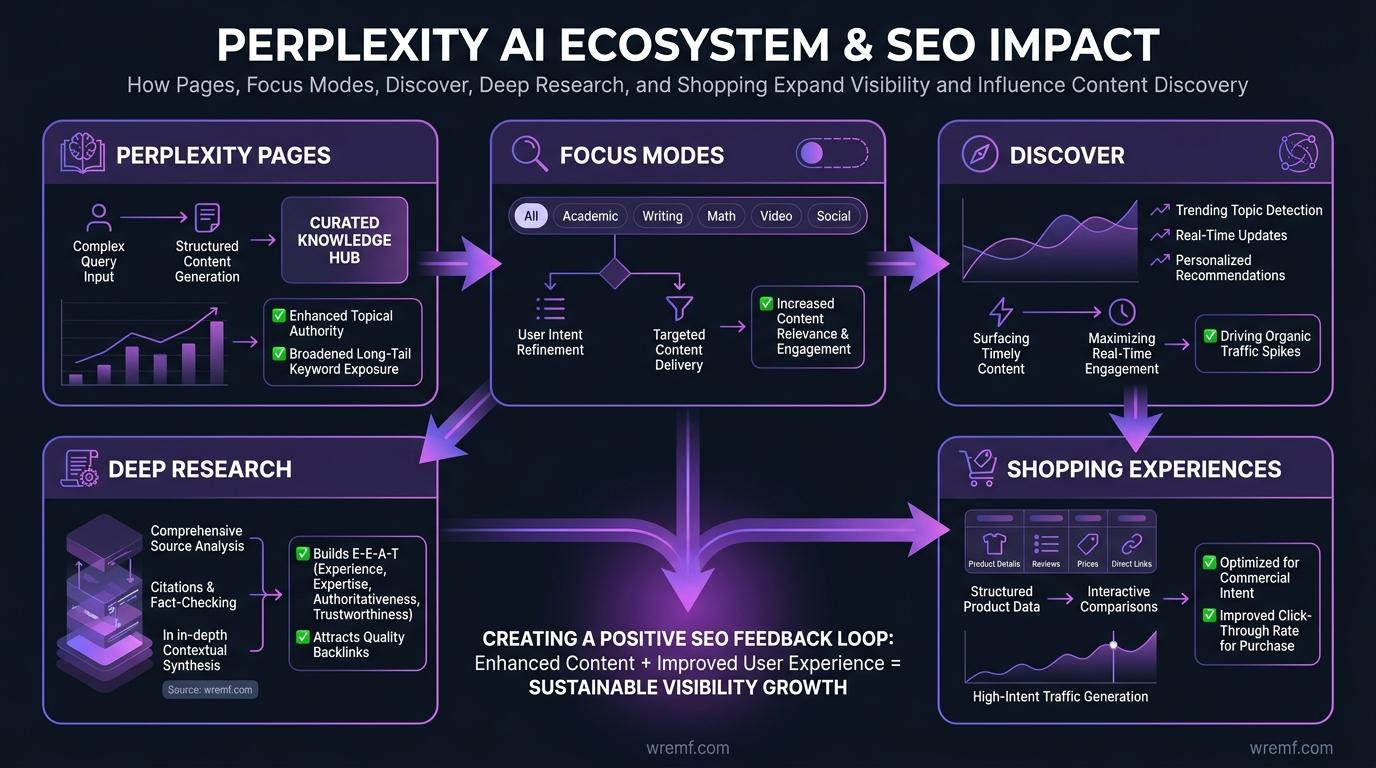
Perplexity product surfaces affect SEO by expanding visibility beyond a single answer box. Perplexity Pages, Focus Modes, Discover-style content, Deep Research, and shopping experiences can shape which sources users see and how topics are discovered.
Perplexity Pages are important because they turn AI-assisted research into shareable content surfaces. If a Page summarises a topic in your category, your brand may be influenced by the sources Perplexity uses to explain that topic. That means your owned pages, third-party mentions, product facts, and content freshness all matter.
Focus Modes matter because different contexts may favour different source types. Academic-style queries may rely more on papers, institutions, and formal sources. Writing-focused queries may rely more on explainers, examples, and editorial guidance. Shopping or product-oriented queries may rely on product data, reviews, availability, and trusted marketplaces.
A content discovery feed matters because it can expose users to curated or trending topics before they run a traditional search. For SEO teams, this means Perplexity SEO should not only target bottom-funnel buyer prompts. It should also target educational, category-building, comparison, and research prompts that shape early awareness.
A shopping surface matters because AI search can compress product discovery, comparison, and recommendation into one flow. For ecommerce and SaaS teams, this means product facts, pricing clarity, reviews, availability, structured content, and third-party credibility become more important.
Answer cards are the generated answer units that summarise information for a query. Answer cards matter because they may become the user’s primary impression of your brand, category, or product.
The best approach is to build a full source ecosystem:
Owned website pages for canonical explanations.
Product pages for pricing, features, and use cases.
Comparison pages for buying-stage prompts.
Research pages for citation-worthy data.
FAQs for conversational queries.
Third-party profiles for entity reinforcement.
Fresh updates for current-market questions.
IMPORTANT: Do not optimise only for one Perplexity surface. A resilient AI search strategy prepares for answer cards, citations, research pages, conversational follow-ups, shopping-style answers, and competitor comparisons.
KEY TAKEAWAY: Perplexity SEO should cover answer cards, Pages, Focus Modes, Discover-style discovery, Deep Research, and shopping-style AI search surfaces.
The next section explains how off-page authority and the citation loop support those surfaces.
What Off-Page Signals Help Perplexity SEO?
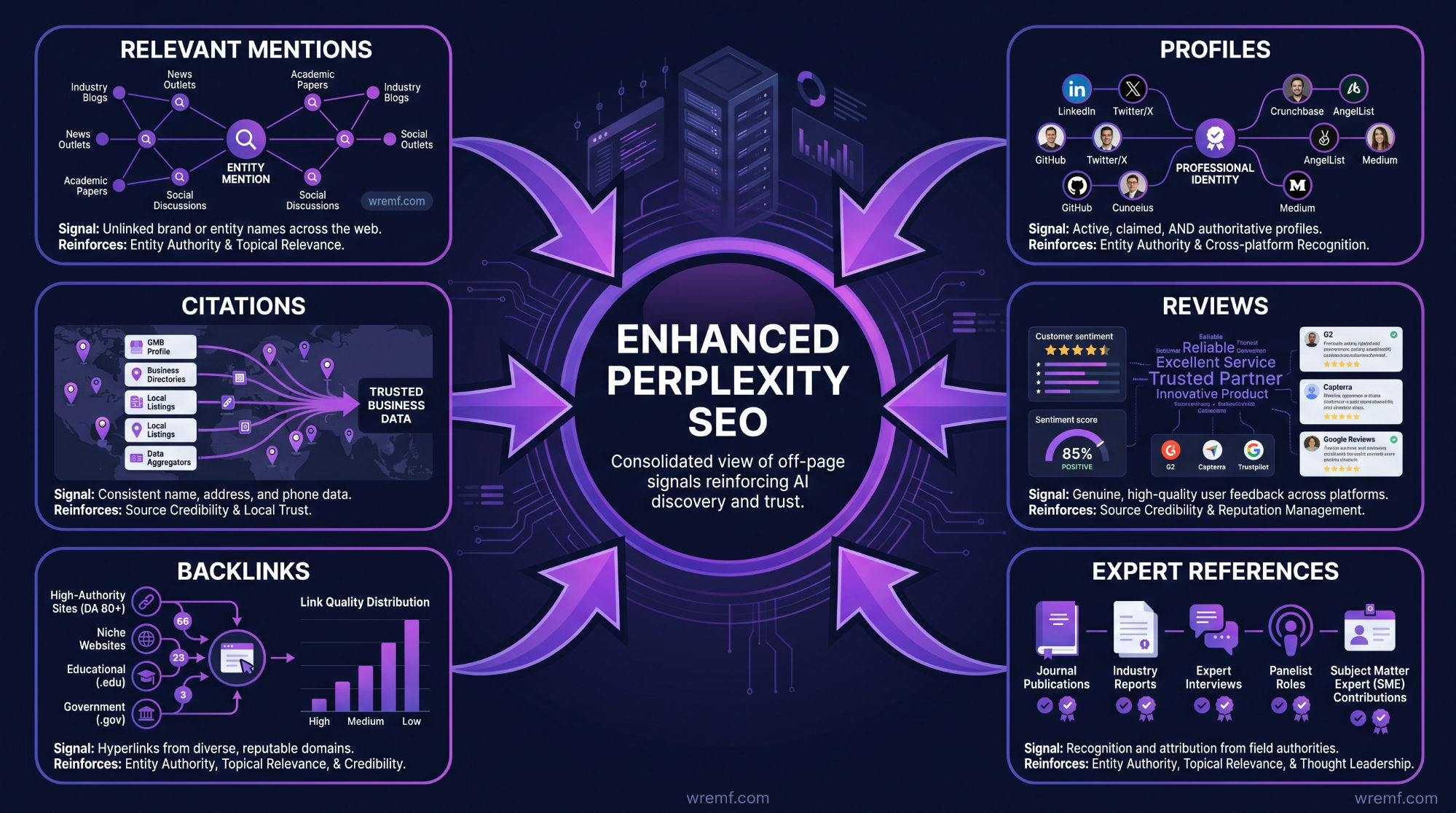
Off-page signals help Perplexity SEO by reinforcing entity authority, topical relevance, and source credibility outside your own website. The most useful off-page SEO signals are relevant mentions, citations, backlinks, profiles, reviews, and expert references.
Off-page SEO is the work of improving a brand’s visibility and authority through signals outside its own website. Off-page SEO matters for Perplexity because answer engines may cite or rely on third-party sources when forming a response.
A citation loop happens when authoritative third-party sources reinforce the same brand facts that your own website states. The citation loop matters because AI systems often compare patterns across the web before producing a confident answer.
For Perplexity SEO, off-page quality matters more than broad link volume. A niche industry directory, a credible analyst quote, a relevant podcast page, a high-quality product review, or a respected documentation page can be more useful than dozens of generic backlinks. The goal is to help AI systems understand your category, use cases, strengths, and credibility.
Useful off-page sources may include:
Wikipedia pages where relevant and appropriate.
Reddit communities with genuine discussions.
Quora answers with useful explanations.
Industry media and news sites.
Review platforms.
Partner pages.
Podcast pages.
Conference speaker profiles.
LinkedIn company and founder profiles.
YouTube video descriptions and transcripts.
Google Business Profile for local or service businesses.
This does not mean every brand should try to manipulate Reddit, Wikipedia, or Quora. The goal is not spam. The goal is to ensure that public sources contain accurate, consistent, useful information where users and AI tools already look for answers.
A strong backlink profile still helps traditional SEO, but for Perplexity SEO the backlink profile should support semantic relevancy. If your company wants to appear for “AI visibility platform,” then the web should consistently connect your brand with AI visibility, AI SEO, Generative Engine Optimisation, Answer Engine Optimization, source citations, prompt tracking, and share of voice.
KEY TAKEAWAY: Off-page authority for Perplexity SEO is about relevant source reinforcement, not just link volume or domain authority.
The next section explains what can go wrong and how to avoid common Perplexity SEO mistakes.
What Are the Biggest Perplexity SEO Mistakes?
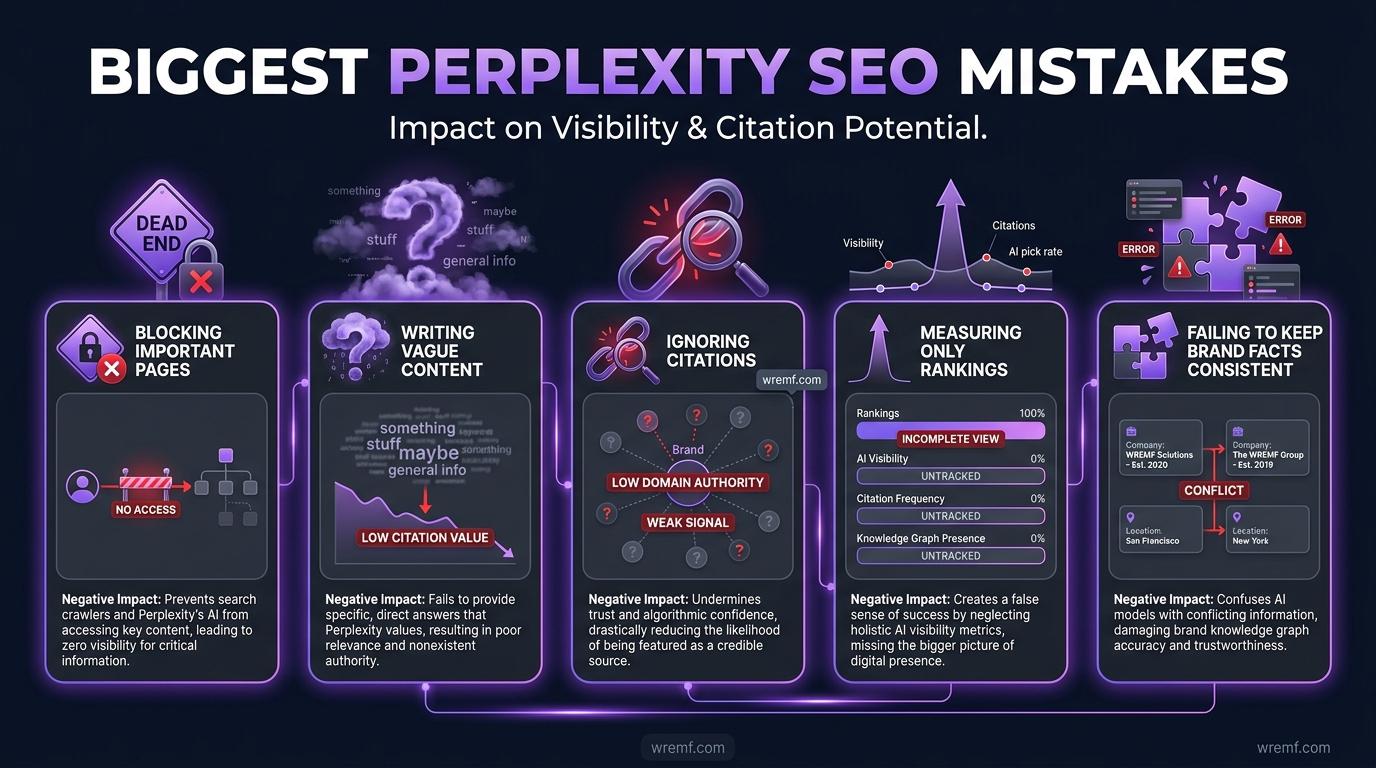
The biggest Perplexity SEO mistakes are blocking important pages, writing vague content, ignoring citations, measuring only rankings, and failing to keep brand facts consistent. These mistakes reduce the chance that Perplexity can retrieve, trust, and cite your content.
The first mistake is blocking AI crawlers without a policy. Some companies block all bots by default, then wonder why they do not appear in AI answers. Other companies allow everything without reviewing content risk. A better approach is to intentionally allow public educational and commercial pages while protecting private, paid, sensitive, or internal content.
The second mistake is writing for keywords but not for user intent. Perplexity users ask natural language queries such as “how do I rank in Perplexity?” or “why is my website not showing up in ChatGPT or Perplexity?” A page that repeats “Perplexity SEO” without answering those questions clearly is unlikely to become a useful source.
The third mistake is relying on generic AI Writer content. AI tools can help draft, summarise, and structure content, but generic AI-generated responses often lack original data, expert nuance, source attribution, and practical experience. Perplexity SEO requires content that adds value beyond what an answer engine can already summarise from existing sources.
The fourth mistake is ignoring content refreshes. Perplexity AI, OpenAI ChatGPT, Google Gemini, Claude, Google AI Overviews, Copilot, and search engine features change quickly. Old advice about AI SEO can become outdated when crawlers, models, APIs, or answer formats change.
The fifth mistake is treating FAQ schemas as a shortcut. FAQ schemas can clarify Q&A structure for search engines, but schema alone cannot compensate for weak answers, thin content, poor evidence, or low source trust. Structured Q&A should be useful to readers first.
The sixth mistake is missing measurement. Without prompt tracking, citation tracking, AI traffic attribution, and competitor monitoring, teams cannot tell whether Perplexity SEO is improving. They may publish content without knowing if it changes answer visibility.
KEY TAKEAWAY: Perplexity SEO fails when teams optimise pages for keywords but ignore access, answers, citations, freshness, source trust, and measurement.
The next section addresses common myths that block teams from acting on AI search visibility.
Common Myths About Perplexity SEO and AI Visibility Debunked
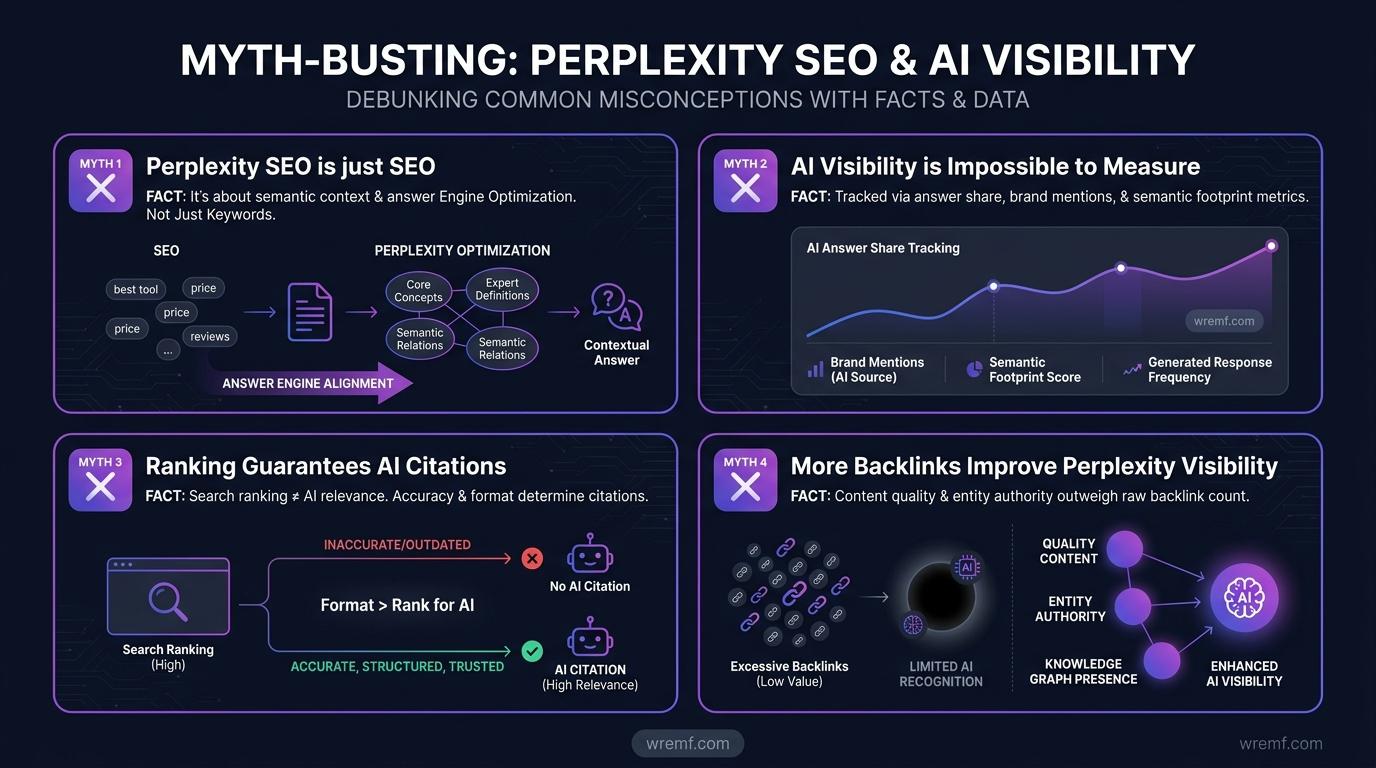
Perplexity SEO is often misunderstood because it overlaps with SEO, AEO, GEO, AI SEO, and content strategy. The most harmful myths lead teams to ignore measurement, over-focus on rankings, or assume AI visibility is impossible to influence.
MYTH: Perplexity SEO is just traditional SEO with a new name.
FACT: Perplexity SEO uses SEO foundations, but it is not the same as traditional SEO. Traditional SEO focuses heavily on rankings, impressions, clicks, and backlinks. Perplexity SEO focuses on AI answer inclusion, source citations, brand mentions, prompt visibility, and source consistency.
MYTH: AI visibility is impossible to measure.
FACT: AI visibility is harder to measure than classic rankings, but it is not impossible to measure. Teams can track repeated prompts, answer presence, cited URLs, competitor mentions, referral traffic, sentiment, and Share of Answers. Microsoft’s AI Performance feature also shows that citation-level AI visibility is becoming a recognised reporting category. (bing.com)
MYTH: Ranking number one in Google guarantees Perplexity citations.
FACT: A strong Google ranking can help, but it does not guarantee citation in Perplexity AI. Perplexity may cite a more direct, current, specific, or source-backed page. Answer engines often need extractable answers, credible evidence, and clear entity context, not only search engine rankings.
MYTH: AEO and GEO replace SEO.
FACT: AEO and GEO build on SEO rather than replacing it. SEO helps content get discovered and understood. AEO makes answers extractable. GEO improves the chance of being mentioned, cited, or recommended inside AI-generated responses.
MYTH: More backlinks automatically improve Perplexity visibility.
FACT: Backlinks can support authority, but Perplexity SEO depends on relevance, citations, content freshness, source clarity, and brand consistency. A smaller number of highly relevant third-party mentions may help entity clarity more than a large number of generic links.
KEY TAKEAWAY: Perplexity SEO is measurable and influenceable, but it requires a broader strategy than rankings, backlinks, or keyword density alone.
With the myths clarified, the final strategic question is how to future-proof SEO for Perplexity and other AI search engines.
How Do You Future-Proof SEO for Perplexity, ChatGPT, Gemini, and AI Overviews?
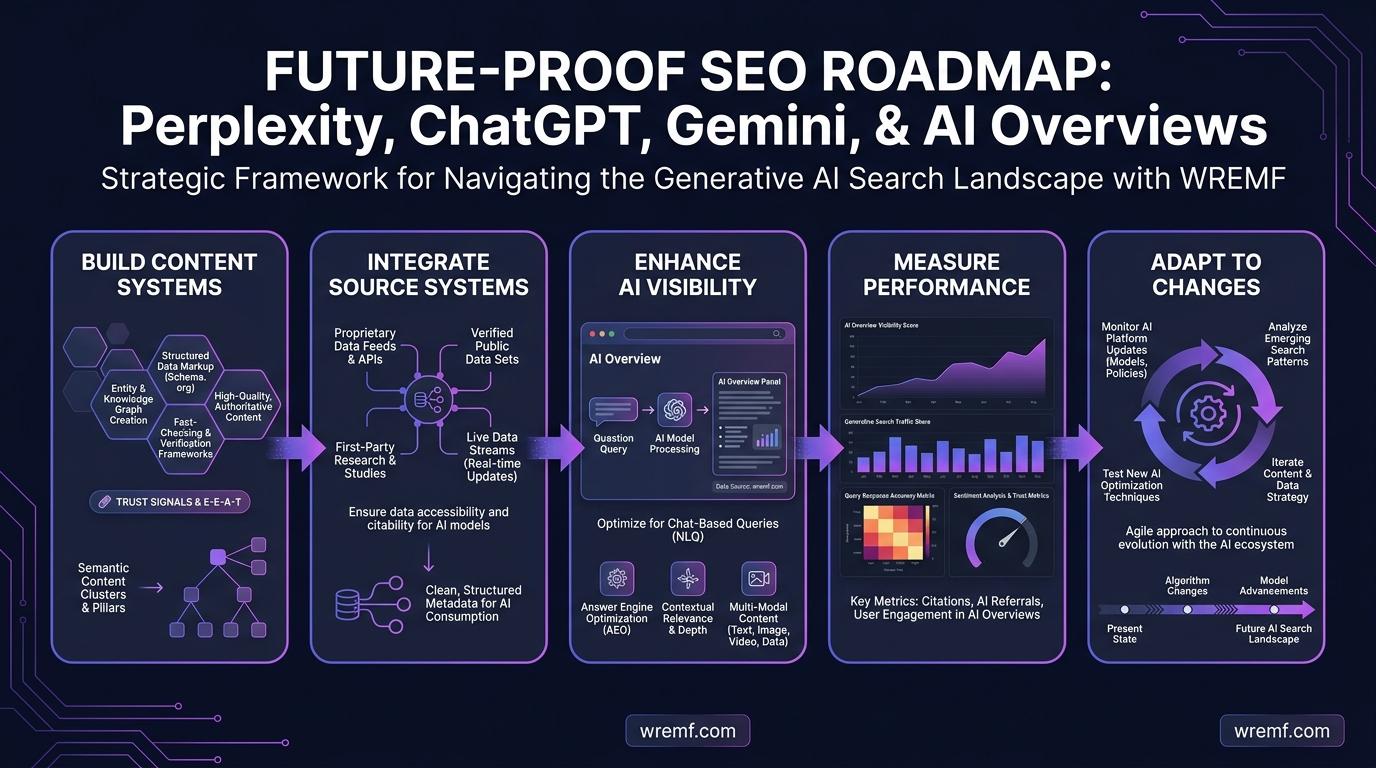
The best way to future-proof SEO is to build content and source systems that work across search engines and AI answer engines. Perplexity SEO should be part of a broader AI search visibility strategy, not an isolated tactic.
AI search landscape refers to the ecosystem of AI-powered search, answer, and discovery tools such as Perplexity, ChatGPT, Claude, Gemini, Google AI Overviews, Copilot, DeepSeek, Grok, Meta AI, and Mistral. The AI search landscape matters because users now move across multiple answer engines during research and buying journeys.
Google Gemini is Google’s AI model family used across Google products and AI experiences. Google Gemini matters for AI SEO because Google’s search ecosystem increasingly includes generative AI answers, summaries, and assistant-style experiences.
OpenAI ChatGPT is an AI assistant used for research, writing, comparison, and decision support. OpenAI ChatGPT matters for AI search visibility because users often ask it for vendor shortlists, product explanations, and buying advice.
A future-proof AI SEO system has five principles:
Make content helpful to humans first.
Make content clear enough for machines to parse.
Make claims verifiable with sources.
Make brand facts consistent across the web.
Make performance measurable across prompts, engines, and citations.
The Nielsen Norman Group has long emphasised that users scan pages and benefit from clear structure, descriptive headings, and concise content. For AI search, the same principle applies to machines. Well-structured content helps both readers and retrieval systems understand the page.
A strong future-proof strategy should include:
Answer-first definitions for every major concept.
Structured content for comparison, implementation, and decision intent.
Original data where your team can provide it.
Content refreshes for changing topics.
Technical access for public pages.
Source citation tracking across AI engines.
Competitor visibility monitoring.
AI traffic attribution connected to analytics.
Entity consistency across third-party sources.
Internal linking between pillar pages and sub-niches.
WREMF supports this broader workflow through AI visibility tracking, prompt intelligence, source citations, competitor visibility, AI share of voice, GEO audits, AEO strategy, content briefs, SEO testing, scheduled monitoring, white-label client reporting, API and MCP integrations, BYOK support, and client portals. The WREMF API and MCP integration page is useful for technical teams that want to connect AI visibility data into internal reporting systems.
KEY TAKEAWAY: Future-proof SEO for Perplexity means building a measurable, source-backed, AI-readable content ecosystem across multiple answer engines.
The final body section shows how WREMF helps teams turn this strategy into an operating system.
How WREMF Helps Teams Improve Perplexity SEO
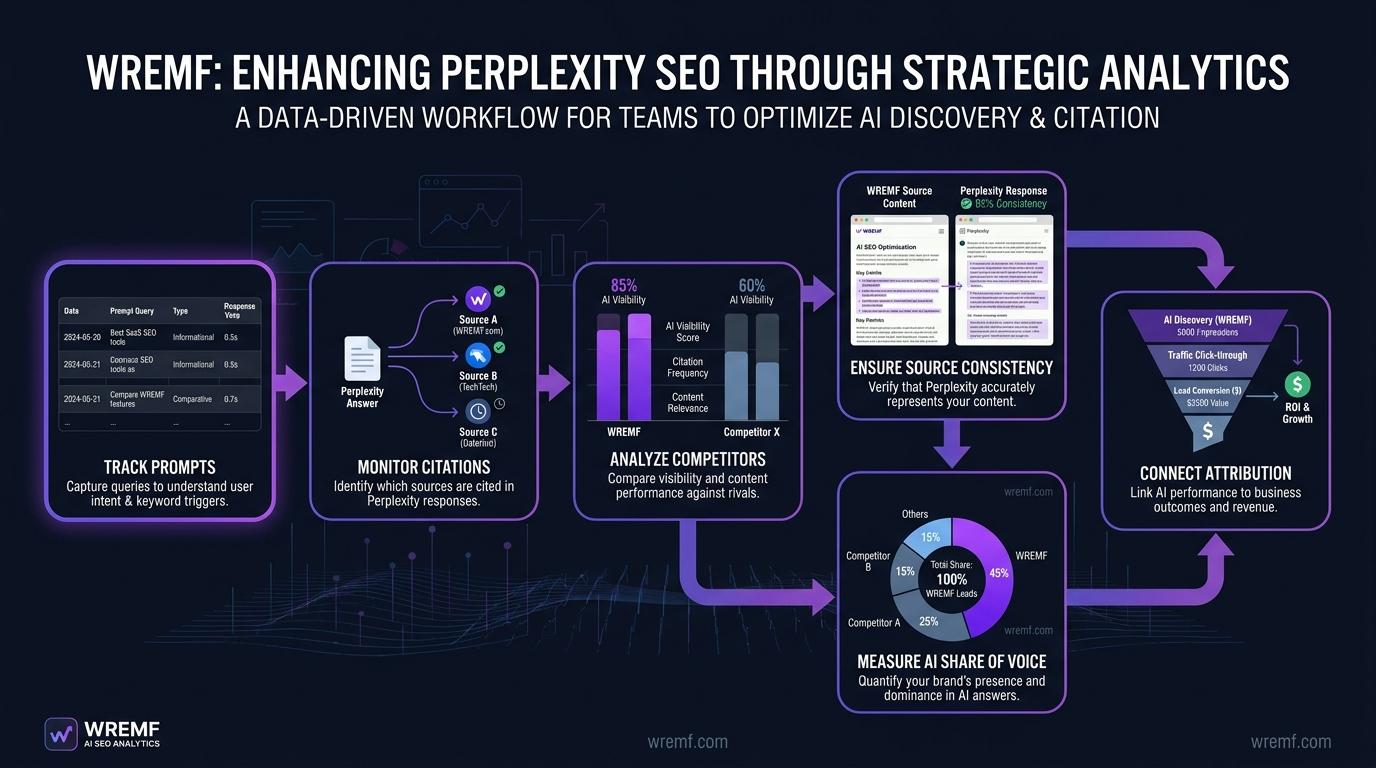
WREMF helps teams improve Perplexity SEO by tracking prompts, citations, competitors, source consistency, AI share of voice, and attribution across major AI engines. WREMF turns AI visibility from manual testing into a repeatable measurement and execution workflow.
WREMF is an AI visibility platform and optional agency partner for B2B teams. WREMF helps teams track, improve, and prove how their brand appears across Perplexity AI, ChatGPT, Claude, Gemini, Google AI Overviews, Copilot, DeepSeek, Grok, Meta AI, Mistral, and other AI discovery surfaces.
The WREMF workflow connects five areas:
| WREMF capability | What it helps with | Why it matters for Perplexity SEO |
|---|---|---|
| AI visibility tracking | Tracks brand presence across AI engines | Shows whether the brand appears in answers |
| Prompt intelligence | Monitors prompts and answer changes | Reveals which user questions trigger visibility |
| Source citations | Tracks cited domains and pages | Shows which sources influence answers |
| Competitive landscape | Compares competitor answer visibility | Identifies who is winning AI recommendations |
| GEO audit | Checks technical and content readiness | Finds crawl, structure, and entity gaps |
| Content briefs | Turns gaps into content plans | Helps create cite-worthy answer-first pages |
| SEO testing | Measures before and after impact | Connects changes to visibility and traffic |
| White-label reporting | Supports agencies and consultants | Makes AI visibility reporting client-ready |
The WREMF competitive landscape feature is useful when leadership asks why a competitor appears in Perplexity AI answers but your brand does not. Instead of guessing, teams can inspect prompt clusters, cited sources, competitor mentions, and recommendation context.
For brands, WREMF helps identify which prompts matter, which pages need improvement, which sources influence AI answers, and which competitors are gaining visibility. The WREMF for brands page is relevant for in-house teams that need AI visibility reporting tied to growth goals.
For agencies, WREMF supports multi-client reporting, white-label dashboards, source tracking, and repeatable AI visibility audits. The WREMF for agencies page is relevant for consultants and agencies managing AI SEO, AEO, GEO, and reporting for clients.
WREMF does not guarantee citations, rankings, traffic, or revenue. No credible AI SEO platform should make that promise. WREMF helps teams make better decisions by connecting prompts, citations, competitors, source consistency, and attribution into a measurable system.
KEY TAKEAWAY: WREMF helps teams manage Perplexity SEO as a measurable workflow across software, agency execution, or a hybrid model.
Before choosing tactics, the FAQ section answers the most common questions users ask about Perplexity SEO.
Frequently Asked Questions
Is Perplexity good for SEO?
Yes, Perplexity can be good for SEO because it creates another discovery surface where users can find brands, sources, products, and explanations. Perplexity SEO does not replace Google Search, but it expands organic visibility into AI-generated answers and citations. The main opportunity is not only referral traffic from Perplexity, but also brand presence when users ask comparison, research, and buying questions. Teams should track Perplexity citations, referral traffic, prompt visibility, source mentions, and competitor presence to understand the real impact.
Is SEO dead or evolving in 2026?
SEO is evolving rather than dying in 2026. Traditional search engine optimization still matters because AI answer engines depend on crawlable, useful, structured, and authoritative web content. What changed is the measurement model. Teams now need to track rankings, clicks, AI citations, Share of Answers, brand mentions, prompt visibility, and AI traffic attribution. SEO, AI SEO, Answer Engine Optimization, and Generative Engine Optimisation work together when content is helpful to humans and understandable to machines.
What is the Perplexity controversy?
The Perplexity controversy refers to public disputes about how Perplexity and related crawlers accessed publisher content. Cloudflare and media outlets alleged that some Perplexity-related crawling bypassed restrictions or used stealth crawling methods, while Perplexity disputed parts of those reports. For SEO teams, the practical lesson is not to ignore crawler governance. Review robots.txt, monitor server logs, decide what public pages should be accessible, and protect private or licensed content with appropriate technical controls.
Is Perplexity a Google killer?
Perplexity is not a simple Google killer, but it is part of a broader shift from search engines to answer engines. Google Search remains a dominant discovery channel, and Google AI Overviews bring generative answers into the Google ecosystem. Perplexity competes by giving direct, cited answers and conversational research workflows. For marketers, the right response is not to abandon Google Search, but to optimise for Google Search, Perplexity AI, ChatGPT, Gemini, Claude, Copilot, and other AI discovery surfaces together.
How does SEO for Perplexity AI work?
SEO for Perplexity AI works by making content crawlable, understandable, current, credible, and useful enough to cite. The workflow includes allowing PerplexityBot where appropriate, creating answer-first content, adding structured data, improving source consistency, filling Content Gaps, building relevant authority, and tracking prompt visibility. Perplexity SEO should also measure citations, brand mentions, answer accuracy, competitor visibility, and referral traffic. WREMF helps teams manage this process through prompt intelligence, source citation tracking, GEO audits, and AI visibility reporting.
How do I rank my website in AI search engines like ChatGPT, Perplexity, and Google AI Overviews?
To rank or appear in AI search engines, start by identifying the prompts users ask about your category. Then create clear, answer-first pages that define terms, compare options, cite reliable sources, and address buying-stage questions. Make sure crawlers can access public content, use structured content, maintain content freshness, and keep brand facts consistent across third-party sources. Measure progress through answer presence, citations, Share of Answers, and referral traffic rather than relying only on keyword rankings.
What makes content cite-worthy to Perplexity?
Content becomes cite-worthy to Perplexity when it gives a direct answer, supports claims with evidence, uses clear structure, and stays current. Strong citation candidates often include definitions, comparison tables, original data, updated facts, expert explanations, Q&A sections, and source-backed claims. Perplexity is less likely to need a page that repeats generic advice without adding clarity or proof. A useful test is whether a paragraph could answer a user’s question without requiring the reader to interpret vague marketing copy.
What is PerplexityBot and is it crawling my site?
PerplexityBot is Perplexity’s crawler for surfacing and linking websites in Perplexity search results. You can check whether it is crawling your site by reviewing server logs, bot analytics, CDN logs, or crawler monitoring tools. If you want public pages to appear in Perplexity, review your robots.txt rules and make sure PerplexityBot is not blocked from the relevant sections. If you have private, paid, internal, or sensitive content, protect it with stronger controls than robots.txt alone.
What is Perplexity’s Sonar model?
Perplexity’s Sonar model is part of Perplexity’s web-grounded AI system for search and answer generation. Sonar is important for Perplexity SEO because it shows how Perplexity combines search, retrieval, language models, citations, and structured responses. The practical SEO takeaway is that cite-worthy content must be easy to retrieve and useful to summarise. Clear answers, current facts, structured sections, and source-backed claims make content more useful for web-grounded AI responses.
What are Perplexity Focus Modes?
Perplexity Focus Modes are search contexts that help users narrow results around a task or source type, such as academic, writing, or other specialised modes depending on product availability. Focus Modes matter for SEO because source selection can change depending on the user’s intent. A general commercial query may retrieve product and comparison pages, while an academic query may favour research papers, formal sources, and institutional content. Perplexity SEO should therefore cover multiple content types, not only blog posts.
What is Perplexity Pages?
Perplexity Pages are Perplexity content surfaces that organise AI-assisted research into shareable pages. Perplexity Pages matter because they show how AI search tools are becoming discovery and publishing environments, not only answer boxes. Brands should treat Pages as a signal that clear, current, and well-sourced information can travel across AI-generated content experiences. Strong owned content and consistent third-party information improve the chance that your category, product, and brand facts are represented accurately.
Does Perplexity use the same signals as Google?
Perplexity does not publicly disclose the full set of signals it uses, and it should not be treated as identical to Google Search. However, many strong SEO fundamentals still help Perplexity SEO, including crawlability, helpful content, clear structure, authoritative sourcing, internal linking, content freshness, and technical quality. The difference is that Perplexity visibility is also shaped by citations, retrieval quality, answer usefulness, and prompt context. Ranking well in Google may help, but it does not guarantee Perplexity citations.
Is Perplexity SEO different from AI SEO?
Perplexity SEO is a specialised part of AI SEO. AI SEO covers visibility across AI search engines and assistants such as Perplexity, ChatGPT, Gemini, Claude, Copilot, and Google AI Overviews. Perplexity SEO focuses specifically on Perplexity’s answer engine, PerplexityBot, Sonar architecture, citations, answer cards, Perplexity Pages, and Perplexity referral traffic. A strong AI SEO strategy should include Perplexity-specific tracking while also measuring visibility across multiple AI discovery surfaces.
What do Perplexity AI SEO services include?
Perplexity AI SEO services usually include prompt research, AI visibility audits, PerplexityBot access checks, content gap analysis, citation tracking, source consistency cleanup, answer-first content briefs, structured content optimisation, technical SEO guidance, and monthly reporting. Advanced services may also include competitor visibility tracking, entity authority building, Digital PR, content refreshes, and AI traffic attribution. WREMF offers software, managed agency execution, and a hybrid model for teams that want both measurement and implementation support.
Why combine Perplexity SEO with AEO and GEO?
Perplexity SEO should be combined with AEO and GEO because Perplexity is both an answer engine and a generative search experience. AEO helps content become extractable as direct answers. GEO helps brands appear inside AI-generated summaries, citations, and recommendations. Perplexity SEO applies those principles to Perplexity-specific surfaces, crawlers, citations, prompts, and referral traffic. The strongest strategy uses SEO for discoverability, AEO for answer clarity, and GEO for AI recommendation visibility.
How can WREMF help with Perplexity SEO?
WREMF helps with Perplexity SEO by tracking how your brand appears across Perplexity and other AI engines, monitoring prompt visibility, identifying cited sources, comparing competitor visibility, and connecting AI search performance to reporting. WREMF also supports GEO audits, AI-ready content briefs, source consistency analysis, SEO testing, white-label reporting, API integrations, MCP workflows, BYOK support, and client portals. Teams can use WREMF as software, an agency service, or a combined software plus managed execution solution.
Conclusion
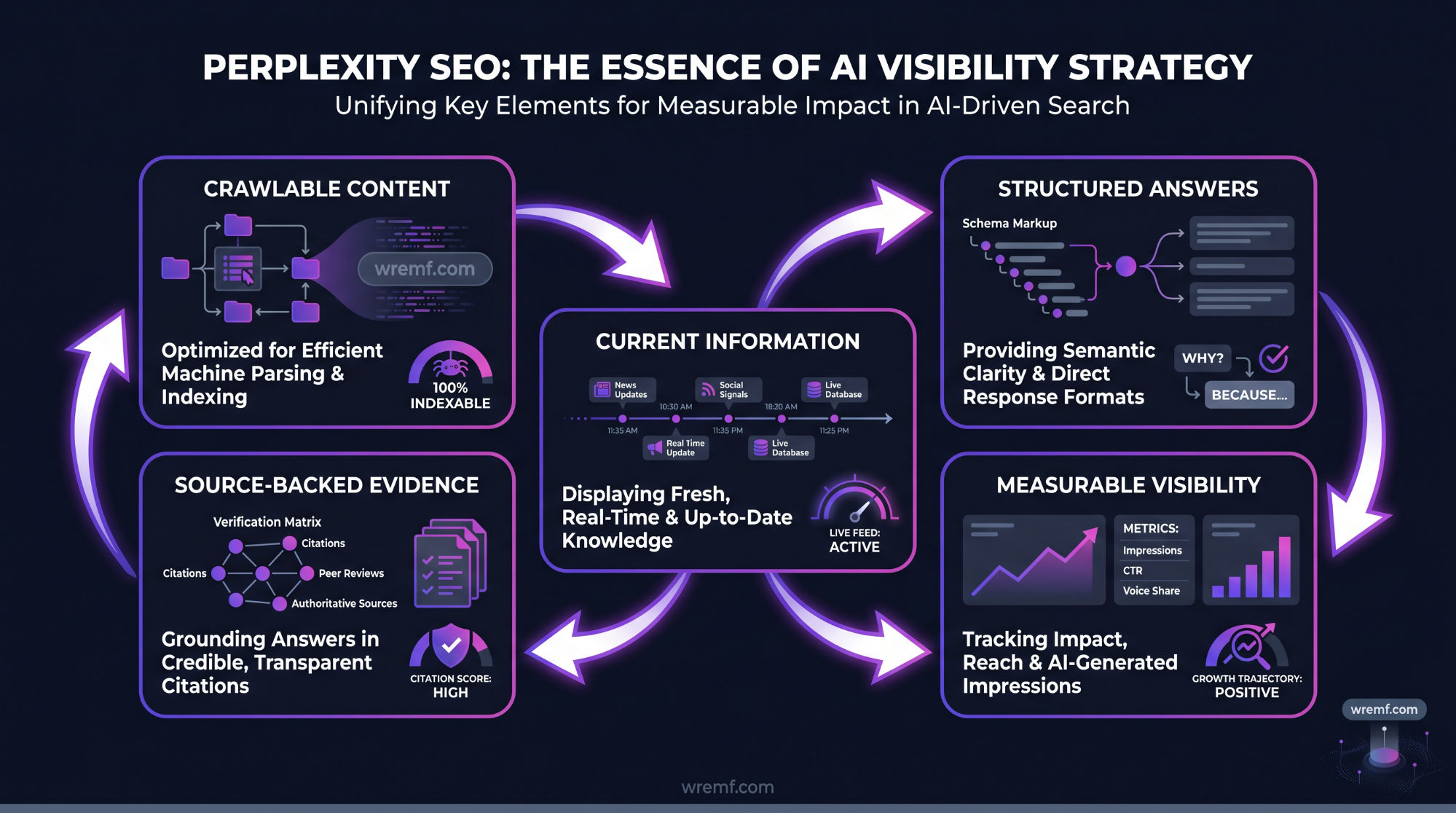
Perplexity SEO is now part of a complete AI visibility strategy because users rely on Perplexity AI, ChatGPT, Gemini, Claude, Copilot, and Google AI Overviews to research, compare, and choose brands. The practical goal is not to chase one ranking signal, but to make your content crawlable, structured, current, source-backed, and measurable across answer engines. Teams that track prompts, citations, competitors, source consistency, and attribution will understand AI search visibility better than teams relying only on rankings. To turn Perplexity SEO into a repeatable workflow, explore the WREMF platform suite or talk to the WREMF agency team.
Related reading
- AI Search Engine Optimization: The Complete Guide for B2B Brands
- Answer Engine Optimization: The Complete Guide to AEO, AI Search Visibility, and Answer-First Content
- SEO for AI Search: Ranking in Google AI Overviews, ChatGPT, Perplexity, Gemini, and Answer Engines
- Perplexity AI Optimization: The Complete Guide to AI Search Visibility in 2026