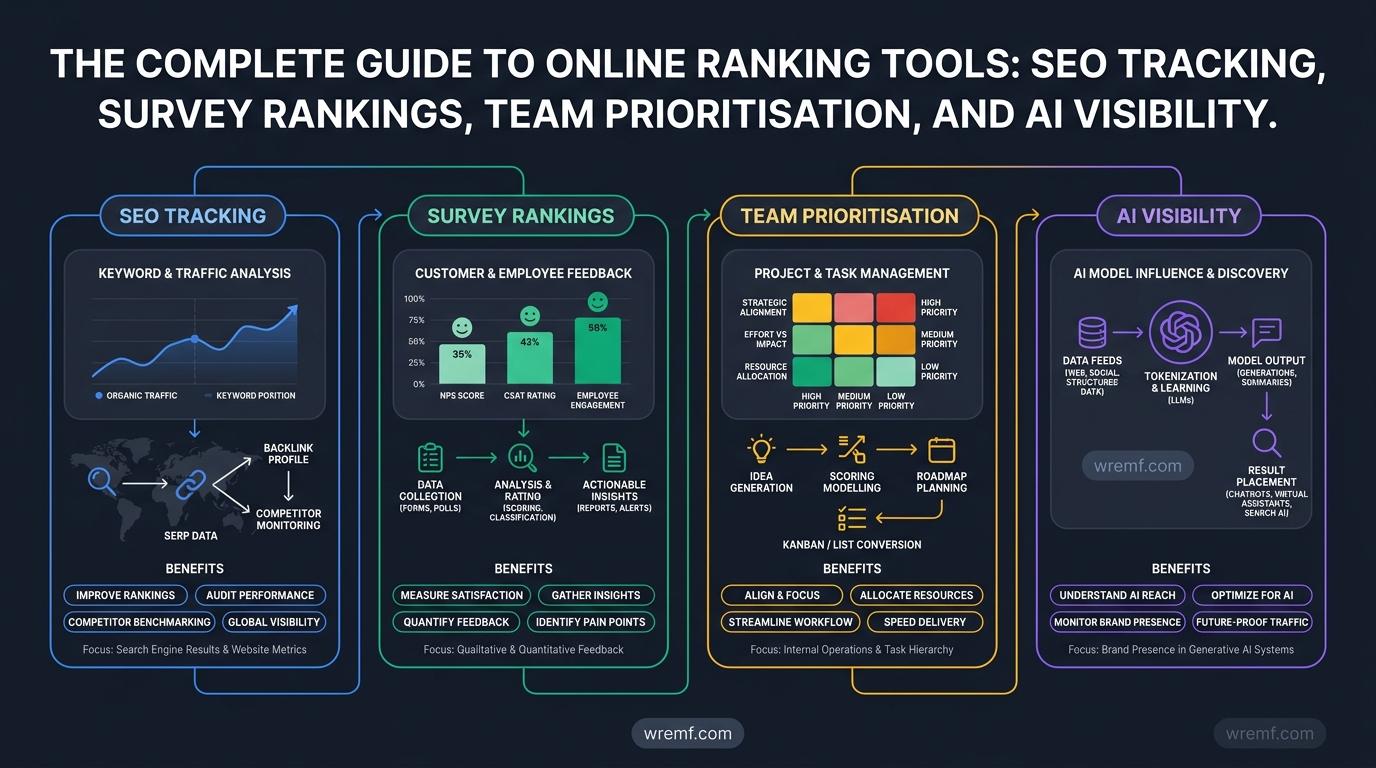
The Complete Guide to Online Ranking Tools: SEO Tracking, Survey Rankings, Team Prioritisation, and AI Visibility
Explore SEO rank trackers, survey ranking tools, and team prioritisation systems. Understand AI visibility's role in ranking tools.
By WREMF Team · 2026-08-25
An online ranking tool is a software solution that measures, visualizes, or facilitates ranked data. The three primary categories are SEO rank trackers for monitoring keyword positions, survey ranking tools that collect ordered preferences, and team prioritisation tools designed for data-backed decision-making. Choosing the right tool depends on your objectives: search visibility, data collection, or team alignment. Understanding these categories helps in selecting a tool to meet specific needs, incorporating AI visibility considerations as needed.
Key takeaways
- Online ranking tools can be categorized into SEO rank trackers, survey ranking tools, and team prioritisation systems.
- SEO rank trackers like SE Ranking, Ahrefs, and SEMRush monitor keywords, domain authority, and backlinks in search engine rankings.
- Survey tools such as Jotform collect preference data using ranking questions and provide conditional logic for custom follow-up.
- Team prioritisation platforms, like ForceRank, use pairwise comparison to efficiently rank options within group settings.
- AI visibility, distinct from traditional SEO tracking, requires dedicated tools like WREMF to measure brand presence in AI-generated environments.
The Complete Guide to Online Ranking Tools: SEO Tracking, Survey Rankings, Team Prioritisation, and AI Visibility
An online ranking tool is software that helps teams measure, compare, and act on ranked data, whether that means tracking keyword positions in Google, collecting ranked survey responses from participants, or prioritising team decisions through structured comparison. The category spans SEO rank tracking platforms, survey-based ranking tools, and collaborative prioritisation systems, each solving a distinct problem. This guide is written for SEO teams, B2B marketers, product managers, agency professionals, and growth leaders who need to understand which type of ranking tool fits their specific use case. It covers how each tool category works, what to look for when selecting one, where AI visibility tracking fits into the broader ranking landscape, and how platforms like WREMF extend traditional rank tracking into the AI search era. If your team makes decisions with data, this guide covers everything you need to choose correctly.
QUICK ANSWER:
An online ranking tool is a software platform that measures, visualises, or facilitates ranked data. The three main categories are SEO rank tracking tools that monitor keyword positions in search results, survey ranking tools that collect ordered preferences from participants, and team prioritisation tools that help groups reach data-backed decisions. The right tool depends on whether your goal is search visibility, research data, or team alignment.
KEY TAKEAWAYS:
- Online ranking tools span three distinct categories: SEO keyword rank trackers, survey and research ranking tools, and team prioritisation platforms.
- SEO rank tracking tools such as SE Ranking, Ahrefs, and SEMRush monitor keyword positions in SERPs, domain authority, and backlinks across Google and Bing.
- Survey ranking tools such as Jotform use ranking questions, the Orderable List widget, and conditional logic to collect structured preference data from participants.
- Team prioritisation tools such as ForceRank use pairwise comparison and consensus scoring to help product teams, sales teams, and stakeholders align on priorities without long meetings.
- Traditional rank tracking tools measure Google and Bing performance, but AI search visibility across ChatGPT, Gemini, Perplexity, and Google AI Overviews requires a separate layer of tracking that platforms like WREMF provide.
- AI citations, prompt-level visibility, and source consistency across AI engines are not captured by standard SEO rank tracking tools.
What Is an Online Ranking Tool and Why the Category Has Three Distinct Meanings
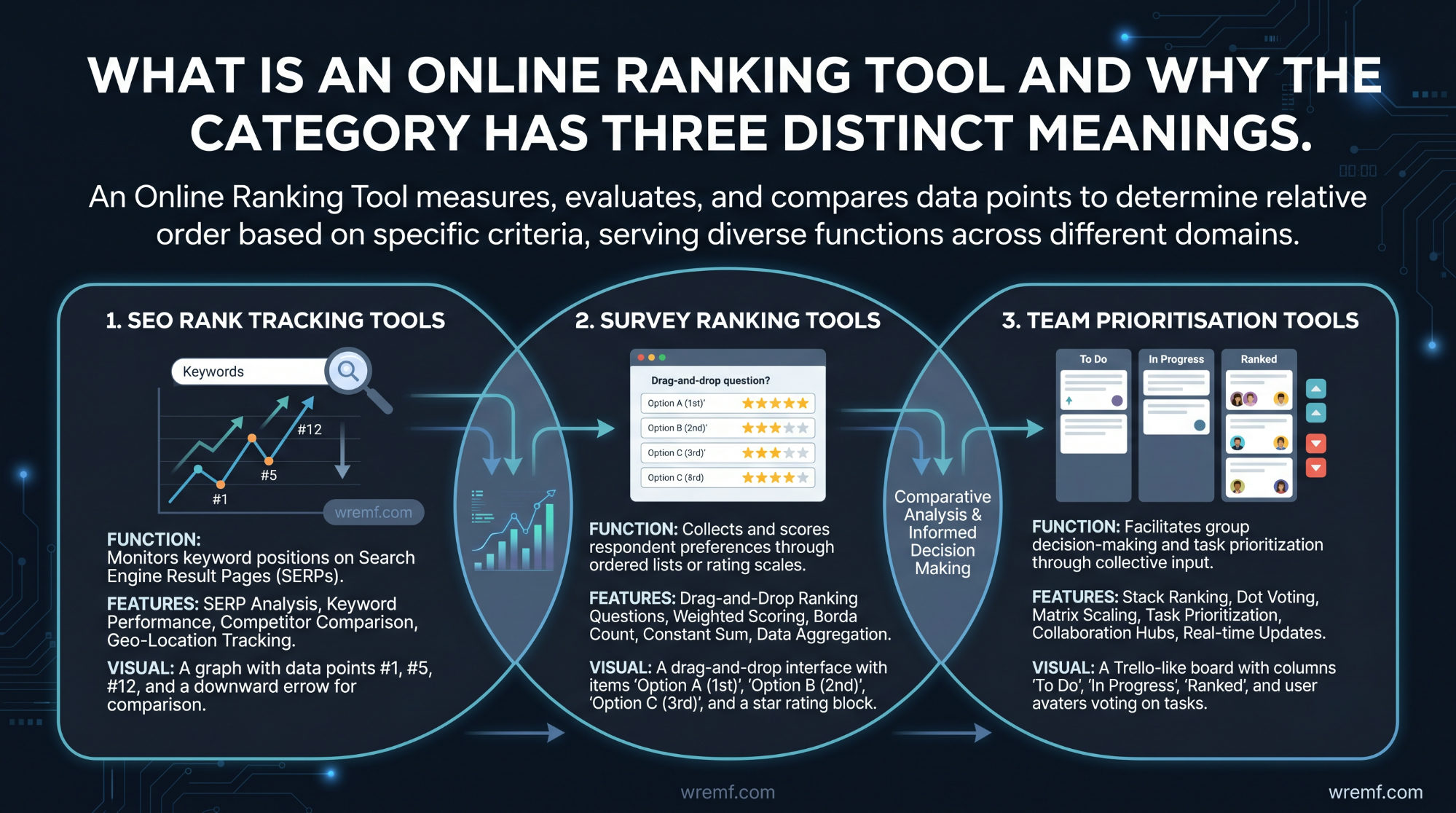
An online ranking tool is any web-based platform designed to measure, assign, collect, or facilitate the ordering of items according to a defined set of criteria. The term covers substantially different use cases depending on the context in which it is used.
In SEO, an online ranking tool typically refers to a rank tracking platform that monitors keyword positions in search results across Google, Bing, and other search engines. These platforms show where a website appears for target keywords, how that position changes over time, and how competitors compare in the same SERPs. Tools in this category include SE Ranking, Ahrefs, SEMRush, Web CEO, and dedicated rank trackers built specifically for keyword ranking analysis.
In market research and survey design, an online ranking tool refers to a platform that presents participants with a list of items and asks them to order those items according to personal preference, perceived importance, or another defined criterion. Jotform is a well-known example in this space, offering drag-and-drop ranking questions, the Orderable List widget, and a full Ranking Survey Maker that supports conditional logic, branching logic, and mobile-optimised layouts.
In team operations and decision-making, an online ranking tool describes a facilitated prioritisation system that helps groups such as product teams, sales teams, and stakeholders collectively rank options according to shared criteria. ForceRank is the most recognised tool in this sub-category, using pairwise comparison and scoring algorithms to surface consensus and disagreement across participants.
Each category has different inputs, different outputs, and different integration requirements. A product team deciding between roadmap features needs a different tool than an SEO agency tracking domain authority across clients, and both need something entirely different from a researcher running ranking surveys to measure human preferences across a sample population.
Understanding which category applies to your use case is the first decision, and this guide covers all three in practical depth.
KEY TAKEAWAY: The phrase online ranking tool describes three genuinely different software categories: SEO rank trackers, survey ranking platforms, and team prioritisation tools. Identifying the correct category before evaluating specific tools saves significant time and avoids misaligned purchases.
SEO Rank Tracking Tools: What They Measure and How to Evaluate Them
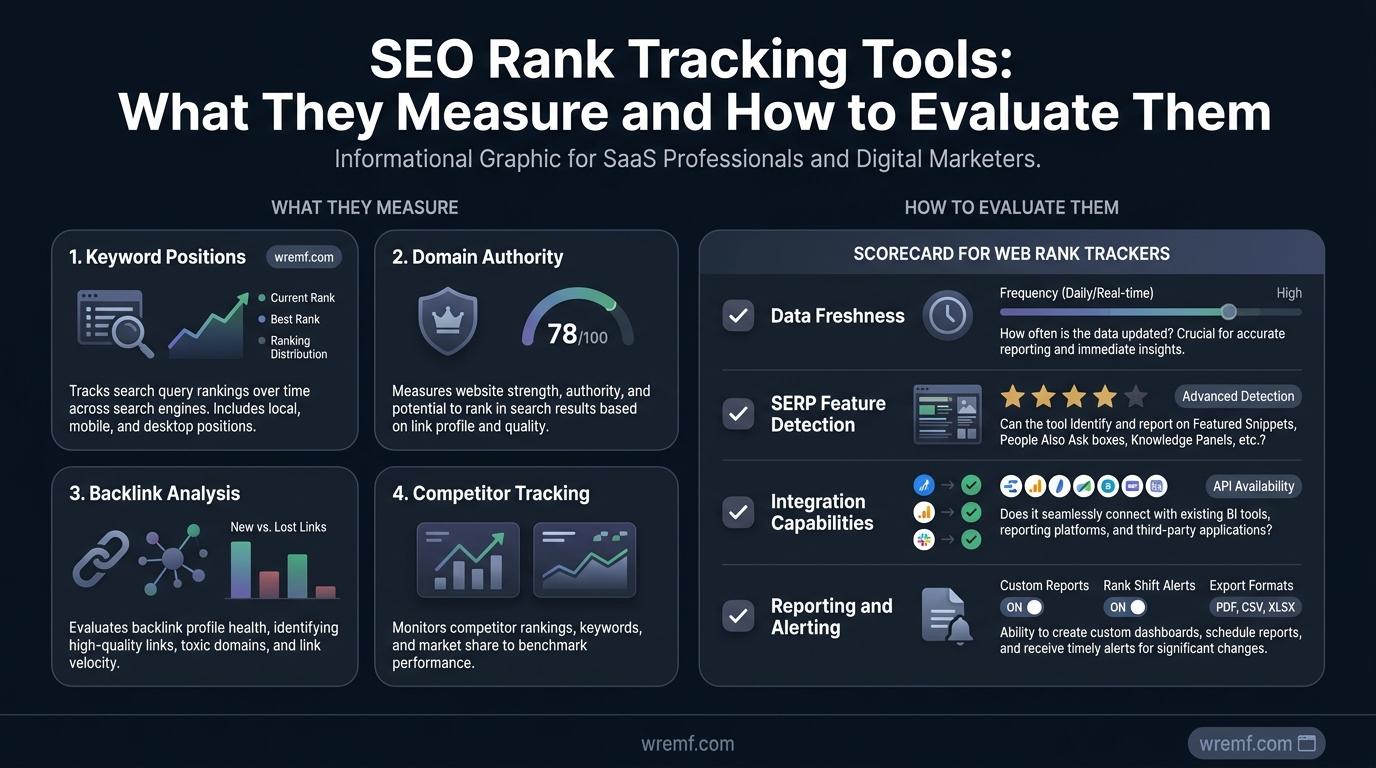
SEO rank tracking tools monitor keyword ranking positions across search engines, providing the data teams need to measure search visibility, assess competitor performance, and attribute organic traffic to specific pages. These tools form the foundation of most SEO measurement programmes.
The core function of a rank tracking tool is straightforward. A team inputs a list of target keywords and one or more domains. The tool queries the search engine at regular intervals and records where each page appears in the search results for each keyword. Over time, this creates a dataset that reveals whether a domain is gaining or losing search visibility.
Beyond raw keyword ranking positions, modern rank tracking tools typically include:
Domain authority scoring, which estimates the relative authority of a domain based on backlink profiles and other signals. Tools such as Ahrefs and SEMRush have developed proprietary domain authority metrics that SEOs use to benchmark sites against competitors.
Backlink analysis, which shows which external websites link to a domain and how those links affect keyword performance in search results.
SERP feature tracking, which records whether a keyword triggers features such as featured snippets, local packs, image carousels, or AI Overviews in addition to standard organic results.
Competitor tracking, which surfaces how competing domains perform for the same keywords so that SEOs can identify gaps, spot opportunities, and measure relative search visibility.
Google Analytics and Google Search Console integration, which connects rank tracking data with actual traffic and impression data from Google's own analytics infrastructure.
The leading tools in this category each have distinct positioning. SE Ranking positions itself as an all-in-one SEO platform suitable for agencies and in-house teams, with white-label reporting, a Looker Studio connector, and API access that supports custom workflows. SE Ranking also notes that it has been doing rank tracking for over 20 years, which reflects the maturity of the core rank tracking function and the platform's depth of historical data. Ahrefs is widely respected for the quality of its backlink index and keyword research data. SEMRush covers the broadest feature set including advertising intelligence, social media tracking, and content marketing tools alongside its core SEO data. Web CEO is used in agency contexts for white-label client reporting.
For teams running enterprise SEO programmes at scale, the differences between platforms often come down to API flexibility, data freshness, white-label reporting quality, and the depth of competitor intelligence available.
TIP:
When evaluating SEO rank tracking tools, prioritise data freshness, keyword ranking accuracy, SERP feature detection, and the quality of competitor visibility data over headline feature lists. A tool that tracks fewer keywords accurately is more useful than one that tracks many keywords inconsistently.
Google Analytics integration remains a standard expectation for any rank tracking platform. The ability to connect organic session data with keyword ranking positions helps teams attribute traffic gains or losses to specific keyword movements, making the data actionable at a page and keyword level.
One practical note: rank tracking tools measure keyword positions in standard search results. They do not measure how a brand appears in AI-generated answers, AI Overviews, or AI Mode responses in Google or other AI search platforms. That measurement requires a separate layer, which is covered in the AI visibility section of this guide.
KEY TAKEAWAY: SEO rank tracking tools are essential for measuring keyword ranking positions, domain authority, backlinks, and search visibility in Google and Bing, but they do not measure how brands appear in AI-generated answers or AI Overviews, which requires a separate AI visibility tracking approach.
Survey Ranking Tools: Collecting and Analysing Ranked Preference Data
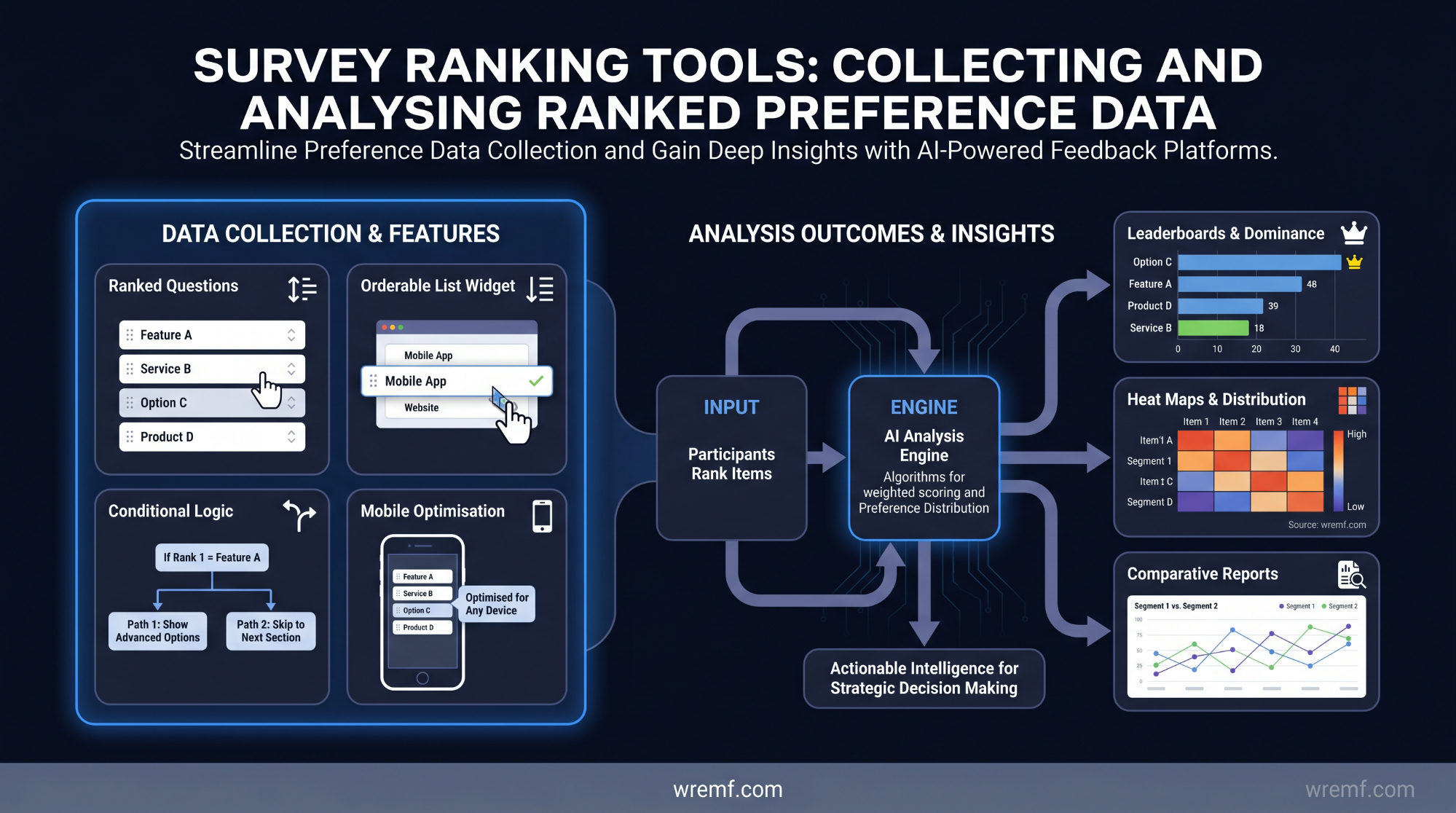
Survey ranking tools enable researchers, product teams, customer experience professionals, and marketers to collect ordered preference data from participants at scale. Instead of asking respondents to rate items independently, ranking questions ask them to place items in a specific order, which reveals relative preference more accurately than rating scales alone.
Jotform is the most widely used platform in this category, offering a dedicated Ranking Survey Maker with a visual drag-and-drop interface that works on desktops, tablets, and mobile devices. The Orderable List widget allows form creators to present a list of items and ask participants to reorder them according to their preferences. This approach captures comparative judgements that simple checkbox or rating questions cannot.
Key features that distinguish full-featured survey ranking platforms include:
Conditional Logic and Branching Logic: These allow a survey to adapt based on how a participant has ranked previous items. A respondent who ranks customer retention as their top priority might be shown a different follow-up question than one who prioritises technical debt reduction.
Jotform Tables: Collected ranking responses are fed into Jotform Tables, which provides a structured view of all responses that teams can sort, filter, and analyse without exporting to a spreadsheet.
Offline Collection: Survey tools that support offline collection allow researchers to gather data in environments without reliable internet access. Jotform's offline collection capability is relevant for fieldwork, in-person interviews, and events such as hackathons or community challenges.
QR Code sharing: Participants can access a ranking survey by scanning a QR code, which is useful for in-person research sessions, printed materials, and event-based data collection.
Shareable Link and Embed Code: Ranking surveys can be distributed via a shareable link embedded in email campaigns or embedded directly on a website using an embed code. This expands participation without requiring participants to navigate to a separate platform.
Progress Bars: Showing participants how far through a survey they are increases completion rates, particularly for longer surveys with multiple ranking questions.
Mobile-Optimised Layouts: Ranking questions that require drag-and-drop reordering must work reliably on touchscreen devices. Platforms with mobile-optimised layouts ensure that participation rates are not reduced by interface friction on phones or chromebooks.
Survey Widgets and Templates: Pre-built templates for common use cases such as product feature prioritisation, customer satisfaction ranking, and employee engagement surveys reduce setup time and improve question quality.
Personalised stack ranking questions and image pair rank methods are more advanced techniques used in consumer research and product validation. Stack ranking asks participants to order a full list from most to least preferred. Image pair rank presents two visual options at a time and asks the participant to select the preferred one, using pairwise comparison logic to derive an overall ranking from a series of binary choices.
For teams building their own ranking tools, Python libraries and Github Pages have been used to create lightweight custom ranking applications. React JS and the Materialize component library have been used to build web apps that implement custom ranking systems with APIs for data collection and retrieval. However, purpose-built platforms typically reduce development time, bugs, and maintenance overhead significantly compared to custom builds.
KEY TAKEAWAY: Survey ranking tools such as Jotform collect ordered preference data from participants using ranking questions, the Orderable List widget, conditional logic, and mobile-optimised layouts. They are appropriate for research, customer feedback, product validation, and any scenario where relative preference data matters more than individual ratings.
Team Prioritisation Tools and the Science of Group Ranking
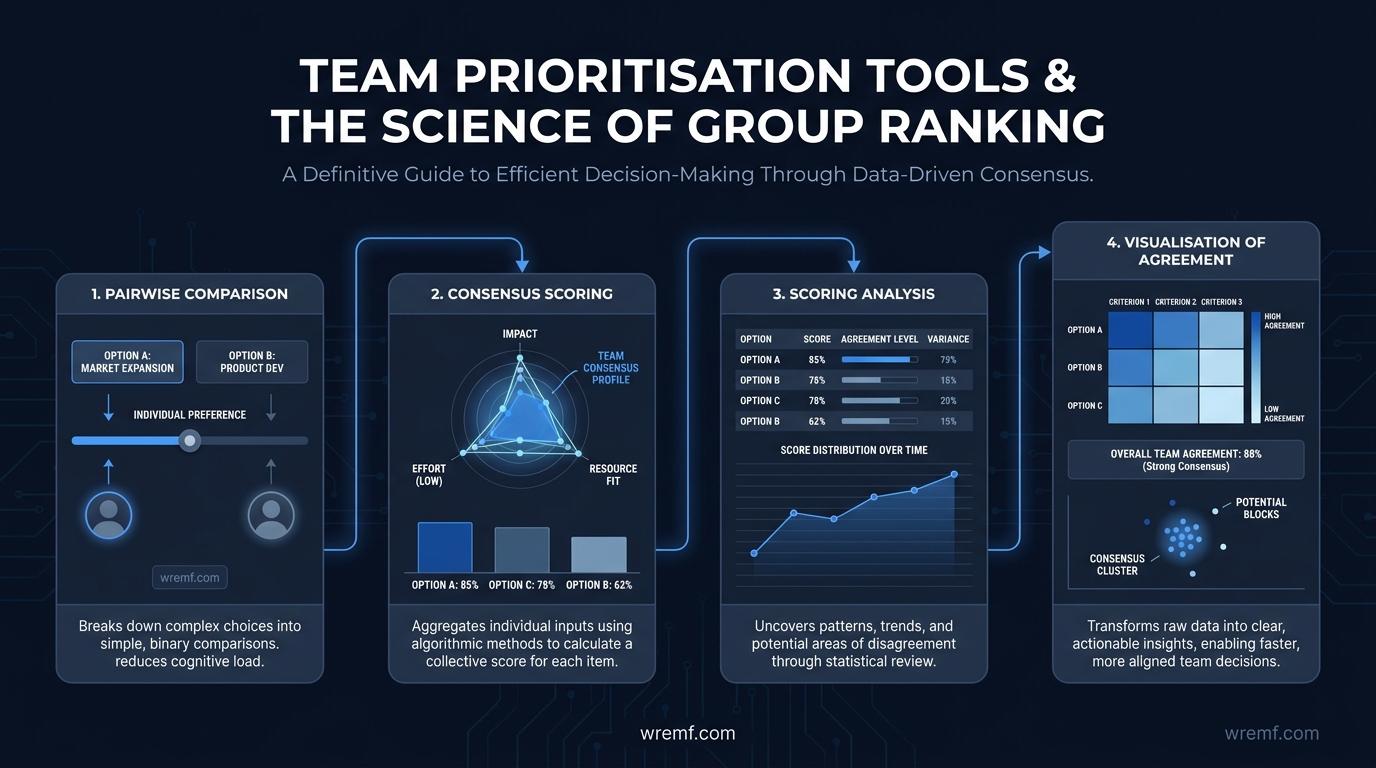
Team prioritisation tools are a distinct subset of online ranking tools designed to help groups reach collective agreement on the relative importance of competing options. They address a specific operational problem: when a team has more options than capacity, ranking those options without bias, long meetings, or interpersonal conflict is difficult.
ForceRank is the leading purpose-built tool in this category. The platform is built around the observation that prioritisation meetings take too long and produce inconsistent outcomes when participants discuss options verbally before committing to a ranking. ForceRank structures the process so that everyone ranks independently before results are shared, which reveals genuine consensus and disagreement rather than groupthink.
The core mechanism in ForceRank and similar tools is pairwise comparison. Rather than asking participants to rank a full list simultaneously, the tool presents two items at a time and asks which is higher priority. This reduces cognitive load and produces more reliable rankings because binary choices are easier for human preferences to resolve consistently than full-list ordering.
The mathematical principle underlying pairwise comparison is transitivity. If a participant consistently ranks option A above option B and option B above option C, the algorithm can infer that the participant ranks A above C, even if that pairing was never directly presented. This makes it possible to derive a stable ranking from a relatively small number of comparisons. Sorting algorithms such as Shell Sort inform how some tools sequence comparison pairs to reach a stable ranking more efficiently.
Scoring and consensus analysis are where group ranking tools distinguish themselves from simple voting tools. ForceRank calculates scores for each option based on aggregate ranking inputs, then surfaces the degree of alignment or disagreement among participants through visualisation. Teams can see exactly where stakeholders agree and where they diverge, which makes the source of conflict visible and resolvable.
Group ranking tools are applicable across a wide range of team contexts:
Quarterly Planning: Product teams use ranking tools to prioritise features against the next quarter's capacity, creating data-backed priorities that reflect the team's collective judgement rather than the opinion of the most senior voice in the room.
Roadmap Prioritisation: Engineering and product leaders use ranking data to sequence technical debt work, new features, and infrastructure improvements based on weighted criteria such as customer retention impact, revenue potential, and delivery confidence.
Budget Decisions: Finance and marketing leaders use group ranking to allocate budget across competing initiatives. When tradeoffs are made explicit through ranking, the reasoning behind resource allocation decisions becomes transparent and defensible.
Team Retrospectives: Retrospective facilitators use ranking tools to identify which improvement ideas the team considers most impactful, turning async exercise data into prioritised actions.
Idea Ranking: Innovation programmes and internal hackathons use ranking tools to surface the ideas that participants collectively value most, reducing the influence of presentation skill or hierarchical position on outcomes.
Virtual Training and Classrooms: Teachers and trainers use live ranking tools to engage participants, run real-time polls, and gather ranked feedback on learning content. Chromebooks and mobile-first interfaces make participation accessible across device types.
Sales teams use ranking tools in marketing campaign planning and competitive analysis, ranking target account criteria, message priorities, and competitive positioning statements to create alignment before campaigns launch.
Community challenges, trivia nights, and live ranking events are lighter-weight applications where the leaderboard and points rank mechanics of online ranking tools create engagement through competition.
The key differentiators when evaluating group ranking tools are: whether participants rank independently before results are shared, how clearly the tool visualises consensus and disagreement, whether subgroups can be analysed separately, whether the tool works in async or synchronous modes, and whether it requires accounts or adds friction to participation.
KEY TAKEAWAY: Team prioritisation tools such as ForceRank use pairwise comparison, transitivity, and scoring algorithms to help groups rank options efficiently. They reduce meeting time, reveal genuine stakeholder alignment and disagreement, and produce data-backed priorities that replace subjective discussion.
AI Search Visibility and the Gap That Traditional Ranking Tools Cannot Fill
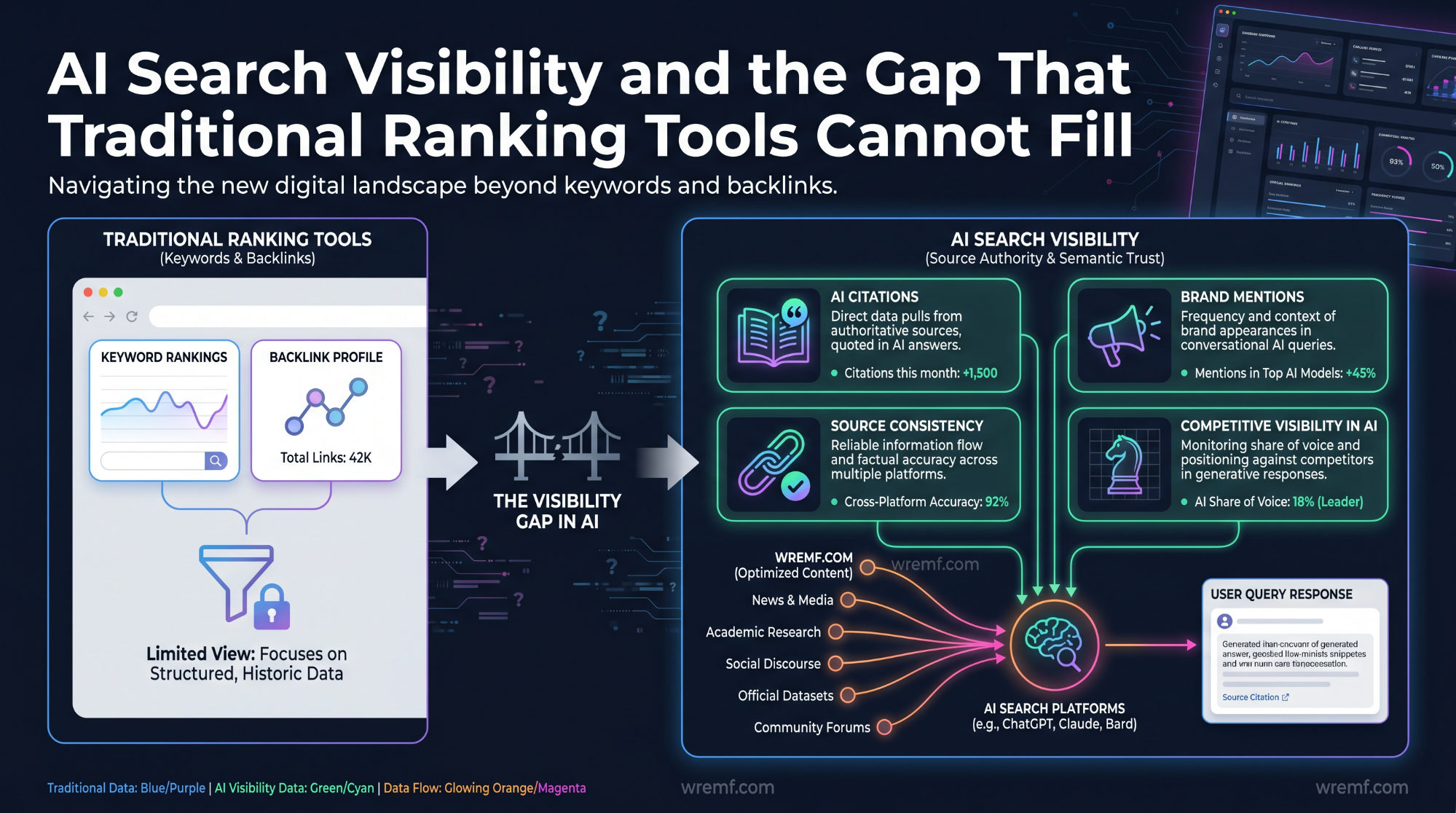
AI search visibility is the measure of how often and how accurately a brand is mentioned, cited, recommended, or compared across AI-generated answers in platforms such as ChatGPT, Gemini, Perplexity, Claude, Google AI Overviews, Copilot, DeepSeek, Grok, Meta AI, and Mistral. It is a distinct measurement from keyword ranking in standard SERPs and requires different tools, different data, and different strategy.
Traditional SEO rank tracking tools were built to measure keyword positions in Google and Bing search results. They are effective at that task. However, as more users turn to AI search platforms to research products, compare vendors, and shortlist solutions, the question of whether a brand appears in AI-generated answers becomes as commercially important as whether it appears on page one of Google.
According to Google's AI Overviews documentation AI Overviews are generated responses that appear at the top of relevant Google search results and draw on sources that Google's systems assess as helpful and authoritative. These sources are not necessarily the pages that rank highest for the same query in standard organic results. A page can rank on page one of Google without being cited in an AI Overview, and a page can be cited in an AI Overview without holding a top organic position.
This creates a measurement gap that standard rank tracking tools cannot address. A team that only tracks keyword rankings may not know that a competitor is being recommended by ChatGPT and Gemini for every relevant buyer prompt in their category. They may not know that their own brand is absent from Perplexity answers, or that a third-party review source is being cited consistently instead of their own content.
The AI search landscape has also expanded beyond Google. Buyers increasingly use ChatGPT for research-stage queries, Perplexity for cited source comparison, and Google's AI Mode for layered exploratory searches. Research from institutions such as Gartner indicates that AI-assisted discovery is becoming a primary behaviour pattern in B2B purchasing journeys, which means that brand visibility in AI answers has direct commercial implications.
AI citations are the specific references to sources, websites, or brand names that appear within an AI-generated answer. When Perplexity answers a question about CRM software, it cites specific sources. When ChatGPT recommends an analytics tool, it may mention specific brand names. These citations and brand mentions reflect which sources the AI engine has assessed as relevant, credible, and consistent. Source consistency, which is the degree to which a brand's content is referenced coherently across different AI engines for the same types of prompts, is a key indicator of AI authority.
This is the layer that WREMF was built to track. WREMF monitors how brands appear across ten AI engines, tracking AI citations, brand mentions, prompt-level visibility, source consistency, AI share of voice, and competitor comparisons. Teams that already use SE Ranking, Ahrefs, or SEMRush for keyword rank tracking can add WREMF as the AI visibility layer without replacing their existing SEO tools.
For a deeper understanding of how AI search optimisation works, the AI search engine optimisation guide provides a thorough foundation for B2B teams starting to build an AI search visibility programme.
KEY TAKEAWAY: Traditional rank tracking tools measure Google and Bing keyword positions but do not capture AI citations, brand mentions, or source consistency across AI search platforms. AI search visibility requires a dedicated measurement layer that tracks how brands appear in AI-generated answers across ChatGPT, Gemini, Perplexity, Google AI Overviews, and other AI engines.
How WREMF Tracks AI Visibility Across Prompts, Citations, and Competitor Comparisons
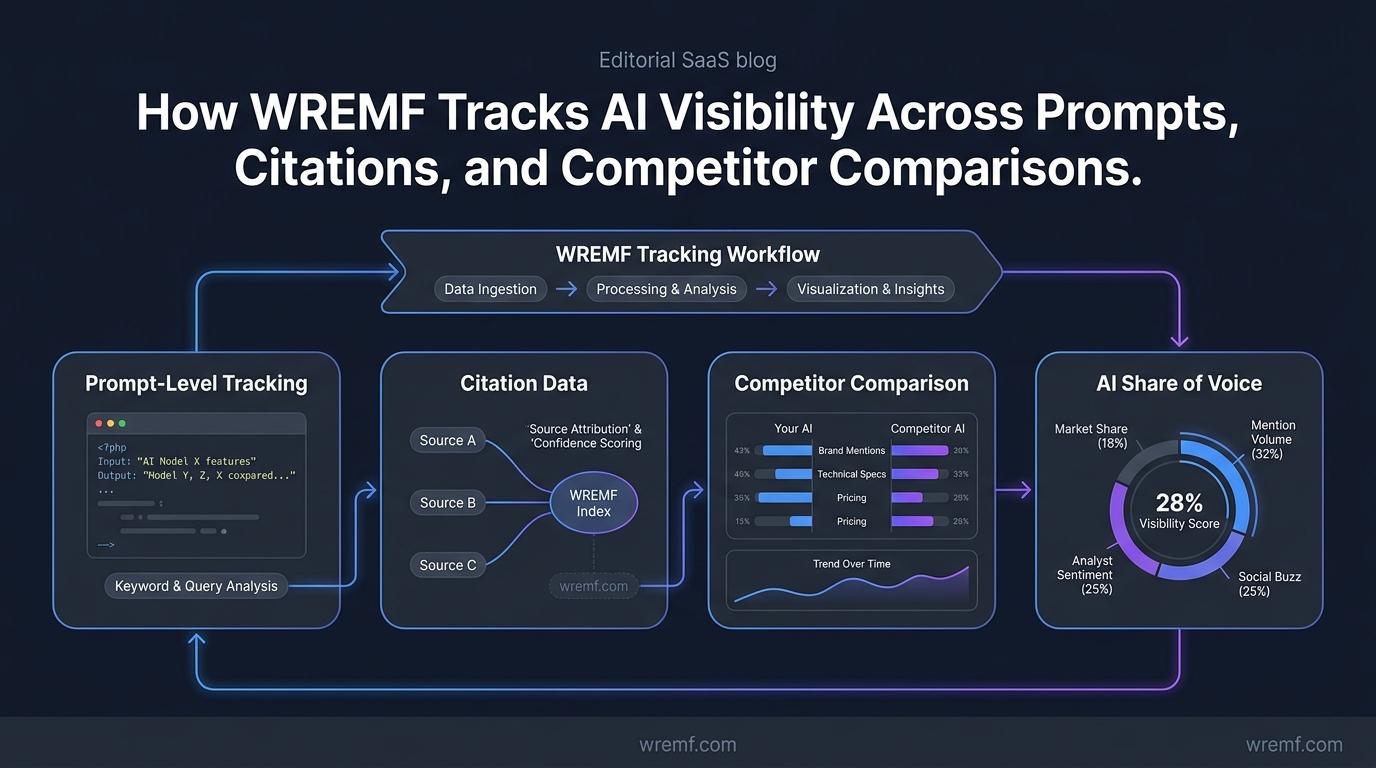
WREMF is an AI visibility platform built specifically to measure and improve how brands appear in AI-generated answers. It tracks prompt-level data across ten AI engines, reports on AI share of voice, monitors competitor visibility, and connects AI citation data to actual referral traffic through GA4 attribution.
The distinction between WREMF and traditional SEO tools is structural, not incremental. Traditional SEO tools track where pages rank in search results for specific keywords. WREMF tracks how brands are mentioned, cited, and recommended when users ask AI engines questions relevant to their category. The measurement units are different, the data sources are different, and the optimisation actions that follow are different.
A practical comparison across key dimensions:
Primary signal
- Traditional SEO tools: Keyword rankings in SERPs
- WREMF: AI prompt answers and citation presence
What it tracks
- Traditional SEO tools: Page position in search results
- WREMF: AI citations, brand mentions, and source consistency
Authority signal
- Traditional SEO tools: Backlinks and domain authority
- WREMF: Source citations in AI answers
Query model
- Traditional SEO tools: Keywords
- WREMF: Prompts
Competitive view
- Traditional SEO tools: SERP overlap and keyword gap
- WREMF: AI share of voice across engines
Attribution
- Traditional SEO tools: Organic sessions from Google Analytics
- WREMF: AI referral traffic and prompt-level attribution
Engine coverage
- Traditional SEO tools: Google and Bing
- WREMF: Ten AI engines including ChatGPT, Gemini, Perplexity, Claude, Copilot, DeepSeek, Grok, Meta AI, and Mistral
Audit type
- Traditional SEO tools: Technical SEO audit
- WREMF: GEO and AEO audits
Source consistency
- Traditional SEO tools: Not measured
- WREMF: Tracked across engines
The recommendation for most B2B teams is to run both in parallel. Keyword ranking data from tools such as SE Ranking or Ahrefs remains essential for organic search performance. WREMF adds the AI visibility layer by answering the question of whether the brand is present and credible in the AI answers that buyers encounter during research.
WREMF is available as standalone software, a fully managed service, or a hybrid model. Teams that have strong internal execution resources may use WREMF software to track, report, and iterate independently. Teams that need strategy, GEO execution, AEO content optimisation, and citation cleanup can use the Managed plan. The hybrid model allows teams to run software-based tracking in-house while engaging the WREMF senior team for audits, strategy sprints, and execution support when needed.
For teams comparing AI visibility platforms and SEO tools, the AI SEO tools guide provides a structured comparison of tool categories and their appropriate use cases.
KEY TAKEAWAY: WREMF adds an AI visibility tracking layer that traditional SEO rank tracking tools do not provide. It tracks AI citations, brand mentions, prompt-level visibility, competitor comparisons, and source consistency across ten AI engines, and connects that data to GA4 attribution for traffic reporting.
How to Track AI Visibility Alongside Traditional SEO Ranking: A Practical Workflow
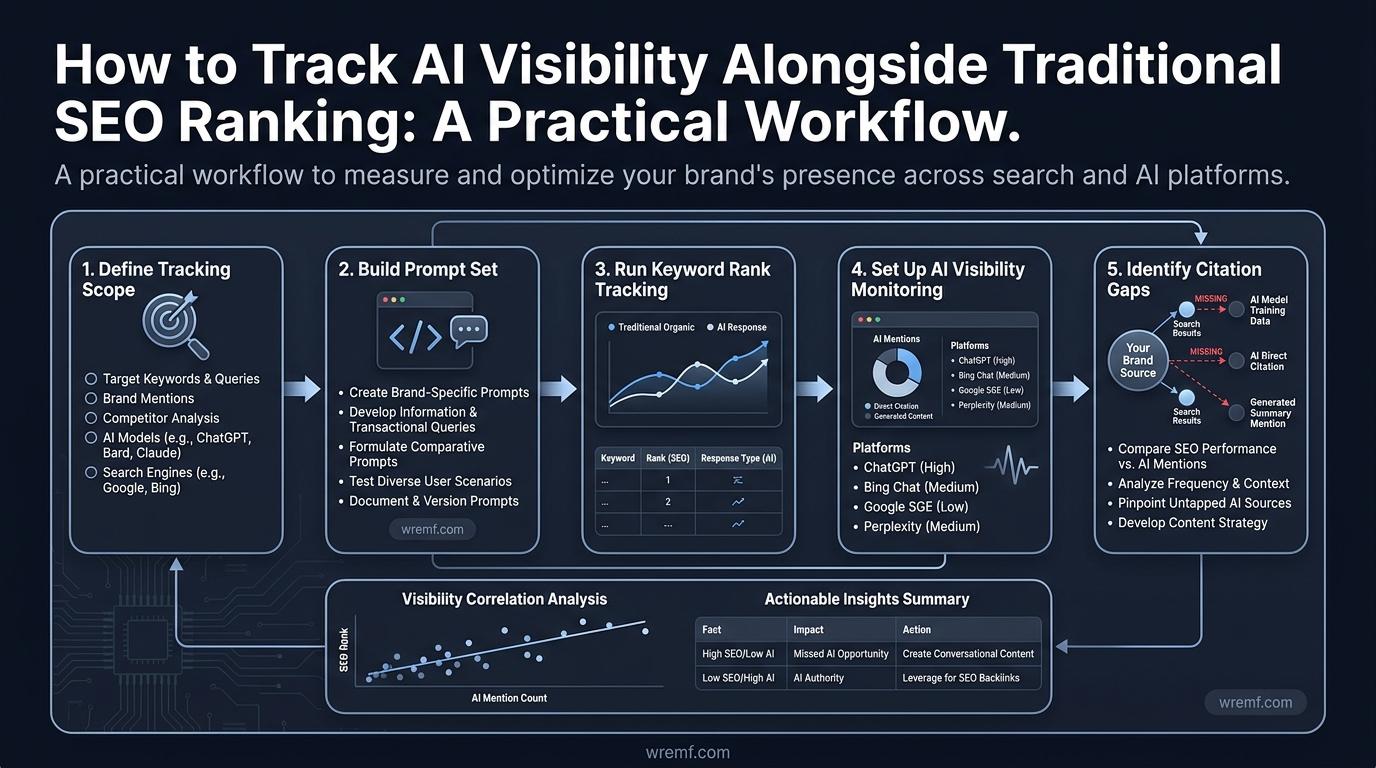
Tracking AI visibility alongside traditional keyword rank tracking requires a structured workflow that treats the two measurement systems as complementary rather than competing. The following process applies to B2B SEO teams, in-house marketing teams, and agencies managing multiple clients.
Step 1: Define Your Tracking Scope
Identify the domain or domains you want to track, your primary competitors, and the AI engines relevant to your market. Most B2B teams start with Google AI Overviews, ChatGPT, Gemini, and Perplexity as the highest-priority platforms for AI search visibility measurement.
Step 2: Build Your Prompt Set
Develop a set of prompts that reflect how your target buyers ask questions during the research and shortlisting phase. These are not keywords. They are full questions or comparative phrases such as "what is the best analytics platform for SaaS companies" or "compare [category] tools for mid-market B2B." Prompt intelligence is the foundation of AI visibility tracking because AI engines respond to intent-rich prompts rather than isolated keywords.
Step 3: Run Keyword Rank Tracking in Parallel
Use your existing SEO rank tracking tool, whether that is SE Ranking, Ahrefs, SEMRush, or another Rank Tracker, to monitor keyword positions in standard search results. Record Google Rankings for your core keyword set, domain authority trends, and backlink profile changes. This data remains relevant because AI engines such as Google AI Overviews draw on the same authority signals that influence organic rankings.
Step 4: Set Up AI Visibility Monitoring
Configure WREMF to run scheduled AI monitoring across your target prompts and AI engines. WREMF tracks which sources are cited in AI answers for each prompt, records brand mentions and competitor mentions, and calculates AI share of voice across the tracked engine set. This step produces a baseline visibility score that can be compared against competitors.
Step 5: Identify Citation and Source Gaps
Review which sources AI engines are citing for your key prompts. If third-party review platforms, competitor pages, or media publications are being cited instead of your own content, that reveals a source consistency gap. WREMF's source citation tracking makes this comparison systematic rather than manual.
Step 6: Conduct a GEO Audit
A generative engine optimisation audit assesses whether your content is structured, authoritative, and accessible enough to be cited by AI engines. This includes reviewing content structure, entity clarity, factual accuracy, internal linking, and the consistency of brand and product information across all indexed sources. The GEO audits available in WREMF's Growth and Managed plans cover these dimensions systematically.
Step 7: Implement AEO Content Improvements
Answer engine optimisation focuses on creating content that directly answers the types of questions AI engines receive in prompts related to your category. This involves building answer-first content structures, expanding topic coverage, improving entity definitions, and strengthening the credibility signals that AI engines use when selecting sources. The answer engine optimisation services guide covers this process in detail.
Step 8: Connect AI Traffic to Attribution
Configure GA4 attribution to identify sessions that originate from AI referral traffic. WREMF's GA4 attribution integration in the Growth plan allows teams to see which AI-driven visits are contributing to pipeline, and which prompts are generating the highest-quality referral traffic.
KEY TAKEAWAY: Tracking AI visibility alongside keyword rank tracking requires a separate prompt-based monitoring system, a GEO audit process, AEO content improvements, and GA4 attribution integration. WREMF supports each of these steps across its software, Growth, and Managed plans.
Real-World Use Cases: How Different Teams Use Online Ranking Tools
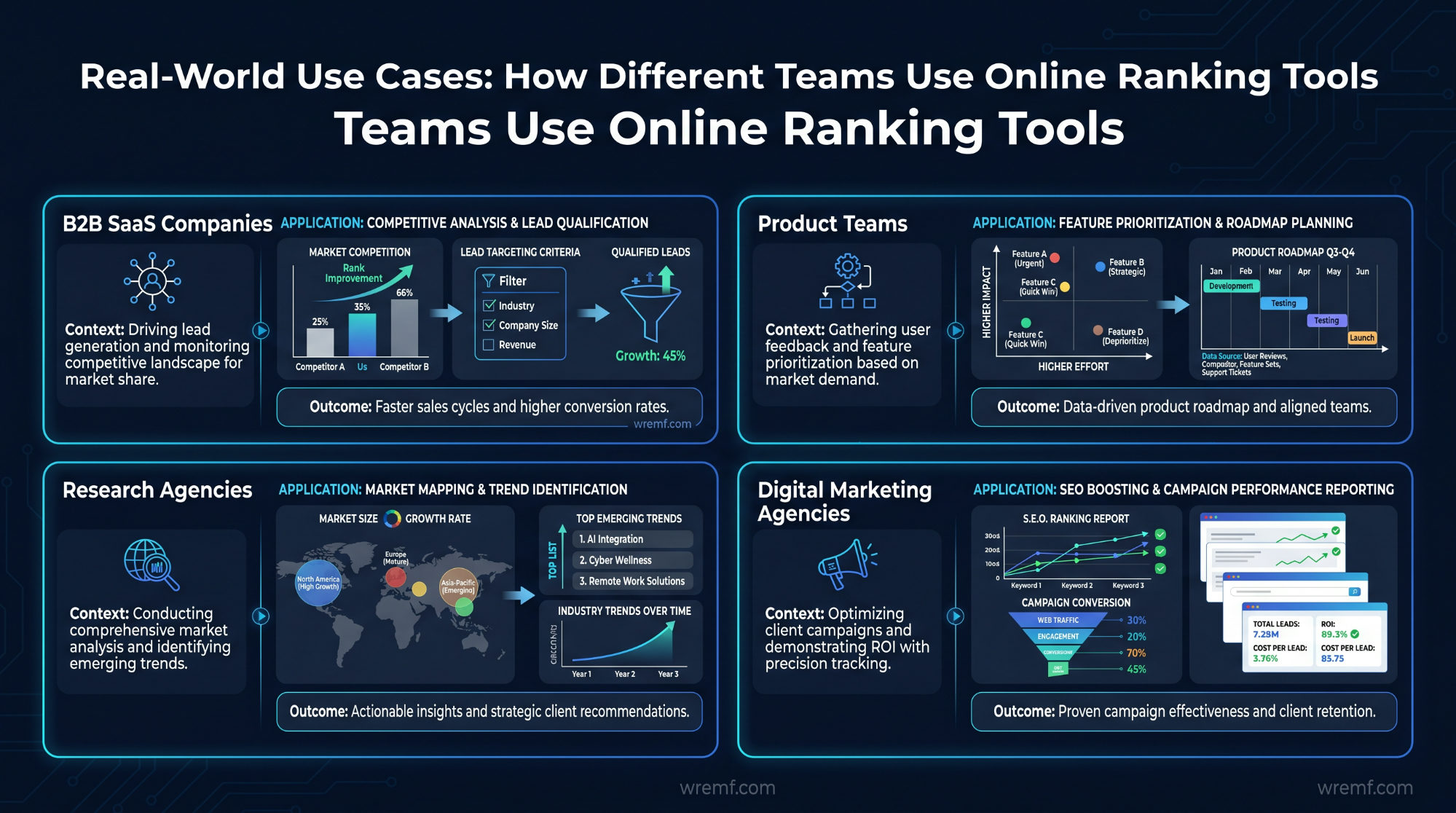
Online ranking tools serve different functions depending on team type, goal, and the type of ranked data that matters most. The following scenarios illustrate how the three categories of ranking tools apply in practice.
Use Case 1: A B2B SaaS Company Investigating Why Competitors Appear in AI Answers
A SaaS company selling project management software notices through informal testing that a competitor is being recommended by ChatGPT and Perplexity when users ask about tools for distributed teams. The company's own brand is not mentioned. Their SE Ranking data shows they rank on page one of Google for several target keywords, but that visibility does not carry over into AI-generated answers.
The team sets up WREMF to track AI citations across a set of buyer-intent prompts. Within the first monitoring cycle, they can see which sources the AI engines are drawing on, which competitor pages are being cited, and what content characteristics those cited pages share. This data informs a GEO audit and a set of AEO content briefs that restructure key pages to improve AI citation potential. The team continues using Se Ranking for keyword tracking and adds WREMF as the AI visibility layer, running both systems in parallel.
Use Case 2: A Product Team Using ForceRank for Quarterly Roadmap Prioritisation
A ten-person product team has a backlog of forty features, bugs, and technical debt items to prioritise for the next quarter. Previous prioritisation meetings consistently ran over time and produced rankings that reflected the opinions of senior voices rather than collective team judgement.
The team adopts ForceRank, asking all stakeholders to rank independently before any discussion takes place. ForceRank's pairwise comparison process takes under ten minutes per participant. The consensus view shows strong agreement on the top five priorities and clear disagreement on three items in the middle of the list. The team uses the disagreement data to structure a focused discussion on those three items only, reducing the full prioritisation meeting from three hours to forty-five minutes.
Use Case 3: A Research Agency Using Jotform for Preference Ranking Surveys
A market research agency is conducting customer preference research for a client launching a new product line. They need to collect ranked preference data from a sample of five hundred participants across three market segments.
The agency builds a ranking survey in Jotform using ranking questions with the Orderable List widget, personalised stack ranking questions, and image pair rank comparisons for visual product concepts. The survey is distributed via shareable link for online participants and via QR code for in-person interviews at community events. Conditional logic routes participants into relevant question paths based on their demographic segment. Results are collected in Jotform Tables and exported for conjoint analysis to model how participants weigh tradeoffs between product attributes.
Use Case 4: An Agency Managing AI Visibility Across Multiple Clients
A digital marketing agency managing SEO for twelve B2B SaaS clients begins receiving questions from clients about AI search visibility. Clients want to know whether their brand is being recommended by ChatGPT and whether Google AI Mode and Google's AI Mode responses include their content.
The agency adopts WREMF on the Growth plan for its multi-brand tracking capability, white-label reports, and Looker Studio connector. Client visibility data is tracked across five websites per plan configuration, with AI share of voice reports delivered to clients alongside standard SEO ranking reports. For two clients with more complex AI visibility challenges, the agency engages WREMF's Managed service for citation cleanup, entity authority work, and custom GEO strategy. For more context on how agencies structure AI visibility services, the AI SEO agency guide provides relevant selection criteria.
KEY TAKEAWAY: Different team types need different online ranking tools. SEO teams need keyword rank trackers with AI visibility layers. Product teams need prioritisation tools with consensus analytics. Research agencies need survey platforms with ranked data collection. Agencies managing multiple clients need platforms with white-label reporting and multi-brand tracking.
Choosing the Right WREMF Plan for AI Visibility Tracking
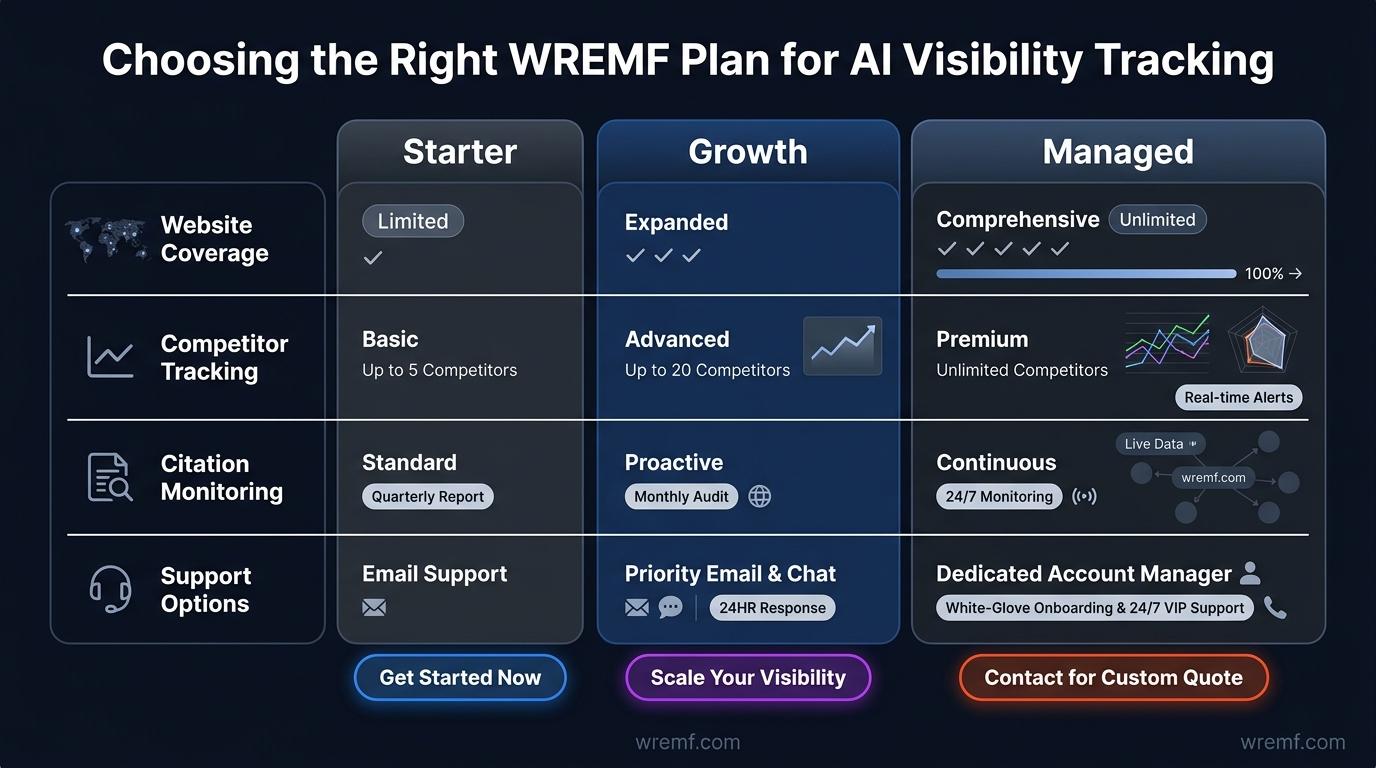
WREMF offers three plan tiers designed for different team sizes, execution capacities, and AI visibility programme maturities. Choosing between them involves understanding what your team can execute internally versus what requires strategic or execution support.
The Starter plan at 59 euros per month is appropriate for founders, solo SEO consultants, and small SaaS teams beginning to track AI visibility. It covers one website, up to three competitors, ten AI engines, unlimited prompt tracking, BYOK support, core prompt intelligence, source citation tracking, and the AI Visibility Index. For a team that simply wants to understand whether its brand is being mentioned in AI answers and how that compares to a handful of competitors, Starter provides the data infrastructure without requiring a large investment.
The Growth plan at 149 euros per month is designed for B2B marketing teams, in-house SEO teams, and agencies that need to move beyond basic visibility monitoring into reporting, attribution, and action. It covers five websites, ten to fifteen competitors, and adds advanced citation tracking, AI share of voice reporting, GEO audits, an AI-ready content brief generator, SEO testing, GA4 attribution, white-label reports, and the Looker Studio connector. For an agency managing multiple clients or an in-house team that needs to connect AI visibility to revenue attribution, Growth provides the reporting and attribution infrastructure required. Compare WREMF pricing plans to assess which plan fits your team's current scale.
The Managed plan starting from 1,500 euros per month is for enterprise brands, large agencies, and multi-market teams that want WREMF to run the AI visibility programme end to end. This includes everything in the Growth plan plus a full AI visibility audit, a custom GEO strategy, AEO content optimisation, citation cleanup, entity and authority work, senior-led execution, strategy calls, a custom roadmap, and monthly reporting. Managed is the right choice when a team has the business need for AI visibility improvement but does not have the internal capacity to execute a full programme.
The hybrid model is relevant for teams that want to run WREMF software in-house for day-to-day tracking and reporting while engaging the WREMF senior team for periodic strategy sessions, audit cycles, and execution sprints. This model is common among agencies and growth teams that have strong internal implementation resources but need specialist strategic input at key points in the year.
Every plan includes unlimited prompt tracking and BYOK support, which means teams can control their AI engine API costs directly without per-prompt markups. This cost structure matters for teams running large prompt sets across multiple engines, because platforms that charge per prompt create unpredictable cost scaling as programme scope grows.
KEY TAKEAWAY: WREMF Starter suits solo practitioners and small teams beginning AI visibility tracking. Growth suits agencies and in-house teams needing attribution and white-label reporting. Managed suits brands and enterprise teams that need full-service execution. All plans include unlimited prompt tracking and BYOK to control costs.
Limitations and Caveats in Ranking Tools and AI Visibility Measurement
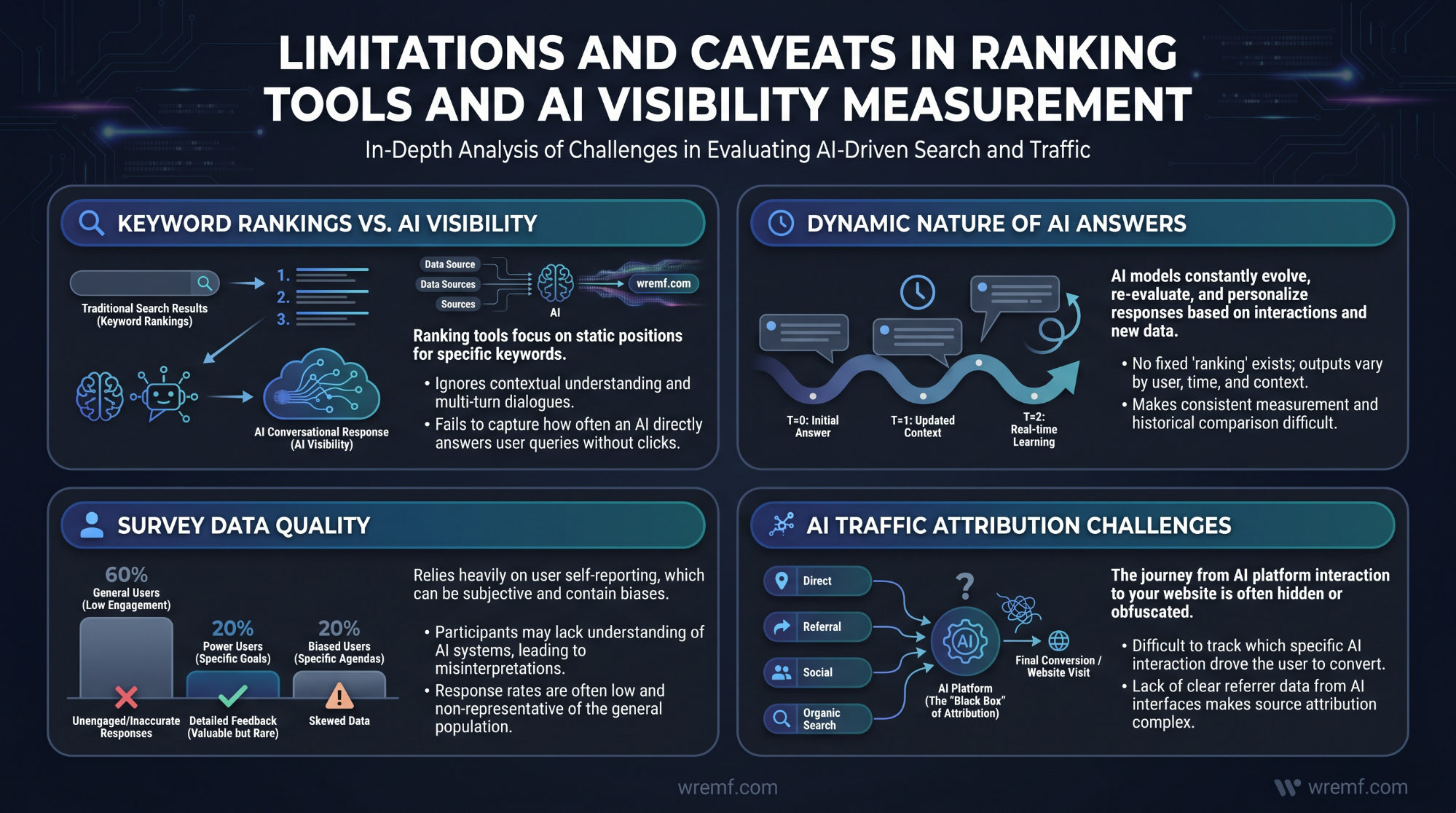
Every category of online ranking tool has meaningful limitations that teams should understand before making decisions based on the data. Honest assessment of these constraints produces better strategies and more realistic expectations.
Limitation 1: Keyword Rankings Do Not Reflect AI Search Presence
A high position in Google's standard search results does not mean a brand will be cited in AI Overviews, ChatGPT answers, or Perplexity responses. The signals that influence AI citation selection overlap with but are not identical to the signals that determine keyword ranking. A brand that ranks well for a keyword may still be entirely absent from AI-generated answers for semantically equivalent prompts. Teams that measure only keyword ranking positions will systematically miss this gap.
Limitation 2: AI Answers Are Dynamic and Variable
AI-generated answers are not fixed outputs. The same prompt submitted to the same AI engine on different days, from different locations, or with slightly different phrasing can produce meaningfully different citations, brand mentions, and source selections. This means that a single test of whether a brand appears in an AI answer is not a reliable measurement. Systematic scheduled monitoring across a defined prompt set is required to build a statistically meaningful picture of AI visibility, which is why WREMF runs continuous monitoring rather than one-time snapshots.
Limitation 3: Survey Ranking Data Reflects Participant Sample Quality
Ranking surveys produce data that is only as representative as the participants who complete them. A ranking survey distributed to an existing customer base reflects the preferences of retained customers, not the broader market. Sampling decisions, question design, the phrasing of ranking options, and the order in which items are presented can all influence results. Teams using Jotform or similar platforms should invest time in survey design, sampling strategy, and response quality review before treating ranking data as definitive.
Limitation 4: Pairwise Comparison Tools Assume Consistent Preferences
The transitivity assumption underlying pairwise comparison ranking is that if a participant consistently prefers A over B and B over C, they also prefer A over C. In practice, human preferences are not always transitive, particularly when options are multidimensional or when the comparison is made in a different context than the original preference was formed. Teams using ForceRank or similar tools should treat pairwise ranking outputs as directional consensus data rather than mathematically precise rankings.
Limitation 5: AI Visibility Cannot Be Guaranteed or Precisely Predicted
No platform, agency, or content strategy can guarantee that an AI engine will recommend a specific brand. AI engines make source selection decisions based on complex, opaque, and frequently updated systems. GEO and AEO optimisation improves the structural and content conditions that make a brand more likely to be cited, but it does not override the AI engine's own selection logic. WREMF tracks, diagnoses, and informs strategy, but it does not guarantee AI recommendations. This is an honest and important distinction that any team evaluating AI visibility services should understand clearly.
Limitation 6: AI Referral Traffic Attribution Is Incomplete
Measuring traffic that originates from AI-generated answers is technically more complex than measuring standard organic referral traffic. Some AI engines do not pass standard referral data, which means that GA4 attribution of AI traffic can be incomplete or imprecise. WREMF's GA4 attribution integration improves coverage, but teams should not expect perfect attribution parity between AI referral traffic and standard organic session measurement.
For a detailed examination of how AI visibility tracking works with its inherent constraints, the AI mention tracking guide covers measurement methodology and the practical steps teams can take to maximise data reliability.
KEY TAKEAWAY: Online ranking tools in every category have meaningful limitations. Keyword rankings do not reflect AI citation presence. AI answers are dynamic and variable. Survey data reflects sample quality. Pairwise rankings assume preference transitivity. AI visibility cannot be guaranteed. Traffic attribution from AI engines is often incomplete. Understanding these constraints produces better strategy and more realistic expectations.
Common Misconceptions About Online Ranking Tools and AI Search Visibility
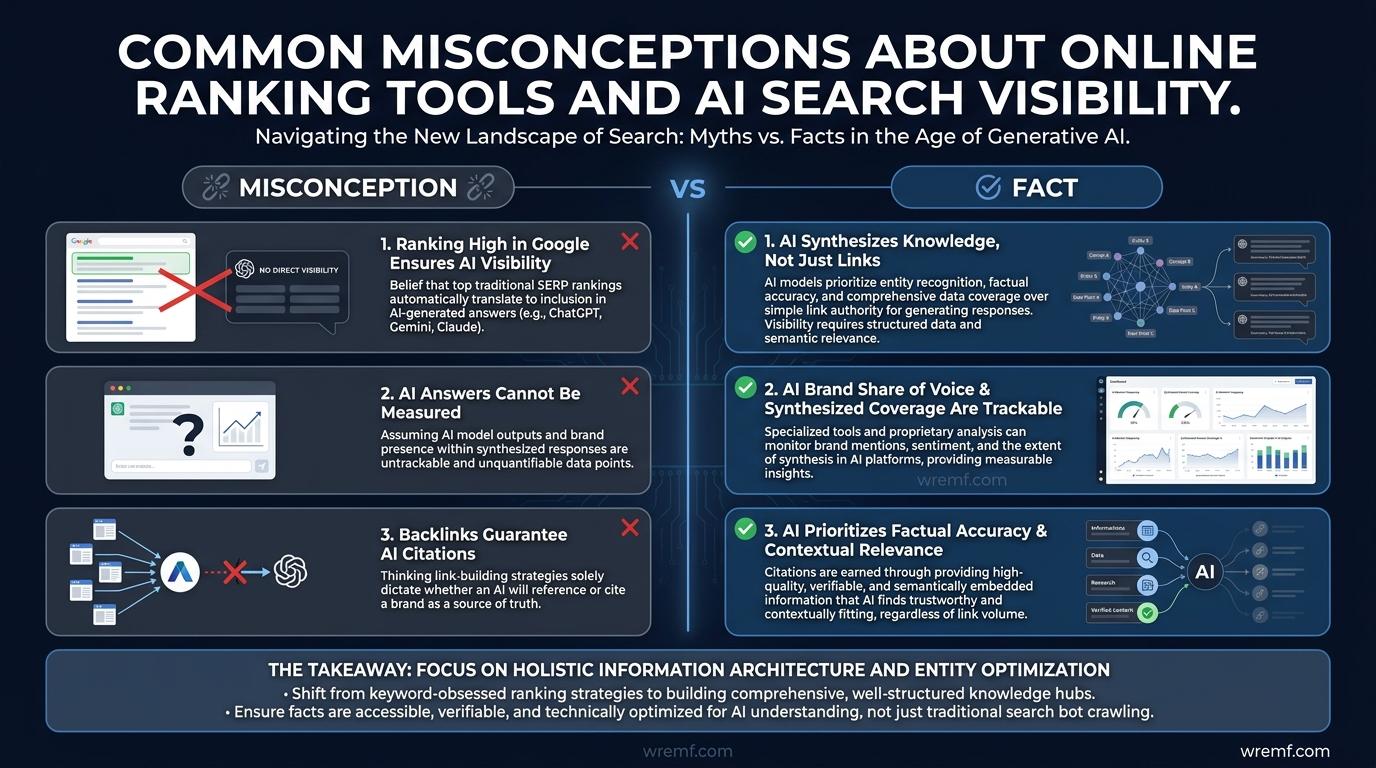
MYTH: If a website ranks on page one of Google, it will automatically appear in AI Overviews and AI-generated answers.
FACT: Google AI Overviews and other AI engines select sources based on factors that overlap with but are distinct from standard organic ranking signals. A page can rank highly in standard search results without being cited in an AI Overview, and vice versa. AI visibility requires separate measurement and separate optimisation. Ranking data from tools such as SE Ranking or Ahrefs confirms SERP performance, not AI citation presence.
MYTH: AI visibility cannot be measured reliably because AI answers change all the time.
FACT: AI visibility can be measured systematically through scheduled prompt monitoring across a defined set of relevant prompts and AI engines. The dynamic nature of AI answers makes single-point measurement unreliable, but continuous monitoring across consistent prompt sets produces meaningful trend data, competitive comparisons, and source citation patterns. Platforms such as WREMF are built specifically for this type of systematic AI visibility tracking.
MYTH: A strong backlink profile and high domain authority are enough to ensure AI engine citations.
FACT: Backlinks and domain authority influence organic search rankings and contribute to the authority signals that AI engines consider, but they are not sufficient on their own for AI citation selection. AI engines also assess content clarity, answer-first structure, entity consistency, source credibility, and factual accuracy. GEO and AEO optimisation addresses these additional dimensions that backlink profiles alone do not cover.
MYTH: Online ranking tools for SEO, surveys, and team prioritisation are all solving the same problem.
FACT: The three categories of online ranking tools serve entirely different use cases. SEO rank trackers measure keyword positions in search results. Survey ranking tools collect ordered preference data from research participants. Team prioritisation tools help groups reach consensus on competing options. Evaluating all three under the same criteria leads to misaligned tool selection. The correct starting point is identifying which type of ranked data your team needs to produce or measure.
MYTH: If a brand appears in a few AI answers, its AI visibility programme is working well.
FACT: Appearing in a small number of AI answers does not constitute a reliable measure of AI visibility. A comprehensive AI visibility programme tracks citation frequency, prompt coverage, source consistency, competitor comparisons, AI share of voice, and referral traffic attribution across multiple AI engines over time. Sporadic appearances without systematic tracking provide no actionable data and no baseline for improvement.
KEY TAKEAWAY: The most costly misconceptions about ranking tools involve assuming that Google rankings guarantee AI visibility, that AI answers cannot be measured, and that occasional AI citations indicate a healthy AI visibility programme. Systematic measurement across the right tool category is what separates strategic insight from guesswork.
The Technical and Development Dimension of Custom Ranking Tools
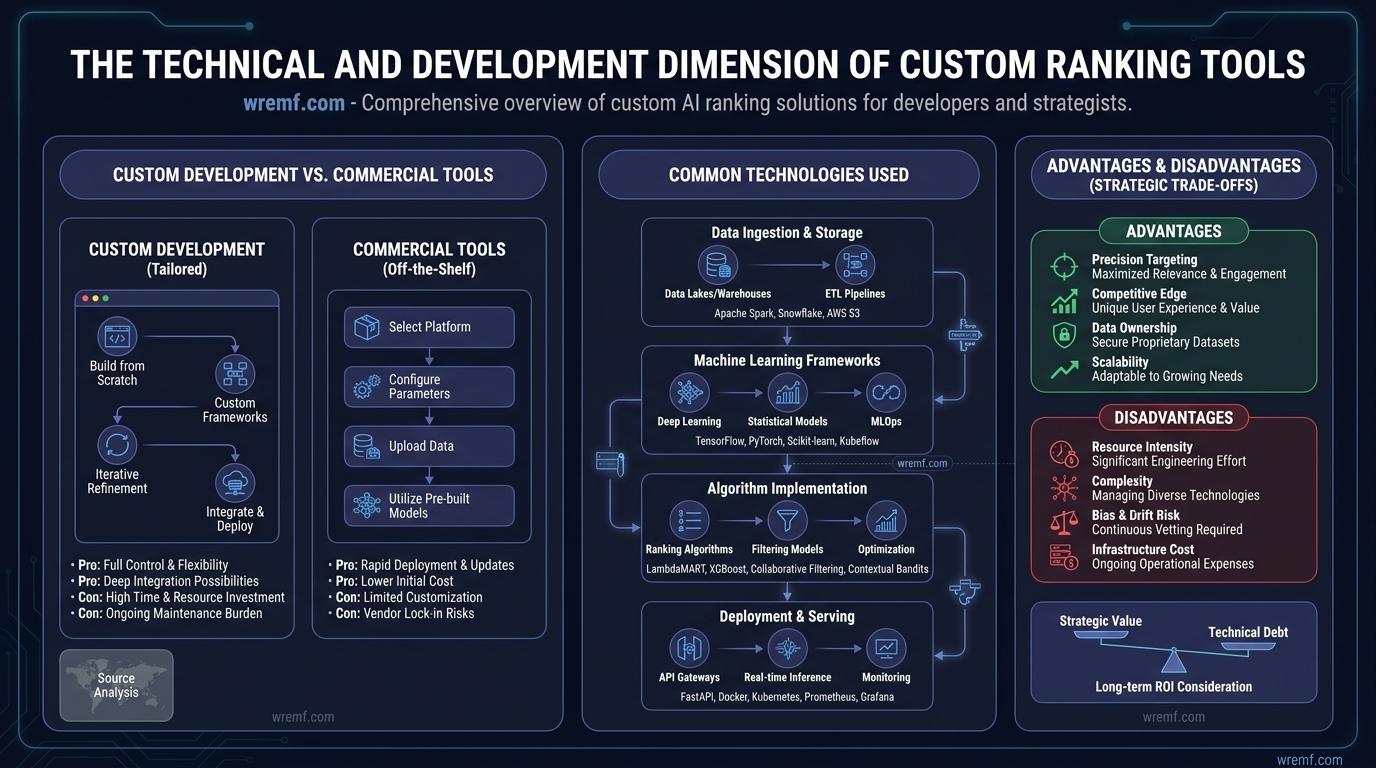
Some teams build custom ranking tools rather than using commercial platforms. This approach is common in developer-led organisations, research institutions, and teams with very specific ranking logic requirements that commercial tools do not support.
Common technical approaches include building web apps using React JS with a Materialize component library for the interface, connecting to custom or third-party APIs for data collection and retrieval, and deploying via Github Pages for lightweight public-facing tools. Python is frequently used for the backend logic of ranking systems, particularly for implementing sorting algorithms, processing pairwise comparison data, calculating transitivity-based scores, and running conjoint analysis on ranked preference data.
Shell Sort is one of the sorting algorithms used in custom ranking implementations where performance matters at larger list sizes. While simpler algorithms are adequate for small lists, Shell Sort improves on insertion sort by allowing items to be moved further in each pass, which reduces the total number of comparisons needed to produce a stable ranking from user input.
Branching logic, filtering, and group ranking capabilities are all achievable through custom development but require significantly more engineering effort than purpose-built platforms. Teams considering custom development should weigh the true cost of building, testing, debugging, and maintaining custom ranking software against the cost of adopting a purpose-built platform. The bugs and ongoing maintenance overhead of custom tools built on React JS and hosted via Github Pages can be substantial when the underlying ranking logic needs to evolve as requirements change.
For custom research implementations, conjoint analysis is a statistical method used to model how participants value different attributes of a product or service based on their ranking responses. It is commonly used in product development research where teams need to understand the specific tradeoffs that customers are willing to make between features, price, and other criteria. Conjoint analysis requires careful survey design, often using image pair rank or pairwise comparison techniques, and dedicated analysis software to process the resulting data.
The decision between custom development and commercial platforms ultimately depends on whether the ranking logic, data ownership, integration requirements, or user interface needs are sufficiently unique to justify the engineering investment. For most teams, commercial platforms such as ForceRank for prioritisation, Jotform for survey ranking, SE Ranking for keyword tracking, and WREMF for AI visibility tracking offer faster deployment, lower maintenance overhead, and more reliable output than equivalent custom builds.
KEY TAKEAWAY: Custom ranking tools built with React JS, Python, Shell Sort, and Github Pages offer flexibility for unique requirements but carry significant development and maintenance costs. Most teams achieve better outcomes faster using purpose-built platforms for their specific ranking use case.
Conclusion
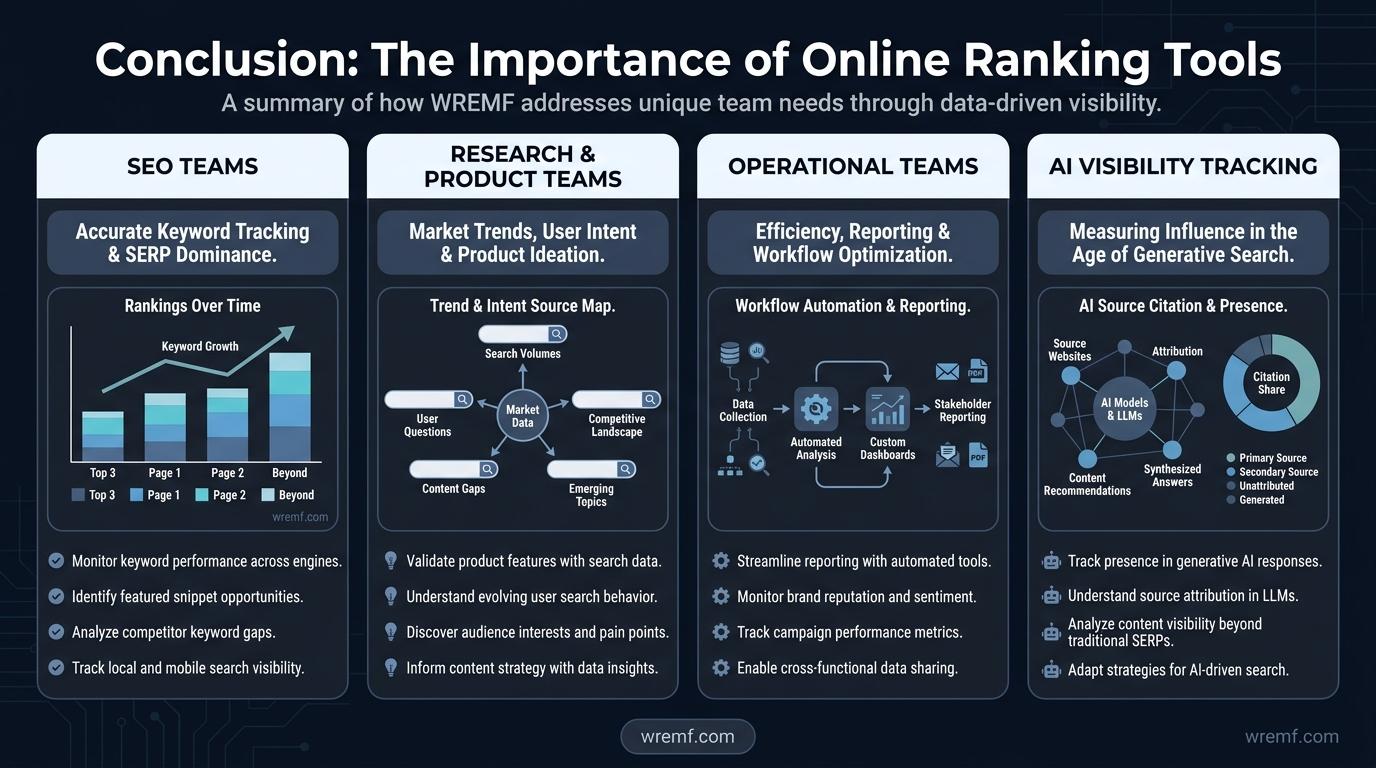
Online ranking tools serve fundamentally different purposes depending on the problem being solved. SEO teams need keyword rank tracking platforms that measure Google and Bing performance, domain authority, backlinks, and search visibility. Research and product teams need survey ranking tools that collect ordered preference data from participants using ranking questions and conditional logic. Operational teams need prioritisation platforms that transform group judgements into data-backed priorities through pairwise comparison and consensus scoring. And as AI search becomes a primary discovery channel for B2B buyers, every team also needs AI visibility tracking that captures how their brand appears in AI-generated answers across ChatGPT, Gemini, Perplexity, Google AI Overviews, and the full range of AI engines. WREMF fills that specific gap. Whether your team needs self-serve AI tracking through the Starter or Growth plan, or full execution support through the Managed service, WREMF is built to help you track, improve, and prove how your brand performs in AI search. Explore WREMF agency services to understand how the managed and hybrid models work, or compare plans directly at WREMF pricing
Frequently Asked Questions About Online Ranking Tools
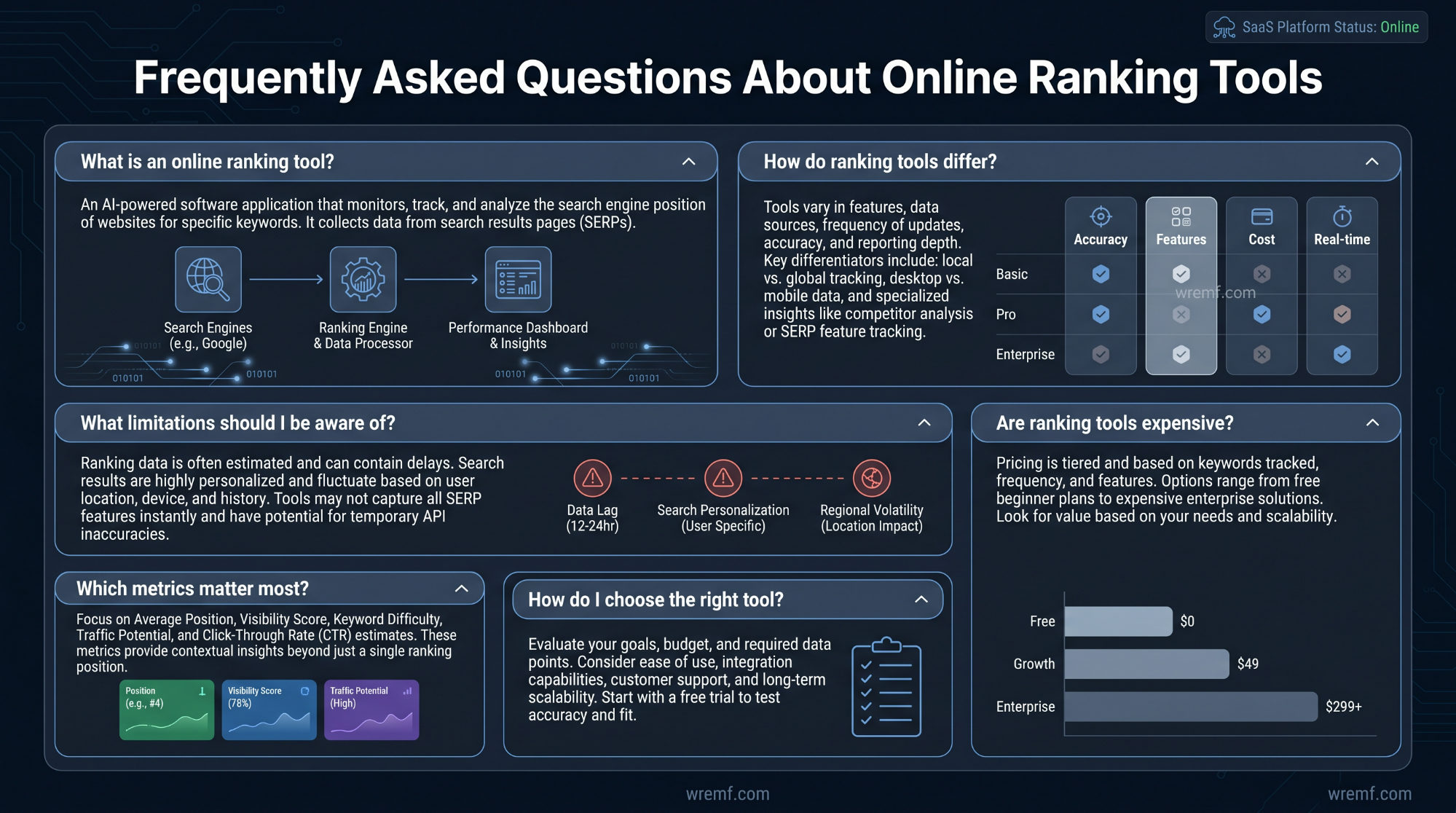
What is an online ranking tool?
An online ranking tool is software that helps you measure, track, or collect ranked data — either by monitoring where your website, content, or brand appears in search engine results, or by gathering prioritised input from users, teams, or customers through structured ranking surveys. The term covers two distinct categories: SEO rank tracking tools that monitor keyword positions in Google, Bing, and AI search results, and ranking survey tools that ask participants to order options by preference or priority. Understanding which type you need depends entirely on whether your goal is search visibility measurement or structured decision-making with ranked human input.
What is the difference between a ranking tool and a rating tool?
A ranking tool asks participants to order items relative to each other, for example placing three product features from most to least important. A rating tool asks participants to score each item independently on a fixed scale, such as one to five stars. Rankings produce relative priorities and force tradeoffs between options, which often reveals stronger signals for decision-making. Ratings collect absolute scores that are easier to average but can be inflated or inconsistent. For product teams, stakeholders, and research exercises where real tradeoffs matter, ranking approaches typically generate more actionable data than open-ended rating scales.
What are examples of ranking questions you can use in a survey?
Common ranking question examples include: which product features do you use most and least, how would you rank your experience with our company across different touchpoints, which of these topics would you most like us to cover next, and which priorities should our team focus on this quarter. More specific examples include asking customers to rank support quality, onboarding clarity, and product reliability in order of importance, or asking a product team to rank ten potential features by development priority. Well-designed ranking surveys produce data-backed priorities rather than vague preference signals, which makes execution decisions easier for product, marketing, and sales teams.
What is a ranking survey and how does it work?
A ranking survey is a structured research format that asks participants to order a set of options according to a defined criterion such as preference, priority, or frequency of use. Participants drag items into order, assign numbered positions, or compare pairs to express relative preference. The survey collects those ordered responses, aggregates them across all participants, and produces a ranked output that reflects group consensus or majority preference. This format is particularly useful for product prioritisation, marketing campaign planning, community challenges, customer retention research, and any situation where a team needs to move from a long list of options to a short list of decisions quickly.
How do I create a ranking survey in Jotform?
To create a ranking survey in Jotform, log into your account and open the Form Builder. Add a ranking question using the Orderable List widget, which allows respondents to drag and reorder items. You can personalise the survey by adding your own questions, adjusting branding, and applying conditional logic or branching logic to show different questions based on earlier responses. Jotform also supports mobile-optimised layouts, offline collection, QR code sharing, progress bars, and Jotform Tables for viewing aggregated responses. For teams that want to avoid building from scratch, Jotform offers a library of survey templates that can be customised quickly and shared via a shareable link or embedded using an embed code.
Which free survey tools offer unlimited participants for ranking surveys?
No ranking survey tool currently offers unlimited respondents on unlimited surveys at the free tier. Every major platform applies some form of free-tier restriction, whether that is a cap on monthly responses, a limit on active surveys, or a restriction on advanced features such as team collaboration, filtering, or group ranking. Paid survey tools unlock premium features that are more useful for serious ranking research, including unlimited participants, subgroup analysis, pairwise comparison, and conjoint analysis. If your project requires large-scale participation or multiple simultaneous surveys, evaluating a paid plan is typically more practical than working around free-tier limits.
Is a paid ranking survey tool worth it?
A paid ranking survey tool is worth it when your research requires features that free tiers do not support. These include unlimited participants, team collaboration, advanced filtering, branching logic, pairwise comparison, conjoint analysis, and exportable data for further analysis in tools like Python or external analytics platforms. For one-off projects or small teams testing an idea, free tiers are adequate. For product teams running ongoing prioritisation, sales teams gathering structured customer feedback, or companies building data-backed priorities across stakeholder groups, the cost of a paid tool is usually justified by the quality and volume of actionable data it produces.
What is ForceRank and how is it used for planning?
ForceRank is a ranking tool designed to help teams quickly reach consensus on priorities by asking each participant to rank a set of options independently and then aggregating the results into a shared view. It is particularly useful for annual planning exercises, roadmap prioritisation, and async decision-making where stakeholders are distributed. The tool surfaces alignment and disagreement at the same time, showing where the group agrees and where tradeoffs need discussion. Teams use ForceRank to move from a large list of competing ideas to a short, defensible priority list without requiring a synchronous meeting, which makes it practical for remote product teams, marketing teams, and technical debt triage exercises.
What is the difference between an SEO rank tracking tool and a ranking survey tool?
An SEO rank tracking tool monitors where your website pages appear in Google, Bing, and other search engines for specific keywords, and it tracks changes in those positions over time. Tools in this category include Ahrefs, SEMrush, SE Ranking, Moz, and Web CEO. A ranking survey tool collects prioritised input from human participants by asking them to order options according to preference or priority. These are entirely different use cases. Rank tracking tools are built for SEOs and marketing teams measuring search visibility. Ranking survey tools are built for product teams, researchers, and anyone who needs structured group prioritisation data rather than search engine position data.
What should SEOs look for in a keyword rank tracking tool?
SEOs should look for accurate keyword position tracking across Google and Bing SERPs, support for tracking rankings on mobile and desktop separately, local rank tracking by city or region, domain authority monitoring, backlink tracking, competitor visibility comparison, and integration with Google Analytics. Additional features worth evaluating include SERP feature tracking such as featured snippets and Google AI Overviews, historical data depth, alerting for significant ranking changes, and the ability to track a large number of keywords without per-keyword pricing penalties. Tools like Ahrefs, SEMrush, SE Ranking, and Moz each have different strengths across these criteria, so the right choice depends on team size, budget, and whether the priority is technical analysis or reporting.
How do AI search engines like ChatGPT, Gemini, and Perplexity affect traditional keyword ranking?
AI search engines including ChatGPT, Gemini, Perplexity, and Google's AI Mode do not use traditional keyword rankings in the same way as standard search results. Instead of returning a ranked list of blue links, these platforms generate synthesised answers and cite specific sources they consider authoritative and relevant. According to Google's AI Overviews documentation, AI Overviews operate through a separate classification layer from standard organic results, which means a page can rank well in traditional SERPs but still receive no citation in AI-generated answers. This is why brands increasingly need AI visibility tracking alongside traditional rank tracking, since the two systems reward content differently.
Does ranking well in Google still matter if AI search is growing?
Ranking well in Google still matters and will continue to matter for the foreseeable future, but it is no longer sufficient on its own for full search visibility. Traditional Google rankings drive organic traffic through standard blue-link results. AI-generated answers in Google AI Overviews, Google AI Mode, ChatGPT, Perplexity, Claude, and Gemini now surface brand mentions and source citations that are not always correlated with traditional ranking positions. Research published by Gartner notes that AI-driven search behaviour is materially changing how buyers discover and evaluate products, which means B2B brands need both traditional SEO and AI visibility strategies running in parallel.
What is AI visibility and how does it differ from traditional search visibility?
AI visibility refers to how often and how accurately a brand, product, or content appears in AI-generated answers from platforms like ChatGPT, Claude, Gemini, Perplexity, Google AI Overviews, Copilot, DeepSeek, Grok, and Meta AI. Traditional search visibility measures keyword ranking positions and organic traffic from standard search engine results pages. AI visibility measures citations, brand mentions, recommendation frequency, source consistency, and share of voice across AI discovery surfaces. A brand can have strong traditional search visibility but low AI visibility if its content is not structured for AI retrieval, its entity authority is weak, or its sources are not being cited by large language models. WREMF's AI visibility tracking measures both dimensions across ten AI engines.
How do you track AI citations and brand mentions across AI platforms?
Tracking AI citations and brand mentions across platforms like ChatGPT, Claude, Gemini, and Perplexity requires running structured prompt queries across those engines, recording which sources each engine cites, and monitoring how often your brand appears in the generated answers. Manual tracking is time-consuming and difficult to scale. Purpose-built platforms automate this by submitting prompt sets relevant to your category, recording citation frequency and source attribution, comparing your visibility against competitors, and flagging gaps where competitors are cited and you are not. WREMF tracks brand mentions, citations, and AI share of voice across ten AI engines and provides source consistency analysis to identify where entity authority needs strengthening. Teams can explore WREMF's source citation tracking to see how this works in practice.
What is AI share of voice and why does it matter for B2B brands?
AI share of voice measures the proportion of AI-generated answers in which your brand is mentioned, cited, or recommended relative to competitors in the same category. It is the AI search equivalent of traditional share of voice in paid media or organic search. For B2B brands, AI share of voice matters because buyers increasingly use AI-powered discovery tools at the top of the funnel to identify vendors, compare options, and shortlist solutions. If competitors appear in AI answers and your brand does not, you are effectively invisible during a growing portion of the research journey. Tracking AI share of voice over time shows whether content and authority investments are producing measurable improvements in AI recommendation frequency.
What are the main limitations of traditional rank tracking tools for modern SEO?
Traditional rank tracking tools measure keyword positions in standard SERPs but cannot track how or whether a brand appears in AI-generated answers, AI Overviews, or conversational search surfaces. They do not capture AI citations, brand mentions in LLM outputs, source consistency across AI engines, or recommendation frequency in tools like Perplexity or ChatGPT. They also typically cannot connect search visibility data directly to AI-driven traffic or assist with GEO or AEO strategy. For SEOs working in 2025 and beyond, traditional rank trackers remain useful for SERP position monitoring but need to be supplemented with AI visibility measurement to provide a complete picture of how a brand is being discovered.
What is the difference between AEO and GEO in the context of ranking and visibility?
Answer Engine Optimisation, known as AEO, focuses on optimising content so that it appears in direct answer outputs from AI tools and voice search systems. Generative Engine Optimisation, known as GEO, focuses on optimising for inclusion and citation in AI-generated responses from large language models such as ChatGPT, Claude, Gemini, and Perplexity. Both disciplines prioritise structured, authoritative, answer-first content, but GEO emphasises source citation, entity authority, and retrieval suitability across generative AI systems specifically. Traditional SEO focuses on keyword rankings and organic click-through. A comprehensive visibility strategy typically addresses all three layers. WREMF's GEO audit feature helps teams identify where their content and entity structure are not meeting AI retrieval requirements.
How can product teams use ranking tools to prioritise features and reduce technical debt?
Product teams use ranking tools to replace subjective debates with structured prioritisation data. By asking team members, stakeholders, or customers to rank feature requests, bugs, or technical debt items in order of importance, the team generates a defensible priority list based on aggregated input rather than whoever speaks loudest in a meeting. This works particularly well as an async exercise for distributed teams. Tools like ForceRank allow everyone to submit their rankings independently, after which the aggregated results reveal consensus and highlight areas of disagreement that need further discussion. The output gives product managers data-backed priorities they can present to leadership, reducing the time spent on alignment meetings and improving execution confidence.
What survey features matter most for running group ranking exercises with stakeholders?
For group ranking exercises with stakeholders, the most important features are support for multiple participants submitting independent rankings, aggregated results that show group consensus, filtering and subgroup analysis to compare responses by role or team, branching logic to ask follow-up questions based on ranking choices, and export options for further analysis. Additional useful features include pairwise comparison for large option sets, image pair ranking for visual materials, and the ability to share via a shareable link or QR code without requiring participants to create accounts. For enterprise teams, white-label branding and team collaboration tools improve the professionalism and efficiency of the exercise. Progress bars and mobile-optimised layouts also improve completion rates when participants are accessing surveys on different devices.
Can ranking survey tools be used alongside SEO and AI visibility tools?
Yes, ranking survey tools and SEO or AI visibility tools serve complementary but distinct purposes and can be used together effectively. Ranking survey tools collect structured human preference data to prioritise content topics, feature development, or messaging. SEO and AI visibility tools measure how that content performs in search engines and AI discovery surfaces after it is published. For example, a marketing team might use a ranking survey to identify which content ideas stakeholders prioritise, then use an AI visibility platform to track whether published content earns citations in ChatGPT, Gemini, or Perplexity. Combining both types of tool connects internal prioritisation decisions to external visibility outcomes, which strengthens content strategy and improves resource allocation.
When should a B2B brand use a managed AI visibility agency rather than software alone?
A B2B brand should consider a managed AI visibility agency when it lacks internal expertise to interpret AI visibility data and translate it into content and technical improvements, when execution capacity is limited, or when the team needs faster results than a self-serve software workflow can deliver. Software-only platforms are well suited for teams with strong internal SEO and content execution resources. Managed agency services are better suited for brands that need AI visibility audits, GEO strategy, AEO content optimisation, citation gap analysis, and ongoing optimisation handled externally. A hybrid model combines visibility tracking software with managed execution, which is practical for growth-stage B2B brands that want measurement and action without hiring a dedicated AI search team. WREMF's agency team offers senior-led AI visibility strategy and execution with clear deliverables and no long-term lock-in.
What does WREMF track and which AI engines does it cover?
WREMF tracks AI visibility across ten AI engines including ChatGPT, Claude, Gemini, Perplexity, Google AI Overviews, Copilot, DeepSeek, Grok, Meta AI, and Mistral. The platform monitors brand mentions, source citations, competitor visibility, AI share of voice, prompt-level recommendation frequency, and source consistency. It also includes a GEO audit tool, AI-ready content brief generation, SEO testing, GA4 attribution, and white-label reporting for agencies. Every plan includes unlimited prompt tracking and BYOK support, meaning teams can connect their own API keys rather than paying per-prompt markups. WREMF pricing starts at €59 per month for the Starter plan, with Growth at €149 per month and Managed execution from €1,500 per month for teams that want strategy and implementation handled by the WREMF team.
How do I know if my content is being cited by AI search engines?
The most direct way to check whether your content is being cited by AI search engines is to run relevant prompts across platforms like ChatGPT, Claude, Gemini, and Perplexity and manually record which sources each engine references in its answers. This is slow and difficult to scale across many prompts and engines. Automated AI visibility platforms accelerate this by running structured prompt sets, recording citation frequency, and flagging which competitors are cited in answers where your brand is absent. The VentureBeat AI coverage of emerging AI search behaviour consistently highlights citation patterns as a key differentiator between brands that appear in AI-generated answers and those that remain invisible, with content authority, entity consistency, and structured formatting identified as primary factors.
What is pairwise comparison and when should you use it in a ranking survey?
Pairwise comparison is a ranking method that presents participants with two options at a time and asks them to choose which they prefer, repeating this process across all possible pairs until a full ranked order can be inferred from the results. It is particularly useful when the number of options is large enough that asking participants to rank everything at once becomes cognitively difficult. Pairwise comparison reduces cognitive load by breaking the ranking task into simple binary choices. The tradeoff is that it requires more individual responses per participant and more backend processing to reconstruct the full ranking from binary choices. It is widely used in human preference research, sorting algorithms, and conjoint analysis where researchers need precise relative preference data rather than approximate ranked lists.
What are the risks of relying only on Google Rankings to measure content performance?
Relying only on Google rankings to measure content performance creates blind spots in categories where AI-driven discovery is growing. A page can rank on page one for a target keyword while receiving zero citations in ChatGPT, Perplexity, or Google AI Overviews, meaning it is effectively invisible to buyers using AI tools for research. Conversely, a page that ranks modestly in traditional SERPs may earn frequent AI citations if it is structured clearly, covers a topic authoritatively, and appears consistently across credible third-party sources. According to McKinsey's AI insights, AI adoption in professional research and discovery workflows is accelerating, which means the gap between traditional ranking metrics and actual discovery visibility will continue to widen for brands that do not measure both.
Related reading
- The Complete Guide to Keyword Monitoring for SEO, Brand Visibility, and AI Search
- AI Search Engine Optimization Tools: The Complete 2026 Guide for AI Search, SEO, AEO, and GEO
- AI Overviews Tracker: The Complete Guide to Monitoring Google AI Overviews, Citations, and AI Search Visibility
- Best AI Search Optimization Platforms: The Complete Guide to AI Visibility Tools, GEO, AEO, and Answer Engine Growth