Best AI Search Optimization Techniques
Discover AI search optimization techniques to enhance brand visibility in AI-generated results by 2026. Learn to optimize content and technical setups effectively.
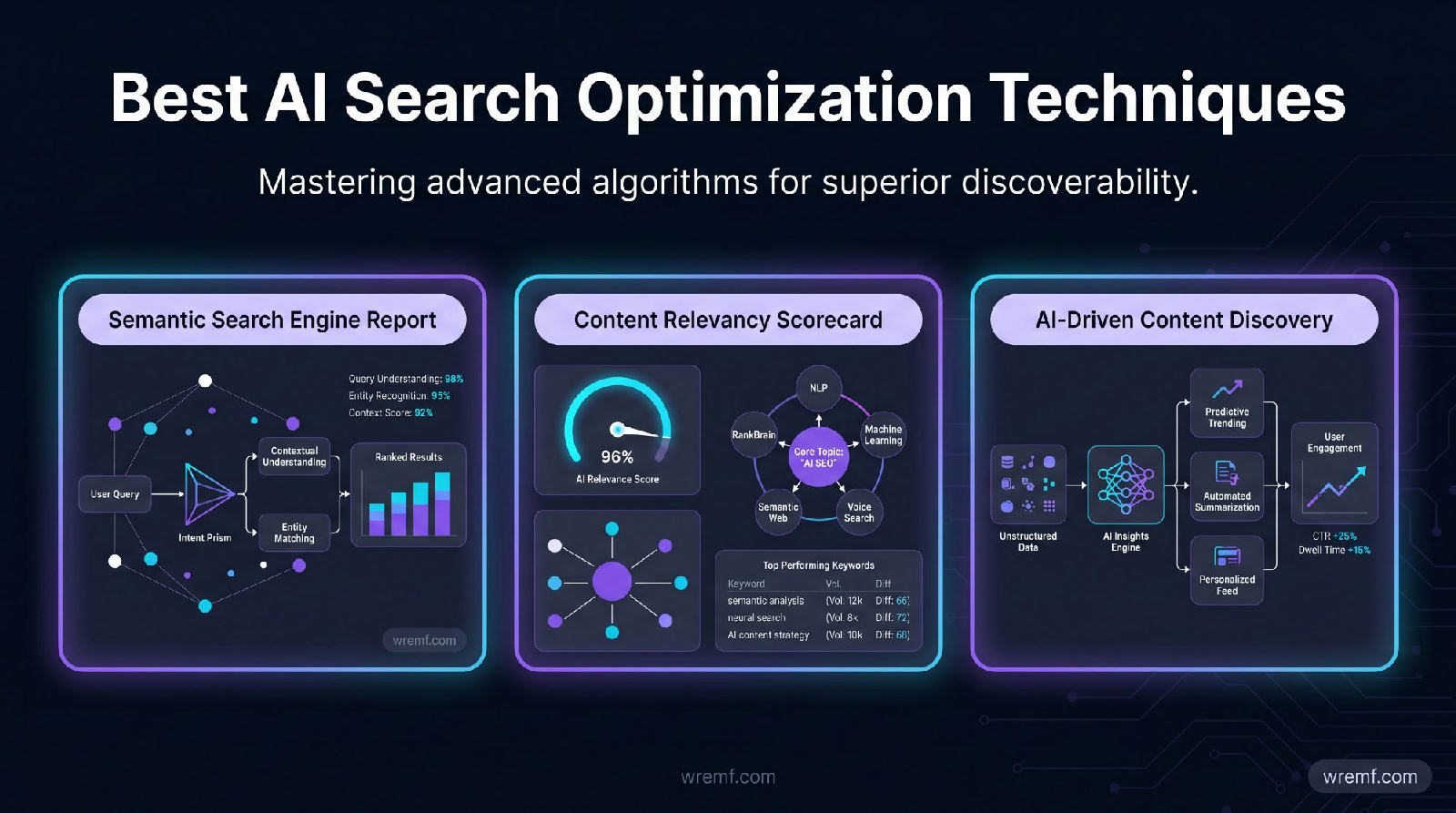
By WREMF Team · 2026-08-25
AI search optimization techniques aim to make brands visible, citeable, and recommendable inside AI-generated answers. By 2026, AI search will require a mixture of Search Engine Optimization, Answer Engine Optimization, Generative Engine Optimization, and AI visibility measurement. AI search involves using AI models to understand queries, retrieve relevant information, and offer direct answers. The practical aspect incorporates technical SEO, structured data, prompt tracking, and measuring visibility across various AI discovery platforms. Successful optimization enables brands to be referenced more accurately in AI summaries, recommendations, and vendor comparisons.
Key takeaways
- AI search optimization is essential for brand visibility in AI-generated answers.
- Combine SEO, AEO, GEO, and measurement for effective AI visibility.
- AI search focus shifts from ranking to citations and ecosystem influence.
- Prepare websites for AI by focusing on crawlability, structure, and data consistency.
- Content should be modular to facilitate extraction by AI systems.
Best AI Search Optimization Techniques
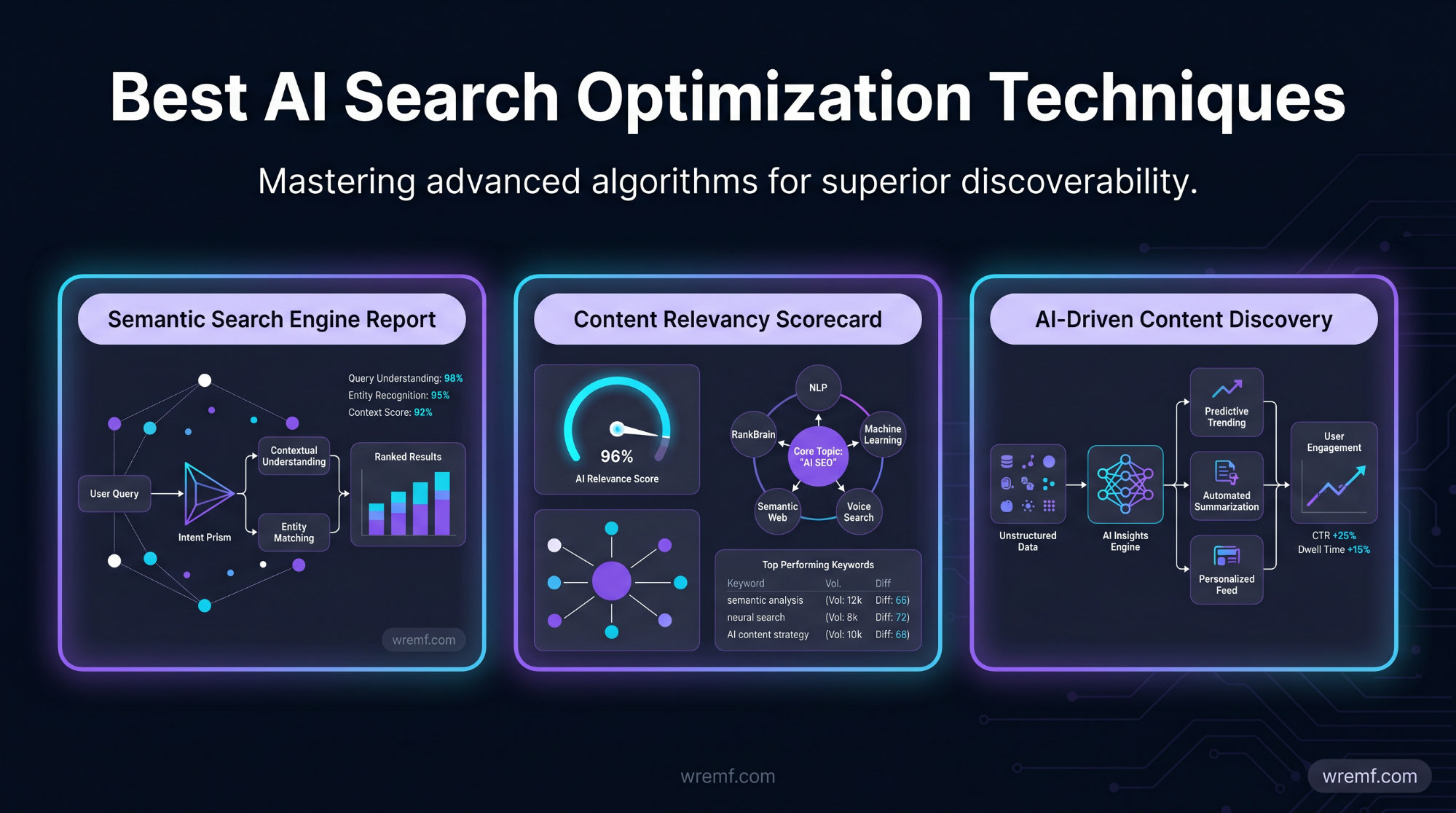
AI search optimization techniques are the methods used to make a brand visible, citeable, and recommendable inside AI-generated answers. Gartner predicted that traditional search engine volume would drop 25% by 2026 as AI chatbots and virtual agents gain search market share, which makes AI visibility a practical marketing priority, not a future trend. This guide explains how to optimise for Google AI Overviews, ChatGPT, Perplexity, Gemini, Claude, Copilot, DeepSeek, Grok, Meta AI, Mistral, and other AI discovery surfaces. It covers technical SEO, Generative Engine Optimization, Answer Engine Optimization, structured data, citations, prompt tracking, content strategy, source consistency, AI visibility tools, and measurement. WREMF helps B2B teams track, improve, and prove this visibility across 10 AI engines. Use this page as a complete 2026 framework for building visibility across search engines and Answer engines.
What Are AI Search Optimization Techniques in 2026?
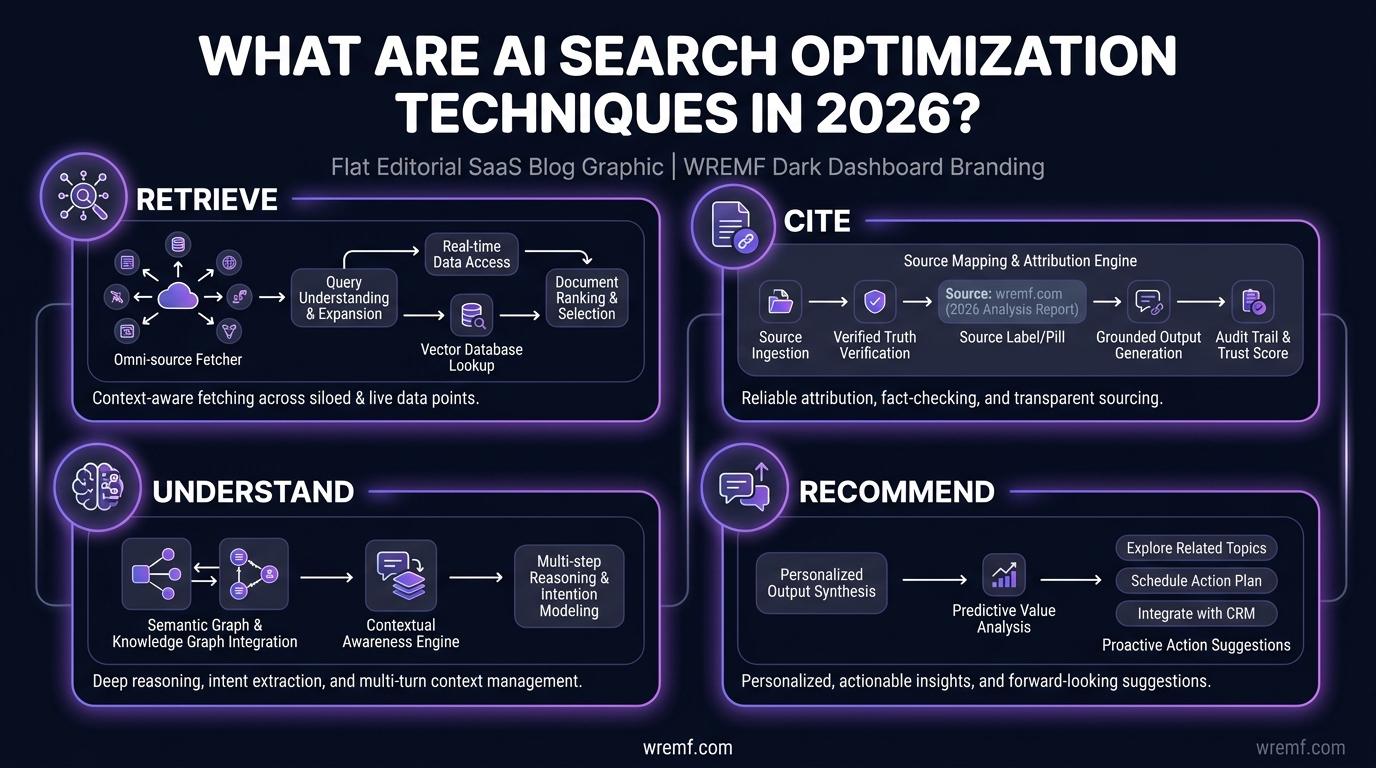
AI search optimization techniques help your content, brand, and sources become easier for AI engines to retrieve, understand, cite, and recommend. In 2026, the goal is not only to rank in search results, but to appear inside AI answers, AI Overviews, citations, summaries, and vendor recommendations.
AI search is the process of using AI models to understand a search query, retrieve relevant information, and generate a direct answer. AI search matters because users increasingly expect search engines and Answer engines to summarise the answer rather than only showing a list of links.
The best AI search optimization techniques in 2026 combine four connected disciplines:
Search Engine Optimization for crawlability, rankings, links, content quality, and traditional search results
Answer Engine Optimization for direct answers, FAQs, featured snippets, voice-like queries, and conversational answers
Generative Engine Optimization for AI-generated answers, AI citations, brand mentions, and source inclusion
AI visibility measurement for prompt tracking, source citations, competitor visibility, AI share of voice, and AI traffic attribution
Generative Engine Optimization is the practice of improving how a brand, page, or source appears inside AI-generated answers. Generative Engine Optimization matters because buyers now ask ChatGPT, Perplexity, Gemini, Claude, Copilot, and Google AI Overviews to compare vendors before they visit a website.
Answer Engine Optimization is the practice of structuring content so an Answer engine can extract a clear and useful answer. Answer Engine Optimization matters because AI answers favour pages that give direct answers, support claims, and organise information in a way that is easy to summarise.
AI visibility is the measurable presence of a brand inside AI-generated answers, citations, recommendations, summaries, and source lists. AI visibility matters because buyers can discover, compare, trust, or reject a company before the company sees a website visit.
WREMF helps teams track, improve, and prove AI visibility across major AI discovery surfaces. The WREMF platform suite combines prompt intelligence, citation analysis, competitor visibility, AI share of voice, GEO audits, content briefs, SEO testing, and white-label reporting in one workflow.
| Discipline | Primary Goal | What It Measures | What It Misses Alone | Best Use Case |
|---|---|---|---|---|
| SEO | Rank in search results | Keywords, impressions, clicks, backlinks, rankings | AI citations, AI answers, prompt visibility | Organic search growth |
| AEO | Win direct answers | Answer clarity, FAQs, snippets, structured signals | Multi-engine AI recommendations | Conversational and question-led queries |
| GEO | Appear in AI-generated answers | AI citations, brand mentions, source inclusion, AI responses | Full traffic attribution | ChatGPT, Perplexity, Gemini, Claude, Copilot, and Google AI Overviews |
| AI visibility | Track presence across AI engines | Prompts, competitors, citations, share of voice, brand mentions | Execution unless paired with content and authority work | B2B reporting, audits, and ongoing AI monitoring |
The key difference between SEO and GEO is that SEO focuses on ranking pages in a search engine, while GEO focuses on making brands and sources retrievable, citeable, and recommendable inside AI-generated answers.
According to Gartner, traditional search engine volume was predicted to drop 25% by 2026 because AI chatbots and virtual agents would take share from search marketing. This matters because AI SEO is no longer only about content creation. It is about visibility across the full discovery journey. (Gartner)
KEY TAKEAWAY: The best AI search optimization techniques combine SEO, AEO, GEO, and AI visibility measurement instead of treating AI search as a separate content trick.
The next step is understanding why the shift from blue links to AI answers changes how visibility is earned, measured, and reported.
Why Search Is Moving From Blue Links to AI Answers
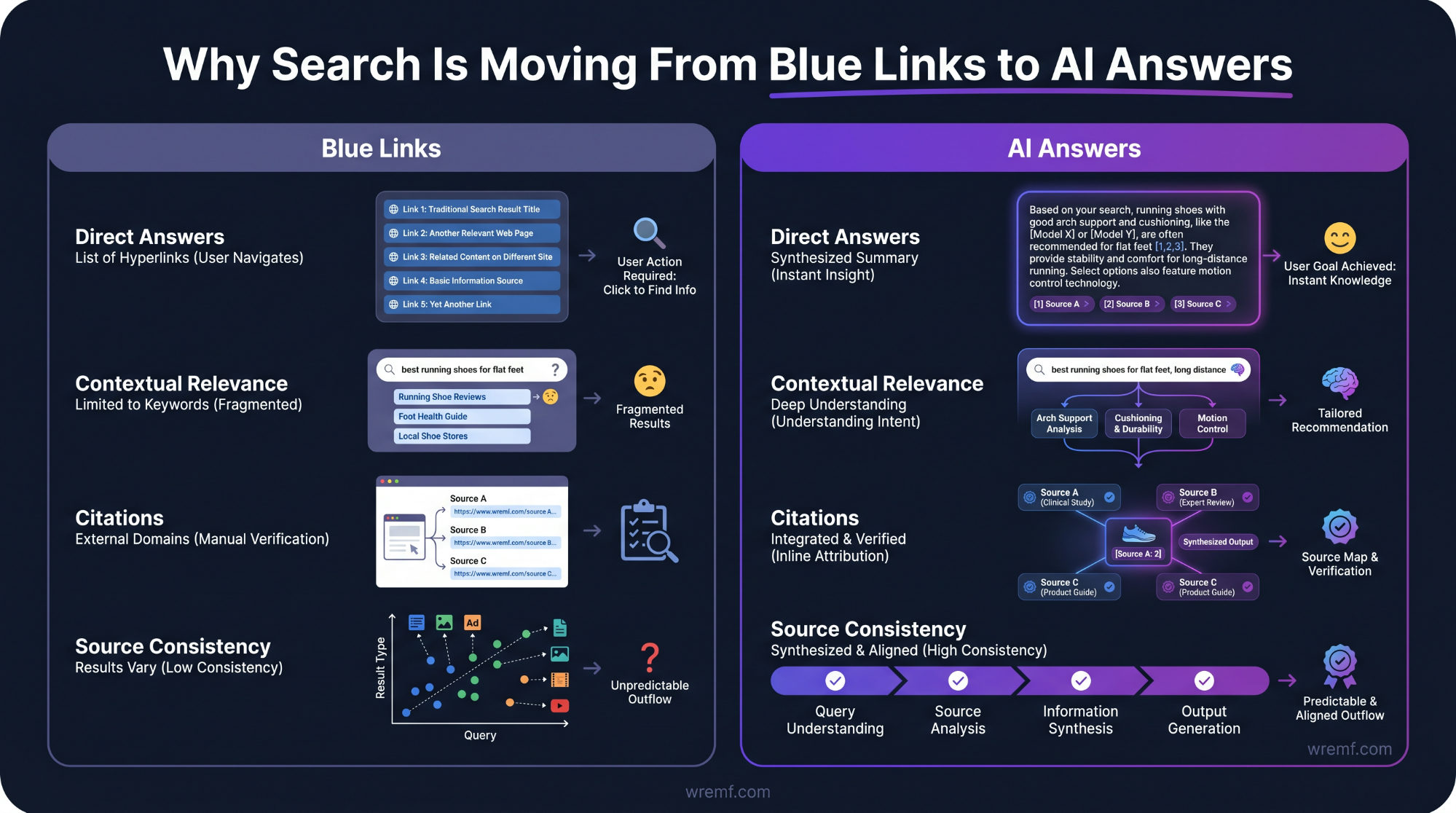
Search is moving from blue links to AI answers because users want direct, contextual answers across Google AI Overviews, ChatGPT, Perplexity, Gemini, Claude, Copilot, and other AI engines. This makes citations, mentions, source consistency, and answer quality as important as rankings.
Google AI Overviews are AI-generated summaries that appear in Google Search for selected queries. Google AI Overviews matter because they can answer a search query directly while also linking to supporting sources.
AI answers are generated responses created by AI models after interpreting a user’s query and, in many cases, retrieving supporting web sources. AI answers matter because they influence the buyer journey before a visitor reaches your website.
The old search model was straightforward. A user searched, saw search results, clicked a page, and converted later. The AI-driven search model is different. A user may ask ChatGPT for options, ask Perplexity for sources, check Google AI Overviews, compare vendors in Gemini, and only then search for a brand name.
In real B2B buying journeys, this means visibility can happen before traffic. A brand can appear in AI responses without receiving a measurable session. A competitor can be recommended in AI answers even when your page ranks well. A source can be cited in Google AI Overviews without producing the same Click-Through Rate as a traditional organic result.
AI search visibility is the ability of a brand, product, or source to appear across AI search experiences. AI search visibility matters because decision-makers increasingly use AI models as research assistants during problem discovery, vendor shortlisting, and comparison.
According to Pew Research Center, Google users who saw an AI summary clicked a traditional search result in 8% of visits, compared with 15% when no AI summary appeared. Pew also found that users clicked a link inside the AI summary in only 1% of visits to pages with a summary. (Pew Research Center)
DID YOU KNOW: Pew Research Center also reported that 58% of participants encountered at least one Google search page with an AI-generated summary during the March 2025 browsing analysis. (Pew Research Center)
Google’s own AI features and your website guidance explains that AI features in Search are part of Google Search and that site owners should focus on creating useful, unique, and satisfying content for people. The implication is clear: AI search optimization does not replace SEO fundamentals, but it adds new measurement and source visibility layers. (Google for Developers)
AI visibility is the measurable presence of a brand inside AI-generated answers, recommendations, citations, and summaries. AI visibility matters because buyers increasingly use AI assistants to compare vendors before visiting websites, reviewing ads, or speaking to sales teams.
WREMF’s AI Visibility Index helps teams track how often a brand appears across AI engines, which competitors appear with it, which sources are cited, and where visibility gaps exist.
KEY TAKEAWAY: AI search changes visibility from a ranking-only problem into a citation, recommendation, and source ecosystem problem.
Once the visibility model changes, the technical foundation of your website becomes the first operational layer.
How Should You Prepare Your Website for AI Crawlers and RAG?
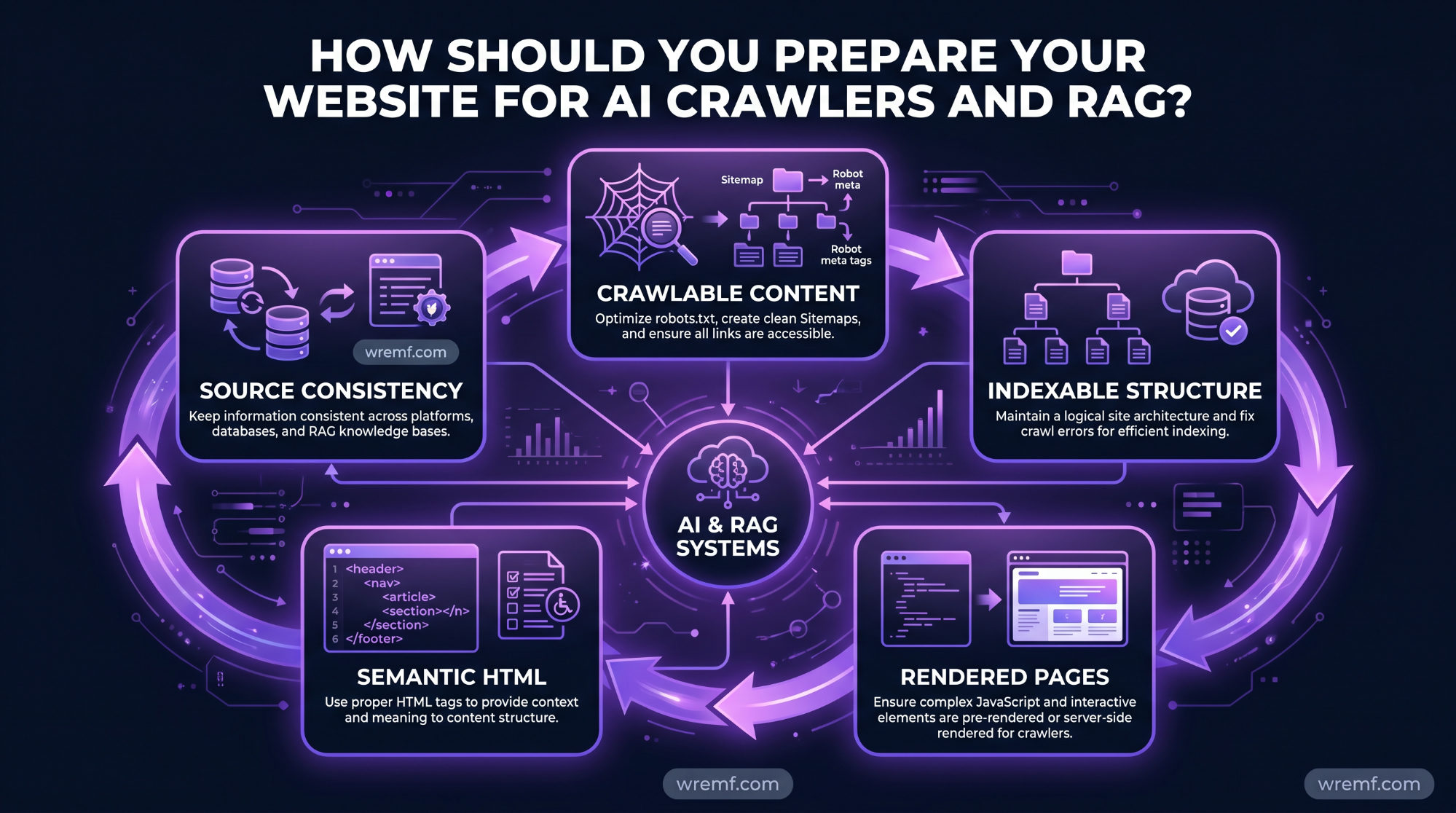
You prepare your website for AI crawlers and RAG by making key content crawlable, indexable, rendered, semantically structured, and source-consistent. AI Crawler access, Technical SEO, structured data, internal linking, and clean HTML all affect whether AI engines can retrieve and understand your content.
An AI Crawler is a system that discovers, scans, or accesses web content for AI products, search features, or retrieval systems. An AI Crawler matters because blocked, thin, or poorly rendered content is harder for AI engines and search engines to use as source material.
Retrieval-Augmented Generation is a method where a Large Language Model retrieves external information before generating an answer. Retrieval-Augmented Generation matters because many AI-generated answers depend on source selection, passage retrieval, citation confidence, and freshness.
Technical SEO is the practice of making a website accessible, understandable, and indexable for search engines. Technical SEO matters in AI-driven search because AI engines still depend on discoverable URLs, rendered content, canonical signals, structured signals, and reliable page architecture.
Your 2026 technical checklist should include:
Crawlable HTML for important product, service, category, comparison, and educational pages
Correct robots.txt, noindex, canonical, and sitemap signals
Server-side rendered or reliably rendered content for key answer passages
Semantic HTML for headings, tables, lists, FAQs, author sections, and article structure
Schema markup and structured data that match visible page content
Internal links with descriptive anchors that connect topic clusters
Fast mobile usability and stable page experience
Clear source pages for methodology, pricing, product details, team expertise, and support documentation
AI Crawler access policies that do not accidentally block useful content
Optional llms.txt guidance where it fits your technical governance model
Semantic HTML is the use of meaningful HTML elements to describe the structure and purpose of content. Semantic HTML matters because search engines, AI crawlers, and AI models can better interpret definitions, lists, questions, tables, author information, and article sections when the page structure is clear.
Structured data is machine-readable markup that helps search engines understand the entities and content on a page. Structured data matters because it reinforces relationships between organisations, authors, products, services, articles, reviews, FAQs, and other source signals.
Schema markup is a structured data format that labels entities and content types for search engines. Schema markup matters because it helps search systems understand what a page represents, but it does not guarantee a Rich snippet, AI Overviews inclusion, or AI citation.
Google’s structured data documentation explains that structured data helps Google understand page content and classify information about a page. This supports AI search readiness because structured signals can reinforce entity meaning when they match the visible content. (Pew Research Center)
| Technical Layer | What to Check | Why It Matters for AI Search | Common Mistake |
|---|---|---|---|
| Crawlability | robots.txt, noindex, canonical tags, XML sitemaps | AI engines and search engines need accessible source pages | Blocking important content by accident |
| Rendering | Server output, JavaScript hydration, visible content | AI systems may miss content that is difficult to render | Hiding key answers inside scripts |
| Semantic HTML | H1, H2, lists, tables, FAQs, article sections | Clear structure improves passage extraction | Designing visually without meaningful structure |
| Structured data | Organization, Article, Product, FAQ schema, author schema | Reinforces entities and content type | Adding markup that does not match visible content |
| Internal links | Descriptive anchors and topic clusters | Helps search engines understand relationships | Using vague anchors such as “learn more” |
| Source controls | snippet directives, robots rules, AI Crawler policies | Controls what search systems can display or access | Blocking snippets without understanding visibility tradeoffs |
| Performance | Mobile speed, stability, cache, Core Web Vitals | Improves user experience and crawl efficiency | Treating speed as separate from discoverability |
LLMs.txt is an emerging text file some sites use to provide AI-facing guidance about useful content paths. LLMs.txt matters because it can clarify important pages for AI discovery surfaces, but it should not replace robots.txt, XML sitemaps, canonical tags, structured data, or standard Technical SEO.
MCP Server infrastructure can also matter for advanced teams. An MCP Server is a Model Context Protocol endpoint that lets AI agents or internal tools access approved data sources and workflows. MCP Server setups matter when a company wants AI systems, dashboards, or reporting tools to retrieve clean product, analytics, content, or visibility data through controlled API access.
WordPress, Elementor AI, and other CMS workflows can support AI SEO when they produce clean HTML, schema-friendly layouts, fast pages, and editable content modules. WordPress Caching also matters because slow or unstable pages can reduce crawl efficiency and user experience.
WREMF supports API access and MCP workflows for teams that want AI visibility data connected to internal dashboards, client portals, or reporting systems. Technical teams can review the WREMF API and MCP integration options when they need structured access to prompt, citation, visibility, and reporting workflows.
KEY TAKEAWAY: AI search readiness starts with crawlable, structured, rendered, source-consistent pages that AI engines can retrieve and interpret.
After the technical layer is sound, the next priority is building content that AI systems can quote, summarise, and trust.
What Content Structure Works Best for AI Search in 2026?
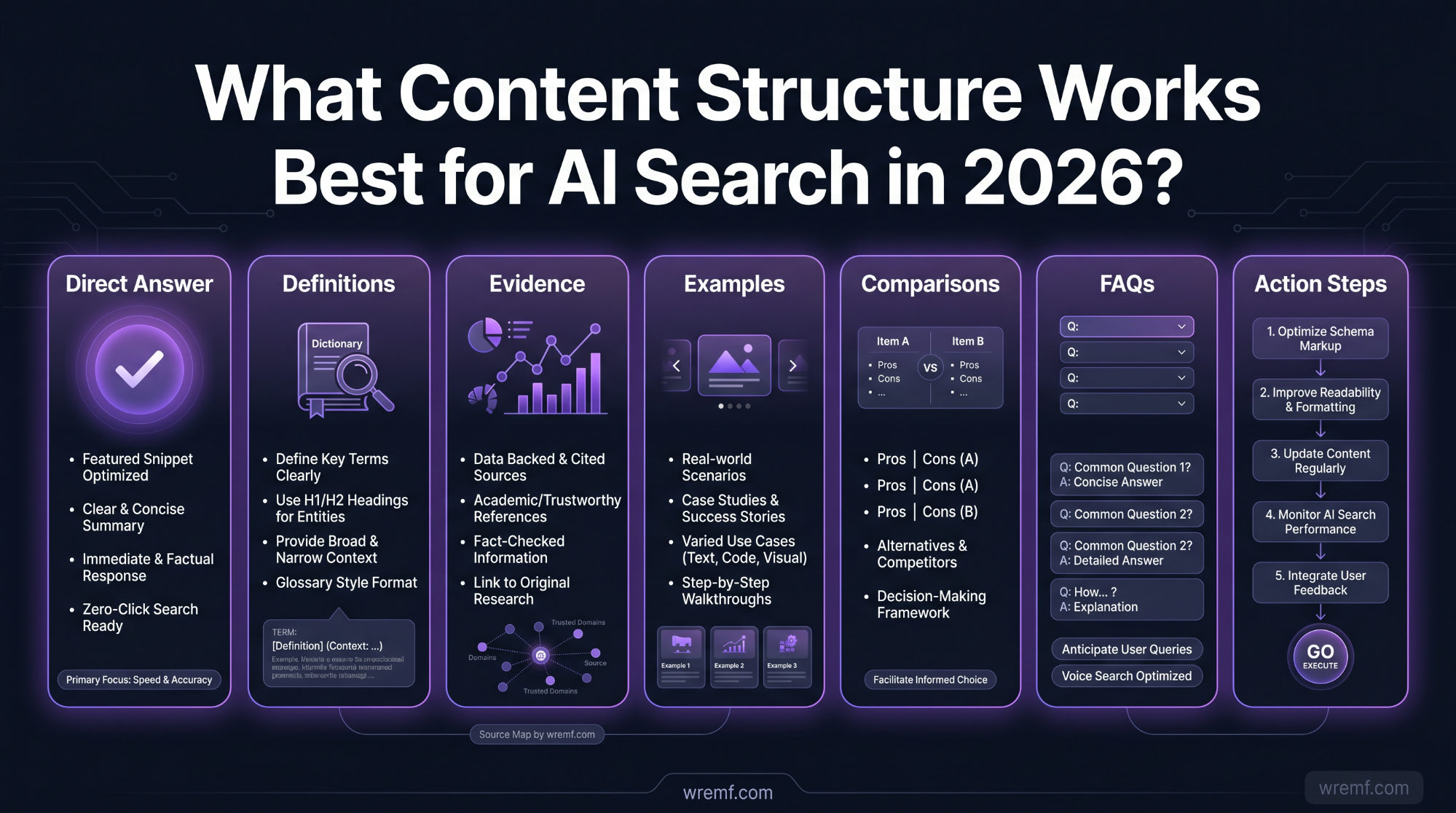
The best content structure for AI search starts with a direct answer, then expands into definitions, evidence, examples, comparisons, FAQs, and action steps. AI engines need passage-level clarity, not keyword stuffing.
Content structure is the way information is organised on a page through headings, paragraphs, lists, tables, definitions, and FAQs. Content structure matters because AI models often retrieve and summarise specific passages rather than reading a page like a human from top to bottom.
Content Modular Design is the practice of building pages from self-contained answer blocks, definitions, comparisons, workflows, FAQs, and summary clusters. Content Modular Design matters because modular content is easier for AI answers, AI Overviews, and Large Language Model retrieval systems to extract.
A strong AI search content structure usually includes:
A direct answer in the introduction
Descriptive H2 headings that match natural language questions
Short definitions for core entities
Source-backed claims close to the relevant paragraph
Tables for comparisons involving 3 or more choices
FAQs that answer real search query variations
Key Takeaway statements after major sections
Internal links to relevant product, methodology, service, and reporting pages
The most effective way to improve AI search visibility is to create content that answers real user prompts with clear, source-backed passages. AI search visibility improves when content is easy to retrieve, easy to verify, and easy to cite.
Content strategy is the plan for creating, organising, updating, and measuring content against business goals and user intent. Content strategy matters for AI search because one isolated article rarely builds enough entity authority or source consistency on its own.
A 2026 content strategy should move beyond keyword density. Keywords still help a search engine classify pages, but AI engines also need topic coverage, entity clarity, source confidence, and answer completeness. A complete page about AI SEO should cover AI search, Google AI, Google AI Overviews, AI Overviews, ChatGPT, Perplexity, Gemini, Claude, Answer engines, AI visibility tools, structured data, Large Language Model retrieval, AI responses, AI-generated answers, and measurement.
Content gaps are missing topics, questions, entities, or source-backed claims that prevent a page from satisfying user intent. Content gaps matter because AI answers often prefer sources that cover the full decision path, not only the primary keyword.
TIP: Build every major page around 10 to 20 real prompts, not only keyword variations. Prompt-based planning helps content match how people ask ChatGPT, Claude, Gemini, Perplexity, Google AI, Copilot, and voice assistants for answers.
| Content Element | Best Use | AI Search Benefit | Example |
|---|---|---|---|
| Answer-first introduction | Defining the page topic | Helps AI answers extract the main answer quickly | “AI search is...” |
| Definition block | Explaining entities | Improves LLM visibility for core terms | “AI visibility is...” |
| Comparison table | Decision-stage queries | Makes tradeoffs extractable | SEO vs AEO vs GEO |
| FAQ section | Long-tail and voice-like prompts | Captures natural search query formats | “Is SEO still worth it in 2026?” |
| Key Takeaway | Summary extraction | Creates a citation-ready summary | One sentence after each H2 |
| Source attribution | Trust and verification | Supports citation confidence | “According to Google...” |
| Internal links | Topic relationships | Connects content ecosystems | Methodology, suite, audit, reports |
Schema-friendly layouts matter because content can be mapped to Article, FAQPage schema, FAQ schema, SoftwareApplication, Product, Service, or HowTo structured data without rewriting the page. FAQPage schema and FAQ schema should match visible FAQ content if used, and should not be added to manipulate search appearance.
Content ecosystems are connected groups of pages that cover a topic from multiple angles. Content ecosystems matter because AI models and search engines can better understand a brand’s expertise when definitions, methodology, comparison pages, product pages, and support content reinforce the same entity relationships.
WREMF’s AI-ready content briefs help teams turn prompt data, competitor visibility, citation gaps, and entity coverage into publishable content plans. This is useful when content creation needs to support both traditional search engine rankings and AI-generated answers.
KEY TAKEAWAY: AI search content should be structured as clear, modular answers that match real prompts and support major claims with context.
Once the page structure is clear, the next layer is passage-level optimization for AI Overviews and Answer engines.
How Do You Optimize for Google AI Overviews and Passage-Level Citations?
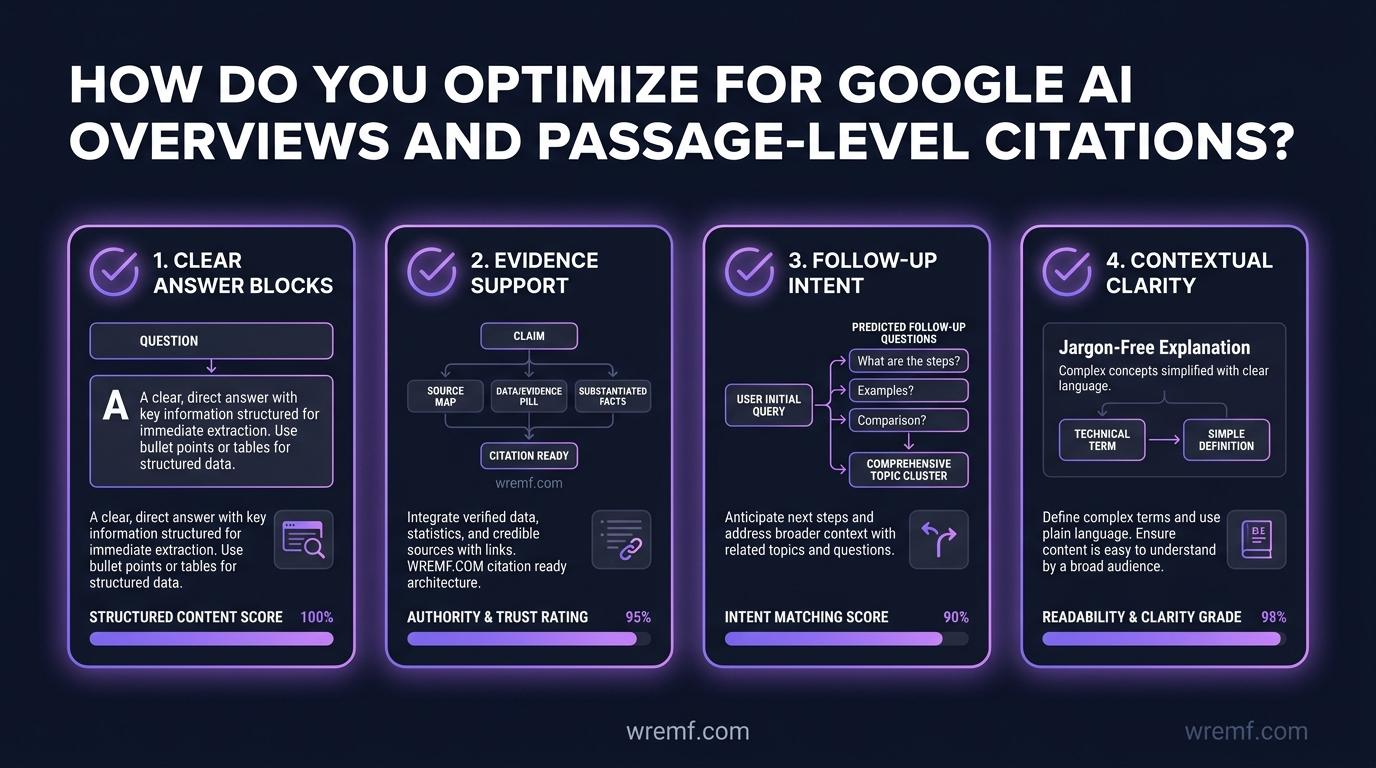
You optimize for Google AI Overviews and passage-level citations by writing clear answer blocks, supporting claims with evidence, covering follow-up intent, and making each section understandable without surrounding context. Passage-level optimization helps AI models extract the exact part of a page that answers the query.
Passage-level optimization is the practice of making individual sections, paragraphs, and answer blocks clear enough to be retrieved independently. Passage-level optimization matters because AI Overviews, Answer engines, and Large Language Model systems may use only a small part of a page as the source for an answer.
AI Overviews are generated summaries in Google Search that appear for selected searches. AI Overviews matter because they can change how users interact with search results, especially when the summary answers the query directly.
Google AI is the broader set of Google AI systems and experiences that can support search, summarisation, recommendations, and discovery. Google AI matters for marketers because Google AI Overviews and AI Mode reshape how users see answers inside Google Search.
Google’s AI features guidance tells site owners to focus on unique, valuable content for people and to make sure Google can access the content through normal Search controls. This means the foundation for Google's AI Overviews is still useful, accessible, well-structured web content. (Google for Developers)
For passage-level optimization, use this workflow:
Start each major section with a direct 1 to 2 sentence answer
Define important terms in 1 to 2 sentences
Use examples that connect the term to a business outcome
Keep paragraphs short and focused on one idea
Add source attribution close to factual claims
Use tables when users need to compare options
Add FAQs for long-tail search query formats
Update passages when products, pricing, or market facts change
Google AI Overviews do not reward vague introductions. A page that begins with a direct answer is easier for AI systems to summarise. A section that says “AI visibility is the measurable presence of a brand inside AI-generated answers” is more extractable than a section that begins with abstract commentary.
Click-Through Rate remains important, but it is no longer the only visibility measure. Pew’s click data shows that traditional result clicks were lower when AI summaries appeared, which makes brand presence inside the answer layer more important. (Pew Research Center)
Rich snippet eligibility can support search visibility, but rich snippets and AI Overviews are not the same thing. Rich snippet outcomes depend on structured data, content quality, and Google’s systems. AI Overviews depend on Google’s AI systems, query interpretation, source usefulness, and Search controls.
A practical passage template for AI search looks like this:
| Passage Element | Purpose | Example Pattern |
|---|---|---|
| Direct answer | Satisfy the core query | “AI visibility is...” |
| Definition | Clarify the entity | “Prompt tracking is...” |
| Evidence | Support the claim | “According to Pew Research Center...” |
| Example | Show practical use | “A B2B SaaS team can...” |
| Implication | Explain why it matters | “This means teams should...” |
WREMF’s GEO audit workflow helps teams identify pages that are technically accessible but weak for AI comprehension. This includes pages with missing definitions, poor content structure, vague claims, thin answer blocks, or unclear entity relationships.
KEY TAKEAWAY: Passage-level optimization helps AI Overviews and Answer engines extract clear, self-contained answers from your content.
After improving passages, teams need to connect those passages into intent-based topic clusters.
How Do Intent Clusters and Content Gaps Improve AI Search Visibility?
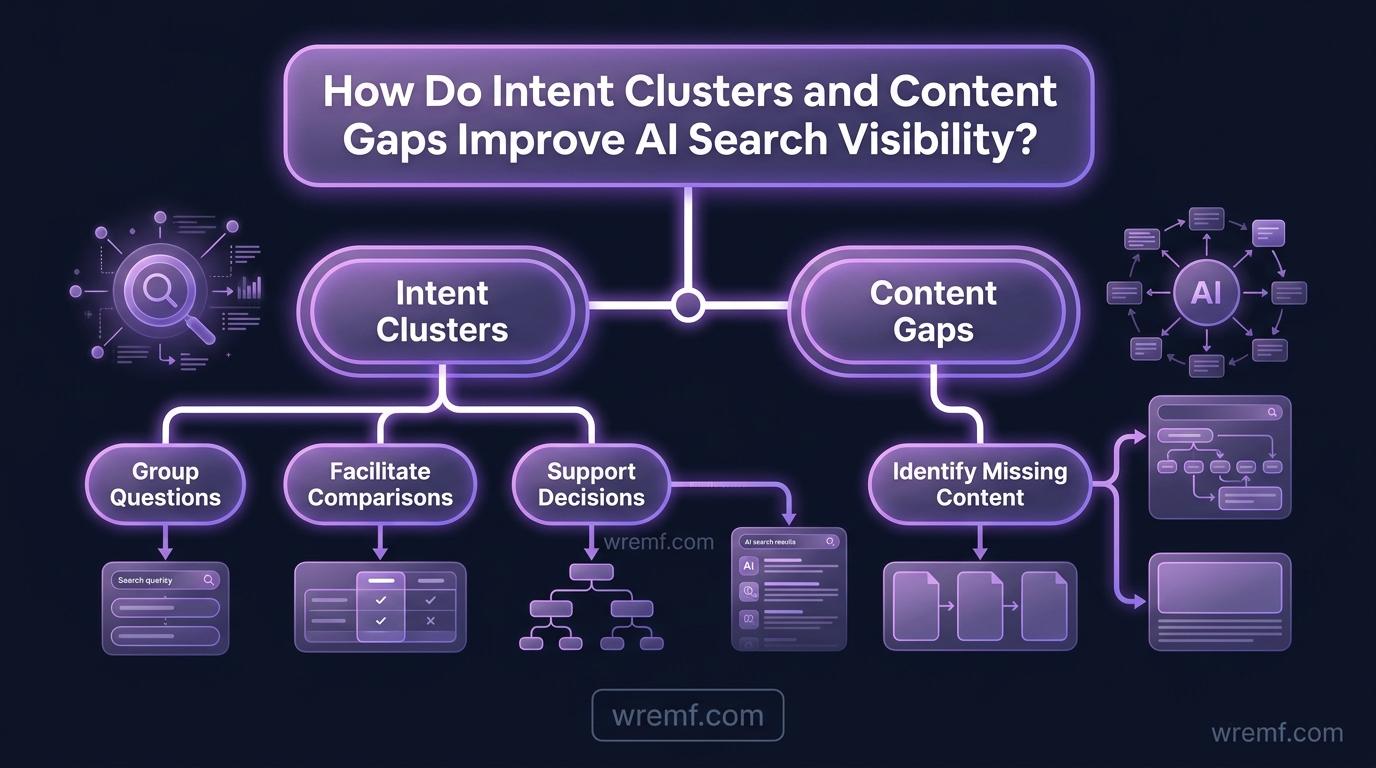
Intent clusters improve AI search visibility by grouping content around the questions, comparisons, and decisions buyers ask AI engines. Content gaps show what your content ecosystem is missing before an AI model can confidently cite or recommend your brand.
User intent is the reason behind a search query or prompt. User intent matters because AI engines generate better answers when source content matches the user’s task, such as learning, comparing, troubleshooting, or buying.
Intent-based data clusters are groups of prompts, keywords, pages, and sources that map to the same user need. Intent-based data clusters matter because AI engines respond to complete information environments, not only isolated keywords.
For a B2B SaaS company, the main AI search intent clusters often include:
Definition intent, such as “What is Generative Engine Optimization?”
Problem intent, such as “How do AI Overviews affect organic traffic?”
Comparison intent, such as “SEO vs AEO vs GEO”
Tool intent, such as “best AI visibility tools for agencies”
Brand intent, such as “What does WREMF do?”
Implementation intent, such as “How do I track AI citations?”
Risk intent, such as “Can AI search hallucinate my brand information?”
Buying intent, such as “Should I use AI visibility software or an agency?”
Marketing teams often find that their content strategy covers informational questions but misses buying-stage prompts. That creates a visibility gap. A brand may rank for “what is AI SEO,” but not appear when AI engines answer “best AI SEO tools for B2B SaaS teams.”
AI answers are strongest when the source ecosystem covers the full journey. A definition page explains the term. A methodology page explains how measurement works. A product page explains the software. A pricing page supports buying intent. A sample report proves the output. A service page supports execution.
The WREMF methodology is built around this full journey by connecting prompts, citations, competitors, source consistency, and attribution into one repeatable system.
| Intent Cluster | Example Prompt | Required Content | AI Visibility Risk if Missing |
|---|---|---|---|
| Definition | “What is AI visibility?” | Clear definition, examples, related terms | AI models cite broader sources instead |
| Comparison | “SEO vs GEO vs AEO” | Comparison table, use cases, limitations | Competitors define the category |
| Tool selection | “Best AI visibility tools for agencies” | Product capabilities, reporting, pricing, criteria | Brand excluded from buying-stage AI answers |
| Implementation | “How do I track AI citations?” | Workflow, metrics, examples | Users understand the problem but not your solution |
| Risk | “Can AI answers describe my brand incorrectly?” | Hallucination monitoring, source cleanup | Negative or outdated sources dominate |
| Proof | “What does an AI visibility report include?” | Sample report, dashboard examples, KPI definitions | Leadership cannot justify investment |
Content optimization should close the highest-value gaps first. For most B2B teams, the highest-value gaps are commercial prompts, comparison prompts, and source citation prompts because they sit closer to buying decisions.
Content creation should not only fill pages with more words. Strong content creation fills missing intent, clarifies entities, answers follow-up questions, and creates source material that AI models can trust.
KEY TAKEAWAY: Intent clusters and content gap analysis help brands build the full source ecosystem that AI engines need for confident answers.
Once content clusters exist, your brand needs authority signals that AI systems can recognise across the web.
How Do Citations, Entity Authority, and Trust Signals Influence AI Answers?
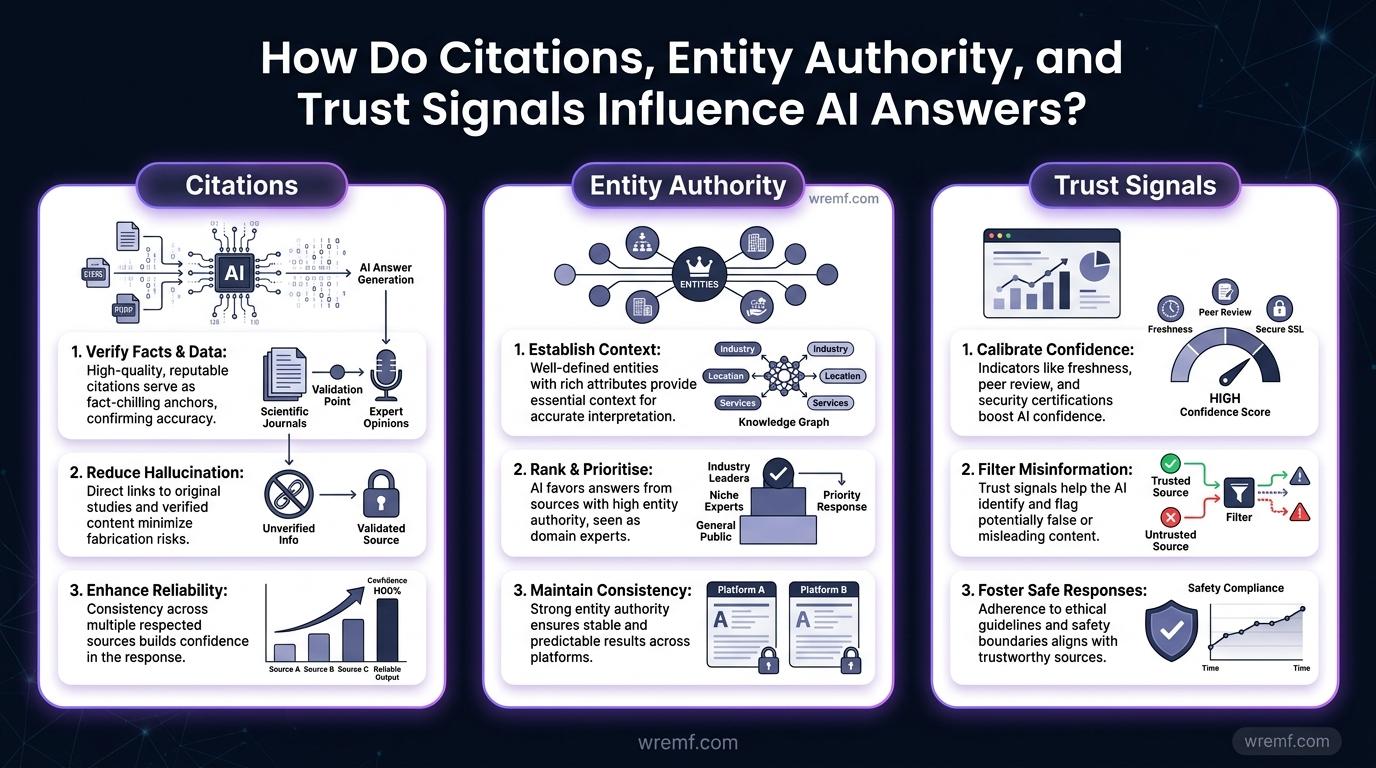
Citations, entity authority, and trust signals influence AI answers by helping AI models decide which sources are reliable enough to use, cite, or recommend. AI citations matter because a citation can become visible proof behind an AI-generated recommendation.
AI citations are links or source references that appear inside AI-generated answers. AI citations matter because they show which pages an AI system used or considered useful for a specific query.
Source citations are the specific pages, publications, databases, profiles, reviews, or documents referenced in AI answers. Source citations matter because they reveal which source ecosystem shapes how AI engines describe your brand.
Entity authority is the level of confidence search engines and AI models have in a named entity such as a company, person, product, category, or location. Entity authority matters because AI models need to understand what your brand is, what it does, who it serves, and why it is credible.
The Conversational Authority Model is a practical way to think about AI visibility in 2026. A brand does not win only because one page is optimised. A brand wins when many sources tell a consistent, verifiable, and useful story about the same entity.
That source ecosystem can include:
Your homepage, product pages, pricing page, and methodology page
Author bio pages and verifiable professional profiles
Help documentation and product documentation
Third-party reviews and peer reviews
Digital PR coverage
Community sources such as Reddit, Quora, specialist forums, and customer communities
Partner pages, directories, podcasts, webinars, and event listings
Structured company profiles and Knowledge Graph-like references
High-authority backlinks from relevant industry sources
A Knowledge Graph is a structured representation of entities and relationships. A Knowledge Graph matters because AI models and search engines use entity relationships to understand that a company, product, founder, category, source, and topic are connected.
Trust signals are visible indicators that content is reliable, accurate, and accountable. Trust signals matter for AI search because AI models are more likely to use content that has clear authorship, evidence, methodology, and source consistency.
IMPORTANT: AIs distrust marketing when claims are vague, unsupported, or inconsistent across sources. Strong AI visibility requires clear evidence, not exaggerated messaging.
Digital PR is the practice of earning trusted mentions, links, and coverage across relevant publications, communities, and industry sources. Digital PR matters for AI search because AI models often encounter brands through third-party sources, not only brand-owned pages.
Link building still matters, but link building is no longer only a Google rank tactic. In AI search, links, citations, and mentions help create a source graph that reinforces entity authority. A high-authority backlink from a relevant source can support both search visibility and AI visibility when the surrounding context clearly explains the brand.
Brand reputation is the public perception of a company based on reviews, articles, community discussions, social content, and customer experiences. Brand reputation matters because AI responses can summarise positive, neutral, or negative public signals.
Brand Sentiment is the pattern of positive, neutral, or negative language used about a brand across public sources. Brand Sentiment matters because AI responses can reflect review data, forum discussions, news coverage, and product comparisons.
Peer reviews and community engagement are especially important for B2B SaaS. In real B2B buying journeys, users do not only ask “what does the company say?” They ask “what do users say?” and “which tools do practitioners recommend?” AI models can surface those community signals when answering comparison or recommendation prompts.
WREMF’s source citation tracking helps teams see which sources AI engines cite when answering prompts about their category, competitors, and brand. This helps teams identify source gaps, unlinked citations, inconsistent descriptions, and opportunities for citation improvement.
KEY TAKEAWAY: AI citations depend on more than page content because AI engines evaluate the broader source ecosystem around a brand.
The next technique is using prompt tracking to understand which AI answers your buyers actually see.
How Do You Move From Keywords to Conversational Prompts?
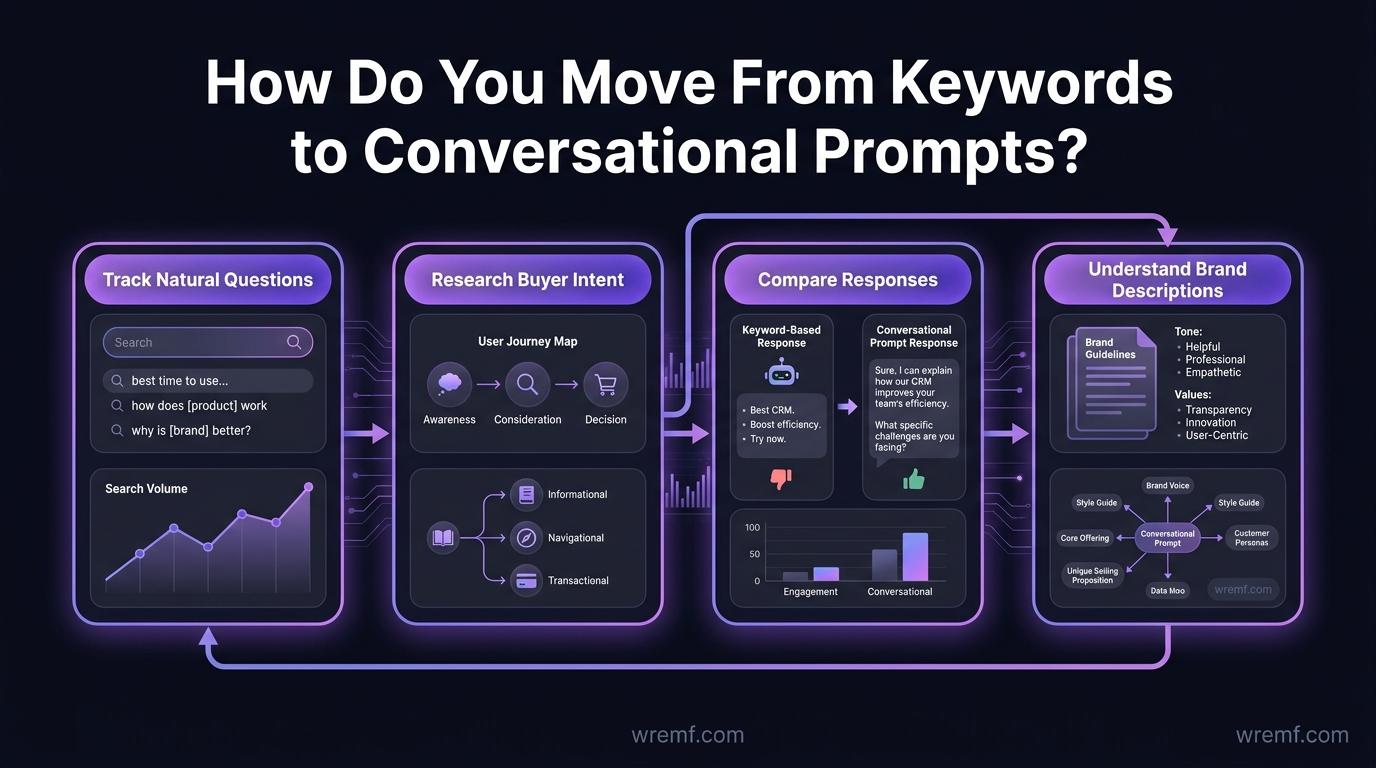
You move from keywords to conversational prompts by tracking the natural questions buyers ask AI engines during research, comparison, and decision-making. Prompt tracking shows how AI answers describe your brand, competitors, category, and sources.
Prompt tracking is the process of monitoring specific natural language queries across AI engines. Prompt tracking matters because AI visibility depends on how brands appear in AI answers for real questions, not only how pages rank for keywords.
A search query is the phrase or question a user enters into a search engine, Answer engine, or AI assistant. A search query matters because the same intent can produce different AI responses depending on wording, location, context, engine, and retrieved sources.
In SEO, a keyword might be “AI SEO tools.” In AI search, a buyer prompt might be “What are the best AI SEO tools for a B2B SaaS company that needs prompt tracking and citation reporting?” The second version reveals audience, criteria, context, and buying stage.
In real-world reporting, teams usually need to track prompts across at least six categories:
Definition prompts, such as “What is Generative Engine Optimization?”
Comparison prompts, such as “SEO vs GEO vs AEO for SaaS”
Tool prompts, such as “best AI visibility tools for agencies”
Brand prompts, such as “What is WREMF used for?”
Problem prompts, such as “how do I surface and correct unlinked citations?”
Buying prompts, such as “should I use AI visibility software or an agency?”
AI-driven search is search that uses AI models to interpret intent, retrieve sources, and generate responses. AI-driven search matters because two users can ask similar questions and receive different AI answers based on wording, context, and available sources.
Brand mentions are references to a company, product, or person inside AI responses, webpages, reviews, or community discussions. Brand mentions matter because they show whether a brand is part of the answer even when the brand is not cited with a link.
AI share of voice is the percentage of tracked AI prompts where a brand appears compared with competitors. AI share of voice matters because it shows whether your brand is present in the AI answers buyers use to shortlist vendors.
A practical prompt set for AI SEO should include 50 to 200 prompts for a serious B2B category. Smaller teams can start with 20 high-intent prompts and expand monthly. Agencies managing multiple clients often need prompt libraries by industry, product type, funnel stage, region, and competitor set.
If you want to see how AI engines currently describe your brand, review a sample AI visibility report before building your own measurement workflow.
| Prompt Type | Example Prompt | What It Reveals | Reporting Value |
|---|---|---|---|
| Definition | “What is AI visibility?” | Whether the brand owns category language | Educational visibility |
| Comparison | “SEO vs AEO vs GEO” | Whether the brand appears in strategic answers | Thought leadership |
| Tool selection | “Best AI visibility tools for agencies” | Whether the brand appears in buying-stage answers | Commercial visibility |
| Competitor | “WREMF vs Peec AI alternatives” | How AI engines compare vendors | Competitive landscape |
| Problem | “How do I correct AI hallucinations about my brand?” | Whether the brand is associated with solutions | Demand capture |
| Implementation | “How do I track AI citations?” | Whether the brand supports practical workflows | Product relevance |
WREMF’s prompt intelligence workflow helps teams monitor prompts across ChatGPT, Claude, Gemini, Perplexity, Google AI Overviews, Copilot, DeepSeek, Grok, Meta AI, and Mistral. It turns prompt testing from manual screenshots into scheduled AI monitoring.
KEY TAKEAWAY: Prompt tracking turns AI search from guesswork into a measurable view of the questions buyers ask before they contact sales.
After prompts are tracked, the next step is improving the pages and sources that AI engines use to answer those prompts.
Which Content Optimization Techniques Improve AI Visibility?
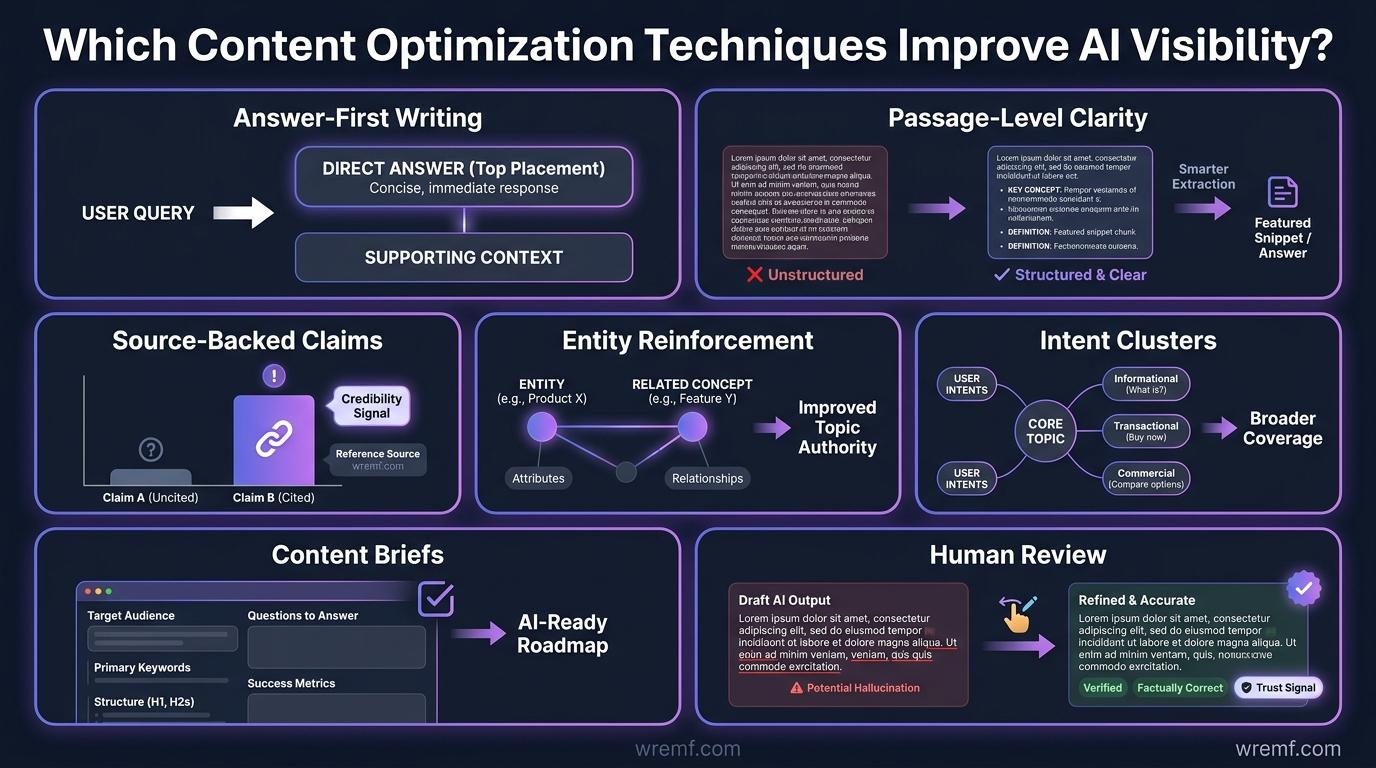
The content optimization techniques that improve AI visibility are answer-first writing, passage-level clarity, source-backed claims, entity reinforcement, intent clusters, content briefs, and human review. These techniques make content easier for AI models to retrieve, understand, and cite.
Content optimization is the process of improving a page so it better satisfies user intent, search engine requirements, and AI retrieval needs. Content optimization matters because AI answers often depend on the clearest passage, not the longest article.
Content Generation can speed up outlines, research clustering, summaries, meta descriptions, title ideas, and draft variants. Content Generation matters only when a human expert reviews accuracy, source quality, originality, tone, and strategic fit.
Human-in-the-loop content creation is the process of using AI tools to support research and drafting while people control judgment, accuracy, and final publishing. Human-in-the-loop content creation matters because AI-generated content without review can create factual errors, duplicate ideas, weak sourcing, and brand inconsistency.
A Content Editor is a tool or workflow used to improve readability, headings, keyword coverage, content gaps, and structure. A Content Editor matters for AI search when it supports prompt intent, entity coverage, answer quality, and source-backed writing rather than only keyword density.
A practical AI SEO content workflow has seven steps:
Map prompts to search intent and buyer stage
Identify missing entities, examples, statistics, and source citations
Rewrite openings so every major section starts with a direct answer
Add tables where users compare 3 or more options
Add FAQs for long-tail prompts and conversational queries
Reinforce author, brand, product, and methodology signals
Update content regularly when AI models, search engines, or category terms change
SEO teams frequently discover that their pages rank but do not get cited. The reason is usually not one missing keyword. The reason is often weak passage structure, missing definitions, no comparison table, vague claims, thin author signals, poor source consistency, or missing third-party validation.
AI-friendly formatting does not mean writing robotic content. It means making expertise easy to locate. Use short paragraphs, precise definitions, descriptive anchors, evidence-led statements, and tables where decisions involve multiple options.
| Technique | What It Improves | Best For | Execution Required |
|---|---|---|---|
| Answer-first headings | Extractability | AI Overviews, snippets, AI answers | Rewrite section openers |
| Passage-level definitions | LLM comprehension | GEO, AEO, educational content | Define key entities clearly |
| Evidence-led claims | Citation confidence | B2B SaaS and expert content | Add named sources and examples |
| Entity reinforcement | Brand understanding | LLM visibility and Knowledge Graph alignment | Use consistent naming |
| Intent clusters | Topic depth | Content ecosystems and pillar pages | Map prompts to sections |
| Content briefs | Scalable execution | Agencies and content teams | Translate gaps into briefs |
| Content Editor workflows | Editing efficiency | Content teams and SEO teams | Review outputs with human expertise |
Surfer SEO, Semrush, Frase AI, and other Content Editor tools can help identify content gaps, keyword coverage, and page structure issues. However, AI SEO requires more than a score. The strongest pages combine source-backed expertise, clear definitions, original examples, brand-specific methodology, and measurable AI visibility tracking.
WREMF’s GEO audit feature helps identify technical, content, and source issues that can limit AI visibility. WREMF’s SEO testing workflow is useful when teams want to measure whether content changes affect search visibility, AI referral traffic, or downstream performance.
KEY TAKEAWAY: Strong content optimization for AI search combines human expertise, prompt data, entity clarity, structured formatting, and source-backed claims.
Content quality is necessary, but teams also need a clear way to measure success in a zero-click ecosystem.
How Do You Measure AI Search Success When Clicks Are Harder to See?
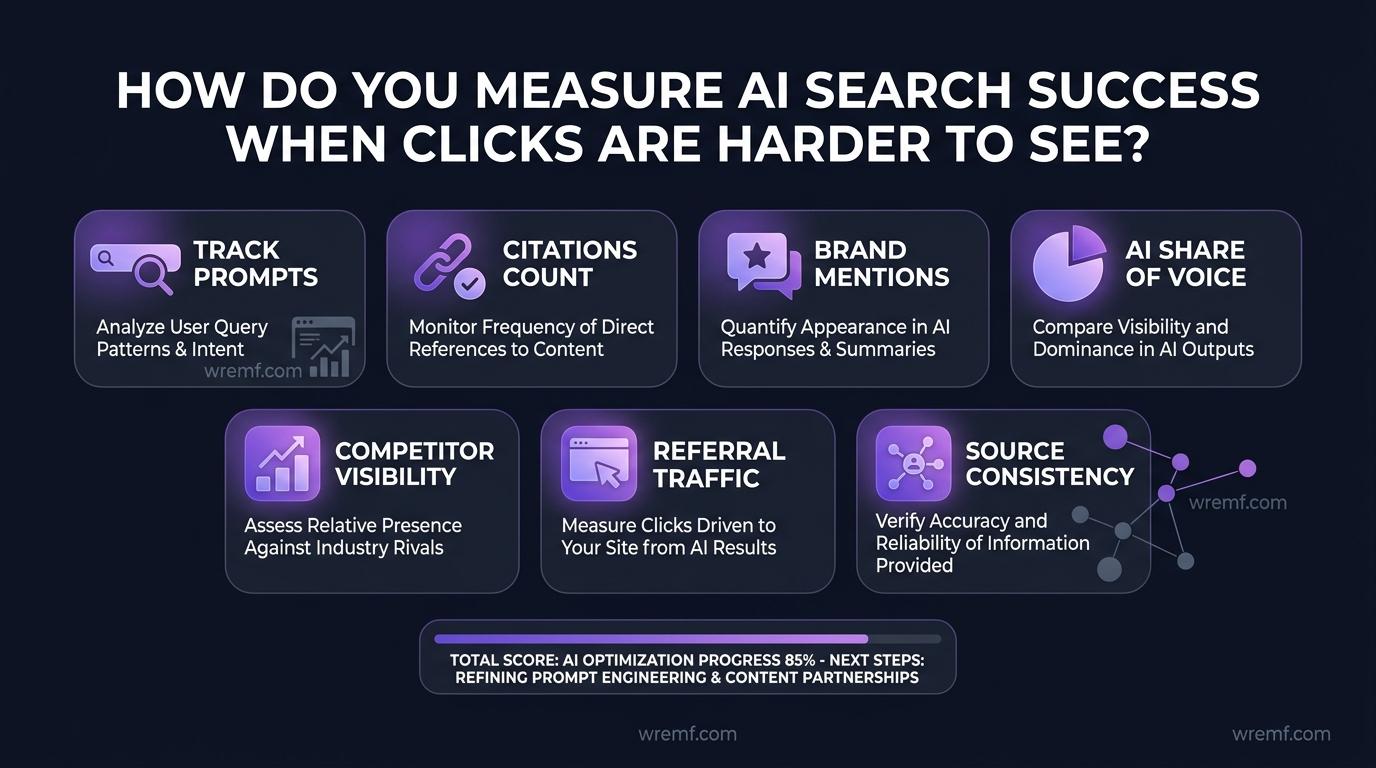
You measure AI search success by tracking prompts, citations, brand mentions, AI share of voice, competitor visibility, referral traffic, and source consistency together. Clicks alone cannot explain AI visibility in a zero-click or low-click ecosystem.
AI traffic attribution is the process of connecting visits, conversions, or pipeline signals to AI discovery surfaces. AI traffic attribution matters because some AI impact appears as direct traffic, branded search, dark traffic, or assisted conversions rather than clean referral sessions.
Search visibility is the measurable presence of a page or brand in search results, AI answers, AI Overviews, and other discovery surfaces. Search visibility matters because a brand can be visible without immediately receiving a click.
The dark traffic problem happens when users discover a brand through AI responses, private messages, documents, or apps but arrive through direct, branded, or unattributed channels. Dark traffic matters because leadership may undervalue AI visibility if reporting only counts visible referrals.
In practical AI visibility audits, the best KPI set includes:
AI visibility score by prompt group
AI share of voice against named competitors
Brand mentions across AI engines
Source citations by domain and page
Citation authority by prompt value
Competitor visibility by engine
Google AI Overviews inclusion where relevant
Referral traffic from generative AI platforms
Branded search lift after visibility gains
Pipeline notes from self-reported attribution
Generative AI platforms are AI systems that create answers, summaries, recommendations, or content based on user prompts. Generative AI platforms matter because they can shape buying decisions before analytics tools record a website visit.
OpenAI states that ChatGPT search can provide timely answers with links to relevant web sources, blending a natural language interface with up-to-date information. This means AI traffic attribution must account for both visible referrals and pre-click answer exposure. (OpenAI)
| KPI | What It Measures | Why It Matters | Limitation |
|---|---|---|---|
| Prompt visibility | Whether your brand appears for tracked prompts | Shows AI answer presence | Depends on prompt set quality |
| AI share of voice | Your visibility versus competitors | Useful for leadership reporting | Needs consistent tracking |
| Citation count | Which pages AI engines cite | Shows source authority | Not every mention has a citation |
| Brand mentions | Whether AI responses name your brand | Captures recommendation visibility | Sentiment still needs review |
| AI referral traffic | Visits from AI platforms | Connects visibility to sessions | Some traffic is unattributed |
| Source consistency | Whether sources describe your brand accurately | Reduces hallucination risk | Requires cleanup work |
| Click-Through Rate | Whether searchers click from search results | Shows remaining search demand | Does not capture no-click AI exposure |
Analyzing referral traffic from generative AI platforms can reveal traffic from ChatGPT, Perplexity, Claude, Copilot, Gemini, and other AI engines. However, referral data is incomplete. Some AI-influenced users come through branded search, direct visits, copied URLs, private documents, or sales conversations.
Brand recommendation visibility measures whether AI engines recommend your company as an option for a relevant user need. Brand recommendation visibility matters because recommendation prompts sit close to commercial intent, especially for software, agencies, consultants, and B2B service categories.
WREMF’s methodology connects prompts, citations, competitors, source consistency, and attribution into one repeatable system. This matters because AI visibility is both a measurement problem and an execution problem.
KEY TAKEAWAY: AI search success should be measured through visibility, citations, mentions, competitors, sources, and attribution, not clicks alone.
Measurement also reveals an uncomfortable truth: AI systems can describe your brand incorrectly.
How Do You Manage Hallucinations, Inaccuracies, and Brand Sentiment in AI Responses?
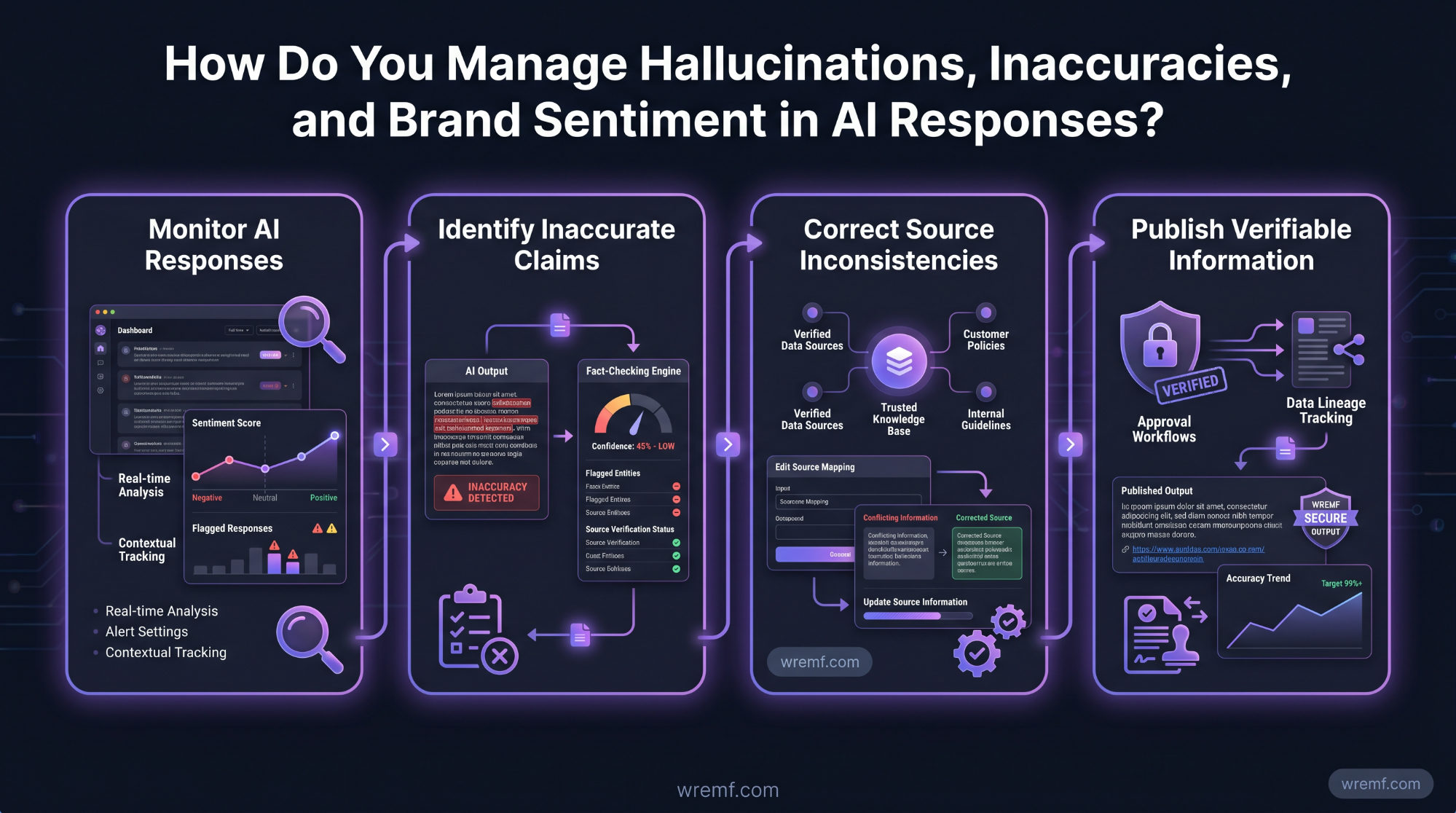
You manage hallucinations and brand sentiment by monitoring AI responses, identifying inaccurate claims, correcting source inconsistencies, and publishing verifiable information across trusted sources. AI responses improve when the source ecosystem becomes clearer, fresher, and more consistent.
AI responses are generated outputs from AI models based on prompts, model knowledge, retrieved sources, and system behaviour. AI responses matter because they can shape how buyers understand your company, competitors, pricing, features, and reputation.
A hallucination is an inaccurate or unsupported AI-generated claim. Hallucinations matter because they can create false product descriptions, outdated pricing, wrong competitor comparisons, or misleading brand summaries.
Source consistency is the alignment of brand facts across your website, profiles, listings, review platforms, documentation, and third-party sources. Source consistency matters because inconsistent public information increases the chance that AI models generate confused or outdated answers.
Marketing teams often find three types of AI response problems:
Factual inaccuracies, such as wrong pricing, location, product category, or feature claims
Missing context, such as a brand being excluded from relevant AI answers
Negative or outdated framing, such as old reviews or forum posts outweighing current positioning
Correcting the record does not mean editing a Large Language Model directly. In most cases, the practical approach is to improve the sources AI systems can retrieve. This includes updating official pages, adding clear methodology pages, improving author bio details, earning authoritative sources, fixing third-party listings, and responding to inaccurate community narratives where appropriate.
Perplexity explains that it works as an answer engine by searching the web, identifying trusted sources, and synthesising information into clear, up-to-date responses. This reinforces why source quality and source consistency affect how Answer engines represent brands. (Perplexity AI)
A common implementation mistake is relying only on a homepage rewrite. AI models may retrieve product pages, comparison pages, documentation, reviews, community sources, and media coverage. If those sources disagree, AI answers may also disagree.
Managing negative Brand Sentiment requires both monitoring and action. A brand should track prompts that ask for drawbacks, alternatives, complaints, reviews, limitations, and comparisons. Then the team should separate valid product issues from outdated or inaccurate source problems.
In real-world reporting, brand accuracy should be reviewed at least monthly for important prompts and weekly for high-intent commercial prompts. Fast-moving categories such as AI SEO, AI visibility tools, MCP Server workflows, and generative AI products need more frequent checks because features, pricing, and terminology change quickly.
WREMF helps teams monitor LLM outputs for brand inaccuracies, competitor framing, source citations, and sentiment patterns. When inaccurate AI responses appear, WREMF helps identify whether the issue comes from weak owned content, outdated third-party sources, missing citations, unclear positioning, or competitor-dominated source ecosystems.
KEY TAKEAWAY: AI hallucination management is a source cleanup workflow, not a one-time content edit.
After accuracy is under control, teams need to choose the right software, agency, or hybrid model for execution.
What Is the Best AI SEO Tech Stack for 2026?
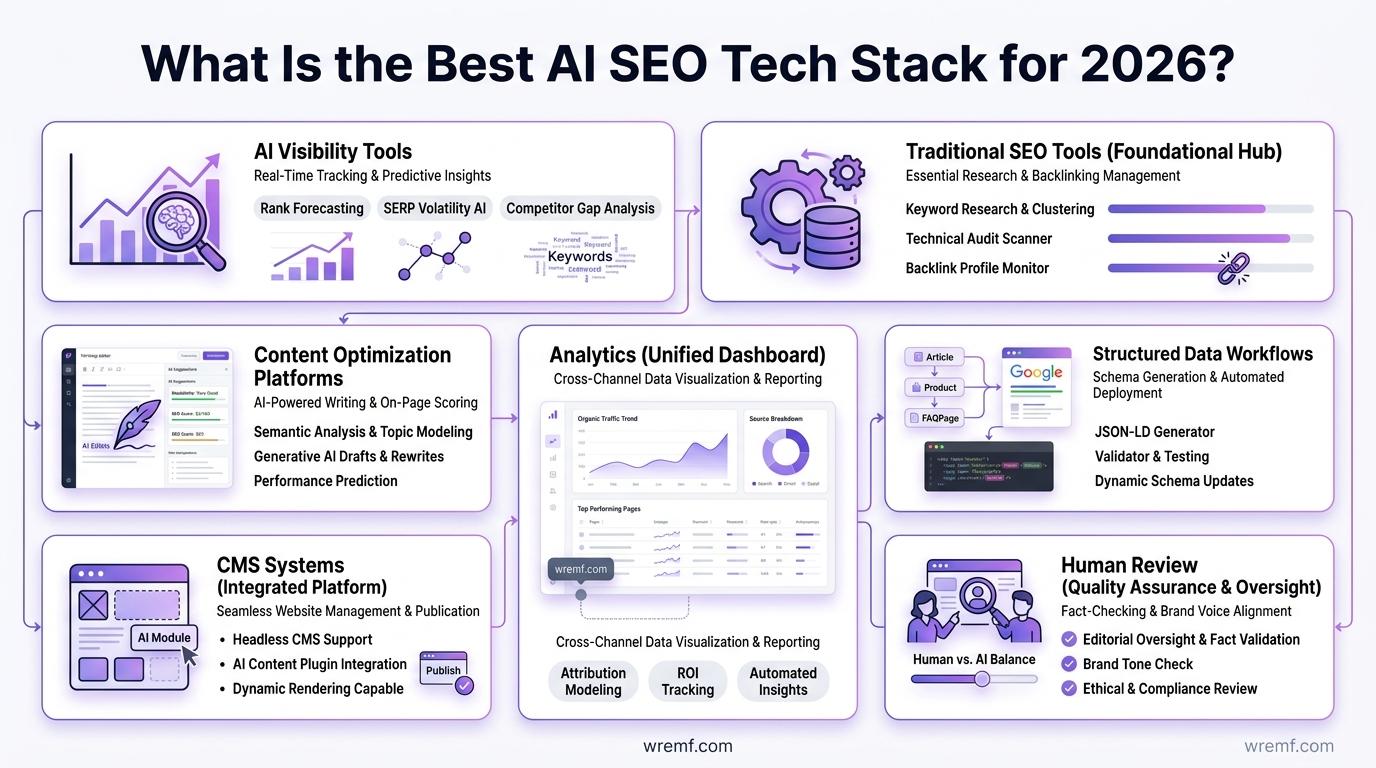
The best AI SEO tech stack for 2026 combines AI visibility tools, traditional SEO tools, content optimization platforms, analytics, structured data workflows, CMS systems, and human review. No single SEO tool covers rankings, AI answers, citations, source consistency, and attribution perfectly.
AI visibility tools are platforms that monitor how brands appear across AI engines, prompts, citations, competitors, and AI-generated answers. AI visibility tools matter because manual testing is too inconsistent for repeatable reporting.
SEO tools are platforms used for keyword research, rank tracking, backlinks, Technical SEO, and competitor analysis. SEO tools matter because traditional search engine performance still influences AI search readiness.
In 2026, the core AI SEO stack usually includes:
AI visibility tools for prompt tracking, AI answers, source citations, and share of voice
SEO tools for search engine rankings, backlinks, Technical SEO, and keyword demand
Content Editor platforms for Content gaps, content optimization, and Content Generation workflows
Analytics tools for search traffic, conversions, branded search, and generative AI referral analysis
CMS systems such as WordPress with schema-friendly layouts
API access or MCP Server workflows for custom reporting and automation
Human review processes for claims, sources, legal risk, and brand accuracy
Peec AI, Profound, AthenaHQ, and similar AI visibility tools reflect the growing need for AI answer monitoring. Surfer SEO, Semrush, Frase AI, and other SEO tools remain useful for content strategy, content optimization, keyword research, and search engine intelligence. The right stack depends on whether your team needs measurement, execution, reporting, or all three.
| Tool Category | Best For | What It Measures | What It Misses | Recommended When |
|---|---|---|---|---|
| Traditional SEO tools | Ranking and keyword teams | Google rank, backlinks, search results, Technical SEO | AI answers, citations, prompt visibility | You need core SEO data |
| AI visibility tools | GEO and AEO teams | AI visibility, brand mentions, citations, competitors | Execution unless workflows are included | You need AI search reporting |
| Content Editor platforms | Writers and editors | Content gaps, content structure, keyword coverage | Brand source consistency | You need scalable content creation |
| Manual AI testing | Early exploration | Sample AI responses | Repeatability and historical tracking | You are validating initial demand |
| Analytics tools | Marketing operations | Sessions, conversions, channels, assisted performance | Invisible AI influence | You need business impact reporting |
| Hybrid platform plus agency | Teams needing execution | Measurement plus action | Requires budget and coordination | You need strategy, delivery, and reporting |
For many B2B teams, the strongest model is hybrid. Software gives repeatable measurement. Agency execution turns findings into content, authority, technical fixes, source cleanup, and reporting. This is especially useful when internal teams lack time to handle GEO, AEO, link building, digital public relations, schema markup, and AI visibility reporting together.
AI visibility tools should be evaluated on engine coverage, prompt monitoring, citation tracking, competitor visibility, source analysis, reporting quality, API access, white-label support, BYOK support, and action recommendations. A tool that only shows screenshots of AI answers is less useful than a platform that turns findings into repeatable workflows.
WREMF is built for brands that want software, agencies that need white-label reporting, and teams that want managed execution. Agencies can review WREMF for agencies, while in-house teams can review WREMF for brands.
KEY TAKEAWAY: The best AI SEO tech stack combines traditional SEO data, AI visibility monitoring, content execution, source ecosystem management, and reporting.
The final strategic decision is how to prioritise software, agency services, or a hybrid operating model.
Should You Use Software, an Agency, or a Hybrid AI Visibility Model?
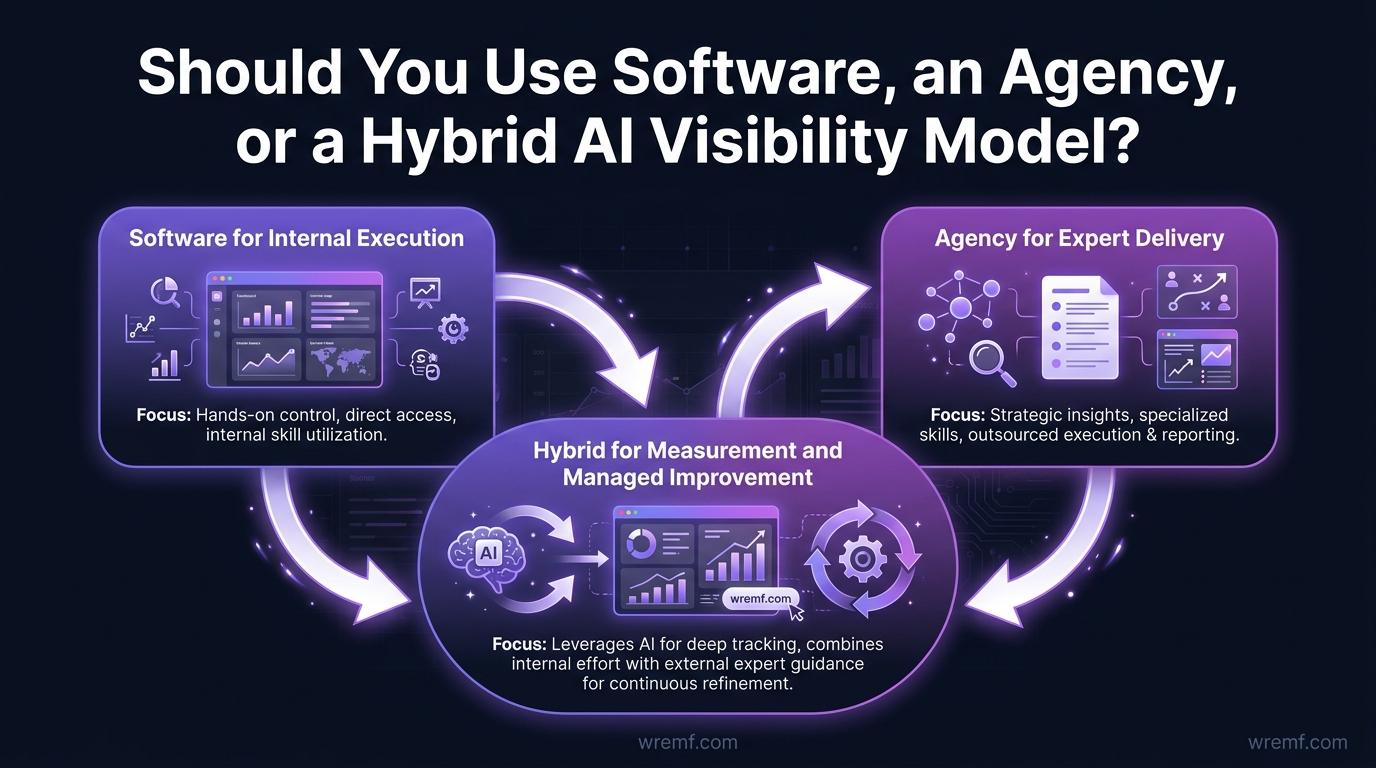
You should use software when you have internal execution capacity, an agency when you need expert delivery, and a hybrid model when you need both measurement and managed improvement. AI visibility requires ongoing monitoring and action.
Software is best when your team can act on insights. This usually fits in-house SEO teams, growth teams, and agencies with content and technical resources. Software gives you prompt tracking, dashboards, source citation monitoring, AI share of voice, competitor visibility, and reporting.
Agency support is best when your team needs strategy, content optimisation, technical guidance, source cleanup, digital PR, or authority building. The agency model works well for teams that know AI search matters but do not have internal time to build a complete GEO and AEO workflow.
A hybrid model is best when leadership needs proof while the marketing team needs execution. The software shows what is changing. The agency team helps improve what AI engines, search engines, and Large Language Model systems can retrieve, cite, and recommend.
| Model | Best For | Strength | Limitation | Example Need |
|---|---|---|---|---|
| Software | Teams with internal execution | Repeatable tracking and reporting | Requires team capacity | Monitor 100 prompts monthly |
| Agency | Teams needing expert delivery | Strategy and implementation | Less self-serve control | Fix source consistency and content gaps |
| Hybrid | Growth teams and agencies scaling AI visibility | Measurement plus execution | Requires clear priorities | Track, improve, and report AI visibility every month |
WREMF can be used as software, an agency service, or a combined software plus managed execution solution. The WREMF agency team helps with AI visibility strategy, GEO and AEO consulting, content optimisation, entity and authority building, citation improvement, source consistency cleanup, monthly reporting, and technical AI visibility foundations.
Pricing can matter when choosing the operating model. WREMF’s Starter plan is €39 per month for 1 website, unlimited prompt tracking, BYOK, 10 AI engines, all features and tools, white-label reports, 1 seat, and email support. Growth is €89 per month for 5 websites, priority email support with a 24h SLA, content brief generator, and SEO A/B testing. Enterprise supports unlimited websites, unlimited seats, dedicated support with a 4h SLA, and custom branded portals.
Teams comparing packages can review WREMF pricing when they need cost clarity across software, agency, or hybrid AI visibility workflows.
KEY TAKEAWAY: Choose software for measurement, agency support for execution, and a hybrid model when AI visibility must become an ongoing growth system.
Before deciding, it helps to challenge the most common myths about AI visibility.
Common Myths About AI Visibility Debunked
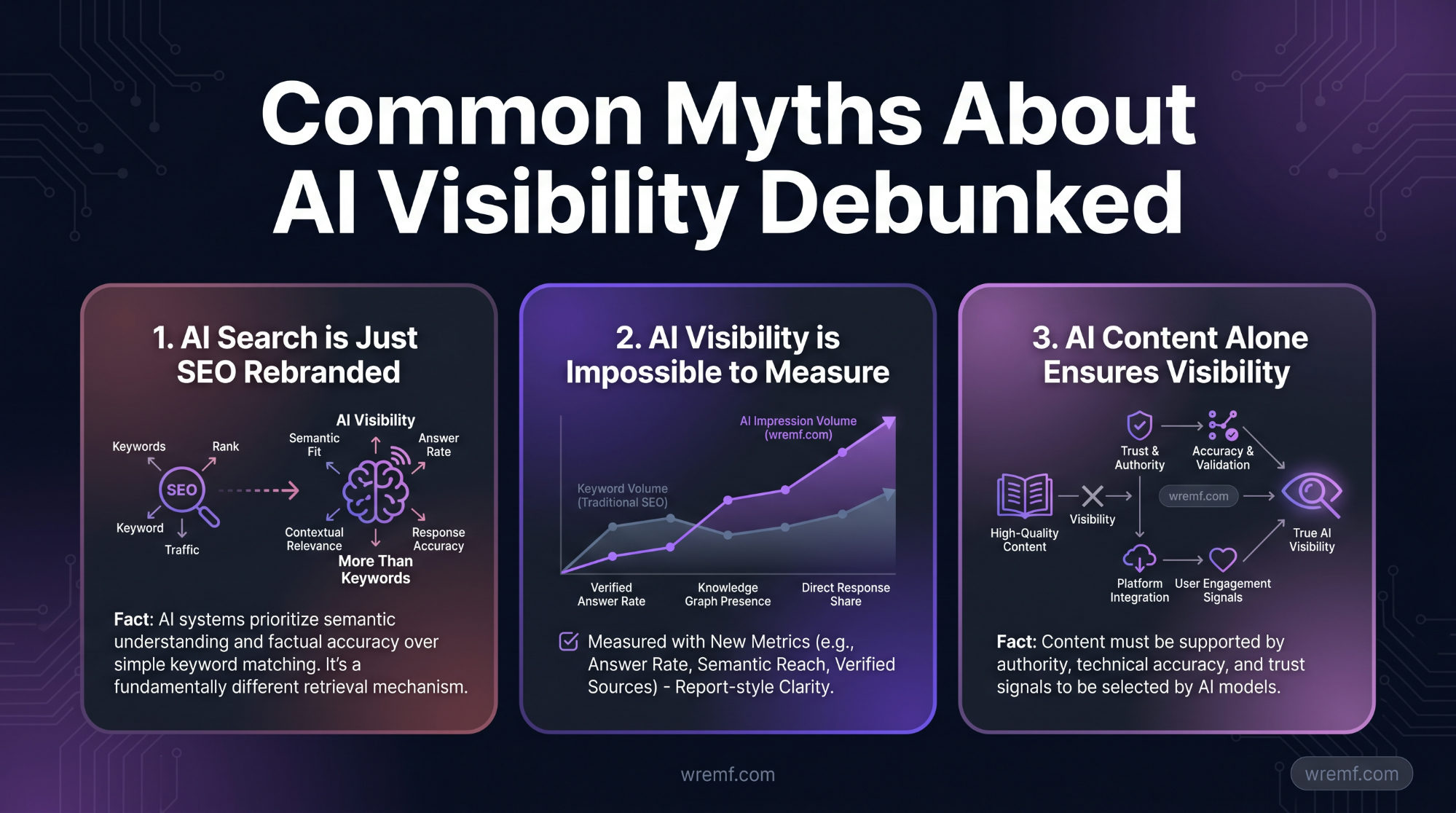
AI visibility myths usually come from treating AI search as either traditional SEO with a new name or as an impossible black box. The truth is more practical: AI visibility can be measured, influenced, and improved, but not guaranteed.
MYTH: SEO, AEO, and GEO are completely separate strategies.
FACT: SEO, AEO, and GEO overlap because AI engines still rely on crawlable content, trusted sources, clear answers, and entity authority. The difference is the outcome measured. SEO tracks search results, AEO tracks answer readiness, and GEO tracks AI-generated answers, citations, and recommendations.
MYTH: AI visibility is impossible to measure.
FACT: AI visibility is measurable through prompt tracking, AI share of voice, brand mentions, source citations, competitor visibility, and AI referral traffic. Measurement is not perfect because AI answers vary, but scheduled monitoring creates a reliable trendline. WREMF uses repeatable prompt sets and cross-engine tracking to make AI visibility reporting practical.
MYTH: Google rank is enough to win AI search.
FACT: Google rank is useful, but rankings alone are not enough. AI engines may cite a third-party review, community source, help document, or comparison page instead of your ranking page. AI search optimization also requires source consistency, passage clarity, and citation authority.
MYTH: Adding schema markup guarantees AI Overviews visibility.
FACT: Schema markup helps search engines understand page content, but it does not guarantee Google AI Overviews visibility. Google explains that structured data helps Search understand page information, but search features still depend on Google’s systems, quality signals, and eligibility requirements. Structured data should support visible content, not replace useful writing, strong sources, or clear answers.
MYTH: AI-generated content is enough for AI SEO.
FACT: Content Generation can support research, briefs, and drafts, but AI SEO requires human judgment, evidence, author expertise, and source quality. AI models are more likely to trust content ecosystems that show clear expertise, consistent facts, and verifiable claims. Thin AI-generated answers rarely build durable AI visibility.
KEY TAKEAWAY: AI visibility is measurable and influenceable, but it requires coordinated SEO, AEO, GEO, source consistency, authority work, and reporting.
The FAQ section answers the most common implementation, buying, and comparison questions teams ask next.
Frequently Asked Questions
What are the best AI search optimization techniques in 2026?
The best AI search optimization techniques in 2026 are answer-first content, prompt tracking, structured data, Semantic HTML, entity reinforcement, source citation analysis, competitor visibility monitoring, and AI traffic attribution. Teams should also maintain traditional Search Engine Optimization because crawlability, page quality, backlinks, and search visibility still support AI retrieval. The strongest workflow combines Technical SEO, content strategy, Generative Engine Optimization, Answer Engine Optimization, and ongoing measurement across AI engines such as ChatGPT, Claude, Gemini, Perplexity, Copilot, and Google AI Overviews.
What is Generative Engine Optimization?
Generative Engine Optimization is the process of improving how a brand, page, or source appears inside AI-generated answers. It focuses on AI citations, brand mentions, prompt visibility, source consistency, and recommendation presence across Large Language Model systems. Generative Engine Optimization differs from traditional SEO because the target is not only a Google rank or search result. The target is inclusion inside AI answers from ChatGPT, Perplexity, Gemini, Claude, Google AI Overviews, and other Answer engines that influence buyer research.
How is AI SEO different from traditional SEO?
AI SEO expands traditional SEO by adding AI visibility, prompt tracking, AI citations, source consistency, and AI-generated answers to the measurement model. Traditional SEO focuses on search engines, keywords, rankings, backlinks, and organic traffic. AI SEO still uses those foundations, but also measures whether AI models mention, cite, compare, or recommend a brand. The practical difference is that AI SEO must optimise both your website and the broader source ecosystem that AI engines use to generate responses.
Is SEO still worth it in 2026?
SEO is still worth it in 2026 because search engines remain major discovery systems and strong SEO foundations support AI search visibility. Google Search, Google AI Overviews, ChatGPT search, Perplexity, and other AI-driven search systems still depend on accessible, useful, source-backed web content. What has changed is the reporting model. Teams should not measure SEO only by rankings and clicks. They should also track AI answers, brand mentions, AI citations, AI share of voice, and assisted pipeline indicators.
How do I surface and correct unlinked citations?
You surface unlinked citations by monitoring AI responses, third-party mentions, review sites, forums, directories, and articles that mention your brand without linking to your site. You correct them by prioritising authoritative sources, requesting updates where appropriate, improving your own source pages, and aligning public descriptions of your brand. WREMF’s source citation tracking helps teams identify which pages AI engines cite or mention, then turn those findings into a source consistency and citation improvement workflow.
Which AI visibility tools should B2B teams consider?
B2B teams should consider AI visibility tools that track prompts, citations, brand mentions, competitor visibility, AI share of voice, and reporting across multiple AI engines. Peec AI, Profound, AthenaHQ, and WREMF represent the broader category of AI visibility tools, while SEO tools such as Semrush and Content Editor platforms support adjacent workflows. WREMF is useful when a team wants software, white-label reporting, BYOK support, API access, and optional agency execution for AEO, GEO, and AI visibility.
How can businesses implement AI-driven search optimization in 2026?
Businesses can implement AI-driven search optimization by starting with a prompt map, auditing current AI answers, identifying source citations, fixing technical crawl and rendering issues, improving content structure, and measuring changes monthly. The first 30 days should focus on baseline visibility and source gaps. The next 60 days should focus on content optimization, structured data, source consistency, and authority building. WREMF can support this workflow through prompt intelligence, GEO audits, content briefs, competitor visibility, and AI visibility reporting.
What KPIs should I track for AI search visibility?
The most useful AI search visibility KPIs are prompt visibility, AI share of voice, brand mentions, source citations, citation authority, competitor mentions, AI referral traffic, and source consistency. Traditional SEO KPIs such as rankings, impressions, clicks, backlinks, and Click-Through Rate still matter, but they do not explain the full AI search journey. A complete reporting model should connect search engine performance, AI answers, Google AI Overviews, generative AI referral traffic, and pipeline attribution where available.
Do structured data and schema markup help AI Overviews?
Structured data and schema markup can help search engines understand page content, entities, and relationships, but they do not guarantee Google AI Overviews visibility. Google’s documentation explains that structured data helps Google understand page information, but eligibility and appearance depend on Google’s systems. The best approach is to use structured data that matches visible content, then combine it with strong answer-first writing, trustworthy sources, clear author signals, useful internal links, and high-quality content.
Should agencies offer AI visibility reporting to clients?
Agencies should offer AI visibility reporting when clients care about how their brand appears across ChatGPT, Claude, Gemini, Perplexity, Google AI Overviews, Copilot, and other AI discovery surfaces. Client reporting should include tracked prompts, AI answers, citations, competitors, share of voice, recommendations, and action items. WREMF supports agencies with white-label reports, client portals, prompt tracking, source citation analysis, and managed workflows. This helps agencies move from SEO-only reporting to AI visibility, AEO, and GEO reporting.
How do traditional SEO tools differ from AI visibility tools?
Traditional SEO tools measure search rankings, backlinks, keyword demand, technical issues, search results, and organic traffic. AI visibility tools measure how brands appear in AI answers, which sources are cited, which competitors are recommended, and how prompt visibility changes across AI engines. Both categories matter. SEO tools show how discoverable your website is in search engines, while AI visibility tools show how discoverable your brand is inside AI responses, AI Overviews, and Answer engines.
What is the best AI tool for SEO in 2026?
The best AI tool for SEO in 2026 depends on the problem you need to solve. Use traditional SEO tools for keyword research, backlinks, rankings, and Technical SEO. Use Content Editor tools for content structure, briefs, and content optimization. Use AI visibility tools such as WREMF when you need prompt tracking, citation analysis, competitor visibility, source consistency, AI share of voice, and reporting across AI engines. For many B2B teams, the best setup combines SEO tools, analytics, and AI visibility software.
Conclusion
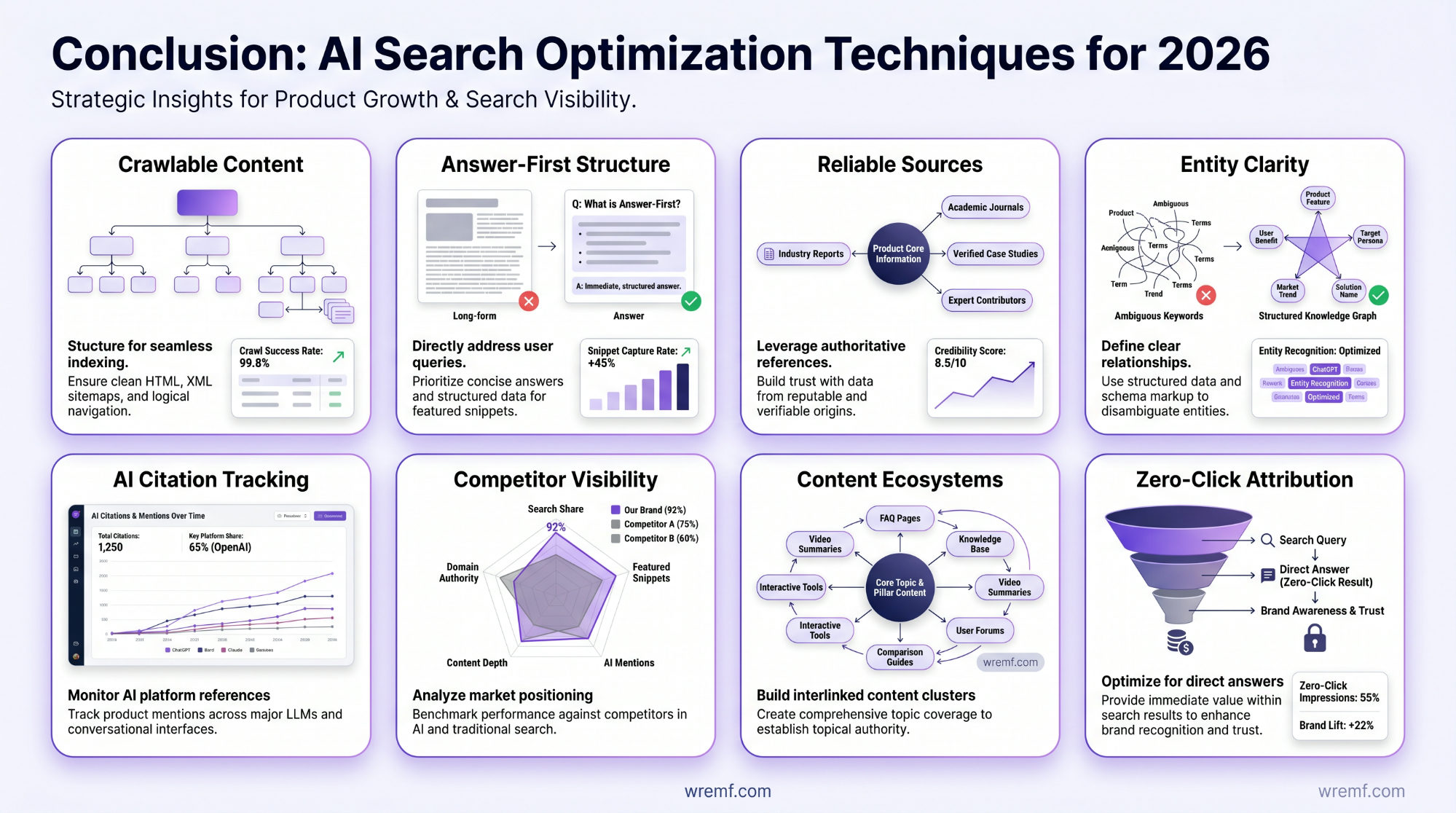
AI search optimization techniques in 2026 require more than ranking pages. Brands need crawlable content, answer-first structure, reliable sources, entity clarity, AI citation tracking, competitor visibility, content ecosystems, and attribution that accounts for zero-click discovery. Traditional SEO remains important, but AI visibility adds a new layer of prompts, citations, AI answers, and source consistency. WREMF helps B2B teams turn that complexity into a measurable workflow across major AI engines. To start tracking, improving, and proving AI visibility, explore the WREMF platform suite or request support from the WREMF agency team.
Related reading
- Answer Engine Optimization: The Complete Guide to AEO, AI Search Visibility, and Answer-First Content
- SEO for AI Search: Ranking in Google AI Overviews, ChatGPT, Perplexity, Gemini, and Answer Engines
- Perplexity SEO: How to Optimize for Perplexity AI, Citations, and AI Search Visibility
- Perplexity AI Optimization: The Complete Guide to AI Search Visibility in 2026