ChatGPT Optimization: The Complete Guide to AI Visibility, GEO, AEO, and Brand Citations
Learn ChatGPT optimization to boost brand visibility in AI responses. Understand key strategies, technical access, citations, and performance monitoring.
By WREMF Team · 2026-08-23
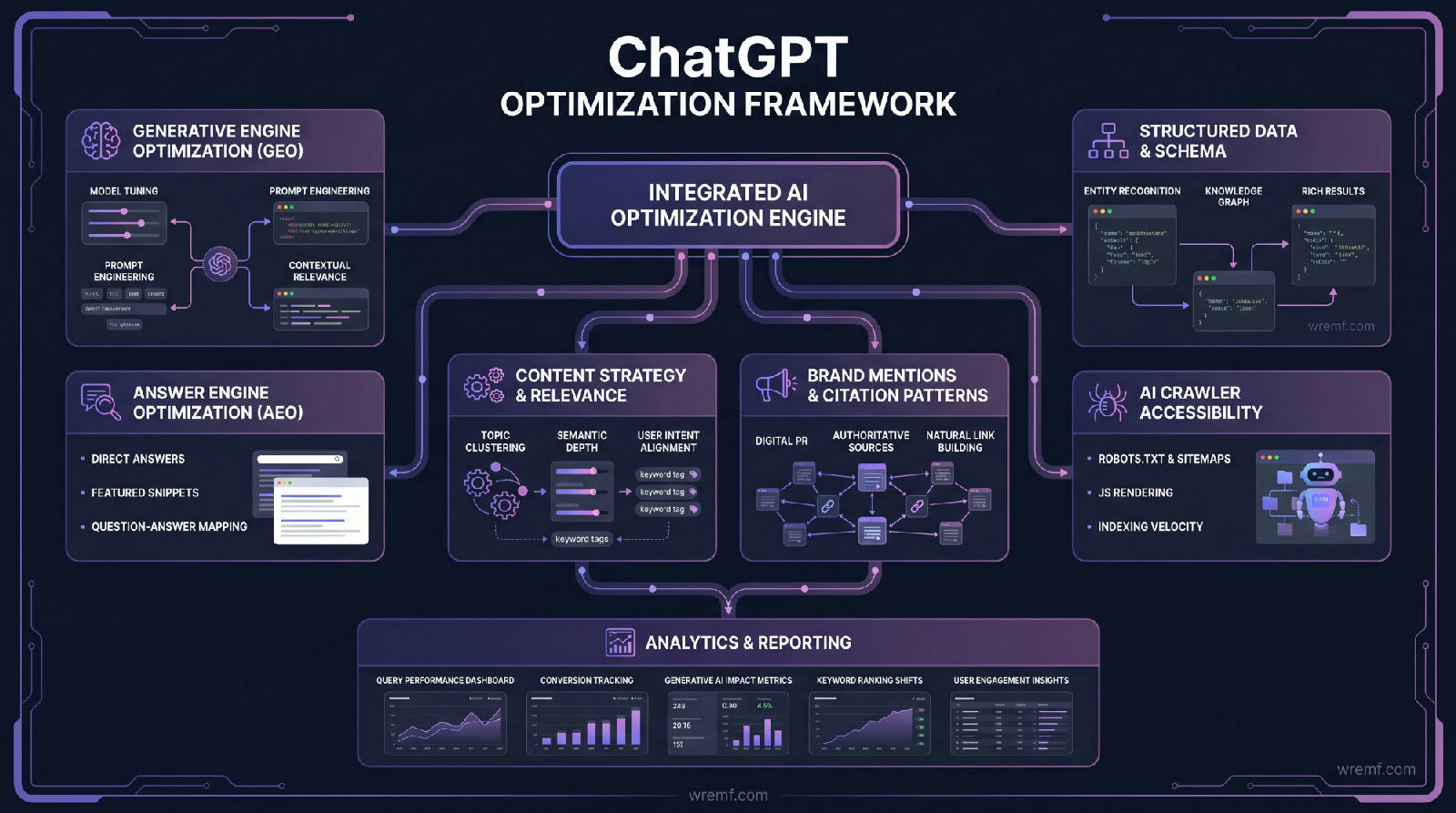
ChatGPT optimization involves enhancing how ChatGPT finds, interprets, cites, and recommends your brand in AI-generated responses. It combines SEO, Answer Engine Optimization, and Generative Engine Optimization to improve AI visibility. Key components include technical access, structured content, authority signals, and performance monitoring. The goal is to make content easier for AI models to understand, ensuring your brand is recognized and cited in buyer queries, vendor comparisons, and product analyses.
Key takeaways
- ChatGPT optimization enhances brand visibility in AI-generated answers.
- Combining SEO, AEO, and GEO is crucial for effective optimization.
- Structured data and technical accessibility are key to AI retrieval.
- Using conversational keywords improves AI-generated response accuracy.
- WREMF helps measure AI visibility and optimize citation patterns.
ChatGPT Optimization: The Complete Guide to AI Visibility, GEO, AEO, and Brand Citations
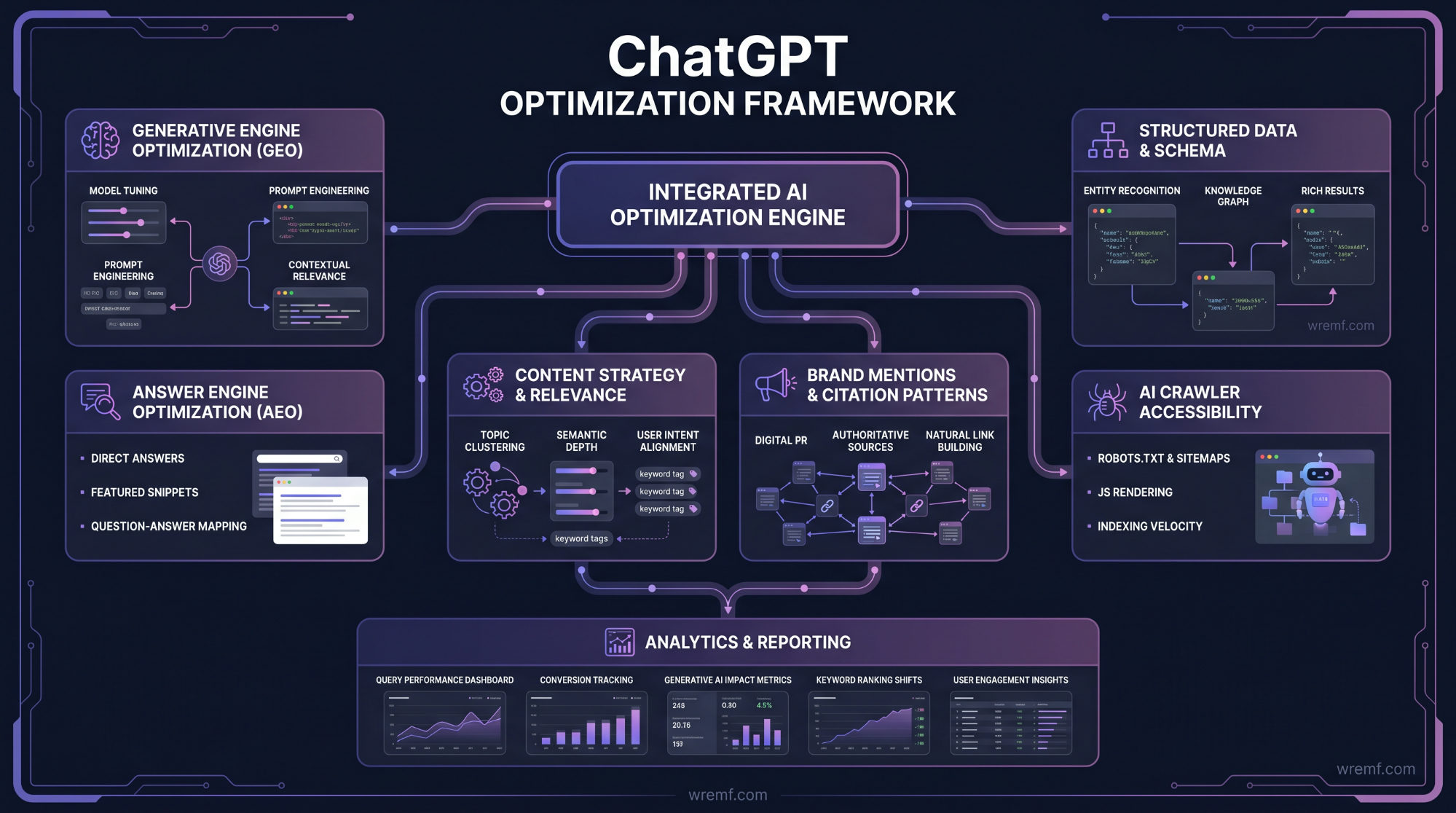
ChatGPT optimization is the process of making your brand easier for ChatGPT to find, understand, cite, and recommend. OpenAI says ChatGPT search can provide timely answers with links to relevant web sources, which means B2B visibility now depends on content quality, technical access, source authority, and measurement. OpenAI’s ChatGPT search announcement explains that web-connected answers blend conversational AI with source links, while WREMF helps teams track, improve, and prove how they appear across ChatGPT and other AI discovery surfaces. This guide covers Generative Engine Optimization, Answer Engine Optimization, structured data, AI crawler accessibility, content strategy, brand mentions, citation patterns, analytics, and reporting. Use it to build a practical ChatGPT optimization system instead of relying on manual testing.
What Is ChatGPT Optimization?
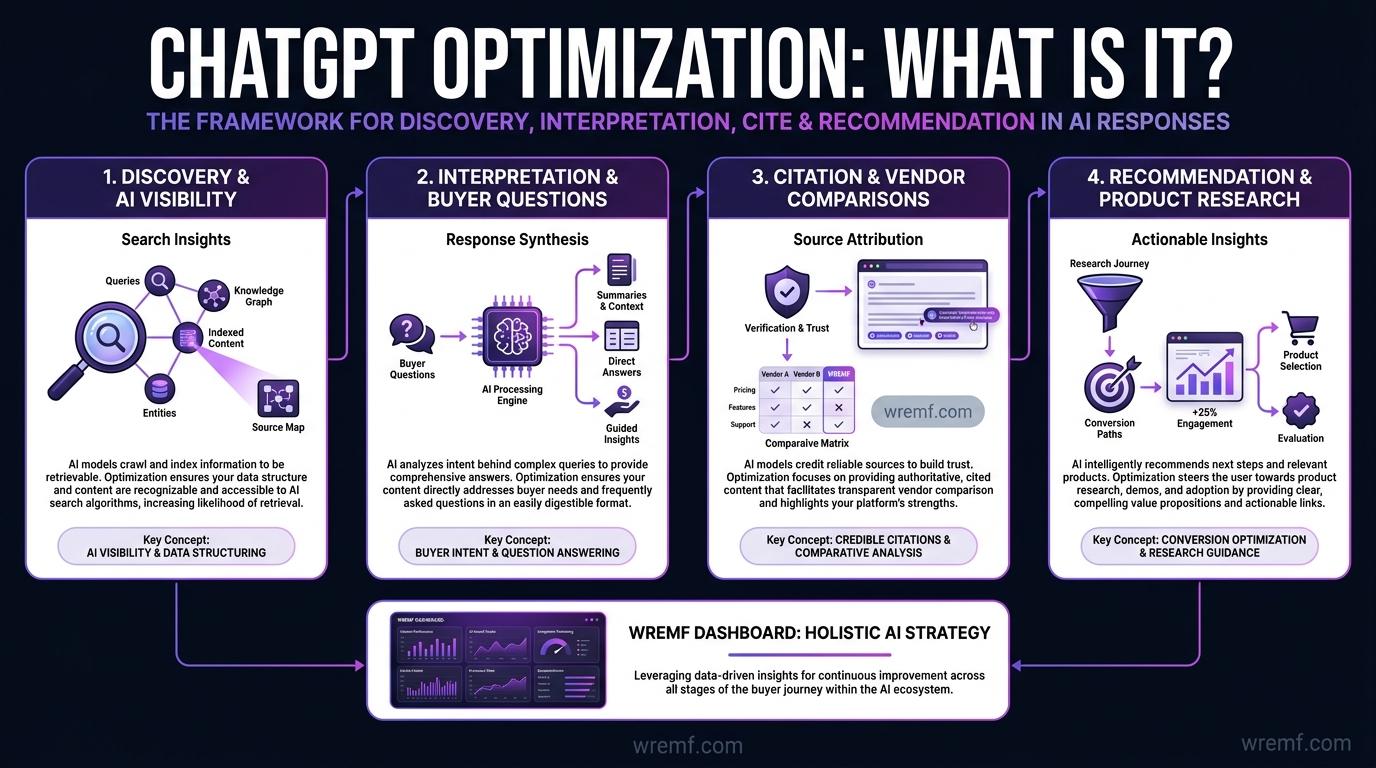
ChatGPT optimization is the practice of improving how ChatGPT discovers, interprets, cites, and recommends your brand in AI-generated responses. It helps B2B teams increase AI visibility across buyer questions, vendor comparisons, product research, and market analysis prompts.
ChatGPT optimization is not the same as using ChatGPT for content creation. It is a broader discipline that combines SEO, Answer Engine Optimization, Generative Engine Optimization, AI Search Optimization, LLM SEO, structured content, technical SEO, authority signals, brand mentions, source tracking, and performance monitoring. The goal is to make your website content, knowledge base, product information, and third-party source footprint easier for AI models to understand.
AI visibility is the measurable presence of a brand inside AI-generated responses, recommendations, citations, summaries, and comparison answers. AI visibility matters because decision-makers increasingly use ChatGPT, Perplexity, Claude, Gemini, Google AI Overview results, Copilot, and other AI search engines before visiting a website or speaking with sales.
Generative Engine Optimization is the process of optimizing your brand, content, and source ecosystem so generative AI systems can retrieve, summarize, cite, and recommend you. Generative Engine Optimization matters because AI models do not only rank pages. AI models synthesize answers from sources, entities, prompts, and context.
Answer Engine Optimization is the practice of structuring content so answer engines can extract clear, direct responses to natural language questions. Answer Engine Optimization matters because ChatGPT responses, AI Overview summaries, voice search answers, and search engine snippets often favor concise, direct, well-supported explanations.
WREMF helps teams track, improve, and prove AI visibility across ChatGPT, Claude, Gemini, Perplexity, Google AI Overviews, Copilot, DeepSeek, Grok, Meta AI, Mistral, and other AI discovery surfaces through the WREMF platform suite. WREMF connects prompt intelligence, source citations, competitive visibility, AI share of voice, AI traffic attribution, and action recommendations into one workflow.
| Concept | Main Goal | What It Measures | What It Misses If Used Alone |
|---|---|---|---|
| SEO | Improve visibility in a search engine | search rankings, impressions, clicks, organic traffic | AI mentions, ChatGPT responses, citation patterns |
| Answer Engine Optimization | Win direct answers | answer clarity, FAQ coverage, featured snippets, conversational keywords | source ecosystem and competitor visibility |
| Generative Engine Optimization | Improve AI-generated responses | AI mentions, source citations, Citation Rate, AI share of voice | traditional search rankings if disconnected |
| ChatGPT optimization | Improve visibility in ChatGPT responses | prompt performance, citations, brand mentions, competitor recommendations | multi-engine visibility if only ChatGPT is tracked |
The best ChatGPT optimization system combines all four layers. SEO makes website content discoverable, AEO makes answers extractable, GEO makes the brand retrievable by Generative AI systems, and ChatGPT optimization focuses the workflow on how ChatGPT responses describe, cite, and recommend your company.
AI visibility is the measurable presence of a brand inside AI-generated responses, citations, summaries, and recommendations. AI visibility matters because buyers can compare vendors, evaluate categories, and shortlist products before creating a traditional search query.
KEY TAKEAWAY: ChatGPT optimization is a measurable visibility discipline that combines SEO, AEO, GEO, technical access, structured content, citations, and brand authority.
To optimize well, you first need to understand how ChatGPT and related AI models consume information.
How ChatGPT and AI Models Consume Data
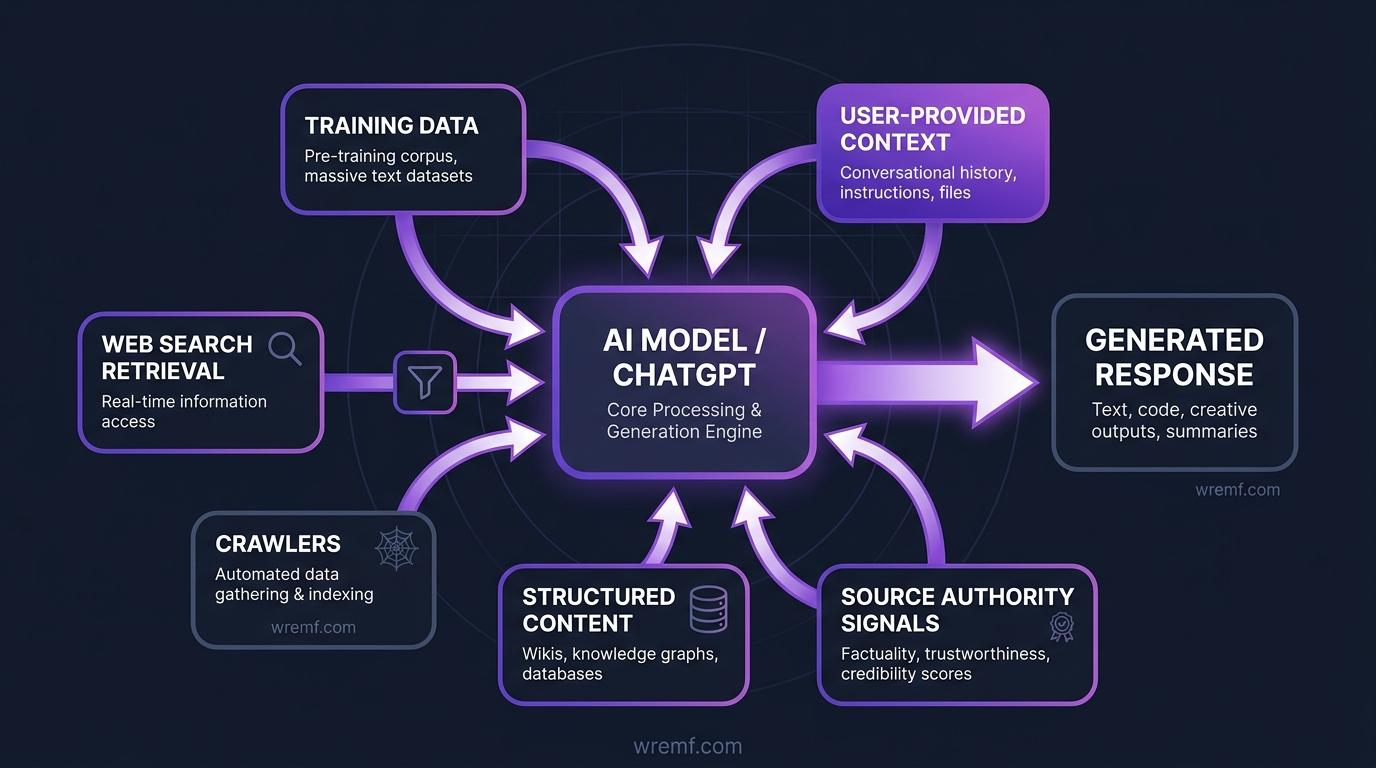
ChatGPT and AI models consume information through training data, web search retrieval, crawlers, user-provided context, structured content, and source authority signals. ChatGPT optimization works when your brand is accessible, clear, consistent, and trusted across those inputs.
Training Data refers to information used to train or improve AI models before a user asks a question. Training Data matters because historical model knowledge can shape baseline understanding, but modern AI-driven search also uses live retrieval, source citations, and web browsing when available.
OpenAI describes ChatGPT search as a way to get fast, timely answers with links to relevant web sources. OpenAI’s ChatGPT search page also states that ChatGPT can choose to search the web based on the question. This means ChatGPT optimization is partly about being present in the sources ChatGPT can access and cite.
AI models process website content differently from traditional search engine crawlers. A search engine may rank a page in a list. An AI model may retrieve several sources, compare claims, summarize key points, and generate an answer that includes your brand, excludes your brand, or recommends a competitor. That is why content citations, citation profiles, citation patterns, and source consistency matter.
AI-generated responses are generated answers produced by AI models from prompts, retrieved sources, learned patterns, and context. AI-generated responses matter because they can influence user interactions, website sessions, brand visibility, vendor recommendations, and lead generation before a buyer reaches your website.
ChatGPT responses are the specific AI-generated responses produced inside ChatGPT. ChatGPT responses matter because users often ask high-intent questions such as “What is the best platform for AI visibility?” or “Which B2B marketing tools help with GEO?”
A practical ChatGPT optimization strategy must account for five source layers:
| Source Layer | Example | Why It Matters |
|---|---|---|
| Your website content | product pages, blog posts, feature pages, list articles | explains what your brand does |
| Structured content | headings, tables, FAQs, definitions, content libraries | improves machine readability |
| Structured data | Organization, Article, FAQPage, SoftwareApplication, JSON-LD schema markup | reinforces entity relationships |
| External authority | backlinks, reputable sources, customer reviews, industry awards | supports trust and relevance |
| Analytics signals | Google Analytics, referral traffic, website sessions, organic traffic | helps prove business impact |
In real B2B buying journeys, users ask ChatGPT questions that sound more like conversations than keywords. A buyer may ask for “best AI visibility tools for SaaS,” “how to optimize a website for ChatGPT,” “which agencies do GEO consulting,” or “how to compare ChatGPT visibility against Google rankings.” Your content strategy must match those prompts.
DID YOU KNOW: OpenAI states that ChatGPT automatically includes the UTM parameter utm_source=chatgpt.com in referral URLs from ChatGPT search results, which helps publishers analyze inbound traffic from ChatGPT in tools such as Google Analytics. OpenAI’s publisher FAQ explains this referral tracking behavior.
KEY TAKEAWAY: ChatGPT optimization depends on training data signals, live web retrieval, source access, structured content, source citations, and consistent brand facts.
The next step is making sure your website can be discovered and processed by AI crawlers and search systems.
Technical Infrastructure for AI Crawler Accessibility
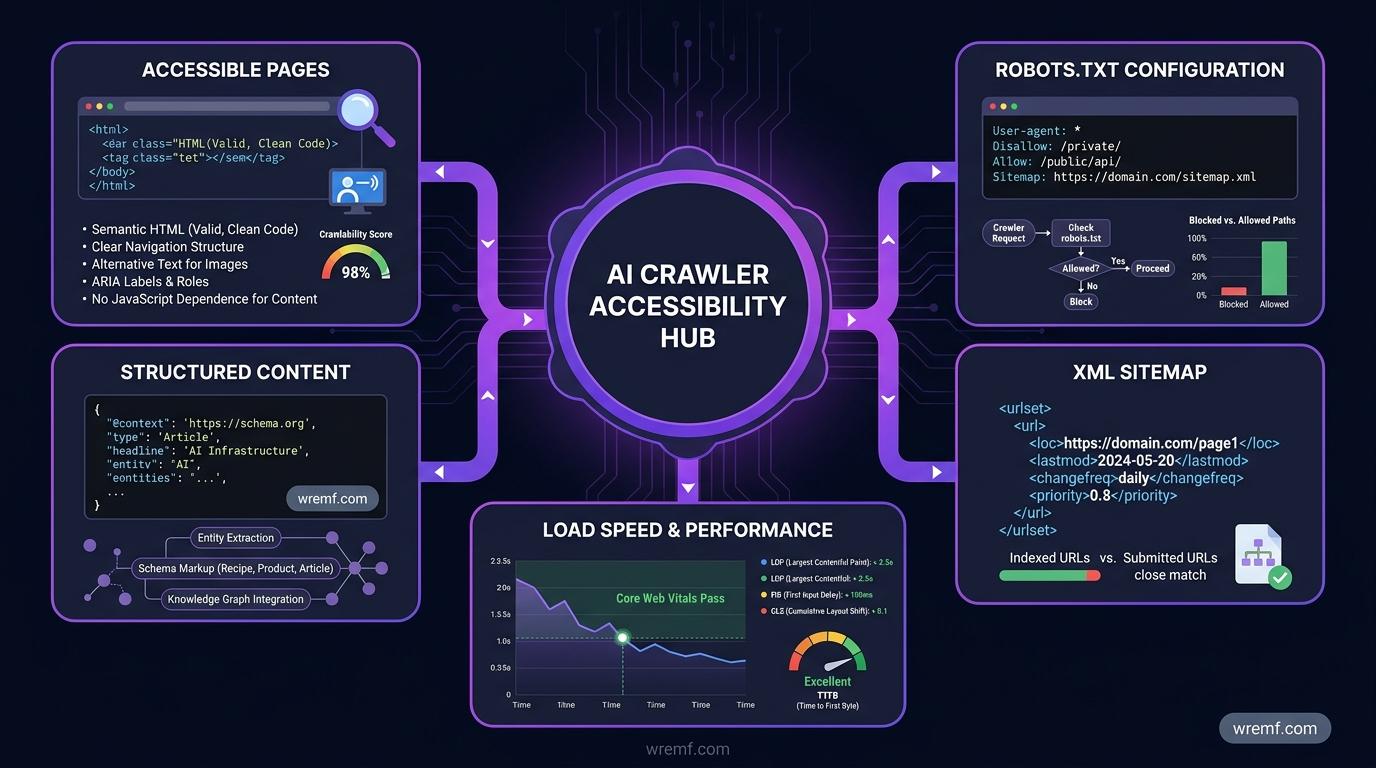
Technical infrastructure for ChatGPT optimization ensures that AI crawlers, search engines, and retrieval systems can access and understand your important pages. AI crawler accessibility matters because blocked, slow, hidden, or poorly structured content cannot reliably influence AI search visibility.
AI crawler accessibility is the ability of AI-related crawlers and retrieval systems to access pages that should appear in AI-generated responses. AI crawler accessibility matters because important website content may be ignored if robots.txt, rendering, redirects, authentication, or site architecture prevents access.
OpenAI identifies OAI-SearchBot as the crawler used to surface websites in ChatGPT search features. OpenAI’s crawler documentation says sites that opt out of OAI-SearchBot will not be shown in ChatGPT search answers, although they may still appear as navigational links. This makes robots.txt review a direct ChatGPT optimization task.
API accessibility strategies also matter. Product information, pricing details, documentation, support answers, and knowledge base content should not live only inside private dashboards or JavaScript-heavy app states. If your important content is invisible to crawlers, AI models may rely on weaker third-party descriptions.
A strong technical setup includes:
Clear robots.txt rules for OAI-SearchBot, Googlebot, Bingbot, and relevant crawlers
Publicly accessible pages for key products, features, pricing, methodology, and documentation
Clean XML sitemap coverage for website content, blog articles, product pages, and list articles
Canonical URLs for duplicate or similar content
Fast loading speeds and mobile-friendly design
Server-rendered or crawlable core text
Clear internal links between related topic clusters
No accidental noindex tags on pages that should be discoverable
Crawlable knowledge base content for support, product, and methodology questions
Accessible documentation for API, MCP, and automation tools
Sitemap quality is often overlooked. A sitemap should help search engine crawlers and AI-connected discovery systems locate important pages efficiently. For a B2B SaaS brand, the sitemap should include homepage, pricing, product suite, feature pages, comparison pages, methodology, sample reports, API documentation, blog content, and knowledge base pages.
Website infrastructure also affects AI integration. If product data is available only through an app, an API, or a gated knowledge base, you should create crawlable summaries that explain the same facts. AI models need visible, stable, canonical pages that describe your product, market category, audience, use cases, and limitations.
WREMF’s GEO audit feature helps teams evaluate crawl, rendering, structured content, internal linking, schema markup, and source clarity issues that affect AI visibility.
KEY TAKEAWAY: Technical ChatGPT optimization means making your most important content crawlable, indexable, fast, canonical, and easy for AI retrieval systems to process.
Once access is fixed, structured data can clarify what each page means.
Structured Data and Schema Markup for ChatGPT Optimization
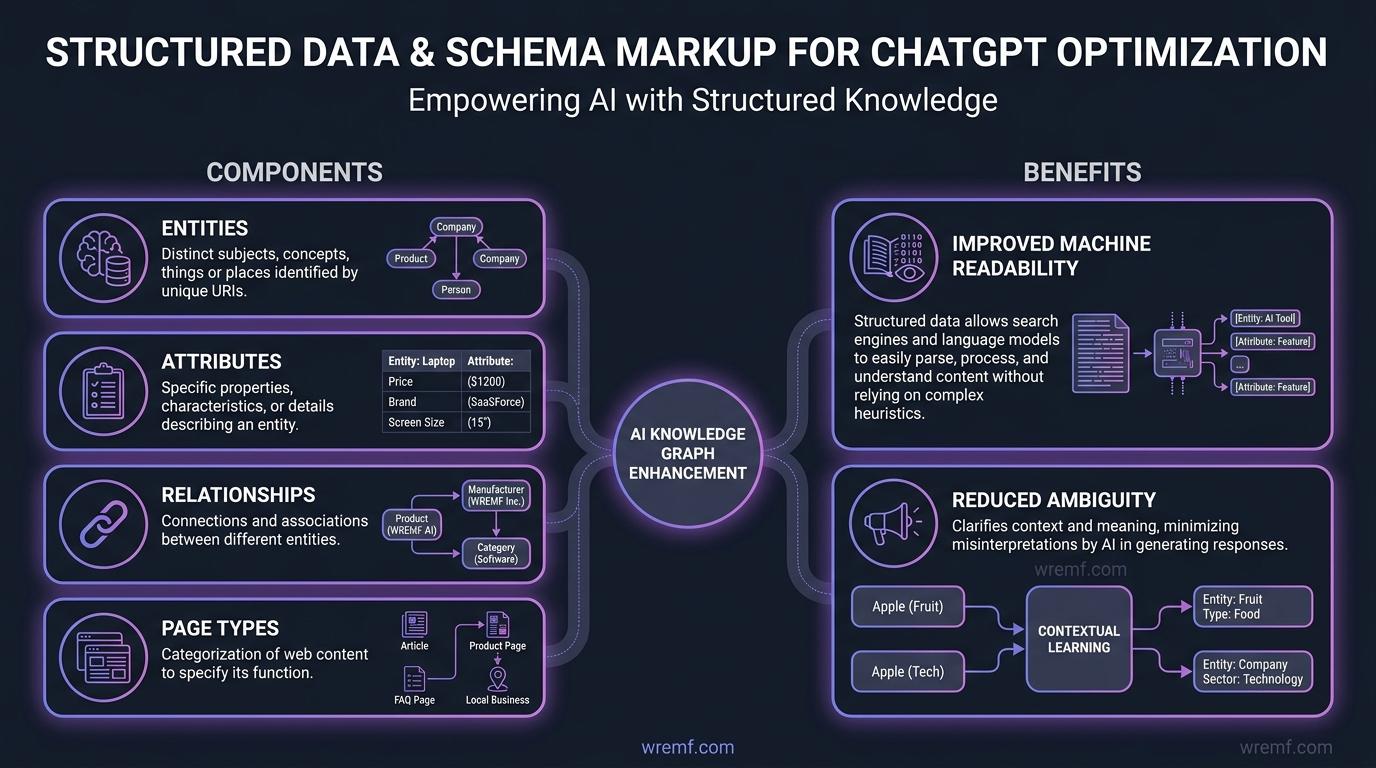
Structured data helps search systems understand entities, attributes, relationships, and page types. Structured data does not guarantee ChatGPT citations, but it improves machine readability and reduces ambiguity.
Structured data is machine-readable information added to a page to describe its content and entities. Structured data matters because Google says structured data can help Google understand page content and gather information about the web and the world in general. Google Search Central’s structured data introduction explains how structured data supports better understanding.
Schema markup is a vocabulary used to label entities and relationships in structured data. Schema markup matters because it can clarify your Organization, Article, Product, FAQPage, SoftwareApplication, HowTo, author, review, and breadcrumb information for search systems.
JSON-LD schema markup is a structured data format that places machine-readable information inside a page without changing the visible layout. JSON-LD schema markup matters because it helps teams describe entity relationships, product attributes, author information, and page purpose consistently.
Structured Data & Schema should support visible content, not replace it. If your schema markup says one thing and your body content says another, source consistency becomes weaker. AI search engines and AI models need consistent facts across headings, body copy, metadata, JSON-LD schema markup, business directory listings, online reviews, and external profiles.
Useful structured data types for ChatGPT optimization include:
| Structured Data Type | Best For | ChatGPT Optimization Value |
|---|---|---|
| Organization | company identity, sameAs links, brand name, business reputation | reinforces entity recognition |
| SoftwareApplication | SaaS platform pages and product pages | clarifies product category and feature set |
| Product | plans, packages, offers, software pricing context | supports commercial understanding |
| Article | guides, pillar pages, research pages, list articles | clarifies authorship and topic relevance |
| FAQPage | frequently asked questions | supports direct answer extraction |
| HowTo | step-by-step implementation workflows | helps AI-generated responses summarize processes |
| BreadcrumbList | site hierarchy | reinforces site architecture |
| Review | customer reviews where appropriate | supports trust and sentiment context |
Google's Structured Data Markup Helper can help teams create basic markup, while Google's Rich Results Test can validate whether a page is eligible for supported rich results. The Rich Results Test should not be treated as a ChatGPT visibility score. It is a technical validation tool, not a guarantee of AI-generated citations.
For ChatGPT optimization, structured content and structured data should work together. Structured content makes the visible article useful to readers and AI models. Structured data reinforces the entities and relationships behind the visible article. Together, they create a clearer roadmap for LLM SEO, AI Search Optimization, and search engine understanding.
TIP: Add JSON-LD schema markup only after the visible website content is accurate, complete, and consistent. Schema markup should reinforce truth, not hide weak content.
KEY TAKEAWAY: Structured data and schema markup improve machine readability, but ChatGPT optimization still depends on useful, visible, source-backed website content.
The next layer is content strategy, because AI models need clear answers worth retrieving.
Content Strategy for ChatGPT Optimization
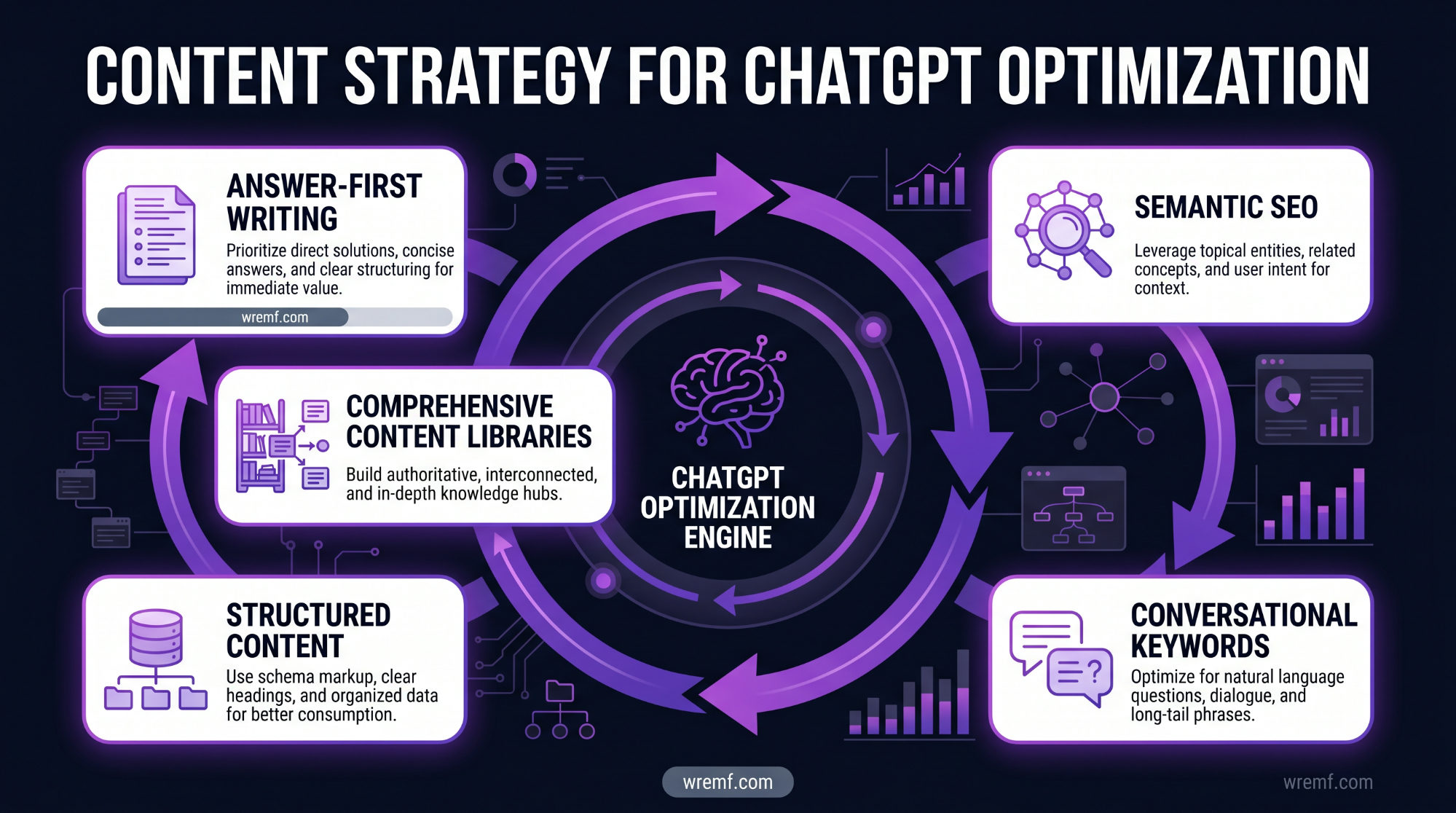
The strongest content strategy for ChatGPT optimization uses answer-first writing, semantic SEO, conversational keywords, structured content, and comprehensive content libraries. AI models need clear answers, not keyword density alone.
Content strategy is the plan for creating, organizing, updating, and measuring website content around audience needs and business goals. Content strategy matters because ChatGPT optimization requires coverage across definitions, comparisons, how-to guidance, commercial intent, decision support, and proof.
Content optimization is the process of improving content so it better satisfies user intent, search engine requirements, and AI retrieval patterns. Content optimization matters because AI-generated responses often favor pages that provide clear definitions, direct answers, examples, tables, FAQs, and authoritative sources.
Content creation for ChatGPT optimization should start with prompts. Buyers ask questions like “What is ChatGPT optimization?”, “How do I optimize my website for ChatGPT?”, “Can ChatGPT do SEO?”, “What tools track AI mentions?”, “How do I increase Citation Rate?”, and “How do I compare AI visibility tools?” Each prompt should map to a page, section, or FAQ answer.
Conversational keywords are natural language phrases that users type or speak into AI assistants, search engines, and voice interfaces. Conversational keywords matter because AI search engines respond to full questions, not only short keywords.
A strong ChatGPT optimization content library should include:
| Content Type | Example | Intent Covered |
|---|---|---|
| Definition page | What is ChatGPT optimization? | informational |
| Comparison page | SEO vs AEO vs GEO | comparison |
| How-to guide | How to optimize your website for ChatGPT | implementation |
| Tool page | Best AI visibility tools | commercial |
| Service page | ChatGPT optimization agency services | buying intent |
| Methodology page | How AI visibility scoring works | trust and proof |
| Knowledge base | How prompt tracking works | product education |
| FAQ content | Can ChatGPT do SEO? | direct answer |
| List articles | Best GEO platforms for B2B SaaS | market analysis |
| Case-style reports | AI visibility sample report | proof and reporting |
Website content should follow the inverted pyramid. Start with the direct answer, then provide supporting explanation, examples, evidence, and implementation detail. This helps readers, search engines, and AI models extract the main point quickly.
Answer-first content is content that gives the direct answer before background explanation. Answer-first content matters because AI-generated responses often need concise, extractable statements that can stand alone.
Structured content is content organized with clear headings, short paragraphs, tables, bullets, definitions, and FAQs. Structured content matters because AI models can more easily identify relationships between entities, concepts, and recommendations.
A knowledge base is a structured collection of support, product, documentation, and educational content. A knowledge base matters because AI models may use documentation and support pages to understand your product features, limitations, integrations, and use cases.
WREMF’s AI-ready content briefs help turn prompt gaps, source gaps, competitor visibility, and citation patterns into practical content creation tasks.
KEY TAKEAWAY: ChatGPT optimization content should answer real prompts clearly, cover the full topic cluster, and create a structured knowledge base that AI models can retrieve.
Content becomes stronger when your brand authority supports it across the web.
Brand Authority, E-E-A-T, and the Source Ecosystem
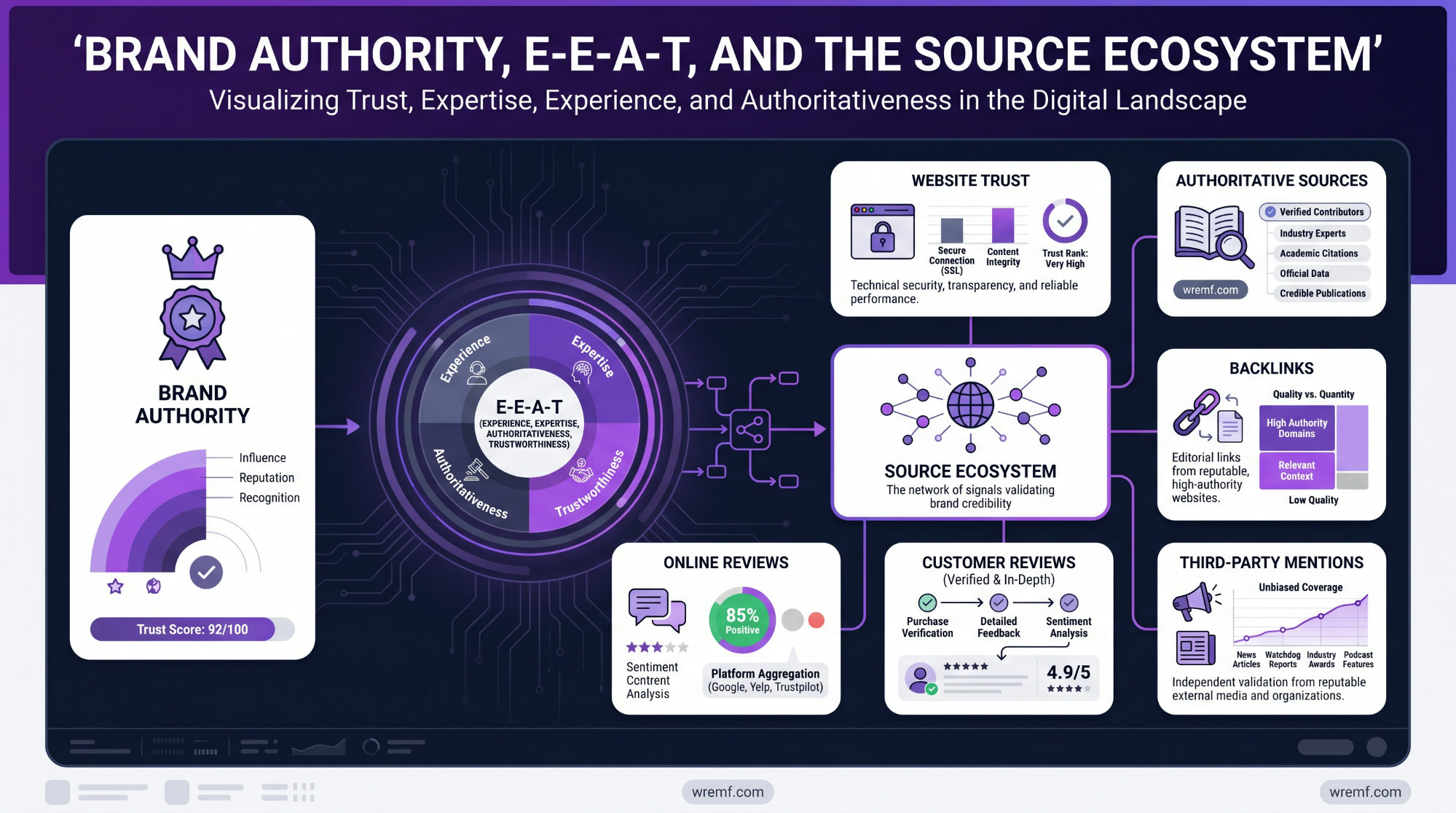
Brand authority improves ChatGPT optimization by making your company easier to trust across your website, authoritative sources, backlinks, online reviews, customer reviews, and third-party mentions. AI models often compare multiple sources before generating recommendations.
E-E-A-T stands for Experience, Expertise, Authoritativeness, and Trustworthiness. E-E-A-T matters because Google says its systems aim to prioritize helpful content and identify signals that demonstrate experience, expertise, authoritativeness, and trustworthiness. Google Search Central’s helpful content guidance explains this people-first approach.
Brand mentions are references to your company across the web, including linked and unlinked brand mentions. Brand mentions matter because AI models can use repeated references across reputable sources to understand category relevance, market presence, business reputation, and authority signals.
AI mentions are appearances of your brand inside AI-generated responses. AI mentions matter because they show whether AI search engines recognize your brand when users ask category, comparison, problem, vendor, or solution questions.
A Backlink profile is the collection of inbound links pointing to your website. A Backlink profile matters because links from reputable sources, industry publications, partner pages, software directories, and market reports can reinforce website authority and entity recognition.
Source consistency is the alignment of your brand facts across your website, structured data, business directory listings, social media profiles, local listings, online reviews, customer reviews, partner pages, and industry sources. Source consistency helps AI models reduce uncertainty when summarizing your company.
In practical AI visibility audits, teams often discover that AI models cite review platforms, list articles, news coverage, documentation, and business directory listings before citing a brand homepage. If those sources describe your product incorrectly, ChatGPT responses may also be inaccurate.
Authority signals that support ChatGPT optimization include:
Reputable sources that describe your product accurately
Strong website authority and topical depth
Digital PR from relevant industry publications
High-quality backlinks from credible sources
Industry awards with clear category relevance
Customer reviews that mention use cases and outcomes
Online reviews with consistent product language
Social media profiles with current descriptions
Local SEO strategies and local listings where geography matters
Consistent Organization details across directories
Expert-authored website content with clear methodology
Content citations from useful guides, reports, and list articles
Domain Rating is a third-party SEO metric that estimates backlink profile strength. Domain Rating can be useful for comparative analysis, but Domain Rating is not a direct AI visibility metric. ChatGPT optimization should evaluate citation profiles, brand mentions, AI mentions, source trust, and prompt performance alongside Domain Rating.
IMPORTANT: Do not treat off-page optimization as link building only. For AI visibility, the broader digital footprint matters, including business reputation, review language, brand voice, social sentiment, industry awards, and source consistency.
KEY TAKEAWAY: ChatGPT optimization is both a content problem and a source ecosystem problem because AI models compare your owned content with external authority signals.
The next section explains how ChatGPT optimization differs from traditional SEO measurement.
ChatGPT Optimization vs SEO, AEO, GEO, and Rank Tracking
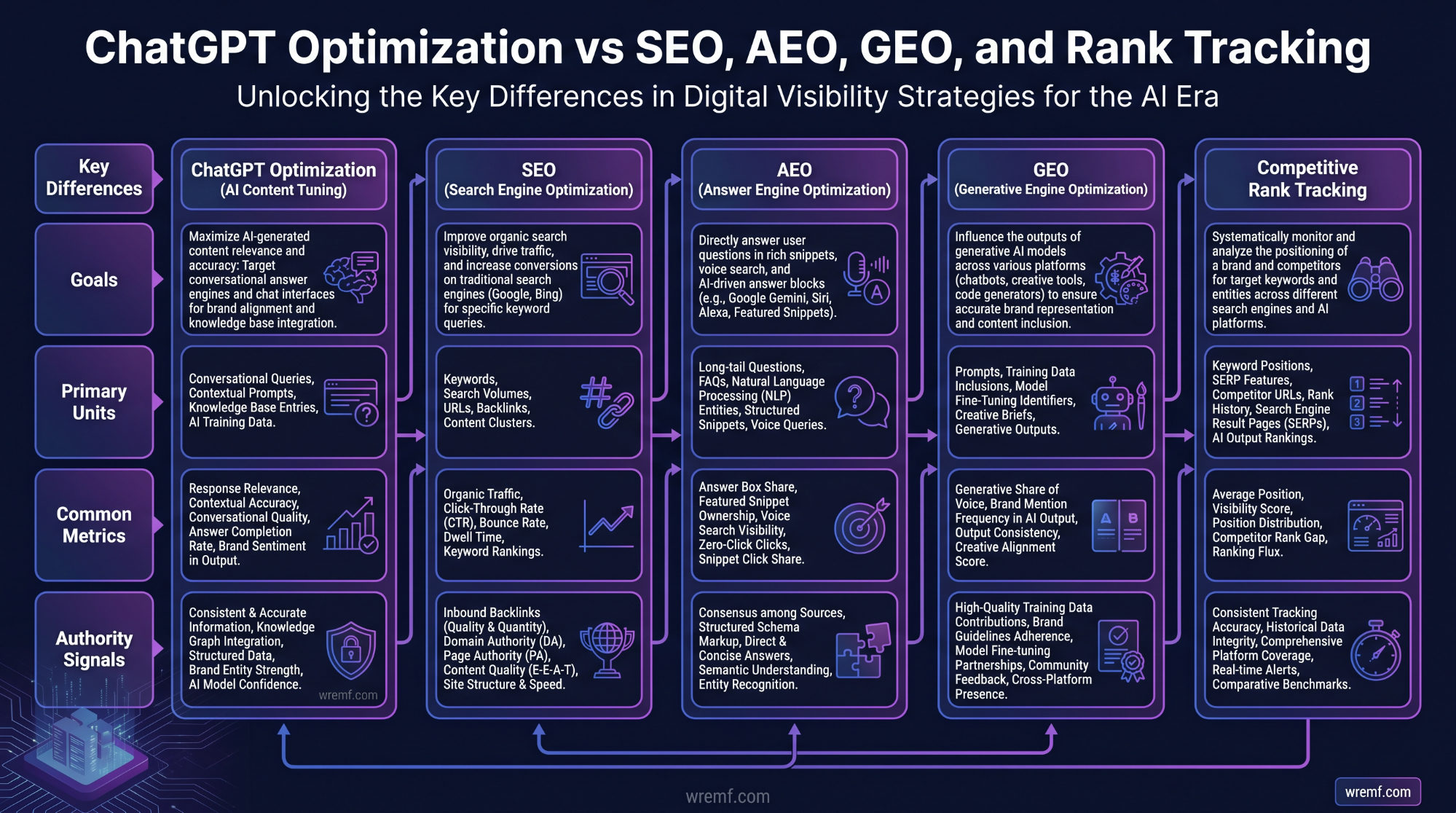
ChatGPT optimization differs from traditional SEO because the goal is not only to rank in a search engine. The goal is to appear, be cited, and be recommended inside AI-generated responses.
Search rankings measure where a page appears in search engine results. Search rankings matter, but they do not show whether ChatGPT recommends your brand, cites your content, or includes you in vendor recommendations.
AI citations are references, source links, or cited materials used by AI systems to support an answer. AI citations matter because citations show which sources influence AI-generated responses.
Citation Rate is the percentage of target prompts where your brand, domain, or content is cited. Citation Rate matters because it turns AI search visibility into a measurable KPI.
Citation profiles are the patterns of domains, URLs, publications, and source types that cite or support your brand across AI search engines. Citation profiles matter because they show whether AI models rely on your owned website, third-party reviews, publishers, comparison pages, or competitor sources.
Prompt performance is the consistency and quality of AI-generated responses for a tracked prompt over time. Prompt performance matters because ChatGPT responses can vary by wording, timing, model behavior, source availability, and user context.
| Metric or Practice | Traditional SEO | ChatGPT Optimization |
|---|---|---|
| Main surface | Google, Bing, traditional search engine results | ChatGPT responses and AI discovery surfaces |
| Primary unit | keyword and URL | prompt, answer, source, citation, competitor |
| Common metric | rankings, clicks, impressions | AI mentions, Citation Rate, AI share of voice |
| Authority signal | backlinks, content quality, website authority | source consistency, brand mentions, citation profiles |
| User behavior | search queries and clicks | AI-driven interactions and follow-up prompts |
| Reporting tool | Google Analytics, Search Console, Bing Webmaster | AI visibility platform plus analytics |
| Main limitation | misses AI-generated responses | requires repeatable prompt tracking |
The key difference between SEO and GEO is that SEO optimizes for rankings and organic traffic, while Generative Engine Optimization optimizes for presence inside generated answers. AEO focuses on direct answer extraction. ChatGPT optimization applies these principles to ChatGPT responses and AI search behavior.
Traditional SEO still matters. Google authority, organic traffic, backlinks, semantic SEO, structured data, website authority, and helpful content can support AI visibility. The mistake is assuming that Google rankings alone prove ChatGPT visibility.
WREMF’s prompt intelligence helps teams monitor prompt performance, while source citation tracking shows which sources AI systems use when answering buyer questions.
KEY TAKEAWAY: Traditional rankings are useful, but ChatGPT optimization requires prompt tracking, citation analysis, AI mentions, competitor visibility, and AI traffic attribution.
Now you can turn the comparison into a practical website optimization workflow.
How Do You Optimize Your Website for ChatGPT?
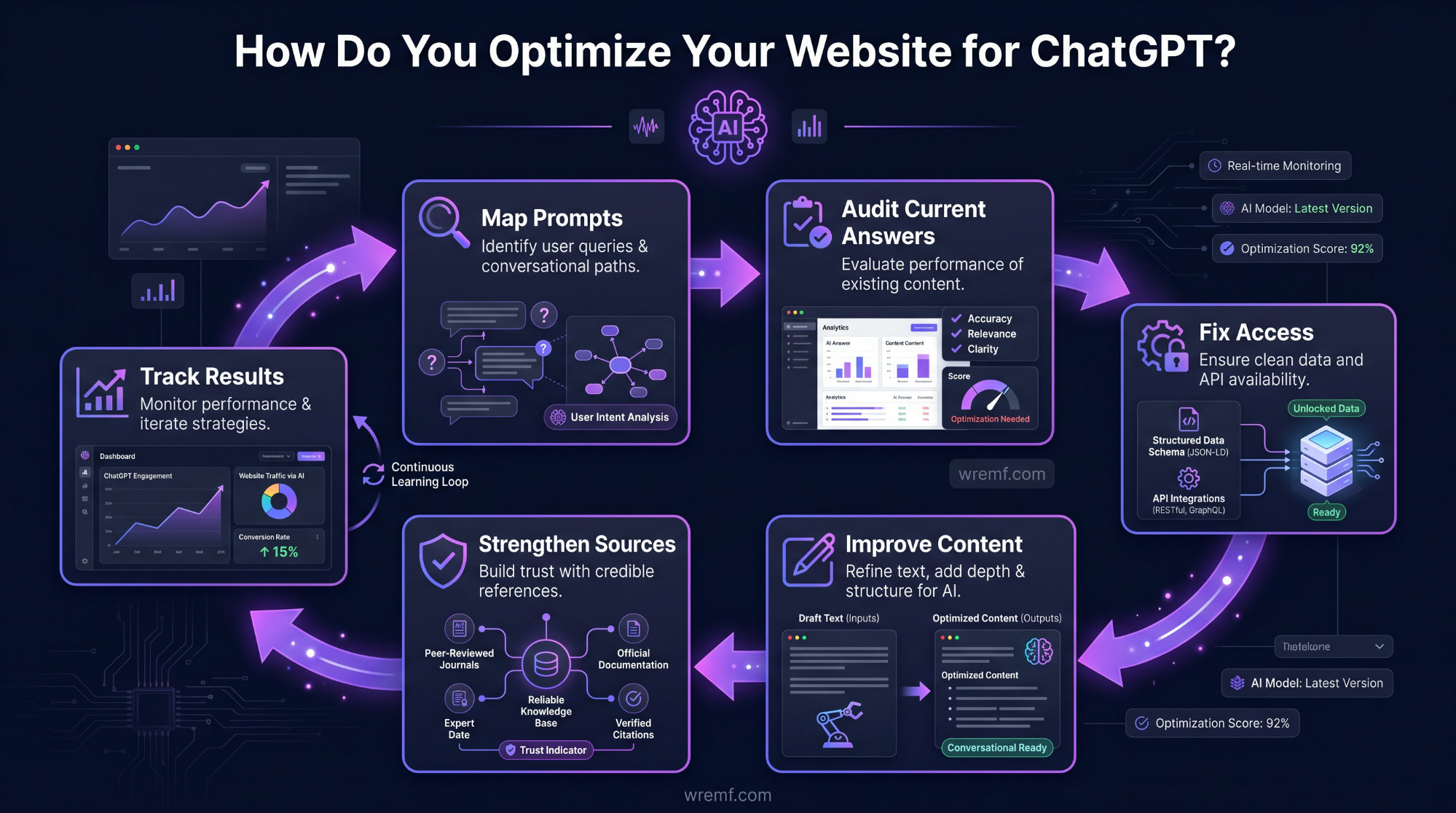
You optimize your website for ChatGPT by making important content crawlable, structured, semantically complete, authority-backed, and measurable. The practical workflow is to map prompts, audit current answers, fix access, improve content, strengthen sources, and track results.
Start with prompt matching. Real users ask ChatGPT and other AI search engines questions such as “How do I optimize my ChatGPT presence?”, “Can ChatGPT do SEO?”, “How do I improve brand visibility in AI search?”, and “Which platform tracks AI mentions and citations?” These natural language prompts should shape your content libraries.
Use this ChatGPT optimization workflow:
| Step | Action | Why It Matters |
|---|---|---|
| 1 | Map buyer prompts | connects content strategy to real AI-driven search behavior |
| 2 | Audit existing ChatGPT responses | shows current AI mentions, competitors, source citations, and gaps |
| 3 | Check AI crawler accessibility | ensures OAI-SearchBot and search crawlers can access content |
| 4 | Improve site architecture and sitemap coverage | helps discovery across product, blog, and knowledge base pages |
| 5 | Add structured content | improves answer extraction and content structure optimization |
| 6 | Add JSON-LD schema markup | reinforces Organization, Article, Product, FAQPage, and SoftwareApplication signals |
| 7 | Build content libraries | covers definitions, comparisons, how-to guides, and buying-stage questions |
| 8 | Strengthen brand mentions | improves third-party authority and source consistency |
| 9 | Track Citation Rate and citation patterns | measures whether AI systems use your sources |
| 10 | Analyze Google Analytics and referral traffic | connects AI visibility to website sessions and lead generation |
| 11 | Use A/B testing and SEO testing | evaluates content changes with evidence |
| 12 | Repeat monthly | tracks drift, competitors, and recommendation algorithm changes |
Content output should match the question type. A definition query needs a direct explanation. A comparison query needs a table. A buying query needs product fit, limitations, and decision criteria. A technical query needs steps, risks, and validation tools.
For example, a ChatGPT optimization page should not only repeat “ChatGPT optimization” many times. It should define Generative Engine Optimization, explain AI crawler accessibility, compare SEO vs AEO vs GEO, describe schema markup, explain Google Analytics referral tracking, cover citation profiles, and answer implementation questions.
Mid-page CTA: If you want to see how AI engines currently describe a brand, review a sample AI visibility report before building your own measurement workflow.
KEY TAKEAWAY: The most effective way to optimize a website for ChatGPT is to connect prompt research, crawler access, structured content, source consistency, citation tracking, and analytics.
Once the website workflow is clear, you need to optimize beyond ChatGPT alone.
ChatGPT Optimization Across Perplexity, Claude, Gemini, Copilot, and AI Overviews
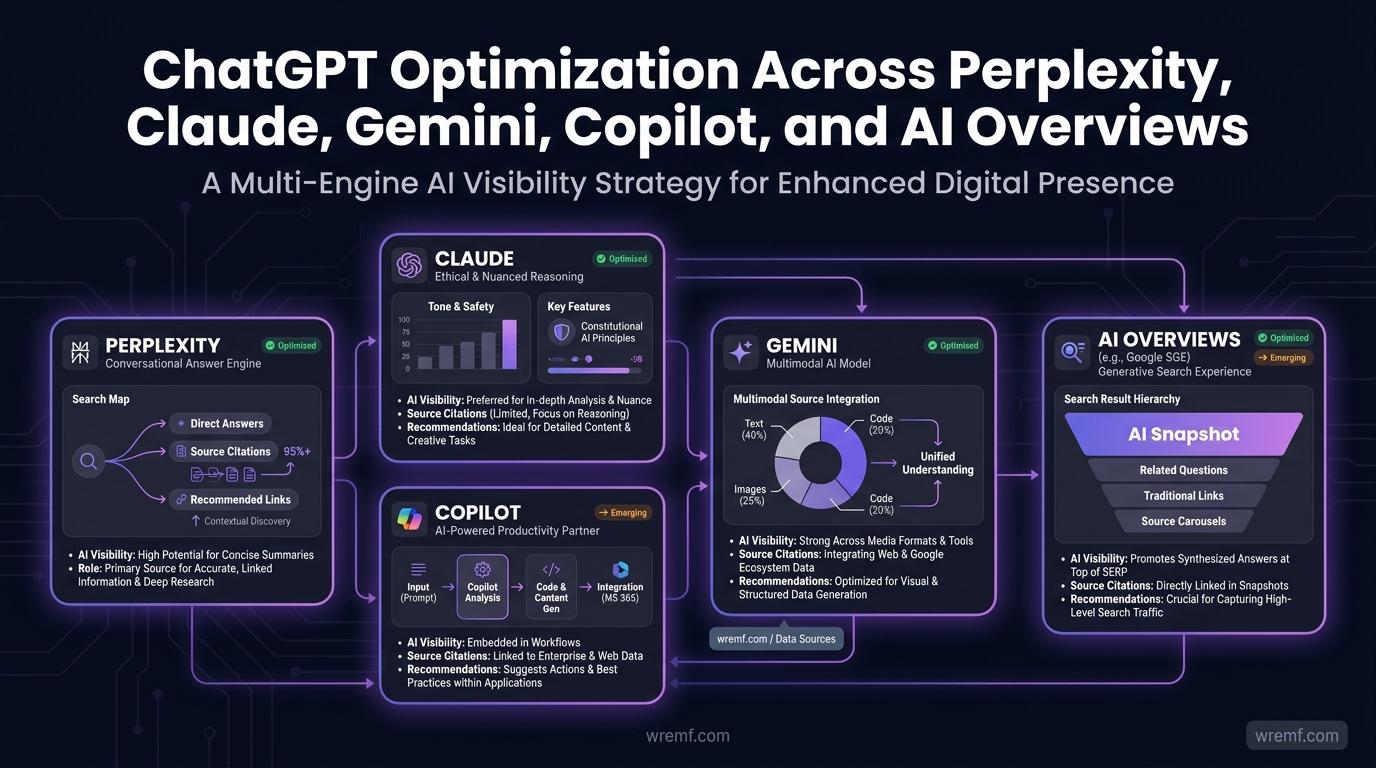
ChatGPT optimization should be part of a multi-engine AI visibility strategy because buyers use many AI search engines and AI discovery surfaces. A brand may appear in ChatGPT but remain absent from Perplexity, Claude, Gemini, Copilot, or Google AI Overview results.
AI search engines are systems that use AI to answer questions, summarize information, retrieve sources, and guide users through search-like experiences. AI search engines matter because users now ask complex search queries in natural language and expect direct answers.
AI-driven search is search behavior shaped by AI-generated responses, conversational follow-up questions, and source-linked summaries. AI-driven search matters because it changes how users move from discovery to consideration and lead generation.
Google AI Overview results are AI-generated snapshots in Google Search that summarize key information and include links for deeper exploration. Google says AI features in Search are covered from a site owner perspective in Google Search Central’s AI features guidance. This means traditional search engine visibility and AI Overview visibility are increasingly connected.
Perplexity describes its Search API as providing real-time access to ranked web search results from a continuously refreshed index. Perplexity’s Search API documentation reinforces why freshness, source quality, and ranked retrieval matter for AI search visibility.
Claude can use web search capabilities through supported environments to augment model knowledge with real-time data and cite sources. Gemini and Google Gemini connect closely to the Google ecosystem. Copilot connects to Microsoft and Bing discovery contexts. Bing Webmaster visibility can therefore support search marketing analysis for Bing, Copilot, and related surfaces.
| AI Surface | What to Track | Optimization Focus |
|---|---|---|
| ChatGPT | ChatGPT responses, citations, AI mentions | OAI-SearchBot access, source clarity, answer-first content |
| Perplexity | citations, ranked sources, freshness | authoritative sources, current content, clear claims |
| Claude | cited answers and source balance | evidence quality, factual precision, safe wording |
| Google AI Overviews | AI Overview links, organic visibility, source selection | helpful content, Google authority, structured data |
| Google Gemini | Google ecosystem answer visibility | entity clarity, structured content, source consistency |
| Copilot and Bing | Bing search visibility and answer surfaces | Bing Webmaster signals, crawlability, trusted sources |
| DeepSeek, Grok, Meta AI, Mistral | answer consistency and AI mentions | multi-engine tracking and source footprint |
AI models can cite different sources for the same question. ChatGPT may cite your product page, Perplexity may cite a review site, Google AI Overview may cite a blog guide, and Copilot may surface a Bing-indexed result. This is why source tracking must be cross-platform.
WREMF’s AI visibility index helps teams track brand visibility across 10 AI engines instead of relying on manual ChatGPT testing.
KEY TAKEAWAY: ChatGPT optimization works best when measured across multiple AI models, because each platform retrieves, ranks, cites, and summarizes sources differently.
The next step is measuring whether your work is improving visibility and business outcomes.
Measuring ChatGPT Optimization Success With AI-Specific KPIs
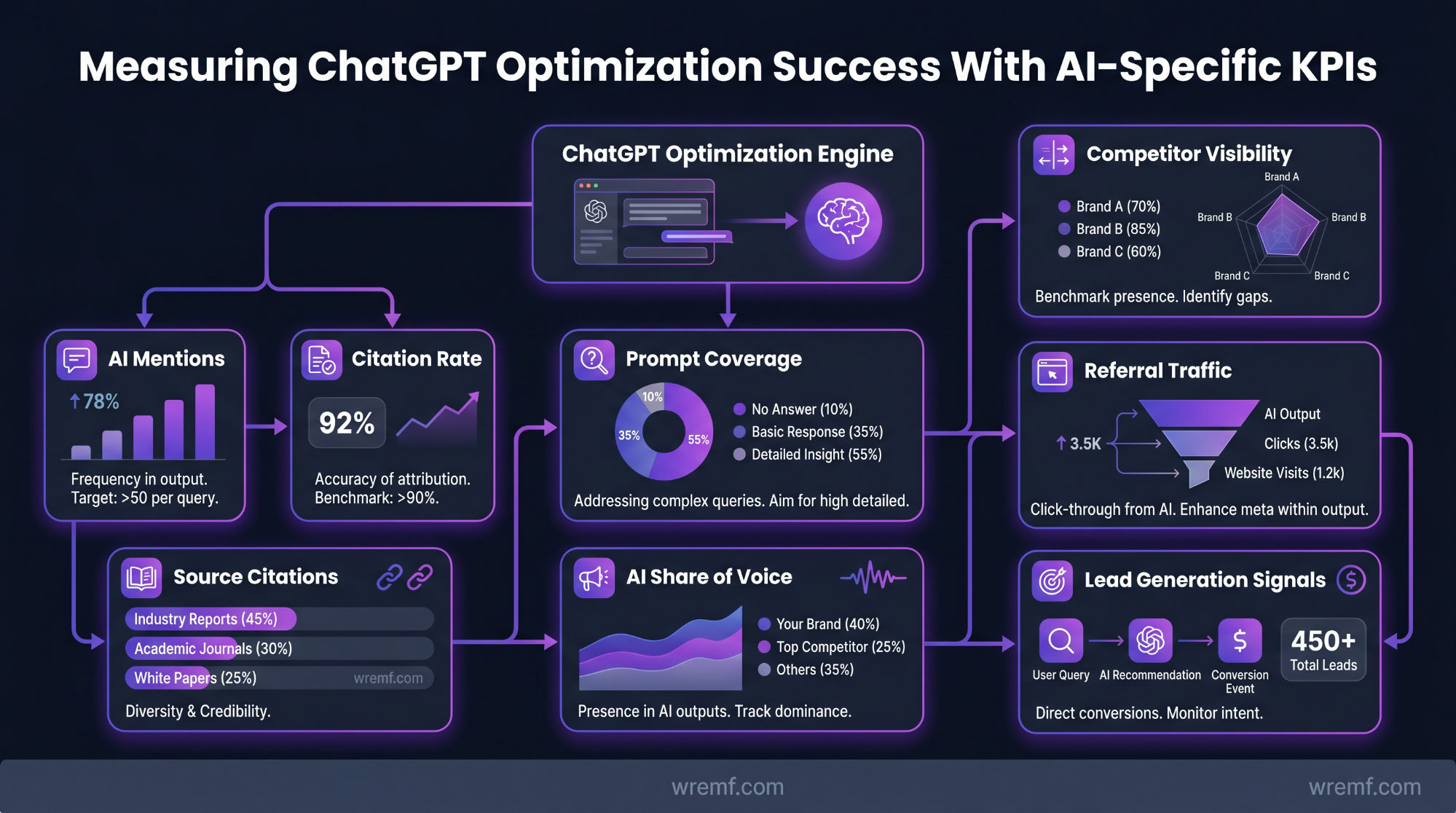
ChatGPT optimization success is measured by AI mentions, Citation Rate, source citations, prompt coverage, AI share of voice, competitor visibility, referral traffic, and lead generation signals. Search rankings alone cannot prove AI visibility.
AI share of voice is the percentage of relevant AI-generated responses where your brand appears compared with competitors. AI share of voice matters because it shows whether AI search engines include your brand when users ask category, comparison, vendor, or market analysis questions.
Competitor visibility is the frequency and quality of competitor appearances in AI-generated responses. Competitor visibility matters because ChatGPT optimization is competitive. Your brand can be absent even when your category appears often.
Source tracking is the process of identifying which domains, URLs, publications, directories, and documents AI systems cite. Source tracking matters because citation patterns reveal which sources influence AI-generated responses and vendor recommendations.
Referral traffic is traffic that arrives from another website or platform. Referral traffic matters for ChatGPT optimization because AI platforms can send website sessions when users click source links or citations.
Google Analytics helps identify referral traffic, website sessions, conversions, organic traffic, and user interactions when source data is available. Google Analytics should be used with caution because some AI-driven interactions may later appear as direct traffic, branded search, or organic traffic.
Bing Webmaster can support search engine data analysis for Bing visibility and related Microsoft discovery experiences. Search Console, Google Analytics, Bing Webmaster, and AI visibility tracking should be viewed as complementary systems, not replacements for each other.
| KPI | What It Shows | Reporting Value |
|---|---|---|
| AI mentions | whether your brand appears in AI-generated responses | top-level brand visibility |
| Citation Rate | how often your content is cited for target prompts | source authority |
| Source citations | which pages influence AI answers | optimization priorities |
| Citation patterns | which domains and source types appear repeatedly | source strategy |
| AI share of voice | visibility versus competitors | market position |
| Prompt coverage | how many tracked prompts mention your brand | demand coverage |
| Competitor displacement | where competitors replace your brand | risk monitoring |
| Referral traffic | traffic from ChatGPT, Perplexity, Bing, Gemini, and other AI sources | traffic impact |
| Website sessions | visits influenced by AI or search | demand impact |
| Lead generation | form fills, demos, signups, and pipeline signals | business impact |
| A/B testing results | performance of content changes | proof of improvement |
| AI-driven interactions | AI-assisted clicks, comparisons, and follow-up actions | engagement quality |
AI traffic attribution connects AI search visibility to measurable traffic and conversion behavior. AI traffic attribution matters because leadership teams need to understand whether AI visibility supports business visibility, website sessions, lead generation, and revenue share.
WREMF’s methodology connects prompts, source citations, competitors, source consistency, AI share of voice, Google Analytics, referral traffic, and attribution into one repeatable reporting system.
KEY TAKEAWAY: ChatGPT optimization should be measured with AI-specific KPIs because AI visibility depends on prompts, citations, source influence, competitors, and attribution.
Measurement becomes more useful when teams choose the right tool, service, or hybrid workflow.
ChatGPT Optimization Tools, Services, and Workflows
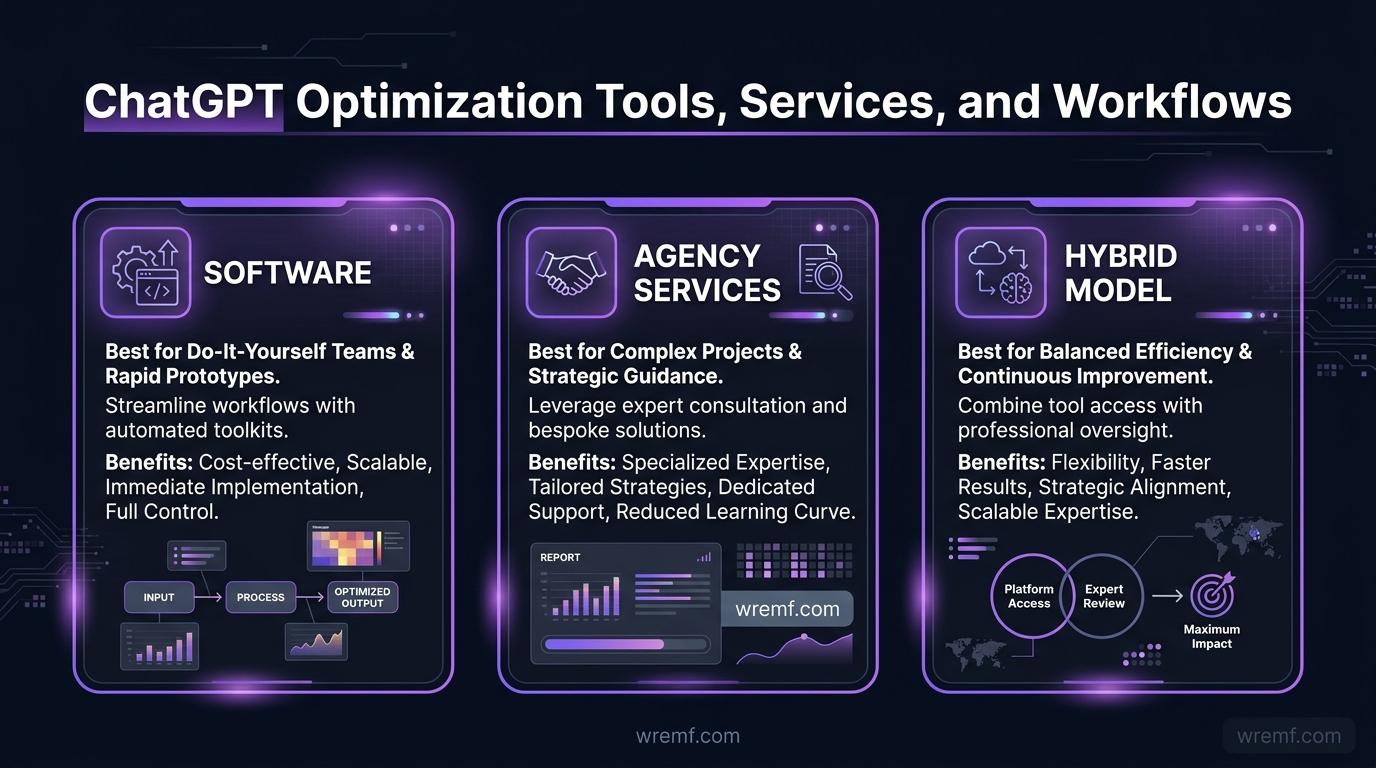
The right ChatGPT optimization option depends on your team’s resources, technical maturity, reporting needs, and execution capacity. Most B2B teams choose software, agency services, or a hybrid model.
ChatGPT optimization tools are platforms that monitor AI-generated responses, prompt performance, citations, competitors, AI mentions, and AI share of voice. ChatGPT optimization tools matter because manual testing is inconsistent and hard to report.
ChatGPT optimization services are consulting or managed execution offers that improve technical access, content optimization, entity clarity, source consistency, authority signals, and reporting. Services matter because many teams can identify AI visibility gaps but lack capacity to fix them.
| Option | Best For | What It Measures | What It Misses | Recommended When |
|---|---|---|---|---|
| Manual ChatGPT testing | early exploration | a few ChatGPT responses | repeatability, trends, citation profiles | you need quick directional insight |
| Traditional SEO tools | organic traffic and search rankings | keywords, backlinks, technical SEO | AI mentions, Citation Rate, prompt performance | SEO is still the main reporting need |
| AI visibility software | repeatable AI monitoring | prompts, citations, competitors, AI share of voice | execution if the team lacks resources | you need scalable measurement |
| Agency service | strategy and execution | audits, content plans, source cleanup | software-level continuous tracking if disconnected | you need expert implementation |
| Hybrid software plus agency | measurement and execution | full visibility workflow | requires clear ownership | you need reporting plus action |
For most B2B SaaS and enterprise marketing teams, the hybrid model is strongest. Software provides repeatable prompt tracking, source tracking, and reporting. Agency support turns insights into content strategy, content optimization, structured data cleanup, authority building, internal linking, and source consistency improvements.
WREMF can be used as software, an agency service, or a combined software plus managed execution solution. The WREMF agency team supports AI visibility strategy, GEO consulting, AEO consulting, content optimization, entity authority building, citation improvement, technical AI visibility foundations, schema and entity markup guidance, crawl checks, internal linking logic, share of voice tracking, and pipeline attribution.
Agencies managing multiple clients often need white-label reporting, client portals, and repeatable workflows. WREMF provides white-label reports and is useful for consultants and agencies that need to manage AI visibility across multiple brands through WREMF for agencies.
KEY TAKEAWAY: ChatGPT optimization tools measure the problem, agency services execute improvements, and a hybrid model gives teams both visibility and action.
The next section covers common mistakes that prevent teams from seeing reliable results.
Common ChatGPT Optimization Mistakes
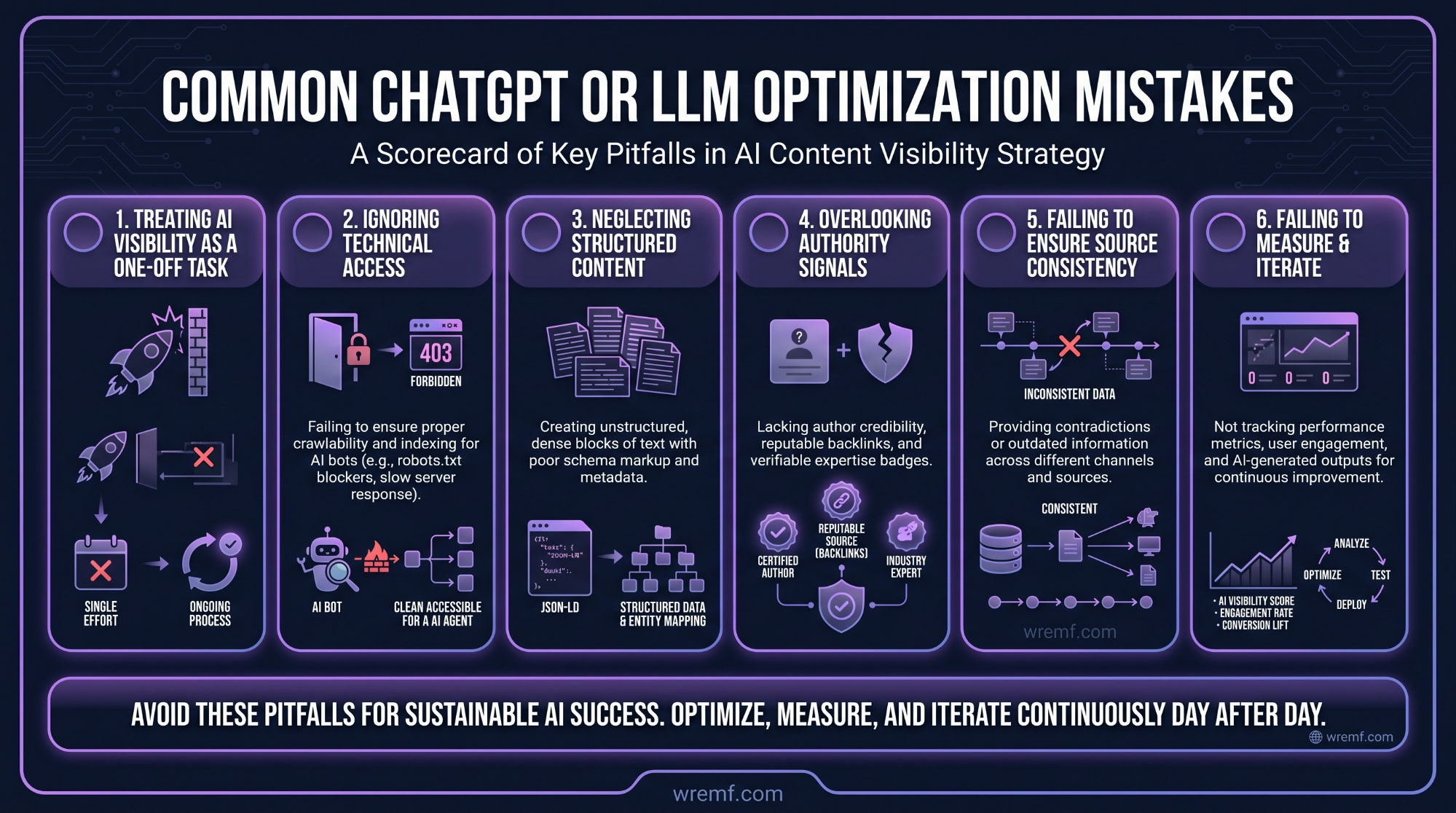
The most common ChatGPT optimization mistake is treating AI visibility as a single content update or prompt engineering exercise. ChatGPT optimization requires technical access, structured content, authority signals, source consistency, and measurement.
Prompt engineering is the practice of writing better instructions to get better outputs from AI models. Prompt engineering matters for internal workflows, but prompt engineering alone does not make your brand more visible in other users’ ChatGPT responses.
A common implementation mistake is optimizing only homepage copy. Your homepage may explain your brand, but AI models often use product pages, documentation, support articles, list articles, review platforms, social media profiles, business directory listings, and reputable sources to understand your company.
Another mistake is focusing on content creation without source cleanup. More website content can help, but weak brand voice, outdated profiles, contradictory online reviews, inconsistent local listings, and old pricing references can weaken source consistency.
Teams should avoid:
Blocking OAI-SearchBot or important crawlers without a deliberate policy
Publishing AI-generated content output without expert review
Using schema markup that contradicts visible content
Treating keyword density as a Generative Engine Optimization strategy
Ignoring structured content and content structure optimization
Optimizing only for ChatGPT and ignoring Perplexity, Claude, Gemini, Bing, and Google AI Overviews
Measuring only search rankings and organic traffic
Ignoring AI mentions, Citation Rate, and citation patterns
Treating Domain Rating as the only authority signal
Ignoring online reviews and customer reviews
Failing to monitor referral traffic and website sessions
Expecting guaranteed vendor recommendations from one tactic
Using unsupported statistics or fake proof in content
Google Search Central explains that SEO can help search engines discover and understand content when it is applied to people-first content rather than search engine-first content. Google’s helpful content guidance is directly relevant because ChatGPT optimization also depends on useful, reliable, clear information.
TIP: Treat every content update as a testable hypothesis. Measure prompt performance, source citations, organic traffic, referral traffic, and AI-driven interactions before declaring success.
KEY TAKEAWAY: ChatGPT optimization fails when teams treat it as keyword stuffing, prompt tweaking, or one-off content creation instead of a complete visibility system.
Many of these mistakes come from myths about AI search visibility.
Common Myths About AI Visibility Debunked
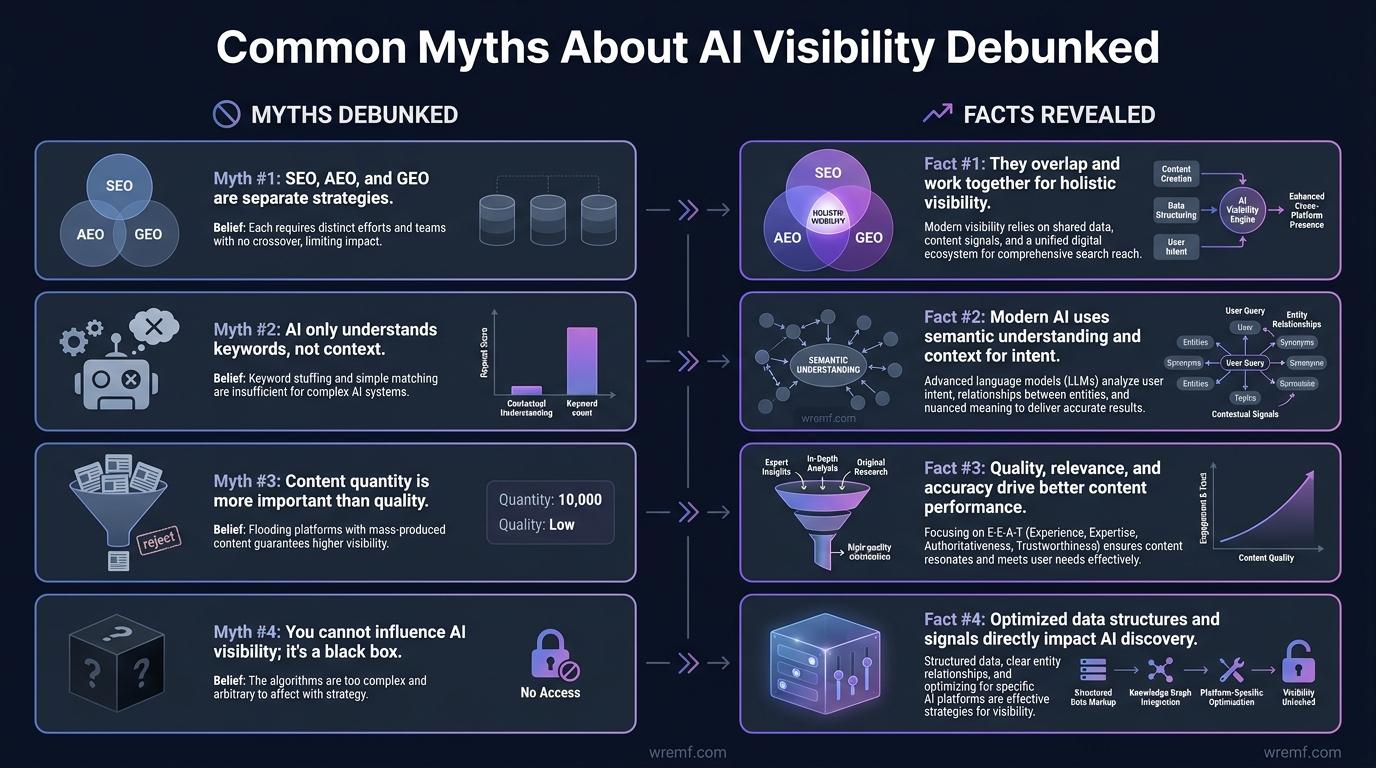
AI visibility myths come from applying traditional SEO assumptions to AI-generated responses. ChatGPT optimization becomes more effective when teams separate measurable facts from speculation.
MYTH: SEO, AEO, and GEO are completely separate strategies.
FACT: SEO, Answer Engine Optimization, and Generative Engine Optimization overlap. SEO improves crawlability, content quality, structured data, backlinks, and organic traffic. AEO improves direct answer extraction. GEO improves visibility inside AI-generated responses, citations, and recommendations. The strongest ChatGPT optimization strategy connects all three.
MYTH: AI visibility is impossible to measure.
FACT: AI visibility is measurable through AI mentions, Citation Rate, source citations, prompt coverage, AI share of voice, competitor visibility, referral traffic, and website sessions. Measurement is not perfect because AI-generated responses can vary, but repeatable prompt tracking makes trends visible.
MYTH: Google rankings are enough for ChatGPT optimization.
FACT: Google rankings help, but rankings alone do not prove that ChatGPT responses cite or recommend your brand. AI models may select third-party reviews, documentation, list articles, directories, publisher sources, or competitor pages even when your site ranks in Google.
MYTH: Structured data guarantees AI citations.
FACT: Structured data improves machine readability, but it does not guarantee AI citations. AI citations depend on access, relevance, authority, source consistency, content quality, prompt context, and citation profiles.
MYTH: More AI-generated content always improves brand visibility.
FACT: More content helps only when the content is accurate, structured, useful, and aligned with real prompts. Thin AI-generated content can create duplication, weak brand voice, unsupported claims, and conflicting information across the source ecosystem.
KEY TAKEAWAY: AI visibility is measurable and improvable, but it requires a connected system across SEO, AEO, GEO, citations, prompts, authority, and attribution.
The next strategic layer is preparing for AI search beyond today’s ChatGPT responses.
The Future of Search Beyond ChatGPT
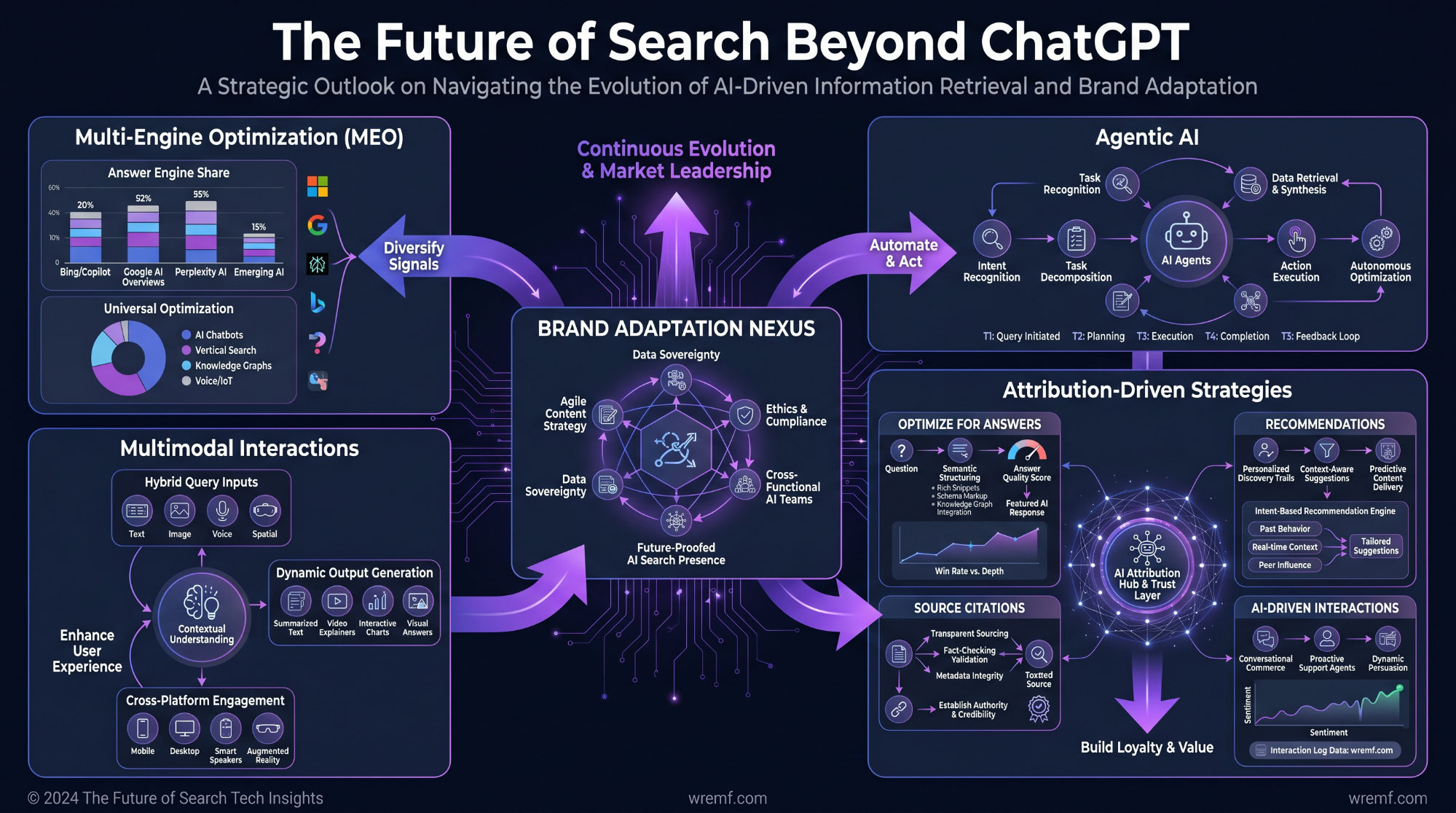
The future of ChatGPT optimization is multi-engine, multimodal, agentic, and attribution-driven. Brands will need to optimize for answers, source citations, recommendations, and AI-driven interactions across many platforms.
Generative AI is software that can create text, summaries, answers, code, analysis, and other outputs from prompts and context. Generative AI matters for B2B marketing because buyers can use AI systems to compare vendors, summarize reviews, evaluate features, and understand market categories.
AI integration is the connection between AI systems and workflows, websites, analytics, support tools, automation tools, and product experiences. AI integration matters because user interactions may increasingly happen through AI assistants, agents, embedded copilots, and search-connected workflows.
AI Engagement Optimization is the practice of improving how users interact with AI-assisted experiences, such as chat interfaces, product advisors, automated research agents, and AI-driven interactions. AI Engagement Optimization matters because visibility should lead to clearer decisions, better website sessions, qualified lead generation, and stronger market analysis.
Multimodal optimization matters because AI search is moving beyond text. Voice, image, video, and Web browsing experiences may influence how users discover brands. For most B2B teams, the practical starting point is not complex media production. The starting point is clear text, structured content, accessible pages, complete entity profiles, and consistent source citations.
Agentic AI may increase the importance of structured, accurate, and accessible product information. When automation tools or AI agents compare software vendors, unclear pricing, gated documentation, weak knowledge base coverage, and inconsistent product pages can reduce business visibility.
Future-ready teams should:
Monitor ChatGPT, Perplexity, Claude, Gemini, Copilot, DeepSeek, Grok, Meta AI, and Mistral
Maintain structured content libraries around buyer prompts
Use reputable sources to support factual claims
Keep website content accessible to relevant crawlers
Refresh sitemaps and important content regularly
Use schema markup to reinforce entity clarity
Build brand mentions across authoritative sources
Track AI mentions, Citation Rate, referral traffic, and lead generation
Connect Google Analytics, Bing Webmaster, and AI visibility reporting
Use SEO testing and A/B testing to validate content improvements
Keep brand voice consistent across website content, social media, reviews, and directories
WREMF supports this future-ready workflow through AI visibility tracking, prompt intelligence, source citations, competitive landscape monitoring, GEO audits, SEO testing, AI-ready content briefs, API and MCP integrations, BYOK support, white-label reporting, and managed execution.
KEY TAKEAWAY: ChatGPT optimization is becoming a multi-engine AI search discipline where brands must track visibility, improve sources, and prove business impact over time.
To make the strategy operational, teams need a repeatable system for software, services, and reporting.
How WREMF Helps With ChatGPT Optimization
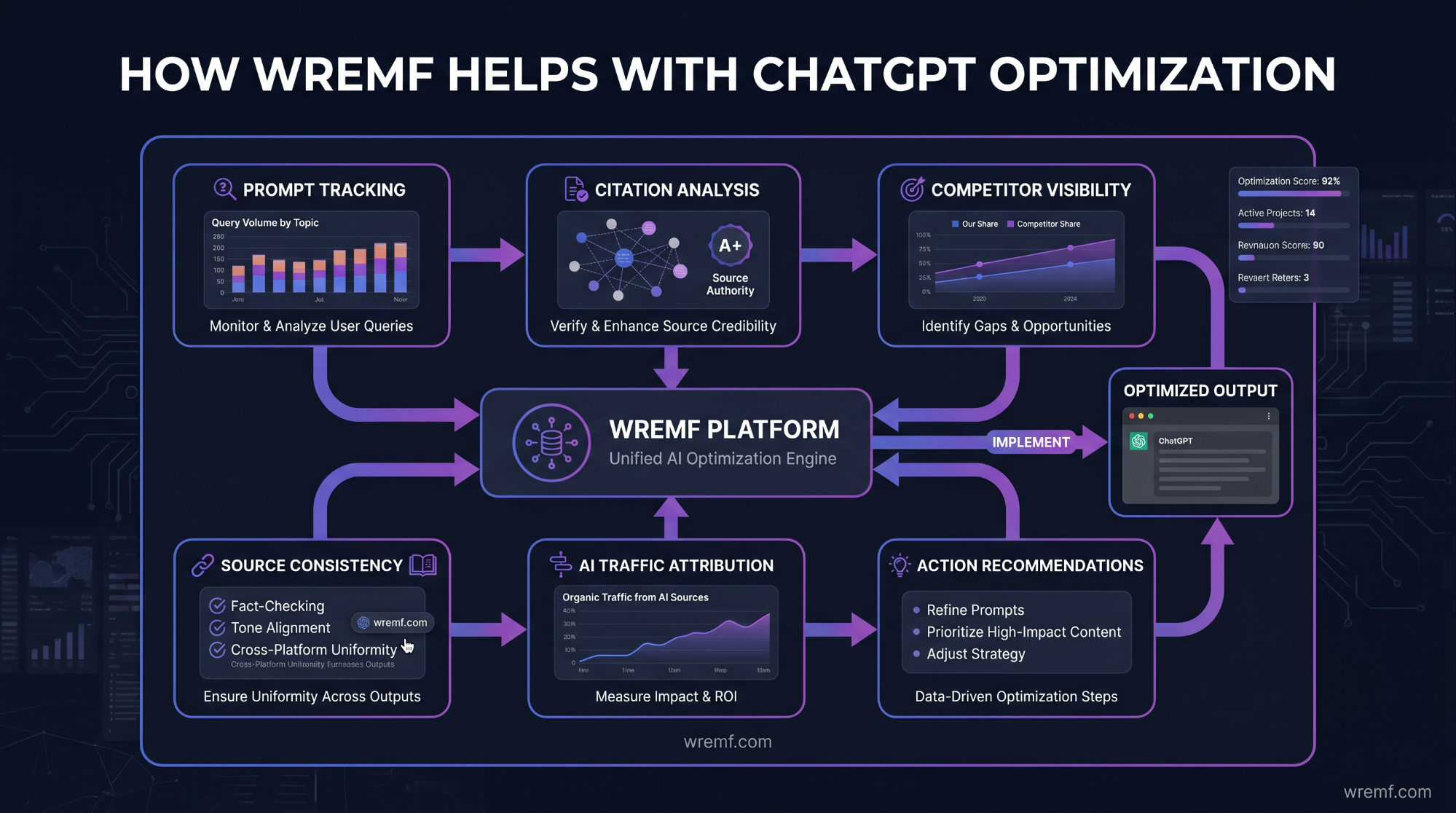
WREMF helps teams turn ChatGPT optimization from manual testing into a measurable workflow. WREMF combines prompt tracking, citation analysis, competitor visibility, source consistency, AI traffic attribution, and action recommendations in one platform.
WREMF is useful for brands, agencies, consultants, SEO teams, content teams, B2B marketing teams, and enterprise marketing teams. Brands can track how AI models describe their company. Agencies can manage multiple clients with white-label reporting. Teams that need execution can combine software with managed AEO, GEO, and AI visibility services.
Brand recommendation visibility measures how often AI systems recommend a brand for buyer prompts, vendor comparisons, and category-specific questions. Brand recommendation visibility matters because AI search can influence demand before a user reaches a website.
| WREMF Capability | What It Helps You Do | Why It Matters |
|---|---|---|
| AI visibility tracking | monitor brand visibility across 10 AI engines | shows where your brand appears or disappears |
| Prompt intelligence | track buyer prompts and ChatGPT responses | reveals prompt performance over time |
| Source citation tracking | identify cited URLs and source patterns | shows which sources influence AI-generated responses |
| Competitive landscape | compare AI mentions against competitors | measures AI share of voice |
| GEO audit | find crawl, rendering, entity, and content gaps | improves AI crawler accessibility |
| Content briefs | turn prompt gaps into structured content tasks | supports content creation and content strategy |
| SEO testing | evaluate content and page changes | connects action to performance monitoring |
| AI traffic attribution | connect AI visibility to referral traffic and website sessions | supports reporting and lead generation analysis |
| API and MCP integrations | connect workflows to internal systems | supports automation tools and technical teams |
| BYOK | use your own AI provider keys | supports governance and cost control |
| White-label reporting | create client-ready reports | supports agencies and consultants |
| Client portals | share visibility data with stakeholders | supports collaborative reporting |
The WREMF competitive landscape helps teams see which competitors appear in ChatGPT responses and other AI-generated responses. This matters because AI visibility is relative. A brand can improve content and still lose buyer attention if competitors appear more often in vendor recommendations.
The WREMF API supports technical workflows, MCP integrations, reporting automation, and programmatic AI visibility analysis. This is useful for teams that want to connect AI visibility data to internal dashboards, client portals, CRM workflows, or automation tools.
WREMF can be used as software, an agency service, or a hybrid model. The software helps you measure. The agency services help you execute. The hybrid model helps teams that need both visibility data and senior-led implementation.
KEY TAKEAWAY: WREMF gives brands and agencies a practical way to track, improve, and prove ChatGPT optimization across prompts, citations, competitors, and attribution.
The following FAQs answer the most common questions from search, ChatGPT, Perplexity, Gemini, Claude, and buyer conversations.
Frequently Asked Questions
What is ChatGPT optimization?
ChatGPT optimization is the process of improving how ChatGPT finds, understands, cites, and recommends your brand in AI-generated responses. It combines technical SEO, Generative Engine Optimization, Answer Engine Optimization, structured content, schema markup, brand mentions, source citations, and AI visibility measurement. For B2B teams, ChatGPT optimization is not only about using ChatGPT to write content. It is about making your website content, knowledge base, product information, and external authority signals clear enough for AI models to retrieve and trust.
Can ChatGPT do optimization?
ChatGPT can help with optimization tasks such as content outlines, content optimization, keyword clustering, prompt engineering, code review, schema markup drafts, Google Ads analysis, market analysis, and workflow automation ideas. ChatGPT cannot independently guarantee search rankings, AI citations, revenue share, traffic, or lead generation. For brand visibility, you still need crawlable website content, structured data, authoritative sources, consistent brand mentions, online reviews, source tracking, and performance monitoring across AI search engines.
How do you fully optimize ChatGPT for your brand?
You fully optimize ChatGPT visibility by improving three layers: access, content, and authority. Access means AI crawlers and search engine systems can reach your important pages. Content means your pages use answer-first structure, structured content, semantic SEO, conversational keywords, and clear entities. Authority means your brand mentions, backlinks, reviews, reputable sources, citation profiles, and business directory listings support the same facts. WREMF helps teams monitor these layers through prompt tracking, citation tracking, GEO audits, and competitor visibility.
What are we optimizing ChatGPT for?
You are optimizing ChatGPT for accurate brand recognition, AI mentions, source citations, vendor recommendations, category relevance, and business visibility. The goal is not to manipulate ChatGPT responses. The goal is to make your brand easier for AI models to understand through clear website content, structured data, authoritative sources, and consistent third-party signals. For B2B marketing teams, the most important outcomes are visibility in buyer prompts, stronger Citation Rate, better competitor positioning, and measurable referral traffic where available.
How do you maximize the use of ChatGPT for SEO?
You maximize ChatGPT for SEO by using it as a research, drafting, analysis, and QA assistant while keeping human strategy and source verification in control. ChatGPT can help cluster search queries, draft outlines, generate FAQ ideas, identify content gaps, rewrite for clarity, and create structured content frameworks. It should not replace expert review, original insight, Google Analytics analysis, Search Console evaluation, or source validation. For ChatGPT optimization, pair AI-assisted content creation with prompt tracking and citation monitoring.
Can ChatGPT do SEO?
ChatGPT can support SEO workflows, but ChatGPT does not replace SEO strategy. It can help with content briefs, semantic SEO, metadata drafts, internal linking ideas, FAQ writing, schema markup drafts, content structure optimization, and Google Ads copy variations. It cannot directly crawl your site, verify all search engine data, guarantee Google rankings, or prove organic traffic performance unless connected to external data. SEO teams should combine ChatGPT with Google Analytics, Search Console, Bing Webmaster, AI visibility tools, and expert review.
What is the difference between SEO, AEO, GEO, and ChatGPT optimization?
SEO improves visibility in traditional search engine results. Answer Engine Optimization improves direct answer extraction for search engines, voice assistants, and AI answer surfaces. Generative Engine Optimization improves inclusion in AI-generated responses, summaries, citations, and vendor recommendations. ChatGPT optimization applies those practices specifically to ChatGPT responses and ChatGPT search behavior. The strongest approach combines all four because rankings, answer clarity, source citations, brand mentions, and AI traffic attribution influence business visibility together.
How do you optimize website content for ChatGPT?
You optimize website content for ChatGPT by writing direct answers, defining entities clearly, using structured headings, adding tables, answering conversational keywords, and supporting claims with authoritative sources. Each major page should explain what the topic is, why it matters, how it works, common mistakes, comparisons, implementation steps, and FAQs. Website content should also connect to related content libraries, knowledge base pages, and product pages. WREMF’s content briefs help teams turn prompt gaps and citation patterns into structured content creation tasks.
Is structured data important for ChatGPT optimization?
Structured data is important because it helps search systems understand entities, page types, authors, organizations, products, and relationships. Schema markup and JSON-LD schema markup can reinforce visible facts about your company, product, article, FAQ, or software application. Structured data does not guarantee ChatGPT citations, but it supports machine readability and source consistency. Use Organization, SoftwareApplication, Product, Article, FAQPage, HowTo, and BreadcrumbList markup when relevant, then validate pages with Google's Rich Results Test.
How do you measure ChatGPT optimization success?
You measure ChatGPT optimization success with AI mentions, Citation Rate, source citations, prompt coverage, AI share of voice, competitor visibility, referral traffic, website sessions, and lead generation signals. Google rankings are useful, but they do not show whether ChatGPT recommends your brand. A practical dashboard should combine prompt tracking, citation profiles, Google Analytics, Bing Webmaster, organic traffic, SEO testing, A/B testing, and source tracking. WREMF’s methodology connects these metrics into a repeatable reporting workflow.
Is ChatGPT optimization only for large brands?
ChatGPT optimization is useful for startups, B2B SaaS companies, agencies, consultants, and enterprise teams. Smaller brands can benefit because AI search engines often answer specific prompts where clear expertise and structured content matter. Large brands may have stronger authority signals, but they also face more source consistency issues across old content, reviews, directories, and social media profiles. The right approach depends on content quality, technical access, authoritative sources, and measurement discipline.
What tools help with ChatGPT optimization?
ChatGPT optimization tools should track prompts, AI-generated responses, AI mentions, source citations, Citation Rate, competitors, AI share of voice, and referral traffic. Traditional SEO tools are still useful for backlinks, search rankings, organic traffic, and technical SEO, but they do not fully measure AI visibility. WREMF combines AI visibility tracking, prompt intelligence, source citations, competitive landscape monitoring, GEO audits, content briefs, SEO testing, BYOK, API access, white-label reports, and agency execution options.
Can ChatGPT optimization improve lead generation?
ChatGPT optimization can support lead generation by improving brand visibility in AI-driven search, buyer comparisons, vendor recommendations, and high-intent prompts. It should not be treated as a guaranteed lead generation channel because AI visibility, referral traffic, and conversion behavior vary by market. The practical goal is to increase qualified visibility, improve source citations, strengthen business reputation, and connect AI-driven interactions to Google Analytics, website sessions, demos, signups, and pipeline data where possible.
What role do online reviews and customer reviews play in ChatGPT optimization?
Online reviews and customer reviews can influence ChatGPT optimization because they create third-party language about product fit, use cases, strengths, weaknesses, and business reputation. AI models may use review platforms, directories, and reputable sources when summarizing brands or comparing vendors. Reviews should be accurate, current, and consistent with your website content. Teams should monitor review language, respond where appropriate, and ensure product descriptions across review sites match current positioning.
How often should you monitor ChatGPT visibility?
You should monitor ChatGPT visibility at least monthly for core prompts and more frequently for competitive categories, product launches, pricing changes, or major content updates. AI-generated responses can shift as sources change, crawlers refresh, competitors publish content, and recommendation algorithms evolve. Agencies and enterprise marketing teams often need scheduled AI monitoring, white-label reporting, and client portals. WREMF supports scheduled AI visibility tracking across 10 AI engines for recurring reporting.
Conclusion
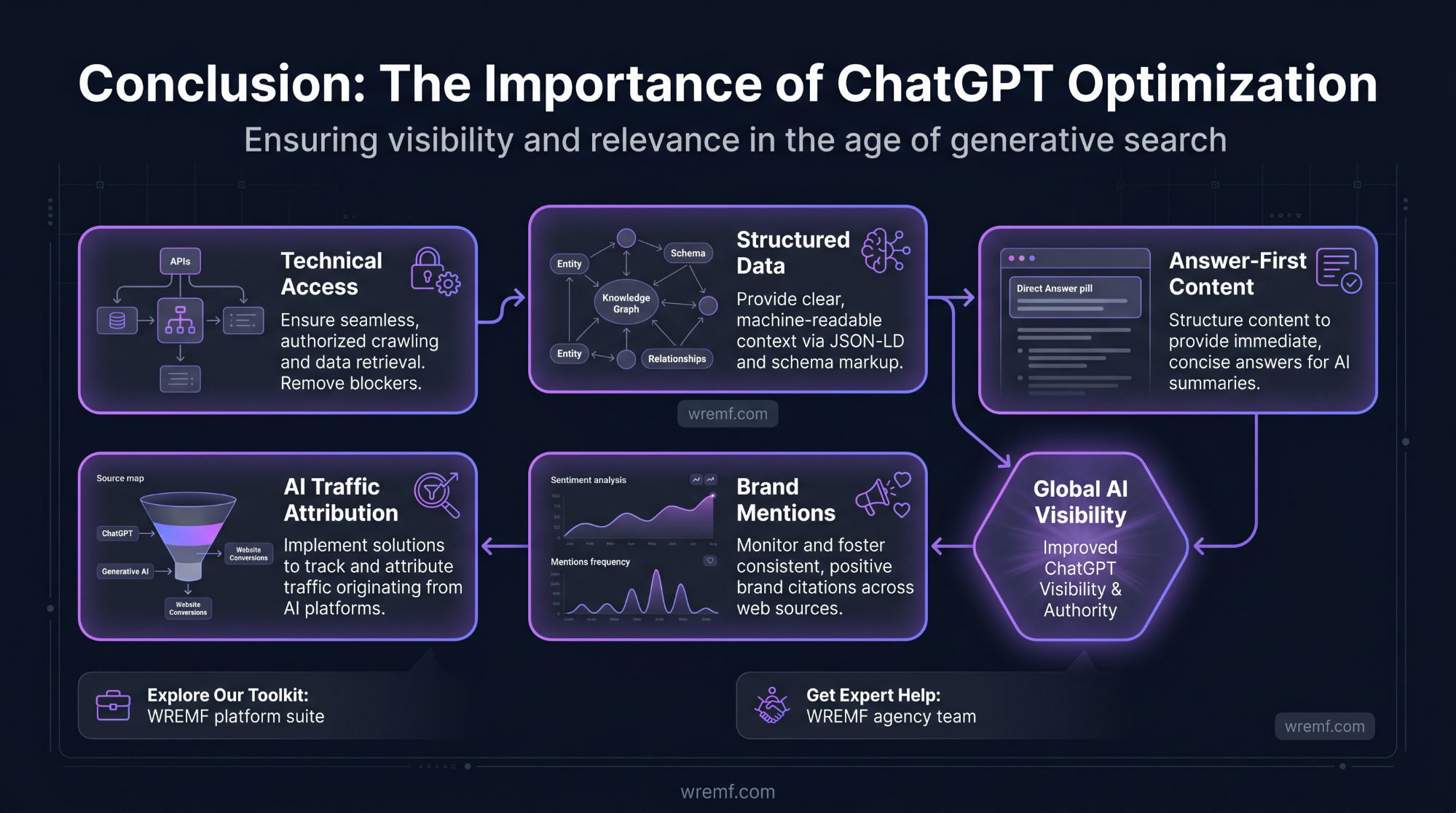
ChatGPT optimization is the practical process of making your brand easier for AI models to understand, cite, compare, and recommend. It combines technical access, structured data, answer-first content, brand mentions, authoritative sources, source consistency, prompt tracking, Citation Rate, and AI traffic attribution. Traditional SEO still matters, but AI visibility requires additional measurement across ChatGPT responses and other AI discovery surfaces. To turn this from manual testing into a repeatable workflow, explore the WREMF platform suite or talk to the WREMF agency team for managed AEO, GEO, and AI visibility execution.
Related reading
- Best Answer Engine Optimization for Enhancing AI Visibility
- Grok Optimization: The Complete Guide to Grok SEO, AI Visibility, and Brand Mentions
- Answer Engine Optimization: The Complete Guide to AEO, AI Search Visibility, and Answer-First Content
- How to Get Mentioned in ChatGPT: The Complete Guide to AI Visibility, Citations, and Brand Mentions