Claude SEO: The Complete Guide to Using Claude AI for SEO, AEO, GEO, and AI Search Visibility
Discover how Claude AI transforms SEO with advanced techniques for improved search visibility.
By WREMF Team · 2026-08-24
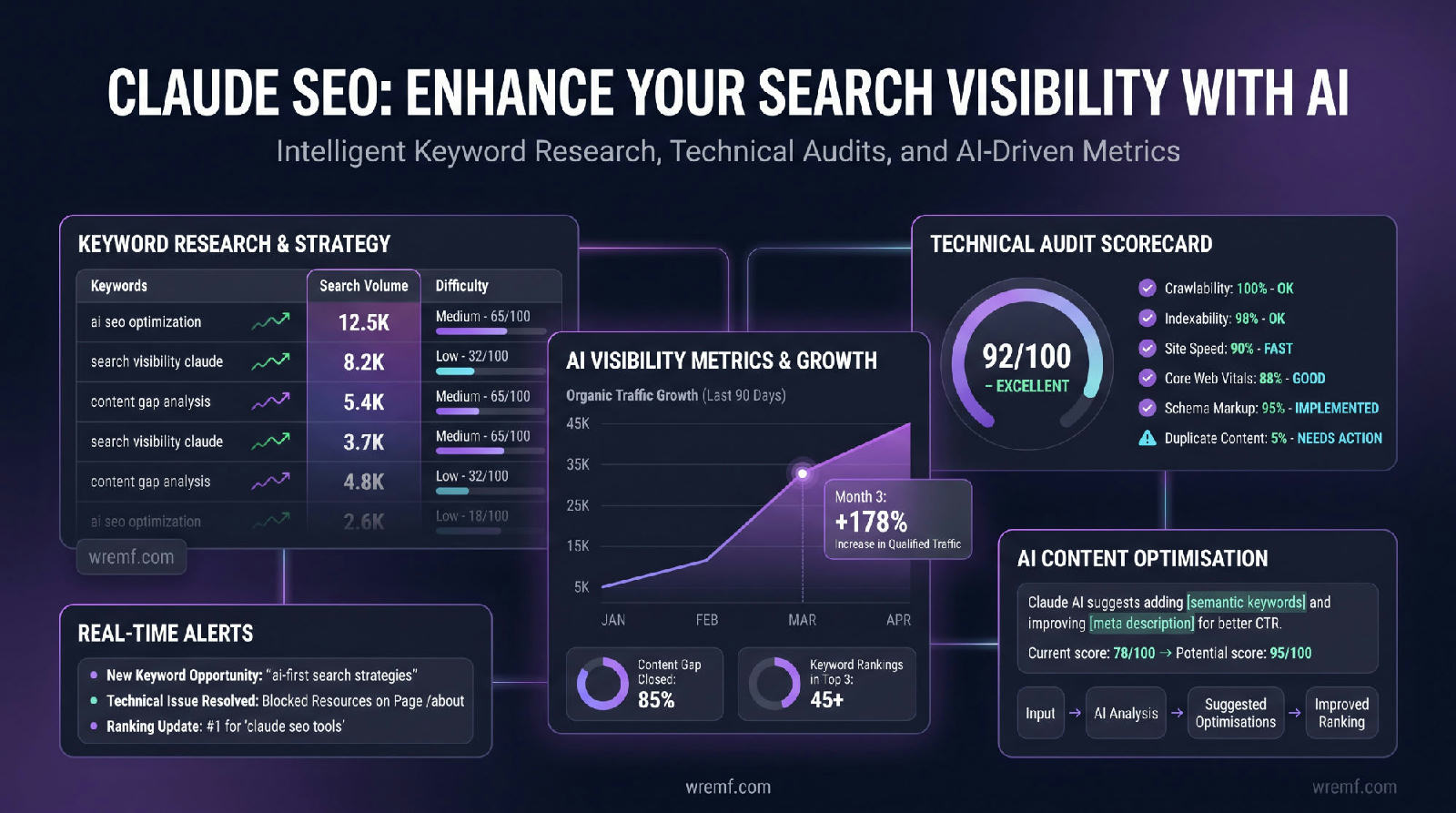
Claude SEO involves using Claude AI to enhance search visibility, content quality, and AI discovery. It integrates keyword research, technical audits, and content gap analysis to improve SEO workflows. Key components include schema markup, internal linking, and using Claude Code. The outcomes include improved AI search visibility and enhanced brand presence in AI-generated content, though Claude SEO requires data interpretation and can't replace traditional SEO tools.
Key takeaways
- Claude AI enhances SEO by improving reasoning over trusted data.
- Keyword research is strengthened by clustering queries with Claude.
- Claude finds content gaps and builds topical authority with structured insights.
- Internal linking and site architecture benefit from Claude's recommendations.
- Claude improves technical SEO audits with code inspection and automation.
Claude SEO: The Complete Guide to Using Claude AI for SEO, AEO, GEO, and AI Search Visibility
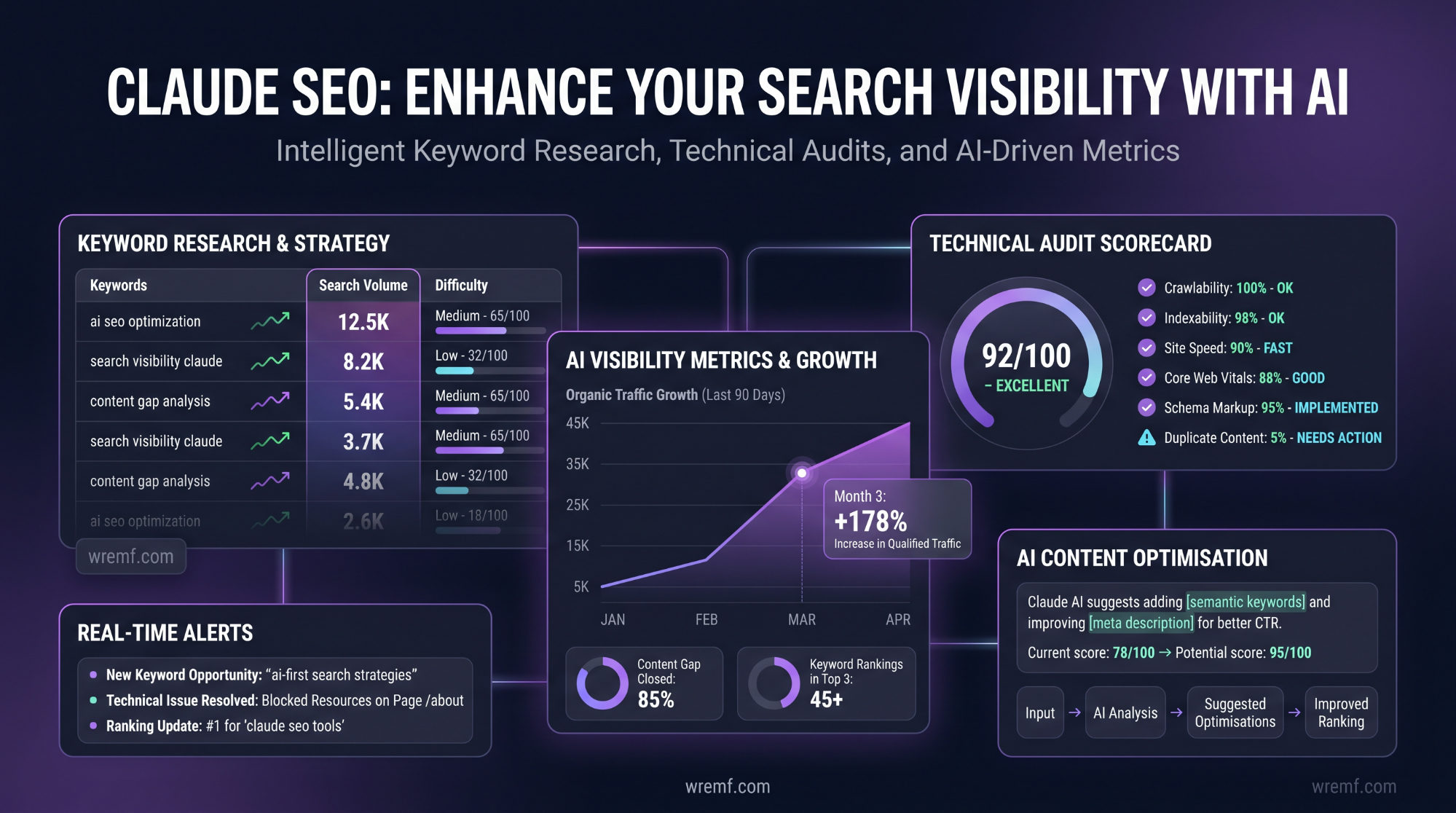
Claude SEO is the use of Claude AI to improve search visibility, technical SEO, content quality, and AI discovery performance. Anthropic describes Claude as an AI platform for language, reasoning, analysis, coding, and related work, which makes it useful for complex SEO workflows when paired with verified search data. This guide explains how Claude supports keyword research, content gaps, Technical SEO audits, schema markup, internal linking, Claude Code, Google AI Overviews, Answer Engine Optimization, Generative Engine Optimization, and AI search optimization. It also shows where WREMF helps teams track, improve, and prove visibility across Claude, ChatGPT, Gemini, Perplexity, Copilot, DeepSeek, Grok, Meta AI, Mistral, and Google AI Overviews through the WREMF platform suite. Use this page to build a practical Claude SEO workflow with clear measurement.
What Is Claude SEO?
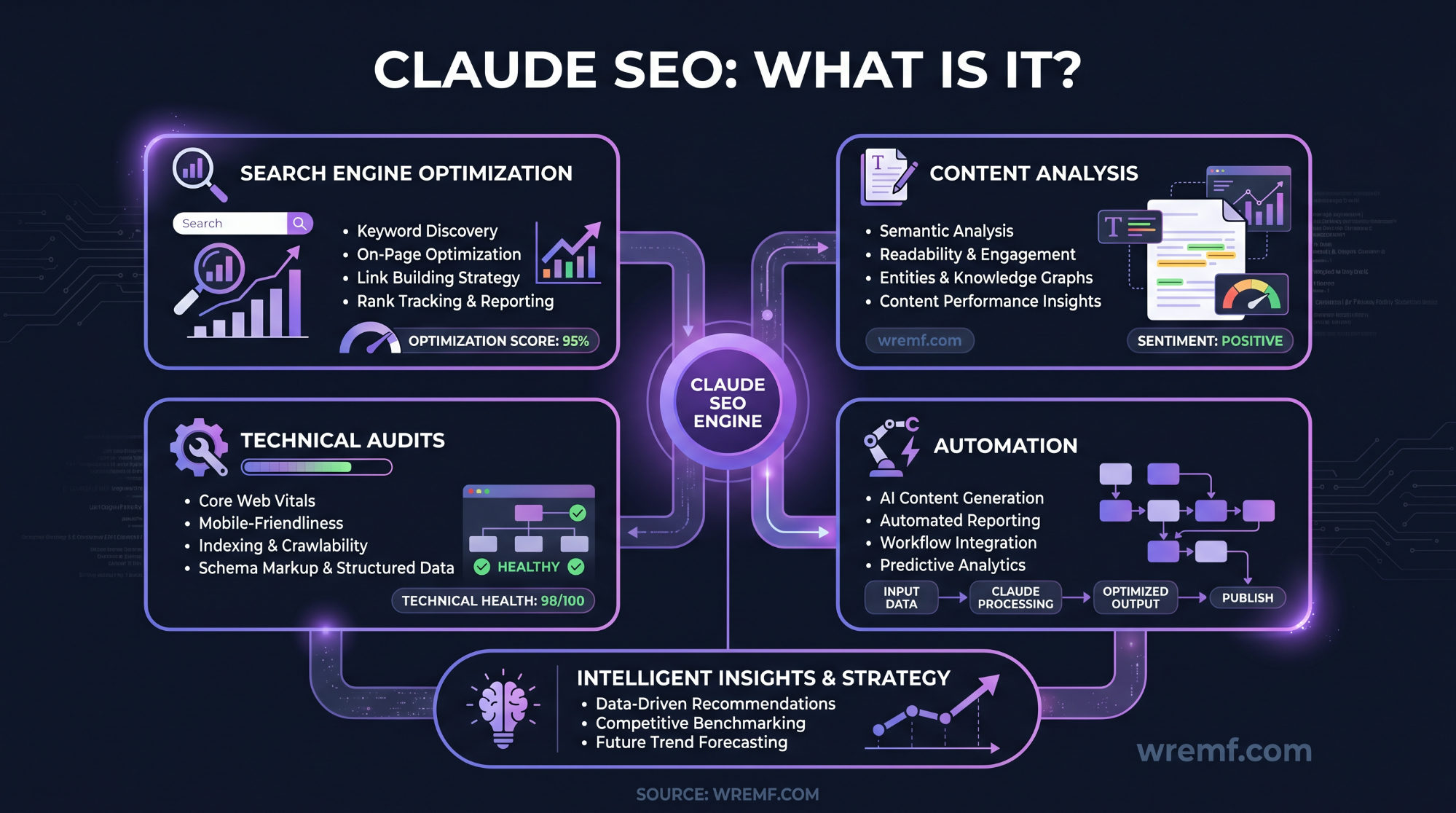
Claude SEO is a structured way to use Claude AI for search engine optimization, content analysis, technical audits, automation, and AI visibility improvement. It helps SEO teams process large information sets, reason through complex tasks, and turn raw data into practical search recommendations.
Claude AI is Anthropic’s AI assistant and model family for language, reasoning, analysis, coding, and other knowledge work. Claude matters for SEO because modern search work often requires more than writing content. Teams need to compare search intent, analyse competitors, inspect technical issues, improve structured data, and understand how AI discovery surfaces describe a brand.
SEO, AEO, and GEO now overlap. Search engine optimization improves visibility in traditional search results. Answer Engine Optimization improves how content answers direct questions. Generative Engine Optimization improves how brands appear inside AI-generated answers, summaries, recommendations, and citations.
AI visibility is the measurable presence of a brand inside AI-generated answers, recommendations, citations, and summaries. AI visibility matters because B2B buyers increasingly ask AI assistants to compare tools, vendors, categories, and solutions before visiting websites.
Claude SEO is not a magic ranking system. Claude cannot replace Google Search Console, crawlers, backlink tools, analytics platforms, or expert review. Claude works best as a reasoning layer that interprets data from search console, crawl exports, Markdown files, repository files, SERP overview notes, keyword research tools, backlink profile exports, and content inventories.
In practical AI visibility audits, teams often use Claude to understand why a page is unclear, why a topic cluster is incomplete, or why an AI system may not cite a brand. WREMF supports this next layer by connecting prompt tracking, source citations, competitor visibility, source consistency, and attribution through the WREMF methodology.
KEY TAKEAWAY: Claude SEO works best when Claude is used to reason over trusted SEO data, not when it is used as a blind content generator.
The next section explains why Claude changes the SEO workflow for teams that manage large sites, technical systems, and AI search visibility.
Why Claude SEO Is Redefining the SEO Workflow
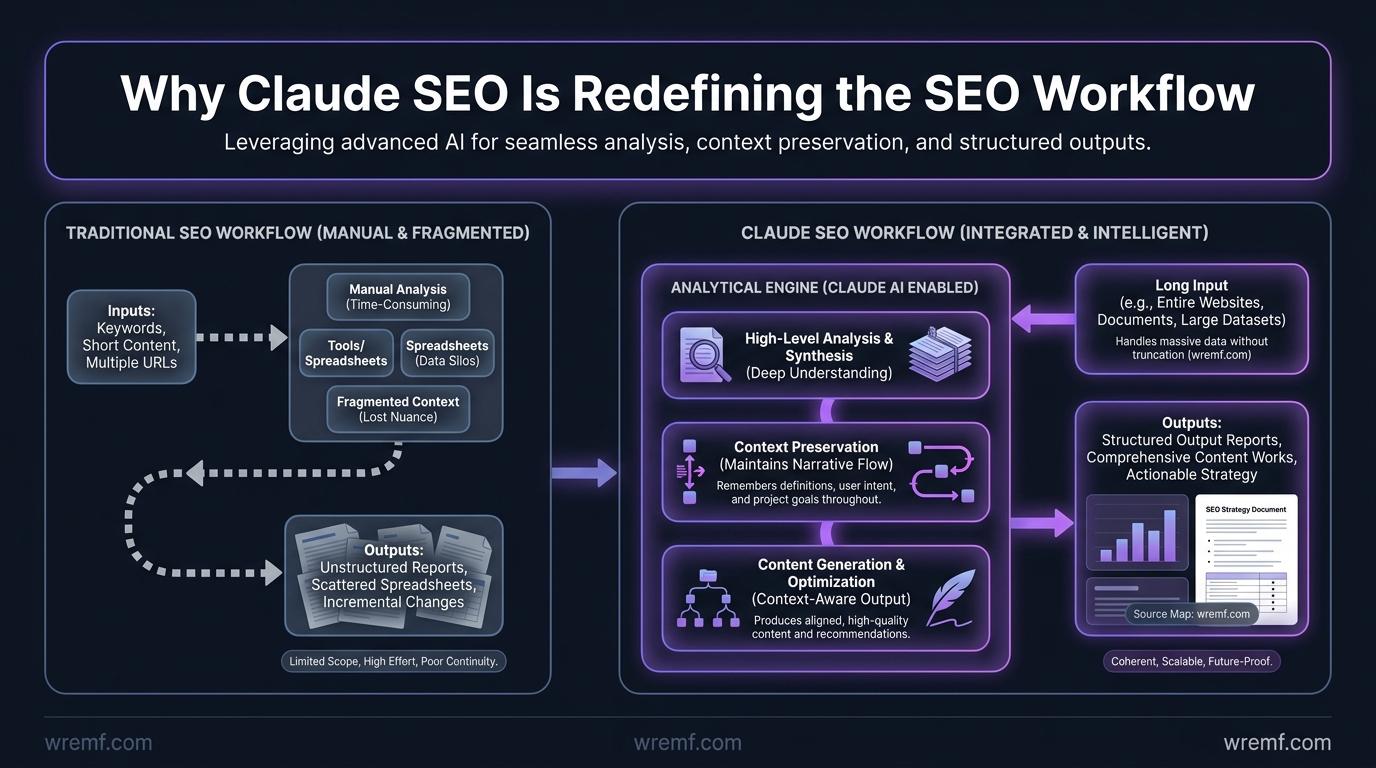
Claude SEO is redefining the SEO workflow because Claude can analyse long inputs, preserve context, reason through tradeoffs, and generate structured outputs. That makes Claude useful for strategy, audits, content optimization, technical analysis, and AI visibility workflows.
An SEO workflow is the repeatable process used to research, optimise, publish, measure, and improve search visibility. A modern SEO workflow includes keyword research, technical audits, SEO content, internal linking, schema markup, Core Web Vitals, content gap analysis, competitor analysis, Google AI Overviews, and AI citations.
Anthropic’s documentation explains that many Claude models support a 200k-token context window, while selected newer Claude models support a 1M-token context window in specific environments. Anthropic also announced Claude Opus 4.6 with 1M token context in beta and up to 128k output tokens for larger-output tasks. These numbers matter for SEO because large websites create large evidence sets, including crawl exports, log files, search engine data, backlink profiles, and content libraries. (Claude)
The key difference between Claude and a basic AI Writer is reasoning depth. Many AI writing tools can generate paragraphs. Claude is more useful when the SEO task requires comparing conflicting inputs, explaining technical tradeoffs, preserving brand voice, and producing structured recommendations.
DID YOU KNOW: Anthropic’s Claude Code documentation explains that the context window includes instructions, files read during the session, Claude’s own responses, and other session context, which is useful when working across repository files navigation, code, and technical SEO materials. (Claude)
In real B2B buying journeys, SEO content has to satisfy more than keyword density. Buyers compare vendors across search results, AI summaries, review sites, documentation, social discussions, and comparison queries. Claude can help SEO teams identify where the brand’s content, competitors’ content, and AI-generated summaries diverge.
Google Search Central explains that Google’s ranking systems aim to prioritise helpful, reliable, people-first content rather than content created mainly to manipulate search engine rankings. That matters because Claude-generated SEO content still needs expert review, source attribution, original insight, and clear usefulness. (Google for Developers)
WREMF turns AI visibility from a guessing game into a measurable workflow. Claude can improve the SEO workflow, but WREMF helps teams verify whether AI discovery surfaces actually mention, cite, compare, or recommend the brand.
KEY TAKEAWAY: Claude improves the SEO workflow by helping teams reason across large datasets, but AI visibility still requires prompt, citation, competitor, and attribution measurement.
Once the workflow role is clear, the next step is using Claude for keyword research and intent mapping.
How Claude Helps With Keyword Research and Search Intent Analysis
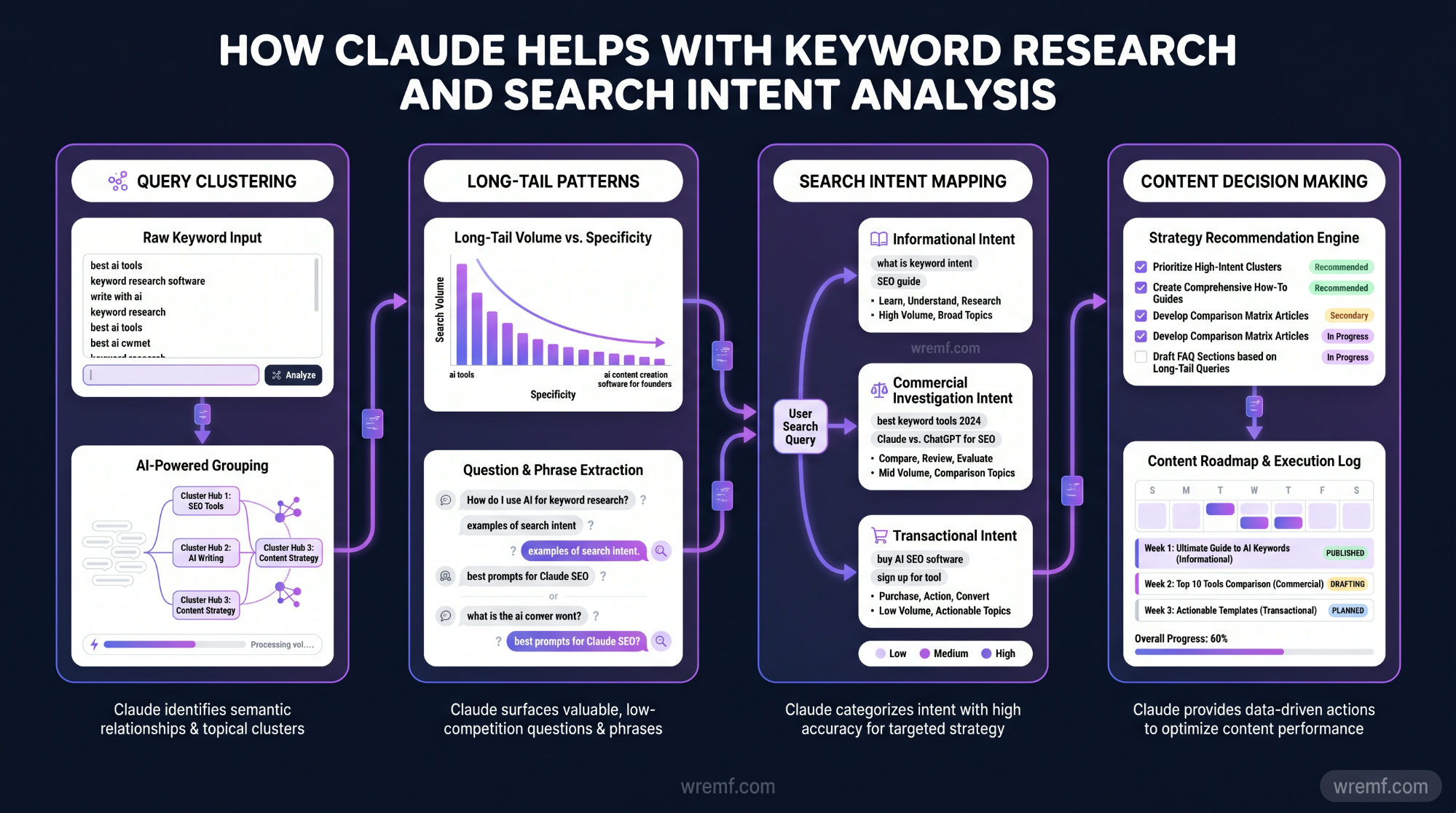
Claude helps with keyword research by clustering queries, identifying long-tail keyword patterns, mapping search intent, and turning raw keyword lists into content decisions. Claude is strongest when keyword research is supported by real search engine data.
Keyword research is the process of finding, grouping, and prioritising search queries based on demand, intent, difficulty, business value, and content fit. Keyword research matters because search engine rankings still depend on matching the language and needs of real users.
Claude should not be used as the source of search volume truth. Search volume, clicks, impressions, and rankings should come from search console, Google Ads Keyword Planner, Semrush, Ahrefs, DataForSEO, SerpAPI, or similar search engine data sources. Claude should interpret that data and convert it into a useful SEO Strategy.
A long-tail keyword is a specific search query that usually has clearer intent than a broad keyword. Long-tail keyword research matters because B2B buyers often use detailed questions such as “how to use Claude for SEO audits,” “Claude vs ChatGPT for SEO content,” or “best LLM for SEO content.”
Search intent analysis is the process of identifying what a user wants to achieve from a query. Search intent analysis matters because a page can target the right keyword but fail if it answers the wrong intent.
Claude can classify keywords into informational, commercial, comparison, implementation, local SEO, technical, and buying-stage groups. This helps you build content that matches real search journeys instead of publishing isolated pages.
A search intent graph is a structured map of how users move from one query to related questions, objections, comparisons, and next steps. A search intent graph matters because SEO teams can use it to build complete topical clusters rather than disconnected posts.
For example, a Claude SEO search intent graph could start with “Can Claude AI help with SEO?” and expand into “Claude for keyword research,” “Claude Code for technical SEO,” “Claude vs ChatGPT for SEO,” “Claude for schema markup,” “Claude for Google AI Overviews,” and “Claude for content gap analysis.”
TIP: Give Claude keyword exports, current rankings, competitor URLs, audience notes, conversion goals, and SERP overview summaries in the same prompt. Ask for keyword research clusters, intent labels, missing pages, and recommended content brief priorities.
Claude can also identify weak keyword targeting. If one page tries to satisfy beginner education, technical implementation, and buying intent at once, Claude can recommend splitting the content into a pillar page, supporting tutorials, comparison pages, and commercial landing pages.
KEY TAKEAWAY: Claude makes keyword research more strategic when it clusters demand, explains intent, and connects keywords to page-level content decisions.
After keyword opportunities are mapped, Claude can help identify content gaps and build topical authority.
How Claude Finds Content Gaps and Builds Topical Clusters
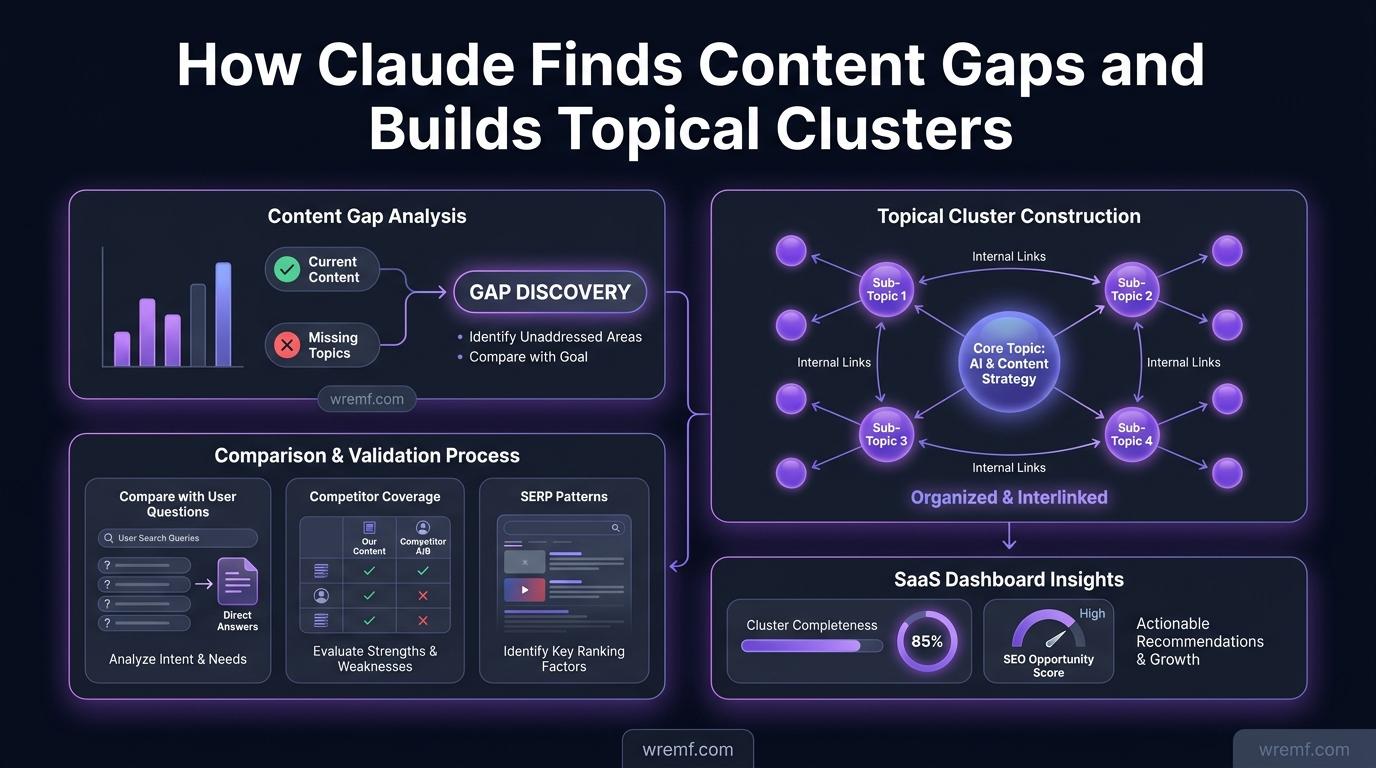
Claude finds content gaps by comparing your existing pages with user questions, competitor coverage, SERP patterns, and AI answer requirements. Claude helps build topical clusters by organising related topics around entities, intent, and internal linking.
Content gaps are missing topics, answers, proof points, examples, or formats that prevent a site from satisfying search intent. Content gaps matter because incomplete coverage can weaken search engine rankings, AI citations, and buyer trust.
Content gap analysis is the process of comparing your content against what users, competitors, and search systems expect. Content gap analysis matters because a page may rank for one query but still fail to answer the follow-up questions that drive decisions.
Claude can compare your existing SEO content against competitor pages and identify missing definitions, examples, FAQs, statistics, internal links, schema markup, entity explanations, and decision tables. This is especially useful when you provide Markdown files, exported HTML text, spreadsheet rows, or repository files.
Topical clusters are groups of related pages that cover a subject in depth and connect through internal linking. Topical clusters matter because search systems and AI systems need enough connected context to understand authority on a topic.
Topical clustering is the process of grouping related keywords, questions, pages, and entities into a structured content system. Claude can support topical clustering by proposing pillar pages, supporting pages, glossary pages, comparison pages, use case pages, and FAQ expansions.
Content's topical authority depends on depth, accuracy, entity clarity, internal linking, and consistent coverage. Claude can improve content's topical authority by identifying where a page needs stronger definitions, named sources, expert examples, or more precise comparisons.
For a Claude SEO cluster, useful pages may include Claude for keyword research, Claude for Technical SEO audits, Claude Code for SEO automation, Claude vs ChatGPT for SEO content, Claude for structured data, Claude for internal linking, Claude for local SEO, and Claude for Google AI Overviews.
A topic gap analysis is a narrower review that focuses on which topics are missing from a content library. A topic gap analysis matters when a team already knows the market category but needs to decide which pages to publish next.
If you want to convert topic gap analysis into production-ready pages, WREMF’s AI-ready content briefs can connect prompt data, citation gaps, competitor coverage, and recommended structure into a repeatable content workflow.
KEY TAKEAWAY: Claude can reveal content gaps faster, but topical authority improves only when those gaps become structured, source-backed, internally linked content.
Once the topic structure is defined, Claude can help improve individual pages through on-page optimization and content quality review.
Using Claude as an SEO Content Optimizer
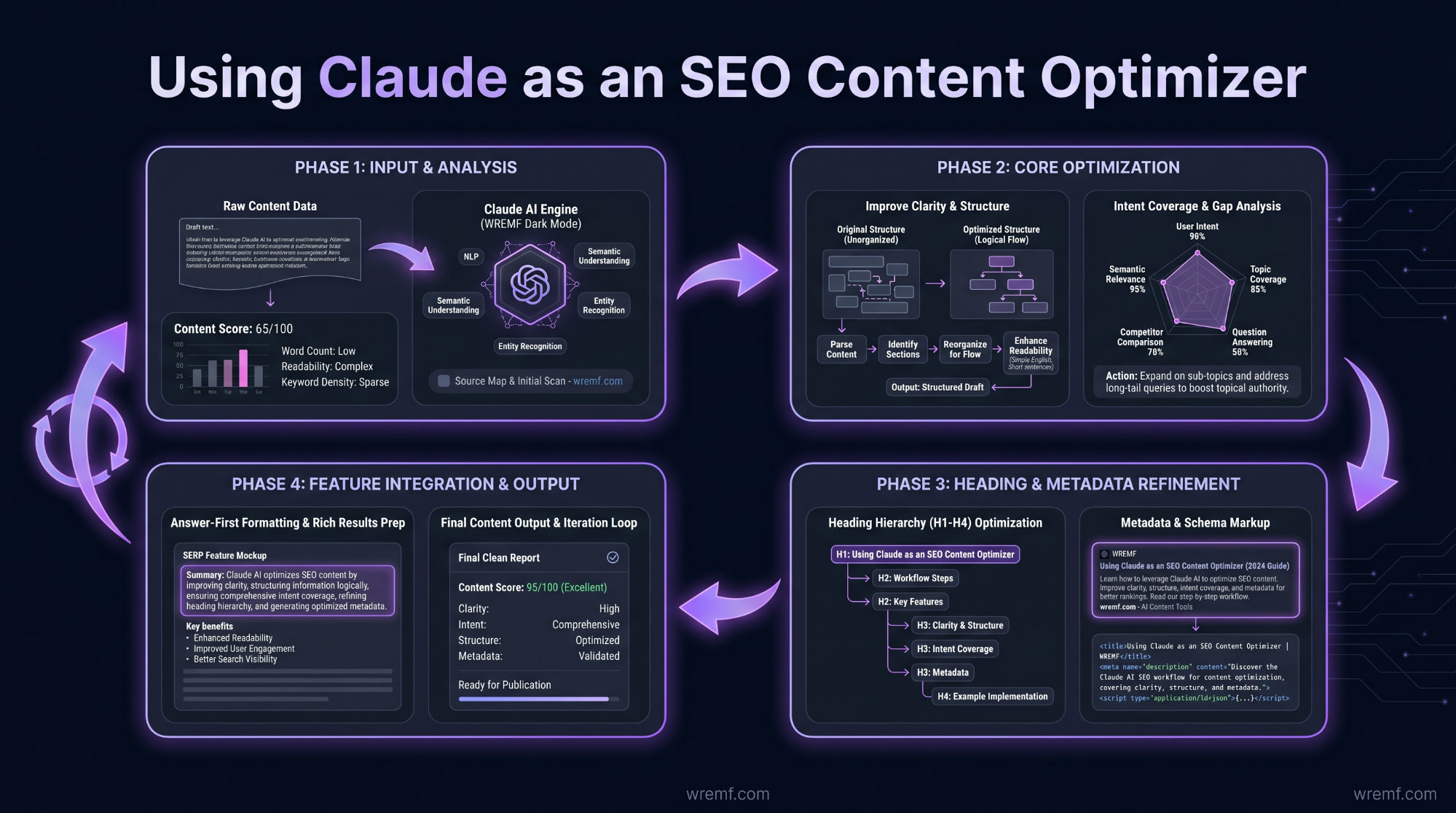
Claude can work as an SEO Content Optimizer by improving clarity, structure, intent coverage, headings, metadata, source attribution, and answer-first formatting. Claude is most effective when human editors control accuracy, expertise, and final publishing decisions.
SEO content is content designed to satisfy search intent, earn visibility, and support business goals. SEO content matters because ranking is not enough if the page does not answer the buyer’s real question.
Content optimization is the process of improving an existing page so it better matches search intent, quality expectations, and conversion goals. Content optimization matters because many SEO gains come from improving existing assets rather than publishing more pages.
Claude can improve SEO content by checking whether the introduction answers the query quickly, whether headings match user questions, whether definitions are snippet-ready, and whether the page includes enough evidence. Claude can also reduce repetition, simplify technical explanations, and make complex content easier to scan.
Google Search Central explains that appropriate use of AI or automation is not against Google Search guidelines, but using generative AI to create many pages without adding value may violate Google’s scaled content abuse policies. This means Claude can support content creation, but the output still needs accuracy, originality, usefulness, and review. (Google for Developers)
An SEO Content Optimizer workflow with Claude usually includes five steps:
Provide the target keyword, secondary keywords, audience, and business goal
Provide the current page copy, ranking pages, and content gaps
Ask Claude to identify missing intent, weak claims, and unclear sections
Ask Claude to rewrite specific sections with answer-first structure and source attribution
Review, fact-check, edit, publish, and measure the updated page
A content brief is a structured plan for a page that includes target query, intent, headings, entities, sources, internal links, examples, and conversion goal. A content brief matters because it gives Claude and human writers a shared strategy before drafting starts.
An AI content process is the repeatable workflow for using AI in research, drafting, review, publishing, and measurement. An AI content process matters because unmanaged AI content can create duplication, weak claims, and inconsistent brand voice.
Content workflow design is especially important for agencies and B2B SaaS teams. Agencies managing multiple clients often need reusable prompts, quality controls, internal linking rules, structured comparison tables, and reporting standards. In-house teams often need brand voice, product accuracy, and expert review.
KEY TAKEAWAY: Claude is useful for content optimization when it improves intent coverage and clarity under human editorial control.
Content quality is only one part of Claude SEO, because technical SEO determines whether search systems can crawl, render, and understand the page.
Technical SEO Audits With Claude, Claude Code, and Structured Data
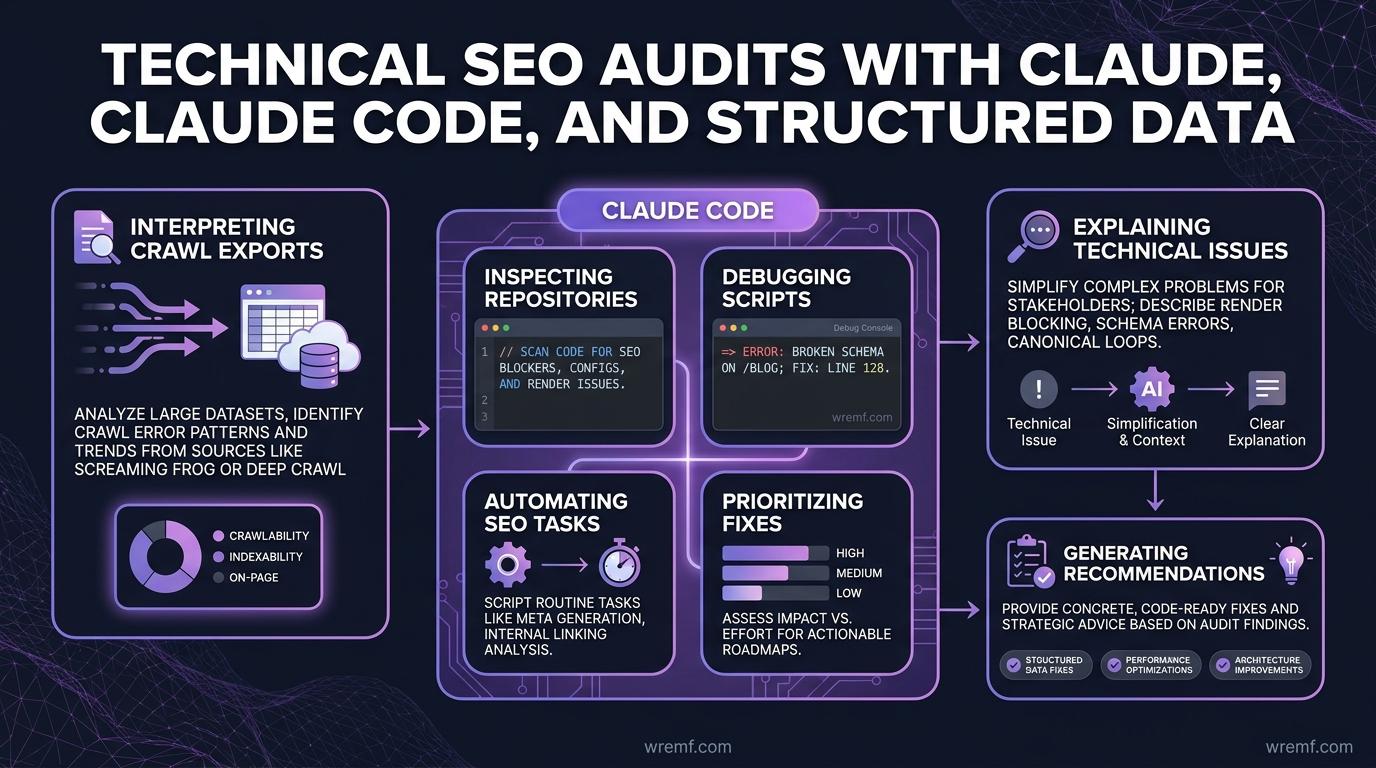
Claude can support Technical SEO audits by interpreting crawl exports, explaining technical issues, prioritising fixes, and generating structured recommendations for developers. Claude Code can extend this workflow by helping inspect repositories, debug scripts, and create repeatable SEO automation.
Technical SEO audits are structured reviews of how well a website can be crawled, rendered, indexed, and understood by search systems. Technical SEO audits matter because strong content may fail when technical barriers block discovery or interpretation.
Technical audits often include crawlability, indexability, canonical tags, hreflang tags, metadata, structured data, sitemap architecture, redirect chain issues, log files, JavaScript rendering, Page speed, PageSpeed Insights, Core Web Vitals, internal linking, and crawl budget.
Crawl budget is the amount of crawling attention search engines allocate to a site over time. Crawl budget matters most on large websites where duplicate URLs, faceted navigation, redirect chains, low-value pages, or broken templates waste crawler attention.
Log files are server records that show how bots and users request pages. Log files matter because they reveal whether Googlebot and other crawlers reach important URLs, waste time on low-value paths, or fail on key templates.
A redirect chain is a sequence where one URL redirects through multiple steps before reaching the final page. A redirect chain matters because it can slow crawling, complicate migrations, and create avoidable technical risk.
Claude Code is Anthropic’s coding environment for using Claude in software development workflows. Claude Code matters for SEO because technical SEO increasingly requires repository analysis, code inspection, route audits, metadata checks, schema generation, and automation scripts.
Python scripts are often used in SEO to clean exports, compare URLs, process logs, validate metadata, or combine crawl data with search console data. Claude can help draft Python scripts, but those scripts should be tested on sample data before production use.
Automation tools help SEO teams repeat checks across many URLs, repositories, or reporting cycles. Automation tools matter because manual audits become unreliable when a site has thousands of URLs, multiple templates, or frequent releases.
KEY TAKEAWAY: Claude and Claude Code can accelerate technical audits, but every technical recommendation needs validation through crawlers, logs, tests, and developer review.
Technical audits often reveal the same next priority: making content and entities easier for search engines and AI systems to understand.
Schema Markup, Structured Data, and Entity Clarity With Claude
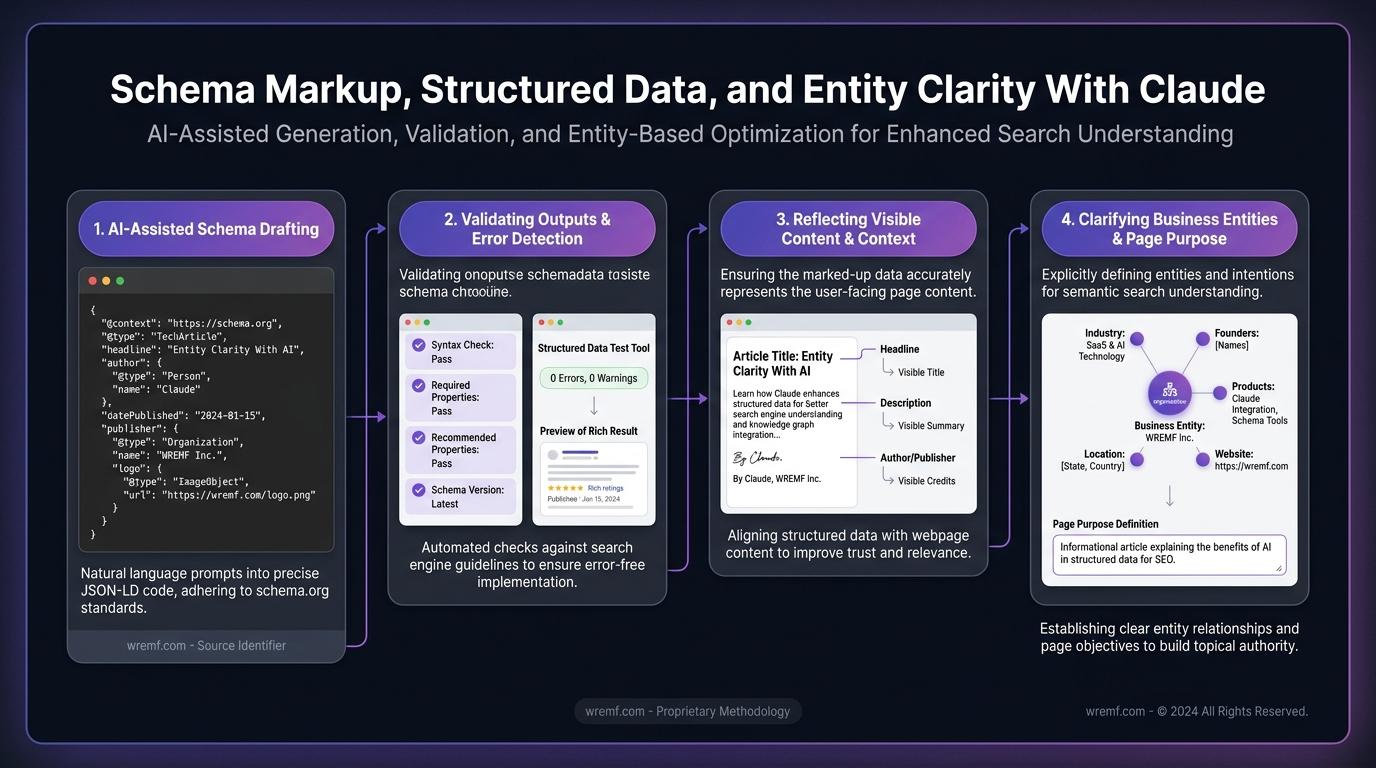
Claude can help draft schema markup and structured data, but every output must be validated before publication. Schema markup works best when it accurately reflects visible content, business entities, and page purpose.
Schema markup is structured data added to a page to help search engines understand entities, content types, products, FAQs, organisations, and relationships. Schema markup matters because it can support clearer interpretation and eligibility for richer search features when implemented correctly.
Structured data is machine-readable information that describes page content in a standard format. STRUCTURED DATA matters because search systems and AI systems benefit from clear entity relationships, attributes, and content meaning.
JSON-LD is a common format for implementing structured data on webpages. JSON-LD matters because it allows developers to describe entities and page elements in a machine-readable way without changing the visible layout.
Claude can generate draft JSON-LD for common content types, including Organisation, Article, FAQ, Product, SoftwareApplication, Service, LocalBusiness, BreadcrumbList, and HowTo. It can also compare schema markup against visible page content and flag mismatches.
Google Search Central explains that Google Search supports structured data to understand page content and enable search result features where appropriate. Google also explains that creators using generative AI should focus on quality, accuracy, metadata, and related page elements rather than automation alone. (Google for Developers)
Entity authority is the degree to which search and AI systems can understand, verify, and associate a brand with topics, products, people, locations, and expertise. Entity authority matters because AI search systems need confidence before mentioning or recommending a brand.
Structured outputs are consistent response formats that make AI-generated work easier to validate, reuse, and automate. Structured outputs matter in Claude SEO because audits, schema recommendations, content briefs, and reporting notes should be easy to convert into tickets, spreadsheets, or dashboards.
A common implementation mistake is asking Claude to generate schema markup without providing the page copy. This can produce unsupported attributes, inaccurate claims, or schema that does not match the visible page.
KEY TAKEAWAY: Claude can speed up schema markup and structured data planning, but entity accuracy and validation matter more than generating code quickly.
Once content and structured data are clear, the next priority is internal linking and site architecture.
Strategic Internal Linking and Site Architecture With Claude
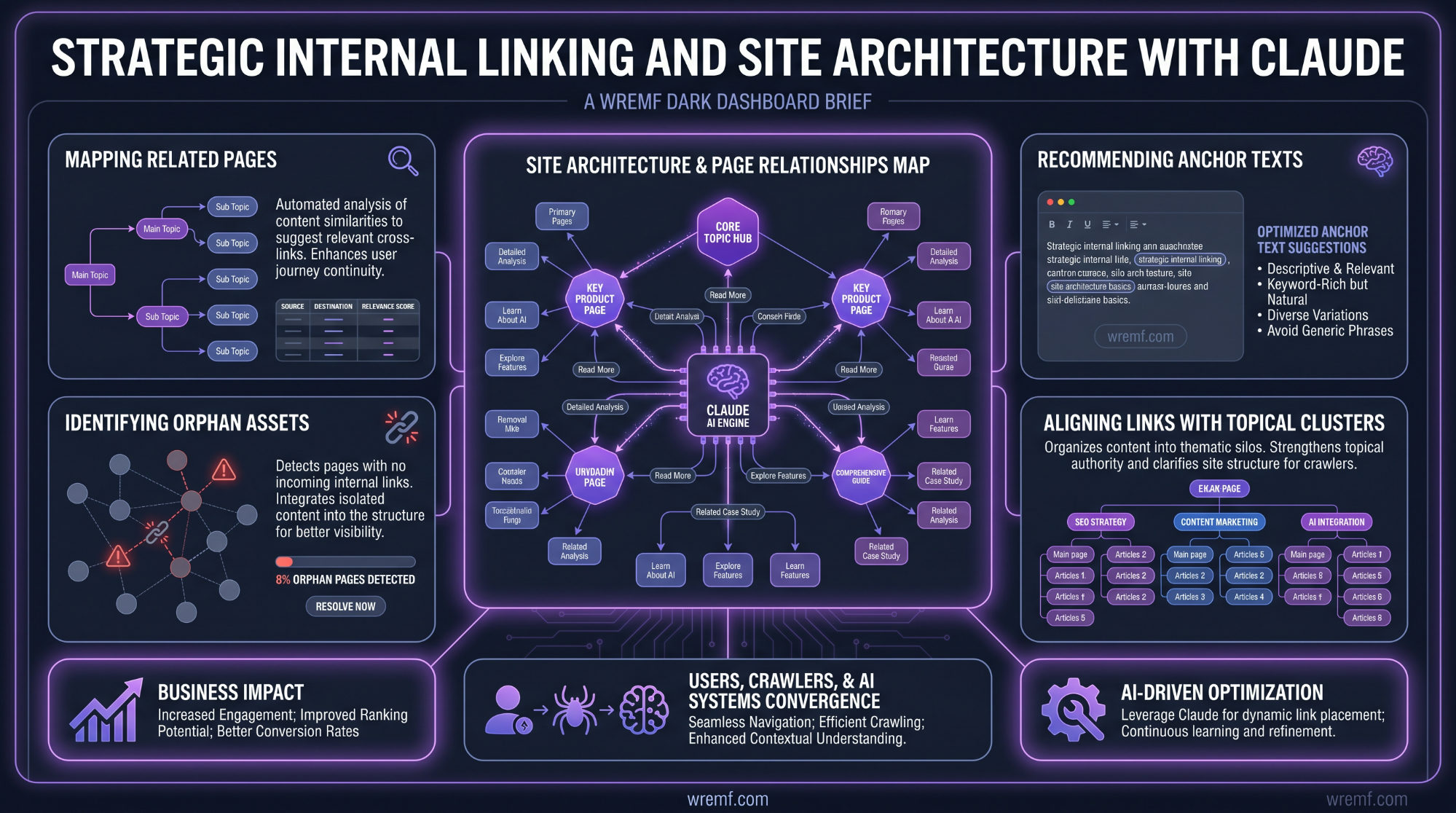
Claude improves internal linking by mapping related pages, identifying orphan assets, recommending anchors, and aligning links with topical clusters. Internal linking helps users, crawlers, and AI systems understand page relationships.
Internal linking is the practice of connecting pages on the same website through contextual links. Internal linking matters because it distributes authority, clarifies topical relationships, and guides users toward useful next steps.
Internal linking analysis is the process of reviewing how pages connect across a site. Internal linking analysis matters because strong pages often underperform when they are isolated, buried, or connected with vague anchors.
Sitemap architecture is the planned structure of important URLs across a website. Sitemap architecture matters because search engines and AI crawlers need clear access to valuable pages, especially on large sites or JavaScript-heavy front ends.
Claude can identify where a page should link based on entities, intent, funnel stage, and content gaps. For example, a Claude SEO page may link to prompt tracking, source citations, competitive landscape, GEO audits, content briefs, SEO testing, and AI visibility methodology.
Good anchor text describes the destination clearly. Anchor text such as “AI visibility tracking methodology” is more useful than “learn more” because it tells readers and crawlers what the linked page covers.
IMPORTANT: Internal linking should support real user journeys first. Forced links can make content harder to read and may reduce trust.
For AI visibility work, internal linking also helps define how your brand explains its own topic universe. WREMF’s source citation tracking helps teams understand which external sources AI engines cite, while strong internal linking helps clarify what your own site says.
KEY TAKEAWAY: Claude can design internal linking systems, but the best links are still those that help users and crawlers move through a clear topic architecture.
Strong architecture also helps Claude support AI search optimization, AEO, and GEO.
Claude SEO for Google AI Overviews, AEO, GEO, and Featured Snippets
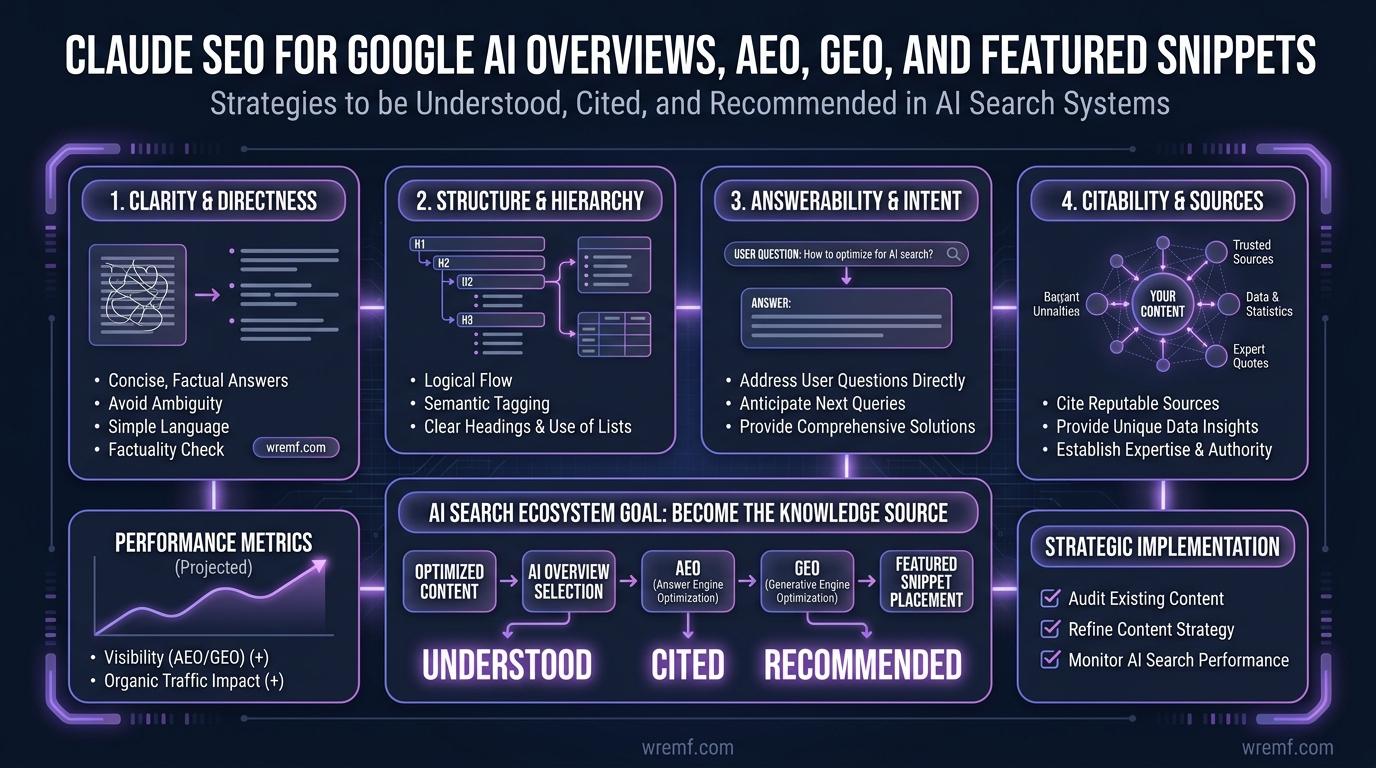
Claude SEO supports Google AI Overviews, AEO, and GEO by making content clearer, more answerable, more structured, and more citable. The goal is not only to rank, but to be understood, cited, and recommended.
Answer Engine Optimization is the process of making content easier for answer engines to extract, summarise, and cite. Answer Engine Optimization matters because users ask direct questions in Google, Claude, ChatGPT, Gemini, Perplexity, Copilot, and voice assistants.
Generative Engine Optimization is the process of improving how a brand appears in AI-generated answers, comparisons, summaries, and recommendations. Generative Engine Optimization matters because AI systems often synthesize information from multiple sources before naming or citing a brand.
AI search optimization is the broader practice of improving visibility across AI discovery surfaces. AI search optimization includes Answer Engine Optimization, Generative Engine Optimization, AI citations, prompt tracking, entity clarity, source consistency, structured content, and AI traffic attribution.
Google AI Overviews are AI-generated snapshots in Google Search that provide key information and links for further exploration. Google Search Central explains that AI features such as AI Overviews and AI Mode are part of Google Search experiences from a site owner perspective. Google’s AI Overviews page also says AI Overviews are available in more than 120 countries and territories and 11 languages. (Google for Developers)
Featured snippets are selected search result extracts that answer a query directly on Google. Featured snippets matter because many answer-first patterns that help snippets also help AI systems identify concise, useful passages.
Passage-level citability is the ability of a specific section or paragraph to be quoted, summarised, or cited independently. PASSAGE-LEVEL CITABILITY matters because AI systems often retrieve and use passages rather than entire pages.
Claude can improve passage-level citability by rewriting sections so each paragraph includes a direct answer, a supporting fact, and a clear implication. This makes the content easier for readers to scan and easier for AI systems to summarise.
Source consistency is the alignment of brand facts across your website, third-party profiles, directories, documentation, review sites, and knowledge sources. Source consistency helps AI systems connect the same brand, claims, products, and expertise across multiple trusted sources.
If you want to see how AI engines currently describe your brand, review a sample AI visibility report before building your own measurement workflow.
KEY TAKEAWAY: Claude can make content easier for AI systems to parse, but AEO and GEO require measurement across prompts, citations, competitors, and source consistency.
The next section compares Claude with ChatGPT, Perplexity, and classic SEO tools so you can choose the right tool for each job.
Claude vs ChatGPT vs Perplexity vs SEO Tools for Search Work
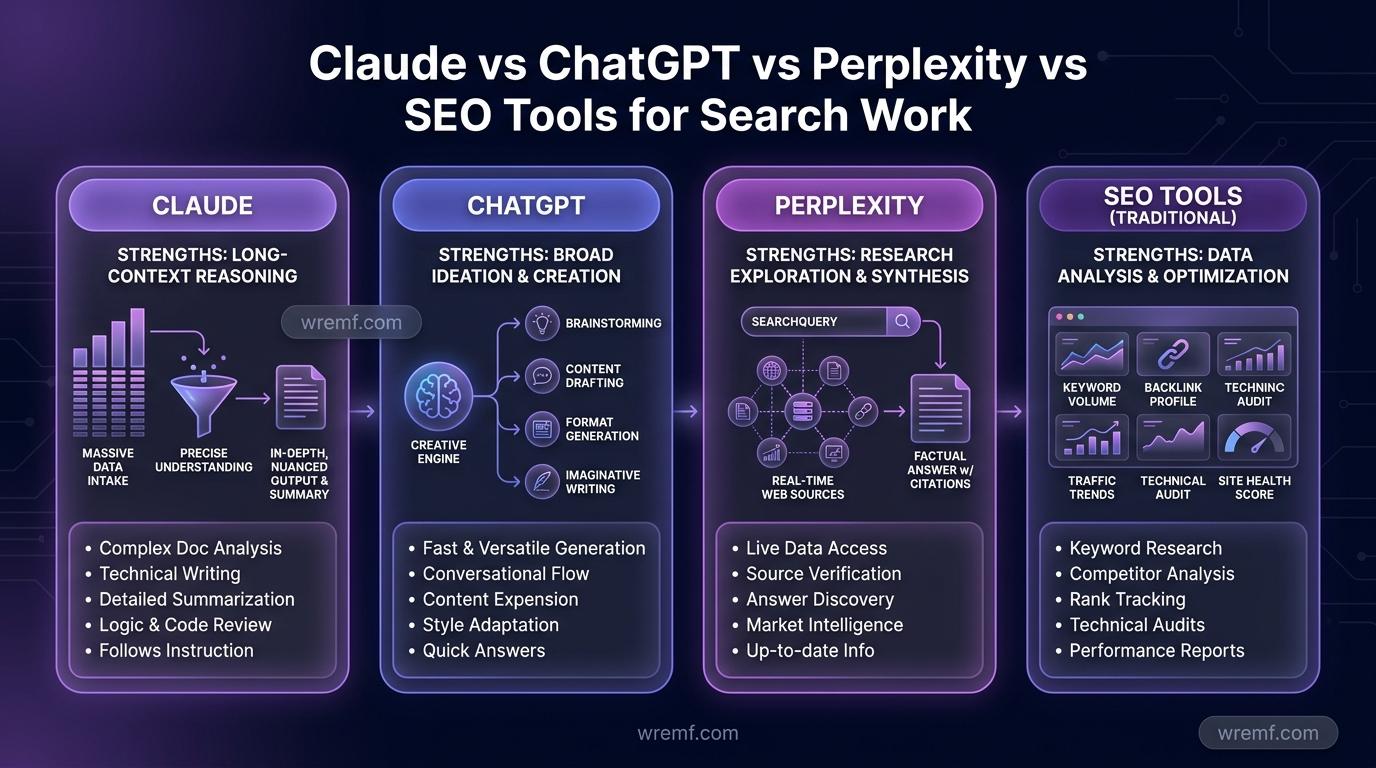
Claude is strongest for long-context reasoning, structured analysis, brand voice, and complex SEO workflows. ChatGPT, Perplexity, and SEO platforms still matter because each tool solves a different part of the SEO and AI visibility problem.
The best LLM for SEO content depends on the task. Claude is strong for long-form synthesis and reasoning, ChatGPT is strong for broad ideation and tool ecosystems, Perplexity is strong for research-style answer exploration, and SEO tools are strongest for keyword, backlink, and search engine data.
ChatGPT is OpenAI’s AI assistant and model interface. ChatGPT matters for SEO because many users ask it for recommendations, comparisons, definitions, and vendor shortlists.
Perplexity is an AI answer engine that combines generated answers with cited web sources. Perplexity matters for SEO because its citation model makes source visibility easier to inspect than in some closed answer systems.
A backlink profile is the set of external links pointing to a website. A backlink profile matters because links can influence authority, discovery, and trust signals in traditional search.
Backlink profiles are still better measured by SEO platforms than by Claude alone. Claude can interpret backlink profile exports, but it should not be treated as a live index of links.
| Option | Best For | What It Measures Or Supports | What It Misses | Recommended When |
|---|---|---|---|---|
| Claude | Long-context reasoning and structured SEO analysis | SEO workflow planning, content analysis, technical explanation, Claude Code support | Live keyword data, live backlink profile data, native rank tracking | You need reasoning across many documents or datasets |
| ChatGPT | Ideation, drafting, and flexible workflow support | Content creation, prompt testing, broad synthesis, workflow automation | Citation consistency varies by mode and source access | You need flexible AI assistance across many tasks |
| Perplexity | Research and cited answer exploration | SERP-style answer synthesis, cited sources, competitor mentions | Full technical crawling and site-wide SEO auditing | You need to inspect sources used in AI-style answers |
| Ahrefs or Semrush | Traditional SEO data | Keyword research, backlink profiles, competitor analysis, rank tracking | Multi-engine AI answer visibility | You need search engine data and link intelligence |
| WREMF | AI visibility tracking and action workflows | Prompt tracking, source citations, competitor visibility, AI share of voice, recommendations | It does not replace expert judgment or publishing discipline | You need to track, improve, and prove AI visibility |
For most B2B teams, the best option is not one tool. Use Claude for reasoning, use SEO tools for search engine data, use crawlers for technical evidence, and use WREMF for AI visibility tracking across engines.
Claude vs ChatGPT vs Perplexity is the wrong question if your goal is measurable growth. The better question is which tool handles each layer of the SEO workflow.
KEY TAKEAWAY: Claude is a powerful SEO reasoning tool, but it should be paired with search data, technical crawlers, and AI visibility measurement platforms.
The comparison becomes even clearer when you separate classic SEO metrics from AI visibility metrics.
Traditional SEO Metrics vs AI Visibility Metrics
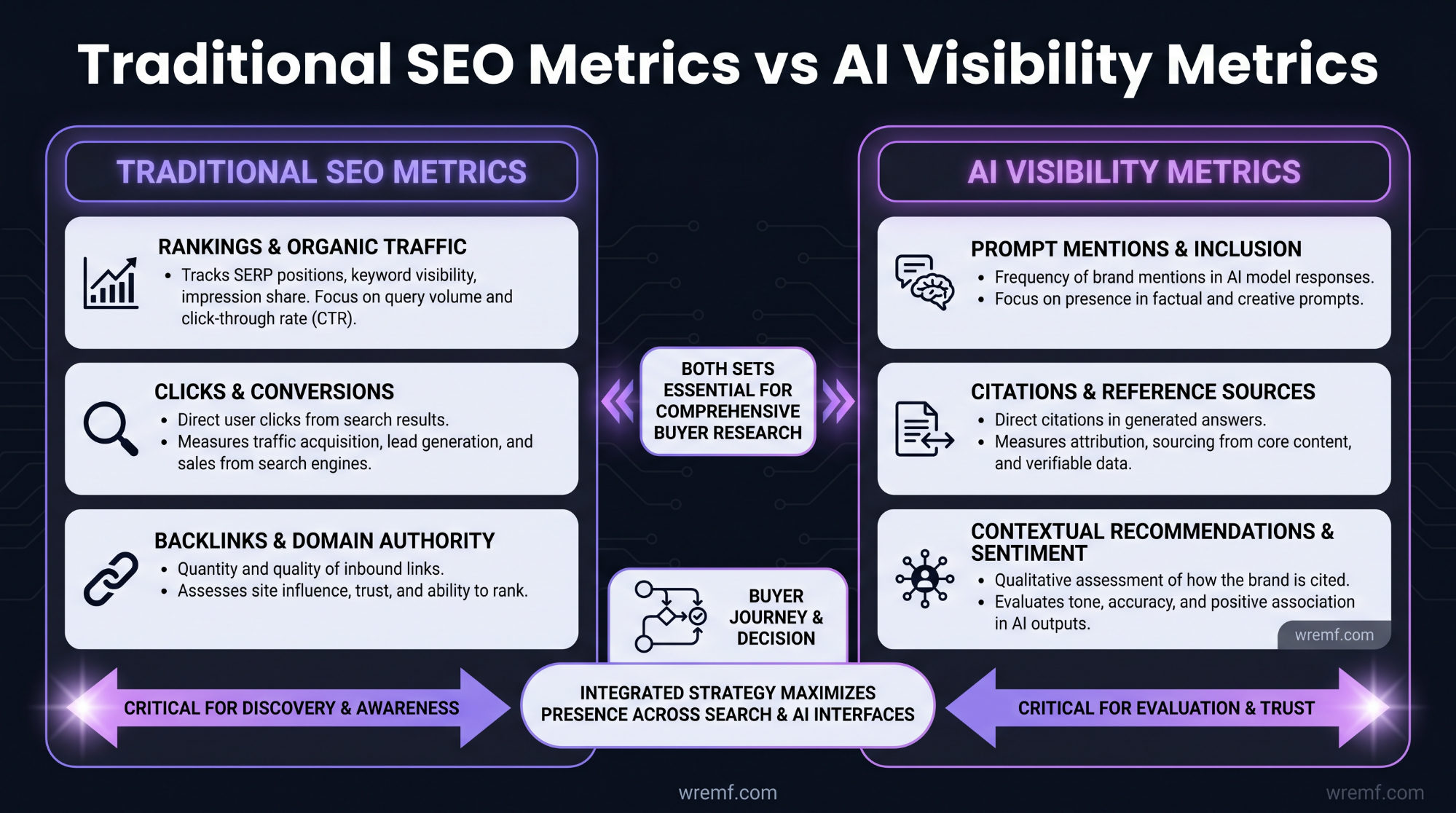
Traditional SEO metrics show how a site performs in search engines, while AI visibility metrics show how a brand appears in AI-generated answers. Both matter because buyers use both search results and AI assistants during research.
Search engine rankings measure where URLs appear for specific queries in traditional search results. Search engine rankings matter because Google still drives discovery, but rankings alone do not show whether Claude, ChatGPT, Perplexity, Gemini, or Google AI Overviews recommend your brand.
AI citations are references or source links used by AI systems to support generated answers. AI citations matter because they reveal which sources influence AI answers and whether your brand is included in the evidence layer.
Brand mentions are references to a company, product, or service inside search results, AI answers, third-party pages, or public sources. Brand mentions matter because AI systems can discuss a brand even when they do not link to it.
AI share of voice measures how often a brand appears compared with competitors across prompts, engines, and categories. AI share of voice matters because B2B buyers often ask comparative questions before visiting vendor websites.
AI traffic attribution connects AI discovery surfaces to website sessions, conversions, pipeline, or assisted revenue where tracking is possible. AI traffic attribution matters because leadership needs to understand whether AI visibility contributes to business outcomes.
| Metric Type | Example Metric | What It Shows | What It Misses | Best Used For |
|---|---|---|---|---|
| Traditional SEO | Rankings, clicks, impressions, CTR | How pages perform in search engines | AI answer mentions without clicks | Search performance reporting |
| Technical SEO | Crawl errors, index coverage, Core Web Vitals | Whether pages can be discovered and used | Brand recommendation visibility | Site health and technical audits |
| Content SEO | Keyword coverage, content gaps, internal linking | Whether content satisfies query intent | Source influence across AI engines | Content optimization |
| AI visibility | Prompt mentions, citations, recommendations | How AI systems describe the brand | Hidden prompts not tracked | AI search monitoring |
| Business attribution | AI referral sessions, conversions, assisted pipeline | Whether visibility connects to outcomes | No-click AI influence | Leadership reporting |
Brand recommendation visibility measures whether AI systems recommend a brand for relevant buying prompts. Brand recommendation visibility matters because a brand can rank well in Google but still be absent from AI-generated vendor shortlists.
Prompt tracking shows how a brand appears across repeated AI queries over time. Prompt tracking matters because AI answers can vary by engine, prompt wording, geography, timing, and cited sources.
WREMF’s prompt intelligence helps teams monitor high-value prompts across multiple AI engines. This is important because manual testing is inconsistent and difficult to scale.
KEY TAKEAWAY: Traditional SEO metrics explain search performance, while AI visibility metrics explain how AI systems mention, cite, and recommend a brand.
After measurement is defined, the next step is connecting Claude to live data and automation workflows.
Advanced Claude SEO Workflows With Model Context Protocol, MCP, and AI Agents
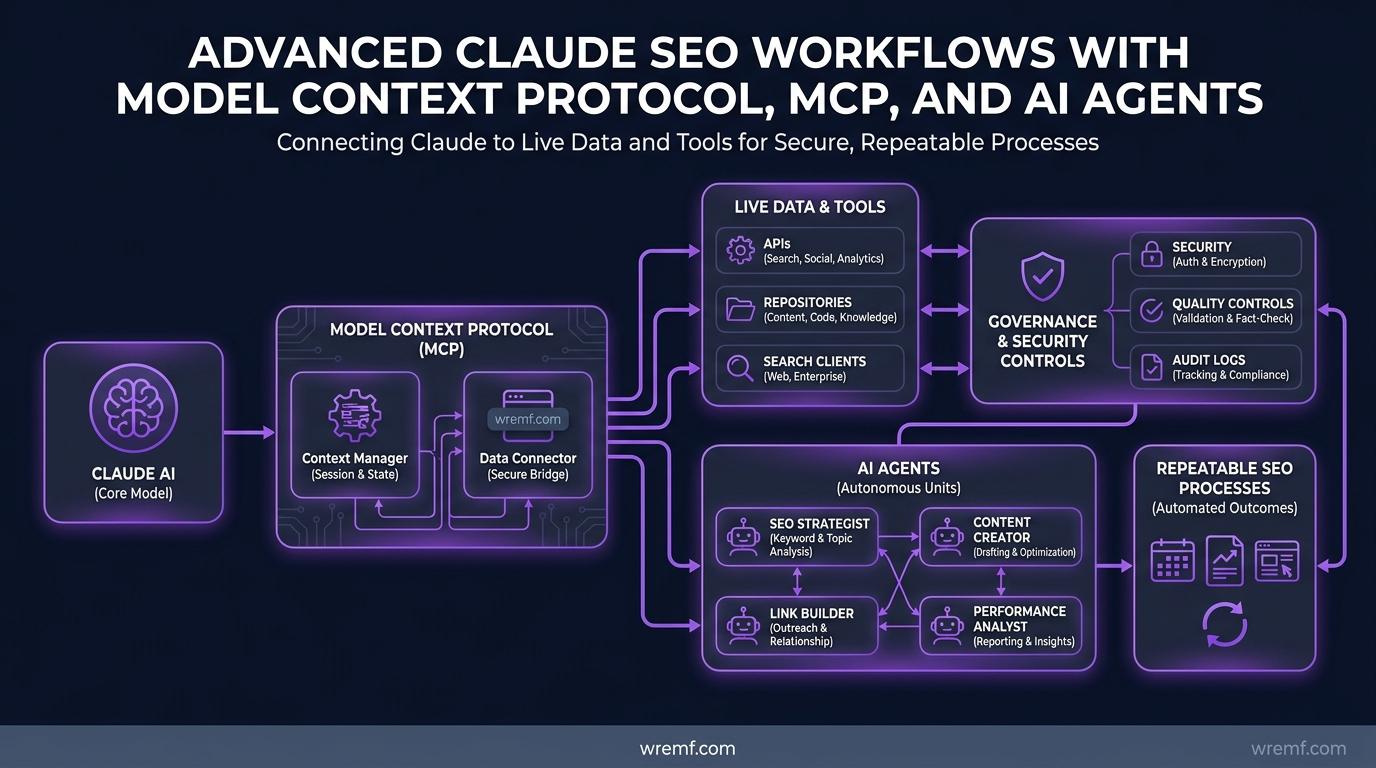
Advanced Claude SEO workflows use MCP, APIs, repositories, and AI agents to connect Claude with live data, tools, and repeatable processes. These workflows are powerful when they are governed by security, review, and clear quality controls.
Model Context Protocol is an open standard for connecting AI applications to external data sources and tools. Anthropic introduced MCP as a way to build secure two-way connections between data sources and AI-powered tools. The official MCP documentation describes MCP as a standard for connecting AI applications such as Claude or ChatGPT to data sources, tools, and workflows. (Anthropic)
Perplexity MCP, Ahrefs MCP, and search console integrations can help SEO teams connect AI workflows to live or semi-live data. Perplexity MCP is useful for research-style source exploration, Ahrefs MCP is useful when backlink and keyword data are available through connected workflows, and Google SEO APIs are useful for search performance analysis.
An API connection is a structured way for one system to exchange data with another system. API connection quality matters because Claude’s recommendations improve when it can access reliable, relevant, and current data.
AI agents are AI systems that can use tools, follow multi-step instructions, and complete workflow tasks with varying degrees of autonomy. AI AGENTS matter for SEO because large workflows often involve data retrieval, analysis, ticket creation, content updates, and reporting.
Claude Skills are modular capabilities that package instructions, metadata, and optional resources so Claude can perform specialised tasks more consistently. Anthropic’s Agent Skills documentation explains that skills can package instructions, scripts, templates, and other resources used automatically when relevant. (Claude)
A Claude SEO Skill could include instructions for technical audits, keyword clustering, content gap analysis, internal linking analysis, schema markup checks, and content brief creation. A Claude SEO Skill is useful when an agency or in-house team needs repeatable quality across many pages or clients.
Claude Project workflows can organise documents, prompts, and reference materials around a specific SEO initiative. A Claude Project is useful when a team needs a shared workspace for audits, content plans, Project Deck Presentation materials, Markdown files, and implementation notes.
Claude Cowork is Anthropic’s system for multi-step knowledge work across files, folders, and applications. Anthropic describes Claude Cowork as outcome-oriented rather than prompt-oriented, which makes Claude Cowork relevant for repeatable SEO tasks such as research synthesis, report preparation, and content workflow coordination. (Anthropic)
Claude Cowork does not remove the need for review. Claude Cowork can help coordinate complex work, but SEO teams still need to verify claims, inspect source data, review recommendations, and approve implementation.
NoCode SaaS teams may use Claude, Claude Code, Claude Project, Claude Cowork, automation tools, and API workflows to manage SEO operations without building a full internal platform. NoCode SaaS workflows can work well for prototypes, but mature SEO systems need permissions, validation, logging, and version control.
WREMF supports technical teams with API and MCP workflows for AI visibility tracking, reporting, and integrations. That makes WREMF useful for teams that want Claude-assisted analysis connected to repeatable AI search monitoring.
KEY TAKEAWAY: MCP, Claude Skills, Claude Code, Claude Project, Claude Cowork, and AI agents can scale SEO workflows, but governance and validation are essential.
Automation becomes especially powerful when Claude is connected to site repositories and technical data sources.
Using Claude Code, GitHub, and Repositories for SEO Engineering
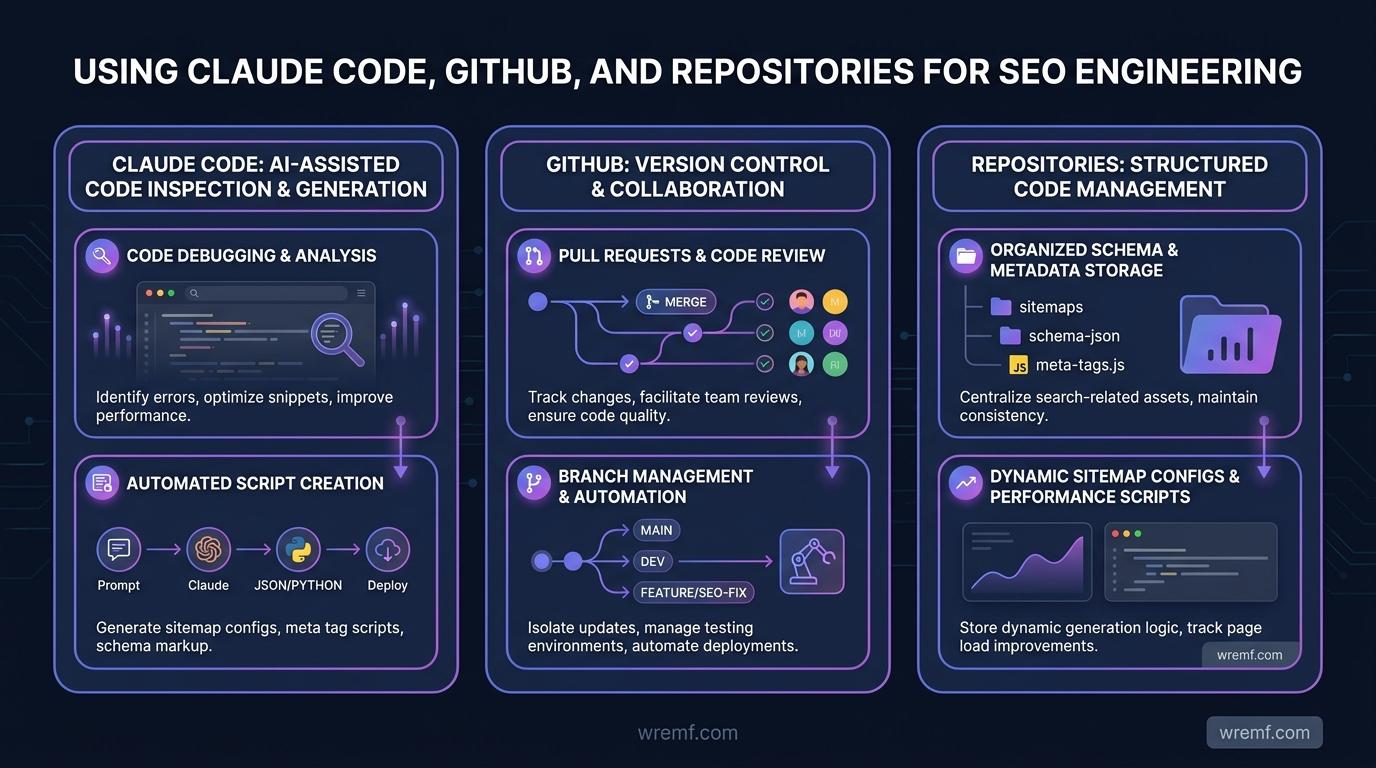
Claude Code helps SEO engineers inspect code, debug technical issues, and create scripts for repeatable SEO checks. It is especially useful when SEO work depends on templates, routes, metadata components, structured data, and repository files.
GitHub is a code hosting and collaboration platform used to manage repositories, branches, issues, and pull requests. GitHub matters for SEO because many technical SEO fixes now happen inside code repositories rather than inside content management systems.
Repositories are structured collections of code, configuration, documentation, and project files. Repositories matter for SEO because metadata, canonical logic, schema markup, redirects, sitemap generation, and front-end rendering often live in code.
Search code workflows help SEO teams find where title tags, meta descriptions, schema components, canonical tags, redirect rules, and page templates are generated. Search code matters because fixing SEO issues at the template level is usually more scalable than editing one URL at a time.
Repository files navigation matters when Claude Code needs to understand how a site is structured. A technical SEO engineer may ask Claude Code to inspect routing files, metadata components, sitemap generators, Tailwind CSS templates, Markdown files, and build configuration.
Tailwind CSS is a utility-first front-end styling framework. Tailwind CSS matters for SEO only when front-end implementation affects usability, layout stability, accessibility, or Core Web Vitals.
Core Web Vitals are Google page experience metrics focused on loading, interactivity, and visual stability. CORE WEB VITALS matter because they affect user experience and can influence search performance in competitive environments.
Page speed is the measured and perceived speed of a page experience. Page speed matters because slow pages can reduce engagement, conversions, and crawl efficiency.
Claude can help interpret PageSpeed Insights output and suggest likely code-level fixes. However, developers should test performance changes in the actual environment because AI-generated front-end recommendations may not reflect the full build system.
Claude Code can also support NoCode SaaS teams that use generated front-end code, hosted databases, and workflow automation. It can inspect generated code, explain TypeScript errors, identify metadata gaps, and help prepare pull requests for SEO fixes.
A Project Deck Presentation can summarise technical SEO issues, stakeholder priorities, implementation tickets, and expected measurement windows. A Project Deck Presentation is useful when SEO teams need to communicate work to founders, developers, marketing leaders, and clients.
KEY TAKEAWAY: Claude Code is valuable for SEO engineering when it helps inspect real code, generate testable fixes, and document implementation steps.
Once technical implementation is covered, Claude can help with competitor analysis and SERP synthesis.
Claude for SERP Overview, Competitor Analysis, and Backlink Profile Review
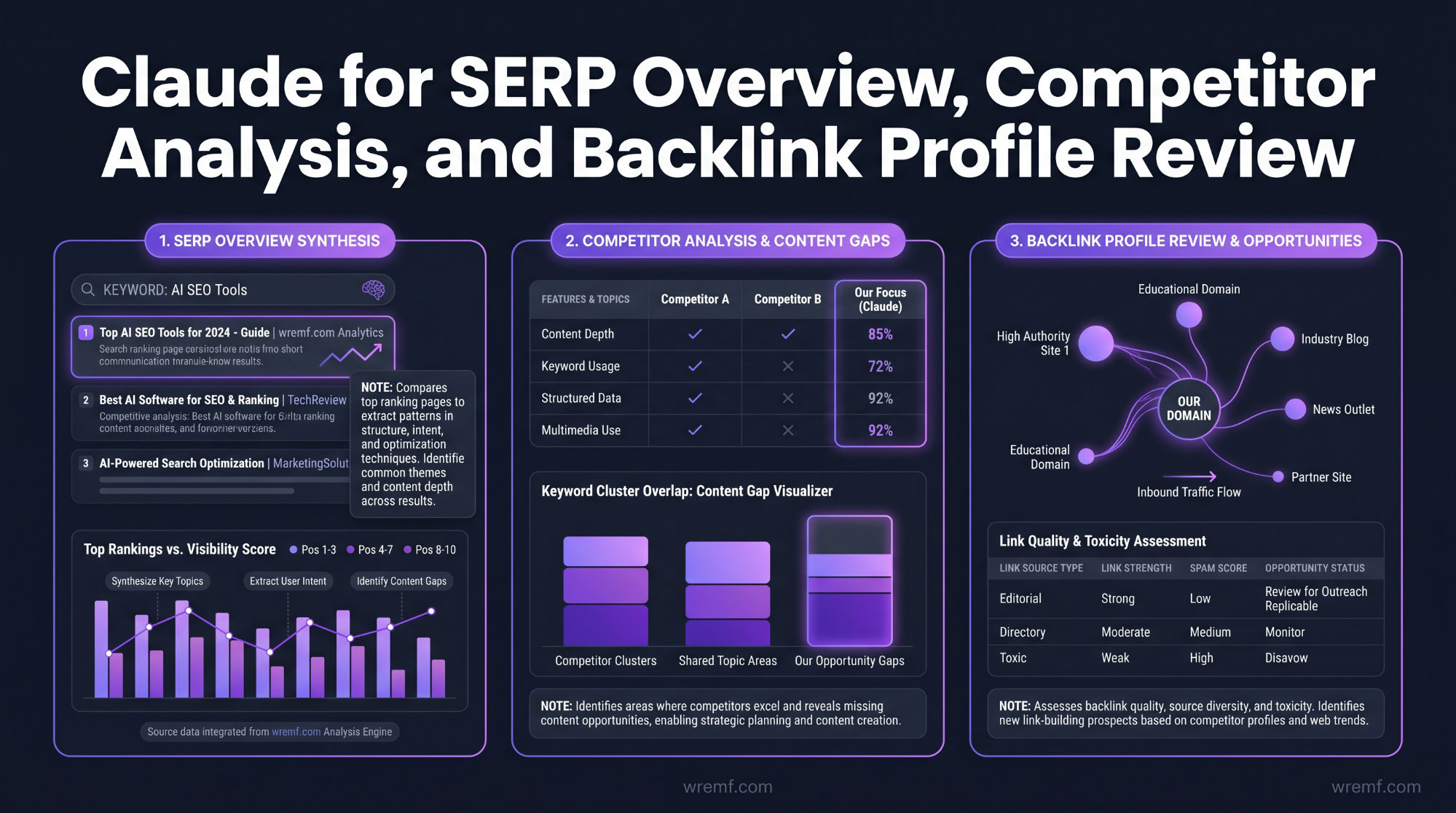
Claude can support SERP overview synthesis and competitor analysis by comparing ranking pages, extracting common patterns, and identifying missing proof points. It should interpret evidence from search results, not invent search results.
A SERP overview is a structured summary of the pages, formats, entities, and angles appearing in search results for a query. A SERP overview matters because it shows what Google currently rewards and what users expect.
Competitor analysis is the process of comparing your content, technical setup, authority, and positioning against competing sites. Competitor analysis matters because SEO performance is relative to what other pages offer for the same intent.
Claude can compare top-ranking pages and summarise common sections, unique angles, missing topics, source quality, internal linking patterns, structured comparison tables, and FAQ coverage. It can also identify whether competitors focus on beginner education, technical implementation, commercial selection, or thought leadership.
Backlink profile review is the process of analysing the quality, relevance, and distribution of links pointing to a site. A backlink profile review matters because authority signals can influence search visibility and trust.
Backlink profiles should be exported from reliable SEO platforms before Claude reviews them. Claude can group referring domains by relevance, flag suspicious patterns, summarise anchor text themes, and identify authority gaps, but it cannot replace a live backlink index.
Content analysis is the process of evaluating structure, intent coverage, quality, evidence, readability, and conversion fit. Content analysis matters because a page can be technically indexed but still fail to satisfy users.
Claude can also compare content quality across competitors. Content quality includes accuracy, usefulness, originality, structure, source support, and experience signals. Google’s helpful content guidance is relevant here because people-first value matters more than surface-level optimization.
Marketing teams often find that competitor pages win because they are clearer, not because they are longer. Claude can show where a competitor defines a term faster, explains tradeoffs better, or answers a buying question more directly.
WREMF’s competitive landscape helps teams compare how brands appear across AI answers, prompts, and competitors. This gives Claude-assisted competitor analysis a measurement layer beyond traditional SERPs.
KEY TAKEAWAY: Claude improves competitor analysis by synthesising evidence, but the evidence should come from live SERPs, SEO platforms, crawl data, and AI visibility reports.
Competitor analysis becomes more actionable when it feeds a repeatable content plan.
Claude for Content Plans, Content Briefs, and Project Deck Presentation Workflows
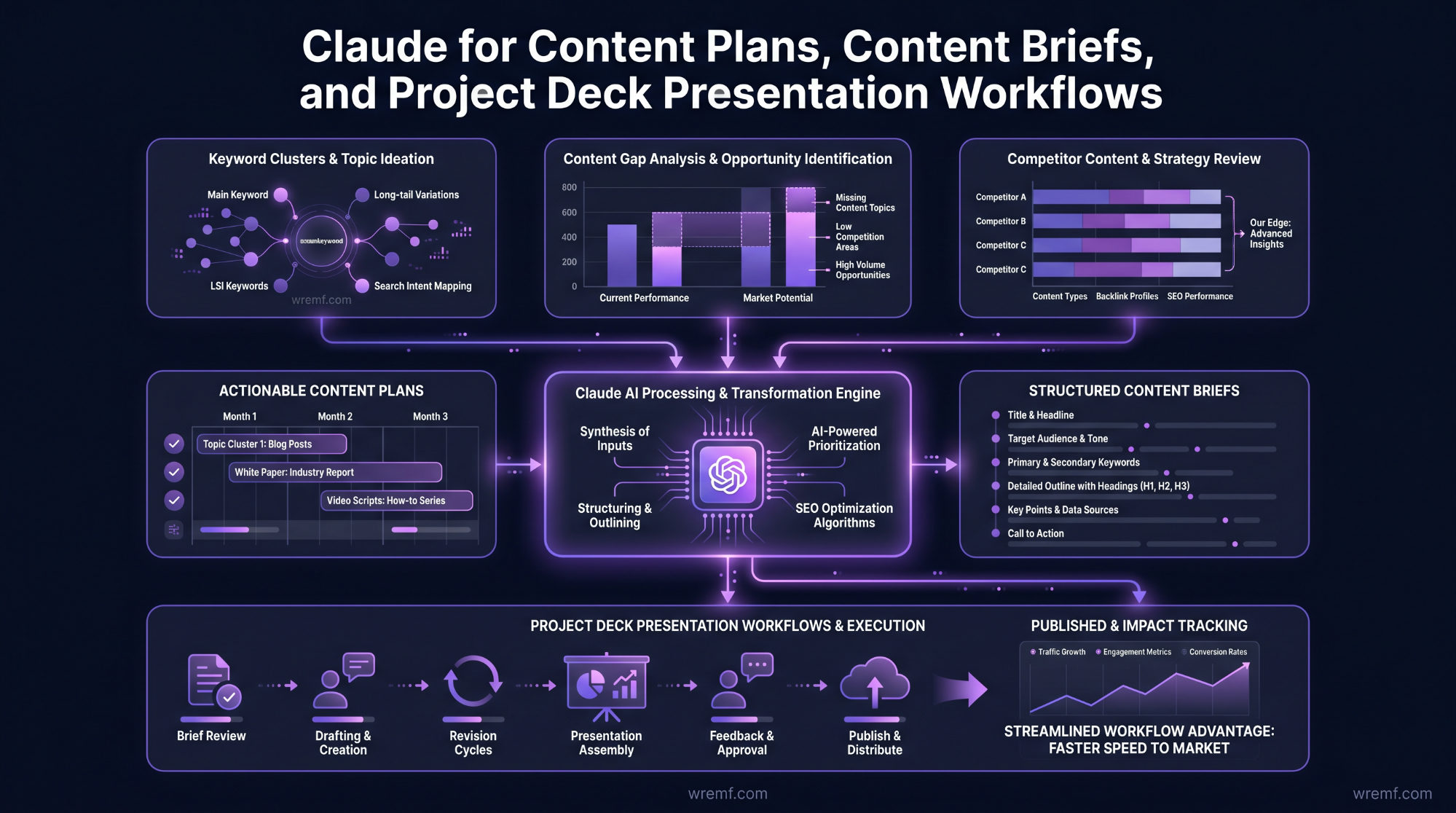
Claude can turn keyword clusters, content gaps, and competitor analysis into content plans, content briefs, and stakeholder-ready Project Deck Presentation materials. This helps teams move from research to execution faster.
A content plan is a prioritised roadmap of pages, updates, and supporting assets needed to grow search visibility. A content plan matters because SEO teams need to sequence work based on impact, effort, intent, and business value.
A content brief is a page-level plan that tells writers and editors what to create. A content brief matters because it reduces ambiguity around target keyword, audience, intent, entities, internal links, external sources, examples, and conversion goal.
Claude can generate content brief drafts from keyword research, SERP overview notes, competitor analysis, and WREMF prompt data. A strong content brief should include the target keyword, secondary keywords, search intent, H1, H2 sections, FAQs, internal links, external source suggestions, entity list, and quality standards.
Project Deck Presentation materials help teams communicate SEO plans to stakeholders. A Project Deck Presentation may include the business problem, search opportunity, technical constraints, content priorities, AI visibility risks, implementation plan, timeline, and reporting framework.
Claude can help create a Project Deck Presentation from audit notes, crawl data, search console trends, and content gap analysis. Project Deck Presentation workflows are useful when SEO work needs approval from founders, developers, product managers, or agency clients.
Maker Access, Substack Notes, LinkedIn, Newsletter workflows, and content marketing systems can also connect to Claude-assisted content planning. These channels should support the main search strategy rather than fragment it.
Ahrefs blog style analysis, competitor blog analysis, and SERP overview synthesis can help Claude identify proven content patterns. The goal is not to copy competitors. The goal is to understand what the search market expects and then produce a better, more useful answer.
A common mistake is asking Claude for a 90-day content plan without giving it business priorities. A better workflow gives Claude ICP, product pages, revenue priorities, existing rankings, content inventory, and competitive gaps.
KEY TAKEAWAY: Claude can turn research into briefs and stakeholder materials, but prioritisation must come from business goals and search evidence.
The same structured approach applies to local SEO and multi-location search strategy.
Claude for Local SEO, Review Sentiment, and Multi-Location Strategy
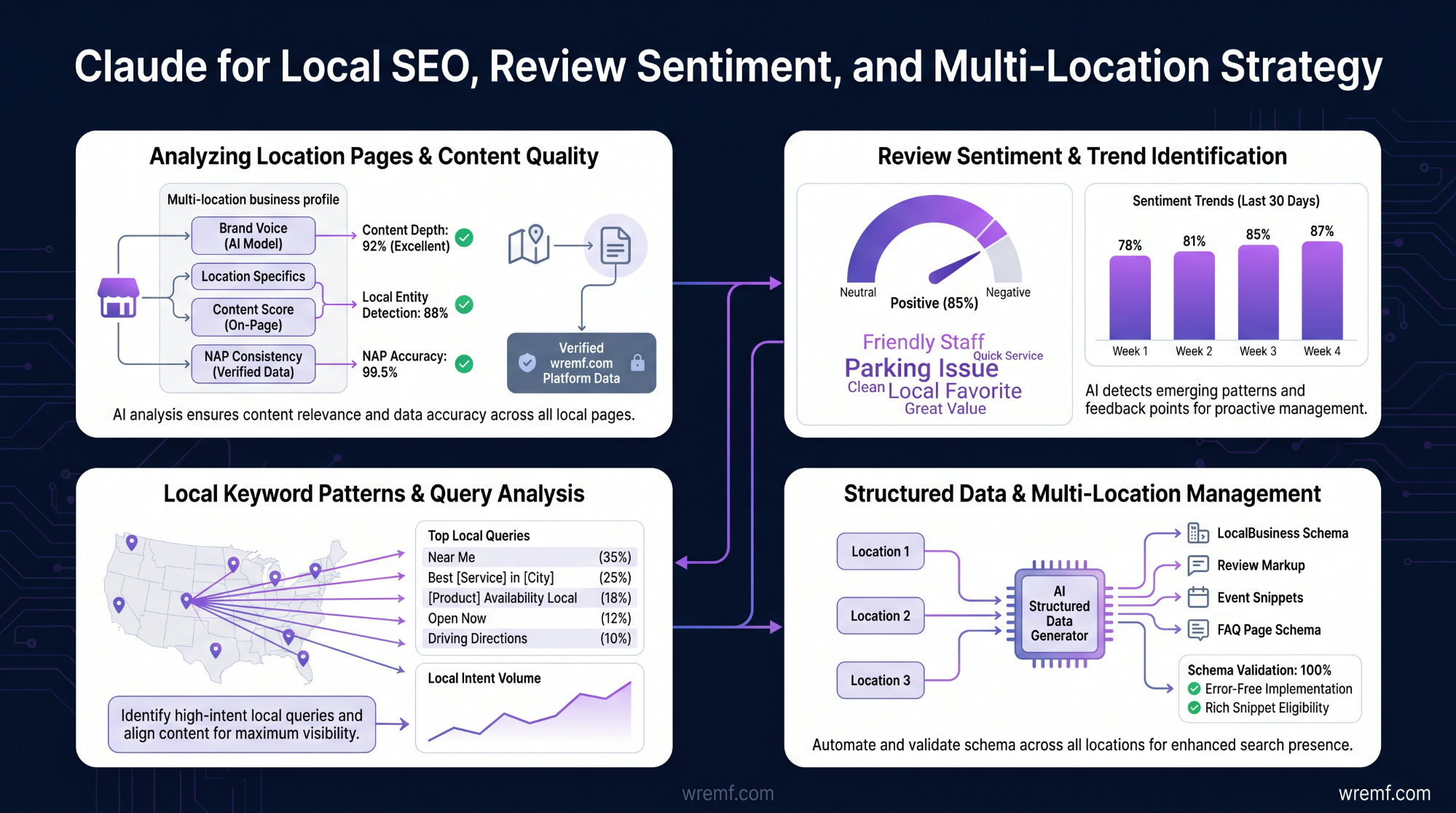
Claude can support local SEO by analysing location pages, review sentiment, local keyword patterns, service-area content, and structured data for local business entities. Local SEO still requires accurate business data and platform-level verification.
Local SEO is the practice of improving visibility for location-based searches. Local SEO matters because users often search for services, vendors, offices, or providers in a specific city, region, or country.
Google Business Profile, formerly Google My Business, is a Google platform for managing how local organisations appear across Google Search and Maps. Google My Business signals still matter in user language because many people use the old term when searching for local SEO guidance.
Review sentiment is the analysis of recurring themes in customer reviews. REVIEW SENTIMENT matters because local search users and AI systems may use reviews to understand trust, service quality, complaints, and strengths.
Local Business structured data helps describe local entities, addresses, service areas, opening hours, and contact details. LOCAL BUSINESS structured data matters when a site needs to clarify location-specific information in a machine-readable format.
Claude can analyse reviews, group positive and negative themes, identify service phrases, and suggest content updates for location pages. For example, Claude may find that reviews repeatedly mention “fast response,” “clear pricing,” or “poor communication,” then recommend page copy that addresses these themes honestly.
Claude can also help manage multi-location content without duplicating thin pages. It can identify where pages need unique service details, local proof, city-specific FAQs, and internal links to relevant service pages.
Hreflang tags are HTML annotations that help search engines understand language and regional versions of pages. Hreflang tags matter for international sites that target multiple languages or markets.
A local SEO workflow with Claude should include location keyword research, local SERP overview notes, Google Business Profile data, review themes, location page audits, schema markup checks, and post-publication measurement.
KEY TAKEAWAY: Claude can improve local SEO planning, but accurate business data, real reviews, and verified local profiles remain essential.
Local SEO shows why Claude should support experts rather than replace them, which leads to quality control and human review.
The Human-in-the-Loop Framework for Claude SEO
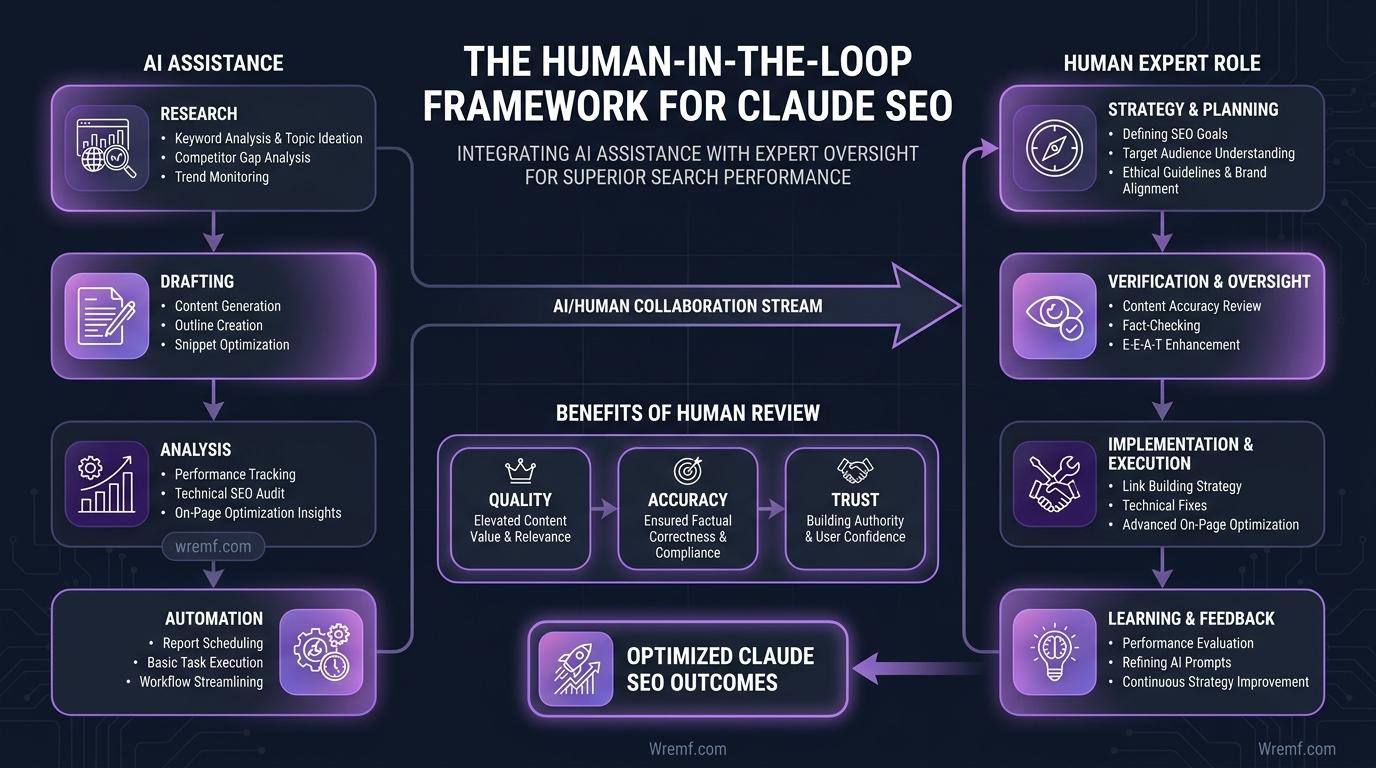
The safest Claude SEO workflow uses a human-in-the-loop process where AI assists research, drafting, analysis, and automation while experts verify facts, strategy, and implementation. Human review protects quality, accuracy, and trust.
Human-in-the-loop means humans remain responsible for reviewing, approving, and improving AI-assisted work. Human-in-the-loop matters because Claude can produce plausible but incorrect claims, outdated details, unsupported schema markup, or recommendations that do not fit the business.
Quality control is the process of checking AI-assisted SEO work for accuracy, usefulness, compliance, and measurable value. Quality control matters because search systems and users reward reliable content, not just fast content production.
Claude can support quality control by creating checklists, comparing claims to sources, flagging vague sections, finding duplicate ideas, and identifying missing user intent. However, Claude should not be the final authority on facts, legal claims, pricing, product details, or technical changes.
A practical human-in-the-loop Claude SEO workflow includes:
Data collection from trusted sources
Claude-assisted synthesis and recommendations
Expert review for accuracy and business fit
Developer or editor implementation
Measurement through search console, analytics, crawlers, and AI visibility tracking
Iteration based on results
The role of the SEO engineer is shifting from execution to architecture. SEO engineers increasingly design systems for metadata, schema markup, internal linking, structured content, automation, crawl monitoring, and AI visibility reporting.
The role of the content strategist is also shifting. Content strategists increasingly define the answer structure, evidence standards, source requirements, prompt coverage, and entity relationships that AI systems can retrieve.
IMPORTANT: Claude should not publish directly to production without review. The risk is not only factual error. The risk is also weak differentiation, duplicated ideas, unsupported claims, and poor alignment with business goals.
KEY TAKEAWAY: Claude SEO scales best when AI handles synthesis and production support while humans own judgment, evidence, and final approval.
With governance in place, teams can choose between software, agency support, or a hybrid model.
How WREMF Helps Teams Turn Claude SEO Into Measurable AI Visibility
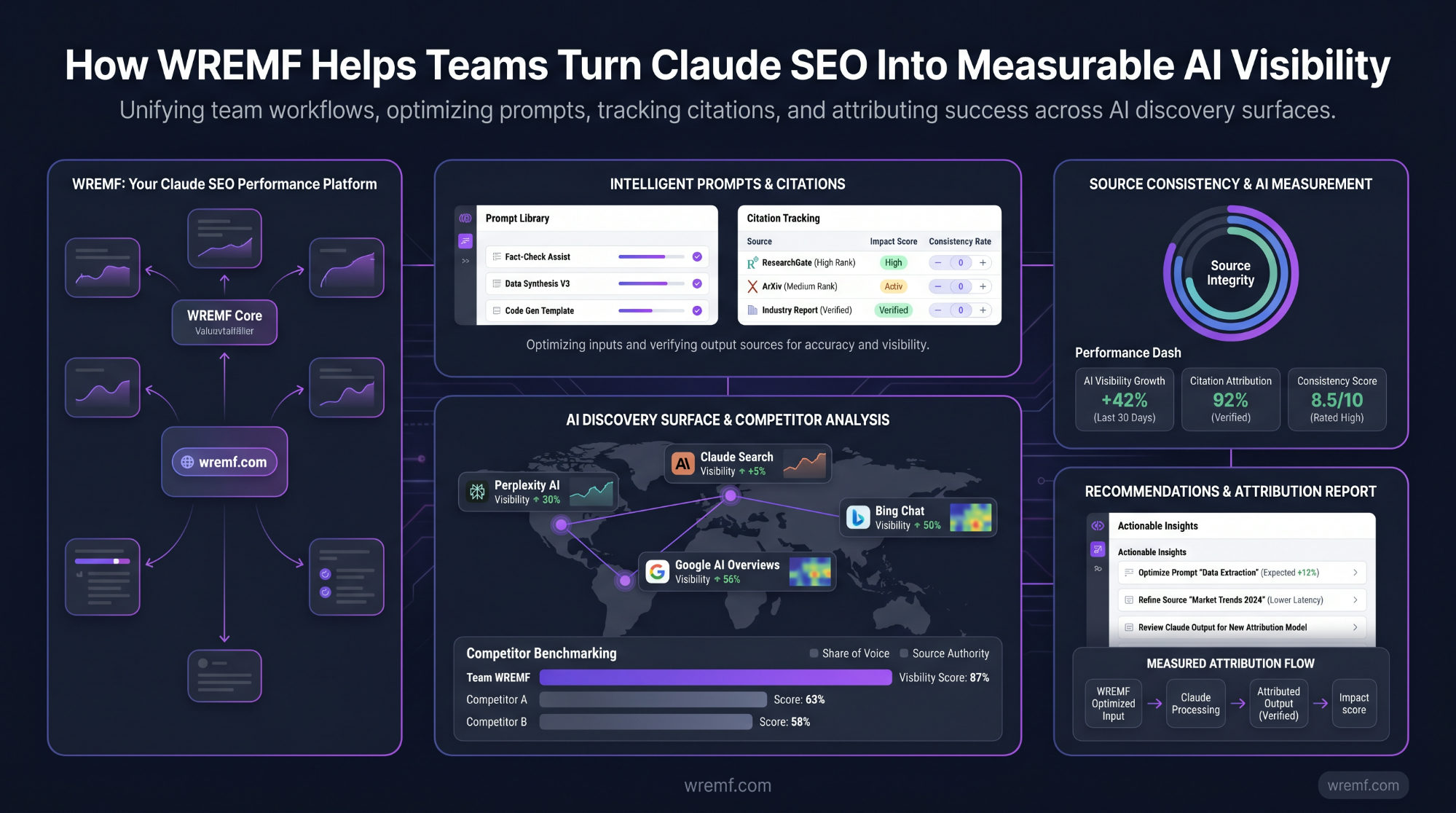
WREMF helps teams turn Claude SEO into measurable AI visibility by tracking prompts, citations, competitors, source consistency, recommendations, and attribution across major AI discovery surfaces. This gives Claude-assisted work a performance measurement layer.
WREMF helps teams track, improve, and prove AI visibility across ChatGPT, Claude, Gemini, Perplexity, Google AI Overviews, Copilot, DeepSeek, Grok, Meta AI, Mistral, and other AI discovery surfaces. WREMF is useful because Claude can help improve assets, but teams still need to know whether AI engines mention, cite, or recommend the brand.
Prompt tracking shows how a brand appears across repeated AI queries over time. Prompt tracking matters because AI answers vary by engine, wording, timing, context, and source selection.
Source citations are the sources AI engines use or reference when generating answers. Source citations matter because they reveal which websites, directories, pages, and third-party sources influence AI answers.
Competitor visibility measures how often competing brands appear in AI answers compared with your brand. Competitor visibility matters because AI buyers often ask for vendor comparisons, category recommendations, and “best tool” shortlists.
Source consistency analysis checks whether brand facts, positioning, product claims, and category associations are aligned across public sources. Source consistency matters because inconsistent information can reduce confidence and create inaccurate AI answers.
WREMF combines prompt tracking, citation analysis, competitor visibility, AI share of voice, AI traffic attribution, GEO audits, AEO strategy, content briefs, SEO testing, white-label reports, BYOK support, client portals, and action recommendations.
| Model | Best For | What You Get | Main Limitation | Recommended When |
|---|---|---|---|---|
| Software | Teams that want control and repeatable tracking | Dashboards, prompts, citations, competitors, reports, API workflows | Requires internal execution | You have SEO or content capacity |
| Agency service | Teams that need strategy and execution | Managed AEO, GEO, content optimization, reporting, authority work | Less self-serve control | You want senior-led execution |
| Hybrid model | Teams that want software plus done-for-you support | Platform visibility plus execution support | Requires clear scope and priorities | You want measurement and action together |
For brands, WREMF helps internal teams understand how AI systems describe the company, which prompts matter, which sources influence answers, and where content should be improved. The WREMF for brands page is the best fit for in-house teams that want to build AI search visibility over time.
For agencies, WREMF supports white-label reporting, multi-client workflows, prompt monitoring, and client portals. The WREMF for agencies page is the best fit for consultants and agencies that need scalable AI visibility reporting.
WREMF can be used as software, as an agency service, or as a combined software plus managed execution solution. For teams comparing cost and packages, WREMF pricing starts with Starter at €39 per month for one website and Growth at €89 per month for five websites, with custom Enterprise plans for larger needs.
KEY TAKEAWAY: WREMF complements Claude SEO by turning AI visibility, prompt performance, citations, and competitor presence into measurable workflows.
The final strategic step is separating real measurement from common myths.
Common Myths About Claude SEO and AI Visibility Debunked
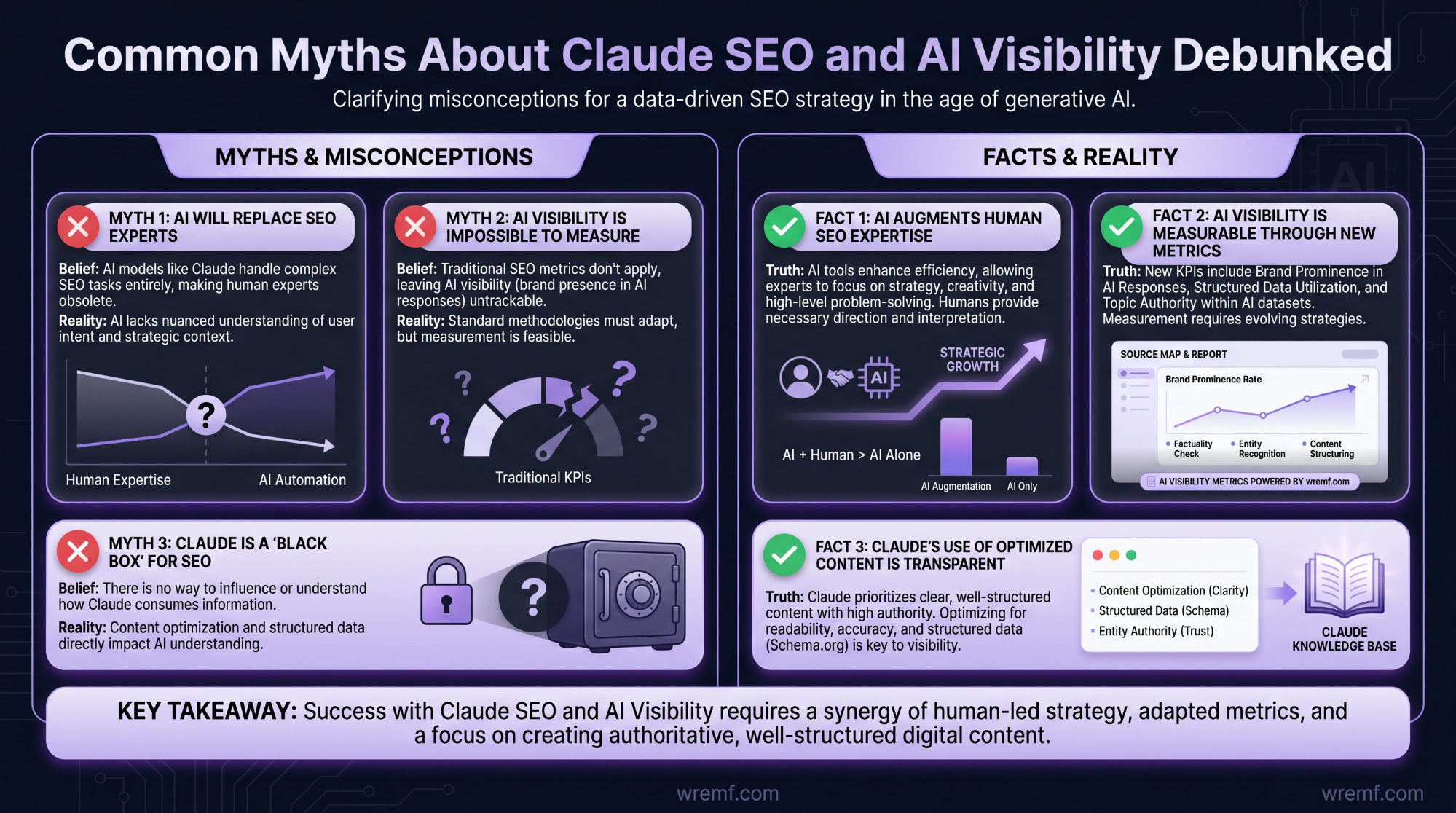
Claude SEO is powerful, but it is often misunderstood. The biggest myths come from treating AI as either a complete replacement for SEO or as something impossible to measure.
MYTH: Claude can replace SEO experts.
FACT: Claude can support SEO research, content optimization, technical analysis, and automation, but it does not replace expert judgment. SEO experts still need to validate data, understand business priorities, review technical changes, and decide what should be published.
MYTH: SEO is dead because AI answers are replacing search results.
FACT: SEO is evolving, not disappearing. Google still uses web content, links, structured data, and helpful content systems, while AI discovery surfaces also depend on accessible and reliable sources. The practical shift is that teams now need SEO, Answer Engine Optimization, and Generative Engine Optimization together.
MYTH: AI visibility is impossible to measure.
FACT: AI visibility is measurable when teams define prompts, engines, competitors, citations, mentions, recommendations, and attribution rules. Measurement is not perfect because AI answers can vary, but repeated prompt tracking and source citation analysis create a useful trendline.
MYTH: Rankings alone are enough.
FACT: Rankings are important, but rankings do not show whether Claude, ChatGPT, Perplexity, Gemini, Copilot, or Google AI Overviews mention your brand. A brand can rank well and still be absent from AI-generated recommendations.
MYTH: More AI-generated content automatically improves search engine rankings.
FACT: More content only helps when it adds value, satisfies intent, and meets quality standards. Google’s AI content guidance makes clear that automation itself is not the issue, but scaled low-value content can violate spam policies. (Google for Developers)
KEY TAKEAWAY: Claude SEO works when it strengthens evidence, structure, and execution, not when it is used to shortcut strategy or quality control.
The remaining questions address the most common buying, implementation, and comparison concerns.
Frequently Asked Questions
Can Claude AI help with SEO?
Claude AI can help with SEO by supporting keyword research, content gaps, content optimization, Technical SEO audits, schema markup, internal linking, competitor analysis, and reporting. Claude is especially useful when you provide real SEO data such as crawl exports, search console data, SERP overview notes, backlink profile summaries, and Markdown files. Claude should not be treated as a live SEO database. Use Claude to analyse and structure evidence, then validate recommendations with SEO tools, analytics, crawlers, and expert review.
Is SEO dead or evolving in 2026?
SEO is evolving in 2026, not dead. Search engine optimization still matters because users continue to search in Google and other search engines, but AI discovery surfaces now influence how buyers compare brands. SEO teams need to optimise for classic rankings, Google AI Overviews, featured snippets, Answer Engine Optimization, Generative Engine Optimization, and AI search visibility. The practical shift is from keyword-only SEO to entity clarity, source consistency, citations, structured content, and measurable AI visibility.
Which AI is best for SEO content?
The best AI for SEO content depends on the workflow. Claude is strong for long-context reasoning, brand voice, content analysis, and structured briefs. ChatGPT is strong for broad ideation, tool-connected workflows, and rapid drafting. Perplexity is useful for cited research exploration. Traditional SEO platforms are still needed for keyword research, backlink profiles, and rank tracking. For AI visibility tracking across engines, WREMF adds measurement for prompts, citations, competitors, and recommendations.
Is SEO being phased out by AI search?
SEO is not being phased out, but its scope is expanding. AI search still depends on content, sources, entities, structure, and user trust. The difference is that users may receive answers before clicking a search result, so brands must care about mentions, citations, and recommendations as well as rankings. SEO teams should combine search engine optimization with Answer Engine Optimization, Generative Engine Optimization, and AI traffic attribution to understand the full discovery journey.
How do I use Claude AI for SEO?
Use Claude AI for SEO by giving it structured inputs and a clear task. Start with keyword research data, search console exports, competitor pages, crawl data, content drafts, or technical reports. Ask Claude to cluster keywords, identify content gaps, write a content brief, improve SEO content, inspect schema markup, summarise technical issues, or create implementation tickets. Always validate Claude’s work with source data, human review, and measurement through search console, crawlers, analytics, and AI visibility tracking.
Can Claude do SEO for your website?
Claude can assist with SEO for your website, but it cannot fully do SEO alone. Claude can analyse content, review technical issues, draft schema markup, suggest internal linking, create content briefs, and explain crawl problems. It still needs accurate data, tool access, human review, and implementation. A complete workflow should combine Claude with Google Search Console, crawl tools, analytics, SEO platforms, developer review, and AI visibility monitoring through a platform such as WREMF.
How is Claude SEO different from tools like Ahrefs or Semrush?
Claude SEO is different from Ahrefs or Semrush because Claude is a reasoning and analysis tool, while Ahrefs and Semrush provide search data, keyword databases, backlink profile data, and competitive metrics. Claude can interpret exports from those tools, cluster topics, explain patterns, and recommend actions. It should not replace live SEO datasets. The strongest workflow uses SEO tools for data, Claude for reasoning, and WREMF for AI visibility tracking across prompts, citations, competitors, and AI engines.
Does Claude crawl the whole site, not just the homepage?
Claude does not automatically crawl a whole site unless it is connected to tools, files, crawl exports, or workflows that provide site data. If you upload a crawl export, Markdown files, repository files, or URL lists, Claude can analyse them within context limits. For full-site audits, use a crawler such as Screaming Frog or Sitebulb, then provide exports to Claude. For AI visibility measurement, use WREMF to track how AI engines mention, cite, and compare your brand over time.
Do I need a Claude subscription to use Claude for SEO?
You may need access to Claude through Claude.ai, the Anthropic API, Claude Code, or an integrated platform depending on the workflow. Simple SEO content analysis can often happen in a chat interface. Technical SEO workflows may require Claude Code, API access, repository context, or connected tools. Larger workflows may also require higher context limits or team access. Pricing and availability can change, so check Anthropic’s current plan and API documentation before planning production workflows.
What is a Claude SEO Skill?
A Claude SEO Skill is a reusable set of instructions, resources, scripts, or templates that helps Claude perform SEO tasks more consistently. Anthropic describes Agent Skills as modular capabilities that package instructions, metadata, and optional resources for specialised tasks. A Claude SEO Skill could cover keyword clustering, content gap analysis, Technical SEO audits, schema markup review, internal linking analysis, and reporting. Skills are useful for agencies or teams that need repeatable quality across many projects.
How can Claude help with Google AI Overviews?
Claude can help with Google AI Overviews by making content clearer, more structured, more answer-first, and more citable. It can rewrite sections into concise definitions, add source-supported explanations, improve entity clarity, and identify missing follow-up questions. Google AI Overviews still depend on Google’s systems and source selection, so Claude cannot guarantee inclusion. The best workflow is to improve content quality, monitor AI visibility, track source citations, and compare how competitors appear in AI-generated answers.
How do I rank my website in AI search engines like ChatGPT, Perplexity, Claude, and Google AI Overview?
To rank or appear in AI search engines, improve entity clarity, answer-first content, source consistency, technical accessibility, third-party citations, and topical authority. Track prompts that buyers actually ask, monitor whether your brand is mentioned, identify which sources AI engines cite, and fix inconsistent brand information. Claude can help improve content and structure, while WREMF can help track prompt visibility, source citations, competitor presence, AI share of voice, and AI traffic attribution.
Conclusion
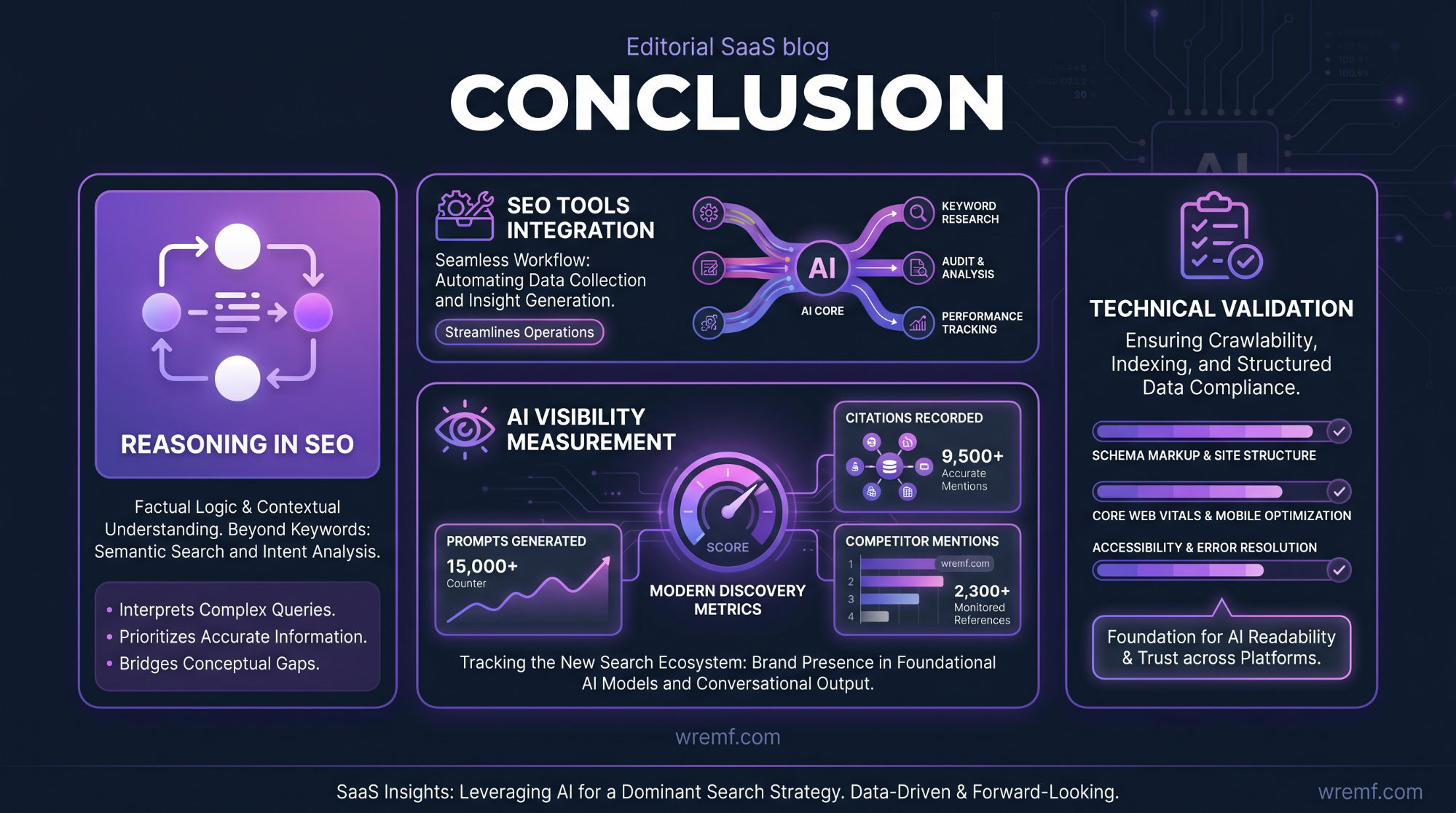
Claude SEO helps teams improve search strategy, content quality, technical analysis, and AI search readiness when it is grounded in real data and expert review. The strongest workflow uses Claude for reasoning, SEO tools for search evidence, crawlers for technical validation, and WREMF for AI visibility measurement. Rankings still matter, but modern discovery also depends on prompts, citations, source consistency, competitor mentions, and AI-generated recommendations. To turn Claude-assisted SEO work into measurable AI visibility, explore the WREMF platform suite or get support from the WREMF agency team.