DeepSeek SEO: The Complete Guide to AI Search, Technical SEO, GEO, and AI Visibility
Understand DeepSeek SEO and its role in AI-assisted search visibility, keyword research, and technical audits.
By WREMF Team · 2026-08-23
DeepSeek SEO involves using DeepSeek models to enhance search visibility through AI-assisted workflows. It integrates with technical SEO, GEO, keyword research, and AI visibility reporting. DeepSeek-R1, a reasoning-focused model, supports multi-step analysis, managing tasks like keyword clustering and technical audits. Key components include schema markup, structured data, and AI citations. It requires verified data for reliable outcomes, and supports AI visibility across platforms like ChatGPT and Google AI, enhancing content's relevance and authority.
Key takeaways
- DeepSeek SEO utilizes AI models for enhanced search visibility and content workflows.
- DeepSeek-R1 supports complex SEO decisions through reasoning-focused AI capabilities.
- Keyword research with DeepSeek integrates intent-led clustering and prompt tracking.
- Technical audits with DeepSeek require verified data alongside AI summarization.
- Integration of SEO, AEO, and GEO enhances AI visibility tracking and brand presence.
DeepSeek SEO: The Complete Guide to AI Search, Technical SEO, GEO, and AI Visibility
DeepSeek SEO is the use of DeepSeek models to support search engine optimisation, AI visibility, and content performance workflows. Google Search Central explains that helpful, reliable, people-first content remains central to search performance, while AI search has expanded discovery beyond classic blue links. This guide explains how DeepSeek fits into SEO, AEO, GEO, keyword research, search intent, schema markup, structured data, technical audits, SERP data, AI citations, DeepSeek API workflows, privacy controls, and AI visibility reporting. It also explains how WREMF helps teams track, improve, and prove visibility across DeepSeek, ChatGPT, Claude, Gemini, Perplexity, Google AI Overviews, Copilot, Grok, Meta AI, Mistral, and other AI discovery surfaces.
What Is DeepSeek SEO?
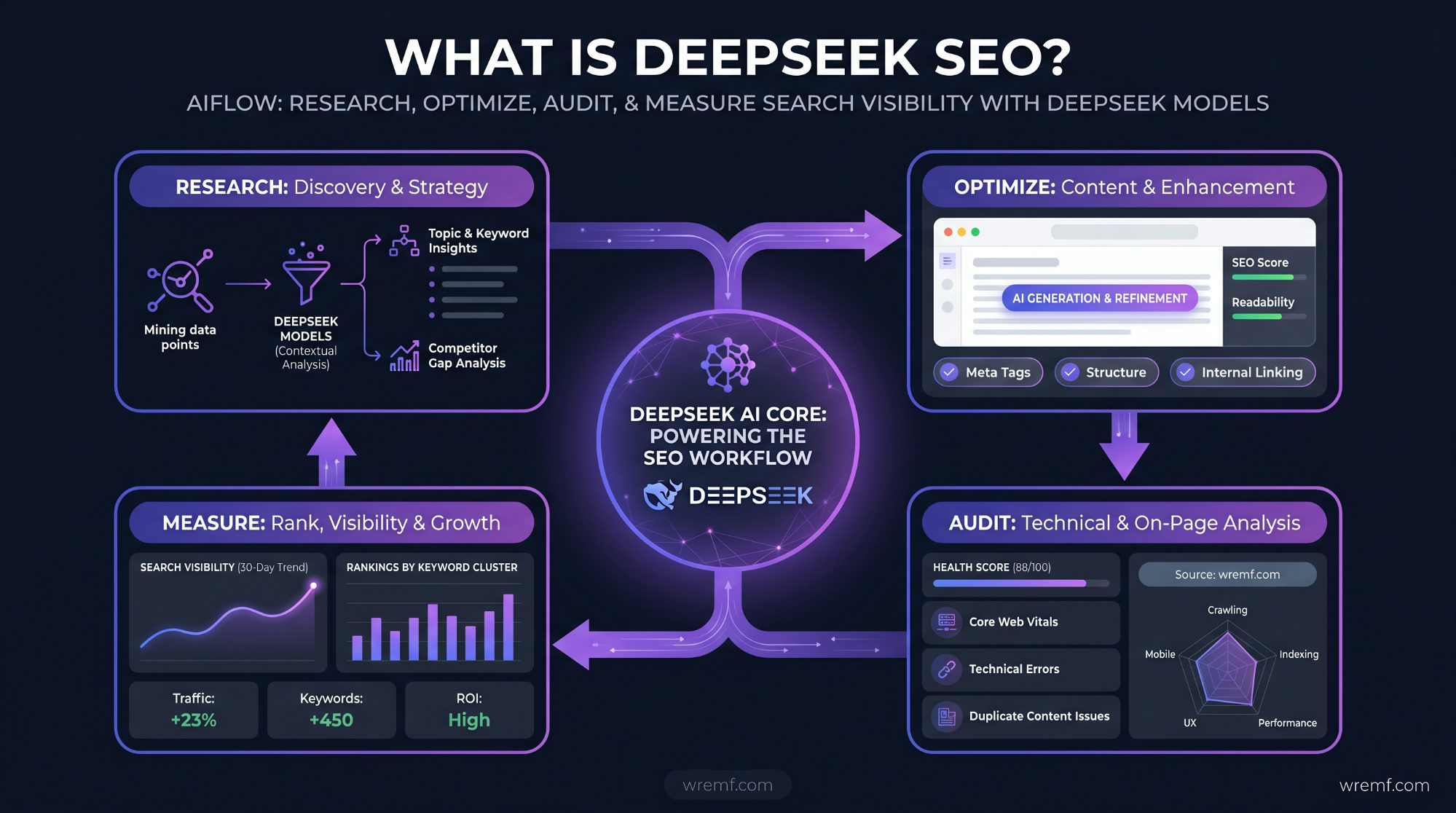
DeepSeek SEO is the use of DeepSeek models to research, optimise, audit, and measure search visibility. DeepSeek SEO helps teams move from keyword-only workflows to intent-led, AI-assisted, and measurable search performance systems.
DeepSeek is an AI startup known for large language models such as DeepSeek-R1. DeepSeek-R1 is a reasoning-focused model family that uses reinforcement learning to improve reasoning behaviours such as self-reflection, verification, and dynamic strategy adaptation, according to the DeepSeek-R1 research paper. That matters for SEO because modern search work often requires multi-step analysis, not just basic keyword generation.
Search Engine Optimization is the process of improving crawlability, relevance, usefulness, authority, and user experience so a website can perform better in organic search results. Search Engine Optimization matters because Google, Bing, and AI-powered platforms still need clear signals to discover, understand, rank, cite, and recommend content.
DeepSeek SEO does not mean “DeepSeek ranking hacks.” It means using DeepSeek as an AI model inside a disciplined workflow that includes keyword research, content relevance, structured analysis, technical audit review, schema markup planning, SERP data interpretation, content gap analysis, and AI visibility measurement.
AI visibility is the measurable presence of a brand inside AI-generated answers, citations, summaries, and recommendations. AI visibility matters because buyers increasingly ask DeepSeek, ChatGPT, Perplexity, Gemini, Claude, Copilot, and Google AI Overviews for recommendations before visiting websites or speaking to sales teams.
WREMF helps teams track, improve, and prove AI visibility across major AI discovery surfaces. You can explore the WREMF AI visibility platform if you need one workflow for prompt tracking, source citations, competitor visibility, AI share of voice, GEO audits, and reporting.
DID YOU KNOW: DeepSeek’s official API pricing documentation states that cache-hit pricing was reduced to one-tenth of launch pricing from April 26, 2026, which makes cost control important for high-volume SEO automation through the DeepSeek API pricing documentation.
KEY TAKEAWAY: DeepSeek SEO is useful when DeepSeek supports real SEO, AEO, GEO, and AI visibility workflows, but it should not replace search data, technical validation, or human editorial judgment.
The next step is understanding how DeepSeek works inside a practical SEO workflow.
How Does DeepSeek SEO Work?
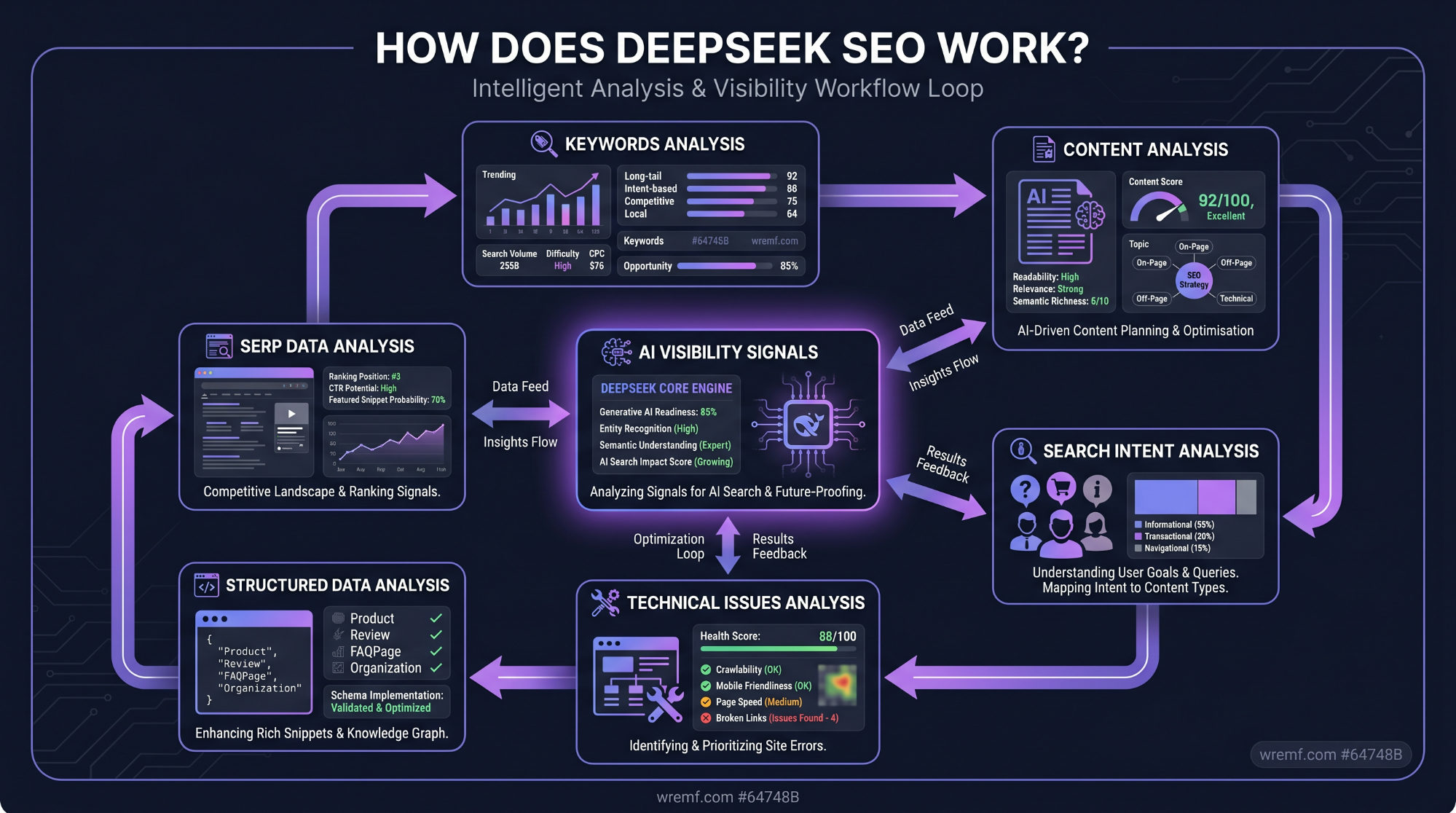
DeepSeek SEO works by using DeepSeek to analyse keywords, content, search intent, technical issues, structured data, SERP data, and AI visibility signals. The strongest workflow combines DeepSeek outputs with verified search, analytics, crawl, and prompt tracking data.
DeepSeek can classify keywords, identify Long-Tail Keywords, group topic clusters, summarise technical audit exports, draft SEO metadata, suggest internal links, and map content gaps. In real B2B buying journeys, this is useful because search teams rarely struggle with having too little data. They usually struggle with turning scattered data into priority decisions.
Search intent is the reason behind a user’s query, such as learning, comparing, buying, troubleshooting, or choosing a vendor. Search intent matters because DeepSeek SEO should match pages to real user needs, not only to keyword density or search volume.
A practical DeepSeek SEO workflow includes six steps:
Collect data from Google Search Console, analytics, crawl tools, SERP data, content inventories, and AI visibility reports
Use DeepSeek to cluster keywords, prompts, and pages by intent
Identify content relevance gaps, missing entities, and thin answer coverage
Review technical audit findings by severity, page type, and likely impact
Improve structured data, internal links, metadata, and answer-first content
Measure outcomes with rankings, clicks, impressions, AI citations, brand mentions, source citations, and AI share of voice
SERP data is information about search engine results pages, including rankings, titles, snippets, People Also Ask, AI Overviews, rich results, knowledge panels, and competitor pages. SERP data matters because it shows what users and search engines actually see for a query.
AI Logs are structured records of prompts, requests, responses, errors, latency, costs, and model behaviour. AI Logs matter because teams using DeepSeek API need to monitor request quality, API availability issues, cost, and response reliability.
DeepSeek can speed up analysis, but it cannot automatically see your private rankings, conversions, crawl exports, logs, or customer journey data unless those inputs are provided. A common implementation mistake is asking DeepSeek for “SEO strategy” without giving it the actual sitemap, keyword set, analytics exports, page templates, competitors, or prompt results.
TIP: Use DeepSeek for structured analysis, clustering, summarisation, and reasoning, but validate every recommendation against search results, analytics, crawl data, and AI visibility data.
KEY TAKEAWAY: DeepSeek SEO works best when DeepSeek is used as a reasoning layer on top of verified SEO, technical, content, and AI visibility inputs.
That workflow becomes more useful when you understand why DeepSeek-R1 changed how SEO teams use AI models.
Why DeepSeek-R1 Matters for SEO Teams
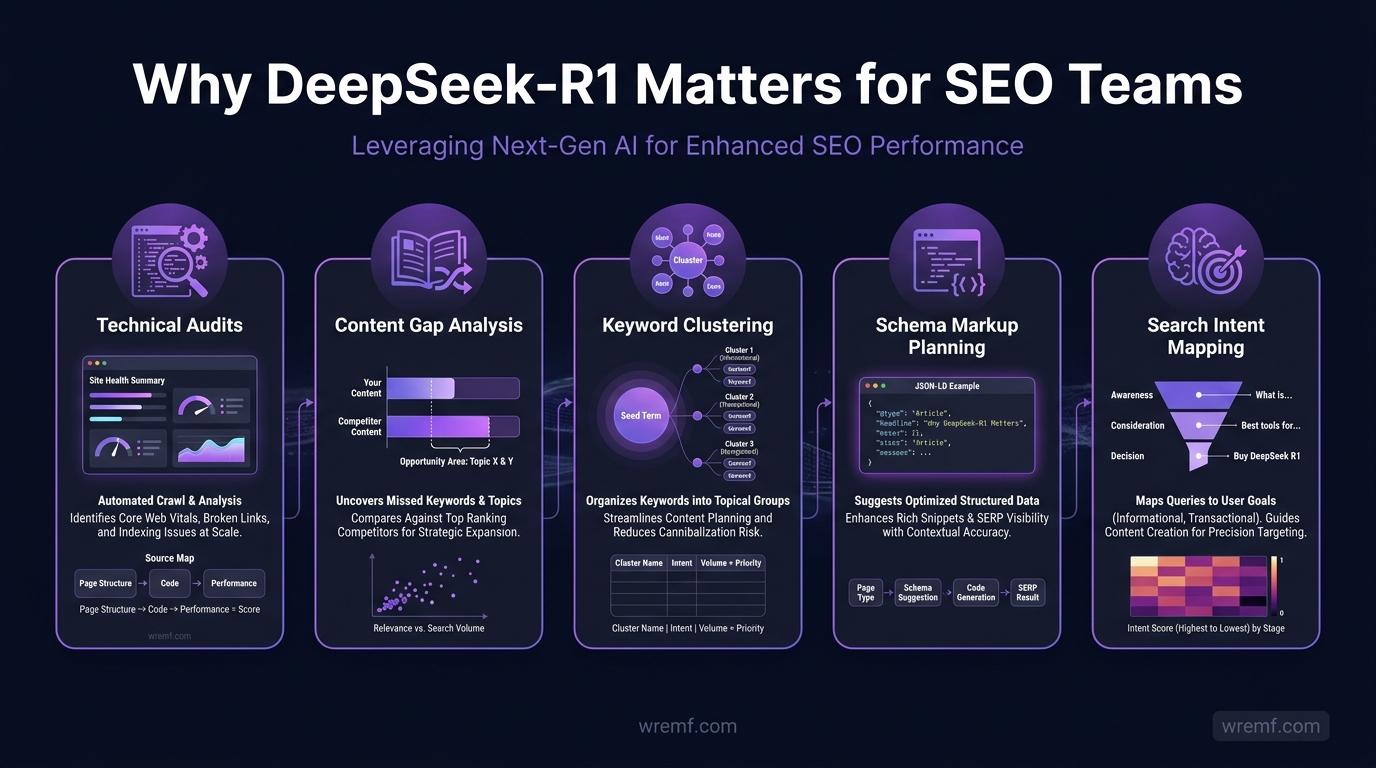
DeepSeek-R1 matters for SEO because reasoning-focused AI can support multi-step analysis. The R1 model is useful for technical audits, content gap analysis, keyword clustering, schema markup planning, and search intent mapping.
The R1 model is a reasoning-focused AI model from DeepSeek. An AI model is a computational system trained to produce outputs from input patterns. For SEO, an AI model matters when it can classify content, infer intent, compare URLs, summarise errors, and generate structured recommendations from messy data.
DeepSeek-R1 is relevant because SEO problems are rarely single-step problems. A technical audit may show broken links, duplicate titles, missing canonical tags, weak internal links, JavaScript rendering gaps, and structured data errors. The SEO team still needs to decide which issues affect search engine rankings, AI discovery, user experience, crawl efficiency, and business value.
Mixture of Experts is an architecture where different expert components handle parts of a task instead of activating every part of a model for every token. Mixture of Experts matters for SEO because efficiency can reduce cost and latency in large-scale workflows such as content analysis, log review, and keyword clustering.
The RL-based approach behind DeepSeek-R1 matters because reinforcement learning can support reasoning behaviours that resemble checking, revising, and adapting. For SEO teams, that means DeepSeek can be useful for structured analysis prompts such as “classify these 800 queries by intent,” “group these crawl errors by template,” or “find the missing entity explanations in this article.”
AI inference optimization is the process of making AI model responses faster, cheaper, or more scalable during use. AI inference optimization matters because agencies and large websites may run thousands of DeepSeek API requests for keyword clustering, content briefs, technical audit summaries, and AI visibility analysis.
DeepSeek-R1 can also help with ranking system analysis when used carefully. A ranking system is the set of processes a search engine uses to evaluate and order search results. DeepSeek can help explain possible ranking factors from page-level evidence, but it cannot know Google’s internal ranking system or guarantee why a URL moved.
KEY TAKEAWAY: DeepSeek-R1 matters because reasoning-focused AI can support complex SEO decisions, but reliable decisions still require verified data, expert review, and measurable outcomes.
The most common starting point for DeepSeek SEO is keyword research, but modern keyword research must also include prompts and AI discovery behaviour.
Can DeepSeek Improve Keyword Research and Search Intent Analysis?
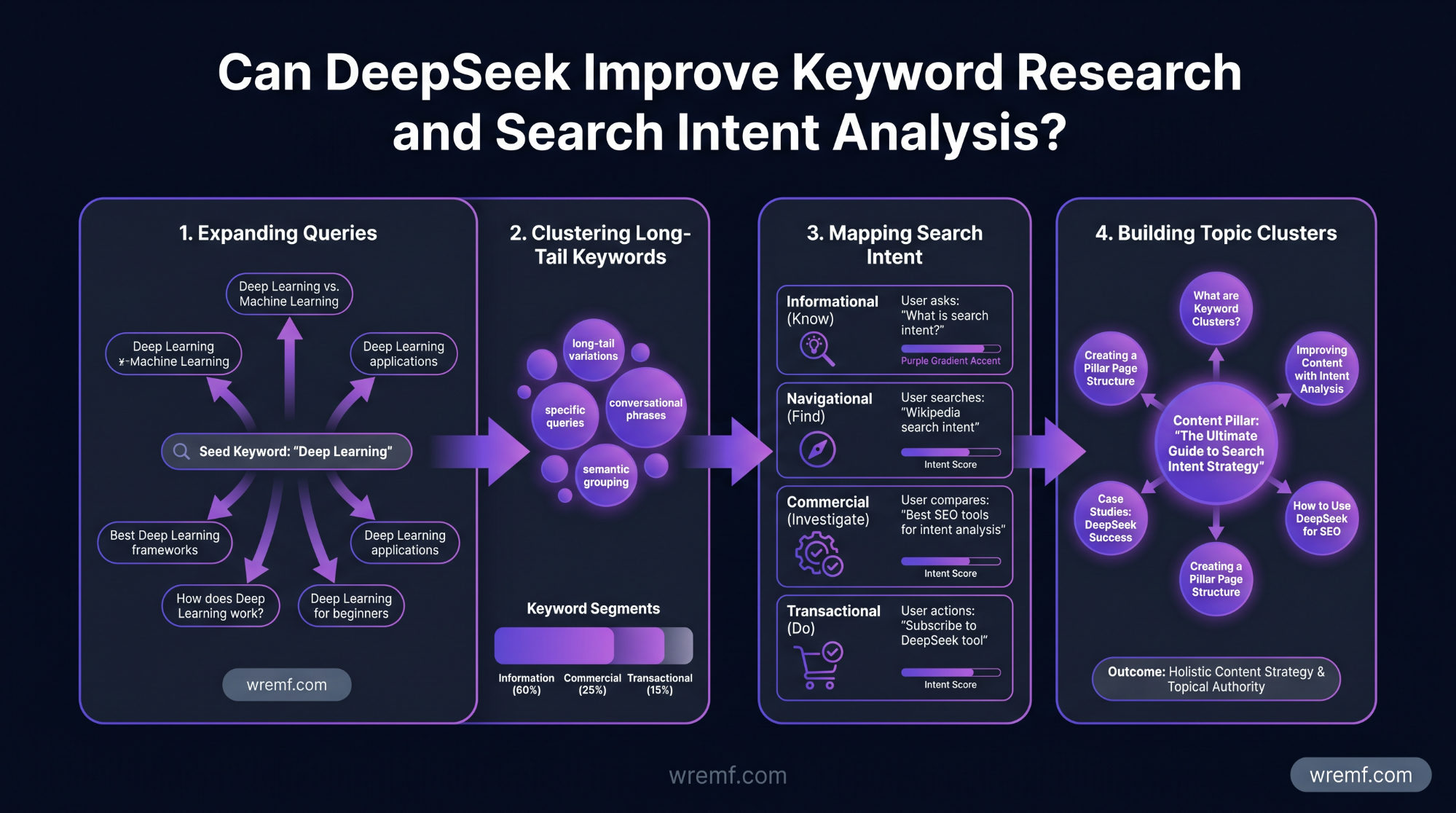
DeepSeek can improve keyword research by expanding queries, clustering Long-Tail Keywords, mapping search intent, and building topic clusters. DeepSeek should support real keyword data, not replace keyword tools or search behaviour evidence.
Long-Tail Keywords are specific search queries that usually contain clearer intent than broad head terms. Long-Tail Keywords matter because B2B buyers often search with detailed questions such as “best AI visibility tool for agencies,” “how to track ChatGPT citations,” or “DeepSeek SEO workflow for technical audits.”
A SEO Keyword Research Tool collects keyword ideas, volumes, difficulty estimates, SERP features, and competitor data. A SEO Keyword Research Tool matters because DeepSeek can generate ideas, but keyword platforms and Google Search Console provide evidence from real search behaviour.
Keyword clustering is the process of grouping related keywords by topic, intent, SERP overlap, or page opportunity. Keyword clustering matters because content teams need to decide whether a group should become a pillar page, product page, comparison page, FAQ section, or supporting article.
| Workflow | What DeepSeek Can Do | What DeepSeek Can Miss | Best Input Data |
|---|---|---|---|
| Keyword expansion | Generate semantic variations and related questions | Reliable volume, difficulty, and live SERP competition | Keyword tools, GSC queries, sales call notes |
| Long-Tail Keywords | Find specific question-style queries | Actual demand and business value | Search Console, paid search data, support tickets |
| Search intent | Classify informational, commercial, decision, and troubleshooting intent | SERP layout and changing user behaviour | SERP data, landing pages, conversion paths |
| Topic clusters | Group related content themes | Cannibalisation risk without URL data | Existing sitemap, internal links, rankings |
| Pillar page planning | Build heading structures and answer-first sections | Original experience, product proof, source quality | Competitor pages, brand data, source list |
Topic clusters are groups of related pages that cover a broad subject and its supporting subtopics. Topic clusters matter because they help search engines, AI platforms, and users understand topical depth and relationships between content pages.
A pillar page is a comprehensive page that covers a broad topic and links to more specific supporting pages. A pillar page matters because DeepSeek SEO, AEO, and GEO all benefit from structured, answer-first, internally linked content that explains entities clearly.
In practical AI visibility audits, marketing teams often find that prompts are more revealing than keywords. A user may search “DeepSeek SEO” on Google, but ask ChatGPT or DeepSeek “Is DeepSeek good for SEO and how should I use it safely?” This means keyword research and prompt tracking should work together.
Prompt tracking is the process of monitoring how AI systems answer specific user prompts over time. Prompt tracking matters because AI answers can mention competitors, cite third-party sources, recommend tools, or omit your brand even when your website ranks on Google.
WREMF’s prompt intelligence workflow helps teams track natural-language prompts across AI engines and connect those prompts to brand mentions, citations, competitors, and content gaps.
KEY TAKEAWAY: DeepSeek improves keyword research when it turns raw query data into intent-led topic clusters, but keyword evidence and prompt tracking are still needed for confident decisions.
After keyword and prompt opportunities are clear, DeepSeek can help review whether your technical foundation supports search and AI visibility.
How DeepSeek Supports Technical SEO Audits
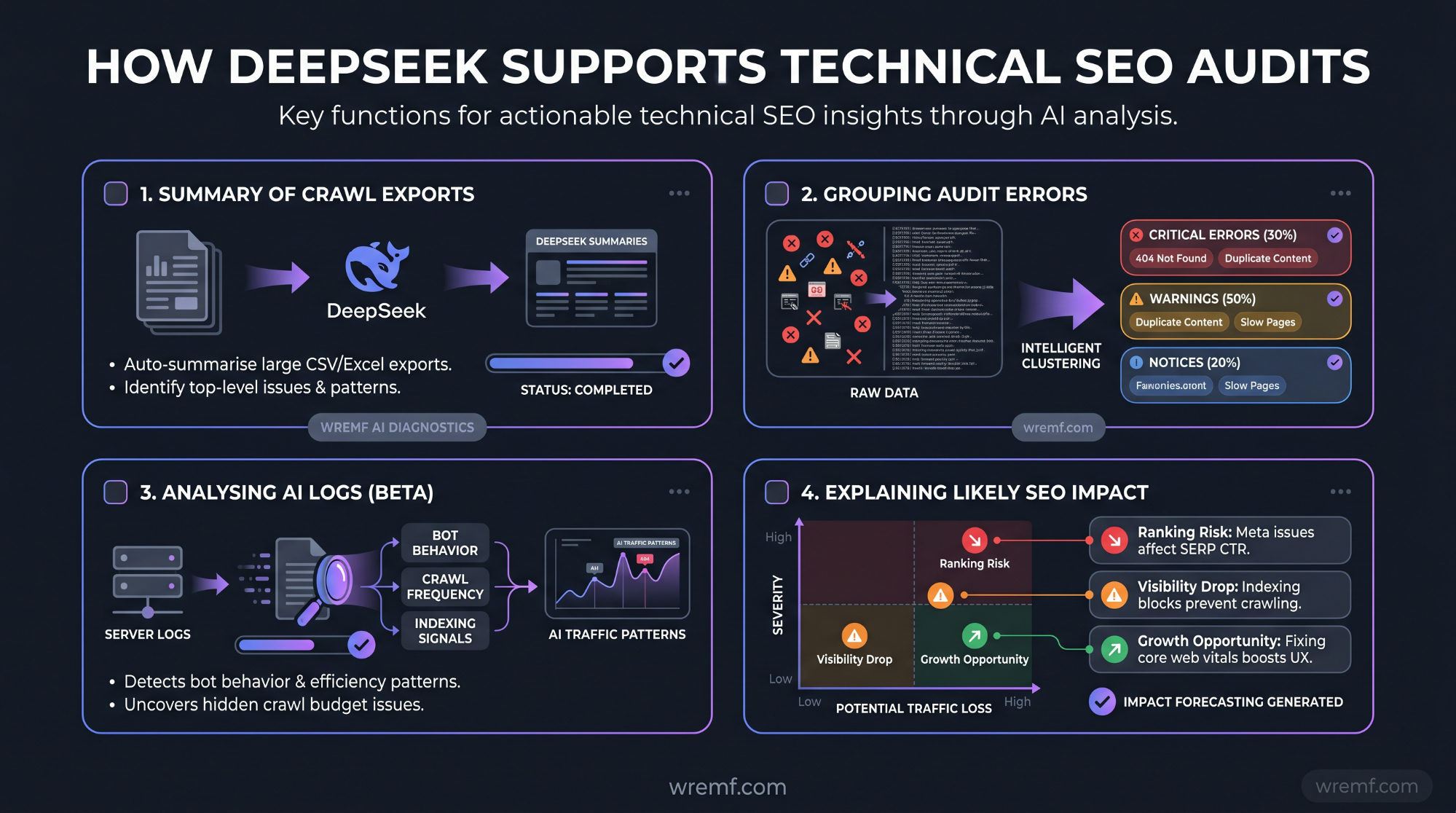
DeepSeek supports technical SEO audits by summarising crawl exports, grouping errors, analysing AI Logs, and explaining likely SEO impact. DeepSeek should not replace crawlers, server log tools, manual validation, or developer review.
A technical audit is a structured review of crawlability, indexation, rendering, site architecture, internal links, structured data, redirects, canonicals, performance, security flaws, and template-level issues. A technical audit matters because strong content cannot perform if search engines cannot discover, render, index, or interpret it.
Google Search Central explains that Google’s automated ranking systems are designed to prioritise helpful, reliable information created for people, not content created to manipulate search engine rankings, according to Google’s helpful content guidance. Technical SEO supports that goal by making useful pages accessible and understandable.
DeepSeek can help technical teams interpret large exports. For example, a crawl file may contain status codes, duplicate titles, canonical conflicts, missing schema markup, thin pages, redirect chains, blocked resources, sitemap issues, and JavaScript rendering warnings. DeepSeek can group these issues by template, likely cause, severity, and recommended owner.
Automated technical audits are software-assisted reviews of SEO technical issues across many pages. Automated technical audits matter because large sites often have thousands of URLs, repeated templates, and recurring errors that are difficult to review manually.
Scalable log file analysis is the process of analysing server logs across large URL sets to understand crawler behaviour, status codes, crawl frequency, bot access, and wasted crawl paths. DeepSeek can summarise exported patterns, while tools such as ClickHouse or log analysis systems can store and query the underlying data.
Technical DeepSeek SEO use cases include:
Summarising crawl issues by page template
Explaining server response patterns from AI Logs or crawler logs
Prioritising indexation problems by business value
Identifying structured data gaps across content pages
Reviewing sitemap setups and canonical logic
Grouping errors by developer, SEO, content, or infrastructure owner
Drafting QA checklists for technical fixes
AI platforms can also struggle with JavaScript-heavy pages, thin rendered HTML, inconsistent metadata, and unclear entity relationships. DeepSeek can help audit the output of raw and rendered HTML, but it should be paired with crawler evidence and live page testing.
IMPORTANT: Do not paste sensitive server logs, customer data, security reports, or proprietary source code into DeepSeek or any AI platform without approved privacy, security, and legal controls.
KEY TAKEAWAY: DeepSeek can accelerate technical audit interpretation, but technical SEO decisions still need verified crawl data, log data, privacy controls, and expert validation.
Once technical access is in place, DeepSeek can help improve how pages explain entities, answers, and structured data.
How DeepSeek Helps With On-Page SEO, Schema Markup, and Structured Data
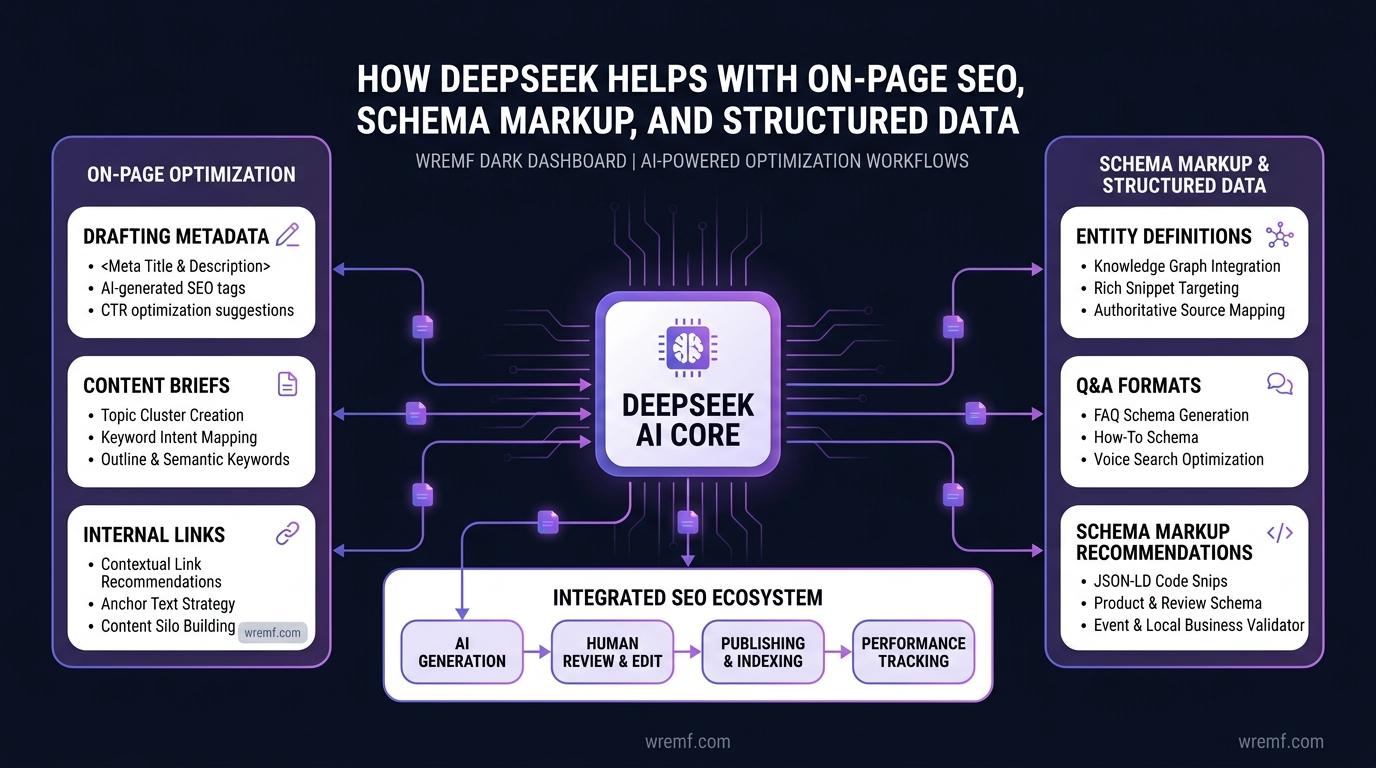
DeepSeek helps with on-page SEO by drafting metadata, content briefs, internal links, entity definitions, Q&A formats, and schema markup recommendations. Published outputs must be reviewed for accuracy, usefulness, and compliance with search engine guidance.
Schema markup is structured vocabulary added to a page to help search engines understand entities, page types, products, reviews, events, organisations, FAQs, and other content. Schema markup matters because it can improve machine understanding and support eligibility for rich results when implemented correctly.
Structured data is machine-readable information that describes page content in a standard format. Google Search Central explains that structured data helps Google understand page content and gather information about people, books, companies, and other entities through Google’s structured data documentation.
Rich results are enhanced search results that may include extra information such as ratings, prices, FAQs, events, breadcrumbs, or product details. Rich results matter because they can improve visibility, clarity, and click-through rates when the page is eligible and the markup accurately reflects visible content.
Knowledge panels are information boxes that search engines may show for entities such as companies, people, places, or organisations. Knowledge panels matter because clear entity data across trusted sources can help search engines understand who a brand is and what it does.
DeepSeek can help produce drafts and recommendations for:
Title tags and meta descriptions
H1 and H2 structures
Definition blocks for AI retrieval
Internal links between related content pages
FAQ answers for Q&A formats
Product and service descriptions
Local Business schema drafts where applicable
Article, Organization, FAQPage, Product, Service, and SoftwareApplication planning
Content relevance checks against search intent
Freshness signals and authority cues
Content relevance is the degree to which a page satisfies the query, task, and expected depth of the user. Content relevance matters because search engines and AI-powered platforms need clear topical alignment before they can rank, cite, or recommend a page.
Authority cues are signals that help users and systems trust content, such as named sources, author expertise, original methodology, transparent limitations, and accurate product details. Authority cues matter because AI-generated answers often depend on source credibility and consistency.
A common mistake is using DeepSeek to generate schema markup that describes content not visible on the page. Schema markup should support visible content, not invent reviews, ratings, offers, prices, locations, or claims. Another mistake is using AI to generate SEO metadata without checking whether the page actually satisfies the promise in the title and description.
If you want to turn prompt gaps and citation gaps into content production, WREMF’s AI-ready content briefs help teams create structured briefs based on AI visibility, source citations, competitors, and search intent.
KEY TAKEAWAY: DeepSeek can speed up on-page optimisation and structured data planning, but published content must remain accurate, visible, useful, and source-backed.
On-page optimisation becomes more strategic when you compare classic SEO, AEO, GEO, and AI visibility instead of treating them as the same discipline.
DeepSeek SEO vs AEO vs GEO: What Is the Difference?
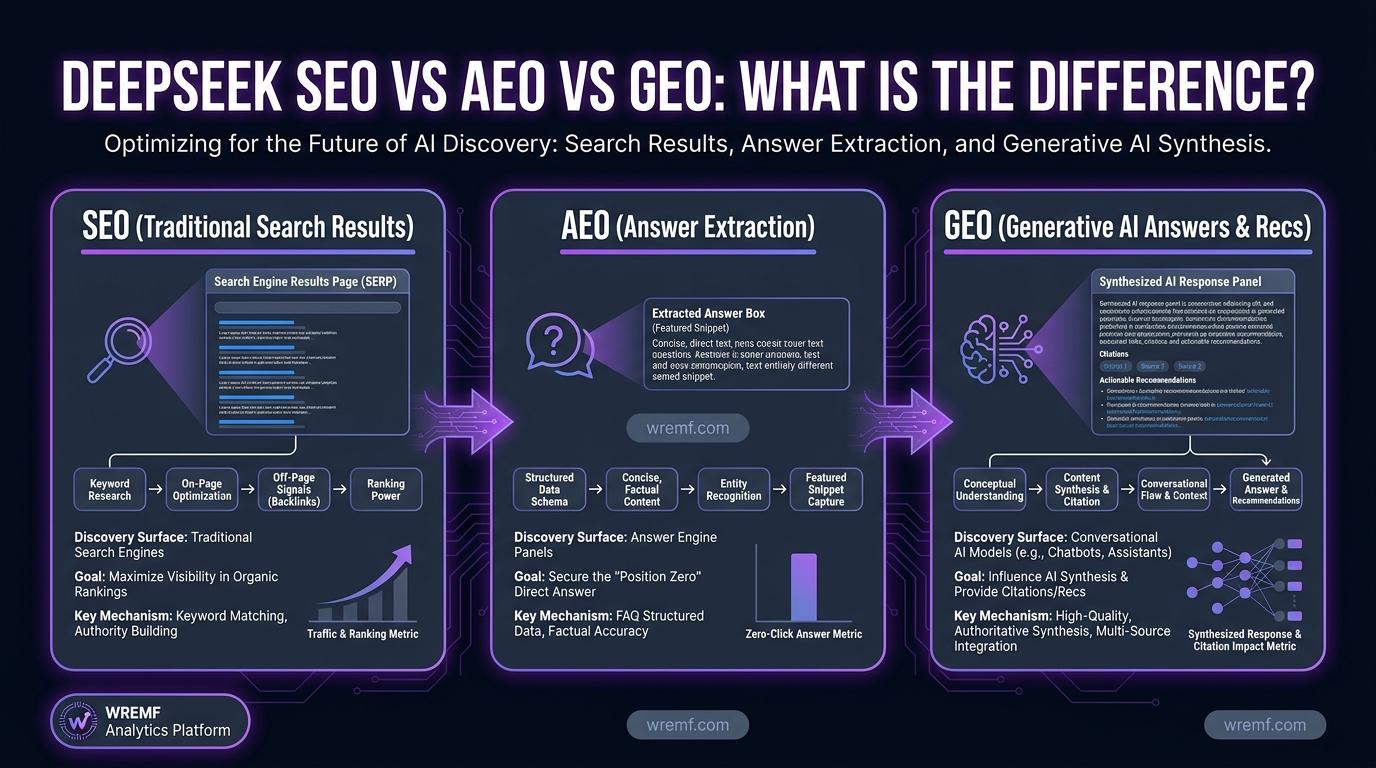
The key difference between SEO, AEO, and GEO is the discovery surface being optimised. SEO targets search results, AEO targets answer extraction, and GEO targets generative AI answers, citations, and recommendations.
AEO means Answer Engine Optimisation. AEO is the process of structuring content so answer engines can extract clear answers to user questions. AEO matters because users increasingly expect direct answers from voice search, AI assistants, AI Overviews, and conversational interfaces.
GEO means Generative Engine Optimisation. GEO is the process of improving how a brand, product, or source appears inside generative AI answers. GEO matters because AI systems may summarise, cite, compare, or recommend a brand before the user visits a website.
AI search visibility is the measurable presence of a brand across AI discovery surfaces. AI search visibility matters because ChatGPT, DeepSeek, Claude, Gemini, Perplexity, Google AI Overviews, Copilot, Grok, Meta AI, and Mistral can influence buyer perception before a click.
Google Search Central explains that AI Overviews and AI Mode are part of Google Search from a site owner’s perspective in Google’s AI features guidance. That means AI visibility is connected to classic search rather than separate from it.
| Discipline | Primary Goal | Example Metric | What It Misses Alone | Recommended When |
|---|---|---|---|---|
| SEO | Improve organic search visibility | Rankings, clicks, impressions, CTR | AI mentions, citations, recommendations | You need traffic from search engines |
| AEO | Win direct answers | Featured answers, answer clarity, Q&A coverage | Broader generative summaries and source ecosystems | You need extractable answers and voice-ready content |
| GEO | Improve generative AI visibility | AI citations, brand mentions, recommendations | Classic SERP movement if isolated | You need visibility in LLM and AI answers |
| AI visibility tracking | Measure brand presence across AI platforms | Share of voice, prompt coverage, source citations | On-site conversion and UX issues | You need reporting across AI discovery surfaces |
AI citations are references or linked sources used by AI systems to support an answer. AI citations matter because cited sources can influence user trust, competitor discovery, and brand inclusion in buying conversations.
Source citations are the specific pages, domains, or references AI systems use in generated answers. Source citations matter because a brand can be mentioned without being cited, cited without being recommended, or omitted while competitors are recommended.
The most effective workflow combines SEO, AEO, and GEO. SEO builds the technical and content foundation. AEO makes answers easier to extract. GEO improves visibility in generated answers. AI visibility tracking measures whether those actions change how DeepSeek and other AI platforms describe your brand.
KEY TAKEAWAY: DeepSeek SEO should be part of a wider SEO, AEO, GEO, and AI visibility system that measures rankings, answers, citations, mentions, competitors, and attribution together.
The next decision is choosing the right DeepSeek workflow for your team, budget, risk level, and reporting needs.
Which DeepSeek SEO Workflow Should You Use?
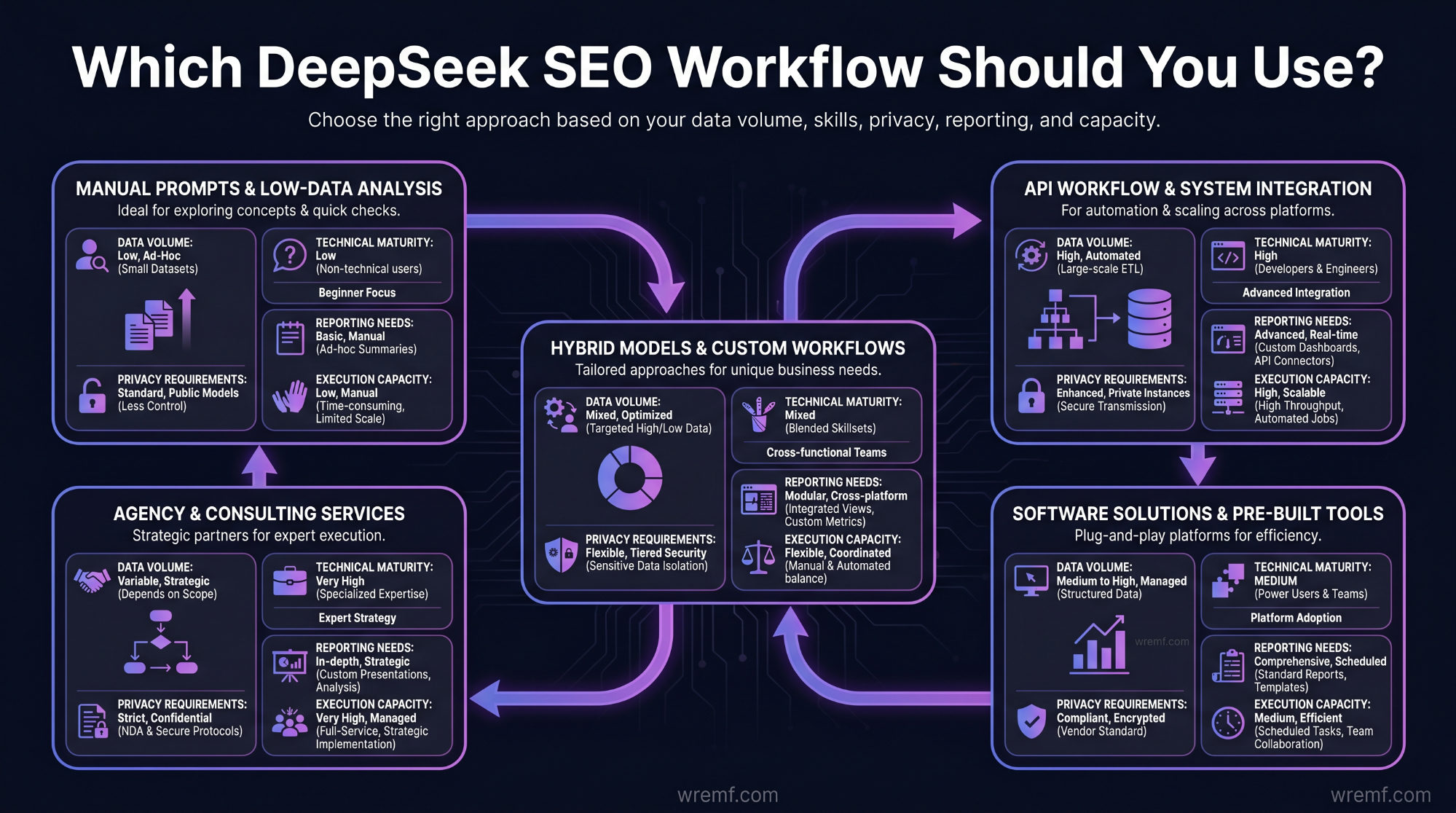
The right DeepSeek SEO workflow depends on data volume, technical maturity, privacy requirements, reporting needs, and execution capacity. Manual prompts help exploration, while API, software, agency, and hybrid workflows support repeatable execution.
DeepSeek API is the programmable interface that allows teams to send requests to DeepSeek models from apps, scripts, workflows, or internal tools. DeepSeek API matters because high-volume SEO tasks such as keyword clustering, content review, technical audit summaries, and prompt analysis require repeatable automation.
DeepSeek-R1 API workflows are useful when a task involves reasoning, classification, prioritisation, or structured analysis. DeepSeek-R1 API workflows are less useful when a task requires live web search, verified rankings, current SERP data, or proprietary analytics unless those inputs are provided by your system.
API key workflows are processes for storing, controlling, rotating, and monitoring credentials used to access an API. API key workflows matter because uncontrolled keys can expose data, create unexpected costs, or allow unauthorised automation.
API availability issues are failures, delays, rate limits, timeouts, or endpoint changes that affect API reliability. API availability issues matter because automated SEO systems can break when model responses fail, pricing changes, or response formats vary.
| Workflow | Best For | What It Produces | Main Limitation | Recommended When |
|---|---|---|---|---|
| Manual DeepSeek prompting | Fast exploration | Draft ideas, clusters, outlines, summaries | Hard to repeat or report | Solo research and early experiments |
| DeepSeek API automation | High-volume processing | Classifications, summaries, structured outputs | Requires engineering and governance | Agencies and technical SEO teams |
| SEO tool plus DeepSeek | Traditional SEO acceleration | Keyword insights, audit summaries, content briefs | May not track AI visibility directly | SEO teams improving workflow speed |
| AI visibility platform | AI search reporting | Prompts, citations, competitors, share of voice | Requires defined prompt methodology | B2B teams proving AI discovery impact |
| Agency service | Strategy and execution | Audits, content, reporting, technical guidance | Requires budget and trust | Teams without internal capacity |
| Hybrid software plus agency | Measurement plus delivery | Tracking, recommendations, execution, reporting | Requires coordination | Teams needing both insight and implementation |
The best option for most B2B teams is a hybrid workflow. Use DeepSeek and other AI models for structured analysis. Use SEO tools for search and technical data. Use AI visibility software for prompt tracking, citations, and competitor visibility. Use agency support when execution is the bottleneck.
If you want to see how AI engines currently describe your brand, review a sample AI visibility report before building your own measurement workflow.
KEY TAKEAWAY: Use manual DeepSeek for exploration, API workflows for scale, AI visibility software for measurement, and agency support when execution capacity is the limiting factor.
Choosing the workflow also requires knowing how DeepSeek compares with other AI platforms for SEO tasks.
DeepSeek vs ChatGPT vs Claude vs Gemini for SEO Tasks
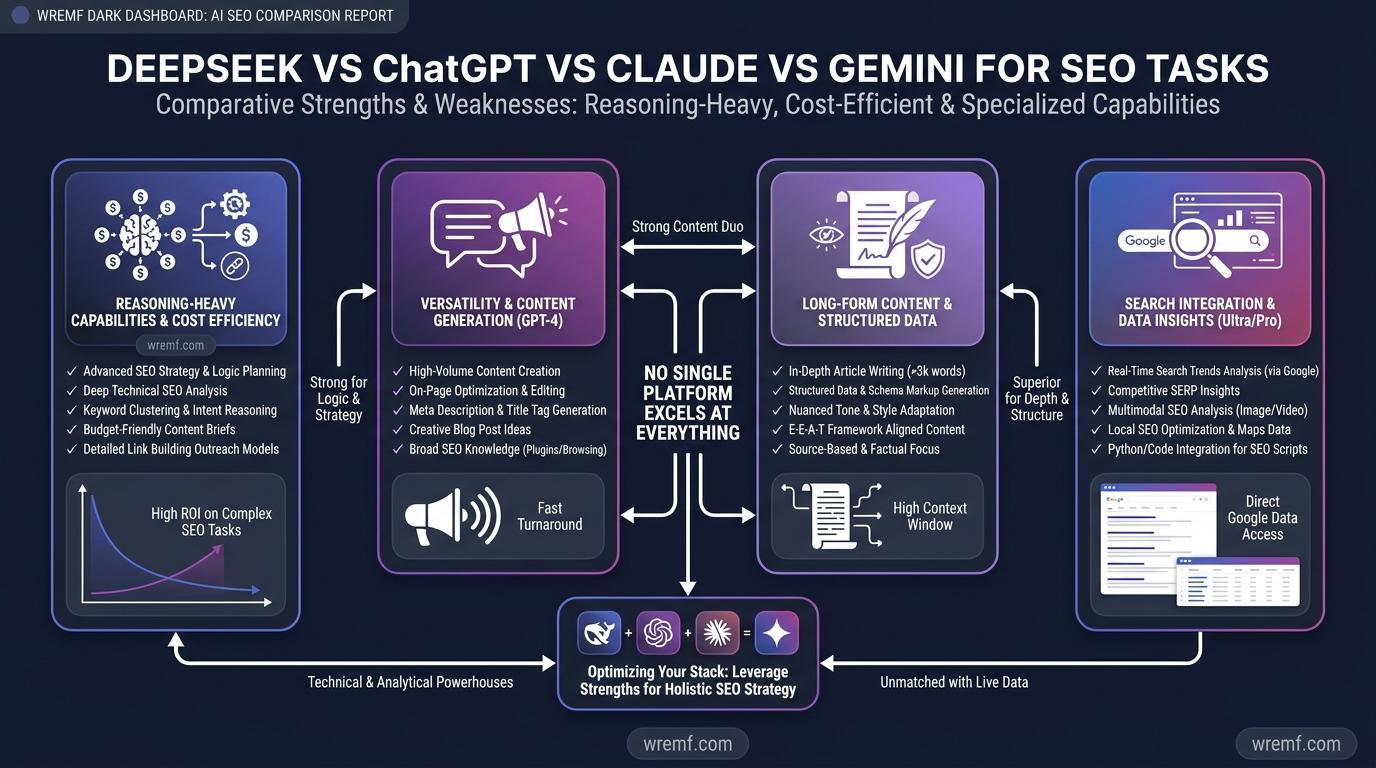
DeepSeek is strong for reasoning-heavy and cost-sensitive SEO analysis, but no single AI platform is best for every SEO task. The best model depends on technical complexity, writing quality, privacy controls, integrations, and workflow scale.
ChatGPT is a general-purpose AI assistant from OpenAI. ChatGPT matters for SEO because teams use it for ideation, content workflows, technical explanations, code assistance, and structured analysis.
Claude is an AI assistant from Anthropic. Claude matters for SEO because many teams use it for long-form review, editorial refinement, document analysis, and nuanced content evaluation.
Gemini is Google’s AI model family. Gemini matters for SEO because Google Search, Google AI Overviews, and Google’s broader AI ecosystem shape how marketers understand search and AI discovery.
DeepSeek is useful when the workflow needs structured analysis, low-cost scaling, and reasoning over batches of inputs. DeepSeek is less ideal as the only source of truth for live web search, current SERP data, legal interpretation, medical accuracy, privacy-sensitive processing, or unsupported factual claims.
| SEO Task | DeepSeek | ChatGPT | Claude | Gemini |
|---|---|---|---|---|
| Keyword clustering | Strong for structured grouping | Strong with detailed prompts | Strong for nuanced grouping | Useful with Google-oriented context |
| Technical audit reasoning | Strong for multi-step analysis | Strong for code and explanations | Strong for long document review | Useful for Google ecosystem framing |
| Blog content drafting | Useful with strong editing | Strong for flexible drafting | Strong for long-form editorial review | Useful for search-oriented ideation |
| Schema markup drafts | Useful for first drafts | Strong for structured outputs | Strong for review and clarity | Useful for Google-oriented checks |
| SERP data interpretation | Useful when data is provided | Useful when data is provided | Useful when data is provided | Useful when data is provided |
| API cost sensitivity | Often attractive | Depends on selected model | Depends on selected model | Depends on selected model |
| Privacy governance | Requires careful review | Depends on product and policy | Depends on product and policy | Depends on Google product and account |
The best practical approach is model selection by task. Use DeepSeek for scalable reasoning and classification. Use ChatGPT for flexible workflows and technical support. Use Claude for long-form review. Use Gemini when Google ecosystem context is important. Then validate outputs through search performance and AI visibility data.
KEY TAKEAWAY: DeepSeek can be a strong SEO workflow model, but teams should select AI platforms by task, data policy, cost, and measurable output quality.
After model selection, the next step is integrating DeepSeek into a safe and measurable SEO stack.
How to Integrate DeepSeek Into Your Existing SEO Stack
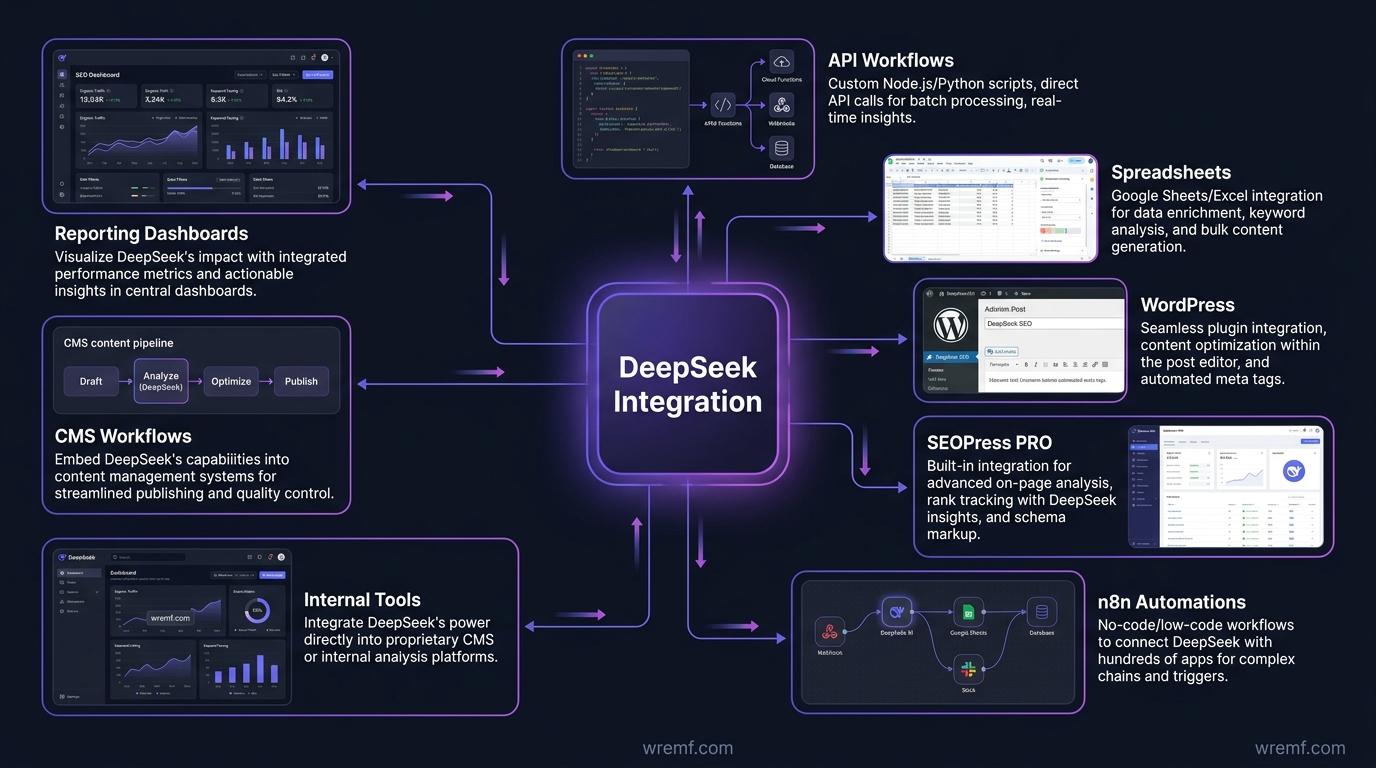
DeepSeek can be integrated into an SEO stack through API workflows, spreadsheets, WordPress, SEOPress PRO, n8n automations, internal tools, CMS workflows, and reporting dashboards. The safest integration uses clean inputs, controlled prompts, logging, and human approval.
API Docs are technical instructions that explain how to authenticate, send requests, select models, handle errors, and interpret responses. API Docs matter because SEO teams using DeepSeek API need to understand pricing, model selection, context handling, rate limits, and response formats before scaling automation.
SEOPress PRO is a WordPress SEO plugin that can support metadata, schema, sitemaps, and on-page SEO workflows. SEOPress PRO matters in a DeepSeek SEO workflow when AI-generated drafts need to be reviewed and published through a controlled WordPress process.
A practical DeepSeek SEO integration can follow this structure:
Pull queries, URLs, clicks, impressions, CTR, and average position from Google Search Console
Export crawl issues from a technical SEO tool
Pull content inventory from the CMS or sitemap
Gather SERP data for priority keywords and competitors
Run DeepSeek classification for keywords, prompts, pages, and issues
Store outputs in a database, spreadsheet, or dashboard
Review AI recommendations before publishing changes
Measure outcomes through rankings, traffic, AI citations, source citations, and conversions
Web search is different from DeepSeek model reasoning. Web search retrieves current information from the web, while DeepSeek model reasoning interprets inputs and generates responses based on model capability and supplied context. This distinction matters because some SEO tasks require live search results, while others require structured analysis.
BYOK means Bring Your Own Key. BYOK matters because teams can use their own AI provider credentials, control billing, select approved models, and apply internal governance rules.
WREMF supports BYOK, API workflows, and technical integrations for teams that need controlled AI visibility monitoring. Technical teams can explore WREMF API and MCP integrations for AI visibility data, reporting, and workflow automation.
Agencies managing multiple clients often need white-label reporting, client portals, usage controls, repeatable dashboards, and stable exports. WREMF supports agencies through white-label AI visibility workflows, prompt monitoring, citation analysis, and client-facing reports.
KEY TAKEAWAY: DeepSeek should be integrated into SEO systems with secure API keys, stable data pipelines, human review, logging, and measurement across search and AI visibility outcomes.
Security and privacy become especially important when DeepSeek SEO workflows include logs, client data, analytics exports, or proprietary strategy.
What Are the Data Privacy and Security Risks of DeepSeek SEO?
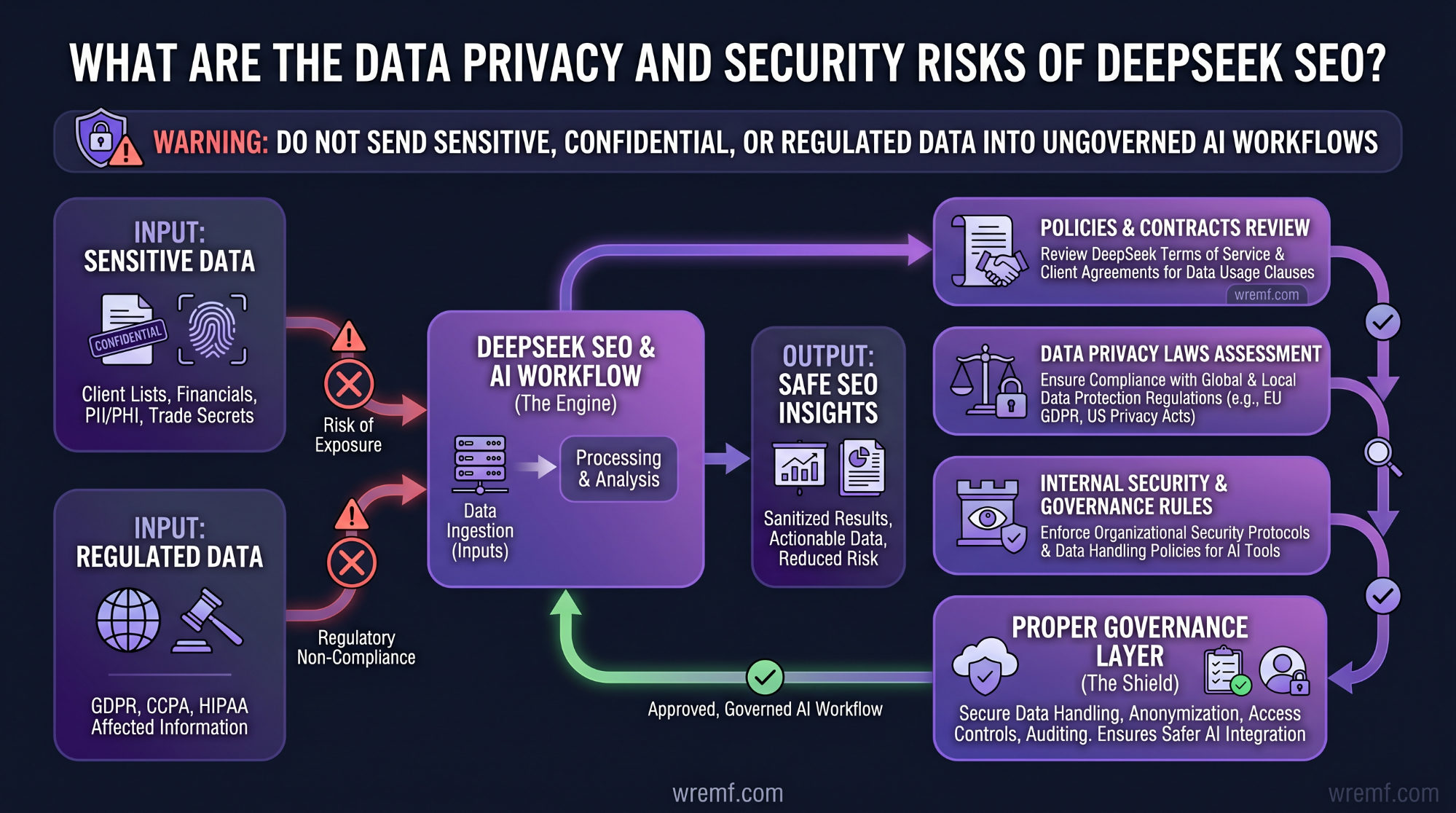
The main privacy risk in DeepSeek SEO is sending sensitive, confidential, or regulated data into an AI workflow without proper governance. Teams should review DeepSeek policies, client contracts, data privacy laws, and internal security rules before use.
DeepSeek’s privacy policy states that it collects personal data from data users provide, automatically collected data, and other sources, and that corporate group entities may process data for functions such as storage, security, research and development, foundation model training and optimisation, analytics, and support, according to the DeepSeek Privacy Policy.
Data privacy laws are legal frameworks that control how personal data can be collected, stored, transferred, processed, and deleted. Data privacy laws matter for DeepSeek SEO because prompts can include customer records, analytics data, logs, emails, lead details, private URLs, unreleased content, or confidential strategy.
Professional data sanitization means removing personal, sensitive, proprietary, or unnecessary information before sending data into an AI platform. Professional data sanitization matters because many SEO tasks can be completed with anonymised URLs, aggregated metrics, template names, issue categories, and representative examples.
A safe DeepSeek SEO workflow should avoid sending:
Customer names, emails, phone numbers, or account records
Private sales notes, lead lists, or CRM exports
Unreleased financial, legal, or pricing strategy
Proprietary source code unless explicitly approved
Full server logs containing identifiable user data
Client data restricted by contracts, NDAs, or data processing agreements
Sensitive strategy that reveals acquisitions, layoffs, launches, or security risks
The China-based factor matters for some organisations because data transfer, storage, regulatory exposure, vendor approval, and internal procurement rules may differ by company and region. The practical response is not panic. The practical response is governance, vendor review, data minimisation, anonymisation, and approved workflows.
A professional agency workflow should use anonymised exports, minimum necessary data, access controls, approved API keys, prompt logs, output review, and clear client communication. Teams should compare data handling across DeepSeek, OpenAI, Anthropic, Google, Microsoft, and other AI platforms because privacy terms can differ by product, region, API tier, and account configuration.
IMPORTANT: Treat AI privacy as a workflow design problem, not a disclaimer. The safest process limits what data is sent, who can send it, how long it is stored, and how outputs are approved.
KEY TAKEAWAY: DeepSeek SEO can support analysis, but sensitive data should be sanitised, governed, and processed only through approved workflows.
Once governance is in place, the central business question becomes measurement.
How Do You Measure DeepSeek SEO and AI Visibility?
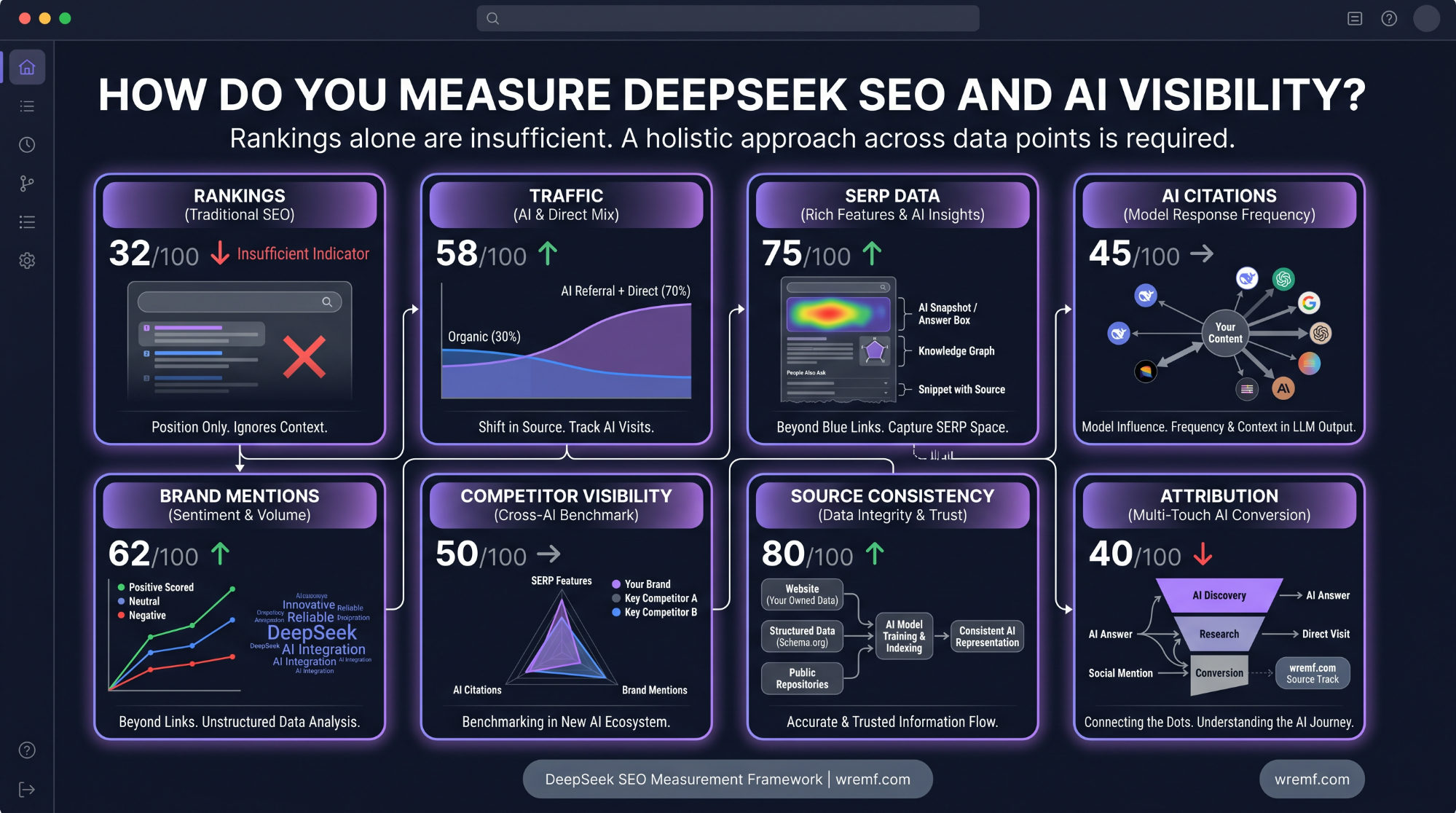
DeepSeek SEO should be measured through rankings, traffic, SERP data, AI citations, brand mentions, competitor visibility, source consistency, and attribution. Rankings alone are not enough because AI discovery can influence buyers before a traditional click.
Search results are the pages, features, snippets, AI summaries, videos, shopping units, local packs, and answers shown by a search engine for a query. Search results matter because DeepSeek SEO should improve how a brand is discovered across both classic and AI-enhanced experiences.
Search engine rankings are the positions that URLs occupy in search results for specific queries. Search engine rankings matter because they still influence visibility, but rankings do not show whether AI platforms cite, mention, summarise, or recommend a brand.
AI share of voice is the percentage of relevant AI answers or prompts where a brand appears compared with competitors. AI share of voice matters because it measures visibility in AI-generated buying conversations, not only website traffic.
Brand mentions are references to a company, product, or service in AI answers, search results, reviews, media, forums, social platforms, or third-party sources. Brand mentions matter because AI platforms may discuss a brand even without linking to its website.
Source consistency is the alignment of brand facts across your website, directories, profiles, review sites, partner pages, documentation, media coverage, and third-party sources. Source consistency matters because AI systems are more likely to describe a brand accurately when public sources agree.
AI traffic attribution connects visits, sessions, leads, or conversions to AI discovery sources where measurable. AI traffic attribution matters because leadership needs to know whether AI visibility contributes to business outcomes.
| Metric Category | Example Metrics | Why It Matters |
|---|---|---|
| SEO visibility | Rankings, clicks, impressions, CTR, average position | Shows classic search engine performance |
| Content quality | Content relevance, answer coverage, freshness signals, authority cues | Shows whether pages satisfy search intent |
| Technical SEO | Crawl errors, indexation, structured data, rendering, server issues | Shows whether pages can be discovered and understood |
| AI visibility | Prompt visibility, brand mentions, citations, recommendations | Shows whether AI platforms include your brand |
| Competitive landscape | Competitor mentions, source overlap, ranking patterns | Shows who AI systems recommend instead |
| Attribution | AI referrals, assisted conversions, pipeline notes | Shows business impact where measurable |
In real-world reporting, teams often discover that SEO metrics and AI visibility metrics tell different stories. A page may rank on Google but never appear in AI-generated answers. A third-party review page may be cited by AI systems more often than the brand’s own website. A competitor may be recommended for high-intent prompts despite weaker organic rankings.
WREMF’s AI visibility methodology connects prompts, citations, competitors, source consistency, and attribution into a repeatable reporting system for B2B teams.
KEY TAKEAWAY: DeepSeek SEO measurement should combine traditional search metrics with AI visibility metrics because rankings, mentions, citations, recommendations, and attribution reveal different parts of discovery.
Measurement only creates value when it leads to practical optimisation.
How Can DeepSeek Improve Content Marketing and Pillar Pages?
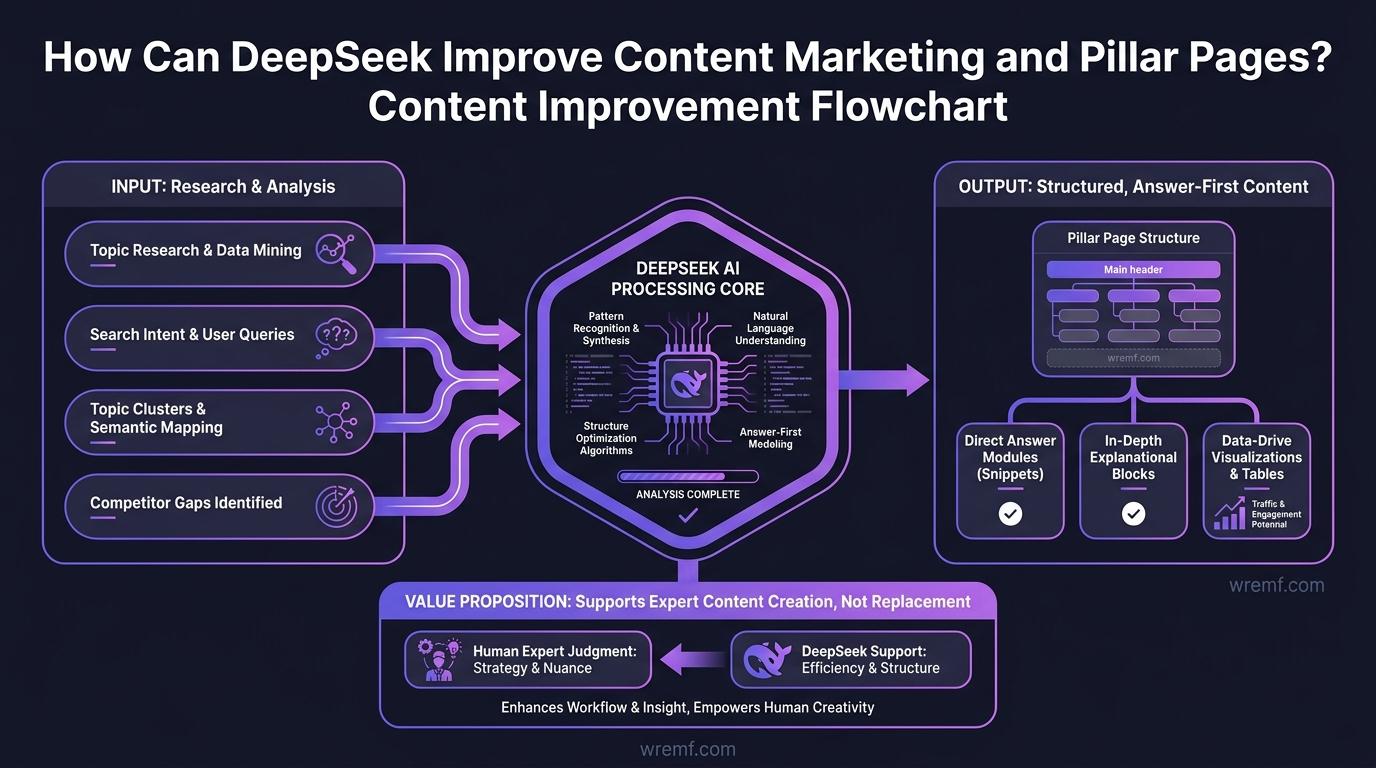
DeepSeek can improve content marketing by turning research, search intent, topic clusters, and competitor gaps into structured, answer-first content. DeepSeek should support expert content creation, not replace experience, sourcing, editing, or brand judgment.
Content marketing is the creation of useful content that attracts, educates, converts, and retains an audience. Content marketing matters because B2B buyers often use educational content to compare problems, solutions, vendors, pricing, and implementation risks.
Content gap analysis is the process of identifying missing topics, weak sections, unanswered questions, competitor advantages, and unserved user intent. Content gap analysis matters because it shows where your content does not yet satisfy search engines, AI platforms, or buyers.
A DeepSeek-first content workflow can help create:
Pillar pages that define the main topic and connect subtopics
Feature pages that explain product capabilities and use cases
Blog content that answers high-intent questions
Q&A formats that match People Also Ask and AI prompts
Use-case breakdowns for different industries, roles, or buyer stages
Internal links that connect related pages logically
Freshness signals that update facts, sources, dates, and examples
Authority cues that include named sources and practical experience
Answer-first content is content that gives a direct answer before expanding into details, examples, comparisons, and next steps. Answer-first content matters because search engines, AI Overviews, and LLMs need concise, extractable explanations.
For example, a DeepSeek SEO pillar page should not only say “DeepSeek helps with SEO.” A stronger page defines DeepSeek SEO, explains how it works, compares SEO vs AEO vs GEO, covers keyword clustering, discusses schema markup, explains privacy risks, addresses DeepSeek API workflows, and shows how to measure AI visibility.
DeepSeek can also help detect repetition, missing definitions, weak examples, unclear headings, unsupported claims, and internal link gaps. This makes it useful for improving existing pages, not only creating new ones.
KEY TAKEAWAY: DeepSeek improves content marketing when it helps build structured, answer-first, source-backed content that maps to search intent and AI retrieval.
Content improvement becomes more powerful when it also supports AI citations, source consistency, and GEO strategy.
How Does DeepSeek SEO Support GEO Strategy and AI Citations?
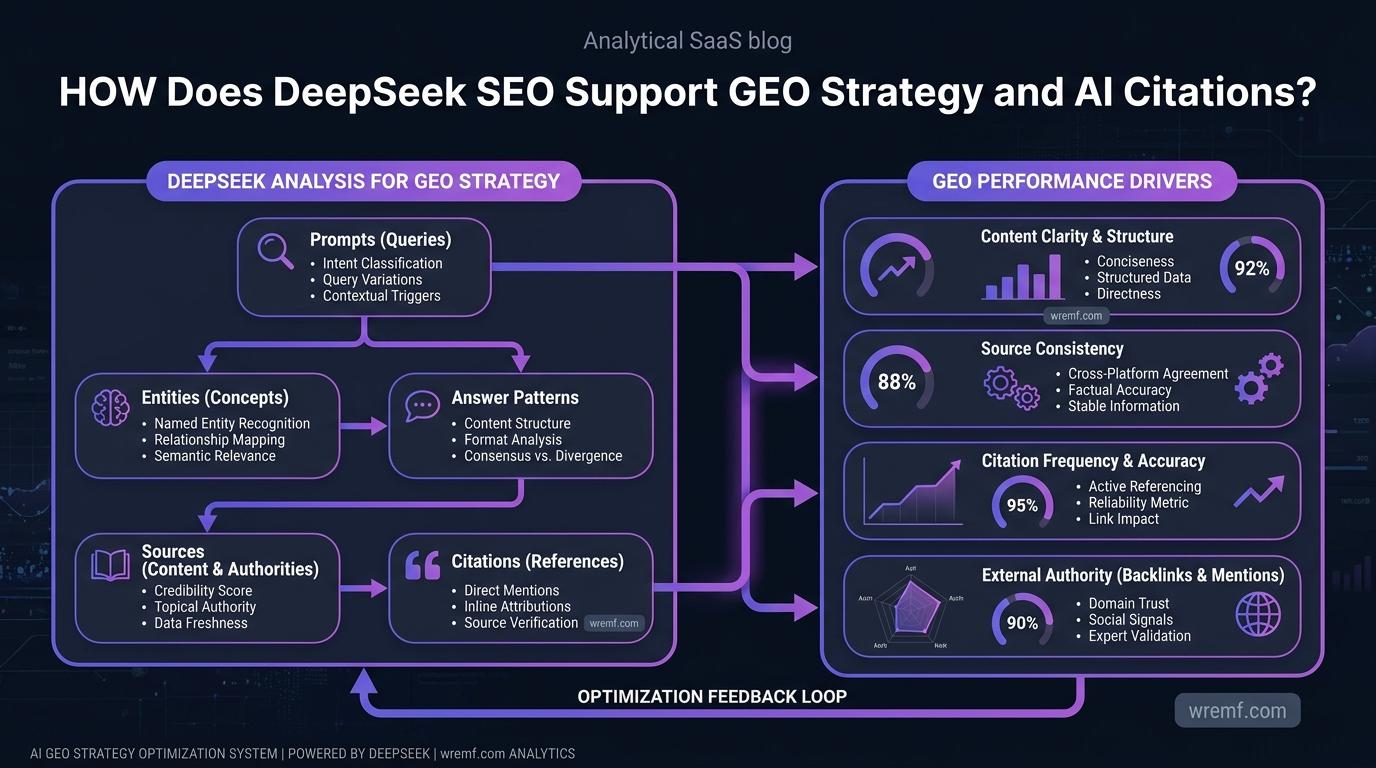
DeepSeek SEO supports GEO strategy by helping teams analyse prompts, sources, citations, entities, and answer patterns across AI platforms. GEO performance depends on content clarity, source consistency, citation frequency, and authority beyond your own website.
GEO strategy is the plan for improving how a brand appears in generative AI answers, summaries, comparisons, and recommendations. GEO strategy matters because AI platforms can influence discovery even when users do not click a traditional search result.
Citation frequency is how often a source is referenced across relevant AI answers, search results, or third-party contexts. Citation frequency matters because repeated source inclusion can reveal which domains AI systems rely on for a topic.
AI-powered platforms such as DeepSeek, ChatGPT, Perplexity, Gemini, Claude, Copilot, and Google AI Overviews may draw from different sources, ranking systems, retrieval methods, or browsing experiences. This means a brand can be visible in one AI platform and absent in another.
DeepSeek can help with GEO strategy by analysing:
Which prompts mention your brand
Which prompts mention competitors
Which sources AI systems cite for your category
Which facts about your brand are inconsistent
Which product claims need clearer evidence
Which content pages are most likely to satisfy AI retrieval
Which third-party sources influence AI answers
Which new content pages or updates should be prioritised
Entity clarity is the degree to which a brand, product, person, or concept is consistently described across sources. Entity clarity matters because AI systems need to understand what a brand is, who it serves, what it offers, and how it differs from alternatives.
Voice search is the use of spoken queries to retrieve answers from search engines or assistants. Voice search matters for DeepSeek SEO because voice queries are usually natural-language questions, which overlap with prompt tracking and answer-first content.
Voice queries are conversational spoken searches such as “Which AI visibility platform tracks DeepSeek and ChatGPT?” Voice queries matter because they reward clear, direct, concise answers that match user intent.
WREMF’s source citation tracking helps teams understand which sources AI systems cite, where competitors appear, and where source consistency needs improvement.
KEY TAKEAWAY: DeepSeek SEO supports GEO when it connects prompts, citations, entities, source consistency, and answer patterns into a measurable optimisation workflow.
A strong GEO workflow also needs competitor visibility because AI systems often recommend alternatives side by side.
How Should You Use DeepSeek for Competitor Visibility and SERP Analysis?
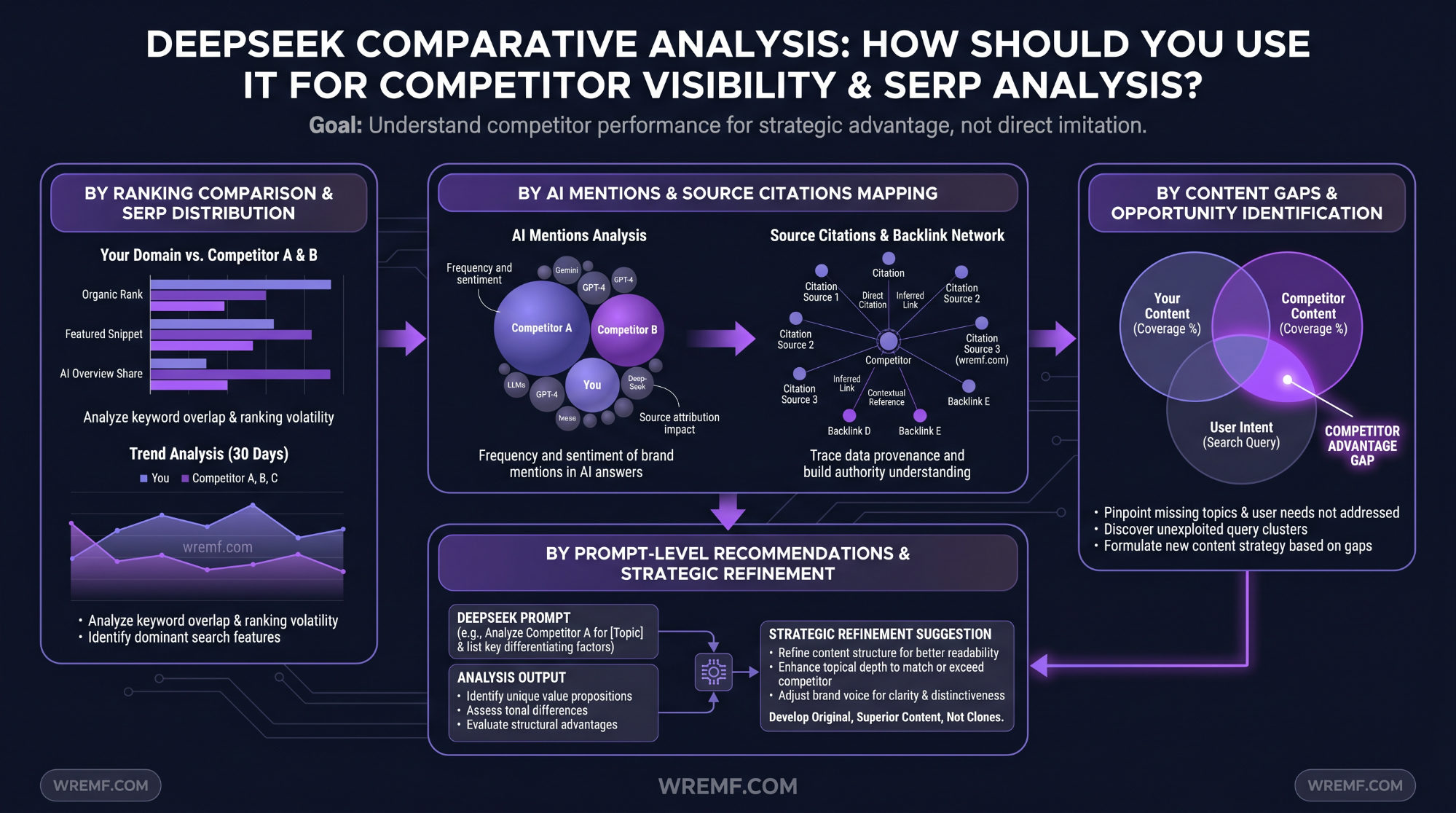
DeepSeek can help competitor visibility analysis by comparing rankings, AI mentions, source citations, content gaps, and prompt-level recommendations. The goal is to understand why competitors appear in search and AI answers, not simply copy their pages.
Competitor visibility is the measurable presence of competing brands across search results, AI-generated answers, citations, recommendations, and third-party sources. Competitor visibility matters because buyers often compare multiple vendors before choosing who to trust.
A search industry workflow that includes DeepSeek should analyse both SERP data and AI answer data. SERP data reveals ranking URLs, search features, snippets, and content formats. AI answer data reveals which brands are recommended, which sources are cited, and which facts are repeated.
DeepSeek can help compare competitors across:
| Comparison Area | What to Analyse | Why It Matters |
|---|---|---|
| Keyword rankings | Which competitor pages rank for priority queries | Shows classic SEO competition |
| SERP features | AI Overviews, People Also Ask, rich results, snippets | Shows how search results are structured |
| AI mentions | Which brands appear in AI answers | Shows AI discovery visibility |
| Source citations | Which third-party sources are cited | Shows authority ecosystem influence |
| Content depth | Missing definitions, examples, FAQs, comparisons | Shows content relevance gaps |
| Positioning | Repeated claims, categories, differentiators | Shows how AI systems understand competitors |
| Internal links | How competitor pages connect topics | Shows topical architecture |
| Freshness signals | Dates, updates, current examples, new data | Shows content maintenance quality |
Search habits are changing because users increasingly ask long, conversational, comparison-based questions. Search habits matter because competitor analysis should include prompts such as “best DeepSeek SEO tools,” “DeepSeek vs ChatGPT for SEO,” and “how to measure AI citations,” not only short keywords.
Viral marketing is not a reliable SEO strategy by itself. Viral marketing may increase brand mentions quickly, but sustainable AI visibility usually depends on source consistency, useful content, trusted citations, technical access, and ongoing measurement.
WREMF’s competitive landscape analysis helps teams compare their visibility against competitors across AI-generated answers, prompt sets, and source patterns.
KEY TAKEAWAY: DeepSeek competitor analysis should compare search rankings, AI mentions, source citations, content gaps, and competitor recommendations together.
Competitor analysis becomes more useful when it leads to a clear improvement plan.
How Can You Improve DeepSeek SEO Performance?
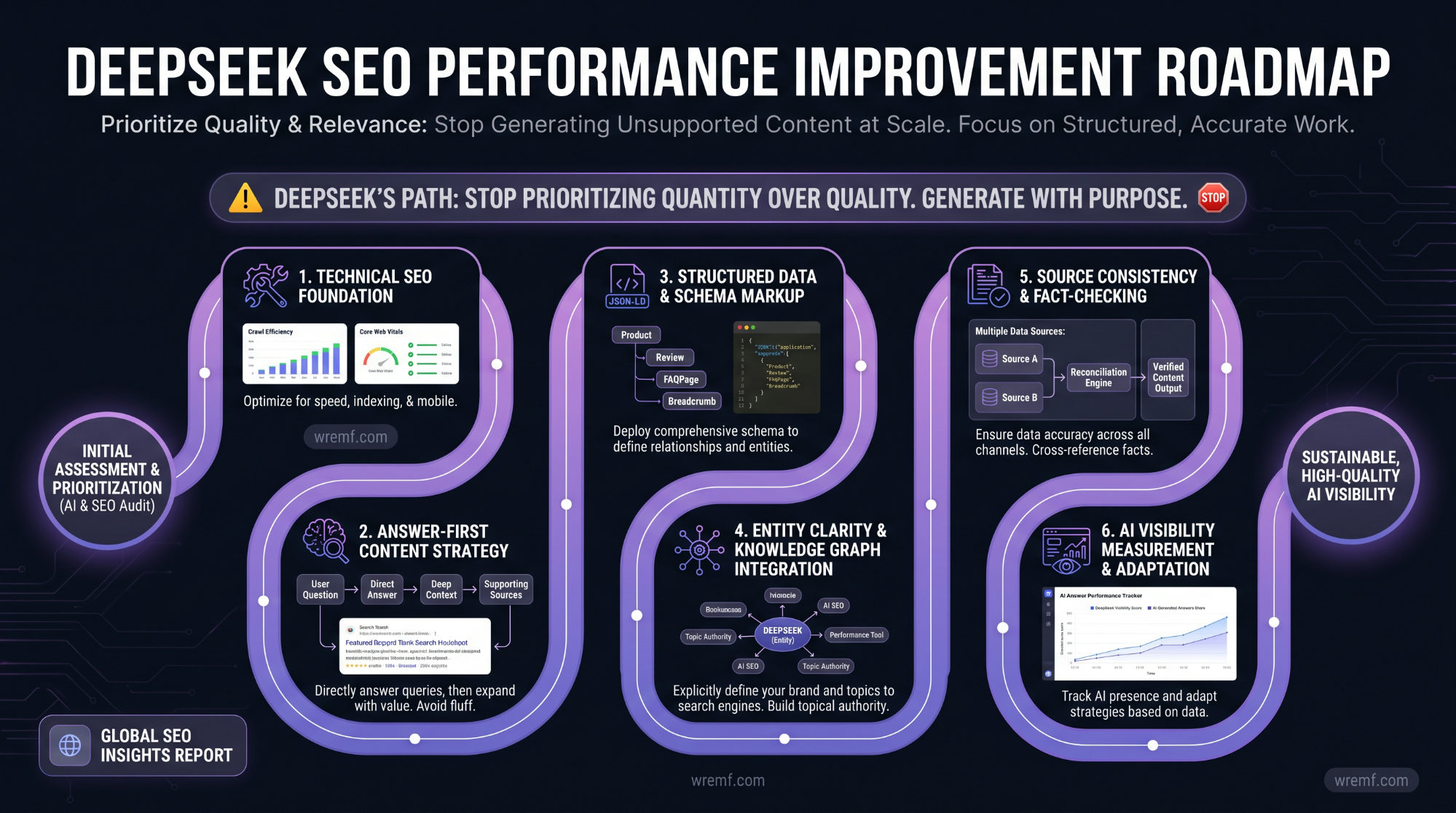
The most effective way to improve DeepSeek SEO performance is to combine technical SEO, answer-first content, structured data, entity clarity, source consistency, and AI visibility measurement. DeepSeek should help prioritise work, not generate unsupported content at scale.
The 80/20 rule for SEO means focusing on the small number of actions most likely to create measurable impact. For DeepSeek SEO, the highest-impact actions usually involve fixing technical blockers, improving high-intent content, clarifying entities, strengthening internal links, and tracking AI visibility.
Machine learning is the field of training systems to find patterns and make predictions or outputs from data. Machine learning matters for SEO because search engines and AI platforms increasingly use model-based systems to interpret content, queries, entities, and relevance.
Natural Language Processing is the field of helping computers understand, generate, and analyse human language. Natural Language Processing matters because DeepSeek, ChatGPT, Gemini, Claude, and other LLMs interact with content through language, entities, context, and structure.
A practical DeepSeek SEO improvement plan includes:
Fix crawlability, rendering, indexation, canonical, and sitemap issues
Improve technical audit priorities based on revenue and page value
Build topic clusters around real search intent and buyer questions
Add concise definitions for core entities and concepts
Improve schema markup and structured data accuracy
Create answer-first sections for AI retrieval and featured snippets
Strengthen internal links between pillar pages, content pages, product pages, and feature pages
Refresh outdated facts, sources, screenshots, product claims, and statistics
Track AI citations, source citations, competitor mentions, and AI share of voice
Use SEO testing to measure whether changes improve performance
Predictive modeling is the use of data and models to estimate future outcomes such as ranking movement, traffic changes, or conversion likelihood. Predictive modeling matters for SEO planning, but it should be treated as probabilistic guidance rather than guaranteed forecasting.
Click-through rates are the percentage of users who click after seeing a result or link. Click-through rates matter because better metadata, stronger search result relevance, and clearer positioning can improve the value of existing impressions.
WREMF’s SEO testing workflow helps teams measure the impact of content and technical changes over time instead of relying only on assumptions.
KEY TAKEAWAY: DeepSeek SEO improves when AI helps teams prioritise technical fixes, answer-first content, structured data, entity clarity, and measurable AI visibility actions.
For many teams, the next question is whether to use software, an agency, or a hybrid model.
Should You Use DeepSeek SEO Software, an Agency, or a Hybrid Model?
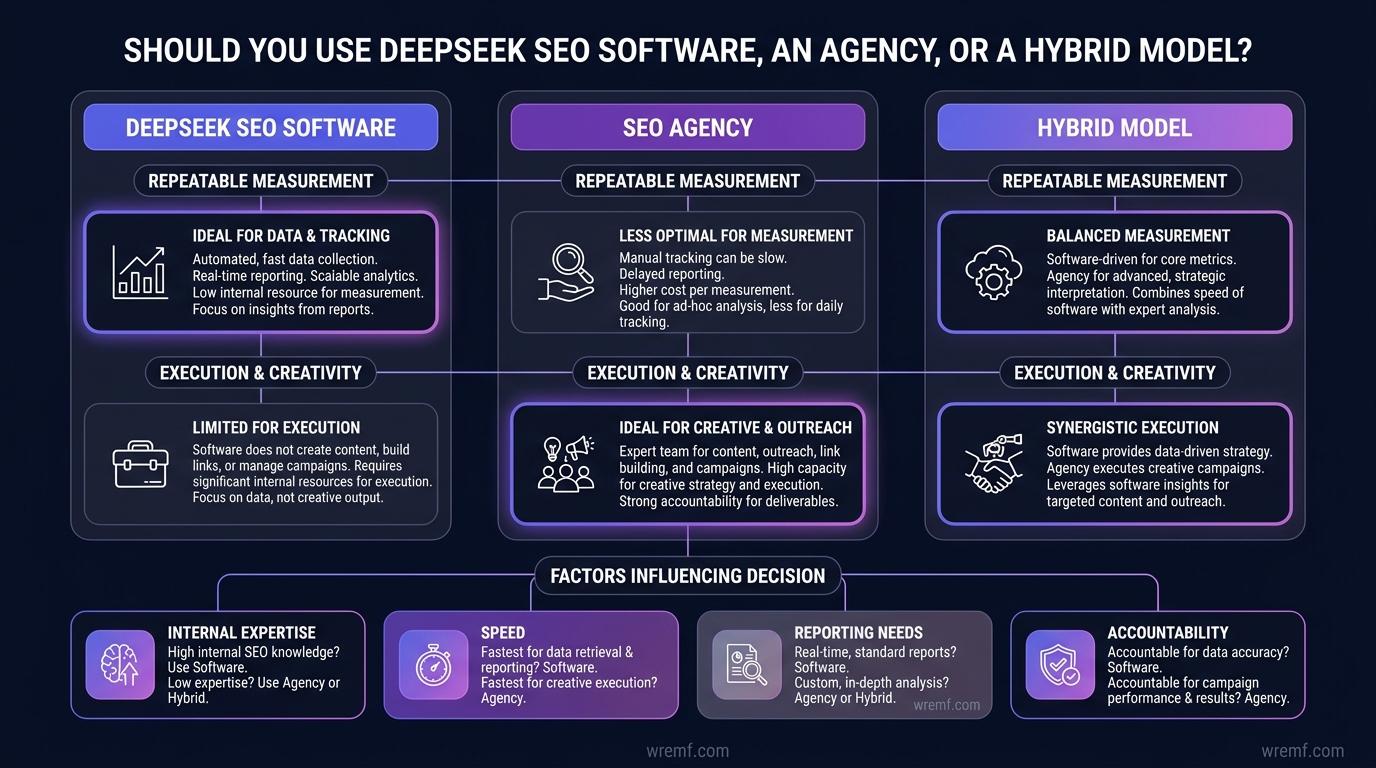
You should use DeepSeek SEO software when you need repeatable measurement, an agency when you need execution, and a hybrid model when you need both. The best choice depends on internal expertise, speed, reporting needs, and accountability.
DeepSeek AI SEO services are managed services that use DeepSeek and other AI workflows to support SEO, AEO, GEO, content optimisation, technical audits, and AI visibility. DeepSeek AI SEO services matter when a team does not have enough internal time or specialised knowledge to execute.
AI visibility software helps teams track prompts, citations, brand mentions, competitors, source consistency, and attribution across AI platforms. AI visibility software matters because manual testing becomes unreliable when you need to monitor many prompts, engines, brands, and clients.
| Option | Best For | What You Get | What It Misses | Recommended When |
|---|---|---|---|---|
| Software | In-house teams needing visibility data | Dashboards, prompt tracking, citations, reports | Execution if the team lacks capacity | You have internal SEO or content resources |
| Agency | Teams needing strategy and delivery | Audits, content, implementation guidance, reporting | Productised self-serve workflows | You need hands-on support |
| Hybrid | Teams needing measurement and execution | Software, methodology, reporting, managed work | Requires coordination | You need both clarity and delivery |
| Manual AI workflows | Early experimentation | Low-cost exploration and drafts | Repeatability, governance, reporting | You are testing workflows before scaling |
WREMF can be used as software, an agency service, or a combined software plus managed execution solution. The platform supports AI visibility tracking, prompt intelligence, source citation tracking, competitor visibility, AI share of voice, AI traffic attribution, GEO audits, AEO strategy, AI-ready content briefs, SEO testing, scheduled AI monitoring, white-label reporting, API and MCP integrations, BYOK, client portals, and source consistency analysis.
For teams that want managed execution, WREMF’s AI visibility agency services help with GEO consulting, AEO strategy, content optimisation, entity and authority building, citation improvement, schema and entity markup guidance, internal linking logic, crawl and rendering checks, monthly reporting, and pipeline attribution.
For teams comparing budgets, the WREMF pricing page explains software plans for different website counts, seats, reporting needs, and support levels.
KEY TAKEAWAY: Software is best for measurement, agency support is best for execution, and a hybrid model is best when teams need both AI visibility data and practical delivery.
Before choosing a workflow, it helps to clear up the myths that make DeepSeek SEO harder to evaluate.
Common Myths About DeepSeek SEO and AI Visibility Debunked
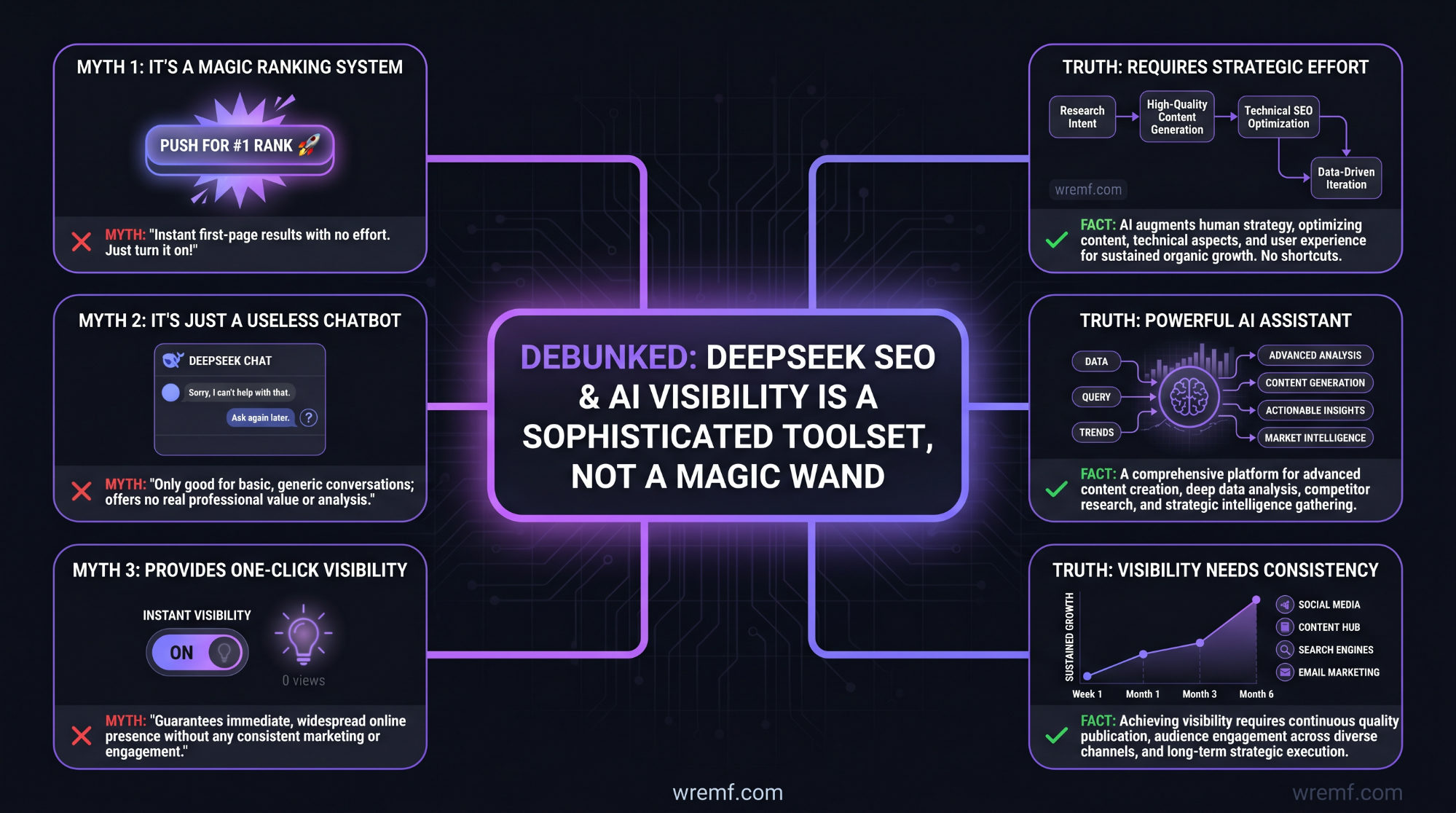
DeepSeek SEO is often misunderstood because it sits between classic SEO, AEO, GEO, AI content, and technical automation. The biggest mistake is treating DeepSeek as either a magic ranking system or a useless chatbot.
MYTH: DeepSeek SEO replaces traditional SEO.
FACT: DeepSeek SEO does not replace crawlability, useful content, structured data, internal links, authority, or user experience. DeepSeek can help analyse, structure, and prioritise SEO work, but search engine visibility still depends on discoverable, relevant, and trustworthy content.
MYTH: SEO, AEO, and GEO are completely separate disciplines.
FACT: SEO, AEO, and GEO overlap because they all depend on clear content, technical access, entity understanding, and trustworthy sources. SEO focuses on search results, AEO focuses on answer extraction, and GEO focuses on generative AI visibility. The strongest strategy connects all three.
MYTH: AI visibility is impossible to measure.
FACT: AI visibility can be measured through prompt coverage, brand mentions, AI citations, source citations, competitor recommendations, AI share of voice, and AI referral traffic where available. Measurement is imperfect because not every AI interaction produces a click, but imperfect measurement is not the same as no measurement.
MYTH: Rankings are enough to understand search visibility.
FACT: Rankings show where a page appears in search engine results, but they do not show whether DeepSeek, ChatGPT, Perplexity, Gemini, Claude, or Google AI Overviews mention or cite your brand. AI visibility requires prompt tracking, source citation analysis, competitor monitoring, and attribution.
MYTH: More AI content automatically improves DeepSeek SEO.
FACT: More AI content can hurt performance if pages are thin, repetitive, inaccurate, or disconnected from search intent. DeepSeek should be used to improve structure, research, content relevance, and prioritisation rather than publish unsupported content at scale.
KEY TAKEAWAY: DeepSeek SEO is most valuable when it supports disciplined SEO, AEO, GEO, and AI visibility workflows rather than replacing strategy, data, privacy controls, or human judgment.
The final section answers the questions SEO teams, founders, agencies, and growth leaders most often ask before using DeepSeek for SEO.
Frequently Asked Questions
Is DeepSeek good for SEO?
DeepSeek is good for SEO when it is used for structured analysis, keyword clustering, search intent mapping, content briefs, schema markup drafts, technical audit summaries, and large-scale classification. DeepSeek is not enough by itself because it does not automatically know your rankings, traffic, conversions, live search results, or AI visibility. The best workflow combines DeepSeek with Google Search Console, analytics, crawl data, SERP data, prompt tracking, and human review. WREMF can help measure how DeepSeek and other AI engines mention, cite, or recommend your brand.
What is DeepSeek SEO and how does it work?
DeepSeek SEO is the use of DeepSeek models and DeepSeek API workflows to support search engine optimisation, AEO, GEO, and AI visibility tasks. It works by sending structured inputs such as keywords, URLs, crawl issues, content drafts, SERP data, or prompt results to DeepSeek for classification, reasoning, clustering, or recommendations. The output should then be validated against search engine rankings, technical audit results, structured data rules, and business outcomes. DeepSeek SEO works best as a workflow layer, not as a standalone ranking tool.
Is SEO dead or evolving in 2026?
SEO is evolving, not dead. Search engine optimisation still matters because users continue to rely on search engines, organic results, AI Overviews, rich results, and source links. What changed is that visibility now includes AI discovery surfaces such as DeepSeek, ChatGPT, Perplexity, Gemini, Claude, Copilot, and Google AI Overviews. SEO teams now need to measure rankings, clicks, structured data, content quality, AI citations, brand mentions, and AI share of voice together. The strongest teams treat SEO, AEO, and GEO as connected disciplines.
Which AI is best for SEO?
The best AI for SEO depends on the task. DeepSeek is useful for reasoning-heavy and cost-sensitive workflows such as clustering, audit interpretation, and structured analysis. ChatGPT is strong for flexible ideation, workflow design, and content operations. Claude is strong for long-form review and nuanced editorial analysis. Gemini can be useful when Google ecosystem context is important. The better question is which model fits the workflow, data policy, cost profile, and output quality standard. Most advanced SEO teams use more than one AI model.
What is the 80/20 rule for SEO?
The 80/20 rule for SEO means focusing on the few actions that create most of the measurable impact. For DeepSeek SEO, the highest-impact actions are usually fixing technical blockers, improving content relevance, mapping search intent, building topic clusters, strengthening internal links, adding accurate structured data, and tracking AI visibility. DeepSeek can help identify and prioritise those actions, but final decisions should be based on search data, AI visibility data, commercial value, and implementation effort.
Can DeepSeek improve search engine rankings?
DeepSeek can help improve the work that supports search engine rankings, but DeepSeek does not directly improve rankings by itself. DeepSeek can identify content gaps, cluster keywords, draft metadata, explain technical issues, suggest internal links, and structure content for search intent. Rankings still depend on crawlability, relevance, authority, competition, page experience, helpful content, and search engine ranking systems. DeepSeek SEO should be measured through rankings, clicks, impressions, CTR, conversions, AI citations, and brand visibility across AI platforms.
How does DeepSeek SEO differ from other SEO tools or services?
Traditional SEO tools usually collect keyword data, backlinks, rankings, crawl issues, SERP data, and technical signals. DeepSeek is an AI model that can interpret, classify, summarise, and reason over data that you provide. This means DeepSeek is better viewed as an analysis and automation layer than a full SEO platform. A strong workflow uses SEO tools for data collection, DeepSeek for reasoning and structure, and AI visibility software such as WREMF’s source citation tracking for prompt, citation, and competitor visibility.
What are the main features of DeepSeek SEO workflows?
The main features of DeepSeek SEO workflows include keyword clustering, Long-Tail Keyword expansion, search intent classification, content gap analysis, technical audit summarisation, schema markup drafting, metadata generation, SERP data interpretation, AI Logs analysis, and prompt-level content planning. Advanced workflows also include DeepSeek API automation, API key governance, response logging, privacy controls, and integration with CMS or reporting tools. The most important feature is not text generation. The most important feature is turning raw SEO and AI visibility data into prioritised actions.
Can DeepSeek help with schema markup and structured data?
DeepSeek can help draft schema markup and structured data recommendations, but the output must be reviewed before publishing. Schema markup should accurately describe visible page content and should not invent reviews, ratings, prices, locations, claims, or product details. DeepSeek is useful for identifying suitable schema types, drafting FAQ structures, improving entity descriptions, and checking whether page content supports the markup. A technical SEO or developer should validate implementation with Google’s structured data guidance and testing tools before release.
How can DeepSeek be used for technical SEO audits?
DeepSeek can summarise crawl exports, classify errors, group issues by template, explain likely SEO impact, and turn technical audit findings into prioritised task lists. It can help analyse status codes, duplicate metadata, canonical conflicts, internal link gaps, sitemap issues, structured data errors, rendering concerns, and server log patterns. DeepSeek should not replace crawling tools, log analysis platforms, or manual validation. The best workflow uses DeepSeek to interpret evidence from trusted tools, then confirms fixes through crawl tests, search results, and analytics.
Does DeepSeek have real-time web search while thinking?
DeepSeek model responses should not be treated as real-time web search unless the product or workflow being used has a live search or retrieval layer. A language model can reason over supplied inputs, but it may not know current search results, current rankings, new pages, recent algorithm changes, or live competitor updates unless that data is provided. For SEO, this means teams should supply SERP data, crawl exports, analytics, source lists, and prompt results. DeepSeek is strongest when paired with current data.
Is DeepSeek better than ChatGPT for SEO?
DeepSeek may be better than ChatGPT for some SEO workflows, especially reasoning-heavy or cost-sensitive classification tasks, but ChatGPT may be better for other tasks such as flexible ideation, technical explanation, and workflow design. Claude may perform better for long-form editorial review, and Gemini may be useful for Google ecosystem context. The best model depends on the task, privacy policy, cost, output quality, integrations, and review process. Serious SEO teams should test models with the same inputs and score outputs against measurable criteria.
Should small businesses use DeepSeek SEO?
Small businesses can use DeepSeek SEO for keyword research, content outlines, metadata drafts, FAQ development, content gap analysis, and basic technical audit interpretation. The biggest benefit is speed and structure. The biggest risk is publishing unsupported AI content without checking accuracy, search intent, or local business details. Small businesses should start with low-risk workflows and avoid pasting sensitive customer data. DeepSeek SEO is useful for small businesses when it improves clarity, consistency, and execution rather than replacing expert review.
Should agencies offer DeepSeek SEO services?
Agencies can offer DeepSeek SEO services if they have clear deliverables, privacy controls, quality assurance, and measurement. Good services include AI visibility audits, prompt tracking, content optimisation, technical audit interpretation, structured data guidance, AI-ready briefs, and reporting across SEO and GEO metrics. Agencies should not sell DeepSeek SEO as guaranteed rankings or guaranteed AI citations. WREMF supports agencies with white-label reporting, client portals, prompt monitoring, source citation analysis, and managed AI visibility workflows for repeatable client delivery.
How do I start using DeepSeek for SEO safely?
Start by choosing one low-risk workflow, such as keyword clustering, content brief generation, metadata drafting, or crawl issue classification. Use anonymised or non-sensitive data, review DeepSeek’s privacy policy, control API key access, and keep human approval before publishing changes. Then compare outputs against Google Search Console, live search results, crawl data, and AI prompt tracking. Once the workflow is reliable, you can automate parts of it through DeepSeek API, spreadsheets, CMS workflows, or a platform that supports BYOK and reporting.
How should DeepSeek SEO be reported to leadership?
DeepSeek SEO should be reported through both traditional SEO metrics and AI visibility metrics. Traditional metrics include rankings, clicks, impressions, CTR, average position, crawl health, indexed pages, and conversions. AI visibility metrics include prompt coverage, brand mentions, citations, competitor recommendations, source consistency, AI share of voice, and AI referral traffic where measurable. Leadership reporting should connect activity to outcomes. WREMF helps teams create this reporting layer through AI visibility scoring, sample reports, competitor tracking, and attribution workflows.
Conclusion
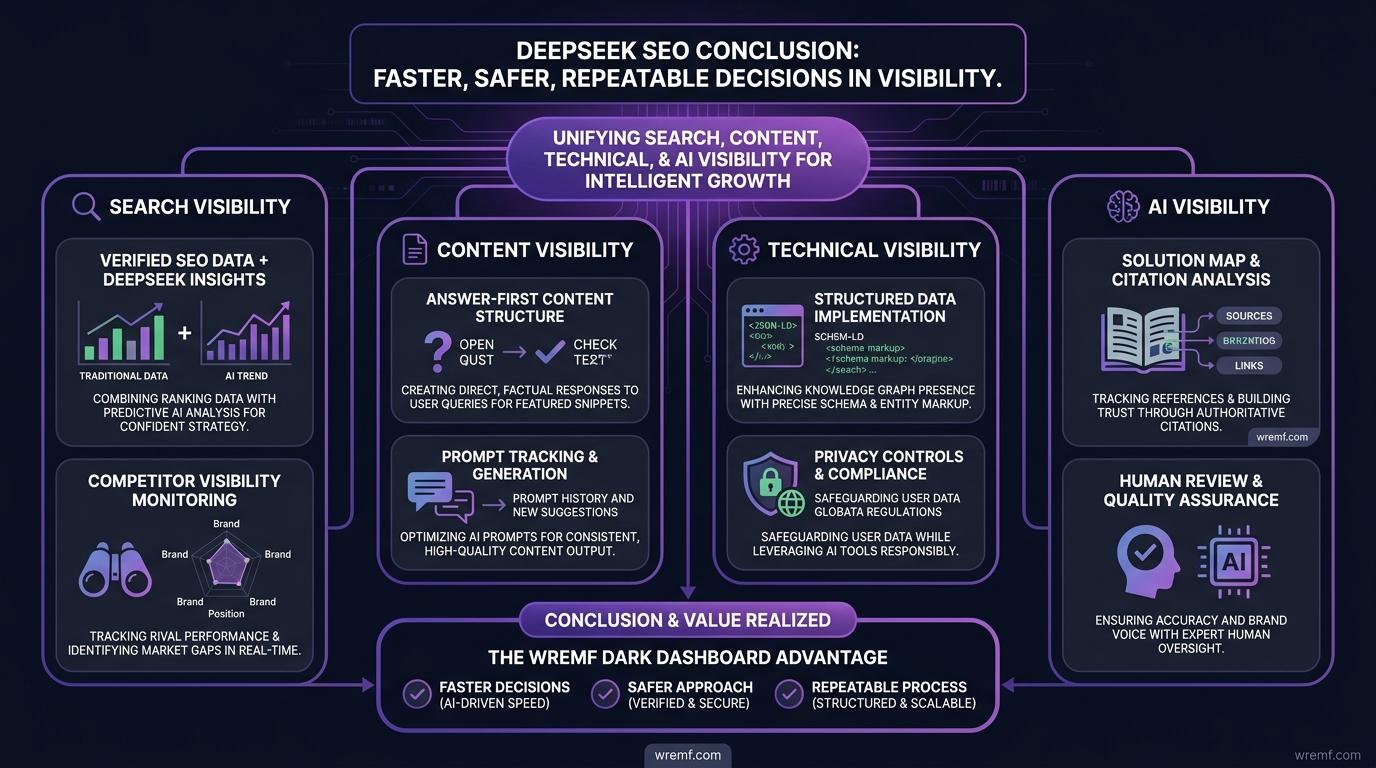
DeepSeek SEO is valuable when it helps you make search, content, technical, and AI visibility decisions faster, safer, and more repeatable. The strongest approach combines DeepSeek with verified SEO data, answer-first content, structured data, privacy controls, prompt tracking, citation analysis, competitor visibility, and human review. Rankings still matter, but AI citations, brand mentions, source consistency, and recommendations now shape how buyers discover and evaluate brands. To turn DeepSeek SEO into a measurable AI visibility workflow, explore the WREMF platform suite or request support from the WREMF agency team.
Related reading
- How to Get Cited by Perplexity: Guide to Perplexity Citations, AI Search Visibility, and Source Authority
- Claude SEO: The Complete Guide to Using Claude AI for SEO, AEO, GEO, and AI Search Visibility
- Answer Engine Optimization: The Complete Guide to AEO, AI Search Visibility, and Answer-First Content
- Why Is My Brand Not Showing in ChatGPT? Reasons, Diagnosis, and a Complete AI Visibility Fix