Google Visibility Score: The Complete Guide for SEO, AI Search, and B2B Brands
Learn to calculate Google visibility score for SEO and AI search, improving it through effective strategies.
By WREMF Team · 2026-09-21
Google visibility score is a calculated SEO metric indicating a website's visibility in Google search results, based on keyword rankings, search volume, and click-through rates. It is produced by SEO platforms like SISTRIX and Ahrefs, not Google itself. A higher score means better keyword ranking performance and potential for organic traffic. It requires an understanding of on-page SEO, technical SEO, keyword prioritization, and AI impact, as platforms like WREMF track AI visibility scores to monitor performance in the growing AI search landscape.
Key takeaways
- Google visibility score is not a native Google metric but calculated by third-party platforms.
- The score depends heavily on keyword rankings, search volume, and click-through rates.
- Improving your visibility score requires addressing SEO components like technical health and content strategy.
- AI visibility scores track brand presence in AI-generated answers, a new challenge alongside traditional SEO.
- Platforms like WREMF help track both traditional and AI search visibility across search engines.
Google Visibility Score: The Complete Guide for SEO, AI Search, and B2B Brands

Google visibility score is a ranking performance metric that estimates how prominently a website appears across Google search results for a defined set of tracked keywords. It is not a single Google-owned number but a calculated index used by SEO platforms, marketing teams, and agencies to measure search presence over time. This guide is written for B2B SaaS teams, in-house SEO professionals, agency leads, and growth marketers who need to understand, track, and improve their visibility across both traditional search and AI-powered discovery surfaces. The article covers how visibility scores are calculated, what affects them, how they connect to AI visibility, and how modern platforms like WREMF extend traditional visibility measurement into the AI search era. If your team is trying to understand why visibility alone is no longer enough to capture AI-driven demand, this guide explains the full picture.
QUICK ANSWER:
Google visibility score is a calculated SEO metric that estimates how visible a website is in Google search results based on its keyword rankings, the search volume of those keywords, and positional click-through rate weighting. The score is not published by Google itself but is produced by SEO platforms such as SISTRIX, Advanced Web Ranking, Ahrefs, and Ubersuggest. A higher Google visibility score generally indicates stronger keyword ranking performance, broader keyword coverage, and higher potential organic traffic.
KEY TAKEAWAYS:
- Google visibility score is a calculated ranking performance metric, not a native Google metric, and different SEO platforms use different methodologies to produce it.
- The score is typically based on keyword positions, search volume weighting, and estimated click-through rates across tracked keywords in Google SERPs.
- Improving your Google visibility score requires coordinated work across keyword rankings, technical SEO, on-page SEO, backlinks, and content strategies.
- Traditional Google visibility scores do not measure AI-generated answers, AI citations, or brand presence in platforms such as ChatGPT, Gemini, Perplexity, or Google's AI Overviews.
- WREMF extends visibility measurement beyond Google rankings into AI search visibility, prompt tracking, source citation tracking, and AI share of voice across ten AI engines.
- Teams that track only keyword rankings risk missing a growing share of buyer discovery that now happens through AI-generated answers rather than organic search results.
What Is Google Visibility Score and How Is It Defined?
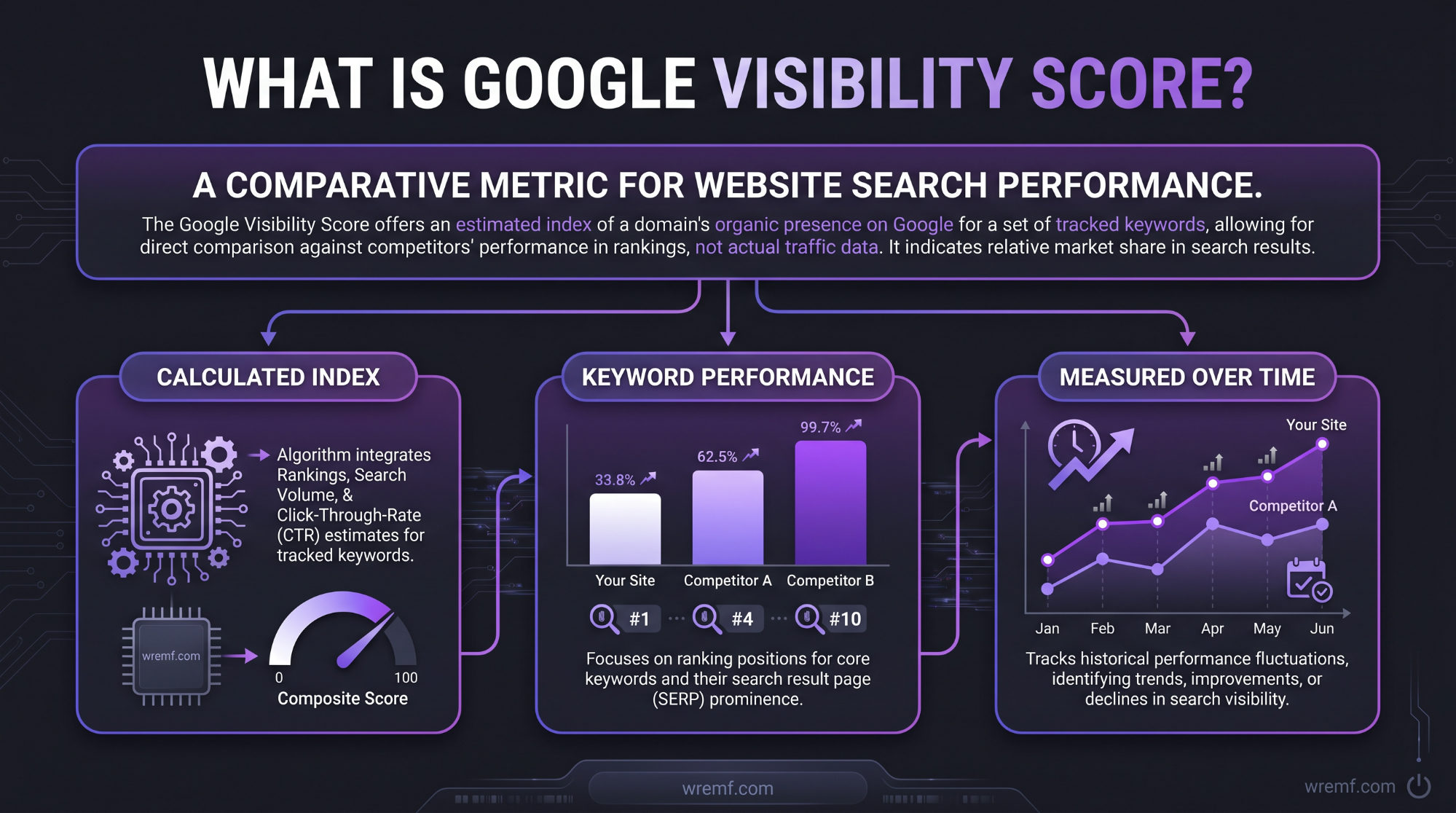
Google visibility score is a calculated index that reflects how visible a website is in Google search results for a selected set of keywords. The score is produced by third-party SEO platforms, not by Google itself, and each platform uses a slightly different methodology to arrive at a number. Despite this variation, the underlying logic is consistent: the score rewards high rankings for high-volume keywords and penalises low positions or keyword gaps.
The metric exists because raw keyword rankings are difficult to interpret in aggregate. A site might rank for thousands of keywords, but if those rankings are clustered in positions 40 to 60, the practical impact on organic traffic is minimal. A visibility score compresses keyword-level data into a single comparable number, making it easier to spot trends, benchmark competitors, and communicate performance to stakeholders.
Most SEO platforms define Google visibility score as the weighted share of potential traffic a website could receive if every tracked keyword resulted in a click from its current ranking position. The score rises when rankings move toward position one and falls when keywords drop in the Google SERPs or when tracked keyword lists expand without corresponding ranking improvements.
The SISTRIX Visibility Index is one of the most widely referenced versions of this metric in European markets. The SISTRIX methodology tracks millions of keywords and assigns Visibility points based on ranking position and click-through rate curves. Other tools such as Advanced Web Ranking, Ahrefs, and Ubersuggest produce their own visibility indexes using comparable logic but with different Data basis, keyword universes, and update frequencies. This means a score of 10 in one platform is not directly comparable to a score of 10 in another.
IMPORTANT:
Google visibility score is a comparative metric. It is most useful when tracked over time within the same platform or compared against competitor domains in the same tool. Cross-platform comparisons of raw scores are not meaningful without normalisation.
Understanding what the score represents helps teams avoid over-interpreting short-term Fluctuations or making decisions based on a single data point. The score is a direction indicator, not an absolute measure of performance.
KEY TAKEAWAY: Google visibility score is a third-party calculated ranking performance metric that compresses keyword position and search volume data into a single index. Its value lies in trend tracking, competitor benchmarking, and communicating overall SEO performance rather than in precise traffic forecasting.
How Visibility Score Is Calculated: The Point-Based System Explained
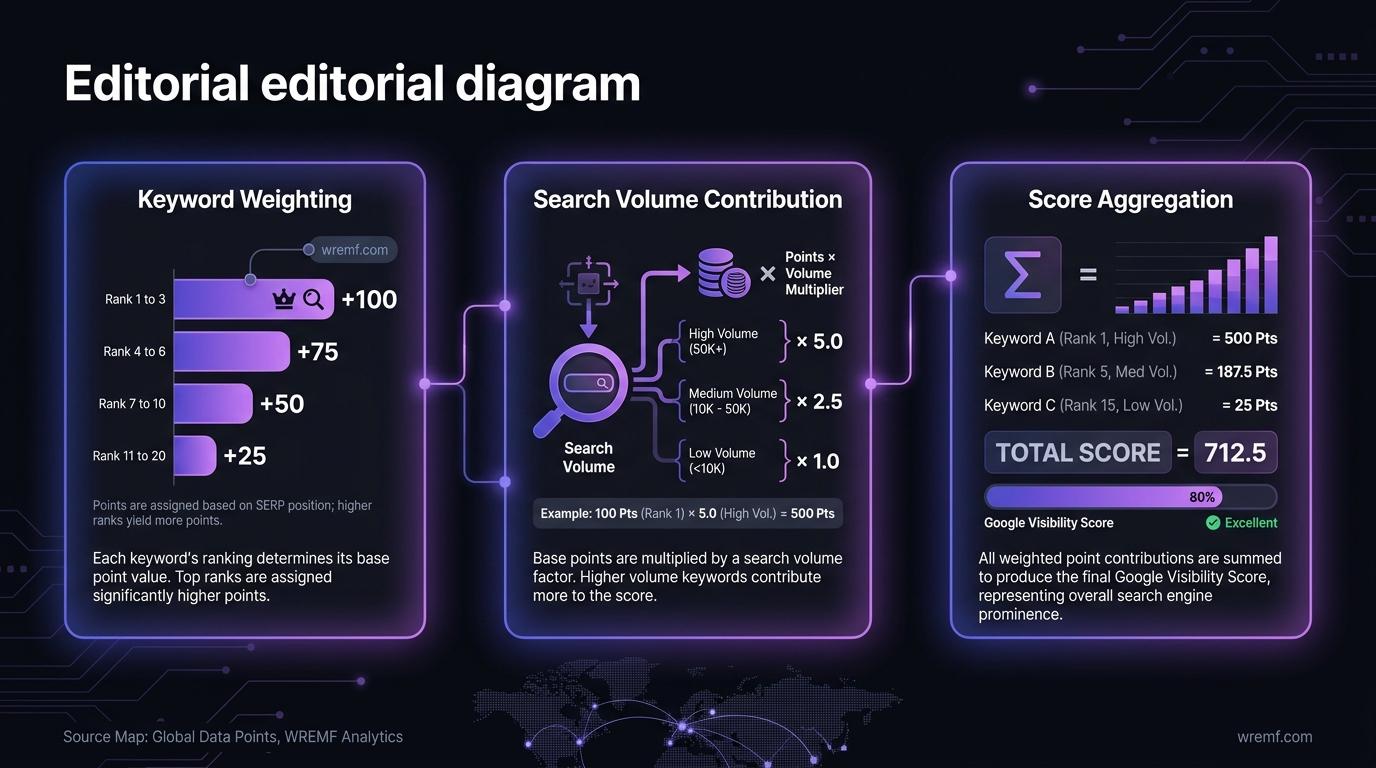
Visibility score is calculated by combining keyword ranking position, search volume, and estimated click-through rate into a weighted score for each tracked keyword, then summing or averaging those scores across the full keyword set.
The calculation follows a point-based system that works in three stages. First, each keyword in the tracked set is assigned a positional weight. Rankings in positions one to three receive the highest Visibility points because click-through rate data consistently shows that clicks cluster heavily at the top of Google SERPs. Rankings below position ten receive close to zero weight because most users do not scroll past the first page of search engine results. Rankings that do not appear in the top 100 receive no contribution to the score.
Second, each keyword's positional weight is multiplied by its Search Volume. A keyword ranking in position three with a monthly search volume of 10,000 contributes far more to the total score than a keyword ranking in position two with a monthly search volume of 50. This is the core logic of the Calculation of the Visibility Index: not all rankings are equal, and search volume is the scaling factor that makes position gains meaningful.
Third, the weighted scores for all tracked keywords are summed or expressed as a Visibility Percent of the total possible score. If every tracked keyword ranked at position one, the site would achieve the theoretical maximum, often expressed as 100 percent visibility or a reference index score of 1. Most real-world websites sit well below this ceiling, and realistic scores vary significantly by industry, domain size, and keyword competitiveness.
The practical implication of this methodology is that improving positions for high-volume keywords produces a disproportionate impact on the overall visibility score. Moving a keyword from position eight to position two for a term with 20,000 monthly searches can raise a score more than gaining position one for ten keywords with 200 searches each. This should directly inform prioritisation decisions in any SEO work plan.
Some platforms, including the Advanced Web Ranking Team's visibility tools, apply additional layers such as device segmentation, geographic weighting, and SERP feature adjustments to account for Featured snippets, local intent results, and Google Ads / PPC entries that reduce organic click-through rates. These refinements make the score more realistic but also more complex to interpret without platform context.
The concept of ranking domains is also relevant here. Platforms that track visibility at the domain level rather than the URL level will treat subdomain performance differently, and this can cause apparent Fluctuations when domain structure changes without any change in actual keyword rankings.
KEY TAKEAWAY: Visibility score is produced by weighting keyword rankings against search volume and click-through rate curves, then aggregating across all tracked keywords. Position gains on high-volume keywords produce the largest score improvements, making keyword prioritisation the most direct lever for improving visibility.
What Affects Your Google Visibility Score?
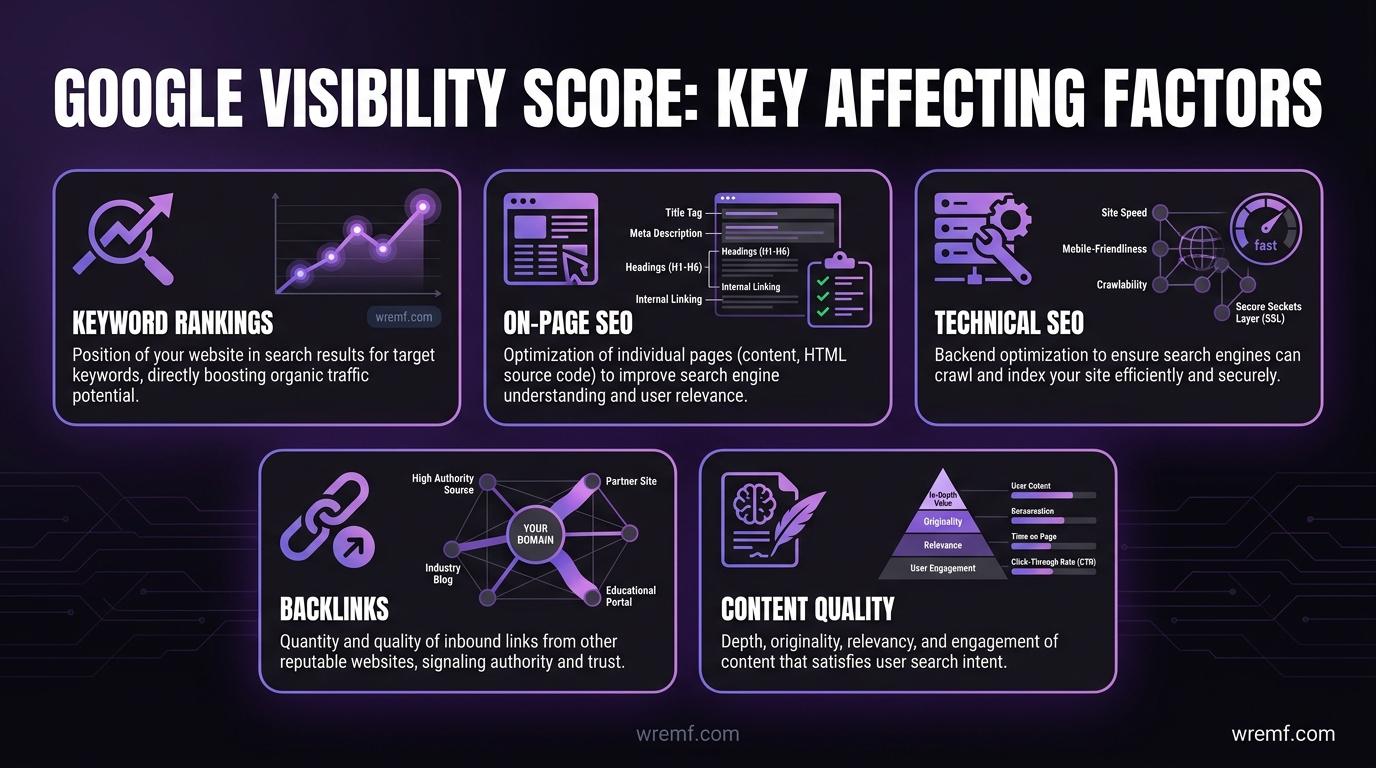
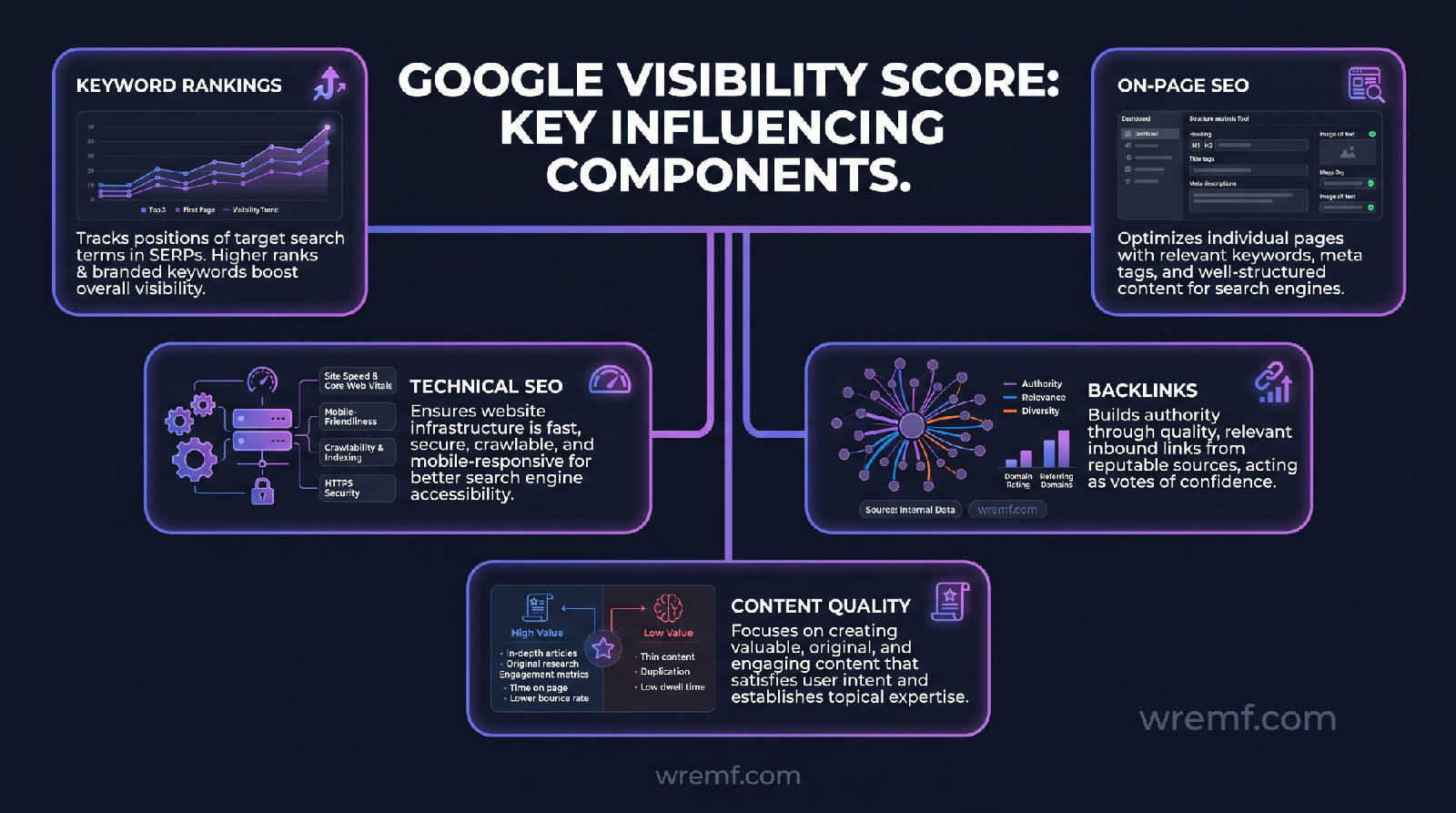
Google visibility score is influenced by every factor that affects keyword rankings in Google SERPs, including on-page SEO, Technical SEO, Backlinks, content quality, and Search Intent alignment. No single factor determines visibility, but some factors have a larger and faster impact than others.
Keyword Rankings and Search Intent Alignment
Keyword Ranking is the most direct driver of visibility score. When a page ranks higher for a tracked keyword, its contribution to the score increases. However, rankings are earned by satisfying Search Intent, which means the content, format, and depth of a page must match what users expect to find when they enter a particular query. Pages that rank for keywords where the content does not match Search Intent typically experience lower Click-through Rate and higher bounce rates, both of which can feed back into ranking systems and suppress positions over time.
On-Page Factors
On-Page Factors such as Header Tags, Meta Descriptions, internal linking, content structure, and keyword relevance all contribute to how Google's Search algorithms assess the quality and topicality of a page. Well-optimised Meta Descriptions do not directly increase rankings, but they influence Click-through Rate, which affects the traffic realised from a given ranking position. Header Tags help Search algorithms understand page structure and can support Featured snippets extraction when content is formatted clearly.
Technical SEO Foundations
Technical SEO factors including Page Load Speed, Mobile Friendliness, latency, crawl errors, Site Architecture, and sitemap completeness affect whether Google can access, index, and rank pages at all. A page that cannot be crawled cannot contribute to visibility. A page that loads slowly on mobile may rank lower due to user experience signals. Platforms like WordPress require specific technical attention to avoid common crawl errors, duplicate content, and Site Architecture problems that can suppress visibility across entire sections of a site.
Backlinks and Domain Authority
Backlinks remain one of the strongest authority signals in Google's ranking systems. Backlink quality, measured by the authority and relevance of linking domains, matters more than raw link count. Domain Authority as calculated by tools such as Ahrefs is a proxy metric, not a Google-owned signal, but it correlates with ranking performance across competitive keyword sets. Building relevant, authoritative Backlinks supports ranking stability and helps pages maintain positions against competitors with more established link profiles.
Content Freshness and Structured Data
Content freshness matters for queries where recency is a ranking factor. Google's synonym system and ability to interpret spelling mistakes means that keyword-exact matching is less critical than topical relevance and content comprehensiveness. Structured Data helps Google understand the entities and relationships within a page, which can support Featured snippets, rich results, and eligibility for components of Search such as knowledge panels. A sitemap ensures that new and updated pages are discovered quickly, limiting the lag between content publication and ranking appearance.
TIP:
Conduct a Content Gaps analysis alongside your visibility score review. Identify which high-volume keywords your tracked domain does not rank for and compare those against competitor domains ranking in positions one to five. Content Gaps analysis is one of the highest-leverage inputs for content marketing and content freshness decisions.
KEY TAKEAWAY: Google visibility score is shaped by the combined effect of keyword rankings, Search Intent alignment, Technical SEO health, Backlink quality, on-page SEO, and content freshness. Improving the score requires addressing all these components, not just publishing more pages or targeting more keywords.
Google Visibility Score vs SEO Visibility vs Visibility Index: Understanding the Differences
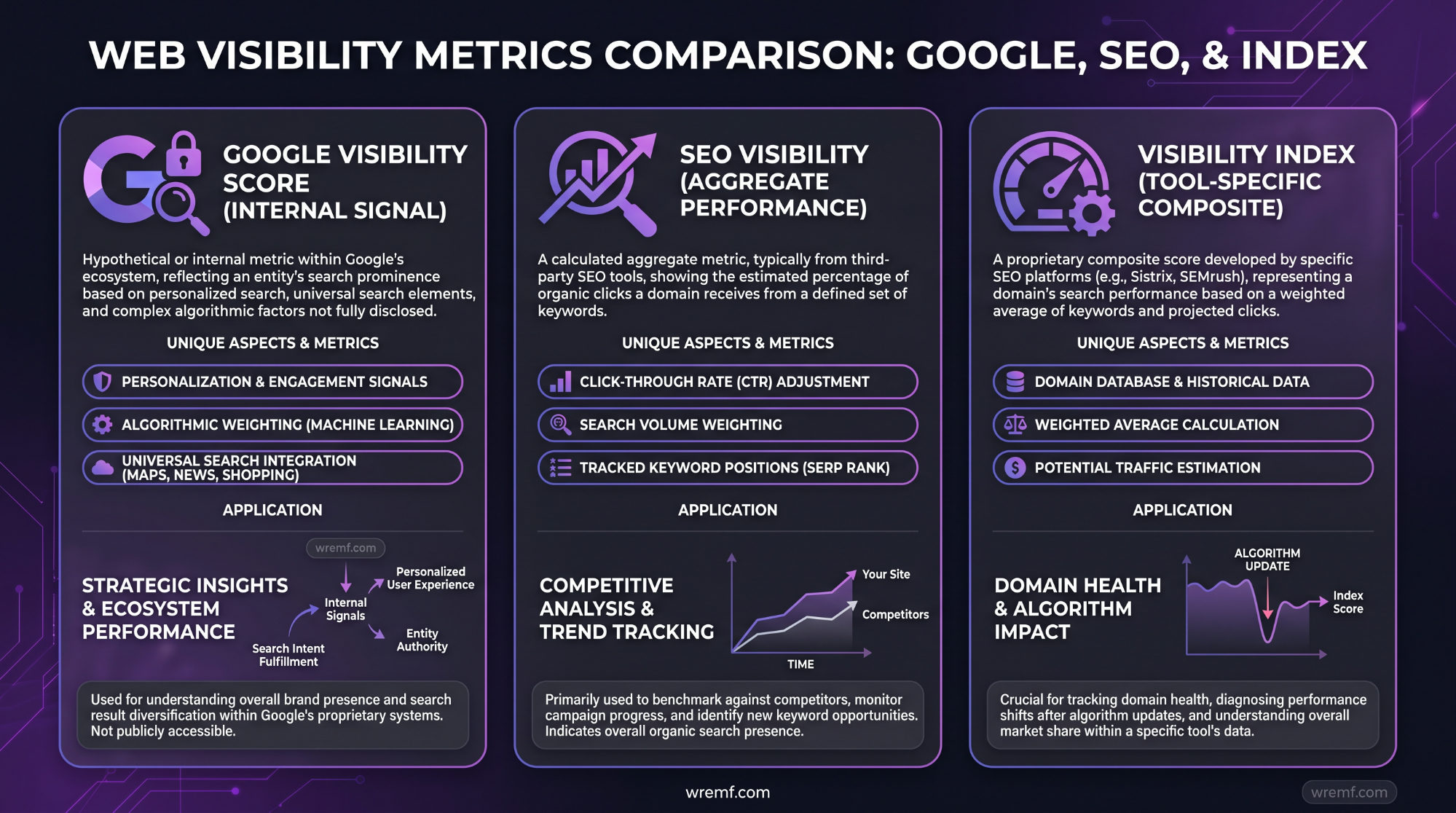
SEO visibility, Google visibility score, and Visibility Index are related but distinct concepts that different platforms operationalise in different ways. Understanding the differences helps teams avoid conflating metrics that use incompatible methodologies.
SEO Visibility is the broadest term. It refers to the overall presence of a website in organic search results across all search engines, not just Google. SEO performance measured at this level includes keyword rankings, Organic Traffic, branded and non-branded query splits, and visibility across different SERPs such as image search, video search, and local search results.
Google visibility score is a narrower concept that focuses specifically on visibility within Google's organic search results for a defined keyword set. It is a snapshot of ranking performance weighted by search volume and positional click-through rate. Tools such as SISTRIX, Advanced Web Ranking, Ahrefs, and Ubersuggest each produce their own version of this score.
Visibility Index, particularly the SISTRIX Visibility Index, is a proprietary implementation of the visibility score concept. SISTRIX tracks millions of keywords across multiple countries and updates its index regularly. The SISTRIX methodology is documented publicly and is widely used by agencies and enterprise SEO teams in Europe as an Independent Success Measurement benchmark. SISTRIX also offers a Time Machine feature that allows teams to view historical visibility data, helping identify when and why visibility dropped, which is useful for diagnosing the impact of algorithm updates, site migrations, or competitor activity.
Marqade and GOOP Digital are among the agency contexts in which these visibility metrics are applied in practice, often alongside Competitor Analysis and ranking domains benchmarking to give clients a relative sense of market share rather than absolute position.
The key practical distinction is that none of these traditional tools track what is happening in AI-generated answers, AI citations, or AI share of voice. SEO visibility as measured by these platforms reflects traditional Search Engine Results Pages and organic search results, not the prompt-based discovery journeys that buyers increasingly use when researching B2B solutions. As explored in the guide to AI search engine optimisation for B2B brands the gap between SEO visibility and AI visibility is growing, and brands that track only one without the other are operating with incomplete data.
KEY TAKEAWAY: SEO visibility, Google visibility score, and Visibility Index are related but not identical. Each tool uses its own methodology, making cross-platform comparisons unreliable. Traditional visibility metrics do not measure AI-generated answer presence, which requires a separate AI Visibility Score framework.
The AI Visibility Score: How AI Search Changes What Visibility Means
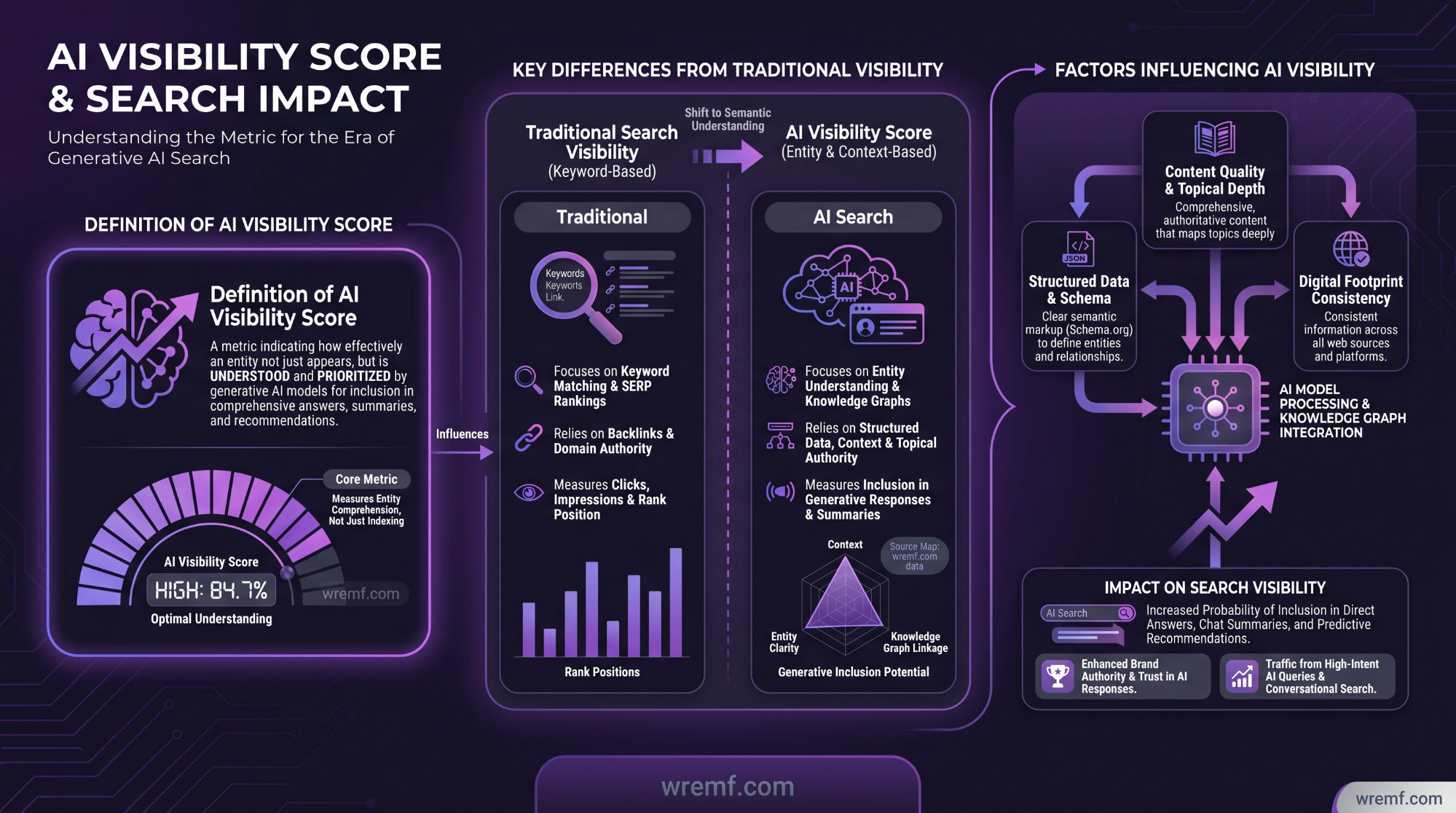
AI Visibility Score is a newer category of metric that measures how often a brand is mentioned, cited, compared, or recommended in AI-generated answers across platforms such as ChatGPT, Gemini, Claude, Perplexity, Google's AI Overviews, Copilot, DeepSeek, Grok, Meta AI, and Mistral. It exists because traditional visibility scoring, which focuses on Google rankings and organic search results, does not capture how AI engines select and surface sources in response to prompts.
The shift toward AI-generated answers is reshaping where and how buyers discover vendors, compare solutions, and form purchase intent. When a buyer types a question into Perplexity or asks Google's AI Overviews to recommend a B2B SaaS tool, the answer they receive is not a ranked list of web pages. It is a synthesised response generated by language models drawing on a selected set of sources. Whether a brand appears in that response depends on factors that are different from traditional ranking factors.
Traditional Google visibility score reflects how well a website ranks in organic search results. AI Visibility Score reflects how well a brand is represented in the source pool that AI engines draw from when generating answers. These are related but distinct problems. A brand can rank on page one of Google for a target keyword and still be absent from the AI-generated answers that a buyer encounters when asking the same question in a different format.
The concept of impression- and citation-driven visibility describes this AI layer. Rather than measuring positions in a Search Engine Results Page, AI visibility measures whether a brand is cited as a source, mentioned by name, compared to competitors, or recommended by name in an AI-generated answer. This requires a different measurement approach built around prompt tracking, source citation tracking, and AI share of voice, rather than the point-based system used for traditional keyword ranking.
WREMF tracks AI Visibility Score across ten AI engines by running structured prompts relevant to a brand's product category, buyer questions, and competitive landscape. The platform measures citation frequency, source consistency, share of voice against named competitors, and changes in brand mention patterns over time. Teams can review this data through the WREMF platform, white-label reports, or Looker Studio connectors, depending on their reporting requirements. The guide to AI brand monitoring explains in detail how this monitoring layer complements traditional SEO visibility tracking.
DID YOU KNOW:
Google's AI Overviews apply a classification separate from standard organic sessions in Google Analytics. According to Google's AI Overviews documentation publishers can monitor AI Overview traffic through Search Console, but AI referral traffic attribution from platforms such as ChatGPT or Perplexity requires separate tracking logic.
KEY TAKEAWAY: AI Visibility Score measures brand presence in AI-generated answers, which is a fundamentally different signal from Google visibility score. Brands that track only traditional ranking performance risk missing the growing share of buyer discovery that happens through prompt-based AI search.
Google's AI Overviews, Bing Chat, and Google Copilot: How AI Engines Are Changing Search Visibility
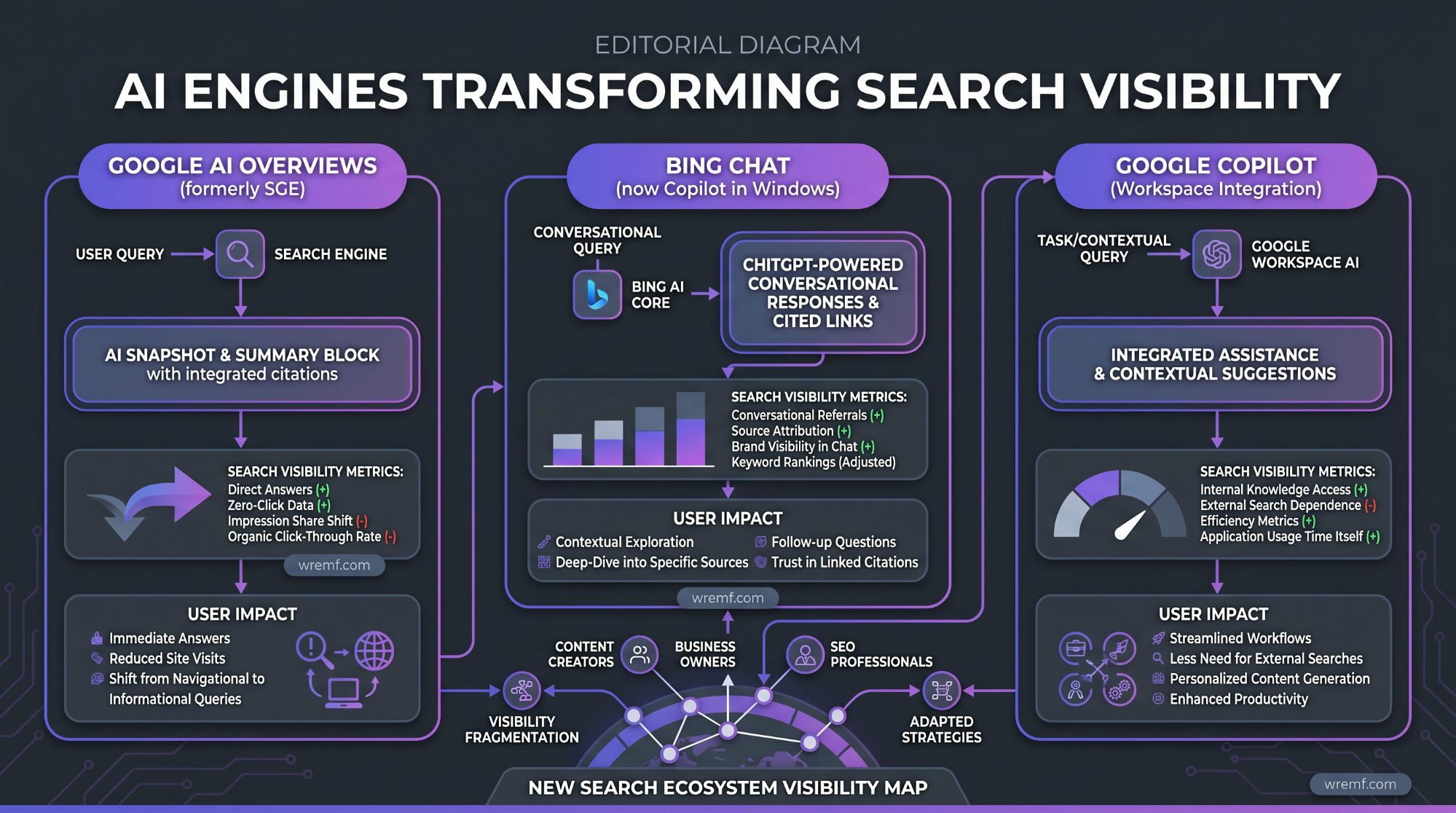
Google's AI Overviews, Bing Chat, and Google Copilot represent the integration of AI-generated answers directly into Search Engine Results Pages, fundamentally changing the relationship between traditional ranking and actual visibility. These features mean that a website can rank well in organic search results and still not appear in the AI-generated summary that dominates the top of a search result page.
Google's AI Overviews appear at the top of relevant Search Engine Results Pages and synthesise information from multiple sources into a direct answer. The sources cited in AI Overviews are not always identical to the top-ranking pages in the organic results below. Google uses its Search algorithms and language models to select sources based on relevance, authority, and the specific angle of the user query. This means that on-page SEO, Structured Data, and content quality all play a role, but the selection process is distinct from standard keyword ranking.
Bing Chat, which operates as part of Microsoft's integration of OpenAI technology into Bing, operates similarly. It generates conversational answers from indexed content and cites sources within the response. Users interacting with Bing Chat may never scroll to the traditional SERP below. This represents a structural shift in where visibility actually matters for driving traffic and brand recognition.
Google Copilot, Meta AI, and Grok are further examples of AI search surfaces where brand visibility is determined by citation and recommendation patterns, not by keyword position alone. The SparkToro blog has documented how AI-driven search behaviour is shifting user attention away from traditional organic search results toward AI-synthesised answers, which has direct implications for how brands measure and invest in search visibility.
Ad labeling in Google SERPs and Google Ads / PPC placements are also affected by the shift to AI search. As AI Overviews take up more real estate at the top of the page, the relative visibility of paid and organic results changes, making it more important for brands to understand their total search presence across both the AI and non-AI layers of the results page.
For brands managing Google Business Profile entries, local intent queries are increasingly influenced by AI-generated answers that pull from structured local data. Mobile Friendliness, Page Load Speed, and local structured content all affect whether a brand appears in these AI-generated local responses.
The relationship between AI-generated answers and traditional SEO is covered in detail in the guide to AI Overview SEO which explains how teams can optimise for both the traditional SERP and AI-generated responses within the same content and technical workflow.
KEY TAKEAWAY: Google's AI Overviews, Bing Chat, and Google Copilot have created a new visibility layer that operates alongside but separate from traditional keyword rankings. Brands must measure and optimise for both organic SERP positions and AI-generated answer inclusion to maintain full search visibility.
How to Improve Google Visibility Score: A Practical Step-by-Step Process
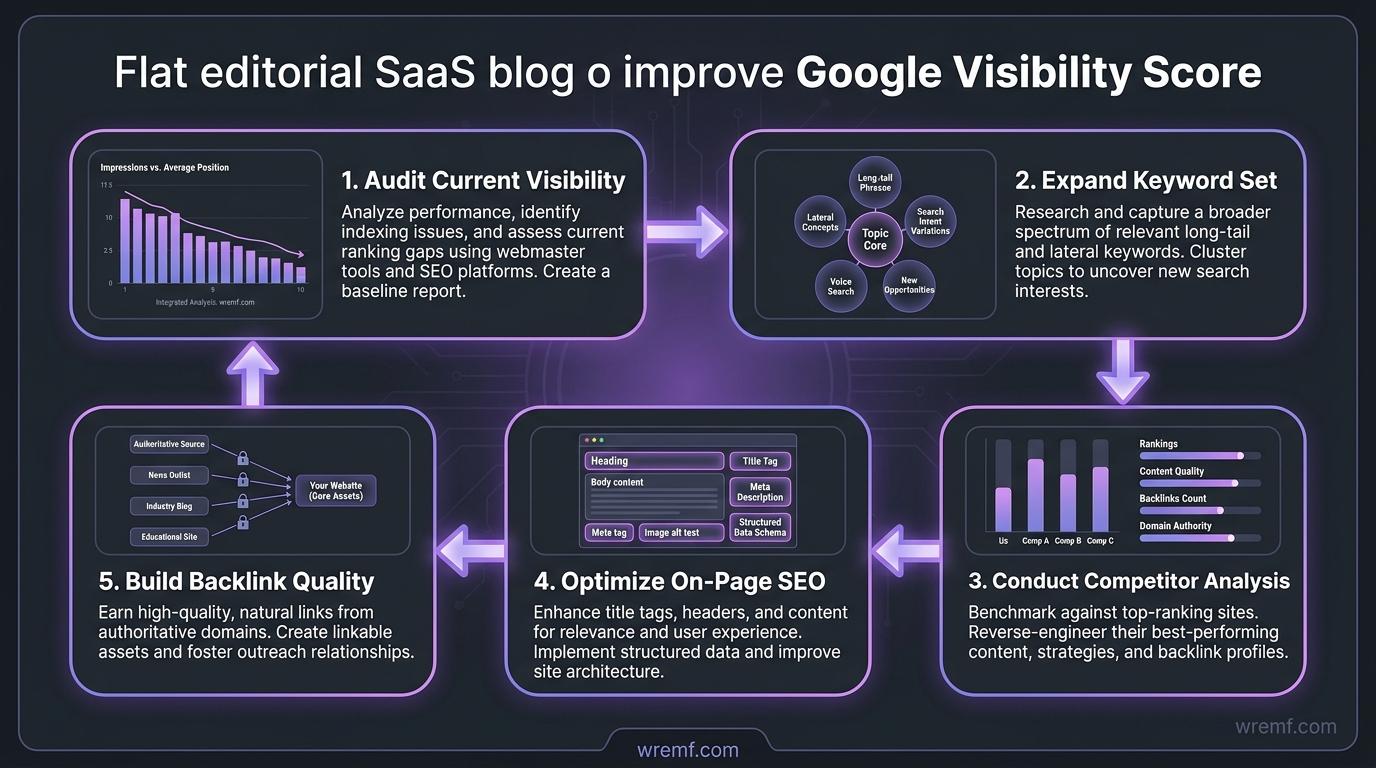
Improving Google visibility score requires a systematic process that targets the highest-leverage ranking and content opportunities first, then builds technical and authority foundations that sustain gains over time.
Step 1: Audit your current visibility baseline
Use a platform such as SISTRIX, Advanced Web Ranking, Ahrefs, or Ubersuggest to establish your current visibility score and identify which keywords are driving your existing Visibility points. Understand which pages contribute most to your score and which tracked keywords are ranking outside the top ten.
Step 2: Conduct Keyword Research and expand your tracked set
Identify high-volume keywords where your domain does not currently rank in the top 20. Use Keyword Research tools to surface Search Intent patterns, question-based queries, and competitor keyword sets. Expand your tracked keyword list to include terms that represent genuine business value, not just volume.
Step 3: Perform a Competitor Analysis
Pull visibility scores and ranking keyword sets for three to five competitor domains in the same tool. Identify where competitors consistently outrank your domain for high-volume keywords. Use this as a map for Content Gaps and Backlink quality opportunities.
Step 4: Prioritise on-page SEO improvements for positions 2 to 12
Keywords already ranking in positions two to 12 have the highest short-term potential for score improvement. Optimise Meta Descriptions, Header Tags, internal linking, and content depth for these pages. Search Intent alignment at this stage often produces faster ranking improvements than publishing new content.
Step 5: Address Technical SEO issues
Run a Technical SEO audit covering crawl errors, Site Architecture, sitemap completeness, Page Load Speed, latency, and Mobile Friendliness. Unresolved technical issues cap ranking potential regardless of content quality. On WordPress sites, check for common crawl errors caused by pagination, category pages, and plugin-generated duplicate content.
Step 6: Build Backlink quality through targeted outreach
Identify high-authority domains that link to competitor pages ranking above yours for target keywords. Develop content-led outreach or digital PR campaigns to earn relevant Backlinks. Focus on Backlink quality rather than quantity because Google's ranking systems weight relevance and authority heavily.
Step 7: Target Featured snippets and SERP features
Identify keywords in positions one to five where a Featured snippet appears. Structure content to answer the snippet question directly, use clear Header Tags, and format lists or tables where appropriate. Winning Featured snippets can increase Click-through Rate significantly even from the same ranking position.
Step 8: Monitor Fluctuations and content freshness regularly
Set up scheduled visibility score tracking so you can detect Fluctuations caused by algorithm updates, competitor changes, or content decay. Update underperforming pages with refreshed data, additional depth, and Search Intent re-alignment. Content freshness is a ranking signal for time-sensitive queries.
TIP:
Teams using WREMF for AI Search Optimization can align this traditional visibility improvement process with a parallel AI visibility programme. Running both in tandem ensures that content improvements made for Google rankings also serve the source selection logic of AI engines such as ChatGPT, Claude, and Perplexity.
KEY TAKEAWAY: Improving Google visibility score follows a structured process starting with baseline measurement, then competitive gap analysis, on-page improvements, technical fixes, and authority building. Consistency and prioritisation by potential score impact produce faster results than broad unfocused optimisation efforts.
SEO Tools for Measuring and Tracking Visibility Score
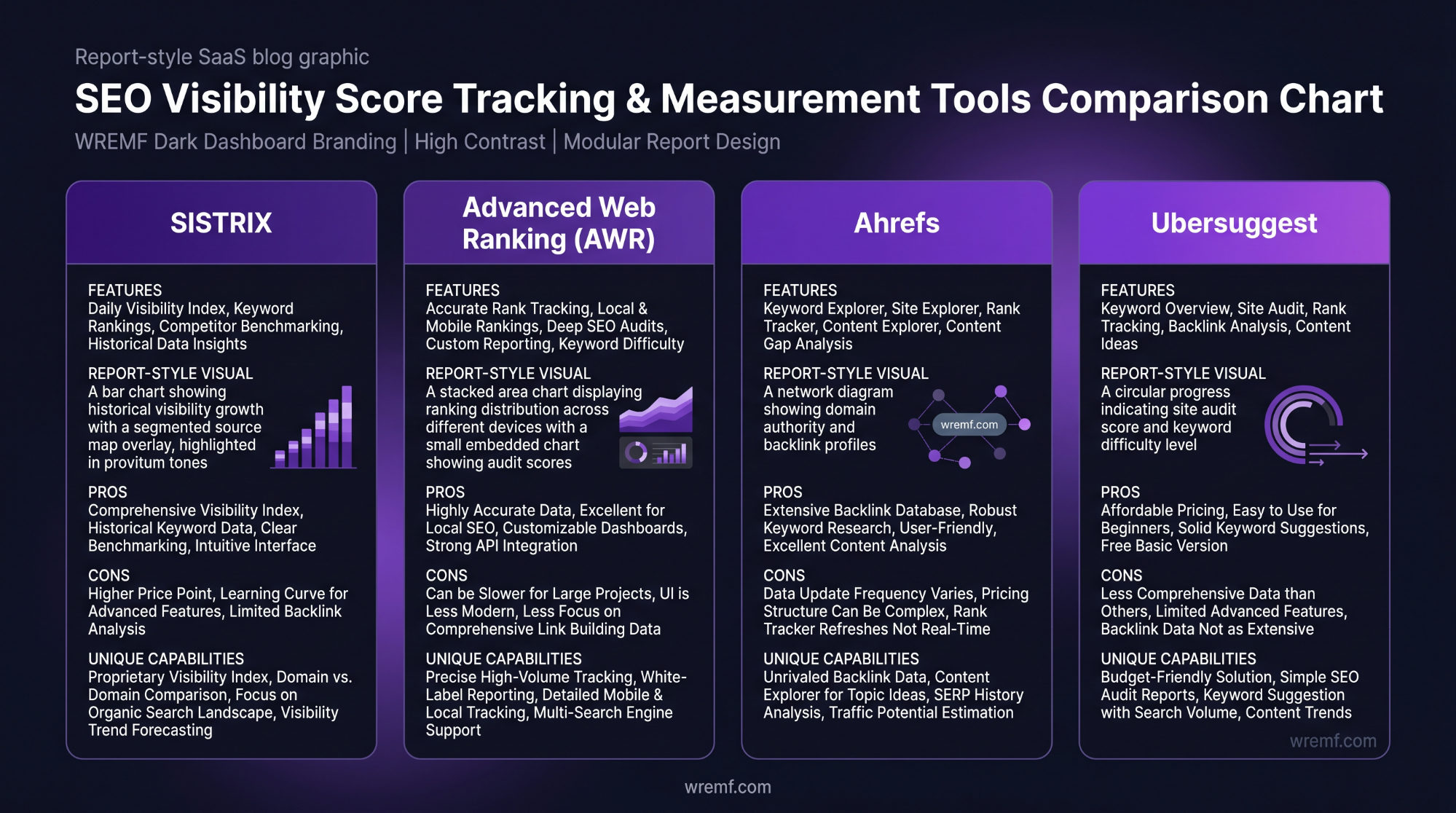
Multiple SEO platforms offer visibility score tracking, each with different keyword universes, update frequencies, and methodologies. Choosing the right tool depends on market focus, reporting requirements, and whether the team needs standalone visibility data or integrated SEO performance analysis.
SISTRIX
SISTRIX produces one of the most widely referenced Visibility Index scores in European markets. Its keyword universe covers millions of terms across multiple countries, and it updates its index regularly to reflect current Google rankings. SISTRIX's Time Machine feature allows teams to view historical visibility trends and diagnose Fluctuations linked to specific dates, making it particularly useful for analysing the impact of Search algorithm updates or site migrations. The platform's Data basis is transparent, which supports its use as an Independent Success Measurement tool.
Advanced Web Ranking
Advanced Web Ranking provides granular visibility tracking with segmentation by device, geographic location, and SERP type. The Advanced Web Ranking Team's visibility score methodology is particularly useful for agencies that need to report visibility performance across different markets and device types within a single dashboard. The tool supports white-label reporting, which makes it practical for client-facing agency workflows.
Ahrefs
Ahrefs produces a domain-level visibility score derived from its own keyword ranking tracking system. The platform integrates visibility data with Backlink analysis, Competitor Analysis, Keyword Research, and Content Gaps identification. Teams that use Ahrefs as their primary SEO platform benefit from having visibility data in the same environment as their authority and content analysis tools.
Ubersuggest
Ubersuggest offers a simplified visibility tracking interface that suits smaller teams and founders who need directional visibility data without the complexity of enterprise SEO platforms. Its scores are less granular than SISTRIX or Ahrefs but provide useful trend data for tracking the impact of SEO work over time.
Google Analytics and Google Search Console
Google Analytics and Google Search Console are essential complements to any visibility score platform. Google Analytics provides organic traffic data, which is a downstream outcome of visibility improvements. Google Search Console provides impression and click data at the keyword level, allowing teams to validate that visibility score changes are translating into actual Search activity and traffic. As noted in Google's guidance on how search works Search Console data reflects only what Google's index records for a verified property, so it should be used alongside third-party tools for full visibility analysis.
For teams tracking AI visibility alongside traditional SEO, WREMF integrates with GA4 attribution to connect AI referral traffic data with organic traffic reporting. This allows teams to understand not just how much traffic comes from Google rankings but how much comes from AI-generated answers and which prompts are driving that traffic. The guide to the 12 best AI search optimization tools covers how these tools compare in the context of full-funnel AI and organic search tracking.
KEY TAKEAWAY: No single SEO tool owns the definitive Google visibility score. SISTRIX, Advanced Web Ranking, Ahrefs, and Ubersuggest each offer visibility tracking with different strengths. Teams should choose a tool that matches their market focus and reporting requirements, and use Google Analytics and Search Console to validate that visibility changes translate into real traffic.
Use Cases: How Different Teams Use Visibility Score in Practice
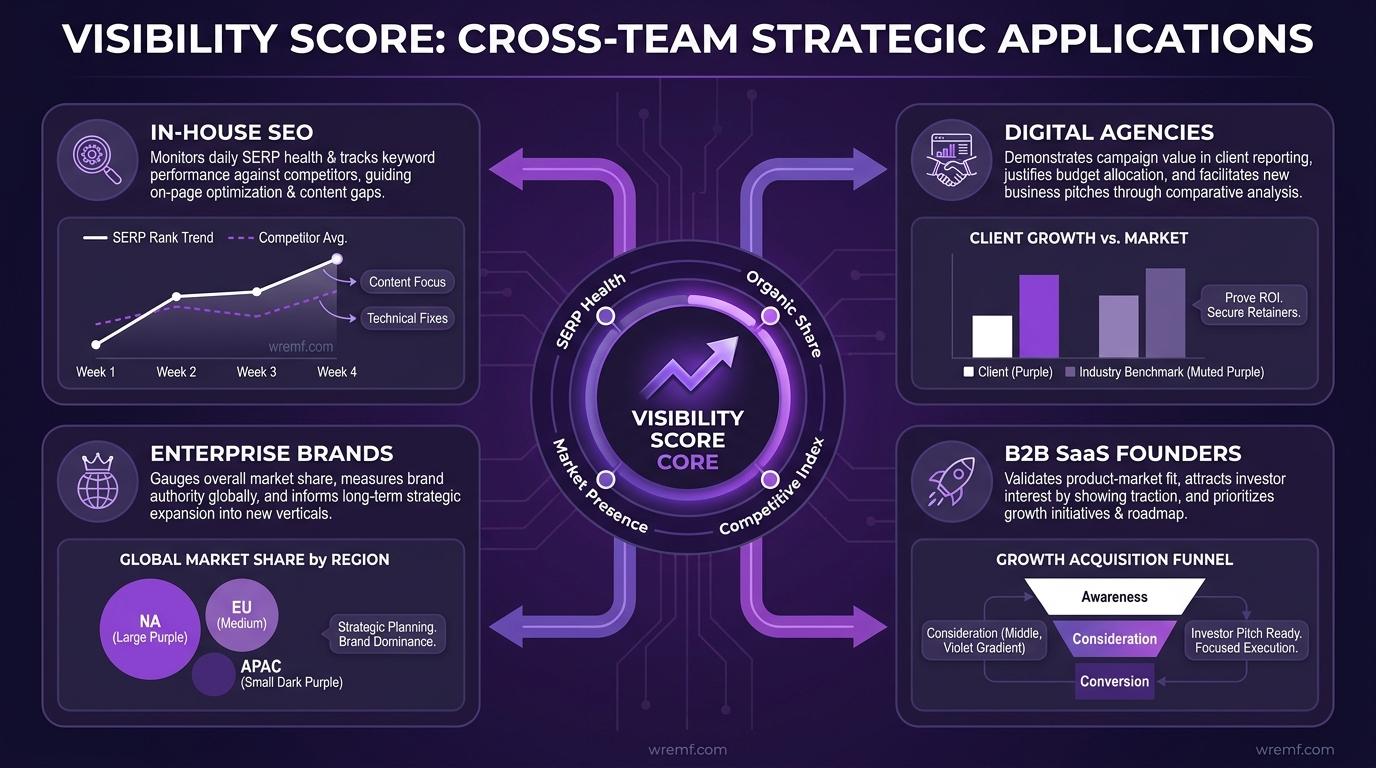
Visibility score serves different purposes depending on whether the team using it is an in-house SEO team, a B2B SaaS company, a digital agency, or an enterprise brand managing multiple markets.
In-House SEO Team at a B2B SaaS Company
An in-house SEO team at a B2B SaaS company uses Google visibility score primarily as a performance indicator to show the leadership team whether the SEO investment is producing results over time. The team tracks visibility weekly or monthly, compares performance against two or three direct competitors, and uses score changes to diagnose whether content updates, technical fixes, or Backlink campaigns are producing measurable ranking improvements. When visibility drops unexpectedly, the team reviews Fluctuations in specific keyword clusters to identify which pages lost positions and whether the cause is algorithmic, competitive, or technical.
Digital Agency Managing Multiple Clients
A digital agency uses visibility score as a standardised client reporting metric across its portfolio. Rather than reporting hundreds of individual keyword rankings, the agency summarises SEO performance as a single visibility trend line, supplemented by key keyword movements and Organic Traffic data from Google Analytics. Tools such as Advanced Web Ranking support white-label reporting for this workflow. Agencies handling Online Reputation Management alongside SEO use visibility data to show clients whether brand-related queries are improving or declining relative to competitor domains.
Enterprise Brand Tracking Multi-Market Visibility
An enterprise brand operating across multiple countries uses visibility score to benchmark SEO performance by market and identify where additional SEO work investment is needed. The brand may have separate domain or subdomain structures for different regions, making it essential to track visibility at the correct domain level. Content Strategies are adjusted based on which markets show the largest gaps between current visibility scores and competitor benchmarks.
B2B SaaS Founder Using Entry-Level Tracking
A B2B SaaS founder using WREMF Starter at €59 per month tracks AI visibility across ten AI engines alongside a basic Google visibility review using Google Search Console and a lightweight keyword tool. The founder uses WREMF's prompt intelligence and source citation tracking to understand whether their brand appears in ChatGPT, Gemini, or Perplexity answers when buyers ask relevant category questions. This dual approach allows a small team to stay in the loop on both traditional search visibility and AI-driven brand discovery without needing a large analytics infrastructure. Teams at this stage can explore WREMF's AI search optimization tools and traffic analysis to understand how both layers of visibility connect to measurable traffic outcomes.
KEY TAKEAWAY: Visibility score serves different strategic purposes depending on team size and business model. In-house teams use it for performance communication, agencies use it for client reporting, enterprise brands use it for market benchmarking, and founders use it for directional tracking alongside AI visibility monitoring.
Traditional SEO Visibility vs AI Visibility: What Each Measures and Why Both Matter
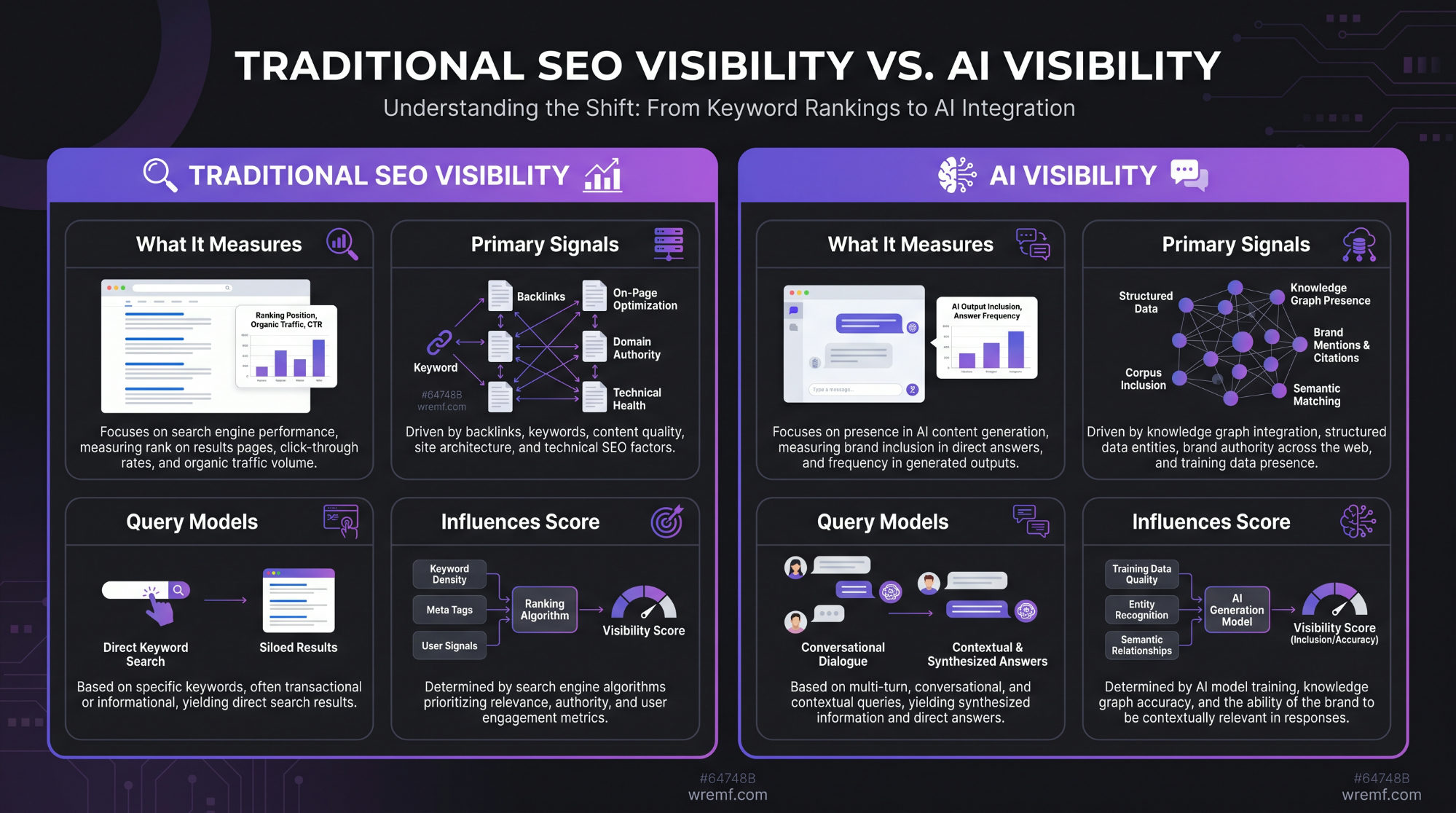
Traditional SEO visibility and AI visibility measure different things, serve different buyer discovery journeys, and require different tools and optimisation strategies. Understanding the distinction helps teams allocate resources and avoid assuming that strong Google rankings guarantee full search visibility in 2026.
The following comparison shows how the two measurement frameworks differ across key dimensions:
Primary signal
- Traditional SEO tools: Keyword rankings in organic search results
- WREMF AI Visibility Score: Brand citations and mentions in AI-generated answers
What it tracks
- Traditional SEO tools: SERP position for tracked keywords
- WREMF AI Visibility Score: AI citations, source mentions, and recommendation frequency across AI engines
Authority signal
- Traditional SEO tools: Backlinks and Domain Authority
- WREMF AI Visibility Score: Source citations in AI answers and entity authority
Query model
- Traditional SEO tools: Keywords
- WREMF AI Visibility Score: Prompts submitted to AI engines
Competitive view
- Traditional SEO tools: SERP overlap and ranking domains
- WREMF AI Visibility Score: AI share of voice across competing brands
Attribution
- Traditional SEO tools: Organic sessions from Google Analytics
- WREMF AI Visibility Score: AI referral traffic and prompt-level attribution
Engine coverage
- Traditional SEO tools: Google and Bing
- WREMF AI Visibility Score: Ten AI engines including ChatGPT, Gemini, Claude, Perplexity, Copilot, DeepSeek, Grok, Meta AI, and Mistral
Audit type
- Traditional SEO tools: Technical SEO audit
- WREMF AI Visibility Score: GEO audit and AEO content optimisation
Source consistency
- Traditional SEO tools: Not measured
- WREMF AI Visibility Score: Tracked across engines and prompt types
Traditional SEO tools remain essential for keyword research, ranking tracking, crawlability, backlink analysis, and technical SEO health. WREMF adds the AI visibility layer by tracking how AI engines mention, cite, compare, and recommend brands across prompt-based discovery journeys. The two are complementary, not competing.
The recommended approach for B2B brands and agencies is to maintain traditional visibility tracking for Google SERPs and layered AI visibility tracking for the growing share of buyer research that happens through AI-generated answers. The complete guide to answer engine optimisation explains how AEO strategy connects the two measurement systems through content structure, entity optimisation, and source consistency.
For teams ready to build this dual-track programme, WREMF Growth at €149 per month provides AI share of voice tracking, GEO audits, GA4 attribution, white-label reporting, and a Looker Studio connector across up to five websites and fifteen competitors.
KEY TAKEAWAY: Traditional Google visibility score and AI Visibility Score measure fundamentally different things. Teams that track only keyword rankings are missing the AI search layer where buyer discovery is increasingly concentrated. Both measurement systems are needed for full visibility in modern B2B search.
Limitations and Risks: What Visibility Score Cannot Tell You
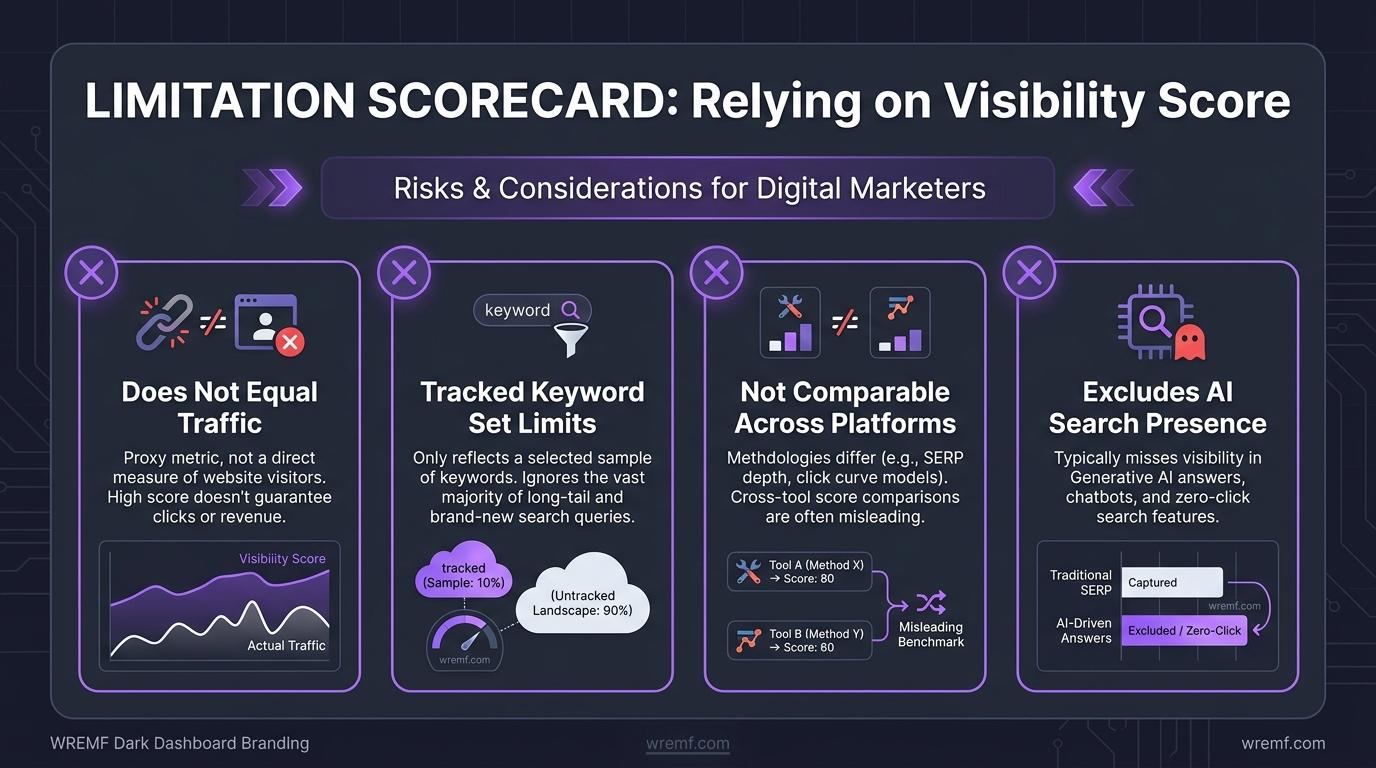
Visibility score is a useful directional metric but carries meaningful limitations that teams should understand before making significant strategy or budget decisions based on it alone.
Limitation 1: Visibility score does not equal traffic
A high visibility score indicates strong rankings across tracked keywords but does not guarantee proportional organic traffic. Click-through rates vary substantially by SERP feature type. A ranking in position one below a Featured snippet, a Google Ads / PPC block, an AI Overview, and a Knowledge Panel generates far less traffic than a position one ranking with minimal SERP competition. Teams that optimise for visibility score without tracking actual Google Analytics traffic data risk improving a metric that is not translating into business outcomes.
Limitation 2: The tracked keyword set determines the score's meaning
Visibility score is only as meaningful as the keywords being tracked. A domain can achieve a very high visibility score for a narrow, low-competition keyword set while being invisible for the most commercially important queries in its category. Teams should regularly review and update their tracked keyword list to ensure it represents genuine business value, including high-volume, high-intent keywords relevant to each stage of the buyer journey.
Limitation 3: Scores are not comparable across platforms
As noted throughout this guide, SISTRIX, Ahrefs, Advanced Web Ranking, Ubersuggest, and Marqade each calculate visibility scores differently. A score of 50 in one tool does not mean the same thing as a score of 50 in another. Teams that switch platforms or benchmark against competitors using a different tool will encounter this incompatibility. The Visibility Percent shown in one platform is a ratio within that platform's own methodology and keyword universe, not a universal standard.
Limitation 4: Visibility score does not measure AI search presence
This is the most structurally significant limitation for B2B brands in 2026. Google visibility score and traditional SEO Visibility Index metrics do not track whether a brand appears in AI-generated answers from ChatGPT, Claude, Gemini, Perplexity, or Google's AI Overviews. As language models become more integrated into the buyer research process, the share of discovery that happens outside the traditional SERP is growing. A brand can have an excellent visibility score and zero presence in AI-generated answers for the same category of buyer queries.
Limitation 5: AI visibility itself cannot be fully predicted or guaranteed
Even with a dedicated AI visibility programme, AI-generated answers are variable. They change based on the AI engine, the exact prompt phrasing, the user's personalisation settings, geographic location, the AI engine's training data, and the source set available at the time of the query. As research from arXiv on AI and machine learning documents, language model output is sensitive to prompt variation and context, which means citation presence is probabilistic, not fixed. No platform, including WREMF, can guarantee that a brand will appear in any specific AI-generated answer.
Limitation 6: Personalization and filter bubbles affect both SEO and AI visibility
Search results and AI-generated answers can vary significantly by user, location, device, and Search activity history. Personalization means that a high visibility score measured from a neutral tracking environment may not reflect what a specific buyer sees in their actual search or AI session. Filter bubbles are a structural feature of both Search algorithms and AI recommendation systems, and they mean that visibility data represents averages and trends rather than individual user experiences.
KEY TAKEAWAY: Visibility score is a useful aggregate metric but cannot substitute for traffic analysis, keyword segmentation by intent, cross-platform validation, AI visibility tracking, or an understanding of SERP feature dynamics. Teams should treat it as one input among several, not as a standalone measure of SEO success.
Common Misconceptions About Google Visibility Score and AI Search Visibility
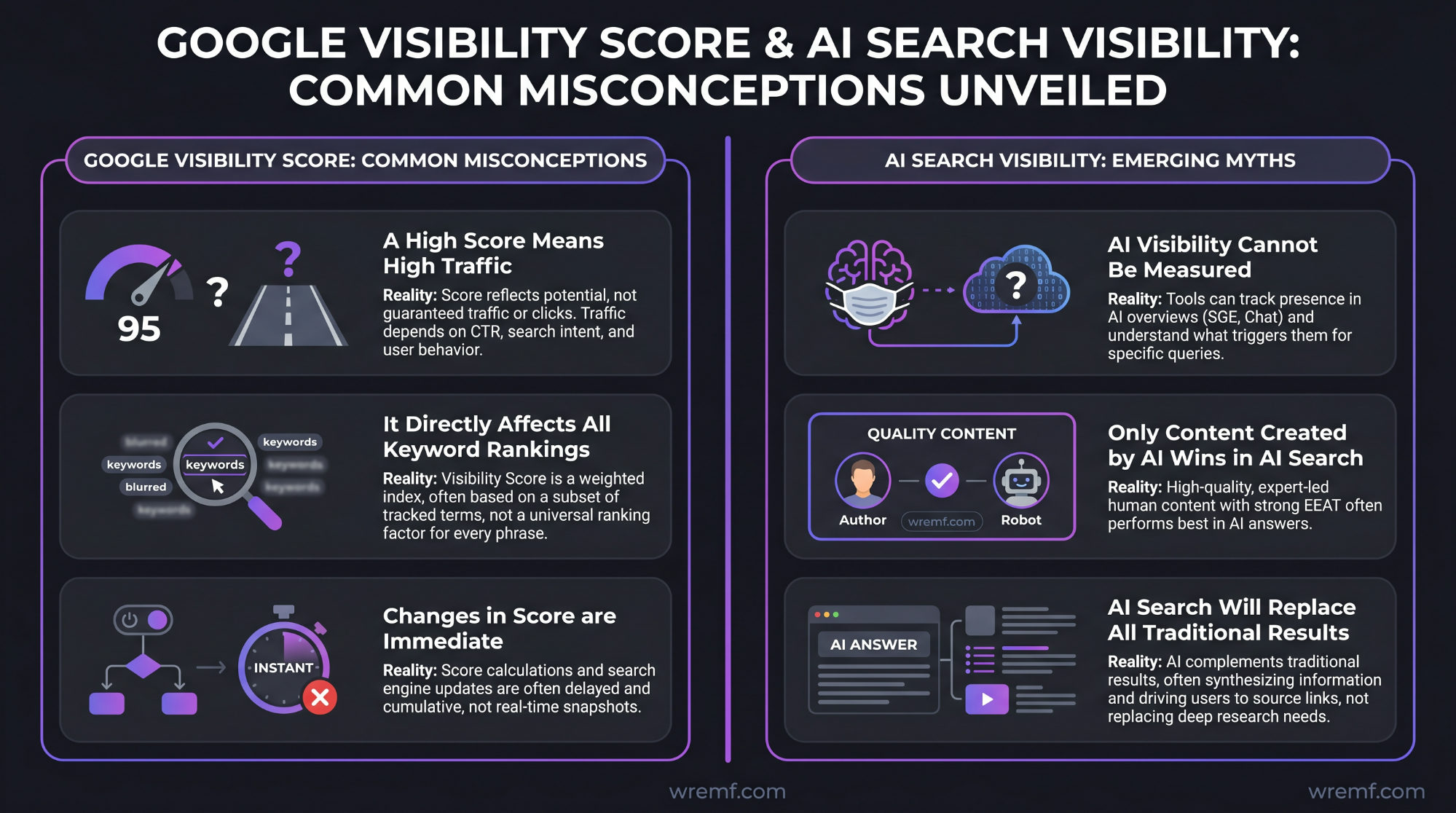
MYTH: A high Google visibility score means your brand is visible everywhere in search, including AI answers.
FACT: Google visibility score measures organic keyword ranking performance in traditional Search Engine Results Pages. It does not track whether your brand is cited, mentioned, or recommended in AI-generated answers from ChatGPT, Gemini, Perplexity, Google's AI Overviews, or any other AI engine. A brand can rank highly in Google SERPs and be completely absent from the AI-generated answers that buyers encounter when researching the same category.
MYTH: You can measure your true search visibility from a single visibility score number.
FACT: A single visibility score reflects only the tracked keyword set within a specific platform. Different tools produce different scores for the same domain because they use different keyword universes, update schedules, and weighting methodologies. True search visibility requires comparing scores across time within the same tool, segmenting by keyword intent, and supplementing SERP data with Google Analytics traffic, Search Console impression data, and AI visibility tracking.
MYTH: If your website ranks on page one, you do not need to worry about AI citations or AI search optimisation.
FACT: Page one rankings and AI citation presence are increasingly independent signals. Google's AI Overviews, Bing Chat, and AI platforms like Perplexity and ChatGPT select sources based on relevance, authority, and content structure signals that are related to but not identical to standard ranking factors. A page ranking in position three may not be cited in the AI Overview above it. Teams that focus exclusively on keyword rankings without an AI Search Optimization strategy risk losing visibility at the point where buyers are increasingly making initial discovery decisions.
MYTH: AI visibility cannot be measured because AI-generated answers are random and unpredictable.
FACT: AI visibility is measurable through structured prompt tracking, source citation analysis, share of voice monitoring, and brand mention frequency tracking across AI engines. While individual AI-generated answers vary by prompt phrasing, session context, and personalisation, patterns in citation frequency and source selection are stable enough to track, benchmark, and act on. Platforms such as WREMF run systematic prompt-based monitoring across ten AI engines to produce reliable AI Visibility Score trends and competitive comparisons.
MYTH: Improving SEO visibility automatically improves AI visibility.
FACT: SEO improvements such as better keyword rankings, stronger Backlinks, and technical SEO fixes contribute to the authority signals that AI engines draw on, but they do not automatically translate into AI citation presence. AI engines use a selection logic that includes entity clarity, content structure, source consistency, and topical authority signals that require specific GEO and AEO optimisation work beyond standard SEO. The guide to generative AI optimization services explains how these additional optimisation layers work in practice.
KEY TAKEAWAY: The most common misconceptions about Google visibility score involve conflating it with AI search visibility, treating a single number as the whole story, and assuming that strong rankings automatically produce full search presence. Each of these assumptions leads to measurement gaps and missed optimisation opportunities.
How WREMF Extends Visibility Tracking Into AI Search
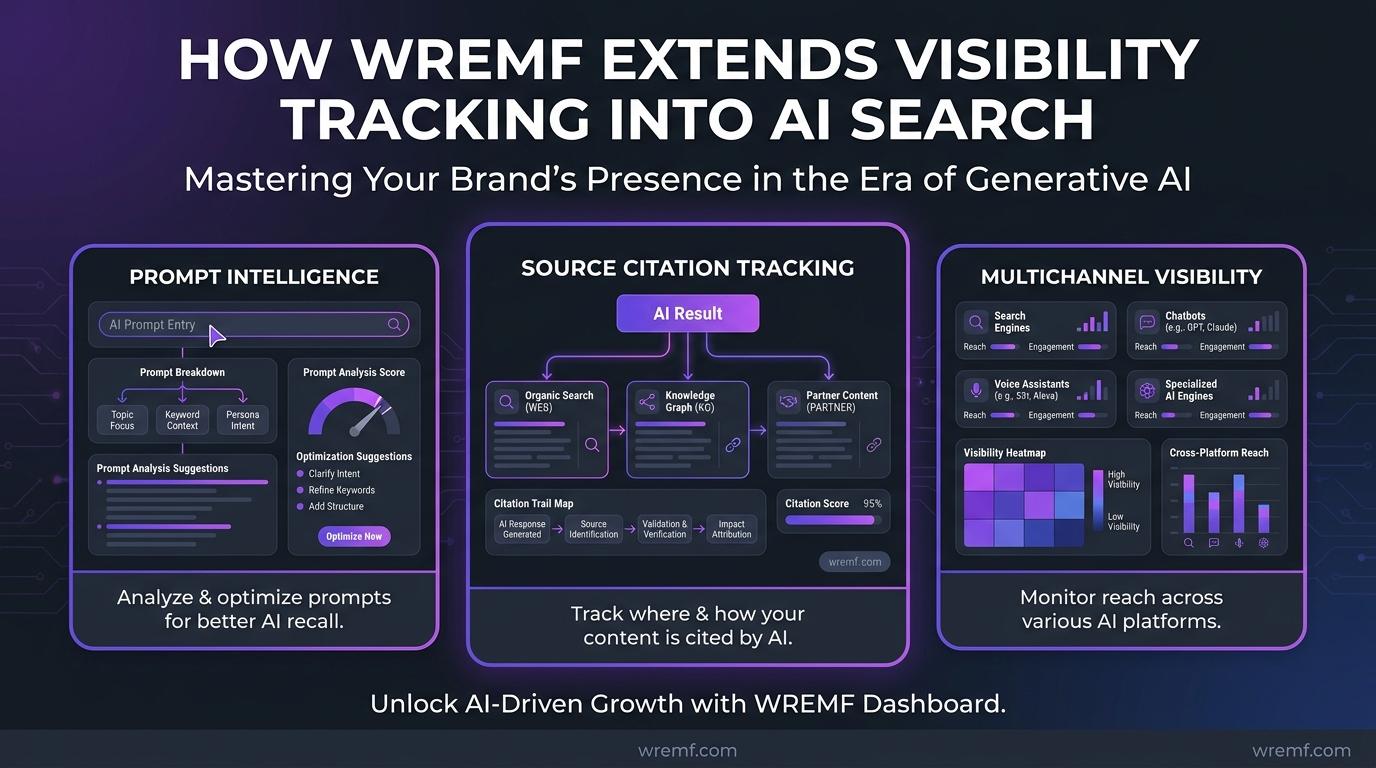
WREMF is an AI visibility platform that helps B2B teams track, improve, and prove how their brand appears across the AI search engines that buyers increasingly use to research, compare, and shortlist vendors. Where traditional SEO tools measure Google visibility score through keyword rankings, WREMF measures AI Visibility Score through prompt tracking, source citation tracking, and AI share of voice across ChatGPT, Claude, Gemini, Perplexity, Copilot, DeepSeek, Grok, Meta AI, Mistral, and Google's AI Overviews.
The platform is available as self-serve software, a fully managed AI visibility service, or a hybrid model that combines software access with senior-led strategy and execution support.
For teams starting to track AI visibility, WREMF Starter at €59 per month provides ten-engine AI visibility tracking, unlimited prompts with BYOK support, core prompt intelligence, source citation tracking, the AI Visibility Index, competitor tracking for up to three competitors, and monthly reporting. The first charge starts after a three-day onboarding window, and workspace setup begins once onboarding details are submitted.
For B2B marketing, SEO, and growth teams that need reporting, attribution, and action, WREMF Growth at €149 per month adds AI share of voice tracking, GEO audits, a content brief generator, SEO testing, GA4 attribution, white-label reports, a Looker Studio connector, and advanced citation tracking across up to five websites and fifteen competitors. Growth suits agencies managing multiple clients, in-house SEO teams, and multi-brand companies that need both visibility data and execution support.
For companies that want WREMF to run the AI visibility programme end to end, the Managed plan from €1,500 per month includes AI visibility audit, custom GEO strategy, AEO content optimisation, citation, entity, and authority cleanup, senior-led execution, strategy calls, a custom roadmap, and monthly reporting. The Managed plan is designed for enterprise brands, large agencies, and multi-market teams that do not have the internal capacity to execute an AI visibility programme alongside their existing SEO work.
WREMF also supports API and MCP integrations, client portals, BYOK on every plan, and white-label reporting for agency partners. Teams that prefer to speak with the team before selecting a plan can book a quick call with WREMF to discuss onboarding, plan fit, and whether a managed or hybrid approach is more appropriate.
The guide to LLM SEO services explains how the AI visibility tracking layer WREMF provides connects to the broader LLM optimisation and AEO strategy that drives citation presence in AI-generated answers.
KEY TAKEAWAY: WREMF extends traditional visibility tracking into AI search by measuring prompt-based brand discovery across ten AI engines. The platform is available as software, managed service, or hybrid, and pricing scales from €59 per month for founders to custom enterprise engagements.
Conclusion
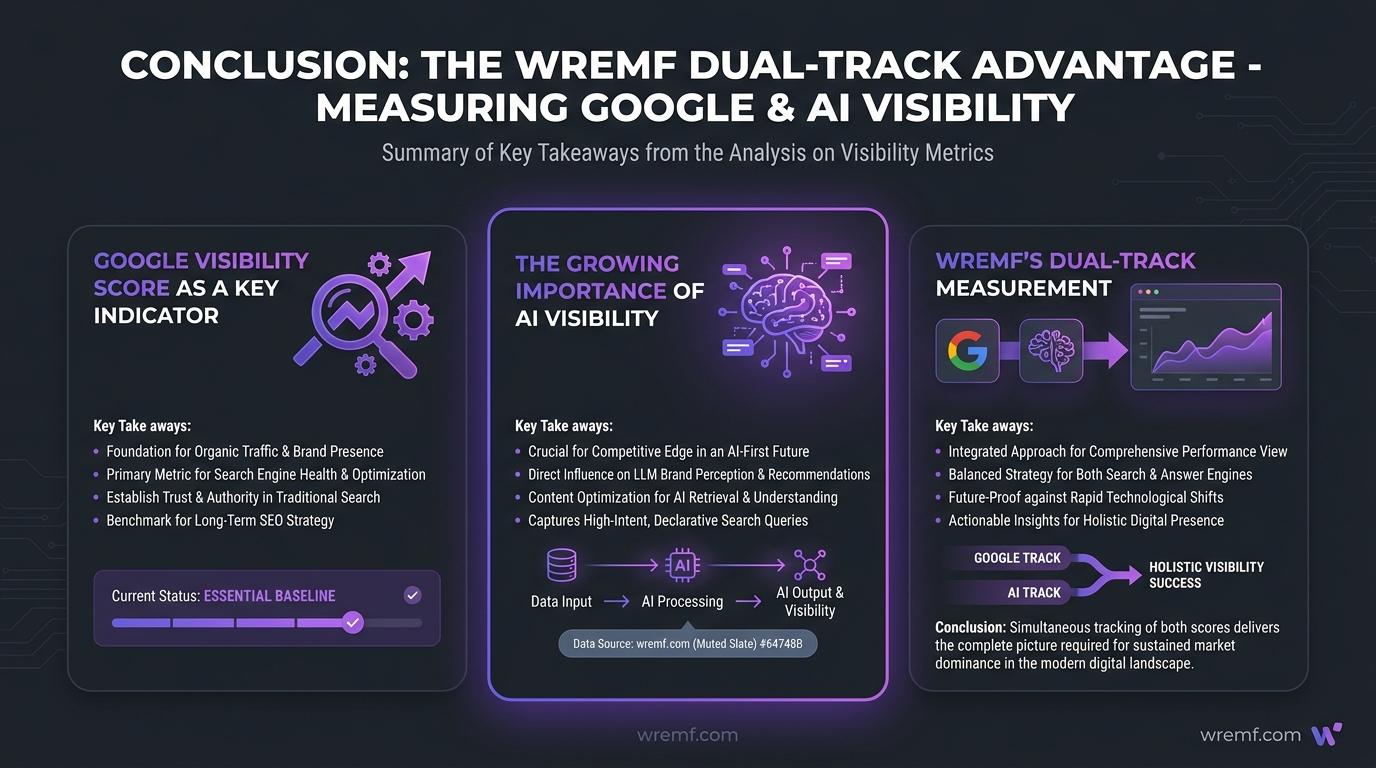
Google visibility score remains one of the most practical and widely used indicators of SEO performance, but it now represents only part of the visibility picture. As buyers use AI engines to research, compare, and discover B2B solutions, the gap between traditional keyword ranking performance and actual brand discoverability is widening. Teams that track only Google visibility score are working with an incomplete view of how their brand is found. Measuring AI Visibility Score alongside traditional SEO visibility gives a fuller and more actionable understanding of where buyers encounter your brand and where gaps need to be addressed. WREMF is built for this dual-track measurement approach, helping teams track both traditional and AI-generated search presence through software, managed execution, or a hybrid model. Compare WREMF pricing plans to find the option that fits your team's size, reporting requirements, and execution capacity.
Frequently Asked Questions About Google Visibility Score
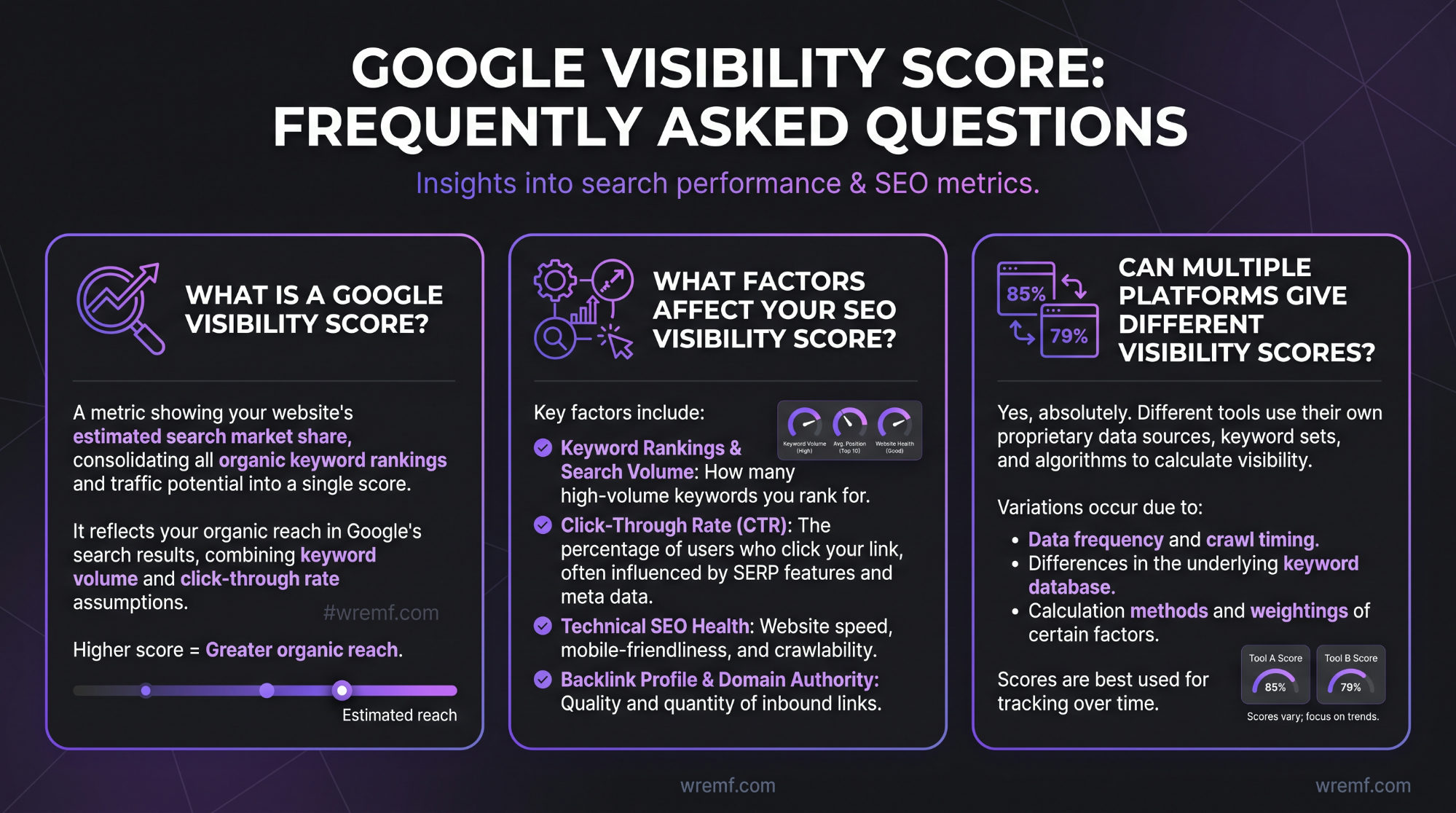
What is a Google visibility score?
A Google visibility score is a metric that estimates how prominently a website appears across Google search results based on its keyword rankings, the search volume of those keywords, and the positions those pages hold in the SERPs. Rather than reporting a single rank for one keyword, it aggregates ranking performance across an entire keyword set into a single percentage or index figure. A higher score indicates that more of your target keywords rank in visible positions, particularly on page one. Tools such as SISTRIX, Ahrefs, and Ubersuggest each calculate this differently, so scores are not always directly comparable across platforms.
What is an SEO visibility score and how is it different from a simple keyword rank?
An SEO visibility score reflects the combined ranking strength of an entire domain or page across multiple keywords, whereas a simple keyword rank reports a single position for a single query. Visibility scores weight each keyword by its search volume and click-through rate potential, meaning a site ranking in position one for a high-volume term contributes far more to its score than ranking in position eight for a low-traffic query. This makes visibility scores a better indicator of overall organic search performance than individual keyword positions alone, particularly for sites targeting large keyword sets.
How is search visibility calculated?
Search visibility is typically calculated using a point-based or impression-weighted system. Each keyword in a tracked set is assigned a weight based on its search volume. The tool then estimates how much of the available traffic or impression share a domain captures based on its ranking position for each keyword. Click-through rate curves are applied to each position so that higher-ranking pages earn more visibility points. The final score is expressed as a percentage of the total available visibility across all tracked keywords. Different platforms including SISTRIX, Ahrefs, Advanced Web Ranking, and WREMF may apply slightly different weighting models, which is why scores can vary between tools.
What is a good SEO visibility score?
There is no universal benchmark for a good SEO visibility score because it depends heavily on your industry, keyword set, domain age, and competitive landscape. In most competitive B2B SaaS and technology categories, even a top-performing domain may hold a visibility score well below 10 percent across a broad keyword set. What matters more than the absolute number is whether your score is improving over time and how it compares to direct competitors targeting the same keywords. The most useful question to ask is not "what is my score?" but "how does my score compare to the sites I am directly competing against?"
What is a bad SEO visibility score?
A visibility score is a concern when it is declining month over month, significantly lower than direct competitors, or when it drops sharply following a Google core update or algorithm change. A score near zero typically indicates that very few of your target keywords rank on page one, that the site has indexing or crawl errors preventing pages from appearing in Google search results, or that the domain has been affected by a penalty. A sudden drop in visibility score is often more informative than a low score in isolation, as it can signal a technical SEO issue, a content quality problem, or a significant algorithm change.
What factors affect your SEO visibility score?
Several factors influence how well a site scores for visibility across Google SERPs. On-page SEO factors include content relevance, keyword targeting, header tags, meta descriptions, structured data, and content freshness. Technical SEO factors include site speed, mobile friendliness, crawl errors, sitemap health, page load speed, and site architecture. Off-page factors include backlink quality, domain authority, and brand mentions across trusted sources. Search intent alignment is also significant, since pages that match the intent behind a query tend to rank more consistently. Visibility scores respond to all of these signals collectively rather than any single factor in isolation.
Why did my search visibility drop?
A drop in search visibility typically results from one or more of the following: a Google core update that reassessed content quality or search intent alignment, a technical SEO issue such as crawl errors, indexing problems, or a broken sitemap, a loss of backlink quality or quantity, content that has become outdated or is no longer matching search intent, or a competitor gaining significant new backlinks or content authority. Checking your visibility history against known Google algorithm update dates is a useful starting point. Tools that include a time machine or historical visibility view, such as SISTRIX or Ahrefs, allow you to correlate drops with specific ranking system changes.
Why is my search visibility 0 percent?
A search visibility of zero percent usually means that none of your tracked keywords rank on page one of Google, or that your site has serious indexing problems preventing it from appearing in organic search results at all. Common causes include the site being newly launched and not yet indexed, noindex tags applied incorrectly, crawl errors blocking Googlebot, a manual penalty from Google, or a keyword set that does not reflect the terms your pages actually rank for. Checking Google Search Console for indexing errors and crawl coverage is the recommended first diagnostic step before adjusting any content or on-page SEO elements.
How often should I measure my visibility score?
Checking your visibility score at least weekly is advisable for most B2B and SaaS sites, particularly if you are actively publishing content or building backlinks. Many tools offer daily tracking, which is useful for detecting sudden changes that may indicate algorithm fluctuations, competitor activity, or technical issues. Monthly visibility reviews are a minimum for sites with limited SEO activity. More frequent monitoring becomes important during content rollouts, after site migrations, following Google core updates, or when running SEO testing experiments to measure the impact of specific changes.
Can multiple platforms give different visibility scores for the same site?
Yes, different SEO platforms will produce different visibility scores for the same domain because each tool uses its own keyword database, click-through rate model, position weighting system, and data update frequency. SISTRIX, Ahrefs, and Ubersuggest each apply different methodologies to calculate their visibility index. This means that comparisons across platforms are rarely meaningful. The most reliable approach is to choose one platform, track your visibility consistently within that platform over time, and compare your score against competitors using the same tool and keyword set.
Is the visibility index comparable across countries?
Visibility scores are generally comparable within the same country and keyword set, but direct cross-country comparisons are unreliable unless the tool explicitly normalises scores for regional search volumes and SERP structures. Search behaviour, keyword volumes, competition levels, and SERP features vary significantly between markets, which means a site scoring 5 percent visibility in Germany may be performing very differently relative to its competition than a site scoring 5 percent in the United States. Tools such as SISTRIX offer country-specific visibility indexes, which are more useful for international SEO analysis than a single global score.
Which search results are used to calculate the visibility index?
Most visibility index calculations are based on organic search results in the top ten positions on Google, since these positions receive the majority of clicks. Some tools also factor in SERP features such as featured snippets, which can significantly increase click-through rates and therefore contribute more to estimated visibility than a standard position one result. Paid search results, Google Ads, and Google Business Profile listings are typically excluded from standard SEO visibility calculations, as they represent separate visibility systems. If a tool includes featured snippets, AI Overviews, or other SERP features in its model, it will note this in its methodology documentation.
What are featured snippets and how do they affect visibility scores?
Featured snippets are answer boxes that appear at the top of Google SERPs, usually pulled from a page that ranks within the top ten organic results. Because featured snippets capture a disproportionate share of clicks for the query, many visibility tools assign them a higher weighting than standard position one results when calculating visibility scores. Earning a featured snippet for a high-volume query can produce a meaningful increase in your overall visibility score even if your broader keyword rankings remain unchanged. Optimising content with direct answers, clear structure, and appropriate use of structured data increases the likelihood of earning featured snippets.
How can I improve my visibility index?
Improving your visibility index requires progress across several areas simultaneously. Content improvements include closing content gaps by targeting keywords where competitors rank but you do not, updating existing content to better match search intent, and structuring pages to be eligible for featured snippets. Technical SEO improvements include resolving crawl errors, improving page load speed, ensuring mobile friendliness, and fixing sitemap issues. Authority improvements include building high-quality backlinks from relevant domains. Keyword research should focus on identifying queries where your content has a realistic opportunity to move into the top five positions, since the visibility gains from moving from position eight to position three are substantially larger than gains from page two to page one.
What is the difference between search visibility and organic traffic?
Search visibility measures the estimated share of available clicks or impressions a site captures based on its keyword rankings and their associated search volumes. Organic traffic measures the actual number of users who arrived at your site from unpaid search results, typically reported in Google Analytics. The two metrics are related but distinct. Visibility can be high while traffic remains low if your ranked keywords have low search volume. Conversely, a single very high-traffic keyword can drive substantial organic traffic even if your overall visibility score is modest. Both metrics are necessary for a complete picture of organic search performance.
What is the AI Visibility Score and how does it differ from a traditional SEO visibility score?
The AI Visibility Score measures how prominently a brand or domain is mentioned, cited, or recommended within AI-generated answers from engines such as ChatGPT, Claude, Gemini, Perplexity, and Google's AI Overviews. Traditional SEO visibility scores measure ranking positions across keyword-based search results. AI visibility scores measure citation frequency, recommendation prominence, and source mention patterns within LLM-generated responses. As AI discovery surfaces increasingly influence B2B buying decisions, AI visibility scores are becoming a complementary and increasingly important metric alongside traditional search visibility measurement.
How is AI visibility different from traditional Google search visibility?
Traditional Google search visibility is based on keyword rankings and click-through rate models applied to the top ten organic results. AI visibility reflects whether and how often an AI engine includes, cites, or recommends a brand when answering relevant prompts. Where traditional SEO asks how well a page ranks for a query, AI visibility asks whether a language model trusts a brand enough to surface it in a generated answer. According to OpenAI's research overview, language models learn associations from large training datasets, meaning brand authority, citation patterns, and content quality all influence AI recommendation behaviour in ways that differ from traditional ranking algorithms.
What is Google's AI Overviews and how does it affect visibility?
Google's AI Overviews is a feature in Google Search that generates a summarised AI-produced answer at the top of results pages for certain queries. Pages cited as sources within AI Overviews can receive increased visibility even when they do not hold the top organic ranking for a query. However, as Google's AI Overviews documentation notes, AI Overviews source selection follows different criteria from traditional ranking, including content clarity, authority signals, and structured answer formats. Brands that optimise for AI citation rather than only for traditional keyword rankings are better positioned to maintain visibility as this feature expands.
What is a Google Knowledge Graph and why does it matter for visibility?
The Google Knowledge Graph is a structured database of entities, relationships, and facts that Google uses to understand and connect information across its search ecosystem. When Google can confidently identify your brand as a recognised entity with consistent information across authoritative sources, your Knowledge Graph presence strengthens. This affects visibility in several ways: Knowledge Graph-backed entities are more likely to appear in knowledge panels, local packs, and structured SERP features. For B2B brands, a strong Knowledge Graph presence also improves the likelihood of being cited in AI-generated answers, since language models tend to favour brands with strong entity authority and consistent off-site representation.
What is a confidence score in relation to Google's Knowledge Graph?
A confidence score reflects how certain Google is about the identity, accuracy, and attributes of an entity in its Knowledge Graph. Higher confidence scores result from consistent and corroborated information appearing across multiple authoritative sources such as Wikipedia entries, structured data on your site, and reputable third-party publications. For brands with a low Knowledge Graph confidence score, critical facts such as founding date, category, and key people may be missing from knowledge panels or presented incorrectly. Building entity consistency through structured data, schema markup, and off-site citations helps raise this confidence score and improve overall brand visibility in Google SERPs.
If I already rank on Google, why should I care about the Knowledge Graph?
Ranking on Google for a set of keywords and being understood by Google as a trusted entity are related but distinct achievements. A site can rank well for specific queries while still having a weak or absent Knowledge Graph presence, which limits eligibility for knowledge panels, featured brand information in SERPs, and citation within AI Overviews. As AI-generated answers increasingly draw on entity relationships rather than keyword matches alone, brands with weak entity authority risk being excluded from AI-generated responses even when they hold strong keyword rankings. Building Knowledge Graph recognition supports both traditional SEO performance and emerging AI visibility goals.
Can I improve my search visibility without using an SEO platform?
Yes, but progress is slower and harder to measure without one. Manually tracking rankings across a large keyword set is impractical, and without a visibility score it is difficult to detect whether changes you are making are improving or worsening your overall organic presence. Free tools such as Google Search Console provide indexing data and click performance but do not calculate an aggregate visibility score across a keyword set. For teams running regular SEO or AI visibility work, a dedicated tracking platform makes it substantially easier to measure the impact of content changes, technical fixes, and link building efforts before and after implementation.
How does technical SEO affect visibility scores?
Technical SEO problems directly reduce visibility scores because they prevent Google from crawling, indexing, or correctly interpreting the pages on a site. Common technical issues that suppress visibility include crawl errors blocking important pages, slow page load speed increasing bounce rates before indexing signals are established, missing or incorrect sitemap entries, mobile usability problems, and duplicate content caused by URL parameters. Resolving technical SEO issues does not automatically increase visibility scores, but it removes the barriers that prevent content quality and backlink improvements from translating into better rankings and higher visibility.
What is search intent and how does it affect visibility?
Search intent refers to the underlying goal a user has when entering a query, which Google categorises broadly as informational, navigational, commercial, or transactional. Pages that match the dominant intent behind a query tend to rank more consistently and maintain higher visibility scores over time, while pages that misalign with intent tend to rank poorly regardless of technical quality or backlink strength. Understanding search intent is therefore a precondition for effective keyword targeting. Google's documentation on how search works explains that its ranking systems evaluate relevance partly through signals that indicate whether a page genuinely satisfies the user's underlying goal.
How do backlinks affect SEO visibility scores?
Backlinks from relevant and authoritative domains signal to Google that a site's content is trusted and worth surfacing in search results. High backlink quality tends to improve both domain authority and individual page authority, which in turn raises the likelihood that pages rank in the top positions where visibility score weighting is highest. Losing backlinks from previously authoritative sources can cause visibility score drops, particularly for competitive queries where the ranking gap between positions three and six is narrow. Backlink quality is generally more influential than backlink quantity, and links from topically relevant sources tend to have a stronger positive effect on visibility for specific keyword categories.
What are content gaps and how do they affect visibility?
Content gaps are topics, questions, or keywords where your competitors rank in Google search results but your site does not have relevant content addressing them. These gaps directly reduce your potential visibility score because they represent ranking opportunities you have not yet captured. Identifying content gaps through competitor analysis and keyword research is a standard part of improving SEO visibility. Closing content gaps by creating targeted, well-structured, search-intent-aligned content expands the keyword set your domain ranks for, which increases the number of keywords contributing positively to your overall visibility index.
What is AI search optimisation and how does it relate to traditional SEO visibility?
AI search optimisation, also called Answer Engine Optimisation or Generative Engine Optimisation, focuses on improving how a brand appears within AI-generated answers from engines such as ChatGPT, Perplexity, Claude, and Google AI Overviews. Traditional SEO visibility measures ranking positions in keyword-based results. AI search optimisation targets citation frequency, recommendation visibility, and source mention patterns within LLM responses. The two disciplines share common foundations including content quality, authority, and structured formatting, but AI search optimisation additionally requires attention to entity consistency, prompt-level targeting, and the content structures that language models are most likely to cite.
How do I track AI visibility alongside traditional Google visibility?
Tracking AI visibility requires a separate system from traditional rank tracking because AI engines do not expose position data in the same way that Google Search Console does. Effective AI visibility tracking involves running structured prompts across multiple AI engines, recording which brands are mentioned, cited, or recommended, and monitoring changes in citation frequency and recommendation prominence over time. WREMF provides AI visibility tracking across ten AI engines including ChatGPT, Claude, Gemini, Perplexity, Google AI Overviews, Copilot, DeepSeek, Grok, Meta AI, and Mistral, combining prompt intelligence, source citation tracking, and competitor visibility into a single measurement system.
How does WREMF help improve AI visibility and citation performance?
WREMF helps B2B teams track how their brand is mentioned, cited, and recommended across major AI discovery surfaces and traditional search engines. The platform combines prompt intelligence, source citation tracking, competitive landscape monitoring, GEO audits, and AI share of voice reporting in one system. For teams that need execution rather than only measurement, WREMF also operates as a senior-led AI visibility agency offering AEO strategy, GEO optimisation, AI-ready content systems, entity authority development, and attribution reporting. Teams can use WREMF as software only, as a managed service, or as a combined software plus execution solution depending on internal resources and goals.
What is the difference between software-only AI visibility tools and a managed AI visibility service?
Software-only AI visibility platforms provide tracking, reporting, and diagnostic data but require your internal team to interpret findings and execute improvements. Managed AI visibility services handle strategy, content optimisation, technical implementation, authority development, and ongoing monitoring on your behalf. A hybrid model combines both, giving you measurement infrastructure and execution support in one engagement. Teams with strong internal SEO and content resources typically benefit most from software alone, while teams without dedicated AI visibility expertise or bandwidth often achieve faster results with a managed or hybrid approach. WREMF offers all three models, with plans starting from software-only at €59 per month and managed execution starting from €1,500 per month.
What should I look for when choosing an AI visibility or SEO visibility tool?
When evaluating AI visibility or SEO visibility tools, the key criteria include the breadth of AI engines tracked, the frequency and accuracy of data updates, the ability to track competitor visibility alongside your own, the quality of attribution connecting AI visibility to traffic and business outcomes, and the depth of actionable recommendations rather than raw data alone. For teams managing clients or multiple brands, white-label reporting and multi-site support are also important. According to Gartner's AI research, enterprise teams increasingly require visibility measurement that spans both traditional search and generative AI surfaces, rather than tools that cover only one channel.
Is a visibility score the best metric for e-commerce sites?
Visibility scores are useful for e-commerce sites but should be used alongside revenue-aligned metrics such as organic click-through rate, organic sessions, and conversion data. For e-commerce, visibility across high-commercial-intent keywords matters more than visibility across broad informational queries, so a visibility score should be segmented by keyword type and purchase funnel stage rather than treated as a single aggregate number. Sites with large product catalogues benefit particularly from visibility tracking at the category or product type level rather than only at the domain level, as visibility improvements on high-converting category pages produce more measurable revenue impact than gains on informational pages.
How do SERP features like sitelinks affect visibility and click-through rates?
Sitelinks are additional page links displayed beneath the main search result for a domain, typically appearing for branded queries where Google recognises the site as the authoritative source. Sitelinks increase the overall click-through rate for the main result by giving users direct navigation paths to relevant sections of a site. While sitelinks are not directly controllable, they are influenced by clear site architecture, strong internal linking, and a well-structured sitemap. Pages that earn sitelinks effectively occupy more visual space in the SERP, which increases brand visibility and reduces the likelihood that users click through to a competing result on the same page.
Why do sites with weaker content sometimes outrank stronger sites in Google?
Sites that appear to rank despite lower apparent content quality often have stronger backlink profiles, higher domain authority, better technical SEO health, or content that more precisely matches the specific search intent behind the query. Authority accumulated over many years of publishing and link building is difficult to replicate quickly, which is why newer or less-established sites frequently find it harder to compete for high-visibility positions even when their content is objectively better structured. BCG's research on AI and digital strategy notes that trust signals and authority cues play an outsized role in how both algorithms and AI engines evaluate which sources to surface, making long-term authority investment a core part of visibility strategy.
How does personalisation and local intent affect search visibility scores?
Personalisation and local intent mean that the search results any individual user sees may differ from the standardised results that visibility tools measure. Most SEO visibility scores are calculated using non-personalised, location-normalised queries to produce a consistent benchmark, but in practice users searching with local intent, signed-in personalisation, or language preferences may see different results. This gap between measured visibility and actual user experience is a known limitation of aggregate visibility scores. For businesses with significant local or regional traffic, tracking visibility separately for specific geographic markets, using tools that offer location-based ranking data, produces more actionable insights than relying on global visibility figures alone.
How does AI search change the meaning of visibility for B2B brands?
For B2B brands, AI search fundamentally shifts what visibility means. If traditional search asked which page ranks highest for a query, AI search asks which brand a language model trusts enough to recommend in a generated answer. This changes the visibility challenge from winning a position in a ranked list to becoming a consistently cited, authoritative source within AI-generated responses across multiple engines. As noted in Harvard Business Review's coverage of AI and machine learning, B2B buying increasingly involves AI-assisted research, meaning that brands absent from AI-generated answers risk losing consideration even when they hold strong traditional keyword rankings. Tracking both SEO visibility scores and AI visibility scores together provides a more complete picture of discoverability in the current search environment.
Related reading
- The Complete Guide to AI Visibility: How B2B Brands Get Cited, Tracked, and Recommended Across AI Search Engines
- AI Search Engine Optimization Tools: The Complete 2026 Guide for AI Search, SEO, AEO, and GEO
- The Complete Guide to AI Search Visibility for B2B Brands and SEO Teams
- The Complete Guide to AI Visibility Tools for B2B Brands, SEO Teams, and Agencies