The Complete Guide to AI Visibility: How B2B Brands Get Cited, Tracked, and Recommended Across AI Search Engines
Learn how to measure and improve AI visibility for B2B brands across AI search engines.
By WREMF Team · 2026-09-20
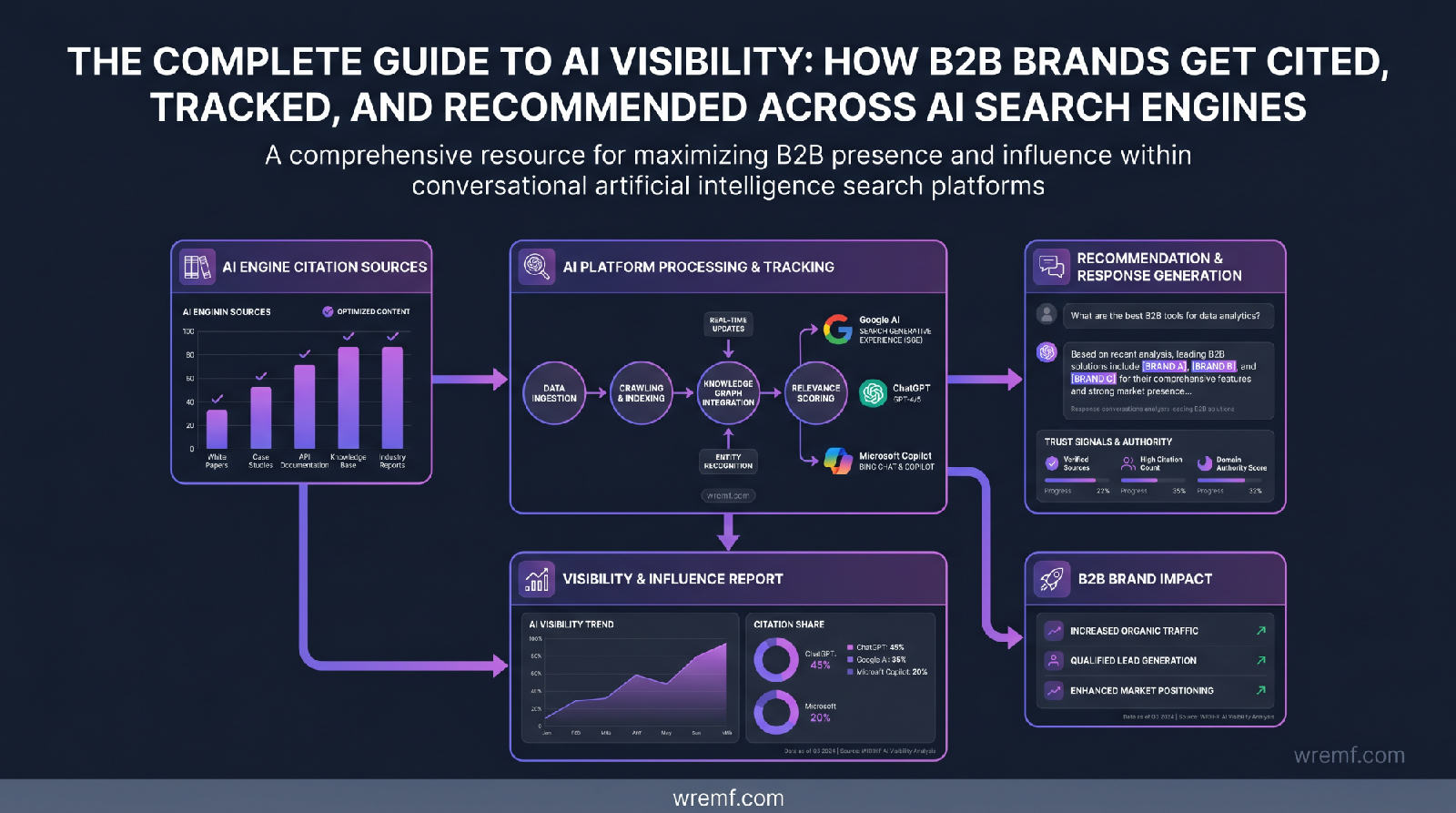
AI visibility measures the frequency and quality with which a brand appears in AI-generated answers across different platforms, such as ChatGPT and Google AI Overviews. It differs from traditional SEO in that it focuses on presence within AI responses rather than search rankings. Key metrics include AI Visibility Score, citation patterns, and share-of-voice analysis. Strong AI visibility helps brands gain an advantage in early buyer discovery by being cited and recommended as trusted sources. The guide emphasizes distinct strategies for optimizing both citation and mention visibility.
Key takeaways
- AI visibility focuses on brand presence inside AI-generated answers, not SEO rankings.
- Key metrics for AI visibility include AI Visibility Score, citation frequency, and sentiment scoring.
- Citations and mentions are distinct; both require separate tracking and optimisation strategies.
- WREMF tracks AI visibility across multiple engines and provides tools to close visibility gaps.
- The zero-click paradigm means brand influence happens even without website visits.
The Complete Guide to AI Visibility: How B2B Brands Get Cited, Tracked, and Recommended Across AI Search Engines

AI visibility is the measure of how often, how accurately, and how favourably a brand appears in AI-generated answers across platforms such as ChatGPT, Google AI Overviews, Gemini, Perplexity, Claude, and Copilot. As buyers increasingly use AI assistants to research products, compare vendors, and make shortlist decisions, the brands that appear in those answers gain a meaningful discovery advantage. This guide is written for B2B SaaS teams, SEO professionals, agencies, and growth leaders who need to understand, measure, and improve their AI visibility systematically. It covers what AI visibility is, how it differs from traditional SEO, what to track, how to close visibility gaps, and how platforms like WREMF help teams turn AI visibility data into action. If you have been wondering why your competitors appear in AI answers and you do not, this guide explains exactly why that happens and what to do about it.
QUICK ANSWER:
AI visibility measures how often and how accurately a brand is mentioned, cited, or recommended inside AI-generated answers from engines such as ChatGPT, Gemini, Perplexity, Claude, Google AI Overviews, and Copilot. It differs from traditional SEO because it tracks presence inside AI responses rather than positions in search results. Brands with strong AI visibility appear consistently across relevant prompts, are cited as trusted sources, and are recommended ahead of competitors during buyer research journeys.
KEY TAKEAWAYS:
- AI visibility measures brand presence inside AI-generated answers, not search result positions or organic rankings.
- The major AI engines generating answers that influence buyer behaviour include ChatGPT, Gemini, Perplexity, Claude, Google AI Overviews, Copilot, DeepSeek, Grok, Meta AI, and Mistral.
- AI citations, brand mentions, share-of-voice analysis, and visibility score are the core metrics used to track AI visibility performance.
- Visibility gaps emerge when competitors are cited consistently across prompts that a brand should be winning but is not present in.
- WREMF tracks AI visibility across 10 AI engines, measures prompt-level citation patterns, and helps teams close visibility gaps through software, managed execution, or a hybrid model.
- Traditional SEO tools measure rankings and backlinks but do not track how AI engines mention, compare, or recommend brands across prompts.
What Is AI Visibility and Why Does It Matter for B2B Brands
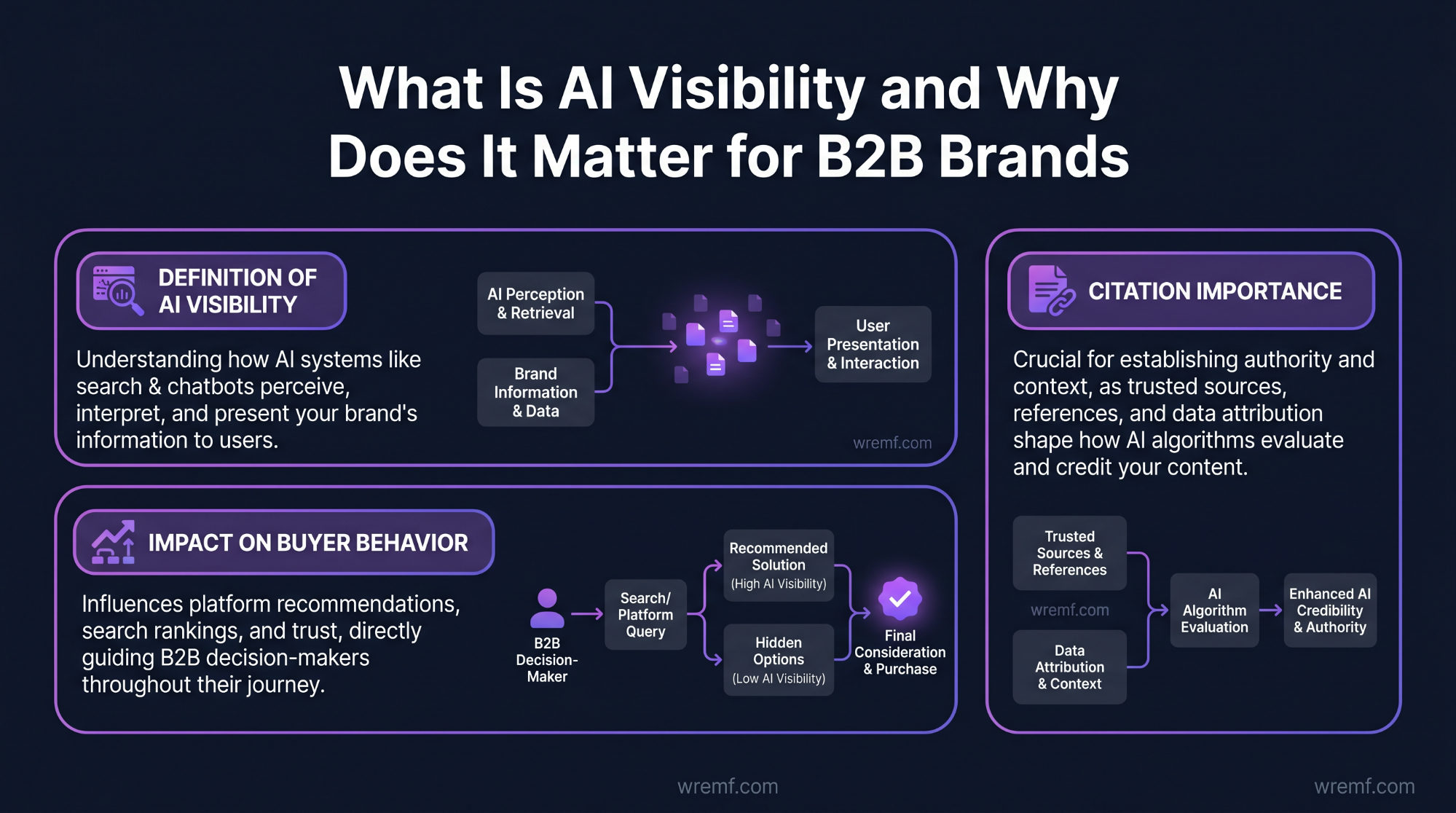
AI visibility is the degree to which a brand is present, accurately described, and positively positioned inside AI-generated answers across the major AI engines and answer platforms. It matters because buyer discovery has shifted: a growing share of product research, vendor comparison, and category queries now happens inside AI assistants rather than through traditional search result pages.
When a potential customer asks ChatGPT for the best project management software for remote teams, or asks Perplexity which B2B analytics platforms are worth evaluating, the AI engine generates an answer. That answer cites sources, names vendors, and shapes the buyer's initial shortlist. If a brand does not appear in that answer, it is invisible to that buyer at a critical discovery moment, regardless of how well it ranks in conventional search results.
AI visibility is therefore not an abstract concept. It is a measurable business signal. The brands that appear in AI answers gain brand presence at the top of the funnel. The brands that are cited as sources earn trust transfer from the AI engine's credibility. The brands that are recommended ahead of competitors in AI responses accumulate AI share of voice that directly influences consideration and demand.
With over 100 million people using AI assistants monthly, and ChatGPT alone receiving billions of prompts, the scale of this discovery channel is significant and growing. Brands that ignore AI visibility are ceding early-funnel influence to competitors who are actively managing their presence across AI search engines.
The two main visibility types that matter in this context are citation visibility, which is whether the brand is named as a source inside an AI answer, and mention visibility, which is whether the brand is referenced, compared, or recommended within the body of an AI-generated response. Both types contribute to overall AI visibility and require separate measurement approaches.
Teams beginning to track AI visibility can explore how AI search optimization tools increase organic traffic as a starting point for understanding how the two channels interact.
KEY TAKEAWAY: AI visibility measures brand presence inside AI-generated answers and is a distinct discovery channel from traditional search rankings, one that directly influences buyer shortlisting at the top of the funnel.
AI Visibility vs SEO: What Carries Over and What Is Different
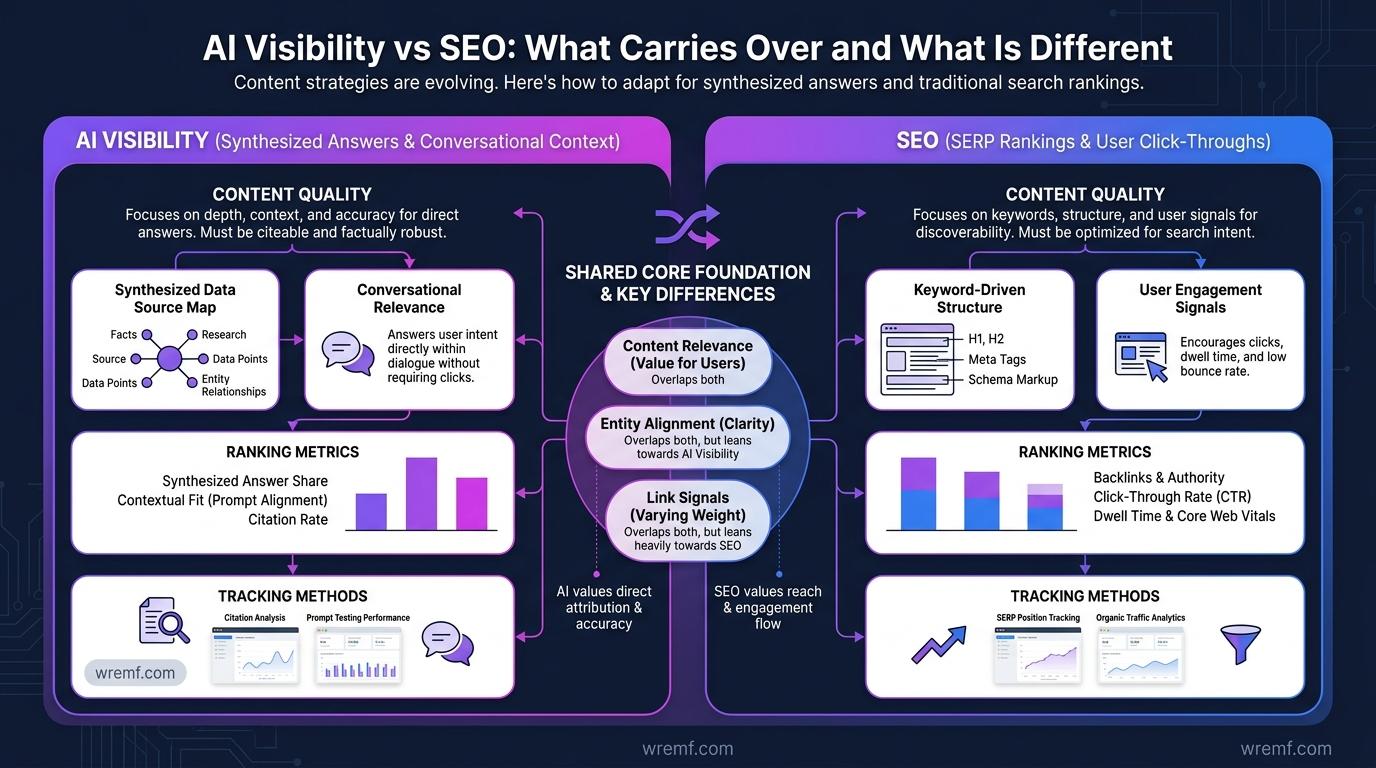
AI visibility and traditional SEO share a common foundation in content quality, authority, and source credibility, but they measure fundamentally different things and require different optimisation strategies. Understanding the distinction prevents teams from assuming that strong rankings automatically produce strong AI visibility, because they do not.
What carries over from SEO to AI visibility includes the importance of authoritative content, structured data, semantic HTML, clear content structure, internal linking, sitemaps, and consistent entity signals. AI engines draw heavily from well-structured, credible web sources when constructing answers. A brand that has invested in high-quality content with clear headings, verified claims, and strong domain authority provides the kind of source material that AI engines prefer to cite. Research on AI citations indicates that a substantial proportion of content cited by ChatGPT comes from pages that have been updated relatively recently, which reinforces the importance of content freshness and recency as ranking-adjacent signals for AI retrieval.
What is different is everything about how success is measured. Traditional SEO measures visibility through keyword rankings, SERP positions, organic sessions, and backlink profiles. AI visibility measures success through citation frequency, brand mention rate, AI share of voice, visibility score across tracked prompts, sentiment scoring of AI responses, and source consistency across engines. A brand can rank on page one of Google and be completely absent from ChatGPT answers. A brand can have strong backlinks but be consistently misrepresented in Gemini responses. These are AI visibility problems, not SEO problems, and SEO tools are not built to detect them.
The comparison below shows where the two disciplines diverge:
Primary signal
- Traditional SEO tools: Keyword rankings in search results
- WREMF: Brand citations and mentions in AI prompt answers
Authority signal
- Traditional SEO tools: Backlinks and domain authority
- WREMF: Source citations in AI-generated answers
What is tracked
- Traditional SEO tools: SERP position and organic click data
- WREMF: AI citations, mention frequency, and visibility score
Query model
- Traditional SEO tools: Keywords and search queries
- WREMF: Prompts and conversational user queries
Competitive view
- Traditional SEO tools: SERP overlap and keyword share
- WREMF: AI share of voice and competitor domains in AI answers
Attribution
- Traditional SEO tools: Organic sessions and conversion tracking
- WREMF: AI referral traffic and prompt-level attribution
Engine coverage
- Traditional SEO tools: Google and Bing
- WREMF: 10 AI engines including ChatGPT, Gemini, Perplexity, Claude, and Copilot
Audit type
- Traditional SEO tools: Technical SEO audits
- WREMF: GEO audits and Answer Engine Optimization assessments
Traditional SEO tools remain essential for managing rankings, crawlability, keyword research, and technical health. WREMF adds the AI visibility layer by tracking how AI engines mention, compare, cite, and recommend brands across the prompt-based discovery journeys that are increasingly shaping B2B buyer behaviour. Teams that want a full picture of where the AI search visibility landscape is heading can read the AI search engine optimization guide for deeper context.
KEY TAKEAWAY: Strong SEO rankings do not guarantee AI visibility. The two disciplines share content quality foundations but require separate measurement frameworks, separate tools, and separate optimisation strategies.
What AI Visibility Actually Measures: The Core Metrics
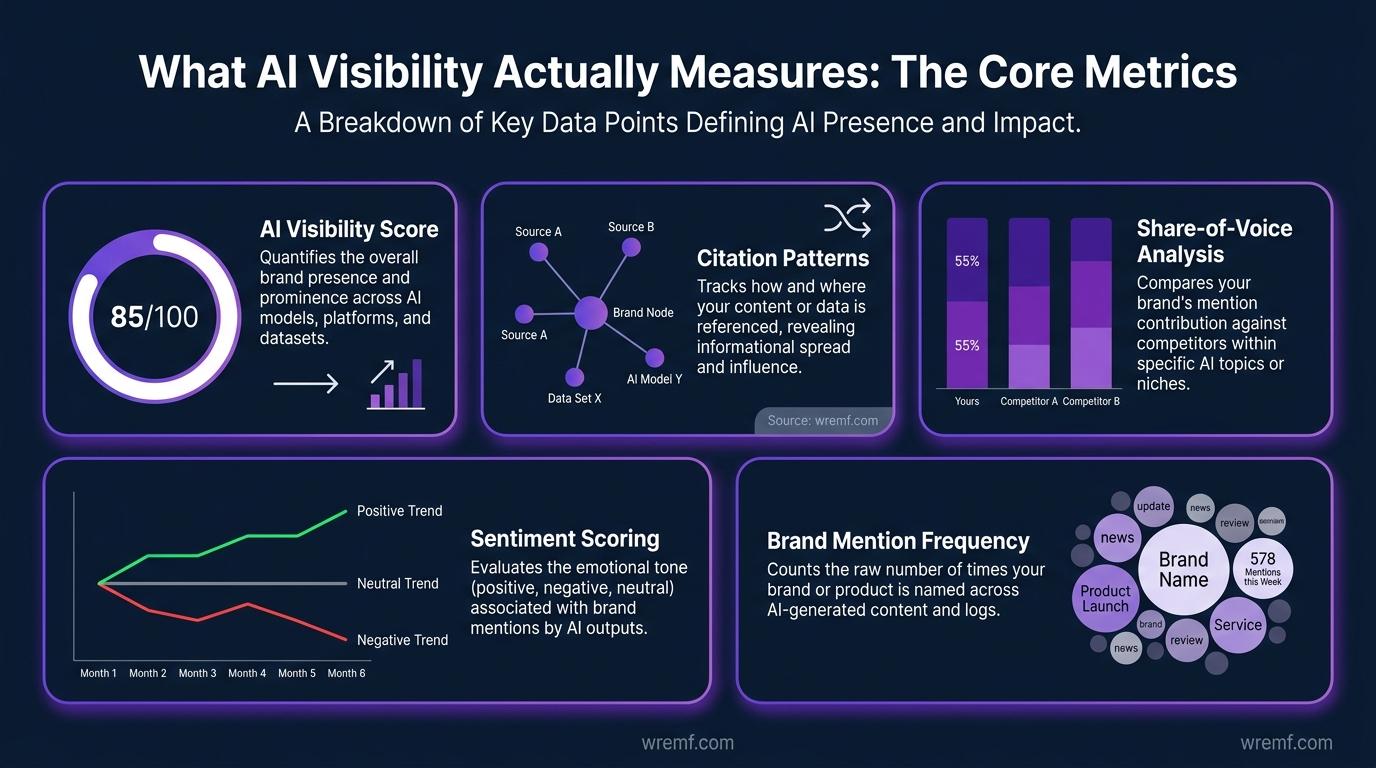
AI visibility is measured through a specific set of metrics that reflect how AI engines engage with a brand across relevant prompts and user queries. These metrics are distinct from traditional SEO metrics and require prompt-based tracking rather than crawler-based ranking data.
The AI Visibility Score is the primary composite metric. It aggregates citation frequency, mention rate, brand sentiment, source presence, and share-of-voice analysis across a defined set of tracked prompts. The score gives teams a single benchmark that reflects overall AI visibility performance across engines and prompt categories. WREMF calculates this score across 10 AI engines, giving teams a cross-model view of where they stand and where visibility gaps exist.
Citation patterns describe the specific sources, pages, and domains that AI engines reference when constructing answers related to a brand's category. Understanding citation patterns reveals which competitor domains are being cited more frequently, which content formats attract citations, and which URLs on a brand's own site are being pulled into AI answers. A team that can see its own citation frequency alongside competitor citations has a clear map of where to focus content and authority efforts.
Brand mentions in AI answers differ from citations. A mention occurs when an AI engine references a brand name, product, or positioning claim within the body of an answer, without necessarily linking to or crediting a specific source. Brand visibility tracking must capture both citation presence and mention presence to give a complete picture of how AI engines represent a brand.
Share-of-voice analysis measures the proportion of AI answers in a defined prompt set where a brand is mentioned or cited, compared with competitors. If a brand appears in 18 percent of tracked AI responses and its primary competitor appears in 54 percent, the share-of-voice gap is a strategic priority, not merely a content gap.
Sentiment scoring evaluates whether AI-generated answers describe a brand positively, neutrally, or negatively. A brand can have high mention frequency but poor sentiment if AI engines consistently associate it with limitations, complaints, or outdated information. Sentiment scoring makes brand positioning visible in a way that rankings data never could.
AI referral traffic attribution captures the sessions and conversions that originate from AI platforms. This requires proper configuration in tools such as Google Analytics and GA4, because AI platforms do not always pass standard referral parameters. WREMF's GA4 attribution integration helps teams connect AI visibility data to actual traffic outcomes, closing the gap between visibility metrics and business impact.
Prompt-level reporting is the most granular layer of AI visibility measurement. Rather than reporting on brand performance in aggregate, prompt intelligence tracks how a brand performs across specific questions, phrases, and user queries. This reveals which prompts a brand wins consistently, which prompts it loses to competitors, and where content investment will have the most impact on AI responses.
Teams serious about understanding the full scope of these metrics can review the AI mention tracking guide for a detailed breakdown of how monitoring brand mentions, AI answers, citations, and share of voice work in practice.
KEY TAKEAWAY: AI visibility is measured through a combination of AI Visibility Score, citation patterns, share-of-voice analysis, sentiment scoring, brand mention frequency, and prompt-level reporting, none of which are captured by traditional SEO tools.
AI Citations vs Brand Mentions: Why the Distinction Matters
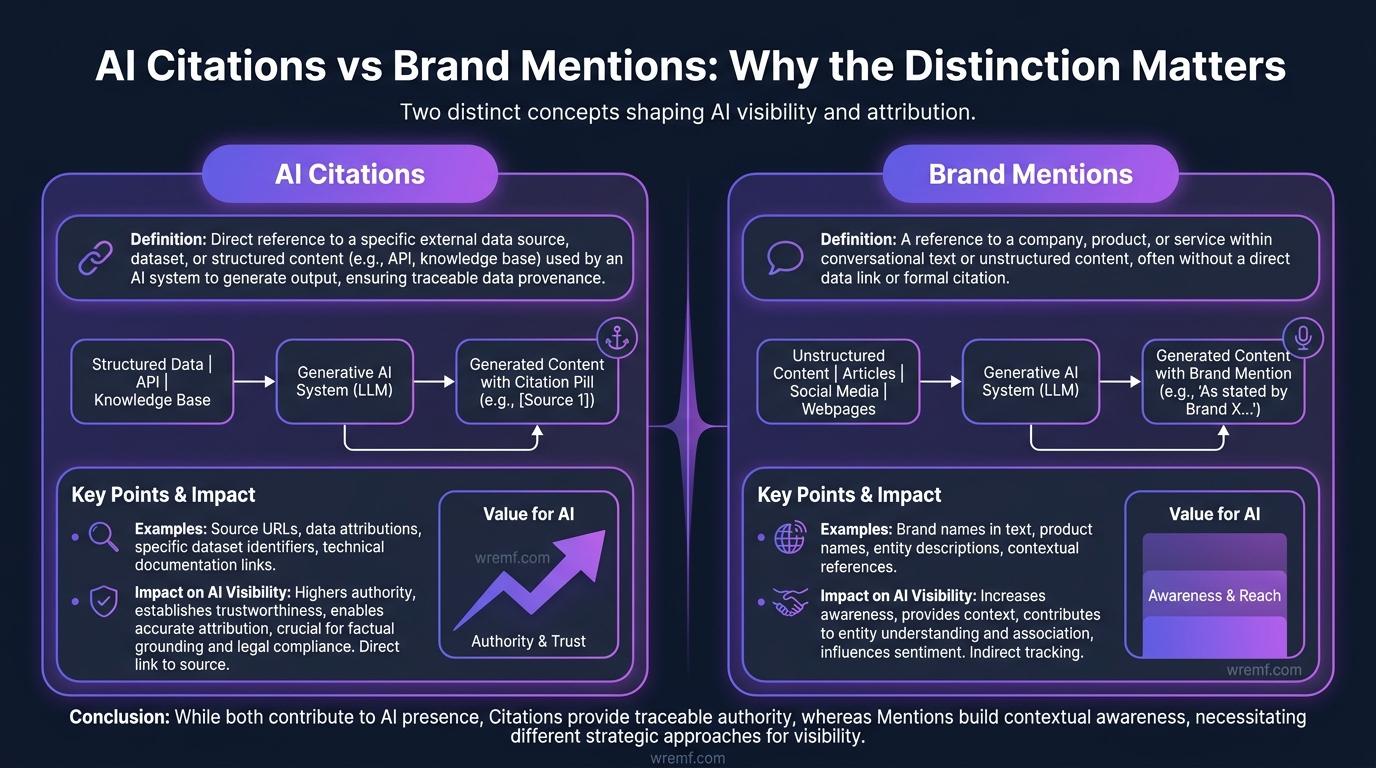
AI citations and brand mentions are related but distinct signals, and treating them as the same metric leads to incomplete measurement and misdirected optimisation.
An AI citation occurs when an AI engine explicitly references a specific source, page, or domain as the basis for information it includes in a response. Citations are the closest equivalent to a backlink in the AI visibility world. When Perplexity cites a brand's research page, or when Google AI Overviews pulls a specific URL into a featured answer, those are citations. They carry trust transfer because the AI engine is explicitly endorsing the source as credible enough to support its answer.
An AI brand mention occurs when an AI engine refers to a brand, product, or company by name within an answer, without necessarily attributing a specific source. Mentions reflect the degree to which a brand exists in the AI engine's trained understanding and retrieval patterns. A brand can be mentioned frequently without being cited, particularly if the AI engine considers the brand widely known enough to reference without sourcing. Conversely, a brand can be cited without a prominent mention if a technical page is used as background evidence rather than as a named recommendation.
The distinction matters for strategy because citations and mentions respond to different optimisation levers. Improving citation frequency requires building authoritative content at specific URLs, ensuring those pages are indexable by AI crawlers such as GPTBot, ClaudeBot, and PerplexityBot, and making content freshness a consistent practice. Improving mention frequency requires entity consistency, structured data, schema markup, and ensuring the brand is clearly represented across the sources that AI engines use during training and retrieval.
Brands should track both signals separately. A brand that is frequently mentioned but rarely cited may have strong awareness but weak authority in the AI layer. A brand that is cited frequently but not named directly in answers may be contributing to competitor responses rather than its own. Both patterns reveal different types of visibility gaps that require different corrective actions.
According to research published on arXiv covering AI and machine learning retrieval patterns retrieval-augmented generation systems show strong preference for recently updated, clearly structured, and explicitly attributed sources when constructing answers. This reinforces why citation optimisation requires both technical readiness and content quality working together.
KEY TAKEAWAY: AI citations and brand mentions measure different things. Citations reflect source authority in AI answers, while mentions reflect brand awareness in AI training and retrieval. Both require separate tracking and separate optimisation strategies.
The Zero-Click Paradigm and AI Visibility for B2B Discovery
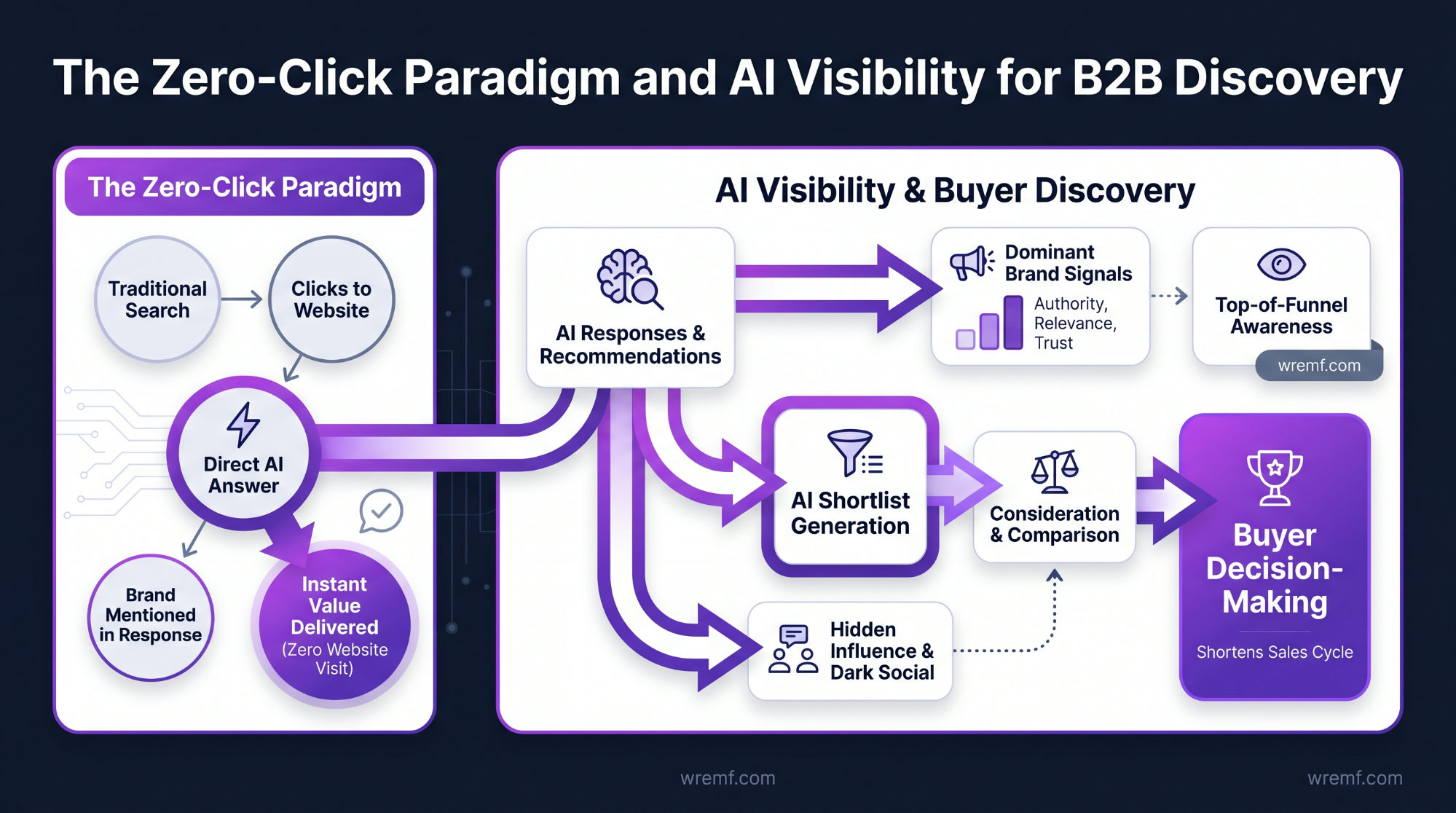
The zero-click paradigm describes the pattern where users receive complete answers from AI engines without clicking through to any website. This is not a future scenario. It is the current default behaviour across ChatGPT, Perplexity, Gemini, Claude, and increasingly across Google AI Mode and Google AI Overviews.
For B2B brands, the zero-click paradigm creates an important strategic tension. If buyers get their answers from AI responses without visiting brand websites, then traditional traffic-based metrics undercount the true influence that AI visibility has on demand, consideration, and brand positioning. A brand that shapes the AI answer earns influence even when no click occurs. A brand that is absent from the answer loses that influence entirely.
This reframes what AI visibility investment actually delivers. The primary value of AI visibility is not measured only in direct AI referral traffic sessions. It is measured in the cumulative effect of being present at scale across thousands of relevant prompts that buyers type into AI search engines every month. When a buyer asks Gemini which marketing analytics platforms integrate with Salesforce, the brand that appears in that answer multiple times across multiple prompts is building recognition and preference before the buyer ever visits a website.
The zero-click paradigm also changes how teams should think about content strategy. Content that is optimised purely for organic click-through rates may not be structured in the way AI engines prefer for extraction. Content that answers specific questions clearly, uses structured formatting with logical headings, and maintains content freshness is more likely to be pulled into AI-generated answers. This is the foundation of both Generative Engine Optimization and Answer Engine Optimization, two disciplines that focus on making content retrievable and citable by AI engines rather than just rankable in traditional search.
The relationship between these disciplines and the broader AI landscape is covered in detail in the generative AI optimization services guide
KEY TAKEAWAY: The zero-click paradigm means AI visibility influences buyer perception even when no website visit occurs. Brands that appear consistently in AI answers earn discovery advantage that cannot be captured by traffic metrics alone.
How AI Engines Choose Sources and What That Means for Brands
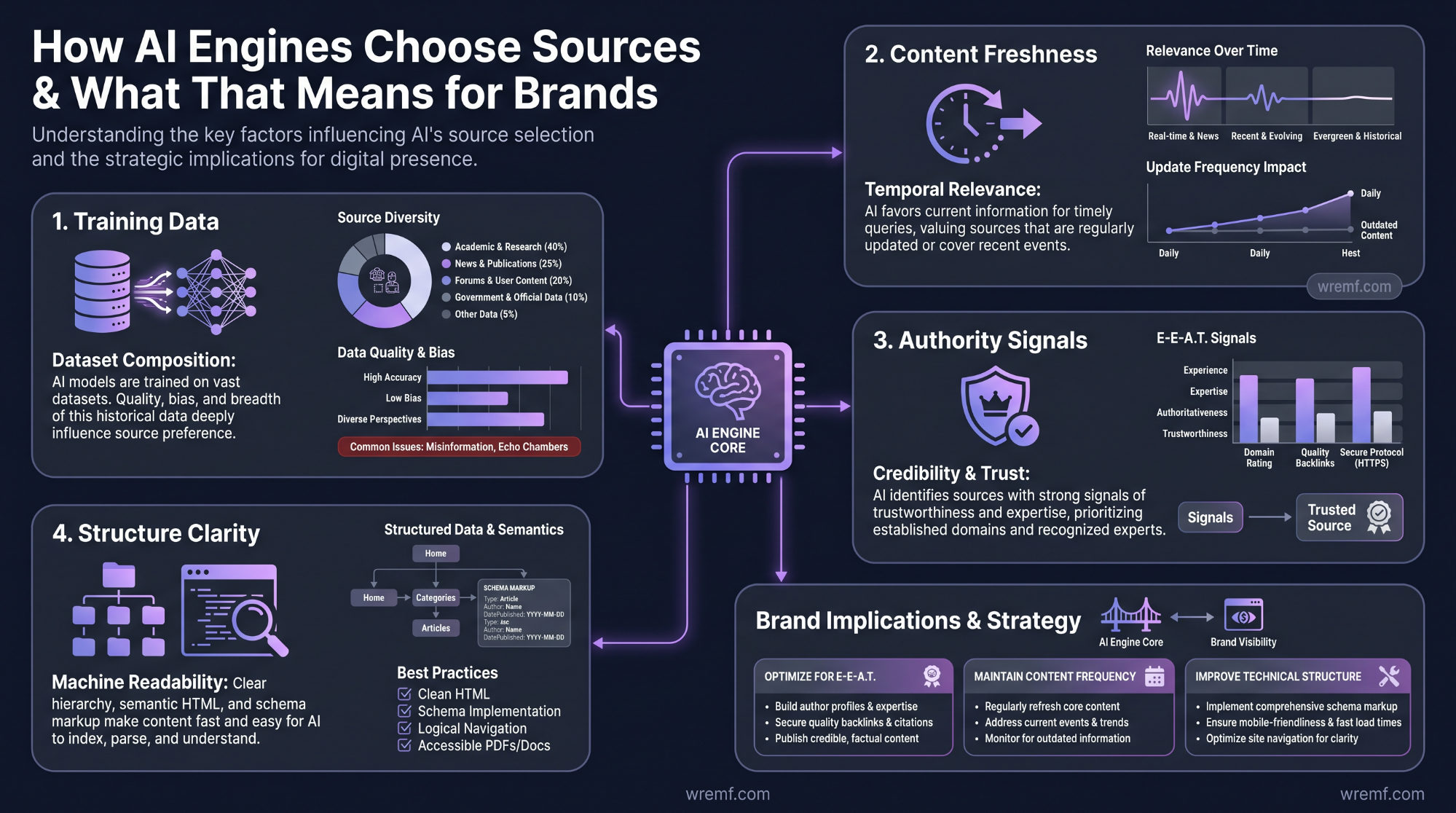
AI engines do not rank sources the way Google ranks web pages. They select and synthesise information from sources based on a combination of training data, retrieval relevance, recency, authority signals, and structural clarity. Understanding how this works helps brands prioritise the right optimisation actions.
Large language models such as the ones powering ChatGPT, Claude, Gemini, and Copilot are trained on large corpora of web content. The sources that are well-represented in training data, frequently cited by other high-authority sources, and consistently updated have a higher probability of influencing AI-generated answers. For retrieval-augmented generation systems such as Perplexity and Google AI Overviews, the selection is also influenced by real-time retrieval, which means content freshness and crawlability by AI bots are directly relevant.
AI crawlers including GPTBot, ClaudeBot, and PerplexityBot access content to update retrieval indexes. Brands that block these crawlers through robots.txt settings are effectively opting out of AI visibility. A site owner who has blocked GPTBot may have done so for reasons unrelated to AI visibility but will experience the consequence of reduced citation potential across ChatGPT-powered answers.
Structured data and schema markup play a measurable role in how AI engines parse and attribute content. Pages that use semantic HTML, logical headings, and schema to identify entities, authors, and content types provide clearer signals to AI retrieval systems. Research from the W3C standards body and the Schema.org documentation supports the principle that machine-readable structure improves content retrieval accuracy across automated systems.
Authoritative content with clear attribution, verified claims, named authors, and supporting sources is consistently favoured. The trust transfer mechanism works because AI engines effectively inherit credibility from the sources they cite. A brand that produces clearly attributed, well-structured, and regularly updated content creates the conditions for stronger citation frequency and more consistent representation in AI-generated answers.
Content freshness is a documented signal in AI citation behaviour. Research cited by practitioners suggests that a significant proportion of content cited in ChatGPT answers comes from pages updated within the previous six months. This does not mean old content is automatically excluded, but it does mean that regularly refreshed, current content has a structural advantage in AI retrieval systems.
Teams managing technical AI readiness should ensure that sitemaps are current, URLs are stable, structured data is implemented correctly, and AI crawlers are permitted where appropriate. These are not replacements for content quality but they are the technical foundation that allows good content to be discovered and cited.
KEY TAKEAWAY: AI engines select sources based on training data representation, retrieval relevance, content freshness, structural clarity, and authority signals. Brands that ensure crawlability, structured data, and regular content updates create better conditions for citation visibility.
How to Start Measuring AI Visibility: A Practical Workflow
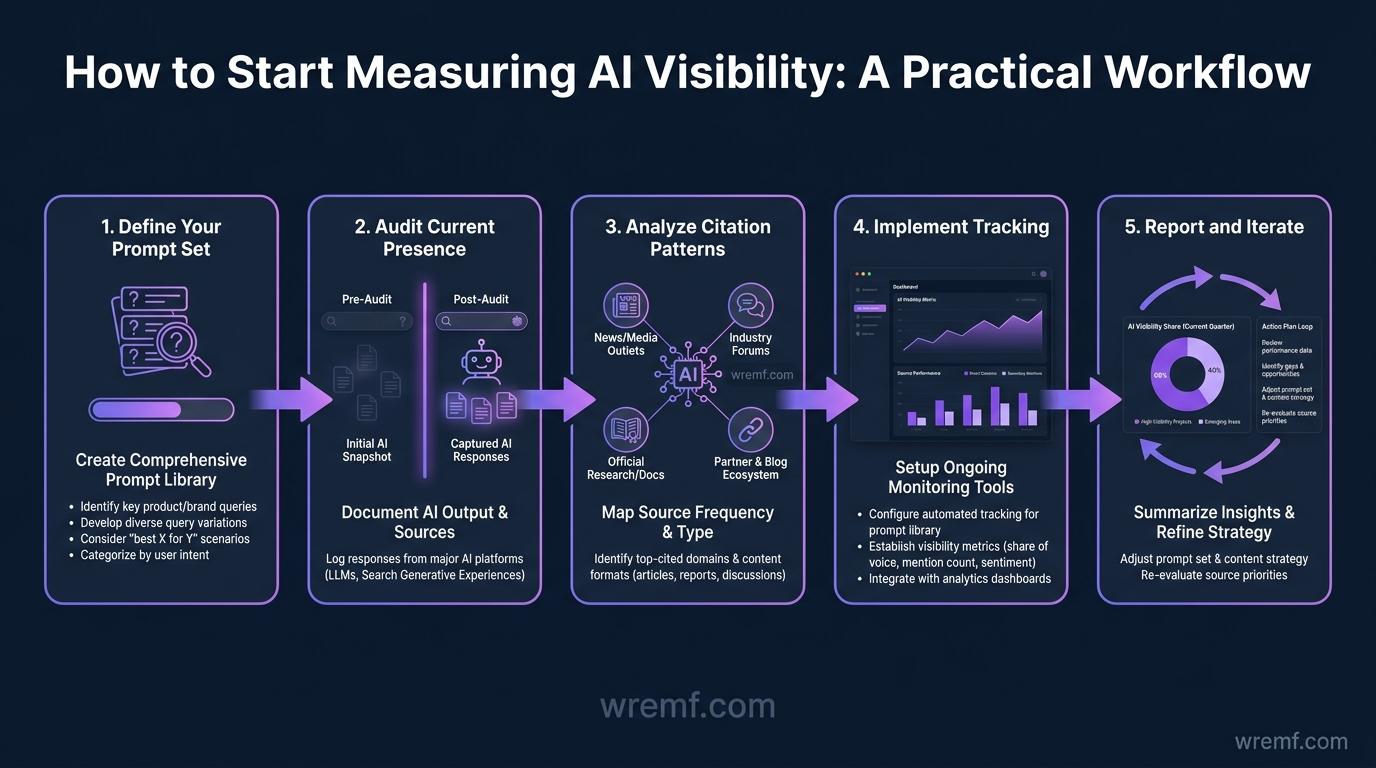
Measuring AI visibility requires a structured approach because AI answers are variable by engine, by prompt, by language, and by time. A single manual query in ChatGPT does not constitute an AI visibility measurement. Consistent, tracked, and comparable data across multiple prompts and multiple engines is the foundation of a reliable AI visibility program.
Step 1: Define your prompt set
Identify the specific questions, comparisons, and category queries that your target buyers are likely to type into AI search engines. These prompts should reflect real user queries across the buying journey, from awareness questions such as "what is the best platform for B2B email analytics" through to decision-stage comparisons such as "ChatGPT vs Gemini for content teams." A well-designed prompt set covers multiple intent stages and multiple competitor names.
Step 2: Audit your current AI presence
Run your defined prompts across the major AI engines and record whether your brand appears, is cited, is mentioned, is compared favourably to competitors, or is absent. This is your baseline AI visibility overview. Document which engines produce the strongest presence, which produce the weakest, and what sources are being cited in answers where your brand does not appear.
Step 3: Analyse citation patterns and source gaps
Identify the specific domains and URLs that are being cited when competitors appear in answers where you do not. These are your citation gaps. They reveal the content types, source formats, and authority signals that AI engines are currently favouring over your brand. This analysis forms the core input for a GEO audit and AEO content strategy.
Step 4: Implement structured prompt tracking
Manual auditing is not sustainable at scale. Set up scheduled AI monitoring across your full prompt set so that changes in citation frequency, mention rate, and AI Visibility Score are tracked consistently over time. WREMF automates this process across 10 AI engines with unlimited prompt tracking and BYOK support, removing the cost variability that makes manual monitoring impractical.
Step 5: Identify visibility gaps and prioritise actions
Use your tracking data to identify the specific prompts, competitor domains, and content gaps where intervention will have the most impact. Visibility gaps are not random. They reflect structural differences in how brands are represented in AI retrieval sources. Prioritise the gaps where competitor advantage is clearest and where your content and authority assets are closest to the citation threshold.
Step 6: Produce AI-ready content and optimise existing pages
Create content that directly answers the prompts in your defined set. Use logical headings, FAQs, structured data, and semantic HTML to make answers extractable. Update existing high-authority pages to improve content freshness and add explicit entity signals. Ensure AI crawlers can access the pages you want cited.
Step 7: Connect AI visibility to traffic and business outcomes
Configure GA4 attribution to capture sessions originating from AI platforms. Monitor AI referral traffic trends alongside prompt-level reporting to understand which visibility improvements are driving measurable traffic. Connect your AI Visibility Score movement to broader demand and pipeline metrics so that the business value of AI visibility investment is visible to leadership.
Step 8: Report and iterate
Produce monthly reports that track AI Visibility Score, citation frequency, share-of-voice analysis against competitor domains, and sentiment scoring trends. Use these reports to refine your prompt set, update content, and adjust your authority-building strategy. AI visibility is not a one-time fix. It is a continuous monitoring and optimisation program.
Teams managing this process in-house can use WREMF as software for self-serve tracking and reporting. Teams that need strategic guidance, content execution, and citation cleanup can engage the WREMF managed service. The WREMF pricing page explains the Starter, Growth, and Managed plan options so teams can match the right level of support to their resources.
KEY TAKEAWAY: Measuring AI visibility requires a structured, repeatable process that covers prompt definition, baseline auditing, citation gap analysis, automated tracking, content optimisation, GA4 attribution, and monthly reporting. Manual one-off queries are not a substitute for systematic measurement.
Generative Engine Optimization and Answer Engine Optimization: The Disciplines Behind AI Visibility
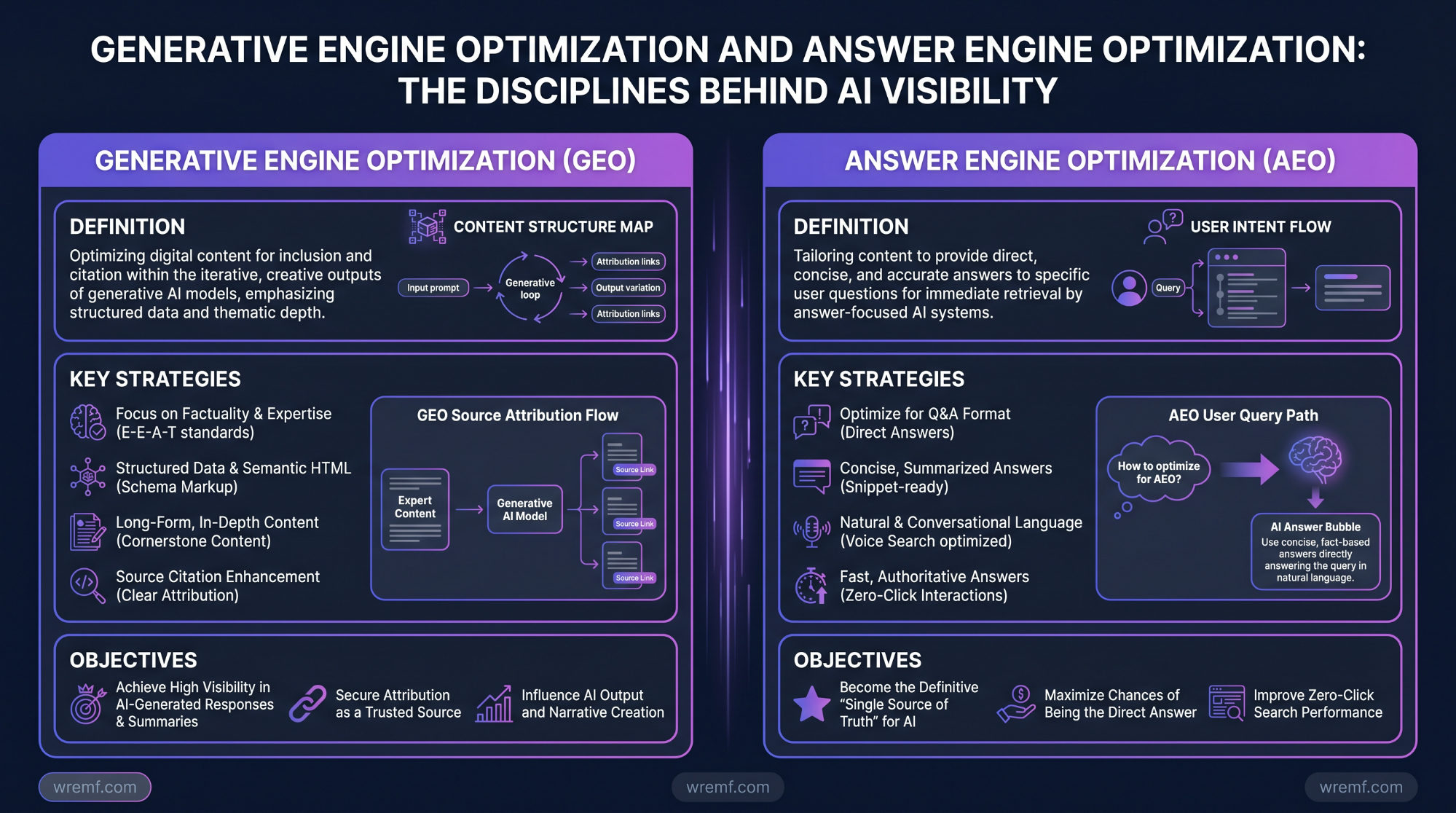
Generative Engine Optimization and Answer Engine Optimization are the two primary disciplines used to improve AI visibility. They are related but distinct, and understanding both is necessary for teams that want to move beyond tracking and into active visibility improvement.
Generative Engine Optimization, commonly referred to as GEO, is the practice of structuring, formatting, and positioning content so that generative AI engines prefer it as a source when constructing answers. GEO focuses on how content is presented to AI retrieval systems. It covers content structure, semantic HTML, headings, citation signals, entity consistency, and source authority. GEO treats AI engines as the audience and asks the question: does this page look like the kind of source a trustworthy AI engine would cite?
Answer Engine Optimization, or AEO, is the practice of creating content that directly and completely answers the specific questions that users ask AI engines and answer engines. AEO focuses on the user's intent rather than the engine's retrieval mechanism. It covers question-answer content formats, FAQs, how-to structures, definitional clarity, and prompt-matched content. AEO asks the question: does this content answer the exact question a buyer is asking, in a format that an AI engine can extract and use?
The two disciplines work together. GEO without AEO produces well-structured content that does not match actual user queries. AEO without GEO produces content that answers questions well but may not be structured in a way that AI engines can reliably retrieve and attribute. The strongest AI visibility programs combine both.
Both GEO and AEO differ from traditional SEO in that they are not primarily concerned with keyword density, backlink quantity, or SERP position. They are concerned with being the answer, not just ranking near answers. This is a meaningful shift in how content strategy is defined and executed. Teams transitioning from keyword-led SEO to prompt-led GEO and AEO often need to rebuild content briefs, restructure existing pages, and reconsider which metrics define success.
WREMF supports both disciplines through its GEO audits, AEO content optimisation, and AI-ready content brief generator, which are available on the Growth and Managed plans. Teams that want a comprehensive explanation of how these services work can explore the answer engine optimization guide | https://wremf.com/blog/answer-engine-optimization-the-complete-guide-to-aeo-ai-search-visibility-and-answer-first-content.
KEY TAKEAWAY: Generative Engine Optimization focuses on making content retrievable by AI engines. Answer Engine Optimization focuses on matching content to the questions buyers ask. Both disciplines are required for sustainable AI visibility improvement and work best when combined.
AI Share of Voice and Competitive Visibility Analysis
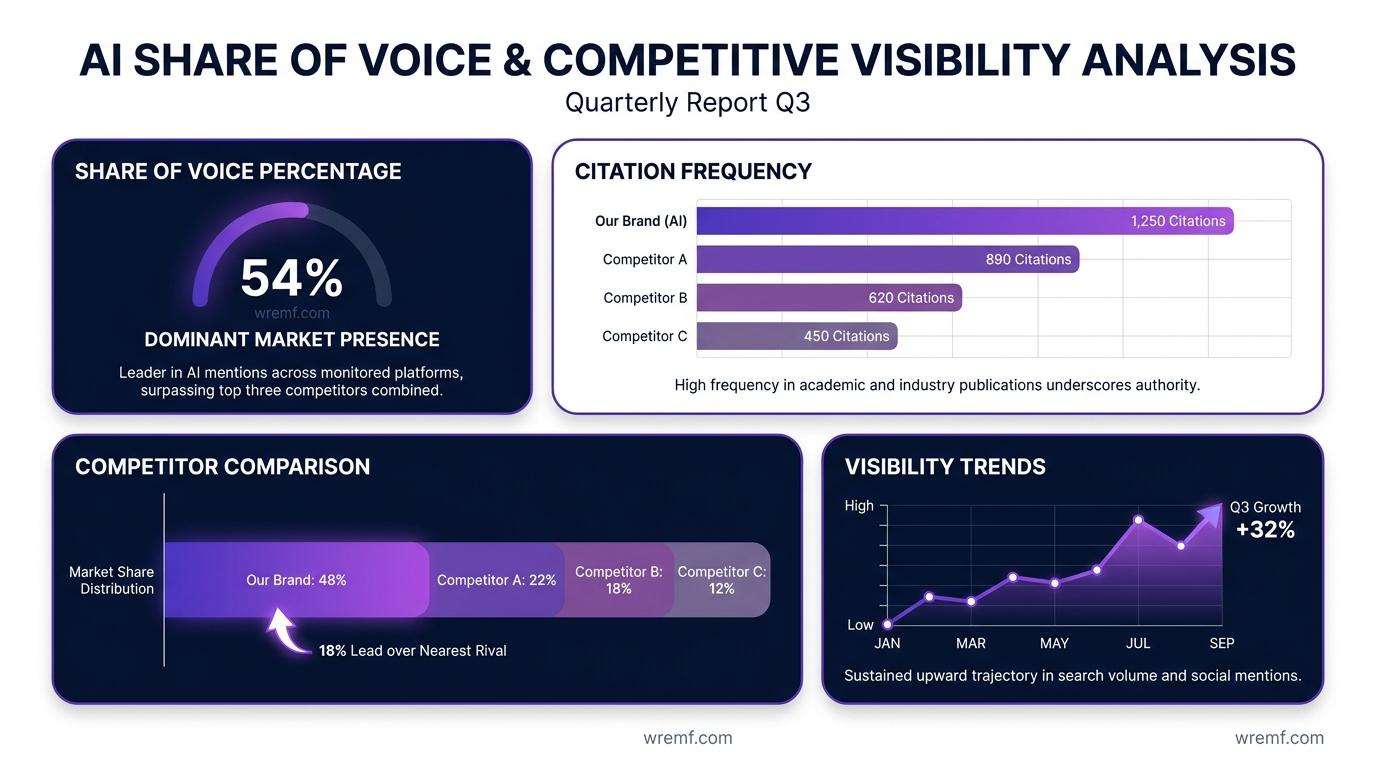
AI share of voice is the metric that makes competitive AI visibility visible. It measures the proportion of AI-generated answers, across a defined prompt set, in which a brand appears compared with its competitors. Share-of-voice analysis is the AI visibility equivalent of SERP visibility scores in traditional SEO, but it is more strategically relevant for B2B teams because AI answers directly influence buyer shortlisting rather than just click distribution.
To calculate AI share of voice, a brand tracks its own mention and citation frequency across a defined prompt set and compares it with the frequency for each competitor domain. If a brand appears in 20 out of 100 tracked prompts and its primary competitor appears in 65 out of the same 100 prompts, the competitive gap is clear and actionable. The team can then examine which specific prompts the competitor is winning, which sources are driving those citations, and what content or authority gaps are responsible for the difference.
Competitor visibility analysis goes deeper than share of voice. It identifies the specific competitor domains that appear most frequently in AI answers, the content types and URL patterns those competitors use, and the citation frequency patterns that explain why AI engines prefer them for certain query categories. This level of competitor intelligence is not available from traditional SEO tools because it is not a function of keyword overlap or SERP comparison. It requires prompt-based tracking across AI engines.
Understanding which competitor domains are winning AI citations for specific user queries also reveals partnership, content, and authority-building opportunities. If a third-party publication consistently appears alongside a competitor in AI answers, earning coverage or citations from that publication becomes a strategic priority. If a competitor's FAQ content is being extracted consistently by Google AI Overviews, building comparable structured content becomes an immediate action.
WREMF's competitor tracking is built into every plan. The Starter plan supports up to three competitors, the Growth plan supports 10 to 15, and the Managed plan supports custom competitor sets for multi-market and enterprise teams. This makes share-of-voice analysis accessible at every team size without requiring custom data engineering.
Teams managing complex competitive landscapes can also review the AI brand monitoring guide for guidance on monitoring brand positioning and competitive visibility across AI search.
KEY TAKEAWAY: AI share of voice measures competitive presence in AI-generated answers and is the most strategically useful metric for understanding where a brand stands relative to competitors in the AI discovery channel.
AI Visibility Across the Major Platforms: What Teams Need to Know
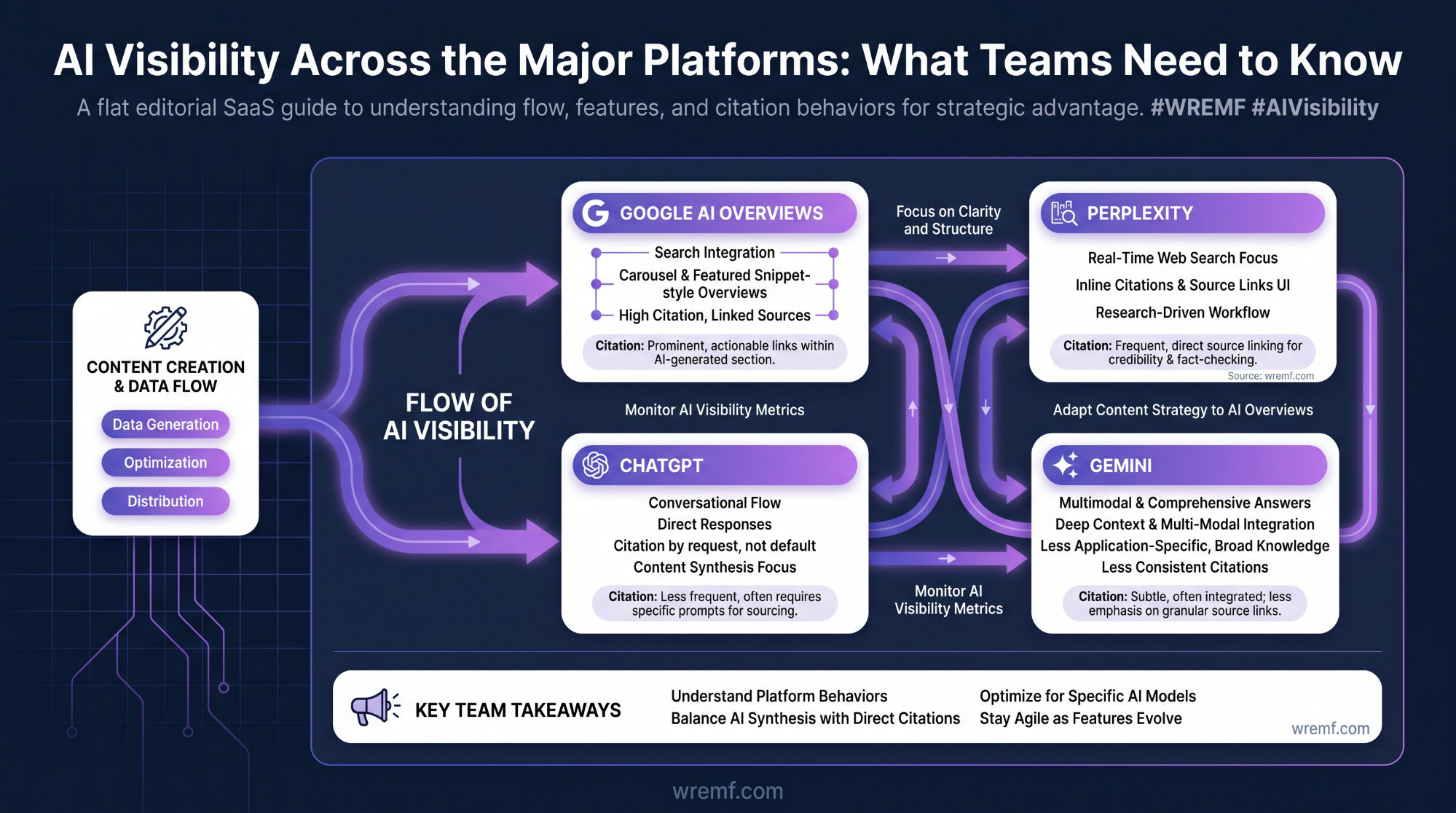
AI visibility is not uniform across engines. Each major AI platform has different retrieval mechanisms, different training data emphases, different citation behaviours, and different user audiences. A brand that performs well in ChatGPT answers may be less visible in Perplexity, misrepresented in Gemini, or absent from Google AI Overviews. Multi-engine tracking is not optional for teams that want an accurate AI visibility overview.
ChatGPT is the largest AI platform by active user volume and prompt volume. It uses a combination of trained knowledge and retrieval-augmented generation depending on the model and configuration. GPTBot is the crawler that OpenAI uses to access web content for retrieval purposes. Brands that want to be cited in ChatGPT answers need to ensure GPTBot is not blocked and that their authoritative content is structured for retrieval. The OpenAI research overview provides background on how OpenAI's models approach knowledge and retrieval.
Google AI Overviews and Google AI Mode represent Google's integration of generative answers into search. According to Google's AI Overviews documentation AI Overviews are served as a distinct layer above organic results for a significant proportion of queries. Brands that appear in Google AI Overviews benefit from placement at the very top of the search experience. Optimising for Google AI Overviews requires strong organic authority combined with structured content that answers the specific query comprehensively.
Perplexity operates as a search-native AI answer engine. It retrieves sources in real-time and cites them explicitly within answers, making it one of the most citation-transparent AI engines available. PerplexityBot indexes content regularly, and brands that are cited in Perplexity answers are explicitly named and linked. Perplexity is particularly relevant for research-stage B2B buyers who want sourced, verifiable answers rather than generative summaries.
Gemini, Google's AI model family, is integrated across Google Workspace, Google Search, and standalone interfaces. It draws on Google's knowledge graph as well as web retrieval. Gemini's citation behaviour is closely tied to content that Google's core algorithm already favours, making strong organic SEO foundations more relevant to Gemini visibility than to some other AI engines.
Claude, developed by Anthropic, powers a growing number of B2B applications and API integrations. ClaudeBot accesses web content for retrieval purposes. Claude is increasingly used in enterprise knowledge management and research workflows, making it relevant for brands targeting enterprise buyers. Anthropic's research page provides context on how Claude's training and retrieval approaches continue to evolve.
Copilot, Microsoft's AI assistant integrated across Microsoft 365 and Bing, draws on the web through Bing's index as well as organisational data in enterprise deployments. The Microsoft Bing Webmaster Guidelines outline the technical standards that help content perform well across Bing and Copilot-powered answers. For B2B brands with audiences heavily embedded in Microsoft environments, Copilot visibility is a meaningful competitive consideration.
DeepSeek, Grok, Meta AI, and Mistral represent the expanding range of AI engines that contribute to AI-generated discovery across different user segments and platforms. Multi-engine visibility tracking ensures brands are not optimising for one engine while remaining invisible across the others.
WREMF tracks AI visibility across all 10 of these engines from a single platform, providing a unified AI visibility overview that no single-engine manual audit can replicate. This cross-model coverage is what makes systematic AI visibility management practical for teams that cannot maintain separate monitoring workflows for each engine.
KEY TAKEAWAY: Each AI engine has distinct retrieval mechanisms, citation behaviours, and user audiences. Multi-engine tracking is essential because strong visibility in one engine does not guarantee equivalent presence across others.
AI Visibility for Agencies and Multi-Client Teams
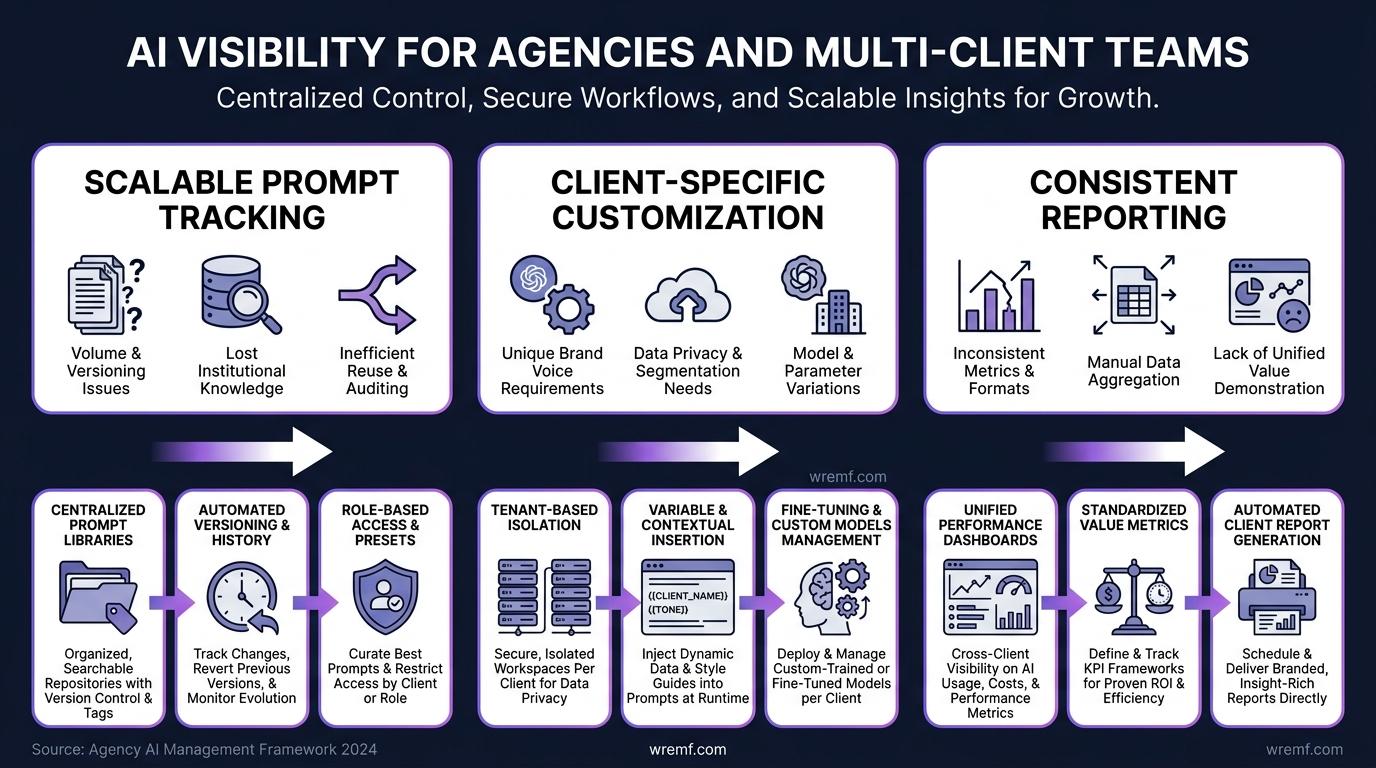
Agencies managing AI visibility for multiple clients face a distinct set of operational challenges. The core problem is scale: running prompt sets, tracking citations, monitoring competitors, and reporting results across five, ten, or twenty clients simultaneously requires infrastructure that manual monitoring and spreadsheet-based workflows cannot sustain.
The primary agency challenge is consistent reporting. Clients expect structured, clear, and branded reports that show AI visibility progress over time. Producing those reports manually for each client is time-intensive and introduces inconsistency. Agencies that use white-label AI visibility reporting can deliver professional, branded reports to clients without rebuilding reports from scratch each month.
The second agency challenge is prompt coverage. Each client has a unique market, audience, competitor set, and prompt vocabulary. An agency managing multiple B2B SaaS clients cannot use a single prompt set across all of them. The ability to configure client-specific prompt sets, competitor domains, and tracking parameters at scale is what separates a functional agency AI visibility workflow from a fragmented manual process.
The third challenge is attribution. Clients want to know whether AI visibility investment is driving results. Without GA4 attribution integration and AI referral traffic analysis, agencies cannot connect visibility improvements to traffic or pipeline outcomes. This makes it difficult to demonstrate ROI and justify ongoing retainers.
WREMF Growth plan supports up to five websites and 10 to 15 competitors, making it suitable for agencies managing a small to mid-size client portfolio. The Growth plan includes white-label reports, GA4 attribution, Looker Studio connector, and advanced citation tracking, giving agency teams the reporting infrastructure they need to manage AI visibility for multiple clients at a professional standard. The WREMF Managed plan supports custom website and competitor configurations for larger agencies managing enterprise-level clients.
Agencies that prefer to offer AI visibility as a white-label service or to build it into broader retainer packages can explore the WREMF agency services page for information on how the agency partnership model works.
KEY TAKEAWAY: Agencies managing AI visibility for multiple clients need scalable prompt tracking, white-label reporting, multi-client competitor analysis, and GA4 attribution integration. WREMF's Growth and Managed plans are built to support agency-scale AI visibility operations.
AI Visibility for B2B SaaS Teams at Different Stages
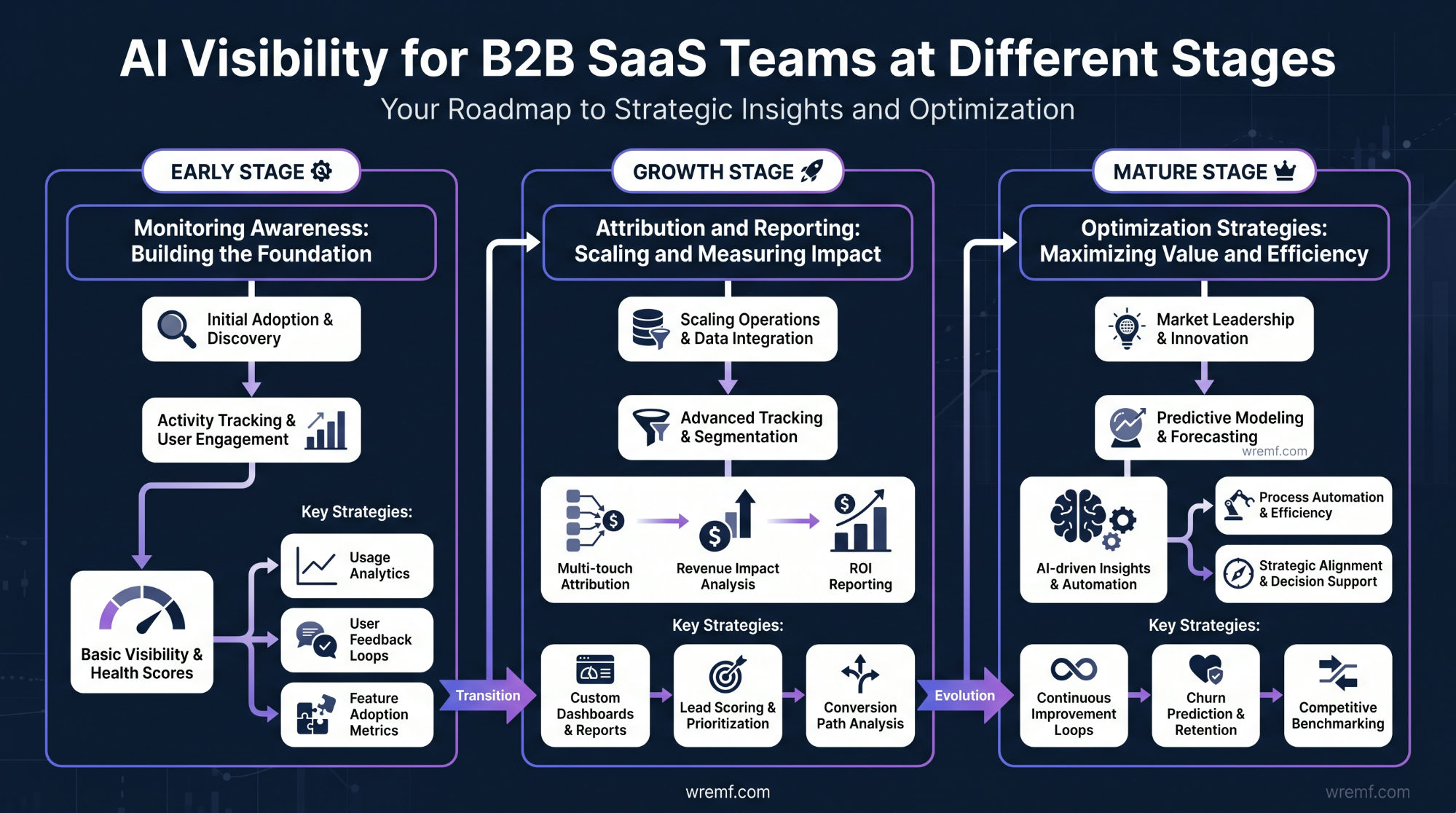
Not every B2B team needs the same level of AI visibility infrastructure. The right approach depends on team size, existing SEO maturity, budget, internal execution capacity, and how much of the competitive landscape is already being shaped by AI-driven discovery.
A founder or solo consultant tracking early AI visibility signals needs to know whether the brand is being mentioned at all across the major AI engines, which competitors are consistently appearing in answers, and whether the brand's core pages are being cited. This is a monitoring and awareness use case. It does not require complex attribution or multi-market tracking. The WREMF Starter plan at €59 per month covers one website, up to three competitors, 10 AI engines, unlimited prompts, and core prompt intelligence with BYOK support. It gives solo operators and small teams a reliable baseline without per-prompt cost exposure.
A B2B SaaS marketing team that is already investing in SEO and content needs AI visibility data to connect those investments to AI search outcomes. The team needs to know which content is being cited, which competitor domains are outperforming them in AI answers, and whether GEO and AEO optimisation is producing measurable movement in AI Visibility Score. This team also needs reporting that communicates AI visibility progress to leadership alongside existing SEO and GA4 data. The WREMF Growth plan at €149 per month adds advanced citation tracking, share-of-voice analysis, GEO audits, content brief generation, GA4 attribution, and white-label reports across five websites and up to 15 competitors.
An enterprise brand or large agency managing AI visibility across multiple markets, multiple brands, and multiple competitive categories needs strategy, execution, and reporting managed end to end. The WREMF Managed plan starting from €1,500 per month provides a custom AI visibility audit, a tailored GEO strategy, AEO content optimisation, citation and entity cleanup, senior-led execution, strategy calls, and a custom roadmap. This is the right model for teams that need AI visibility outcomes without diverting internal resources from existing programs.
The hybrid model is a practical middle ground that more teams are adopting. In this model, the team uses WREMF software in-house for ongoing tracking, reporting, and attribution, and engages the WREMF senior team for periodic audits, strategy sprints, and execution support when specific visibility challenges require expert intervention. This approach combines cost efficiency with strategic depth and allows the engagement model to flex as the AI visibility program matures.
Choosing between software, managed service, and hybrid depends on three practical questions: does the team have the internal capacity to translate AI visibility data into content and authority actions, does the team need external strategic guidance to close visibility gaps effectively, and does the team need to demonstrate AI visibility ROI to leadership through structured reporting?
KEY TAKEAWAY: Starter teams need monitoring and baseline awareness. Growth teams need attribution, reporting, and GEO execution support. Enterprise and agency teams need strategy, implementation, and custom reporting. WREMF covers all three through Starter, Growth, and Managed plans.
Limitations, Risks, and Honest Caveats About AI Visibility
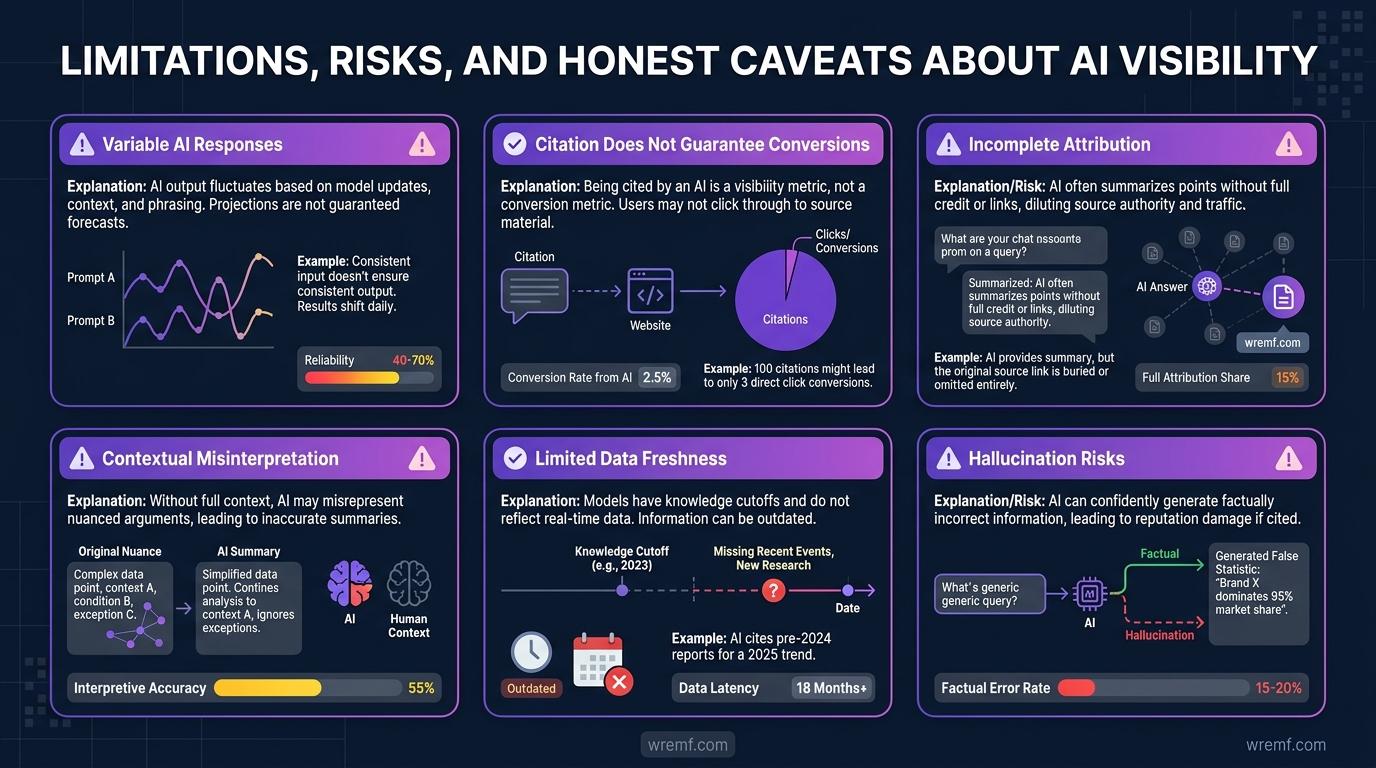
AI visibility is a real and measurable competitive signal, but it comes with limitations that teams should understand before building expectations or reporting commitments around it.
AI answers are not fixed. The same prompt submitted to ChatGPT, Gemini, or Perplexity on different days, by different users, or in different language contexts can produce meaningfully different answers. AI engines update their models, retrieval indexes, and ranking signals on their own timelines. A brand that appears prominently in AI answers today may see that presence shift following a model update, a change in retrieval weighting, or a competitor's content investment. This variability is not a failure of the measurement system. It is a property of the AI landscape itself, and it reinforces why continuous monitoring rather than periodic manual audits is the correct approach.
Rankings alone do not prove AI visibility. A brand that ranks highly on Google for a set of SEO queries is not automatically present in AI answers for related prompts. The content that ranks well in traditional search and the content that is cited in AI answers often differ by format, structure, specificity, and recency. Teams that assume their strong organic SEO performance translates directly into AI visibility will consistently overestimate their actual presence in AI-generated answers.
Citations do not guarantee conversions. A brand that is frequently cited in AI answers is earning discovery advantage and trust transfer, but citation frequency does not directly translate into pipeline or revenue without the downstream content, product, and sales experience to convert that awareness. AI visibility should be treated as a top-of-funnel signal, not as a direct revenue metric. Attribution from AI referral traffic to pipeline requires proper GA4 configuration and clear mapping of the buyer journey from AI discovery to conversion.
AI referral traffic attribution is incomplete by design. AI platforms do not always pass clear referral parameters through to analytics tools. Some AI-generated visits appear as direct traffic rather than referral traffic in standard GA4 configurations. WREMF's attribution integration improves this, but teams should understand that AI traffic measurement is an approximation rather than a complete data set, particularly for engines that generate zero-click answers without any corresponding visit.
No platform, including WREMF, can guarantee that an AI engine will recommend, cite, or mention a specific brand. AI engines make their own retrieval and generation decisions based on opaque processes that are not fully transparent to external tools. What AI visibility platforms can do is measure the current state, identify the gaps, and help teams improve the conditions that make citation and mention more likely.
Software-only plans require internal execution capacity. The WREMF Starter and Growth plans provide tracking, reporting, and audit data, but they require the team to act on that data. If a team lacks the content, technical, or strategy resources to close visibility gaps independently, a managed or hybrid engagement is more appropriate than a software-only subscription.
KEY TAKEAWAY: AI visibility measurement is valuable but imperfect. Answers vary across engines and over time, citations do not guarantee conversions, and no platform can guarantee AI recommendations. Understanding these limitations leads to more realistic expectations and more durable strategy.
Real-World Scenarios: How Teams Use AI Visibility Data
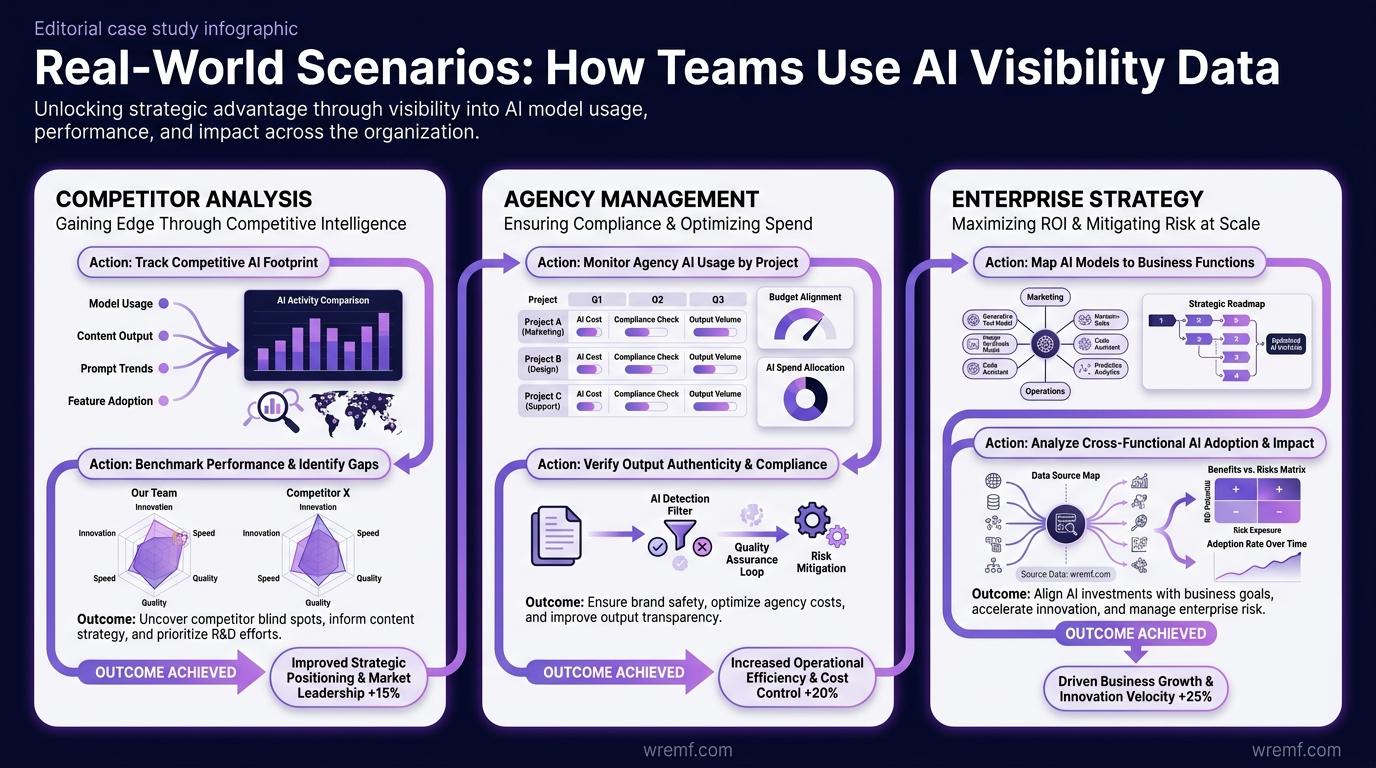
The practical value of AI visibility data becomes clearest when it is connected to specific business problems. The following scenarios illustrate how different teams use AI visibility tracking in practice.
Scenario one: A B2B SaaS company investigating competitor AI presence
A marketing team at a mid-size B2B SaaS company notices that a competitor is consistently being recommended in ChatGPT and Perplexity answers when buyers ask about integration-heavy CRM alternatives. The team's own brand does not appear in those answers despite having comparable features. Using WREMF's prompt intelligence and citation pattern analysis, the team identifies that the competitor is being cited via a specific integration documentation page that is well-structured, frequently updated, and clearly attributed to an expert author. The team's equivalent page is outdated and lacks structured data. The team updates the page, adds schema markup, improves headings, and refreshes the content with current integration details. Within two months, the page begins appearing in citation tracking reports alongside the competitor, and the AI Visibility Score for that prompt category improves measurably.
Scenario two: An agency managing AI visibility for multiple clients
A digital agency runs SEO and content programs for eight B2B clients across different verticals. The agency has started receiving questions from clients about whether their brand appears in ChatGPT and Perplexity answers. Using WREMF Growth, the agency sets up separate client workspaces with custom prompt sets, competitor domains, and white-label reporting templates. Each month, the agency delivers branded AI visibility reports that show citation frequency, share-of-voice trends, and prompt-level insights for each client. Two clients identify visibility gaps in high-intent prompt categories and commission content briefs to address them. The agency positions AI visibility reporting as a differentiated service layer on top of existing SEO retainers.
Scenario three: An enterprise brand using managed AI visibility
A large enterprise SaaS brand with presence in multiple markets engages WREMF Managed after an internal audit reveals significant visibility gaps in Gemini and Google AI Overviews for high-value product category prompts. WREMF runs a comprehensive AI visibility audit, delivers a custom GEO strategy, executes AEO content optimisation across 15 priority pages, and manages citation and entity cleanup across the brand's main domain. Monthly strategy calls align the execution roadmap with the brand's content and product marketing calendar. The brand's AI Visibility Score shows consistent improvement across tracked engines over a six-month period, and AI referral traffic attribution begins contributing a measurable share of inbound pipeline.
These scenarios are illustrative of how teams at different stages and sizes approach AI visibility as a structured program rather than an occasional audit.
KEY TAKEAWAY: AI visibility data produces the most value when it is connected to specific content, authority, and competitive actions. Scenario-based planning helps teams translate visibility metrics into measurable improvements in citation frequency and share of voice.
Common Misconceptions About AI Visibility
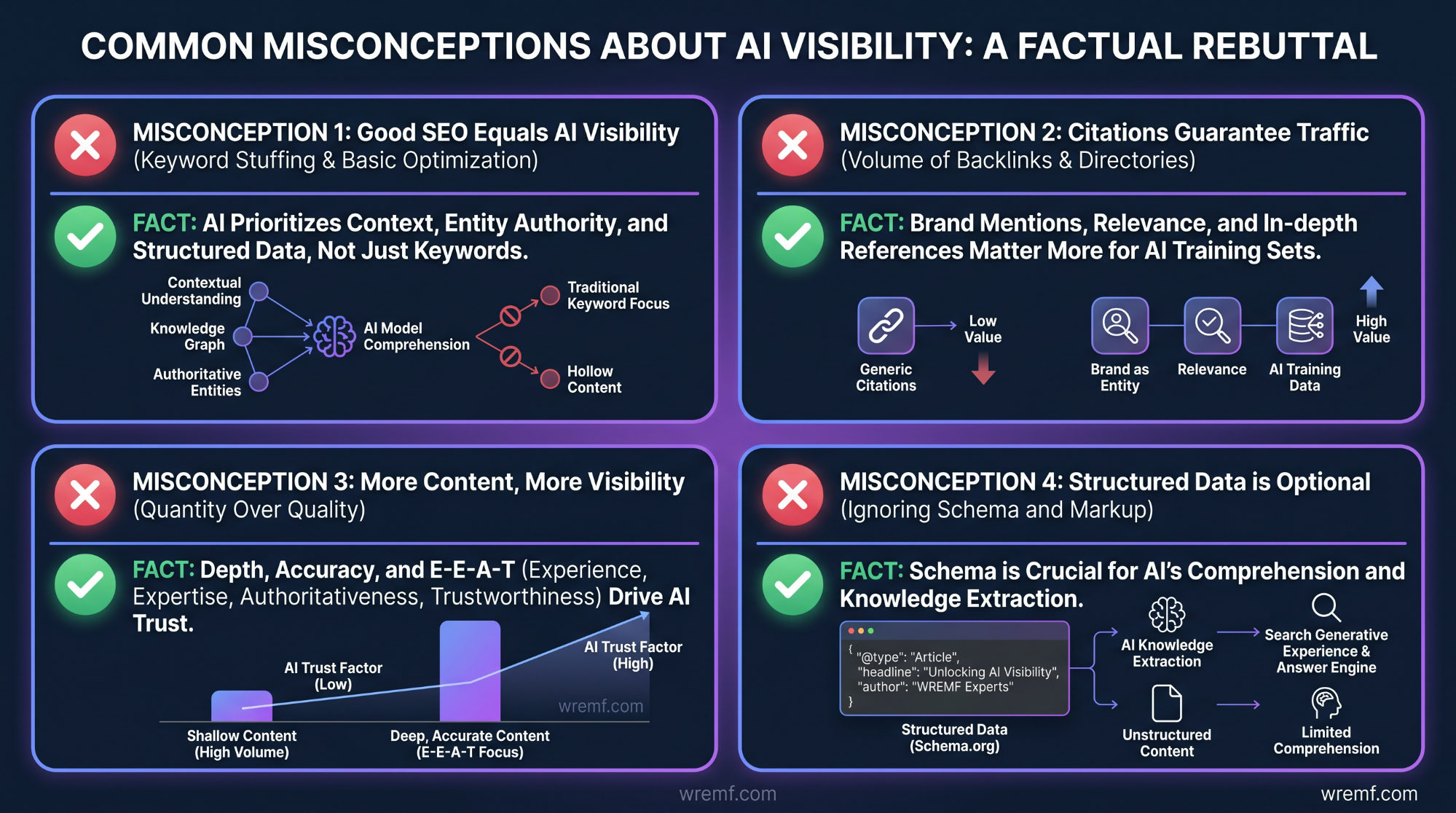
MYTH: If a brand ranks well on Google, it will automatically appear in AI answers.
FACT: Google rankings and AI citation presence are separate signals. AI engines select sources based on retrieval relevance, content structure, entity clarity, and recency, not SERP position. A brand can rank on page one and be completely absent from ChatGPT or Perplexity answers for the same topic. AI visibility requires its own measurement and optimisation program.
MYTH: AI visibility cannot be measured because AI answers are random and unpredictable.
FACT: AI answers are variable but not random. Systematic prompt tracking across a defined set of prompts, run consistently across multiple AI engines, produces reliable and comparable visibility data. AI Visibility Scores, citation frequency, share-of-voice analysis, and prompt-level reporting all provide actionable measurement even within the natural variability of AI-generated answers. WREMF's scheduled AI monitoring automates this process so measurement is continuous rather than occasional.
MYTH: Good SEO is the same as GEO. If content is optimised for Google, it is already optimised for AI engines.
FACT: SEO and GEO share some foundations but are not the same discipline. SEO focuses on keyword ranking signals, backlinks, and SERP position. GEO focuses on making content structurally and semantically retrievable by AI engines. Content that performs well in traditional search may lack the structured data, explicit attribution, FAQs, and content freshness signals that AI retrieval systems prefer. GEO and AEO require their own content brief frameworks and optimisation actions alongside SEO.
MYTH: If a brand invests in AI visibility, it can guarantee that AI engines will recommend it.
FACT: No platform or agency can guarantee that any AI engine will recommend, cite, or mention a specific brand. AI engines make retrieval and generation decisions based on processes that are not fully transparent. What AI visibility investment does is improve the conditions that make citation and mention more likely, by ensuring content is authoritative, well-structured, current, and accessible to AI crawlers. The outcome is improved probability, not guaranteed placement.
MYTH: AI visibility only matters when AI-generated answers drive direct traffic.
FACT: The zero-click paradigm means that AI-generated answers shape buyer awareness and brand positioning even when no website visit occurs. A brand that appears consistently in AI answers is building recognition and preference across the buyer journey regardless of whether those impressions produce an immediate click. Measuring AI visibility only through referral traffic sessions significantly undercounts its strategic value as a top-of-funnel discovery and positioning signal.
KEY TAKEAWAY: The most common AI visibility misconceptions involve assuming SEO automatically covers AI search, that AI answers cannot be measured, and that GEO is the same as traditional SEO. Each misconception leads to underinvestment in a discovery channel that is actively influencing buyer decisions.
Conclusion
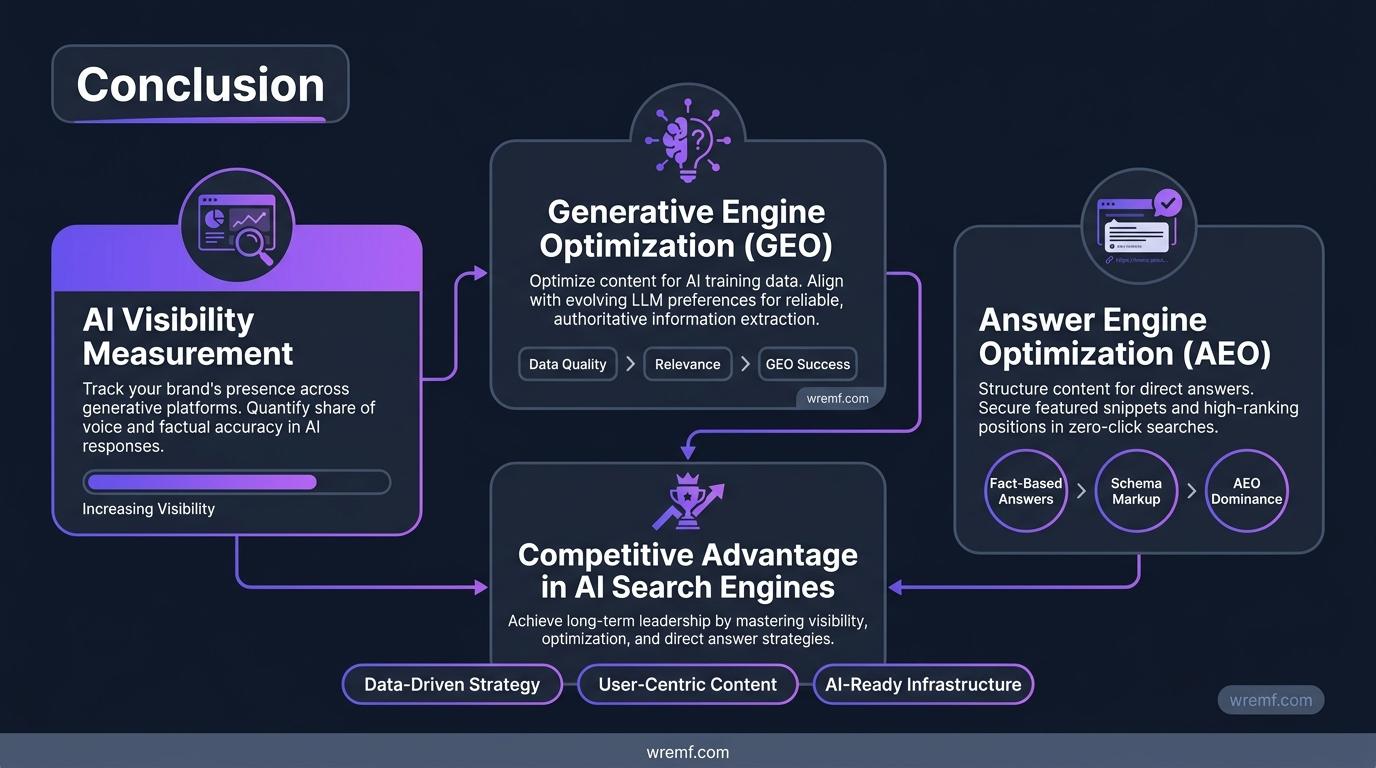
AI visibility is the measurement of how a brand is mentioned, cited, compared, and recommended inside AI-generated answers across the platforms that buyers use to research and shortlist vendors. It is distinct from traditional SEO, requires its own metrics, and demands its own optimisation disciplines in the form of Generative Engine Optimization and Answer Engine Optimization. Brands that invest in AI visibility tracking, close citation gaps, and monitor share of voice across AI search engines are building a durable discovery advantage in a channel where most competitors are still reacting rather than planning. WREMF helps B2B teams track AI visibility across 10 engines, measure prompt-level performance, and act on citation and mention data through software, managed execution, or a hybrid model. To see which approach fits your team, compare WREMF pricing plans or explore the full AI search engine optimization tools guide
Frequently Asked Questions About AI Visibility
What is AI visibility?
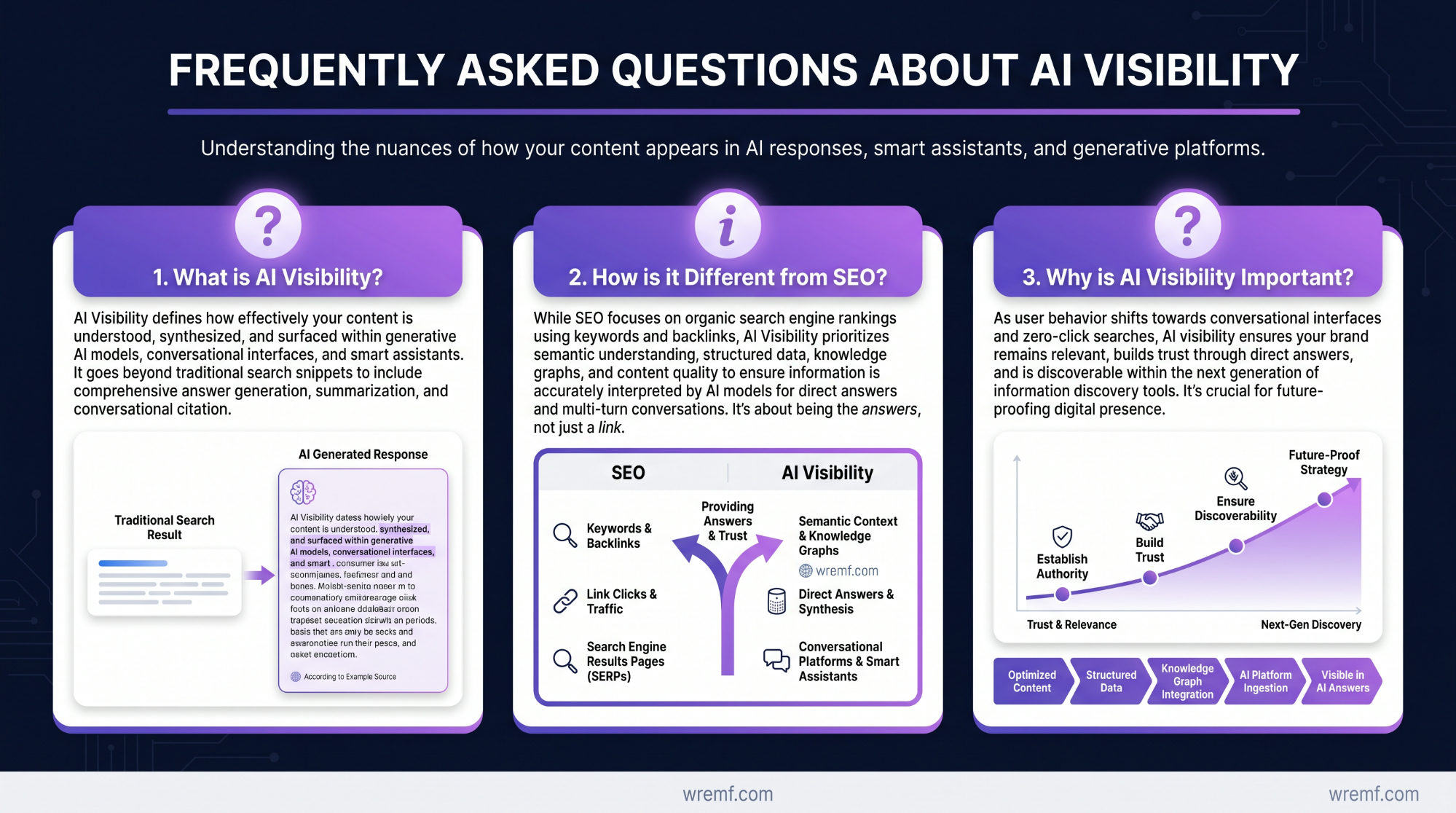
AI visibility refers to how often and how prominently a brand, product, or website appears in responses generated by AI-powered discovery systems such as ChatGPT, Claude, Gemini, Perplexity, Google AI Overviews, Copilot, and other large language models. Unlike traditional SEO, which measures rankings in blue-link search results, AI visibility measures whether your brand is cited, mentioned, or recommended when users ask AI assistants questions relevant to your category, use case, or competitors. As AI search engines handle more discovery queries, AI visibility has become a critical component of any B2B brand's search strategy.
How is AI visibility different from traditional SEO rankings?
Traditional SEO rankings measure where a webpage appears in a list of blue-link results for a keyword. AI visibility measures whether your brand appears inside AI-generated answers, and in what context, with what sentiment, and alongside which competitors. AI models such as ChatGPT, Gemini, and Perplexity do not return ranked lists in the same way Google does. They synthesise sources into natural language answers. A brand can rank highly in organic search yet be completely absent from AI responses, and vice versa. According to Google's AI Overviews documentation, AI Overviews apply a separate classification from standard organic sessions, which means traditional rank tracking tools do not capture this layer of visibility at all.
Why is AI visibility critical for brands today?
AI visibility matters because buyer behaviour is shifting toward AI-assisted discovery. When a prospect asks ChatGPT for the best software in a category, or asks Perplexity to compare vendors, or reads a Google AI Overview summary before clicking anything, the brand that appears in that answer has a significant advantage. Brands that are absent from AI-generated answers are invisible at the moment of consideration. McKinsey's AI insights consistently show that AI adoption in business decision-making is accelerating, which means more buyers are relying on AI answers rather than scrolling through traditional search results. AI visibility is no longer optional for B2B brands that want to be found.
What is the difference between AI visibility and SEO?
AI visibility and SEO overlap but address different discovery systems. SEO optimises a website to rank in traditional search engine results pages. AI visibility optimises a brand to appear in AI-generated answers, citations, and recommendations across platforms like ChatGPT, Claude, Gemini, Perplexity, and Google AI Overviews. The signals that drive AI citations, including entity authority, structured content, source consistency, citation frequency, authoritative content, and semantic HTML, differ from the signals that drive organic rankings. Traditional search rankings are not reliably correlated with AI citation frequency. Teams that focus only on SEO without addressing AI visibility are leaving a growing share of buyer attention unaddressed.
Which platforms influence AI visibility the most?
The platforms with the greatest influence on AI visibility for most B2B brands are ChatGPT, Google AI Overviews, Perplexity, Gemini, Claude, and Microsoft Copilot. Each platform uses different retrieval and generation approaches, which means a brand can appear in some AI responses and be completely absent from others. Emerging platforms including DeepSeek, Grok, Meta AI, and Mistral are growing in usage and should also be monitored. Tracking AI visibility across multiple AI engines simultaneously is more reliable than checking a single platform, because citation patterns and source preferences vary meaningfully across models.
What is a good AI visibility score?
A good AI visibility score depends on your category, competitive landscape, and the prompts being tracked. There is no universal benchmark. What matters is whether your brand appears in relevant AI-generated answers for the queries your buyers actually ask, how your visibility compares to direct competitors, and whether your score is improving over time. In practice, teams should aim to appear in AI responses for high-intent, category-level, and comparison prompts relevant to their product. WREMF's AI Visibility Index provides a structured scoring framework that accounts for prompt coverage, citation frequency, competitor comparison, and source consistency rather than reducing visibility to a single number.
What are AI citations?
AI citations are the references, links, or source attributions that AI systems include when generating answers. When ChatGPT, Perplexity, or Google AI Overviews pulls information from a webpage and either quotes it, paraphrases it, or links back to it within a generated response, that is an AI citation. Citations are significant because they indicate that an AI model has identified your content as a credible, relevant source for a given query. Brands with stronger citation patterns tend to appear more consistently across AI-generated answers. Tracking citation frequency, source consistency, and which pages are being cited helps teams understand where their AI visibility is strongest and where gaps exist.
What are AI brand mentions?
AI brand mentions occur when an AI model names a brand within a generated response, even without linking to a specific source. This differs from a citation, which typically includes a source reference or URL. A brand mention might appear when ChatGPT lists recommended tools in a category, when Gemini names vendors in a comparison answer, or when Claude references a company while explaining a concept. Both mentions and citations contribute to AI brand visibility. Monitoring AI brand mentions helps teams understand how AI models perceive their brand, which products or services are associated with their name, and how brand awareness compares to direct competitors across different AI platforms.
How can I check my brand's AI visibility?
Checking AI visibility manually is possible but unreliable. You can open ChatGPT, Claude, Gemini, or Perplexity and ask prompts your buyers might use, then look for your brand in the responses. The problem is that AI responses vary across sessions, models, and time, so manual checks produce inconsistent results. A more reliable approach is to use a platform that runs systematic prompt tracking across multiple AI engines, logs citations and mentions, and tracks competitor visibility in the same responses. WREMF runs automated prompt monitoring across ten AI engines and surfaces citation gaps, competitor comparisons, and visibility trends in a structured dashboard rather than requiring manual spot-checks.
Why don't I get the same results when I ask the same questions directly on AI platforms?
AI responses are non-deterministic, meaning the same prompt asked twice can produce different outputs. This happens because large language models generate responses probabilistically, and many platforms apply additional variation through temperature settings, real-time retrieval layers, and personalisation signals. This is one of the core reasons manual monitoring is unreliable for measuring AI visibility. Systematic AI visibility tracking runs prompts across multiple sessions, aggregates results statistically, and identifies consistent patterns rather than relying on any single response. This approach reveals which brands are consistently cited and which only appear occasionally, which is far more useful for strategic decision-making than a one-off manual check.
Why isn't my website showing up in AI search results?
There are several common reasons a website does not appear in AI-generated answers. AI models may not be able to crawl your pages if GPTBot, ClaudeBot, or PerplexityBot are blocked in your robots.txt. Your content may not be structured in a way that AI systems can extract clear answers from. Your brand may lack sufficient entity authority or third-party mentions for AI models to treat it as a credible source. Your content may not align with the specific prompts or questions buyers are asking. A structured AI visibility audit reviews crawl access, content structure, entity signals, citation gaps, and prompt alignment to identify which of these factors is limiting your visibility. WREMF's GEO audit covers these areas as part of a systematic diagnostic process.
Can AI crawlers access my site?
AI crawlers including GPTBot, ClaudeBot, and PerplexityBot access websites to index content for use in AI-generated responses. If your robots.txt file explicitly blocks these bots, or if your server configuration returns errors to these crawlers, your content will not be available to the AI systems that rely on them. Checking whether AI bots can access your site is a foundational step in any AI visibility audit. Beyond access, AI systems also need to be able to extract structured, meaningful information from your pages. Pages with poor semantic HTML, missing schema markup, or heavily JavaScript-dependent content may be accessible but difficult for AI models to process effectively.
What is the difference between AI mentions and AI citations?
An AI mention is when an AI model names a brand or product in a generated response. An AI citation is when the AI attributes specific information to a source, typically by linking to or explicitly referencing a webpage. Both matter for AI visibility, but they measure different things. Mentions indicate brand awareness within the AI's training data and retrieval systems. Citations indicate that your content is being used as a trusted source for specific claims or answers. A brand can receive mentions without citations, and citations without prominent mentions. Tracking both separately gives a clearer picture of how AI models perceive and use your brand compared to competitors.
What are search-backed prompts?
Search-backed prompts are AI queries that trigger real-time web retrieval rather than relying solely on a model's training data. Platforms such as Perplexity, Google AI Overviews, and the browsing-enabled versions of ChatGPT and Copilot use search-backed responses that pull live content from indexed webpages. This means content freshness, recency, and crawlability directly influence whether a brand appears in these responses. Optimising for search-backed prompts requires both strong traditional SEO foundations and AI-specific content structures. Brands that are well-indexed, frequently updated, and structurally clear tend to perform better in search-backed AI responses than brands with static or poorly structured content.
What is the difference between SEO queries and the questions asked on AI pages?
SEO queries are typically short keyword strings entered into a traditional search engine, such as "best CRM software" or "B2B email marketing tool." Questions asked on AI platforms tend to be more conversational, contextual, and multi-part, such as "What CRM is best for a ten-person B2B SaaS team that already uses HubSpot for marketing?" AI models generate responses based on the full context of the question, not just keyword matching. This means the content that performs well in AI-generated answers is often structured around specific use cases, buyer scenarios, comparison contexts, and answer-first explanations rather than around keyword density or traditional on-page SEO signals.
How do I improve my AI visibility score?
Improving AI visibility requires addressing several interconnected factors. First, ensure AI crawlers can access your site and that your content is structured for extraction, using clear headings, FAQs, semantic HTML, and schema markup. Second, build entity authority through consistent brand mentions across third-party sources, industry publications, and authoritative content. Third, align your content with the specific prompts your buyers ask across AI platforms, not just keyword targets. Fourth, address citation gaps by identifying which competitors are cited where you are not. Fifth, maintain content freshness and recency, as AI systems with real-time retrieval favour recently updated sources. Systematic tracking of prompt coverage and citation patterns helps prioritise which improvements will have the greatest impact.
Can I track the visibility of specific prompts?
Yes. Prompt-level tracking allows teams to monitor whether their brand appears in AI-generated responses for specific questions relevant to their category, use case, or competitive set. This is more precise than general brand monitoring because it connects visibility to the actual questions buyers are asking. For example, a B2B SaaS company might track prompts such as "What is the best project management tool for remote teams?" or "How does [Brand X] compare to [Brand Y]?" across ChatGPT, Gemini, Perplexity, Claude, and other AI engines. WREMF's prompt intelligence features are designed specifically for this type of systematic, multi-engine prompt monitoring.
How does AI competitor research work?
AI competitor research identifies which competing brands are being cited, mentioned, and recommended across AI-generated answers for the same prompts relevant to your category. This reveals which competitors have stronger AI visibility than you, which sources AI models are using to support competitor mentions, and where gaps exist in your own citation profile. Competitor visibility analysis in AI search is different from traditional competitor analysis because it is not about keyword overlap or backlink comparison. It is about understanding which brands AI models consider authoritative sources for specific buyer questions. WREMF's competitive landscape tracking maps competitor citation patterns across multiple AI engines to surface these gaps.
How do I measure the ROI of AI search visibility?
Measuring the ROI of AI visibility requires connecting prompt-level tracking to traffic attribution and pipeline data. Start by identifying which AI engines are sending traffic to your site using UTM parameters, referral source analysis, and GA4 event tracking. Track whether pages that receive AI citations also see increases in direct traffic, branded search, or demo requests over time. AI attribution is not always linear because many AI-driven discovery journeys involve zero-click interactions or brand awareness that influences a later direct visit. GA4 attribution integration helps connect AI visibility signals to downstream business outcomes. WREMF's pricing page details which attribution and reporting capabilities are available at each plan tier.
We barely have capacity for SEO. How do we add AI visibility as another channel?
AI visibility does not have to be a fully separate workstream from SEO. Many of the foundations that support AI citation, including structured content, clear entity definitions, authoritative external mentions, and technically accessible pages, also strengthen traditional SEO performance. The most practical approach for resource-constrained teams is to start with a focused audit that identifies the highest-priority gaps, then address them systematically. For teams without internal capacity, WREMF's managed execution option handles AI visibility strategy, content optimisation, citation building, and reporting on behalf of the client, removing the need to hire or train additional staff. Learn more about the agency service model to understand what a managed engagement includes.
How do we measure ROI when we cannot track clicks from ChatGPT?
This is a real limitation of AI visibility measurement that affects all brands. ChatGPT and several other AI platforms do not always pass referral data in the way traditional search engines do. However, measurable proxies exist. Track changes in branded search volume following periods of increased AI citation activity. Monitor direct traffic trends in GA4. Analyse whether pages receiving AI citations also show increases in time-on-page, lead form completions, or pipeline entry. Track AI share of voice alongside revenue and pipeline metrics over quarterly periods. The correlation between AI visibility and pipeline impact becomes clearer over time, even when session-level attribution is incomplete. Gartner's AI research consistently highlights that AI-influenced buying journeys require multi-touch attribution models rather than last-click analysis.
What is AI visibility maturity, and what does it mean for a brand at different stages?
AI visibility maturity describes how systematically a brand monitors, optimises, and reports on its presence across AI-generated discovery systems. At the earliest stage, brands have no visibility tracking in place and are unaware of whether they appear in AI responses at all. At an intermediate stage, brands track some prompts manually or use basic monitoring tools but lack a structured strategy. At a mature stage, brands run systematic prompt tracking across multiple AI engines, analyse citation patterns and competitor gaps, optimise content and technical foundations, and connect AI visibility to pipeline attribution. Most B2B brands are currently at the earliest or intermediate stage. Building AI visibility maturity progressively, starting with a baseline audit, is more practical than attempting a full transformation at once.
What should marketing agencies look for in an AI visibility tool?
Agencies managing multiple clients need AI visibility tools that support multi-workspace or multi-brand tracking, white-label reporting, flexible competitor monitoring, and efficient workflows. Key capabilities to evaluate include the number of AI engines tracked, the ability to run systematic prompt monitoring rather than manual checks, citation and source tracking, competitor visibility comparison, white-label dashboard and report export options, API or Looker Studio integration for embedding data into existing reporting stacks, and BYOK support for cost control. Tools built only for single-brand use or limited to one or two AI platforms are difficult to scale across a client portfolio. WREMF's agency features are specifically designed for multi-client AI visibility management with white-label reporting included.
What is the best approach to running an AI visibility audit?
An AI visibility audit assesses a brand's current performance across AI discovery systems and identifies the gaps that are limiting citation and recommendation visibility. A structured audit covers five areas: crawl and access review to confirm AI bots such as GPTBot, ClaudeBot, and PerplexityBot can index your pages; content structure analysis to assess whether pages are formatted for AI extraction; entity and brand consistency review to check how your brand is represented across third-party sources; prompt landscape mapping to identify which queries your buyers use and whether your brand appears in those responses; and competitor citation comparison to reveal where competing brands outperform you in AI answers. The output of an audit should be a prioritised action plan, not just a list of scores.
What is Answer Engine Optimization (AEO)?
Answer Engine Optimization, commonly referred to as AEO, is the practice of structuring content and building brand authority so that AI-powered answer engines, including ChatGPT, Gemini, Perplexity, Claude, and Google AI Overviews, surface your brand's answers in response to relevant queries. AEO focuses on answer-first content structures, clear entity definitions, FAQ systems, structured data, and authoritative external citations rather than keyword density or backlink volume. Nielsen Norman Group's research on AI-generated content highlights that users increasingly trust AI-generated answers for initial research, which makes AEO a critical strategy for brands that want to influence AI-assisted buyer journeys.
What is Generative Engine Optimization (GEO)?
Generative Engine Optimization, or GEO, is a strategic framework for improving how a brand is represented in responses generated by large language models and generative AI search engines. While AEO focuses primarily on answer extraction and factual citation, GEO addresses the broader question of how AI models understand, position, and recommend a brand across a range of informational, comparative, and decision-stage queries. GEO includes content strategy, entity authority building, source consistency optimisation, technical crawl and rendering improvements, and ongoing monitoring of AI-generated answers across multiple platforms. GEO is not a replacement for SEO but an additional optimisation layer that addresses the generative search behaviour increasingly driving B2B discovery.
How does AI brand monitoring differ from traditional brand monitoring?
Traditional brand monitoring tracks mentions of a brand name across news sites, social media, forums, and review platforms. AI brand monitoring tracks how a brand is represented specifically within AI-generated responses, including the context of mentions, the sentiment of those mentions, which competing brands appear alongside your brand, which sources AI models cite when mentioning you, and whether your brand is recommended or merely referenced. These are fundamentally different data sets. A brand might receive positive press coverage that traditional monitoring captures while being completely absent from or poorly positioned in AI-generated answers that influence buyer decisions. WREMF's AI brand monitoring capabilities are designed to surface this AI-specific visibility layer separately from traditional media monitoring.
Why is my AI Visibility Overview not showing any data?
An AI visibility overview typically fails to show data for a small number of reasons. The most common are that the prompt set has not yet been configured or processed, that the domain has not yet completed its initial scan cycle, or that the business category has been incorrectly classified, resulting in irrelevant prompts being used. If your overview is generating prompts that do not match your actual business category, the system may be querying AI engines with questions unrelated to your audience, which will return no meaningful visibility data. Verifying your business category, reviewing the auto-generated prompt set, and confirming that your domain is correctly configured usually resolves this. If the issue persists, contacting platform support with your workspace details is the most efficient path to resolution.
Why is the AI Visibility Overview incorrectly identifying my business category?
AI visibility platforms that auto-generate business categories and prompt sets use your website content, domain name, and structured data signals to classify your business. If your homepage, meta descriptions, or structured data are ambiguous, incomplete, or focused on broad topics rather than your specific category, the classification logic may assign an incorrect category. Ensuring that your homepage clearly states your product category, primary use case, and target audience in structured, crawlable content reduces the likelihood of misclassification. Manually reviewing and correcting the business category within your workspace settings is usually the fastest fix if auto-classification has produced incorrect results.
Why does my site appear as mentioned in an AI response but not visible in the full response text?
This discrepancy occurs because AI visibility tools track mentions and citations at a data level that may include source references, retrieved documents, or indirect attributions that are not always surfaced visibly in the generated text a user reads. Some AI platforms retrieve and process multiple sources to generate an answer but only display a subset of those sources as visible citations. Your site may have contributed to the answer's content without appearing as a named source in the visible output. This is why citation tracking at the retrieval layer, not just the visible response layer, provides a more complete picture of how AI models are using your content.
What is the difference between the AI Search Toolkit and traditional SEO tools?
Traditional SEO tools measure keyword rankings, backlink profiles, crawl health, and on-page optimisation signals for standard search engine results pages. An AI search toolkit measures how a brand appears within AI-generated answers, which prompts trigger brand citations, which sources AI models reference, how competitors compare in AI responses, and how visibility changes over time across multiple AI engines. The data inputs, the metrics, and the optimisation recommendations are fundamentally different. Traditional SEO tools do not capture AI citations, AI share of voice, prompt-level visibility, or AI-specific content gaps. Teams that rely only on traditional SEO tools have no visibility into a growing share of buyer discovery behaviour.
How many prompts can you realistically track across AI platforms?
Manual prompt tracking is practically limited to a small number of queries per day because it requires opening each AI platform, entering each prompt, and recording the response manually. This approach does not scale beyond a handful of prompts per week for a single person, and the results are inconsistent due to AI response variability. Automated AI visibility platforms can run hundreds or thousands of prompt queries across multiple AI engines systematically, log results consistently, and aggregate data into usable reports. For B2B brands with broad category coverage or agencies managing multiple clients, automated prompt tracking is the only practical approach to comprehensive AI visibility monitoring.
Which AI search systems does an AI visibility tool typically analyse?
A comprehensive AI visibility tool should analyse the major platforms driving AI-influenced discovery, including ChatGPT, Google AI Overviews, Perplexity, Gemini, Claude, and Microsoft Copilot. Coverage of emerging platforms such as DeepSeek, Grok, Meta AI, and Mistral is increasingly relevant as their user bases grow. Different platforms use different retrieval methods, training data, and answer generation approaches, which means brand visibility varies significantly across engines. Tools that only monitor one or two platforms provide an incomplete picture. WREMF tracks across ten AI engines, which allows teams to identify which platforms offer the strongest citation opportunities and where visibility gaps are most significant.
What is AI share of voice?
AI share of voice measures the proportion of relevant AI-generated responses in which a brand appears compared to its competitors. For example, if your brand appears in 30 out of 100 tracked prompts and your closest competitor appears in 55 out of the same 100 prompts, your AI share of voice is lower and your competitor has a stronger AI recommendation presence for that prompt set. AI share of voice is a more useful competitive metric than simple mention counts because it provides context relative to the total opportunity and direct competition. Tracking share of voice trends over time shows whether AI visibility improvements are translating into a stronger competitive position in AI-generated answers.
How does brand perception appear in AI responses?
Brand perception in AI responses reflects how large language models characterise a brand when asked direct or indirect questions about it. This includes how AI models describe a brand's strengths and weaknesses, which use cases they associate with it, which competitors they mention alongside it, and whether the overall tone is positive, neutral, or negative. AI models synthesise brand perception from a combination of their training data and real-time retrieval, meaning that what appears in third-party publications, review sites, industry forums, and authoritative content directly influences how AI characterises your brand. Monitoring brand perception across ChatGPT, Gemini, and Perplexity reveals whether AI models are accurately and favourably representing your positioning versus competitors.
How consistent is brand perception across different AI platforms?
Brand perception is often inconsistent across AI platforms because each model uses different training data, retrieval mechanisms, and response generation approaches. ChatGPT may describe a brand differently from Gemini or Claude, particularly for niche B2B categories where training data is sparse or unevenly distributed. Significant inconsistencies in how AI models characterise your brand across platforms are a signal that your entity authority and source consistency need strengthening. When the same authoritative facts, use cases, and differentiators appear consistently across multiple credible sources, AI models are more likely to produce consistent and accurate brand descriptions regardless of which platform a buyer uses.
What does AI visibility mean for B2B brands specifically?
For B2B brands, AI visibility is particularly important at the awareness and consideration stages of the buying journey. Enterprise buyers increasingly use AI assistants to research categories, compare vendors, and shortlist solutions before engaging with sales. If a B2B brand does not appear in AI-generated answers for category-level, use-case, and comparison queries, it may be entirely absent from a prospect's initial research phase. This is sometimes described as the zero-click paradigm, where a buyer forms a shortlist based entirely on AI-generated answers without clicking through to any website. B2B brands with strong AI visibility appear in that shortlist. Brands without it do not, regardless of how strong their traditional SEO performance may be.
When should a brand use software only versus a managed AI visibility agency?
Software-only AI visibility platforms are well-suited for teams with strong internal capacity to interpret data, develop strategy, execute content improvements, and manage ongoing optimisation. Managed agency services are more appropriate for teams that need strategic guidance, content execution, technical implementation, or authority-building support alongside the measurement platform. A hybrid model, combining software-based tracking and reporting with agency-led execution, is often the most practical approach for B2B brands that want comprehensive coverage without building a fully internal AI visibility function. WREMF offers all three models: software-only, managed execution, and a combined software plus agency approach, so teams can choose the level of support that matches their current capacity and objectives.
What is the overall sentiment associated with a brand in AI responses?
Sentiment in AI responses describes whether AI models characterise a brand positively, neutrally, or negatively when generating answers. This is distinct from sentiment in social media monitoring or review platforms. AI sentiment is shaped by the aggregated content AI models retrieve and process when forming a response, including industry reviews, comparison articles, third-party mentions, and the brand's own published content. A brand that is frequently referenced in positive comparative contexts, recommended alongside strong use cases, and cited by authoritative sources will typically carry more positive AI sentiment than a brand with sparse, inconsistent, or predominantly critical coverage. Tracking AI sentiment helps teams identify whether content or authority gaps are producing inaccurate or unfavourable AI characterisations.
Are competitor domains in AI visibility tools clickable for research purposes?
In AI visibility dashboards, competitor domains are typically made clickable so users can navigate directly to a competitor's website to investigate their content strategy, page structure, and positioning. This is a research convenience feature. When a competitor appears more frequently in AI citations for a given prompt set, clicking through to their domain helps you analyse why, which pages are being cited, how their content is structured, and what authoritative signals they have built. This context is useful for diagnosing citation gaps and informing your own content and authority strategy. Understanding why competitors achieve stronger AI visibility for specific prompts is as important as knowing that the gap exists.
How do I run a structured AI visibility audit?
A structured AI visibility audit follows five steps. First, confirm that AI crawlers including GPTBot, ClaudeBot, and PerplexityBot can access your site and that rendering, structured data, and sitemaps are correctly configured. Second, map the prompt landscape for your category by identifying the questions your buyers ask across awareness, consideration, and decision stages. Third, run those prompts across multiple AI engines and log which brands are cited and in what context. Fourth, analyse citation gaps by comparing your citation rate to direct competitors for each prompt cluster. Fifth, review entity consistency to confirm that your brand is described accurately and consistently across third-party sources. The output should be a prioritised action plan rather than a raw score. WREMF's methodology page explains how this process is structured in practice.
What are the key features to look for in an AI visibility platform?
The most important features in an AI visibility platform are multi-engine prompt tracking across at least five to ten AI systems, citation and source attribution tracking, competitor visibility comparison, AI share of voice measurement, content gap identification, structured reporting and export options, attribution support for connecting AI visibility to traffic and pipeline, and white-label reporting capabilities for agencies. Additional features that improve practical usability include BYOK support for API cost management, Looker Studio or API integrations, scheduled monitoring for prompt sets, and the ability to generate AI-ready content briefs informed by prompt data. Platforms that provide only a single visibility score without supporting analysis of citations, competitors, prompts, and sources do not provide enough actionable information to guide optimisation decisions.
What does the future of AI in SEO look like?
AI is progressively becoming the primary interface through which buyers discover, research, and compare products and services. VentureBeat's AI coverage regularly documents the pace at which AI-native discovery is displacing traditional search behaviour, particularly for research and comparison queries. For SEO teams, this means that optimising for AI citations, entity authority, structured answer content, and multi-engine visibility will become as foundational as optimising for keywords and backlinks. The distinction between SEO, AEO, and GEO will likely narrow as AI-powered search engines become the dominant discovery channel. Teams that build AI visibility capabilities now, while the space is still relatively early, are likely to maintain a stronger competitive position than those who wait for the channel to fully mature before investing.
Related reading
- AI Brand Visibility: The Complete B2B Guide to Tracking, Measuring, and Improving How AI Engines Mention Your Brand
- The Complete Guide to AI Brand Visibility Tools for B2B Teams
- The Complete Guide to AI Visibility Optimization for B2B Brands
- The Complete Guide to AI Search Visibility for B2B Brands and SEO Teams