How to Measure Share of Voice Across SEO, Social, PR, and AI Search
Discover how to measure your brand's share of voice across SEO, social, PR, and AI search. Learn formulas and tools.
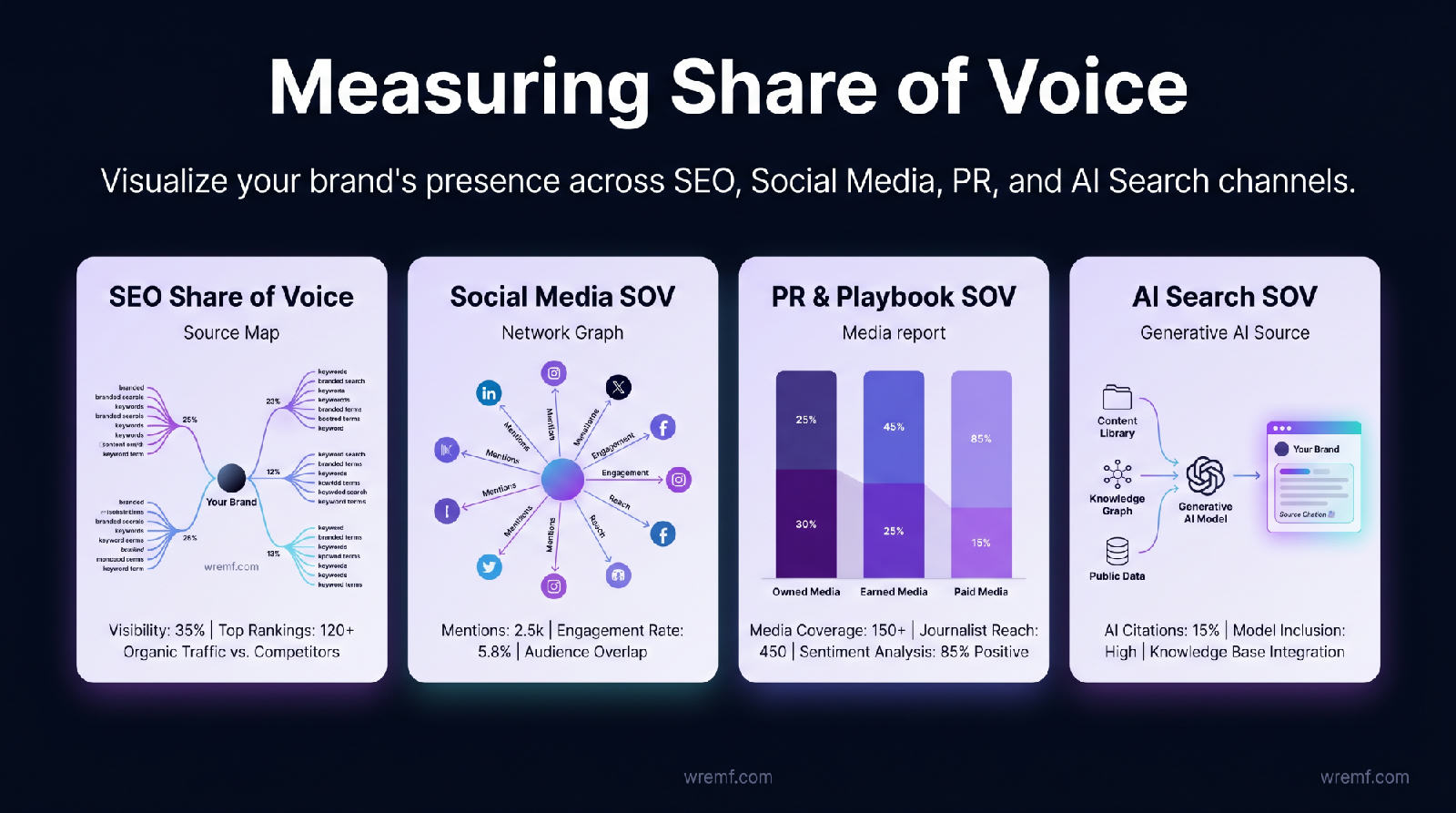
By WREMF Team · 2026-09-21
Share of voice (SOV) is the percentage of total market visibility a brand owns in a specific channel compared to its competitors. The key components include social media mentions, SEO keyword visibility, paid ad impression share, earned media mentions, and AI search citations. Calculating SOV requires different metrics and tools for each channel. Brands need to measure SOV independently for each channel to understand their market position. A higher SOV often correlates with market growth, particularly when exceeding the existing market share, a concept known as excess SOV (ESOV).
Key takeaways
- Share of voice reflects brand visibility percentage by channel and requires separate calculations per channel.
- Achieving excess share of voice (ESOV) can predict long-term market share growth.
- AI-generated answers now constitute a unique share of voice surface requiring specialized tracking tools.
- Defining an accurate competitive set and measurement period is crucial for valid SOV calculations.
- Paid advertising SOV is directly reported by platforms like Google Ads as impression share.
How to Measure Share of Voice Across SEO, Social, PR, and AI Search

Share of voice is the percentage of total market visibility your brand owns across a specific channel, compared to all relevant competitors. It is one of the most direct ways to understand whether your brand is growing, losing ground, or maintaining position in a competitive market. This guide is written for B2B SaaS marketers, SEO teams, PR and communications leads, agency strategists, and growth leaders who need to measure, interpret, and act on share of voice data. The sections below cover every major channel, including organic search, paid advertising, social media, earned media, and AI-generated answers. You will also find practical formulas, tool comparisons, measurement workflows, and guidance on how AI search is creating a new share of voice frontier that traditional tools cannot yet track. WREMF addresses that gap directly.
QUICK ANSWER:
Share of voice is measured by dividing your brand's metric in a given channel by the total combined metric across all competitors in that channel, then multiplying by 100. For social media, the metric is brand mentions. For SEO, it is keyword visibility. For paid advertising, it is impression share. For earned media, it is media mentions. For AI search, it is citation frequency across AI-generated answers. Each channel requires a different measurement method and different tools.
KEY TAKEAWAYS:
- Share of voice measures your brand's proportion of total market visibility in a specific channel and must be calculated separately for each channel.
- The basic formula is your brand metric divided by the total market metric, multiplied by 100, applied consistently across social, SEO, PR, paid, and AI channels.
- Sentiment analysis, engagement rate, and source quality must be layered on top of raw mention counts to give share of voice meaningful context.
- AI-generated answers from ChatGPT, Gemini, Perplexity, Claude, and Google AI Overviews now represent a distinct share of voice surface that standard social listening tools and SEO platforms do not measure.
- WREMF tracks AI share of voice across 10 AI engines, including citation frequency, prompt-level reporting, and competitor visibility inside AI-generated answers.
- Excess share of voice, also known as ESOV, predicts long-term market share growth when your SOV consistently exceeds your current share of market.
What Share of Voice Actually Measures
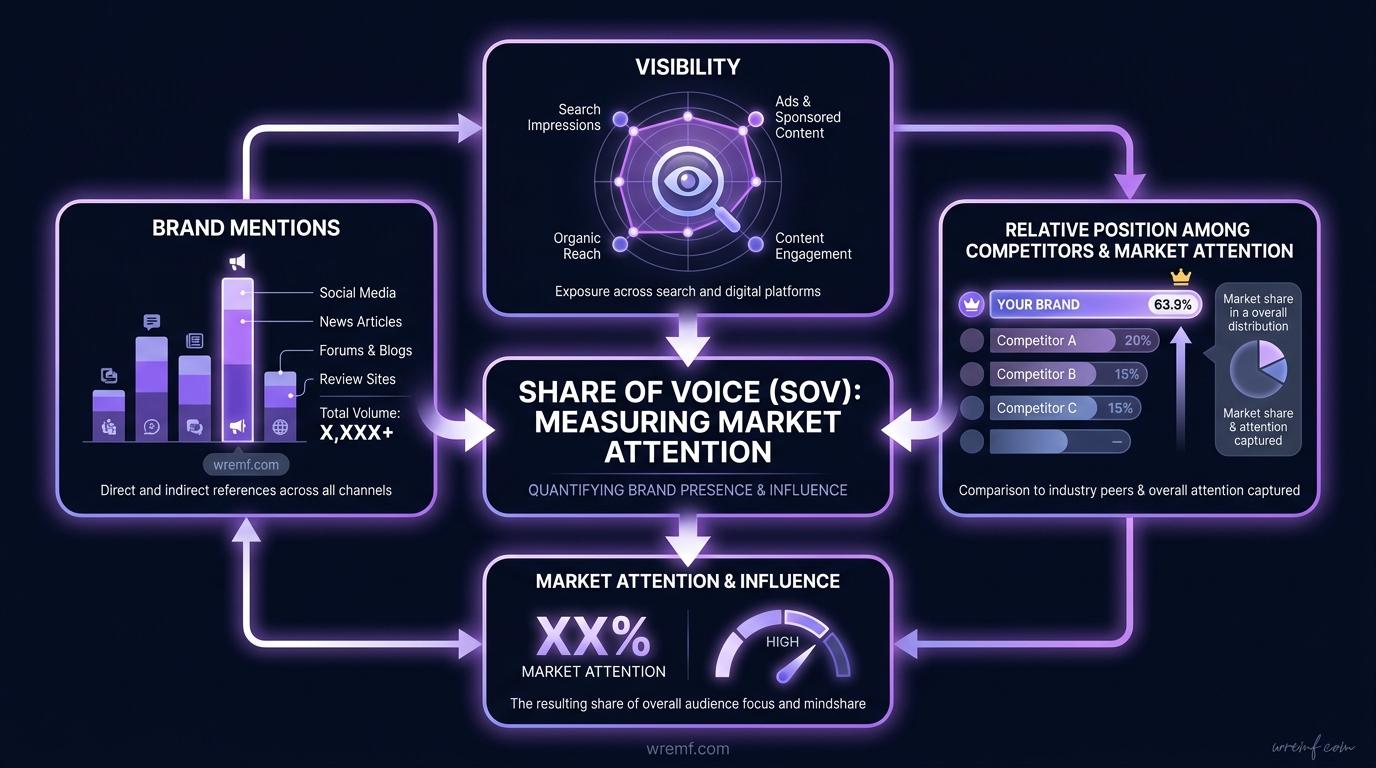
Share of voice measures the fraction of total market attention your brand captures in a given channel during a defined period. It does not measure absolute size or quality in isolation. It measures relative position among the brands your audience is aware of, engaging with, or encountering across their research and buying journey.
The reason share of voice matters to B2B marketers, agencies, and Business Leaders is that market attention correlates with market share over time. Research from the advertising and brand measurement community consistently supports the principle that brands with a higher share of voice than their share of market tend to grow. This relationship is known as excess share of voice, or ESOV. When your SOV exceeds your Share of Market, you are investing more in visibility than your current position justifies, which tends to generate growth over time. When your SOV falls below your share of market, you are likely to lose ground.
Share of voice is channel-specific. A brand can own a dominant social media share of voice while losing badly on SEO share of voice. A brand can appear in every media mention while being invisible in paid advertising or in AI-generated answers. This means share of voice is never a single number. It is a set of numbers, one per channel, that together describe where your brand is winning attention and where it is not.
The most common channels for SOV measurement include social media, organic search, paid search, earned media and PR, and, increasingly, AI search and answer engines. Each channel has its own metric and its own measurement tools.
Share of voice also differs from market share, though the two are connected. Market share is the percentage of sales or revenue a brand captures in its category. Share of voice is the percentage of category attention the brand captures before and during the purchase decision. You can have a high share of voice and a low market share, which often describes a challenger brand investing aggressively in visibility ahead of commercial returns.
KEY TAKEAWAY: Share of voice measures relative market visibility by channel, not absolute reach, and must be calculated separately for every channel your brand competes in.
The Core Share of Voice Formula and How to Apply It
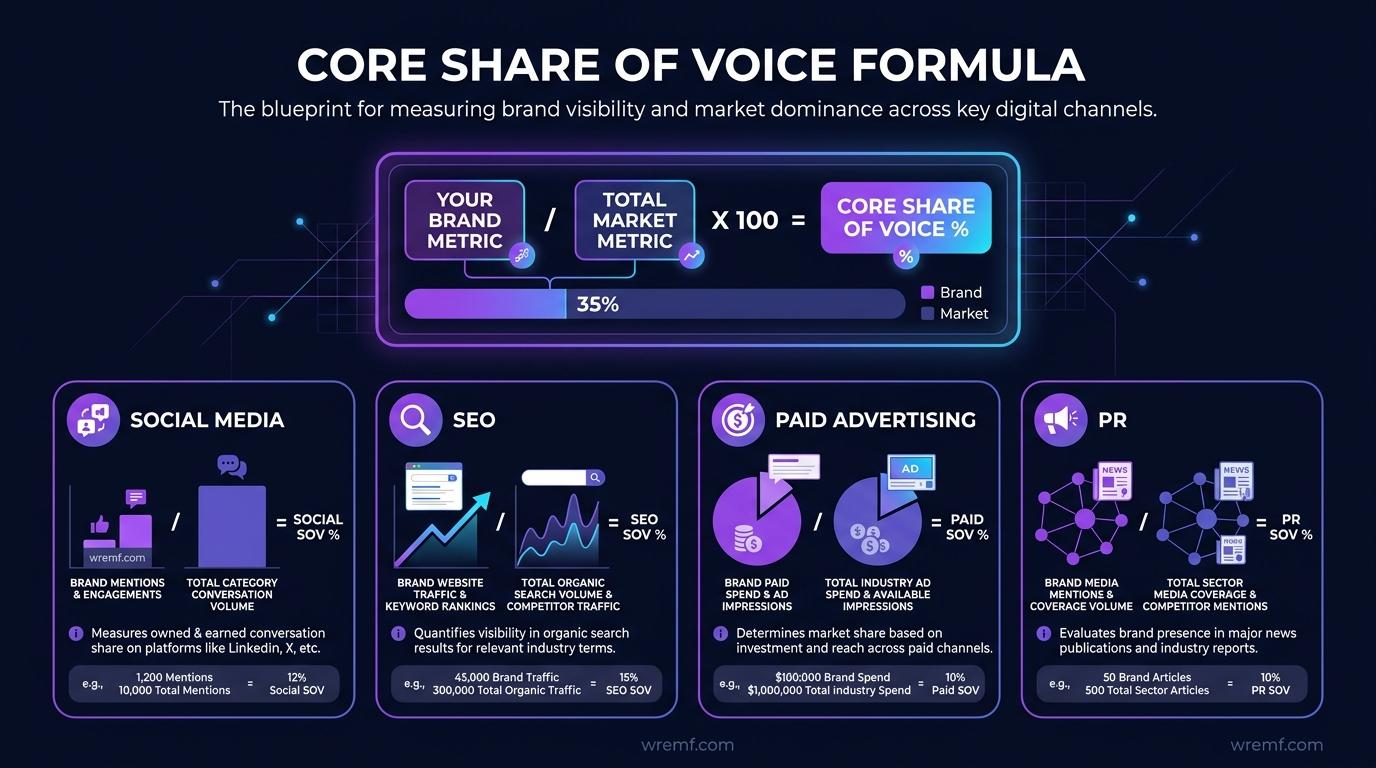
The share of voice formula is the same across every channel, even though the input metric changes depending on where you are measuring. The formula is: your brand metric divided by the total market metric, multiplied by 100. The result is a percentage.
In practice, the formula works like this. If your brand received 500 media mentions in a month and your four competitors received 300, 100, 50, and 50 mentions respectively, the total market coverage is 1,000. Your SOV equals 500 divided by 1,000, multiplied by 100, which equals 50 percent. This means your brand had half of the total media visibility in that space for that period.
The same logic applies to every channel. For SEO share of voice, you compare your keyword visibility score to the combined keyword visibility of all tracked competitors. For paid advertising, you compare your impression share in Google Ads to the total impression shares of all competitors in the same auction. For social media share of voice, you compare your brand mentions to the total brand mentions across all competitors. For earned media, you compare your media mentions to the total across all market players.
The critical variable in every share of voice calculation is defining your competitive set accurately. If you include too few competitors, your SOV percentage will be artificially high. If you include too many, including brands your audience does not actually consider, your SOV will appear artificially low. The right competitive set reflects the actual brands competing for your target audience's attention in that specific channel.
The measurement period also matters. SOV measured over a single week is not comparable to SOV measured over a quarter. Seasonal businesses, product launches, campaigns, and PR moments create short-term spikes that look very different from longer-term trends. The most useful share of voice data is collected consistently over time and compared against the same period in prior months or years.
Here is how to apply the formula across the four main channels.
Social Media SOV
Your brand mentions divided by total mentions across all tracked competitors, multiplied by 100. For example, if your brand gets 2,000 social mentions in a month and the total across your brand and three competitors is 10,000, your social media share of voice is 20 percent.
SEO SOV
Your keyword visibility score divided by total keyword visibility across all tracked competitors, multiplied by 100. SEO share of voice tools such as Semrush calculate this automatically using position tracking and impression data across a defined keyword set.
Paid Advertising SOV
Your impression share in the ad auction divided by the total available impressions, multiplied by 100. Google Ads reports impression share natively, making this the easiest channel to measure without third-party tools.
Earned Media SOV
Your media mentions divided by total media mentions across the competitive set, multiplied by 100. Media monitoring platforms such as Prowly, Meltwater, Cision, and Brandwatch track this across online news, blogs, and traditional media.
AI Search SOV
Your citation frequency across AI-generated answers divided by the total citations across all competitors in those same answers, multiplied by 100. This channel requires dedicated AI visibility tracking tools because standard SEO and social listening tools do not crawl or index AI answers.
KEY TAKEAWAY: The share of voice formula is consistent across every channel, but the input metric and the tools required are different for each channel, and defining the right competitive set is critical for accuracy.
How to Measure SEO Share of Voice
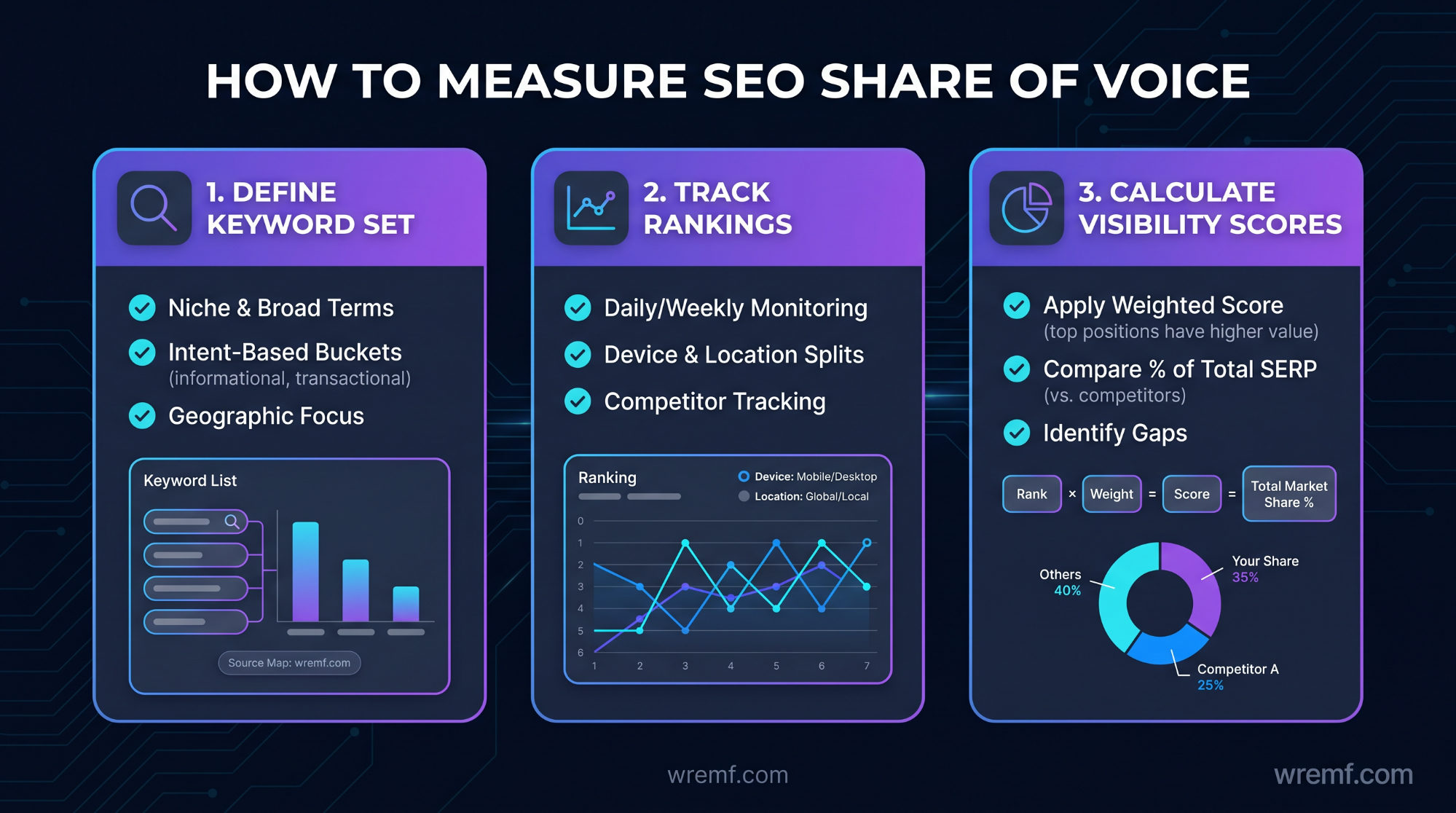
SEO share of voice measures how visible your brand is in organic search results across a defined set of keywords compared to your competitors. It is distinct from raw keyword rankings because a single keyword ranking does not represent your overall organic presence. SEO SOV aggregates your visibility across every keyword in your tracked set, weighted by search volume and position.
To measure SEO share of voice accurately, you need a defined keyword set that reflects the topics your target audience searches for, a position tracking tool that monitors rankings for those keywords across your brand and your competitors, and a method for calculating visibility scores that accounts for both rank position and search volume.
Semrush is one of the most widely used platforms for measuring SEO share of voice. Its Position Tracking tool calculates a visibility score for every tracked domain across your keyword set. The SEO share of voice metric in Semrush shows what percentage of all clicks for your tracked keywords go to your domain compared to competitors. This is impression-based SOV weighted by expected click-through rates at each ranking position.
To set up SEO share of voice tracking in Semrush, start by defining your keyword set using the keyword research tool. Include the keywords your competitors rank for that you do not, as well as your own priority terms. Add all relevant competitors to your Position Tracking campaign. Monitor changes over time rather than treating a single snapshot as meaningful. Use Keyword Tags to segment your keyword set by topic cluster, product area, or campaign so you can measure SEO share of voice at a granular level rather than only at the aggregate.
Google Search Console provides organic traffic and impression data at the keyword level, but it only shows your own site's data. You cannot see competitor data in Search Console directly. Pairing Google Search Console with a competitive position tracking tool gives you the combination of first-party impression data and competitive context needed for a complete picture.
For local search, share of voice extends to local map results. Tracking local visibility requires tools that monitor rankings across local map packs in addition to standard SERP positions. Your target search engine for local SOV measurement should match where your customers actually search, which for most markets means Google.
One important caveat: SEO share of voice only measures organic traffic from traditional search engine results pages, or SERPS. It does not measure visibility in AI Overviews, Google AI Mode, or other AI-generated answers within Google Search. These surfaces require separate tracking, which is covered in the AI search section below.
DID YOU KNOW:
Google's AI Overviews documentation confirms that AI Overviews apply a separate classification from standard organic sessions, meaning your organic share of voice metrics do not capture AI Overview visibility.
KEY TAKEAWAY: SEO share of voice requires position tracking across a defined keyword set for both your brand and competitors, and it must be measured separately from AI search visibility because standard SERP rankings do not reflect AI Overview or AI-generated answer presence.
How to Measure Social Media Share of Voice
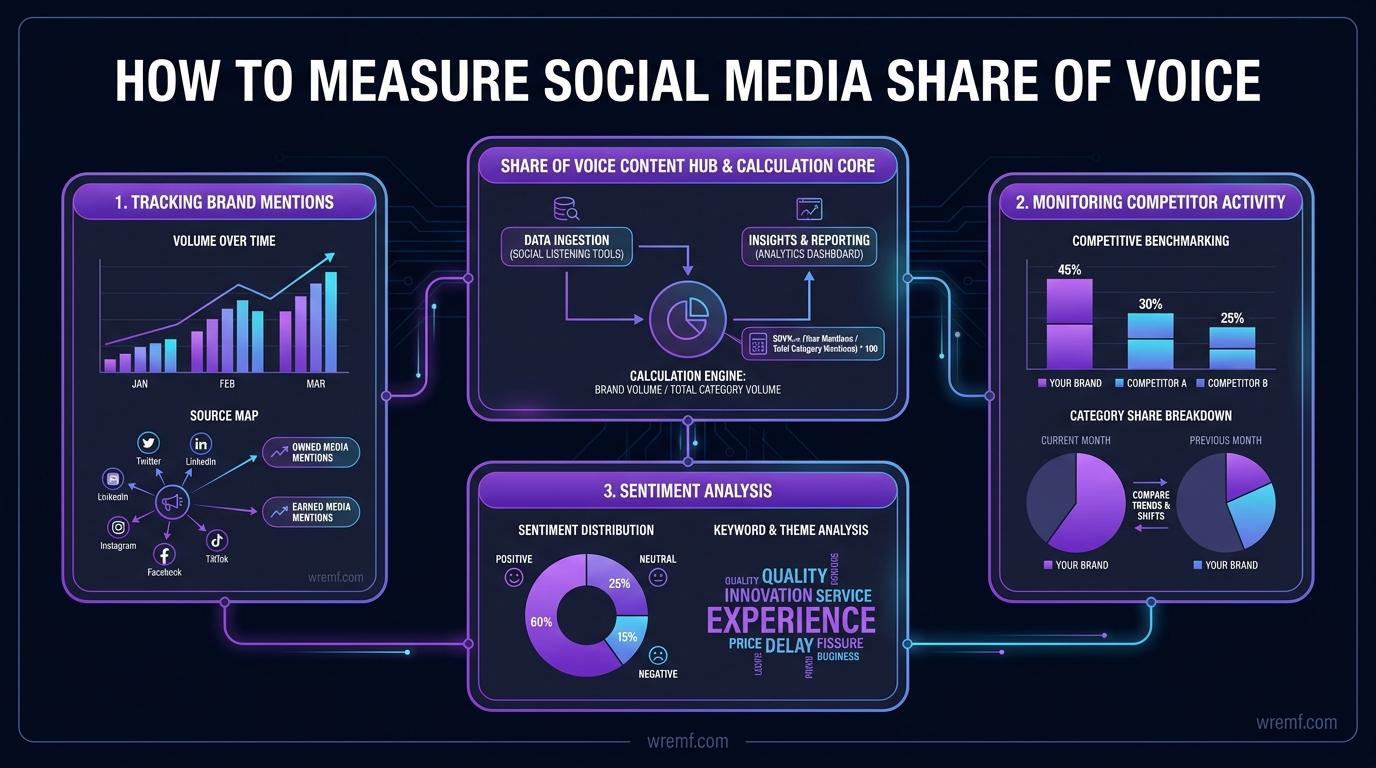
Social media share of voice measures the percentage of total brand mentions, hashtags, and social conversations your brand owns compared to competitors across social platforms. It is one of the most commonly tracked share of voice metrics because social data is relatively accessible and updates in near real time.
To measure social media share of voice, you need a social listening tool that monitors mentions of your brand and your competitors across relevant platforms including X, LinkedIn, Instagram, Facebook, YouTube, Reddit, discussion forums, and other social channels. The raw mention count is then divided by the total mentions across all tracked brands in your competitive set to produce a percentage.
For example, if your brand gets 2,000 social mentions over a month and the total across your brand and three competitors is 10,000, your social media share of voice is 20 percent.
Social listening tools used for this measurement include Brandwatch, Sprout Social, Hootsuite, Talkwalker, Meltwater, Awario, and YouScan. Each platform has different coverage breadth, data update frequency, and filtering capabilities. Awario is able to automatically measure SOV for three brands, with that number expanding to 15 brands on higher tiers. Talkwalker and Brandwatch provide more enterprise-grade coverage with visual insights, audio recognition, and AI-powered coverage filtering for complex brand monitoring needs.
Raw mention volume alone does not make social media share of voice a reliable indicator of brand health. Sentiment analysis is essential. A spike in mentions driven by a product complaint or a PR crisis increases your SOV numerically while damaging your brand reputation. Always layer sentiment analysis on top of your raw SOV numbers to understand whether your share of voice represents positive feedback, neutral discussion, or negative customer sentiment.
Engagement rate is a second important layer. A brand with fewer mentions but consistently high engagement rates across social media metrics may have a more loyal and responsive audience than a brand with higher mention volume but low interaction. Audience insights from social listening tools help identify which customer segments are generating mentions, whether those segments match your target audience, and what content or topics are driving conversation.
Social mentions can also extend beyond direct brand references to include influencer marketing activity, employee advocacy, and brand promotion by partners or customers. Tracking these extended mention categories gives a more complete picture of your social share of voice in markets where influencers and communities play a significant role in purchase decisions.
Social media share of voice is typically a leading indicator for brand awareness and consideration rather than a direct driver of conversion rate or revenue. Use it alongside other metrics such as website traffic, engagement rate, and CRM data to build a more complete view of your brand's market position.
KEY TAKEAWAY: Social media share of voice requires sentiment analysis and engagement rate context alongside raw mention counts, because a high volume of negative mentions can increase your SOV percentage while actively damaging your brand equity.
How to Measure Paid Advertising Share of Voice
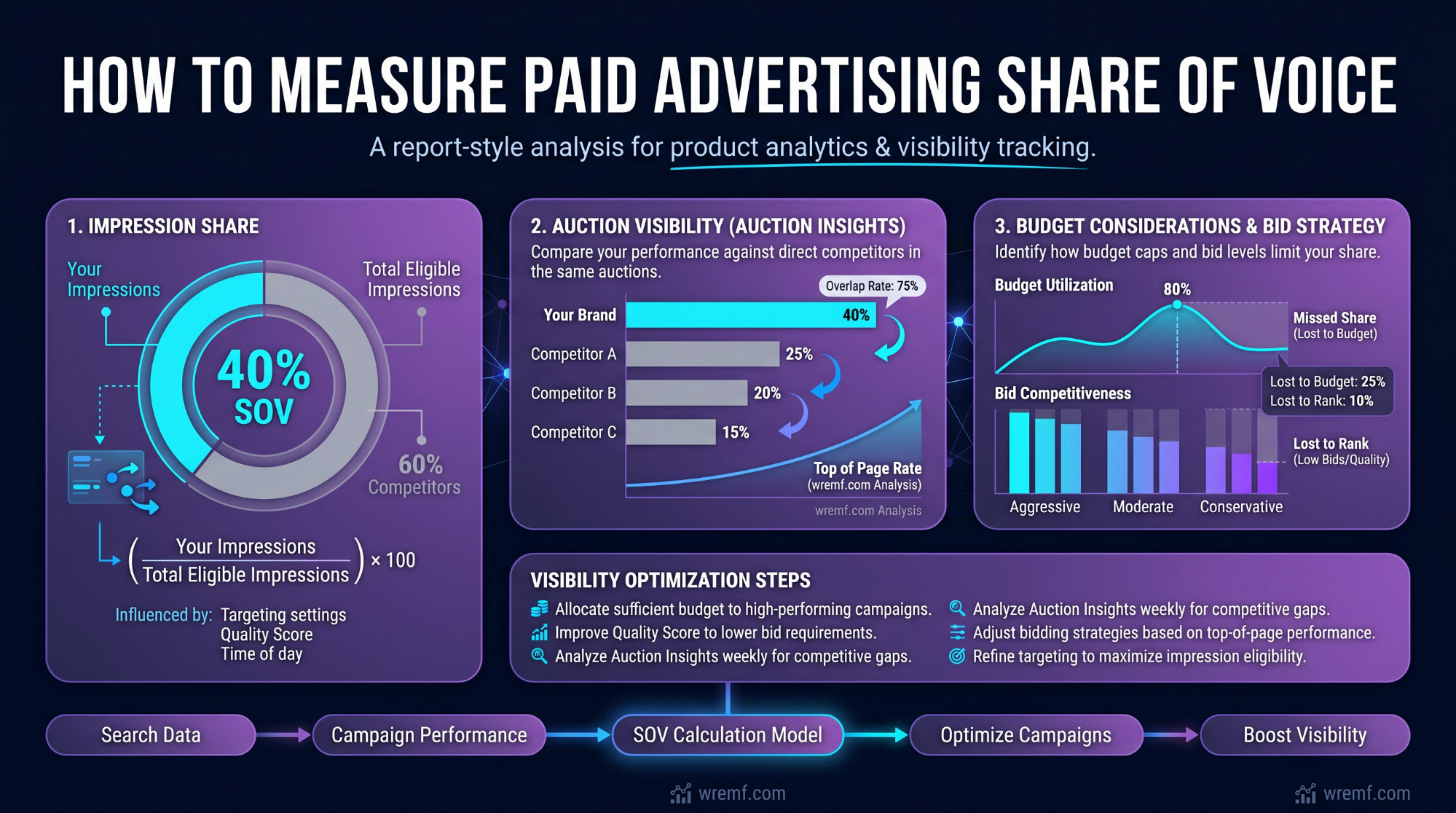
Paid advertising share of voice, often called PPC share of voice or impression share, measures how often your ads appear compared to the total number of times they could appear for the keywords or audiences you are targeting. It is one of the most precisely measurable forms of share of voice because ad platforms report it directly.
In Google Ads, impression share is available as a native metric in your campaign dashboard. It shows the percentage of total available impressions your ads received in a given period. If your impression share is 45 percent, your ads appeared in 45 percent of all eligible auctions. The remaining 55 percent went to competitors or was lost to budget constraints or quality score issues.
Google Ads also reports lost impression share due to budget and lost impression share due to rank, which tells you whether your visibility gap is caused by insufficient media spend, poor ad quality, or both. This distinction matters for campaign optimisation decisions.
Beyond Google Ads, paid advertising share of voice can be measured across display advertising, programmatic channels, and social paid campaigns. For display and programmatic, viewability and view-through rates are relevant additional metrics. An ad that served but was never in view does not contribute meaningfully to brand awareness or share of voice in a practical sense, even if it counts as an impression.
For social media paid campaigns, platforms like Meta, LinkedIn, and others provide reach and frequency data rather than direct impression share. You can calculate an approximate SOV by comparing your estimated reach to your estimated total available audience in a given segment, though this requires combining platform data with market research estimates.
Media planning and media spend decisions are directly connected to paid advertising share of voice. Increasing your media spending in a specific channel will typically increase your impression share, provided your quality score and targeting are competitive. Media channels where your competitors are heavily invested may require proportionally higher investment to achieve meaningful impression-based SOV gains.
Tracking paid advertising share of voice as part of your overall campaign performance reporting helps connect advertising campaigns to broader market position goals, not just click-through rate or conversion rate within the platform.
KEY TAKEAWAY: Paid advertising share of voice is measured using impression share data from ad platforms like Google Ads, and the lost impression share breakdowns reveal whether visibility gaps are driven by media spend, quality issues, or competitive pressure.
How to Measure Earned Media and PR Share of Voice
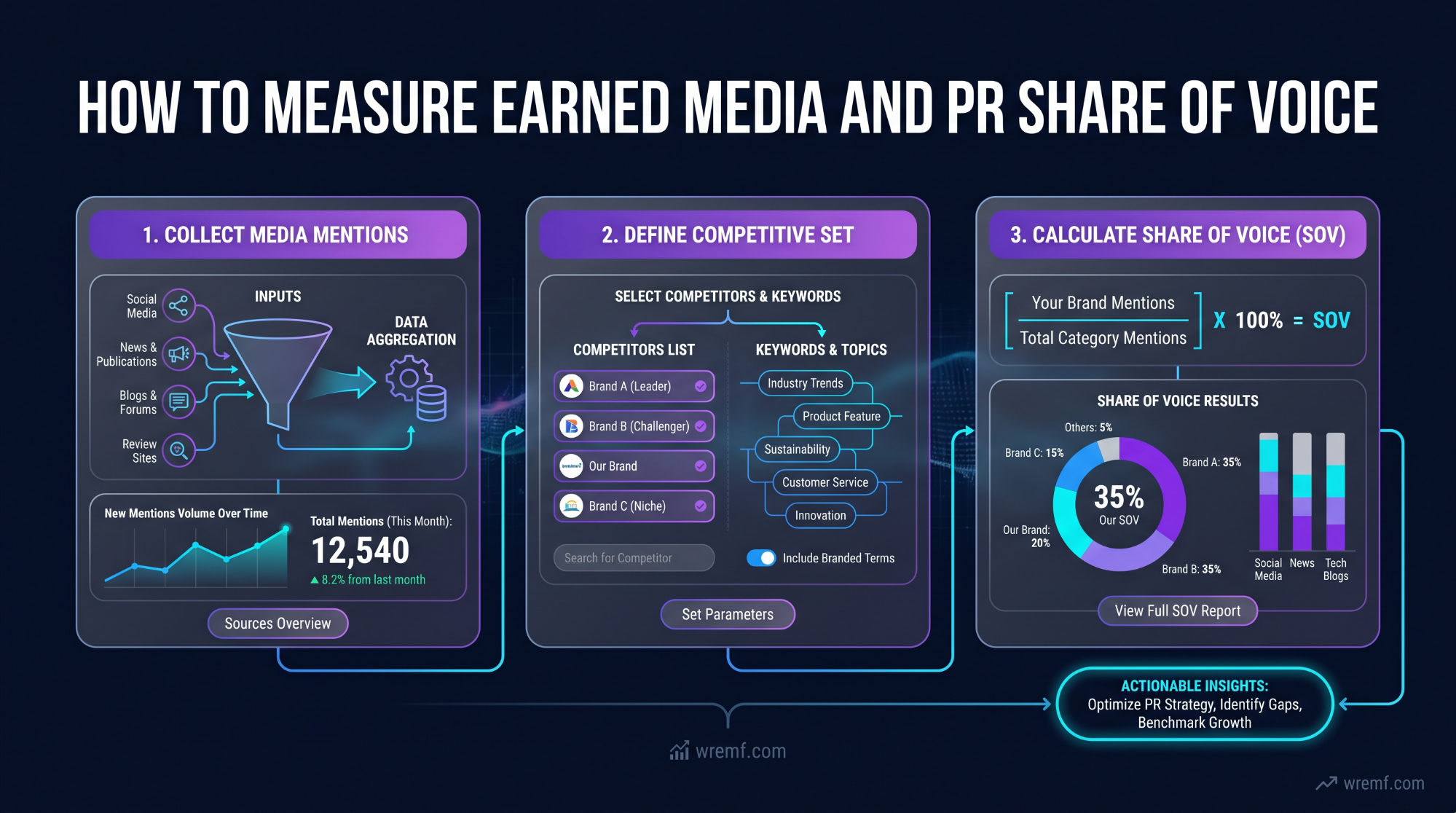
Earned media share of voice measures the percentage of total media coverage in your category that mentions your brand compared to all tracked competitors. It covers mentions across online news, blogs, trade publications, print media, traditional media, and broadcast, depending on the monitoring scope of the tool you use.
To calculate earned media SOV, you collect the total number of media mentions for your brand and for every competitor in your defined competitive set over the same time period. You then divide your brand's mention count by the total and multiply by 100. A brand with 500 mentions out of a total of 1,000 across all tracked competitors has a media share of voice of 50 percent.
Media monitoring platforms used to collect this data include Prowly, Meltwater, Cision, Brandwatch, Trendkite, and Hootsuite. Prowly is positioned as a strong overall option for PR measurement teams who want clear reporting graphs and share of voice analytics that compare brand performance to competitors in real time. Cision and Meltwater offer broader enterprise coverage including broadcast and print. Trendkite specialises in analytics for PR marketing teams who need to connect media coverage to business outcomes.
A media database is an important component of any earned media monitoring setup. PR software platforms like Prowly include access to large media databases, with Prowly's database covering over one million journalists and outlets. This allows PR teams to identify which Media Outlets and journalists are driving the most coverage for your competitors and where there are content gaps in your own coverage strategy.
AI-powered coverage filtering is an increasingly important feature in modern media monitoring tools. Not every brand mention represents a valuable media placement. AI-powered filtering identifies whether a mention appears in a high-authority publication, a niche blog, or an aggregator with minimal reach. This distinction matters for PR success measurement because earned media quality affects how much each mention contributes to brand building and brand reputation.
Sentiment analysis is equally important in earned media SOV. A competitor receiving twice as many media mentions may actually be receiving predominantly negative coverage, which weakens rather than strengthens their market position. PR teams that track sentiment alongside volume have a more accurate picture of how media coverage is contributing to brand equity versus simply inflating mention counts.
For reporting purposes, share of voice analytics should be visualised alongside sentiment trends, publication authority scores, and topic distribution. This gives Business Leaders and agencies a complete view of Earned Media performance rather than a single percentage figure.
TIP:
When comparing earned media SOV across competitors, segment coverage by media type, including online news, print, broadcast, blogs, and trade media, to see which channels each brand is winning and which channels represent an opportunity for your PR strategy.
KEY TAKEAWAY: Earned media share of voice must be combined with sentiment analysis, source quality assessment, and media type segmentation to give PR measurement teams a meaningful view of brand performance rather than raw mention volume alone.
How to Measure AI Search Share of Voice
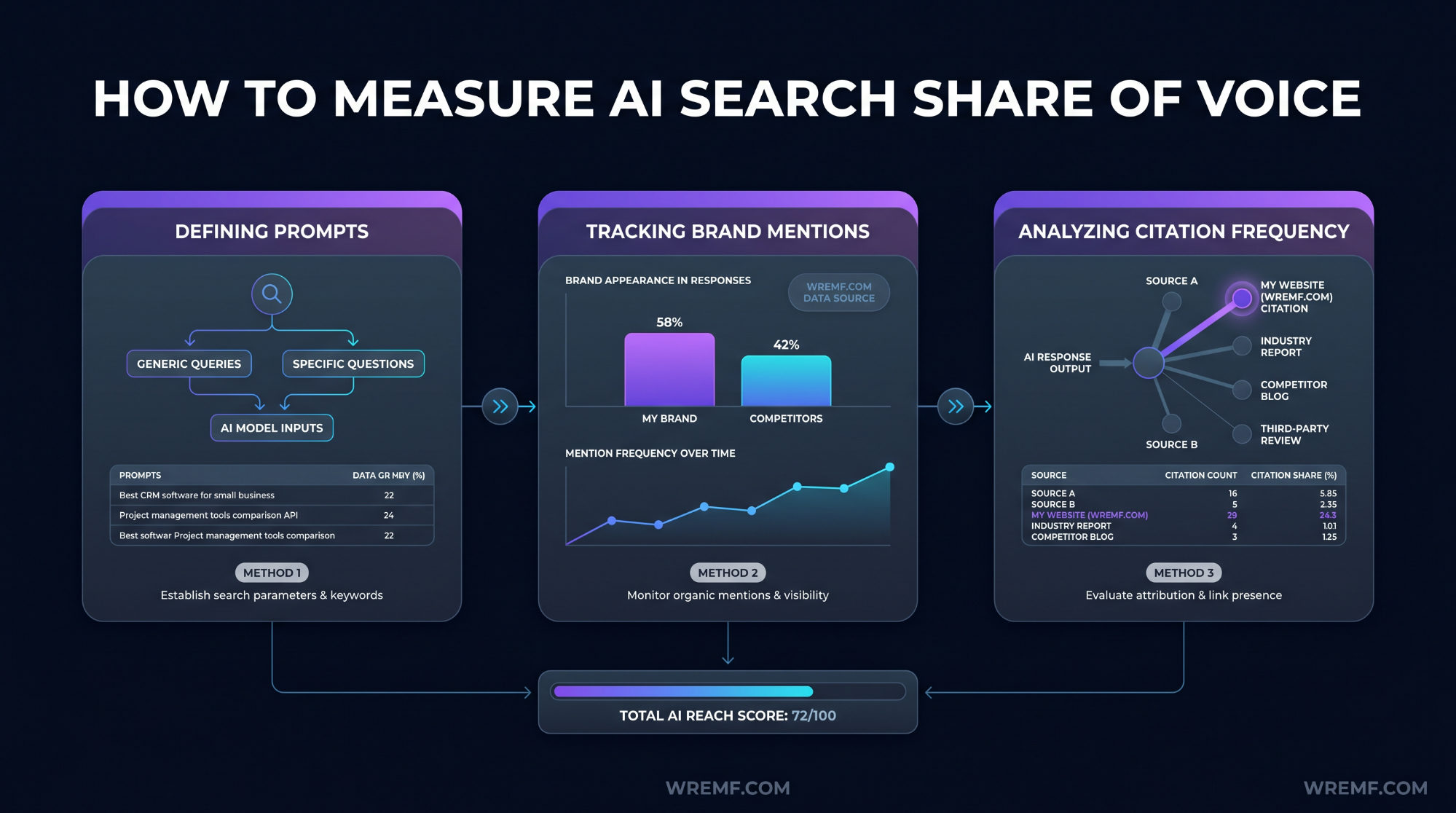
AI search share of voice is the percentage of relevant AI-generated answers across platforms like ChatGPT, Gemini, Perplexity, Claude, Google AI Overviews, Copilot, DeepSeek, Grok, Meta AI, and Mistral that mention, cite, recommend, or compare your brand relative to competitors. It is an emerging but increasingly important metric because buyers increasingly use answer engines to research and shortlist vendors before visiting websites.
AI search share of voice is categorically different from all other share of voice measurements because AI engines do not produce rankings, impression counts, or mention volumes in the way that search engines and social platforms do. An AI engine produces a generated response to a specific prompt. Whether your brand appears in that response, how it is described, which sources it cites, and whether it compares your brand favourably against competitors are all distinct data points that require dedicated tracking.
Standard social listening tools do not monitor AI-generated answers. SEO platforms do not track whether your brand appears in a Perplexity answer or a Gemini response. Google Analytics and Google Search Console report AI referral traffic in aggregate but do not show you which prompts drove that traffic or which competitors are being cited instead of you. This gap means that the majority of B2B brands currently have no measurement of their AI search share of voice even as AI-generated answers become a standard part of the buyer research journey.
To measure AI search share of voice, you need to define the prompts your target audience is likely to use when researching your category, run those prompts systematically across multiple AI engines, extract and analyse the responses to identify which brands are mentioned, cited, and recommended, and repeat this process over time to track changes. This is called prompt tracking or prompt intelligence, and it requires either a manual research process or a dedicated AI visibility platform.
WREMF tracks AI share of voice across 10 AI engines by running defined prompts at scheduled intervals, extracting citation data, scoring brand mentions, and comparing your presence to competitors across every engine. The AI Visibility Index gives teams a consolidated visibility score that aggregates prompt-level performance across engines. Teams using the WREMF Growth plan also receive GEO audits, content brief generators, and source citation tracking that show which pages and sources are being cited by AI engines in response to relevant prompts. You can explore how this connects to broader AI search strategy through the AI search engine optimization guide
AI search SOV also connects to the concept of Citation Analysis. In AI search, citations are the primary authority signal. When an AI engine recommends a vendor, it typically cites a source. That source is usually a web page, article, review, or third-party publication. The brands that appear most consistently in AI answers tend to be the brands whose content is most frequently cited by the sources AI engines draw on. Tracking citation frequency across engines over time is the functional equivalent of tracking backlinks for traditional SEO, but with different dynamics and a different set of tools.
Prompts are the unit of measurement in AI search SOV. A single prompt asked across 10 AI engines produces 10 data points. A prompt tracking program that covers 50 to 100 prompts per week across 10 engines produces hundreds of data points per week that can be aggregated into share of voice scores, competitor gap analysis, and content strategy decisions.
AI-generated answers also vary by engine, prompt phrasing, user location, and time. This means AI search share of voice is not a fixed number. It requires ongoing scheduled monitoring rather than a one-time audit. The answer engines that dominate buyer research today, including ChatGPT and Perplexity, may produce different answers for the same prompt phrasing next month as their underlying models are updated.
For B2B brands that are beginning to invest in AI search visibility, reviewing the answer engine optimization guide | https://wremf.com/blog/answer-engine-optimization-the-complete-guide-to-aeo-ai-search-visibility-and-answer-first-content provides context on how AEO strategy connects to the citation patterns that drive AI search share of voice over time.
KEY TAKEAWAY: AI search share of voice requires prompt-level tracking across multiple AI engines over time, and it cannot be measured using traditional SEO tools, social listening platforms, or standard web analytics because AI-generated answers are not indexed or reported through those channels.
Tools for Measuring Share of Voice Across Channels
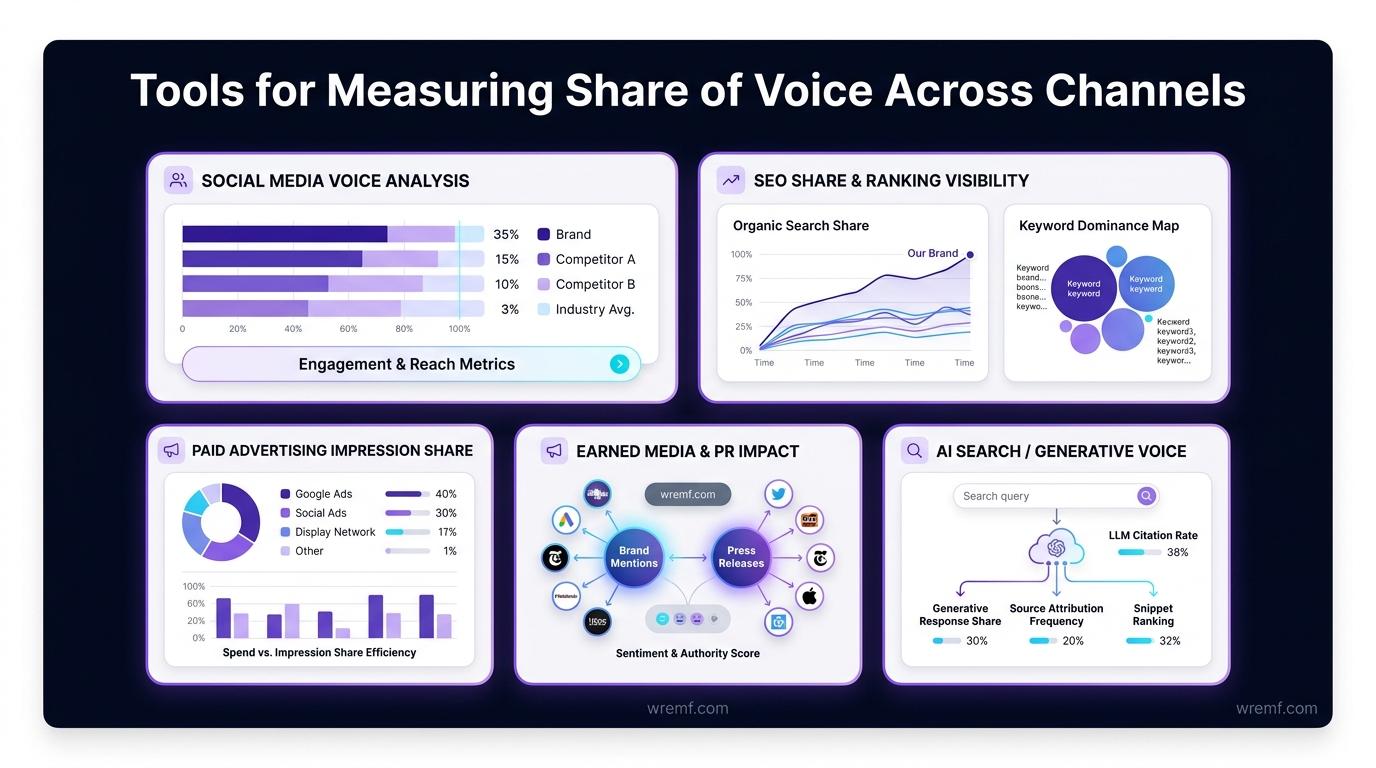
Different share of voice channels require different tools. No single platform currently measures SOV comprehensively across social media, SEO, paid advertising, earned media, and AI search simultaneously. Assembling the right tool set requires matching each channel to a platform built for that type of data.
Social Listening and Earned Media Tools
Brandwatch is a widely used enterprise social listening and media monitoring platform with strong sentiment analysis, audience insights, and visual insights capabilities. Sprout Social combines social media management with share of voice reporting, making it suitable for teams that manage publishing and measurement in the same platform. Hootsuite offers social listening integration for teams using it as their primary social management tool. Talkwalker and Meltwater provide broader enterprise monitoring coverage including traditional media, print, broadcast, and emerging channels. Cision is commonly used by PR marketing teams for media monitoring, PR measurement, and access to a comprehensive media database. Awario tracks social mentions and brand conversations with an automated SOV calculation that covers up to three brands at entry level. YouScan specialises in visual insights and image recognition for brand mentions across social platforms. Trendkite, now part of the Cision ecosystem, focuses on connecting PR coverage to business metrics including website traffic and engagement rate.
SEO Share of Voice Tools
Semrush is the most established platform for measuring SEO share of voice, with Position Tracking providing keyword visibility scores across your brand and up to a defined number of competitors. Google Search Console provides first-party impression and click data for your own site but does not show competitor data. HubSpot Marketing Hub Pro and Content Hub include some SEO performance reporting for teams using HubSpot as their primary marketing platform. Google Trends provides directional visibility data across search interest over time, which can supplement SOV analysis even though it does not calculate a share of voice percentage directly. Google Analytics connects organic traffic performance to content and campaign data, which helps contextualise SEO SOV changes against actual audience behaviour.
Paid Advertising Tools
Google Ads provides impression share natively within the campaign interface, making it the primary tool for measuring PPC share of voice. Impression shares are broken down by campaign, ad group, and keyword, with lost impression share split between budget and rank. Third-party tools like Semrush also provide competitive paid visibility data that supplements native Google Ads reporting.
AI Search Share of Voice Tools
WREMF is purpose-built for tracking AI share of voice across ChatGPT, Claude, Gemini, Perplexity, Google AI Overviews, Copilot, DeepSeek, Grok, Meta AI, Mistral, and other AI engines. Unlike social listening tools, SEO platforms, and PR monitoring software, WREMF runs structured prompts across AI engines at scheduled intervals, extracts and analyses AI-generated answers, tracks brand mentions and source citations, and calculates competitor visibility scores in AI responses.
For teams managing multiple clients, WREMF's Growth plan at EUR 149 per month supports five websites and up to 15 competitors, white-label reports, Looker Studio connector, and GA4 attribution. For enterprise brands and large agencies that need full-service AI visibility strategy and execution, the Managed plan from EUR 1,500 per month includes custom GEO strategy, AEO content optimisation, citation and entity cleanup, and senior-led execution. You can review the full options at WREMF pricing
The broader landscape of AI-specific measurement tools is covered in the AI SEO tools guide for teams evaluating their options.
KEY TAKEAWAY: Share of voice measurement requires channel-specific tools because no single platform covers social, SEO, paid, earned media, and AI search simultaneously, and AI search share of voice specifically requires a dedicated prompt tracking platform like WREMF.
Channel-Specific SOV: A Practical Comparison
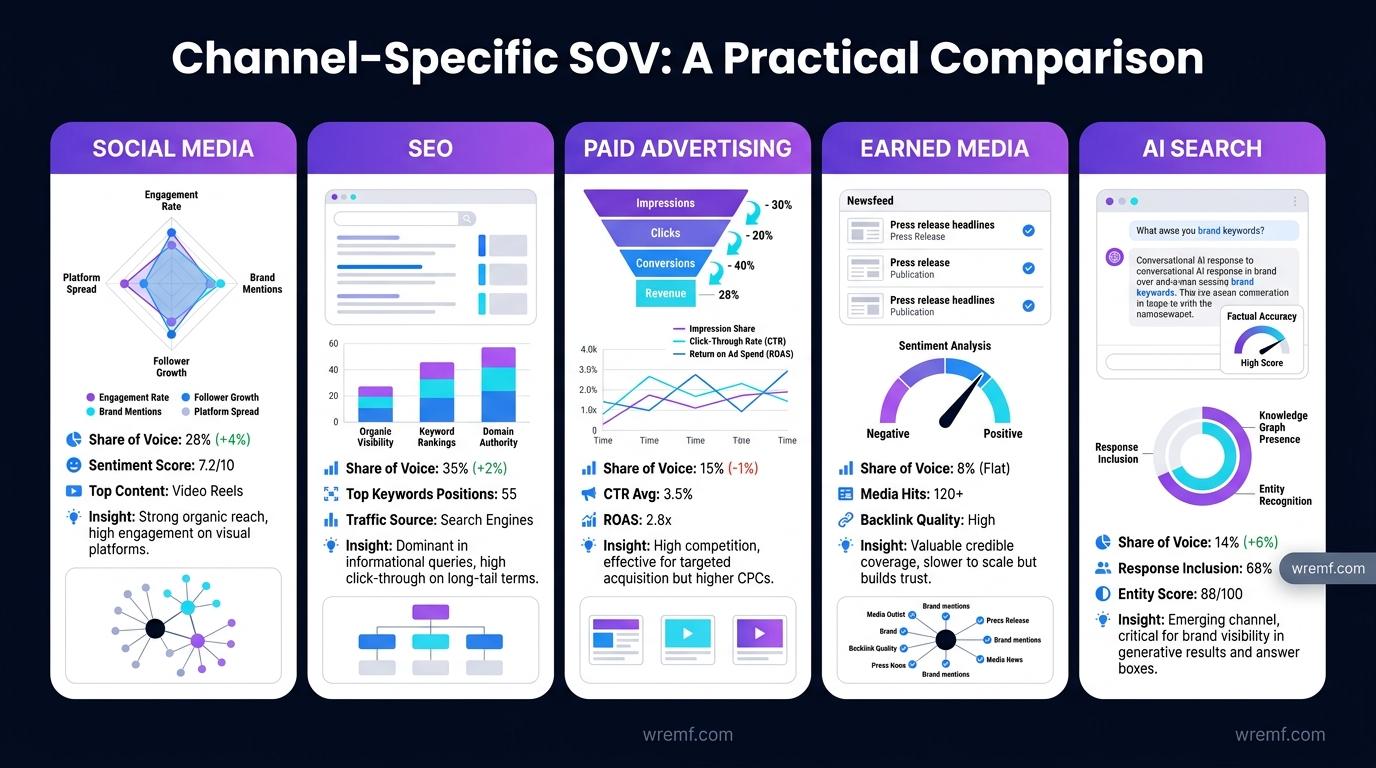
Different channels produce different SOV signals, and each signal has a different relationship to brand awareness, pipeline generation, and market share growth. Understanding the practical differences helps marketing teams, agencies, and Business Leaders allocate measurement resources and interpret SOV data correctly.
The comparison below shows how each channel differs across five dimensions relevant to marketing decision-making.
Primary metric used
- Social media SOV: Brand mentions, hashtags, social engagement
- SEO SOV: Keyword visibility score, organic traffic share
- Paid advertising SOV: Impression share, reach, frequency
- Earned media SOV: Media mentions, publication coverage
- AI search SOV: Citation frequency, brand mentions in AI-generated answers
Speed of data availability
- Social media SOV: Near real time
- SEO SOV: Weekly to monthly
- Paid advertising SOV: Daily, reported natively in ad platforms
- Earned media SOV: Daily to weekly, depending on monitoring tool
- AI search SOV: Scheduled prompt intervals, not real time
What it predicts
- Social media SOV: Brand awareness, community engagement, sentiment trends
- SEO SOV: Organic search visibility, long-term traffic share
- Paid advertising SOV: Ad auction competitiveness, budget efficiency
- Earned media SOV: PR reach, brand reputation, media influence
- AI search SOV: AI recommendation presence, citation authority, AI referral traffic
Tools required
- Social media SOV: Brandwatch, Sprout Social, Talkwalker, Hootsuite, Meltwater, YouScan, Awario
- SEO SOV: Semrush, Google Search Console, Google Analytics
- Paid advertising SOV: Google Ads, Semrush
- Earned media SOV: Prowly, Cision, Meltwater, Trendkite, Brandwatch
- AI search SOV: WREMF
Relationship to ESOV
- Social media SOV: Indirect, depends on reach quality
- SEO SOV: Strong, organic traffic share compounds over time
- Paid advertising SOV: Direct and adjustable through media spend
- Earned media SOV: Strong for brand equity, harder to scale predictably
- AI search SOV: Emerging, but citation authority compounds similarly to SEO
Traditional SEO tools remain useful for search rankings, crawlability, keyword research, backlinks, and technical SEO. WREMF adds the AI visibility layer by tracking how AI engines mention, cite, compare, and recommend brands across prompt-based discovery journeys. Teams that are investing in generative AI optimization services will find that AI search SOV data from WREMF complements rather than replaces their existing SEO and social listening stack.
KEY TAKEAWAY: Each SOV channel measures a different signal, predicts a different outcome, and requires different tools, so the most complete picture of brand visibility comes from tracking SOV across all relevant channels simultaneously and connecting those signals to pipeline and revenue metrics.
A Practical Workflow for Measuring Share of Voice
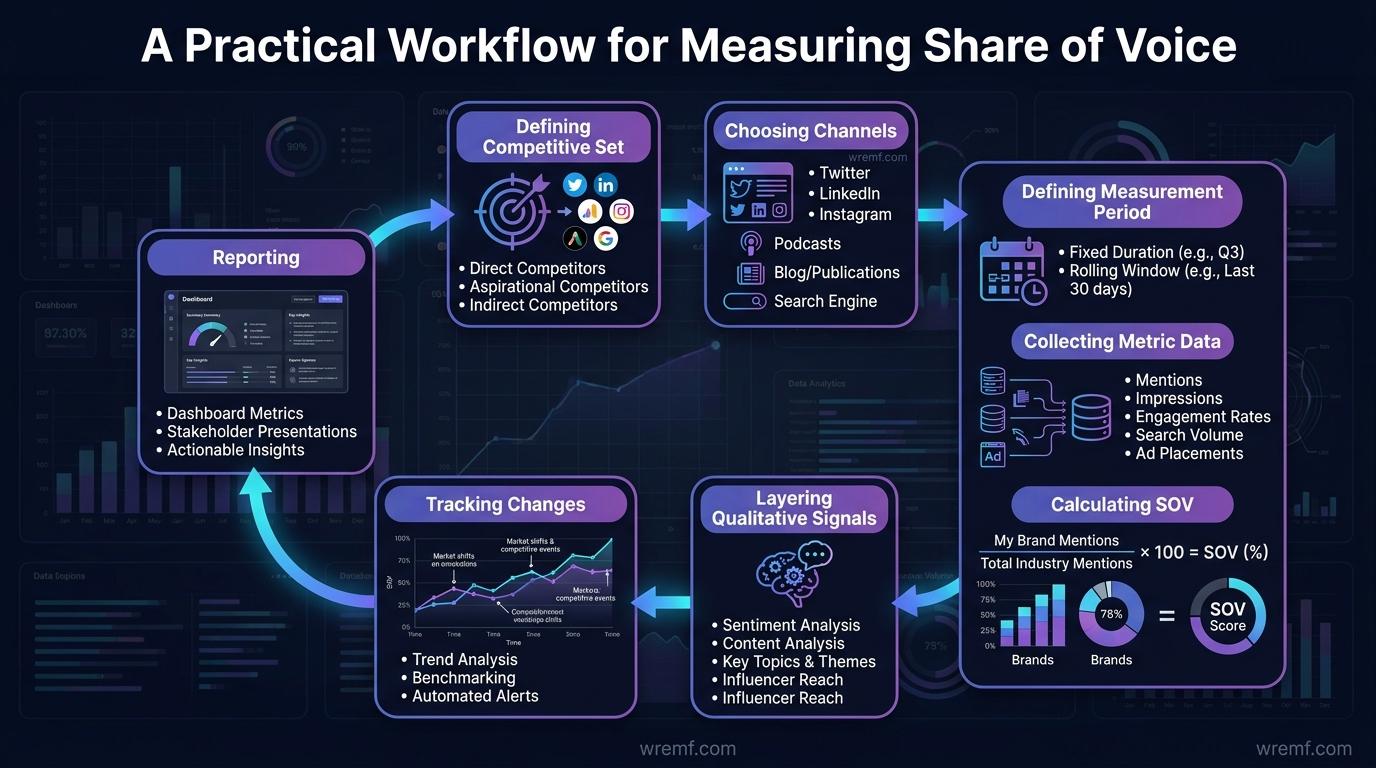
Measuring share of voice effectively requires a repeatable process. The following workflow applies across channels and can be adapted based on the tools available to your team.
Step 1: Define your competitive set
Identify the brands your target audience actively considers when researching your category. This is not the same as your full list of competitors. Focus on the three to seven brands that compete most directly for the same buyer attention in each channel. Your competitive set may differ by channel, for example a different set of competitors may appear in SEO than in social media or earned media.
Step 2: Choose the channels you will measure
Select the channels where your brand and your competitors are actively investing. Measuring SEO share of voice for a brand with no organic content strategy produces data with no actionable context. Prioritise the channels where you have existing visibility data and where your target audience spends research time.
Step 3: Define your measurement period
Decide whether you will measure SOV weekly, monthly, or quarterly. Monthly measurement is practical for most teams. Quarterly measurement is useful for reporting to Business Leaders and for connecting SOV trends to campaign cycles. Weekly measurement is most useful for brands in fast-moving competitive environments or during active campaigns.
Step 4: Collect your metric data
Use the appropriate tool for each channel. For social media, configure your social listening tool to track mentions for every brand in your competitive set. For SEO, set up Position Tracking in Semrush or your preferred SEO platform across your full keyword set. For paid advertising, pull impression share data from Google Ads. For earned media, configure your media monitoring platform to track media mentions for every competitor. For AI search, set up prompt tracking in WREMF across your relevant category prompts.
Step 5: Calculate share of voice for each channel
Apply the formula: your brand metric divided by the total metric across all brands in your competitive set, multiplied by 100. Record the result for each channel separately. Do not aggregate across channels into a single number unless you have a weighting methodology that reflects the relative importance of each channel to your business.
Step 6: Layer in qualitative signals
Add sentiment analysis to your social and earned media SOV numbers. Add engagement rate and audience insights to your social SOV data. Add source quality and publication authority to your earned media SOV data. Add citation source analysis to your AI search SOV data. Raw percentages without qualitative context can lead to incorrect decisions.
Step 7: Track changes over time and connect to KPIs
SOV data is most valuable as a trend over time rather than as a snapshot. Record your SOV percentage for each channel at every measurement interval and compare against prior periods. Connect SOV changes to campaign activity, content strategy launches, PR campaigns, and media spend changes so you can understand what is driving shifts in your market position.
Step 8: Report and act
Create reporting graphs that show SOV trends by channel and by competitor. Share these with relevant teams, including SEO, content, PR, paid media, and leadership. Identify the channels where your SOV is declining or stagnating and use that data to prioritise investment. For AI search, use WREMF's prompt-level reporting to identify which specific topics and prompts are generating AI citations for competitors but not for your brand, and use that to inform your content brief generator and AEO strategy.
KEY TAKEAWAY: A repeatable share of voice measurement workflow requires a defined competitive set, channel-specific measurement tools, consistent measurement intervals, qualitative signal layering, and a direct connection between SOV data and content strategy, media planning, and campaign decisions.
Real-World Use Cases for Share of Voice Measurement
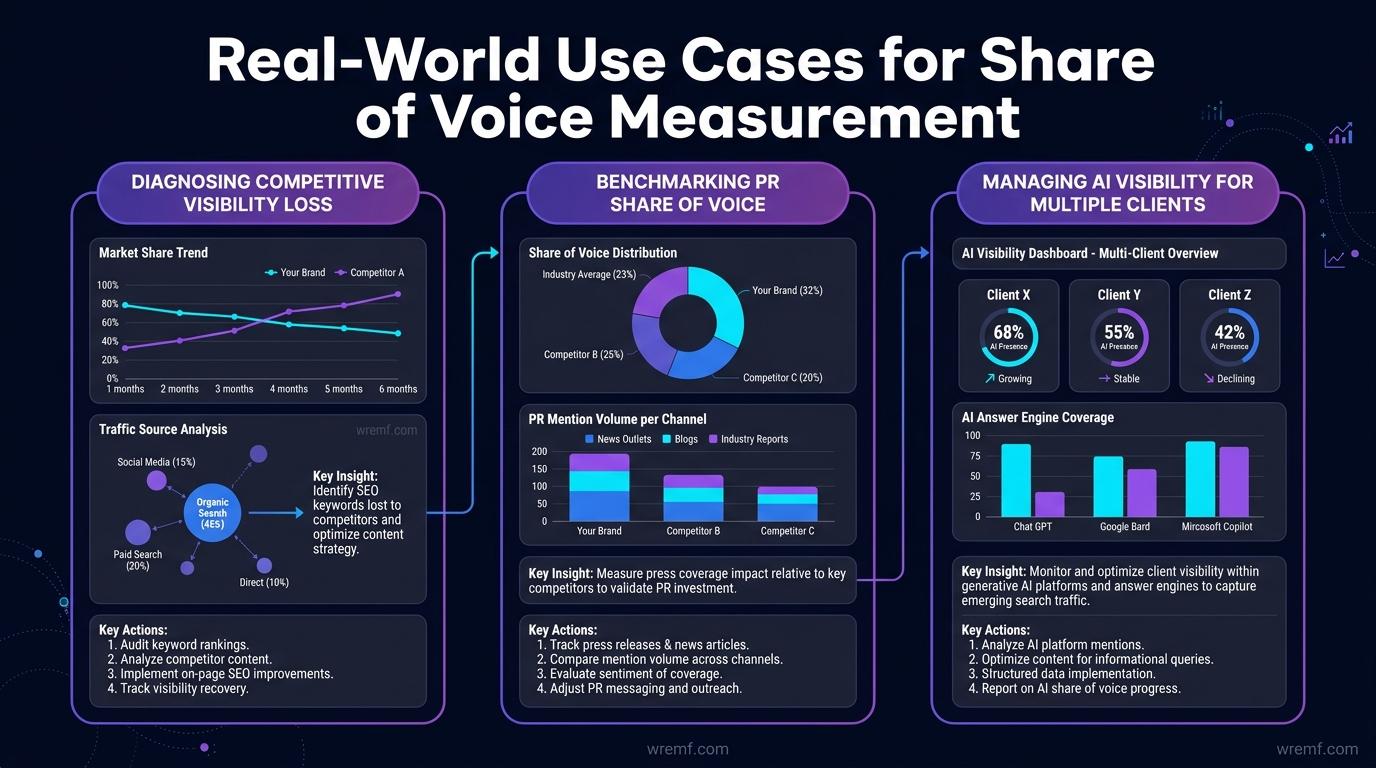
Understanding how share of voice works in practice helps teams move from theory to execution. The following scenarios illustrate how different types of organisations use SOV measurement to make better marketing and competitive decisions.
Use Case One: A B2B SaaS Brand Diagnosing Competitive Visibility Loss
A B2B SaaS company notices that organic traffic has plateaued despite continued content production. Their SEO team runs a Position Tracking campaign in Semrush across their full keyword set and discovers that their SEO share of voice has declined from 34 percent to 21 percent over six months. Three of their competitors have grown their visibility scores, with one challenger brand growing from 8 percent to 19 percent.
By analysing the keywords driving that competitor's growth, the team identifies a cluster of content gaps around topics they had not prioritised. They also run WREMF across 40 relevant prompts and discover that the same challenger brand is being cited in ChatGPT and Perplexity responses to category research questions while their brand is absent entirely. This combination of SEO SOV data and AI search SOV data from WREMF gives them a complete picture of where they are losing visibility and which content investments will have the most impact. Teams building this type of visibility program can learn more about the methodology through LLM SEO services guide
Use Case Two: A Furniture Retailer Benchmarking PR Share of Voice
A furniture retailer wants to understand how their media coverage compares to competitors including Sleep Number, Rooms to Go, and Wayfair. They configure Prowly to track media mentions across online news, blogs, and print for all four brands over a 90-day period. The resulting SOV analysis reveals that Wayfair owns 41 percent of total earned media mentions in the category, while the client holds only 12 percent.
Digging into the data, the team discovers that Wayfair's coverage is concentrated in consumer lifestyle publications while the client's coverage skews toward trade media. This channel-specific SOV insight informs a PR strategy shift toward pitching consumer-facing Media Outlets that influence the target audience's purchase decisions. Sentiment analysis from the monitoring tool also reveals that customer sentiment in Wayfair's consumer press coverage is mixed, creating an opportunity for the client to position more strongly on product quality and customer service in their outreach.
Use Case Three: An Agency Managing AI Visibility for Multiple Clients
A digital marketing agency manages AI search visibility reporting for eight B2B SaaS clients. Each client competes in a different software category and has a different set of competitors. The agency uses WREMF on the Growth plan to track AI share of voice across all eight clients, generating white-label reports for each client that show citation frequency, competitor presence in AI-generated answers, and prompt-level performance across 10 AI engines.
When one client asks why a specific competitor keeps appearing in Perplexity and Gemini answers for high-intent research prompts, the agency uses WREMF's source citation tracking to identify which third-party sources those AI engines are drawing on. They discover the competitor is cited heavily in two industry review sites and one analyst publication. The agency builds a targeted outreach plan to earn coverage on those same sources, creating a citation strategy informed directly by AI search SOV data. For agencies building this type of service offering, the AI SEO agency guide provides useful framing on how to position and structure AI visibility services for clients.
KEY TAKEAWAY: Share of voice use cases demonstrate that the most valuable insights come from combining channel-specific SOV data with qualitative analysis, competitive source research, and content strategy decisions that address the specific gaps the data reveals.
Limitations and Risks When Measuring Share of Voice
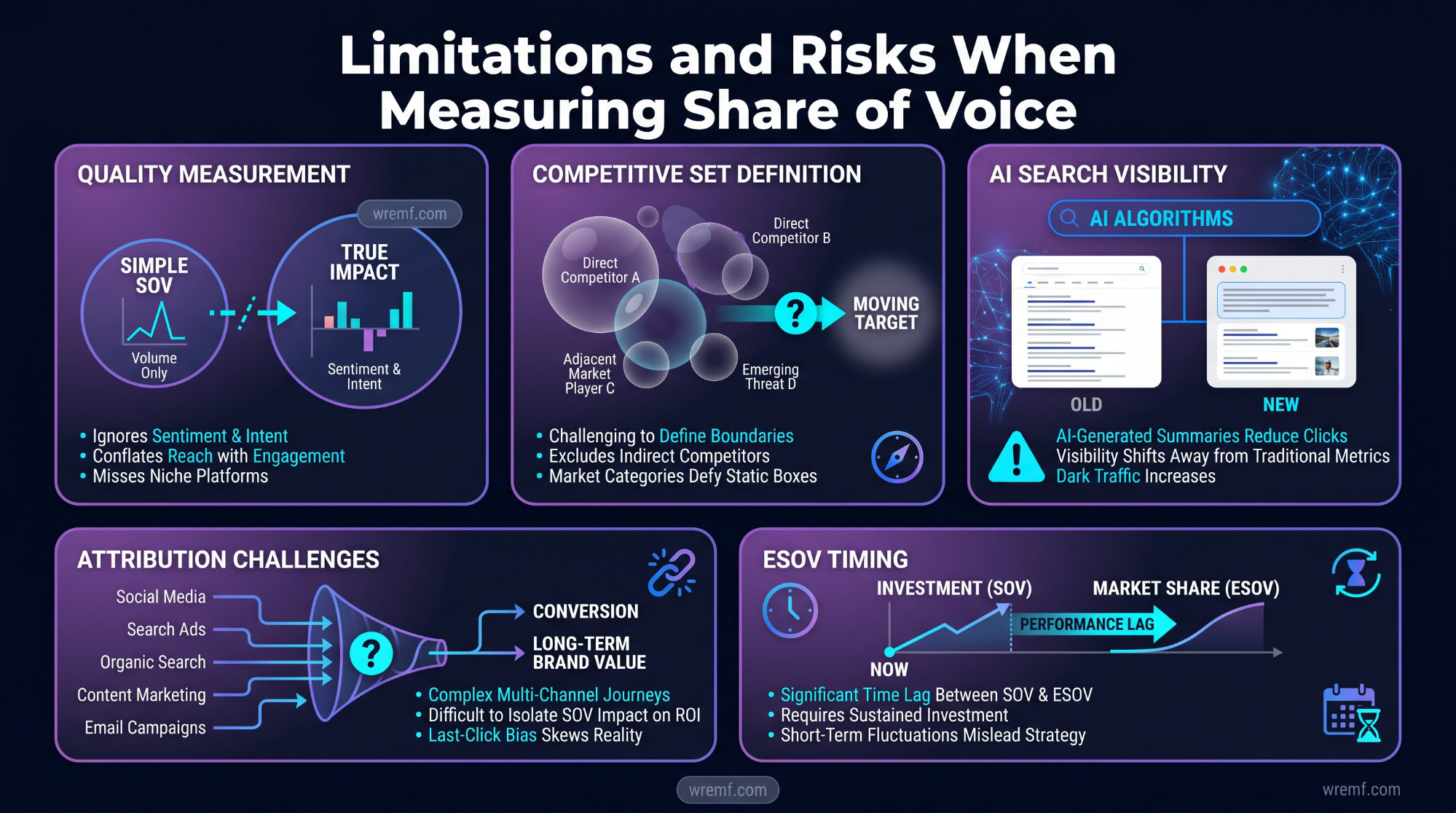
Share of voice is a useful metric, but it has real limitations that marketing teams should understand before making major strategic decisions based solely on SOV data.
Limitation one: SOV does not measure quality, only volume
The core SOV formula measures how much of the total conversation your brand captures, not how valuable that portion is. A high SOV driven by negative media coverage, customer complaints, or low-authority blog mentions can actively damage your brand rather than strengthen it. Always combine SOV with sentiment analysis, source authority scoring, and engagement rate data to avoid misinterpreting volume as positive visibility.
Limitation two: Competitive set definition directly determines the number
The SOV percentage you calculate is entirely dependent on which competitors you include. A small SaaS company that only tracks two minor competitors might show a 60 percent SOV while the actual market leaders are excluded from the calculation. Defining your competitive set too narrowly produces numbers that feel good but do not reflect your real market position. Revisit your competitive set regularly as new market players enter and existing competitors scale.
Limitation three: AI search SOV cannot be measured from one prompt or one point in time
AI-generated answers vary significantly across engines, prompt phrasing, user location, model versions, and time. A single prompt run once across two AI engines gives you almost no usable SOV data. Meaningful AI search share of voice requires hundreds of prompts tracked across multiple engines over weeks and months. No platform, including WREMF, can guarantee that your brand will appear in any specific AI-generated answer because AI engines make independent decisions about which sources and brands to include based on their training data, retrieval mechanisms, and content quality signals.
Limitation four: Traditional search rankings do not reflect AI search visibility
A brand that ranks number one for its most important keywords may have zero presence in ChatGPT, Perplexity, Gemini, or Google AI Overviews for the same topic. SEO share of voice and AI search share of voice are independent measurements. Brands that assume strong organic rankings translate directly to AI visibility are operating with incomplete data. McKinsey's AI insights suggest that AI adoption in professional research and decision-making contexts is accelerating, which means this gap between traditional search visibility and AI search visibility is likely to widen rather than narrow.
Limitation five: Attribution across channels is incomplete
AI referral traffic attribution presents a specific challenge. Google Analytics and GA4 classify traffic from AI engines inconsistently. Some AI engine referrals appear as direct traffic, some as organic, and some as referral, depending on whether the AI engine passes a referrer header. This means the actual volume of traffic your brand receives from AI-generated answers is likely higher than what your website traffic reports show. WREMF's GA4 attribution integration helps teams reconcile these gaps, but complete AI traffic attribution remains an evolving challenge across the industry.
Limitation six: ESOV is a long-term predictor, not a short-term signal
Excess share of voice predicts market share growth over extended periods, typically one to three years or longer. A brand that achieves a higher SOV than its Share of Market in a given quarter should not expect an immediate conversion rate lift. ESOV works as a directional investment signal for brand-building, not as a campaign performance metric. Using ESOV to justify short-term budget decisions often leads to disappointment because the relationship between SOV and market share growth plays out slowly.
IMPORTANT:
Software-only SOV tracking plans are most effective for teams with strong internal execution capacity. If your team lacks the resources to interpret SOV data and translate it into content strategy, GEO audits, and AEO content optimisation, a managed or hybrid engagement model will generate faster and more consistent results.
KEY TAKEAWAY: Share of voice data is only as useful as the quality of the competitive set definition, the qualitative signals layered on top of raw numbers, and the team's capacity to act on what the data reveals.
Common Misconceptions About Measuring Share of Voice
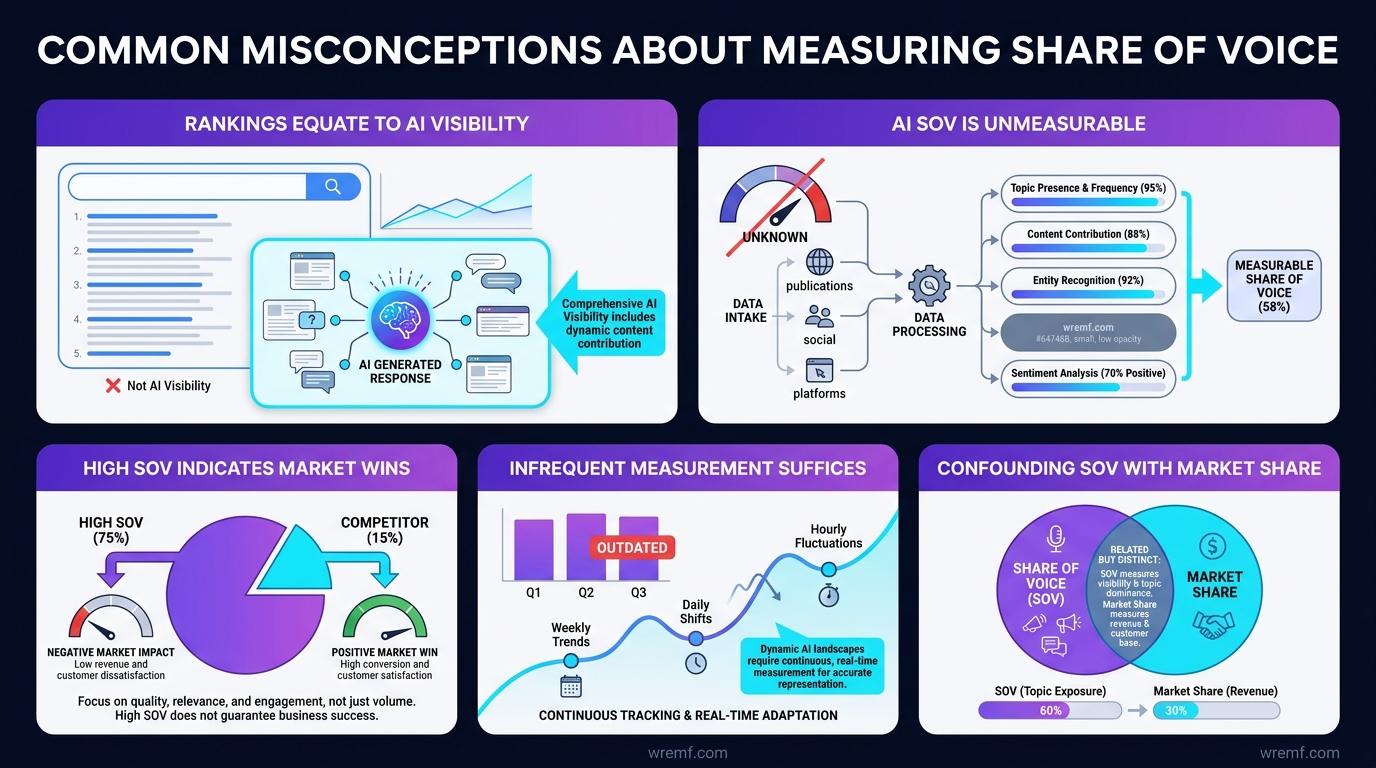
MYTH: If your brand ranks well on Google, you automatically have strong AI search share of voice.
FACT: SEO rankings and AI search visibility are independent signals measured by different mechanisms. A brand can hold top organic rankings while being absent from ChatGPT, Perplexity, Gemini, and Google AI Overviews entirely. AI engines draw on sources based on citation authority, content structure, entity consistency, and retrieval relevance, not SERP position alone. Measuring AI search share of voice requires dedicated prompt tracking, which is separate from position tracking in SEO tools.
MYTH: AI search share of voice cannot be measured because AI answers are unpredictable.
FACT: AI-generated answers are variable, but they follow detectable patterns across prompts, engines, and time periods. Systematic prompt tracking across multiple AI engines over consistent intervals produces statistically meaningful share of voice data. WREMF runs structured prompts at scheduled intervals across 10 AI engines and aggregates the results into citation frequency scores, competitor visibility comparisons, and AI Visibility Index scores. The variability is real, but it does not make measurement impossible. It makes consistent, ongoing measurement essential rather than optional.
MYTH: A high share of voice percentage means your brand is winning the market.
FACT: Share of voice measures relative visibility, not business performance. A high SOV built on low-quality media mentions, negative sentiment, or irrelevant keywords does not translate to brand equity, pipeline generation, or revenue. SOV must always be interpreted alongside sentiment analysis, engagement rate, source quality, and conversion data to assess whether your market visibility is contributing to commercial outcomes or simply inflating a number.
MYTH: Measuring share of voice once per quarter is sufficient.
FACT: SOV is a dynamic metric that changes continuously as competitors publish content, earn media coverage, run advertising campaigns, and are cited by AI engines. A quarterly measurement catches trends but misses the specific campaign moments, competitor moves, and AI citation pattern changes that drive strategic decisions. Monthly measurement is a practical minimum for most teams, and AI search share of voice specifically requires ongoing scheduled monitoring because AI-generated answers can shift week to week as models are updated.
MYTH: Share of voice and market share are the same metric measured differently.
FACT: Share of voice measures brand visibility in a given channel. Market share measures commercial performance, typically revenue or units sold as a percentage of total market output. The two are related through the ESOV principle, which shows that sustained excess share of voice tends to predict market share growth over time. But they measure fundamentally different things, and a brand can have high SOV and low market share for years if its visibility is not converting to purchase decisions.
KEY TAKEAWAY: The most common share of voice misconceptions involve assuming that rankings equal AI visibility, that SOV percentages alone measure brand health, and that measurement can be infrequent. All three assumptions produce incomplete or misleading data.
Conclusion
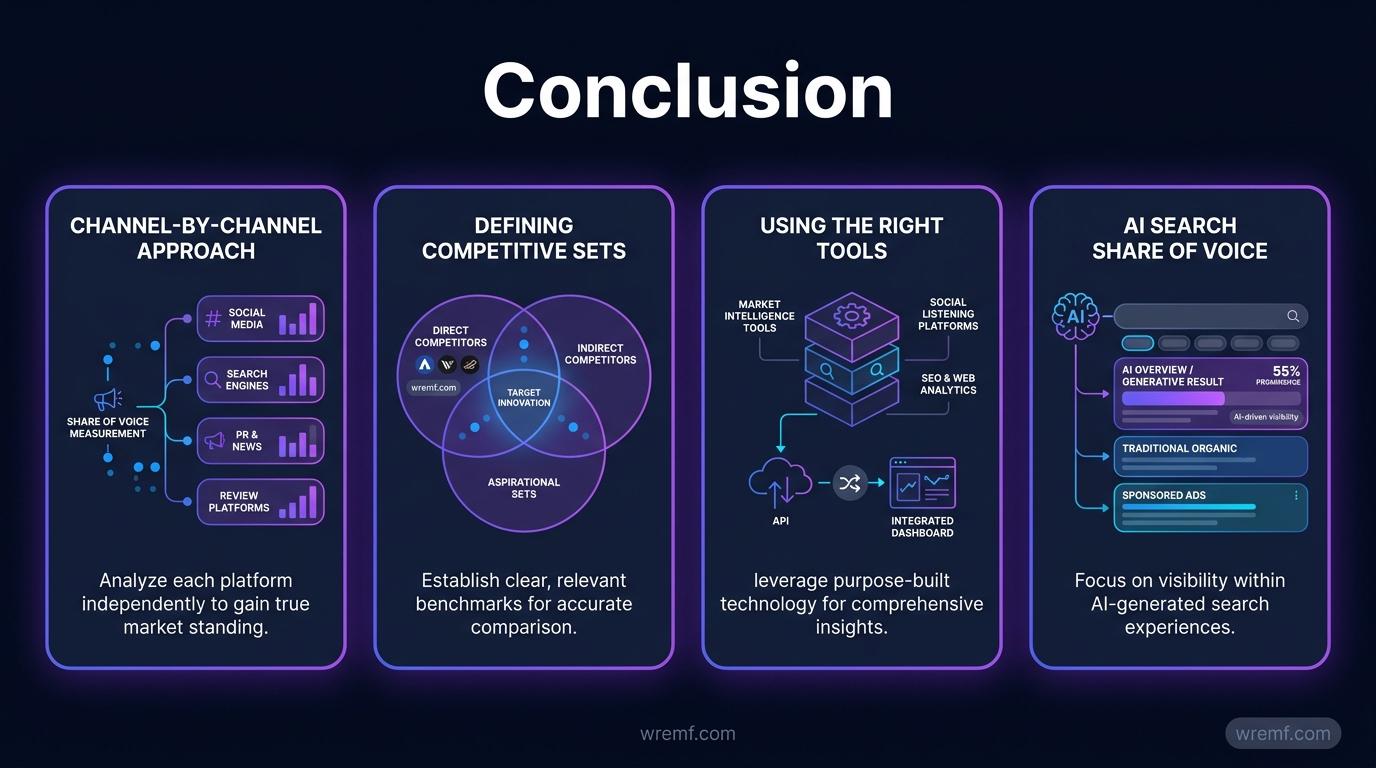
Measuring share of voice accurately requires a channel-by-channel approach, a clearly defined competitive set, the right tools for each signal, and a commitment to layering qualitative context on top of raw percentages. Social listening tools, SEO platforms, media monitoring software, and ad platforms each cover part of the picture. The part that most brands are currently missing is AI search share of voice, which requires tracking how AI-generated answers from ChatGPT, Gemini, Perplexity, Google AI Overviews, and other answer engines mention, cite, and recommend your brand versus competitors. WREMF is built specifically for that measurement layer. Whether your team wants self-serve AI visibility tracking through software, full managed execution, or a hybrid of both, you can start with AI brand monitoring guide or compare plans directly at WREMF pricing
Frequently Asked Questions About How to Measure Share of Voice
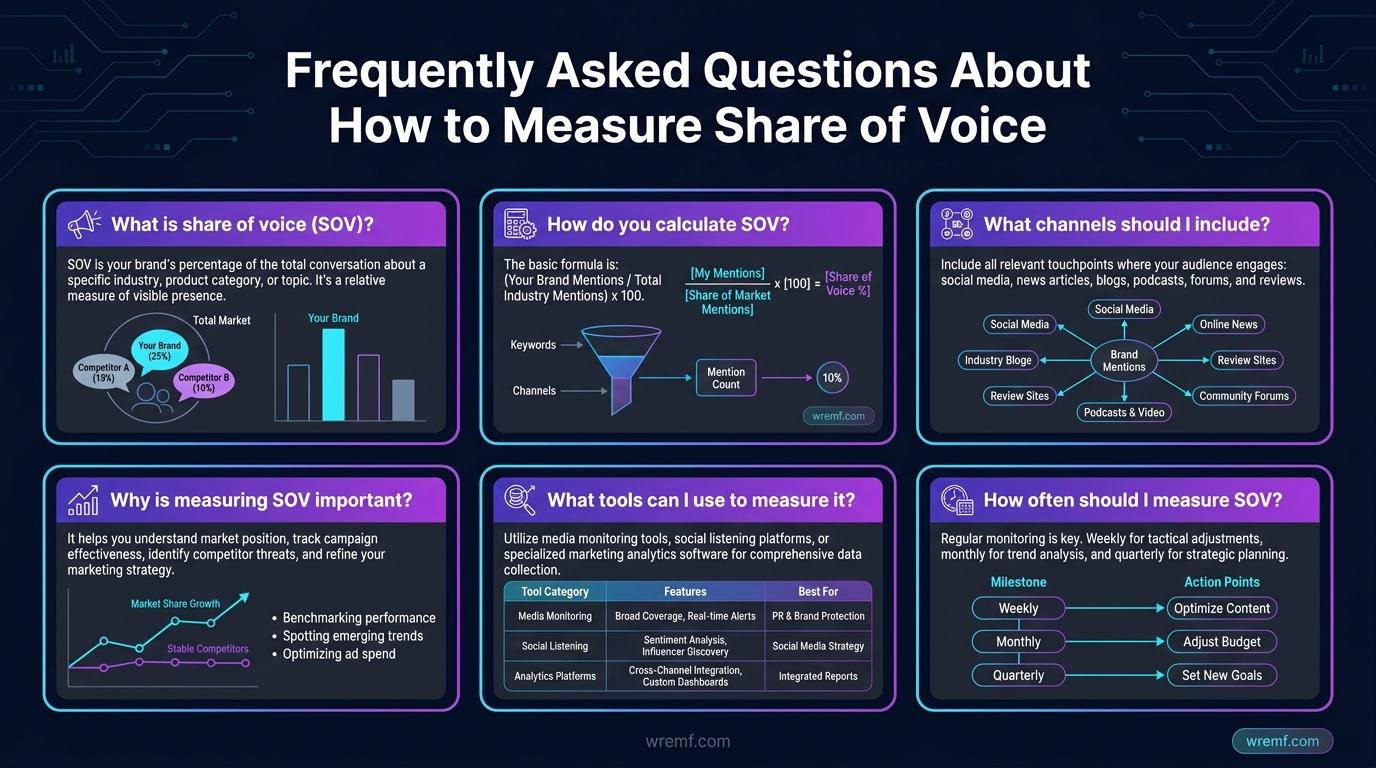
What is share of voice and what does it actually measure?
Share of voice (SOV) measures how much of the total conversation, visibility, or attention your brand receives compared to your competitors within a defined market or channel. It answers the question: of all the brand mentions, impressions, keyword rankings, or media coverage in your category, how much belongs to you? SOV is expressed as a percentage and can be measured across paid advertising, organic search, social media, PR and earned media, and increasingly across AI-generated answers. It is distinct from market share, which measures sales volume rather than conversation or visibility.
What is the difference between share of voice and market share?
Share of voice and market share measure different things. Market share is your percentage of total sales or revenue within an industry and answers "How much do we sell?" Share of voice measures your brand's portion of conversation, impressions, or visibility within a category and answers "How much are we talked about or seen?" The two metrics often correlate, and research from institutions including Nielsen suggests that brands with excess share of voice (ESOV) relative to their market share tend to grow over time, making SOV a useful leading indicator of future market share growth.
How do you calculate share of voice?
The core share of voice formula is: (your brand's metric divided by the total metric for all competitors in the category) multiplied by 100. The specific metric used depends on the channel. For paid advertising, you use impression share. For organic search, you use keyword visibility or clicks. For social media, you use brand mentions. For PR and earned media, you use total media mentions. For example, if your brand generates 400 social mentions and competitors generate a combined 1,600, your social share of voice is 20 percent. Each channel requires a separate calculation because no single formula covers all surfaces simultaneously.
What is a good share of voice percentage to aim for?
There is no universal benchmark for a good share of voice percentage because it depends on your industry, the number of competitors, your brand's maturity, and the channel being measured. A dominant brand in a concentrated category might hold 40 to 60 percent SOV, while a challenger brand in a crowded space might consider 10 to 15 percent competitive. The more useful benchmark is whether your SOV exceeds your current market share, a condition known as excess share of voice (ESOV). Brands with positive ESOV consistently tend to grow. Tracking your own SOV trend over time is often more actionable than chasing an absolute percentage.
Why does share of voice matter for brands and marketers?
Share of voice matters because it reveals your competitive position across channels beyond revenue metrics alone. It shows whether your brand is gaining or losing visibility relative to competitors, helps you identify whether campaign investments are working, and signals whether you are building brand awareness at a pace that supports future growth. SOV is particularly valuable for brand-building decisions, media planning, content strategy prioritisation, and identifying gaps where competitors are outperforming you. According to Gartner's research on AI and marketing measurement, brands that track visibility metrics consistently are better positioned to allocate budget efficiently across channels.
How do you measure SEO share of voice?
SEO share of voice measures how much of the total organic search visibility your brand captures across a defined set of target keywords compared to your competitors. It is typically calculated using keyword impression data from Google Search Console or a third-party rank tracking tool. You identify the full keyword set relevant to your category, calculate the total impressions or estimated clicks available across all ranking brands, and then divide your brand's impressions by the total to get your percentage. Tools such as Semrush's Position Tracking feature allow you to monitor SEO share of voice across a keyword list alongside competitor rankings in one dashboard.
How do you measure social media share of voice?
Social media share of voice is measured by collecting all brand mentions across platforms such as X, LinkedIn, Instagram, Facebook, and others, counting your brand's total mentions alongside those of your competitors, and dividing your count by the combined total. Social listening tools such as Brandwatch, Sprout Social, Talkwalker, Meltwater, Hootsuite, and Awario automate this process by monitoring keywords, hashtags, and brand names across social platforms in real time. The metric can be refined further by filtering for sentiment, region, or media type to understand not just how much you are mentioned but in what context.
How do you measure share of voice in PR and earned media?
PR share of voice is calculated by counting your brand's media mentions across news sites, blogs, industry publications, print, broadcast, and online media outlets relative to the total mentions across your competitive set. PR software platforms such as Cision, Prowly, Meltwater, and Talkwalker aggregate media coverage and allow you to filter by source, sentiment, publication tier, and time period to generate share of voice reports. The result tells you whether your earned media activity is generating proportionate coverage relative to competitors and whether positive coverage is outweighing negative sentiment. WREMF's source citation tracking extends this concept into AI-generated answers, where earned citations in AI responses are increasingly important for brand visibility.
What channels should I include in my share of voice calculation?
The channels you include should reflect where your target audience discovers and evaluates brands. Common channels include paid advertising impression share, organic search keyword visibility, social media mentions, earned media and PR coverage, and increasingly AI-generated answers from platforms such as ChatGPT, Perplexity, Gemini, and Google AI Overviews. For most B2B brands, organic search and social media SOV are the starting point, with paid and earned media added as measurement capabilities grow. AI visibility is a newer but important channel, particularly for brands competing for recommendations in answer engines where traditional impression-based metrics do not apply.
What is paid advertising share of voice and how is it measured?
Paid advertising share of voice, sometimes called impression share, measures how often your ads were shown compared to the total number of times they were eligible to appear in a given auction. Google Ads provides impression share data directly within campaign reporting, broken down by search, display, and Shopping. A low impression share indicates budget constraints, low quality scores, or strong competitor bidding. Impression share is one of the most precise SOV metrics available because it is drawn from first-party platform data rather than estimated through sampling or social listening. It should be tracked alongside other channel metrics to avoid over-optimising paid visibility at the expense of organic or earned share.
How do you measure share of voice in AI search and answer engines?
AI share of voice measures how often your brand is mentioned, cited, or recommended in responses generated by AI platforms such as ChatGPT, Claude, Gemini, Perplexity, Google AI Overviews, Copilot, and others across a defined set of relevant prompts. It is calculated by running a set of category-relevant prompts across multiple AI engines and recording how frequently your brand appears relative to competitors. This differs from traditional SOV because the inputs are prompts rather than keywords, the outputs are generated answers rather than ranked links, and the citations are often determined by entity authority and source consistency rather than bid prices or backlink counts. WREMF tracks AI share of voice across 10 AI engines to show how your brand compares to competitors in AI-generated recommendations.
What are prompts in the context of share of voice measurement?
Prompts, in the context of AI share of voice, are the questions and queries that buyers type into answer engines such as ChatGPT, Perplexity, Gemini, and Google AI Overviews when researching products, services, and solutions. Examples include "What is the best CRM for a growing sales team?" or "Which marketing automation tools work best for B2B companies?" These prompts represent real buying-stage research behaviour that increasingly bypasses traditional search results. Tracking your brand's presence across relevant prompts tells you whether your brand is being recommended, cited, or ignored in the conversations that matter most to your pipeline. WREMF's prompt intelligence feature maps brand presence across a structured set of category prompts.
Is your brand present in relevant product conversations in AI answers?
If your brand is not appearing in AI-generated answers to the product and solution questions your buyers are asking, you have a visibility problem that traditional SEO metrics will not fully reveal. AI answer engines synthesise responses from training data, cited sources, and entity associations rather than serving a ranked list of links. A brand that ranks well in traditional search may still be absent from AI-generated recommendations if its content is not structured to answer specific questions, if its entity authority is weak, or if competitors have stronger citation patterns across the sources AI engines rely on. Auditing your presence in AI answer engines is now a necessary part of a complete share of voice analysis.
How often should you measure share of voice?
Share of voice should be measured consistently and at a cadence that matches your reporting cycle and campaign activity. Monthly measurement is the minimum for most brands because it allows trend identification without reacting to short-term noise. Brands running active campaigns or entering competitive markets benefit from weekly tracking to identify early performance signals. For AI visibility specifically, prompt-level monitoring benefits from continuous or scheduled automated tracking because AI engine outputs can shift when models are updated or when competitor content changes. Tools that support scheduled AI monitoring, like WREMF, allow teams to track AI SOV changes without manual effort.
Can share of voice be measured on a small budget?
Yes. Basic share of voice measurement does not require enterprise software. Google Search Console provides organic keyword impression data for free. Google Ads provides impression share data within its reporting interface. Free tiers of tools such as Semrush, Sprout Social, and Google Trends can provide directional SOV data across search and social channels. For PR and earned media, free tools offer limited coverage but are sufficient to track major publications. The limitation with low-budget approaches is coverage depth and automation. As measurement needs grow, paid tools become necessary to handle volume, sentiment analysis, and cross-channel consolidation accurately.
What tools are used to measure share of voice?
Common tools used to measure share of voice include Semrush and similar rank trackers for SEO visibility, Google Ads for paid impression share, Sprout Social, Brandwatch, Talkwalker, Meltwater, Hootsuite, and Awario for social and earned media mentions, Cision and Prowly for PR and media monitoring, and Google Search Console for organic search data. For AI share of voice, dedicated platforms are required because standard SEO and social tools do not query AI engines or track prompt-level brand mentions. WREMF is purpose-built for AI visibility tracking across ChatGPT, Claude, Gemini, Perplexity, Google AI Overviews, Copilot, and other AI discovery surfaces, complementing traditional SOV tools that do not cover AI-generated answers.
What is an example of a share of voice analysis?
A practical share of voice analysis might involve a B2B SaaS company identifying the 30 most important organic search keywords in its category, pulling Google Search Console impression data for its own domain, and using a tool like Semrush to estimate the traffic share held by each competitor for those terms. The analysis would show that the brand holds 18 percent of organic SOV, its primary competitor holds 34 percent, and the remainder is split across smaller players and informational content. The insight would direct content investment toward closing keyword gaps and improving rankings for high-volume commercial terms where visibility is weakest relative to competitors. A similar analysis can be run for social media mentions or AI-generated answers using the appropriate measurement tool for each channel.
Should share of voice be measured alongside other metrics?
Yes. Share of voice is most useful when tracked alongside complementary metrics such as brand awareness, sentiment analysis, organic traffic, conversion rate, and revenue or pipeline data. SOV tells you how much of the conversation you own, but it does not tell you whether that conversation is positive, whether it is reaching the right audience, or whether it is driving business outcomes. Combining SOV with sentiment data reveals whether high mention volume reflects positive or negative coverage. Combining SOV with organic traffic data shows whether search visibility is translating into website visits. Combining SOV with CRM data connects visibility to pipeline impact. A complete measurement framework uses SOV as one signal among several rather than as a standalone success metric.
What are common mistakes when tracking share of voice?
Common mistakes include measuring SOV in only one channel while ignoring others, failing to define the competitive set consistently over time, using inconsistent keyword lists that inflate or deflate results, not filtering for sentiment when analysing mention volume, and treating share of voice as a goal rather than a diagnostic tool. Another frequent mistake is focusing exclusively on traditional search and social SOV while ignoring AI-generated visibility, which is becoming a significant source of brand discovery particularly in B2B research journeys. As VentureBeat's AI coverage has documented, AI answer engines are increasingly influencing purchase decisions, making AI SOV a measurement gap for brands that track only legacy channels.
How does negative coverage affect share of voice?
Negative coverage inflates raw mention volume without indicating positive brand presence. A brand experiencing a communications crisis may see a sharp rise in share of voice simply because it is generating a high volume of negative media mentions. This is why sentiment analysis is essential alongside share of voice tracking. If negative coverage is overwhelming your brand's share of voice, the volume number becomes misleading as a performance indicator. PR teams should monitor both the quantity of mentions and the sentiment breakdown, adjusting response strategy based on whether crisis-related coverage is growing as a proportion of total brand conversation. Tracking sentiment alongside SOV helps distinguish healthy brand visibility from reputational risk.
How do you measure share of voice in AI search when there are no impression metrics?
AI share of voice does not have the same impression-based metrics as paid search. Instead, it is measured by running a structured set of prompts relevant to your category across multiple AI engines and tracking how frequently your brand appears in the generated answers compared to competitors. The output is a visibility score or mention rate rather than an impression count. Factors that influence AI SOV include entity authority, source citation patterns, content structure, and whether your brand is consistently named across the third-party sources that AI engines rely on. This is methodologically different from traditional SOV and requires dedicated tracking infrastructure rather than standard rank tracking or social listening tools. The WREMF methodology explains how AI visibility scoring is calculated across engines.
When should a brand consider using an agency to improve its share of voice?
A brand should consider agency support when it lacks the internal resources to execute content, technical optimisation, and citation-building at the speed required to compete. Increasing share of voice is rarely a measurement problem alone. It is an execution problem that requires consistent content output, entity authority development, structured technical implementation, and monitoring across multiple channels simultaneously. For AI share of voice specifically, improving visibility requires GEO and AEO strategy, prompt-level gap analysis, AI-ready content development, and source consistency work that goes beyond what most in-house teams can handle alongside existing responsibilities. WREMF's agency services combine AI visibility auditing, content strategy, technical optimisation, and ongoing monitoring for brands that need both the measurement and the execution to improve AI search recommendations.
How does WREMF help teams measure and improve share of voice across AI engines?
WREMF helps B2B teams track how their brand appears across 10 AI engines including ChatGPT, Claude, Gemini, Perplexity, Google AI Overviews, Copilot, DeepSeek, Grok, Meta AI, and Mistral. The platform measures brand mentions, citation frequency, competitor visibility, and AI share of voice across a structured set of prompts relevant to your category. It identifies where competitors are outperforming your brand in AI-generated answers and provides actionable recommendations for improving citations, content structure, and entity authority. For teams that need execution support, WREMF also operates as an AI visibility agency delivering GEO audits, AEO content optimisation, citation gap analysis, and share of voice reporting as a managed service. Explore the WREMF platform suite or view pricing to see which approach fits your team.
What is the difference between share of voice in traditional media and AI-generated answers?
Traditional media share of voice measures how often your brand appears in articles, broadcasts, print coverage, and online publications compared to competitors. It is driven by PR activity, media relationships, newsworthiness, and advertising. AI-generated share of voice measures how often your brand is mentioned or recommended in AI answer engine responses, which are driven by training data, source citation patterns, entity authority, content structure, and the quality of information available about your brand across the web. As Google's AI Overviews documentation illustrates, AI-generated responses draw from a different set of signals than traditional editorial coverage, making AI SOV a distinct and increasingly important measurement category for brand visibility.
How can agencies use share of voice data for client reporting?
Agencies can use share of voice data to demonstrate the competitive value of their work in terms clients understand: visibility relative to competitors rather than abstract rankings or impressions. SOV reports show clients whether their brand is growing its portion of the total conversation across search, social, PR, or AI answers over time. For agencies managing multiple B2B clients, white-label share of voice reporting across AI engines is particularly valuable because AI visibility is a newer metric that few agencies can currently provide. WREMF's white-label reporting and agency features allow agencies to track AI share of voice for multiple clients, deliver branded dashboards, and demonstrate measurable AI visibility improvement as part of ongoing retainer work.
Related reading
- AI Brand Visibility: The Complete B2B Guide to Tracking, Measuring, and Improving How AI Engines Mention Your Brand
- AI Brand Monitoring: The Complete Guide to Tracking Brand Visibility Across AI Search, LLMs, and Generative Engines
- The Complete Guide to AI Visibility: How B2B Brands Get Cited, Tracked, and Recommended Across AI Search Engines
- The Complete Guide to AI Search Visibility for B2B Brands and SEO Teams