Which AI Search Optimization Tools Have the Best ROI?
Learn which AI search optimization tools offer the best ROI by measuring visibility and optimizing content.
By WREMF Team · 2026-09-17
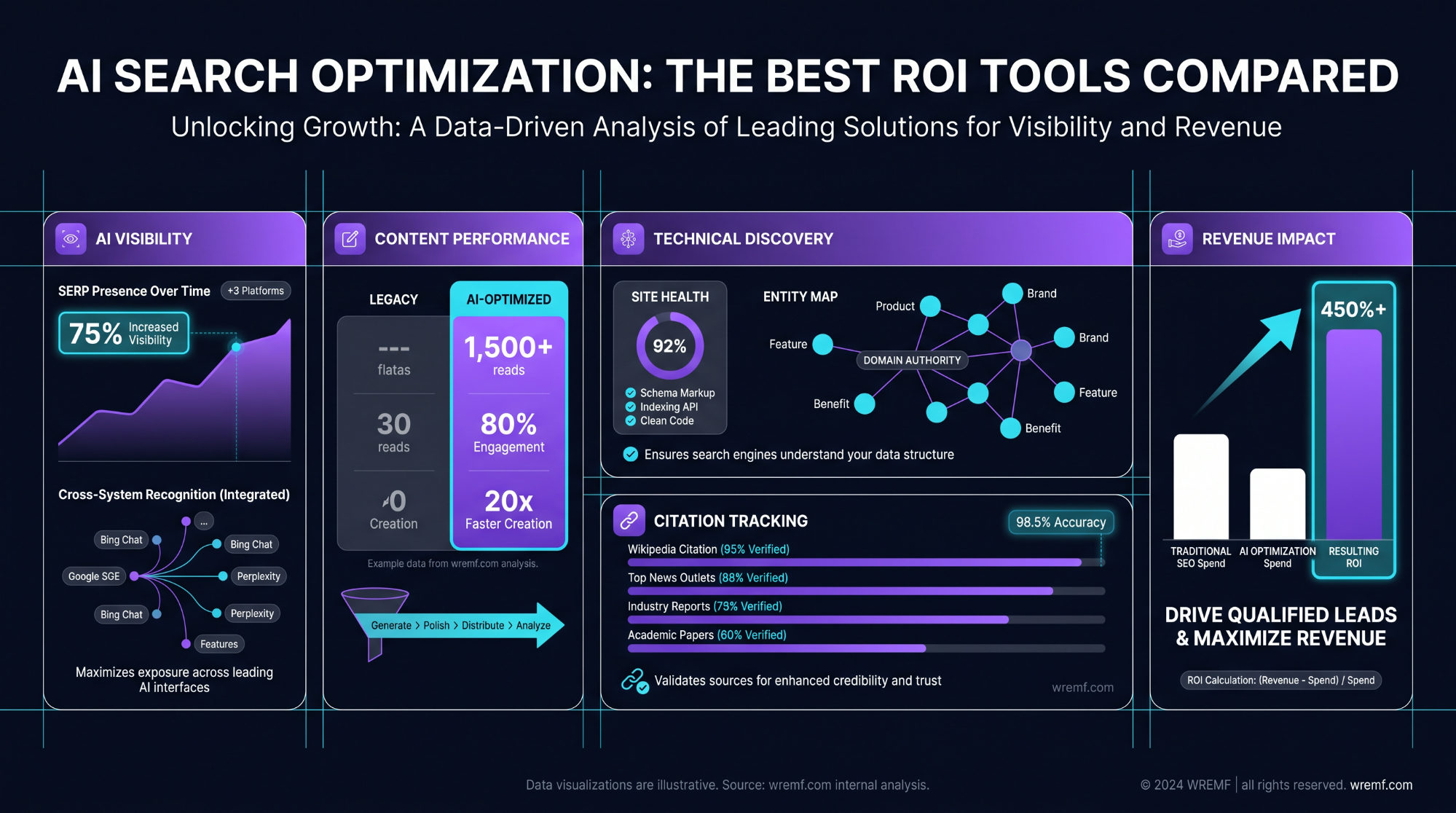
AI search optimization tools enhance brand presence within AI-generated platforms like ChatGPT, Perplexity, and Google AI Overviews. Effective tools focus on AI visibility, content optimization, technical SEO, and citation consistency. The highest ROI often emerges from integrating visibility tracking with other SEO facets, tailored to resolve specific challenges in AI discovery. B2B teams benefit from tools that improve measurement and strategic decisions directly tied to revenue impact.
Key takeaways
- AI search optimization tools should focus on visibility tracking, content, technical SEO, and citation consistency for maximum ROI.
- Integrating AI visibility with content optimization and attribution provides stronger returns than using isolated tools.
- AI search ROI extends beyond rankings and impressions, encompassing integrations into AI-generated answers and citations.
- Combining various SEO tools into a cohesive stack can streamline operations and optimize AI search reporting.
- Regularly track AI mentions, citations, and visibility to adapt strategies for improved brand recognition.
Which AI Search Optimization Tools Have the Best ROI?
Which AI search optimization tools have the best ROI depends on whether your team needs to measure AI visibility, improve content performance, fix technical discovery issues, track citations, or prove revenue impact. Google Search Central explains that AI Overviews help users understand complex topics faster and explore links for more detail, while OpenAI says ChatGPT search includes links to relevant web sources. That changes ROI because discovery now happens across Google, ChatGPT, Perplexity, Gemini, Claude, Copilot, and other AI engines, not only blue-link search results. This guide compares the AI search optimization tool categories with the strongest payback, the metrics that prove value, and the mistakes that reduce ROI. WREMF helps B2B teams track, improve, and prove AI visibility across 10 AI discovery surfaces through software, agency support, or a hybrid model.
Which AI Search Optimization Tools Have the Best ROI?
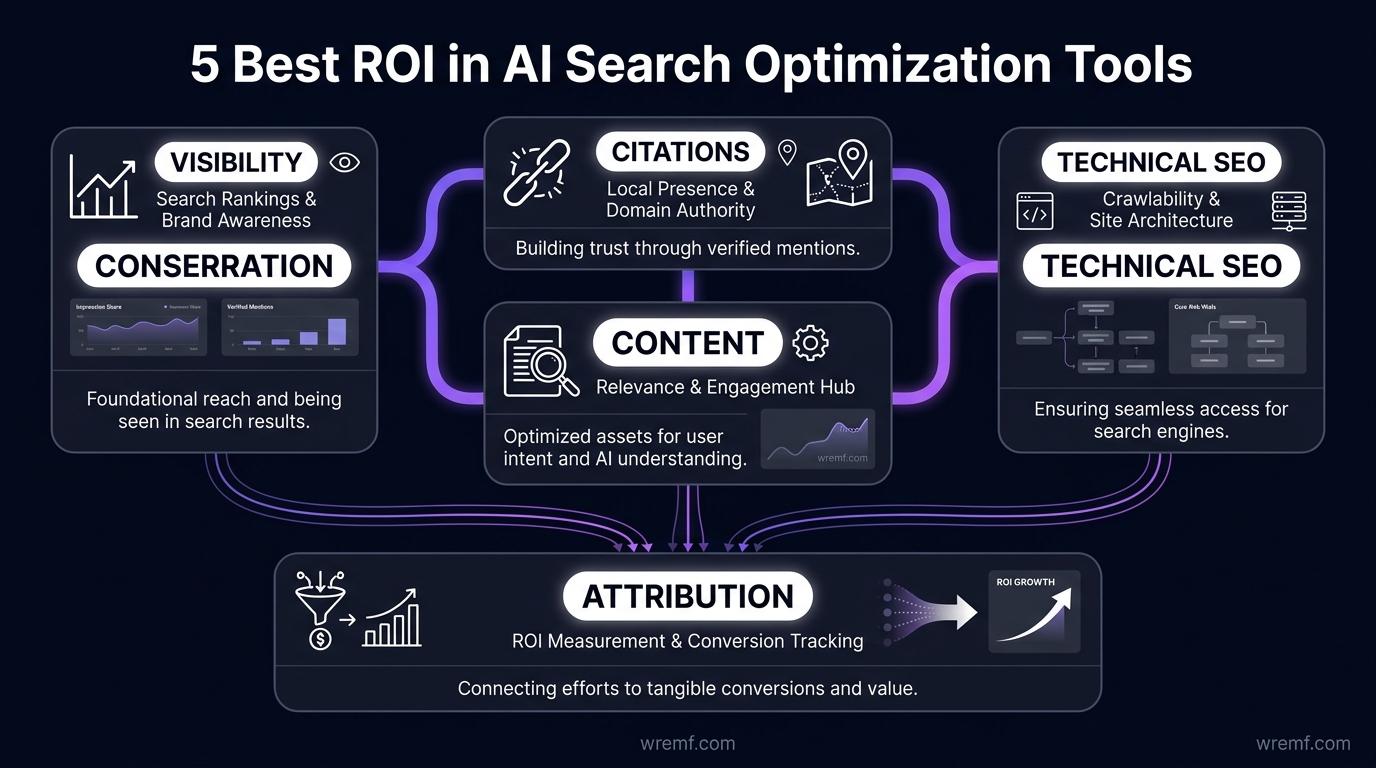
The AI search optimization tools with the best ROI are the tools that connect visibility, citations, content, technical SEO, and attribution. For most B2B teams, the strongest return comes from a focused stack rather than one isolated AI SEO tool.
AI search optimization is the process of improving how a brand appears inside AI-generated answers, AI Overviews, ChatGPT search results, Perplexity responses, Gemini results, Copilot answers, Claude summaries, and other AI discovery surfaces. AI search optimization matters because buyers increasingly ask AI systems for product comparisons, vendor recommendations, definitions, alternatives, and decision support before they visit a website.
The highest-ROI AI search optimization tools usually fall into six categories:
AI visibility and LLM visibility tracking tools
Content optimization and content brief tools
Technical SEO and structured data tools
Citation, entity, and source consistency tools
Analytics, attribution, and reporting tools
Agency or hybrid execution support
WREMF belongs to the AI visibility, citation tracking, competitor visibility, and attribution workflow category. The WREMF platform suite helps teams monitor prompts, AI citations, brand mentions, competitors, source consistency, share of voice, and reporting across major AI engines.
The best ROI does not always come from the tool that writes the most content. The best ROI usually comes from the tool that removes the biggest decision gap. If you do not know whether ChatGPT, Perplexity, Gemini, Claude, or Google AI Overviews mention your brand, a content generation tool will not solve the measurement problem.
| Tool Category | Best For | What It Measures | What It Misses | Typical User | ROI Driver |
|---|---|---|---|---|---|
| AI visibility platforms | Measuring brand presence in AI answers | Prompts, mentions, citations, competitors, share of voice | Deep content editing workflow | B2B SaaS, agencies, growth teams | Better strategic decisions |
| Content optimization suites | Planning and improving SEO content | Keywords, topics, entities, content gaps, briefs | Multi-engine AI answer visibility | Content and SEO teams | Faster production and stronger content |
| Technical SEO tools | Fixing crawl and indexation barriers | Crawlability, site structure, schema, rendering, performance | AI recommendation quality | SEO and engineering teams | Reduced technical friction |
| Citation and entity tools | Improving source trust and brand clarity | Citation sources, brand facts, third-party references | Full revenue attribution | Brands in competitive markets | Stronger AI retrievability |
| Analytics and attribution tools | Proving business impact | Sessions, conversions, revenue paths, assisted traffic | Zero-click AI influence | Growth and revenue teams | Better ROI reporting |
| Agency or hybrid support | Turning insights into execution | Strategy, content, audits, reporting, implementation | Lowest software-only cost | Teams with limited capacity | Faster implementation |
For B2B teams, the strongest ROI usually comes from combining AI visibility tracking with content optimization, technical SEO, and attribution. This avoids the common mistake of publishing more content without knowing whether AI engines can retrieve, trust, cite, or recommend the brand.
AI visibility is the measurable presence of a brand inside AI-generated answers, recommendations, citations, summaries, and comparison responses. AI visibility matters because a brand can be included or excluded from a buyer’s shortlist before the buyer reaches a pricing page, product page, or sales form.
KEY TAKEAWAY: The highest-ROI AI search optimization tools connect AI visibility measurement with content, citations, competitors, and attribution rather than only automating content creation.
To compare tools fairly, you first need to redefine ROI for AI search rather than relying only on traditional SEO metrics.
How Has ROI Changed From SEO Tools to AI Search Optimization Tools?
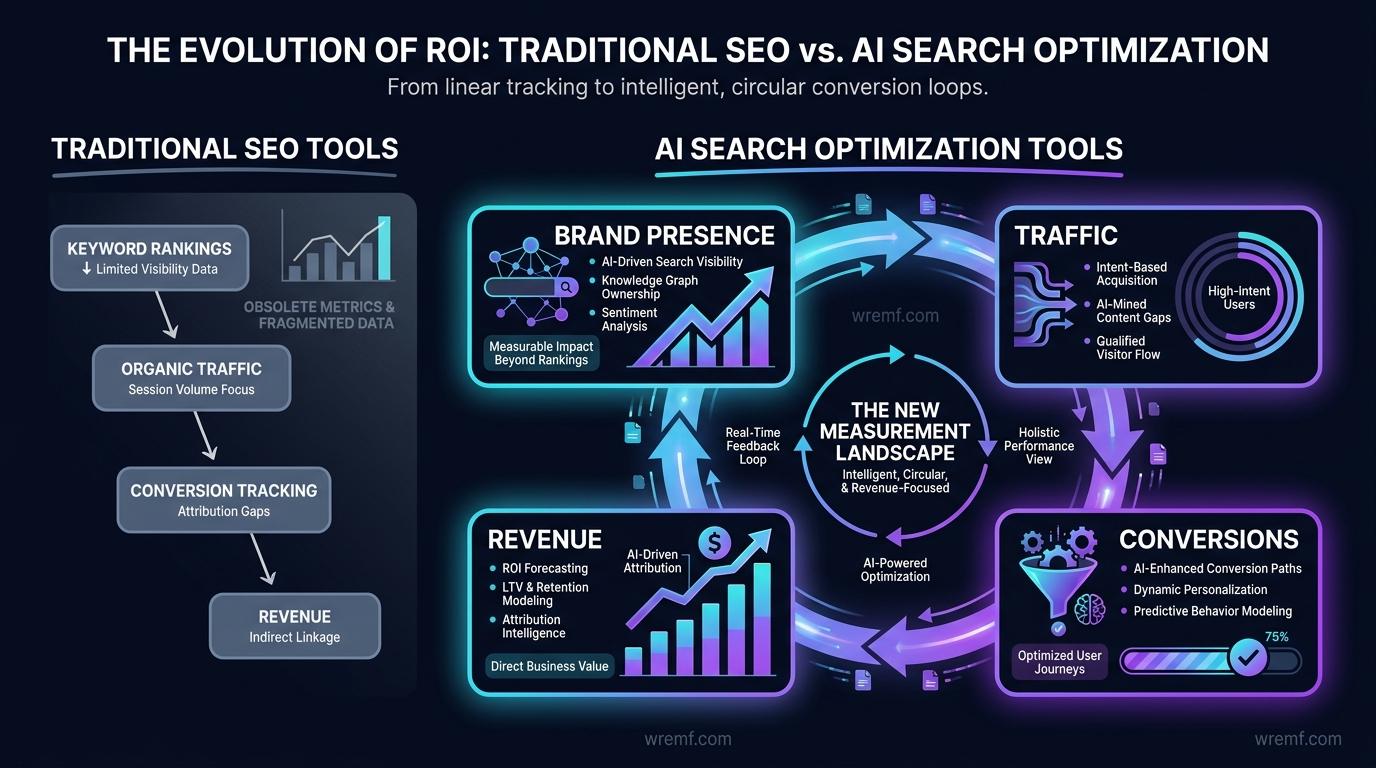
ROI has changed because AI search surfaces answers, summaries, citations, and recommendations, not only ranked URLs. AI search optimization ROI must measure brand presence inside AI answers as well as traffic, conversions, and revenue.
Traditional SEO ROI focuses on rankings, impressions, organic clicks, sessions, leads, and revenue. Those metrics still matter. The Google Search Central guidance on helpful, reliable, people-first content explains that Google’s ranking systems are designed to prioritise useful information created for people, not content made mainly to manipulate rankings.
AI search adds a second layer. A brand can rank on Google but be absent from ChatGPT recommendations. A brand can appear in Perplexity citations but receive limited direct referral traffic. A competitor can appear in Google AI Overviews even when your page ranks nearby in traditional search results. These differences make AI search ROI both a measurement problem and a source ecosystem problem.
AI search visibility is the measurable presence of a brand across AI answers, AI citations, AI Overviews, AI recommendations, and AI-generated summaries. AI search visibility matters because buyers use AI engines to compress research, compare options, and decide which vendors deserve attention.
In real B2B buying journeys, search no longer happens in one place. A buyer may ask ChatGPT for a shortlist, use Perplexity to compare sources, check Google AI Overviews for a summary, search Google for reviews, and then visit vendor websites. This means ROI should include both click-based metrics and pre-click AI visibility signals.
| ROI Dimension | Traditional SEO Tools | AI Search Optimization Tools |
|---|---|---|
| Visibility | Rankings, impressions, SERP features | AI mentions, recommendations, citations, prompt coverage |
| Authority | Backlinks, domain metrics, topical authority | Trusted sources, citation sources, entity consistency |
| Content | Keyword targeting and on-page optimization | Answer-first content, source-backed claims, extractable definitions |
| Competition | SERP competitors | Competitors recommended inside AI answers |
| Traffic | Organic clicks and sessions | AI referrals, branded search lift, assisted discovery |
| Reporting | Rank reports and SEO dashboards | AI share of voice, prompt trends, citation reports, source gaps |
DID YOU KNOW: OpenAI says ChatGPT search can provide timely answers with links to relevant web sources, which means source visibility is now part of AI discovery and not only traditional SEO.
AI search ROI is not only time saved. Time saved matters when tools accelerate keyword discovery, content briefs, clustering, audits, and reporting. But time saved becomes meaningful only when it improves visibility, source trust, content quality, or business outcomes.
KEY TAKEAWAY: AI search optimization ROI must include AI visibility, citations, recommendations, source consistency, and attribution alongside rankings and traffic.
Once ROI is defined correctly, the next step is to calculate it with a model that includes both efficiency and measurable business impact.
How Do You Calculate the ROI of AI Search Optimization Tools?
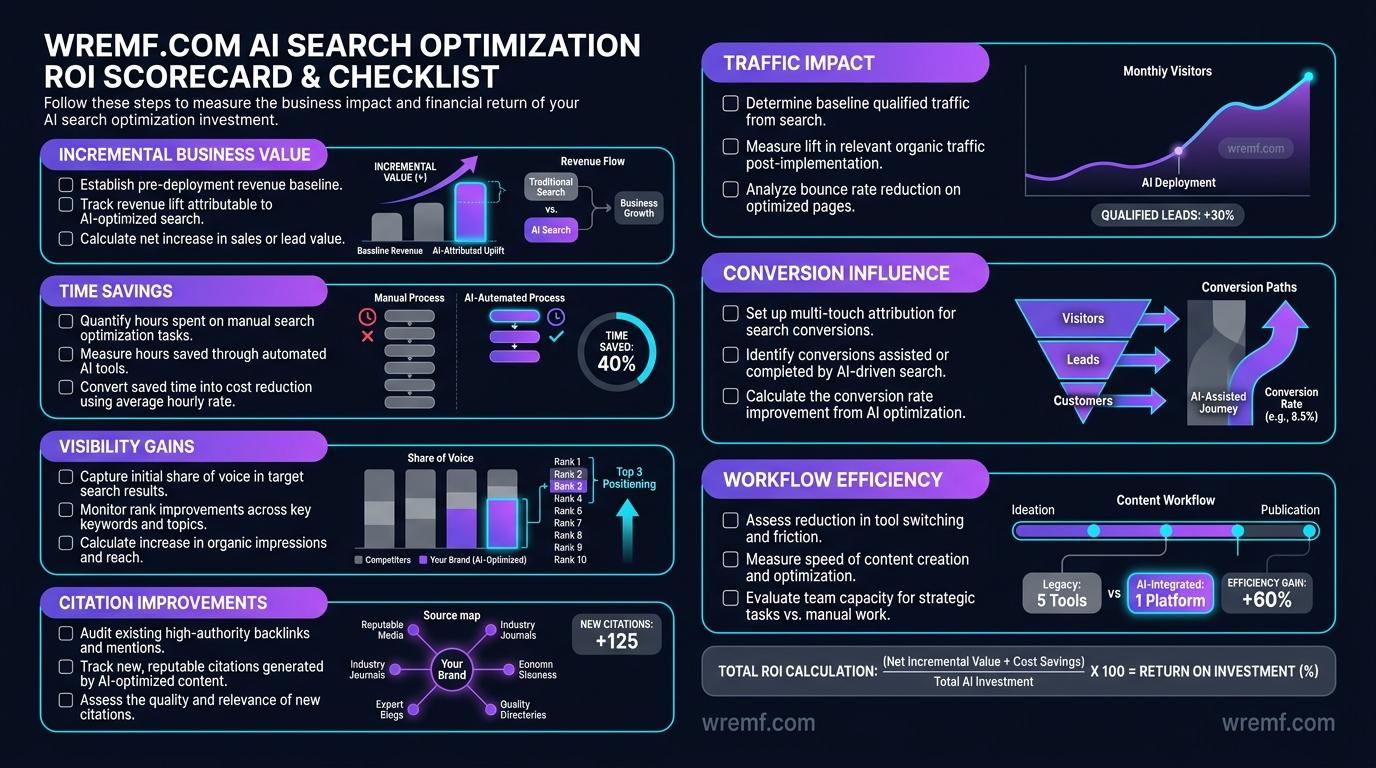
You calculate AI search optimization ROI by comparing incremental business value and time savings against software, service, implementation, and human review costs. A reliable ROI model includes visibility gains, citation improvements, traffic impact, conversion influence, and workflow efficiency.
AI search ROI is the return generated by AI search optimization after subtracting the cost of tools, services, setup, review, and execution. AI search ROI matters because AI-generated answers can influence discovery before a buyer produces a clean analytics session.
A practical formula is:
Monthly AI Search ROI = Incremental value from traffic, conversions, assisted pipeline, and time saved minus tool and labor cost, divided by tool and labor cost.
Example calculation:
| Input | Example Monthly Value |
|---|---|
| Incremental AI-assisted and organic pipeline value | €8,000 |
| Content and reporting time saved | €3,000 |
| Tool, setup, and review cost | €1,500 |
| Net value | €9,500 |
| Monthly ROI | 633 percent |
This example shows how to calculate ROI. It is not a benchmark or guarantee. Your actual ROI depends on traffic quality, average deal value, conversion rate, sales cycle length, attribution model, review time, content quality, and execution speed.
Human-in-the-loop cost is often missing from AI tool ROI calculations. AI tools can reduce drafting and research time, but expert review, fact-checking, source validation, brand voice editing, and strategic prioritisation still require human work. McKinsey’s 2025 State of AI research says value capture depends on management practices across strategy, talent, operating model, technology, data, and adoption at scale, not just tool adoption.
AI content generation is the use of artificial intelligence to draft, summarise, rewrite, or structure content. AI content generation matters because it can reduce production time, but unchecked output can increase editing costs and weaken trust.
A strong AI search optimization ROI model should include:
Software subscription cost
Agency or consultant cost
Setup and integration time
Prompt engineering time
Human review and editing time
Technical implementation effort
Content production velocity
AI visibility improvement
AI citation improvement
Organic traffic impact
AI referral traffic impact
Assisted conversion value
Reporting time saved
WREMF’s AI visibility methodology connects prompts, citations, competitors, source consistency, and attribution into one repeatable measurement system. This helps teams avoid reporting only on outputs, such as pages published, and instead report on outcomes, such as AI visibility, citations, competitor gaps, and referral signals.
IMPORTANT: Do not count AI-generated content volume as ROI by itself. Content volume only creates value when it improves visibility, trust, conversions, or operational efficiency.
KEY TAKEAWAY: The best AI search ROI formula combines revenue impact, time savings, visibility improvement, citation gains, and human review costs.
After the formula is clear, you can compare tool categories by payback speed and strategic value.
Which Types of AI Search Optimization Tools Usually Deliver the Fastest Payback?
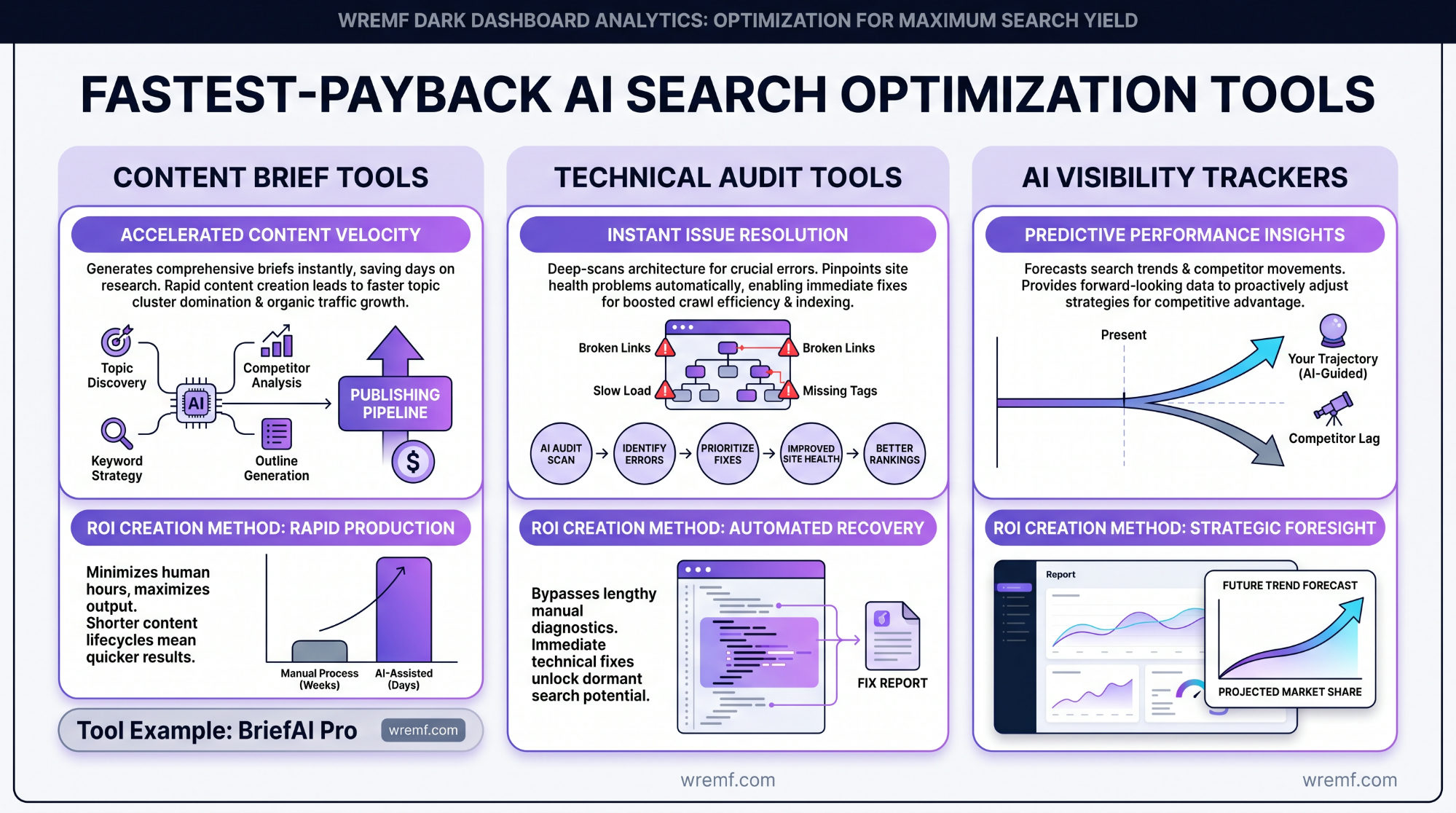
The fastest-payback AI search optimization tools are usually content brief tools, technical audit tools, and AI visibility trackers. Each creates ROI differently, so the right choice depends on whether your bottleneck is production, discoverability, technical access, or proof.
Content optimization tools often deliver quick efficiency gains because they help teams create briefs, map search intent, compare SERP patterns, identify entity gaps, and improve page structure. Surfer, Frase, Clearscope, and MarketMuse are common examples in this category. Their ROI is strongest when a team already has writers, editors, and a publishing process.
AI visibility tools deliver strategic ROI by showing whether your brand appears in AI answers at all. WREMF, Profound, Airank, Goodie AI, Scrunch AI, and Am I On AI are part of the newer AI visibility and LLM visibility tracking market. Their ROI is strongest when leadership asks what ChatGPT, Perplexity, Gemini, Claude, Copilot, or Google AI Overviews say about the brand and its competitors.
Technical SEO tools deliver foundational ROI because AI systems and search engines still depend on accessible, crawlable, well-structured content. Technical SEO is not replaced by generative engine optimization. Technical SEO becomes the foundation that allows content and source signals to be discovered, interpreted, and cited.
| Tool Type | Fastest Payback When | Main ROI Metric | What It Helps With | Risk If Used Alone |
|---|---|---|---|---|
| AI visibility tracker | You need to measure AI mentions and competitors | Prompt visibility, share of voice, citations | AI discovery and reporting | Insights without execution |
| Content optimization suite | You need faster briefs and better content | Content velocity, rankings, content quality | Topic coverage and on-page structure | More content without AI proof |
| Technical SEO platform | Crawl or indexation is weak | Fixed issues, indexed pages, crawl efficiency | Crawlability and structured data | Technical fixes without market strategy |
| Attribution tool | Leadership needs ROI evidence | Conversions, pipeline, source paths | Revenue reporting | Misses zero-click AI influence |
| Agency or hybrid partner | Internal execution is limited | Shipped improvements and reporting quality | Strategy and implementation | Higher cost than software alone |
Prompt tracking is the process of monitoring how AI engines answer specific questions related to your category, brand, competitors, and buyer journey. Prompt tracking matters because AI answers vary by question, engine, and intent stage.
In practical AI visibility audits, teams often find that different AI engines behave differently. ChatGPT may summarise a category from broad web sources. Perplexity may expose more citations. Google AI Overviews may rely on search-indexed source signals. Copilot may ground some responses through Bing and source buttons, according to Microsoft support documentation. These differences make multi-engine tracking more useful than testing one model manually.
KEY TAKEAWAY: Content tools often save time fastest, but AI visibility and attribution tools provide stronger strategic ROI when teams need proof across AI engines.
The next decision is whether to buy one platform or combine several tools into a focused stack.
Do You Need Multiple AI SEO Tools or Just One Platform?
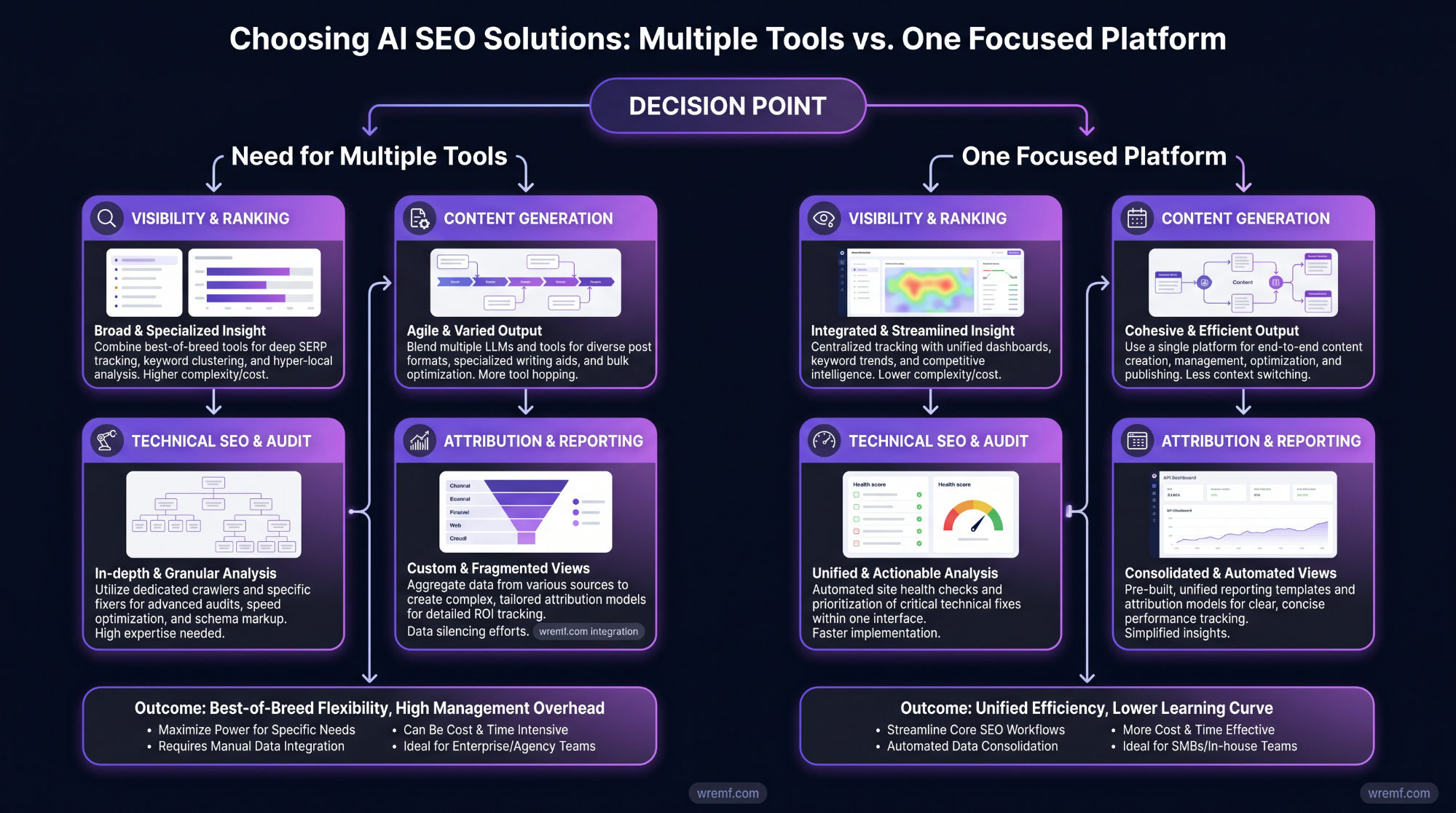
You need multiple AI SEO tools when one platform cannot cover visibility, content, technical SEO, and attribution. You need one focused platform when your main goal is to reduce complexity and standardise AI search reporting.
AI SEO tools are software products that use artificial intelligence to support keyword research, content optimization, technical checks, content generation, reporting, or search visibility analysis. AI SEO tools matter because they can accelerate repetitive work, but they do not replace strategy, evidence, editorial judgment, or business prioritisation.
A one-platform approach works best when your team needs clarity, repeatability, and fewer reporting gaps. A multi-tool approach works best when your team has specialists for SEO, content, analytics, engineering, and revenue operations. The wrong approach is buying several tools that produce overlapping dashboards without changing what your team ships.
The stack ROI approach means selecting tools that work together rather than buying every new AI feature. For example, a B2B team might use WREMF for AI visibility, citation tracking, prompt monitoring, and competitor analysis. The same team might use Google Search Console for search performance validation, Google Analytics 4 for traffic and conversion reporting, a content optimization suite for briefs, and a technical SEO crawler for implementation checks.
| Stack Option | Best For | Typical Tools | Main Benefit | Main Limitation |
|---|---|---|---|---|
| Lean startup stack | Founders and small teams | AI visibility tracker, GSC, GA4, lightweight brief tool | Low cost and fast learning | Less automation |
| Growth team stack | B2B SaaS marketing teams | AI visibility, content optimization, technical SEO, attribution | Strong balance of speed and proof | Requires workflow ownership |
| Agency stack | Consultants and agencies | White-label AI reports, prompt tracking, content briefs, client portals | Scalable client reporting | Needs standardised delivery |
| Enterprise stack | Large brands | Multi-engine tracking, API, BI, governance, technical SEO | Deep reporting and controls | Higher setup cost |
Agencies managing multiple clients often need repeatable reporting more than another writing assistant. The WREMF agency workflow supports white-label reports, multi-client visibility tracking, prompt monitoring, and client-facing proof. In-house brands can use WREMF for brands to benchmark competitors, track source gaps, and monitor AI visibility trends over time.
If you want to see what AI visibility reporting can look like before building your own stack, review a sample AI visibility report and compare it with your current SEO reporting workflow.
KEY TAKEAWAY: One platform is best for standardised AI visibility reporting, while a focused stack is best when you need content, technical SEO, and attribution workflows to work together.
After choosing the stack model, compare the main AI search optimization tools by use case and ROI stage.
What Are the Best AI Search Optimization Tools by Use Case?
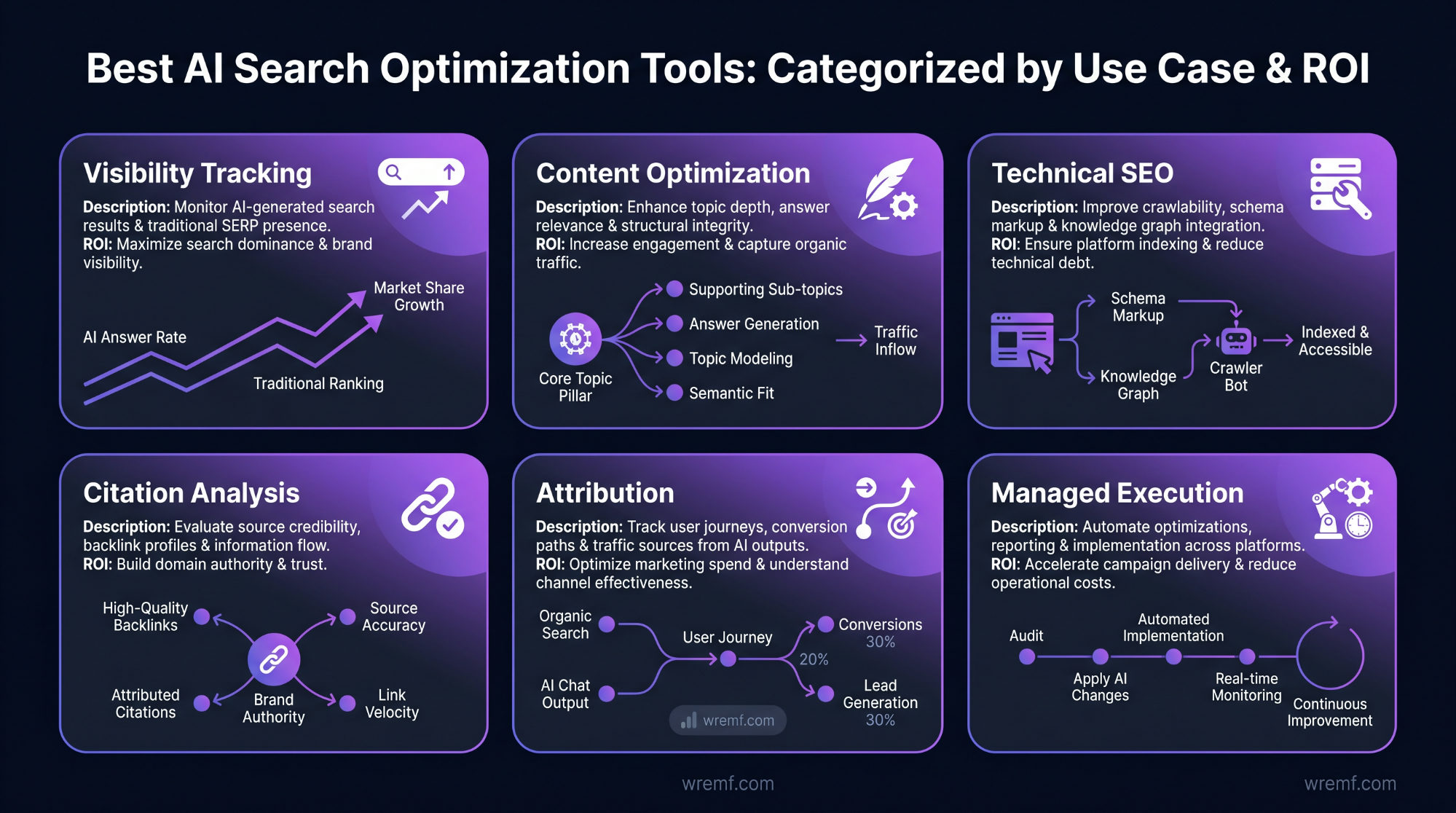
The best AI search optimization tools vary by use case because ROI comes from different workflows. Visibility tracking, content optimization, technical SEO, citation analysis, attribution, and managed execution solve different problems.
AI visibility tools measure whether AI engines mention, cite, recommend, or compare a brand. AI visibility tools matter because they reveal discovery gaps that traditional rank tracking cannot show.
Content optimization tools help teams plan, brief, structure, and improve pages for search intent, semantic coverage, answer quality, and entity clarity. Content optimization matters because search engines and AI systems need clear, useful, well-supported information to retrieve and summarise.
Technical SEO tools identify crawl, rendering, indexation, schema markup, internal linking, and performance issues. Technical SEO matters because inaccessible content cannot reliably support AI citations, AI Overviews, organic rankings, or AI-generated answers.
Attribution tools connect acquisition channels to sessions, conversions, and revenue. Attribution matters because AI visibility can influence buyers before the final click.
| Use Case | Best-Fit Tool Category | Example Tools | ROI Comes From | Recommended When |
|---|---|---|---|---|
| Track AI visibility | LLM visibility tracking platform | WREMF, Profound, Airank, Goodie AI, Scrunch AI, Am I On AI | Better visibility decisions and competitor benchmarking | You need prompt and AI answer tracking |
| Track AI citations | Citation and source tracking | WREMF, Profound, AI visibility platforms | Understanding which sources influence AI answers | You need citation proof |
| Improve content briefs | Content optimization suite | Frase, Clearscope, Surfer, MarketMuse | Faster briefs and stronger topic coverage | You publish regularly |
| Improve content workflow | Content planning and management tools | Frase, MarketMuse, content management systems | Better production velocity | You need repeatable publishing |
| Fix technical barriers | Technical SEO platform | Screaming Frog, Sitebulb, Search Atlas, enterprise crawlers | Better crawlability and implementation clarity | Technical issues block growth |
| Validate search performance | Search analytics tools | Google Search Console, GA4 | Search trend validation and traffic proof | You need performance evidence |
| Prove conversion impact | Attribution and CRM tools | GA4, HubSpot, Salesforce, BI tools | Pipeline and revenue reporting | Leadership needs ROI proof |
| Get implementation support | Agency or hybrid model | WREMF agency, specialist SEO teams | Faster execution and clearer accountability | Internal capacity is limited |
The most effective way to improve AI search visibility is to combine measurement with action. A tracker shows where your brand is missing. A content optimization tool helps improve pages. A technical SEO tool removes barriers. An attribution tool connects visibility work to business results.
WREMF combines prompt tracking, source citation tracking, competitor visibility, AI share of voice, visibility scoring, and action recommendations. For teams that need execution, the WREMF agency team can support AI visibility strategy, AEO consulting, GEO audits, content optimization, entity clarity, source consistency cleanup, technical foundations, and monthly reporting.
KEY TAKEAWAY: The best AI search optimization tool is the one that matches your bottleneck, not the one with the longest feature list.
To understand the strategic tradeoff, you also need to compare AI search optimization with SEO, AEO, and GEO.
How Do SEO, AEO, and GEO Affect AI Search Tool ROI?
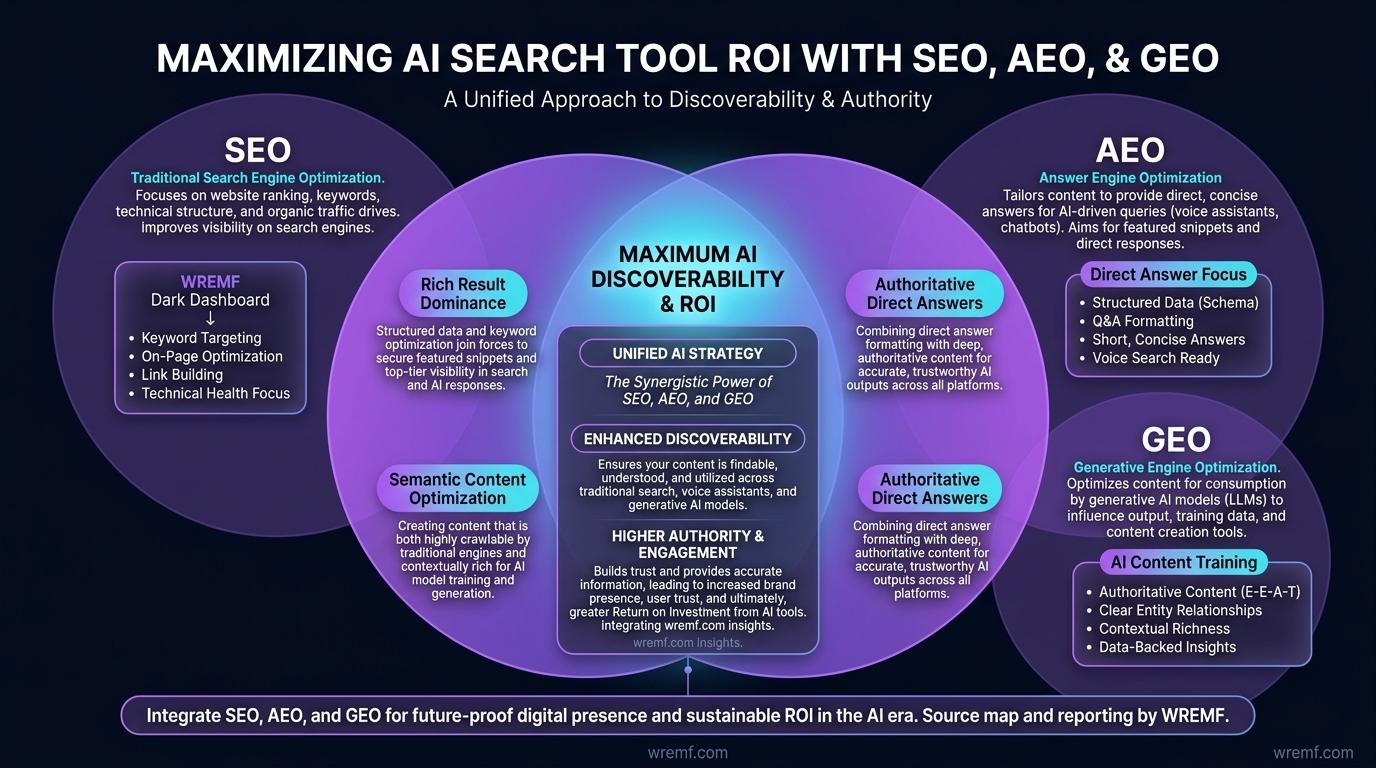
SEO, AEO, and GEO overlap, but they measure different layers of discoverability. Tool ROI improves when all three work together instead of competing for budget.
SEO is search engine optimization, the practice of improving organic visibility through technical quality, content relevance, authority, internal linking, and user usefulness. SEO matters because search engines remain a major validation layer even when AI systems influence discovery.
AEO is answer engine optimization, the practice of structuring content so answer systems can extract clear, direct, source-backed responses. AEO matters because AI assistants, featured snippets, voice assistants, and answer engines need concise answers that can be understood quickly.
GEO is generative engine optimization, the practice of improving how generative AI systems understand, cite, summarise, and recommend a brand. GEO matters because ChatGPT, Claude, Gemini, Perplexity, Google AI Overviews, Copilot, DeepSeek, Grok, Meta AI, Mistral, and other AI engines can shape brand discovery before a click.
| Discipline | Primary Goal | Tool ROI Focus | Example Metric | Common Mistake |
|---|---|---|---|---|
| SEO | Rank and earn organic traffic | Rankings, clicks, conversions | Organic sessions | Treating keywords as the only signal |
| AEO | Provide extractable answers | Answer clarity and snippet readiness | Answer coverage | Writing vague introductions |
| GEO | Influence generative answers | Mentions, citations, recommendations | AI share of voice | Ignoring source consistency |
| AI visibility | Measure AI discovery | Prompt visibility across engines | Brand presence by prompt | Relying on manual testing |
| Attribution | Prove business impact | Traffic, conversions, pipeline | AI-assisted conversions | Ignoring zero-click influence |
The key difference between SEO and GEO is that SEO optimizes for search result visibility, while GEO optimizes for generative answer inclusion, citation, and recommendation. AEO sits between them by making content easier to extract into direct answers.
The OpenAI ChatGPT search announcement explains that chats can include links to sources such as news articles and blog posts. That matters because AI search visibility depends not only on having content, but also on becoming a source that AI systems can find, interpret, and reference.
AI optimization is the repeatable process of improving visibility, content, sources, technical access, and measurement across AI discovery surfaces. AI optimization matters because one-off testing cannot show whether visibility is improving over time.
KEY TAKEAWAY: SEO, AEO, and GEO create the strongest ROI when treated as connected layers of one AI search visibility system.
That connected system depends heavily on citations, brand mentions, source consistency, and entity clarity.
Why Do AI Citations, Brand Mentions, and Source Consistency Matter for ROI?
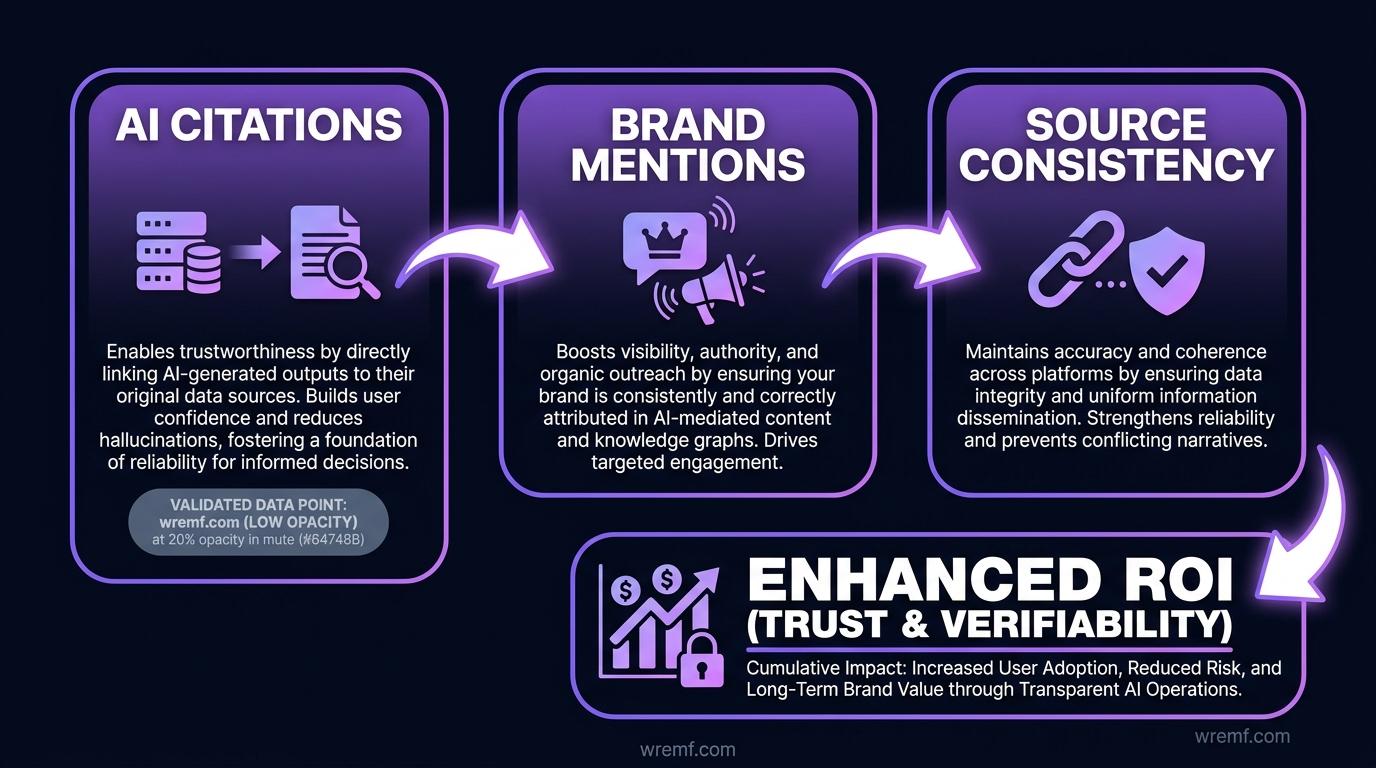
AI citations, brand mentions, and source consistency matter because AI engines need reliable sources to describe and recommend brands. ROI improves when your brand is easy to verify across trusted pages and consistent source material.
AI citations are links or source references used by AI systems to support generated answers. AI citations matter because they show which sources influence how AI systems explain a topic, category, company, or product.
Brand mentions are references to a company, product, or entity inside AI answers, search results, third-party pages, reviews, directories, or source documents. Brand mentions matter because AI systems can recognise and compare brands even when the answer does not produce a direct click.
Source consistency is the alignment of brand facts across your website, profiles, directories, documentation, media mentions, knowledge panels, review pages, and third-party sources. Source consistency helps AI systems understand what your brand does, who it serves, and why it is relevant.
Entity recognition is the process by which search and AI systems identify a named concept, person, product, company, or category. Entity recognition matters because AI systems need to connect your brand name to the right category, features, audience, competitors, and proof points.
Marketing teams often find that AI engines cite third-party pages more often than brand-owned pages for comparison and buying-stage prompts. This makes citation source analysis important. A brand may need stronger owned content, clearer product pages, better comparison pages, original research, trusted third-party references, or cleaner directory profiles.
WREMF’s source citation tracking helps teams see which sources AI engines use when answering prompts. This matters because improving AI visibility is not only about editing your website. It is also about understanding the source ecosystem that AI systems retrieve from.
TIP: Prioritise source consistency before scaling content. Conflicting descriptions across your website, review pages, directories, and social profiles can weaken entity clarity.
KEY TAKEAWAY: AI citations and source consistency turn AI visibility from a content problem into a trust and retrieval problem.
Once the source layer is understood, the next step is choosing metrics that prove ROI.
What Metrics Should You Track to Prove AI Search Optimization ROI?
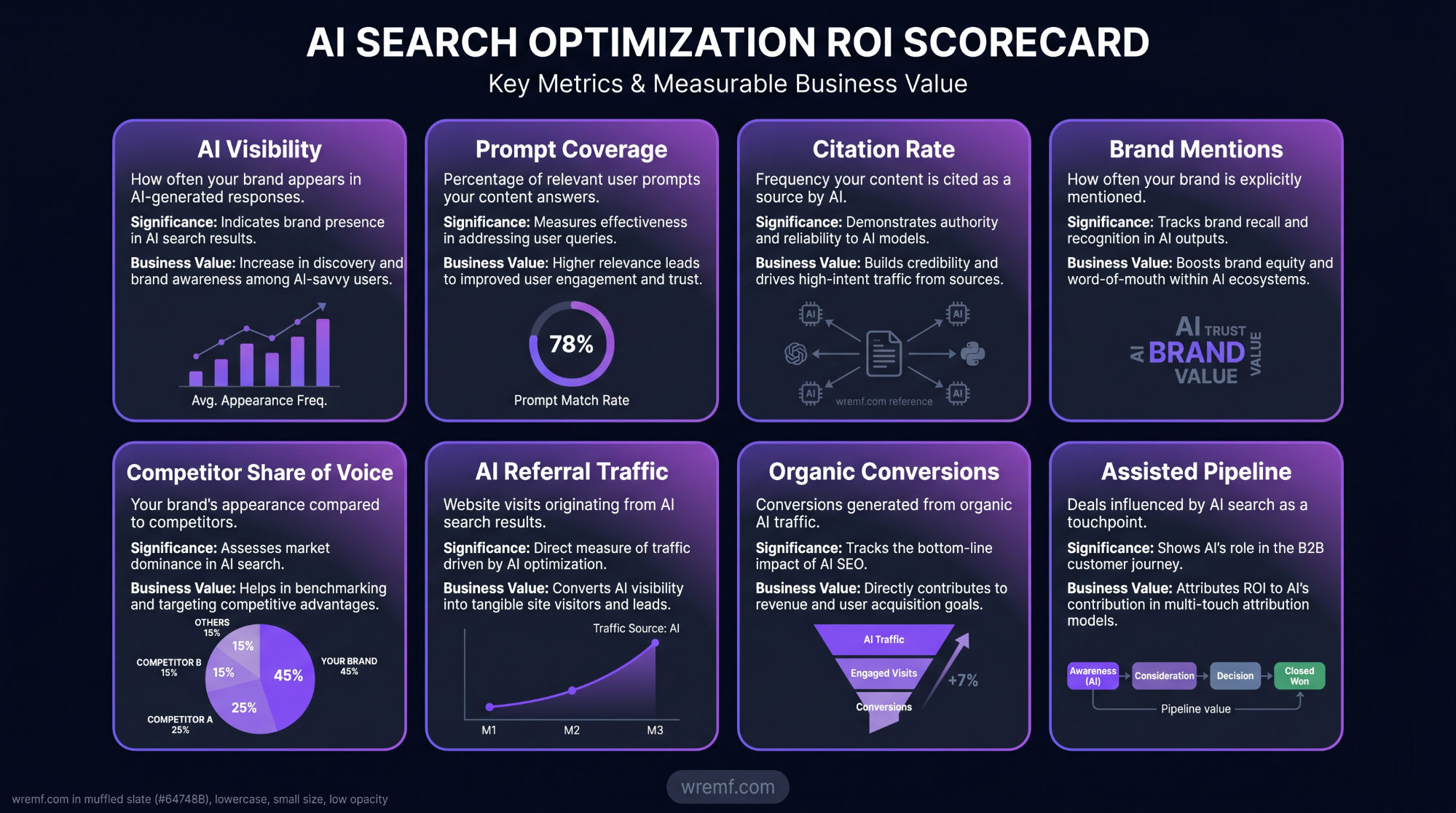
You should track AI visibility, prompt coverage, citation rate, brand mentions, competitor share of voice, AI referral traffic, organic conversions, and assisted pipeline. These metrics show whether AI search optimization is creating measurable business value.
AI share of voice is the percentage of relevant AI answers where your brand appears compared with competitors. AI share of voice matters because AI-generated recommendations can shape shortlists before buyers visit vendor websites.
LLM visibility tracking is the process of monitoring how large language models and AI answer systems mention, cite, compare, or recommend a brand. LLM visibility tracking matters because AI answers can vary by model, prompt, source set, location, and time.
AI traffic attribution connects visits from AI sources such as ChatGPT, Perplexity, Copilot, Gemini, or other referral paths to sessions, conversions, and revenue. AI traffic attribution matters because leadership needs proof that AI visibility work contributes to business outcomes.
Use a metric set like this:
| Metric | What It Shows | Why It Matters |
|---|---|---|
| Prompt visibility | Whether your brand appears for tracked prompts | Shows discovery coverage |
| Recommendation visibility | Whether AI engines recommend your brand | Shows shortlist influence |
| Citation rate | How often your pages or trusted sources are cited | Shows source authority |
| AI Overview citations | Whether Google AI Overviews cite relevant sources | Shows visibility in Google AI results |
| Competitor AI share of voice | How often competitors appear instead | Shows competitive risk |
| Source consistency score | Whether brand facts align across sources | Shows entity clarity |
| AI referral traffic | Visits from AI tools when visible | Shows measurable traffic |
| Assisted conversions | Conversions influenced by AI or organic discovery | Shows business impact |
| Content gap count | Missing pages or weak answer coverage | Shows execution priorities |
| Visibility trends | Movement across prompts and AI engines over time | Shows whether work is improving outcomes |
A common implementation mistake is tracking only branded prompts. Branded prompts show what AI engines say about you when users already know your name. Non-branded category prompts show whether AI engines discover and recommend you before the buyer knows you exist.
The WREMF AI Visibility Index helps teams turn multi-engine visibility into a score that is easier to report to leadership or clients. The score is most useful when paired with prompt-level evidence, citation sources, source gaps, and competitor comparisons.
Brand recommendation visibility measures whether an AI engine includes your brand when a user asks for best tools, alternatives, vendors, software, agencies, or category recommendations. Brand recommendation visibility matters because recommendation prompts are closer to buying intent than generic informational prompts.
KEY TAKEAWAY: AI search ROI is easier to prove when you track visibility, citations, competitors, traffic, and conversions together.
With the right metrics in place, you can decide whether software, agency support, or a hybrid model has the best ROI.
Software vs Agency vs Hybrid: Which AI Search Optimization Model Has the Best ROI?
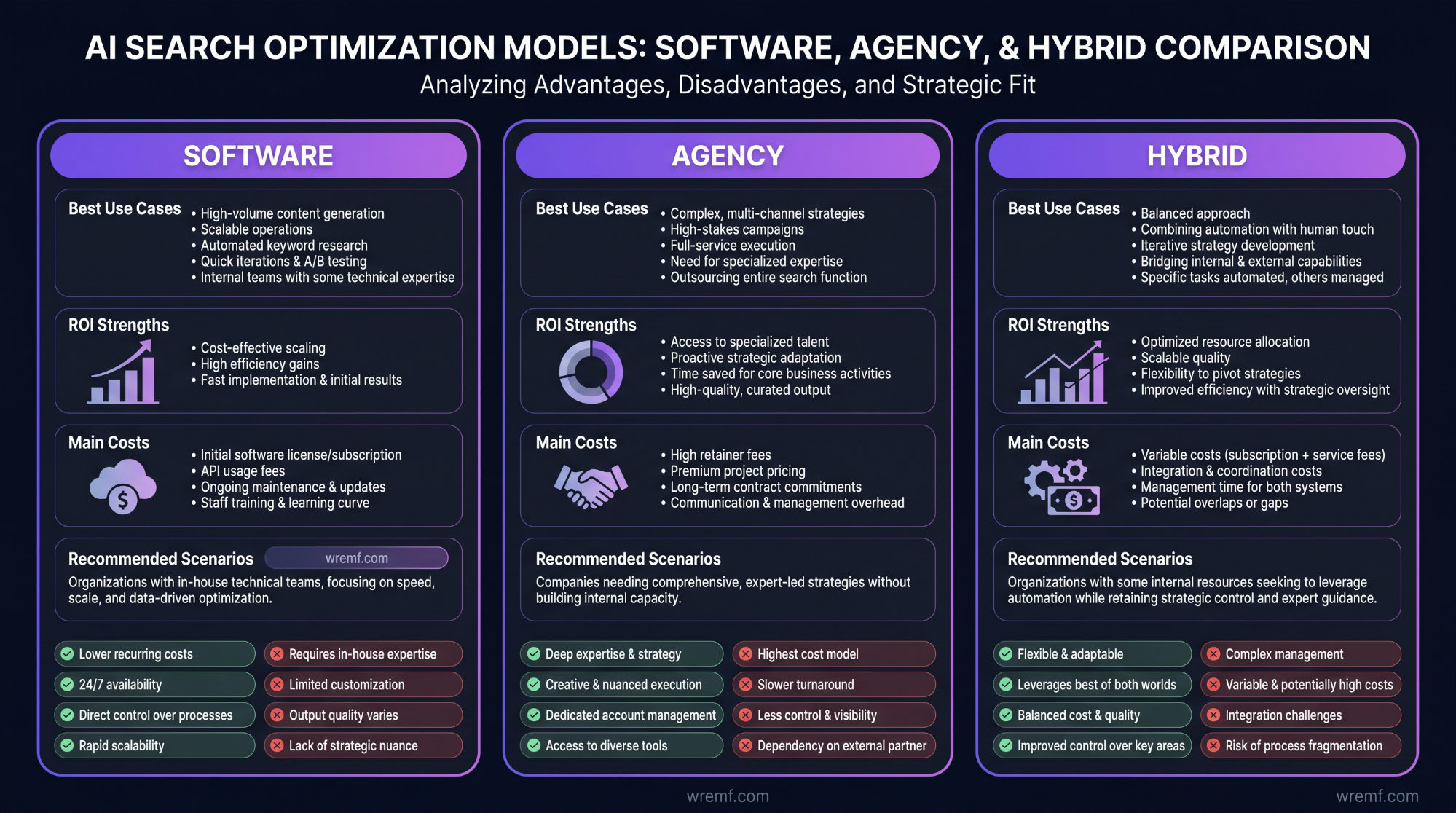
Software has the best ROI when your team can execute internally, agency support has the best ROI when you lack capacity, and a hybrid model works best when you need measurement plus implementation. The right model depends on skill, speed, and accountability.
AI search optimization software helps teams monitor prompts, citations, competitors, content gaps, and reporting workflows. Software matters because manual testing across ChatGPT, Claude, Gemini, Perplexity, Google AI Overviews, Copilot, DeepSeek, Grok, Meta AI, and Mistral is slow and inconsistent.
AI search optimization services help teams turn analysis into action. Services matter when your team needs help with AEO strategy, GEO audits, entity and authority building, source consistency cleanup, citation improvement, content briefs, schema guidance, internal linking, crawl checks, and reporting.
A hybrid model combines software with managed execution. Hybrid support matters when leadership wants measurable AI visibility, but the internal team needs senior-led execution without long-term lock-in.
| Model | Best For | ROI Strength | Main Cost | Recommended When |
|---|---|---|---|---|
| Software only | Teams with SEO and content capacity | Low recurring cost and control | Internal execution time | You can act on insights quickly |
| Agency only | Teams without SEO capacity | Faster implementation | Higher service fees | You need strategy and delivery |
| Hybrid | Growth teams and agencies | Measurement plus execution | Medium to high total cost | You need proof and progress |
| Manual testing | Very early exploration | Low software spend | High time cost and inconsistency | You are validating the need |
WREMF supports software, agency, and hybrid models. The platform is useful for tracking AI visibility, prompts, citations, competitors, share of voice, visibility scoring, scheduled AI monitoring, white-label client reporting, and AI traffic attribution. The agency model is useful when teams need execution across AEO, GEO, content systems, entity clarity, and technical foundations.
For buying-stage evaluation, WREMF pricing starts with Starter at €39 per month for 1 website and Growth at €89 per month for 5 websites. Both include BYOK, 10 AI engines, unlimited prompt tracking, all features and tools, and white-label reports. Enterprise supports unlimited websites, unlimited seats, dedicated support with a 4-hour SLA, and custom branded portals.
KEY TAKEAWAY: Software gives the best ROI when teams can execute, while hybrid support gives the best ROI when teams need both measurement and implementation.
The next practical step is building a stack based on company stage, not copying another company’s tool list.
What AI Search Optimization Stack Should You Choose by Growth Stage?
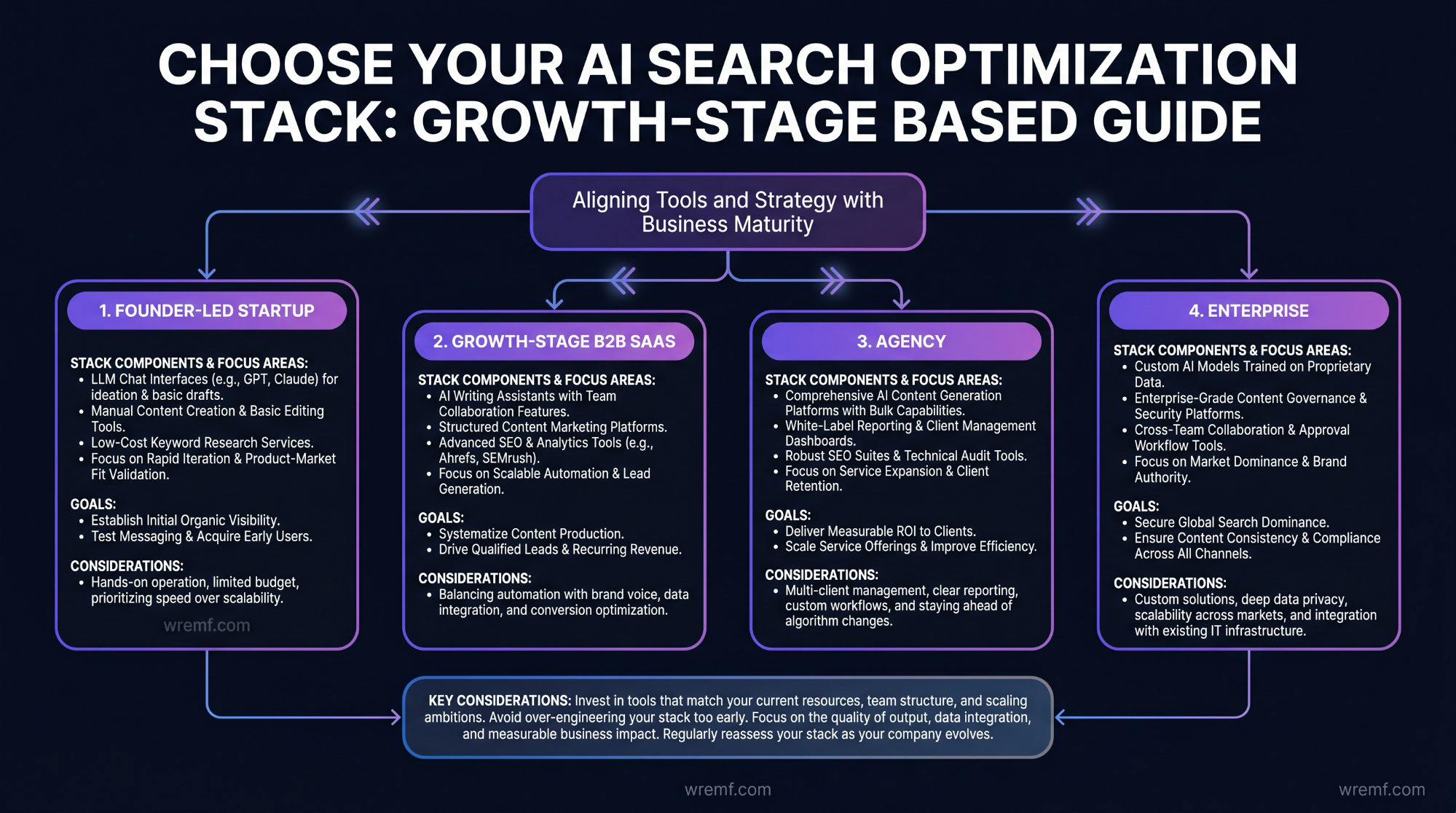
You should choose an AI search optimization stack based on company stage, content volume, reporting needs, and execution capacity. Early teams need focus, growth teams need proof, and enterprises need governance.
A lean startup should avoid buying too many overlapping AI SEO tools. The best early stack is usually AI visibility tracking, Google Search Console, Google Analytics 4, a content brief workflow, and a basic technical crawl process. This gives the team enough data to learn without creating tool debt.
A B2B SaaS growth team usually needs more structure. The stack should include AI visibility tracking, competitor monitoring, citation tracking, content optimization, technical SEO, and CRM or analytics attribution. This helps connect AI search optimization to pipeline conversations.
An agency needs repeatable reporting. Agencies managing multiple clients often need white-label reports, client portals, prompt libraries, share of voice tracking, competitor visibility, and scalable content brief workflows.
| Company Stage | Recommended Stack | Main ROI Goal | Avoid |
|---|---|---|---|
| Founder-led startup | WREMF Starter, Google Search Console, GA4, lightweight content briefs | Learn which prompts and pages matter | Buying enterprise tools too early |
| Growth-stage B2B SaaS | WREMF Growth, content optimization, technical SEO, CRM attribution | Improve visibility and prove impact | Measuring rankings only |
| Agency | WREMF agency workflows, white-label reports, content briefs, client portals | Scale client delivery | Manual prompt screenshots |
| Enterprise | WREMF Enterprise, API, BI, governance, technical SEO | Standardise visibility and reporting | Uncontrolled AI content generation |
AI search volume is an emerging planning concept that estimates demand for prompts, questions, and AI-assisted journeys rather than only keyword searches. AI search volume matters because buyer demand may appear as natural language prompts, comparison requests, and recommendation queries that do not map cleanly to traditional keyword tools.
Predictive analytics can help forecast which topics, prompts, and content opportunities may influence future AI visibility. Predictive analytics matters when teams need to prioritise limited resources across many possible pages, prompts, and source improvements.
The WREMF API and MCP integrations are useful for technical teams that want to connect AI visibility data to internal dashboards, client portals, BI tools, or automated workflows. This matters most when AI visibility reporting needs to become part of an operating system rather than a monthly spreadsheet.
KEY TAKEAWAY: The best AI search optimization stack matches your growth stage, team capacity, and reporting requirements.
Even the right stack can fail if teams misunderstand what AI can safely automate.
Which SEO Tasks Can You Automate With AI Without Hurting Quality?
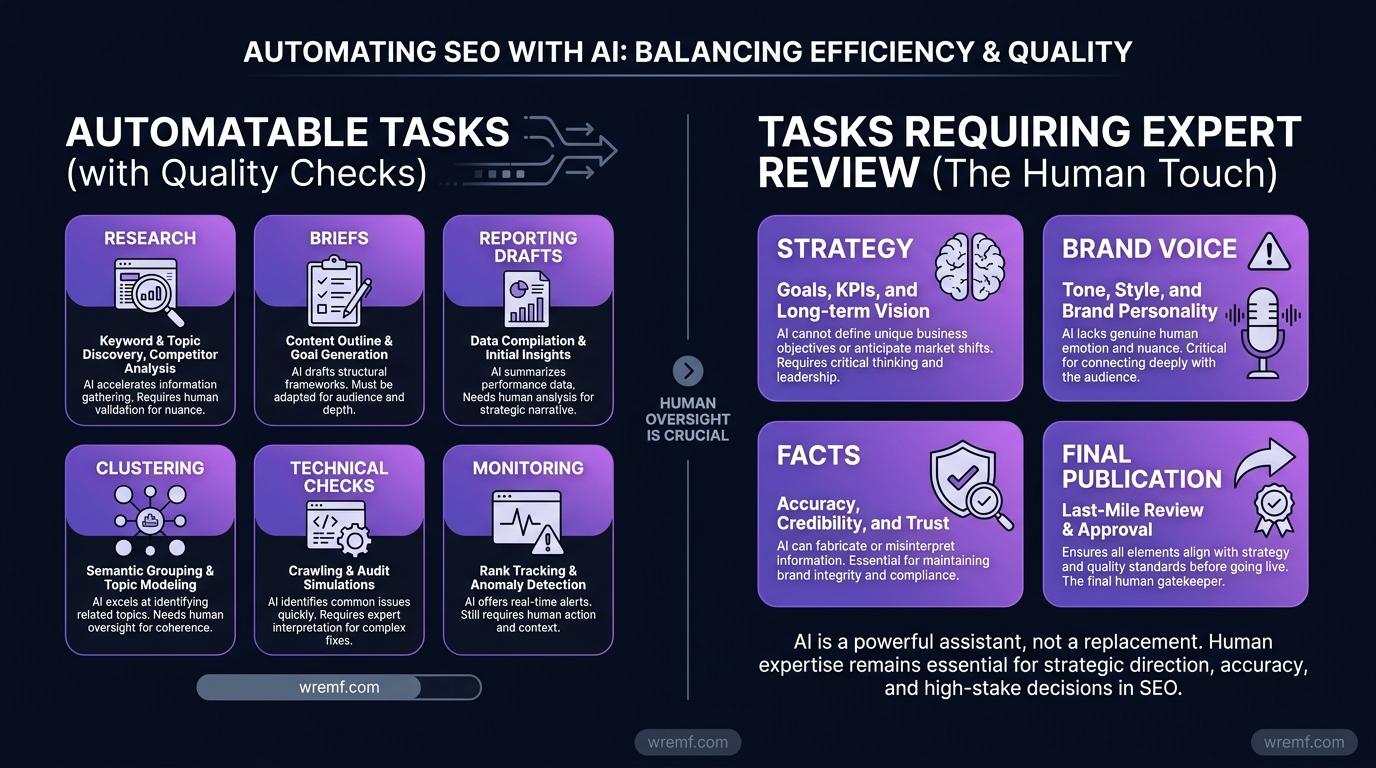
You can automate research, clustering, briefs, technical checks, reporting drafts, and monitoring, but expert review should stay in place for strategy, facts, brand voice, and final publication. AI works best as a workflow accelerator, not an unsupervised replacement.
AI content generation is the use of artificial intelligence to draft, summarise, rewrite, or structure content. AI content generation matters because it can improve speed, but it also increases the need for fact-checking, originality, and editorial control.
Content production velocity is the speed at which a team can research, brief, write, review, publish, and improve content. Content production velocity matters because faster output only creates ROI when quality, accuracy, and relevance stay high.
Safe automation areas include:
Keyword discovery
Topic clustering
Prompt library generation
Search intent analysis
Content brief drafts
SERP and AI answer summaries
Internal linking suggestions
Metadata drafts
Technical issue grouping
Schema recommendations
Reporting summaries
Competitor monitoring
Content refresh prioritisation
Human review should remain central for:
Original expertise
Product positioning
Legal or compliance claims
Statistics and source validation
Brand voice
Final recommendations
Strategic prioritisation
Customer insight
Conversion messaging
Sensitive claims
Executive reporting
The Google Search Central helpful content guidance matters here because AI-assisted content still needs to be helpful, reliable, and people-first. The risk is not that AI touched the workflow. The risk is publishing generic, inaccurate, unsupported, or search-first content that does not help the reader.
In practical AI visibility audits, the highest ROI content is often not the longest content. It is the clearest content. AI systems need concise definitions, source-backed claims, named entities, comparison tables, direct answers, and consistent brand facts.
The WREMF content brief generator helps teams turn AI visibility gaps into structured briefs that writers can use without relying on generic AI output alone.
KEY TAKEAWAY: Automate repeatable research and workflow steps, but keep human expertise in control of facts, strategy, and final publishing quality.
The same quality principle applies to technical SEO, structured data, and crawlability.
Why Is Technical AI Optimization Foundational for ROI?
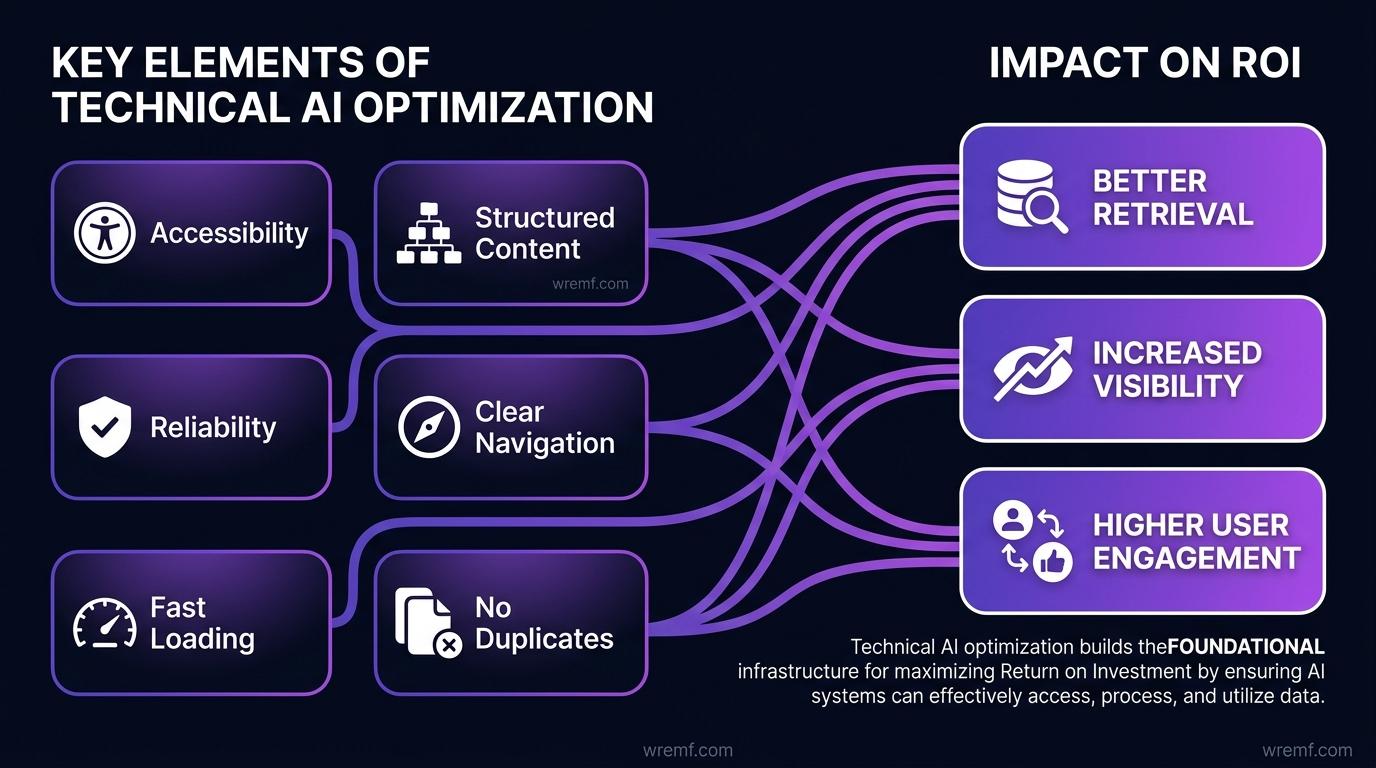
Technical AI optimization is foundational because AI systems and search engines need accessible, structured, and reliable pages to retrieve information. Tools cannot deliver full ROI if important content is blocked, unclear, slow, duplicated, or poorly connected.
Technical AI optimization is the process of improving crawlability, renderability, structured data, internal linking, entity clarity, and content accessibility for search engines and AI retrieval systems. Technical AI optimization matters because invisible or confusing content is difficult to rank, cite, or summarise.
Technical SEO is the practice of improving website infrastructure so search engines can crawl, render, understand, and index content effectively. Technical SEO matters because weak infrastructure limits the impact of content and authority work.
Structured data is a standardised format for providing information about a page and classifying its content. Google Search Central explains that structured data helps Google understand page content and can enable eligible search features.
Key technical areas include:
Crawlability and robots settings
Indexation and canonical signals
Rendered HTML visibility
Structured data and schema markup
Internal linking logic
Page speed and stability
Duplicate content control
Clear headings and answer structure
Entity-rich product and service pages
Consistent metadata
Accessible navigation
Clean URL structure
Google’s AI features documentation explains that AI Overviews are designed to help people understand complex topics and explore links for more detail. If your content is not crawlable, clear, useful, or trustworthy, it is less likely to support that discovery path.
Schema markup is structured data that helps search engines understand page entities, content type, and relationships. Schema markup matters because clear machine-readable context can support interpretation, although schema alone does not guarantee AI citations, rankings, or recommendations.
WREMF’s GEO audit feature helps teams identify technical and content issues that affect AI visibility, including crawl and rendering checks, entity clarity, structured content, and AI-readiness.
KEY TAKEAWAY: Technical AI optimization creates the foundation that allows content, citations, and visibility tracking to produce better ROI.
After the technical foundation, the strongest long-term ROI usually comes from original, trusted, and citation-worthy content.
Why Are Original Research and Trusted Sources High-ROI Assets?
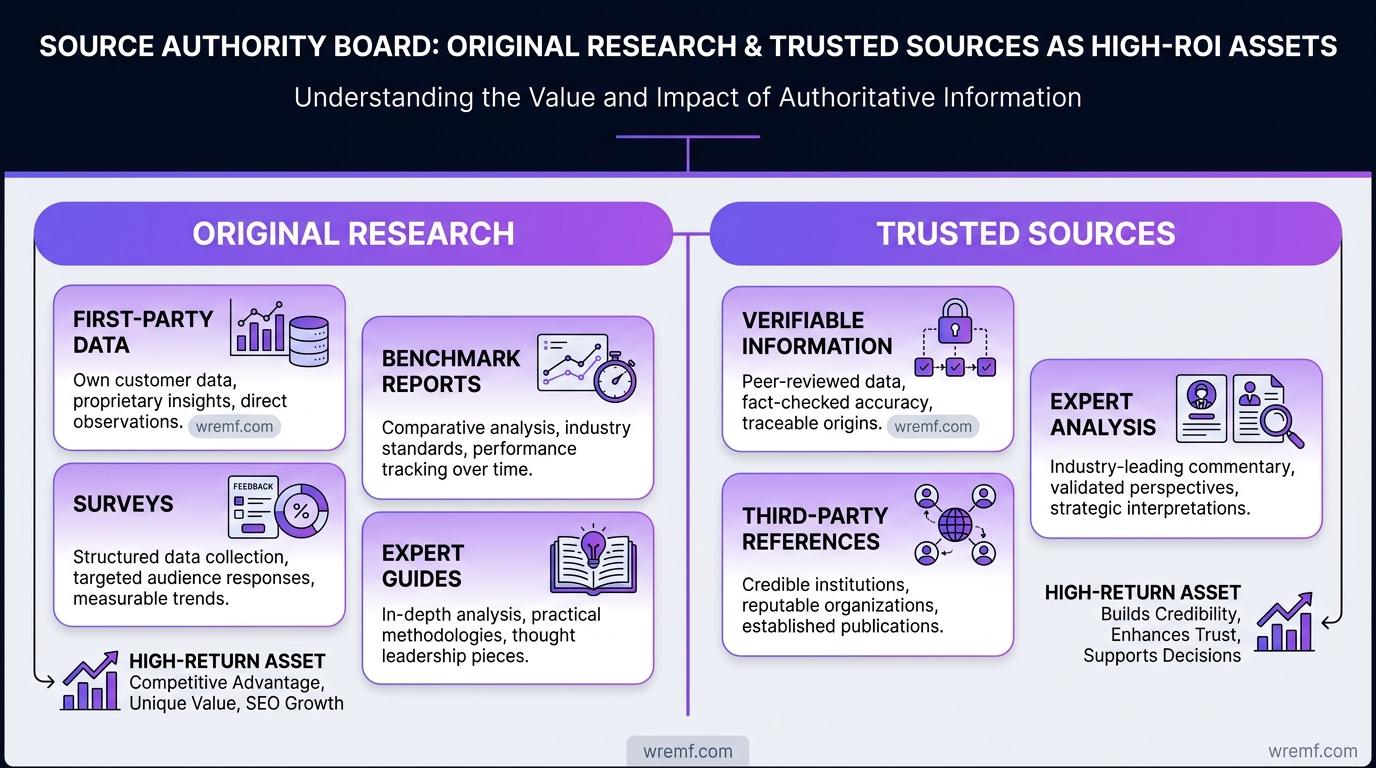
Original research and trusted sources are high-ROI assets because AI engines need reliable evidence to support answers. Brands that publish clear, useful, source-backed content can become easier to cite, compare, and recommend.
Original research is first-party data, analysis, surveys, benchmarks, experiments, or proprietary insights created by your organisation. Original research matters because it gives AI systems and human readers a reason to reference your brand beyond generic explanations.
Trusted sources are pages, publications, datasets, documentation, expert profiles, and third-party references that support a claim. Trusted sources matter because AI answers often depend on verifiable information, especially for B2B, SaaS, finance, health, legal, and technical topics.
Citation sources are the pages, domains, documents, or references an AI system uses to support an answer. Citation sources matter because they show which assets influence the answer a user sees.
High-ROI source assets include:
Benchmark reports
Original survey data
Customer problem research
Product methodology pages
Comparison frameworks
Glossaries with clear definitions
Technical documentation
Expert-authored guides
Transparent pricing pages
Case study methodology pages
Research-backed category pages
Source-backed FAQ pages
Public changelogs or product documentation
AI citations matter because citations can influence trust even when users do not click. A cited source can shape the answer, provide validation, and position a brand as part of the knowledge base for a category.
For WREMF, the AI visibility methodology page acts as a source asset because it explains how prompts, citations, competitors, source consistency, and attribution connect. This type of page helps readers and AI systems understand the brand’s approach.
DID YOU KNOW: Microsoft support documentation explains that when Copilot uses web search, users can view a sources button to see the query and sources used, which reinforces why source transparency matters in AI-assisted discovery.
KEY TAKEAWAY: Original research and trusted source assets create durable ROI because they improve both human trust and AI retrievability.
The next ROI lever is connecting AI visibility to bottom-funnel performance.
How Do You Connect AI Visibility to Bottom-Funnel Conversions?
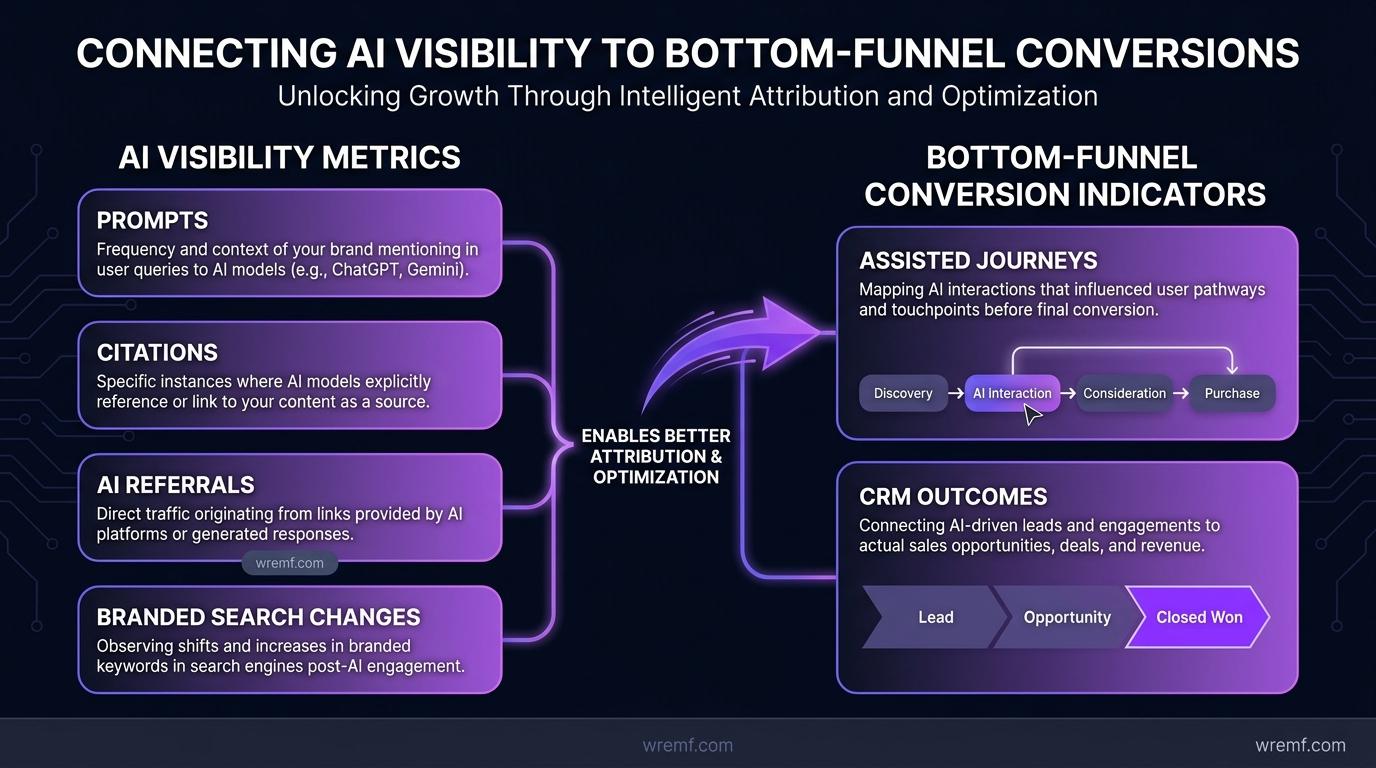
You connect AI visibility to bottom-funnel conversions by tracking prompts, citations, AI referrals, branded search changes, assisted journeys, and CRM outcomes together. AI visibility does not always create a direct click, so attribution needs multiple evidence layers.
Conversion attribution is the process of assigning credit to marketing touchpoints that contribute to a lead, sale, or revenue outcome. Conversion attribution matters because AI search may influence awareness, comparison, and shortlist formation before a measurable website visit.
Attribution models are frameworks for distributing credit across touchpoints. Attribution models matter because last-click reporting can undercount AI influence when buyers use AI tools before searching your brand or visiting your website.
Organic conversion rate is the percentage of organic visitors who complete a desired action, such as booking a demo, starting a trial, joining a waitlist, or submitting a form. Organic conversion rate matters because visibility without conversion does not prove business impact.
A practical attribution workflow includes:
Track AI visibility for branded and non-branded prompts
Monitor citation sources and competitor appearances
Tag AI referral traffic where visible in analytics
Track branded search changes after AI visibility improvements
Compare content updates with GSC and GA4 trend changes
Connect landing pages to CRM lead and opportunity data
Report prompt-level wins alongside conversion-level outcomes
Separate measurable facts from directional influence
Google Analytics 4 can show traffic acquisition and referral data when AI tools pass a visible referral. However, AI discovery can also be zero-click, masked, or followed by a later branded search. This means AI ROI reporting should combine analytics evidence with visibility evidence.
Customer lifetime value is the total expected value of a customer relationship over time. Customer lifetime value matters because a small number of high-intent AI-assisted leads can justify a tool investment even when direct traffic volume looks modest.
KEY TAKEAWAY: AI visibility ROI is strongest when prompt tracking, citation evidence, analytics, and CRM outcomes are reported together.
This is why multi-engine tracking is more useful than checking one AI tool manually.
Why Does Multi-Engine Tracking Improve ROI?
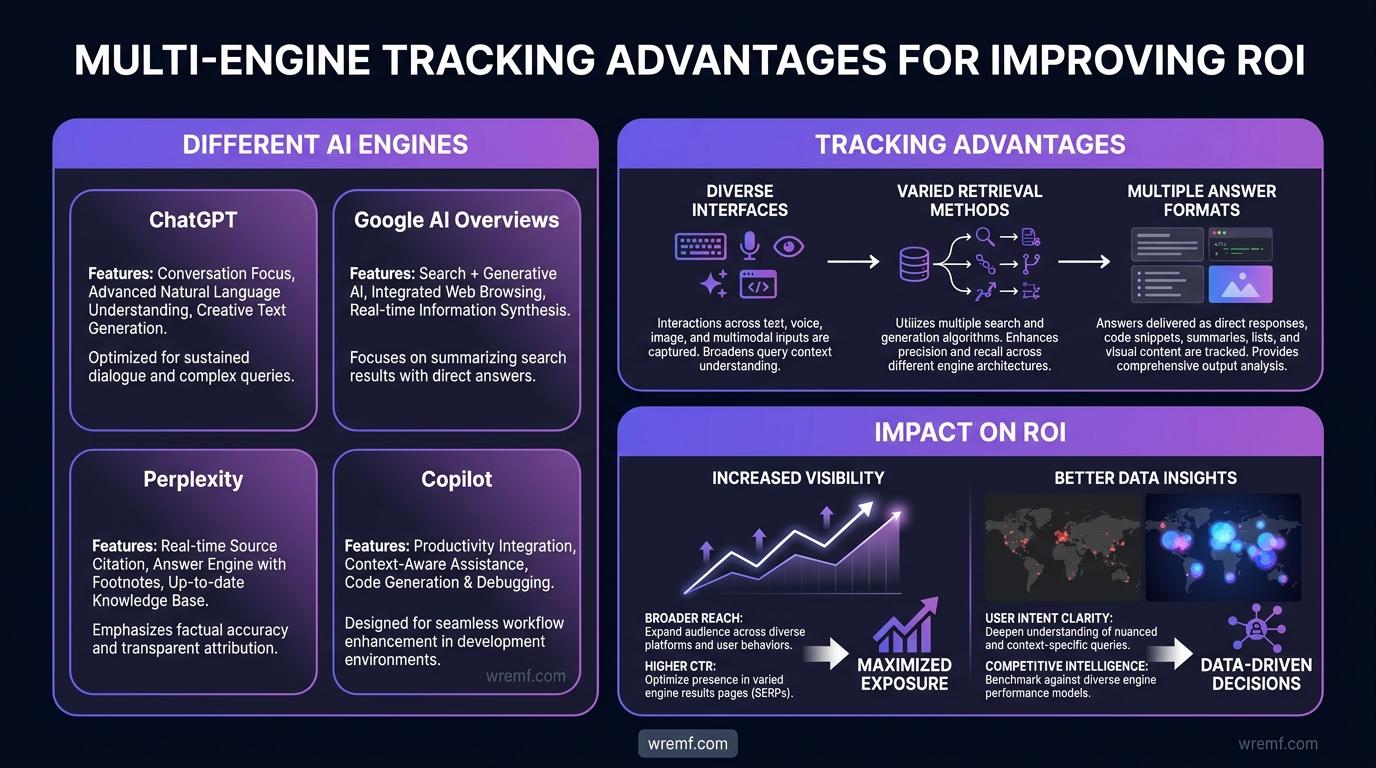
Multi-engine tracking improves ROI because different AI engines use different interfaces, source patterns, retrieval methods, and answer formats. A brand that appears in one AI engine may be invisible in another.
Multi-engine tracking is the process of monitoring visibility across several AI discovery surfaces rather than testing one model or search engine. Multi-engine tracking matters because buyers use ChatGPT, Perplexity, Gemini, Claude, Copilot, Google AI Overviews, DeepSeek, Grok, Meta AI, Mistral, and traditional search in different ways.
Google AI Overviews appear inside Google Search and can summarise information with links for deeper exploration. ChatGPT search can provide conversational answers with source links. Perplexity positions itself as an AI-powered answer engine. Microsoft Copilot can show sources when web search is used. These differences affect how brands are surfaced and measured.
| AI Discovery Surface | Why It Matters | ROI Signal to Track |
|---|---|---|
| Google AI Overviews | Appears inside Google Search journeys | AI Overview citations and source presence |
| ChatGPT | Used for summaries, comparisons, and recommendations | Brand mentions and source links |
| Perplexity | Source-led answer engine behavior | Citation sources and competitor presence |
| Gemini | Google ecosystem discovery and AI answers | Category visibility and branded accuracy |
| Claude | Long-form reasoning and research workflows | Brand explanation and accuracy |
| Copilot | Microsoft and Bing-connected workflows | Source references and business-user discovery |
| DeepSeek | Additional AI answer surface | Visibility consistency |
| Grok | Social and real-time discussion context | Brand mention quality |
| Meta AI | Consumer and social discovery | Brand presence in social-adjacent journeys |
| Mistral | European AI ecosystem relevance | Multi-market visibility |
WREMF tracks 10 AI engines so teams can compare AI visibility across different discovery surfaces. This is useful because a single-engine report can create false confidence. A brand may look visible in one system and weak in another.
AI answers are generated responses that summarise, recommend, compare, or explain information for a user. AI answers matter because they can replace or compress the research journey that once required several search results pages.
KEY TAKEAWAY: Multi-engine tracking improves ROI because it shows where your brand is visible, missing, cited, or misrepresented across different AI discovery surfaces.
Multi-engine tracking also helps teams prepare for multimodal and voice-led search behavior.
How Should Teams Future-Proof ROI for Multimodal and Voice AI Search?
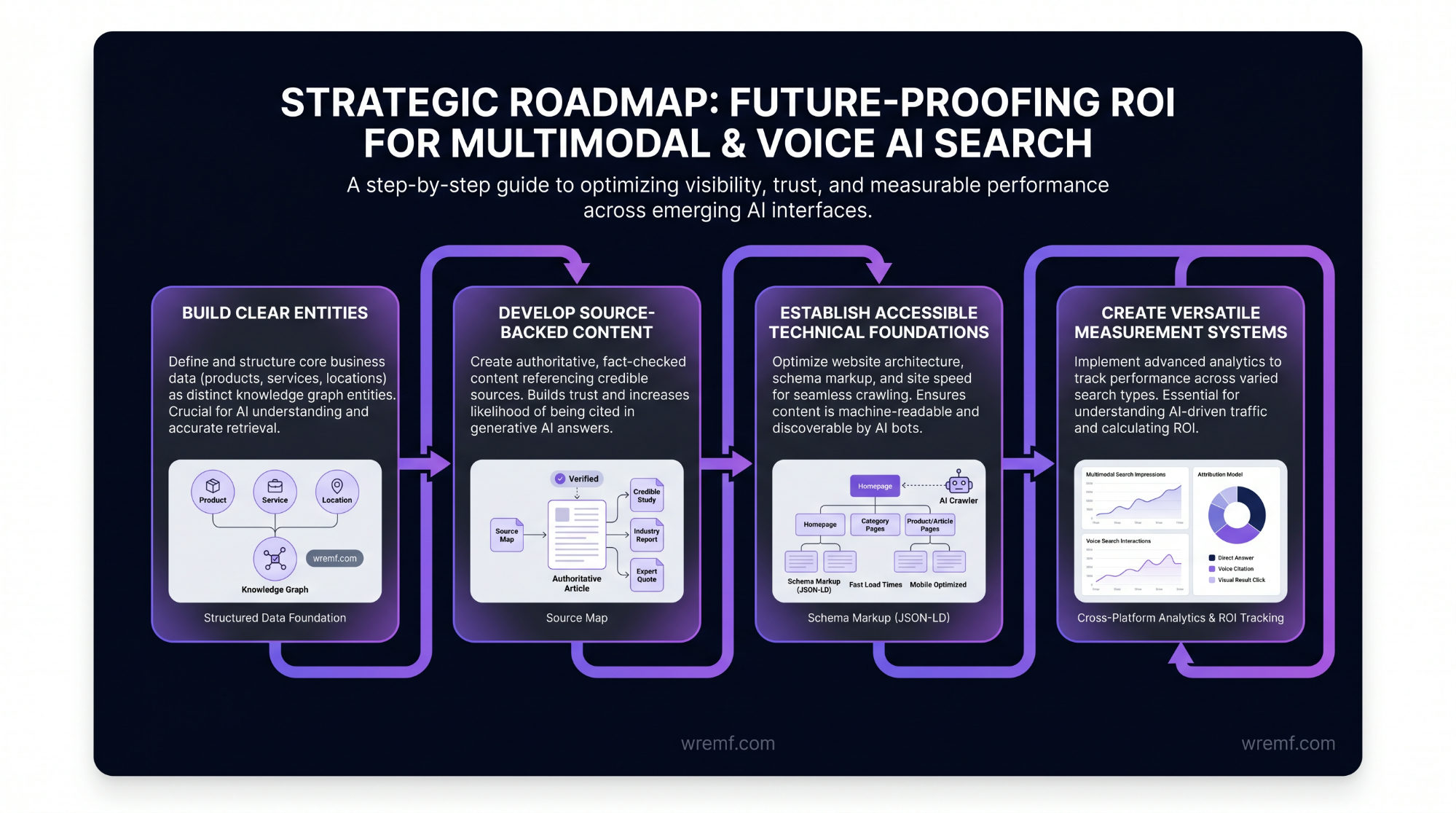
Teams should future-proof ROI by building clear entities, source-backed content, accessible technical foundations, and measurement systems that work beyond text-based rankings. Multimodal and voice AI make brand clarity more important, not less.
Multimodal AI search is search behavior that uses text, voice, images, documents, screenshots, or other inputs to generate answers. Multimodal AI search matters because users may discover brands through product screenshots, voice questions, visual search, or document-based research.
Voice search is the use of spoken queries to retrieve answers, recommendations, or actions. Voice search matters because spoken queries are usually conversational, question-based, and intent-rich.
Visual search is the use of images or visual inputs to discover information, products, places, or related content. Visual search matters because users may search by what they see rather than by typed keywords.
Future-proof AI search optimization focuses on principles that apply across formats:
Clear brand positioning
Consistent entity descriptions
Answer-first content
Structured data
Accessible page content
Strong internal linking
Source-backed claims
Original research
Product and service clarity
Updated documentation
Technical crawlability
Measurable prompt coverage
The ROI of future-facing AI optimization is not about chasing every new interface. The ROI comes from making your brand easier for search systems, answer engines, and users to understand. A clear entity with consistent sources is more resilient than a page built around one keyword variation.
In real-world reporting, teams should track current engines while designing content for broader retrieval. This means writing direct definitions, comparison tables, decision frameworks, FAQs, and methodology pages that make sense to both humans and AI systems.
KEY TAKEAWAY: Future-proof AI search ROI comes from clear entities, trusted sources, accessible content, and measurement systems that can adapt beyond traditional rankings.
The final evaluation step is knowing what mistakes reduce ROI after tools are purchased.
What Mistakes Reduce the ROI of AI Search Optimization Tools?
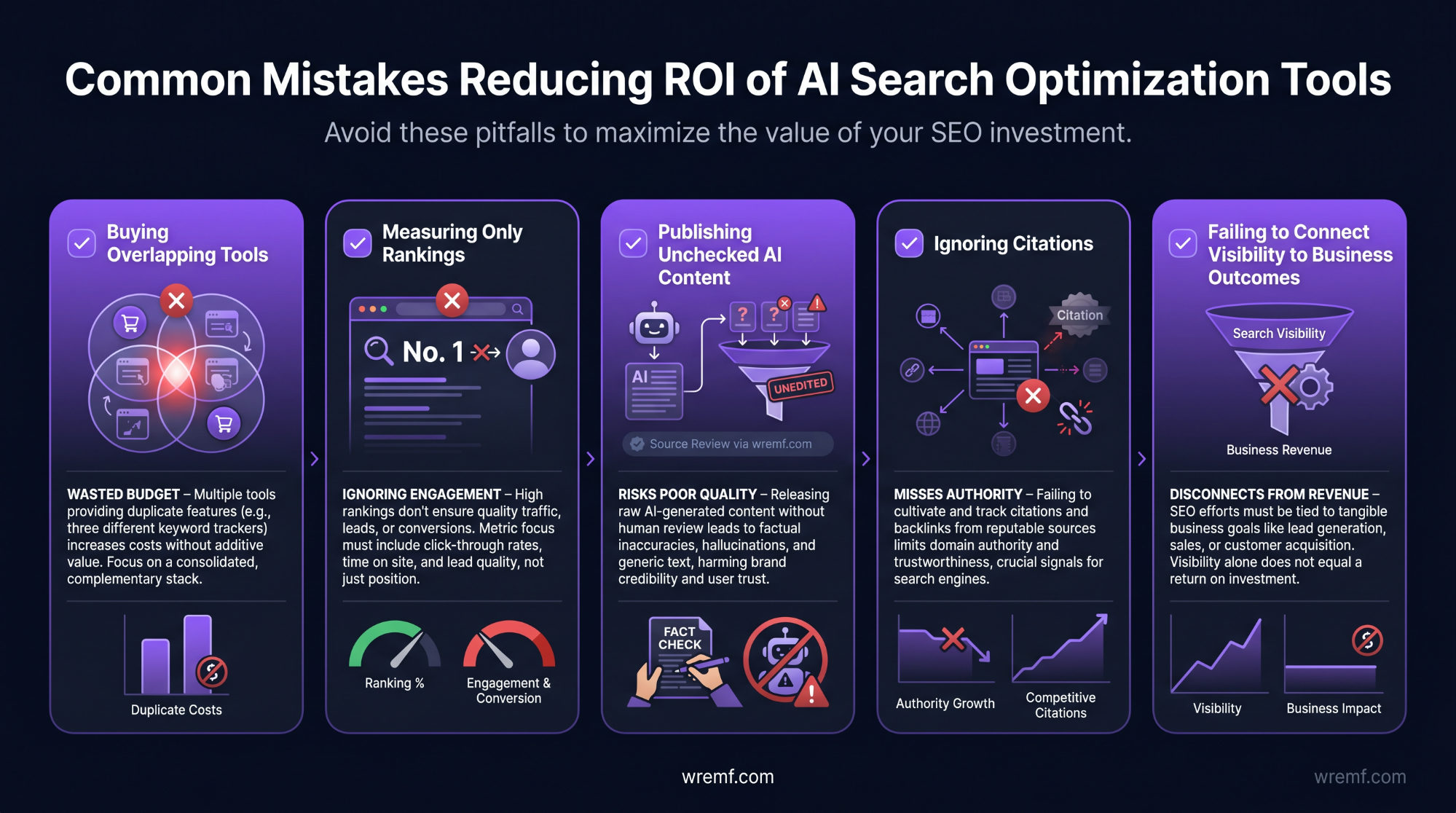
The biggest ROI mistakes are buying overlapping tools, measuring only rankings, publishing unchecked AI content, ignoring citations, and failing to connect visibility to business outcomes. Tools create ROI only when they change decisions and execution.
A common implementation mistake is treating AI search optimization as content production only. More content does not automatically create more AI visibility. AI engines need clear answers, credible sources, consistent entities, technical accessibility, and evidence of relevance.
Another mistake is relying on manual prompt testing. Manual testing is useful for early exploration, but it is inconsistent across users, locations, engines, dates, and prompt wording. Scheduled AI monitoring is more reliable when teams need trend data.
Teams also reduce ROI when they ignore competitors. Competitor visibility shows which brands appear in AI answers when yours does not. This helps you identify missing pages, weak positioning, source gaps, and category authority issues.
| Mistake | Why It Hurts ROI | Better Approach |
|---|---|---|
| Measuring rankings only | Misses AI answers and recommendations | Track AI visibility and share of voice |
| Publishing unchecked AI content | Increases factual and brand risk | Keep expert review in the workflow |
| Ignoring citations | Misses source influence | Track citation sources and improve source assets |
| Buying overlapping tools | Increases cost without clarity | Build a focused stack |
| Tracking branded prompts only | Misses category discovery | Track informational, comparison, and buying prompts |
| No attribution plan | Makes ROI hard to prove | Connect GA4, CRM, and reporting workflows |
| Ignoring technical issues | Limits retrievability | Run crawl, rendering, and structured data checks |
| Treating AI visibility as one-time | Misses trend movement | Use scheduled monitoring |
WREMF’s competitive landscape tracking helps teams compare how competitors appear across AI answers, which is especially useful for B2B categories where buyers ask AI tools for vendor shortlists.
IMPORTANT: Rankings alone are not enough. A brand can rank well in Google and still be absent from AI-generated vendor recommendations.
KEY TAKEAWAY: AI search tool ROI falls when teams automate activity without measuring visibility, citations, competitors, and business impact.
Many of these mistakes come from myths that make teams underinvest, overinvest, or measure the wrong thing.
Common Myths About AI Visibility Debunked
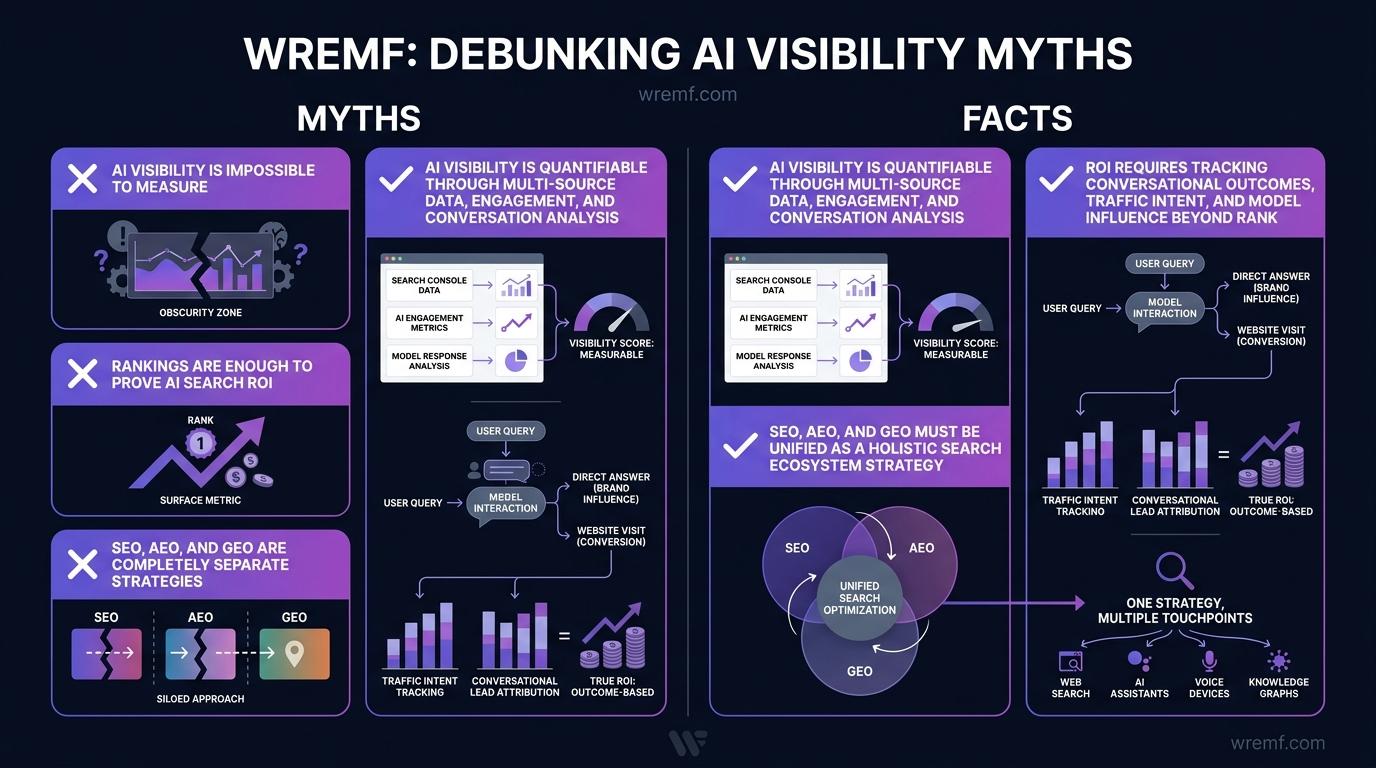
AI visibility is measurable, but it requires different metrics from traditional SEO. The most common myths come from applying rank tracking logic to AI-generated answers.
MYTH: AI visibility is impossible to measure.
FACT: AI visibility can be measured through prompt tracking, brand mentions, AI citations, recommendation presence, competitor share of voice, and AI referral traffic. The measurement is probabilistic rather than fixed because AI answers can vary by prompt, location, engine, source set, and time. Scheduled tracking makes the trend more useful than one-off manual checks.
MYTH: SEO, AEO, and GEO are completely separate strategies.
FACT: SEO, AEO, and GEO overlap. SEO provides technical and content foundations, AEO improves extractable answers, and GEO focuses on generative AI inclusion, citation, and recommendation. The best ROI comes from integrating all three rather than replacing SEO with a new acronym.
MYTH: Rankings are enough to prove AI search ROI.
FACT: Rankings still matter, but rankings do not show whether ChatGPT, Claude, Gemini, Perplexity, Copilot, or Google AI Overviews mention your brand. AI visibility requires additional metrics such as prompt coverage, citations, brand mentions, source consistency, and competitor presence.
MYTH: AI SEO tools can replace an SEO agency or content team.
FACT: AI SEO tools can automate research, monitoring, briefs, and reporting, but they do not replace strategy, expert judgment, original research, technical implementation, or brand-level decision-making. A software-only model works best when your team can execute. A hybrid model works better when your team needs support.
MYTH: The highest-ROI tool is always the cheapest tool.
FACT: The cheapest tool can have poor ROI if it produces unused reports, weak content, or incomplete data. ROI depends on whether the tool improves decisions, saves meaningful time, increases visibility, supports attribution, and helps teams ship better work.
KEY TAKEAWAY: AI visibility is measurable when you track prompts, citations, competitors, source consistency, and attribution instead of relying on rankings alone.
These myths lead directly into the buying questions teams ask before choosing a tool.
Frequently Asked Questions
Which AI search optimization tools offer the best ROI?
The AI search optimization tools with the best ROI are the tools that solve your current bottleneck. If you cannot measure AI visibility, use a platform such as WREMF for prompt tracking, citations, competitor visibility, and share of voice. If content production is slow, use content optimization tools such as Frase, Clearscope, Surfer, or MarketMuse. If technical issues block performance, prioritise technical SEO tools. The best ROI often comes from combining AI visibility tracking, content briefs, technical SEO, and attribution rather than relying on one isolated tool.
Which AI model is best for SEO optimization?
The best AI model for SEO optimization depends on the task. ChatGPT is strong for ideation, outlines, briefs, rewriting, and analysis. Claude is useful for long-form review, synthesis, and editorial refinement. Gemini can be useful for Google ecosystem workflows. Perplexity is useful for source-led research and citation discovery. No single AI model replaces SEO judgment. For ROI, the model matters less than the workflow: source validation, prompt quality, expert review, search intent mapping, and performance measurement.
Is SEO dead or evolving in 2026?
SEO is evolving, not dead. Search still matters because buyers use Google, review pages, vendor websites, communities, and AI assistants together. What has changed is the measurement layer. SEO teams now need to understand AI Overviews, ChatGPT search, Perplexity citations, Gemini answers, and AI recommendation visibility. Traditional SEO metrics such as rankings, clicks, and conversions remain important, but they should be paired with AI visibility, source citations, brand mentions, and competitor share of voice.
Which AI search engine is worth paying for?
The AI search engine worth paying for depends on the job. ChatGPT can be useful for broad research, ideation, and search-assisted answers. Perplexity can be useful for source-led research and citation review. Gemini can be useful for Google ecosystem workflows. Claude can be useful for long-form reasoning and content review. For a B2B team, the bigger ROI question is not which AI engine to buy, but whether your brand is visible across the AI engines your buyers use. That is where AI visibility tracking becomes important.
How do I maximize AI ROI from search optimization tools?
To maximize AI ROI, start with a clear baseline. Track your current AI visibility, branded and non-branded prompts, citation sources, competitor mentions, organic traffic, and conversions. Then prioritise the work that removes the biggest constraint: content gaps, weak source consistency, missing citations, technical issues, or poor attribution. Use AI to automate research and briefs, but keep human review for facts and strategy. WREMF helps teams turn this into a repeatable workflow across tracking, recommendations, reporting, and execution.
Do I need multiple AI SEO tools or just one?
You need one focused platform if your main goal is AI visibility tracking, reporting, and decision clarity. You need multiple tools if your workflow also requires content optimization, technical crawling, analytics, CRM attribution, and publishing operations. Small teams should avoid tool overload. Growth teams usually benefit from a focused stack: AI visibility platform, Google Search Console, Google Analytics 4, content optimization suite, and technical SEO tool. Agencies may need white-label reporting, client portals, and repeatable prompt libraries.
Can AI SEO tools replace my SEO agency?
AI SEO tools can reduce manual work, but they usually cannot replace a good SEO agency when strategy and execution are needed. Tools can monitor prompts, generate briefs, identify gaps, and summarise performance. Agencies can interpret tradeoffs, prioritise actions, fix technical issues, build authority, improve content systems, and connect work to business goals. WREMF supports both models: software for teams that execute internally and managed AEO, GEO, and AI visibility services for teams that want senior-led support.
Are AI SEO tools safe to use, or can they get my site penalized?
AI SEO tools are generally safe when used for research, monitoring, briefs, technical checks, and decision support. Risk increases when teams publish large volumes of unchecked AI-generated content, fabricate expertise, use unsupported claims, or create pages mainly to manipulate rankings. Google Search Central emphasises helpful, reliable, people-first content, which means quality and usefulness matter more than whether AI assisted the workflow. Use AI tools with editorial review, source validation, original insight, and clear user value.
How quickly do AI search optimization tools show results?
AI search optimization tools can show measurement value immediately because they reveal prompts, citations, competitors, and content gaps. Business results usually take longer because content updates, technical fixes, source improvements, and authority signals need time to influence search and AI systems. A practical timeline is 1 to 2 weeks for baseline visibility, 30 to 60 days for early content and technical improvements, and 90 days or more for stronger trend reporting. Results vary by site authority, category competition, and execution speed.
How much should I budget for AI search optimization tools?
Budget depends on your stage and execution model. A small team can start with a low-cost AI visibility platform, Google Search Console, GA4, and a lightweight content workflow. A growth team may need AI visibility tracking, content optimization, technical SEO, and attribution tools. WREMF pricing starts at €39 per month for Starter and €89 per month for Growth, with BYOK, 10 AI engines, unlimited prompt tracking, and white-label reports included. Enterprise budgets should include governance, API workflows, and implementation support.
What data access do AI SEO tools need?
AI SEO tools usually need access to public website data, tracked prompts, search performance data, analytics data, and sometimes CRM or conversion data. Visibility tools may need your domain, competitors, target prompts, brand facts, and target markets. Attribution workflows may need Google Analytics 4, Google Search Console, CRM, or BI access. BYOK support can also matter when teams want to control AI provider costs and data workflows. The safest setup gives the tool only the access required for the task.
What are the best AI SEO tools for B2B SaaS growth teams?
The best AI SEO tools for B2B SaaS growth teams cover AI visibility, content strategy, technical SEO, competitor tracking, and attribution. WREMF is useful for tracking how a SaaS brand appears across ChatGPT, Claude, Gemini, Perplexity, Google AI Overviews, Copilot, DeepSeek, Grok, Meta AI, and Mistral. Content optimization tools help create briefs and improve topic coverage. Technical SEO tools help remove crawl and rendering barriers. GA4 and CRM reporting help connect visibility to pipeline and conversions.
Conclusion
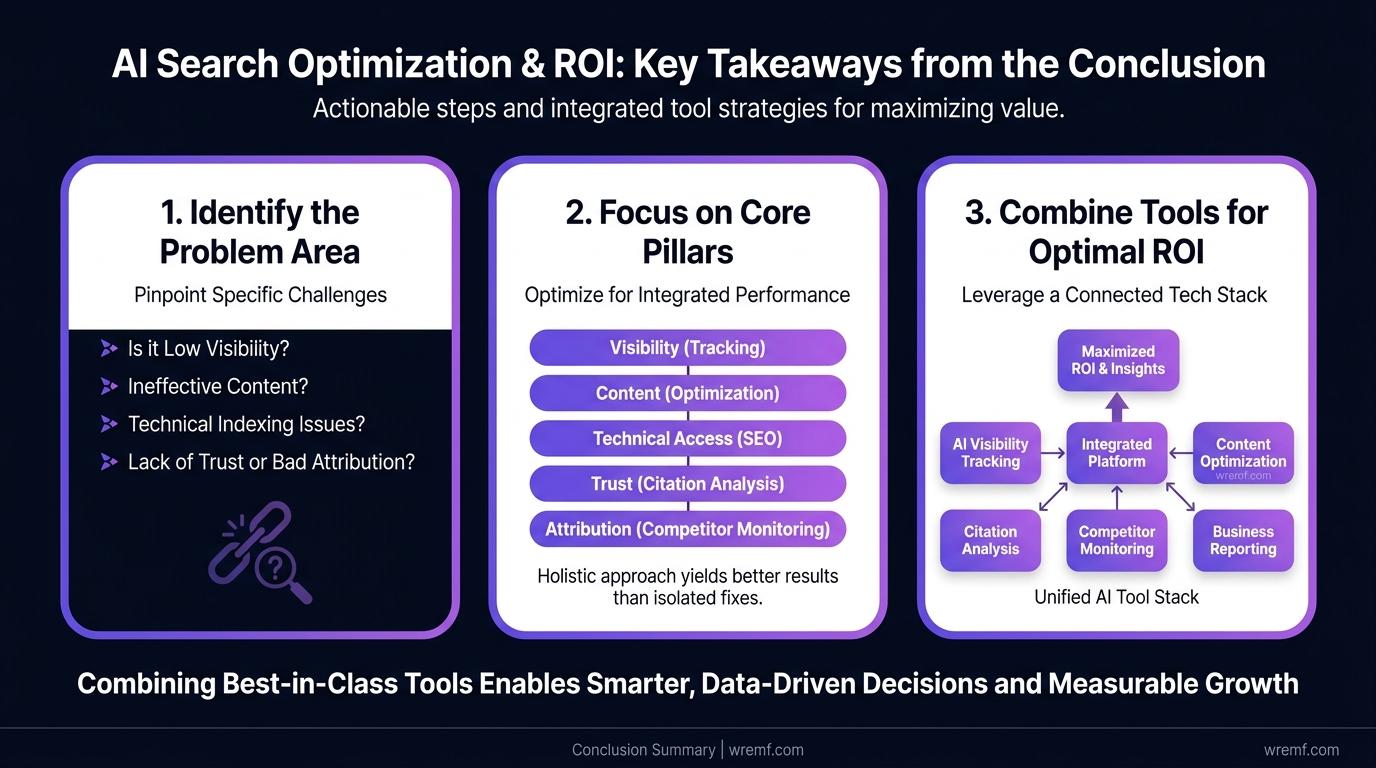
Which AI search optimization tools have the best ROI depends on the problem you need to solve first: visibility, content velocity, technical access, source trust, or attribution. The strongest ROI usually comes from a focused stack that combines AI visibility tracking, content optimization, technical SEO, citation analysis, competitor monitoring, and business reporting. WREMF helps teams turn AI search optimization from manual testing into a measurable workflow across prompts, citations, competitors, source consistency, and attribution. To evaluate your next step, explore the WREMF platform suite or talk to the WREMF agency team for managed AEO and GEO execution.
Related reading
- AI Search Engine Optimization Tools: The Complete 2026 Guide for AI Search, SEO, AEO, and GEO
- AI Overviews Tracker: The Complete Guide to Monitoring Google AI Overviews, Citations, and AI Search Visibility
- The Complete Guide to AI Rank Tracker Tools for B2B Search Visibility
- Why Use AI Search Optimization Tools for Your Business