The Complete Guide to Marketing Intelligence Tools for B2B and Enterprise Teams
Learn how marketing intelligence tools assist B2B teams in analyzing data and streamlining decisions. Discover tool categories and evaluation criteria.
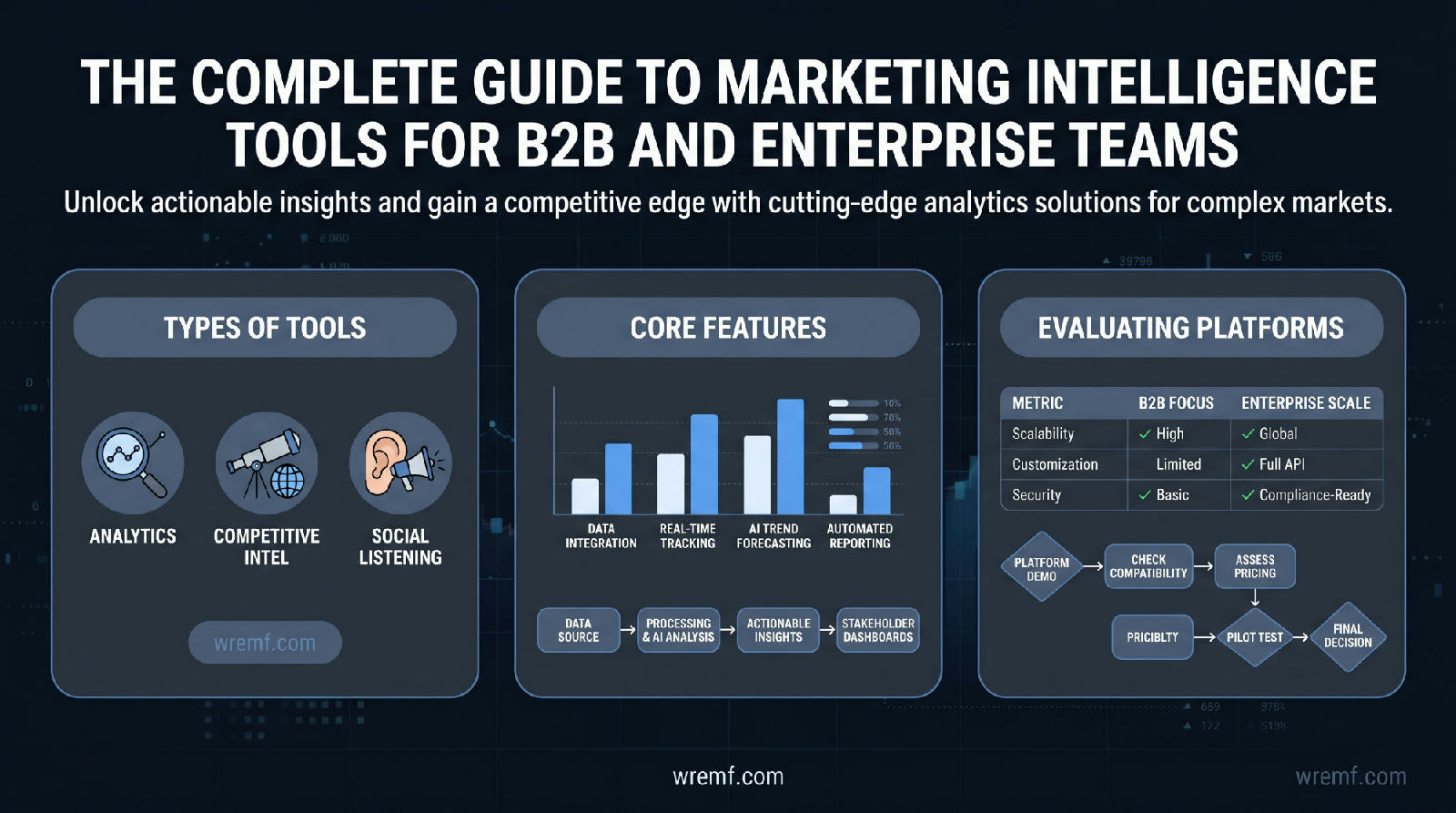
By WREMF Team · 2026-08-26
Marketing intelligence tools are platforms that collect and analyze data about competitors, market trends, campaign performance, and customer behavior for B2B and enterprise teams. These tools include competitive intelligence, marketing analytics, attribution solutions, social listening, and financial research. They help teams make fast and confident decisions by reducing decision latency and improving budget execution. Key components include AI-powered platforms like AlphaSense and Crayon, which use machine learning to automate data analysis. Effective tool selection involves matching platform features to specific use cases and ensuring integration with existing systems.
Key takeaways
- Marketing intelligence tools cover competitive monitoring, attribution modelling, and social listening.
- Market intelligence is continuous, while market research is project-based.
- Choosing the right tool requires matching it to specific data problems and use cases.
- AI search visibility adds a new layer of intelligence traditional tools don't cover.
- Attribution is challenging due to cross-device tracking and untracked research activity.
The Complete Guide to Marketing Intelligence Tools for B2B and Enterprise Teams
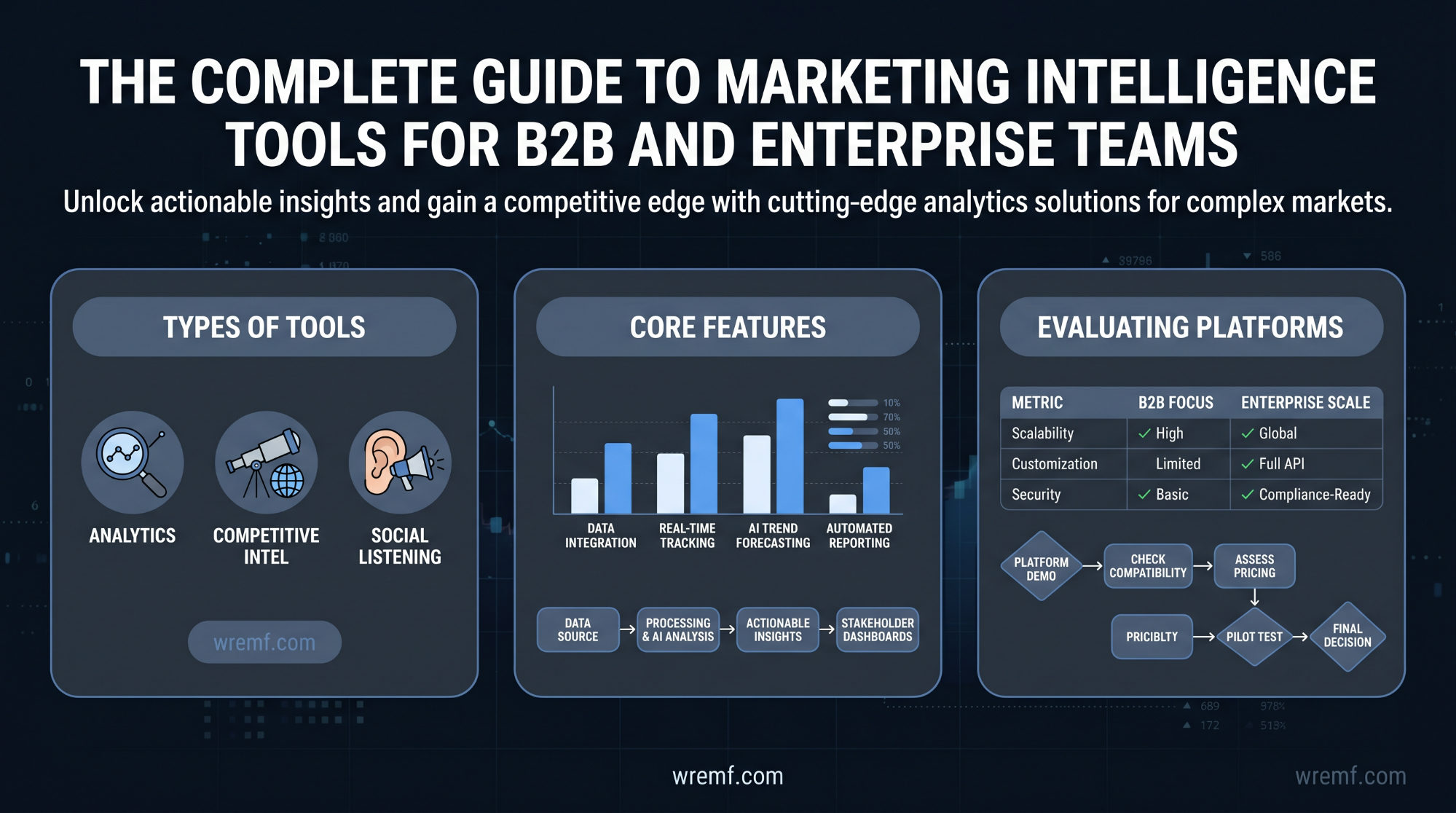
Marketing intelligence tools are platforms that collect, analyse, and surface data about competitors, customers, market trends, and campaign performance so teams can make faster and more confident decisions. The category spans competitive monitoring, attribution modelling, traffic analysis, financial research, social listening, and AI-powered analytics. This guide is written for B2B teams, enterprise marketing teams, growth leaders, agencies, and consultants who need to choose the right platform for their specific situation. It covers what marketing intelligence tools do, how the major categories differ, how to evaluate platforms against your feature requirements, and where AI visibility fits into a modern intelligence stack. Whether you are assessing Crayon, AlphaSense, Similarweb, or attribution tools such as Improvado and Funnel, this guide gives you a framework for selecting the platform that matches your target market, data needs, and budget.
QUICK ANSWER:
Marketing intelligence tools are software platforms that help teams track competitors, analyse market trends, measure campaign attribution, monitor customer behaviour, and surface actionable signals from data. The category includes competitive intelligence platforms, marketing analytics tools, attribution solutions, social listening tools, SEO and search intelligence platforms, and financial research tools. Teams use them to reduce decision latency, improve budget execution, and understand their competitive environment.
KEY TAKEAWAYS:
- Marketing intelligence tools span multiple categories including competitive monitoring, attribution modelling, traffic analysis, social listening, and financial research, and most teams need more than one platform.
- The difference between market intelligence and competitive intelligence is scope: market intelligence covers the full competitive environment including customers, regulations, and market signals, while competitive intelligence focuses specifically on competitor activity.
- Attribution remains one of the hardest problems in marketing intelligence because cross-device fragmentation, dark funnel activity, and incomplete CRM systems create gaps in measurement.
- AI-powered platforms such as AlphaSense, Crayon, and Contify use natural language processing and machine learning to automate analysis at a scale that manual research cannot match.
- AI search visibility is a separate intelligence layer that traditional marketing intelligence tools do not cover. Platforms such as WREMF track how brands appear in ChatGPT, Gemini, Perplexity, and other AI engines where buyers increasingly discover and shortlist vendors.
- Choosing the right marketing intelligence platform requires matching platform type, data volume, user count, integration requirements, and budget against your team's specific use cases.
What Are Marketing Intelligence Tools?
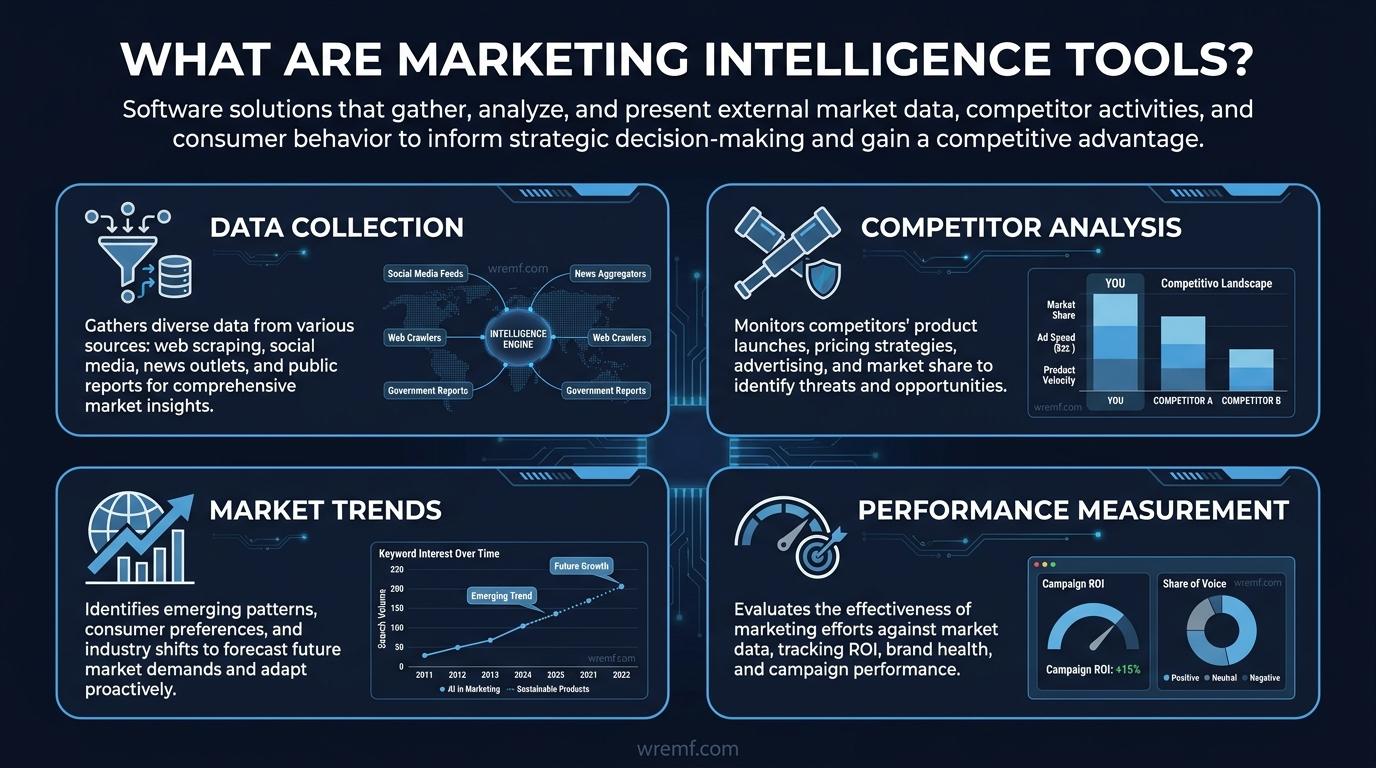
Marketing intelligence tools are software platforms that aggregate, analyse, and present data from internal and external sources so marketing teams can understand their market, track competitors, measure performance, and act on buyer signals. They reduce the time between data collection and campaign decisions, which is the measurement-to-action loop that separates high-performing teams from reactive ones.
The category is broad by design. A marketing intelligence platform might focus on one domain, such as competitive monitoring or multi-touch attribution, or it might consolidate multiple data streams into a unified analytics layer. The right tool depends on what problem your team is trying to solve, not on which platform has the longest feature list.
At their core, marketing intelligence tools answer four categories of questions. The first is competitive: what are competitors doing with pricing, content marketing, product launches, and messaging? The second is market: what signals from regulations, funding rounds, customer sentiment, and market trends should inform strategy? The third is performance: which campaigns, channels, and touchpoints are driving pipeline and revenue? The fourth is audience: who is buying, what do they care about, and where are they in their journey?
The distinction between a marketing intelligence platform and a business intelligence tool such as Tableau or PowerBI is significant. Business intelligence tools are configurable data infrastructure. They require data engineers, analysts, and time to connect sources and build dashboards. Marketing intelligence platforms are purpose-built for GTM teams. They come pre-integrated with ad platforms, CRM systems, and data sources, and they surface decisions rather than just displaying data. Digital marketers and growth teams benefit most from tools built for their specific workflows, not generic analytics canvases.
Data quality and data governance are foundational concerns across all categories. A platform that pulls from 500 sources but delivers inconsistent, unverified, or stale records creates more problems than it solves. When evaluating any marketing intelligence tool, governance standards such as SOC 2 compliance, data refresh frequency, and source verification matter as much as feature count.
KEY TAKEAWAY: Marketing intelligence tools are purpose-built for GTM decision-making, and the right platform is determined by the specific data problem your team needs to solve, not by feature breadth alone.
Market Intelligence vs Market Research vs Competitive Intelligence
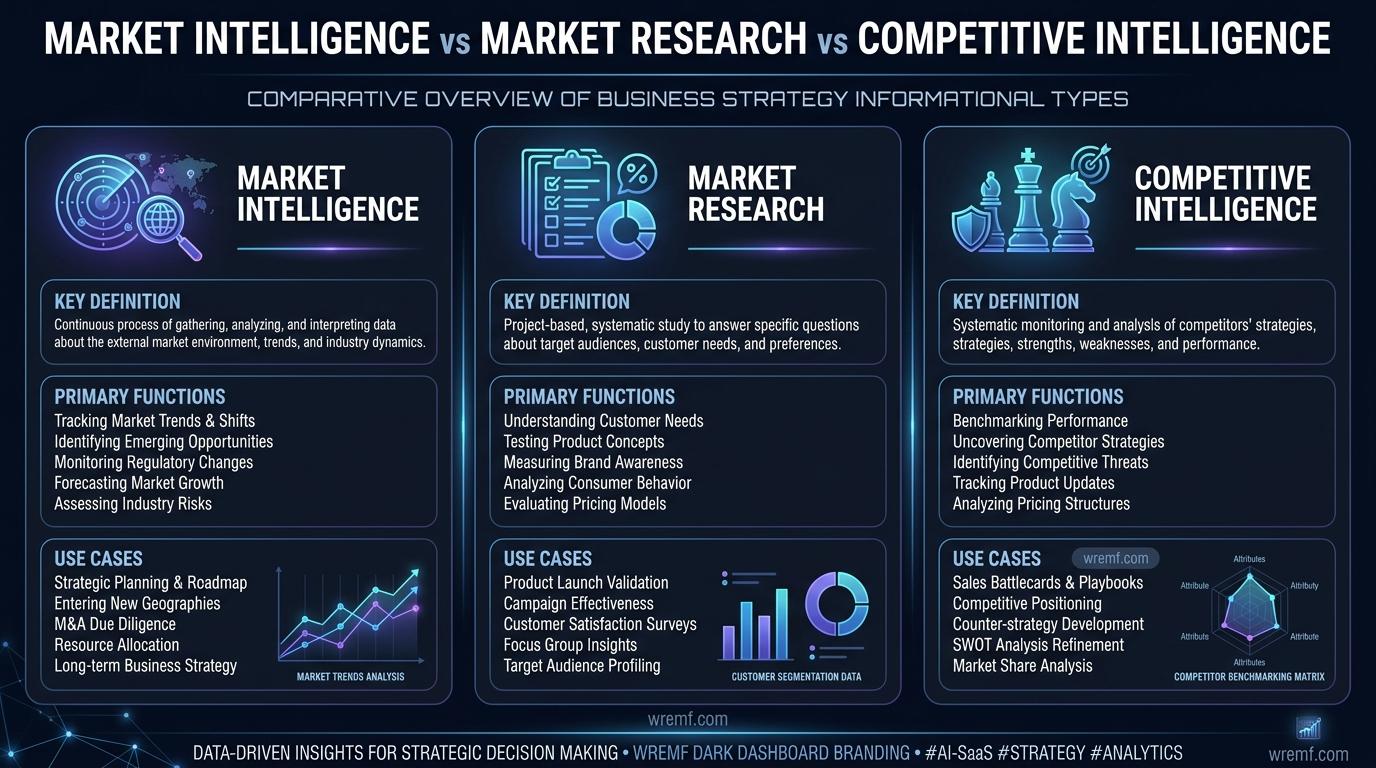
Market intelligence, market research, and competitive intelligence are related but distinct disciplines, and conflating them leads to buying the wrong tools.
Market intelligence is the continuous, ongoing collection and analysis of external market signals including competitor activity, customer behaviour, pricing changes, regulatory shifts, funding rounds, and industry trends. It is always-on and automated where possible. Market intelligence platforms such as Contify and AlphaSense are designed for this continuous monitoring model.
Market research is project-based. It involves gathering specific data at a point in time to answer a defined question, such as validating product positioning, understanding a target market, or sizing an opportunity. Market research uses surveys, expert calls, focus groups, and structured analysis. It is valuable for strategic planning but does not replace the continuous signal monitoring that market intelligence provides.
Competitive intelligence is a subset of market intelligence that focuses specifically on competitors. It tracks pricing changes, product launches, messaging shifts, hiring patterns, patents, and content marketing activity from direct and indirect competitors. Tools such as Crayon and Contify are built primarily for competitive intelligence workflows, delivering battlecards, alerts, and competitor trackers to sales and product marketing teams.
Understanding this distinction matters for tool selection. A team that primarily needs competitor battlecards for sales enablement has different requirements than a team that needs to monitor SEC filings, track expert calls, and analyse earnings transcripts for market signals. Both are legitimate use cases but they require different platforms.
Sales intelligence is another adjacent category. It focuses on identifying and prioritising buyers using buyer intent signals, funding rounds, personnel changes, and firmographic data. Enterprise sales intelligence platforms such as ZoomInfo combine B2B contact data with real time signals to help sales teams identify when accounts are ready to engage. The B2B database context is relevant here: platforms in this space track hundreds of millions of professionals and companies alongside market signals to help revenue teams prioritise outreach. For B2B teams, sales intelligence and market intelligence increasingly overlap, particularly in account-based marketing where external market signals inform both targeting and messaging.
KEY TAKEAWAY: Market intelligence is continuous and automated, market research is project-based, and competitive intelligence is a focused subset. Each requires different tools, and most enterprise teams benefit from running all three in parallel.
The Main Categories of Marketing Intelligence Tools
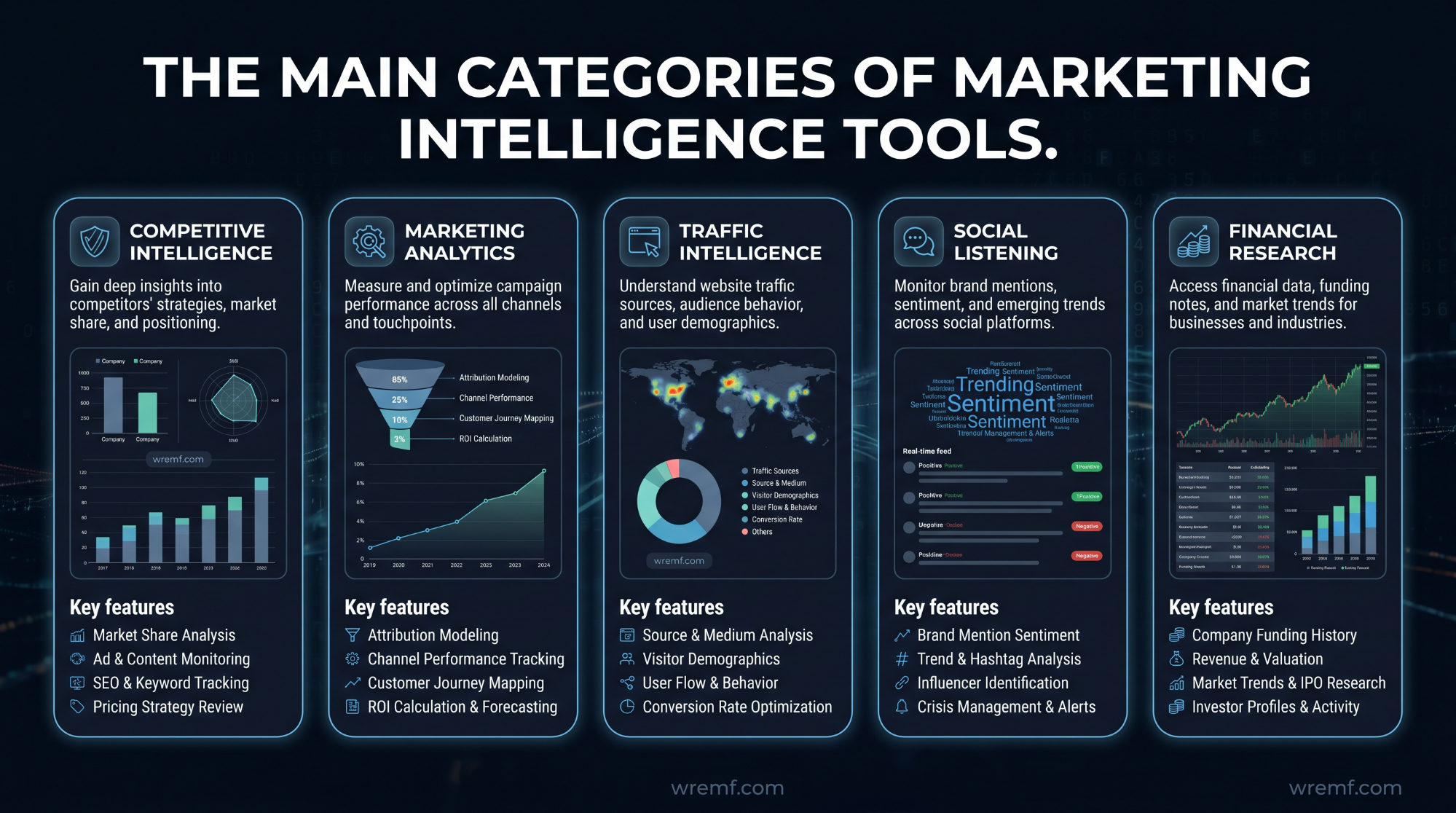
Marketing intelligence tools fall into several distinct categories, each addressing a different layer of the intelligence stack. Most organisations need tools from multiple categories rather than a single platform.
Competitive Intelligence and Monitoring Platforms
Competitive monitoring tools track competitor activity across websites, product pages, pricing, content marketing, job listings, and digital channels. Crayon is the most widely recognised platform in this category, using AI and natural language processing to detect competitor changes and convert them into structured battlecards and alerts delivered through Slack, MS Teams, and SFDC integrations. Contify takes a similar approach, using AI and NLP to collect and curate information from over 1 million public sources including news, press releases, and regulatory documents. For teams operating in the mid-market and enterprise segments, these platforms reduce the manual research burden and ensure that sales teams have current, accurate competitive information when they need it.
Marketing Analytics and Attribution Platforms
Attribution is one of the most persistent measurement problems in digital marketing. Cross-channel attribution, cross-device fragmentation, and the rise of dark funnel behaviour mean that last-click models significantly undercount the influence of brand and upper-funnel activity. Multi-touch attribution and marketing mix modeling tools attempt to solve this, each with different methodologies and trade-offs.
Improvado is an enterprise marketing analytics platform that pulls data from over 500 sources and delivers cross-channel attribution, data consolidation, and analytics dashboards without requiring a data engineering team to build every connection. It is well suited to enterprise marketing teams that need a centralised data layer across ad platforms, CRM systems, and campaign intelligence sources.
Funnel is a revenue marketing platform focused on data consolidation and automated reporting. It connects marketing data from over 600 sources, normalises it, and makes it available for analysis in tools such as Tableau, PowerBI, and Looker Studio. For agencies managing multiple clients, Funnel provides consistent, client-ready data pipelines that remove the manual extraction work.
Northbeam, Rockerbox, and Cometly are attribution platforms focused on digital marketing intelligence, particularly for direct-to-consumer and e-commerce brands. They each address the measurement problem differently. Northbeam uses ML attribution and server-side tracking to improve data accuracy in a cookieless environment. Rockerbox focuses on attribution methodology transparency and cross-channel attribution across paid, organic, and direct channels. Cometly emphasises real time campaign decisions with creative-level attribution and automated budget optimization.
SegmentStream applies AI-Powered Optimization and machine learning to solve the attribution problem at the channel level, particularly for teams running significant spend across multiple ad platforms. Datorama, now part of Salesforce Marketing Cloud Intelligence, is an enterprise-grade analytics platform that consolidates marketing data for large organisations, with strong SFDC integration and support for custom attribution modeling.
Measured focuses on incrementality testing for enterprise brands, particularly in CPG and retail. Its strength is helping Fortune 500 brands validate the incremental impact of media investments at the channel level using geo holdout experiments and incrementality validation methodologies. For enterprise marketing teams with significant offline and digital media investment, incrementality testing provides a more rigorous alternative to standard attribution models.
Clarisights and Adverity are analytics dashboards and reporting platforms for marketing teams that need cross-channel performance visibility without building custom BI infrastructure. Lifesight focuses on measurement and optimization using privacy-safe data and machine learning to improve attribution in a post-cookie environment. Conversion Sync and automated budget execution features are increasingly common in these platforms as teams look to close the measurement-to-action loop automatically.
Digital Market and Traffic Intelligence
Similarweb is a digital marketing intelligence platform that provides website traffic analysis, audience insights, competitive benchmarking, and market share data across industries. It is widely used by growth teams, competitive analysts, and investment professionals to understand web traffic patterns, referral sources, and digital performance relative to competitors. Website Traffic Analysis with Similarweb allows teams to benchmark their own traffic against competitors and identify gaps in channel strategy.
Semrush is a digital intelligence platform covering SEO and Search Intelligence, paid advertising, content marketing, social media, and competitive analysis. Its Keyword Research, Backlink Analysis, and competitor SEO tracking capabilities make it the standard choice for content and SEO teams. Semrush also offers market intelligence features including traffic analysis and audience insights, making it a practical option for teams that need SEO and competitive data in one place. The platform is well established in the Gartner Magic Quadrant discussions for digital marketing analytics.
Social Listening and Brand Intelligence
Social listening tools monitor brand mentions, sentiment, and conversation patterns across social media, forums, news, and review sites. Brandwatch is one of the leading enterprise social listening platforms, offering sentiment analysis, audience intelligence, and crisis monitoring across billions of data points. Social listening tools are particularly valuable for brand teams, PR functions, and product teams that need to track customer perception in real time. Social listening overlaps with market intelligence when it is used to monitor competitor brand mentions, product sentiment, and emerging market trends.
Financial Research and Enterprise Market Intelligence
AlphaSense is an AI-powered financial research platform used by investment professionals, strategy teams, and enterprise sales intelligence functions. It provides access to earnings transcripts, SEC filings, expert calls, broker research, and proprietary Wall Street Insights, with AI search and summarisation technology that surfaces relevant information from vast document sets. AlphaSense provides access to historical financials and estimates across over 19,000 public companies, sector-specific KPIs from institutional-grade models, transaction intelligence covering nearly 1 million M&A deals and 750,000 private funding rounds, and dynamic peer sets with 125 or more pre-built industry comparables. AlphaSense's Smart Summaries feature uses generative AI to condense complex documents into actionable insights. For enterprise brands and financial research platforms users, AlphaSense reduces the time required for deep market research and deal sourcing.
Bloomberg Terminal remains the gold standard for real-time financial data, comprehensive company financial data, and agentic AI capabilities for professional finance users. Its AI-Powered Document Insights and real-time qualitative insights make it essential for investment teams but its cost and complexity place it outside the typical marketing team's toolkit. PitchBook covers private market data with extensive company and deal coverage, making it valuable for teams involved in funding rounds analysis, competitive landscape research, and deal sourcing in venture and private equity contexts. The Mosaic Score, a proprietary health indicator for private companies, is a distinctive feature.
AskB and REYO represent emerging platforms in the financial and strategic intelligence space, focused on helping teams surface relevant signals from large document sets without manual review.
KEY TAKEAWAY: The marketing intelligence tools landscape spans at least six distinct categories, and the platforms that dominate one category rarely lead in another. Matching your primary use case to the right category is the most important step in tool selection.
How to Evaluate Marketing Intelligence Tools: A Practical Framework
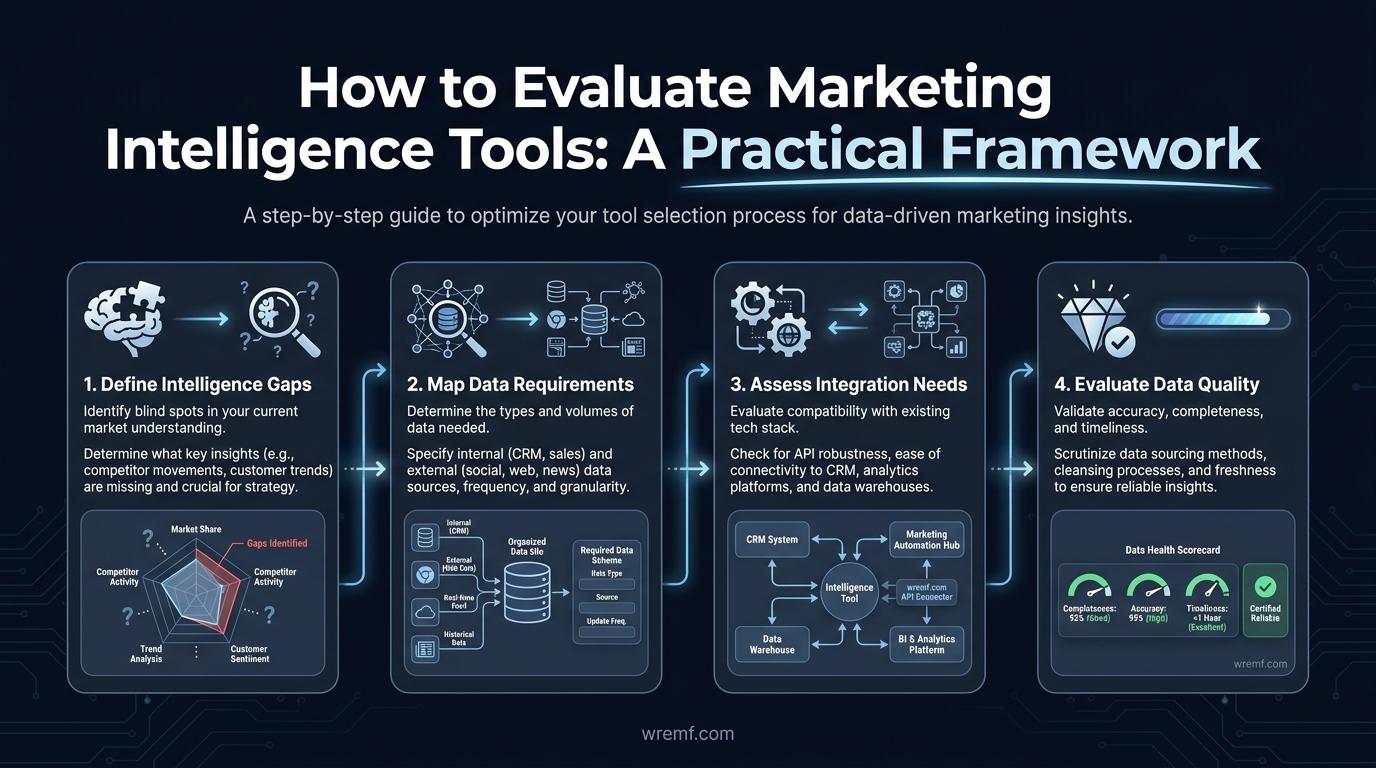
Selecting a marketing intelligence platform requires a structured evaluation approach. The instinct to choose the tool with the most features or the strongest brand recognition often leads to expensive mismatches.
Step 1: Define the primary intelligence gap.
Before evaluating any platform, identify what decisions are currently being made with insufficient data. Is the problem competitive monitoring? Attribution accuracy? Traffic benchmarking? Financial research? Being specific about the gap prevents evaluating tools that solve a different problem.
Step 2: Map your data access requirements.
Different platforms have different data models. Some aggregate third-party data, others connect directly to your ad platforms and CRM systems, and others rely on web scraping or licensed data feeds. Assess whether the platform's data sources match your intelligence requirements and whether the data governance model meets your organisation's standards, including SOC 2 certification.
Step 3: Assess integration requirements.
A marketing intelligence platform that cannot connect to your existing stack creates data silos. Check native integrations with your CRM systems, ad platforms, and collaboration tools such as Slack, MS Teams, and SFDC. Also evaluate API usage flexibility and whether the platform supports custom data pipelines.
Step 4: Evaluate data quality and refresh rate.
Real time intelligence is only valuable if the underlying data is accurate. Ask vendors about data refresh frequency, source verification processes, and how they handle data quality issues. Platforms that track real-time signals such as personnel changes, pricing changes, and competitor content should demonstrate transparent methodology.
Step 5: Assess user count and feature requirements against pricing.
Most marketing intelligence platforms scale pricing by user count, data volume, or feature tier. Mid-market teams often face a gap where enterprise features are required but enterprise pricing is not feasible. Evaluate free tiers carefully. Free plans rarely provide production-grade data access and often serve as acquisition tools rather than functional intelligence solutions.
Step 6: Test the measurement-to-action loop.
The most important question about any analytics or intelligence platform is not how much data it collects but how quickly it converts data into a decision or action. Ask vendors to demonstrate how a user moves from a signal to a decision within the platform. Platforms that require extensive analyst work to generate actionable output add latency to your intelligence cycle.
Step 7: Assess AI and machine learning capabilities.
AI-powered MI platforms analyse millions of data points to find patterns that manual review cannot surface. Natural language processing capabilities, generative AI summarisation, automated competitor analysis, and ML attribution all reduce the time between data and decision. When evaluating AI capabilities, ask about transparency of methodology, model training sources, and how the platform handles data rising in volume over time.
Step 8: Consider the governance model.
Data governance matters more as organisations scale. Assess role-based access controls, audit trails, data retention policies, and compliance certifications. For enterprise brands operating across multiple markets, data governance failures create both operational and regulatory risk.
DID YOU KNOW:
Contify uses AI and NLP technologies to collect, curate, and analyse information from over 1 million public sources including websites, news sources, press releases, regulatory documents, and more. This scale of monitoring is not achievable through manual research processes.
KEY TAKEAWAY: A structured evaluation process that starts with the intelligence gap rather than the feature list consistently produces better platform selections and faster time to value.
Marketing Attribution: The Hardest Intelligence Problem
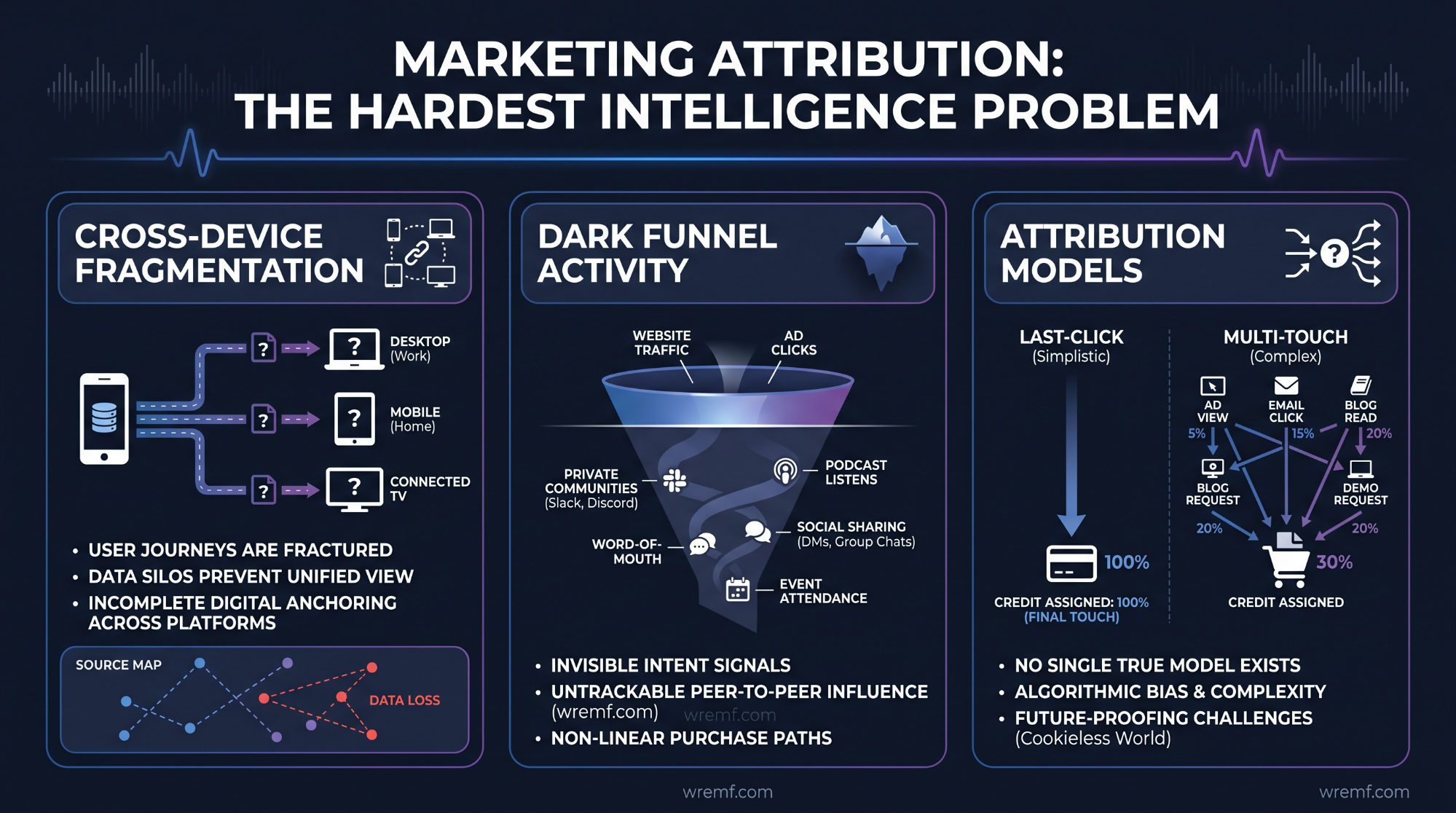
Attribution is the process of assigning credit for a conversion or revenue outcome to the marketing touchpoints that influenced it. Despite decades of investment in attribution methodology, it remains one of the most contested and difficult problems in digital marketing intelligence.
The core challenge is that buyers rarely convert through a single, linear path. A B2B buyer might encounter a brand through a LinkedIn ad, read three blog posts over two months, attend a webinar, search for competitors on Perplexity, see a retargeting ad, and then book a demo through a direct visit. Multi-touch attribution attempts to model this journey and assign credit proportionally. Marketing mix modeling uses statistical analysis to measure the contribution of each channel across longer timeframes. Incrementality testing uses controlled experiments to isolate the true causal impact of a channel or campaign.
Cross-device fragmentation makes every approach harder. When a buyer switches between a work laptop, a personal phone, and a shared tablet, connecting those sessions to a single buyer journey requires identity resolution that most organisations do not have in place. Server-Side Tracking and Conversion Sync capabilities are increasingly important for improving data completeness in a cookieless environment.
The dark funnel compounds the attribution problem further. Research, social proof, word-of-mouth, community activity, and AI-generated answers that influence buyers before they interact with tracked channels are largely invisible to standard attribution models. A buyer who asks ChatGPT or Perplexity which platforms are recommended for their use case and then arrives at a website via direct visit leaves no traceable attribution signal in most systems.
This is where AI search visibility intersects with attribution. Platforms such as WREMF track AI referral traffic analysis and help teams understand which AI engines are generating brand discovery before buyers enter tracked channels. Understanding the AI visibility layer is becoming a necessary component of full-funnel attribution, particularly for B2B teams where the buying journey is long and research-intensive. Teams can explore AI referral traffic tracking through WREMF's AI brand monitoring guide to understand how AI engines are influencing discovery before buyers arrive.
For teams building or improving their attribution stack, the practical principle is to combine methodologies rather than rely on a single attribution model. Use multi-touch attribution for campaign-level decisions and budget execution. Use marketing mix modeling for strategic budget optimisation across quarters. Use incrementality testing to validate the causal contribution of major channels. Use AI visibility tracking to account for the research activity that happens in AI engines before buyers enter your tracked funnel.
KEY TAKEAWAY: No single attribution model solves the full measurement problem. The strongest attribution stacks combine multi-touch attribution, marketing mix modeling, incrementality testing, and AI visibility tracking to account for the full buyer journey including dark funnel activity.
Competitive Intelligence Tools and Battlecard Workflows
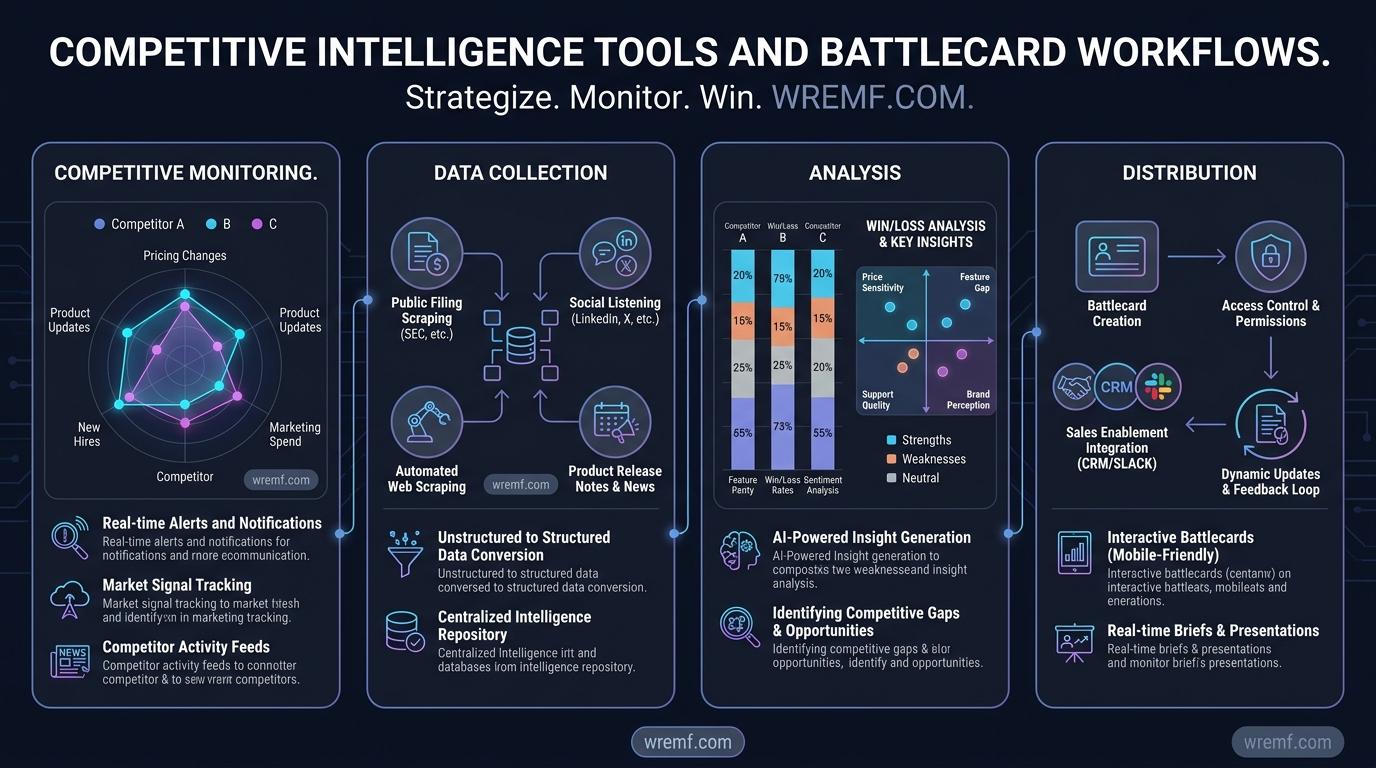
Competitive intelligence is the systematic process of tracking competitor activity, synthesising it into usable intelligence, and distributing it to the teams that need it at the point of decision. For sales teams, this means battlecards. For product teams, this means positioning maps. For marketing teams, this means messaging and content strategy informed by what competitors are doing and where they are weak.
Crayon is the most widely adopted competitive monitoring platform in the mid-market and enterprise segments. It monitors competitor websites, content marketing, pricing, product updates, job listings, and digital activity in real time, then organises findings into structured battlecards that can be distributed through Slack and SFDC integrations. The battlecard workflow in Crayon is designed so that sales representatives receive updated competitive information before key calls without manually searching for updates. Crayon's AI capabilities reduce the manual curation effort that made competitive intelligence programs difficult to sustain at scale.
Contify takes a broader approach, covering not just competitors but also customers, partners, markets, and regulatory sources. Its NLP and AI layer categorises and curates signals from over 1 million public sources, making it more suitable for organisations that need a comprehensive market intelligence repository rather than a purely competitor-focused tool. Contify also delivers signals through Slack, email, and integration with MS Teams, supporting the same real time distribution model as Crayon.
The challenge with competitive intelligence tools is keeping the output useful rather than overwhelming. The instinct to track everything leads to alert fatigue, where teams stop engaging with intelligence because there is too much of it. A useful governance principle is: if data does not change a decision within 30 days, stop collecting it. This principle applies directly to competitive monitoring configuration. Define the specific signals that would change a battlecard, pricing response, or messaging decision, and filter everything else out.
Battlecards are the most common output of competitive intelligence programs, but they are only valuable if they are maintained and trusted. Stale battlecards are worse than no battlecards because they create false confidence. The platforms that integrate competitive monitoring directly with battlecard distribution solve this problem by keeping cards current automatically rather than relying on manual updates.
For enterprise brands with complex competitive environments across multiple markets, a competitive intelligence platform alone may be insufficient. AlphaSense and Bloomberg Terminal add financial research platforms capability that tracks competitor performance through earnings calls, SEC filings, and analyst reports alongside the website and content monitoring that Crayon and Contify provide. Combining both layers gives enterprise strategy teams a complete picture of competitor health, intent, and market positioning.
KEY TAKEAWAY: Competitive intelligence tools create value only when the output is trusted, current, and connected to the decisions that sales, product, and marketing teams make daily. Alert volume without quality filtering creates fatigue rather than intelligence.
SEO, Search Intelligence, and Traffic Analysis Tools
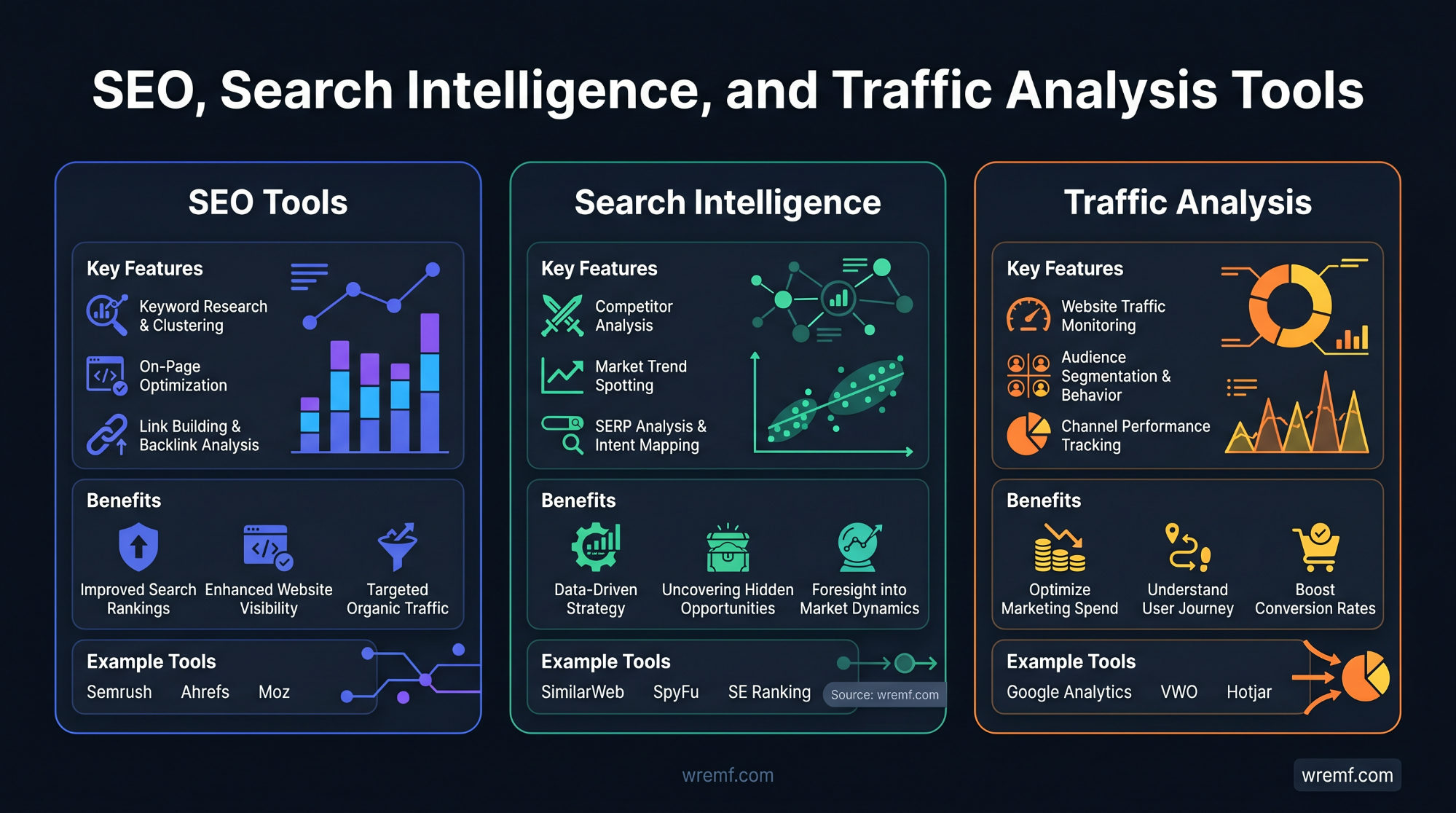
SEO and Search Intelligence tools measure organic search performance, keyword rankings, backlink profiles, and competitor search activity. They are essential components of any marketing intelligence stack for teams that invest in content marketing, organic acquisition, or search-based demand generation.
Semrush is the most comprehensive platform in this category. It covers Keyword Research, Backlink Analysis, competitor SEO analysis, content marketing performance, and paid search intelligence in a single platform. Semrush's competitive analysis features let teams track competitor keyword rankings, identify content gaps, and analyse ad platform spend patterns from competitors. For digital marketers and content teams, Semrush is typically the first tool purchased and the last one cancelled.
Ahrefs is Semrush's closest competitor in the SEO and Search Intelligence space. It is particularly strong in Backlink Analysis and keyword data, with a user experience that many SEO practitioners prefer. Ahrefs and Semrush cover broadly similar functionality, and most teams use one or the other based on preference, existing workflow integration, and pricing. Both platforms cover the core SEO toolkit of keyword research, rank tracking, site audit, and competitor analysis.
Similarweb extends beyond SEO to cover Website Traffic Analysis across all channels including direct, referral, social, and paid. This makes it valuable for competitive benchmarking that goes beyond search performance to cover full digital footprint comparisons. Similarweb's audience intelligence and market share features are particularly useful for investors, strategy teams, and growth functions that need to understand digital market dynamics rather than just keyword rankings.
For teams building AI search visibility alongside traditional SEO, there is an important distinction. SEO tools track keyword rankings on Google and Bing. They do not track whether a brand is mentioned, cited, or recommended in AI-generated answers from ChatGPT, Gemini, Claude, Perplexity, or Google AI Overviews. The AI search discovery layer requires a different measurement approach, which is what platforms built for AI visibility like WREMF cover. Teams can explore the relationship between SEO tools and AI visibility in WREMF's guide to AI search optimization tools and organic traffic
KEY TAKEAWAY: SEO and traffic analysis tools measure performance in traditional search engines. They do not cover the AI answer layer where an increasing share of B2B research and vendor discovery now happens.
Social Listening Tools and Sentiment Intelligence
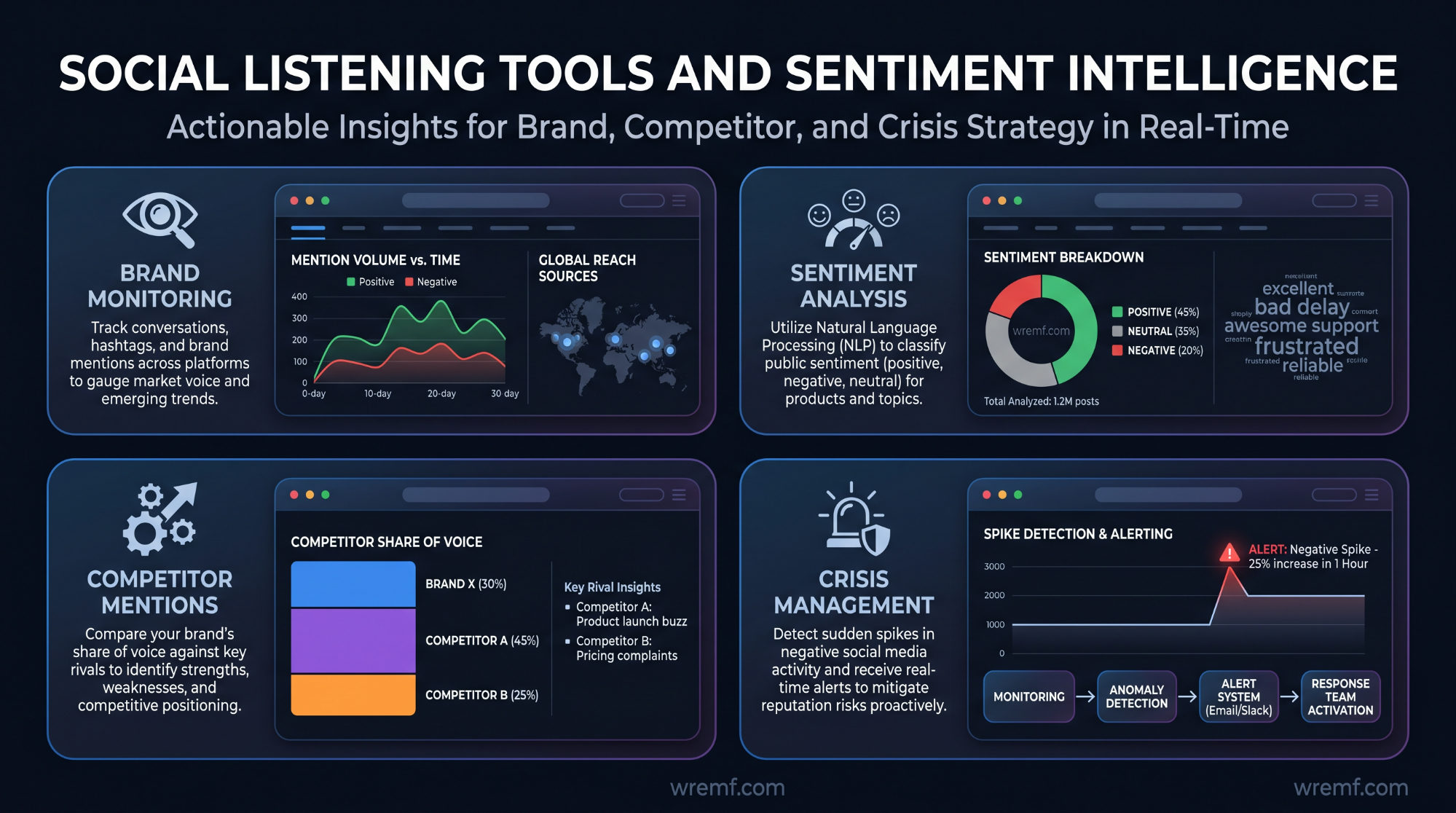
Social listening tools track brand mentions, competitor mentions, product conversations, and sentiment signals across social networks, news sources, forums, review platforms, and the broader web. They convert unstructured conversation data into structured intelligence that informs brand, product, and marketing decisions.
Social listening is distinct from monitoring. Monitoring alerts you when your brand is mentioned. Social listening analyses patterns in those mentions to surface insights about sentiment trends, competitive perception, emerging customer needs, and potential reputation risks. For enterprise marketing teams and brand functions, the analytical layer is what makes social listening tools valuable rather than just notification services.
Brandwatch is one of the leading enterprise social listening platforms, offering deep sentiment analysis, audience intelligence, and crisis monitoring across billions of data points. Its AI layer uses natural language processing to categorise mentions, detect sentiment shifts, and identify influential voices in a brand's conversation landscape. Brandwatch integrates with enterprise workflows and supports custom dashboards for different stakeholder groups.
Social listening data also has direct applications in competitive intelligence. Tracking competitor brand mentions, product sentiment following launches, and customer complaints about competitor products surfaces intelligence that is not available through website monitoring or SEO analysis alone. For teams building comprehensive competitive monitoring programs, social listening tools should sit alongside platforms like Crayon and Contify rather than replacing them.
One emerging challenge for social listening is the shift of research conversations to private and AI-mediated channels. When buyers discuss options in private Slack workspaces, professional communities, or through prompts submitted to AI engines, those conversations do not surface in standard social listening tools. The dark funnel aspect of social listening is growing as more B2B research moves to AI answer engines. This is why AI visibility monitoring is becoming a complementary intelligence layer for brand-conscious B2B teams.
KEY TAKEAWAY: Social listening tools provide valuable sentiment and conversation intelligence, but the shift of B2B research conversations to private channels and AI engines creates coverage gaps that require additional monitoring approaches.
AI Visibility: The Intelligence Layer That Most Marketing Tools Miss
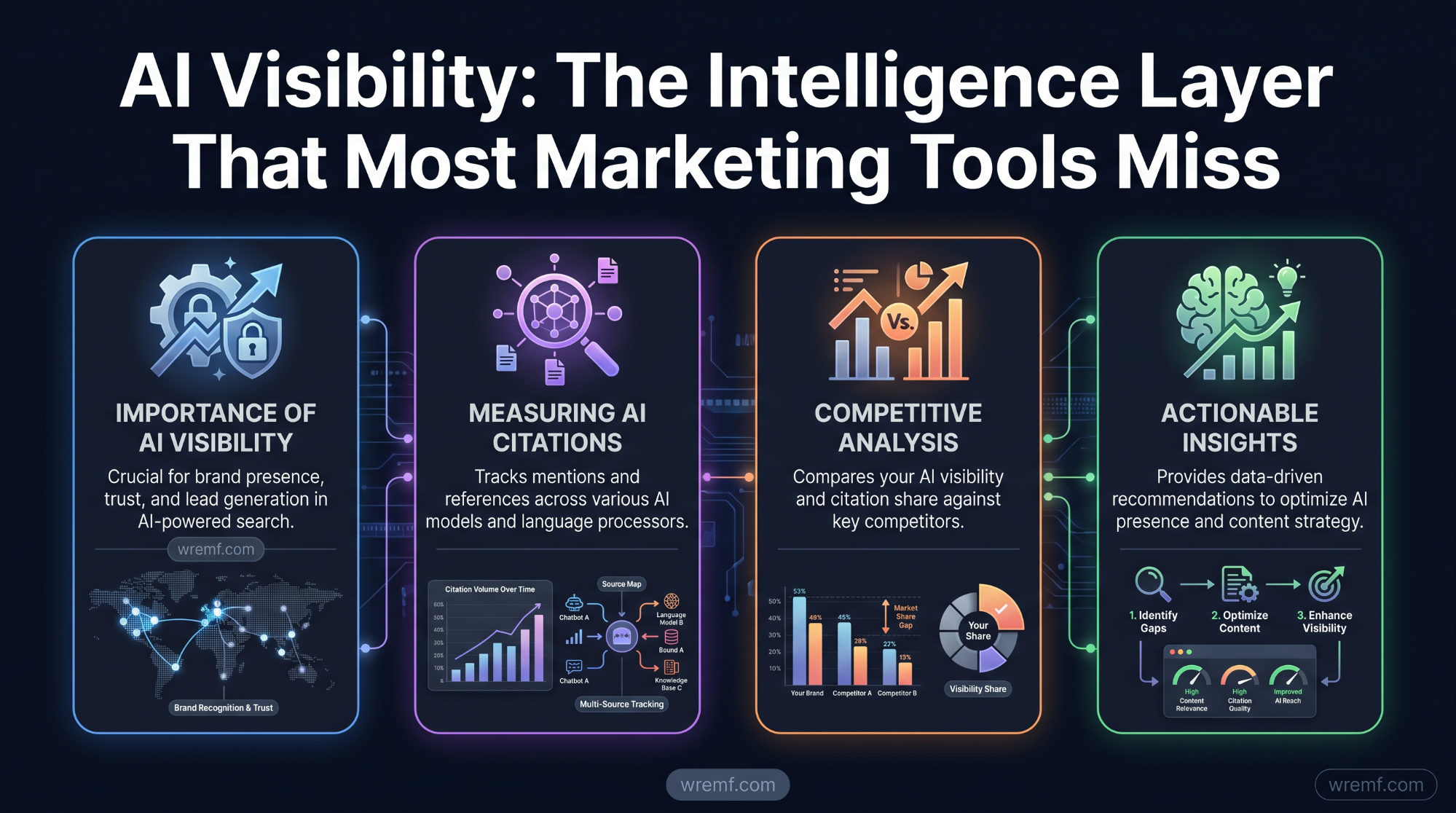
AI search visibility is the measure of how often, how prominently, and how accurately a brand is mentioned, cited, compared, or recommended in AI-generated answers from engines such as ChatGPT, Claude, Gemini, Perplexity, Copilot, DeepSeek, Grok, Meta AI, and Mistral. It is a distinct intelligence layer that traditional marketing intelligence tools were not built to measure.
AI search visibility matters for marketing intelligence because buyers increasingly use AI answer engines as their first research step when evaluating vendors, comparing solutions, and shortlisting options. According to research trends tracked by organisations including McKinsey's AI insights reporting AI adoption in professional and business contexts is accelerating rapidly. When a buyer asks an AI engine which marketing intelligence platforms are best for mid-market B2B teams, the answer that engine generates influences the shortlist before the buyer visits a single website.
Traditional marketing intelligence tools, including Semrush, Ahrefs, Similarweb, Crayon, and attribution platforms, do not track this layer. They measure keyword rankings, web traffic, competitive content, and campaign performance. They do not measure whether a brand appears in AI answers, which sources the AI engine cited, how the brand's description compares to competitors in AI-generated content, or whether the brand's AI share of voice is growing or declining across different prompt categories.
Answer engine optimisation (AEO) and generative engine optimisation (GEO) are the practices of improving a brand's visibility and accuracy of representation in AI-generated answers. These practices require prompt tracking, source citation tracking, source consistency analysis, and AI share of voice measurement across multiple engines. They sit alongside SEO and content marketing in the modern intelligence stack, and they require dedicated tooling.
WREMF is built specifically for this layer. It tracks how brands appear across 10 AI engines, monitors prompt-level citations, measures AI share of voice against competitors, identifies source consistency gaps, and connects AI visibility data to traffic attribution through GA4 integration. For B2B teams that already use Semrush for SEO intelligence, Crayon for competitive monitoring, and Improvado or Funnel for attribution, WREMF adds the AI visibility layer that those platforms do not cover. Teams can review the complete framework for AI search engine optimisation in WREMF's complete guide for B2B brands
The distinction between what traditional marketing intelligence tools measure and what WREMF covers can be understood clearly across several dimensions.
Primary signal
- Traditional marketing intelligence tools: Keyword rankings, web traffic, campaign performance
- WREMF: AI prompt answers and citations
What it tracks
- Traditional marketing intelligence tools: SERP position, backlinks, ad spend
- WREMF: AI citations, brand mentions in AI answers, source consistency
Competitive view
- Traditional marketing intelligence tools: SERP overlap, share of search
- WREMF: AI share of voice across 10 engines
Attribution
- Traditional marketing intelligence tools: Organic sessions, paid conversions
- WREMF: AI referral traffic and prompt-level attribution
Audit type
- Traditional marketing intelligence tools: Technical SEO, content gaps
- WREMF: GEO audits, AEO content optimisation, entity and citation cleanup
Engine coverage
- Traditional marketing intelligence tools: Google and Bing primarily
- WREMF: ChatGPT, Claude, Gemini, Perplexity, Copilot, DeepSeek, Grok, Meta AI, Mistral, and Google AI Overviews
The recommended framing is additive rather than competitive. Traditional marketing intelligence tools remain essential for SEO rankings, web traffic analysis, competitive content monitoring, and campaign attribution. WREMF adds the AI visibility layer by tracking how AI engines mention, cite, compare, and recommend brands across prompt-based discovery journeys. Teams can compare WREMF's approach to AI SEO tools in the complete guide
KEY TAKEAWAY: AI search visibility is the fastest-growing gap in modern marketing intelligence stacks. Traditional tools do not measure it, and B2B buyers are increasingly using AI engines as their primary research and vendor discovery channel.
Real-World Use Cases: How Teams Use Marketing Intelligence Tools
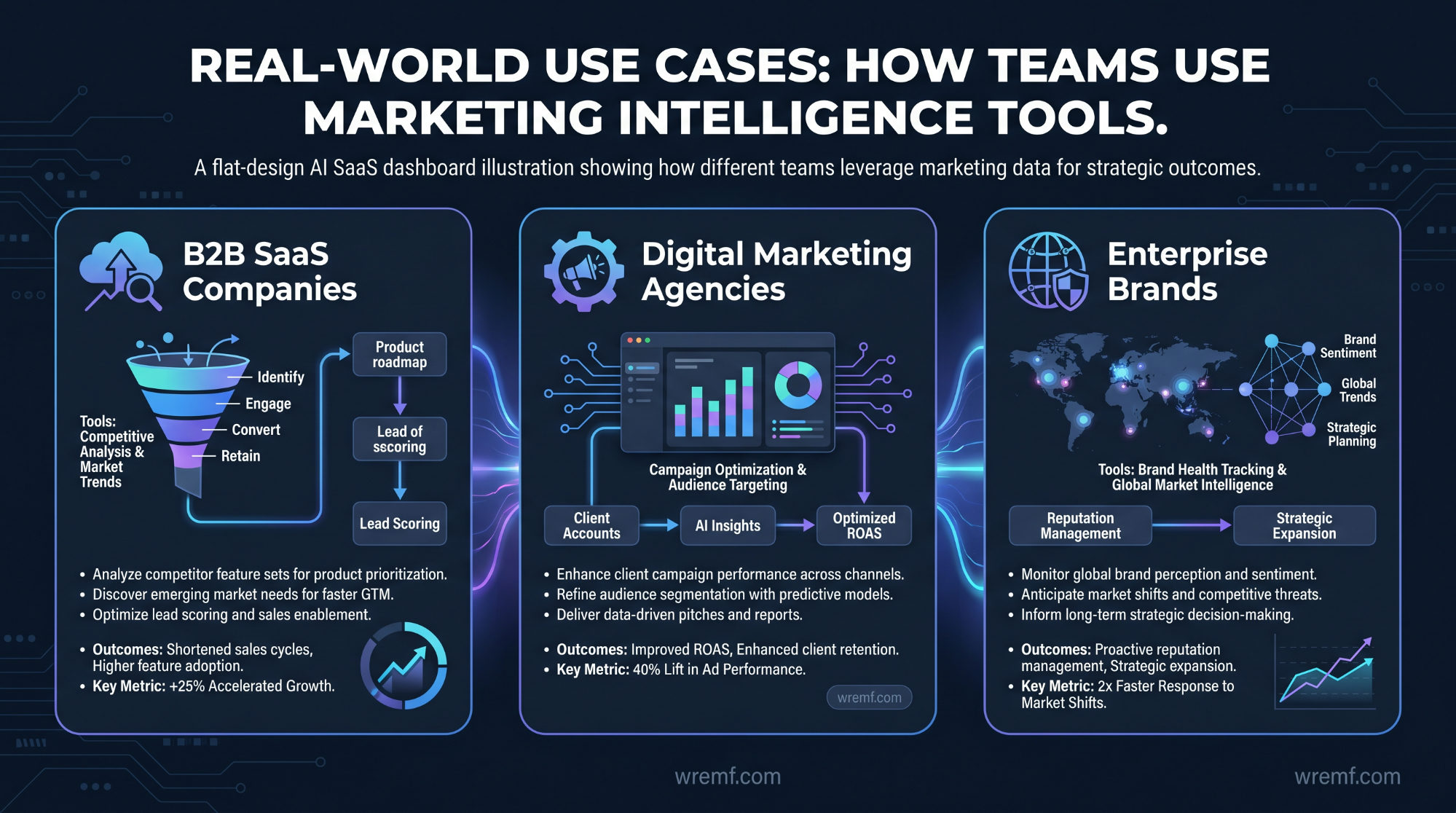
Understanding how different organisations actually use marketing intelligence tools helps clarify which platforms solve which problems in practice.
Use Case One: A B2B SaaS company trying to understand why competitors appear in AI answers
A mid-market B2B SaaS company notices that when potential buyers ask ChatGPT or Perplexity for recommendations in their category, a specific competitor consistently appears in the top three mentions while their brand is absent or described inaccurately. Their existing stack includes Semrush for SEO intelligence, Crayon for competitive monitoring, and Funnel for attribution reporting. None of these tools explain the AI citation gap.
Using WREMF, the team begins prompt tracking across relevant buyer questions in their category. They identify that the competitor is cited because it is referenced consistently in high-authority industry publications and review aggregators that AI engines draw from heavily. Their own brand lacks source consistency, with inconsistent descriptions across different sources that create confusion for AI engines when generating answers. WREMF's GEO audit surfaces specific source gaps and content brief recommendations that the team uses to improve their AI visibility over the following quarter. The team can explore this type of programme through WREMF's generative AI optimization services guide
Use Case Two: An agency managing marketing intelligence for multiple clients
A digital marketing agency serves 12 B2B clients across different verticals. For each client, the agency runs monthly competitive intelligence reporting using Crayon for competitor monitoring, Semrush for SEO and Search Intelligence, and Brandwatch for social listening. As AI search adoption grows, clients begin asking why their brands are not appearing in ChatGPT and Perplexity answers when buyers research their categories.
The agency adds WREMF Growth to their stack. At 5 websites per plan and up to 15 competitors, the Growth plan covers their smaller client accounts with white-label reporting built in, making it straightforward to deliver branded AI visibility reports alongside their existing competitive and SEO deliverables. The Looker Studio connector connects AI visibility data to their existing client dashboards without creating a separate reporting workflow.
Use Case Three: An enterprise brand building a comprehensive intelligence program
A large enterprise brand with marketing operations across four markets needs a consolidated intelligence stack. Their existing infrastructure includes Bloomberg Terminal for financial research, AlphaSense for earnings and expert call analysis, Similarweb for web traffic benchmarking, and Improvado for cross-channel attribution. The intelligence function is well resourced but AI visibility is not yet measured.
The strategy team engages WREMF's Managed service, which includes a full AI visibility audit, custom GEO strategy, AEO content optimisation, citation and entity cleanup, and monthly reporting with senior-led execution. The Managed plan is appropriate for their complexity and their preference for an execution partner rather than a self-serve tool. Teams considering this level of engagement can explore WREMF's agency services
KEY TAKEAWAY: The most effective marketing intelligence programs layer complementary tools rather than seeking one platform that does everything. AI visibility is the layer most commonly missing from otherwise mature intelligence stacks.
Limitations, Risks, and Caveats of Marketing Intelligence Tools
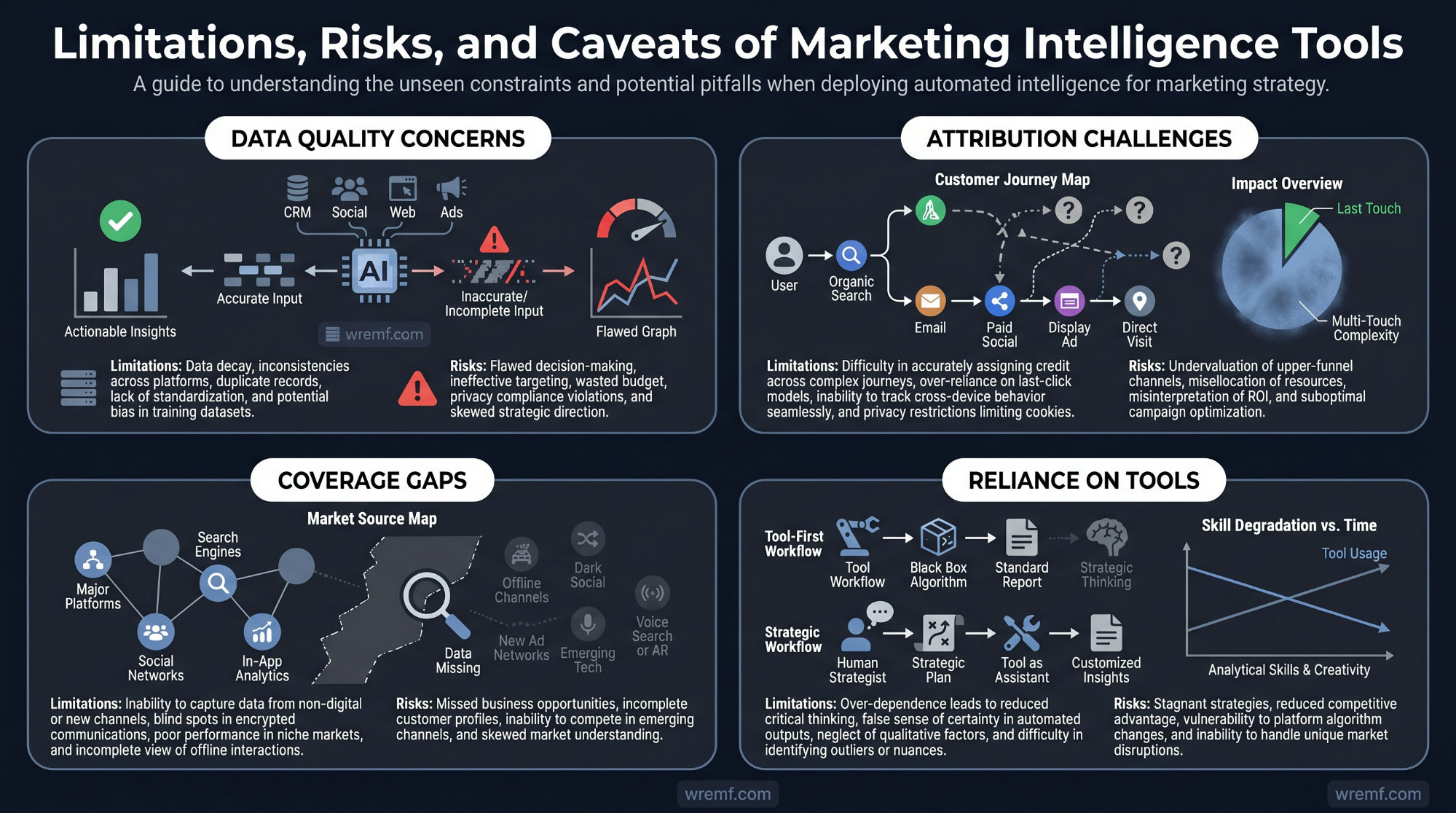
Marketing intelligence tools are powerful, but treating them as authoritative without understanding their limitations leads to poor decisions.
Attribution models never capture the full picture. Every attribution methodology, whether multi-touch attribution, marketing mix modeling, or incrementality testing, rests on assumptions that do not perfectly reflect reality. Cross-device fragmentation means that a significant proportion of buyer journeys contain disconnected sessions that cannot be resolved to a single identity. Dark funnel activity, including research in AI engines, private communities, and word-of-mouth, is structurally invisible to most attribution tools. Teams should treat attribution data as directional rather than definitively accurate and use multiple methodologies to triangulate rather than relying on a single attribution model.
Competitive intelligence platforms can generate false confidence. Battlecards that are not maintained become misleading. Competitor monitoring tools track observable signals such as website changes, job postings, and published content, but they cannot reliably track competitor pricing conversations with prospects, internal strategy shifts, or unreleased product roadmaps. The intelligence they provide is valuable but partial. Teams that build strategy exclusively on competitive monitoring data without combining it with customer research, expert calls, and market research create blind spots.
AI visibility is probabilistic, not deterministic. No platform can guarantee that a brand will appear in AI-generated answers for a specific prompt. AI engines select sources and generate answers based on complex, constantly updated models that vary by engine, prompt phrasing, user context, location, and session history. WREMF tracks patterns in AI citations and measures source consistency, but improving AI visibility is a long-term practice that requires sustained content, authority building, and entity consistency work. AI visibility cannot be measured from a single prompt, and citation frequency varies across engines and time. Teams can understand the realistic scope of this work through WREMF's guide to LLM SEO services
Social listening has structural coverage gaps. Standard social listening tools cannot monitor private communities, direct messages, encrypted platforms, or AI-mediated conversations. As more B2B research moves into these channels, social listening data becomes less representative of the full conversation landscape.
Free tiers are usually acquisition tools rather than functional intelligence solutions. Most marketing intelligence platforms offer free plans or trials that provide limited data access, restricted features, and low query volumes. Teams that rely on free tier data for production decisions risk acting on unrepresentative samples.
Data quality varies significantly across platforms and data types. Real-time web traffic estimates, competitive intelligence signals, and B2B contact data all carry uncertainty. The most reputable platforms are transparent about their methodologies and confidence intervals. When a platform presents precise figures without explaining the underlying data model, that precision should be treated with scepticism.
KEY TAKEAWAY: Marketing intelligence tools improve decision quality when used with an honest understanding of their methodological limitations. The strongest intelligence programs combine multiple tools, multiple methodologies, and a governance model that distinguishes between directional signals and confirmed facts.
How to Build a Marketing Intelligence Stack for B2B Teams
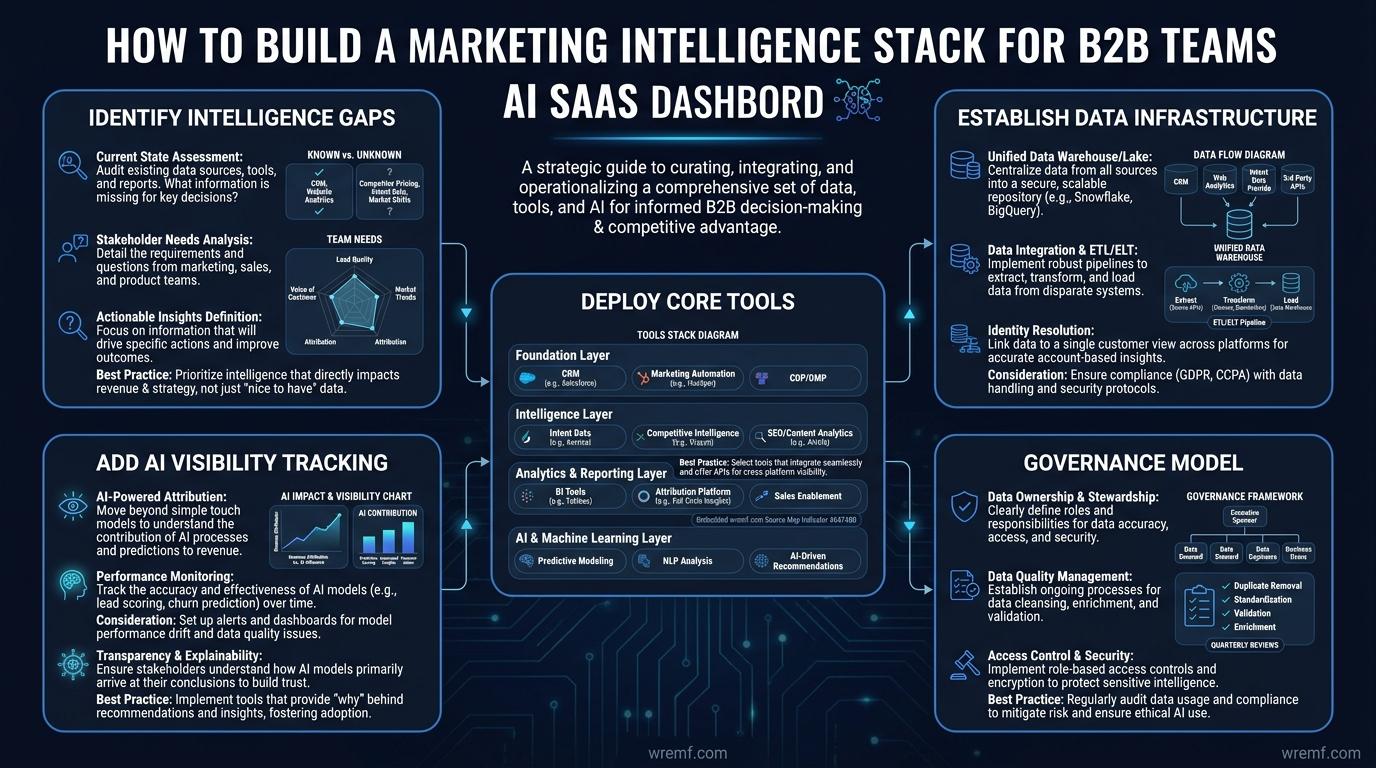
Building a marketing intelligence stack is a sequencing problem as much as a selection problem. Adding too many tools too quickly creates data overload. Starting with too few creates gaps that compound over time.
Step 1: Identify your highest-priority intelligence gap.
Start with the decision that is currently being made with the worst data. For most B2B teams, this is either attribution accuracy or competitive positioning. Solving one problem well creates more value than partially solving five.
Step 2: Establish your data infrastructure baseline.
Ensure that your CRM systems, ad platforms, and analytics tools are connected and tracking accurately before adding intelligence layers. Marketing intelligence platforms that pull from broken or incomplete data sources produce unreliable outputs. Server-Side Tracking and Conversion Sync configurations should be validated before deploying attribution tools.
Step 3: Deploy core competitive and market intelligence.
A competitive monitoring platform such as Crayon or Contify should be deployed early. Configure it to track the specific signals that would change sales messaging, pricing decisions, or product positioning. Integrate it with Slack or MS Teams so intelligence reaches the people who need it without requiring them to log in to a separate tool.
Step 4: Add SEO and traffic intelligence.
Semrush or Ahrefs covers SEO, Keyword Research, and Backlink Analysis. Similarweb covers Website Traffic Analysis and digital benchmarking. For most B2B teams, one SEO tool and Similarweb covers the core search and traffic intelligence requirements.
Step 5: Build attribution infrastructure.
Select an attribution approach based on your team's complexity, budget, and analytical capacity. Mid-market teams with straightforward digital channels should start with a multi-touch attribution tool such as Rockerbox or Northbeam. Enterprise teams with significant media budgets and offline components should consider marketing mix modeling and incrementality testing through platforms such as Measured.
Step 6: Add AI visibility tracking.
Track how your brand appears in AI-generated answers across ChatGPT, Gemini, Claude, Perplexity, Copilot, and other engines. This layer is now important enough for B2B visibility that it belongs in a standard marketing intelligence stack, not as an experimental addition. WREMF's Starter plan at 59 euros per month covers core prompt intelligence, source citation tracking, and AI Visibility Index for teams beginning to measure this layer. Growth plan at 149 euros per month adds AI share of voice, GEO audits, and GA4 attribution for teams that need full reporting and attribution integration. For teams that want WREMF to run the entire AI visibility programme including strategy, content, and citation cleanup, the Managed plan from 1,500 euros per month provides senior-led execution. Teams can review WREMF pricing plans to choose the option that fits their organisation.
Step 7: Establish a governance model.
Define who owns each platform, which signals trigger which decisions, how often intelligence is reviewed, and how the measurement-to-action loop is closed. Data governance for marketing intelligence stacks is not just a compliance requirement. It is the operational practice that determines whether the stack produces value or just accumulates unused dashboards.
Step 8: Review and rationalise quarterly.
Marketing intelligence stacks accumulate tools faster than they rationalise them. Every quarter, review API usage, feature requirements actually used, and decision value generated by each platform. Remove tools that are not changing decisions and reinvest in tools that are.
KEY TAKEAWAY: A marketing intelligence stack is more valuable at depth in the right categories than at breadth across every category. Sequence deployment to solve the highest-priority intelligence gap first, then add complementary layers including AI visibility as the programme matures.
Choosing Between Software, Managed Service, and Hybrid Models
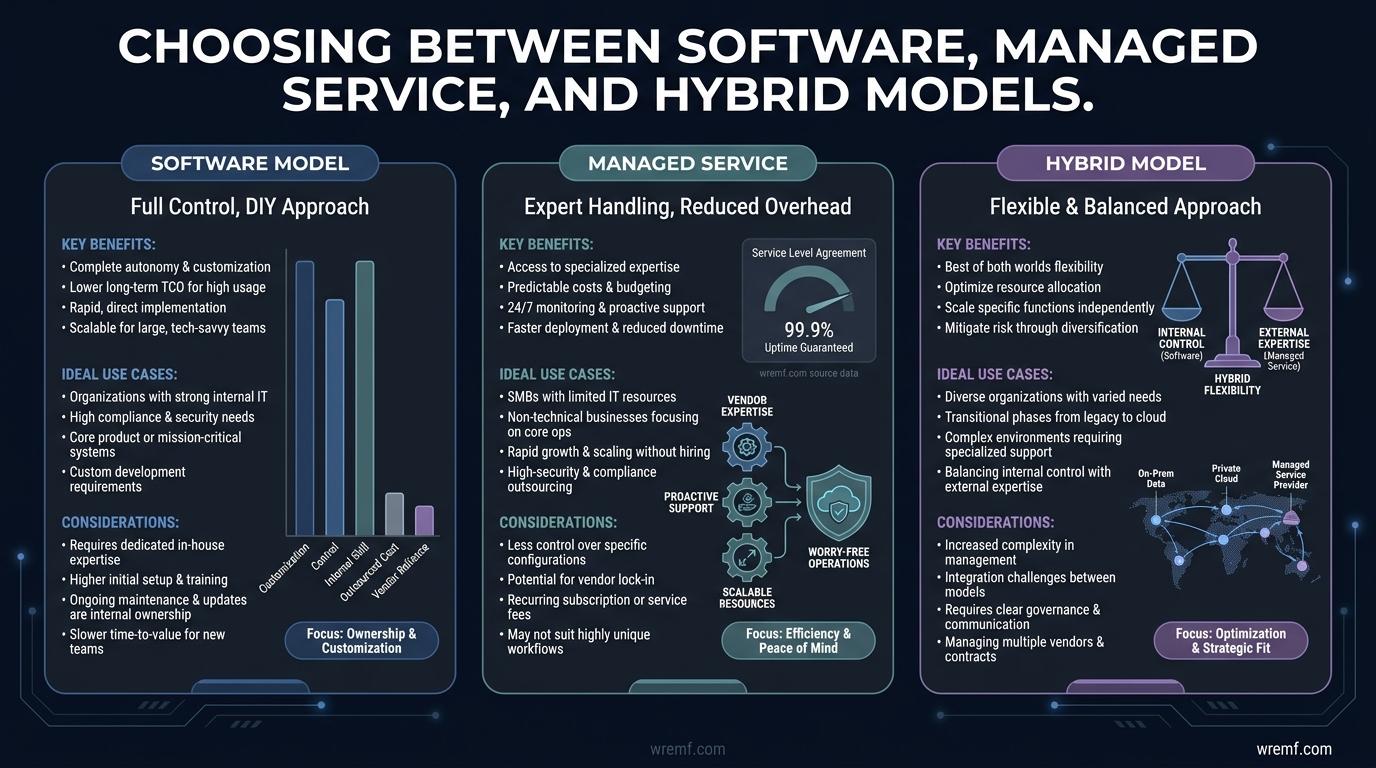
For marketing intelligence programs that include AI visibility tracking, the choice between self-serve software, a managed service, and a hybrid model depends on three factors: internal execution capacity, strategic complexity, and programme maturity.
Software-only models work best when the team has the analytical capacity to interpret intelligence data, the content and technical resources to act on it, and the bandwidth to manage the platform independently. WREMF as software gives teams full prompt tracking, citation monitoring, AI share of voice measurement, and attribution integration through self-serve dashboards. This model suits well-resourced in-house SEO teams, growth teams with strong analytical skills, and agencies that want to run AI visibility programmes for their clients independently.
Managed AI visibility services are the right choice when teams lack the internal resources to execute GEO strategy, AEO content optimisation, entity cleanup, and citation building alongside their existing workload. WREMF's Managed plan provides an end-to-end programme including AI visibility audit, custom strategy, content optimisation, citation and authority cleanup, and senior-led execution with monthly reporting. This model is appropriate for enterprise brands and multi-market teams that need results without building an internal AI visibility capability from scratch. Teams can explore what managed execution covers through WREMF's answer engine optimisation services guide
Hybrid models combine the measurement and reporting capability of WREMF software with access to the senior WREMF team for strategy, audits, and execution sprints when needed. This model suits teams that are building internal AI visibility capability over time but need expert support for specific projects such as an initial GEO audit, a citation cleanup initiative, or a competitive AI share of voice analysis.
The same logic applies across the broader marketing intelligence stack. Competitive intelligence platforms such as Crayon and Contify are software-first tools. Financial research platforms such as AlphaSense and Bloomberg Terminal typically require analyst support to generate maximum value from their data. Attribution platforms such as Measured often require expert configuration for geo holdout experiments and incrementality validation. Matching the complexity of the problem to the depth of support available is the practical principle.
KEY TAKEAWAY: The right engagement model for any marketing intelligence platform depends on internal execution capacity and strategic complexity, not just platform features or price. Teams should be honest about both before committing to a self-serve plan that requires execution resources they do not have.
Common Misconceptions About Marketing Intelligence Tools
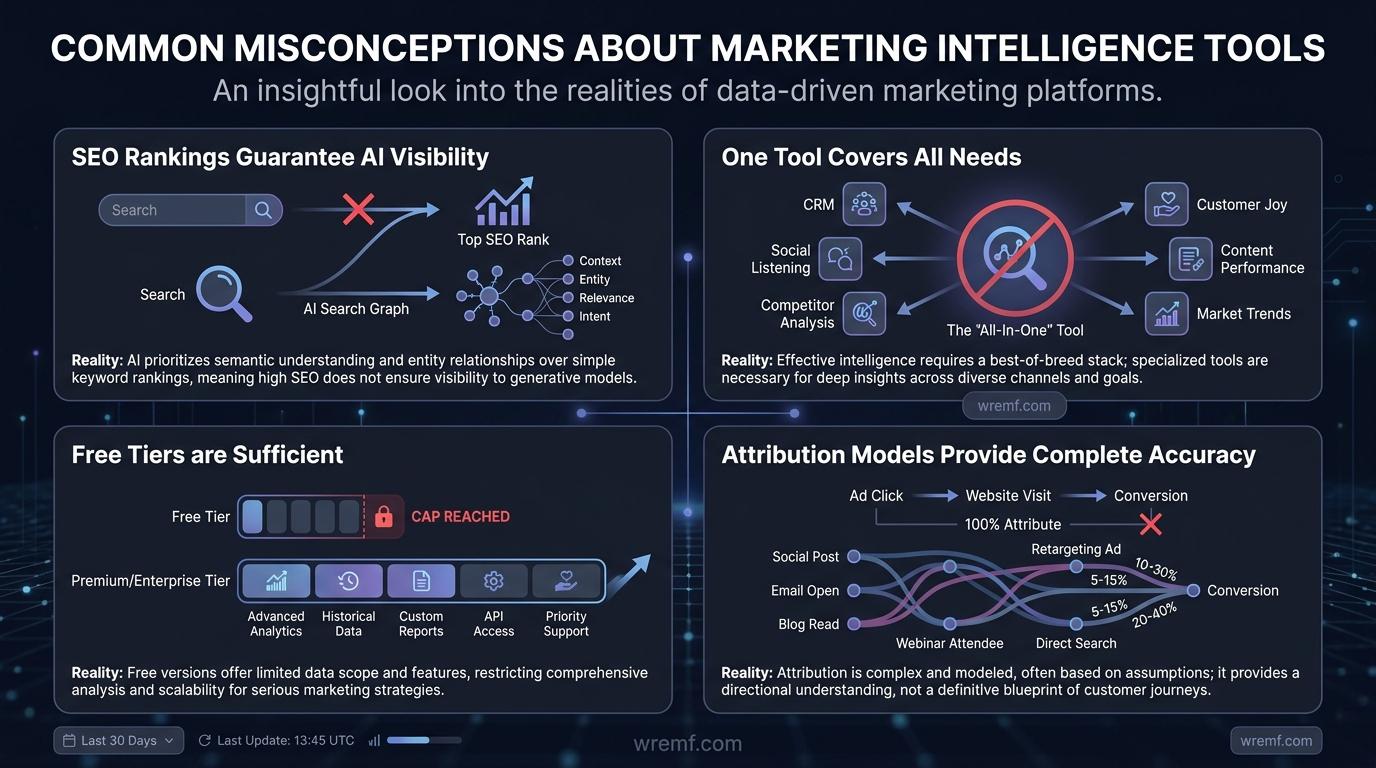
MYTH: If you rank well on Google, your brand will automatically appear in AI-generated answers.
FACT: Google rankings and AI citation frequency are related but not the same thing. AI engines select sources based on authority signals, source consistency, entity clarity, and content structure, not simply search rank position. A brand can rank on page one for competitive keywords and be entirely absent from AI-generated answers in the same category. AI visibility requires dedicated measurement and optimisation separate from traditional SEO. Teams can explore the distinction further in WREMF's AI Overview SEO guide
MYTH: AI visibility cannot be measured because AI answers change constantly.
FACT: AI visibility can be measured systematically through prompt tracking, citation frequency analysis, source consistency monitoring, and AI share of voice measurement across multiple engines. While individual AI answers vary by prompt phrasing, session, and engine, patterns in citation behaviour are measurable and actionable when tracked at scale across standardised prompts. WREMF tracks these patterns across 10 AI engines with unlimited prompt tracking on every plan.
MYTH: A single marketing intelligence platform can cover competitive monitoring, attribution, SEO, social listening, and AI visibility.
FACT: No single platform currently leads across all five intelligence categories. The platforms that dominate competitive monitoring, such as Crayon and Contify, do not cover attribution. Attribution platforms do not cover social listening. SEO tools do not track AI citations. A mature marketing intelligence stack requires purpose-built tools for each category, connected by a clear governance model and a defined measurement-to-action loop.
MYTH: Marketing mix modeling and multi-touch attribution solve the same problem.
FACT: Marketing mix modeling and multi-touch attribution answer different questions and operate at different time scales. Multi-touch attribution assigns credit to individual touchpoints in a buyer's journey and is most useful for campaign-level decisions and budget execution. Marketing mix modeling uses statistical analysis across longer time windows to measure the contribution of channels including those without direct click tracking, such as broadcast media and out-of-home. Most enterprise teams benefit from both, used together to triangulate channel contribution at different levels of granularity.
MYTH: Free tiers of marketing intelligence tools are sufficient for production use.
FACT: Free tiers are acquisition tools, not production-grade intelligence solutions. They typically provide limited data access, reduced query volumes, restricted feature sets, and less frequent data refreshes than paid plans. Teams that rely on free tier data for competitive decisions, attribution analysis, or AI visibility measurement risk acting on unrepresentative or outdated data. The gap between free tier and paid functionality is particularly significant in platforms covering real-time market signals and AI citation tracking.
KEY TAKEAWAY: The most damaging misconceptions about marketing intelligence tools involve assuming that strong performance in one intelligence channel such as SEO rankings automatically translates to strength in adjacent channels such as AI visibility, attribution, or competitive monitoring. Each layer requires its own measurement approach.
Conclusion
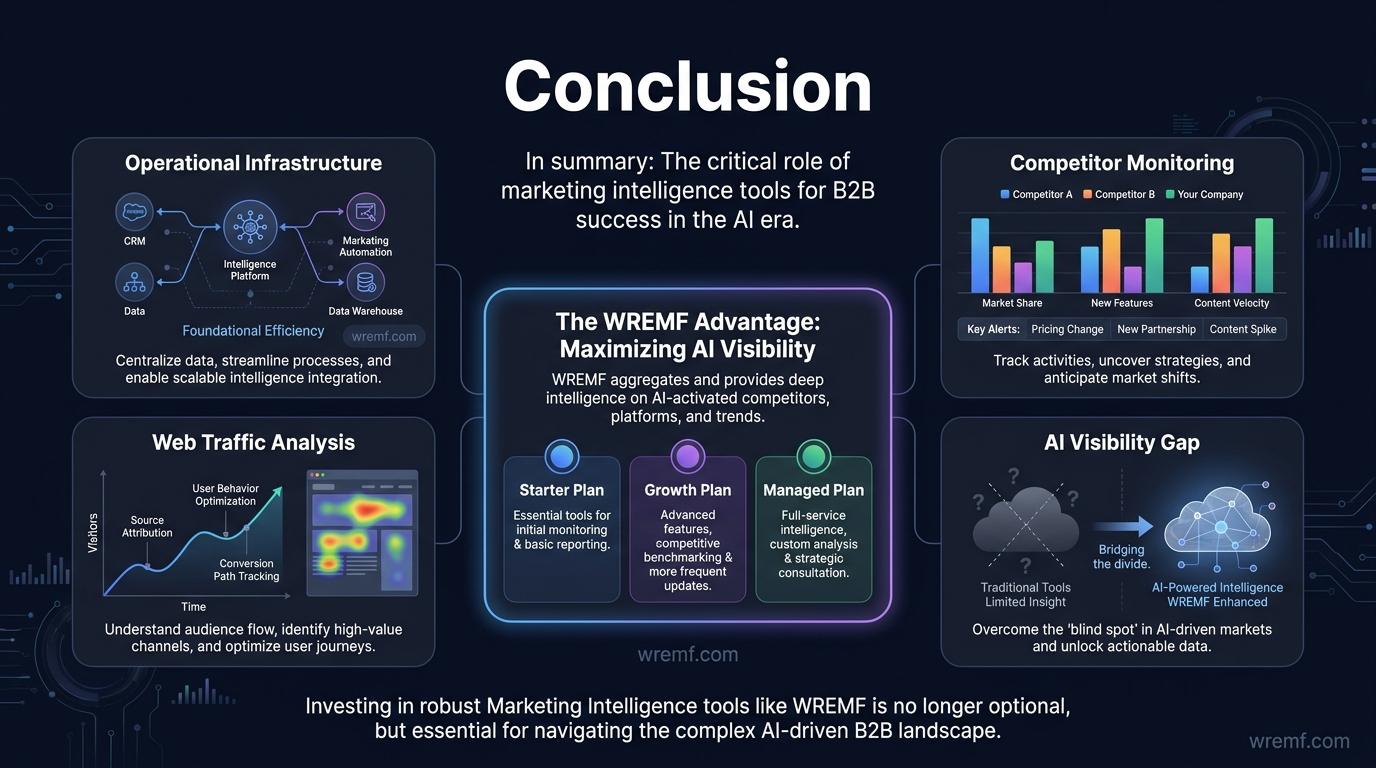
Marketing intelligence tools have become the operational infrastructure of competitive B2B marketing. The ability to monitor competitors with platforms like Crayon, analyse web traffic with Similarweb, track attribution across channels with Improvado or Funnel, research markets with AlphaSense, and listen to customer sentiment with Brandwatch represents a mature intelligence capability. But the fastest-growing gap in most marketing intelligence stacks is the AI visibility layer. Buyers are increasingly discovering and shortlisting vendors through ChatGPT, Gemini, Perplexity, and Google AI Overviews, and most organisations have no systematic way to measure or improve how they appear in those answers. WREMF is built specifically for this layer. Whether you start with the Starter plan to track prompt citations, use the Growth plan for full AI share of voice and attribution reporting, or engage the Managed service for end-to-end strategy and execution, WREMF adds the intelligence capability that traditional marketing tools were not built to provide. Review the full WREMF suite of AI search engine optimization services to understand where AI visibility fits in your intelligence programme.
Frequently Asked Questions About Marketing Intelligence Tools
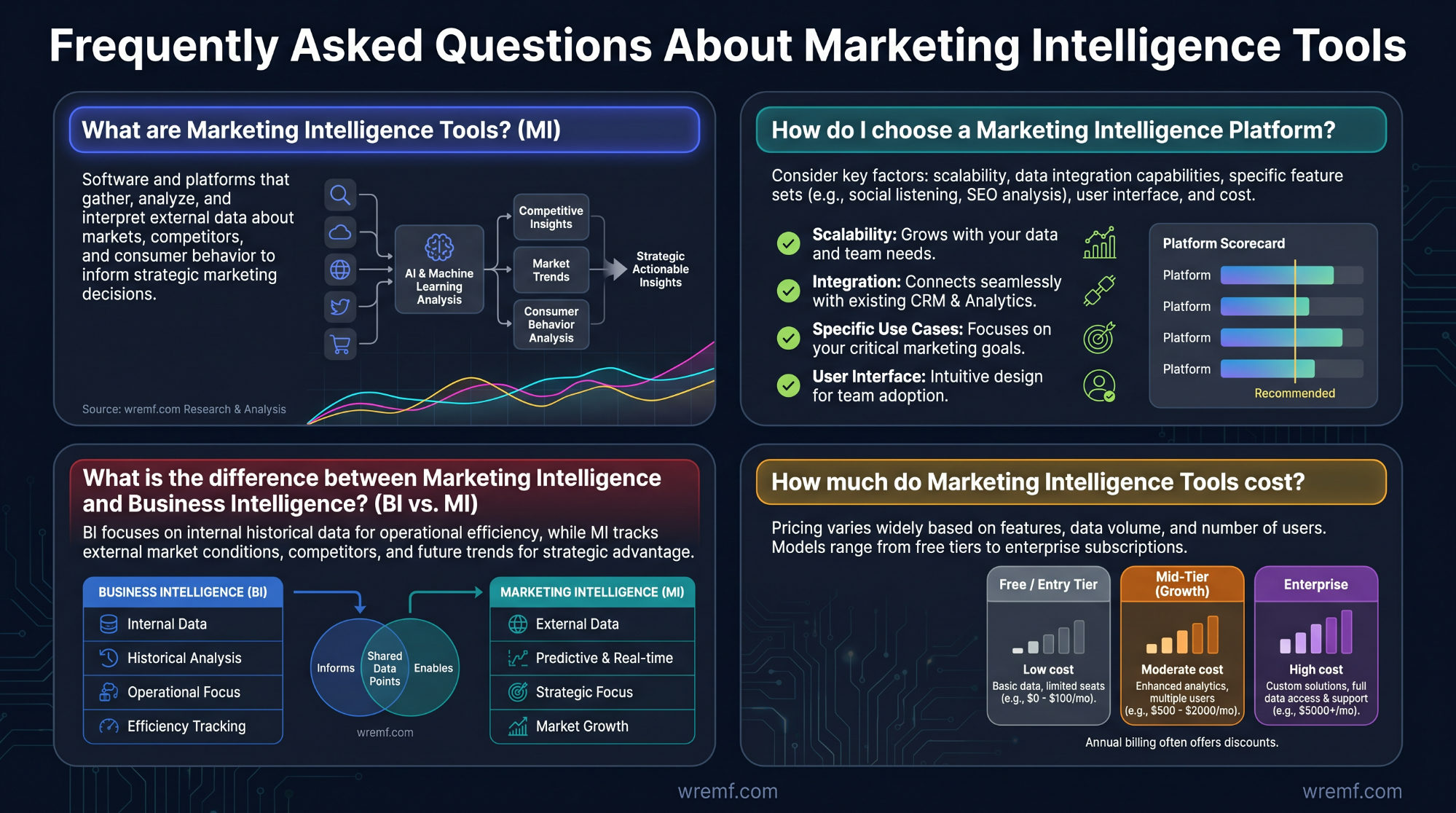
What are marketing intelligence tools?
Marketing intelligence tools are software platforms that collect, analyze, and present data about markets, competitors, customers, and marketing performance to help teams make faster and more informed decisions. They aggregate signals from sources such as web traffic, ad platforms, CRM systems, social listening feeds, search data, and competitor activity into a unified view. Marketing teams use these platforms to identify trends, benchmark performance, adjust strategy, and justify budget decisions. The category spans a wide range of tools, from competitive monitoring platforms and attribution software to campaign intelligence systems and AI-powered analytics dashboards.
What is the difference between marketing intelligence and market intelligence?
Marketing intelligence focuses on data that directly informs marketing execution, including campaign performance, attribution modeling, competitor ad activity, content strategy, and channel optimization. Market intelligence has a broader scope and covers macro-level signals such as industry trends, regulatory changes, funding rounds, product launches, pricing changes, and competitive positioning across an entire market. In practice, many platforms blend both disciplines. A tool like Semrush focuses on marketing intelligence through keyword research and web traffic analysis, while platforms like AlphaSense or PitchBook provide financial and market-level intelligence more relevant to strategic planning than day-to-day campaign decisions.
What is the difference between marketing intelligence and business intelligence?
Marketing intelligence focuses specifically on understanding markets, customers, competitors, and campaign performance to guide marketing and revenue decisions. Business intelligence is a broader discipline that covers operational and financial data across an entire organization, typically surfaced through tools like Tableau, PowerBI, or Looker. A business intelligence platform answers questions such as "How is revenue trending by region?" while a marketing intelligence platform answers questions such as "Which channels are driving pipeline and how are competitors shifting their messaging?" Both categories overlap when marketing data is fed into enterprise BI dashboards, but marketing intelligence tools are purpose-built for marketing workflows and decision-making cadences.
What is a marketing intelligence platform?
A marketing intelligence platform is a system that consolidates data from multiple marketing sources, competitive signals, customer insights, and external market data into a structured workflow for analysis and decision-making. Unlike standalone analytics tools, a marketing intelligence platform typically combines data ingestion, normalization, visualization, and insight generation in one environment. Platforms in this category include multi-touch attribution tools such as Northbeam and Rockerbox, competitive intelligence platforms such as Crayon and Contify, digital marketing intelligence solutions such as Improvado and Adverity, and sales and market intelligence systems such as AlphaSense and PitchBook. The right platform depends on whether the primary need is attribution, competitive analysis, data consolidation, or strategic market research.
What is marketing intelligence used for?
Marketing intelligence is used to improve the quality and speed of decisions across marketing, sales, and strategy functions. Common use cases include tracking competitor messaging, pricing, and product launches; measuring campaign performance and cross-channel attribution; identifying market trends and buyer intent signals; benchmarking web traffic and share of voice against competitors; optimizing budget allocation across ad platforms; and connecting marketing activity to pipeline and revenue. Enterprise marketing teams often use marketing intelligence platforms to consolidate fragmented data from CRM systems, ad platforms, and web analytics into a single source of measurable insight that can be shared with finance and leadership.
What is the difference between a marketing intelligence platform and a BI tool like Looker?
A marketing intelligence platform is designed specifically for marketing workflows, with built-in connectors to ad platforms, CRM systems, SEO tools, and competitive data sources, alongside marketing-specific metrics such as attribution, share of voice, and campaign-level performance. A BI tool like Looker, Tableau, or PowerBI is a general-purpose data visualization and querying environment that can handle any business data but requires significant data engineering work to configure for marketing use cases. Marketing intelligence platforms reduce time-to-insight for marketing teams, while BI tools offer more flexibility for complex, cross-functional reporting. Many organizations use both: a marketing intelligence platform for operational decisions and a BI tool for executive reporting.
What is the difference between marketing intelligence and marketing analytics?
Marketing analytics refers to the measurement and reporting of marketing performance data, such as impressions, clicks, conversions, and revenue from campaigns. Marketing intelligence is a broader discipline that adds competitive context, market signals, customer insight, and strategic framing to that performance data. Analytics tells you what happened. Intelligence explains why it happened and what to do about it. For example, a marketing analytics tool might report that paid search conversion rates dropped. A marketing intelligence platform would combine that with competitor pricing changes, new product launches in the market, and shift in search intent to explain the root cause and suggest a response.
How much do marketing intelligence tools cost?
Marketing intelligence tool pricing varies widely depending on category, data coverage, and user requirements. Entry-level competitive intelligence tools and SEO platforms such as Semrush start from a few hundred dollars per month. Mid-market attribution and data consolidation platforms such as Improvado, Funnel, or Clarisights typically range from $1,000 to $5,000 per month. Enterprise platforms such as AlphaSense, Brandwatch, or Bloomberg Terminal are priced significantly higher and often involve annual contracts with custom pricing. Incrementality and marketing mix modeling platforms such as Measured or Lifesight are typically available from $2,000 per month upward. Most platforms offer free tiers, trials, or demo-first onboarding, and pricing is generally influenced by data volume, user count, feature requirements, and API usage.
How do I choose a marketing intelligence platform?
Choosing a marketing intelligence platform starts with identifying your primary use case. The most important questions to ask are: Is your bottleneck data access or data understanding? Do you need attribution, competitive monitoring, market research, or all three? Does the insight need to become action automatically, or does your team have the capacity to interpret and act on data? Do you need to defend your numbers to finance or leadership? How fast do budget decisions need to happen? Once use cases are clear, evaluate platforms on data quality, refresh cadence, integration with your existing CRM systems and ad platforms, customization options, governance and SOC 2 compliance, and the quality of customer support. Matching platform type to the specific decision you need to make is more important than feature count.
What are the best marketing intelligence tools for e-commerce brands?
E-commerce brands typically need marketing intelligence tools that cover attribution, competitive pricing, channel performance, and customer behavior. Northbeam and Rockerbox are strong options for multi-touch attribution and cross-channel performance visibility. Measured is well-suited to e-commerce brands that need incrementality testing to validate whether ad spend is generating genuine lift or capturing conversions that would have occurred anyway. Similarweb is useful for benchmarking web traffic against competitors. For creative-level attribution and campaign decisions, Cometly and SegmentStream offer ML-driven attribution modeling. The right combination depends on whether the priority is measurement, optimization, or competitive intelligence, and most e-commerce marketing teams benefit from combining two to three complementary tools rather than relying on one platform for everything.
Do I need a marketing intelligence platform if I already use Google Analytics?
Google Analytics provides valuable website and session-level data but does not cover competitive intelligence, cross-channel attribution, market trends, social listening, pricing changes, or multi-touch attribution across paid channels. A marketing intelligence platform fills the gaps that Google Analytics cannot address, including how competitors are shifting messaging, where budget is most effectively deployed, which content strategies are working in your category, and how marketing activity connects to pipeline and revenue. For many B2B teams and digital marketers running campaigns across multiple ad platforms, Google Analytics alone is insufficient for making confident budget and strategy decisions. Whether you need a dedicated platform depends on the complexity of your marketing stack and the speed at which you need to act on competitive and performance signals.
Do I need to hire a data analyst to use a marketing intelligence platform?
Most modern marketing intelligence platforms are designed for use by marketing teams without dedicated data analyst support. Platforms such as Funnel, Clarisights, HockeyStack, and Improvado offer pre-built dashboards, drag-and-drop report builders, and natural language search features that allow marketers to ask questions such as "which blog posts drove enterprise deals last quarter?" and receive visual answers without writing SQL. That said, more complex use cases such as custom attribution modeling, marketing mix modeling, advanced data governance, or enterprise-grade data consolidation may benefit from analyst or data engineering support, particularly when integrating with a BI tool like Looker or PowerBI. The level of technical resource required varies significantly by platform and use case.
What types of data do marketing intelligence tools collect?
Marketing intelligence tools collect data across several categories depending on their focus area. Competitive intelligence platforms such as Crayon and Contify track competitor website changes, pricing changes, product launches, messaging updates, and content strategies. Web traffic and SEO tools such as Semrush, Ahrefs, and Similarweb collect keyword rankings, backlink analysis, and web traffic estimates. Attribution platforms such as Northbeam, Rockerbox, Measured, and SegmentStream collect campaign-level performance data from ad platforms and CRM systems. Social listening tools such as Brandwatch monitor sentiment analysis and brand mentions across social channels. Financial research platforms such as AlphaSense, PitchBook, and Bloomberg Terminal aggregate SEC filings, funding rounds, earnings data, and Wall Street Insights for enterprise and strategic research.
How do I gather market intelligence effectively?
Effective market intelligence gathering combines internal data sources with external signals. CRM systems are a valuable starting point because they contain customer engagement data, deal history, and buyer behavior patterns. Competitive intelligence platforms automate the monitoring of competitor pricing, messaging, product changes, and hiring plans. Financial databases such as Crunchbase and PitchBook surface funding rounds and investment signals relevant to understanding competitive environment shifts. Social listening tools track sentiment analysis and messaging trends in real time. Review platforms such as G2 provide product intelligence by aggregating customer feedback about competing products. Expert calls and primary research add qualitative depth to quantitative signals. The key is building a systematic process that combines these sources into a workflow rather than checking them ad hoc.
What are the main types of market intelligence?
Market intelligence is typically organized across four domains. Customer intelligence focuses on understanding who you are selling to, including their needs, behaviors, and decision criteria. Competitive intelligence covers the process of capturing, analyzing, and activating information about competitors, including their messaging, pricing, product launches, and go-to-market strategies. Product intelligence aggregates user and market data to inform product development and improve customer experience. Market intelligence in the broader sense defines the total competitive environment, including market size, regulatory changes, funding activity, and macro trends that affect category dynamics. Most marketing intelligence platforms focus on one or two of these domains, which is why many organizations combine tools to achieve complete coverage.
What is incrementality testing and which marketing intelligence tools support it?
Incrementality testing measures whether a specific marketing activity generated genuine additional conversions or simply reached customers who would have converted regardless of being exposed to the ad. It answers the question that finance and leadership frequently ask: "Do our ads actually drive revenue, or are we paying for conversions that would have happened anyway?" Tools purpose-built for incrementality testing include Measured, which uses geo holdout experiments and controlled testing to isolate true marketing lift, and SegmentStream, which combines ML attribution with incrementality validation. Northbeam and Rockerbox also offer incrementality modeling features alongside multi-touch attribution. According to McKinsey's AI insights, measurement accuracy is a growing priority for marketing leaders as budget scrutiny increases, making incrementality testing an increasingly critical capability.
What is campaign intelligence and how does it differ from competitive monitoring?
Campaign intelligence focuses on understanding what competitors are planning in terms of paid media, creative strategy, and budget timing, answering the question: "What are competitors planning, and when?" Competitive monitoring tools answer a different question: "What are competitors doing?" in terms of messaging, product changes, pricing, and content strategies. Most marketing intelligence tools address the monitoring question well. Campaign intelligence platforms such as REYO go further by surfacing external market signals that indicate when competitors are increasing ad spend, shifting platforms, or preparing campaign launches. For teams with budgets of $2,000 or more per month in competitive ad markets, understanding competitor timing and intent provides a meaningful strategic advantage beyond standard competitive monitoring.
How quickly can I expect to see ROI from a marketing intelligence tool?
The time to ROI from a marketing intelligence tool depends on the platform type, how quickly the team integrates it into their decision-making workflow, and the quality of data being surfaced. Attribution tools such as Northbeam or Rockerbox can surface actionable insights within the first few weeks once ad platform integrations are live and data begins to normalize. Competitive intelligence tools such as Crayon typically deliver early value within the first month when monitoring is configured and alerts are connected to Slack or MS Teams workflows. Market research and financial intelligence platforms such as AlphaSense take longer to generate ROI because they depend on analyst-level usage and strategic application. The most common cause of delayed ROI is not the tool itself but the absence of a defined workflow for turning insights into decisions.
Can marketing intelligence tools track offline activities like events or direct mail?
Some marketing intelligence platforms support offline channel tracking through manual data uploads, CRM integrations, and conversion sync mechanisms that connect offline events to digital campaign data. Platforms such as Improvado and Adverity can ingest offline data sources alongside digital marketing data to provide a more complete picture of cross-channel performance. Marketing mix modeling tools, which take a top-down statistical approach to attribution, are better suited than multi-touch attribution tools for including offline channels such as events, direct mail, and broadcast advertising in overall budget optimization analysis. Server-side tracking implementations also help reduce the data loss that occurs when direct mail or event-driven activity triggers digital behavior that standard pixel tracking misses.
What is multi-touch attribution and how is it different from marketing mix modeling?
Multi-touch attribution assigns credit for a conversion to individual touchpoints in the customer journey, using rules or machine learning to weight the contribution of each ad, content piece, or channel interaction. It is best suited for digital marketing environments where individual user journeys can be tracked. Marketing mix modeling takes a statistical approach, analyzing aggregate data across all marketing and non-marketing inputs to estimate the contribution of each channel to overall performance. It works well for offline channels and longer measurement windows. Tools such as Northbeam, Rockerbox, and SegmentStream specialize in multi-touch attribution, while Measured uses a combination of geo holdout experiments and marketing mix modeling for incrementality validation. Many enterprise marketing teams use both approaches together to capture individual-level and macro-level insights simultaneously.
What should I look for when evaluating the data quality of a marketing intelligence platform?
When evaluating data quality in a marketing intelligence platform, the most important factors are coverage breadth, refresh cadence, source transparency, and data governance practices. Coverage breadth refers to how many relevant data sources are included and whether gaps exist in your key channels or competitor set. Refresh cadence determines how current the insights are, which matters significantly for competitive monitoring and campaign decisions. Source transparency means the platform clearly explains where data comes from, which is important for building internal trust in reported numbers. Data governance covers how the platform handles data access, permissions, SOC 2 compliance, and integration security. According to Gartner's AI research, poor data quality remains one of the leading barriers to effective AI-powered decision-making in marketing organizations.
What role does AI and machine learning play in marketing intelligence tools?
AI and machine learning are increasingly embedded in marketing intelligence platforms to automate insight generation, improve attribution accuracy, and surface signals that human analysts would miss at scale. Machine learning attribution models in platforms such as SegmentStream, Northbeam, and Cometly use algorithmic weighting to distribute conversion credit more accurately than rule-based models. Generative AI features in platforms such as AlphaSense and Crayon use natural language processing to summarize competitive signals, draft battlecards, and generate smart summaries from large volumes of unstructured data such as earnings calls, SEC filings, and news. AI-powered budget optimization tools automate budget execution decisions based on real-time performance signals. Natural language search interfaces allow marketers to query their data conversationally, reducing dependence on analysts for routine reporting questions.
How do marketing intelligence tools integrate with CRM and ad platforms?
Most marketing intelligence platforms offer native integrations with major CRM systems such as Salesforce (SFDC) and HubSpot, and with major ad platforms including Google Ads, Meta, LinkedIn, and TikTok. Data consolidation platforms such as Funnel, Improvado, Adverity, and Clarisights are specifically built to ingest data from dozens of ad platforms, CRM systems, and analytics tools and normalize it into a unified dataset for reporting and analysis. Attribution tools such as Northbeam and Rockerbox connect directly to ad platforms to receive conversion data and send optimized signals back through conversion sync mechanisms. The depth of integration varies significantly between platforms, and enterprise marketing teams should evaluate API usage limits, integration maintenance requirements, and the availability of server-side tracking support before committing to a platform.
How do marketing intelligence platforms support competitive intelligence workflows?
Marketing intelligence platforms support competitive intelligence by automating the monitoring of competitor signals across websites, ad libraries, review platforms, search rankings, social channels, and financial databases. Platforms such as Crayon track pricing changes, product launches, messaging updates, and content strategies in real time and route alerts through Slack or MS Teams for team-wide visibility. Contify and Klue offer similar competitive monitoring capabilities with customizable watchlists and battlecard generation. Similarweb provides web traffic benchmarking and digital marketing intelligence, including competitor keyword strategies and referral traffic patterns. For enterprise sales intelligence, platforms such as AlphaSense combine SEC filings, funding rounds, expert calls, and Wall Street Insights to give sales and strategy teams a comprehensive view of competitor financial and strategic activity.
Is marketing intelligence software suitable for mid-market B2B teams?
Yes. Many marketing intelligence platforms are designed with mid-market B2B teams in mind, offering scalable pricing, self-serve onboarding, and pre-built integrations that do not require enterprise-level data engineering resources. Mid-market teams typically benefit most from platforms that combine attribution, competitive monitoring, and data consolidation in a single environment rather than purchasing separate enterprise tools for each function. Platforms such as HockeyStack, Clarisights, Funnel, and Crayon are commonly used by mid-market B2B teams. The key evaluation criteria for mid-market buyers are ease of integration with existing CRM and ad platform stacks, quality of customer support, customization flexibility, and whether the platform can scale as data volume and team size grow without requiring a significant increase in technical resource investment.
How can marketing teams use marketing intelligence to improve AI search visibility?
Marketing intelligence data can directly inform AI search visibility strategy by identifying the prompts, topics, and questions that buyers use when researching solutions in your category. Understanding how competitors are mentioned in AI-generated answers, which sources are being cited by AI engines, and where your brand appears across platforms such as ChatGPT, Gemini, and Perplexity requires a purpose-built AI visibility layer on top of traditional marketing intelligence workflows. Teams that combine competitive marketing intelligence with AI visibility tracking are better positioned to identify content gaps, strengthen entity authority, and improve their brand's presence in AI-driven discovery. According to Google's AI Overviews documentation, authoritative, well-structured content that directly answers user queries is central to inclusion in AI-generated search responses.
What are buyer intent signals and how do marketing intelligence tools use them?
Buyer intent signals are behavioral indicators that suggest a prospect is actively researching a purchase decision. These signals include search queries, content consumption patterns, review platform activity, third-party website visits, and engagement with competitor content. Marketing intelligence platforms that incorporate intent data, such as those integrating with Bombora or G2 Buyer Intent, surface these signals within CRM and campaign workflows so that sales and marketing teams can prioritize outreach and adjust messaging based on where prospects are in their decision process. Intent signals are particularly valuable for B2B teams operating with long sales cycles because they indicate when an account has entered an active research phase, enabling faster and more relevant engagement before competitors establish preference. The dark funnel, which includes research activity that does not generate trackable clicks, makes intent signal aggregation an increasingly important capability in B2B marketing intelligence.
When should I use software alone versus hiring an AI visibility agency?
Software-only AI visibility platforms are best suited for teams with strong internal execution resources that can interpret data, develop content strategies, and implement technical recommendations independently. An AI visibility agency is more appropriate when a team lacks the time, expertise, or resources to act on what the software surfaces. A hybrid model, combining platform access with managed execution, is the most practical option for organizations that want both visibility measurement and ongoing optimization support without building a dedicated in-house function. WREMF operates as both an AI visibility software platform and a senior-led agency, allowing teams to choose the level of support that matches their internal capability and budget, from self-serve tracking through to fully managed GEO, AEO, and citation optimization execution.
Related reading
- Best AI Search Visibility Platforms: Playbook for B2B Teams
- The Complete Guide to Keyword Gap Analysis for SEO, Content Strategy, and Competitive Intelligence
- AI Overviews Tracker: The Complete Guide to Monitoring Google AI Overviews, Citations, and AI Search Visibility
- Enterprise AI Visibility Platform: The Complete Guide for B2B Brands